EP1589737A1 - Procédé pour enregistrer un message audio et serveur de messagerie vocale associé - Google Patents
Procédé pour enregistrer un message audio et serveur de messagerie vocale associé Download PDFInfo
- Publication number
- EP1589737A1 EP1589737A1 EP04010732A EP04010732A EP1589737A1 EP 1589737 A1 EP1589737 A1 EP 1589737A1 EP 04010732 A EP04010732 A EP 04010732A EP 04010732 A EP04010732 A EP 04010732A EP 1589737 A1 EP1589737 A1 EP 1589737A1
- Authority
- EP
- European Patent Office
- Prior art keywords
- message
- server
- audio
- terminal
- component
- Prior art date
- Legal status (The legal status is an assumption and is not a legal conclusion. Google has not performed a legal analysis and makes no representation as to the accuracy of the status listed.)
- Withdrawn
Links
- 238000000034 method Methods 0.000 title claims abstract description 29
- 238000004891 communication Methods 0.000 claims abstract description 30
- 238000012217 deletion Methods 0.000 claims description 2
- 230000037430 deletion Effects 0.000 claims description 2
- 239000011295 pitch Substances 0.000 claims 1
- 230000001131 transforming effect Effects 0.000 claims 1
- 238000009792 diffusion process Methods 0.000 description 2
- 238000012986 modification Methods 0.000 description 2
- 230000004048 modification Effects 0.000 description 2
- 230000001413 cellular effect Effects 0.000 description 1
- 239000002131 composite material Substances 0.000 description 1
- 238000010586 diagram Methods 0.000 description 1
- 239000000203 mixture Substances 0.000 description 1
- 238000004088 simulation Methods 0.000 description 1
- 230000001629 suppression Effects 0.000 description 1
- 238000012360 testing method Methods 0.000 description 1
Images
Classifications
-
- H—ELECTRICITY
- H04—ELECTRIC COMMUNICATION TECHNIQUE
- H04M—TELEPHONIC COMMUNICATION
- H04M3/00—Automatic or semi-automatic exchanges
- H04M3/42—Systems providing special services or facilities to subscribers
- H04M3/50—Centralised arrangements for answering calls; Centralised arrangements for recording messages for absent or busy subscribers ; Centralised arrangements for recording messages
- H04M3/53—Centralised arrangements for recording incoming messages, i.e. mailbox systems
- H04M3/533—Voice mail systems
- H04M3/53366—Message disposing or creating aspects
-
- H—ELECTRICITY
- H04—ELECTRIC COMMUNICATION TECHNIQUE
- H04M—TELEPHONIC COMMUNICATION
- H04M3/00—Automatic or semi-automatic exchanges
- H04M3/42—Systems providing special services or facilities to subscribers
- H04M3/50—Centralised arrangements for answering calls; Centralised arrangements for recording messages for absent or busy subscribers ; Centralised arrangements for recording messages
- H04M3/53—Centralised arrangements for recording incoming messages, i.e. mailbox systems
- H04M3/533—Voice mail systems
- H04M3/53366—Message disposing or creating aspects
- H04M3/53383—Message registering commands or announcements; Greetings
Definitions
- the present invention relates to a method for recording an audio message, a method for viewing said audio message and voicemail servers for the implementation of these methods.
- Most fixed or mobile telephony networks offer their users a voicemail service.
- a voicemail server takes the call and invite the caller to leave a message.
- the voice message of the caller is stored in a first database and a pointer, intended to locate the position of the message in this first database, is associated with a profile of the called user, stored in the second database.
- the user called later wishes to view the received message, it calls the server of voicemail and, upon request, listens to the message.
- the sender terminal locally creates a multi-component message with different multimedia elements, consisting for example of audio files, and instructions defining the structure of the message.
- the terminal sender sends the composite message to the server, that is, the instructions on the structure of the message and the files constituting the components of the message, to a voicemail server that stores it.
- the SMV server reads the message structure instructions and broadcasts components to the destination terminal in accordance with these instructions.
- This process recording of audio messages requires the use of a message editor to several components in the sender terminal. It is not possible to register a multi-component message according to the method described in EP 1056267, using a standard sender terminal, that is to say not equipped with a message editor to several components.
- the technical problem of the invention is therefore first of all to enable the recording of multicomponent messages from a standard terminal.
- the present invention therefore proposes to allow the recording of a an audio message with various audio components using a terminal standard.
- each audio component of the message is entered using the transmitter terminal and concomitantly recorded, by the server SMV in real time during a communication session between the server and the transmitting terminal.
- a user can thus record a message having several components intended to be superimposed temporally during their distribution, in other words to be broadcast simultaneously.
- the content of the message can thus be easily enriched by superposition of successive components that can be extremely varied.
- the enriched message may, for example, contain a "spoken" component to which a musical component is then superimposed.
- Several people can also save one after another different components to create a "multi-component" message obtained by superposition of the respective components of the different people.
- the SMV server is provided with means for interpreting the instructions regarding message structure while the SMV server's the invention must simply be able to simultaneously diffuse the different audio components, the timing of which was made at the time of the record.
- a recording step in a profile of the recipient user, located in a second database, of a group of N pointers, associated with the message, the N pointers being respectively intended to locate the positions of the N audio components of the message in the first database.
- the server simultaneously sends the previous audio components to the terminal recorded.
- the user can easily synchronize the durations of the components successively recorded.
- the invention also relates to an SMV voicemail server for the implementation of the previously defined method, associated with a first base of data containing audio message components characterized in that it comprises means for recording an audio message intended for a user, arranged to record N audio components forming the message, in the first base of data, during a communication session between the SMV server and a terminal sending user during which the user's terminal seizes successively the N components to register them with the SMV server.
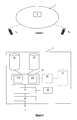
- FIG. 1 shows a communication network, in this case a cellular telephone network 1, a communication terminal T A of a user A, a communication terminal T B of a user B and a communication server. voicemail (SMV) 2 of the telephone network 1.
- the terminals T A and T B are here network 1 cell phones.
- the voicemail server 2 comprises a network connection interface 1, a first "messages” database 21, a second "user” database 22, a communication module 23 terminal / server, an identification module 24 and a module 25 for recording and consultation of messages.
- the SMV server 2 proposes to users, or subscribers, the telephone network 1 a voice mail service allowing them to receive audio messages in a voicemail box and view them later.
- Received messages can be "simple” or "multi-component".
- a "multi-component" message is formed of a plurality of audio components temporally superimposed, whereas a "simple" or ordinary message does not include only one component.
- the first database "messages" 21 is intended to store components of audio messages.
- the second "user" database 22 is intended to store the profiles Voicemail Server Users 2.
- Each User Profile Contains personal identification data of the user and, for each message registered with the SMV server 2 and intended for that user, one or more pointer (s) associated with the message in the "messages" database 21.
- a single pointer intended to locate the position of the message itself in the database "messages” 21, is associated with the profile of the user.
- a group of N pointers respectively for locating the positions of the N components of the message in the first database "messages" 21, is associated with the profile of the user.
- the commands and queries sent by a terminal to the SMV server 2 consist of codes DTMF generated by pressing keys on the terminal.
- the identification module 24, connected to the communication module server / terminal 23, is intended to identify a user accessing the service of voicemail and wishing, for example, to consult a message or to modify its profile. This module 24 is connected to the server / terminal communication module 23.
- the message recording and consultation module 25 includes a block 250 for recording messages and a block 251 for viewing messages.
- the record block 250 is arranged to record messages in the database "messages" 21.
- the block record 250 records the message, in the case of a single message, or the N components of the message, in the case of a multi-component message, in the first database "messages" 21 and, at the same time, stores the pointer, or the group of N pointers, associated with the message in the second database 22.
- the N pointers are respectively for locating the positions of the N audio components in the first database 21.
- the record block 250 is also arranged to delete, totally or partially, the messages in the database "messages” 21 and, in parallel, the pointers, or groups of pointers, corresponding in the "users" database 22.
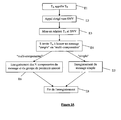
- a step E1 the terminal T A calls the terminal T B.
- the call of the terminal T A is directed to the voice mail server SMV 2 (step E2) and, in a step E3, the terminal T A is connected to the server SMV 2.
- the SMV server 2 invites the user A to leave either a "simple" message or a "multi-component" message for the user B.
- step E5 If user A chooses to leave a simple message, he records his message to the SMV server 2, in a known manner.
- the SMV server 2 stores the message in the "messages" database 21 (step E5) and, at the same time, a pointer to locate the position of this message in the database "messages” 21, in the profile of user B located in the database "users" 22.
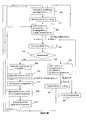
- the SMV server 2 When option a) is selected, the SMV server 2 simultaneously sends the n previously recorded audio components C n , C n-1 ,..., C 1 to the terminal T A in a step E63 in order to allow the user A to listen to the temporary message formed by the components previously recorded and temporally superimposed.
- the SMV server 2 After the listening step E63, the SMV server 2 performs a test to determine if the terminal T A wishes to modify one of the previous registered components (step E64).
- the terminal T A If, after having listened to the previous registered components, the terminal T A wishes to modify one of them, it sends to the server SMV 2 a request for modification, here by pressing the "*" key.
- the SMV server 2 invites the terminal T A to indicate the index of the component that it wishes to modify (step E65).
- the terminal T A By pressing the key of the terminal T A bearing the number of the index of the component to be modified, the terminal T A indicates to the server SMV 2 the component to be modified (step E66).
- the SMV server 2 then broadcasts this component (step E67) and, during this broadcast, the terminal T A indicates to the server SMV 2 the beginning and the end of a part of the component to be deleted, here by pressing the "# "(step E68).
- the SMV server 2 then deletes the portion of the component as indicated in the "messages" database (step E69). After the deletion step E69, step E62 is repeated.
- step E60 When selecting the option a1), we go to step E60 to record the next audio component C n + 1 .
- the SMV server 2 When selecting the option a2), the SMV server 2 deletes the audio component C n in the database "messages" and, at the same time, the corresponding pointer p n in the profile of the user B located in the "user" database (step E71).
- step E60 is taken to record the next component C n + 1 .
- step E62 When selecting the option c) in the step E62, one proceeds to the step "end of the recording" E8, during which the communication between the terminal T A and the server SMV 2 is interrupted.
- Each component C n is inputted by the transmitting terminal T A and parallel recorded in the database 21 of the server SMV 2, in real time, during a communication session between the terminal T A and the server SMV 2.
- operation of entering the component using the transmitting terminal T A and recording it in parallel in the database 21 of the server SMV 2, during a communication session between the server and the terminal T A is reiterated for recording each component.
- the SMV server 2 thus successively records the N audio components ⁇ C 1 ,..., C N-1 , C N ⁇ forming the message in the "messages" database 21 and, at the same time, in the user's profile.
- N pointers ⁇ p 1 , ..., p N-1 , p N ⁇ corresponding to locate the respective positions of the N components of the message in the database "messages 21.
- These N pointers ⁇ p 1 , ..., p N-1 , p N ⁇ form a unitary group of pointers associated with the message.
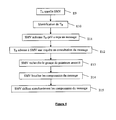
- a step E9 the terminal T B of the user B calls the SMV 2 voicemail server in order to be put in contact with him.
- the SMV server 2 then proceeds, in known manner, to the identification of the terminal T B (step E10).
- the SMV server 2 informs the user B that he has received a message (step E11) and, at the invitation of the SMV server 2, the terminal T B sends him a request to consult the received message (step E12) .
- the server SMV 2 searches in the database "users" 22 the group of pointers ⁇ p 1 , ..., p N-1 , p N ⁇ associated with the message to consult, which is stored in the profile of the user B (step E13).
- the server SMV 2 locates in the database "messages" 21 the N components ⁇ C 1 , ..., C N-1 , C N ⁇ forming the message to consult, using the pointers of the group ⁇ p 1 , ..., p N-1 , p N ⁇ (step E14).
- the SMV server 2 then simultaneously broadcasts the N audio components ⁇ C 1 ,..., C N-1 , C N ⁇ forming the message to the terminal T B in order to allow the user B to listen to it (step E15).
- the voicemail server includes a third database containing sound backgrounds (eg birdsong, the sound of the sea, melodies, etc.).
- sound backgrounds eg birdsong, the sound of the sea, melodies, etc.
- the voicemail server can select a background sound from the set of backgrounds offered by the SMV server 2 to create a background component sound message "Such a feature could be used to create particularly refined audio messages for special events like, for example, a birthday, a birth, etc.
- the voicemail server includes a note height recognition module, arranged to transform a musical component into a musical score by recognizing the heights of notes, as well as different modules of digital simulation of musical instrument arranged to play musical scores by different musical instruments digital.
- a user records a music component, for example in singing
- the server can turn this musical component into a score musical, by recognizing the heights of sung notes.
- An instrument of digital music can then play the musical score to allow the user to listen to it.
- the voicemail server could also be arranged to send the musical score in written form to the terminal, for example by email.
- the voicemail server could also include a database of music data and be arranged to analyze a component music recorded by a user to recognize a piece of music among those stored in the database. In case of recognition of a piece music, the server could create a message audio component from the piece of music thus recognized.
- the recording method of multicomponent audio messages to a voicemail server could also be used to provide a user with a personal voice mailbox service for recording and consulting personal audio messages, for example compositions personal musical notes, personal notes or voice memos.
- the terminal of the sending user would record the N components in a box of personal voicemail of the sending user.
- the different components of a personal message could, in this case, be recorded at different communication sessions between the user's terminal and the mail server the user can thus modify his personal message during these different communication sessions by adding, deleting or modifying the audio components of the message.
- the user could for example record a message, during a first communication session, and then modify this message to adding comments, during a second communication session.
- the invention could apply to any type of communication network, for example example, to a fixed or mobile telephony network, and to any type of terminal that may communicate through this network.
- the databases associated with the server of voicemail could be external to this one.
- a first voicemail server dedicated to the recording of messages
- a second mail server dedicated to the consultation of messages, both connected to external databases.
Landscapes
- Engineering & Computer Science (AREA)
- Signal Processing (AREA)
- Mobile Radio Communication Systems (AREA)
- Telephonic Communication Services (AREA)
Abstract
Description
- à saisir une composante audio de message à l'aide du terminal de l'utilisateur émetteur et
- à enregistrer ladite composante audio dans une première base de données du serveur SMV,
- diffusion de la ou des précédente(s) composante(s) audio enregistrée(s),
- enregistrement de la composante audio suivante ou
- fin de l'enregistrement,
- enregistrement de la composante audio suivante,
- suppression de la dernière composante audio enregistrée et
- fin de l'enregistrement,
- la figure 1 représente une vue schématique du serveur de messagerie vocale et de deux terminaux de communication, reliés à travers un réseau;
- la figure 2 représente un schéma bloc fonctionnel du serveur de messagerie vocale de la figure 1;
- les figures 3A et 3B représentent un organigramme des étapes du procédé pour enregistrer un message et
- la figure 4 représente un organigramme des étapes du procédé pour consulter le message enregistré.
- rechercher dans la base de données "utilisateurs" 22, dans le profil de l'utilisateur considéré, soit un seul pointeur soit un groupe de N pointeurs, selon la nature du message (simple ou multi-composantes), associé au message,
- puis, à l'aide de ce ou ces pointeurs, repérer dans la première base de données "messages" 21 soit la position du message, soit les positions respectives des N composantes du message,
- et enfin envoyer soit le message simple, soit les N composantes audio formant le message, simultanément, vers le terminal de l'utilisateur.
Claims (15)
- Procédé pour enregistrer un message audio destiné à un utilisateur destinataire (B), auprès d'un serveur de messagerie vocale SMV (2), à partir d'un terminal de communication (TA) d'un utilisateur émetteur (A), caractérisé en ce qu'il comprend, lors d'une session de communication entre le terminal (TA) de l'utilisateur émetteur et du serveur SMV (2) à travers un réseau (1), une étape d'enregistrement du message, par le terminal d'utilisateur émetteur (A), auprès du serveur SMV (2), comportant une succession d'opérations consistant chacuneafin d'enregistrer N composantes audio formant le message.à saisir une composante audio de message à l'aide du terminal de l'utilisateur émetteur (A) età enregistrer ladite composante audio dans une première base de données (21) du serveur SMV,
- Procédé selon la revendication 1, caractérisé en ce que, pendant l'enregistrement d'une composante audio, le serveur (2) envoie simultanément vers le terminal de l'utilisateur émetteur (TA) les précédentes composantes audio enregistrées (E60).
- Procédé selon l'une des revendications 1 et 2, caractérisé en ce que, après l'enregistrement de chaque composante audio, le terminal (TA) sélectionne l'une des étapes suivantes (E62):et, le cas échéant, après diffusion de la ou des précédente(s) composante(s) audio enregistrée(s), le terminal (TA) sélectionne l'une des sous-étapes suivantes (E69):diffusion de la ou des précédente(s) composante(s) audio enregistrée(s),enregistrement de la composante audio suivante oufin de l'enregistrement,enregistrement de la composante audio suivante,suppression de la dernière composante audio enregistrée etfin de l'enregistrement.
- Procédé selon l'une des revendications 1 à 3, caractérisé en qu'il comporte une étape de modification de l'une des précédentes composantes audio enregistrées dans laquelle:le serveur (2) diffuse (E67) la composante à modifier vers le terminal (TA) etdurant la diffusion de la composante à modifier, le terminal (TA) indique au serveur (2) le début et la fin d'une partie de ladite composante (E68) afin d'en commander la suppression (E69).
- Procédé selon l'une des revendications 1 à 4, caractérisé en ce que, dans le cas où l'utilisateur enregistre une composante audio musicale, le serveur transforme la composante musicale en une partition musicale, par reconnaissance des hauteurs de notes chantées.
- Procédé selon l'une des revendications 1 à 5, dans lequel le terminal sélectionne un fond sonore parmi un ensemble de fonds sonores proposés par le serveur afin de créer une composante du message.
- Procédé selon l'une des revendications 1 à 6, dans lequel, dans le cas où l'utilisateur enregistre une composante audio musicale, le serveur analyse la composante musicale enregistrée afin de reconnaítre un morceau de musique parmi une pluralité de morceaux de musique stockés dans une base de données et crée une composante de message à partir du morceau de musique reconnu.
- Procédé selon l'une des revendications 1 à 7, dans lequel le terminal enregistre les N composantes audio formant le message lors de différentes sessions de communication avec le serveur.
- Procédé selon l'une des revendications 1 à 8, dans lequel le terminal de l'utilisateur émetteur enregistre les N composantes dans une boíte de messagerie vocale personnelle de l'utilisateur émetteur.
- Procédé selon l'une des revendications 1 à 9, dans lequel il est prévu une étape d'enregistrement (E6), dans un profil de l'utilisateur destinataire (B), situé dans une seconde base de données (22), d'un groupe de N pointeurs, associé au message, les N pointeurs étant destinés respectivement à repérer les positions des N composantes audio du message dans la première base de données (21).
- Serveur de messagerie vocale SMV pour la mise en oeuvre du procédé de la revendication 1, associé à une première base de données (21) contenant des composantes de message audio caractérisé en ce qu'il comprend des moyens (250) d'enregistrement d'un message audio destiné à un utilisateur, agencés pour enregistrer N composantes audio formant le message, dans la première base de données (21), lors d'une session de communication entre le serveur SMV (2) et un terminal d'utilisateur émetteur (TA) durant laquelle le terminal de l'utilisateur émetteur (TA) saisit successivement les N composantes pour les enregistrer auprès du serveur SMV.
- Serveur selon la revendication 11, caractérisé en ce qu'il comprend des moyens (250) pour supprimer l'une des composantes audio d'un message dans la première base de données et le pointeur correspondant dans la seconde base de données.
- Serveur selon l'une des revendications 11 et 12, caractérisé en ce qu'il comprend des moyens de reconnaissance de hauteurs de notes destinés à transformer une composante musicale en une partition musicale.
- Serveur selon l'une des revendications 11 à 13, caractérisé en ce qu'il comprend des moyens de liaison à une base de données de fonds sonores.
- Serveur selon l'une des revendications 11 à 14, dans lequel il est prévu une seconde base de données (22) contenant des profils d'utilisateur et les moyens d'enregistrement d'un message audio sont agencés pour enregistrer, parallèlement à l'enregistrement du message audio, dans le profil de l'utilisateur auquel le message est destiné, un groupe de N pointeurs, associés au message, les N pointeurs étant respectivement destinés à repérer les positions des N composantes audio dans la première base de données (21).
Applications Claiming Priority (2)
| Application Number | Priority Date | Filing Date | Title |
|---|---|---|---|
| FR0304939A FR2854298A1 (fr) | 2003-04-22 | 2003-04-22 | Procede pour enregistrer un message audio, procede pour consulter ledit message audio et serveurs de messagerie vocale pour la mise en oeuvre desdits procedes |
| FR0304939 | 2004-04-22 |
Publications (1)
| Publication Number | Publication Date |
|---|---|
| EP1589737A1 true EP1589737A1 (fr) | 2005-10-26 |
Family
ID=33104316
Family Applications (1)
| Application Number | Title | Priority Date | Filing Date |
|---|---|---|---|
| EP04010732A Withdrawn EP1589737A1 (fr) | 2003-04-22 | 2004-05-06 | Procédé pour enregistrer un message audio et serveur de messagerie vocale associé |
Country Status (2)
| Country | Link |
|---|---|
| EP (1) | EP1589737A1 (fr) |
| FR (1) | FR2854298A1 (fr) |
Citations (2)
| Publication number | Priority date | Publication date | Assignee | Title |
|---|---|---|---|---|
| EP1056267A2 (fr) * | 1999-05-25 | 2000-11-29 | Lucent Technologies Inc. | Messages structures de messagerie vocale |
| US20020110224A1 (en) * | 2001-02-13 | 2002-08-15 | International Business Machines Corporation | Selectable audio and mixed background sound for voice messaging system |
-
2003
- 2003-04-22 FR FR0304939A patent/FR2854298A1/fr active Pending
-
2004
- 2004-05-06 EP EP04010732A patent/EP1589737A1/fr not_active Withdrawn
Patent Citations (2)
| Publication number | Priority date | Publication date | Assignee | Title |
|---|---|---|---|---|
| EP1056267A2 (fr) * | 1999-05-25 | 2000-11-29 | Lucent Technologies Inc. | Messages structures de messagerie vocale |
| US20020110224A1 (en) * | 2001-02-13 | 2002-08-15 | International Business Machines Corporation | Selectable audio and mixed background sound for voice messaging system |
Also Published As
| Publication number | Publication date |
|---|---|
| FR2854298A1 (fr) | 2004-10-29 |
Similar Documents
| Publication | Publication Date | Title |
|---|---|---|
| US8977248B1 (en) | Methods and systems for managing telecommunications and for translating voice messages to text messages | |
| US10110741B1 (en) | Determining and denying call completion based on detection of robocall or telemarketing call | |
| US7613287B1 (en) | Method and apparatus for providing ringback tones | |
| US7369649B2 (en) | System and method for caller initiated voicemail annotation and its transmission over IP/SIP for flexible and efficient voice mail retrieval | |
| US6222909B1 (en) | Audio note taking system and method for communication devices | |
| US7424098B2 (en) | Selectable audio and mixed background sound for voice messaging system | |
| US7761293B2 (en) | Spoken mobile engine | |
| CA2172748C (fr) | Secretaire numerique | |
| US20100161683A1 (en) | Method and System for Event Notifications | |
| US8750466B2 (en) | Voicemail system and method for providing voicemail to text message conversion | |
| JP2008546358A (ja) | カラオケ式リングバック・トーンおよびカラオケ式リングトーンのためのシステムおよび方法 | |
| EP2715724A1 (fr) | Analyse de conversation vocale à l'aide de mots clés | |
| US20110150191A1 (en) | Method and apparatus for call handling | |
| FR2854298A1 (fr) | Procede pour enregistrer un message audio, procede pour consulter ledit message audio et serveurs de messagerie vocale pour la mise en oeuvre desdits procedes | |
| EP3744079B1 (fr) | Procédé et appareil de détection de répondeur | |
| US20070288571A1 (en) | Method and device for the production and distribution of messages directed at a multitude of recipients in a communications network | |
| WO2006067351A1 (fr) | Procede et systeme de mise en relation de personnes dans un reseau de telecommunication de type internet | |
| CN101515972A (zh) | 通信方法、通信设备和通信系统 | |
| MX2007015971A (es) | Un metodo y arreglo para configurar una sesion de comunicacion conmutada en paquetes. | |
| FR2852438A1 (fr) | Systeme de traduction pour audioconference multilingue | |
| RU95206U1 (ru) | Система предоставления услуг в телекоммуникационной сети | |
| CA2323686A1 (fr) | Methodes pour envoyer un message a partir d'un telephone | |
| JP2001318681A (ja) | 音楽配信装置及び音楽配信記録媒体若しくは音楽配信方法 | |
| CN108234783A (zh) | 一种ivr语音播放的方法及装置 | |
| FR2864399A1 (fr) | Procede de diffusion de chansons et systeme pour la pratique du karaoke a distance, notamment par le telephone |
Legal Events
| Date | Code | Title | Description |
|---|---|---|---|
| PUAI | Public reference made under article 153(3) epc to a published international application that has entered the european phase |
Free format text: ORIGINAL CODE: 0009012 |
|
| 17P | Request for examination filed |
Effective date: 20040506 |
|
| AK | Designated contracting states |
Kind code of ref document: A1 Designated state(s): AT BE BG CH CY CZ DE DK EE ES FI FR GB GR HU IE IT LI LU MC NL PL PT RO SE SI SK TR |
|
| AX | Request for extension of the european patent |
Extension state: AL HR LT LV MK |
|
| AKX | Designation fees paid |
Designated state(s): AT BE BG CH CY CZ DE DK EE ES FI FR GB GR HU IE IT LI LU MC NL PL PT RO SE SI SK TR |
|
| RAP1 | Party data changed (applicant data changed or rights of an application transferred) |
Owner name: ORANGE |
|
| GRAP | Despatch of communication of intention to grant a patent |
Free format text: ORIGINAL CODE: EPIDOSNIGR1 |
|
| INTG | Intention to grant announced |
Effective date: 20140224 |
|
| STAA | Information on the status of an ep patent application or granted ep patent |
Free format text: STATUS: THE APPLICATION IS DEEMED TO BE WITHDRAWN |
|
| 18D | Application deemed to be withdrawn |
Effective date: 20140708 |