EP1589693A1 - System und Verfahren zum Aussenden von Konfigurationsdaten von verteilten Geräten - Google Patents
System und Verfahren zum Aussenden von Konfigurationsdaten von verteilten Geräten Download PDFInfo
- Publication number
- EP1589693A1 EP1589693A1 EP05252476A EP05252476A EP1589693A1 EP 1589693 A1 EP1589693 A1 EP 1589693A1 EP 05252476 A EP05252476 A EP 05252476A EP 05252476 A EP05252476 A EP 05252476A EP 1589693 A1 EP1589693 A1 EP 1589693A1
- Authority
- EP
- European Patent Office
- Prior art keywords
- configuration data
- measurement
- distributed devices
- kiosk
- devices
- Prior art date
- Legal status (The legal status is an assumption and is not a legal conclusion. Google has not performed a legal analysis and makes no representation as to the accuracy of the status listed.)
- Withdrawn
Links
- 238000000034 method Methods 0.000 title claims abstract description 16
- 238000005259 measurement Methods 0.000 claims abstract description 60
- 238000004891 communication Methods 0.000 claims description 54
- 230000033001 locomotion Effects 0.000 abstract description 7
- 238000009792 diffusion process Methods 0.000 description 34
- 238000012545 processing Methods 0.000 description 9
- 230000007246 mechanism Effects 0.000 description 6
- 230000001413 cellular effect Effects 0.000 description 3
- 229920001690 polydopamine Polymers 0.000 description 3
- 230000015572 biosynthetic process Effects 0.000 description 2
- 238000005070 sampling Methods 0.000 description 2
- XLYOFNOQVPJJNP-UHFFFAOYSA-N water Substances O XLYOFNOQVPJJNP-UHFFFAOYSA-N 0.000 description 2
- 230000007613 environmental effect Effects 0.000 description 1
- 230000002123 temporal effect Effects 0.000 description 1
Images


Classifications
-
- H—ELECTRICITY
- H04—ELECTRIC COMMUNICATION TECHNIQUE
- H04L—TRANSMISSION OF DIGITAL INFORMATION, e.g. TELEGRAPHIC COMMUNICATION
- H04L41/00—Arrangements for maintenance, administration or management of data switching networks, e.g. of packet switching networks
- H04L41/08—Configuration management of networks or network elements
- H04L41/0803—Configuration setting
- H04L41/0813—Configuration setting characterised by the conditions triggering a change of settings
- H04L41/082—Configuration setting characterised by the conditions triggering a change of settings the condition being updates or upgrades of network functionality
Definitions
- the present invention relates to a measurement/control system and to a method for configuring a set of distributed devices.
- a distributed measurement/control system may include a number of distributed devices that are capable of performing measurement functions and/or control functions. Examples of distributed devices that may be employed in a measurement/control system include a wide variety of sensor devices and a wide variety of actuator devices.
- a distributed device may be configured by providing it with an appropriate set of configuration data.
- a set of configuration data may specify a geographic location, a time, and/or other parameters for performing a measurement and/or control function.
- Prior techniques for providing configuration data to distributed devices may employ direct communication paths to the distributed devices.
- an application controller in a measurement/control system may send configuration data to a set of distributed devices via a data bus or a communication network to which the distributed devices are attached.
- a measurement/control system may employ potentially large numbers of distributed devices for which direct communication is impractical and/or expensive.
- a measurement/control system may employ mobile devices whose locations and movements may only be estimated statistically.
- Techniques are disclosed for diffusing configuration data to distributed devices whose locations and movements vis-a-vis a measurement/control application may only be estimated statistically.
- Examples of distributed devices whose locations and movements may only be estimated statistically include handheld devices and devices mounted on vehicles or other moving platforms.
- a measurement/control system includes a configuration data source that provides a set of configuration data that specifies a measurement/control function, and a set of distributed devices each having means for obtaining the configuration data from the configuration data source and means for diffusing the configuration data among the distributed devices.
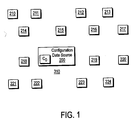
- Figure 1 shows a measurement/control system 310 according to the present teachings.
- the measurement/control system 310 includes a set of distributed devices 210-224 and a configuration data source 200.
- the configuration data source 200 and the distributed devices 210-224 include mechanisms for diffusing a set of configuration data C 0 throughout the measurement/control system 310.
- the distributed devices 210-224 are each capable of performing a measurement/control function in response to the configuration data C 0 .
- the distributed devices 210-224 may include large numbers of mobile devices, e.g. thousands or millions.
- Example embodiments for the distributed devices 210-224 include devices held or worn by individuals, e.g. cell phones, PDAs, portable game and media devices, calculators, etc, as well as vehicle mounted devices, e.g. devices in automobiles, aircraft including drones, water buoys, etc.
- the configuration data C 0 may specify a set of boundaries within which a measurement/control function is to be performed. Given that the movements of the distributed devices 210-224 may be such that their locations may only be estimated statistically, the configuration data source 200 and the distributed devices 210-224 provide mechanisms for diffusing the configuration data C 0 among the distributed devices 210-224 so that, statistically, enough of the distributed devices 210-224 will obtain the configuration data C 0 and perform the desired measurement/control function in light of the boundaries specified in the configuration data C 0 .
- the configuration data C 0 may specify a geographic location at or within which a measurement/control function is to be performed and the configuration data C 0 is diffused so that it is likely that some of the distributed devices 210-224 will move into the specified geographic location and perform the desired measurement/control function in accordance with the configuration data C 0 .
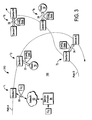
- Figure 2 illustrates an example of the diffusion of the configuration data C 0 into the measurement/control system 310.
- the device A moves along a path A and the device B moves along a path B in a geographic area 100.
- the configuration data C 0 originates with an application server 10.
- the application server 10 may be associated with a measurement/control application in the measurement/control system 310.
- a measurement/control system may include a number of application servers.
- the configuration data source 200 in this embodiment includes a source kiosk 14 that has a direct communication path to the application server 10 via a network 12.
- the application server 10 transfers the configuration data C 0 to the source kiosk 14 via the network 12.
- the measurement/control system 310 may include any number of source kiosks having direct communication with the application server 10.
- the source kiosk 14 obtains the configuration data C 0 via the network 12 at time t 0 and internally stores the configuration data C 0 . Thereafter, the source kiosk 14 passes the configuration data C 0 on to any of the devices A-C that establish a communication channel to the source kiosk 14. For example, at time t 1 the device A establishes a communication channel 20 to the source kiosk 14. The source kiosk 14 in response transfers the configuration data C 0 to the device A via the communication channel 20.
- the device A after obtaining the configuration data C 0 from the source kiosk 14 continues on the path A.
- the device A reaches a diffusion kiosk 16, establishes a communication channel 22 to the diffusion kiosk 16, and then transfers the configuration data C 0 to the diffusion kiosk 16 via the communication channel 22.
- the diffusion kiosk 16 stores the configuration data C 0 internally so that it may provide the configuration data C 0 to other devices that may come into physical proximity with the diffusion kiosk 16.
- the diffusion kiosk 16 may already have a set of configuration data stored internally when the communication channel 22 is established with the device A at time t 2 .
- the diffusion kiosk 16 may have a direct communication path to obtain the configuration data C 0 from the application server 10.
- the diffusion kiosk 16 may have obtained configuration data from another distributed device.
- the diffusion kiosk 16 and the device A may compare their respective internally stored configuration data to determine which to apply.
- Each set of configuration data may include a time-stamp and/or other indicator that may be used to determine its relative staleness in comparison to other configuration data.
- the configuration data C 0 For example, if a time-stamp in the configuration data C 0 is more recent than a time-stamp in the configuration data stored in the diffusion kiosk 16, then the configuration data C 0 supercedes the configuration data stored in the diffusion kiosk 16. On the other hand, if a time-stamp in the configuration data C 0 is specifies an earlier time than a time-stamp in the configuration data stored in the diffusion kiosk 16, then the configuration data C 0 is stale and is superceded by the configuration data stored in the diffusion kiosk 16.
- the device A and the diffusion kiosk 16 may exchange configuration data via the communication channel 22 and then each independently determine which set of configuration data is stale and discard the stale configuration data. Alternatively, the device A and the diffusion kiosk 16 may exchange time-stamps from their internally stored configuration data and cooperatively determine which is stale before transferring the non-stale configuration data via the communication channel 22.
- diffusion kiosk 16 If the configuration data stored internally in the diffusion kiosk 16 supercedes the configuration data C 0 stored in the device A at time t 2 , then diffusion kiosk 16 provides its configuration data to the device A via the communication channel 22. Thereafter, the device A carries its new configuration data and distributes it to other encountered devices or diffusion kiosks that contain no configuration data or stale configuration data.
- the device A If the configuration data C 0 stored in the device A at time t 2 supercedes the configuration data stored internally in the diffusion kiosk 16, then the device A provides the configuration data C 0 to the diffusion kiosk 16 via the communication channel 22 and the diffusion kiosk 16 internally stores it diffuses it thereafter to other distributed devices that come into proximity and that have no configuration data or stale configuration data.
- the device A After encountering the diffusion kiosk 16, the device A proceeds along the path A and encounters the device B which is proceeding along the path B.
- the device A establishes a communication channel 24 with the device B, and then transfers its internally stored configuration data to the device B via the communication channel 24 if it supercedes any configuration data held in the device B.
- the device B On the other hand, if the configuration data in the device A is superceded by the configuration data stored internally in the device B, then the device B provides its configuration data to the device A via the communication channel 24.
- the device B moves along the path B and encounters a diffusion kiosk 18 and at time t 4 establishes a communication channel 26 to the diffusion kiosk 18.
- the device B transfers its internally stored configuration data to the diffusion kiosk 18 if it supercedes any configuration data held in the diffusion kiosk 18 or accepts configuration data from the diffusion kiosk 18 if its own configuration data is superceded by the configuration data stored internally in the diffusion kiosk 18.
- the device B encounters the device C and establishes a communication channel 28 with the device C.
- the device B transfers its configuration data to the device C if it supercedes any configuration data held in the device C or accepts configuration data from the device C if its own configuration data is superceded by the configuration data stored internally in the device C.
- the kiosks 14-18 may be positioned at selected locations within the geographic area 100 depending on the requirements of a particular application. For efficiency, the source kiosk 14 should be appropriately positioned within the geographic area 100.
- the boundaries specified in the configuration data C 0 correspond to a particular city then a placement of the source kiosk 14 in that particular city is appropriate.
- a source kiosk centered in nearby airport may still result in configured devices reaching the particular city but not as efficiently as when a source kiosk is placed in the particular city.
- a source kiosk in an airport would be more efficient for applications that require measurements to be performed in many cities.
- the diffusion efficiency of configuration data from source kiosks is a function of the statistical nature of the paths of the distributed devices that interact with the source kiosk.
- the application server 10 may use communication paths to the distributed devices 210-224 that are associated with the other functions of the distributed devices 210-224.
- the distributed devices 210-224 include mechanisms for accepting configuration data contained in a wide class of communications normally used for other purposes. For example, if the distributed devices 210-224 are capable of CDMA communications then extensions on the CDMA neighbor lists may be used to carry configuration data.
- the configuration data may be co-located with services that are widely used by the distributed devices 210-224.
- an application server may provide downloadable games, information, or other services that increase the likelihood that devices used by a particular type of user would contact a server and cause the distributed device to obtain configuration data along with a downloaded game or other service.
- the technique of co-locating configuration data with a service may be adapted for specific application types. For example, user quality of service measurements may be obtained for an on-line retailer by including the measurement configuration data as part of any contact with the on-line retailer. This technique could be combined with kiosks and the diffusion behavior of the distributed devices themselves for even greater dispersal of configuration data.
- any one or more of the communication channels 20-28 may be embodied as a wireless communication link.
- the communication channels 20-28 may be implemented with protocols that form communication channels on the basis of physical proximity of devices, e.g. cellular, WiFi, Bluetooth, infrared, etc.
- any one or more of the communication channels 20-28 may be a wire link that involves a physical connection between a kiosk and a device or between devices.
- the same device may function as a kiosk and as an application server at different times or may function as both an application server and a kiosk at the same time.
- a robot mail cart for example, or a handheld device, both of which move around while staying within a defined region may be employed as a kiosk.
- Figure 3 illustrates an example of the diffusion of the configuration data C 0 into the measurement/control system 310 in which the configuration data source 200 is co-located with a service provider 94.
- the configuration data source 200 may be co-located with multiple service providers.
- the service provider 94 may be any type of service provider that may be accessed by the users of devices such as cell phones, PDAs, portable game/media devices, etc. Examples include online retailers, cell phone service providers, information services, etc.
- any one or more of the devices A-C may obtain the configuration data C 0 from a service provider at any time when in normal contact.
- the device A may obtain the configuration data C 0 from the service provider 94 at time t 1 when in normal contact with the service provider 94 via a network 92.
- the device A may reach the network 92 via a wireless link 90.
- the service provider 94 may download the configuration data C 0 when downloading other information to the device A, e.g. games, web pages, etc.
- the device A may thereafter diffuse the configuration data C 0 to other encountered devices and kiosks.
- a mechanism for diffusing configuration data according to the present techniques may include any combination of source and/or diffusion kiosks and/or service providers.
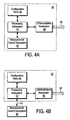
- FIGs 4a-4b illustrates a distributed device 50 that may be configured using the present techniques.
- the distributed device 50 includes a processing subsystem 52, a communication subsystem 54 and a configuration store 58.
- a measurement/control subsystem 56 may be internal to the distributed device 50 as shown in Figure 4a or external to the distributed device 50 as shown in Figure 4b .
- a communication path 62 to the external measurement/control subsystem 56 may be wireless or wire-based.
- the communication subsystem 54 enables the formation of communication channels, e.g. a communication channel 60, with kiosks and other distributed devices.
- the communication channel 60 may be formed on the basis of physical proximity of kiosks or other distributed devices.
- the communication subsystem 54 may provide short-range wireless communication, e.g. cellular, WiFi, Bluetooth, infrared, etc, or wire-based communication.
- the processing subsystem 52 implements code for obtaining and distributing configuration data according to the present techniques.
- the processing subsystem 52 may implement code for exchanging configuration data with encountered kiosk or other devices via short range communication channels and for determining staleness of configuration data, etc.
- the processing subsystem 52 may implement code for obtaining configuration data downloaded from a service provider, e.g. the service provider 94.
- the processing subsystem 52 in the embodiment shown internally stores its configuration data in the configuration store 58.
- the processing subsystem 52 may implement code for employing the measurement/control subsystem 56 in a measurement/control function using the configuration data in the configuration store 58.
- the measurement/control subsystem 56 provides the capability of performing one or more measurement and/or control functions in response to the configuration data in the configuration store 58.
- the distributed device 50 is a wireless telephone, e.g. cell phone
- the measurement/control subsystem 56 may be a circuit for measuring received RF power or for transmitting an RF signal.
- Other examples of measurement functions that may be performed by the measurement/control subsystem 56 include environmental measurements, e.g. pressure, temperature, system measurements, e.g. signal power, response time, message delay, as well as other types of sampling, e.g. images, audio samples, etc.
- Examples of actuator functions that may be performed by the measurement/control subsystem 56 include generating electrical signals, performing physical motions, sending messages, etc.
- the elements of the distributed device 50 shown in Figures 4a-4b may be contained in devices such as cell phones, PDAs, portable game and media devices, calculators etc, as well as automobiles, aircraft including drones, water buoys, etc.
- FIG. 5 illustrates elements of the source kiosk 14 in one embodiment.
- the source kiosk 14 includes a processing subsystem 70, a communication subsystem 72, and a network interface 74, and a configuration store 76
- the processing subsystem 70 implements code for obtaining configuration data from the application server 10 and for diffusing the configuration data to distributed devices according to the present techniques.
- the processing subsystem 70 obtains configuration data from the application server 10 via the network interface 74.
- the network interface 74 may provide communication via the network 12 using Internet protocols.
- the communication subsystem 72 enables the formation of communication channels, e.g. a communication channel 80, with the distributed devices 210-224.
- the communication subsystem 72 may provide wireless communication, e.g. cellular, WiFi, Bluetooth, infrared, etc, or wire-based communication depending on a particular embodiment of the measurement/control system 310.
- the configuration data C 0 includes a specification of a set of boundaries within which a measurement and/or control function is to be performed by a device.
- the boundaries may be spatial boundaries and/or temporal boundaries or may involve a wider set of variables pertaining to an application.
- the distributed device 50 may include mechanisms for measuring or accepting the values pertaining to the specified boundaries and for determining whether or not it is within the specified boundaries.
- the distributed device 50 may include a clock for determining the time and/or a mechanism for determining its geographic location, e.g. a GPS receiver or cell site locator.
- the distributed device 50 may obtain information pertaining to boundaries, e.g. time and/or geographic location from external devices.
- the configuration data C 0 in some embodiments includes a specification of parameters that pertain to measurement, actuation, computation functions, etc. to be formed both within and without the boundaries specified in the configuration data C 0 .
- parameters such as sampling rate or what is to be measured, etc. may vary depending on whether or not the distributed device 50 is within the boundaries specified in the configuration data C 0 .
- the configuration data C 0 in some embodiments includes a specification of what the distributed device 50 is to report both within and without the boundaries specified in the configuration data C 0 . These specifications may be time bounded, i.e. defined to hold over finite times.
Landscapes
- Engineering & Computer Science (AREA)
- Computer Networks & Wireless Communication (AREA)
- Signal Processing (AREA)
- Arrangements For Transmission Of Measured Signals (AREA)
- Mobile Radio Communication Systems (AREA)
- Telephonic Communication Services (AREA)
Applications Claiming Priority (2)
| Application Number | Priority Date | Filing Date | Title |
|---|---|---|---|
| US10/829,091 US20050267957A1 (en) | 2004-04-20 | 2004-04-20 | Diffusing configuration data to distributed devices |
| US829091 | 2004-04-20 |
Publications (1)
| Publication Number | Publication Date |
|---|---|
| EP1589693A1 true EP1589693A1 (de) | 2005-10-26 |
Family
ID=34940945
Family Applications (1)
| Application Number | Title | Priority Date | Filing Date |
|---|---|---|---|
| EP05252476A Withdrawn EP1589693A1 (de) | 2004-04-20 | 2005-04-20 | System und Verfahren zum Aussenden von Konfigurationsdaten von verteilten Geräten |
Country Status (2)
| Country | Link |
|---|---|
| US (1) | US20050267957A1 (de) |
| EP (1) | EP1589693A1 (de) |
Families Citing this family (1)
| Publication number | Priority date | Publication date | Assignee | Title |
|---|---|---|---|---|
| US8914018B2 (en) * | 2006-04-03 | 2014-12-16 | Keysight Technologies, Inc. | System and method for measuring user behavior and use of mobile equipment |
Citations (2)
| Publication number | Priority date | Publication date | Assignee | Title |
|---|---|---|---|---|
| US20010052858A1 (en) * | 2000-06-16 | 2001-12-20 | Schneider Automation | Access system to an item of automatic control equipment via a wireless proximity network |
| US20030212802A1 (en) * | 2002-05-09 | 2003-11-13 | Gateway, Inc. | Proximity network encryption and setup |
Family Cites Families (5)
| Publication number | Priority date | Publication date | Assignee | Title |
|---|---|---|---|---|
| GB2360173B (en) * | 2000-03-07 | 2004-04-07 | Hewlett Packard Co | Distributed telemetry method and system |
| EP1133115A3 (de) * | 2000-03-11 | 2003-07-23 | Hewlett-Packard Company | Feststellung von Positionen mittels Mobilgeräte mit geringer Reichweite |
| US6804524B1 (en) * | 2000-11-21 | 2004-10-12 | Openwave Systems Inc. | System and method for the acquisition of automobile traffic data through wireless networks |
| US7315739B2 (en) * | 2002-11-27 | 2008-01-01 | Agilent Technologies, Inc. | Systems and methods for measurement and/or control using mobile probes |
| US7209710B2 (en) * | 2003-10-31 | 2007-04-24 | Agilent Technologies, Inc. | Bandwidth management in a wireless measurement system using statistical processing of measurement data |
-
2004
- 2004-04-20 US US10/829,091 patent/US20050267957A1/en not_active Abandoned
-
2005
- 2005-04-20 EP EP05252476A patent/EP1589693A1/de not_active Withdrawn
Patent Citations (2)
| Publication number | Priority date | Publication date | Assignee | Title |
|---|---|---|---|---|
| US20010052858A1 (en) * | 2000-06-16 | 2001-12-20 | Schneider Automation | Access system to an item of automatic control equipment via a wireless proximity network |
| US20030212802A1 (en) * | 2002-05-09 | 2003-11-13 | Gateway, Inc. | Proximity network encryption and setup |
Non-Patent Citations (1)
| Title |
|---|
| HAARTSEN J: "BLUETOOTH - THE UNIVERSAL RADIO INTERFACE FOR AD HOC, WIRELESS CONNECTIVITY", ON - ERICSSON REVIEW, ERICSSON. STOCKHOLM, SE, no. 3, 1998, pages 110 - 117, XP000783249, ISSN: 0014-0171 * |
Also Published As
| Publication number | Publication date |
|---|---|
| US20050267957A1 (en) | 2005-12-01 |
Similar Documents
| Publication | Publication Date | Title |
|---|---|---|
| US9399292B2 (en) | System, method and robot terminal apparatus for providing robot interaction service utilizing location information of mobile communication terminal | |
| EP1446972B1 (de) | Bereitstellung von positionsinformationen | |
| KR101085633B1 (ko) | 로밍 중인 이동단말기의 위치 서버 선택방법 및 그 장치와그에 의한 이동단말기의 위치 결정 방법 | |
| US8798613B2 (en) | Systems and method for triggering location based voice and/or data communications to or from mobile ratio terminals | |
| US6567661B2 (en) | Distributed telemetry method and system | |
| US8355693B2 (en) | Determining application usage relative to a particular location | |
| US20060099963A1 (en) | Location-based mobile service provision | |
| KR101572745B1 (ko) | 미래의 내비게이션 동작에 대한 예상된 기여도에 기초한 이동국으로의 무선 송신기 얼머낵 정보의 제공 | |
| US20110244837A1 (en) | Mobile communication terminal and function limitation control | |
| US20120120938A1 (en) | Methods and apparatus for resolving wireless signal components | |
| KR20150060840A (ko) | 더 신속한 최초 위치결정 시간을 위한 기술들 | |
| KR20060101790A (ko) | 위치 정보의 제공 | |
| WO2015057746A1 (en) | Method and apparatus for detecting location changes and monitoring assistance data via scanning | |
| TW201026127A (en) | Location determination of mobile device | |
| WO2002062092A1 (en) | A method and a system for finding a partner based on location information in a communication system | |
| KR20070019501A (ko) | Supl을 이용한 위치 측정 시스템 및 방법 | |
| US20060165100A1 (en) | Wireless location privacy | |
| CN102804862B (zh) | 激活基于位置的应用的方法和相应的服务器 | |
| KR100797759B1 (ko) | 이동 단말에서의 자동 위치 등록방법 | |
| EP1763274A1 (de) | Tragbares endgerät und funkqualitäts-display-verfahren, programm und system | |
| CN117121577A (zh) | 一种侧链定位方法及装置、通信系统及存储介质 | |
| KR101115426B1 (ko) | 위치 정보를 이용한 상점 안내 서비스 방법 및 그를 위한gps 이동통신 단말기 | |
| US20050267957A1 (en) | Diffusing configuration data to distributed devices | |
| CN101160986A (zh) | 一种定位移动终端的方法 | |
| KR20040104195A (ko) | 이동 통신 단말기의 위치 정보 제공 방법 |
Legal Events
| Date | Code | Title | Description |
|---|---|---|---|
| PUAI | Public reference made under article 153(3) epc to a published international application that has entered the european phase |
Free format text: ORIGINAL CODE: 0009012 |
|
| AK | Designated contracting states |
Kind code of ref document: A1 Designated state(s): AT BE BG CH CY CZ DE DK EE ES FI FR GB GR HU IE IS IT LI LT LU MC NL PL PT RO SE SI SK TR |
|
| AX | Request for extension of the european patent |
Extension state: AL BA HR LV MK YU |
|
| 17P | Request for examination filed |
Effective date: 20060418 |
|
| AKX | Designation fees paid |
Designated state(s): DE FR GB |
|
| 17Q | First examination report despatched |
Effective date: 20060920 |
|
| RAP1 | Party data changed (applicant data changed or rights of an application transferred) |
Owner name: AGILENT TECHNOLOGIES, INC. |
|
| STAA | Information on the status of an ep patent application or granted ep patent |
Free format text: STATUS: THE APPLICATION IS DEEMED TO BE WITHDRAWN |
|
| 18D | Application deemed to be withdrawn |
Effective date: 20091103 |
|
| R18D | Application deemed to be withdrawn (corrected) |
Effective date: 20091031 |