EP1588612A1 - Method of manufacturing fishing rod - Google Patents
Method of manufacturing fishing rod Download PDFInfo
- Publication number
- EP1588612A1 EP1588612A1 EP04703261A EP04703261A EP1588612A1 EP 1588612 A1 EP1588612 A1 EP 1588612A1 EP 04703261 A EP04703261 A EP 04703261A EP 04703261 A EP04703261 A EP 04703261A EP 1588612 A1 EP1588612 A1 EP 1588612A1
- Authority
- EP
- European Patent Office
- Prior art keywords
- rod
- fishing rod
- prepreg material
- fishing
- bodies
- Prior art date
- Legal status (The legal status is an assumption and is not a legal conclusion. Google has not performed a legal analysis and makes no representation as to the accuracy of the status listed.)
- Withdrawn
Links
Images



Classifications
-
- A—HUMAN NECESSITIES
- A01—AGRICULTURE; FORESTRY; ANIMAL HUSBANDRY; HUNTING; TRAPPING; FISHING
- A01K—ANIMAL HUSBANDRY; AVICULTURE; APICULTURE; PISCICULTURE; FISHING; REARING OR BREEDING ANIMALS, NOT OTHERWISE PROVIDED FOR; NEW BREEDS OF ANIMALS
- A01K87/00—Fishing rods
-
- B—PERFORMING OPERATIONS; TRANSPORTING
- B29—WORKING OF PLASTICS; WORKING OF SUBSTANCES IN A PLASTIC STATE IN GENERAL
- B29C—SHAPING OR JOINING OF PLASTICS; SHAPING OF MATERIAL IN A PLASTIC STATE, NOT OTHERWISE PROVIDED FOR; AFTER-TREATMENT OF THE SHAPED PRODUCTS, e.g. REPAIRING
- B29C70/00—Shaping composites, i.e. plastics material comprising reinforcements, fillers or preformed parts, e.g. inserts
- B29C70/04—Shaping composites, i.e. plastics material comprising reinforcements, fillers or preformed parts, e.g. inserts comprising reinforcements only, e.g. self-reinforcing plastics
- B29C70/28—Shaping operations therefor
- B29C70/30—Shaping by lay-up, i.e. applying fibres, tape or broadsheet on a mould, former or core; Shaping by spray-up, i.e. spraying of fibres on a mould, former or core
-
- B—PERFORMING OPERATIONS; TRANSPORTING
- B29—WORKING OF PLASTICS; WORKING OF SUBSTANCES IN A PLASTIC STATE IN GENERAL
- B29L—INDEXING SCHEME ASSOCIATED WITH SUBCLASS B29C, RELATING TO PARTICULAR ARTICLES
- B29L2031/00—Other particular articles
- B29L2031/70—Agricultural usage or equipment
- B29L2031/7002—Agricultural usage or equipment for fishing
Definitions
- the present invention relates to a method for manufacturing a fishing rod, and more particularly to a method for manufacturing a fishing rod composed of a fiber reinforced resin in which reinforced fiber, such as carbon fiber and glass fiber, is impregnated with a synthetic resin.
- a fiber reinforced resin material for manufacturing a rod body is wound so as to be partially overlaid thereon (for example, see Japanese: unexamined patent application No. 2002-209477, Fig. 2).
- fiber reinforced resin materials with different elasticities are wound on axially different parts (for example, see Japanese unexamined patent application No. H11-289925, Fig. 2).
- a fishing rod composed of a natural material such as natural bamboo
- a natural material such as natural bamboo
- various techniques have been developed to provide a fishing rod that is manufactured from a fiber reinforced resin material and has preferable “characteristics of rod” as mentioned above, they have not yet achieved “characteristics of rod” similar to a fishing rod composed of a natural material that anglers want.
- An object of the present invention is to provide a method that industrially manufactures a fishing rod capable of providing preferable characteristics of rod similar to a fishing rod composed of a natural material. Furthermore, another object of the present invention is to provide a method that can industrially manufacture a fishing rod with arbitrary characteristics of rod.
- the resonance vibration characteristics refer to a resonance frequency and a shape in resonance vibration mode (particularly, the positions of antinode and node).
- the resonance vibration characteristics are specified by the weight distribution and flexural rigidity distribution of fishing rod.
- the present invention have been made on basis the findings, and provide a method for manufacturing a fishing rod with prescribed resonance vibration characteristics by previously specifying any of the primary to third resonance frequencies. Furthermore, the present invention provides a method for manufacturing a fishing rod with prescribed resonance vibration characteristics in additional consideration of flexural rigidity of fishing rod in a fishing rod to be configured. A fishing rod manufactured by specifying its resonance vibration characteristics will exhibit any of the primary to third resonance vibrations at a certain frequency. Additionally, it has prescribed flexural rigidity.
- the "primary to third resonance frequencies” refer to frequencies of a fishing rod measured by the following method.
- a sandwich member sandwiches and secures a fishing rod in the range of 80 mm from the handle-end side end thereof as a fixed ends. The fore side end is left as a free end.
- the fishing rod is maintained in the horizontal direction.
- a vibrator vibrates the fishing rod via this sandwich member (frequency of fishing rod).
- An acceleration sensor senses the acceleration of this vibrator and obtains an input acceleration value (A).
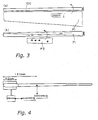
- the acceleration sensor senses the acceleration at the position of 180 mm from the handle-end side end of the fishing rod and obtains the output acceleration value (B) (see Fig. 4).
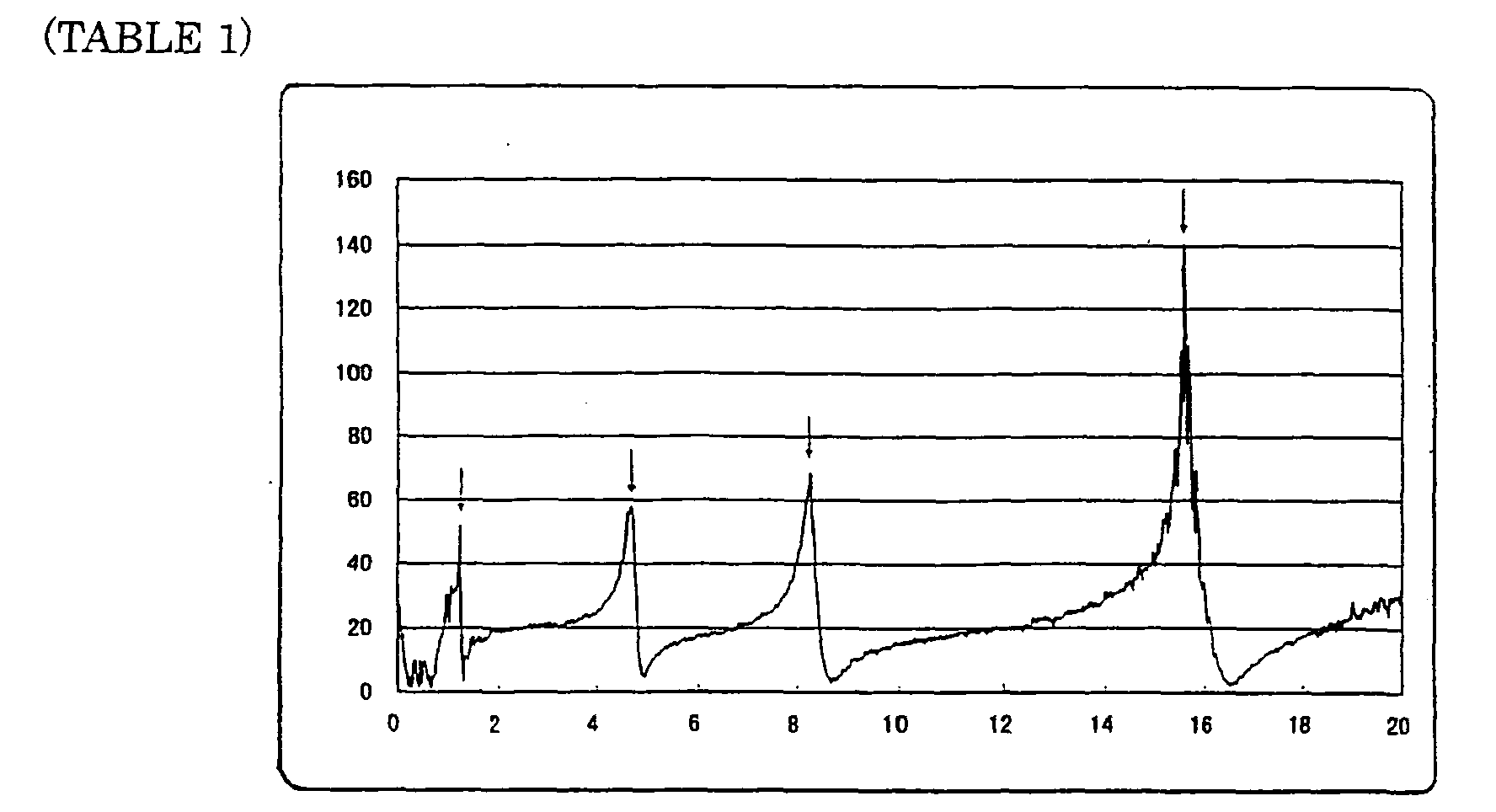
- the ratios of B/A are plotted in coordinates with one axis of the frequency of fishing rod.
- Fig. 5 shows shapes of the primary to third resonance vibration modes of a fishing rod for reference purposes.
- the resonance frequency of a fishing rod with target preferable characteristics of rod is previously measured, thus, a fishing rod to be manufactured is designed so as to have the corresponding resonance vibration characteristics.
- a fishing rod to be manufactured is designed so as to have the corresponding resonance vibration characteristics.
- the weight distribution in each rod body is calculated by simulation based on variation of diameter in the axial direction of the rod body to be configured, length, elasticity of prepreg material, weight, and so on, so that the frequency of the fishing rod in any of the primary to third resonance vibrations (resonance frequency) is a specified frequency (in other words, so that the fishing rod has the prescribed resonance vibration characteristics).
- the target weight distribution is then achieved based on the material arrangement, the specific gravity of material, and so on, to achieve the prescribed resonance characteristics, thus, a fishing rod with preferable "characteristics of rod” is designed.
- a method for manufacturing a fishing rod, of another aspect of the present invention, including a plurality of connected rod bodies comprises steps of calculating weight balance of the rod bodies required for resonance characteristics in the secondary resonance vibration of the fishing rod in the state where the plurality of rod bodies are connected to each other as one fishing rod after specifying the resonance characteristics; and forming the rod bodies that are tubular members composing the fishing rod by burning a prepreg material that is wound around a core member and is adjusted to weight distribution in the axial direction of the prepreg material to achieve the calculated weight balance.
- a method for manufacturing a fishing rod, of still another aspect of the present invention, including a plurality of connected rod bodies comprises steps of calculating weight balance of the rod bodies required for resonance characteristics in the third resonance vibration of the fishing rod in the state where the plurality of rod bodies are connected to each other as one fishing rod after specifying the resonance characteristics; and forming the rod bodies that are tubular members composing the fishing rod by burning a prepreg material that is wound around a core member and is adjusted to weight distribution in the axial direction of the prepreg material to achieve the calculated weight balance.
- the prepreg material may be wound around the core member and adjusted to the weight distribution in the axial direction by partially winding a prepreg material with high specific gravity on or above the outer periphery of the prepreg material.
- the flexural rigidity of a fishing rod with target preferable characteristics of rod is measured by the following method.
- Rod bodies of the fishing rod to be manufactured are designed so as to have prescribed flexural rigidity, thus, the present invention can provide a method for manufacturing a fishing rod with the prescribed resonance vibration characteristics. That is, according to the present invention, it is possible to industrially mass-produce fishing rods with target characteristics of rod.
- the flexural rigidity of a fishing rod varies depending on various factors, such as a material (a fiber reinforced resin, so-called as prepreg material), thickness, taper, and so on, of the rod bodies that compose the fishing rod. Accordingly, variation of diameter in the axial direction of the rod body that composes the fishing rod, length, elasticity of prepreg material (particularly, elasticity of reinforced fiber drawn to be aligned in the axial direction in the prepreg material), and so on, are selected so that the fishing rod has the prescribed flexural rigidity.
- this flexural rigidity of fishing rod has an effect on the aforementioned resonance vibration characteristics, and is a factor that specifies the resonance vibration characteristics. For this reason, the weight distribution in each rod body and additionally the flexural rigidity of the fishing rod are calculated by simulation so that the resonance vibration characteristics of the fishing rod in any of the primary to third resonance vibrations are the specified resonance vibration characteristics. The target weight distribution is then achieved based on the material arrangement, the specific gravity of material, and so on, thus, the fishing rod is designed.
- a method for manufacturing a fishing rod, of one aspect of the present invention, including a plurality of connected rod bodies comprises steps of specifying flexural rigidity by selecting a prepreg material that composes a material, and calculating weight balance of the rod bodies required for resonance characteristics in the primary resonance vibration of the fishing rod in the state where the plurality of rod bodies are connected to each other as one fishing rod after specifying the resonance characteristics; and forming the rod bodies that are tubular members composing the fishing rod by burning the selected prepreg material that is wound around a core member and is adjusted to weight distribution in the axial direction of the prepreg material to achieve the calculated weight balance.
- a method for manufacturing a fishing rod, of another aspect of the present invention, including a plurality of connected rod bodies comprises steps of specifying flexural rigidity by selecting a prepreg material that composes a material, and calculating weight balance of the rod bodies required for resonance characteristics in the secondary resonance vibration of the fishing rod in the state where the plurality of rod bodies are connected to each other as one fishing rod after specifying the resonance characteristics; and forming the rod bodies that are tubular members composing the fishing rod by burning the selected prepreg material that is wound around a core member and is adjusted to weight distribution in the axial direction of the prepreg material to achieve the calculated weight balance.
- a method for manufacturing a fishing rod, of still another aspect of the present invention, including a plurality of connected rod bodies comprises steps of specifying flexural rigidity by selecting a prepreg material that composes a material, and calculating weight balance of the rod bodies required for resonance characteristics in the third resonance frequency of the fishing rod in the state where the plurality of rod bodies are connected to each other as one fishing rod after specifying the resonance characteristics; and forming the rod bodies that are tubular members composing the fishing rod by burning the selected prepreg material that is wound around a core member and is adjusted to weight distribution in the axial direction of the prepreg material to achieve the calculated weight balance.
- a fishing rod in which one embodiment of the present invention is adopted is described.
- the fishing rod is a hera fishing rod used for hera-crucian fishing.
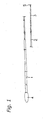
- the fishing rod includes three rod bodies of a base rod 1, an intermediate rod 2, and a fore end rod 3 in order from the handle end side, as shown in Fig. 1.
- These rod bodies are formed by burning a prepreg material reinforced fiber, such as carbon fiber or glass fiber, impregnated with a synthetic resin. As discussed later, prepreg with high specific gravity is partially laminated.
- These rod bodies are coated to have fake natural bamboo appearance. For example, a knot or a branch trace of bamboo can be formed by three-dimensional coating (see Fig. 2).
- the rod bodies are successively connected in a so-called put-over joint manner.
- the handle-end side end of the intermediate rod 2 is partially inserted into the fore side end of the base rod 1, thus they are connected to each other.
- a joint manner for connecting these rod bodies is not limited to a put-over joint.
- known joints for example, telescopic joint, spigot joint, and so on
- a grip 4 formed by winding a tape-shaped material impregnated with a urethane resin, or the like, is provided on the handle-end side end of the base rod 1, while a fishing line interlock 5 is attached to the fore side end of the fore end rod 3.
- the overall length of hera fishing rod is 9 shaku (2700 mm).
- the intermediate rod 2 is described as exemplary example of the structure of rod bodies that compose this hera fishing rod.
- the intermediate rod 2 includes a main layer 11, a weight layer 12 laminated in a certain range in the axial direction as an outer periphery layer of the main layer 11, and a coating layer 13 laminated on or above the outer periphery of these main layer 11 and weight layer 12.
- the main layer 11 is a layer composed of a laminated prepreg material.
- one kind or two different kinds of prepreg material(s) can be laminated.
- tape-shaped and sheet-shaped prepreg materials in which carbon fiber is impregnated with an epoxy resin can be given as the material.
- the carbon fiber is oriented in the circumferential direction or in the direction that extends at a certain angle relative to the circumferential direction.
- the sheet-shaped prepreg material carbon fiber is oriented in the axial direction.
- the weight layer 12 is composed of a prepreg material with high specific gravity.
- the prepreg material with high specific gravity is a material in which glass scrim impregnated with an epoxy resin and metal powder such as tungsten are mixed, for example.
- This prepreg material with high specific gravity has an extent of 500 to 600 g/mm 2 , and of thickness of 0.100 to 0.150 mm.
- This prepreg material with high specific gravity is laminated on the aforementioned main layer 11 in a prescribed axial location calculated as discussed later.
- the coating layer 13 is formed by applying a synthetic resin coating material, such as epoxy resin and urethane resin.
- a synthetic resin coating material such as epoxy resin and urethane resin.
- the stepped difference between the main layer 11 and the weight layer 12 is canceled by this coating layer 13.
- a prepreg material is partially wound and burned, or an epoxy resin is applied thickly, and it is cuts off in a prescribed shape to form a knot of bamboo, and so on.
- other rod bodies have different diameters, and so on, they have similar structure, thus, their description is omitted.
- the resonance vibration characteristics for example, several hera fishing rods with different resonance vibration characteristics are manufactured, and feeling test in which anglers practically use them, thus, values, and so on, in fishing rods that satisfy anglers in terms of the characteristics of rod are adopted. Values of hera fishing rod composed of natural bamboo that satisfies many anglers in terms of characteristics of rod may be adopted as target values.
- the overall length and the resonance frequency of a fishing rod the case where the overall length is 2700 mm and the secondary resonance frequency is set to 5.45 Hz is described, for example.
- the weight balance of a rod body is calculated so that the secondary resonance frequency of the fishing rod is 5.45 Hz when the target base rod 1 to fore end rod 3 are connected to each other as one hera fishing rod. That is, in consideration of target diameters and lengths of base rod 1 to the fore end rod 3, elasticities and weights of a prepreg material and a prepreg material with high specific gravity, and so on, the weight distribution in the rod bodies that provide 5.45 Hz of frequency (resonance frequency) of the fishing rod in the secondary resonance vibration is simulated, then the axial range where the aforementioned prepreg material with high specific gravity should be laminated is calculated for every rod body. In order to simulate such weight distribution, techniques, such as finite element method or link model, can be used.
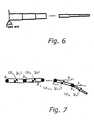
- the fishing rod is modeled by using an elastic cantilever composed of N of one-dimensional cantilever elements that have two degrees of freedom of the translational direction and the rotational direction at node. It is assumed that each cantilever element is uniform inside the element in cross section. Under the boundary condition in the state where one end is an fixed end and the other end is a free end, the resonance frequency and the mode shape corresponding to it are calculated.
- the fishing rod is modeled by using multibody dynamics corresponding to large deformation (geometric nonlinearity).
- the fishing rod is modeled by using a multibody composed of N of rigid body links with rotation spring at node.
- the fishing rod is modeled by using a link model, thus, the posture angle between rigid body links adjacent to each other is not limited. Accordingly, it is possible to express even large deformation.
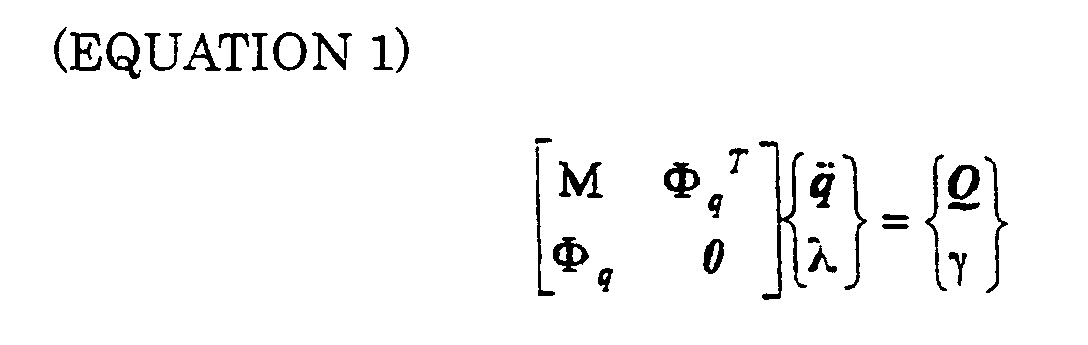
- the equation of motion of the fishing rod can be represented by Equation 1 under the constraint condition.
- a mandrel 100 that corresponds to diameter or taper variation of each rod body is wound with a necessary prepreg material P1 (a tape-shaped or sheet-shaped material can be wound as discussed above), and a prepreg material with high specific gravity P2 is wound around the prescribed axial range that is calculated as discussed above (Fig. 3(b)).
- a prepreg material with high specific gravity P2 is wound around the prescribed axial range that is calculated as discussed above (Fig. 3(b)).
- several plies of the prepreg material with high specific gravity P2 may be wound.
- two or more sheets of prepreg materials with high specific gravity P2 may be wound so as to be spaced from each other in the axial direction.
- rod materials corresponding to the base rod 1 to the fore end rod 3 are produced, respectively. These are burned in a furnace. After burning, each rod material is subjected to polish processing on its outer periphery, and is cut at both ends to have a prescribed axial length. Thus, rod bodies are produced.
- a fishing rod may be adjusted based on the resonance vibration characteristics in the primary or third resonance vibration.
- the primary or third resonance frequency of the target fishing rod is measured, then the weight distribution in each rod body is simulated by using this as a target.
- the axial range where the aforementioned prepreg material with high specific gravity should be laminated is calculated for each rod body.
- a type of fishing rod is not limited to this. Even in the case of a fishing rod other than hera fishing rod, since, generally, the "characteristics of rod" is an important factor in a fishing rod, needless to say, the present invention can be applied to other types of fishing rods. It is very effective to apply the present invention to a fly fishing rod, a lure fishing rod, and so on, for example.
- a second method for manufacturing a hera fishing rod is described.
- This method for manufacturing a fishing rod provides a fishing rod with characteristics of rod that anglers desire.
- fore-side balance characteristics Saki-Choshi
- middle balance characteristics Moto-Choshi
- Dou-Choshi handle-side balance characteristics
- the fore-side balance characteristics refer to characteristics of a fishing rod that has preferable flexibility particularly in its fore side.
- the middle balance characteristics refer to characteristics of a fishing rod that has preferable flexibility particularly in the axial central part.
- the handle-side balance characteristics refer to characteristics of a fishing rod that has preferable flexibility particularly in its handle side.
- the anglers choose hera fishing rods with their favorite characteristics of rod.
- the aforementioned resonance vibration characteristics are specified in additional consideration of the flexural rigidity of fishing rod, thus, a fishing rod with prescribed characteristics of rod is manufactured.
- this manufacturing method is similar to the aforementioned first manufacturing method. That is, similarly to the aforementioned first manufacturing method, in consideration of target diameters and lengths of base rod 1 to the fore end rod 3, elasticities and weights of a prepreg material and a prepreg material with high specific gravity, additionally, the kind of reinforced fiber that is oriented in the axial direction of the prepreg material, the content of the reinforced fiber, and so on, the weight distribution and the flexural rigidity in the rod bodies that provide prescribed values of resonance characteristics of the fishing rod in the primary resonance vibration, or the secondary or third resonance vibration are simulated, then the axial range where the aforementioned prepreg material with high specific gravity should be laminated is calculated for every rod body. In order to simulate such weight distribution, techniques, such as finite element method or link model, can be used.
- the following description describes a method that manufactures a fishing rod particularly in consideration of flexural rigidity index as another manufacturing method.
- flexural rigidity index refers to the numerical value converted from flexural rigidity.
- the “flexural rigidity index” is measured and calculated by the following method.
- Equation 2 This numerical value is calculated by the following Equation 2 in the state where, in a fishing rod composed of a plurality of connected rod bodies, its handle end is secured so that its fore end is directed at an angle of 75° relative to horizontal direction, then the fishing rod is bent by attaching a weight of 200 g to the fore end of the fishing rod.
- a) flexural rigidity indices, b) secondary resonance vibration characteristics, and c) third resonance vibration characteristics were measured. An extent of correlation between these values and the evaluations of the characteristics of fishing rod by the anglers was analyzed. Thus, "Choshi index" that represented the characteristics of fishing rod providing good correlation between the evaluations of the characteristics of fishing rod by the anglers and the aforementioned three factors was obtained.
- Fig. 8 is a graph showing the analysis result that represents the correlation.
- the secondary and third resonance vibration characteristics can be calculated based on the weight balance of rod body, and the flexural rigidity of rod body. That is, similarly to the aforementioned first manufacturing method, in consideration of target diameters and lengths of base rod 1 to the fore end rod 3, elasticities and weights of a prepreg material and a prepreg material with high specific gravity, additionally, the kind of reinforced fiber that is oriented in the axial direction of the prepreg material, the content of the reinforced fiber, and so on, the weight distribution in the rod bodies that provide prescribed values of resonance characteristics of the fishing rod in the secondary and third resonance vibrations is simulated, then the axial range where the aforementioned prepreg material with high specific gravity should be laminated is calculated for every rod body. In order to simulate such weight distribution, techniques, such as finite element method or link model, can be used.
- a fishing rod capable of providing preferable "characteristics of rod” similar to a fishing rod composed of a natural material.
- a relationship between the specific characteristics of each fishing rod and its resonance vibration characteristics is shown for a user who wants to buy a fishing rod, thus, he can buy a fishing rod with the "characteristics of rod” that he requires.
- the user can easily buy a fishing rod with the "characteristics of rod” different from a fishing rod that he already has, or a fishing rod with the "characteristics of rod” similar to a fishing rod that he previously had but was broken.
Landscapes
- Life Sciences & Earth Sciences (AREA)
- Environmental Sciences (AREA)
- Marine Sciences & Fisheries (AREA)
- Animal Husbandry (AREA)
- Biodiversity & Conservation Biology (AREA)
- Chemical & Material Sciences (AREA)
- Engineering & Computer Science (AREA)
- Composite Materials (AREA)
- Mechanical Engineering (AREA)
- Fishing Rods (AREA)
Abstract
Description
Claims (9)
- A method for manufacturing a fishing rod including a plurality of connected rod bodies comprising steps of:calculating weight balance of the rod bodies required for resonance characteristics in the primary resonance vibration of the fishing rod in the state where the plurality of rod bodies are connected to each other as one fishing rod after specifying the resonance characteristics; andforming the rod bodies that are tubular members composing the fishing rod by burning a prepreg material that is wound around a core member and is adjusted to weight distribution in the axial direction of said prepreg material to achieve said calculated weight balance.
- A method for manufacturing a fishing rod including a plurality of connected rod bodies comprising steps of:calculating weight balance of the rod bodies required for resonance characteristics in the secondary resonance vibration of the fishing rod in the state where the plurality of rod bodies are connected to each other as one fishing rod after specifying the resonance characteristics; andforming the rod bodies that are tubular members composing the fishing rod by burning a prepreg material that is wound around a core member and is adjusted to weight distribution in the axial direction of said prepreg material to achieve said calculated weight balance.
- A method for manufacturing a fishing rod including a plurality of connected rod bodies comprising steps of:calculating weight balance of the rod bodies required for resonance characteristics in the third resonance vibration of the fishing rod in the state where the plurality of rod bodies are connected to each other as one fishing rod after specifying the resonance characteristics; andforming the rod bodies that are tubular members composing the fishing rod by burning a prepreg material that is wound around a core member and is adjusted to weight distribution in the axial direction of said prepreg material to achieve said calculated weight balance.
- The method for manufacturing a fishing rod set forth in any of claims 1 to 3, wherein in said step of forming the rod bodies, the prepreg material is wound around the core member and is adjusted to the weight distribution in the axial direction by partially winding a prepreg material with high specific gravity on or above the outer periphery of said prepreg material.
- A method for manufacturing a fishing rod including a plurality of connected rod bodies comprising steps of:specifying flexural rigidity by selecting a prepreg material that composes a material, and calculating weight balance of the rod bodies required for resonance characteristics in the primary resonance vibration of the fishing rod in the state where the plurality of rod bodies are connected to each other as one fishing rod after specifying the resonance characteristics; andforming the rod bodies that are tubular members composing the fishing rod by burning said selected prepreg material that is wound around a core member and is adjusted to weight distribution in the axial direction of said prepreg material to achieve said calculated weight balance.
- A method for manufacturing a fishing rod including a plurality of connected rod bodies comprising steps of:specifying flexural rigidity by selecting a prepreg material that composes a material, and calculating weight balance of the rod bodies required for resonance characteristics in the secondary resonance vibration of the fishing rod in the state where the plurality of rod bodies are connected to each other as one fishing rod after specifying the resonance characteristics; andforming the rod bodies that are tubular members composing the fishing rod by burning said selected prepreg material that is wound around a core member and is adjusted to weight distribution in the axial direction of said prepreg material to achieve said calculated weight balance.
- A method for manufacturing a fishing rod including a plurality of connected rod bodies comprising steps of:specifying flexural rigidity by selecting a prepreg material that composes a material, and calculating weight balance of the rod bodies required for resonance characteristics in the third resonance frequency of the fishing rod in the state where the plurality of rod bodies are connected to each other as one fishing rod after specifying the resonance characteristics; andforming the rod bodies that are tubular members composing the fishing rod by burning said selected prepreg material that is wound around a core member and is adjusted to weight distribution in the axial direction of said prepreg material to achieve said calculated weight balance.
- A method for manufacturing a fishing rod including a plurality of connected rod bodies comprising steps of:selecting a prepreg material that composes a material, and calculating weight balance of the rod bodies required for the fishing rod to have secondary resonance vibration characteristics, third resonance vibration characteristics, and a flexural rigidity index of the fishing rod in the state where the plurality of rod bodies are connected to each other as one fishing rod after specifying said secondary resonance vibration characteristics, third resonance vibration characteristics, and flexural rigidity index of the fishing rod; andforming the rod bodies that are tubular members composing the fishing rod by burning said selected prepreg material that is wound around a core member and is adjusted to weight distribution in the axial direction of said prepreg material to achieve said calculated weight balance.
- Fishing Rod including a plurality of connected rod bodies manufactured according to anyone of claims 1 to 8.
Applications Claiming Priority (3)
| Application Number | Priority Date | Filing Date | Title |
|---|---|---|---|
| PCT/JP2003/000688 WO2004064510A1 (en) | 2003-01-24 | 2003-01-24 | Method of manufacturing fishing rod |
| JP2003000688 | 2003-01-24 | ||
| PCT/JP2004/000373 WO2004064512A1 (en) | 2003-01-24 | 2004-01-19 | Method of manufacturing fishing rod |
Publications (2)
| Publication Number | Publication Date |
|---|---|
| EP1588612A1 true EP1588612A1 (en) | 2005-10-26 |
| EP1588612A4 EP1588612A4 (en) | 2006-07-19 |
Family
ID=32750598
Family Applications (1)
| Application Number | Title | Priority Date | Filing Date |
|---|---|---|---|
| EP04703261A Withdrawn EP1588612A4 (en) | 2003-01-24 | 2004-01-19 | Method of manufacturing fishing rod |
Country Status (7)
| Country | Link |
|---|---|
| EP (1) | EP1588612A4 (en) |
| JP (1) | JP4385023B2 (en) |
| KR (1) | KR100994413B1 (en) |
| CN (1) | CN100407911C (en) |
| AU (2) | AU2003303781A1 (en) |
| TW (1) | TW200415987A (en) |
| WO (2) | WO2004064510A1 (en) |
Families Citing this family (4)
| Publication number | Priority date | Publication date | Assignee | Title |
|---|---|---|---|---|
| JP5517512B2 (en) * | 2009-07-13 | 2014-06-11 | 株式会社シマノ | fishing rod |
| JP2011188751A (en) * | 2010-03-12 | 2011-09-29 | Shimano Inc | Fishing rod |
| JP7198727B2 (en) * | 2019-06-04 | 2023-01-04 | 株式会社シマノ | fishing rod |
| JP7209655B2 (en) * | 2020-02-26 | 2023-01-20 | グローブライド株式会社 | Evaluation method for objective evaluation of fishing rod performance |
Family Cites Families (13)
| Publication number | Priority date | Publication date | Assignee | Title |
|---|---|---|---|---|
| CA1207189A (en) * | 1982-05-12 | 1986-07-08 | Walter Schwab | Rotary pump for blood and other sensitive liquids |
| JP2911062B2 (en) * | 1991-04-19 | 1999-06-23 | ダイワ精工株式会社 | Fishing rod |
| JPH0634459U (en) * | 1992-10-16 | 1994-05-10 | ダイワ精工株式会社 | Fishing rod |
| JPH06125681A (en) * | 1992-10-16 | 1994-05-10 | Daiwa Seiko Inc | Fishing rod |
| US6092324A (en) * | 1995-05-26 | 2000-07-25 | The Orvis Company, Inc. | Damped fishing rod |
| JPH1075688A (en) * | 1996-09-02 | 1998-03-24 | Ryobi Ltd | Laminated pipe such as fishing rod and method of manufacturing the same |
| US5915943A (en) * | 1997-04-24 | 1999-06-29 | Berkley Inc. | Fishing rod with bulge |
| JP3810900B2 (en) * | 1997-08-18 | 2006-08-16 | 藤倉ゴム工業株式会社 | Manufacturing method of hollow pipe |
| DE69931851D1 (en) * | 1998-07-24 | 2006-07-27 | Daiwa Seiko Inc | Solid sports bars |
| JP4079524B2 (en) * | 1998-09-14 | 2008-04-23 | 株式会社シマノ | fishing rod |
| JP2001204305A (en) * | 2000-01-27 | 2001-07-31 | Ryobi Ltd | Fishing rod |
| JP2002058393A (en) * | 2000-08-22 | 2002-02-26 | Mamiya Op Co Ltd | Spatula rods and their constituent spatula rods |
| TW523397B (en) * | 2001-05-02 | 2003-03-11 | Shimano Kk | Fishing rod with plug-in fishing line |
-
2003
- 2003-01-24 WO PCT/JP2003/000688 patent/WO2004064510A1/en not_active Ceased
- 2003-01-24 AU AU2003303781A patent/AU2003303781A1/en not_active Abandoned
-
2004
- 2004-01-19 CN CNB2004800026364A patent/CN100407911C/en not_active Expired - Fee Related
- 2004-01-19 KR KR1020057013057A patent/KR100994413B1/en not_active Expired - Fee Related
- 2004-01-19 WO PCT/JP2004/000373 patent/WO2004064512A1/en not_active Ceased
- 2004-01-19 AU AU2004206163A patent/AU2004206163A1/en not_active Abandoned
- 2004-01-19 EP EP04703261A patent/EP1588612A4/en not_active Withdrawn
- 2004-01-19 JP JP2005508071A patent/JP4385023B2/en not_active Expired - Fee Related
- 2004-01-20 TW TW093101663A patent/TW200415987A/en not_active IP Right Cessation
Also Published As
| Publication number | Publication date |
|---|---|
| JPWO2004064512A1 (en) | 2006-05-18 |
| WO2004064512A1 (en) | 2004-08-05 |
| KR100994413B1 (en) | 2010-11-16 |
| TW200415987A (en) | 2004-09-01 |
| WO2004064510A1 (en) | 2004-08-05 |
| AU2004206163A1 (en) | 2004-08-05 |
| KR20050093831A (en) | 2005-09-23 |
| EP1588612A4 (en) | 2006-07-19 |
| JP4385023B2 (en) | 2009-12-16 |
| TWI299253B (en) | 2008-08-01 |
| AU2004206163A2 (en) | 2004-08-05 |
| AU2003303781A1 (en) | 2004-08-13 |
| CN1741739A (en) | 2006-03-01 |
| CN100407911C (en) | 2008-08-06 |
Similar Documents
| Publication | Publication Date | Title |
|---|---|---|
| JP2014140747A (en) | Tapered isolating element for bat and system therefor | |
| US6354960B1 (en) | Golf club shaft with controllable feel and balance using combination of fiber reinforced plastics and metal-coated fiber-reinforced plastics | |
| EP1591008A1 (en) | Rod body and fishing rod | |
| US10005889B2 (en) | Fishing rod with enhanced tactile response | |
| AU2004206163A1 (en) | Method of manufacturing fishing rod | |
| EP1588611A1 (en) | Fishing rod group | |
| EP1595448A1 (en) | Fishing rod | |
| JPH08126451A (en) | Fishing rod | |
| JP2005027587A (en) | Rod body and fishing rod | |
| KR20050093834A (en) | Fishing rod | |
| JPH06339333A (en) | Tubular element embodying method for embodying tubular elements in thermosetting resin impregnated reinforcing fibers fitted together to form a fishing rod | |
| JP5517512B2 (en) | fishing rod | |
| GB2250412A (en) | Fishing rods | |
| JP2005176653A (en) | Tubular body | |
| JP3130226U (en) | Metal piece that can freely change the center of gravity and weight of the arrow | |
| JP2005160700A (en) | Golf club shaft | |
| JPH10155394A (en) | Fishing rod | |
| JP2005160729A (en) | Golf club shaft |
Legal Events
| Date | Code | Title | Description |
|---|---|---|---|
| PUAI | Public reference made under article 153(3) epc to a published international application that has entered the european phase |
Free format text: ORIGINAL CODE: 0009012 |
|
| 17P | Request for examination filed |
Effective date: 20050725 |
|
| AK | Designated contracting states |
Kind code of ref document: A1 Designated state(s): AT BE BG CH CY CZ DE DK EE ES FI FR GB GR HU IE IT LI LU MC NL PT RO SE SI SK TR |
|
| AX | Request for extension of the european patent |
Extension state: AL LT LV MK |
|
| DAX | Request for extension of the european patent (deleted) | ||
| RBV | Designated contracting states (corrected) |
Designated state(s): DE GB IT |
|
| A4 | Supplementary search report drawn up and despatched |
Effective date: 20060621 |
|
| RAP1 | Party data changed (applicant data changed or rights of an application transferred) |
Owner name: SHIMANO INC. |
|
| 17Q | First examination report despatched |
Effective date: 20061019 |
|
| GRAP | Despatch of communication of intention to grant a patent |
Free format text: ORIGINAL CODE: EPIDOSNIGR1 |
|
| RBV | Designated contracting states (corrected) |
Designated state(s): DE GB IT |
|
| STAA | Information on the status of an ep patent application or granted ep patent |
Free format text: STATUS: THE APPLICATION IS DEEMED TO BE WITHDRAWN |
|
| 18D | Application deemed to be withdrawn |
Effective date: 20080215 |