EP1585348A1 - Videoqualitätsmessung - Google Patents
Videoqualitätsmessung Download PDFInfo
- Publication number
- EP1585348A1 EP1585348A1 EP05252018A EP05252018A EP1585348A1 EP 1585348 A1 EP1585348 A1 EP 1585348A1 EP 05252018 A EP05252018 A EP 05252018A EP 05252018 A EP05252018 A EP 05252018A EP 1585348 A1 EP1585348 A1 EP 1585348A1
- Authority
- EP
- European Patent Office
- Prior art keywords
- processing
- video
- video streams
- video stream
- variables
- Prior art date
- Legal status (The legal status is an assumption and is not a legal conclusion. Google has not performed a legal analysis and makes no representation as to the accuracy of the status listed.)
- Withdrawn
Links
- 238000005259 measurement Methods 0.000 title claims abstract description 22
- 238000012545 processing Methods 0.000 claims abstract description 64
- 238000000034 method Methods 0.000 claims abstract description 20
- 238000004590 computer program Methods 0.000 claims abstract description 3
- 238000012360 testing method Methods 0.000 claims description 23
- 238000013139 quantization Methods 0.000 claims description 9
- 230000005540 biological transmission Effects 0.000 claims description 8
- 230000008569 process Effects 0.000 claims description 7
- 238000012805 post-processing Methods 0.000 claims description 5
- 238000007781 pre-processing Methods 0.000 claims description 4
- 230000006835 compression Effects 0.000 description 5
- 238000007906 compression Methods 0.000 description 5
- 238000000691 measurement method Methods 0.000 description 3
- 230000003247 decreasing effect Effects 0.000 description 2
- 238000010586 diagram Methods 0.000 description 2
- 230000004075 alteration Effects 0.000 description 1
- 238000004458 analytical method Methods 0.000 description 1
- 230000015556 catabolic process Effects 0.000 description 1
- 238000012512 characterization method Methods 0.000 description 1
- 238000004891 communication Methods 0.000 description 1
- 238000006731 degradation reaction Methods 0.000 description 1
- 238000011156 evaluation Methods 0.000 description 1
- 230000004424 eye movement Effects 0.000 description 1
- 230000033001 locomotion Effects 0.000 description 1
- 238000012986 modification Methods 0.000 description 1
- 230000004048 modification Effects 0.000 description 1
- 230000004044 response Effects 0.000 description 1
- 230000007704 transition Effects 0.000 description 1
- 230000000007 visual effect Effects 0.000 description 1
Images
Classifications
-
- H—ELECTRICITY
- H04—ELECTRIC COMMUNICATION TECHNIQUE
- H04N—PICTORIAL COMMUNICATION, e.g. TELEVISION
- H04N17/00—Diagnosis, testing or measuring for television systems or their details
- H04N17/004—Diagnosis, testing or measuring for television systems or their details for digital television systems
Definitions
- the present invention relates to video quality measurement and in particular, but not exclusively, to subjective video quality measurement.
- Video quality measurement is an important requirement for designers and implementers of video communication systems. Quality measurement is especially important for compressed video, since most video compression algorithms are "lossy" and degrade video quality. That is, compression is achieved at the expense of video quality.
- Video quality measurement include: comparing the performance of alternative video compression algorithms; quantifying the bit-rate versus distortion ("rate-distortion") behaviour of a video compression algorithm; and determining levels of acceptable video quality for a particular purpose -for example, broadcast video, videoconferencing or streamed video.
- Video quality measurement methods can be categorised as objective: based on automatic measurement of parameters of the video sequence, or subjective: based on evaluation by one or more human observers.
- Subjective measurements can provide a realistic guide to the video quality perceived by a user.
- obtaining an accurate outcome from subjective tests typically involves many repetitions of a time-consuming test with a large number of test subjects, making the process expensive and difficult to carry out.
- Objective measurements are, in general, straightforward to carry out and are readily repeatable. However, objective measurement techniques developed to date do not correlate well with the results of subjective tests with "real" observers as reported in Zhong, Y., Richardson, I., Sahraie, A. and McGeorge, P., (2003) "Qualitative and quantitative assessment in video compression", 12 th European Conference on Eye Movements. Subjective tests therefore remain essential for the characterisation of visual quality.
- Conventional subjective quality measurement methods typically involve presenting a test subject with one or more video clips. The subject is asked to make a decision about the subjective quality of the test clip or clips, for example, by recording the perceived degradation of the clip compared with a reference video clip.
- a typical test requirement is to determine the optimum choice from a set of alternatives. Examples include choosing versions of the same clip encoded with different CODECs; selecting the optimum strength of a post-processing filter; and choosing the preferred trade-off between frame-rate and image quality for a given bit-rate, from a given set of frame-rate/image quality options.
- a video quality measurement system comprising:
- the processing variable variance means selects from two or more video streams according to the control input.
- the processing variable variance means processes a video stream in real time according to the control input.
- processing variables are one or more of the following:
- the processing variables are both frame-rate and image quality of a video stream encoded at a particular bit-rate.
- the processing variable variance means outputs a result of the video quality measurement system after a preferred one or more processing variables are selected.
- a human test subject controls the processing variable variance means.
- the human test subject may control the processing variable variance means with an input device such as a potentiometer or by means of a software control such as an on-screen slider bar.
- an input device such as a potentiometer
- a software control such as an on-screen slider bar.
- a method of measuring video quality comprising the steps of:
- step (iii) comprises selecting from two or more video streams according to the one or more processing variables.
- step (iii) comprises processing a video stream in real time according to the one or more processing variables.
- processing variables are one or more of the following:
- the processing variables are both frame-rate and image quality of a video stream encoded at a particular bit-rate.
- the method of measuring video quality further comprises the step of outputting a result after a preferred one or more processing variables are selected.
- a human test subject controls varying the one or more processing variables.
- a computer program product directly loadable into the internal memory of a digital computer comprising software code portions for performing the steps of the second aspect of the invention when said product is run on a computer.
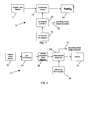
- a video quality measurement system 10 has an original video stream 12 that is processed by a processor 14 to produce a processed video stream for output to a display 16.
- the processor 14 can perform a number of different operations.
- the processor 14 may encode the original video stream 12 according to a particular CODEC standard.
- the processor 14 enables the video stream 12 to be processed in real time before output to the display 16.
- a control 18 allows the alteration of a set of processing variables 20.
- the processor 14 modifies the processed video stream to the display 16 according to the set of processing variables 20.
- the control 18 also allows the video quality measurement system 10 to record the chosen set of processing variables to an output 22.
- control 18 may modify processing variables related to encoding such as frame rate and quantization parameter according to a specified bit-rate.
- a higher frame rate provides a video stream which when viewed has smooth transitions and a generally less "jerky" motion.
- a higher quantization parameter reduces the quality of the image as a larger range of values are included in a particular quantization step.
- the set of processing variables 20 are altered such that if the frame rate is increased the quantization parameter is increased and if the frame rate is decreased the quantization parameter is decreased. Therefore, the processor 14 outputs a processed video stream to the display 16 which uses the bit-rate specified either by having an increased frame rate at the expense of image quality or increased image quality at the expense of frame rate.
- the control 18 may subsequently select a set of processing variables according to a chosen processed video stream for recording to the output 22.
- the control 18 may be operated by an objective system. For example, the control 18 may analyse the decoded video stream from the display 16 and provide a feedback system to the processor 14 through the set of processing variables 20. The control 18 would then halt the system 10 when a steady state situation had been reached.
- a human test subject may operate the control 18 and therefore provide a subjective video quality measurement system.
- the human test subject has selected, according to their subjective judgement, the "optimum" decoded video stream, the preferred set of processing variables are recorded.
- control 18 may record the variation in the set of processing variables 20 throughout the course of a human test subject's operation of the video quality measurement system 10. This allows an insight into the test subject's response to the video clip. For example, an oscillating set of processing variables with respect to time may indicate uncertainty on the part of the test subject.
- FIG.2 an alternative embodiment of a video quality measurement system is shown in which like numerals are used to label systems shown in Fig. 1.
- the video quality measurement system 10 in this embodiment has a pre-processor 24 which generates a plurality of processed video streams from the original video stream 12. Each processed video stream varying from the other processed video streams by a range of predetermined processing variables.
- the plurality of video streams are stored in a video stream store 26.
- One of the processed video streams is outputted to the display 16.
- the control 18 is then enabled to modify a video stream selector 28.
- the video stream selector 28 selects, from the plurality of processed video streams in the video stream store 26, an alternative processed video stream to output to the display 16.
- the alternative processed video stream is selected according to the processing variables used by the pre-processor 24 and the control 18.
- the video stream selector 28 ensures that the position of playback is maintained even though the processed video stream has been changed. This provides display continuity and enables direct comparison from one processed video stream to another. Once a "preferred" processed video stream has been selected the control 18 records the selection at the output 22.
Landscapes
- Engineering & Computer Science (AREA)
- Health & Medical Sciences (AREA)
- Biomedical Technology (AREA)
- General Health & Medical Sciences (AREA)
- Multimedia (AREA)
- Signal Processing (AREA)
- Compression Or Coding Systems Of Tv Signals (AREA)
Applications Claiming Priority (2)
| Application Number | Priority Date | Filing Date | Title |
|---|---|---|---|
| GB0407428 | 2004-04-01 | ||
| GB0407428A GB0407428D0 (en) | 2004-04-01 | 2004-04-01 | Video quality measurement |
Publications (1)
| Publication Number | Publication Date |
|---|---|
| EP1585348A1 true EP1585348A1 (de) | 2005-10-12 |
Family
ID=32247683
Family Applications (1)
| Application Number | Title | Priority Date | Filing Date |
|---|---|---|---|
| EP05252018A Withdrawn EP1585348A1 (de) | 2004-04-01 | 2005-03-31 | Videoqualitätsmessung |
Country Status (2)
| Country | Link |
|---|---|
| EP (1) | EP1585348A1 (de) |
| GB (1) | GB0407428D0 (de) |
Cited By (3)
| Publication number | Priority date | Publication date | Assignee | Title |
|---|---|---|---|---|
| US7929764B2 (en) | 2007-06-15 | 2011-04-19 | Microsoft Corporation | Identifying character information in media content |
| US8189052B1 (en) | 2008-07-29 | 2012-05-29 | Sprint Communications Company L.P. | Method and system for evaluating video processing technology |
| WO2013100960A1 (en) * | 2011-12-28 | 2013-07-04 | Intel Corporation | Method of and apparatus for performing an objective video quality assessment using non-intrusive video frame tracking |
Citations (2)
| Publication number | Priority date | Publication date | Assignee | Title |
|---|---|---|---|---|
| US5684714A (en) * | 1995-05-08 | 1997-11-04 | Kabushiki Kaisha Toshiba | Method and system for a user to manually alter the quality of a previously encoded video sequence |
| EP1069764A2 (de) * | 1999-07-16 | 2001-01-17 | Nec Corporation | Vorrichtung und Verfahren zur Bildqualitätsauswahl, und Aufzeichnungsträger zur Programmabspeicherung dafür |
-
2004
- 2004-04-01 GB GB0407428A patent/GB0407428D0/en not_active Ceased
-
2005
- 2005-03-31 EP EP05252018A patent/EP1585348A1/de not_active Withdrawn
Patent Citations (2)
| Publication number | Priority date | Publication date | Assignee | Title |
|---|---|---|---|---|
| US5684714A (en) * | 1995-05-08 | 1997-11-04 | Kabushiki Kaisha Toshiba | Method and system for a user to manually alter the quality of a previously encoded video sequence |
| EP1069764A2 (de) * | 1999-07-16 | 2001-01-17 | Nec Corporation | Vorrichtung und Verfahren zur Bildqualitätsauswahl, und Aufzeichnungsträger zur Programmabspeicherung dafür |
Non-Patent Citations (2)
| Title |
|---|
| DARIM VISION CO ET AL: "VideoOffice - User's Guide", 6 July 1999 (1999-07-06), XP002215224, Retrieved from the Internet <URL:http://www.darvision.com/ftp/videooffice/vo5ug.pdf> [retrieved on 20020927] * |
| MALLESON H H ET AL: "Optimisation of bit rates, for digitally compressed television services, as functions of acceptable picture quality and picture complexity", AFRICON, 1996., IEEE AFRICON 4TH STELLENBOSCH, SOUTH AFRICA 24-27 SEPT. 1996, NEW YORK, NY, USA,IEEE, US, vol. 2, 24 September 1996 (1996-09-24), pages 592 - 596, XP010207878, ISBN: 0-7803-3019-6 * |
Cited By (4)
| Publication number | Priority date | Publication date | Assignee | Title |
|---|---|---|---|---|
| US7929764B2 (en) | 2007-06-15 | 2011-04-19 | Microsoft Corporation | Identifying character information in media content |
| US8189052B1 (en) | 2008-07-29 | 2012-05-29 | Sprint Communications Company L.P. | Method and system for evaluating video processing technology |
| WO2013100960A1 (en) * | 2011-12-28 | 2013-07-04 | Intel Corporation | Method of and apparatus for performing an objective video quality assessment using non-intrusive video frame tracking |
| US9307188B2 (en) | 2011-12-28 | 2016-04-05 | Intel Corporation | Method of and apparatus for performing an objective video quality assessment using non-intrusive video frame tracking |
Also Published As
| Publication number | Publication date |
|---|---|
| GB0407428D0 (en) | 2004-05-05 |
Similar Documents
| Publication | Publication Date | Title |
|---|---|---|
| Bampis et al. | Towards perceptually optimized adaptive video streaming-a realistic quality of experience database | |
| US12192591B2 (en) | Training an encrypted video stream network scoring system with non-reference video scores | |
| Huynh-Thu et al. | The accuracy of PSNR in predicting video quality for different video scenes and frame rates | |
| Duanmu et al. | A quality-of-experience index for streaming video | |
| Lee et al. | A subjective and objective study of space-time subsampled video quality | |
| Pinson et al. | Temporal video quality model accounting for variable frame delay distortions | |
| Jumisko-Pyykkö et al. | Experienced quality factors: qualitative evaluation approach to audiovisual quality | |
| Leszczuk et al. | Recent developments in visual quality monitoring by key performance indicators | |
| KR20020084172A (ko) | 자동 비디오 품질 평가를 위한 스케일링 가능한 객관적매트릭 | |
| US8243143B2 (en) | Method and apparatus for generation of a video quality parameter | |
| KR20090126316A (ko) | 비디오 품질 평가 방법 및 시스템 | |
| Yao et al. | Bitrate-based no-reference video quality assessment combining the visual perception of video contents | |
| Mozhaeva et al. | Constant subjective quality database: the research and device of generating video sequences of constant quality | |
| Pastrana-Vidal et al. | Predicting subjective video quality from separated spatial and temporal assessment | |
| Keimel et al. | No-reference video quality metric for HDTV based on H. 264/AVC bitstream features | |
| Usman et al. | A novel no-reference metric for estimating the impact of frame freezing artifacts on perceptual quality of streamed videos | |
| Bampis et al. | Measuring and predicting perceptions of video quality across screen sizes with crowdsourcing | |
| Duanmu et al. | Quality-of-experience prediction for streaming video | |
| Ghadiyaram et al. | Subjective and objective quality assessment of mobile videos with in-capture distortions | |
| US20240144453A1 (en) | Methods and systems for automatic video quality evaluation with feature-based selection models | |
| Richardson et al. | Fast subjective video quality measurement with user feedback | |
| Arsenović et al. | Quality of Experience Assessment for HTTP Based Adaptive Video Streaming | |
| Martínez-Rach et al. | On the performance of video quality assessment metrics under different compression and packet loss scenarios | |
| Qi et al. | Bvi-ugc: A video quality database for user-generated content transcoding | |
| Demirbilek et al. | Perceived audiovisual quality modelling based on decison trees, genetic programming and neural networks |
Legal Events
| Date | Code | Title | Description |
|---|---|---|---|
| PUAI | Public reference made under article 153(3) epc to a published international application that has entered the european phase |
Free format text: ORIGINAL CODE: 0009012 |
|
| AK | Designated contracting states |
Kind code of ref document: A1 Designated state(s): AT BE BG CH CY CZ DE DK EE ES FI FR GB GR HU IE IS IT LI LT LU MC NL PL PT RO SE SI SK TR |
|
| AX | Request for extension of the european patent |
Extension state: AL BA HR LV MK YU |
|
| 17P | Request for examination filed |
Effective date: 20060411 |
|
| AKX | Designation fees paid |
Designated state(s): AT BE BG CH CY CZ DE DK EE ES FI FR GB GR HU IE IS IT LI LT LU MC NL PL PT RO SE SI SK TR |
|
| 17Q | First examination report despatched |
Effective date: 20060626 |
|
| RIN1 | Information on inventor provided before grant (corrected) |
Inventor name: KANNANGARA, CHAMINDA SAMPATH Inventor name: RICHARDSON, IAIN E. G. |
|
| STAA | Information on the status of an ep patent application or granted ep patent |
Free format text: STATUS: THE APPLICATION HAS BEEN WITHDRAWN |
|
| 18W | Application withdrawn |
Effective date: 20081015 |