EP1584607A1 - Apatitglaskeramik auf der Basis von silicatischen Oxyapatiten - Google Patents
Apatitglaskeramik auf der Basis von silicatischen Oxyapatiten Download PDFInfo
- Publication number
- EP1584607A1 EP1584607A1 EP05003561A EP05003561A EP1584607A1 EP 1584607 A1 EP1584607 A1 EP 1584607A1 EP 05003561 A EP05003561 A EP 05003561A EP 05003561 A EP05003561 A EP 05003561A EP 1584607 A1 EP1584607 A1 EP 1584607A1
- Authority
- EP
- European Patent Office
- Prior art keywords
- weight
- glass
- apatite
- glass ceramic
- sio
- Prior art date
- Legal status (The legal status is an assumption and is not a legal conclusion. Google has not performed a legal analysis and makes no representation as to the accuracy of the status listed.)
- Granted
Links
Images


Classifications
-
- C—CHEMISTRY; METALLURGY
- C03—GLASS; MINERAL OR SLAG WOOL
- C03C—CHEMICAL COMPOSITION OF GLASSES, GLAZES OR VITREOUS ENAMELS; SURFACE TREATMENT OF GLASS; SURFACE TREATMENT OF FIBRES OR FILAMENTS MADE FROM GLASS, MINERALS OR SLAGS; JOINING GLASS TO GLASS OR OTHER MATERIALS
- C03C10/00—Devitrified glass ceramics, i.e. glass ceramics having a crystalline phase dispersed in a glassy phase and constituting at least 50% by weight of the total composition
- C03C10/0036—Devitrified glass ceramics, i.e. glass ceramics having a crystalline phase dispersed in a glassy phase and constituting at least 50% by weight of the total composition containing SiO2, Al2O3 and a divalent metal oxide as main constituents
-
- A—HUMAN NECESSITIES
- A61—MEDICAL OR VETERINARY SCIENCE; HYGIENE
- A61K—PREPARATIONS FOR MEDICAL, DENTAL OR TOILETRY PURPOSES
- A61K6/00—Preparations for dentistry
- A61K6/80—Preparations for artificial teeth, for filling teeth or for capping teeth
- A61K6/802—Preparations for artificial teeth, for filling teeth or for capping teeth comprising ceramics
- A61K6/807—Preparations for artificial teeth, for filling teeth or for capping teeth comprising ceramics comprising magnesium oxide
-
- A—HUMAN NECESSITIES
- A61—MEDICAL OR VETERINARY SCIENCE; HYGIENE
- A61K—PREPARATIONS FOR MEDICAL, DENTAL OR TOILETRY PURPOSES
- A61K6/00—Preparations for dentistry
- A61K6/80—Preparations for artificial teeth, for filling teeth or for capping teeth
- A61K6/802—Preparations for artificial teeth, for filling teeth or for capping teeth comprising ceramics
- A61K6/816—Preparations for artificial teeth, for filling teeth or for capping teeth comprising ceramics comprising titanium oxide
-
- A—HUMAN NECESSITIES
- A61—MEDICAL OR VETERINARY SCIENCE; HYGIENE
- A61K—PREPARATIONS FOR MEDICAL, DENTAL OR TOILETRY PURPOSES
- A61K6/00—Preparations for dentistry
- A61K6/80—Preparations for artificial teeth, for filling teeth or for capping teeth
- A61K6/802—Preparations for artificial teeth, for filling teeth or for capping teeth comprising ceramics
- A61K6/818—Preparations for artificial teeth, for filling teeth or for capping teeth comprising ceramics comprising zirconium oxide
-
- A—HUMAN NECESSITIES
- A61—MEDICAL OR VETERINARY SCIENCE; HYGIENE
- A61K—PREPARATIONS FOR MEDICAL, DENTAL OR TOILETRY PURPOSES
- A61K6/00—Preparations for dentistry
- A61K6/80—Preparations for artificial teeth, for filling teeth or for capping teeth
- A61K6/802—Preparations for artificial teeth, for filling teeth or for capping teeth comprising ceramics
- A61K6/822—Preparations for artificial teeth, for filling teeth or for capping teeth comprising ceramics comprising rare earth metal oxides
-
- A—HUMAN NECESSITIES
- A61—MEDICAL OR VETERINARY SCIENCE; HYGIENE
- A61K—PREPARATIONS FOR MEDICAL, DENTAL OR TOILETRY PURPOSES
- A61K6/00—Preparations for dentistry
- A61K6/80—Preparations for artificial teeth, for filling teeth or for capping teeth
- A61K6/802—Preparations for artificial teeth, for filling teeth or for capping teeth comprising ceramics
- A61K6/824—Preparations for artificial teeth, for filling teeth or for capping teeth comprising ceramics comprising transition metal oxides
-
- A—HUMAN NECESSITIES
- A61—MEDICAL OR VETERINARY SCIENCE; HYGIENE
- A61K—PREPARATIONS FOR MEDICAL, DENTAL OR TOILETRY PURPOSES
- A61K6/00—Preparations for dentistry
- A61K6/80—Preparations for artificial teeth, for filling teeth or for capping teeth
- A61K6/802—Preparations for artificial teeth, for filling teeth or for capping teeth comprising ceramics
- A61K6/827—Leucite
-
- A—HUMAN NECESSITIES
- A61—MEDICAL OR VETERINARY SCIENCE; HYGIENE
- A61K—PREPARATIONS FOR MEDICAL, DENTAL OR TOILETRY PURPOSES
- A61K6/00—Preparations for dentistry
- A61K6/80—Preparations for artificial teeth, for filling teeth or for capping teeth
- A61K6/831—Preparations for artificial teeth, for filling teeth or for capping teeth comprising non-metallic elements or compounds thereof, e.g. carbon
- A61K6/833—Glass-ceramic composites
-
- A—HUMAN NECESSITIES
- A61—MEDICAL OR VETERINARY SCIENCE; HYGIENE
- A61K—PREPARATIONS FOR MEDICAL, DENTAL OR TOILETRY PURPOSES
- A61K6/00—Preparations for dentistry
- A61K6/80—Preparations for artificial teeth, for filling teeth or for capping teeth
- A61K6/831—Preparations for artificial teeth, for filling teeth or for capping teeth comprising non-metallic elements or compounds thereof, e.g. carbon
- A61K6/838—Phosphorus compounds, e.g. apatite
-
- C—CHEMISTRY; METALLURGY
- C03—GLASS; MINERAL OR SLAG WOOL
- C03C—CHEMICAL COMPOSITION OF GLASSES, GLAZES OR VITREOUS ENAMELS; SURFACE TREATMENT OF GLASS; SURFACE TREATMENT OF FIBRES OR FILAMENTS MADE FROM GLASS, MINERALS OR SLAGS; JOINING GLASS TO GLASS OR OTHER MATERIALS
- C03C4/00—Compositions for glass with special properties
- C03C4/0007—Compositions for glass with special properties for biologically-compatible glass
- C03C4/0021—Compositions for glass with special properties for biologically-compatible glass for dental use
Definitions
- the invention relates to apatite glass ceramics which are crystalline Phase containing silicate oxyapatite. These glass ceramics are suitable due to their physical and chemical properties especially for use in dental technology.
- Apatite is a phosphate-containing mineral with the general formula Ca 10 (PO 4 ) 6 (OH, F, Cl) 2 .
- Hydroxyapatite, Ca 5 (PO 4 ) 3 OH is the major constituent of the enamel of the teeth and the solid substance of the bones, which also contains portions of CO 3 2- .
- z In the scientific literature of crystallography but also, z.
- apatites which are phosphate and fluorine free are described. This is unusual at first, but can be explained by isotypic or even isomorphic relations between phosphates and silicates. These phosphate-free apatites are called silicatic oxyapatites.
- DE 44 23 793 discloses leucite-containing phosphosilicate glass-ceramics, which in addition to a leucite crystal phase at least a further crystal phase and one or more glass phases. Preference is given to glass ceramics which act as a further crystal phase containing phosphate-containing acicular apatite crystals.
- US Pat. No. 5,952,253 discloses transparent glass ceramics which contain apatite crystals as the crystalline phase.
- the glass-ceramics have a relatively high Al 2 O 3 content and less than 20% by volume of apatite crystals. These apatite crystals may contain silicate, but have no oxygen ions in the (OH, F, Cl) position and are therefore not to be designated as silicate oxyapatites.
- the glass-ceramics should be particularly suitable for polarization-sensitive applications, such as magnifying lenses and lasers. They are not suitable for dental applications due to their complete optical transparency.
- DE 103 40 597 relates to translucent, radio-opaque phosphosilicate glass ceramics with improved optical properties, in particular with a specifically adjustable translucency and optical Brightness, the needle-shaped, phosphate-containing apatite crystals and leucite crystals. Both crystal phases arise from a source glass without admixing another glass ceramic composition. These glass ceramics were characterized that they visually conform to the characteristics of the natural very close to human teeth.
- Translucent apatite glass ceramics with phosphate and fluorine-free silicatic oxyapatite crystals whose linear thermal expansion coefficient be varied in a wide range can and which have a specifically adjustable translucency, are thus not known in the prior art.
- the invention is based on the object glass ceramics for To provide their linear thermal expansion coefficient can be varied in a wide range, whose optical properties are specifically adjustable and the above In addition, a high chemical resistance and good processing properties have on a variety of substrate materials.
- Apatitglaskeramiken with at least one Glass phase and at least one Apatitphase solved thereby characterized in that at least one of the apatite phases a phosphate and fluorine-free silicate oxyapatite phase.
- apatite phases a phosphate and fluorine-free silicate oxyapatite phase.
- Prefers are glass-ceramics which are 1 to 8 and in particular 1 to 3 contain different fluorine-free silicate oxyapatite phases.
- Silica oxyapatites are understood as meaning crystal phases which, in the apatite crystal structure, have [PO 4 ] tetrahedral [SiO 4 ] tetrahedra and whose (OH, F, Cl) positions are occupied by oxygen ions.
- the oxyapatite crystals thus not only contain no phosphate but are also free of fluorine. In contrast, can the glass phase of the glass ceramic fluorine and also phosphate.
- the opacity of the apatite glass ceramics according to the invention can be found in a range of 0.3 to 0.96, measured according to the BS standard (British Standard) 5612-1978.
- the glass ceramics thus have a translucency and an opacity that largely which correspond to natural teeth.
- apatite glass ceramics which contain as the apatite phase (s) exclusively phosphate-free and fluorine-free siliceous oxyapatites.
- Phosphate and fluorine-free siliceous oxyapatites are understood in particular to mean silicates of the general formula Me [I] x Me [II] y Me [III] z (SiO 4 ) 6 O 2 , where Me [I] is in each case a monovalent cation, Me [ II] is in each case a bivalent and Me [III] is in each case a trivalent cation and x, y and z are selected such that the sum of the valences of the mono-, di- and trivalent cations gives a value of 28.
- the indices x, y, and z can be 0, but at least one of these indices must always be different from 0.
- These crystal phases are also referred to as silicatic oxyapatites in the following for the sake of
- Me [I], Me [II] and Me [III] are preferably metal cations, quite Me [I] is particularly preferably Na or Li, Me [II] is Ca or Sr and Me [III] Y or La.
- apatite glass ceramics comprising one or more oxyapatite phases of the formula Me [I] Me [III] 9 (SiO 4 ) 6 O 2 , Me [II] 2 Me [III] 8 (SiO 4 ) 6 O 2 and / or Me [III] 9,33 (SiO 4 ) 6 O 2 , especially those containing one or more silicatic oxyapatite phases of the formula NaY 9 (SiO 4 ) 6 O 2 , LiY 9 (SiO 4 ) 6 O 2 , Sr 2 Y 8 (SiO 4 ) 6 O 2, Ca 2 Y 8 (SiO 4 ) 6 O 2 , Sr 2 La 8 (SiO 4 ) 6 O 2 and / or La 9,33 (SiO 4 ) 6 O 2 .
- the apatite glass ceramics according to the invention may contain one or more, preferably 1 to 8, particularly preferably 1 to 3 further crystal phases.
- Leucite (KAlSi 2 O 6 ) is particularly preferred as a further crystal phase.
- Particularly preferred glass ceramics according to the invention comprise one or more differently composed fluorine-free oxyapatite crystal silicon phases, very particularly preferably 1 to 3 oxyapatite fluorine-free silicate phases, and 1 to 2 leucite phases.
- the glass ceramics according to the invention preferably contain 1 to 8, more preferably 1 to 2 glass phases.
- the detection of the crystalline phase is carried out by scanning electron micrographs (SEM) and room temperature X-ray diffraction analyzes (RT-XRD).
- the apatite glass ceramics according to the invention preferably contain the following components, all percentages, unless stated otherwise, relating to the total mass of the glass ceramic: SiO 2 40 to 70% by weight B 2 O 3 0 to 9% by weight Al 2 O 3 7 to 15% by weight Y 2 O 3 0 to 14% by weight La 2 O 3 0 to 17% by weight ZrO 2 0 to 3% by weight LiO 2 0 to 8% by weight Na 2 O 0 to 24% by weight K 2 O 0 to 14% by weight CaO 0 to 9% by weight SrO 0 to 15% by weight F 0 to 3 wt .-%.
- the following preferred ranges of quantities exist which can be chosen independently: SiO 2 45.9 to 64.0% by weight B 2 O 3 0 to 8.5% by weight Al 2 O 3 7.9 to 14.3% by weight Y 2 O 3 0 to 12.0% by weight La 2 O 3 0 to 14.9% by weight ZrO 2 0 to 1.7% by weight LiO 2 0 to 6.0% by weight Na 2 O 0 to 20.0% by weight K 2 O 0 to 11.6% by weight CaO 0 to 7.3% by weight SrO 0 to 12.8% by weight F 0 to 2.2% by weight.
- compositions are preferred for apatite glass ceramics with a high degree of haze in which the sum of the masses of the components Al 2 O 3 , Y 2 O 3 and La 2 O 3 is 12.9 to 25.9% by weight, based on the total mass of the glass ceramic ,
- apatite glass ceramics are preferred in which the sum of the masses of the components Li 2 O, Na 2 O and K 2 O is 10.5 to 20.0% by weight.
- apatite crystals is at least 5% by weight, preferably 10 to 35 wt .-% is.
- the proportion of other crystal phases preferably leucite, more than 5 wt .-%, preferably 10 to 70 wt .-% is.
- the apatite crystals themselves are preferably acicular and have according to a further preferred embodiment, an average Length from 0.1 to 10 ⁇ m, based on the number of Crystals.
- the apatite crystals preferably have an average Aspect ratio of 0.1 to 100, based on the number of Crystals.
- the aspect ratio is the ratio of the mean Crystal length to the mean crystal diameter.
- the apatite glass ceramics according to the invention can be used as a clouding component preferably for sintered glass ceramics in the dental field be used. They are also suitable as a coating or Veneering materials for substrates such as dental superstructures based on ceramic and glass-ceramic materials. They have an adjustable linear thermal expansion coefficient (WAK) and are therefore different Substrate materials suitable.
- WAK adjustable linear thermal expansion coefficient
- Dental restorations usually consist of a substructure onto which a veneering material is applied in one or more sintering processes, which replaces the actual tooth hard substance.
- Suitable framework materials are a number of materials, in particular differently composed metal alloys, but also shaped workpieces of zirconium oxide ZrO 2 , aluminum oxide Al 2 O 3 and high-strength glass ceramics, for example based on lithium disilicate.
- the scope of dental restorations ranges from single crowns to large work that can replace the entire dental arch. Which material is used in which restoration is essentially determined by the indication.
- the production of artificial dentures using ceramic materials usually requires a matching of the properties of the veneering materials on the framework materials in order to obtain sufficient mechanical properties for the intended use.
- veneering materials Due to the wide range of framework materials are veneering materials required, whose characteristics are over a vary widely.
- An important parameter is the sintering or firing temperature of the veneering material on the framework material must be tuned to deformations due to prevent too high a thermal load.
- a Too low a firing temperature can lead to a lack of adhesion.
- the optimal bond between substructure and subsequently fired layers is achieved by the correct adaptation of the linear thermal expansion behavior of the veneering material to the framework material.
- the range for the thermal expansion coefficient is marked by aluminum oxide Al 2 O 3 (CTE approx. 6, 9 * 10 -6 K -1 ) and high-gold cast alloys (CTE approx. 16.0 * 10 -6 K -1 ).
- the artificial replacement of hard tooth substance also requires the individual adaptation of the restoration to the respective one clinical situation of the patient.
- the different ceramic veneering materials over a defined Translucency ( ⁇ CR).
- the glass-ceramics according to the invention allow the abovementioned Parameter firing temperature, linear thermal expansion coefficient (WAK), wetting, chemical solubility, flexural strength and translucency by choosing different compositions and / or the variation of their thermal treatment targeted.
- WAK linear thermal expansion coefficient
- the CTE is adjusted by the targeted change in the chemical composition of the Apatitglaskeramik invention within the ranges mentioned and the targeted control of crystallization.
- By targeted variation of the leucite-forming components K 2 O, Al 2 O 3 and SiO 2 it is achieved, for example, that lucite crystals are formed in the glass ceramic by controlled surface crystallization, which bring about an increase in the CTE.
- the surface crystallization can be accelerated by activating the glass surface by finely grinding and producing a glass granule.
- the linear thermal expansion coefficient (CTE) of the apatite glass ceramics according to the invention is in the range of 6 * 10 -6 K -1 to 15 * 10 -6 K -1 at temperatures of 100 to 500 ° C.
- the glass ceramics are therefore suitable both for coating or veneering of high-gold dental alloys with a CTE range of 14 to 16 * 10 -6 K -1 , such as Ag-Au, Au, Au-Pt alloys, as well as for coating and Veneering of Al 2 O 3 , ZrO 2 ceramics, titanium or titanium alloys with CTE in the range of 7 to 12 * 10 -6 K -1 and Ag-Pd, Pd and Co-Cr alloys.
- the firing temperature of the apatite glass ceramics according to the invention can be varied over a wide range and thus to adapt to a wide variety of substrates.
- An adaptation of the Firing temperature may vary due to the composition of the composition Glass ceramic or by the use of other glasses or glass ceramics as a mixture component (s) for the inventive Apatite glass ceramic. Preference is given to apatite glass ceramics, which have a firing temperature of 830 ° C to 1150 ° C.
- the apatite glass ceramics according to the invention preferably have a chemical resistance of ⁇ 100 ⁇ g / cm 2 , more preferably of ⁇ 80 ⁇ g / cm 2 and very particularly preferably of from 10 to ⁇ 80 ⁇ g / cm 2, measured according to ISO specification 9693.
- the apatite glass ceramics according to the invention are also distinguished through a controllable translucency, haze and high brightness out.
- the translucency can be achieved by varying the chemical composition the glass ceramic and by varying the conditions to control the thermal treatments. A high translucency and Thus, a slight cloudiness is reduced by the excretion Crystal amounts reached, i.e. of crystal amounts in the lower range the crystal contents defined above. Conversely, result high levels of crystals in the glass ceramic high turbidity and a low translucency.
- step (a) the required individual components, such as. Carbonates, oxides and fluorides homogeneous with each other mixed and melted at the temperatures indicated. This forms the desired starting glass, which subsequently is transferred into a glass ceramic.
- step (b) the obtained glass melt through Poured in water quenched. It forms a glass granules. This manufacturing step is commonly called frits designated.
- step (c) the glass granules are retrofitted crushed, i. preferably with conventional mills to the preferred Grit size ground.
- the glass powder thus produced preferably has a mean particle size of 1 to 500 microns, based on the number of particles.
- the glass granules or optionally the Glass powder of a thermal treatment at temperatures of 700 to 1200 ° C for a period of 30 minutes to 6 hours, preferably Subjected for 30 minutes to 3 hours per treatment step.
- the thermal treatment may be in one or more Steps take place. Preferably, it comprises 1 to 4, in particular 1 or 2 steps.
- a temperature of 900 ° C to 1200 ° C is preferred because it is the excretion of the siliceous oxyapatite crystals favors in the inventive form and amount.
- a particular advantage of the method according to the invention is therein to see that apatite glass ceramics are accessible for the first time, containing the phosphate- and fluorine-free siliceous oxyapatite.
- silicatic oxyapatites the main crystal phase of Apatitglaskeramiken invention represent.
- the crystallite size can be different thermal treatments (single or multi-stage, different Temperatures) are controlled.
- these are preferably in powder form with water or a suitable other solvent moistened, shaped and then fired.
- the powdered glass ceramics are first to moldings sintered, which for further shaping in the viscous state hot pressed or at room temperature by CAD / CAM method can be mechanically processed.
- Such mixed glass ceramics represent an important field of application for the Apatitglaskeramiken invention.
- the Mixed glass ceramics are characterized by a content of phosphate and fluorine-free crystals of the type of siliceous oxyapatite out.
- multicomponent Materials which as the first component at least one inventive Apatite glass ceramic in powder form and as a second component contain at least one other glass and / or glass ceramic powder. These materials can be in the manner described above convict in mixed glass ceramics and allow it by simple Measuring the components 1 and 2 a mixed glass ceramic produce, for example, has a specific CTE.
- the phosphate-free apatite glass ceramics according to the invention are with virtually all glasses and glass-ceramics freely miscible, whereby Mixed glass ceramics with silicatic Oxyapatitphasen arise. But it is also possible, the Apatitglaskeramik invention with silico-phosphate glasses in powder or granular form without the subsequent sintering of the phosphate-free, silicatic oxyapatite in the inventive Glass ceramic is destroyed.
- the glass ceramics according to the invention or not according to the invention may be added to the glass ceramics or other glass ceramics which are added to the glass ceramics according to the invention as blending components.
- Preferred glasses and non-inventive glass ceramics for combination with the glass ceramics according to the invention are silicate, borate, phosphate or aluminosilicate glasses and glass ceramics. SiO 2 -Al 2 O 3 -K 2 O- (with cubic or tetragonal leucite crystals), SiO 2 -B 2 O 3 -Na 2 O-, alkali silicate, alkali-zinc-silicate, silicophosphate and / or or SiO 2 -ZrO 2 glasses and glass ceramics.
- mixtures preferably contain 5 to 90% by weight of glass ceramics according to the invention and 5 to 90% by weight of glasses and / or glass ceramics not according to the invention.
- the content of oxyapatite crystals is preferably in the range of 1 to 35% by weight.
- sintered or monolithic bodies also be obtained by one or more inventive Glass ceramic powder without the addition of non-inventive glasses or glass-ceramics are used.
- the inventive Glass ceramics and mixed glass ceramics advantageous one or more contain coloring or fluorescing oxides of metals, preferably from the group of 3d and 4f elements of the Periodic Table of the Elements are selected in particular one or more oxides of the metals Zr, Ta, Yb, Nb, Tb, La, Er, Pr, Ce, Ti, V, Fe and Mn. These oxides are incorporated into the glass structure built-in.
- the apatite glass ceramics according to the invention are particularly suitable as dental materials and for the production of dental materials, in particular coating materials or veneering materials, and for the production of dental restorations, in particular crowns, Bridges, partial crowns, onlays, artificial teeth, butt abutments or facets.
- the invention are suitable Apatite glass ceramics in particular also as turbidity component for dental composites, Opaquer materials etc.
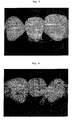
- FIG. 2 shows an X-ray diffraction diagram of the glass ceramic from Example 2
- FIG. 4 shows an X-ray diffraction diagram of the glass ceramic from Example 12.
- Determination of the Crystal Phases was done according to the JCPDS index, which is a comprehensive database of X-ray diffraction patterns of crystalline compounds.
- the respective references according to this file are shown as so-called line diagrams in FIG. 2 and FIG. 4.
- FIG. 2 contains the Referenzdiffraktogramm 35-0404 for NaY 9 Si 6 O 26 [NaY 9 (SiO 4) 6 O 2].
- Example 2 The optical and physical properties of some glass-ceramics are summarized in Table II. These properties were determined in the manner described in Example 18. The CTE of the glass ceramics shown ranges from 6.5 * 10 -6 K -1 (Example 9) to 14.1 * 10 -6 K -1 (Example 6), the firing temperatures from 830 ° C (Example 11) to 1160 ° C (Example 9).
- the glass-ceramics of Examples 1, 4, 8, 9 and 11 are particularly suitable for the coating and veneering of Al 2 O 3 , ZrO 2 ceramics, titanium or titanium alloys and lithium disilicate glass ceramics with a low CTE because of their lower CTE values.
- Range of 7 to 12 * 10 -6 K -1 suitable see Table II
- the glass-ceramics of Examples 7 and 8 are due to their high CTE values especially for coating or veneering of high-gold dental alloys with a high CTE range of 14 to 16 * 10 -6 K -1 .
- Example 18 Preparation of a veneering material on the basis a mixed glass ceramic
- a mixture series of several two-component mixed glass ceramics was created.
- the compositions of the mixed glass ceramics were selected so that a systematic property variation resulted by varying the proportions of the blend components.
- Also included in the investigation were the edge members of the mixture series, ie the pure components A and B.
- the component A used was the glass ceramic from Example 7, component B a glass of the following composition, which was prepared according to DE 44 28 839 (all data in wt .-%): Composition of the glass B component proportion of SiO 2 63.5% by weight Al 2 O 3 8.8% by weight K 2 O 9, 6% by weight Na 2 O 6.8% by weight LiO 2 0.8% by weight ZnO 2.4% by weight CaO 3.5% by weight TiO 2 0.4% by weight ZrO 2 1.0% by weight P 2 O 5 0.4% by weight F 0.8% by weight CeO 2 0.8% by weight B 2 O 3 1.2% by weight
- composition of the examined glass ceramic mixtures Name of the mixture Content of A [wt%] Content of B [% by weight] Temperature of the therm. Treatment [ ° C] M1 100.0 0.0 1020 M2 80.0 20.0 900 M3 50.0 50.0 840 M4 20.0 80.0 770 M5 0.0 100.0 740
- the individual components weighed and intimately mixed. Subsequently were from the powders by uniaxial pressing (max 1 bar) cylindrical, conical green bodies with a height of 35 mm and a medium diameter of 40 mm. These were over a period of 1 hour for those given in Table IV Temperatures thermally treated. At the end of this period the sintered bodies were quenched in cold water, dried, crushed mechanically and to a particle size ⁇ 90 ⁇ m sieved.
- CTE linear thermal expansion coefficient
- Acid resistance was determined according to ISO 9693. For this purpose, first sample plates with a diameter of 12 mm and a thickness of 1 mm by sintering together Glass-ceramic powder with a particle size of ⁇ 90 ⁇ m in a vacuum kiln (Programat® P100, Ivoclar Vivadent AG). The test specimens were incubated for 1 minute in Tables II and VI sintered firing temperature sintered. Then the Platelet 16 hours in 4 vol .-% aqueous acetic acid in closed Glass vessels stored at 80 ° C. As a measure of acid resistance was the measured mass loss relative to the Platelet surface determined. The results are in the tables II and VI shown.
- the temperature was assumed at the Standard platelets are sintered through and have a slight surface gloss having.
- the flexural strength was set to those described in ISO 6872 Determined manner in a biaxial experimental setup. To this Purpose, 8 standard slides were moistened, manual compacted ceramic produced by double firing, the polished after plane-parallel processing to a thickness of 1.2 mm were. The results are shown in Table VI.
- these bridges were conditioned and then by priming with a Opaquer prepared for veneering with the appropriate mixture. Subsequently, the glass ceramic mixture to be applied was slaked with water and applied to the metal framework. The sintering was carried out in a dental kiln under vacuum the firing parameters given in Table VI. The Opaquer serves for priming and covering the intrinsic color of the metal. When Opaquer were not inventive glass-ceramics, with the finest distributed color pigments were added, in a thin layer 840 ° C sintered on the metal substrate.
Landscapes
- Health & Medical Sciences (AREA)
- Oral & Maxillofacial Surgery (AREA)
- Chemical & Material Sciences (AREA)
- Life Sciences & Earth Sciences (AREA)
- Ceramic Engineering (AREA)
- Engineering & Computer Science (AREA)
- Plastic & Reconstructive Surgery (AREA)
- Epidemiology (AREA)
- Animal Behavior & Ethology (AREA)
- General Health & Medical Sciences (AREA)
- Public Health (AREA)
- Veterinary Medicine (AREA)
- Crystallography & Structural Chemistry (AREA)
- Chemical Kinetics & Catalysis (AREA)
- General Chemical & Material Sciences (AREA)
- Geochemistry & Mineralogy (AREA)
- Materials Engineering (AREA)
- Organic Chemistry (AREA)
- Inorganic Chemistry (AREA)
- Molecular Biology (AREA)
- Dispersion Chemistry (AREA)
- Glass Compositions (AREA)
- Dental Preparations (AREA)
- Dental Prosthetics (AREA)
- Compositions Of Oxide Ceramics (AREA)
Abstract
Description
| SiO2 | 40 bis 70 Gew.-% |
| B2O3 | 0 bis 9 Gew.-% |
| Al2O3 | 7 bis 15 Gew.-% |
| Y2O3 | 0 bis 14 Gew.-% |
| La2O3 | 0 bis 17 Gew.-% |
| ZrO2 | 0 bis 3 Gew.-% |
| LiO2 | 0 bis 8 Gew.-% |
| Na2O | 0 bis 24 Gew.-% |
| K2O | 0 bis 14 Gew.-% |
| CaO | 0 bis 9 Gew.-% |
| SrO | 0 bis 15 Gew.-% |
| F | 0 bis 3 Gew.-%. |
| SiO2 | 45,9 bis 64,0 Gew.-% |
| B2O3 | 0 bis 8,5 Gew.-% |
| Al2O3 | 7,9 bis 14,3 Gew.-% |
| Y2O3 | 0 bis 12,0 Gew.-% |
| La2O3 | 0 bis 14,9 Gew.-% |
| ZrO2 | 0 bis 1,7 Gew.-% |
| LiO2 | 0 bis 6,0 Gew.-% |
| Na2O | 0 bis 20,0 Gew.-% |
| K2O | 0 bis 11,6 Gew.-% |
| CaO | 0 bis 7,3 Gew.-% |
| SrO | 0 bis 12,8 Gew.-% |
| F | 0 bis 2,2 Gew.-%. |
| SiO2 | 52,0 bis 63,5 Gew.-% |
| Me'[III]2O3 | 8,5 bis 13,0 Gew.-% |
| K2O | 0 bis 20,5 Gew.-% |
| Na2O | 1,5 bis 20,0 Gew.-% |
| LiO2 | 0 bis 5,0 Gew.-% |
| ZnO | 2,0 bis 8,0 Gew.-% |
| Me' [II]O | 2,5 bis 6,5 Gew.-% |
| TiO2 + ZrO2 | 0,5 bis 6,0 Gew.-% |
| SnO2 | 0 bis 9,5 Gew.-% |
| P2O5 | 0 bis 4,0 Gew.-% |
| F | 0 bis 2,0 Gew.-% |
| CeO2 | 0 bis 3,0 Gew.-%, |
| Komponente | Anteil [in Gew.-%] |
| SiO2 | 60,0 - 72,0 |
| Li2O | 1,0 - 5,0 |
| K2O | 10,0 - 23,0 |
| ZnO | 8,5 - 20,0 |
| Komponente | Anteil [Gew.-%] |
| SiO2 | 56,0 - 65,0 |
| Li2O | 1,8 - 5,3 |
| K2O | 9,0 - 17,5 |
| ZnO | 9,0 - 16,0 |
| CaO | 3,5 - 10,5 |
| P2O5 | 2,0 - 6,0 |
| F | 0,5 - 1,0 |
| Komponente | Anteil [Gew.-%] |
| SiO2 | 45,0 - 70,0 |
| Al2O3 | 5, 0 - 22,0 |
| K2O | 3,0 - 8,5 |
| Na2O | 4,0 - 13,0 |
| CaO | 1,5 - 11,0 |
| P2O5 | 0,5 - 6,5 |
| F | 0,1 - 2,5 |
| Komponente | Anteil [Gew.-%] |
| SiO2 | 55,0 - 71,0 |
| Al2O3 | 5,0 - 16,0 |
| B2O3 | 0,2 - 10,0 |
| K2O | 4,5 - 10,0 |
| Na2O | 3,0 - 14,0 |
| Komponente | Anteil [Gew.-%] |
| SiO2 | 57,0 - 80,0 |
| Al2O3 | 3,0 - 5,0 |
| La2O3 | 0,1 - 6,0 |
| Li2O | 11,0 - 19,0 |
| Komponente | Anteil [Gew.-%] |
| SiO2 | 42,5 - 58,5 |
| Li2O | 7,0 - 14,5 |
| P2O5 | 4,0 - 13,5 |
| ZrO2 | 15,0 - 28,0 |
| Komponente | Anteil [Gew.-%] |
| SiO2 | 49,0 - 57,5 |
| Al2O3 | 11,4 - 21,0 |
| P2O5 | 0,5 - 5,5 |
| CaO | 2,5 - 11,5 |
| K2O | 9,0 - 22,5 |
| Na2O | 1,0 - 9,5 |
| ZrO2 | 0,8 - 8,5 |
| F | 0,25 - 2,5 |
| Komponente | Anteil [Gew.-%] |
| SiO2 | 48,0 - 66,0 |
| MeIII 2O3 | 5,0 - 20,0 |
| MeI 2O | 6,0 - 22,0 |
| MeIIO | 3,5 - 16,0 |
| MeIVO2 | 0,5 - 10,0 |
| P2O5 | 0,5 - 5,0 |
| Zusammensetzung von Apatitglaskeramiken | ||||
| Oxid | Beispiel | |||
| 1 | 2 | 3 | 4 | |
| Gew.% | Gew.-% | Gew.-% | Gew.-% | |
| SiO2 | 46,7 | 48,9 | 47,5 | 47,5 |
| B2O3 | 7,3 | 7,9 | 7,7 | 7,7 |
| Al2O3 | 9,8 | 10,5 | 10,2 | 10,2 |
| Y2O3 | - | 11,1 | 10,8 | 10,8 |
| La2O3 | 14,9 | - | - | - |
| ZrO2 | - | - | - | - |
| Li2O | - | - | - | - |
| Na2O | 6, 6 | 7,1 | 6, 9 | 6, 9 |
| K2O | 10,0 | 10,7 | 10,5 | 10,5 |
| CaO | - | - | - | - |
| SrO | 4,1 | - | 5,7 | 5,7 |
| F | 0,6 | 0,7 | 0,7 | 0,7 |
| Krist. -Phase | La9.33 (SiO4) 6O2 | NaY9 (SiO4) 6O2 | NaY9 (SiO4) 6O2 | NaY9 (SiO4) 6O2 |
| (Fortsetzung) | ||||
| Oxid | Beispiel | |||
| 5 | 6 | 7 | 8 | |
| Gew.-% | Gew.-% | Gew.-% | Gew.-% | |
| SiO2 | 49,2 | 46,4 | 51,1 | 53,3 |
| B2O3 | 7,9 | 7,4 | 3,9 | - |
| Al2O3 | 10,5 | 9,9 | 10,9 | 11,3 |
| Y2O3 | 11,1 | 10,5 | 11,5 | 12,0 |
| La2O3 | - | - | - | - |
| ZrO2 | - | - | - | - |
| Li2O | - | - | - | - |
| Na2O | 2,7 | 2,6 | 7,4 | 7,7 |
| K2O | 10,8 | 10,2 | 11,2 | 11,6 |
| CaO | 7,1 | - | 3,3 | 3,4 |
| SrO | - | 12,4 | - | - |
| F | 0,7 | 0,6 | 0,7 | 0,7 |
| Krist. -Phase | NaY9 (SiO4) 6O2 | NaY9 (SiO4) 6O2 | NaY9 (SiO4) 6O2 Leucit | NaY9 (SiO4) 6O2 Leucit |
| (Fortsetzung) | ||||
| Oxid | Beispiel | |||
| 9 | 10 | 11 | 12 | |
| Gew.-% | Gew.-% | Gew.-% | Gew.-% | |
| SiO2 | 51,0 | 48,00 | 49,9 | 45,9 |
| B2O3 | 8,2 | 7,7 | 8,0 | 7,2 |
| Al2O3 | 10,9 | 10,2 | 14,3 | 9,6 |
| Y2O3 | 11,5 | 10,8 | 11,3 | - |
| La2O3 | - | - | - | 14,7 |
| ZrO2 | - | - | - | 1,6 |
| Li2O | - | - | 2,4 | - |
| Na2O | - | - | - | 6,5 |
| K2O | 11,1 | 10,5 | 10,9 | 9,9 |
| CaO | 7,3 | - | 3,2 | - |
| SrO | - | 12,8 | - | 4,0 |
| F | - | - | - | 0,6 |
| Krist. -Phase | Ca2Y8 (SiO4) 6O2 | Sr2Y8 (SiO4) 6O2 | LiY9 (SiO4) 6O2 | La9.33 (SiO4) 6O2 |
| (Fortsetzung) | |||||
| Oxid | Beispiel | ||||
| 13 | 14 | 15 | 16 | 17 | |
| Gew.-% | Gew.-% | Gew.-% | Gew.-% | Gew.-% | |
| SiO2 | 48,1 | 55,0 | 61,0 | 64,0 | 56,0 |
| B2O3 | 7,7 | - | - | - | 8,5 |
| Al2O3 | 10,3 | 6,0 | 8,4 | 8,8 | 7,9 |
| Y2O3 | 10,9 | 10,0 | 5,0 | 5,3 | 5,0 |
| La2O3 | - | - | - | - | - |
| ZrO2 | 1,7 | - | - | - | - |
| TiO2 | - | - | - | - | - |
| Li2O | 6,9 | 20,0 | - | 6,0 | - |
| Na2O | 10,6 | - | 8,8 | - | 7,8 |
| K2O | 3,1 | 7,2 | 8,8 | 9,4 | 7,8 |
| CaO | - | - | 6,0 | 4,3 | 5,0 |
| SrO | - | - | - | ||
| F | 0,7 | 1,8 | 2,0 | 2,2 | 2,0 |
| Krist.-Phase | NaY9 (SiO4) 6O2 | NaY9 (SiO4) 6O2 | NaY9 (SiO4) 6O2 Leucit | LiY9 (SiO4) 6O2 Leucit | NaY9 (SiO4) 6O2 |
| Eingenschaften ausgewählter Glaskeramiken | |||||||
| Parameter | Beispiel | ||||||
| 1 | 4 | 7 | 8 | 9 | 10 | 11 | |
| Schmelzbedingungen | 1550°C für 2h | ||||||
| Optik nach Abschrecken | transparent | ||||||
| Temperbedingungen | 800°C für 1 h und 1050°C für 0,5 h | ||||||
| Optik nach Tempern | starke Trübung und hohe Helligkeit | ||||||
| Brenntemp. [°C] | 850 | - | 1010 | 1110 | 1010 | 1160 | 870 |
| WAK[10-6K-1] | 9,7 | 9,5 | 14,1 | 13,3 | 7,1 | 6,5 | 9,4 |
| Tg[°C] | 575 | 601 | 533 | 589 | 666 | 648 | 580 |
| Chem. Beständigkeit | - | - | 53,7 | 41,0 | - | - | 42,9 |
| Zusammensetzung des Glases B | |
| Komponente | Anteil |
| SiO2 | 63,5 Gew.-% |
| Al2O3 | 8,8 Gew.-% |
| K2O | 9, 6 Gew.-% |
| Na2O | 6,8 Gew.-% |
| LiO2 | 0,8 Gew.-% |
| ZnO | 2,4 Gew.-% |
| CaO | 3,5 Gew.-% |
| TiO2 | 0,4 Gew.-% |
| ZrO2 | 1,0 Gew.-% |
| P2O5 | 0,4 Gew.-% |
| F | 0,8 Gew.-% |
| CeO2 | 0,8 Gew.-% |
| B2O3 | 1,2 Gew.-% |
| Zusammensetzung der untersuchten Glaskeramik-Mischungen | |||
| Bezeichnung der Mischung | Gehalt an A [Gew.-%] | Gehalt an B [Gew.-%] | Temperatur der therm. Behand- lung [°C] |
| M1 | 100,0 | 0,0 | 1020 |
| M2 | 80,0 | 20,0 | 900 |
| M3 | 50,0 | 50,0 | 840 |
| M4 | 20,0 | 80,0 | 770 |
| M5 | 0,0 | 100,0 | 740 |
| Eigenschaften der Glasskeramiken nach dem Aufbrennen auf Dantellegierung | ||||||
| Nr. | Brenn- temp. [°C] | WAK [10 -6 ·K -1 ] | T g [°C] | Chem. Best. [µg cm -2 ] | Biegef. [Mpa] | Transl. ΔCR |
| M1 | 990 | 14,1 | 533 | 53,7 | 116 | 0,98 |
| M2 | 960 | 12,9 | 558 | 16,5 | 112 | 0,97 |
| M3 | 890 | 13,1 | 532 | 24,6 | 109 | 0,96 |
| M4 | 850 | 11,1 | 516 | 23,9 | 78 | 0,88 |
| M5 | 840 | 9,2 | 510 | 21,0 | 93 | 0,27 |
| Eigenschaften und Zusammensetzung der Dentallegierung | |||
| Chemische Zusammen- setzung [Gew. %] | WAK (25-500 °C) [10 -6 K -1 ] | Dichte [g cm -3 ] | Soliduspunkt [°C] |
| Pd 75,2 | 13,8 | 11,0 | 1270 |
| Au 6,0 | |||
| Ag 6,5 | |||
| In 6,0 | |||
| Ga 6,0 | |||
| Ru < 1,0 | |||
| Li < 1,0 |
Claims (27)
- Apatitglaskeramik mit mindestens einer Glasphase und mindestens einer Apatitphase, dadurch gekennzeichnet, daß mindestens eine der Apatitphasen eine phosphat- und fluorfreie silicatische Oxyapatitphase ist.
- Apatitglaskeramik nach Anspruch 1 oder 2, in der alle Apatitphasen phosphat- und fluorfreie silicatische Oxyapatite sind.
- Apatitglaskeramik nach Anspruch 2, die eine oder mehrere Oxyapatitphasen der Formel Me[I]xMe[II]yMe[III]z(SiO4)6O2 enthalten, in der Me[I] für ein einwertiges Kation, Me[II] für ein zweiwertiges Kation und Me[III] für ein dreiwertiges Kation steht und x, y und z so gewählt sind, daß die Summe der Wertigkeiten der Kationen Me[I], Me[II] und Me[III] den Wert 28 ergibt.
- Apatitglaskeramik nach Anspruch 3, in der die eine oder mehreren Oxyapatitphasen die Formel Me[I]Me[III]9(SiO4)6O2, Me[II]2Me[III]8(SiO4)6O2 und/oder Me[III]9,33(SiO4)6O2 haben.
- Apatitglaskeramik nach Anspruch 3 oder 4, in der Me[I], Me[II] und Me[III] Metallkationen sind und insbesondere Me[I] Na oder Li, Me[II] Ca oder Sr und Me[III] Y oder La ist.
- Apatitglaskeramik nach Anspruch 4 oder 5, in der die eine oder mehreren Oxyapatitphasen die Formel NaY9(SiO4)6O2, LiY9(SiO4) 6O2, Sr2Y8 (SiO4) 6O2, Ca2Y8 (SiO4) 6O2, Sr2La8(SiO4)6O2 und/oder La9,33(SiO4)6O2 haben.
- Apatitglaskeramik nach einem.der Ansprüche 1 bis 6, die mindestens eine weitere kristalline Phase enthält.
- Apatitglaskeramik nach Anspruch 7, die als weitere kristalline Phase Leucit enthält.
- Apatitglaskeramik nach einem der Ansprüche 1 bis 8, welche die folgenden Komponenten enthält, wobei sich die Prozentangaben auf die Gesamtmasse der Glaskeramik beziehen:
SiO2 40 bis 70 Gew.-% B2O3 0 bis 9 Gew.-% Al2O3 7 bis 15 Gew.-% Y2O3 0 bis 14 Gew.-% La2O3 0 bis 17 Gew.-% ZrO2 0 bis 3 Gew.-% LiO2 0 bis 8 Gew.-% Na2O 0 bis 24 Gew.-% K2O 0 bis 14 Gew.-% CaO 0 bis 9 Gew.-% SrO 0 bis 15 Gew.-% F 0 bis 3 Gew.-%. - Apatitglaskeramik nach Anspruch 9, welche die folgenden Komponenten enthält:
SiO2 45,9 bis 64,0 Gew.-% B2O3 0 bis 8,5 Gew.-% Al2O3 7,9 bis 14,3 Gew.-% Y2O3 0 bis 12,0 Gew.-% La2O3 0 bis 14,9 Gew.-% ZrO2 0 bis 1,7 Gew.-% LiO2 0 bis 6,0 Gew.-% Na2O 0 bis 20,0 Gew.-% K2O 0 bis 11,6 Gew.-% CaO 0 bis 7,3 Gew.-% SrO 0 bis 12,8 Gew.-% F 0 bis 2,2 Gew.-%. - Apatitglaskeramik nach Anspruch 9 oder 10, die ein oder mehrere farbgebende oder fluoreszenzgebende Metalloxide enthält.
- Apatitglaskeramik nach Anspruch 11, in der das Metall des Metalloxids oder die Metalle der Metalloxide aus der Gruppe der 3d- und 4f-Elemente des Periodensystems der Elemente ausgewählt sind.
- Apatitglaskeramik nach einem der Ansprüche 1 bis 12, in welcher der Anteil der Apatitkristalle mindestens 5 Gew.-% beträgt.
- Apatitglaskeramik nach einem der Ansprüche 1 bis 13, in welcher die Apatitkristalle nadelförmig sind.
- Apatitglaskeramik nach einem der Ansprüche 1 bis 14, in welcher die Apatitkristalle eine durchschnittliche Länge von 0,1 bis 10 µm aufweisen.
- Apatitglaskeramik nach einem der Ansprüche 1 bis 15, die im Temperaturbereich von 100 bis 500 °C einen Wärmeausdehnungskoeffizienten von 6 * 10-6 K-1 bis 15 * 10-6 K-1 aufweist.
- Apatitglaskeramik nach einem der Ansprüche 1 bis 16, die eine Brenntemperatur von 830 °C bis 1150 °C aufweist.
- Apatitglaskeramik nach einem der Ansprüche 1 bis 17, die eine chemische Beständigkeit von < 80 µg/cm2 aufweist.
- Verfahren zur Herstellung einer Apatitglaskeramik gemäß einem der Ansprüche 1 bis 18, bei dem man(a) die zur Herstellung der Glaskeramik erforderlichen Komponenten mischt und zu einem Glas aufschmilzt,(b) man die Glasschmelze aus Schritt (a) in ein Glasgranulat überführt,(c) man ggf. das Glasgranulat zu einem Pulver mit einer mittleren Korngröße von 1 bis 500 µm (bezogen auf die Teilchenzahl) zerkleinert, und(d) man das Glasgranulat aus Schritt (b) oder das Glaspulver aus Schritt (c) anschließend einer ein- oder mehrstufigen thermischen Behandlung im Temperaturbereich von 700 bis 1200 °C für eine Dauer von 30 Minuten bis 6 Stunden unterwirft.
- Verfahren nach Anspruch 19, bei man das Glasgranulat aus Schritt (b) oder das Glaspulver aus Schritt (c) in Schritt (d) einer thermischen Behandlung im Temperaturbereich von 900 bis 1200 °C unterwirft.
- Verfahren nach Anspruch 19 oder 20, bei man das Glasgranulat aus Schritt (b) oder das Glaspulver aus Schritt (c) in Schritt (d) einer thermischen Behandlung für eine Dauer von 30 Minuten bis 3 Stunden unterwirft.
- Mehrkomponentiger Werkstoff, der als erste Komponente mindestens eine Apatitglaskeramik gemäß einem der Ansprüche 1 bis 18 in Pulverform und als zweite Komponente mindestens ein weiteres Glas- und/oder Glaskeramikpulver enthält.
- Werkstoff nach Anspruch 22, der als zweite Komponente ein Alkali-Zink-Silikat-Glas enthält, welche die folgenden Komponenten enthält:
SiO2 52,0 bis 63,5 Gew.-% Me'[III]2O3 8,5 bis 13,0 Gew.-% K2O 0 bis 20,5 Gew.-% Na2O 1,5 bis 20,0 Gew.-% LiO2 0 bis 5,0 Gew.-% ZnO 3,6 bis 8,0 Gew.-% Me' [II]O 2,5 bis 6,5 Gew.-% TiO2 + ZrO2 0,5 bis 6,0 Gew.-% SnO2 0 bis 9,5 Gew.-% P2O5 0 bis 4,0 Gew.-% F 0 bis 2,0 Gew.-% CeO2 0 bis 3,0 Gew.-%, (a) Me'[III]2O3 durch 0 bis 13 Gew.-% Al2O3 und 0 bis 9,5 Gew.-% La2O3.gebildet wird; und(b) Me' [II]O durch 0 bis 3,5 Gew.-% CaO, 0 bis 4,5 Gew.-% BaO und 0 bis 5,0 Gew.-% MgO gebildet wird. - Mischglaskeramik, dadurch erhältlich, daß man die Komponenten eines Werkstoffs gemäß einem der Ansprüche 22 bis 23 mischt und dann in eine Mischglaskeramik überführt.
- Verwendung einer Apatitglaskeramik gemäß einem der Ansprüche 1 bis 18 oder einer Mischglaskeramik gemäß Anspruch 24 als Trübungskomponente, Dentalwerkstoff, zur Herstellung eines Dentalwekstoffs oder einer Dentalrestauration.
- Verwendung nach Anspruch 25, wobei der Dentalwerkstoff ein Beschichtungsmaterial oder Verblendmaterial ist.
- Verwendung nach Anspruch 25, wobei die Dentalrestauration eine Krone, Brücke, Teilkrone, ein Onlay, ein künstlicher Zahn, ein Stumpfaufbau oder eine Facette ist.
Applications Claiming Priority (2)
| Application Number | Priority Date | Filing Date | Title |
|---|---|---|---|
| DE102004013455 | 2004-03-18 | ||
| DE102004013455A DE102004013455B3 (de) | 2004-03-18 | 2004-03-18 | Apatitglaskeramik auf der Basis von silicatischen Oxyapatiten, Verfahren zu ihrer Herstellung und ihre Verwendung |
Publications (2)
| Publication Number | Publication Date |
|---|---|
| EP1584607A1 true EP1584607A1 (de) | 2005-10-12 |
| EP1584607B1 EP1584607B1 (de) | 2008-04-16 |
Family
ID=34833191
Family Applications (1)
| Application Number | Title | Priority Date | Filing Date |
|---|---|---|---|
| EP05003561A Expired - Lifetime EP1584607B1 (de) | 2004-03-18 | 2005-02-18 | Apatitglaskeramik auf der Basis von silicatischen Oxyapatiten |
Country Status (5)
| Country | Link |
|---|---|
| US (1) | US7166548B2 (de) |
| EP (1) | EP1584607B1 (de) |
| JP (1) | JP5049466B2 (de) |
| AT (1) | ATE392399T1 (de) |
| DE (2) | DE102004013455B3 (de) |
Families Citing this family (32)
| Publication number | Priority date | Publication date | Assignee | Title |
|---|---|---|---|---|
| JP4496050B2 (ja) * | 2004-09-21 | 2010-07-07 | 株式会社アドバンス | 歯科補綴物加工用ブロックの製造方法 |
| ES2489523T3 (es) | 2005-02-08 | 2014-09-02 | Ivoclar Vivadent Ag | Material vitrocerámico de silicato de litio |
| DE102007011337A1 (de) * | 2007-03-06 | 2008-09-11 | Hermsdorfer Institut Für Technische Keramik E.V. | Verblendkeramik für dentale Restaurationen aus yttriumstabilisiertem Zirkoniumdioxid und Verfahren zur Verblendung von dentalen Restaurationen aus yttriumstabilisiertem Zirkoniumdioxid |
| JP5501642B2 (ja) | 2009-03-23 | 2014-05-28 | 株式会社ノリタケカンパニーリミテド | 蛍光性ジルコニア材料 |
| EP2287122B1 (de) * | 2009-07-24 | 2013-05-15 | Ivoclar Vivadent AG | Phosphosilikat-Glaskeramik |
| DE202009019061U1 (de) | 2009-12-23 | 2016-02-23 | Degudent Gmbh | Lithiummetasilicat-Glaskeramik und deren Verwendung |
| ES2581452T3 (es) | 2010-04-16 | 2016-09-05 | Ivoclar Vivadent Ag | Vitrocerámica y vidrio de silicato de litio con óxido de metal de transición |
| US8865606B2 (en) | 2010-04-16 | 2014-10-21 | Ivoclar Vivadent Ag | Process for the preparation of dental restorations |
| DE102010035545A1 (de) | 2010-08-24 | 2012-03-01 | Fraunhofer-Gesellschaft zur Förderung der angewandten Forschung e.V. | Verblendkeramik für dentale Restaurationen aus yttriumstabilisiertem Zirkoniumdioxid sowie Verfahren zu deren Auftrag |
| RU2587448C2 (ru) * | 2010-10-22 | 2016-06-20 | Конинклейке Филипс Электроникс Н.В. | Люминесцентный материал и светоизлучающее устройство, содержащее такой люминесцентный материал |
| DE102010050275A1 (de) | 2010-11-02 | 2012-05-03 | Degudent Gmbh | Lithiumsilikat-Gläser oder -Glaskeramiken, Verfahren zu deren Herstellung sowie deren Verwendung |
| JP5989770B2 (ja) | 2011-06-22 | 2016-09-07 | ヴィタ ツァーンファブリク ハー.ラウター ゲーエムベーハー ウント コー.カーゲー | 歯科用修復材、その製造方法およびガラスセラミック |
| WO2012175615A1 (en) | 2011-06-22 | 2012-12-27 | Fraunhoffer-Gesellschaft Zur Förderung Der Angewandten Forschung E.V. | Dental restoration, method for its production and ingot |
| US20140227511A1 (en) * | 2013-02-13 | 2014-08-14 | Goodrich Corporation | Formulations and methods for oxidation protection of composite articles |
| EP2792345B1 (de) * | 2013-04-15 | 2019-10-09 | Ivoclar Vivadent AG | Lithiumsilikat-Glaskeramik und -Glas mit Gehalt an Cäsiumoxid |
| CN104212453A (zh) * | 2013-05-29 | 2014-12-17 | 海洋王照明科技股份有限公司 | 镨掺杂硅酸氧钇上转换发光材料、制备方法及其应用 |
| CN104212452A (zh) * | 2013-05-29 | 2014-12-17 | 海洋王照明科技股份有限公司 | 钬掺杂硅酸氧钇盐上转换发光材料、制备方法及有机发光二极管 |
| AU2015285456B2 (en) * | 2014-06-30 | 2018-08-02 | Gc Corporation | Fluoroaluminosilicate glass powder |
| JP2016108180A (ja) * | 2014-12-05 | 2016-06-20 | 京セラメディカル株式会社 | ガラスセラミックス |
| US20170342383A1 (en) | 2016-05-27 | 2017-11-30 | Corning Incorporated | Lithium disilicate glass-ceramic compositions and methods thereof |
| US10676713B2 (en) | 2016-05-27 | 2020-06-09 | Corning Incorporated | Bioactive borophosphate glasses |
| US10751367B2 (en) | 2016-05-27 | 2020-08-25 | Corning Incorporated | Bioactive glass microspheres |
| US10647962B2 (en) | 2016-05-27 | 2020-05-12 | Corning Incorporated | Bioactive aluminoborate glasses |
| CN106145664B (zh) * | 2016-06-28 | 2018-08-14 | 美轲(广州)化学股份有限公司 | 复合硅酸锆乳浊剂及其制备方法与应用 |
| EP3717030A1 (de) | 2017-11-28 | 2020-10-07 | Corning Incorporated | Bioaktive glaszusammensetzungen und behebung von dentinüberempfindlichkeit |
| CN111417601A (zh) | 2017-11-28 | 2020-07-14 | 康宁股份有限公司 | 化学强化的生物活性玻璃陶瓷 |
| CN111417603B (zh) | 2017-11-28 | 2023-10-31 | 康宁股份有限公司 | 生物活性硼酸盐玻璃及其方法 |
| EP3717427A1 (de) | 2017-11-28 | 2020-10-07 | Corning Incorporated | Bioaktives glas mit hoher liquidusviskosität |
| US20220154034A1 (en) | 2019-03-06 | 2022-05-19 | Celanese International Corporation | Use of aqueous copolymer dispersions in preservative-free aqueous coating compositions |
| CN114901608B (zh) * | 2019-11-27 | 2024-04-09 | 康宁股份有限公司 | 含y2o3的玻璃组合物、基材、及制品 |
| US20210172071A1 (en) * | 2019-12-05 | 2021-06-10 | Monireh Ganjali | Hard and wear resistant titanium alloy and preparation method thereof |
| CN114455843B (zh) * | 2022-02-22 | 2023-08-01 | 山东国瓷功能材料股份有限公司 | 一种牙科用玻璃陶瓷及其制备方法、牙科修复体 |
Family Cites Families (17)
| Publication number | Priority date | Publication date | Assignee | Title |
|---|---|---|---|---|
| US3632523A (en) * | 1969-09-22 | 1972-01-04 | Westinghouse Electric Corp | Calcium-yttrium silicate oxyapatite laser materials |
| JPS6345148A (ja) * | 1986-08-11 | 1988-02-26 | Natl Inst For Res In Inorg Mater | 機械加工性の針状結晶析出結晶化ガラスの製造方法 |
| US4748391A (en) * | 1986-12-18 | 1988-05-31 | Gte Laboratories Incorporated | Yellow green barium lanthanum silicate oxyapatite phosphor, a fluorescent lamp containing the same, and a method thereof |
| FR2634028B1 (fr) * | 1988-07-06 | 1994-07-22 | Commissariat Energie Atomique | Monocristaux de silicates de lanthanides utilisables comme scintillateurs pour la detection des rayonnements x et gamma |
| DE4314817A1 (de) * | 1993-04-30 | 1994-11-03 | Ivoclar Ag | Opaleszierendes Glas |
| DE4423794C1 (de) * | 1994-07-01 | 1996-02-08 | Ivoclar Ag | Zr0¶2¶-haltige Glaskeramik, Verfahren zu deren Herstellung sowie deren Verwendung |
| DE4423793C1 (de) * | 1994-07-01 | 1996-02-22 | Ivoclar Ag | Leucithaltige Phosphosilikat-Glaskeramik, Verfahren zu deren Herstellung und deren Verwendung |
| DE19647739C2 (de) * | 1996-09-05 | 2001-03-01 | Ivoclar Ag Schaan | Sinterbare Lithiumdisilikat-Glaskeramik sowie Glas |
| AU735721B2 (en) * | 1997-04-03 | 2001-07-12 | Corning Incorporated | Transparent apatite glass-ceramics |
| DE19725555A1 (de) * | 1997-06-12 | 1998-12-24 | Ivoclar Ag | Transluzente Apatit-Glaskeramik |
| DE19725552A1 (de) * | 1997-06-12 | 1998-12-24 | Ivoclar Ag | Alkali-Silicat-Glas |
| DE19725553A1 (de) * | 1997-06-12 | 1998-12-24 | Ivoclar Ag | Chemisch stabile transluzente Apatit-Glaskeramik |
| FR2786478B1 (fr) * | 1998-11-30 | 2000-12-22 | Commissariat Energie Atomique | Confinement du cesium et/ou du rubidium dans des ceramiques apatitiques |
| DE10031430A1 (de) * | 2000-06-28 | 2002-01-17 | Ivoclar Vivadent Ag | Tiefsinternde Apatit-Glaskeramik |
| DE10031431B4 (de) * | 2000-06-28 | 2008-03-13 | Ivoclar Vivadent Ag | Tiefsinterndes Kalium-Zink-Silicat-Glas und dessen Verwendung |
| DE10340597B4 (de) * | 2003-09-01 | 2007-11-08 | Ivoclar Vivadent Ag | Transluzente und radio-opake Glaskeramiken, Verfahren zu ihrer Herstellung und ihre Verwendung |
| US7498043B2 (en) * | 2004-04-07 | 2009-03-03 | Warsaw Orthopedic, Inc. | Silicon substituted oxyapatite |
-
2004
- 2004-03-18 DE DE102004013455A patent/DE102004013455B3/de not_active Expired - Lifetime
- 2004-10-26 US US10/973,233 patent/US7166548B2/en not_active Expired - Lifetime
-
2005
- 2005-02-18 EP EP05003561A patent/EP1584607B1/de not_active Expired - Lifetime
- 2005-02-18 AT AT05003561T patent/ATE392399T1/de active
- 2005-02-18 DE DE502005003695T patent/DE502005003695D1/de not_active Expired - Fee Related
- 2005-03-16 JP JP2005076100A patent/JP5049466B2/ja not_active Expired - Lifetime
Non-Patent Citations (1)
| Title |
|---|
| UO M ET AL: "THE EFFECT OF RARE-EARTH OXIDES ON THE CRYSTALLIZATION OF CAO-AL2O3-SIO2 GLASSES", JOURNAL OF MATERIALS SCIENCE, CHAPMAN AND HALL LTD. LONDON, GB, vol. 33, no. 3, 1 February 1998 (1998-02-01), pages 749 - 754, XP000733026, ISSN: 0022-2461 * |
Also Published As
| Publication number | Publication date |
|---|---|
| EP1584607B1 (de) | 2008-04-16 |
| DE502005003695D1 (de) | 2008-05-29 |
| US7166548B2 (en) | 2007-01-23 |
| US20050209082A1 (en) | 2005-09-22 |
| JP5049466B2 (ja) | 2012-10-17 |
| ATE392399T1 (de) | 2008-05-15 |
| JP2005263627A (ja) | 2005-09-29 |
| DE102004013455B3 (de) | 2005-09-08 |
Similar Documents
| Publication | Publication Date | Title |
|---|---|---|
| EP1584607B1 (de) | Apatitglaskeramik auf der Basis von silicatischen Oxyapatiten | |
| EP2868634B1 (de) | Lithiumdisilikat-Apatit-Glaskeramik mit Übergangsmetalloxid | |
| DE10340597B4 (de) | Transluzente und radio-opake Glaskeramiken, Verfahren zu ihrer Herstellung und ihre Verwendung | |
| EP2792345B1 (de) | Lithiumsilikat-Glaskeramik und -Glas mit Gehalt an Cäsiumoxid | |
| DE10336913B4 (de) | Verwendung eines Lithiumsilicatmaterials | |
| EP0690030B1 (de) | Leucithaltige Phosphosilikat-Glaskeramik | |
| EP2765974B1 (de) | Lithiumsilikat-glaskeramik und -glas mit zweiwertigem metalloxid | |
| EP0885855B1 (de) | Transluzente Apatit-Glaskeramik | |
| EP2765977B1 (de) | Lithiumsilikat-glaskeramik und -glas mit einwertigem metalloxid | |
| EP2765976B1 (de) | Lithiumsilikat-glaskeramik und -glas mit vierwertigem metalloxid | |
| EP3050856B1 (de) | Lithiumsilikat-Diopsid-Glaskeramik | |
| EP2765978B1 (de) | Lithiumsilikat-glaskeramik und -glas mit sechswertigem metalloxid | |
| EP1888474A1 (de) | Dentalglaskeramiken | |
| EP2662343A1 (de) | Lithiumsilikat-Glaskeramik und -Glas mit Gehalt an ZrO2 | |
| WO2013053865A2 (de) | Lithiumsilikat-glaskeramik und -glas mit dreiwertigem metalloxid | |
| DE19725553A1 (de) | Chemisch stabile transluzente Apatit-Glaskeramik | |
| EP1167311B1 (de) | Tiefsinternde Apatit-Glaskeramik | |
| DE10362378C5 (de) | Verfahren zur Herstellung eines Lithiumsilicatrohlings | |
| DE10362377B3 (de) | Lithiumsilicatrohling und dessen Verwendung |
Legal Events
| Date | Code | Title | Description |
|---|---|---|---|
| PUAI | Public reference made under article 153(3) epc to a published international application that has entered the european phase |
Free format text: ORIGINAL CODE: 0009012 |
|
| AK | Designated contracting states |
Kind code of ref document: A1 Designated state(s): AT BE BG CH CY CZ DE DK EE ES FI FR GB GR HU IE IS IT LI LT LU MC NL PL PT RO SE SI SK TR |
|
| AX | Request for extension of the european patent |
Extension state: AL BA HR LV MK YU |
|
| 17P | Request for examination filed |
Effective date: 20051103 |
|
| AKX | Designation fees paid |
Designated state(s): AT BE BG CH CY CZ DE DK EE ES FI FR GB GR HU IE IS IT LI LT LU MC NL PL PT RO SE SI SK TR |
|
| 17Q | First examination report despatched |
Effective date: 20061006 |
|
| GRAP | Despatch of communication of intention to grant a patent |
Free format text: ORIGINAL CODE: EPIDOSNIGR1 |
|
| GRAS | Grant fee paid |
Free format text: ORIGINAL CODE: EPIDOSNIGR3 |
|
| RIN1 | Information on inventor provided before grant (corrected) |
Inventor name: RITZBERGER, CHRISTIAN Inventor name: RHEINBERGER, VOLKER M. Inventor name: BOLLE, URS Inventor name: HOELAND, WOLFRAM Inventor name: APEL, ELKE |
|
| GRAA | (expected) grant |
Free format text: ORIGINAL CODE: 0009210 |
|
| AK | Designated contracting states |
Kind code of ref document: B1 Designated state(s): AT BE BG CH CY CZ DE DK EE ES FI FR GB GR HU IE IS IT LI LT LU MC NL PL PT RO SE SI SK TR |
|
| GBT | Gb: translation of ep patent filed (gb section 77(6)(a)/1977) |
Effective date: 20080418 |
|
| REG | Reference to a national code |
Ref country code: CH Ref legal event code: NV Representative=s name: KELLER & PARTNER PATENTANWAELTE AG Ref country code: CH Ref legal event code: EP |
|
| REG | Reference to a national code |
Ref country code: IE Ref legal event code: FG4D Free format text: LANGUAGE OF EP DOCUMENT: GERMAN |
|
| REF | Corresponds to: |
Ref document number: 502005003695 Country of ref document: DE Date of ref document: 20080529 Kind code of ref document: P |
|
| PG25 | Lapsed in a contracting state [announced via postgrant information from national office to epo] |
Ref country code: SI Free format text: LAPSE BECAUSE OF FAILURE TO SUBMIT A TRANSLATION OF THE DESCRIPTION OR TO PAY THE FEE WITHIN THE PRESCRIBED TIME-LIMIT Effective date: 20080416 |
|
| NLV1 | Nl: lapsed or annulled due to failure to fulfill the requirements of art. 29p and 29m of the patents act | ||
| PG25 | Lapsed in a contracting state [announced via postgrant information from national office to epo] |
Ref country code: NL Free format text: LAPSE BECAUSE OF FAILURE TO SUBMIT A TRANSLATION OF THE DESCRIPTION OR TO PAY THE FEE WITHIN THE PRESCRIBED TIME-LIMIT Effective date: 20080416 Ref country code: PT Free format text: LAPSE BECAUSE OF FAILURE TO SUBMIT A TRANSLATION OF THE DESCRIPTION OR TO PAY THE FEE WITHIN THE PRESCRIBED TIME-LIMIT Effective date: 20080916 Ref country code: BG Free format text: LAPSE BECAUSE OF FAILURE TO SUBMIT A TRANSLATION OF THE DESCRIPTION OR TO PAY THE FEE WITHIN THE PRESCRIBED TIME-LIMIT Effective date: 20080716 Ref country code: FI Free format text: LAPSE BECAUSE OF FAILURE TO SUBMIT A TRANSLATION OF THE DESCRIPTION OR TO PAY THE FEE WITHIN THE PRESCRIBED TIME-LIMIT Effective date: 20080416 Ref country code: ES Free format text: LAPSE BECAUSE OF FAILURE TO SUBMIT A TRANSLATION OF THE DESCRIPTION OR TO PAY THE FEE WITHIN THE PRESCRIBED TIME-LIMIT Effective date: 20080727 |
|
| PG25 | Lapsed in a contracting state [announced via postgrant information from national office to epo] |
Ref country code: PL Free format text: LAPSE BECAUSE OF FAILURE TO SUBMIT A TRANSLATION OF THE DESCRIPTION OR TO PAY THE FEE WITHIN THE PRESCRIBED TIME-LIMIT Effective date: 20080416 |
|
| REG | Reference to a national code |
Ref country code: IE Ref legal event code: FD4D |
|
| PG25 | Lapsed in a contracting state [announced via postgrant information from national office to epo] |
Ref country code: IS Free format text: LAPSE BECAUSE OF FAILURE TO SUBMIT A TRANSLATION OF THE DESCRIPTION OR TO PAY THE FEE WITHIN THE PRESCRIBED TIME-LIMIT Effective date: 20080816 |
|
| ET | Fr: translation filed | ||
| PG25 | Lapsed in a contracting state [announced via postgrant information from national office to epo] |
Ref country code: IE Free format text: LAPSE BECAUSE OF FAILURE TO SUBMIT A TRANSLATION OF THE DESCRIPTION OR TO PAY THE FEE WITHIN THE PRESCRIBED TIME-LIMIT Effective date: 20080416 Ref country code: CZ Free format text: LAPSE BECAUSE OF FAILURE TO SUBMIT A TRANSLATION OF THE DESCRIPTION OR TO PAY THE FEE WITHIN THE PRESCRIBED TIME-LIMIT Effective date: 20080416 Ref country code: LT Free format text: LAPSE BECAUSE OF FAILURE TO SUBMIT A TRANSLATION OF THE DESCRIPTION OR TO PAY THE FEE WITHIN THE PRESCRIBED TIME-LIMIT Effective date: 20080416 Ref country code: DK Free format text: LAPSE BECAUSE OF FAILURE TO SUBMIT A TRANSLATION OF THE DESCRIPTION OR TO PAY THE FEE WITHIN THE PRESCRIBED TIME-LIMIT Effective date: 20080416 |
|
| PLBE | No opposition filed within time limit |
Free format text: ORIGINAL CODE: 0009261 |
|
| STAA | Information on the status of an ep patent application or granted ep patent |
Free format text: STATUS: NO OPPOSITION FILED WITHIN TIME LIMIT |
|
| PG25 | Lapsed in a contracting state [announced via postgrant information from national office to epo] |
Ref country code: RO Free format text: LAPSE BECAUSE OF FAILURE TO SUBMIT A TRANSLATION OF THE DESCRIPTION OR TO PAY THE FEE WITHIN THE PRESCRIBED TIME-LIMIT Effective date: 20080416 Ref country code: SK Free format text: LAPSE BECAUSE OF FAILURE TO SUBMIT A TRANSLATION OF THE DESCRIPTION OR TO PAY THE FEE WITHIN THE PRESCRIBED TIME-LIMIT Effective date: 20080416 |
|
| 26N | No opposition filed |
Effective date: 20090119 |
|
| PG25 | Lapsed in a contracting state [announced via postgrant information from national office to epo] |
Ref country code: EE Free format text: LAPSE BECAUSE OF FAILURE TO SUBMIT A TRANSLATION OF THE DESCRIPTION OR TO PAY THE FEE WITHIN THE PRESCRIBED TIME-LIMIT Effective date: 20080416 |
|
| BERE | Be: lapsed |
Owner name: IVOCLAR VIVADENT AG Effective date: 20090228 |
|
| PG25 | Lapsed in a contracting state [announced via postgrant information from national office to epo] |
Ref country code: MC Free format text: LAPSE BECAUSE OF NON-PAYMENT OF DUE FEES Effective date: 20090228 Ref country code: CY Free format text: LAPSE BECAUSE OF FAILURE TO SUBMIT A TRANSLATION OF THE DESCRIPTION OR TO PAY THE FEE WITHIN THE PRESCRIBED TIME-LIMIT Effective date: 20080416 |
|
| PG25 | Lapsed in a contracting state [announced via postgrant information from national office to epo] |
Ref country code: DE Free format text: LAPSE BECAUSE OF NON-PAYMENT OF DUE FEES Effective date: 20090901 |
|
| PG25 | Lapsed in a contracting state [announced via postgrant information from national office to epo] |
Ref country code: BE Free format text: LAPSE BECAUSE OF NON-PAYMENT OF DUE FEES Effective date: 20090228 |
|
| PG25 | Lapsed in a contracting state [announced via postgrant information from national office to epo] |
Ref country code: GR Free format text: LAPSE BECAUSE OF FAILURE TO SUBMIT A TRANSLATION OF THE DESCRIPTION OR TO PAY THE FEE WITHIN THE PRESCRIBED TIME-LIMIT Effective date: 20080717 |
|
| PG25 | Lapsed in a contracting state [announced via postgrant information from national office to epo] |
Ref country code: LU Free format text: LAPSE BECAUSE OF NON-PAYMENT OF DUE FEES Effective date: 20090218 |
|
| PG25 | Lapsed in a contracting state [announced via postgrant information from national office to epo] |
Ref country code: HU Free format text: LAPSE BECAUSE OF FAILURE TO SUBMIT A TRANSLATION OF THE DESCRIPTION OR TO PAY THE FEE WITHIN THE PRESCRIBED TIME-LIMIT Effective date: 20081017 |
|
| PG25 | Lapsed in a contracting state [announced via postgrant information from national office to epo] |
Ref country code: TR Free format text: LAPSE BECAUSE OF FAILURE TO SUBMIT A TRANSLATION OF THE DESCRIPTION OR TO PAY THE FEE WITHIN THE PRESCRIBED TIME-LIMIT Effective date: 20080416 |
|
| REG | Reference to a national code |
Ref country code: CH Ref legal event code: PCAR Free format text: NEW ADDRESS: EIGERSTRASSE 2 POSTFACH, 3000 BERN 14 (CH) |
|
| REG | Reference to a national code |
Ref country code: FR Ref legal event code: PLFP Year of fee payment: 12 |
|
| REG | Reference to a national code |
Ref country code: FR Ref legal event code: PLFP Year of fee payment: 13 |
|
| PGFP | Annual fee paid to national office [announced via postgrant information from national office to epo] |
Ref country code: SE Payment date: 20170214 Year of fee payment: 13 |
|
| REG | Reference to a national code |
Ref country code: FR Ref legal event code: PLFP Year of fee payment: 14 |
|
| REG | Reference to a national code |
Ref country code: SE Ref legal event code: EUG |
|
| PG25 | Lapsed in a contracting state [announced via postgrant information from national office to epo] |
Ref country code: SE Free format text: LAPSE BECAUSE OF NON-PAYMENT OF DUE FEES Effective date: 20180219 |
|
| REG | Reference to a national code |
Ref country code: CH Ref legal event code: PFA Owner name: IVOCLAR VIVADENT AG, LI Free format text: FORMER OWNER: IVOCLAR VIVADENT AG, LI |
|
| PGFP | Annual fee paid to national office [announced via postgrant information from national office to epo] |
Ref country code: AT Payment date: 20240109 Year of fee payment: 20 |
|
| PGFP | Annual fee paid to national office [announced via postgrant information from national office to epo] |
Ref country code: GB Payment date: 20240108 Year of fee payment: 20 Ref country code: CH Payment date: 20240301 Year of fee payment: 20 |
|
| PGFP | Annual fee paid to national office [announced via postgrant information from national office to epo] |
Ref country code: IT Payment date: 20240110 Year of fee payment: 20 Ref country code: FR Payment date: 20240129 Year of fee payment: 20 |
|
| REG | Reference to a national code |
Ref country code: CH Ref legal event code: PL |
|
| REG | Reference to a national code |
Ref country code: GB Ref legal event code: PE20 Expiry date: 20250217 |
|
| REG | Reference to a national code |
Ref country code: AT Ref legal event code: MK07 Ref document number: 392399 Country of ref document: AT Kind code of ref document: T Effective date: 20250218 |
|
| PG25 | Lapsed in a contracting state [announced via postgrant information from national office to epo] |
Ref country code: GB Free format text: LAPSE BECAUSE OF EXPIRATION OF PROTECTION Effective date: 20250217 |