EP1584139B1 - Auf inhalt basierendes segmentierungsschema für die datenkomprimierung bei der speicherung und übertragung mit hierarchischer segmentrepräsentation - Google Patents
Auf inhalt basierendes segmentierungsschema für die datenkomprimierung bei der speicherung und übertragung mit hierarchischer segmentrepräsentation Download PDFInfo
- Publication number
- EP1584139B1 EP1584139B1 EP03781454A EP03781454A EP1584139B1 EP 1584139 B1 EP1584139 B1 EP 1584139B1 EP 03781454 A EP03781454 A EP 03781454A EP 03781454 A EP03781454 A EP 03781454A EP 1584139 B1 EP1584139 B1 EP 1584139B1
- Authority
- EP
- European Patent Office
- Prior art keywords
- segment
- data
- file
- input data
- group
- Prior art date
- Legal status (The legal status is an assumption and is not a legal conclusion. Google has not performed a legal analysis and makes no representation as to the accuracy of the status listed.)
- Expired - Lifetime
Links
- 230000011218 segmentation Effects 0.000 title claims description 30
- 230000005540 biological transmission Effects 0.000 title description 4
- 238000013144 data compression Methods 0.000 title description 4
- 238000000034 method Methods 0.000 claims abstract description 63
- 230000027455 binding Effects 0.000 claims abstract description 54
- 238000009739 binding Methods 0.000 claims abstract description 54
- 230000002085 persistent effect Effects 0.000 claims abstract description 20
- 230000008569 process Effects 0.000 abstract description 40
- 238000007906 compression Methods 0.000 description 34
- 230000006835 compression Effects 0.000 description 34
- 238000013459 approach Methods 0.000 description 25
- 230000006870 function Effects 0.000 description 21
- 238000010586 diagram Methods 0.000 description 8
- 230000008901 benefit Effects 0.000 description 6
- 230000008859 change Effects 0.000 description 5
- 230000004044 response Effects 0.000 description 5
- 238000004891 communication Methods 0.000 description 4
- 230000000694 effects Effects 0.000 description 4
- 238000013461 design Methods 0.000 description 3
- 230000003252 repetitive effect Effects 0.000 description 3
- 108091081062 Repeated sequence (DNA) Proteins 0.000 description 2
- 230000003044 adaptive effect Effects 0.000 description 2
- 238000012217 deletion Methods 0.000 description 2
- 230000037430 deletion Effects 0.000 description 2
- 238000009826 distribution Methods 0.000 description 2
- 238000003780 insertion Methods 0.000 description 2
- 230000037431 insertion Effects 0.000 description 2
- 230000007246 mechanism Effects 0.000 description 2
- 230000002093 peripheral effect Effects 0.000 description 2
- VBAHFEPKESUPDE-UHFFFAOYSA-N 2-methoxyamphetamine Chemical compound COC1=CC=CC=C1CC(C)N VBAHFEPKESUPDE-UHFFFAOYSA-N 0.000 description 1
- 230000015572 biosynthetic process Effects 0.000 description 1
- 230000000903 blocking effect Effects 0.000 description 1
- 230000005587 bubbling Effects 0.000 description 1
- 230000000295 complement effect Effects 0.000 description 1
- 238000012790 confirmation Methods 0.000 description 1
- 238000000354 decomposition reaction Methods 0.000 description 1
- 230000001934 delay Effects 0.000 description 1
- 230000001419 dependent effect Effects 0.000 description 1
- 238000005315 distribution function Methods 0.000 description 1
- 238000005516 engineering process Methods 0.000 description 1
- 230000001747 exhibiting effect Effects 0.000 description 1
- 239000000284 extract Substances 0.000 description 1
- 238000009432 framing Methods 0.000 description 1
- 230000001939 inductive effect Effects 0.000 description 1
- 230000003993 interaction Effects 0.000 description 1
- 230000004807 localization Effects 0.000 description 1
- 238000007639 printing Methods 0.000 description 1
- 238000012545 processing Methods 0.000 description 1
- 230000004043 responsiveness Effects 0.000 description 1
- 238000012552 review Methods 0.000 description 1
- 230000005654 stationary process Effects 0.000 description 1
- 238000012546 transfer Methods 0.000 description 1
Images



Classifications
-
- H—ELECTRICITY
- H03—ELECTRONIC CIRCUITRY
- H03M—CODING; DECODING; CODE CONVERSION IN GENERAL
- H03M7/00—Conversion of a code where information is represented by a given sequence or number of digits to a code where the same, similar or subset of information is represented by a different sequence or number of digits
- H03M7/30—Compression; Expansion; Suppression of unnecessary data, e.g. redundancy reduction
-
- Y—GENERAL TAGGING OF NEW TECHNOLOGICAL DEVELOPMENTS; GENERAL TAGGING OF CROSS-SECTIONAL TECHNOLOGIES SPANNING OVER SEVERAL SECTIONS OF THE IPC; TECHNICAL SUBJECTS COVERED BY FORMER USPC CROSS-REFERENCE ART COLLECTIONS [XRACs] AND DIGESTS
- Y10—TECHNICAL SUBJECTS COVERED BY FORMER USPC
- Y10S—TECHNICAL SUBJECTS COVERED BY FORMER USPC CROSS-REFERENCE ART COLLECTIONS [XRACs] AND DIGESTS
- Y10S707/00—Data processing: database and file management or data structures
- Y10S707/99941—Database schema or data structure
- Y10S707/99943—Generating database or data structure, e.g. via user interface
-
- Y—GENERAL TAGGING OF NEW TECHNOLOGICAL DEVELOPMENTS; GENERAL TAGGING OF CROSS-SECTIONAL TECHNOLOGIES SPANNING OVER SEVERAL SECTIONS OF THE IPC; TECHNICAL SUBJECTS COVERED BY FORMER USPC CROSS-REFERENCE ART COLLECTIONS [XRACs] AND DIGESTS
- Y10—TECHNICAL SUBJECTS COVERED BY FORMER USPC
- Y10S—TECHNICAL SUBJECTS COVERED BY FORMER USPC CROSS-REFERENCE ART COLLECTIONS [XRACs] AND DIGESTS
- Y10S707/00—Data processing: database and file management or data structures
- Y10S707/99951—File or database maintenance
- Y10S707/99952—Coherency, e.g. same view to multiple users
- Y10S707/99953—Recoverability
Definitions
- the present invention rela tes generally to data compression and more specifically to segmentation used for compression.
- Data compression is useful for more efficiently storing and transmitting data.
- Data compression is a process of representing input data as compressed data such that the compressed data comprises fewer bits or symbols than the input data and is such that the compressed data can be decompressed into at least a suitable approximation of the original input data. Compression allows for more efficient transmission of data, as fewer bits need to be sent to allow a receiver to recover the original set of bits (exactly or approximately) and compression allows for more efficient storage as fewer bits need be stored.
- compression ratio refers to the ratio of the number of bits or symbols in the original data to the number of bits or symbols in the compressed data. For example, if a sequence of 100 bytes of data is representable by 5 bytes of data, the compression ratio in that example is 20:1. If the input data need not be recovered exactly, so called “lossy compression” can be used, generally resulting in greater compression ratios than “lossless” compression. In a typical application where the compression is to be transparent, the compression should be lossless.
- a typical compressor receives an input stream or block of data and produces a compressed stream or block, taking into account the symbol values in the input, the position of particular symbol values in the input, relationships among various symbol values in the input, as well as the expected nature of the source of input data. For example, where the input data is expected to be English text, it is highly likely that the output of the source following a (period) symbol is a " " (blank space) symbol. This characteristic of the source can be exploited by the compressor. For example, the blank space might be represented by no symbol at all in the compressed data, thus reducing the data by one symbol.
- dictionary approach One method of compression used with sources that are likely to contain repeated sequences of input characters is the dictionary approach. With this approach, a dictionary of symbol sequences is built up and each occurrence of one of the symbol sequences in the dictionary is replaced with the index into the dictionary. Where the compressor and the decompressor have access to the same dictionary, the decompressor can losslessly decompress the compressed data by replacing each dictionary reference with the corresponding entry.
- dictionary compression assumes that an input stream can be divided into sequences and that those sequences will recur later in the input stream.
- the decompressor has to have a copy the dictionary used by the compressor.
- the compressor and the decompressor are normally separated by the transmission channel over which efforts are being reduced, but the load on the channel may be increased if the dictionary is sent over that channel.
- the dictionary is a fixed dictionary and thus it can be amortized over many compressions to reduce the per compression cost of the dictionary to where the overhead is insignificant.
- the dictionary is adaptive, but is reconstructable from data already available to the decompressor, but as previously decompressed symbols.
- Compression is useful in networks where network traffic is limited by bandwidth constraints.
- a wide area network such as the Internet
- LAN local area network
- WAN wide area network
- LAN local area network
- Compression can potentially make it feasible to use a low bandwidth link for high bandwidth applications since it reduces the number of actual bits required to represent a larger input sequence.
- compression can potentially enhance performance or capacity of a file system by reducing the number of bits required to represent all of the files in the system.
- portions of transmitted files are replaced with hashes, and the recipient uses the hashes to reconstruct which portion of which file on a file system corresponds to the replaced data.
- segmentation based on input content is described in the context of matching portions of files, as described by Manber, "Finding Similar Files in a Large File System", USENIX Proceedings, San Francisco 1994 (available as University of Arizona Dept. of Comp. Sci. Technical Report TR93-33 ).
- segmentation is described by WO96/25801 .
- the mechanism is implemented at the packet level, it only applies to regions of the network where two ends of a communicating path have been configured with the device. This configuration can be difficult to achieve, if not impractical, in certain environments. Also, by indexing network packets using a relatively small memory-based table with a first-in first-out replacement policy (without the aid of, for instance, a large disk-based backing store), the efficacy of the approach is limited to detecting and exploiting communication redundancies that are fairly localized in time, i.e., the approach can not exploit LRD properties of the underlying data stream.
- An alternative approach to reduce network traffic involves caching, where a request for data is not sent over the network if a copy of the data is available locally in a cache.
- the terms “near”, “far”, “local” and “remote” might refer to physical distance, but more typically they refer to effective distance.
- the effective distance between two computers, computing devices, servers, clients, peripherals, etc. is, at least approximately, a measure of the difficulty of getting data between the two computers.
- caching is good for blocks of data that do not change and are not found in similar forms under different names, improvements are still needed in many cases.
- file caching the unit of caching is typically a block of a file or the whole file. If the same data is present in a different file, or two files have only small differences, caching will not remove the redundancies or exploit them to reduce communication costs. Even if a data object is segmented into many blocks and each of the blocks is cached separately, the net result is still inefficient because a small insertion of deletion of data in the underlying object will cause the data to shift through many (if not all) of the blocks and thus nullify the benefits of caching. This is due to the fact that the blocks are imposed arbitrarily on the input stream, and so it is impossible to detect that only a small change has been made to the underlying data.
- US-B1-6 301 376 and US-B1-6 341 171 disclose biometric finger printing.
- input data within a system is encoded.
- the input data might include sequences of symbols that repeat in the input data or occur in other input data encoded in the system.
- the encoding includes determining one or more target segment sizes, determining one or more window sizes, identifying a fingerprint within a window of symbols at an offset in the input data, determining whether the offset is to be designated as a cut point and segmenting the input data as indicated by the set of cut points. For each segment so identified, the encoder determines whether the segment is to be a referenced segment or an unreferenced segment, replacing the segment data of each referenced segment with a reference label and storing a reference binding in a persistent segment store for each referenced segment, if needed.
- the process can be repeated by segmenting the reference label strings into groups, replacing the grouped references with a group label, storing a binding between the grouped references and group label, if one is not already present, and repeating the process.
- the number of levels of hierarchy can be fixed in advanced or it can be determined from the content encoded.
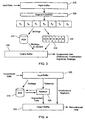
- Fig. 1 is a block diagram of an encoder that encodes a data stream or block using segmentation based on content and segment references.
- Fig. 2 is a block diagram of a decoder that decodes a data stream or block using segmentation bindings from a persistent segment store.
- Fig. 3 is a diagram illustrating an encoding process in more detail.
- Fig. 4 is a diagram illustrating a decoding process in more detail.
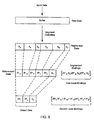
- Fig. 5 is a diagram illustrating a hierarchical encoding process.
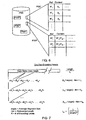
- Fig. 6 is an illustration of a persistent segment store having a plurality of level segment stores.
- Fig. 7 diagrammatically illustrates a problem with using too few encoding levels.
- Fig. 8 diagrammatically illustrates a problem with using too few encoding levels.
- Fig. 9 is an illustration of a persistent segment store organized to hold arbitrary depth of references.
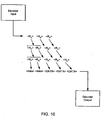
- Fig. 10 illustrates a decoding process using the persistent segment store of Fig. 9 .
- Fig. 11 illustrates hierarchical content-induced segmentation.
- Fig. 12 is a block diagram of a networked client-server pair where some traffic between the client and the server is routed through a client-side transaction accelerator (“CTA”) and a server-side transaction accelerator (“STA”).
- CTA client-side transaction accelerator
- STA server-side transaction accelerator
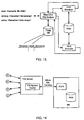
- Fig. 13 illustrates a file system using hierarchical content-induced segmentation.
- Fig. 14 illustrates a near-line file system (NLFS) and file server front end.
- NLFS near-line file system
- Coding can be done by a number of different devices, which might involve hardware, software, or both. Coding can be done with a computer, computing device, peripheral, electronics, or the like, and/or using an application being executed or controlled by such element. Coding might be done incident to a transport process, such as that described in McCanne I.
- the coding apparatus and processes described herein the responsiveness of transactions over a network can be improved by lessening the number of bits that need to be transmitted at critical times over critical channels.
- the coding system may be integrated into a stand-alone storage system to optimize capacity. In this environment, the effective capacity of a storage system can be enhanced as the coding system described herein extracts common sequences of data and stores them just once, even if the sequence appears potentially many times, in potentially many different files.
- Fig. 1 illustrates the particular inputs that an encoder might have.
- an encoder has an input for receiving input data and inputs for parameters, such as target segment size, window size and other control parameters, as well as outputs for the output data and bindings generated in the encoding process, which are stored in a persistent segment store (PSS) 210 as needed.
- PSS persistent segment store
- encoder 200 would process input data, identify segments of data, replace the segment's data with a reference, provide the segment data and a segment reference to PSS 210 in the form of a binding and output the encoded data.
- the encoded output data might include unreferenced segment data, embedded bindings and/or reference labels for referenced segments. In the simplest case, the output data is entirely reference labels.
- the target segment size parameter is used by the encoder to control the average size of a segment.
- segments are variable length and there are design tradeoffs in selection of this size as described below.
- Fig. 2 illustrates a decoder 300 and a PSS 310, which together perform decoding that is the inverse of the encoding done by encoder 200.
- the encoded data might comprise references, bindings and unreferenced residual data.
- decoder 300 encounters a binding in received data, it can use the segment data in that binding to reconstruct the original data and it can also store the binding in its PSS.
- decoder 300 encounters a reference without a binding, it can use the reference to obtain segment data from PSS 310 to reconstruct the segment. If the segment reference is not found in PSS 152, decoder 300 can send a request for the segment data.
- Fig. 3 is a diagram illustrating an encoding process in more detail.
- input data to be encoded is stored in buffer 220, segmented by segment delimiter 222, which creates the output references and bindings for PSS 210.
- the output references, unreferenced segments, such as segment 224, and bindings as needed are provided to an output buffer 230 to form the output of the encoder.
- Fig. 4 is a diagram illustrating a decoding process in more detail. As shown there, encoded data is buffered in an input buffer 320. From the buffer contents, bindings are extracted and stored in PSS 310. Reference labels are provided to a replacer 325 that replaces them with the referenced segment data and places the data in an output buffer 330. Unreferenced segment data is output directly to output buffer 330 for eventual output as the reconstructed data.
- one aspect of the encoding process is the segmentation of input data.
- identifying "cut points" such as offsets in the input data where one segment ends and the next segment begins, is equivalent to segregating the input data into separate data structures, or the like.
- segment boundaries should always appear in the same place for the same sequences of data, regardless of the context in which that data appeared. If that were the case, commonly repeated patterns of data would be segmented in the same way over each repetition of data and a system can be designed to efficiently identify these repeated patterns. For example, a particular data sequence (such as pieces of a widely used GIF image or pieces of a bitmap representing a commonly used graphical icon) that appears in many different locations in larger files (such as a word processing document, slide presentation document, or on a Web page) will always be found and segmented in the same way, regardless of what data surrounds it.
- a particular data sequence such as pieces of a widely used GIF image or pieces of a bitmap representing a commonly used graphical icon
- the segmentation scheme herein uses information in the data itself to guide the segmentation process rather than externally imposed parameters like block sizes, transaction boundaries, etc.
- the various values and structure of the input symbols guide the segmentation process (as described below). Consequently, the system has a "self-synchronizing" property where if similar data patterns are presented to its input, the same segment boundaries are detected, inducing the formation of the same segments that have been seen in the past.
- this means that the system is robust to insertions, deletions, or other changes in the underlying input data, in that once a previously present segment boundary is found, the new segment will match an existing segment from that point on (assuming the data pattern from that point on has been seen in the past).
- content-induced segmentation Because this scheme is guided by the content of the input, it is described herein as "content-induced segmentation".
- content-induced segmentation By applying content-induced segmentation to an input stream with repeated patterns across very large time scales (i.e., exhibiting LRD statistics), the same segments are created without having to keep track of the entire history of data patterns that have been seen in the past. That is, the segmentation process can simply segment the input based on the input itself without having to search over the existing data patterns already found. While, in general, this approach does not produce the optimal segmentation (i.e., maximizing the size of segments while simultaneously maximizing the number of repeated segments found), it provides a good tradeoff between complexity and performance - the scheme is effective at exploiting certain types of LRD while leading to an efficient and practical implementation.
- a segmenter such as segment delimiter 222 in Fig. 3 operates on a portion (or all) of a set of input data.
- the segmenter batches up a certain number of input symbols (determined by the current offset and the window size parameter) and computes a hash function over the window. This is referred to as the fingerprint of the window.
- a deterministic fingerprint indicator function returns a Boolean value for each fingerprint indicating whether the offset is to be considered a cut point and thereby defines a segment boundary.
- the window does not extend beyond either end of an application data unit (ADU), so that each window contribution is from exactly one ADU.
- the encoder is provided an indication in an input data stream where one ADU ends and another one starts.
- the fingerprint indicator function values are 1 and 0, 1 might represent a cut point and 0 represent other than a cut point.
- 1 might represent a cut point and 0 represent other than a cut point.
- the function evaluates to 1 for a given fingerprint having a given offset and window, a new segment is created at the symbol defined by the first symbol of the input data (in order according to an input data order).
- the function evaluates to 0, then one more input symbol is consumed and the window is advanced to cover this new symbol (and the least current symbol is removed from the window but remains in the current segment).
- the target segment size can thus be controlled as a parameter of the fingerprint indicator function.
- the Bernoulli distribution function of a random variable, parameterized by the target segment size can be used to map the hash value into the indicator value.
- the parameter can be chosen such that on average, assuming a random distribution of fingerprint inputs, 1 out of M times, the function evaluates to true.
- the segment size is going to be M+W bytes, where W is the window size in use (because a segment is at least W bytes large).
- W is the window size in use (because a segment is at least W bytes large).
- the value of M determines the target segment size.
- a variation of the segmentation process allows the window to define the start of a segment boundary instead of the end of a boundary. This allows segments to be arbitrarily small, since the pattern of data used to define the fingerprint window is not necessarily consumed as part of the segment.
- an explicit fingerprint window is not needed. Instead, a hash function is computed over a variable number of input symbols. As each input symbol is consumed, the fingerprint function is re-computed over the entire buffer of consumed symbols. Again, a subsequent indicator function applied to the fingerprint decides when and if to insert a new segment boundary at the current point in the input.
- This approach is in general less efficient than the previous approach, because changes in data near the start of a segment impact the segmentation process going forward. Consequently, segment boundaries that would have otherwise been created and matched against previous segments are missed due to changes in data that can be far removed from the desired segment boundary.
- the windowing approach described earlier accomplishes exactly this goal.
- the fingerprint hashing scheme can be made efficient by using a hash function that can be incrementally updated as input symbols are read. Examples of efficient generation of hash functions for incrementally updated windows are known and need not be described in further detail here. See, for example, Rabin, "Fingerprinting by Random Polynomials", Technical Report TR-15-81, Dept. of Comp Sci., Harvard University (1981 ).
- the segment is compared against all the existing segments that are stored in the PSS.
- This lookup process can be made efficient by maintaining an index of segments keyed by a hash function computed over the segment data (either the entire segment content, portions of the segment content, the segment fingerprint value, or combinations thereof). For each hash value, the index contains the set of segments present in the PSS that hash to that value.
- the encoder computes the hash for the segment in question and performs a lookup on the segment index using said hash. If the lookup fails, the segment cannot be in the PSS. If the lookup succeeds, the encoder can compare each segment returned by the lookup to the segment in question to check for an exact match. This handles the rare case that multiple segments hash to the same hash index.
- the binding (reference label, segment data) is entered into the PSS.
- the binding can be compressed, but in the simplest case where the PSS is not constrained, the binding might be stored as a record in a database with fields in each record for storing a string representing the reference label and data representing the segment data.
- the segment data within the binding could be itself compressed using a traditional compression algorithm that effectively exploits the short-range dependence present in any segment data. This could be especially useful in the non-terminal segments (described below) that comprise strings of labels that could have a high degree of redundancy depending on the details of the segment naming scheme.
- the original input data is represented as a sequence of references labels bound to data objects stored in the PSS.
- Some of the data might not be replaced by reference labels, such as where it is determined that replacement of a particular segment (for example, segment 224 in fig. 3 with a reference label will not substantially improve performance.
- all of the segments are represented with reference labels.
- reference labels might not be compactly represented, resulting in more bits being used for sequence 226 than necessary. If that is the case, reference labels might be in turn be compressed using traditional methods for compression, e.g., differential encoding of the reference labels followed by run-length coding and or Huffman coding, or other approaches.
- Fig. 4 illustrates a decoding process, which is the inverse of what is shown in Fig. 3
- the encoded data (reference labels and possibly also bindings and unreferenced segment data) is received into input buffer 320. From that input buffer data, bindings are extracted and stored in PSS 310 and unreferenced segment data is moved to output buffer 330.
- Referenced segments which are represented in the encoded data as reference labels (or compressed reference labels), are replaced with their segment data by replacer 325 using the reference labels to locate bindings in PSS 310 and thus obtain the corresponding segment data. Since reference labels are unique for unique data, the correct segment data can always be provided. If the referenced bindings are not present in PSS 310, they can be requested from, for example, PSS 210. Where encoding is done for storage purposes, PSS 210 and PSS 310 might one data structure, written by the encoder and read by the decoder.
- the parameters for the encoding process need to be chosen carefully for good performance. If the target segment size is chosen to be very large, then the effective compression ratio might be high, as large numbers of symbols are grouped into segments and replaced with a relatively small number of bits representing the segment's reference label. However, a large target block size might tend to miss finer-grained repetitions of data, and add to the overhead of storing and moving multiple versions of nearly similar segment data. On the other hand, if the target segment size is chosen to be very small, the compression ratio might be low, as the number of bits required to represent a reference label might not be substantially less than the number of bits in the original segment data. In general, the degree to which a particular segmentation scheme is effective depends on the underlying statistics of the data. This problem can be solved by introducing hierarchy into the reference label scheme. This approach is referred to herein as Hierarchical Content-Induced Segmentation (HCS).
- HCS Hierarchical Content-Induced Segmentation
- hierarchical referencing can be used.
- input data to be encoded might be segmented using a small target block size, yielding many reference labels.
- the reference labels are in turn grouped and replaced with group labels, with reference bindings (group labels, sequence of reference labels forming the group) stored in a PSS-like structure.
- group labels sequence of reference labels forming the group
- the target block size is chosen to be relatively small.
- a small target block size can be expected to result in a more verbose encoded reference stream, but the hierarchical referencing will tend to reduce the overhead of having many reference label patterns repeat, in effect having each resulting label in the final result represent as large a span of the input data as can be found repeating.
- the hierarchical referencing can use a different target block size at each level that is tuned to the relative size of the reference names at that level, or it can use the same size. Similarly it might use a different fingerprint function and/or a different fingerprint window size at each level in the hierarchy, or use the same functions uniformly throughout
- FIG. 5 An example of hierarchical reference encoding is shown in Fig. 5 .
- An input buffer is loaded with input data to be encoded and that input data is segmented into segments S A , S B , S C , S D , S E and S F .
- the first five segments are to be replaced with references and the references happen to be R 1 15 , R 1 16 , R 1 17 , R 1 3 and R 1 8 .
- the references are not necessarily in order, and this example illustrates that some references (e.g., R 1 3 and R 1 8 .) might be to segment data that were already encountered, in which case a new segment is not used, but the reference is to the preexisting segment.
- the encoder would then determine, for example, that the sequences (R 1 15 , R 1 16 , R 1 17 ) and (R 1 3 , R 1 8 ) recur frequently, so that they can be grouped and replaced with group labels, such as R 2 1 and R 2 2 , respectively.
- group labels such as R 2 1 and R 2 2 , respectively.
- the encoder re-applies the method of content-induced segmentation to the reference label sequence, yielding similar benefits to the original approach but at a higher-level (i.e., relatively low complexity and the ability to find patterns in the input sequence independent of shifts and localized changes to the underlying data).
- the segmenter decided that the sequence (R 2 1 , R 2 2 , S F ) corresponded to a new segment at this higher layer (by reapplying a fingerprint function, window, and indicator), the original input data can then be represented by a reference to the new segment (R 2 1 , R 2 2 , S F ).
- a binding would be entered into the PSS that related the new reference label to the new higher-level segment.
- the final sequence can have reference labels and group labels from any or all levels. As needed, the segment bindings and the reference bindings are stored and/or provided to the decoder.
- the PSS is structured as a set ofN (some indeterminate integer greater than one) binding tables PSS 1 , PSS 2 ,..., PSS N .
- Binding table PSS 1 provides bindings between reference labels and segment data.
- Binding table PSS 2 provides bindings between reference label sequences and group labels.
- Other binding tables provide bindings for groups of groups of reference labels, and so on. This is illustrated in Fig. 6 .
- the binding tables can store an arbitrary string of bits for each segment and an arbitrary sequence of reference labels.
- PSS 1 would hold the bindings (R 1 15 , S A ), (R 1 16 , S B ), (R 1 17 , S C ), (R 1 3 , S D ) and (R 1 8 , S E ) and PSS 2 would hold the reference bindings (R 2 1 , R 1 15 +R 1 16 +R 1 17 ) and (R 2 2 , R 1 3 +R 1 8 ).
- the reference grouping can have a variable depth determined at run time. This eliminates the problem of having to choose a value for N that would work over all types and sizes of data.
- Fig. 9 is an illustration of a persistent segment store organized to hold an arbitrary depth of references to address this issue. There, instead of each reference label having a specified level (the superscript in the above example), all the references are treated equally, whether they are reference labels for a sequence of segment data symbols, a sequence of reference labels, or a combination of the two. As shown in Fig. 9 , reference label R 1 is bound to segment data S A , reference label R 2 is bound to segment data S B , reference label R i is bound to a group of reference labels (R 3 , R 7 , R 9 ), and so on.
- the decoder should be informed of the number of levels of hierarchy present at any given point in time. Thus, this information should be somehow conveyed in the coded bit stream.
- the coded reference stream explicitly indicates the number of levels verbatim in the bit stream with special codes. In this scheme, when the encoder changes the number of levels in use, it would emit a code to explicitly indicate the change.
- the adaptive level structure can be conveyed in the encoded output by marking each segment (as conveyed in a binding) explicitly as being either non-terminal or terminal, as shown in Fig. 10 .
- terminal segments represent strings of the final output data while non-terminal segments represent strings of labels.
- This information would be stored as a "leaf bit" in the PSS, indicating for each binding, whether it terminates the hierarchy and represents the final output data or whether it refers to a sequence of labels that refer to other bindings.
- a set leaf bit (e.g., a "1") indicates that the record is for a terminal segment and the contents of the record are segment data without any further delimiters and a cleared leaf bit (e.g., a "0") indicates that the record is a sequence of reference labels. Where reference labels are fixed length or have unique decipherability, no space is needed to delimit the references in the group.
- the content of each record is encoded such that a reader can determine whether the content includes references or is all just segment data without the presence of a specific leaf bit.
- the encoder consumes the input data stream, it generates new references and appends them to a sequence of first-level reference labels. Each time a new reference is appended to this growing block of labels, the encoder determines whether a segment boundary should be defined using content-induced segmentation applied to the reference label sequence. Thereby, a fingerprint is computed over the label sequence using a fingerprint window and a fingerprint indicator function dictating where to create a new segment boundary. Note that these parameters are independent of the decoding process and do not need to be known by the decoder (rather, they control performance tradeoffs at the encoder). If the fingerprint function indicates that the newly appended reference does not cause the sequence to define a segment boundary, the encoder continues consuming the next input data symbol.
- a new segment is defined comprising the string of reference labels.
- this new segment is compared against all the existing segments in the appropriate PSS. If an existing segment is found, the existing reference label for that segment is retrieved from the PSS. If no segment is found, a new label is assigned to the block of reference labels and a new binding is added to the PSS (and potentially the output stream). In either case, the second-level label can now be used to express the sequence of first-level reference labels. This new label is then appended to a growing sequence of second-level reference labels.
- the encoding process examines this second-level reference sequence, applying content-induced segmentation to the second-level sequence of reference labels, again determining if there is a segment boundary and if so, generating a third-level reference for the segment of second level labels.
- This process repeats incrementally for subsequent levels of hierarchy, in each case "bubbling up" new reference definitions to the next higher level. In this manner, a large block of data passing through the encoder will likely pass through the recursion multiple times, whereas a small block of data would not undergo unnecessary encoding levels.
- Fig. 11 illustrates a decoding process using the persistent segment store of Fig. 9 , wherein each reference label is replaced with the content of its binding. If the segment content contains a sequence of references, these references are in turn replaced, and the process repeats until all of the reference labels refer to terminal nodes and then the segment data can be output.
- the decoder recursively resolves reference blocks, terminating when it reaches a data segment.
- the encoded stream is equivalent to a hierarchical tree of references where the segments at the leaves of the tree are marked (via the terminal flag) to indicate where the decoding traversal should halt.
- Fig. 11 illustrates one such example.
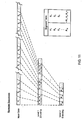
- the input stream contains an initial sequence of data bytes that is cut into three segments: S 1 , S 2 , and S 3 . These segments are allocated references R 1 , R 2, and R 3 . In this example, the remaining input stream contains, among other symbols, the same data repeated twice more. Because the segment cut points are defined as a function of the content, the same segment boundaries will be detected and found in the PSS, and so the same sequence of references will be output.
- the hierarchical encoding determines that the sequence of references ⁇ R 1 , R 2 , R 3 > defines a cut point for new segment, labeled R 10 , then again, the single label R 10 can be used to identify the repeated sequence later on in the input stream.
- Fig. 12 illustrates an example of a system where HCS coding described herein might be used.
- a client 612 is coupled to a server 614 over a network 616, via a client-side transaction accelerator (“CTA”) 620 and a server-side transaction accelerator (“STA”) 622. While only one client and one server are shown, it should be understood that the CTA and STA might well operate with multiple clients and/or multiple servers.
- CTA client-side transaction accelerator
- STA server-side transaction accelerator
- Client 612 is coupled to a client proxy 630 of CTA 620.
- the other elements of CTA 620 shown in Fig. 12 include a transaction transformer (TT) 632, an inverse transaction transformer (TT -1 ) 634, a persistent segment store (PSS) 636 and a reference resolver (RR) 638.
- Server 614 is coupled to a server proxy 640 of STA 622, which is shown including elements similar to those of CTA 620, such as a transaction transformer (TT) 642, an inverse transaction transformer (TT -1 ) 644, a persistent segment store (PSS) 646 and a reference resolver (RR) 648.
- TT transaction transformer
- TT -1 inverse transaction transformer
- PSS persistent segment store
- RR reference resolver
- Client 612 is coupled to client proxy 630, which is coupled to TT 632 and TT -1 634.
- TT 632 is coupled to PSS 636 and to the network between CTA 620 and STA 622.
- TT -1 634 is coupled to PSS 636, client proxy 630, RR 638 and to the network between CTA 620 and STA 622.
- RR 638 is also coupled to PSS 636 and to the network between CTA 620 and STA 622.
- server 614 is coupled to server proxy 640, which is coupled to TT 642 and TT -1 644.
- TT 642 is coupled to PSS 646 and to the network between STA 622 and CTA 620.
- TT -1 644 is coupled to PSS 646, server proxy 640, RR 648 and to the network between STA 622 and CTA 620.
- RR 648 is also coupled to PSS 646 and to the network between STA 622 and CTA 620.
- TT 632 generally sends information in the direction of TT -1 644, but that might involve data such as confirmations, handshakes, etc., flowing from TT -1 644 to TT 632.
- the CTA's and STA's segment the payloads of their transactions where warranted and store/cache strings or other sequences of data ("segments") derived from those payloads using a unique naming scheme that can be independent of the transaction and when sending the payload from one TA to another, substitutes in references to the segments for the segment data when the segment data is such that the sender can expect that the receiver would have that uniquely named segment data, either because it appeared in an earlier transaction or was sent through other processes to the receiver.
- client-server interactions may involve the transfer of file data from the server to the client, though this is just one special case of a client-server transaction-oriented application.
- client 612 might request a number of files from server 614 by sending file open requests to server 614.
- These requests would be proxied by client proxy 630, which would interact with STA 622, which in turn proxies the requests to server 614 via its proxy 640.
- client proxy 630 routes the requests to TT 632, which being file open requests, will probably not be encoded.
- the response from server 614 is assumed to contain a payload comprising a portion of the request files.
- a server first responds to a file request message with a short response and only includes a payload when the client makes a file read request on an open file.
- the server is returning file contents as payload.
- server proxy 640 When server proxy 640 receives the response message and its payload, it conveys the data to TT 642, which encodes the response message (or just its payload), as is described below, and adds any bindings it creates to PSS 646, if they do not already exist, and sends the encoded message to TT -1 634, which reconstructs the message and relays it to client 612 via client proxy 630.
- TT -1 634 can reconstruct the message because it has the bindings to replace segment references in the message. Those bindings come from PSS 636 and where they are not in PSS 636, reference resolver 638 can get the bindings from reference resolver 648. In this manner, messages can be encoded and decoded transparent to the message sender and recipient.
- each TT creates bindings, it assigns globally unique reference labels so that a recipient of a reference label will always be able to replace it with unambiguous segment data.
- Several schemes are usable to ensure unique names, as described in McCanne I.
- HCS HCS within a file system.
- HCS HCS Encoder and HCS Decoder
- a better approach is to apply HCS to a file system that employs whole-file accesses rather than block-based accesses.
- the system shown in Fig. 13 implements a file system with a whole-file interface and leverages HCS. That is, clients store, retrieve, and delete entire files instead of individual pieces of files. While this approach typically could not support a standard file-system interface, it is well suited for other uses of file systems, e.g., as the foundation of backup system.
- a disk-based, on-line backup system where access is slower than a native file system but faster than a traditional backup system (e.g., based on tape), is often called “near-line” storage to describe the compromise between a high-performance, on-line file system and low-performance, off-line backup system.
- a traditional backup system e.g., based on tape
- NLFS near-line file system
- a client can store, retrieve, and delete whole files.
- the NLFS employs an HCS Encoder, PSS, and HCS Decoder to efficiently store file data such that only a single copy of each common segment need be stored once.
- the NLFS employs a data base table, called the "file map data base (FMDB)", to map file names to the top-level label (or labels) that represents a particular file.
- FMDB includes a time stamp field so that the file system may contain multiple copies of the same file that represent the file at different points in time.
- a client stores or updates a file by sending a "STORE" command to the file system followed by the file name and file data.
- the file system then transmits all of the file data to the HCS Encoder, which returns one or more labels that represent the stored file. Those labels are then entered into the FMDB as part of the tuple representing the new or updated file. Included in this tuple is the corresponding file name and current time stamp (taken from a time-of-day clock, for example).
- a client sends a "RETRIEVE" command to the file system along with the filename and optional time stamp.
- the file system in turn sends a query to the FMDB with the file name as the key, retrieving all tuples that contain said file name. If there are no such tuples, an error is returned to the client.
- the file system selects the tuple with the greatest time stamp that is less than or equal to the specified time stamp. If no time stamp is specified in the command, the tuple with the greatest time stamp is chosen. This has the effect of choosing the version of the file that was stored in the system at the requested time.
- the file system sends the label string from the selected tuple to the HCS Decoder.
- the HCS Decoder in turn decodes the labels into file data and returns that data to the file system.
- the file system then returns the file data to the client.
- this process could be pipelined such that the file system could deliver file data to the client as the decoder delivers the decoded file to the file system.
- a client sends a "DELETE" command to the file system along with the filename and an optional time range, telling to delete all files that were stored with respect to the time range specified.
- the NLFS looks up and removes the corresponding entries from the FMDB and deletes the corresponding labels from the PSS.
- the NLFS component is deployed in a standard backup architecture and interfaces with clients desiring backup service through standard protocols like NDMP.
- HCS can be used as a complementary component of a more standard, operating system-based file system by combing the NLFS described above with a file system front-end.
- Fig. 14 shows NLFS and a file server front-end.
- the file server reads the file from the NLFS system and copies the file into a local file system.
- This file is effectively cached in the local front-end file system, which allows the file server to employ normal file system protocols and algorithms for managing the open file.
- UFS unix file system
- NLFS NLFS
- UFS unix file system
- UFS uses directories to map file names to disk data structures.
- the directory entry for a file points to an index node (or inode).
- UFS thus, could be extended with a new inode type that contains a reference to a file in NLFS.
- UFS checks for the new inode type and when this is the case, reads the file from the NLFS.
- UFS then writes the returned file data in the local file system effectively formatting the file data onto local disk using normal inode data structures.
- the single inode pointing to an NLFS file is replaced with a multitude of inodes and disk blocks to represent the actual file locally.
- the client open call finishes. Thereafter, all client file activity proceeds identically to the traditional UFS model (including cases where multiple clients open the same file simultaneously) and any file updates or changes are reflected in the local file copy.
- the modified UFS then reads the file data from local file system (using the normal inode data suctures) and writes this data back to the NLFS.
- the inodes representing the file data can be freed up and replaced with a single inode of the new type that points to NLFS.
- the file can be copied out the NLFS in this fashion without necessarily freeing up the local copy of the file so that future accesses to the file do not need to wait for NLFS.
- the UFS could free up files using the method describe above by applying any number of the numerous well-known cache replacement policies (e.g., least recently used, least frequently accessed, and so forth).
Landscapes
- Engineering & Computer Science (AREA)
- Theoretical Computer Science (AREA)
- Compression, Expansion, Code Conversion, And Decoders (AREA)
- Compression Or Coding Systems Of Tv Signals (AREA)
- Communication Control (AREA)
- Compression Of Band Width Or Redundancy In Fax (AREA)
- Information Transfer Between Computers (AREA)
- Information Retrieval, Db Structures And Fs Structures Therefor (AREA)
Claims (8)
- Verfahren zum Codieren von Eingangsdaten in einem System, wobei die Eingangsdaten Sequenzen (SA - SG) von Symbolen umfassen, die sich in den Eingangsdaten wiederholen oder in anderen in dem System codierten Eingangsdaten auftreten, wobei das Verfahren umfasst, dass(a) innerhalb einer Anzahl von sequentiellen Eingangsdatensymbolen, die durch einen Offset und eine Fenstergröße definiert ist, eine Fingerabdruckdarstellung der Anzahl von sequentiellen Eingangsdatensymbolen identifiziert wird;(b) aus der Fingerabdruckdarstellung ermittelt wird, ob der Offset als ein Grenzpunkt zu bezeichnen ist, wobei ein Grenzpunkt die Stelle angibt, an der ein erster Satz von Eingangsdatensymbolen (SA) endet und ein nächster Satz von Eingangsdatensymbolen (SB) beginnt;(c) die obigen Schritte des Identifizierens und Ermittelns wiederholt werden, um zu einem Satz von Grenzpunkten zu gelangen;(d) die Eingangsdaten wie durch den Satz von Grenzpunkten angegeben segmentiert werden;
wobei das Verfahren dadurch gekennzeichnet ist, dass es ferner umfasst, dass(e) für jedes Segment (SA - SF) ermittelt wird, ob eine Leistungsverbesserung erreicht wird, indem auf das Segment durch einen Bezeichner anstatt auf das Segment selbst Bezug genommen wird, wobei das Segment ein Segment (SA) mit Referenz ist, wenn eine Leistungserbesserung erreicht wird oder es ansonsten ein Segment (224, SF) ohne Referenz ist;(f) für jedes Segment (SA) mit Referenz die Segmentdaten des Segments (SA) mit Referenz durch ein Referenzkennzeichen (R1 15) ersetzt werden;(g) für jedes Segment (SA) mit Referenz, das nicht bereits in einem persistenten Segmentspeicher (210, 310, 636 und 646) vorhanden ist, eine Referenzverbindung (R1 15, SA) in dem persistenten Segmentspeicher (210, 310, 636 und 646) gespeichert wird, wobei eine Referenzverbindung (R1 15, SA) das Referenzkennzeichen und die Daten des Segments mit Referenz umfasst und die Daten des Segments mit Referenz mit deren Referenzkennzeichen (R1 15) assoziiert;(h) ermittelt wird, ob irgendein Teil einer Sequenz (226), die Referenzkennzeichen (R) umfasst, häufig wieder auftritt, wobei ein Teil einer Sequenz auf der Grundlage einer Häufigkeit eines Wiederauftretens als eine Referenzgruppe (R1 3, R1 8) gruppiert wird;(i) für jede Referenzgruppe die Referenzgruppe (R1 3, R1 8) durch ein Gruppenkennzeichen (R2 2) ersetzt wird; und(j) für jede Referenzgruppe, die nicht bereits in dem persistenten Segmentspeicher (210, 310, 636 und 646) vorhanden ist, eine Gruppenreferenzverbindung (R2 2, R1 3 + R1 8) in dem persistenten Segmentspeicher (210, 310, 636 und 646) gespeichert wird, wobei eine Gruppenreferenzverbindung (R2 2, R1 3 + R1 8) die Referenzgruppe (R1 3 + R1 8) mit ihrem Gruppenkennzeichen (R2 2) assoziiert. - Verfahren nach Anspruch 1, das ferner umfasst, dass
Gruppen von Kennzeichen rekursiv in Gruppen einer höheren Ebene identifiziert werden, wobei Gruppen von Kennzeichen eine oder mehrere von Gruppen von Referenzkennzeichen und Gruppen von Gruppenkennzeichen umfassen;
für jede Gruppe einer höheren Ebene die Gruppe einer höheren Ebene durch ein Gruppenkennzeichen ersetzt wird; und
für jede Gruppe einer höheren Ebene, die nicht bereits in dem persistenten Segmentspeicher (210, 310, 636 und 646) vorhanden ist, eine Gruppenreferenzverbindung in dem persistenten Segmentspeicher (210, 310, 636 und 646) für die Gruppe einer höheren Ebene gespeichert wird. - Verfahren nach Anspruch 1,
wobei die Eingangsdaten Nutzdaten von Nachrichten zwischen Clients (612) und Servern (614) in einem Client-Server-Netz umfassen. - Verfahren nach Anspruch 1,
wobei die Eingangsdaten Teile von Dateien in einem Online-Backup-System umfassen, ferner umfassend, dass Dateien in dem Online-Backup-System als Sequenzen (226) von Referenzkennzeichen und/oder Gruppenkennzeichen dargestellt werden und Inhalte des persistenten Segmentspeichers (210, 310, 636 und 646) als Teil des Online-Backup-Systems gespeichert werden. - Verfahren nach Anspruch 1,
wobei die Eingangsdaten einen Teil von Dateien in einem Dateisystem umfassen, ferner umfassend, dass Dateien in dem Dateisystem als Sequenzen (226) von Referenzkennzeichen und/oder Gruppenkennzeichen und/oder einem Segmentspeicher dargestellt werden. - Verfahren nach Anspruch 1,
wobei die Eingangsdaten einen Teil von in einem Dateisystem zu verwendenden Dateien umfassen, wobei das Verfahren ferner umfasst, dass, wenn eine Datei in dem Dateisystem gespeichert wird, sie mit mindestens einem Segment (S1) der Datei codiert wird, die als ein Segment (S1) dargestellt wird, auf das in dem persistenten Segmentspeicher (210, 310, 636 und 646) Bezug genommen wird; und wenn eine Datei von dem Dateisystem abgerufen wird, die Datei in einem lokalen Dateispeicher als decodierte Datei gepuffert wird,
wobei jedes Referenzkennzeichen und jedes Gruppenkennzeichen durch entsprechende Segmentdaten von dem persistenten Segmentspeicher (210, 310, 636 und 646) ersetzt wird. - Verfahren nach Anspruch 1, das ferner umfasst, dass die codierten Daten an einen Empfänger gesendet werden.
- Verfahren nach Anspruch 1,
wobei die Segmentierung, die verwendet wird, um zu ermitteln, ob irgendein Teil einer Sequenz (226), die Referenzkennzeichen (R) umfasst, als eine Referenzgruppe (R1 3, R1 8) gruppiert werden soll, umfasst, dass auf die Sequenz (226) die Schritte (a) - (d) angewandt werden.
Priority Applications (1)
| Application Number | Priority Date | Filing Date | Title |
|---|---|---|---|
| EP09006966A EP2093885A1 (de) | 2002-10-30 | 2003-10-28 | Inhaltsbasiertes Segmentierungsschema für Datenkomprimierung bei Speicherung und Übertragung |
Applications Claiming Priority (3)
| Application Number | Priority Date | Filing Date | Title |
|---|---|---|---|
| US285330 | 2002-10-30 | ||
| US10/285,330 US6667700B1 (en) | 2002-10-30 | 2002-10-30 | Content-based segmentation scheme for data compression in storage and transmission including hierarchical segment representation |
| PCT/US2003/034327 WO2004042930A2 (en) | 2002-10-30 | 2003-10-28 | Content-based segmentation scheme for data compression |
Related Child Applications (1)
| Application Number | Title | Priority Date | Filing Date |
|---|---|---|---|
| EP09006966A Division EP2093885A1 (de) | 2002-10-30 | 2003-10-28 | Inhaltsbasiertes Segmentierungsschema für Datenkomprimierung bei Speicherung und Übertragung |
Publications (3)
| Publication Number | Publication Date |
|---|---|
| EP1584139A2 EP1584139A2 (de) | 2005-10-12 |
| EP1584139A4 EP1584139A4 (de) | 2006-04-26 |
| EP1584139B1 true EP1584139B1 (de) | 2009-07-22 |
Family
ID=29735736
Family Applications (2)
| Application Number | Title | Priority Date | Filing Date |
|---|---|---|---|
| EP03781454A Expired - Lifetime EP1584139B1 (de) | 2002-10-30 | 2003-10-28 | Auf inhalt basierendes segmentierungsschema für die datenkomprimierung bei der speicherung und übertragung mit hierarchischer segmentrepräsentation |
| EP09006966A Ceased EP2093885A1 (de) | 2002-10-30 | 2003-10-28 | Inhaltsbasiertes Segmentierungsschema für Datenkomprimierung bei Speicherung und Übertragung |
Family Applications After (1)
| Application Number | Title | Priority Date | Filing Date |
|---|---|---|---|
| EP09006966A Ceased EP2093885A1 (de) | 2002-10-30 | 2003-10-28 | Inhaltsbasiertes Segmentierungsschema für Datenkomprimierung bei Speicherung und Übertragung |
Country Status (8)
| Country | Link |
|---|---|
| US (7) | US6667700B1 (de) |
| EP (2) | EP1584139B1 (de) |
| JP (3) | JP4512893B2 (de) |
| CN (2) | CN1736030B (de) |
| AT (1) | ATE437477T1 (de) |
| AU (1) | AU2003288962A1 (de) |
| DE (1) | DE60328528D1 (de) |
| WO (1) | WO2004042930A2 (de) |
Families Citing this family (223)
| Publication number | Priority date | Publication date | Assignee | Title |
|---|---|---|---|---|
| US7509420B2 (en) * | 2000-02-18 | 2009-03-24 | Emc Corporation | System and method for intelligent, globally distributed network storage |
| FR2813743B1 (fr) * | 2000-09-06 | 2003-01-03 | Claude Seyrat | Procede de compression/decompression de documents structures |
| US6810398B2 (en) * | 2000-11-06 | 2004-10-26 | Avamar Technologies, Inc. | System and method for unorchestrated determination of data sequences using sticky byte factoring to determine breakpoints in digital sequences |
| US7003479B2 (en) * | 2000-12-15 | 2006-02-21 | First Data Corporation | Systems and methods for ordering and distributing incentive messages |
| US20020161860A1 (en) * | 2001-02-28 | 2002-10-31 | Benjamin Godlin | Method and system for differential distributed data file storage, management and access |
| US6976081B2 (en) * | 2002-01-30 | 2005-12-13 | Motorola, Inc. | Session initiation protocol compression |
| US7493911B2 (en) * | 2002-08-09 | 2009-02-24 | The Boeing Company | Shrouded valve apparatus and related methods |
| US8176186B2 (en) | 2002-10-30 | 2012-05-08 | Riverbed Technology, Inc. | Transaction accelerator for client-server communications systems |
| US7318100B2 (en) * | 2003-04-14 | 2008-01-08 | Riverbed Technology, Inc. | Cooperative proxy auto-discovery and connection interception |
| US7120666B2 (en) * | 2002-10-30 | 2006-10-10 | Riverbed Technology, Inc. | Transaction accelerator for client-server communication systems |
| US8364815B2 (en) | 2005-03-18 | 2013-01-29 | Riverbed Technology, Inc. | Reliability and availability of distributed servers |
| US7650416B2 (en) * | 2003-08-12 | 2010-01-19 | Riverbed Technology | Content delivery for client-server protocols with user affinities using connection end-point proxies |
| US6667700B1 (en) * | 2002-10-30 | 2003-12-23 | Nbt Technology, Inc. | Content-based segmentation scheme for data compression in storage and transmission including hierarchical segment representation |
| DE602004028121D1 (de) | 2003-01-31 | 2010-08-26 | Visto Corp | Asynchrones echtzeit-abrufen von daten |
| EP1620951A4 (de) * | 2003-05-08 | 2006-06-21 | Sap Portals Israel Ltd | Mustergesteuerte nachrichtenorientierte kompressionsvorrichtung und verfahren |
| US7296030B2 (en) * | 2003-07-17 | 2007-11-13 | At&T Corp. | Method and apparatus for windowing in entropy encoding |
| US8938595B2 (en) * | 2003-08-05 | 2015-01-20 | Sepaton, Inc. | Emulated storage system |
| US7464331B2 (en) * | 2003-08-18 | 2008-12-09 | Microsoft Corporation | System and method for validating hierarchically-organized messages |
| US8135683B2 (en) * | 2003-12-16 | 2012-03-13 | International Business Machines Corporation | Method and apparatus for data redundancy elimination at the block level |
| US7002493B2 (en) * | 2004-01-08 | 2006-02-21 | Mathstar, Inc. | Boolean logic tree reduction circuit |
| US20050169223A1 (en) * | 2004-01-16 | 2005-08-04 | Crocker Ronald T. | Method and apparatus for facilitating a PTT session initiation using an IP-based protocol |
| US20060047855A1 (en) | 2004-05-13 | 2006-03-02 | Microsoft Corporation | Efficient chunking algorithm |
| US7269689B2 (en) * | 2004-06-17 | 2007-09-11 | Hewlett-Packard Development Company, L.P. | System and method for sharing storage resources between multiple files |
| US7613787B2 (en) * | 2004-09-24 | 2009-11-03 | Microsoft Corporation | Efficient algorithm for finding candidate objects for remote differential compression |
| US20060085740A1 (en) * | 2004-10-20 | 2006-04-20 | Microsoft Corporation | Parsing hierarchical lists and outlines |
| US7574409B2 (en) * | 2004-11-04 | 2009-08-11 | Vericept Corporation | Method, apparatus, and system for clustering and classification |
| US7849462B2 (en) * | 2005-01-07 | 2010-12-07 | Microsoft Corporation | Image server |
| US20070094348A1 (en) * | 2005-01-07 | 2007-04-26 | Microsoft Corporation | BITS/RDC integration and BITS enhancements |
| US8073926B2 (en) * | 2005-01-07 | 2011-12-06 | Microsoft Corporation | Virtual machine image server |
| US8332485B1 (en) | 2005-03-04 | 2012-12-11 | Cisco Technology, Inc. | Lock optimization and lock prediction approaches for reducing client-server messages |
| US20060248194A1 (en) | 2005-03-18 | 2006-11-02 | Riverbed Technology, Inc. | Connection forwarding |
| US7098815B1 (en) * | 2005-03-25 | 2006-08-29 | Orbital Data Corporation | Method and apparatus for efficient compression |
| US7853962B1 (en) | 2005-05-31 | 2010-12-14 | Cisco Technology, Inc. | Method and apparatus for optimization of remote procedure call communications |
| US8521752B2 (en) | 2005-06-03 | 2013-08-27 | Osr Open Systems Resources, Inc. | Systems and methods for arbitrary data transformations |
| US8095774B1 (en) | 2007-07-05 | 2012-01-10 | Silver Peak Systems, Inc. | Pre-fetching data into a memory |
| US8392684B2 (en) | 2005-08-12 | 2013-03-05 | Silver Peak Systems, Inc. | Data encryption in a network memory architecture for providing data based on local accessibility |
| US8171238B1 (en) | 2007-07-05 | 2012-05-01 | Silver Peak Systems, Inc. | Identification of data stored in memory |
| US8811431B2 (en) | 2008-11-20 | 2014-08-19 | Silver Peak Systems, Inc. | Systems and methods for compressing packet data |
| US8489562B1 (en) | 2007-11-30 | 2013-07-16 | Silver Peak Systems, Inc. | Deferred data storage |
| US8929402B1 (en) | 2005-09-29 | 2015-01-06 | Silver Peak Systems, Inc. | Systems and methods for compressing packet data by predicting subsequent data |
| US7716307B1 (en) | 2005-10-21 | 2010-05-11 | Cisco Technology, Inc. | Method and apparatus for reducing client-server messages associated with opening a file |
| US7844774B2 (en) * | 2005-11-16 | 2010-11-30 | Sun Microsystems, Inc. | Extensible fingerprinting functions and content addressed storage system using the same |
| US7636767B2 (en) * | 2005-11-29 | 2009-12-22 | Cisco Technology, Inc. | Method and apparatus for reducing network traffic over low bandwidth links |
| US9460060B2 (en) * | 2005-12-22 | 2016-10-04 | Xerox Corporation | System and method for managing dynamic document references |
| US8509563B2 (en) * | 2006-02-02 | 2013-08-13 | Microsoft Corporation | Generation of documents from images |
| US20070192086A1 (en) * | 2006-02-13 | 2007-08-16 | Linfeng Guo | Perceptual quality based automatic parameter selection for data compression |
| US7562186B2 (en) * | 2006-04-11 | 2009-07-14 | Data Domain, Inc. | Efficient data storage using resemblance of data segments |
| US7949824B2 (en) * | 2006-04-11 | 2011-05-24 | Emc Corporation | Efficient data storage using two level delta resemblance |
| US7844652B2 (en) * | 2006-04-11 | 2010-11-30 | Emc Corporation | Efficient computation of sketches |
| US8190742B2 (en) * | 2006-04-25 | 2012-05-29 | Hewlett-Packard Development Company, L.P. | Distributed differential store with non-distributed objects and compression-enhancing data-object routing |
| US8051043B2 (en) | 2006-05-05 | 2011-11-01 | Hybir Inc. | Group based complete and incremental computer file backup system, process and apparatus |
| US20070276912A1 (en) * | 2006-05-05 | 2007-11-29 | Mike Rybak | Apparatus and method for forming and communicating a responsive data message |
| US8463843B2 (en) | 2006-05-26 | 2013-06-11 | Riverbed Technology, Inc. | Throttling of predictive ACKs in an accelerated network communication system |
| US7769834B2 (en) | 2006-05-30 | 2010-08-03 | Riverbed Technology, Inc. | System for selecting a proxy pair based on configurations of autodiscovered proxies on a network |
| US7504969B2 (en) * | 2006-07-11 | 2009-03-17 | Data Domain, Inc. | Locality-based stream segmentation for data deduplication |
| US7979584B1 (en) * | 2006-07-14 | 2011-07-12 | Emc Corporation | Partitioning a data stream using embedded anchors |
| CN1997011B (zh) * | 2006-07-26 | 2011-01-12 | 白杰 | 数据分割方法和数据分割装置 |
| US8755381B2 (en) | 2006-08-02 | 2014-06-17 | Silver Peak Systems, Inc. | Data matching using flow based packet data storage |
| US8885632B2 (en) | 2006-08-02 | 2014-11-11 | Silver Peak Systems, Inc. | Communications scheduler |
| CN1928850B (zh) * | 2006-08-11 | 2011-04-13 | 白杰 | 基于数据字典的数据压缩方法、装置 |
| US7950062B1 (en) * | 2006-08-15 | 2011-05-24 | Trend Micro Incorporated | Fingerprinting based entity extraction |
| US7844581B2 (en) * | 2006-12-01 | 2010-11-30 | Nec Laboratories America, Inc. | Methods and systems for data management using multiple selection criteria |
| US7733910B2 (en) * | 2006-12-29 | 2010-06-08 | Riverbed Technology, Inc. | Data segmentation using shift-varying predicate function fingerprinting |
| US20080172430A1 (en) * | 2007-01-11 | 2008-07-17 | Andrew Thomas Thorstensen | Fragmentation Compression Management |
| US8775663B1 (en) | 2007-04-25 | 2014-07-08 | Netapp, Inc. | Data replication network traffic compression |
| EP2153340A4 (de) * | 2007-05-08 | 2015-10-21 | Riverbed Technology Inc | Hybrider segmentorientierter dateiserver und wan-beschleuniger |
| US7769729B2 (en) | 2007-05-21 | 2010-08-03 | Sap Ag | Block compression of tables with repeated values |
| US7836099B2 (en) * | 2007-07-31 | 2010-11-16 | Yahoo! Inc. | Mail compression scheme with individual message decompressability |
| US8463759B2 (en) * | 2007-09-24 | 2013-06-11 | Ca, Inc. | Method and system for compressing data |
| US8150851B2 (en) * | 2007-10-25 | 2012-04-03 | Hewlett-Packard Development Company, L.P. | Data processing apparatus and method of processing data |
| US20100235372A1 (en) * | 2007-10-25 | 2010-09-16 | Peter Thomas Camble | Data processing apparatus and method of processing data |
| US9372941B2 (en) * | 2007-10-25 | 2016-06-21 | Hewlett Packard Enterprise Development Lp | Data processing apparatus and method of processing data |
| CN101855619B (zh) * | 2007-10-25 | 2017-04-26 | 慧与发展有限责任合伙企业 | 数据处理设备和数据处理方法 |
| US8140637B2 (en) | 2007-10-25 | 2012-03-20 | Hewlett-Packard Development Company, L.P. | Communicating chunks between devices |
| US8099573B2 (en) * | 2007-10-25 | 2012-01-17 | Hewlett-Packard Development Company, L.P. | Data processing apparatus and method of processing data |
| US8332404B2 (en) * | 2007-10-25 | 2012-12-11 | Hewlett-Packard Development Company, L.P. | Data processing apparatus and method of processing data |
| US20090112861A1 (en) * | 2007-10-30 | 2009-04-30 | Honeywell International, Inc. | Non-word or non-number search |
| US8307115B1 (en) | 2007-11-30 | 2012-11-06 | Silver Peak Systems, Inc. | Network memory mirroring |
| US9690668B2 (en) * | 2008-03-05 | 2017-06-27 | Ca, Inc. | Data boundary identification |
| US8959089B2 (en) * | 2008-04-25 | 2015-02-17 | Hewlett-Packard Development Company, L.P. | Data processing apparatus and method of processing data |
| US8620877B2 (en) * | 2008-04-30 | 2013-12-31 | International Business Machines Corporation | Tunable data fingerprinting for optimizing data deduplication |
| US8266114B2 (en) | 2008-09-22 | 2012-09-11 | Riverbed Technology, Inc. | Log structured content addressable deduplicating storage |
| US8370309B1 (en) | 2008-07-03 | 2013-02-05 | Infineta Systems, Inc. | Revision-tolerant data de-duplication |
| US8832034B1 (en) | 2008-07-03 | 2014-09-09 | Riverbed Technology, Inc. | Space-efficient, revision-tolerant data de-duplication |
| US8743683B1 (en) | 2008-07-03 | 2014-06-03 | Silver Peak Systems, Inc. | Quality of service using multiple flows |
| US10805840B2 (en) | 2008-07-03 | 2020-10-13 | Silver Peak Systems, Inc. | Data transmission via a virtual wide area network overlay |
| US10164861B2 (en) | 2015-12-28 | 2018-12-25 | Silver Peak Systems, Inc. | Dynamic monitoring and visualization for network health characteristics |
| US9717021B2 (en) | 2008-07-03 | 2017-07-25 | Silver Peak Systems, Inc. | Virtual network overlay |
| US8788466B2 (en) * | 2008-08-05 | 2014-07-22 | International Business Machines Corporation | Efficient transfer of deduplicated data |
| US8078593B1 (en) | 2008-08-28 | 2011-12-13 | Infineta Systems, Inc. | Dictionary architecture and methodology for revision-tolerant data de-duplication |
| US8290915B2 (en) * | 2008-09-15 | 2012-10-16 | International Business Machines Corporation | Retrieval and recovery of data chunks from alternate data stores in a deduplicating system |
| US8369324B1 (en) * | 2008-09-29 | 2013-02-05 | Avaya Inc. | Variable compression queue |
| US8495032B2 (en) | 2008-10-01 | 2013-07-23 | International Business Machines Corporation | Policy based sharing of redundant data across storage pools in a deduplicating system |
| US7873060B2 (en) | 2008-10-18 | 2011-01-18 | Fortinet, Inc. | Accelerating data communication using tunnels |
| US8117343B2 (en) * | 2008-10-28 | 2012-02-14 | Hewlett-Packard Development Company, L.P. | Landmark chunking of landmarkless regions |
| US8751462B2 (en) * | 2008-11-14 | 2014-06-10 | Emc Corporation | Delta compression after identity deduplication |
| US8849772B1 (en) * | 2008-11-14 | 2014-09-30 | Emc Corporation | Data replication with delta compression |
| US8447740B1 (en) | 2008-11-14 | 2013-05-21 | Emc Corporation | Stream locality delta compression |
| JP5468620B2 (ja) * | 2008-12-18 | 2014-04-09 | コピウン,インク. | コンテンツアウェア・データ分割およびデータ重複排除のための方法ならびに装置 |
| US8161255B2 (en) * | 2009-01-06 | 2012-04-17 | International Business Machines Corporation | Optimized simultaneous storing of data into deduplicated and non-deduplicated storage pools |
| US20100217948A1 (en) * | 2009-02-06 | 2010-08-26 | Mason W Anthony | Methods and systems for data storage |
| US8375182B2 (en) * | 2009-02-10 | 2013-02-12 | Hewlett-Packard Development Company, L.P. | System and method for segmenting a data stream |
| US8001273B2 (en) * | 2009-03-16 | 2011-08-16 | Hewlett-Packard Development Company, L.P. | Parallel processing of input data to locate landmarks for chunks |
| CN102439580A (zh) | 2009-03-20 | 2012-05-02 | 普林斯顿大学托管委员会 | 用于网络加速以及对高速缓存文件系统进行高效索引编制的系统及方法 |
| US7979491B2 (en) * | 2009-03-27 | 2011-07-12 | Hewlett-Packard Development Company, L.P. | Producing chunks from input data using a plurality of processing elements |
| US9141621B2 (en) * | 2009-04-30 | 2015-09-22 | Hewlett-Packard Development Company, L.P. | Copying a differential data store into temporary storage media in response to a request |
| US20100281077A1 (en) * | 2009-04-30 | 2010-11-04 | Mark David Lillibridge | Batching requests for accessing differential data stores |
| US8412848B2 (en) * | 2009-05-29 | 2013-04-02 | Exagrid Systems, Inc. | Method and apparatus for content-aware and adaptive deduplication |
| US8731190B2 (en) * | 2009-06-09 | 2014-05-20 | Emc Corporation | Segment deduplication system with encryption and compression of segments |
| US8762348B2 (en) * | 2009-06-09 | 2014-06-24 | Emc Corporation | Segment deduplication system with compression of segments |
| US8401181B2 (en) * | 2009-06-09 | 2013-03-19 | Emc Corporation | Segment deduplication system with encryption of segments |
| US9438413B2 (en) | 2010-01-08 | 2016-09-06 | Novell, Inc. | Generating and merging keys for grouping and differentiating volumes of files |
| US9298722B2 (en) | 2009-07-16 | 2016-03-29 | Novell, Inc. | Optimal sequential (de)compression of digital data |
| US8200641B2 (en) * | 2009-09-11 | 2012-06-12 | Dell Products L.P. | Dictionary for data deduplication |
| US9164969B1 (en) * | 2009-09-29 | 2015-10-20 | Cadence Design Systems, Inc. | Method and system for implementing a stream reader for EDA tools |
| US8423520B2 (en) * | 2009-11-23 | 2013-04-16 | Dell Products L.P. | Methods and apparatus for efficient compression and deduplication |
| US8633838B2 (en) * | 2010-01-15 | 2014-01-21 | Neverfail Group Limited | Method and apparatus for compression and network transport of data in support of continuous availability of applications |
| US8495312B2 (en) * | 2010-01-25 | 2013-07-23 | Sepaton, Inc. | System and method for identifying locations within data |
| US8660994B2 (en) * | 2010-01-28 | 2014-02-25 | Hewlett-Packard Development Company, L.P. | Selective data deduplication |
| WO2011093870A1 (en) * | 2010-01-29 | 2011-08-04 | Hewlett Packard Development Company, L.P. | Parallel test payload |
| US9292594B2 (en) * | 2010-03-10 | 2016-03-22 | Novell, Inc. | Harvesting relevancy data, including dynamic relevancy agent based on underlying grouped and differentiated files |
| US8782734B2 (en) * | 2010-03-10 | 2014-07-15 | Novell, Inc. | Semantic controls on data storage and access |
| CN102934115B (zh) * | 2010-03-12 | 2016-07-06 | 科派恩股份有限公司 | 管理数据的方法、客户端设备和系统 |
| WO2011116087A2 (en) * | 2010-03-16 | 2011-09-22 | Copiun, Inc. | Highly scalable and distributed data de-duplication |
| US8832103B2 (en) | 2010-04-13 | 2014-09-09 | Novell, Inc. | Relevancy filter for new data based on underlying files |
| US8217813B2 (en) * | 2010-04-29 | 2012-07-10 | Advanced Micro Devices, Inc. | System and method for low-latency data compression/decompression |
| CN102143039B (zh) * | 2010-06-29 | 2013-11-06 | 华为技术有限公司 | 数据压缩中数据分段方法及设备 |
| US9141831B2 (en) | 2010-07-08 | 2015-09-22 | Texas Instruments Incorporated | Scheduler, security context cache, packet processor, and authentication, encryption modules |
| WO2012027472A2 (en) | 2010-08-24 | 2012-03-01 | Copiun, Inc. | Constant access gateway and de-duplicated data cache server |
| US8682873B2 (en) | 2010-12-01 | 2014-03-25 | International Business Machines Corporation | Efficient construction of synthetic backups within deduplication storage system |
| US9798732B2 (en) | 2011-01-06 | 2017-10-24 | Micro Focus Software Inc. | Semantic associations in data |
| US20120185612A1 (en) * | 2011-01-19 | 2012-07-19 | Exar Corporation | Apparatus and method of delta compression |
| US8688651B2 (en) | 2011-01-25 | 2014-04-01 | Sepaton, Inc. | Dynamic deduplication |
| US8732660B2 (en) | 2011-02-02 | 2014-05-20 | Novell, Inc. | User input auto-completion |
| US8442986B2 (en) | 2011-03-07 | 2013-05-14 | Novell, Inc. | Ranking importance of symbols in underlying grouped and differentiated files based on content |
| US9323769B2 (en) | 2011-03-23 | 2016-04-26 | Novell, Inc. | Positional relationships between groups of files |
| EP2702514B1 (de) * | 2011-05-12 | 2017-02-22 | Huawei Technologies Co., Ltd. | Verfahren und system zum finden des längsten präfixes in hierarchischen namen verschiedener länge durch treelets |
| US8825626B1 (en) | 2011-08-23 | 2014-09-02 | Emc Corporation | Method and system for detecting unwanted content of files |
| US8756249B1 (en) * | 2011-08-23 | 2014-06-17 | Emc Corporation | Method and apparatus for efficiently searching data in a storage system |
| US8799467B2 (en) * | 2011-09-09 | 2014-08-05 | Microsoft Corporation | Storage and communication de-duplication |
| US9130991B2 (en) | 2011-10-14 | 2015-09-08 | Silver Peak Systems, Inc. | Processing data packets in performance enhancing proxy (PEP) environment |
| US8903874B2 (en) | 2011-11-03 | 2014-12-02 | Osr Open Systems Resources, Inc. | File system directory attribute correction |
| US9626224B2 (en) | 2011-11-03 | 2017-04-18 | Silver Peak Systems, Inc. | Optimizing available computing resources within a virtual environment |
| CN102684827B (zh) | 2012-03-02 | 2015-07-29 | 华为技术有限公司 | 数据处理方法及数据处理设备 |
| JP2013190891A (ja) * | 2012-03-13 | 2013-09-26 | Hitachi Ltd | データ転送システム |
| US8639672B2 (en) * | 2012-03-27 | 2014-01-28 | International Business Machines Corporation | Multiplex classification for tabular data compression |
| US20130279882A1 (en) * | 2012-04-23 | 2013-10-24 | Apple Inc. | Coding of Video and Audio with Initialization Fragments |
| CN110990603B (zh) * | 2012-08-21 | 2024-02-27 | Emc 公司 | 用于分段图像数据的格式识别的方法和系统 |
| US9351196B2 (en) | 2012-08-31 | 2016-05-24 | International Business Machines Corporation | Byte caching in wireless communication networks |
| US9166620B2 (en) * | 2012-09-26 | 2015-10-20 | Qualcomm Incorporated | Method and apparatus for a memory based packet compression encoding |
| US20140095605A1 (en) * | 2012-10-01 | 2014-04-03 | Matteo Varvello | Method and apparatus for increasing localization of peer-to-peer traffic for content distribution in communication network |
| US10304047B2 (en) | 2012-12-07 | 2019-05-28 | Visa International Service Association | Token generating component |
| US9699231B2 (en) * | 2012-12-27 | 2017-07-04 | Akamai Technologies, Inc. | Stream-based data deduplication using directed cyclic graphs to facilitate on-the-wire compression |
| US9166619B2 (en) * | 2013-01-02 | 2015-10-20 | Verizon Patent And Licensing Inc. | Method and system for pattern-based compression |
| US8704686B1 (en) | 2013-01-03 | 2014-04-22 | International Business Machines Corporation | High bandwidth compression to encoded data streams |
| US9306997B2 (en) | 2013-01-16 | 2016-04-05 | Cisco Technology, Inc. | Method for optimizing WAN traffic with deduplicated storage |
| US9509736B2 (en) | 2013-01-16 | 2016-11-29 | Cisco Technology, Inc. | Method for optimizing WAN traffic |
| US9300748B2 (en) * | 2013-01-16 | 2016-03-29 | Cisco Technology, Inc. | Method for optimizing WAN traffic with efficient indexing scheme |
| US9876507B2 (en) | 2013-02-22 | 2018-01-23 | Sap Se | Semantic compression of structured data |
| WO2014134538A1 (en) | 2013-02-28 | 2014-09-04 | Xaptum, Inc. | Systems, methods, and devices for adaptive communication in a data communication network |
| US9766832B2 (en) | 2013-03-15 | 2017-09-19 | Hitachi Data Systems Corporation | Systems and methods of locating redundant data using patterns of matching fingerprints |
| US9237014B2 (en) * | 2013-05-28 | 2016-01-12 | Hong Kong Applied Science & Technology Research Institute Company, Limited | Partial CipherText updates using variable-length segments delineated by pattern matching and encrypted by fixed-length blocks |
| US9256611B2 (en) | 2013-06-06 | 2016-02-09 | Sepaton, Inc. | System and method for multi-scale navigation of data |
| CN103609091B (zh) * | 2013-06-24 | 2017-01-11 | 华为技术有限公司 | 一种数据传输的方法和装置 |
| US9756347B2 (en) * | 2013-07-23 | 2017-09-05 | Futurewei Technologies, Inc. | Screen content coding systems and methods |
| US9678973B2 (en) | 2013-10-15 | 2017-06-13 | Hitachi Data Systems Corporation | Multi-node hybrid deduplication |
| US9830329B2 (en) | 2014-01-15 | 2017-11-28 | W. Anthony Mason | Methods and systems for data storage |
| CN105099460B (zh) * | 2014-05-07 | 2018-05-04 | 瑞昱半导体股份有限公司 | 字典压缩方法、字典解压缩方法与字典建构方法 |
| JP6318878B2 (ja) * | 2014-06-04 | 2018-05-09 | 富士通株式会社 | 通信装置、システム及び通信処理方法 |
| US9948496B1 (en) | 2014-07-30 | 2018-04-17 | Silver Peak Systems, Inc. | Determining a transit appliance for data traffic to a software service |
| US9999924B2 (en) | 2014-08-22 | 2018-06-19 | Sigma Labs, Inc. | Method and system for monitoring additive manufacturing processes |
| US9875344B1 (en) * | 2014-09-05 | 2018-01-23 | Silver Peak Systems, Inc. | Dynamic monitoring and authorization of an optimization device |
| US10786948B2 (en) | 2014-11-18 | 2020-09-29 | Sigma Labs, Inc. | Multi-sensor quality inference and control for additive manufacturing processes |
| US10108633B2 (en) * | 2014-12-27 | 2018-10-23 | Ascava, Inc. | Using a distributed prime data sieve for efficient lossless reduction, search, and retrieval of data |
| US10226817B2 (en) | 2015-01-13 | 2019-03-12 | Sigma Labs, Inc. | Material qualification system and methodology |
| KR20160133719A (ko) | 2015-05-13 | 2016-11-23 | 삼성에스디에스 주식회사 | 청크 파일 생성 장치 및 그 방법 |
| US10416915B2 (en) * | 2015-05-15 | 2019-09-17 | ScaleFlux | Assisting data deduplication through in-memory computation |
| GB2542707B (en) | 2015-07-03 | 2020-02-12 | Sisp Tech Ltd | Data processing method and apparatus |
| TWI534619B (zh) * | 2015-09-11 | 2016-05-21 | 慧榮科技股份有限公司 | 動態邏輯分段方法以及使用該方法的裝置 |
| US10042751B1 (en) * | 2015-09-30 | 2018-08-07 | EMC IP Holding Company LLC | Method and system for multi-tier all-flash array |
| US10216748B1 (en) * | 2015-09-30 | 2019-02-26 | EMC IP Holding Company LLC | Segment index access management in a de-duplication system |
| US10207489B2 (en) | 2015-09-30 | 2019-02-19 | Sigma Labs, Inc. | Systems and methods for additive manufacturing operations |
| RU2628199C1 (ru) * | 2016-06-07 | 2017-08-15 | Общество с ограниченной ответственностью "ЛАН-ПРОЕКТ" | Способ сжатия данных |
| US10432484B2 (en) | 2016-06-13 | 2019-10-01 | Silver Peak Systems, Inc. | Aggregating select network traffic statistics |
| EP3479485B1 (de) | 2016-07-04 | 2022-03-16 | SISP Technologies Ltd | Datenverarbeitungsverfahren und -vorrichtung |
| US9967056B1 (en) | 2016-08-19 | 2018-05-08 | Silver Peak Systems, Inc. | Forward packet recovery with constrained overhead |
| CN106572090A (zh) * | 2016-10-21 | 2017-04-19 | 网宿科技股份有限公司 | 数据传输方法及系统 |
| US10361997B2 (en) | 2016-12-29 | 2019-07-23 | Riverbed Technology, Inc. | Auto discovery between proxies in an IPv6 network |
| CN106855930B (zh) * | 2017-01-04 | 2019-12-31 | 成都四方伟业软件股份有限公司 | 一种安全可靠的大数据存储系统及方法 |
| US10771394B2 (en) | 2017-02-06 | 2020-09-08 | Silver Peak Systems, Inc. | Multi-level learning for classifying traffic flows on a first packet from DNS data |
| US10257082B2 (en) | 2017-02-06 | 2019-04-09 | Silver Peak Systems, Inc. | Multi-level learning for classifying traffic flows |
| US11044202B2 (en) | 2017-02-06 | 2021-06-22 | Silver Peak Systems, Inc. | Multi-level learning for predicting and classifying traffic flows from first packet data |
| US10892978B2 (en) | 2017-02-06 | 2021-01-12 | Silver Peak Systems, Inc. | Multi-level learning for classifying traffic flows from first packet data |
| US10795860B1 (en) * | 2017-04-13 | 2020-10-06 | EMC IP Holding Company LLC | WAN optimized micro-service based deduplication |
| WO2019050418A1 (en) * | 2017-09-11 | 2019-03-14 | Nyriad Limited | COMPRESSION OF DATA BASED ON A DICTIONARY |
| US11212210B2 (en) | 2017-09-21 | 2021-12-28 | Silver Peak Systems, Inc. | Selective route exporting using source type |
| US12189580B2 (en) | 2017-10-30 | 2025-01-07 | Atombeam Technologies Inc | System and methods for bandwidth-efficient data encoding |
| US11700013B2 (en) | 2017-10-30 | 2023-07-11 | Atombeam Technologies Inc | System and method for data compaction and security with extended functionality |
| US11397707B2 (en) * | 2017-10-30 | 2022-07-26 | AtomBeam Technologies Inc. | System and method for computer data type identification |
| US12489459B2 (en) | 2017-10-30 | 2025-12-02 | AtomBeam Technologies Inc. | System and method for data compaction and security with extended functionality |
| US12423271B2 (en) | 2017-10-30 | 2025-09-23 | AtomBeam Technologies Inc. | System and methods for adaptive bandwidth-efficient encoding of genomic data |
| US11741051B2 (en) * | 2017-10-30 | 2023-08-29 | AtomBeam Technologies Inc. | System and methods for secure storage for data deduplication |
| US11424760B2 (en) | 2017-10-30 | 2022-08-23 | AtomBeam Technologies Inc. | System and method for data compaction and security with extended functionality |
| US12308864B2 (en) | 2017-10-30 | 2025-05-20 | Atombeam Technologies Inc | System and method for data compaction with multi-layer data processing and selective encryption transformation |
| US10585626B2 (en) | 2017-12-07 | 2020-03-10 | International Business Machines Corporation | Management of non-universal and universal encoders |
| US10128868B1 (en) * | 2017-12-29 | 2018-11-13 | Intel Corporation | Efficient dictionary for lossless compression |
| US11057352B2 (en) | 2018-02-28 | 2021-07-06 | Xaptum, Inc. | Communication system and method for machine data routing |
| US10637721B2 (en) | 2018-03-12 | 2020-04-28 | Silver Peak Systems, Inc. | Detecting path break conditions while minimizing network overhead |
| US10965653B2 (en) | 2018-03-28 | 2021-03-30 | Xaptum, Inc. | Scalable and secure message brokering approach in a communication system |
| US10805439B2 (en) | 2018-04-30 | 2020-10-13 | Xaptum, Inc. | Communicating data messages utilizing a proprietary network |
| US10924593B2 (en) | 2018-08-31 | 2021-02-16 | Xaptum, Inc. | Virtualization with distributed adaptive message brokering |
| US10454497B1 (en) * | 2018-10-22 | 2019-10-22 | Dell Products L. P. | Reducing a size of multiple data sets |
| US10963436B2 (en) * | 2018-10-31 | 2021-03-30 | EMC IP Holding Company LLC | Deduplicating data at sub-block granularity |
| US10938877B2 (en) | 2018-11-30 | 2021-03-02 | Xaptum, Inc. | Optimizing data transmission parameters of a proprietary network |
| US10912053B2 (en) | 2019-01-31 | 2021-02-02 | Xaptum, Inc. | Enforcing geographic restrictions for multitenant overlay networks |
| US11153119B2 (en) | 2019-10-15 | 2021-10-19 | Cisco Technology, Inc. | Dynamic discovery of peer network devices across a wide area network |
| CN110830361B (zh) * | 2019-10-22 | 2021-12-07 | 新华三信息安全技术有限公司 | 邮件数据存储方法及装置 |
| CA3093681C (en) * | 2019-11-26 | 2021-11-09 | Citrix Systems, Inc. | Document storage and management |
| US11366735B2 (en) | 2020-08-20 | 2022-06-21 | Bank Of America Corporation | Dynamic data storage management |
| CN114328373B (zh) * | 2020-09-29 | 2025-12-05 | 伊姆西Ip控股有限责任公司 | 管理文件系统的方法、电子设备和计算机程序产品 |
| US11681659B2 (en) * | 2021-05-21 | 2023-06-20 | Red Hat, Inc. | Hybrid file compression model |
| US11687266B2 (en) | 2021-05-26 | 2023-06-27 | Red Hat, Inc. | Managing deduplication operations based on a likelihood of duplicability |
| US11971857B2 (en) * | 2021-12-08 | 2024-04-30 | Cohesity, Inc. | Adaptively providing uncompressed and compressed data chunks |
Family Cites Families (45)
| Publication number | Priority date | Publication date | Assignee | Title |
|---|---|---|---|---|
| US4377803A (en) * | 1980-07-02 | 1983-03-22 | International Business Machines Corporation | Algorithm for the segmentation of printed fixed pitch documents |
| US4641274A (en) | 1982-12-03 | 1987-02-03 | International Business Machines Corporation | Method for communicating changes made to text form a text processor to a remote host |
| US5414850A (en) * | 1991-08-23 | 1995-05-09 | Stac Electronics, Inc. | System for transparently compressing data files in a computer system |
| US6076084A (en) | 1994-01-03 | 2000-06-13 | Norton-Lambert Corp. | File transfer method and apparatus utilizing delimiters |
| DE4422648C2 (de) | 1994-06-28 | 1998-09-03 | Rene P Schmid | Sollriß-Fugenschiene |
| US5822746A (en) * | 1994-07-05 | 1998-10-13 | Trustus Pty Ltd | Method for mapping a file specification to a sequence of actions |
| US5737594A (en) * | 1994-07-05 | 1998-04-07 | Trustus Pty Ltd. | Method for matching elements of two groups |
| US5561421A (en) * | 1994-07-28 | 1996-10-01 | International Business Machines Corporation | Access method data compression with system-built generic dictionaries |
| EP0700229B1 (de) * | 1994-08-22 | 2006-06-28 | Fujitsu Limited | Verbindungsloses Kommunikationssystem, Testmethode und Intra-Station-Steuerungssystem |
| US6341171B1 (en) * | 1995-01-10 | 2002-01-22 | De Lanauze Pierre | Method and apparatus for scanning and storing a low resolution optical representation of a finger's image |
| WO1996025801A1 (en) | 1995-02-17 | 1996-08-22 | Trustus Pty. Ltd. | Method for partitioning a block of data into subblocks and for storing and communicating such subblocks |
| EP2270687A2 (de) * | 1995-04-11 | 2011-01-05 | Kinetech, Inc. | Identifizierung von Daten in einem Datenverarbeitungssystem |
| US5754774A (en) | 1996-02-15 | 1998-05-19 | International Business Machine Corp. | Client/server communication system |
| US6791947B2 (en) * | 1996-12-16 | 2004-09-14 | Juniper Networks | In-line packet processing |
| US6075876A (en) * | 1997-05-07 | 2000-06-13 | Draganoff; Georgi Hristoff | Sliding yardsticks fingerprint enrollment and verification system and method |
| US6301378B1 (en) * | 1997-06-03 | 2001-10-09 | R2 Technology, Inc. | Method and apparatus for automated detection of masses in digital mammograms |
| US6148342A (en) * | 1998-01-27 | 2000-11-14 | Ho; Andrew P. | Secure database management system for confidential records using separately encrypted identifier and access request |
| US6415329B1 (en) * | 1998-03-06 | 2002-07-02 | Massachusetts Institute Of Technology | Method and apparatus for improving efficiency of TCP/IP protocol over high delay-bandwidth network |
| US6452915B1 (en) * | 1998-07-10 | 2002-09-17 | Malibu Networks, Inc. | IP-flow classification in a wireless point to multi-point (PTMP) transmission system |
| US6163811A (en) * | 1998-10-21 | 2000-12-19 | Wildseed, Limited | Token based source file compression/decompression and its application |
| US6178461B1 (en) | 1998-12-08 | 2001-01-23 | Lucent Technologies Inc. | Cache-based compaction technique for internet browsing using similar objects in client cache as reference objects |
| US7409546B2 (en) * | 1999-10-20 | 2008-08-05 | Tivo Inc. | Cryptographically signed filesystem |
| CN1174374C (zh) * | 1999-06-30 | 2004-11-03 | 国际商业机器公司 | 并发进行语音识别、说话者分段和分类的方法 |
| US6915302B1 (en) * | 1999-10-01 | 2005-07-05 | International Business Machines Corporation | Method, system, and program for accessing files in a file system |
| US6449658B1 (en) * | 1999-11-18 | 2002-09-10 | Quikcat.Com, Inc. | Method and apparatus for accelerating data through communication networks |
| DE19962278A1 (de) * | 1999-12-23 | 2001-08-02 | Heidenhain Gmbh Dr Johannes | Positionsmeßeinrichtung |
| US6553141B1 (en) * | 2000-01-21 | 2003-04-22 | Stentor, Inc. | Methods and apparatus for compression of transform data |
| US6704730B2 (en) * | 2000-02-18 | 2004-03-09 | Avamar Technologies, Inc. | Hash file system and method for use in a commonality factoring system |
| CA2399555A1 (en) * | 2000-02-18 | 2001-08-23 | Avamar Technologies, Inc. | Hash file system and method for use in a commonality factoring system |
| US7412462B2 (en) * | 2000-02-18 | 2008-08-12 | Burnside Acquisition, Llc | Data repository and method for promoting network storage of data |
| JP2002032236A (ja) * | 2000-07-13 | 2002-01-31 | Nec Commun Syst Ltd | データ通信装置及びそのデータ通信方法 |
| US6856651B2 (en) * | 2000-07-25 | 2005-02-15 | Peribit Networks, Inc. | System and method for incremental and continuous data compression |
| US7047281B1 (en) * | 2000-08-08 | 2006-05-16 | Fineground Networks | Method and system for accelerating the delivery of content in a networked environment |
| US6883035B2 (en) | 2000-11-16 | 2005-04-19 | Telefonaktiebolaget Lm Ericsson (Publ) | System and method for communicating with temporary compression tables |
| JP2004518327A (ja) * | 2001-01-11 | 2004-06-17 | コーニンクレッカ フィリップス エレクトロニクス エヌ ヴィ | 逆進的にストリングを参照する為の識別子を用いたデータ圧縮方法 |
| US7310687B2 (en) * | 2001-03-23 | 2007-12-18 | Cisco Technology, Inc. | Methods and systems for managing class-based condensation |
| US7159014B2 (en) * | 2001-06-04 | 2007-01-02 | Fineground Networks | Method and system for efficient and automated version management of embedded objects in web documents |
| US7370120B2 (en) | 2001-12-07 | 2008-05-06 | Propel Software Corporation | Method and system for reducing network latency in data communication |
| US7143191B2 (en) * | 2002-06-17 | 2006-11-28 | Lucent Technologies Inc. | Protocol message compression in a wireless communications system |
| US6678828B1 (en) * | 2002-07-22 | 2004-01-13 | Vormetric, Inc. | Secure network file access control system |
| US6667700B1 (en) | 2002-10-30 | 2003-12-23 | Nbt Technology, Inc. | Content-based segmentation scheme for data compression in storage and transmission including hierarchical segment representation |
| US7269689B2 (en) * | 2004-06-17 | 2007-09-11 | Hewlett-Packard Development Company, L.P. | System and method for sharing storage resources between multiple files |
| US7366859B2 (en) * | 2005-10-06 | 2008-04-29 | Acronis Inc. | Fast incremental backup method and system |
| KR101359834B1 (ko) * | 2005-10-06 | 2014-02-07 | 레드 밴드 리미티드 | 압축 버전을 포함하는 내용을 업데이트하는 방법 및시스템들 |
| US7712094B2 (en) * | 2005-12-22 | 2010-05-04 | Alan Joshua Shapiro | Method and apparatus for replicating a panoplex onto a storage medium from a master |
-
2002
- 2002-10-30 US US10/285,330 patent/US6667700B1/en not_active Expired - Lifetime
-
2003
- 2003-10-28 AU AU2003288962A patent/AU2003288962A1/en not_active Abandoned
- 2003-10-28 AT AT03781454T patent/ATE437477T1/de not_active IP Right Cessation
- 2003-10-28 CN CN2003801049091A patent/CN1736030B/zh not_active Expired - Fee Related
- 2003-10-28 WO PCT/US2003/034327 patent/WO2004042930A2/en not_active Ceased
- 2003-10-28 DE DE60328528T patent/DE60328528D1/de not_active Expired - Lifetime
- 2003-10-28 EP EP03781454A patent/EP1584139B1/de not_active Expired - Lifetime
- 2003-10-28 EP EP09006966A patent/EP2093885A1/de not_active Ceased
- 2003-10-28 CN CN200910145579XA patent/CN101599091B/zh not_active Expired - Fee Related
- 2003-10-28 JP JP2004550188A patent/JP4512893B2/ja not_active Expired - Fee Related
- 2003-12-08 US US10/731,687 patent/US6828925B2/en not_active Expired - Lifetime
-
2004
- 2004-10-18 US US10/968,868 patent/US6961009B2/en not_active Expired - Lifetime
-
2005
- 2005-09-08 US US11/223,789 patent/US7116249B2/en not_active Expired - Lifetime
-
2006
- 2006-08-22 US US11/508,531 patent/US7477166B2/en not_active Expired - Lifetime
-
2008
- 2008-12-08 US US12/330,197 patent/US7852237B2/en not_active Expired - Lifetime
-
2009
- 2009-05-07 JP JP2009112964A patent/JP2009171636A/ja active Pending
- 2009-05-07 JP JP2009112959A patent/JP4533454B2/ja not_active Expired - Fee Related
-
2010
- 2010-11-04 US US12/940,017 patent/US8508389B2/en not_active Expired - Fee Related
Also Published As
| Publication number | Publication date |
|---|---|
| US6828925B2 (en) | 2004-12-07 |
| JP4533454B2 (ja) | 2010-09-01 |
| AU2003288962A8 (en) | 2004-06-07 |
| EP2093885A1 (de) | 2009-08-26 |
| WO2004042930A2 (en) | 2004-05-21 |
| DE60328528D1 (de) | 2009-09-03 |
| US20090079597A1 (en) | 2009-03-26 |
| US20110267207A1 (en) | 2011-11-03 |
| US8508389B2 (en) | 2013-08-13 |
| US20070018858A1 (en) | 2007-01-25 |
| JP4512893B2 (ja) | 2010-07-28 |
| HK1076935A1 (en) | 2006-01-27 |
| EP1584139A4 (de) | 2006-04-26 |
| US6961009B2 (en) | 2005-11-01 |
| ATE437477T1 (de) | 2009-08-15 |
| AU2003288962A1 (en) | 2004-06-07 |
| CN101599091B (zh) | 2012-11-28 |
| US7116249B2 (en) | 2006-10-03 |
| JP2009171636A (ja) | 2009-07-30 |
| US7477166B2 (en) | 2009-01-13 |
| US7852237B2 (en) | 2010-12-14 |
| JP2009171635A (ja) | 2009-07-30 |
| US20060061495A1 (en) | 2006-03-23 |
| US6667700B1 (en) | 2003-12-23 |
| WO2004042930A3 (en) | 2005-08-18 |
| US20050162288A1 (en) | 2005-07-28 |
| CN101599091A (zh) | 2009-12-09 |
| EP1584139A2 (de) | 2005-10-12 |
| CN1736030A (zh) | 2006-02-15 |
| CN1736030B (zh) | 2010-07-14 |
| US20040174276A1 (en) | 2004-09-09 |
| JP2006505217A (ja) | 2006-02-09 |
Similar Documents
| Publication | Publication Date | Title |
|---|---|---|
| US6667700B1 (en) | Content-based segmentation scheme for data compression in storage and transmission including hierarchical segment representation | |
| US6233589B1 (en) | Method and system for reflecting differences between two files | |
| Bentley et al. | A locally adaptive data compression scheme | |
| US5850565A (en) | Data compression method and apparatus | |
| US5990810A (en) | Method for partitioning a block of data into subblocks and for storing and communcating such subblocks | |
| MEMON | Algorithms for delta compression and remote file synchronization | |
| US5953503A (en) | Compression protocol with multiple preset dictionaries | |
| US7373464B2 (en) | Efficient data storage system | |
| US7487169B2 (en) | Method for finding the longest common subsequences between files with applications to differential compression | |
| US9208031B2 (en) | Log structured content addressable deduplicating storage | |
| US20100088277A1 (en) | Object deduplication and application aware snapshots | |
| EP2256934A1 (de) | Verfahren und Vorrichtung für eine inhaltsbewusste und adaptive Deduplikation | |
| US20040148306A1 (en) | Hash file system and method for use in a commonality factoring system | |
| EP0794530B1 (de) | Komprimier- und Pufferungssystem für Datenstrom | |
| US7379940B1 (en) | Focal point compression method and apparatus | |
| HK1076935B (en) | Content-based segmentation scheme for data compression in storage and transmission including hierarchical segment representation | |
| BENTLEY et al. | A Locally Adaptive Data |
Legal Events
| Date | Code | Title | Description |
|---|---|---|---|
| PUAI | Public reference made under article 153(3) epc to a published international application that has entered the european phase |
Free format text: ORIGINAL CODE: 0009012 |
|
| 17P | Request for examination filed |
Effective date: 20050525 |
|
| AK | Designated contracting states |
Kind code of ref document: A2 Designated state(s): AT BE BG CH CY CZ DE DK EE ES FI FR GB GR HU IE IT LI LU MC NL PT RO SE SI SK TR |
|
| AX | Request for extension of the european patent |
Extension state: AL LT LV MK |
|
| REG | Reference to a national code |
Ref country code: HK Ref legal event code: DE Ref document number: 1076935 Country of ref document: HK |
|
| DAX | Request for extension of the european patent (deleted) | ||
| A4 | Supplementary search report drawn up and despatched |
Effective date: 20060309 |
|
| RIC1 | Information provided on ipc code assigned before grant |
Ipc: H03M 7/30 20060101AFI20060303BHEP Ipc: G06K 9/62 20060101ALI20060303BHEP |
|
| 17Q | First examination report despatched |
Effective date: 20070209 |
|
| GRAP | Despatch of communication of intention to grant a patent |
Free format text: ORIGINAL CODE: EPIDOSNIGR1 |
|
| GRAS | Grant fee paid |
Free format text: ORIGINAL CODE: EPIDOSNIGR3 |
|
| GRAA | (expected) grant |
Free format text: ORIGINAL CODE: 0009210 |
|
| AK | Designated contracting states |
Kind code of ref document: B1 Designated state(s): AT BE BG CH CY CZ DE DK EE ES FI FR GB GR HU IE IT LI LU MC NL PT RO SE SI SK TR |
|
| REG | Reference to a national code |
Ref country code: GB Ref legal event code: FG4D |
|
| REG | Reference to a national code |
Ref country code: CH Ref legal event code: EP |
|
| REG | Reference to a national code |
Ref country code: IE Ref legal event code: FG4D |
|
| REF | Corresponds to: |
Ref document number: 60328528 Country of ref document: DE Date of ref document: 20090903 Kind code of ref document: P |
|
| REG | Reference to a national code |
Ref country code: HK Ref legal event code: GR Ref document number: 1076935 Country of ref document: HK |
|
| NLV1 | Nl: lapsed or annulled due to failure to fulfill the requirements of art. 29p and 29m of the patents act | ||
| PG25 | Lapsed in a contracting state [announced via postgrant information from national office to epo] |
Ref country code: FI Free format text: LAPSE BECAUSE OF FAILURE TO SUBMIT A TRANSLATION OF THE DESCRIPTION OR TO PAY THE FEE WITHIN THE PRESCRIBED TIME-LIMIT Effective date: 20090722 Ref country code: AT Free format text: LAPSE BECAUSE OF FAILURE TO SUBMIT A TRANSLATION OF THE DESCRIPTION OR TO PAY THE FEE WITHIN THE PRESCRIBED TIME-LIMIT Effective date: 20090722 Ref country code: ES Free format text: LAPSE BECAUSE OF FAILURE TO SUBMIT A TRANSLATION OF THE DESCRIPTION OR TO PAY THE FEE WITHIN THE PRESCRIBED TIME-LIMIT Effective date: 20091102 Ref country code: SE Free format text: LAPSE BECAUSE OF FAILURE TO SUBMIT A TRANSLATION OF THE DESCRIPTION OR TO PAY THE FEE WITHIN THE PRESCRIBED TIME-LIMIT Effective date: 20090722 |
|
| REG | Reference to a national code |
Ref country code: FR Ref legal event code: CA |
|
| PG25 | Lapsed in a contracting state [announced via postgrant information from national office to epo] |
Ref country code: NL Free format text: LAPSE BECAUSE OF FAILURE TO SUBMIT A TRANSLATION OF THE DESCRIPTION OR TO PAY THE FEE WITHIN THE PRESCRIBED TIME-LIMIT Effective date: 20090722 Ref country code: SI Free format text: LAPSE BECAUSE OF FAILURE TO SUBMIT A TRANSLATION OF THE DESCRIPTION OR TO PAY THE FEE WITHIN THE PRESCRIBED TIME-LIMIT Effective date: 20090722 |
|
| PG25 | Lapsed in a contracting state [announced via postgrant information from national office to epo] |
Ref country code: BG Free format text: LAPSE BECAUSE OF FAILURE TO SUBMIT A TRANSLATION OF THE DESCRIPTION OR TO PAY THE FEE WITHIN THE PRESCRIBED TIME-LIMIT Effective date: 20091022 Ref country code: PT Free format text: LAPSE BECAUSE OF FAILURE TO SUBMIT A TRANSLATION OF THE DESCRIPTION OR TO PAY THE FEE WITHIN THE PRESCRIBED TIME-LIMIT Effective date: 20091122 |
|
| PG25 | Lapsed in a contracting state [announced via postgrant information from national office to epo] |
Ref country code: CZ Free format text: LAPSE BECAUSE OF FAILURE TO SUBMIT A TRANSLATION OF THE DESCRIPTION OR TO PAY THE FEE WITHIN THE PRESCRIBED TIME-LIMIT Effective date: 20090722 Ref country code: RO Free format text: LAPSE BECAUSE OF FAILURE TO SUBMIT A TRANSLATION OF THE DESCRIPTION OR TO PAY THE FEE WITHIN THE PRESCRIBED TIME-LIMIT Effective date: 20090722 Ref country code: DK Free format text: LAPSE BECAUSE OF FAILURE TO SUBMIT A TRANSLATION OF THE DESCRIPTION OR TO PAY THE FEE WITHIN THE PRESCRIBED TIME-LIMIT Effective date: 20090722 Ref country code: EE Free format text: LAPSE BECAUSE OF FAILURE TO SUBMIT A TRANSLATION OF THE DESCRIPTION OR TO PAY THE FEE WITHIN THE PRESCRIBED TIME-LIMIT Effective date: 20090722 |
|
| PLBE | No opposition filed within time limit |
Free format text: ORIGINAL CODE: 0009261 |
|
| STAA | Information on the status of an ep patent application or granted ep patent |
Free format text: STATUS: NO OPPOSITION FILED WITHIN TIME LIMIT |
|
| PG25 | Lapsed in a contracting state [announced via postgrant information from national office to epo] |
Ref country code: SK Free format text: LAPSE BECAUSE OF FAILURE TO SUBMIT A TRANSLATION OF THE DESCRIPTION OR TO PAY THE FEE WITHIN THE PRESCRIBED TIME-LIMIT Effective date: 20090722 Ref country code: MC Free format text: LAPSE BECAUSE OF NON-PAYMENT OF DUE FEES Effective date: 20091031 Ref country code: BE Free format text: LAPSE BECAUSE OF FAILURE TO SUBMIT A TRANSLATION OF THE DESCRIPTION OR TO PAY THE FEE WITHIN THE PRESCRIBED TIME-LIMIT Effective date: 20090722 |
|
| REG | Reference to a national code |
Ref country code: CH Ref legal event code: PL |
|
| 26N | No opposition filed |
Effective date: 20100423 |
|
| PG25 | Lapsed in a contracting state [announced via postgrant information from national office to epo] |
Ref country code: LI Free format text: LAPSE BECAUSE OF NON-PAYMENT OF DUE FEES Effective date: 20091031 Ref country code: GR Free format text: LAPSE BECAUSE OF FAILURE TO SUBMIT A TRANSLATION OF THE DESCRIPTION OR TO PAY THE FEE WITHIN THE PRESCRIBED TIME-LIMIT Effective date: 20091023 Ref country code: CH Free format text: LAPSE BECAUSE OF NON-PAYMENT OF DUE FEES Effective date: 20091031 Ref country code: IE Free format text: LAPSE BECAUSE OF NON-PAYMENT OF DUE FEES Effective date: 20091028 |
|
| PG25 | Lapsed in a contracting state [announced via postgrant information from national office to epo] |
Ref country code: IT Free format text: LAPSE BECAUSE OF FAILURE TO SUBMIT A TRANSLATION OF THE DESCRIPTION OR TO PAY THE FEE WITHIN THE PRESCRIBED TIME-LIMIT Effective date: 20090722 |
|
| PG25 | Lapsed in a contracting state [announced via postgrant information from national office to epo] |
Ref country code: LU Free format text: LAPSE BECAUSE OF NON-PAYMENT OF DUE FEES Effective date: 20091028 |
|
| PG25 | Lapsed in a contracting state [announced via postgrant information from national office to epo] |
Ref country code: HU Free format text: LAPSE BECAUSE OF FAILURE TO SUBMIT A TRANSLATION OF THE DESCRIPTION OR TO PAY THE FEE WITHIN THE PRESCRIBED TIME-LIMIT Effective date: 20100123 |
|
| PG25 | Lapsed in a contracting state [announced via postgrant information from national office to epo] |
Ref country code: TR Free format text: LAPSE BECAUSE OF FAILURE TO SUBMIT A TRANSLATION OF THE DESCRIPTION OR TO PAY THE FEE WITHIN THE PRESCRIBED TIME-LIMIT Effective date: 20090722 |
|
| PG25 | Lapsed in a contracting state [announced via postgrant information from national office to epo] |
Ref country code: CY Free format text: LAPSE BECAUSE OF FAILURE TO SUBMIT A TRANSLATION OF THE DESCRIPTION OR TO PAY THE FEE WITHIN THE PRESCRIBED TIME-LIMIT Effective date: 20090722 |
|
| REG | Reference to a national code |
Ref country code: FR Ref legal event code: PLFP Year of fee payment: 13 |
|
| REG | Reference to a national code |
Ref country code: FR Ref legal event code: PLFP Year of fee payment: 14 |
|
| REG | Reference to a national code |
Ref country code: FR Ref legal event code: PLFP Year of fee payment: 15 |
|
| REG | Reference to a national code |
Ref country code: FR Ref legal event code: PLFP Year of fee payment: 16 |
|
| PGFP | Annual fee paid to national office [announced via postgrant information from national office to epo] |
Ref country code: DE Payment date: 20201028 Year of fee payment: 18 Ref country code: GB Payment date: 20201029 Year of fee payment: 18 Ref country code: FR Payment date: 20201029 Year of fee payment: 18 |
|
| REG | Reference to a national code |
Ref country code: DE Ref legal event code: R119 Ref document number: 60328528 Country of ref document: DE |
|
| GBPC | Gb: european patent ceased through non-payment of renewal fee |
Effective date: 20211028 |
|
| PG25 | Lapsed in a contracting state [announced via postgrant information from national office to epo] |
Ref country code: GB Free format text: LAPSE BECAUSE OF NON-PAYMENT OF DUE FEES Effective date: 20211028 Ref country code: DE Free format text: LAPSE BECAUSE OF NON-PAYMENT OF DUE FEES Effective date: 20220503 |
|
| PG25 | Lapsed in a contracting state [announced via postgrant information from national office to epo] |
Ref country code: FR Free format text: LAPSE BECAUSE OF NON-PAYMENT OF DUE FEES Effective date: 20211031 |