EP1583523B1 - Use of hydroxamic acid derivatives for the preparation of anti-tumour medicaments - Google Patents
Use of hydroxamic acid derivatives for the preparation of anti-tumour medicaments Download PDFInfo
- Publication number
- EP1583523B1 EP1583523B1 EP03782390A EP03782390A EP1583523B1 EP 1583523 B1 EP1583523 B1 EP 1583523B1 EP 03782390 A EP03782390 A EP 03782390A EP 03782390 A EP03782390 A EP 03782390A EP 1583523 B1 EP1583523 B1 EP 1583523B1
- Authority
- EP
- European Patent Office
- Prior art keywords
- tumour
- itf
- cells
- preparation
- hydroxamic acid
- Prior art date
- Legal status (The legal status is an assumption and is not a legal conclusion. Google has not performed a legal analysis and makes no representation as to the accuracy of the status listed.)
- Expired - Lifetime
Links
- 0 C*NC(NC(*)*)=O Chemical compound C*NC(NC(*)*)=O 0.000 description 1
Images
Classifications
-
- A—HUMAN NECESSITIES
- A61—MEDICAL OR VETERINARY SCIENCE; HYGIENE
- A61K—PREPARATIONS FOR MEDICAL, DENTAL OR TOILETRY PURPOSES
- A61K31/00—Medicinal preparations containing organic active ingredients
- A61K31/16—Amides, e.g. hydroxamic acids
- A61K31/165—Amides, e.g. hydroxamic acids having aromatic rings, e.g. colchicine, atenolol, progabide
-
- A—HUMAN NECESSITIES
- A61—MEDICAL OR VETERINARY SCIENCE; HYGIENE
- A61P—SPECIFIC THERAPEUTIC ACTIVITY OF CHEMICAL COMPOUNDS OR MEDICINAL PREPARATIONS
- A61P35/00—Antineoplastic agents
Definitions
- the present invention relates to the use of a hydroxamic acid derivative containing an amidobenzoic moiety according to claim 1 for the preparation of anti-tumour medicaments.
- Hydroxamic acid derivatives containing an amidobenzoic moiety are disclosed in EP 901465 as potential medicaments with anti-inflammatory and immuno-suppressive activity, ascribable to the inhibition of the production of pro-inflammatory cytokines, in particular Tumour Necrosis Factor and interleukin-1-beta.
- Preferred compounds of formula (I) are those in which R' is hydrogen, A is optionally substituted phenyl or 1- or 2-naphthyl, cyclohexyl, 1- or 2- 1,2,3,4-tetrahydronaphthyl, adamantyl, quinolinyl, isoquinolinyl, 1- or 2-indenyl, tetrahydroquinolinyl, tetrahydroisoquinolinyl.
- R is phenyl when A is phenyl or is hydrogen when A is 1- or 2-naphthyl.
- Said compounds can be prepared according to methods disclosed in EP 901465.
- WO01/38322 also describes compounds and methods for inhibiting histone deacetylase enzymatic activity and for treating cell proliferation diseases and conditions.
- the compound 4-[(6-diethylaminomethyl)napht-2-ylmethyloxy-carbamoyl]benzohydroxamic acid or an acceptable salt thereof can be used for the treatment of neoplasias of different origin, in particular of melanomas, colon, lung and breast carcinomas, neuroblastomas, sarcomas and various forms of leukaemia (erythroleukaemia, acute promyelocytic leukaemia), at daily single or multiple doses ranging from 1 to 500 mg, depending on the disease and pharmaceutical and toxicological characteristics of the considered compound, which can be administered as suitable formulations through the oral, parenteral or topical route, for example through direct perfusion at the site of the tumour lesion.
- the compound according to claim 1 can be administered in combination with other known antineoplastic agents, according to polychemotherapy protocols.
- the activity of the compound according to claim 1 was evidenced in vitro, on cultured tumour cell lines, and in vivo, on the experimental model of the murine melanoma B 16-BL6.
- the anti-tumour effect of the compound of example 12 of EP 901465, 4-[6-(diethylaminomethyl)naphth-2-ylmethyloxycarbamoyl)] benzohydroxamic acid hydrochloride was tested in vitro by measuring the capacity of the compound to inhibit the growth of tumour cell lines of different histotype deriving from both solid tumours and haematological tumours.
- the cell lines used were: A549 (pulmonary carcinoma), MDA-MB435 (breast carcinoma) and KG-1 (myeloid leukaemia).
- A549 and MDA-MB435 cells were seeded on 96 wells-flat bottom-plates (5000 cells/well) and allowed to adhere for 4 hours at 37°C under 5% CO 2 atmosphere. Thereafter ITF 2357 at various doses was added to each well (4 replicates). After further 36 hours, tritiated thymidine (1 ⁇ Ci/well) was added to each well and left therein for the following 12 hours. After this time, the cells were washed 3 times with culture medium and then solubilized with 1N NaOH for 30 minutes.
- a liquid scintillation beta counter was used for measurement of the radioactivity contained in each sample, which is directly proportional to DNA synthesis and therefore to cell proliferation.
- KG-1 cells grown in RPMI 1640 culture medium, supplemented with 5% fetal calf serum, were seeded in 96 wells-flat bottom-plates (250000 cells/well). ITF 2357 at various doses was immediately added and after 36 hours tritiated thymidine was added to each well (1 ⁇ Ci/well) and left therein for the following 12 hours.
- the cells were collected by a cell harvester and the radioactivity contained in each sample which is directly proportionated to DNA synthesis and therefore to cell proliferation was measured by a liquid scintillation beta counter.
- ITF 2357 The effect of different doses of ITF 2357 was measured as percent of inhibition of radioactivity incorporation compared with untreated control cells. The concentration capable of inducing a 50% cell growth inhibition (IC 50 ) was then determined by means of linear regression.
- ITF 2357 inhibits in vitro , at very low dosages (range 10-9M), the growth of the cell lines employed. ITF 2357 in particular inhibits cell growth both of cells from solid tumours (A549 and MDA-MB435) and from leukaemias (KG-1), therefore suggesting its use on tumours of different histotype.
- Cell lines derived from human solid tumours of different histotype and stabilised in vitro were used in the following experiment.
- three cell lines from head and neck tumours (KB, Cal27 and Hep2), two cell lines derived from colon carcinomas (HT-29 and LoVo) and four cell lines derived from melanomas (Colo38, Pes41, Pes43 and Anad) were studied.
- the cells were grown according to conventional methods in flasks containing synthetic culture medium added with fetal serum, at 37°C under 5% CO 2 atmosphere, then seeded in 96 wells plates and allowed to adhere for some hours. ITF 2357 was added in triplicate at increasing doses to each well and the cells were incubated for further 72 hours.
- Viable cells were labelled by dyeing with sulforhodamine B and their amount was determined by spectrophotometric evaluation of the dye content in each well.
- the effect of ITF 2357 was calculated as percentage of inhibition, at each concentration, of the dye incorporation in wells containing ITF 2357 compared with control wells (cells without drug).
- IC 50 values of ITF 2357 were calculated by Software Calcusyn (Biosoft) according to dose-response curves.
- the anti-tumour effect of ITF 2357 was studied measuring the capacity of the compound to reduce the growth of the murine melanoma B16-BL6.
- B 16-BL6 tumour is a highly metastatic variant (Sciumbata T. et al. Invasion and Metastasis 1996; 16: 132-143) of the native tumour B16 and it grows subcutaneously in the syngenic mouse C57BL/6 (Gutman M et al. Cancer Biother. 1994; 9(2): 163-170).
- B16-BL6 tumour cells were inoculated subcutaneously in female C57BL/6 mice (10 animals/group, weight 20-22 grams) at the dose of 2x10 5 cells/mouse. ITF 2357 dissolved in water was administered orally, at the indicated doses, 10 minutes before the inoculum of the tumour cells and then daily for 6 days a week.
- the tumour growth was expressed as tumour weight, measuring twice a week, by means of a calibre, the two perpendicular diameters of the nodules. The weight was calculated according to the formula: (diameter 1 x diameter 2) 2 / 2 as described in Giavazzi R. et al. Cancer Res. 1986; 46: 1928-1933.
- ITF 2357 exerts a dose-dependent inhibitory effect on the tumour growth, since it reduced of about 50% the volume of the tumoural nodule after 15 days of treatment.
Landscapes
- Health & Medical Sciences (AREA)
- Life Sciences & Earth Sciences (AREA)
- Chemical & Material Sciences (AREA)
- Veterinary Medicine (AREA)
- Medicinal Chemistry (AREA)
- Animal Behavior & Ethology (AREA)
- General Health & Medical Sciences (AREA)
- Pharmacology & Pharmacy (AREA)
- Public Health (AREA)
- Epidemiology (AREA)
- Chemical Kinetics & Catalysis (AREA)
- Organic Chemistry (AREA)
- Nuclear Medicine, Radiotherapy & Molecular Imaging (AREA)
- General Chemical & Material Sciences (AREA)
- Pharmaceuticals Containing Other Organic And Inorganic Compounds (AREA)
- Acyclic And Carbocyclic Compounds In Medicinal Compositions (AREA)
Description
- The present invention relates to the use of a hydroxamic acid derivative containing an amidobenzoic moiety according to claim 1 for the preparation of anti-tumour medicaments.
- Hydroxamic acid derivatives containing an amidobenzoic moiety are disclosed in EP 901465 as potential medicaments with anti-inflammatory and immuno-suppressive activity, ascribable to the inhibition of the production of pro-inflammatory cytokines, in particular Tumour Necrosis Factor and interleukin-1-beta.
- Said derivatives are represented by the following general formula (I)

- R'
- is hydrogen or (C1-4)alkyl;
- A
- is adamantyl or a mono-, bi- or tricyclic residue, which can optionally be partially or completely unsaturated, contain one or more heteroatoms selected from the group consisting of N, S or O, and optionally substituted with hydroxy, alkanoyloxy, primary, secondary or tertiary amino, amino (C1-4) alkyl, mono- or di-(C1-4)alkyl-amino(C1-4)alkyl, halogen, (C1-4)alkyl, tri(C1-4)alkylammonium-(C1-4)alkyl;
- ~~~~
- is a 1 to 5 carbon atoms chain optionally containing a double bond or a NR' group wherein R' is as defined above;
- R
- is hydrogen or phenyl;
- X
- is an oxygen atom or a NR' group wherein R' is either as defined above or absent;
- r and m
- are independently 0, 1 or 2;
- B
- is a phenylene or a cyclohexylene ring;
- Y
- is hydroxy or an amino(C1-5)alkyl chain optionally interrupted by an oxygen atom;
- Preferred compounds of formula (I) are those in which R' is hydrogen, A is optionally substituted phenyl or 1- or 2-naphthyl, cyclohexyl, 1- or 2- 1,2,3,4-tetrahydronaphthyl, adamantyl, quinolinyl, isoquinolinyl, 1- or 2-indenyl, tetrahydroquinolinyl, tetrahydroisoquinolinyl.
- Most preferred are the compounds (I) in which A is phenyl or 1- or 2-naphthyl, R is phenyl when A is phenyl or is hydrogen when A is 1- or 2-naphthyl.
- Said compounds can be prepared according to methods disclosed in EP 901465.
- Uesato, Shinichi et al. Bioorganic&Medicinal Chemistry Letters (2002), 12(10), 1347-1349 discloses that utilising tranexamic acid as starting material, a series of N-hydroxycarboxamides were synthesized in order to seek new histone deacetylase (HDAC) inhibitors. Further structure optimization involving the replacement of the 1,4-cyclohexylene group with the 1,4-phenylene group yielded the promising HDAC inhibitors which possess a terminal bicyclic aryl amide.
- WO01/38322 also describes compounds and methods for inhibiting histone deacetylase enzymatic activity and for treating cell proliferation diseases and conditions.
-
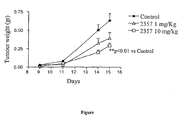
- Figure 1 illustrates the anti-tumor effect of ITF 2357 by measuring the capacity of the compound to reduce the growth of the murine melanoma B16-BL6.
- It has now been found that the compound 4-[(6-diethylaminomethyl)napht-2-ylmethyloxy-carbamoyl]benzohydroxamic acid or an acceptable salt thereof can be used for the treatment of neoplasias of different origin, in particular of melanomas, colon, lung and breast carcinomas, neuroblastomas, sarcomas and various forms of leukaemia (erythroleukaemia, acute promyelocytic leukaemia), at daily single or multiple doses ranging from 1 to 500 mg, depending on the disease and pharmaceutical and toxicological characteristics of the considered compound, which can be administered as suitable formulations through the oral, parenteral or topical route, for example through direct perfusion at the site of the tumour lesion. Moreover, the compound according to claim 1 can be administered in combination with other known antineoplastic agents, according to polychemotherapy protocols.
- The activity of the compound according to claim 1 was evidenced in vitro, on cultured tumour cell lines, and in vivo, on the experimental model of the murine melanoma B 16-BL6.
- The following examples illustrate the invention in greater detail.
- The anti-tumour effect of the compound of example 12 of EP 901465, 4-[6-(diethylaminomethyl)naphth-2-ylmethyloxycarbamoyl)] benzohydroxamic acid hydrochloride (ITF 2357), was tested in vitro by measuring the capacity of the compound to inhibit the growth of tumour cell lines of different histotype deriving from both solid tumours and haematological tumours. The cell lines used were: A549 (pulmonary carcinoma), MDA-MB435 (breast carcinoma) and KG-1 (myeloid leukaemia).
- A549 and MDA-MB435 cells (respectively grown in E-MEM and D-MEM culture medium, supplemented with 10% of fetal calf serum) were seeded on 96 wells-flat bottom-plates (5000 cells/well) and allowed to adhere for 4 hours at 37°C under 5% CO2 atmosphere. Thereafter ITF 2357 at various doses was added to each well (4 replicates). After further 36 hours, tritiated thymidine (1 µCi/well) was added to each well and left therein for the following 12 hours. After this time, the cells were washed 3 times with culture medium and then solubilized with 1N NaOH for 30 minutes.
- A liquid scintillation beta counter was used for measurement of the radioactivity contained in each sample, which is directly proportional to DNA synthesis and therefore to cell proliferation. KG-1 cells, grown in RPMI 1640 culture medium, supplemented with 5% fetal calf serum, were seeded in 96 wells-flat bottom-plates (250000 cells/well). ITF 2357 at various doses was immediately added and after 36 hours tritiated thymidine was added to each well (1 µCi/well) and left therein for the following 12 hours. At the end the cells were collected by a cell harvester and the radioactivity contained in each sample which is directly proportionated to DNA synthesis and therefore to cell proliferation was measured by a liquid scintillation beta counter.
- The effect of different doses of ITF 2357 was measured as percent of inhibition of radioactivity incorporation compared with untreated control cells. The concentration capable of inducing a 50% cell growth inhibition (IC50) was then determined by means of linear regression.
- The results obtained are summarized in the following table:
Cell line A549 MDA-MB435 KG-1 IC50(nM) 495 73 552 - The results obtained show that ITF 2357 inhibits in vitro, at very low dosages (range 10-9M), the growth of the cell lines employed. ITF 2357 in particular inhibits cell growth both of cells from solid tumours (A549 and MDA-MB435) and from leukaemias (KG-1), therefore suggesting its use on tumours of different histotype.
- Cell lines derived from human solid tumours of different histotype and stabilised in vitro were used in the following experiment. In particular, three cell lines from head and neck tumours (KB, Cal27 and Hep2), two cell lines derived from colon carcinomas (HT-29 and LoVo) and four cell lines derived from melanomas (Colo38, Pes41, Pes43 and Anad) were studied.
The cells were grown according to conventional methods in flasks containing synthetic culture medium added with fetal serum, at 37°C under 5% CO2 atmosphere, then seeded in 96 wells plates and allowed to adhere for some hours. ITF 2357 was added in triplicate at increasing doses to each well and the cells were incubated for further 72 hours. Viable cells were labelled by dyeing with sulforhodamine B and their amount was determined by spectrophotometric evaluation of the dye content in each well. The effect of ITF 2357 was calculated as percentage of inhibition, at each concentration, of the dye incorporation in wells containing ITF 2357 compared with control wells (cells without drug). IC50 values of ITF 2357 were calculated by Software Calcusyn (Biosoft) according to dose-response curves.Cell line Tumour origin ITF 2357 IC50 (µM) KB Head-neck 0.64 Ca127 Head-neck 3.4 Hep-2 Head-neck 1 HT-29 Colon carcinoma 0.7 LoVo Colon carcinoma 2.5 Colo38 Melanoma 2.38 Pes41 Melanoma 1.6 Pes43 Melanoma 1.4 Anad Melanoma 5.7 - The anti-tumour effect of ITF 2357 was studied measuring the capacity of the compound to reduce the growth of the murine melanoma B16-BL6.
- B 16-BL6 tumour is a highly metastatic variant (Sciumbata T. et al. Invasion and Metastasis 1996; 16: 132-143) of the native tumour B16 and it grows subcutaneously in the syngenic mouse C57BL/6 (Gutman M et al. Cancer Biother. 1994; 9(2): 163-170).
- B16-BL6 tumour cells were inoculated subcutaneously in female C57BL/6 mice (10 animals/group, weight 20-22 grams) at the dose of 2x10⁵ cells/mouse. ITF 2357 dissolved in water was administered orally, at the indicated doses, 10 minutes before the inoculum of the tumour cells and then daily for 6 days a week. The tumour growth was expressed as tumour weight, measuring twice a week, by means of a calibre, the two perpendicular diameters of the nodules. The weight was calculated according to the formula: (diameter 1 x diameter 2)2 / 2 as described in Giavazzi R. et al. Cancer Res. 1986; 46: 1928-1933.
- The results obtained are reported in the enclosed figure.
- It can be observed that ITF 2357 exerts a dose-dependent inhibitory effect on the tumour growth, since it reduced of about 50% the volume of the tumoural nodule after 15 days of treatment.
Claims (4)
- Use of 4-[6-diethylaminomethyl)naphth-2-ylmethyloxycarbamoyl]benzohydroxamic acid or of an acceptable salt thereof for the preparation of a medicament for the treatment of neoplasias.
- Use according to claim 1 characterized in that said neoplasias are selected from melanomas, colon, lung and breast carcinomas, neuroblastomas, sarcomas and leukaemia.
- Use according to claim 2 characterized in that said leukaemia is selected from etythroleukaemia and acute promyelocytic leukaemia.
- Use according to claims 1 to 3 characterized in that 4-[6-diethylaminomethyl)napbth-2-ylmethyloxycarbamoyl]benzohydroxamic acid or the acceptable salt thereof are administered in combination with other antineoplastic agents.
Applications Claiming Priority (3)
| Application Number | Priority Date | Filing Date | Title |
|---|---|---|---|
| IT000064A ITMI20030064A1 (en) | 2003-01-17 | 2003-01-17 | USE OF HYDROXAMIC ACID DERIVATIVES FOR PREPARATION |
| ITMI20030064 | 2003-01-17 | ||
| PCT/EP2003/014171 WO2004064824A1 (en) | 2003-01-17 | 2003-12-10 | Use of hydroxamic acid derivatives for the preparation of anti-tumour medicaments |
Publications (2)
| Publication Number | Publication Date |
|---|---|
| EP1583523A1 EP1583523A1 (en) | 2005-10-12 |
| EP1583523B1 true EP1583523B1 (en) | 2007-02-14 |
Family
ID=32750476
Family Applications (1)
| Application Number | Title | Priority Date | Filing Date |
|---|---|---|---|
| EP03782390A Expired - Lifetime EP1583523B1 (en) | 2003-01-17 | 2003-12-10 | Use of hydroxamic acid derivatives for the preparation of anti-tumour medicaments |
Country Status (8)
| Country | Link |
|---|---|
| US (1) | US8227515B2 (en) |
| EP (1) | EP1583523B1 (en) |
| JP (1) | JP4495599B2 (en) |
| AU (1) | AU2003290034A1 (en) |
| DE (1) | DE60311888T2 (en) |
| ES (1) | ES2282705T3 (en) |
| IT (1) | ITMI20030064A1 (en) |
| WO (1) | WO2004064824A1 (en) |
Families Citing this family (1)
| Publication number | Priority date | Publication date | Assignee | Title |
|---|---|---|---|---|
| IT1392908B1 (en) * | 2008-09-29 | 2012-04-02 | Italfarmaco Spa | USE OF HISTONE-DEACETYLASE INHIBITORS FOR PHILADELPHIA-NEGATIVE CARE OF MYELOPROLIFERATIVE SYNDROMES |
Family Cites Families (6)
| Publication number | Priority date | Publication date | Assignee | Title |
|---|---|---|---|---|
| IT1283637B1 (en) * | 1996-05-14 | 1998-04-23 | Italfarmaco Spa | COMPOUNDS WITH ANTI-INFLAMMATORY AND IMMUNOSOPPRESSIVE ACTIVITY |
| CA2391952C (en) * | 1999-11-23 | 2012-01-31 | Methylgene Inc. | Inhibitors of histone deacetylase |
| JPWO2002074298A1 (en) * | 2001-03-21 | 2004-07-08 | 小野薬品工業株式会社 | IL-6 production inhibitor |
| SE0101257D0 (en) * | 2001-04-06 | 2001-04-06 | A & Science Invest Ab | Treatment of whiplash associated disorder |
| ITMI20011733A1 (en) | 2001-08-07 | 2003-02-07 | Italfarmaco Spa | HYDROXAMIC ACID DERIVATIVES HISTONE DEHYACETYLASE ENZYM INHIBITORS, WHICH NEW ANTI-INFLAMMATORY DRUGS INHIBIT CITOC SYNTHESIS |
| JPWO2003070691A1 (en) | 2002-02-21 | 2005-06-09 | 財団法人大阪産業振興機構 | N-hydroxycarboxamide derivatives |
-
2003
- 2003-01-17 IT IT000064A patent/ITMI20030064A1/en unknown
- 2003-12-10 WO PCT/EP2003/014171 patent/WO2004064824A1/en not_active Ceased
- 2003-12-10 EP EP03782390A patent/EP1583523B1/en not_active Expired - Lifetime
- 2003-12-10 AU AU2003290034A patent/AU2003290034A1/en not_active Abandoned
- 2003-12-10 ES ES03782390T patent/ES2282705T3/en not_active Expired - Lifetime
- 2003-12-10 US US10/542,244 patent/US8227515B2/en not_active Expired - Lifetime
- 2003-12-10 JP JP2004566776A patent/JP4495599B2/en not_active Expired - Lifetime
- 2003-12-10 DE DE60311888T patent/DE60311888T2/en not_active Expired - Lifetime
Also Published As
| Publication number | Publication date |
|---|---|
| US20060063800A1 (en) | 2006-03-23 |
| JP4495599B2 (en) | 2010-07-07 |
| AU2003290034A1 (en) | 2004-08-13 |
| DE60311888T2 (en) | 2007-12-06 |
| US8227515B2 (en) | 2012-07-24 |
| DE60311888D1 (en) | 2007-03-29 |
| EP1583523A1 (en) | 2005-10-12 |
| ITMI20030064A1 (en) | 2004-07-18 |
| WO2004064824A1 (en) | 2004-08-05 |
| ES2282705T3 (en) | 2007-10-16 |
| JP2006514659A (en) | 2006-05-11 |
Similar Documents
| Publication | Publication Date | Title |
|---|---|---|
| US5798339A (en) | Treatment method for cancer | |
| WO1990009787A1 (en) | Novel sulfonamides as radiosensitizers | |
| EP1718322B1 (en) | Synergistic compositions with fk-228 | |
| EP1628965B1 (en) | Hydroxyamidine and hydroxyguanidine compounds as urokinase inhibitors | |
| EP0774255A1 (en) | Use of ursolic acid for the manufacture of a medicament for suppressing metastasis | |
| US6262093B1 (en) | Methods of treating cancer with benzimidazoles | |
| WO1989007441A1 (en) | 6-amino-1,2-benzopyrone antitumorigenic agents and method | |
| US20130023511A1 (en) | Organometallic complexes as therapeutic agents | |
| JPH11507333A (en) | Water-soluble camptothecin analog | |
| EP0768084A1 (en) | Cancerous metastasis inhibitor | |
| EP0087629A2 (en) | Antiinflammatory and/or analgesic 2,3-Diaryl-5-halo thiophenes | |
| US8227515B2 (en) | Use of hydroxamic acid derivatives for the preparation of anti-tumour medicaments | |
| JPH0559038A (en) | Thiourea derivative and medicine preparation containing the same | |
| JP2511709B2 (en) | Xanthocillin X monomethyl ether derivative and antitumor agent containing the same | |
| CA1327047C (en) | Complexes of tellurium and selenium derivatives | |
| CN110698491A (en) | 2- (camptothecin-10-oxyl) acetamide compound and application thereof | |
| FI80440B (en) | ANALOGIFICATE FARAMENTAL FRAMSTAELLNING AV TERAPEUTISKT ANVAENDBARA AFIDKOLANDERIVAT. | |
| GB2076395A (en) | Nonaprenylamine derivatives | |
| US5206270A (en) | Method of inhibiting melanoma cells | |
| US4845284A (en) | Substituted 3-nitrobenzenesulfonamides useful as adjuncts in radiation therapy | |
| GB2104073A (en) | Fluorinated diamino-heptene and -heptyne derivatives | |
| EP0486944A2 (en) | Method of inhibiting tumor growth using xanthocillin X dimethylether | |
| EP2258370A1 (en) | Treatment of malignant diseases | |
| WO2024044751A3 (en) | Peroxiredoxin 3 inhibitors and methods of use for treating cancer | |
| AU2003204339B2 (en) | Cytotoxic Alkaloid Derivatives Including Asmarine A and B Isolated from a Sponge |
Legal Events
| Date | Code | Title | Description |
|---|---|---|---|
| PUAI | Public reference made under article 153(3) epc to a published international application that has entered the european phase |
Free format text: ORIGINAL CODE: 0009012 |
|
| 17P | Request for examination filed |
Effective date: 20050712 |
|
| AK | Designated contracting states |
Kind code of ref document: A1 Designated state(s): AT BE BG CH CY CZ DE DK EE ES FI FR GB GR HU IE IT LI LU MC NL PT RO SE SI SK TR |
|
| AX | Request for extension of the european patent |
Extension state: AL LT LV MK |
|
| DAX | Request for extension of the european patent (deleted) | ||
| RBV | Designated contracting states (corrected) |
Designated state(s): DE ES FR GB IT |
|
| GRAP | Despatch of communication of intention to grant a patent |
Free format text: ORIGINAL CODE: EPIDOSNIGR1 |
|
| GRAS | Grant fee paid |
Free format text: ORIGINAL CODE: EPIDOSNIGR3 |
|
| GRAA | (expected) grant |
Free format text: ORIGINAL CODE: 0009210 |
|
| AK | Designated contracting states |
Kind code of ref document: B1 Designated state(s): DE ES FR GB IT |
|
| REG | Reference to a national code |
Ref country code: GB Ref legal event code: FG4D |
|
| REF | Corresponds to: |
Ref document number: 60311888 Country of ref document: DE Date of ref document: 20070329 Kind code of ref document: P |
|
| REG | Reference to a national code |
Ref country code: DE Ref legal event code: R096 Ref document number: 60311888 Country of ref document: DE Effective date: 20070329 |
|
| ET | Fr: translation filed | ||
| REG | Reference to a national code |
Ref country code: ES Ref legal event code: FG2A Ref document number: 2282705 Country of ref document: ES Kind code of ref document: T3 |
|
| PLBE | No opposition filed within time limit |
Free format text: ORIGINAL CODE: 0009261 |
|
| STAA | Information on the status of an ep patent application or granted ep patent |
Free format text: STATUS: NO OPPOSITION FILED WITHIN TIME LIMIT |
|
| 26N | No opposition filed |
Effective date: 20071115 |
|
| REG | Reference to a national code |
Ref country code: DE Ref legal event code: R097 Ref document number: 60311888 Country of ref document: DE Effective date: 20071115 |
|
| REG | Reference to a national code |
Ref country code: FR Ref legal event code: PLFP Year of fee payment: 13 |
|
| REG | Reference to a national code |
Ref country code: FR Ref legal event code: PLFP Year of fee payment: 14 |
|
| REG | Reference to a national code |
Ref country code: FR Ref legal event code: PLFP Year of fee payment: 15 |
|
| REG | Reference to a national code |
Ref country code: DE Ref legal event code: R082 Ref document number: 60311888 Country of ref document: DE Representative=s name: 2K PATENT- UND RECHTSANWAELTE PARTNERSCHAFT MB, DE |
|
| PGFP | Annual fee paid to national office [announced via postgrant information from national office to epo] |
Ref country code: GB Payment date: 20221227 Year of fee payment: 20 Ref country code: FR Payment date: 20221227 Year of fee payment: 20 |
|
| PGFP | Annual fee paid to national office [announced via postgrant information from national office to epo] |
Ref country code: ES Payment date: 20230102 Year of fee payment: 20 |
|
| PGFP | Annual fee paid to national office [announced via postgrant information from national office to epo] |
Ref country code: IT Payment date: 20221214 Year of fee payment: 20 Ref country code: DE Payment date: 20221228 Year of fee payment: 20 |
|
| P01 | Opt-out of the competence of the unified patent court (upc) registered |
Effective date: 20230624 |
|
| REG | Reference to a national code |
Ref country code: DE Ref legal event code: R071 Ref document number: 60311888 Country of ref document: DE |
|
| REG | Reference to a national code |
Ref country code: ES Ref legal event code: FD2A Effective date: 20231227 |
|
| REG | Reference to a national code |
Ref country code: GB Ref legal event code: PE20 Expiry date: 20231209 |
|
| PG25 | Lapsed in a contracting state [announced via postgrant information from national office to epo] |
Ref country code: GB Free format text: LAPSE BECAUSE OF EXPIRATION OF PROTECTION Effective date: 20231209 |
|
| PG25 | Lapsed in a contracting state [announced via postgrant information from national office to epo] |
Ref country code: ES Free format text: LAPSE BECAUSE OF EXPIRATION OF PROTECTION Effective date: 20231211 |
|
| PG25 | Lapsed in a contracting state [announced via postgrant information from national office to epo] |
Ref country code: GB Free format text: LAPSE BECAUSE OF EXPIRATION OF PROTECTION Effective date: 20231209 Ref country code: ES Free format text: LAPSE BECAUSE OF EXPIRATION OF PROTECTION Effective date: 20231211 |