EP1583042A2 - Portable communication terminal and method of transmission of electronic mail - Google Patents
Portable communication terminal and method of transmission of electronic mail Download PDFInfo
- Publication number
- EP1583042A2 EP1583042A2 EP05006149A EP05006149A EP1583042A2 EP 1583042 A2 EP1583042 A2 EP 1583042A2 EP 05006149 A EP05006149 A EP 05006149A EP 05006149 A EP05006149 A EP 05006149A EP 1583042 A2 EP1583042 A2 EP 1583042A2
- Authority
- EP
- European Patent Office
- Prior art keywords
- passage
- electronic mail
- communication terminal
- portable communication
- transmission
- Prior art date
- Legal status (The legal status is an assumption and is not a legal conclusion. Google has not performed a legal analysis and makes no representation as to the accuracy of the status listed.)
- Withdrawn
Links
Images


Classifications
-
- G—PHYSICS
- G07—CHECKING-DEVICES
- G07C—TIME OR ATTENDANCE REGISTERS; REGISTERING OR INDICATING THE WORKING OF MACHINES; GENERATING RANDOM NUMBERS; VOTING OR LOTTERY APPARATUS; ARRANGEMENTS, SYSTEMS OR APPARATUS FOR CHECKING NOT PROVIDED FOR ELSEWHERE
- G07C9/00—Individual registration on entry or exit
- G07C9/20—Individual registration on entry or exit involving the use of a pass
- G07C9/28—Individual registration on entry or exit involving the use of a pass the pass enabling tracking or indicating presence
-
- G—PHYSICS
- G07—CHECKING-DEVICES
- G07C—TIME OR ATTENDANCE REGISTERS; REGISTERING OR INDICATING THE WORKING OF MACHINES; GENERATING RANDOM NUMBERS; VOTING OR LOTTERY APPARATUS; ARRANGEMENTS, SYSTEMS OR APPARATUS FOR CHECKING NOT PROVIDED FOR ELSEWHERE
- G07C9/00—Individual registration on entry or exit
- G07C9/20—Individual registration on entry or exit involving the use of a pass
- G07C9/27—Individual registration on entry or exit involving the use of a pass with central registration
Definitions
- the present invention relates to a portable communication terminal and a method of transmission of an electronic mail and, more particularly, to a method of transmission of an electronic mail by use of a portable communication terminal which can detect a passage through a passage verification apparatus including a gate and ticket gate through which a passage is verified and by use of a portable communication terminal equipped with a non-contact IC card.
- JP-A-2002-298169 discloses a routing assistance system using a portable communication terminal equipped with a non-contact IC card.
- information on a commuter pass such as a usable range of stations and a valid time period for commuting are previously stored in the non-contact IC card.
- automatic ticket gating is performed using the information on the commuter pass through the non-contact IC card when the portable communication terminal passes through an automatic gate.
- the portable communication terminal receives information on the entrance station transmitted from the automatic ticket gate, and in addition the current time is acquired from the inside clock means.
- the portable communication terminal receives destination information from the user prior or even after passing through the automatic ticket gate.
- the portable communication terminal transmits information on the entrance station, the time at entrance, and the destination to a route search server.
- the portable communication terminal receives a result of route search from the route search server, and displays it.
- the routing assistance system disclosed in JP-A-2002-298169 uses a portable communication terminal equipped with a non-contact IC card as a portable communication terminal for substituting a commuter pass.
- this system only allows a user of the portable communication terminal to pass through a ticket gate, using this portable communication terminal as a commuter pass based on the functionality of a non-contact IC card. Adding to this, the system only allows the portable communication terminal to display a routing assistance when passing through a ticket gate.
- the portable communication terminal it is not possible for the portable communication terminal to automatically transmit an electronic mail with which the passage of the terminal at a ticket gate is reported to someone to whom a user of the terminal wants to inform his passage at the ticket gate.
- the portable communication terminal manually writes an electronic mail which the user wants to transfer at the time of exit and entrance at a ticket gate. Then, the user manually transmits the electronic mail to someone to whom the user wants to send an electronic mail. It is bothersome.
- the content to be transferred by the electronic mail is a message, for example, "On the way home from the station", "Arrival at an exit of the station” or "Now, entering the station and on the way to get to the destination"
- an exemplary portable communication terminal of the present invention is capable of detecting a passage through a passage verification apparatus including a gate for verifying a passage.
- the terminal detects a passage through the passage verification apparatus, and after the detection, controls transmission of an electronic mail which has been reserved for transmission.
- the exemplary portable communication terminal of the present invention is a portable communication terminal which includes: a non-contact IC card which receives, from a passage verification apparatus, information indicating a passage of the non-contact IC card through the passage verification apparatus including gate for verifying a passage; passage detector for detecting a passage of the portable communication terminal through the passage verification apparatus by receiving the information on the passage from the non-contact IC card; and mail transmission controller for controlling transmission of an electronic mail reserved for transmission in accordance with the detection.
- An exemplary transmission method of an electronic mail with a portable communication terminal of the present invention includes: detecting a passage when the portable communication terminal passes through a passage verification apparatus including a gate which verifies a passage; and controlling transmission of electronic mail which is reserved for transmission after detection of the passage.
- the exemplary transmission method of an electronic mail by use of the portable communication terminal of the present invention includes: receiving by the non-contact IC card, from a passage verification apparatus, information indicating a passage of the non-contact IC card through the passage verification apparatus including a gate for verifying a passage; detecting the passage of the portable communication terminal through the passage verification apparatus by receiving the information on the passage from the non-contact IC card; and controlling transmission of the electronic mail reserved for transmission in accordance with the detection.
- the exemplary portable communication terminal of the present invention detects a passage through the passage verification apparatus, and after the detection, controls transmission of an electronic mail which has been reserved for transmission.
- the present invention facilitates automatic transmission of an electronic mail to someone to communicate with just by passing through the passage verification apparatus including a gate of a theater, a ticket gate of a station, etc. Consequently, it is not necessary to perform operations for creating an electronic mail after passing through the passage verification apparatus.
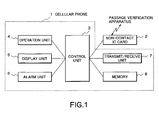
- FIG. 1 is a block diagram showing an exemplary hardware configuration for embodying the present invention.
- FIG. 1 describes an example of a hardware configuration when a portable communication terminal of the present invention is applied to a cellular phone 1.
- the hardware of this cellular phone 1 includes an operation unit 4, a display unit 5, an alarm unit 6, transmit/receive unit 7, a memory 8, and a control unit 3.
- a non-contact IC card 2 is detachably installed in the cellular phone 1 or attached to the outside thereof.
- the operation unit 4 performs operations of electronic mailing, such as inputting and editing texts thereof, and transmitting/receiving thereof, and operations of phone functions.
- the display unit 5 displays relevant information, texts of electronic mail, and the like.
- the alarm unit 6 reports events to a user of the cellular phone 1 by means of voice, emission of light, and vibration.
- the transmit/receive unit 7 performs transmission/reception of radio communications.
- the memory 8 stores a prerequisite program for the operations of the cellular phone 1, information on the electronic mail, various settings of the cellular phone 1 and the like.
- the control unit 3 controls operations of various units.
- the information includes: commuter pass information (holder information of the commuter pass, station identification information such as names of stations for entrance/exit, station numbers, a valid time period of the commuter pass, names of railway lines to be used (A line, B line and so forth), and the like); and ticket information (theater identification information such as names of theaters, concert hall names, theater numbers, and concert hall numbers and the like).
- the non-contact IC card 2 which is detachably installed in the cellular phone 1 or attached to the outside thereof communicates with a passage verification apparatus, receives entrance/exit approval information (station identification information or theater identification information) from the passage verification apparatus, and transmits this entrance/exit approval information to the cellular phone 1.
- the passage verification apparatus verifies and approves the passage through a gate at a theater and a concert hall and the like, and a ticket gate in station.
- the control unit 3 of the cellular phone 1 performs transmission control of an electronic mail which is reserved for transmission upon reception of this entrance/exit approval information.
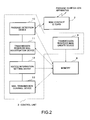
- FIG. 2 is a block diagram showing an exemplary embodiment of a portable communication terminal of the present invention.
- the present embodiment includes a transmission reserved mail create device 9, a passage detection device 10, a transmission reserved mail investigation device 11, a notice information setting device 12, and a mail transmission control device 13.
- Each device can be a hardware or a software function realized by CPU control.
- CPU executes any suitable program pre-stored in a memory.
- the portable communication terminal of this exemplary embodiment is described as a cellular phone 1.
- the transmission reserved mail create device 9 is used to create an electronic mail in accordance with operations in the operation unit 4 by a user, and reserves the created electronic mail for transmission. Then subsequently, the electronic mail is stored in the memory 8 with the related information such as station identification and theater identification. For example, this electronic mail is stored in reference to a name of a station or the electronic mail is stored in reference to a name of a theater.
- the passage detection device 10 receives entrance/exit approval information which indicates a passage of the non-contact IC card 2 through the passage verification apparatus at a gate or a ticket gate and the like from this non-contact IC card 2.
- the entrance/exit approval information includes station identification information or theater identification information.
- the passage detecting device 10 detects that the cellular phone 1 itself has passed through the passage verification apparatus.
- the transmission reserved mail investigation device 11 investigates whether or not there is an electronic mail reserved for transmission by searching the memory 8.
- the search is to be conducted upon the passage of the cellular phone 1 through the passage verification apparatus, which is detected by the passage detection device 10.
- the notice information setting device 12 acquires the current time from the clock possessed by the cellular phone 1 when the result of investigation shows that there is an electronic mail reserved for transmission. Then the device 12 sets the time, for example, in the body of the electronic mail, which is stored in the memory 8 in reference to station identification information or theater identification information within the entrance/exit approval information received by the passage detection device 10.
- the mail transmission control device 13 controls transmission of the electronic mail by the transmit/receive unit 7 after reading out the electronic mail from the memory 8.
- the electronic mail has been reserved for transmission with the time data set by the notice information setting device 12.
- a user of the portable communication terminal operates the operation unit 4 and stores an electronic mail to the cellular phone 1.
- the transmission reserved mail create device 9 generates an electronic mail by inputting a title of the electronic mail, an address, and a body text, according to the operation on the operation unit 4 by the user. Then, the transmission reserved mail create device 9 stores this electronic mail in the memory 8.
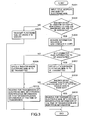
- step S302 of FIG. 3 the transmission reserved mail create device 9 displays a confirmation display on the display unit 5.
- the confirmation display is for confirmation whether or not the information in the non-contact IC card 2 should be associated with the electronic mail created in step S301.
- the information in the non-contact IC card 2 may mean exemplary information relating to a commuter pass, a ticket, etc.
- the user of the cellular phone 1 operates the operation unit 4 by observing content on the display.
- the transmission reserved mail create device 9 receives information indicating whether or not the association is selected, depending on the operation on the operation unit 4 by the user. When information indicating a selected choice for non-association is received, the process proceeds to step S303 of FIG. 3. When information indicating a selected choice for association is received, the process proceeds to step S304 of FIG. 3.
- step S303 of FIG. 3 the control unit 3 transmits this created electronic mail immediately and stores it in the memory 8. Then the process is ended.
- step S304 of FIG. 3 the transmission reserved mail create device 9 requests from the non-contact IC card 2 the commuter pass information and ticket information stored in the card, and receives the commuter pass information and ticket information from the non-contact IC card 2.
- step S305 of FIG. 3 the transmission reserved mail create device 9 displays a confirmation display on the display unit 5.
- the confirmation display is to confirm that the information to be associated is either the commuter pass information or the ticket information.
- the transmission reserved mail create device 9 receives information indicating what would be the selected information, either the commuter pass information or ticket information.
- the process proceeds to step S307 of FIG. 3.
- the process proceeds to step S306 of FIG. 3.
- step S306 of FIG. 3 the transmission reserved mail create device 9 displays an assignment display on the display unit 5.
- the assignment display is to designate in which theater an electronic mail would be transmitted.
- the transmission reserved mail create device 9 receives theater identification information identifying a theater and the like where an electronic mail is to be transmitted, and stores it in the memory 8. Then the process proceeds to step S310.
- the transmission reserved mail create device 9 displays an assignment display on the display unit 5.
- the assignment display is to designate in which station an electronic mail would be transmitted.
- the transmission reserved mail create device 9 receives station identification information identifying a station where an electronic mail is to be transmitted, and stores it in the memory 8.
- step S308 of FIG. 3 a user of the cellular phone 1 is asked to confirm when this electronic mail would be transmitted. For example , it may be whether once in every day when the cellular phone 1 passes through the ticket gate of the station indicated in the station identification information, or only once at the time of passing.
- the transmission reserved mail create device 9 displays a confirmation display on the display unit 5.
- the confirmation display is to ask a user to confirm when the electronic mail is to be transmitted whether once in every day or once at the time of passing.
- the transmission reserved mail create device 9 receives information concerning whether the electronic mail will be transmitted once in every day or once at the time of passing, depending on the operation of the user through the operation unit 4.
- the process proceeds to step S309 of FIG. 3.
- the process proceeds to step S310 of FIG. 3.
- step S309 of FIG. 3 the transmission reserved mail create device 9 registers the electronic mail, the station identification information and the repeat information in the management table for transmission reserved mails of FIG. 4, and terminates processes for transmission reservation.
- This electronic mail is what has been created in step S301.
- This station identification information is what has been stored in step 307 and is for identification of the station where the electronic mail is to be transmitted.
- This repeat information is what has been received in step S308 and concerns the indication of transmission "once in every day".
- FIG. 4 shows a management table for transmission reserved mails.
- This table is stored in the memory 8, and includes a first memory address, a second memory address, and repeat information.
- the first memory address indicates a location for storage of the electronic mail which is reserved for transmission.
- the second memory address indicates a location for storage of a station identifier of a station or a theater identifier of a theater from which this electronic mail is to be transmitted.
- the repeat information assigns how often the electronic mail is to be sent either once or once in every day repeatedly.
- This management table includes a plural number of groups corresponding to the number of the electronic mails reserved for transmission. A group includes the first memory address, the second memory address and the repeat information
- step S310 of FIG. 3 the transmission reserved mail create device 9 registers the electronic mail, the station identification information or the theater identification information, and the repeat information in the management table for transmission reserved mails of FIG. 4, and terminates processes for transmission reservation.
- This electronic mail is what has been created in step S301.
- This station identification information is what has been stored in step S307.
- This theater identification information is what has been stored in step S306.
- This repeat information is what has been received in step S308 and is concerns the indication of transmission "once at the time of passing".
- a user of the cellular phone 1 enters the automatic ticket gate of a station, exits the automatic ticket gate of a station, or enters the entrance gate of a theater.
- the user of the cellular phone 1 holds the cellular phone 1 which includes the non-contact IC card 2 up to a non-contact IC card read out apparatus (not shown in the figures).
- Both the gate and the ticket gate are a passage verification apparatus which verifies and authenticates a passage, and includes the non-contact IC card read out apparatus therein.
- the non-contact IC card 2 in the cellular phone 1 transmits ticket information and commuter pass information which is necessitated for entrance/exit and passage at the gate and ticket gate, to the non-contact IC card read out apparatus.
- the non-contact IC card read out apparatus transmits the information sent from the non-contact IC card 2 to a server (not shown in the figures). Based on the information received, the server determines whether or not the entrance/exit and passage at the gate and ticket gate should be approved.
- the server sends the entrance/exit approval information which includes the station identification information or the theater identification information and data for approving entrance/exit, to the non-contact IC card read out apparatus.
- the non-contact IC card 2 receives the entrance/exit approval information from the non-contact IC card read out apparatus.
- step S502 of FIG. 5 the passage detection device 10 receives the entrance/exit approval information from the non-contact IC card 2.
- the device 10 detects that the cellular phone 1 has passed through the passage verification apparatus.
- step S503 of FIG.5 the transmission reserved mail investigation device 11 investigates whether or not the electronic mail, which is reserved for transmission corresponding to the entrance/exit approval information received by the passage detection device 10, is stored in the memory 8.
- the transmission reserved mail investigation device 11 investigates whether or not there is an electronic mail reserved for transmission in the management table for transmission reserved mails shown in FIG. 4. Then, if there is an electronic mail reserved for transmission in this table, existence of the electronic mails corresponding to the station identification information, or the theater identification information, included in the entrance/exit approval information within the electronic mails in the table is investigated.
- step S504 of FIG. 5 If there are electronic mails corresponding to the station identification information or the theater identification information included in the entrance/exit approval information, then the process proceeds to step S504 of FIG. 5.
- the notice information setting device 12 sets the station identification information or the theater identification information included in the entrance/exit approval information into the body of the electronic mail reserved for transmission, as shown in FIG. 4. Furthermore, the device 12 acquires the current time from time measurement means (for example, a clock) pre-equipped in the cellular phone 1, and sets the current time information in the body of electronic mail reserved for transmission, as shown in FIG. 4.
- time measurement means for example, a clock
- step S505 of FIG. 5 the mail transmission control device 13 transmits the electronic mail reserved for transmission to a mail server by controlling the transmit/receive unit 7.
- step S504 the station identification information or the theater identification information, and the current time have been set in the electronic mail.
- a retaining device in the mail transmission control device 13 investigates whether the cellular phone 1 is within the communication range, which indicates an electronic mail can be transmitted, or out of the communication range, which indicates an electronic mail cannot be transmitted. When the result of the investigation indicates that it is out of the communication range, the retaining device in the device 13 retains transmission of the electronic mail till the cellular phone enters the communication range.
- the mail transmission control device 13 investigates whether or not the cellular phone 1 has entered the communication range using a background processing of the cellular phone 1. Then, the mail transmission control device 13 automatically transmits this retained electronic mail to a mail server by controlling the transmit/receive unit 7 when the cellular phone 1 has entered the communication range. In other words, when the cellular phone 1 enters the communication range, the mail transmission control device 13 transmits the retained electronic mail, in multi-task processing, in keeping continuously the current function executed by the cellular phone 1. However, when the function currently executed by the cellular phone 1 is a transmission function of an electronic mail, the retained electronic mail will be transmitted later after the function has been finalized.
- the electronic mail can be automatically transmitted when the cellular phone 1 enters the communication range. Furthermore, even when the functions of the cellular phone 1 are used by the user of the cellular phone 1, the retained electronic mail will be automatically transmitted. Therefore, it becomes possible to reduce operations such as checking of un-transmitted mails and re-transmission of the electronic mail by the user himself. Besides, by use of transmission in multi-task processing, the electronic mail will be transmitted while the user keeps continuously using the currently executing function.
- step S506 of FIG. 5 the mail transmission control device 13 receives a mail reception acknowledgement corresponding to the electronic mail transmitted to a mail server from the mail server by controlling transmit/receive unit 7. Thereby the mail transmission control device 13 displays a mail transmission completion display on the display unit 5. The user of the cellular phone 1 confirms this display.
- the notice information setting device 12 adds station identification information or theater identification information, and the time information to the electronic mail.
- station identification information is added to the electronic mail
- other information such as a departure time of a train and an arrival time of a train, for example, may be further added to the electronic mail, as described below.
- step S501 of FIG. 5 given that the information received from the non-contact IC card read out apparatus is commuter pass information, the server measures the time when it receives the commuter pass information. Then, the server makes inquiries, using a pre-equipped database, a departure time which is closest to the time of the measurement and an arrival time at the other station (arrival station) indicated in the commuter pass on the basis of the time schedule of trains running in the railway lines to be used by the user of the commuter pass. Then, the server sends the obtained departure and arrival times of the train together with the entrance/exit approval information to the non-contact IC card read out apparatus. The non-contact IC card 2 receives the departure and arrival times together with the entrance/exit approval information from the non-contact IC card read out apparatus.
- the passage detection device 10 receives the departure and arrival times together with the entrance/exit approval information from the non-contact IC card 2, and detects that the cellular phone 1 has passed the passage verification apparatus.
- step S503 of FIG. 5 when the electronic mail reserved for transmission corresponding to the entrance/exit approval information is stored in the memory 8, the process proceeds to step S504 of FIG. 5.
- the notice information setting device 12 sets the departure and arrival times of the train obtained in step S502 together with the current time obtained from the cellular phone 1 in the body of the electronic mail reserved for transmission.
- the non-contact IC card 2 in which commuter pass information and ticket information is pre-stored is set between the cellular phone 1 and passage verification apparatus.
- the non-contact IC card 2 transmits this commuter pass information and ticket information to the passage verification apparatus, and then receives entrance/exit approval information from the passage verification apparatus.
- the cellular phone 1 receives entrance/exit approval information from the non-contact IC card 2, and by use of this entrance/exit approval information, transmits the electronic mail reserved for transmission.
- close range communication devices both in the cellular phone 1 and passage verification apparatus, those communication devices can be used to substitute the non-contact IC cards 2.
- the close range communication devices are based on technologies, such as infrared light and Bluetooth.
- commuter pass information and ticket information are pre-stored in the memory 8.
- the communication control function of the non-contact IC card 2 is assigned to this communication device, and the storage control function of the non-contact IC card 2 is assigned to the control unit 3 and memory unit 8 of the cellular phone 1.
- this communication device receives commuter pass information and ticket information from the memory 8 of the cellular phone 1, and transmits the commuter pass information and ticket information to the passage verification apparatus. Thereafter, the communication device receives entrance/exit approval information from the passage verification apparatus.
- the cellular phone 1 receives entrance/exit approval information from the communication device, and by use of this entrance/exit approval information, transmits the electronic mail reserved for transmission.
- the present invention facilitates automatic transmission of an electronic mail to the partner to communicate with just by passing through a gate of a theater, a ticket gate of a station, etc. Thus, it is not necessary to perform operations for creating an electronic mail after passing through the gate of a theater and the ticket gate of a station.
- a time stamp of passing through a gate and ticket gate is automatically added to a body of an electronic mail which will be automatically transmitted to a partner to communicate with. Therefore, it is not necessary to perform operations for writing in a time in a body of electronic mail by checking a time before passing through a gate or a ticket gate of a station.
- a determination of a communication range is performed before transmission. If "out of the communication range" is determined, transmission of an electronic mail is retained until “within the communication range” is determined. Even if a user is operating other functions, an electronic mail which is retained un-transmitted will be able to be automatically transmitted by use of multi-task functionality of the cellular phone. Accordingly, the automatic transmission can reduce operations such as checking of un-transmitted electronic mails and re-transmission thereof by the user himself.
Landscapes
- Physics & Mathematics (AREA)
- General Physics & Mathematics (AREA)
- Devices For Checking Fares Or Tickets At Control Points (AREA)
- Information Transfer Between Computers (AREA)
- Telephonic Communication Services (AREA)
- Management, Administration, Business Operations System, And Electronic Commerce (AREA)
Abstract
Description
Consequently, it is not necessary to perform operations for creating an electronic mail after passing through the passage verification apparatus.
Claims (23)
- A portable communication terminal capable of detecting a passage through a passage verification apparatus including a gate for verifying a passage, the portable communication terminal comprising:passage detecting means for detecting a passage of the portable communication terminal through the passage verification apparatus; andmail transmission control means for controlling transmission of an electronic mail reserved for transmission after detection of the passage.
- The portable communication terminal according to claim 1, further comprising:adding means for automatically adding information to the electronic mail to be transmitted, said information representing the passage verification apparatus in which a passage takes place and a time of the passage.
- The portable communication terminal according to claim 1 or 2, further comprising:retaining means for investigating, before transmission of the electronic mail, whether the portable communication terminal is within a communication range, which indicates the electronic mail can be transmitted, or out of the communication range, which indicates the electronic mail cannot be transmitted, and if a result of the investigation indicates the portable communication terminal is out of the communication range, retaining transmission of the electronic mail until the portable communication terminal enters the communication range.
- The portable communication terminal according to claim 3, further comprising:automatic transmission means for automatically transmitting the retained electronic mail when the portable communication terminal enters the communication range.
- A portable communication terminal, comprising:a non-contact IC card which receives, from a passage verification apparatus, information indicating a passage of the non-contact IC card through the passage verification apparatus including a gate for verifying a passage;passage detecting means for detecting a passage of the portable communication terminal through the passage verification apparatus by receiving the information on the passage from the non-contact IC card; andmail transmission control means for controlling transmission of an electronic mail reserved for transmission in accordance with the detection.
- The portable communication terminal according to claim 5, further comprising:adding means for automatically adding information to the electronic mail to be transmitted, said information representing the passage verification apparatus in which the passage takes place and the time of detection of the passage, on the basis of the information received from the non-contact IC card.
- The portable communication terminal according to claim 5 or 6, wherein the mail transmission control means investigates, before transmission of the electronic mail, whether the portable communication terminal is within a communication range, which indicates the electronic mail can be transmitted, or out of the communication range, which indicates the electronic mail cannot be transmitted, and if a result of the investigation indicates the portable communication terminal is out of the communication range, retains transmission of the electronic mail until the portable communication terminal enters the communication range.
- The portable communication terminal according to claim 7, wherein the mail transmission control means automatically transmits the retained electronic mail when the portable communication terminal enters the communication range.
- A transmission method of an electronic mail with a portable communication terminal, comprising:detecting a passage of the portable communication terminal through a passage verification apparatus which includes a gate for verifying a passage; andcontrolling transmission of the electronic mail reserved for transmission after detection.
- The transmission method of an electronic mail according to claim 9, further comprising:automatically adding information to the electronic mail to be transmitted, said information representing the passage verification apparatus in which the passage takes places and a time of the passage.
- The transmission method of an electronic mail according to claim 9 or 10, further comprising:investigating, before transmission of the electronic mail, whether the portable communication terminal is within the communication range, which indicates the electronic mail can be transmitted, or out of the communication range, which indicates the electronic mail cannot be transmitted; andretaining transmission of the electronic mail until the portable communication terminal enters the communication range, if a result of the investigation indicates the portable communication terminal is out of the communication range.
- The transmission method of an electronic mail according to claim 11, wherein the retained electronic mail is automatically transmitted when the portable communication terminal enters the communication range.
- A transmission method of an electronic mail by use of a portable communication terminal equipped with a non-contact IC card, the transmission method comprising:receiving by the non-contact IC card, from a passage verification apparatus, information indicating a passage of the non-contact IC card through the passage verification apparatus including a gate for verifying a passage;detecting the passage of the portable communication terminal through the passage verification apparatus by receiving the information on the passage from the non-contact IC card; andcontrolling transmission of the electronic mail reserved for transmission in accordance with the detection.
- The transmission method of an electronic mail according to claim 13, further comprising:detecting which passage verification apparatus the passage takes place, on the basis of the information received from the non-contact IC card;measuring the time at the passage when the passage through the passage verification apparatus is detected; andadding information to the electronic mail to be transmitted, said information representing the passage verification apparatus in which the passage takes place and the time of detection of the passage.
- The transmission method of an electronic mail according to claim 13 or 14, further comprising: investigating, before transmission of the electronic mail, whether the portable communication terminal is within the communication range, which indicates the electronic mail can be transmitted, or out of the communication range, which indicates the electronic mail cannot be transmitted; and
retaining transmission of the electronicmail until the portable communication terminal enters the communication range, if a result of the investigation indicates the portable communication terminal is out of the communication range. - The transmission method of an electronic mail according to claim 15, wherein the retained electronic mail is automatically transmitted when the portable communication terminal enters the communication range.
- A portable communication terminal capable of detecting a passage through a passage verification apparatus including a gate for verifying a passage, the portable communication terminal comprising:passage detector that detects a passage of the portable communication terminal through the passage verification apparatus; andmail transmission controller that controls transmission of an electronic mail reserved for transmission after detection of the passage.
- The portable communication terminal according to claim 17, further comprising:adding device that adds information automatically to the electronic mail to be transmitted, said information representing the passage verification apparatus in which a passage takes place and a time of the passage.
- The portable communication terminal according to claim 17 or 18, further comprising:retaining device that investigates, before transmission of the electronic mail, whether the portable communication terminal is within a communication range, which indicates the electronic mail can be transmitted, or out of the communication range, which indicates the electronicmail cannot be transmitted, and if a result of the investigation indicates the portable communication terminal is out of the communication range, retains transmission of the electronic mail until the portable communication terminal enters the communication range.
- The portable communication terminal according to claim 19 , further comprising:automatic transmission device that transmits the retained electronic mail automatically when the portable communication terminal enters the communication range.
- A portable communication terminal, comprising:a non-contact IC card which receives, from a passage verification apparatus, information indicating a passage of the non-contact IC card through the passage verification apparatus including a gate for verifying a passage;passage detector that detects a passage of the portable communication terminal through the passage verification apparatus by receiving the information on the passage from the non-contact IC card; andmail transmission controller that controls transmission of an electronic mail reserved for transmission in accordance with the detection.
- The portable communication terminal according to claim 21 , further comprising:adding device that adds information automatically to the electronic mailto betransmitted,saidinformationrepresenting the passage verification apparatus in which the passage takes place and the time of detection of the passage, on the basis of the information received from the non-contact IC card.
- A computer program product for causing a computer to execute processing for transmitting an electronic mail with a portable communication terminal, said processing comprising:detecting a passage of the portable communication terminal through a passage verification apparatus which includes a gate for verifying a passage; andcontrolling transmission of the electronic mail reserved for transmission after detection.
Applications Claiming Priority (2)
| Application Number | Priority Date | Filing Date | Title |
|---|---|---|---|
| JP2004103585A JP2005292940A (en) | 2004-03-31 | 2004-03-31 | Contactless card function built-in portable communication terminal and mail transmitting system |
| JP2004103585 | 2004-03-31 |
Publications (2)
| Publication Number | Publication Date |
|---|---|
| EP1583042A2 true EP1583042A2 (en) | 2005-10-05 |
| EP1583042A3 EP1583042A3 (en) | 2006-09-20 |
Family
ID=34880037
Family Applications (1)
| Application Number | Title | Priority Date | Filing Date |
|---|---|---|---|
| EP05006149A Withdrawn EP1583042A3 (en) | 2004-03-31 | 2005-03-21 | Portable communication terminal and method of transmission of electronic mail |
Country Status (4)
| Country | Link |
|---|---|
| US (2) | US7228126B2 (en) |
| EP (1) | EP1583042A3 (en) |
| JP (1) | JP2005292940A (en) |
| CN (1) | CN100369041C (en) |
Families Citing this family (9)
| Publication number | Priority date | Publication date | Assignee | Title |
|---|---|---|---|---|
| EP1804433A1 (en) * | 2005-12-30 | 2007-07-04 | Nederlandse Organisatie voor toegepast-natuurwetenschappelijk Onderzoek TNO | Initialization of a wireless communication network |
| JP2007199984A (en) * | 2006-01-26 | 2007-08-09 | Toshiba Corp | Communication terminal device |
| JP2008071292A (en) * | 2006-09-15 | 2008-03-27 | Toshiba Corp | Ticket gate system and ticket gate method |
| JP2008136082A (en) * | 2006-11-29 | 2008-06-12 | Fujitsu Ltd | Mobile terminal and program |
| WO2009062089A1 (en) * | 2007-11-08 | 2009-05-14 | Austin William Shoemaker | Close-contact-confirm-then-communicate data exchange methods and apparatus |
| JP5194913B2 (en) * | 2008-03-18 | 2013-05-08 | 沖電気工業株式会社 | Terminal and automatic transaction device |
| JP5541648B2 (en) * | 2008-06-30 | 2014-07-09 | キヤノン株式会社 | Wireless communication apparatus, control method, and program |
| JP6115745B2 (en) * | 2011-12-05 | 2017-04-19 | 大日本印刷株式会社 | Meeting support system |
| US10891599B2 (en) * | 2012-09-12 | 2021-01-12 | Microsoft Technology Licensing, Llc | Use of state objects in near field communication (NFC) transactions |
Family Cites Families (10)
| Publication number | Priority date | Publication date | Assignee | Title |
|---|---|---|---|---|
| DE69838967T2 (en) * | 1997-02-07 | 2008-05-08 | Casio Computer Co., Ltd. | NETWORK SYSTEM FOR INFORMATION SUPPLY TO MOBILE TERMINAL |
| JP3956064B2 (en) * | 1997-05-29 | 2007-08-08 | カシオ計算機株式会社 | Communication apparatus and communication system |
| JPH1116011A (en) * | 1997-06-26 | 1999-01-22 | Hitachi Ltd | Method of notifying entry / exit gate passage information on IC card entrance / exit tickets |
| US6360101B1 (en) * | 1998-12-31 | 2002-03-19 | Ericsson Inc. | Cellular phone that displays or sends messages upon its arrival at a predetermined location |
| JP4789321B2 (en) * | 2000-12-27 | 2011-10-12 | キヤノン株式会社 | Wireless communication system, access control apparatus, wireless communication apparatus, control method of wireless communication system, control method of access control apparatus, and control method of wireless communication apparatus |
| JP2002298169A (en) * | 2001-03-29 | 2002-10-11 | Sony Corp | Mobile information terminal, contactless IC card, computer program, and route guidance system |
| JP3776809B2 (en) * | 2002-01-25 | 2006-05-17 | Necフィールディング株式会社 | Transportation usage fee settlement system |
| US7920827B2 (en) * | 2002-06-26 | 2011-04-05 | Nokia Corporation | Apparatus and method for facilitating physical browsing on wireless devices using radio frequency identification |
| JP2004038726A (en) * | 2002-07-05 | 2004-02-05 | Hitachi Kokusai Electric Inc | Automatic toll collection system |
| JP2004178471A (en) * | 2002-11-29 | 2004-06-24 | Hitachi Ltd | Communication terminal and information communication system using the same |
-
2004
- 2004-03-31 JP JP2004103585A patent/JP2005292940A/en active Pending
-
2005
- 2005-03-21 US US11/084,146 patent/US7228126B2/en not_active Expired - Fee Related
- 2005-03-21 EP EP05006149A patent/EP1583042A3/en not_active Withdrawn
- 2005-03-24 CN CNB2005100569511A patent/CN100369041C/en not_active Expired - Fee Related
-
2007
- 2007-04-27 US US11/790,801 patent/US20070202860A1/en not_active Abandoned
Also Published As
| Publication number | Publication date |
|---|---|
| US20050221803A1 (en) | 2005-10-06 |
| CN1677423A (en) | 2005-10-05 |
| CN100369041C (en) | 2008-02-13 |
| US20070202860A1 (en) | 2007-08-30 |
| EP1583042A3 (en) | 2006-09-20 |
| US7228126B2 (en) | 2007-06-05 |
| JP2005292940A (en) | 2005-10-20 |
Similar Documents
| Publication | Publication Date | Title |
|---|---|---|
| US20070202860A1 (en) | Portable communication terminal and method of transmission of electronic mail | |
| JP2003317191A (en) | Taxi allocation accepting method | |
| JP2013152722A (en) | Method and system for automatically and directly establishing contact between driver and at least one person to be transported | |
| KR101306366B1 (en) | Method of controlling access to an area accessible by persons, particularly to a space closed by a door | |
| JPWO2008053707A1 (en) | Information providing system and information providing method | |
| JP4215676B2 (en) | Driver inspection system | |
| JP2010231549A (en) | Passenger display system, program, and portable information terminal | |
| JP2005100023A (en) | Traffic expense management system and method and its program | |
| JP2003242394A (en) | Reservation system, portable terminal and reservation processing device used therefor | |
| JP2003179542A (en) | Arrival station guide system | |
| JPH10320597A (en) | Terminal device, facility use system, facility use information providing method, and recording medium recording control program | |
| KR20160038542A (en) | A smart cooperation system | |
| KR101751512B1 (en) | Terminal, method for judging location of terminal and system for judging location of terminal | |
| JP2003132495A (en) | Vehicle dispatch system, portable information terminal, in-vehicle terminal, and dispatch management server | |
| JP2005351859A (en) | Wireless communication system and communication terminal device | |
| CN112651806A (en) | Method for quickly finding passenger | |
| JP2004102715A (en) | Seat management system | |
| JP2007323123A (en) | Incorrect boarding prevention system and erroneous boarding prevention method | |
| JP2002150087A (en) | Playground facility reservation server, information terminal, playground facility reservation system, and playground facility reservation method | |
| KR20190023163A (en) | Smart student management system using audio signal and method thereof | |
| JP2010039667A (en) | Passenger management system | |
| JP2008225613A (en) | Seat management device, seat confirmation method, and computer program | |
| JP2006048597A (en) | Mobile object information providing device | |
| JP2003226184A (en) | Boarding confirming system | |
| JP2002330097A (en) | Mobile object selection connection system and method, and communication line connection device |
Legal Events
| Date | Code | Title | Description |
|---|---|---|---|
| PUAI | Public reference made under article 153(3) epc to a published international application that has entered the european phase |
Free format text: ORIGINAL CODE: 0009012 |
|
| AK | Designated contracting states |
Kind code of ref document: A2 Designated state(s): AT BE BG CH CY CZ DE DK EE ES FI FR GB GR HU IE IS IT LI LT LU MC NL PL PT RO SE SI SK TR |
|
| AX | Request for extension of the european patent |
Extension state: AL BA HR LV MK YU |
|
| PUAL | Search report despatched |
Free format text: ORIGINAL CODE: 0009013 |
|
| AK | Designated contracting states |
Kind code of ref document: A3 Designated state(s): AT BE BG CH CY CZ DE DK EE ES FI FR GB GR HU IE IS IT LI LT LU MC NL PL PT RO SE SI SK TR |
|
| AX | Request for extension of the european patent |
Extension state: AL BA HR LV MK YU |
|
| 17P | Request for examination filed |
Effective date: 20060825 |
|
| 17Q | First examination report despatched |
Effective date: 20070307 |
|
| AKX | Designation fees paid |
Designated state(s): DE FR GB IT |
|
| RAP1 | Party data changed (applicant data changed or rights of an application transferred) |
Owner name: WARREN & LEWIS INVESTMENT CORPORATION |
|
| STAA | Information on the status of an ep patent application or granted ep patent |
Free format text: STATUS: THE APPLICATION IS DEEMED TO BE WITHDRAWN |
|
| 18D | Application deemed to be withdrawn |
Effective date: 20141001 |