EP1583019A2 - System and method for managing growth and development of child - Google Patents
System and method for managing growth and development of child Download PDFInfo
- Publication number
- EP1583019A2 EP1583019A2 EP05250531A EP05250531A EP1583019A2 EP 1583019 A2 EP1583019 A2 EP 1583019A2 EP 05250531 A EP05250531 A EP 05250531A EP 05250531 A EP05250531 A EP 05250531A EP 1583019 A2 EP1583019 A2 EP 1583019A2
- Authority
- EP
- European Patent Office
- Prior art keywords
- user
- data
- biological information
- weight
- measuring
- Prior art date
- Legal status (The legal status is an assumption and is not a legal conclusion. Google has not performed a legal analysis and makes no representation as to the accuracy of the status listed.)
- Withdrawn
Links
Images





Classifications
-
- A—HUMAN NECESSITIES
- A61—MEDICAL OR VETERINARY SCIENCE; HYGIENE
- A61B—DIAGNOSIS; SURGERY; IDENTIFICATION
- A61B5/00—Measuring for diagnostic purposes; Identification of persons
- A61B5/0002—Remote monitoring of patients using telemetry, e.g. transmission of vital signals via a communication network
-
- A—HUMAN NECESSITIES
- A61—MEDICAL OR VETERINARY SCIENCE; HYGIENE
- A61B—DIAGNOSIS; SURGERY; IDENTIFICATION
- A61B5/00—Measuring for diagnostic purposes; Identification of persons
- A61B5/05—Detecting, measuring or recording for diagnosis by means of electric currents or magnetic fields; Measuring using microwaves or radio waves
- A61B5/053—Measuring electrical impedance or conductance of a portion of the body
- A61B5/0537—Measuring body composition by impedance, e.g. tissue hydration or fat content
-
- A—HUMAN NECESSITIES
- A61—MEDICAL OR VETERINARY SCIENCE; HYGIENE
- A61B—DIAGNOSIS; SURGERY; IDENTIFICATION
- A61B5/00—Measuring for diagnostic purposes; Identification of persons
- A61B5/103—Measuring devices for testing the shape, pattern, colour, size or movement of the body or parts thereof, for diagnostic purposes
- A61B5/107—Measuring physical dimensions, e.g. size of the entire body or parts thereof
- A61B5/1072—Measuring physical dimensions, e.g. size of the entire body or parts thereof measuring distances on the body, e.g. measuring length, height or thickness
-
- A—HUMAN NECESSITIES
- A61—MEDICAL OR VETERINARY SCIENCE; HYGIENE
- A61B—DIAGNOSIS; SURGERY; IDENTIFICATION
- A61B5/00—Measuring for diagnostic purposes; Identification of persons
- A61B5/117—Identification of persons
-
- A—HUMAN NECESSITIES
- A61—MEDICAL OR VETERINARY SCIENCE; HYGIENE
- A61B—DIAGNOSIS; SURGERY; IDENTIFICATION
- A61B5/00—Measuring for diagnostic purposes; Identification of persons
- A61B5/117—Identification of persons
- A61B5/1171—Identification of persons based on the shapes or appearances of their bodies or parts thereof
-
- A—HUMAN NECESSITIES
- A61—MEDICAL OR VETERINARY SCIENCE; HYGIENE
- A61B—DIAGNOSIS; SURGERY; IDENTIFICATION
- A61B5/00—Measuring for diagnostic purposes; Identification of persons
- A61B5/24—Detecting, measuring or recording bioelectric or biomagnetic signals of the body or parts thereof
- A61B5/316—Modalities, i.e. specific diagnostic methods
- A61B5/318—Heart-related electrical modalities, e.g. electrocardiography [ECG]
-
- A—HUMAN NECESSITIES
- A61—MEDICAL OR VETERINARY SCIENCE; HYGIENE
- A61B—DIAGNOSIS; SURGERY; IDENTIFICATION
- A61B5/00—Measuring for diagnostic purposes; Identification of persons
- A61B5/24—Detecting, measuring or recording bioelectric or biomagnetic signals of the body or parts thereof
- A61B5/316—Modalities, i.e. specific diagnostic methods
- A61B5/318—Heart-related electrical modalities, e.g. electrocardiography [ECG]
- A61B5/33—Heart-related electrical modalities, e.g. electrocardiography [ECG] specially adapted for cooperation with other devices
-
- A—HUMAN NECESSITIES
- A61—MEDICAL OR VETERINARY SCIENCE; HYGIENE
- A61B—DIAGNOSIS; SURGERY; IDENTIFICATION
- A61B5/00—Measuring for diagnostic purposes; Identification of persons
- A61B5/48—Other medical applications
- A61B5/4869—Determining body composition
- A61B5/4872—Body fat
Definitions
- the present invention relates to an apparatus and a method for measuring biological information, and more particularly, to an apparatus and a method for measuring and managing biological information associated with growth and development of a child.
- biological information reflecting growth degrees of children include, for example, heights, weights, and so on
- biological information reflecting development states of children include, for example, data on fatness, etc. obtained by measuring body fats of children.
- the data such as heights, weights, and so on, which are used as barometers for evaluating a growth degree are the most basic biological information reflecting the growth degrees of human bodies
- the body fat data, which is used as a barometer for evaluating a development state is widely used as a parameter reflecting nutritive conditions of the human bodies.
- the body fat data is also important as a parameter for managing fatness or beauty, and can be also used for diagnosing the developments and the nutritive conditions of children or the nutritive conditions of the old or weak.
- the biological information could be obtained by measuring growth data and development data with individual measuring modules.
- conventional biological information measuring apparatuses could supply the biological information such as weights, heights, body fats, etc. only individually, but not comprehensively. That is, the conventional biological information measuring apparatuses did not supply the health data for managing growth and development states of children for each period (for example, daily, weekly, monthly, etc.) and providing solutions such as customized exercise data, diet, rest, etc. suitable for the development states of the children.
- a system for managing growth and development of a child comprising: a biological information measuring module for acquiring at least two biological signals to be used for analyzing growth and development of a user, and identifying the user by analyzing at least one biological signal of the acquired biological signals; and a biological information processing module for evaluating a development state and a growth level of the user in response to the biological signals, storing and managing personal data and the evaluated result of the user.
- a method of managing growth and development of a child comprising: (a) determining whether a user is positioned at a right position for measurement of biological information; (b) identifying the user on the basis of at least one biological signal acquired from an integrated identification-weight-body fat measuring module; (c) loading previously registered data of the user and measuring the biological information from the user; (d) transmitting wirelessly the measured biological information to a biological information processing module; and (e) allowing the biological information processing module to evaluate a development state and a growth level of the user in response to the biological information and store the evaluated result of the user.
- the present invention thus provides a system and a method for managing growth and development of a child, the system and the method comprehensively supplying data on a growth and development state of the child, and solutions such as exercise, rest, diet, etc. suitable for a current situation of the child by collecting and analyzing biological information such as height, weight, body fat, etc. of the child and showing time-sequential transition results in the same kind of biological information of the child, the data having been stored for a predetermined period.
- the present invention also provides a system and a method for managing growth and development of a child, the system and method being easily used at any place since a space for a biological signal measuring device is minimized to facilitate carrying, moving, and keeping of the biological signal measuring device.
- the present invention also provides a computer readable recording medium on which a program for executing the method with a computer is recorded.
- FIG. 1 is a diagram illustrating an outer appearance of a system 1000 for managing growth and development of a child according to an exemplary embodiment of the present invention
- FIG. 2 is a block diagram schematically illustrating a configuration of the system 1000 shown in FIG. 1.
- the system 1000 for managing growth and development of a child roughly comprises a biological information measuring module 100 and a biological information processing module 500, where the biological information measuring module 100 comprises a height measuring module 200 and an identification-weight-body fat measuring module 300.
- the identification-weight-body fat measuring module 300 comprises an identification module 320 and a weight-body fat measuring module 340. Since each of these modules has a radio communication port, they can communicate with each other wirelessly in a separated situation.
- the height measuring module 200 involved in the biological information measuring module 100 measures a height of a user using ultrasonic waves, and transmits wirelessly the measured results by user to the biological information processing module 500.
- the identification-weight-body fat measuring module 300 analyzes electrocardiogram ECG signals acquired from hand electrodes 341 contacting with palm and foot electrodes 342 contacting with soles of both feet while or before measuring the height with the height measuring module 200, and identifies the user. Then, weight and body fat of the identified user are comprehensively measured, and the measured results for each user are transmitted wirelessly to the biological information processing module 500.
- the biological information processing module 500 can systematically manage growth and development data for each user, even health-relevant information on the corresponding user.
- the biological information processing module 500 receives the biological information transmitted from the radio communication port in the biological information measuring module 100, analyzes the biological information, that is, height, weight, body fat data, evaluates a development state and a growth level of the user, and analyzes growth and development variations for each predetermined period. Then, the received biological information and the analyzed results are stored and managed in a predetermined storage area.
- the biological information processing module 500 is a stand-alone type device, and can be embodied in a PC (Personal Computer), a mobile phone, a wrist watch, a PDA (Personal Digital Assistant), etc.
- the system 1000 for managing growth and development of a child is portable and detachable at any place such as home or traveling place. Particularly, since the system 1000 performs a function of measuring and managing data of children, it is constructed such that a basic measuring procedure is easy and simple and various biological information can be processed quickly and exactly through a batch procedure. Further, the system 1000 manages the health-relevant data such as fatness and nutritive condition, etc. for each user and each period, as well as managing growth and development of children. Accordingly the system can comprehensively supply additional information such as health information, exercise information, menu, etc. for each period to each user (see FIG. 9). The system can be applied to adults as well.
- FIG. 3 is a detailed block diagram of the height measuring module shown in FIGS. 1 and 2.
- the height measuring module 200 using an ultrasonic wave sensor is portable, and can be easily established.
- the height measuring module 200 can be placed on the ceiling to measure a user's height in anywhere of a room.
- the height measuring module 200 comprises a height data acquiring unit 210, an analog-to-digital converter (ADC) 220, a control unit 230, a height measured signal receiving unit 240, and a height measurement data transmitting unit 250.
- ADC analog-to-digital converter
- the height data acquiring unit 210 irradiates ultrasonic waves on a user's head portion using a Doppler's effect and then senses the reflected ultrasonic waves.
- the height data acquiring unit 210 comprises an ultrasonic wave generating unit 212 for irradiating ultrasonic waves to a user and an ultrasonic wave receiving unit 214 for receiving the ultrasonic waves reflected from the user.
- the received analog-type ultrasonic waves acquired from the height data acquiring unit 210 are converted to a digital ultrasonic wave data by the ADC 220.
- the digital ultrasonic wave data is input to the control unit 230.
- the control unit 230 comprises one of a microprocessor, a CPU (Central Processing Unit), a DSP (Digital Signal Processor), and another corresponding processor.
- the control unit 230 responds to height measuring signals received from the height measured signal receiving unit 240 and the ultrasonic wave data, and calculates a user height.
- the calculated user height is obtained by subtracting the distance from the ceiling to a top of the user's head after a user positions in a predetermined measuring position from the distance from the ceiling to the upper surface of the identification-weight-body fat measuring module 300 situated in a vertical downward direction of the ceiling.
- the user height is calculated in the control unit 230, it is transmitted wirelessly to the biological information processing module 500 through the height measurement data transmitting unit 250.
- the height measuring module 200 measures a user height to non-contact mode using ultrasonic waves, an error and disadvantage can be reduced, compared with manually measured case. Also, the occupying space of the height measuring device can be also reduced.
- FIG. 4 is a diagram illustrating an outer appearance of the identification-weight-body fat measuring module shown in FIGS. 1 and 2
- FIG. 5 is a detailed block diagram illustrating a configuration of the identification-weight-body fat measuring module shown in FIGS. 1 and 2.
- the identification-weight-body fat measuring module 300 measures all of a user's weight, body fat, and ECG signals at once.
- a load cell 343 for measuring a weight is included in a main body of the identification-weight-body fat measuring module 300.
- two foot electrodes 342 for measuring the body fat are at a top portion of the main body of the identification-weight-body fat measuring module 300, and two hand electrodes 341 for measuring the body fat are at two upper corners of the main body of the identification-weight-body fat measuring module 300.
- the foot electrodes 342 are fixed to the top portion of the main body of the identification-weight-body fat measuring module 300, but the hand electrodes 341 are wired to the main body of the identification-weight-body fat measuring module 300 to provide flexibility to move. For instance, when a user pulls the hand electrodes 341, the hand electrodes 341 extend through a wire from the main body to a user side. Further, when a user loosens the hand electrodes 341, the wire is rewound into the main body of the identification-weight-body fat measuring module 300 in order for the hand electrodes 341 to return again to the corner portion of the main body.
- the hand electrodes 341 and the foot electrodes 342 are commonly used for measuring the body fat and ECG.
- the identification-weight-body fat measuring module 300 identified the user through measuring the ECG signal before measuring the biological signals, and measures weight of the identified user and bioelectric impedance input from the hand electrodes 341 and the foot electrodes 342. Then, the measured biological signals are transmitted wirelessly to the biological information processing module 500.
- the identification-weight-body fat measuring module 300 performs substantially simultaneously operations of identifying a user through measuring the ECG signal, reading a user weight, and measuring the bioelectric impedance using electrodes contacted with the user's hands and feet while measuring a user's height by the height measuring module 200.
- the weight-body fat measuring module 340 comprises the hand electrodes 341, the foot electrodes 342, the load cell 343, a weight measuring unit 344, a body fat measuring unit 345, an ADC 346, a control unit 347, and a measurement data transmitting/receiving unit 348.
- An identification module 320 comprises an ECG measuring unit 322, and shares the hand and foot electrodes 341, 342 as ECG electrodes and processes the ECG signal acquired from the ECG measuring unit 322 by sharing the ADC 346, the control unit 347, and the measurement data transmitting/receiving unit 348.
- the identification module 320 transmits an amplified ECG signal to the ADC 346 after amplifying by a predetermined magnitude the ECG signal input from the hand electrodes 341 and the foot electrodes 342 through the ECG measuring unit 322.
- An ECG record method used for measuring the ECG signal may be performed through electrodes of a right hand and a left hand by a first standard limb lead, may be performed through electrodes of a right hand and a left foot by a second standard limb lead, and may be performed through electrodes of a left hand and a left foot by a third standard limb lead.
- the control unit 347 After receiving the digital-type ECG signals from the ADC 346, the control unit 347 analyzes the ECG signal, and identifies a user by comparing the analyzed ECG signal with ECG templates of registered user's. When the input ECG signal is equal with one of the registered ECG signals, the control unit 347 retrieves the identified user's personal data, for example, a user's name, birth date, sex, blood type, basic medical history, and so on, stored at the biological information processing module 500 through the measurement data transmitting/receiving unit 348.
- the identified user's personal data for example, a user's name, birth date, sex, blood type, basic medical history, and so on
- the biological information such as fat condition information, nutritive condition information can be measured without repetitively inputting information required for managing a child's growth and development, for example, data of a user's name, birth date, sex, blood type, basic medical history, and so on.
- information for identifying a user combined information of weight, bioelectric impedance, body fat, etc. as well as the ECG signal acquired from the user may be also used.
- each functional block constituting the weight-body fat measuring module 340 will be operated as follows.
- the weight measuring unit 344 receives a user's weight data sensed by the load cell 343 when a user steps on the identification-weight-body fat measuring module 300, amplifies the received data, and transmits to the ADC 346.
- data used for measuring weight is data acquired during a few seconds before user's hands contact the hand electrodes 341 after a user steps on the identification-weight-body fat measuring module 300, and the control unit 347 receives digital-type weight data from the ADC 346, calculates average of the received weight data, and outputs the average as the user's weight. Further, the output weight data are transmitted wirelessly to the biological information processing module 500 through the measurement data transmitting/receiving unit 348.
- a bioelectric impedance measuring method is a method of estimating a water amount, a muscle amount, a fat amount, etc. of a human body by measuring electric resistance or impedance of the human body when the human body contacts with the electrodes 341 and 342 and a weak alternating current flows to the human body.
- the body fat measuring unit 345 comprises a current source 3451 for allowing predetermined current to flow between two electrode pair 341 and 342, a voltage meter 3452 for measuring voltage between two electrode pair 341 and 342, and an amplifier 3453 for amplifying voltage measured in the voltage meter 3452.
- Bioelectric impedance data measured in the body fat measuring unit 345 is amplified by the amplifier 3453 and is transmitted to the ADC 346.
- a control unit 347 receives digital-type bioelectric impedance data from the ADC 346 and analyzes body fat ingredients from the received bioelectric impedance data.
- the analyzed body fat data is transmitted wirelessly to the biological information processing module 500 through the measurement data transmitting/receiving unit 348.
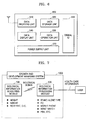
- FIG. 6 is a block diagram illustrating a configuration of a biological information processing module according to an embodiment of the present invention
- FIG. 7 is a block diagram illustrating a whole configuration of the system to which the biological information processing module shown in FIG. 6 is applied.
- the biological information processing module 500 comprises a data receiving unit 510, a data storage unit 520, a data operation unit 530, a data display unit 540, a digital input and output (digital IO) unit 550, and a power supply unit 570.
- the biological information processing module 500 analyzes, stores, and manages the biological information transmitted wirelessly from the biological information measuring module 100.
- the data receiving unit 510 has a radio data receiver and receives the biological information transmitted wirelessly from the biological information measuring module 100.
- the data storage unit 520 sorts and stores the biological information received from the data receiving unit 510 for each user.
- the data operation unit 530 analyzes growth and development data of a user (for example, child) through a statistical process and a predetermined analyzing algorithm of the received biological information.
- the analyzed results by the data operation unit 530 are transmitted to the data storage unit 520 and are stored for each user, and the analyzed results or the biological information stored in the data storage unit 520 are supplied to a user through the data display unit 540.
- the data display unit 540 has a speaker (not shown) outputting relevant data in a voice and a display device, for instance, liquid crystal display LCD, etc.
- the digital IO unit 550 controls input/output of the data receiving unit 510, the data storage unit 520, the data operation unit 530, and the data display unit 540.
- the power supply unit 570 supplies electric power required for the biological information processing module 500.
- the biological information processing module 500 together with the biological information measuring module 100 is involved in the system 1000.
- the biological information processing module 500 receives wirelessly, analyzes, and manages for each user the biological information of height, weight, body fat, etc. measured from the biological information measuring module 100.
- the biological information processing module 500 can be embodied in an exclusive platform for managing the user's growth and development information and can also be embodied in a mobile phone, a PDA, or a wrist-watch typed potable terminal, etc.
- the growth and development managing system 1000 extends the configuration so that the biological information processing module 500 can interact with a data center (see 700 of FIG. 9) in a remote place as well as the biological information measuring module 100, the system can supply fatness and nutritive condition managing services and health information managing services of adult as well.
- the configuration of the biological information processing module having such extended functions will be as follows.
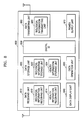
- FIG. 8 is a block diagram illustrating a configuration of the biological information processing module according to another embodiment of the present invention
- FIG. 9 is a block diagram illustrating a configuration of a fatness and nutritive condition managing system and a health information managing system to which the biological information processing module shown in FIG. 8 is applied.
- the biological information processing module 600 performs functions of analyzing the biological information transmitted wirelessly from the biological information measuring module 100 to manage fatness and nutritive conditions, and storing and managing health care information for each user transmitted wirelessly from the data center (see 700 of FIG. 9).
- the biological information processing module 600 comprises a data receiving unit 610, a data storage unit 620, a data operation unit 630, a data display unit 640, a digital IO unit 650, a data transmitting unit 660, and a power supply unit 670.
- the data receiving unit 610 comprises a biological information receiving unit 612 and a health information receiving unit 614.
- the data receiving unit 610 receives each of the biological information transmitted from the biological information measuring module 100 and the health care information for each user transmitted from the data center.
- the data storage unit 620 comprises the biological information storage unit 622 and the health information storage unit 624.
- the data storage unit 620 stores the biological information and the health care information for each user received from the biological information receiving unit 612 and the health information receiving unit 614. , Particularly, since a user identification function is provided to the fatness and nutritive condition managing system 1000' to which the biological information processing module 600 is applied and a health information managing system 2000, the data storage unit 620 manages the biological information and the health care information for each user according to a user recognition result.
- the data operation unit 630 analyzes a fatness and nutritive condition management information of a user, for example, a child through statistical process and a predetermined analysis algorithm on the received biological information.
- the analyzed results are transmitted to the data storage unit 620, are stored for each user, and are transmitted wirelessly to the data center through the digital IO unit 650 and the data transmitting unit 660.
- the analyzed results or the biological information stored to the data storage unit 620 are supplied to a user through the data display unit 640.
- the data display unit 640 has a speaker (not shown) to output related information in a voice and a display device, for instance, LCD, etc., to output the analyzed biological information in images.
- the data transmitting unit 660 involves a biological information transmission unit 662 and transmits the analyzed results of the biological information to the data center 700.
- the digital IO unit 650 controls the input/output of the data receiving unit 610, the data storage unit 620, the data operation unit 630, the data display unit 640, and the data transmitting unit 660.
- the power supply unit 670 supplies electric power required for the biological information processing module 600.
- the biological information processing module 600 shown in FIG. 8 performs functions of processing and managing biological information for each user as in the biological information processing module 500 shown in FIG. 6 and additional functions of exchanging and managing health information such as custom-made health information for each predetermined period for each user based on data of height, weight, body fat, etc., with the data center in a remote place. Therefore, the module can systematically supply the growth and development data for each user, and even health-relevant information on corresponding user.
- the biological information processing module 600 together with the biological information measuring module 100 is involved in the fatness and nutritive condition managing system 1000' and the health information managing system 2000.
- the biological information processing module 600 receives wirelessly, analyzes, and manages for each user the biological information of height, weight, body fat, etc. measured from the biological information measuring module 100.
- the biological information processing module 600 together with the data center 700 is involved in the health information managing system 2000.
- the biological information processing module 600 analyzes, stores, and manages the biological information transmitted wirelessly from the biological information measuring module 100, and stores and manages the health care information for each user transmitted wirelessly from the data center 700.
- the biological information processing module 600 can be embodied in an exclusive platform, a mobile phone, a PDA, a wrist-watch typed potable terminal, etc. managing the user growth and development data or fat and nutritive management data and health-relevant information.
- the data center 700 is situated in a remote place of the biological information processing module 600, involves a health care data database 720, and packs the health-relevant information for each user to a database.
- FIG. 10 is a diagram illustrating data flow between the biological information processing module 600 and the data center 700 shown in FIG. 9.
- the data center 700 analyzes the health care information of a user for each period, for example, daily, weekly, monthly, based on the biological information, for example, height, weight, body fat data, and the user personal information, for example, sex, age, basic medical history, transmitted from the biological information processing module 600, performs statistic processes and analytic algorithms on the health care information and the user personal information, and then separates the performed results for each user and stores the separated results to the health care information database 720. Further, the data center 700 can make the biological information processing module 600 to integratedly supply the health care information to a user by transmitting back the health care information for each user stored in the health care information database 720 to the biological information processing module 600.
- the health care information can be supplied as a voice message, a short message service SMS, an e-mail, etc., to a user or a user can retrieve relevant data by logging in the data center 700.
- FIG. 11 is a flowchart illustrating a growth and development measuring and analyzing method to be performed in a system 1000 for managing growth and development of a child, according to an exemplary embodiment of the present invention.
- the system 1000 for managing growth and development of a child determines whether a user stands in a right position for measuring the biological information (operation 1100), and identifies a user by acquiring the ECG signal from the user through the integrated identification-weight-body fat measuring module 300 (operation 1200). At this time, combination of weight information, bioelectric impedance information, and body fat information, etc. acquired from the user as well as the ECG signal may be used in the identifying process.
- the registered data related to the user is retrieved (operation 1300), and thus a pre-process for measurement is completed.
- the biological information for example, height, weight, body fat data, etc.
- the biological information measuring module 100 is measured through the biological information measuring module 100 (operation 1400), and it is determined whether there is an error in the measured biological information (operation 1500).
- the process returns to operation 1400 and the biological information is measured again, but when there is no error in the measured biological information, the measured biological information is transmitted wirelessly to the biological information processing module 500 (operation 1600).
- the biological information processing module 500 processes and analyzes the biological information transmitted from the biological information measuring module 100 (operation 1700)
- the analyzed results are stored for each user (operation 1800).
- the analyzed results stored in operation 1800 may be stored for each user in the biological information processing module 500, and may be stored to a database at the data center 700.
- Such biological information stored for each user is supplied to a user in a voice message, a SMS, an e-mail, etc., through the biological information processing module 500 (operation 1900), and a user can retrieve relevant data by logging in the data center 700.
- FIG. 12 is a detailed flow chart for determining whether a user stands at a right position shown in FIG. 11.
- the system 1000 sets a vertical right position of the height measuring module 200 determining whether a user stands at a right position (operation 1101).
- Vertical right position setting process performed in operation 1101 is a process of normally implementing a the ultrasonic wave generating unit 212 and the ultrasonic wave receiving unit 214 on the ceiling and the floor of a room for measuring height and is performed when initializing the system 1000.
- a process of measuring a height is on standby (operation 1103), the hand and the foot electrodes 341 and 342 of the integrated identification-weight-body fat measuring module 300 are contacted to a user's hands and feet, respectively (operation 1104). Then, it is determined whether the contact state of electrodes is normal by confirming whether the hand and the foot electrodes 341 and 342 of the identification-weight-body fat measuring module 300 normally contacted to a user's hands and feet (operation 1105). For example, if 4 or 8 electrodes normally contact to a user's hands and feet when measuring body fat, a voltage drop starts from a saturated bioelectric impedance. The contact state of the electrodes is determined to normal if there is no abnormality after a few seconds pass from the start of the voltage drop.
- the integrated identification-weight-body fat measuring module 300 transmits signals of which the contact state of the electrodes is normal to the ultrasonic wave generating unit 212 in the height measuring module 200 (operation 1106), the height measuring module 200 on a standby mode for measurement finishes the standby mode and completes preparation for measurement (operation 1107).
- FIG. 13 is a detailed flow chart illustrating a user identifying process shown in FIG. 11.
- the identification-weight-body fat measuring module 300 in the system 1000 measures an ECG signal through the hand electrodes 341 and the foot electrodes 342 contacted to the user's hands and feet (operation 1201). It is also examined whether leads connected to the hand and foot electrodes are dropped or there is an error in measuring the ECG signal (operation 1202). When there is an error in measuring the ECG signal in operation 1202, the process returns to operation 1201 and the ECG signal is measured again. When there is no error in measuring the ECG signal, however, it is determined whether there is a correspondence by comparing the ECG signals measured from the ECG measuring unit 322 with the previously stored ECG templates (operation 1203).
- the ECG templates to be used for identifying a user may be stored to a personal data storage unit in the identification-weight-body fat measuring module 300, or may be stored at the biological information processing module 500 or the data center 700 in a remote place according to the system configuration.
- the personal data storage unit can interact with the biological information measuring module 100 by implementing the personal data storage unit in the biological information processing module 500. That is, the personal data storage unit may be included in an integrated form to the biological information processing module 500, or may be embodied in a portable electronic record media such as an electronic record card.
- the identification-weight-body fat measuring module 300 retrieves the user data, for example, name, birth date, sex, blood type, basic medical history, etc. from the biological information processing module 500 (operation 1300).
- the identification-weight-body fat measuring module 300 records ECG data acquired for a predetermined time by the standard limb lead of ECG, and the identifying process is completed by retrieving the most interrelated user health information record through an operation to compare the recorded user ECG data with the previously input ECG templates for each user.
- a technology to use an ECG signal for identifying a user is disclosed in the article, "One-Lead ECG for Identity Verification" published the 2nd Joint Conference of the IEEE Engineering in Medicine and Biology Society and the Biomedical Engineering Society by T.W. Shen, W.J. Tompkins, and Y.H.Hu in 2002.
- the ECG recording for identification is continued for about 20 seconds to 30 seconds when heart beat fluctuates between 20 and 30 times.
- the interrelationship is analyzed by using a training algorism such as a template matching and neural network, etc. QRS onset, P duration, QRS duration, R duration, S duration, ST slope, QRS p-p amplitude, T amplitude, and ST amplitude, etc. are used as ECG matching parameters for the Template matching.
- QRS onset, P duration, QRS duration, R duration, S duration, ST slope, QRS p-p amplitude, T amplitude, and ST amplitude, etc. are used as ECG matching parameters for the Template matching.
- a user recognition method through training ECG signals is disclosed in the paper, "ECG analysis: A new approach in human identification", IEEE Proc. Instrumentation & Measurement Technology Conference, to be presented in Venice, Italy by Biel, L., Pettersson, O., Philipson, L., and Wide, P. in 1998.
- the ECG signal
- a user recognition method of the present invention whenever measuring the biological information, a user is automatically identified through the ECG signal, and health-relevant information as well as the growth and development information of each identified user, can be systematically managed without inputting a user's personal data.
- FIG. 14 is a detailed flow chart illustrating the biological information measuring process shown in FIG. 11.
- the identification-weight-body fat measuring module 300 in the system 1000 determines whether a contact state of the hand electrodes 341 and the foot electrodes 342 contacted to a user hands and feet is normal (operation 1401). When there is an error in the contact state of the hand and foot electrodes 341 and 342 in operation 1401, a simple voice message requesting to measure again is output. However, when the contact state of the hand and foot electrodes 341 and 342 is normal, the user height is measured through the height measuring module 200 mounted on the ceiling (operation 1402), and the user's weight is measured through the identification-weight-body fat measuring module 300 (operation 1403).
- a body fat is calculated using the measured bioelectric impedance; height information measured in operation 1402, and weight information measured in operation 1403 (operation 1404).
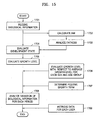
- FIG. 15 is a detailed flow chart illustrating the data processing and analyzing process shown in FIG. 11.
- Growth and development evaluation performed by the system 1000 is divided into a development state evaluation, a growth level evaluation, a positive growth entry term and positive growth term determination, and an analysis of variation transition in growth and development for each period as shown in Table 1 below.
- the biological information processing module 500 in the system 1000 receives the biological information, that is, weight, body fat, height, etc., measured from the identification-weight-body fat measuring module 300 (operation 1701), and calculates BMI (Body Mass Index) as in the following Equation 1 (operation 1702).
- BMI weight (kg)/ square of height (m)
- BMI is calculated in operation 1702
- weight and fatness are analyzed based on a BMI table for sex and age (operation 1703).
- the BMI table used at this time can replace with the BMI table updated in the nearest time to corresponding year. below shows an example of a BMI table.
- the analysis of fatness of children performed in operation 1703 is largely divided into determination of fatness based on the BMI table and determination of fatness based on the bioelectric impedance. That is, in operation 1703, after determination of fatness based on BMI table is firstly performed, determination of fatness based on the bioelectric impedance is selectively performed, so that more correct fatness information of a user can be obtained.
- a bioelectric impedance measuring method is to flow minute current of which a user cannot sense to the user's hands and feet after attaching 4 electrodes typically on ankle, foot, wrist, and hand and to detect voltage from wrist and ankle. Then, the method is to calculate a body fat percentage from electric conductivity of a human organ, namely, the measured voltage.
- the present invention determines fatness once more based on bioelectric impedance of a user having overweight and fatness after estimating overweight and fatness through the BMI, so that reliability of health information on the user development state is enhanced.
- the user development state is evaluated based on the analyzed result (operation 1704).
- subjects are divided in three groups having low, normal, and high body fat percentage, to determine the development state of users belonging to each group.
- Table 3 below shows definitions of three groups based on the body fat percentage.
- Body fat percentage Group to be evaluated less than 10% low 10% to 14% normal 15% or more high
- evaluation on user's growth level is performed (operation 1705), and the user's growth level vs average growth by sex and age is evaluated (operation 1706).
- the evaluation of the growth level performed in operation 1706 is divided into evaluation of the growth level vs average height by sex and age and evaluation of the growth level vs average weight by sex and age, and both evaluations are calculated by the following equations, respectively.
- average growth information (height, and weight) and a user's growth information are compared with and the compared result is represented by percentage, so that the growth level is evaluated.
- FIG. 16 is a graph illustrating the positive growth term determining process shown in FIG. 15.
- the inflection point portion is determined as a positive growth entry term, and based on this, when the slope of the curve maintains the positive slope for six months or more or is spread to more sharp positive, it is determined as a positive growth term.
- operation 1708 the variation in biological information and development state for period is analyzed (operation 1708), and data for user are retrieved (operation 1709).
- the system 1000 in analyzing biological information for user, does not only support to analyze instant data, but also stores the analyzed results on the development state and growth level for user. Then the system 1000 accumulatively sums the analyzed results for each period and each user, and analyzes the variations of the accumulated results.
- FIG. 17 is a diagram illustrating a growth and development analysis displays according to an exemplary embodiment of the present invention.
- the system 1000 provides tendency to the changes of the biological information for each period for each user and the analyzed results thereof. Further, the system provides health information related to the tendency to changes as well as exercise prescription, diet information, etc., required for each user. Furthermore, the system can interact with the data center 700 so as to manage the health information in a remote place, so that it is possible to provide information on sports center for exercise, information on specialized medical clinics related to disease, and a function of making a reservation to see a doctor.
- the system 1000 for managing growth and development of a child collects and analyzes the biological information of height, weight, body fat, etc., for user, and shows time sequential changes of the same kind of biological information which have been stored for a predetermined period for user, so that the system can comprehensively provide information on child's growth and development state and information on a solution such as exercise, rest, diet, etc., suitable for each situation when measuring.
- Such health information management can be expanded to adults as well as children.
- the system can minimize a size of device and space required for measuring biological signals, whereby carrying, moving and storing of the system are easy, so that the system can easily be used at a house or a tour place.
- the present invention can also be embodied as computer readable codes on a computer readable recording medium.
- the computer readable recording medium is any data storage device that can store data which can be thereafter read by a computer system. Examples of the computer readable recording medium include read-only memory (ROM), random-access memory (RAM), CD-ROMs, magnetic tapes, floppy disks, optical data storage devices, and carrier waves such as data transmission through the Internet.
- the computer readable recording medium can also be distributed over network coupled computer systems so that the computer readable code is stored and executed in a distributed fashion.
Landscapes
- Health & Medical Sciences (AREA)
- Life Sciences & Earth Sciences (AREA)
- Engineering & Computer Science (AREA)
- Animal Behavior & Ethology (AREA)
- Public Health (AREA)
- Biophysics (AREA)
- Pathology (AREA)
- Biomedical Technology (AREA)
- Heart & Thoracic Surgery (AREA)
- Medical Informatics (AREA)
- Molecular Biology (AREA)
- Surgery (AREA)
- Veterinary Medicine (AREA)
- General Health & Medical Sciences (AREA)
- Physics & Mathematics (AREA)
- Computer Networks & Wireless Communication (AREA)
- Dentistry (AREA)
- Oral & Maxillofacial Surgery (AREA)
- Nuclear Medicine, Radiotherapy & Molecular Imaging (AREA)
- Radiology & Medical Imaging (AREA)
- Cardiology (AREA)
- Measurement And Recording Of Electrical Phenomena And Electrical Characteristics Of The Living Body (AREA)
- Measuring And Recording Apparatus For Diagnosis (AREA)
- Measurement Of The Respiration, Hearing Ability, Form, And Blood Characteristics Of Living Organisms (AREA)
- Medical Treatment And Welfare Office Work (AREA)
Abstract
Description
| Data processing | Method |
| Evaluation of development state | 1) weight analysis and fatness determination by BMI calculation (weight (kg)/ square of height (m)); weight analysis and fatness determination based on BMI table by sex and age of corresponding year |
| 2) fatness determination by bioelectric impedance measuring method | |
| Analysis of growth level evaluation | express the difference based on average height and weight by sex and age as percentage |
| * growth level vs average height by sex and age = {(average height by sex and age-user's height)/(average height by sex and age)}*100 | |
| * growth level vs average weight by sex and age = {(average weight by sex and age-user's weight)/(average weight by sex and age)}*100 | |
| Determination of positive growth entry term and positive growth term | * the inflection point portion where the slope of a height increment rate curve in recent 6 months since 6 age is converted to positive (+) from negative (-) or zero (0) is determined as a positive growth entry term, and based on this, when the slope of an increment rate curve maintains the positive slope for six months or more or is expanded to more sharp positive slope, it is determined as a positive growth term. |
| Analysis of variation in biological information and development state for each period | Variation is output as a graph over a predetermined period by cumulatively summing weight, height, body fat percentage, and fatness data for each period. |
| below shows an example of a BMI table. | ||||
| Age | Overweight | Fatness | ||
| 18 or more | 25 to 29 | 30>BMI | ||
| 4 | male | 17.56 | Male | 19.29 |
| female | 17.28 | Female | 19.15 | |
| 6 | male | 17.56 | Male | 19.78 |
| female | 17.34 | Female | 19.65 | |
| 8 | male | 18.44 | Male | 21.60 |
| female | 18.35 | Female | 21.57 | |
| 10 | male | 19.84 | Male | 24.00 |
| female | 19.86 | Female | 24.11 | |
| 12 | male | 21.22 | Male | 26.02 |
| female | 21.68 | Female | 26.67 | |
| 14 | male | 22.62 | Male | 27.63 |
| female | 23.34 | Female | 28.57 | |
| 16 | male | 23.90 | Male | 28.88 |
| female | 24.37 | Female | 29.43 | |
| 18 | male | 25.00 | Male | 30.00 |
| female | 25.00 | Female | 30.00 |
| Body fat percentage | Group to be evaluated |
| less than 10% | low |
| 10% to 14% | normal |
| 15% or more | high |
Claims (17)
- A system for managing growth and development of a child, the system comprising:a biological information measuring module for acquiring at least two biological signals to be used for analyzing growth and development of a user, and identifying the user by analyzing at least one biological signal of the acquired biological signals; anda biological information processing module for evaluating a development state and a growth level of the user in response to the biological signals, storing and managing personal data and the evaluated result of the user.
- The system according to claim 1 or 2, further comprising a data center for receiving the biological information, the personal data, and the evaluated result of the development state and the growth level of the user from the biological information processing module, analyzing information required for a health condition and a health care of the user, and supplying the health-relevant information of the user at every predetermined period.
- The system according to claim 2, wherein the biological information processing module further comprises;
a data transmitting unit for transmitting wirelessly the biological information, the personal data, and the evaluated result of the development state and the growth level of the user to the data center; and
a data receiving unit for receiving the health-relevant data supplied from the data center and providing the health-relevant data to the user. - The system according to claim 2 or 3, wherein the data center comprises a health care database for storing the health care data for each user, and
the health care data is supplied to the biological information processing module in any one among a voice message, a short message service, and an electronic mail. - The system according to any preceding claim, wherein the biological information measuring module comprises:a height measuring module for measuring height of the user using ultrasonic waves; andan integrated identification-weight-body fat for measuring module measuring an electrocardiogram, weight, and a bioelectric impedance of the user, identifying the user by analyzing the measured electrocardiogram, and analyzing a body fat value from the bioelectric impedance.
- The system according to claim 5, wherein the height measuring module comprises:a height data acquiring unit for applying the ultrasonic waves to a head portion of the user and sensing the reflected ultrasonic waves;an analog-to-digital converter for converting the sensed ultrasonic waves into digital data;a control unit for calculating the height of the user in response to the converted ultrasonic wave data; anda data transmitting unit for transmitting wirelessly the calculated height data to the biological information processing module.
- The system according to claim 5 or 6, wherein the identification-weight-body fat measuring module comprises:an identification module for identifying the user by comparing the measured electrocardiogram with the previously-registered electrocardiogram templates; anda weight-body fat measuring module for measuring the weight and the bioelectric impedance of the user and analyzing the body fat value from the measured bioelectric impedance.
- The system according to claim 7, wherein the weight-body fat measuring module comprises:hand electrodes for coming in contact with hands of the user and acquiring the electrocardiogram and bioelectric impedance signal;foot electrodes for coming in contact with feet of the user and acquiring the electrocardiogram and bioelectric impedance signal;a load cell for coming in contact with the feet of the user and acquiring the weight signal;a weight measuring unit for amplifying the weight signal acquired by the load cell;a body fat measuring unit for measuring the bioelectric impedance signal by allowing a predetermined amount of current to flow in the hand electrodes and the foot electrodes and measuring voltages across the electrodes, and amplifying the measured bioelectric impedance signal;an analog-to-digital converter for converting the amplified weight signal and the amplified bioelectric impedance signal into digital weight data and digital bioelectric impedance data, respectively;a control unit for calculating the weight of the user by averaging the digital weight data, and calculating the body fat by analyzing the digital bioelectric impedance data; anda data transmitting/receiving unit for transmitting wirelessly the weight and the body fat data calculated by the control unit to the biological information processing module and receiving the personal data of the user from the biological information processing module.
- The system according to claim 8, wherein the identification module comprises an electrocardiogram measuring unit for amplifying the electrocardiogram acquired through the hand electrodes and the foot electrodes,
wherein the electrocardiogram amplified by the electrocardiogram measuring unit are compared with the electrocardiogram templates in the control unit in order to identify the user, and
the personal data is received by the data transmitting/receiving unit. - The system according to any preceding claim, wherein the biological information processing module comprises:a data receiving unit for receiving wirelessly the biological information transmitted from the biological information measuring module;a data storage unit for storing the received biological information for each user;a data operation unit for analyzing the biological information, evaluating the development state and the growth level, and analyzing tendencies of variations in growth and development of the user by period;a data display unit for outputting the analyzed result to the user;a digital input and output controller for controlling the data input and output of the data receiving unit, the data storing unit, the data operation unit, and the data display unit; anda power supply unit for supplying electric power required for the biological information processing module.
- The system according to any preceding claim, wherein the biological information processing module has any one among a stand-alone type device, a personal computer, a mobile phone, a wrist watch, and a personal digital assistant.
- A method of managing growth and development of a child, the method comprising:determining whether a user is positioned at a right position for measurement of biological information;identifying the user on the basis of at least one biological signal acquired from an integrated identification-weight-body fat measuring module;retrieving previously registered data of the identified user and measuring the biological information from the user;transmitting wirelessly the measured biological information to a biological information processing module; andallowing the biological information processing module to evaluate a development state and a growth level of the user in response to the biological information and store the evaluated result of the user.
- The method according to claim 12, further comprising:allowing the biological information processing module to transmit wirelessly the biological information, personal data, and the evaluated result of the development state and growth level of the user to a data center; andallowing the data center to receive and analyze the biological information, the personal data, and the evaluated result of the development state and growth level of the user, and to supply the analyzed health-relevant information at every predetermined period to the biological information processing module.
- The method according to claim 12 or 13, wherein the evaluating comprises:calculating a body mass index in response to the biological information and analyzing a weight and a fatness on the basis of a body mass index table for each sex and age;analyzing the weight and the fatness of the user on the basis of bioelectric impedance measured from the user when the fatness is above a predetermined value;evaluating the growth level of the user on the basis of average heights and average weights for each sex and age;determining a positive growth entry term and a positive growth term in consideration of a increment rate in height of the user; andanalyzing variation of the biological information by period by analyzing a tendency of the analyzed results for a predetermined period.
- The method according to claim 14, wherein after the user is over 6 years old, the positive growth entry term is represented by an inflection point where a slope of a height increment rate curve for latest six months is converted into a positive (+) value from a negative (-) value or zero (0).
- The method according to claim 14 or 15, wherein the positive growth term is a term when the slope of the curve maintains the positive slope for six months or more or when the slope of the curve has a sharper slope with respect to the positive growth entry term.
- A computer readable recording medium on which a program for executing a method according to any one of claims 12 to 16 is recorded.
Applications Claiming Priority (2)
| Application Number | Priority Date | Filing Date | Title |
|---|---|---|---|
| KR1020040007232A KR20050079235A (en) | 2004-02-04 | 2004-02-04 | System and method for managing growth and development of children |
| KR2004007232 | 2004-02-04 |
Publications (2)
| Publication Number | Publication Date |
|---|---|
| EP1583019A2 true EP1583019A2 (en) | 2005-10-05 |
| EP1583019A3 EP1583019A3 (en) | 2006-04-26 |
Family
ID=34806107
Family Applications (1)
| Application Number | Title | Priority Date | Filing Date |
|---|---|---|---|
| EP05250531A Withdrawn EP1583019A3 (en) | 2004-02-04 | 2005-02-01 | System and method for managing growth and development of child |
Country Status (4)
| Country | Link |
|---|---|
| US (1) | US20050171451A1 (en) |
| EP (1) | EP1583019A3 (en) |
| JP (1) | JP2005228315A (en) |
| KR (1) | KR20050079235A (en) |
Cited By (7)
| Publication number | Priority date | Publication date | Assignee | Title |
|---|---|---|---|---|
| CN102004855A (en) * | 2010-11-26 | 2011-04-06 | 马慧 | Engineering control method and evaluation hierarchical model for carbon footprint |
| CN102042865A (en) * | 2009-10-09 | 2011-05-04 | 丹·迈尔 | weighing computer |
| WO2013017716A3 (en) * | 2011-07-29 | 2013-03-28 | Universitat Politècnica De Catalunya | Method and apparatus for obtaining a plurality of simultaneous leads of the electrocardiogram |
| CN103258129A (en) * | 2013-05-09 | 2013-08-21 | 中国科学院上海光学精密机械研究所 | Method for processing data of excimer laser interference fringes |
| ES2550695A1 (en) * | 2014-05-09 | 2015-11-11 | Universitat Politècnica De Catalunya | Electrocardiography apparatus (Machine-translation by Google Translate, not legally binding) |
| CN106994015A (en) * | 2017-03-20 | 2017-08-01 | 上海斐讯数据通信技术有限公司 | Height detection method and device and the method and system that body fat rate is detected according to height |
| FR3131523A1 (en) * | 2022-12-29 | 2023-07-07 | Withings | Measuring station with electrocardiogram measurement |
Families Citing this family (64)
| Publication number | Priority date | Publication date | Assignee | Title |
|---|---|---|---|---|
| KR100659695B1 (en) * | 2004-06-25 | 2006-12-20 | 전미숙 | System and method for providing a service to check the growth and development stage of the infant |
| JP2006107159A (en) * | 2004-10-06 | 2006-04-20 | Aprica Kassai Inc | Infants growth diagnosis device and its program |
| US7006405B1 (en) * | 2004-10-22 | 2006-02-28 | Kyooh Precision Industry Co., Ltd. | Portable ultrasound height measuring apparatus |
| US20070030339A1 (en) * | 2005-02-18 | 2007-02-08 | Nathaniel Findlay | Method, system and software for monitoring compliance |
| US20070083392A1 (en) * | 2005-10-07 | 2007-04-12 | Siemens Medical Solutions Health Services Corporation | Automatic Patient Parameter Acquisition System |
| EP2037999B1 (en) | 2006-07-07 | 2016-12-28 | Proteus Digital Health, Inc. | Smart parenteral administration system |
| JP4234163B2 (en) * | 2006-09-06 | 2009-03-04 | 株式会社タニタ | Body composition index estimation system |
| CN100434043C (en) * | 2007-01-10 | 2008-11-19 | 陈菊萍 | Ultrasonic Height Measuring Device |
| KR20080069859A (en) * | 2007-01-24 | 2008-07-29 | 엘지전자 주식회사 | Blood pressure measuring device |
| DE102007039448A1 (en) * | 2007-08-21 | 2009-02-26 | Siemens Ag | Device for measuring medical data and for recording a patient identity |
| BRPI0722004A2 (en) * | 2007-09-11 | 2015-06-16 | Franck Baudino | Health Center. |
| US8961437B2 (en) * | 2009-09-09 | 2015-02-24 | Youhanna Al-Tawil | Mouth guard for detecting and monitoring bite pressures |
| US8870780B2 (en) | 2008-10-15 | 2014-10-28 | The Board Of Trustees Of The Leland Stanford Junior University | Systems and methods for monitoring heart function |
| KR101041033B1 (en) * | 2008-11-26 | 2011-06-13 | 서울대학교산학협력단 | Apparatus and method for evaluating weightless restraint health status |
| CN102333573B (en) * | 2009-02-26 | 2015-11-25 | 皇家飞利浦电子股份有限公司 | Exercise system and the method for communicating |
| FR2945957B1 (en) * | 2009-06-02 | 2012-11-23 | Taztag | DATA EXCHANGE TERMINAL COMPRISING A CARDIAC PULSATION SENSOR. |
| TW201116256A (en) * | 2009-11-09 | 2011-05-16 | Charder Electronic Co Ltd | Device for measuring human body composition by using biolectrical impedance method and artificial neural network |
| KR101192932B1 (en) * | 2009-12-22 | 2012-10-18 | 삼성전자주식회사 | Method and apparatus for recognizing identification in portable terminal using touchscreen |
| SG182824A1 (en) * | 2010-02-01 | 2012-09-27 | Proteus Biomedical Inc | Two-wrist data gathering system |
| JP2011177298A (en) * | 2010-02-26 | 2011-09-15 | Tanita Corp | Living body index measuring apparatus |
| GB2481199B (en) * | 2010-06-14 | 2015-01-21 | Pet Technology Store Ltd | A measuring system |
| US9208287B2 (en) | 2011-01-10 | 2015-12-08 | Videokall, Inc. | System and method for remote tele-health services |
| AU2012211300A1 (en) | 2011-01-27 | 2013-05-09 | The Board Of Trustees Of The Leland Stanford Junior University | Systems and methods for monitoring the circulatory system |
| DE102011118810A1 (en) * | 2011-11-15 | 2013-05-16 | Seca Ag | Device for measuring length |
| JP5949163B2 (en) * | 2012-05-28 | 2016-07-06 | オムロンヘルスケア株式会社 | Personal identification device and body composition meter |
| US10130273B2 (en) | 2014-06-12 | 2018-11-20 | PhysioWave, Inc. | Device and method having automatic user-responsive and user-specific physiological-meter platform |
| US9546898B2 (en) | 2014-06-12 | 2017-01-17 | PhysioWave, Inc. | Fitness testing scale |
| US9568354B2 (en) | 2014-06-12 | 2017-02-14 | PhysioWave, Inc. | Multifunction scale with large-area display |
| US9943241B2 (en) | 2014-06-12 | 2018-04-17 | PhysioWave, Inc. | Impedance measurement devices, systems, and methods |
| US9949662B2 (en) | 2014-06-12 | 2018-04-24 | PhysioWave, Inc. | Device and method having automatic user recognition and obtaining impedance-measurement signals |
| US9498137B2 (en) | 2014-08-07 | 2016-11-22 | PhysioWave, Inc. | Multi-function fitness scale with display |
| US9693696B2 (en) | 2014-08-07 | 2017-07-04 | PhysioWave, Inc. | System with user-physiological data updates |
| CN104146703A (en) * | 2014-08-21 | 2014-11-19 | 于东方 | Health detection system |
| CN104240169A (en) * | 2014-10-09 | 2014-12-24 | 上海贝生医疗设备有限公司 | Health data acquisition and management system |
| US20160128625A1 (en) * | 2014-11-11 | 2016-05-12 | Htc Corporation | Method and apparatus for advising physical condition and recording medium using the method |
| US10945671B2 (en) | 2015-06-23 | 2021-03-16 | PhysioWave, Inc. | Determining physiological parameters using movement detection |
| US11197628B2 (en) * | 2015-07-10 | 2021-12-14 | Bodyport Inc. | Cardiovascular health monitoring device |
| US11696715B2 (en) | 2015-07-10 | 2023-07-11 | Bodyport Inc. | Cardiovascular signal acquisition, fusion, and noise mitigation |
| JP2017077404A (en) * | 2015-10-21 | 2017-04-27 | 富士通株式会社 | Measuring apparatus, measuring method, and measuring program |
| USD796681S1 (en) * | 2015-11-03 | 2017-09-05 | Impeto Medical | Electrode |
| JP6878449B2 (en) * | 2015-11-10 | 2021-05-26 | インペディメッド・リミテッド | Impedance measurement system |
| US10395055B2 (en) | 2015-11-20 | 2019-08-27 | PhysioWave, Inc. | Scale-based data access control methods and apparatuses |
| US10553306B2 (en) | 2015-11-20 | 2020-02-04 | PhysioWave, Inc. | Scaled-based methods and apparatuses for automatically updating patient profiles |
| US10436630B2 (en) | 2015-11-20 | 2019-10-08 | PhysioWave, Inc. | Scale-based user-physiological data hierarchy service apparatuses and methods |
| US10980483B2 (en) | 2015-11-20 | 2021-04-20 | PhysioWave, Inc. | Remote physiologic parameter determination methods and platform apparatuses |
| US10923217B2 (en) | 2015-11-20 | 2021-02-16 | PhysioWave, Inc. | Condition or treatment assessment methods and platform apparatuses |
| US11561126B2 (en) | 2015-11-20 | 2023-01-24 | PhysioWave, Inc. | Scale-based user-physiological heuristic systems |
| US20170188846A1 (en) * | 2016-01-05 | 2017-07-06 | Tosense, Inc. | Physiological monitoring system featuring floormat and wired handheld sensor |
| US20170188961A1 (en) * | 2016-01-05 | 2017-07-06 | Tosense, Inc. | Combined floormat and body-worn physiological sensors |
| CN106951753B (en) * | 2016-01-06 | 2020-08-21 | 北京三星通信技术研究有限公司 | Electrocardiosignal authentication method and device |
| US10130307B2 (en) | 2016-01-06 | 2018-11-20 | Samsung Electronics Co., Ltd. | Electrocardiogram (ECG) authentication method and apparatus |
| CN109069055A (en) * | 2016-02-16 | 2018-12-21 | 伊派迪迈德公司 | Physical condition classification |
| US10390772B1 (en) | 2016-05-04 | 2019-08-27 | PhysioWave, Inc. | Scale-based on-demand care system |
| KR102614487B1 (en) * | 2016-07-29 | 2023-12-15 | 엘지전자 주식회사 | Electronic device and method for controlling the same |
| CN110267589A (en) | 2016-08-26 | 2019-09-20 | Ami 研发有限责任公司 | Vital Signs Monitoring via Touchscreen Using Bioelectrical Impedance |
| US10215619B1 (en) | 2016-09-06 | 2019-02-26 | PhysioWave, Inc. | Scale-based time synchrony |
| JP6856420B2 (en) * | 2017-03-24 | 2021-04-07 | 聡子 水流 | Evaluation system and evaluation program |
| JP7144249B2 (en) * | 2018-09-05 | 2022-09-29 | 聡子 水流 | Evaluation system and evaluation program |
| CN109820504A (en) * | 2018-11-15 | 2019-05-31 | 芯海科技(深圳)股份有限公司 | A kind of measuring body composition method and system improving accuracy |
| CN112426132A (en) * | 2020-11-24 | 2021-03-02 | 首都体育学院 | Terminal for nutrition and health prediction based on big data |
| JP7167241B1 (en) * | 2021-04-28 | 2022-11-08 | ジーイー・プレシジョン・ヘルスケア・エルエルシー | LEARNED MODEL GENERATION METHOD, PROCESSING DEVICE, AND STORAGE MEDIUM |
| CN113571185A (en) * | 2021-07-21 | 2021-10-29 | 正艺星空(北京)教育科技有限公司 | Teenager quality evaluation system based on multivariate intelligent theory |
| US20230032996A1 (en) * | 2021-07-23 | 2023-02-02 | United Metal Fabricators, Inc. d/b/a UMF Medical | System and Method for Height Determination |
| CN113598747A (en) * | 2021-08-09 | 2021-11-05 | 芯海科技(深圳)股份有限公司 | Impedance measuring device, body scale and body composition analyzer |
Family Cites Families (11)
| Publication number | Priority date | Publication date | Assignee | Title |
|---|---|---|---|---|
| ES2010309A6 (en) * | 1988-07-18 | 1989-11-01 | Torres Manuel Torralba | Apparatus for weighing and measuring the stature of persons. |
| US5415176A (en) * | 1991-11-29 | 1995-05-16 | Tanita Corporation | Apparatus for measuring body fat |
| US5763837A (en) * | 1994-10-11 | 1998-06-09 | Davignon; Andre | Automatic biometric data system |
| US6354996B1 (en) * | 1998-04-15 | 2002-03-12 | Braun Gmbh | Body composition analyzer with trend display |
| KR100333166B1 (en) * | 1999-07-29 | 2002-04-18 | 차기철 | Useful Apparatus and Method for Analyzing Body Composition Based on Bioelectrical Impedance |
| US6612984B1 (en) * | 1999-12-03 | 2003-09-02 | Kerr, Ii Robert A. | System and method for collecting and transmitting medical data |
| JP2002306439A (en) * | 2001-04-11 | 2002-10-22 | Tanita Corp | Visceral fat measuring device |
| US6678557B1 (en) * | 2001-08-20 | 2004-01-13 | Tvx Internet Services, Inc. | System and method for body fat management |
| JP3874243B2 (en) * | 2001-08-29 | 2007-01-31 | 株式会社タニタ | Biological information management device with growth process graph display function |
| DE10159803A1 (en) * | 2001-12-05 | 2003-07-03 | Degussa | Catalysts and processes for the preparation of polyisocyanates containing isocyanurate groups and their use |
| US6748264B2 (en) * | 2002-02-04 | 2004-06-08 | Fook Tin Technologies Limited | Body fat analyzer with integral analog measurement electrodes |
-
2004
- 2004-02-04 KR KR1020040007232A patent/KR20050079235A/en not_active Ceased
-
2005
- 2005-02-01 EP EP05250531A patent/EP1583019A3/en not_active Withdrawn
- 2005-02-04 JP JP2005029476A patent/JP2005228315A/en active Pending
- 2005-02-04 US US11/049,946 patent/US20050171451A1/en not_active Abandoned
Cited By (8)
| Publication number | Priority date | Publication date | Assignee | Title |
|---|---|---|---|---|
| CN102042865A (en) * | 2009-10-09 | 2011-05-04 | 丹·迈尔 | weighing computer |
| CN102004855A (en) * | 2010-11-26 | 2011-04-06 | 马慧 | Engineering control method and evaluation hierarchical model for carbon footprint |
| WO2013017716A3 (en) * | 2011-07-29 | 2013-03-28 | Universitat Politècnica De Catalunya | Method and apparatus for obtaining a plurality of simultaneous leads of the electrocardiogram |
| CN103258129A (en) * | 2013-05-09 | 2013-08-21 | 中国科学院上海光学精密机械研究所 | Method for processing data of excimer laser interference fringes |
| CN103258129B (en) * | 2013-05-09 | 2016-09-21 | 中国科学院上海光学精密机械研究所 | The data processing method of excimer laser interference fringe |
| ES2550695A1 (en) * | 2014-05-09 | 2015-11-11 | Universitat Politècnica De Catalunya | Electrocardiography apparatus (Machine-translation by Google Translate, not legally binding) |
| CN106994015A (en) * | 2017-03-20 | 2017-08-01 | 上海斐讯数据通信技术有限公司 | Height detection method and device and the method and system that body fat rate is detected according to height |
| FR3131523A1 (en) * | 2022-12-29 | 2023-07-07 | Withings | Measuring station with electrocardiogram measurement |
Also Published As
| Publication number | Publication date |
|---|---|
| JP2005228315A (en) | 2005-08-25 |
| KR20050079235A (en) | 2005-08-09 |
| EP1583019A3 (en) | 2006-04-26 |
| US20050171451A1 (en) | 2005-08-04 |
Similar Documents
| Publication | Publication Date | Title |
|---|---|---|
| EP1583019A2 (en) | System and method for managing growth and development of child | |
| KR0137272B1 (en) | Healthcare measuring device | |
| EP3474287A1 (en) | Apparatus and method for correcting error of bio-information sensor, and apparatus and method for estimating bio-information | |
| RU2532953C2 (en) | Biological information measuring device, method for measuring biological information and body composition measuring device | |
| US20190365308A1 (en) | Urinary event detection, tracking, and analysis | |
| JP2004130142A (en) | Mobile device having health management function based on biological signal and health management method using the same | |
| JP2023512987A (en) | Systems and methods for monitoring patient spine, balance, gait, or posture | |
| US20210137468A1 (en) | Portable health and wellness device | |
| KR100755974B1 (en) | Health Care Network System using Smart Communicator and Method thereof | |
| US20020059081A1 (en) | Health control system and information processing apparatus | |
| JP2012024390A (en) | Biomeasurement device, biomeasurement method, control program for biomeasurement device, and recording medium with the control program recorded thereon | |
| JP2004049345A (en) | Medical information providing system and cellular phone | |
| JP2019504747A (en) | Classification of body condition | |
| CN111344805A (en) | Lifestyle management device, method, and program | |
| Ahmed | An intelligent healthcare service to monitor vital signs in daily life–a case study on health-iot | |
| JP2023020895A (en) | Biometric device, pulse wave sensor, blood pressure meter, diagnosis system, diagnosis method, program, and conference support system | |
| CN112890785B (en) | Health management system using non-contact imaging physiological detection technology | |
| KR20170103704A (en) | System for mesuring and managing body informantion having personal identification function | |
| JP2004351184A (en) | Ubiquitous health management support system | |
| JP2000262484A (en) | Group medical examination diagnostic system | |
| JP2004255029A (en) | Mobile terminal, health management support system | |
| JP2003216740A (en) | Health management method, health management system, health management program, and medium recording health management program | |
| JP2005305134A (en) | Biological information processing apparatus and biological information processing system | |
| JP2010086220A (en) | Health management system, measurement terminal, and server | |
| HALABY et al. | Novel approach of a smart medical mirror system for medical applications |
Legal Events
| Date | Code | Title | Description |
|---|---|---|---|
| PUAI | Public reference made under article 153(3) epc to a published international application that has entered the european phase |
Free format text: ORIGINAL CODE: 0009012 |
|
| 17P | Request for examination filed |
Effective date: 20050216 |
|
| AK | Designated contracting states |
Kind code of ref document: A2 Designated state(s): AT BE BG CH CY CZ DE DK EE ES FI FR GB GR HU IE IS IT LI LT LU MC NL PL PT RO SE SI SK TR |
|
| AX | Request for extension of the european patent |
Extension state: AL BA HR LV MK YU |
|
| PUAL | Search report despatched |
Free format text: ORIGINAL CODE: 0009013 |
|
| RIN1 | Information on inventor provided before grant (corrected) |
Inventor name: LEE, JEONG-HWAN Inventor name: WHANG, JIN-SANG Inventor name: KIM, KYUNG-HO Inventor name: YEO, HYUNG-SOK |
|
| AK | Designated contracting states |
Kind code of ref document: A3 Designated state(s): AT BE BG CH CY CZ DE DK EE ES FI FR GB GR HU IE IS IT LI LT LU MC NL PL PT RO SE SI SK TR |
|
| AX | Request for extension of the european patent |
Extension state: AL BA HR LV MK YU |
|
| STAA | Information on the status of an ep patent application or granted ep patent |
Free format text: STATUS: THE APPLICATION HAS BEEN WITHDRAWN |
|
| 18W | Application withdrawn |
Effective date: 20060627 |