EP1582796A2 - Plastics pipe - Google Patents
Plastics pipe Download PDFInfo
- Publication number
- EP1582796A2 EP1582796A2 EP05252081A EP05252081A EP1582796A2 EP 1582796 A2 EP1582796 A2 EP 1582796A2 EP 05252081 A EP05252081 A EP 05252081A EP 05252081 A EP05252081 A EP 05252081A EP 1582796 A2 EP1582796 A2 EP 1582796A2
- Authority
- EP
- European Patent Office
- Prior art keywords
- pipe according
- plastics pipe
- polypropylene
- plastics
- polymeric material
- Prior art date
- Legal status (The legal status is an assumption and is not a legal conclusion. Google has not performed a legal analysis and makes no representation as to the accuracy of the status listed.)
- Withdrawn
Links
Images


Classifications
-
- C—CHEMISTRY; METALLURGY
- C08—ORGANIC MACROMOLECULAR COMPOUNDS; THEIR PREPARATION OR CHEMICAL WORKING-UP; COMPOSITIONS BASED THEREON
- C08K—Use of inorganic or non-macromolecular organic substances as compounding ingredients
- C08K3/00—Use of inorganic substances as compounding ingredients
- C08K3/40—Glass
-
- C—CHEMISTRY; METALLURGY
- C08—ORGANIC MACROMOLECULAR COMPOUNDS; THEIR PREPARATION OR CHEMICAL WORKING-UP; COMPOSITIONS BASED THEREON
- C08K—Use of inorganic or non-macromolecular organic substances as compounding ingredients
- C08K7/00—Use of ingredients characterised by shape
- C08K7/02—Fibres or whiskers
- C08K7/04—Fibres or whiskers inorganic
- C08K7/14—Glass
-
- F—MECHANICAL ENGINEERING; LIGHTING; HEATING; WEAPONS; BLASTING
- F16—ENGINEERING ELEMENTS AND UNITS; GENERAL MEASURES FOR PRODUCING AND MAINTAINING EFFECTIVE FUNCTIONING OF MACHINES OR INSTALLATIONS; THERMAL INSULATION IN GENERAL
- F16L—PIPES; JOINTS OR FITTINGS FOR PIPES; SUPPORTS FOR PIPES, CABLES OR PROTECTIVE TUBING; MEANS FOR THERMAL INSULATION IN GENERAL
- F16L11/00—Hoses, i.e. flexible pipes
- F16L11/14—Hoses, i.e. flexible pipes made of rigid material, e.g. metal or hard plastics
- F16L11/15—Hoses, i.e. flexible pipes made of rigid material, e.g. metal or hard plastics corrugated
-
- F—MECHANICAL ENGINEERING; LIGHTING; HEATING; WEAPONS; BLASTING
- F16—ENGINEERING ELEMENTS AND UNITS; GENERAL MEASURES FOR PRODUCING AND MAINTAINING EFFECTIVE FUNCTIONING OF MACHINES OR INSTALLATIONS; THERMAL INSULATION IN GENERAL
- F16L—PIPES; JOINTS OR FITTINGS FOR PIPES; SUPPORTS FOR PIPES, CABLES OR PROTECTIVE TUBING; MEANS FOR THERMAL INSULATION IN GENERAL
- F16L11/00—Hoses, i.e. flexible pipes
- F16L11/20—Double-walled hoses
-
- F—MECHANICAL ENGINEERING; LIGHTING; HEATING; WEAPONS; BLASTING
- F16—ENGINEERING ELEMENTS AND UNITS; GENERAL MEASURES FOR PRODUCING AND MAINTAINING EFFECTIVE FUNCTIONING OF MACHINES OR INSTALLATIONS; THERMAL INSULATION IN GENERAL
- F16L—PIPES; JOINTS OR FITTINGS FOR PIPES; SUPPORTS FOR PIPES, CABLES OR PROTECTIVE TUBING; MEANS FOR THERMAL INSULATION IN GENERAL
- F16L9/00—Rigid pipes
- F16L9/12—Rigid pipes of plastics with or without reinforcement
-
- F—MECHANICAL ENGINEERING; LIGHTING; HEATING; WEAPONS; BLASTING
- F16—ENGINEERING ELEMENTS AND UNITS; GENERAL MEASURES FOR PRODUCING AND MAINTAINING EFFECTIVE FUNCTIONING OF MACHINES OR INSTALLATIONS; THERMAL INSULATION IN GENERAL
- F16L—PIPES; JOINTS OR FITTINGS FOR PIPES; SUPPORTS FOR PIPES, CABLES OR PROTECTIVE TUBING; MEANS FOR THERMAL INSULATION IN GENERAL
- F16L9/00—Rigid pipes
- F16L9/12—Rigid pipes of plastics with or without reinforcement
- F16L9/133—Rigid pipes of plastics with or without reinforcement the walls consisting of two layers
Definitions
- This invention relates to plastics pipes, and more particularly to plastics pipes that are water jetting resistant and impact resistant. Such pipes find particular application for use in sewage systems.
- Water jetting is a common procedure for clearing blockages and cleaning of pipes in sewage systems.
- the UK industry standard for structured wall sewer pipes (WIS 04-35-01) requires the pipes to sustain a water jet impact on the bore for two minutes at a pressure of 180 bar (2600 psig) without penetration (clause 6.10).
- WIS 04-35-01 structured wall sewer pipes
- contractors in practice are increasingly using higher pressures, for example, up to and including 273 bar (4000 psig) in the UK, and many plastics materials fail to meet this requirement.
- the plastics pipe manufacturing industry has resorted to complex solutions, for example, as described in GB2306609.
- This specification proposes a multilayer pipe structure, comprising up to five layers or more, wherein at least one layer is formed from PVC, and the total wall thickness of the pipe can be as much as 8mm.
- the PVC layer is typically formed from uPVC comprising a very high level of filler.
- the specification also describes further structures which are not PVC based, but which comprise layers of filled ABS or polyolefins.
- pipes comprising conventional PVC, ABS or polyolefin layers do not meet the industry requirements for jetting resistance at economic pipe wall thicknesses.
- the complicated multilayer structures proposed in GB2306609 also add substantially to the equipment complexity and costs of manufacturing the sewer pipe.
- GB2306609 does not address the impact strength of polyolefin pipes, although a further requirement for sewer pipes is high external impact resistance.
- the external impact test (clause 6.14) in WIS 04-35-01 for a 150/170 mm diameter structured wall pipe requires a weight of 7.5 kg to be dropped onto the pipe from a height of 1 m at 0°C without sustaining a fracture. This test is extremely difficult for certain polyolefin pipes to meet unless the wall thickness is increased to an unacceptable extent.
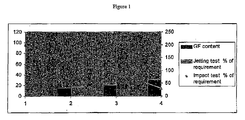
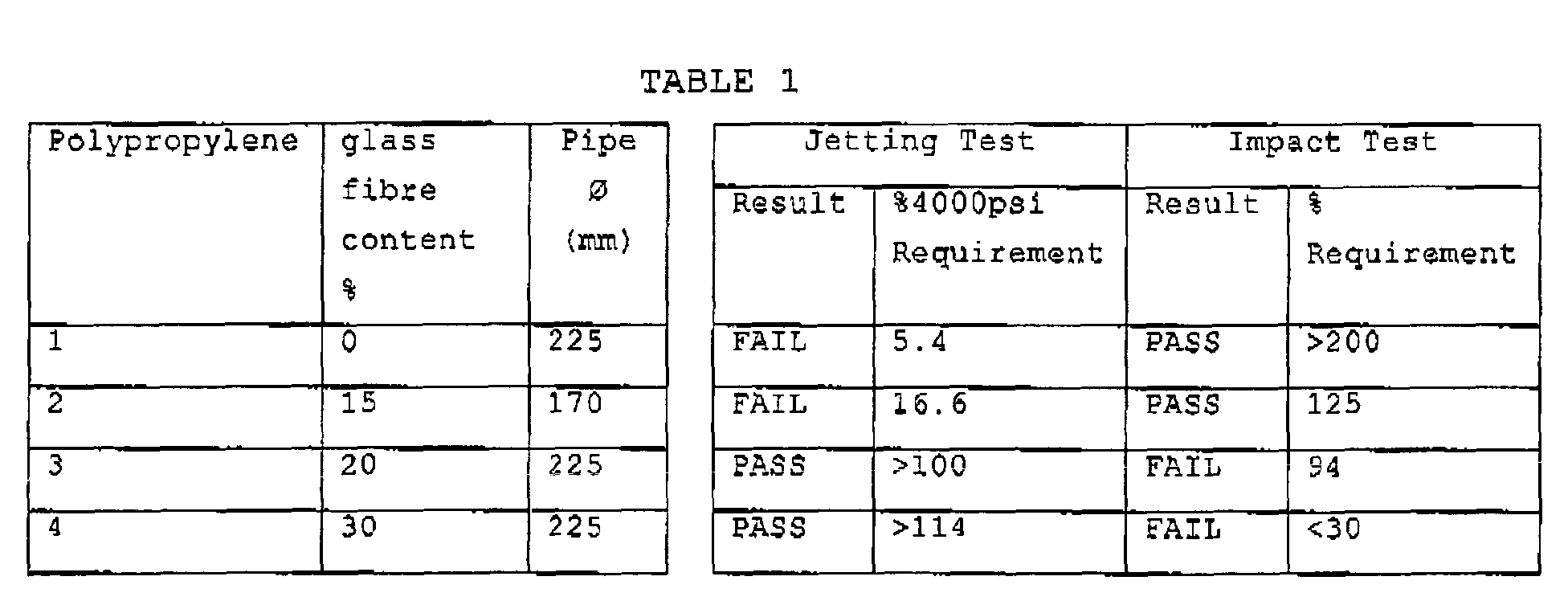
- Table 1 illustrate the difficulty of achieving the twin requirements of good jetting performance and high impact strength. Increasing the glass fibre content of the polypropylene polymeric material increases its stiffness and improves the jetting performance but unacceptably lowers impact strength.
- plastics pipes have many advantages over traditional earthenware pipes in sewer applications, their inability to meet simultaneously the higher jetting resistance and impact resistance requirements is a potential inhibiting factor in the changeover to plastics pipes.
- the present invention provides a plastics pipe formed from polypropylene polymeric material that can meet the new, more stringent requirements of the water industry.
- a jetting resistant and impact resistant plastics pipe comprising:
- the jetting resistant and impact resistant plastics pipe of the invention can consist of inner and outer walls of polypropylene polymeric material, or it may be a multilayer pipe in which the pipe wall comprises two or more polypropylene layers combined with layers of other polymeric materials.
- Such other polymeric materials can include, for example, polyethylene, PVC, polycarbonate and ABS, together with various tie layers.
- the glass fibre filled polypropylene layer can be an inner, intermediate, or outer layer of the inner wall, but preferably it is the innermost layer in order that the erosion due to the water jetting can be minimised.
- the first polypropylene polymeric matrix material of the inner pipe wall is preferably a polypropylene homopolymer, or a blend of homopolymers.
- Polypropylene polymeric materials containing less than about 10% by weight, preferably less than about 5% by weight, of one or more co-monomers may be included, but are not at present preferred. In general it has been found that the addition of a co-monomer can increase the impact strength of the polypropylene material but decreases jetting performance.
- the second polypropylene polymeric material of the outer pipe wall is preferably a polypropylene copolymer, or a blend of copolymers.
- Polypropylene polymeric materials containing up to about 20% by weight, preferably from 1% to about 10% by weight, of one or more co-monomers can be included.
- Typical comonomers include, for example, other olefins, such as, ethylene.
- the polypropylene copolymer can be a random copolymer, block copolymer, graft copolymer, or a blend thereof. Very good results have been obtained using a polypropylene block co-polymer comprising about 10% of co-monomer.
- Tie layers of compatibilising agents may be included between the various layers of polymeric materials as required.
- a plastics pipe is defined as being jetting resistant in this specification if, under the conditions of WIS 04-35-01, a plaque of the material of the pipe wall can withstand for two minutes a water jet impact at a pressure of 273 bar (4000 psig) without penetration. It has been observed with the jetting test that, to a first approximation, the time to penetration is relatively independent of the thickness of the plaque, within the thickness range 2mm to 4mm. Plaques that pass the jetting test have relatively undamaged surfaces, whereas if, during the test, even a small erosion pit is formed on the surface, complete penetration rapidly follows. In the present specification, tests are carried out on plaques of various thicknesses from 2mm to 4mm and the effect of thickness are ignored in assessing pass or failure.
- a plastics pipe is defined as being impact resistant in this specification if the pipe can withstand a weight being dropped onto it from a height of 1 m at 0°C without sustaining a fracture, using the test conditions of WIS 04-35-01.
- the weight is 7.5 kg
- the weight is 9.0 kg
- plastics pipes of nominal internal diameter of 225 mm and above the weight is 12.5 kg.
- a jetting resistant and impact resistant plastics pipe having an inner pipe wall comprising a glass fibre filled semi-crystalline first polypropylene polymeric matrix material, and a ribbed or corrugated outer pipe wall comprising a second polypropylene polymeric material, the pipe having a jetting resistance of at least 273 bar (4000 psi) and an impact energy of at least 73.58 kJ (for plastic pipes of nominal internal diameter of 150 mm) at least 88.3 kJ (for plastics pipes of nominal internal diameter of 180 mm) and at least 122.63 kJ (for plastics pipes of nominal internal diameter of 225 mm and above) measured at 0°C using the standard method of WIS 04-35-01 clause 6.14.
- the invention is applicable to ribbed or corrugated plastics pipes preferably having a smooth inner wall surface.
- Such pipes, and methods for their manufacture, are described in EP0820566, EP0543243, GB1483113, EP0142482, EP0352255, EP0419470, EP0451241, EP0291136, EP0239046, EP0359088, EP0368096, EP0385465 and US5324557.
- the smooth inner wall of the ribbed or corrugated pipe comprises at least one layer of glass fibre filled polypropylene polymeric material.
- Other plastics pipes that can be usefully employed in the invention include, for example, twin-walled pipes and pipes having at least one layer of foamed polymeric material, provided that the outer layer is ribbed or corrugated.
- the first polypropylene polymeric matrix material of the inner wall preferably comprises a relatively high weight fraction of glass fibres, preferably from 15% to 35 % glass fibres by weight, more preferably from 20% to 30%, for example, about 25% glass fibres by weight.
- Discontinuous, relatively short, glass fibres of average length from about 500 ⁇ m to about 900 ⁇ m, for example about 700 ⁇ m, in length are preferred. Some glass fibres can be broken during processing, and for the avoidance of doubt, it is to be understood that the fibre lengths quoted herein are post-processing fibre lengths.
- the ring stiffness and strength of the pipe is also affected by the post-processing length to diameter ratio (L:D) of the glass fibres, and preferably the average L:D of the glass fibres is from 10 to 90, more preferably from 20 to 60, for example, about 50.
- L:D post-processing length to diameter ratio
- the total thickness of the pipe wall can, for example, be up to 15mm, but for economic reasons the total wall thickness is preferably less than this, for example, in the range of from 0.5 mm to 6 mm, more preferably from 1 mm to 5mm, such as, for example, about 4 mm.
- the expression "total thickness" as applied to a ribbed or corrugated pipe having a smooth inner wall in this specification is the thickness of the pipe wall between the ribs or corrugations.
- the thickness of the layer of glass fibre filled first polypropylene polymeric matrix material is preferably at least 1 mm, more preferably from 1mm to 5mm, and most preferably from 1.5mm to 3.5mm. In general, the thickness of the layer of glass fibre filled first polypropylene polymeric matrix material increases with increasing diameter of the plastics pipe.
- the plastics pipe of the invention can have any suitable diameter, although for many applications the pipe will have an outer diameter in excess of 90 mm, more particularly from 110 mm to 1000 mm.
- the height of the ribs or corrugations is from 5 to 100 mm, more preferably from 8 to 40 mm, and the pitch, that is, the distance between the peaks of adjacent ribs or corrugations is from 5 to 100 mm, more preferably from 10 to 50 mm.
- Preferred first polypropylene polymeric matrix materials for use as the matrix of the inner wall of the pipe of the present invention include, for example, those having a degree of crystallinity of greater than 50 %, more preferably up to 60 % or more. Good results have been obtained using a polypropylene homopolymer having a degree of crystallinity of from 40 % to 60 %.
- Preferred first polypropylene polymeric matrix materials for use as the matrix of the inner wall of the pipe of the present invention include, for example, those having an MFR (230°C, 2.16 kg) of from 0.01 to 4 g/10 min, more preferably from 0.05 to 3, for example, about 0.3 g/10 min.
- Preferred filled polypropylene polymeric materials for use as the inner wall of the pipe preferably have an impact strength of from 900 to 1300 Normalised J/m, more preferably about 1100 Normalised J/m measured at 0°C using an Instrumented Falling Weight impact test (IFWT).
- INFWT Instrumented Falling Weight impact test
- the filled polypropylene polymeric materials for use as the inner wall of the pipe have a flexural modulus of from 2500 to 3000 Mpa, more preferably about 2800 Mpa.
- the first polypropylene polymeric material of the inner pipe wall comprises a nucleating agent.
- nucleating agent in this specification is meant an additive that produces a higher degree of crystallisation of the first polypropylene polymer matrix material on processing than is achieved on processing the same polypropylene polymer material without the additive.
- nucleating agents increase the temperature at which crystals begin to form.
- Preferred nucleating agents for use with the first polypropylene polymeric matrix material are nucleating colorants or pigments. Suitable nucleating agents may be inorganic or organic colorants or pigments, but in general organic pigments are preferred.
- Suitable organic colorants and pigments include polycyclic, azo (mono- and di-) and metal complex pigments, for example, anthraquinone, dioxazine, diketo pyrrolo pyrrole, isoindoline, isoindolinone, perinone, perylene, quinacridone, quinophthalone, thioindigo, bona lake, mono azo salt, benzimidazolone, diarylide, diazo and copper-phthalocyanine colorants and pigments.
- Blue colorants and pigments for example, copper-phthalocyanine colorants and pigments such as Heliogen Blue K6911D (BASF) are particularly preferred.
- Suitable inorganic colorants and pigments include titanium dioxide and especially Co/Al/Cr oxides such as Sicopal Blue K6310 (BASF). Mixtures of more than one of the pigments may be used.
- the particle size of the colorant or pigment is preferably in the range of from 0.5 to 3.0 ⁇ m, more preferably from 0.6 to 1.2 ⁇ m.
- Preferred second polypropylene polymeric materials for use as the outer ribbed or corrugated wall of the pipe of the present invention include, for example, those having an MFR (230°C, 2.16 kg) of from 0.01 to 4 g/10 min, more preferably from 0.05 to 3 g/ 10 min, most preferably from 0.1 to 0.6 g/10 min, for example, about 0.3 g/10 min.
- the outer pipe wall preferably has a flexural modulus of from 1200 to less than 1700 Mpa, for example, about 1500 Mpa, and preferably has an impact strength of from 10 to 40 kJ/m 2 , for example, about 30 kJ/m 2 , measured at 0°C using an Izod impact test.
- the addition of filler to the second polypropylene polymeric material can be omitted.
- filler is added to the second polypropylene polymeric matrix material.
- the outer pipe wall comprising filled second polypropylene matrix material preferably has a flexural modulus of from 1200 to 1800 Mpa, for example, about 1500 Mpa, and preferably has an impact strength of from 10 to 40 kJ/m 2 , for example, about 30kJ/m 2 , measured at 0°C using an Izod impact test.
- One or more particulate fillers can be added to the second polypropylene polymeric matrix material forming the outer wall of the pipe to improve the overall impact resistance of the pipe.
- Suitable fillers include, for example, calcium carbonate, silica and talc, or mixtures thereof.
- the filler or fillers are preferably added in an amount of from 10 to 50 % by weight, more preferably from 15 to 35% by weight, for example, about 25% by weight, as required.
- the particle size of the filler has been found to be significant, and preferably is in the range of from 0.5 to 5 ⁇ m, more preferably from 0.8 to 2.5 ⁇ m. Particularly good results have been obtained using calcium carbonate (1.4 ⁇ m average particle size) and silica (1.5 ⁇ m average particle size).
- Such fillers may not always be necessary, however, and surprisingly it has been found that the selection of a combination of a glass fibre filled polypropylene inner wall and an unfilled polypropylene ribbed or corrugated outer wall of appropriate impact strength can produce a pipe of unexpectedly high impact resistance.
- the invention enables a jetting resistant, high impact strength pipe to be produced from relatively inexpensive polymeric materials, without the need to use a commercially unacceptable thick-walled pipe section.
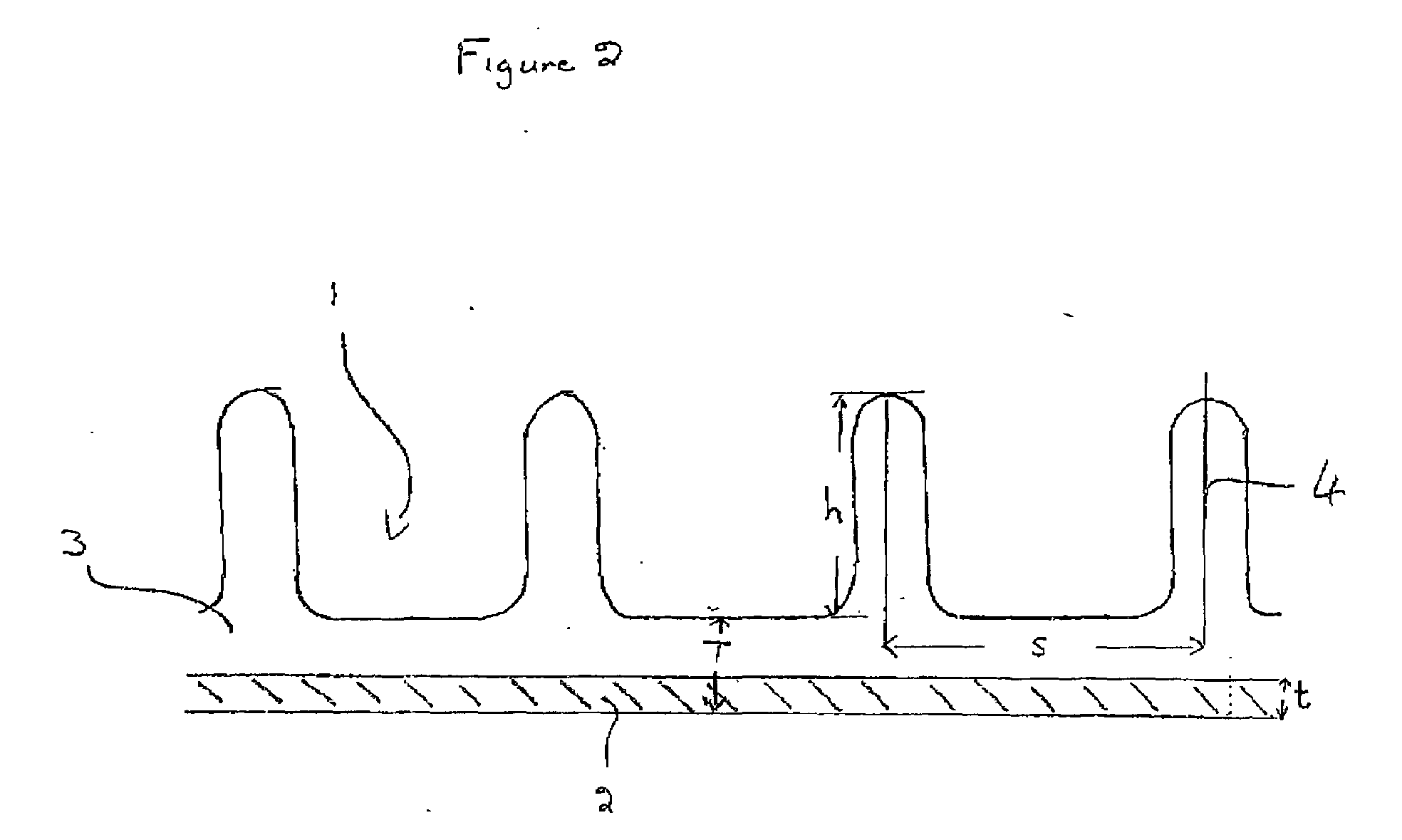
- the pipe illustrated generally at 1, has a smooth inner wall 2 and a ribbed outer wall 3.
- the pipe has a total wall thickness T and an inner wall of thickness t.
- the ribbed outer wall 3 has integrally formed ribs 4 of height h and rib spacing s.
- the inner wall 2 is formed from a semi-crystalline polypropylene homopolymer matrix having a glass fibre content of 25 % by weight and the outer wall is formed from a polypropylene block co-polymer matrix having a calcium carbonate filler content of 25 % by weight.
- the invention is particularly applicable to plastics pipes for use in sewer systems, although of course other fluid transfer systems, for example, domestic water and gas systems, are not excluded.
- the plaques were also subjected to a jetting test.
- the jetting test five samples for each thickness were tested, and the results given as a single percentage, which was calculated using equation (1).
- PP6, PP7 and PP8 are comparison polypropylenes containing particulate glass spheres as filler.
- the polypropylene matrix material of Table 1 including 20% glass fibres achieved the required jetting test requirement but reached only 94% of the required impact strength.
- IWT Instrumented Falling Weight Impact Test
- this material had a measured impact strength of 888.25 J/m.
- 2mm thick plaques of further glass fibre filled polypropylene polymer materials were prepared containing 20% and 25% glass fibres and submitted to a jetting test in accordance with WIS 04-35-01 and an impact test according to ISO 6603.2 Instrumented Falling Weight Puncture Test (IFMT)(see Table 5).
- the chosen polypropylene materials were polypropylene co-polymers, all having higher impact strengths than the 20% glass fibre filled polypropylene material of Table 1.
- Example 2 demonstrates that increasing the impact strength of the glass fibre filled inner layer of the pipe wall using polypropylene co-polymers causes the jetting performance to deteriorate to below the required value. Using a polypropylene homopolymer matrix of lower impact strength and slightly increasing the glass fibre content can reverse this deterioration.
- the pipes had an inner layer of glass fibre filled polypropylene homopolymer matrix and an outer ribbed layer of polypropylene co-polymer.
- the results of impact tests on the pipes and flexural modulus measurements on the outer layer are given in Table 7
- Example 3 demonstrates that in order to meet the test requirements, the flexural modulus of an unfilled outer polypropylene layer needs to be less than 1700Mpa.
- This example demonstrates the effect of adding particulate filler to the polypropylene matrix material of the outer pipe wall.
- Example 4 demonstrates that it is possible to use a polypropylene matrix material having a higher flexural modulus as the outer layer of the pipe, provided that a particulate impact strengthening filler is included in the outer layer.
Landscapes
- Engineering & Computer Science (AREA)
- General Engineering & Computer Science (AREA)
- Chemical & Material Sciences (AREA)
- Mechanical Engineering (AREA)
- Health & Medical Sciences (AREA)
- Chemical Kinetics & Catalysis (AREA)
- Medicinal Chemistry (AREA)
- Polymers & Plastics (AREA)
- Organic Chemistry (AREA)
- Rigid Pipes And Flexible Pipes (AREA)
- Compositions Of Macromolecular Compounds (AREA)
- Laminated Bodies (AREA)
Abstract
Description

- Pja =
- Actual Jetting Pressure
- tfa =
- Actual Time to Failure
- N =
- Number of samples tested
- Pjt =
- Target Jetting Pressure (275bar/4000psi)
- tft=
- Target Time to Failure (120 seconds)

| Assessment of polypropylenes for outer pipe wall | ||||||||
| Properties | ||||||||
| Material | MFR | Density | Filler % | Flexural | Tensile Str'gth | Izod Impact | ||
| 230°C | Modulus | at yield | 23° | 0°C | -20°C | |||
| 2.16kg | g/cm3 | G/CC | MPa | MPa | kJ/m2 | kJ/m2 | kJ/m2 | |
| PP11 | 0.3 | 0.9 | 0 | 1500 | - | >50 | 9 | 5 |
| PP12 | 0.3 | 0.9 | 0 | 1700 | - | - | - | - |
| PP13 | - | - | CC 25 | - | - | - | - | - |
| PP14 | 0.3 | 0.9 | 0 | 1480 | 29 | 75 | 35 | 19 |
| PP15 | 0.4 | 0.9 | 0 | 1050 | 26 | 60 | - | 6.5 |
| PP16 | 2.1 | 0.9 | 0 | 1750 | 35.5 | 45 | - | 4 |
| CC 25 = 1.4 micron calcium carbonate particles 25% by weight |


Claims (35)
- A jetting resistant and impact resistant plastics pipe comprising:a) an inner pipe wall comprising a glass fibre filled semi-crystalline first polypropylene matrix polymeric material comprising from 10 to 35 weight % glass fibres of average fibre length from 100 to 3000 µm, the first polypropylene polymeric material having an MFR (230°C, 2.16 kg) of up to 5 g/10 min, and the filled polymeric material having an impact strength of from 800 to 2000 normalised J/m measured at 0°C using an Instrumented Falling Weight impact test, and a flexural modulus of from 1000 to 3000 Mpa; and eitherb) a ribbed or corrugated outer pipe wall comprising a second polypropylene polymeric material having an MFR (230°C, 2.16 kg) of up to 5 g/10 min, the polymeric material having a flexural modulus of from 1000 to less than 1700 Mpa, and an impact strength of from 5 to 50 KJ/m2 measured at 0°C using an Izod impact test, orc) a ribbed or corrugated outer pipe wall comprising a second polypropylene polymeric matrix material comprising from 5 to 50% of a particulate filler, the polymeric matrix material having an MFR (230°C, 2.16 Kg) of up to 5g/10min, and the filled polymeric material having a flexural modulus of from 1000 to 2000 Mpa, and an impact strength of from 5 to 50 kJ/m2 measured at 0°C using an Izod impact test.
- A plastics pipe according to claim 1, which consists of polypropylene polymeric material.
- A plastics pipe according to claim 1 or 2, wherein the first polypropylene polymeric matrix material comprises a polypropylene homopolymer layer, optionally together with one or more layers of other polymeric materials.
- A plastics pipe according to any one of the preceding claims, wherein the second polypropylene polymeric material is a propylene co-polymer.
- A plastics pipe according to claim 4, wherein the propylene co-polymer is a random co-polymer or a block co-polymer.
- A plastics pipe according to any one of the preceding claims, which is a ribbed or corrugated plastics pipe having a smooth inner surface.
- A jetting resistant and impact resistant plastics pipe having an inner pipe wall comprising a glass fibre filled semi-crystalline first polypropylene polymeric matrix material, and a ribbed or corrugated outer pipe wall comprising a second polypropylene polymeric material, the pipe having a jetting resistance of at least 273 bar (4000 psi) and an impact energy of at least 73.58 kJ (for plastic pipes of nominal internal diameter of 150 mm) at least 88.3 kJ (for plastics pipes of nominal internal diameter of 180 mm) and at least 122.63 kJ (for plastics pipes of nominal internal diameter of 225 mm and above) measured at 0°C using the standard method of WIS 04-35-01.
- A plastics pipe according to any one of the preceding claims, wherein the semi-crystalline first polypropylene material comprises an effective amount of a nucleating agent.
- A plastics pipe according to any one of the preceding claims, wherein the glass fibre filled first polypropylene polymeric matrix material comprises from 20 to 30% by weight of glass fibres.
- A plastics pipe according to any one of the preceding claims, wherein the average length of the glass fibres is from 500µm to 900µm, or
wherein the average length to diameter ratio of the glass fibres is from 10 to 90. - A plastics pipe according to any one of the preceding claims, wherein the total pipe wall thickness is from 0.5mm to 6mm.
- A plastics pipe according to any one of the preceding claims, wherein the thickness of the layer of glass fibre filled polypropylene polymeric material in the pipe wall is from 1mm to 5mm.
- A plastics pipe according to any one of the preceding claims, having an outer diameter of from 110 to 1000 mm.
- A plastics pipe according to any one of the preceding claims wherein the first polypropylene polymeric matrix material has a degree of crystallinity of from 40 to 60%
- A plastics pipe according to any one of the preceding claims, adapted for use in a sewer system.
- A plastics pipe according to any one of the preceding claims, wherein the glass fibre filled first polypropylene polymeric matrix material has an MFR (230°C, 2.16 kg) of from 0.05 to 3 g/10 min.
- A plastics pipe according to any one of the preceding claims, wherein the filled polypropylene polymeric material for use as the inner wall of the pipe has an impact strength of from 900 to 1300 Normalised J/m, measured at 0°C using an Instrumented Falling Weight impact test (IFWT), or
wherein the filled polypropylene polymeric material for use as the inner wall of the pipe has a flexural modulus of from 2500 to 3000 Mpa. - A plastics pipe according to claim 8, wherein the nucleating agent is a nucleating colorant or pigment.
- A plastics pipe according to claim 18, wherein the nucleating agent is an inorganic colorant or pigment, or
wherein the nucleating agent is an organic colorant or pigment. - A plastics pipe according to claim 19, wherein the organic colorant or pigment is a polycyclic, azo (mono- and di-) or metal complex colorant or pigment.
- A plastics pipe according to claim 20, wherein the organic colorant or pigment is an anthraquinone, dioxazine, diketo pyrrolo pyrrole, isoindoline, isoindolinone, perinone, perylene, quinacridone, quinophthalone, thioindigo, bona lake, mono azo salt, benzimidazolone, diarylide, diazo, or copper-phthalocyanine colorant or pigment.
- A plastics pipe according to claim 19, wherein the inorganic colorant or pigment is titanium dioxide or a Co/Al/Cr oxide.
- A plastics pipe according to any one of claims 18 to 22, wherein the colorant or pigment is a blue colorant or pigment.
- A plastics pipe according to claim 23, wherein the colorant or pigment is a copper-phthalocyanine or a Co/Al/Cr oxide.
- A plastics pipe according to claim 8, wherein the particle size of the nucleating agent is in the range of from 0.5 to 3.0 µm, or
wherein the particle size of the nucleating agent is in the range of from 0.6 to 1.2 µm. - A plastics pipe according to any one of the preceding claims, wherein the glass fibre filled polypropylene polymeric material of the inner wall contains one or more additives to improve the adhesion of the polymer to the glass fibres.
- A plastics pipe according to any one of the preceding claims, wherein the second polypropylene polymeric material has an MFR (230°C, 2.16 kg) of from 0.05 to 3 g/10 min.
- A plastics pipe according to any one of the preceding claims, wherein the filled polymeric material of the outer pipe wall has an impact strength of from 10 to 40 kJ/m2 measured at 0°C using an Izod impact test.
- A plastics pipe according to any one of the preceding claims, wherein the outer pipe wall comprises an unfilled polypropylene co-polymer.
- A plastics pipe according to any one of the preceding claims, wherein the filled polymeric material of the outer pipe wall has a flexural modulus of from 1200 to 1800 Mpa and comprises from 10 to 50% by weight of particulate filler.
- A plastics pipe according to claim 30, wherein the filler is calcium carbonate, silica, or talc.
- A plastics pipe according to claim 30 or 31, wherein the particle size of the filler is in the range of from 0.5 to 5 µm, or
wherein the particle size of the filler is in the range of from 0.8 to 2.5 µm. - A plastics pipe according to any one of claims 30 to 32, wherein the filler is calcium carbonate of about 1.4 µm average particle size.
- A sewer system comprising a plastics pipe according to claim 1.
- A jetting resistant plastics pipe having a pipe wall comprising a glass fibre filled semi-crystalline polypropylene polymeric material.
Applications Claiming Priority (2)
| Application Number | Priority Date | Filing Date | Title |
|---|---|---|---|
| GB0407564 | 2004-04-02 | ||
| GB0407564A GB2412708B (en) | 2004-04-02 | 2004-04-02 | Plastics pipe |
Publications (2)
| Publication Number | Publication Date |
|---|---|
| EP1582796A2 true EP1582796A2 (en) | 2005-10-05 |
| EP1582796A3 EP1582796A3 (en) | 2011-01-05 |
Family
ID=32247790
Family Applications (1)
| Application Number | Title | Priority Date | Filing Date |
|---|---|---|---|
| EP05252081A Withdrawn EP1582796A3 (en) | 2004-04-02 | 2005-04-01 | Plastics pipe |
Country Status (2)
| Country | Link |
|---|---|
| EP (1) | EP1582796A3 (en) |
| GB (1) | GB2412708B (en) |
Cited By (6)
| Publication number | Priority date | Publication date | Assignee | Title |
|---|---|---|---|---|
| WO2011107625A1 (en) * | 2010-03-04 | 2011-09-09 | Sanchez Herranz Juan Andres | Damper for washing machines |
| DE202010012463U1 (en) * | 2010-09-10 | 2011-12-12 | Rehau Ag + Co. | Plastic pipe fitting |
| WO2019165539A1 (en) * | 2018-02-28 | 2019-09-06 | Lupke Manfred Arno Alfred | Corrugated plastic pipe reinforced with glass reinforced polymers |
| US11193619B2 (en) | 2018-05-30 | 2021-12-07 | Crompton Technology Group Limited | Composite components |
| US12188837B2 (en) | 2019-10-04 | 2025-01-07 | Crompton Technology Group Limited | Composite components with impact detection |
| US12313505B2 (en) | 2019-10-04 | 2025-05-27 | Crompton Technology Group Limited | Method of manufacturing a composite component |
Families Citing this family (1)
| Publication number | Priority date | Publication date | Assignee | Title |
|---|---|---|---|---|
| CN118546457A (en) * | 2024-05-15 | 2024-08-27 | 广东威林工程塑料股份有限公司 | Special low-odor low-warpage ultrahigh-rigidity long glass fiber reinforced PP automobile bracket material |
Family Cites Families (13)
| Publication number | Priority date | Publication date | Assignee | Title |
|---|---|---|---|---|
| JPS5844583U (en) * | 1981-09-18 | 1983-03-25 | 金尾 史朗 | Synthetic resin corrugated double pipe |
| JPH0310464Y2 (en) * | 1984-10-22 | 1991-03-14 | ||
| US5223566A (en) * | 1989-06-28 | 1993-06-29 | Nippon Petrochemicals Company, Limited | Thermoplastic resin composition for extrusion molding |
| DE3921075A1 (en) * | 1989-06-28 | 1991-01-03 | Wilhelm Hegler | PLASTIC TUBE FOR PIPE RENOVATION |
| JP3558422B2 (en) * | 1995-09-07 | 2004-08-25 | 三井化学株式会社 | Multi-layer tube |
| GB9522501D0 (en) * | 1995-11-02 | 1996-01-03 | Hepworth Building Prod | Jetting resistant pipe |
| FI961834A7 (en) * | 1996-04-30 | 1997-10-31 | Borealis Polymers Oy | Pressure pipe made of plastic material |
| JP3832129B2 (en) * | 1999-02-05 | 2006-10-11 | 株式会社プライムポリマー | Polypropylene resin composition and injection molded product |
| US6199592B1 (en) * | 1999-02-05 | 2001-03-13 | Hancor, Inc. | Pipe structure and method of manufacture |
| ZA200102941B (en) * | 2000-04-13 | 2001-05-22 | Gerhard Rosenberg | Extruded, injection moulded or blow moulded pipe, fitting of component. |
| EP1448704B1 (en) * | 2001-10-30 | 2011-07-27 | Basell Poliolefine Italia S.r.l. | Pipe systems of polypropylene compositions |
| JP3838154B2 (en) * | 2002-05-20 | 2006-10-25 | 東海ゴム工業株式会社 | Heat resistant anti-vibration rubber composition |
| EP1364986A1 (en) * | 2002-05-21 | 2003-11-26 | Borealis Technology Oy | Polypropylene compositions especially for pipes |
-
2004
- 2004-04-02 GB GB0407564A patent/GB2412708B/en not_active Expired - Fee Related
-
2005
- 2005-04-01 EP EP05252081A patent/EP1582796A3/en not_active Withdrawn
Cited By (6)
| Publication number | Priority date | Publication date | Assignee | Title |
|---|---|---|---|---|
| WO2011107625A1 (en) * | 2010-03-04 | 2011-09-09 | Sanchez Herranz Juan Andres | Damper for washing machines |
| DE202010012463U1 (en) * | 2010-09-10 | 2011-12-12 | Rehau Ag + Co. | Plastic pipe fitting |
| WO2019165539A1 (en) * | 2018-02-28 | 2019-09-06 | Lupke Manfred Arno Alfred | Corrugated plastic pipe reinforced with glass reinforced polymers |
| US11193619B2 (en) | 2018-05-30 | 2021-12-07 | Crompton Technology Group Limited | Composite components |
| US12188837B2 (en) | 2019-10-04 | 2025-01-07 | Crompton Technology Group Limited | Composite components with impact detection |
| US12313505B2 (en) | 2019-10-04 | 2025-05-27 | Crompton Technology Group Limited | Method of manufacturing a composite component |
Also Published As
| Publication number | Publication date |
|---|---|
| GB0407564D0 (en) | 2004-05-05 |
| GB2412708B (en) | 2009-07-22 |
| GB2412708A (en) | 2005-10-05 |
| EP1582796A3 (en) | 2011-01-05 |
Similar Documents
| Publication | Publication Date | Title |
|---|---|---|
| RU2312115C2 (en) | Polypropylene compositions, especially those suitable for manufacturing tubes | |
| RU2426931C2 (en) | Tube, having high heat resistance and use of polyethylene composition in making said tube | |
| US6187402B1 (en) | Multilayer pipe | |
| RU2280805C2 (en) | Multi-layer tube made of polyolefins | |
| US8415447B2 (en) | Polyolefin coated steel pipes | |
| US6624099B1 (en) | Glass-reinforced multi-layer sheets from olefin polymer materials | |
| US12491678B2 (en) | Biaxially oriented MDPE film | |
| CN1171804A (en) | Barrier layer for use in refrigerator cabinets | |
| MXPA04009223A (en) | High density polyethylene melt blends for improved stress crack resistance in pipe. | |
| US6368545B1 (en) | High clarity polyolefin multilayer blown coextruded film | |
| EP2424729B1 (en) | Composition and film comprising a c4-c10 alpha olefin containing polyolefin | |
| US11725098B2 (en) | Thermoplastic vulcanizate conduits for transporting hydrocarbon fluids | |
| AU3449500A (en) | High surface gloss, co-extruded sheets from olefin polymer materials | |
| KR102003019B1 (en) | Polypropylene based film having improved barrier property and cell pouch comprising the same | |
| GB2412708A (en) | Jetting and Impact Resistant Plastics Pipe | |
| US20220371262A1 (en) | Biaxially oriented pipe | |
| JPH053832B2 (en) | ||
| KR101412832B1 (en) | Compound for shield layer with improved impact strength and multi-layer product comprised of the compound | |
| JP5795802B2 (en) | Polypropylene / polyethylene multilayer film with improved adhesion | |
| KR20190064340A (en) | Medical film with high transparency, flexibility and impact strength | |
| CN107406643A (en) | Processing aids and mixtures employing same for effective orientation of extruded film layers and bidirectionally oriented films containing same | |
| EP1283224B1 (en) | High density polyethylene barrier grade resins and films, methode for making same | |
| JPS5931929B2 (en) | Ethylene polymer water pipe | |
| KR100784983B1 (en) | Polypropylene block copolymer resin composition with improved heat resistance, impact strength and orange peel | |
| JP4238692B2 (en) | Breathable film for building materials |
Legal Events
| Date | Code | Title | Description |
|---|---|---|---|
| PUAI | Public reference made under article 153(3) epc to a published international application that has entered the european phase |
Free format text: ORIGINAL CODE: 0009012 |
|
| 17P | Request for examination filed |
Effective date: 20050422 |
|
| AK | Designated contracting states |
Kind code of ref document: A2 Designated state(s): AT BE BG CH CY CZ DE DK EE ES FI FR GB GR HU IE IS IT LI LT LU MC NL PL PT RO SE SI SK TR |
|
| AX | Request for extension of the european patent |
Extension state: AL BA HR LV MK YU |
|
| RAP1 | Party data changed (applicant data changed or rights of an application transferred) |
Owner name: RADIUS SYSTEMS LIMITED |
|
| TPAC | Observations filed by third parties |
Free format text: ORIGINAL CODE: EPIDOSNTIPA |
|
| PUAL | Search report despatched |
Free format text: ORIGINAL CODE: 0009013 |
|
| AK | Designated contracting states |
Kind code of ref document: A3 Designated state(s): AT BE BG CH CY CZ DE DK EE ES FI FR GB GR HU IE IS IT LI LT LU MC NL PL PT RO SE SI SK TR |
|
| AX | Request for extension of the european patent |
Extension state: AL BA HR LV MK YU |
|
| 17Q | First examination report despatched |
Effective date: 20110715 |
|
| AKX | Designation fees paid |
Designated state(s): AT BE BG CH CY CZ DE DK EE ES FI FR GB GR HU IE IS IT LI LT LU MC NL PL PT RO SE SI SK TR |
|
| STAA | Information on the status of an ep patent application or granted ep patent |
Free format text: STATUS: THE APPLICATION IS DEEMED TO BE WITHDRAWN |
|
| 18D | Application deemed to be withdrawn |
Effective date: 20120126 |