EP1582523A1 - Method of preparing organomagnesium compounds - Google Patents
Method of preparing organomagnesium compounds Download PDFInfo
- Publication number
- EP1582523A1 EP1582523A1 EP04008081A EP04008081A EP1582523A1 EP 1582523 A1 EP1582523 A1 EP 1582523A1 EP 04008081 A EP04008081 A EP 04008081A EP 04008081 A EP04008081 A EP 04008081A EP 1582523 A1 EP1582523 A1 EP 1582523A1
- Authority
- EP
- European Patent Office
- Prior art keywords
- reagent
- formula
- reaction
- liy
- compounds
- Prior art date
- Legal status (The legal status is an assumption and is not a legal conclusion. Google has not performed a legal analysis and makes no representation as to the accuracy of the status listed.)
- Withdrawn
Links
- QARVLSVVCXYDNA-UHFFFAOYSA-N Brc1ccccc1 Chemical compound Brc1ccccc1 QARVLSVVCXYDNA-UHFFFAOYSA-N 0.000 description 1
- 0 CCl*c1ccccc1 Chemical compound CCl*c1ccccc1 0.000 description 1
Images


Classifications
-
- C—CHEMISTRY; METALLURGY
- C07—ORGANIC CHEMISTRY
- C07B—GENERAL METHODS OF ORGANIC CHEMISTRY; APPARATUS THEREFOR
- C07B49/00—Grignard reactions
-
- C—CHEMISTRY; METALLURGY
- C07—ORGANIC CHEMISTRY
- C07F—ACYCLIC, CARBOCYCLIC OR HETEROCYCLIC COMPOUNDS CONTAINING ELEMENTS OTHER THAN CARBON, HYDROGEN, HALOGEN, OXYGEN, NITROGEN, SULFUR, SELENIUM OR TELLURIUM
- C07F3/00—Compounds containing elements of Groups 2 or 12 of the Periodic Table
- C07F3/02—Magnesium compounds
Definitions
- the present invention is directed to a reagent for use in the preparation of organomagnesium compounds as well as to a method of preparing such organomagnesium compounds.
- the present invention furthermore provides a method of preparing organic compounds. It further provides the use of the reagents of the present invention in the preparation of organometallic compounds and their reaction with electrophiles.
- the present invention is directed to the use of lithium salts - LiY in the preparation of organometallic compounds and their reactions with electrophiles and to an organometallic compound which is obtainable by the disclosed method.
- the I/Mg-exchange reaction is an excellent method for preparing functionalized aryl and heteroaryl compounds. It has as main drawback the need of using sometimes unstable, often expensive or commercially not available organic iodides.
- the alternative of using aryl bromides as substrates for the Br/Mg-exchange is known, but was strongly limited to only highly reactive aryl bromides (bearing several electron-withdrawing groups) due to the low rate of the exchange reaction using either i -PrMgCl or i -Pr 2 Mg.
- the method of the present invention considerably facilitates in particular the preparation of aryl-, heteroaryl-, alkenyl-, alkinyl or alkyl- magnesium compounds and finds broad applications in university as well as in industrial laboratories for large scale use. Basically, the method of the present invention corresponds to the following reaction scheme:
- R 2 is indicated in this application (for example in R 2 N or PR 2 ), both R's may be the same or may be different according to the definition indicated above.
- the reagent comprises R 1 (MgX) n and LiY in a molar ratio of between 0,05-6,0.
- Y is Cl in R 1 (MgX) n ⁇ LiY or LiY.
- R 1 (MgX) n ⁇ LiY is i-PrMgCl ⁇ LiCl.
- Y in R 1 (MgX) n ⁇ LiY or LiY is tert-butylate or sec-butylate.
- Other lithium salts like lithium perchlorate, lithium acetylacetonate, lithium bromide, lithium iodide and lithium tetrafluoroborate are also included in this invention, however, are less preferred embodiments.
- the present invention provides a method of preparing organomagnesium compounds, comprising the following steps:
- the organomagnesium compound obtained in c) can additionally be isolated.
- R 2 A are bromonapthalene, bromophenanthrene, bromoanisole, bromothiophene, bromothiazole, bromopyridine, 1-bromo-3-fluorobenzene, 3-bromobenzothiophene, 1,2-dibromobenzene, 1,2,4 tribrombenzene and derivatives thereof as well as the further compounds disclosed hereinafter.
- the reagent of the general formula R 1 (MgX) n ⁇ LiY is provided by reacting R 1 X, Mg and LiY or by reacting R 1 (MgX) n and LiY. It is noted that some components for use in this reaction are commercially available and thus, are not required to be synthesized de novo (for example, i-PrMgCl for R 1 MgX is commercially available from Aldrich or Strem CAS [1068-55-9])
- the reagent provided in step b) is used in a molar amount of 0,4-6,0 mole per mole of the compound provided in step a).
- the reagent of the present invention having the general formula R 1 (MgX) n ⁇ LiY can be added up to 6,0 mole of the reagent to 1 mole of compound provided in a) (general formula R 2 A).
- the lower limit of 0,4 mole per mole R 2 A means that the effects of the present invention, i.e. the spectacular rate increase in the conversion reaction: may not be achieved, if values lower than this limit will be used.
- n may be different in R 1 (MgX) n ⁇ LiY and R 2 (MgX) n ⁇ LiY.
- the solvent, in which R 1 MgX) n ⁇ LiY is solved is an inert aprotic solvent, for example tetrahydrofurane, diethyl ether, tert-butylmethyl ether, dimethoxyethane, dioxane, triethylamine, pyridine, ethyldiisopropylamine, dichlormethane, 1,2-dichlorethane, dimethylsulfide, dibutylsulfide, benzene, toluene, xylene, pentane, hexane or heptane, or combinations thereof and/or solvents usually used for performing of Grignard reactions that are indicated in the literature cited above.
- an inert aprotic solvent for example tetrahydrofurane, diethyl ether, tert-butylmethyl ether, dimethoxyethane, dioxane, triethylamine,
- the above solution of R 1 (MgX) n ⁇ LiY is 0,05 to 3,0 M, preferably 1,0-2,5 M.
- more than 3 M solutions of R 1 (MgX) n ⁇ LiY will no more be soluble and thus will not function in this invention.
- R 1 (MgX) n ⁇ LiY is also possible and especially convenient for storage.
- the invention provides a method for preparing functionalized or unfunctionalized organic compounds, comprising steps a)-c) as defined above, and d) reacting the obtained organomagnesium compound with an organic or inorganic electrophile (E+).
- the methods mentioned above are performed at a temperature in a range between -78°C to 80°C, preferably at room temperature.
- the upper limit of the temperature range generally is the boiling temperature of the respective solvent used.
- the invention is directed to the use of the reagent R 1 (MgX) n ⁇ LiY in the preparation of organometallic compounds and their reaction with electrophiles.
- a further aspect of the invention is directed to the use of LiY in the preparation of organometallic compounds and their reaction with electrophiles, wherein Y is defined as above. It is noted that in particular LiCl turned out to dramatically increase the conversion rates in the above exchange methods. For comparison, see enclosed Table 2.
- the invention provides an organometallic compound, which is obtainable by the method in accordance with the second aspect as defined above. It is noted that the complexed product of this reaction, i.e. a product of general formula R 2 (MgX) n ⁇ LiY, has a much higher reactivity with electrophile (E+) than the prior art reagents and also its solubility in the respective suitable solvents (see above) is superior.
- alkyl As used herein, the terms “alkyl”, “alkenyl” and “alkinyl” refer to linear and branched, substituted and unsubstitued C 1 -C 20 compounds. Preferred ranges for these compounds are C 1 -C 10 , preferably C 1 -C 5 (lower alkyl).
- cycloalkyl generally refers to linear and branched, substituted and unsubstitued C 3 -C 20 . Here, preferred ranges are C 3 -C 15 , more preferably C 3 -C 8 .
- aryl refers to substituted or unsubstituted C 4 -C 24 aryl.
- heteroaryl a substituted or unsubstituted C 3 -C 24 heteroaryl, containing one or more heteroatoms as B, O, N, S, Se, P, is meant. Preferred ranges for both are C 4 -C 15 , more preferably C 4 -C 10 .
- this catalysis can be applied to heterocyclic systems like 2,6-dibromopyridine (1b).
- This dibromide requires also the use of i -Pr 2 Mg [3a] or i -PrMgCl [3f] for performing the Br/Mg-exchange reaction. Under these conditions, the reaction with benzaldehyde provides the desired alcohol 2ba in only 42% yield. [3f]
- i -PrMgCl ⁇ LiCl as exchange reagent have observed a conversion of 92% after reaction time of 1h at 25°C whereas the use of i -Pr 2 Mg requires a reaction time of 4h.
- the desired reaction product (2ba) is obtained in 89% isolated yield (Scheme 1). Also good results were obtained in the reactions of formed Grignard reagent (3b) from 2,6-dibromopyridine ( 1b ) with other electrophiles (Table 1, entries 1-3).
- the Br/Mg-exchange in the case of 3,5-dibromopyridine can be performed in 15 min at -10°C and the reaction with allyl bromide provides allylated pyridine 2ca in excellent yield (Table 1, entry 4). Less activated 3-bromopyridine can be also easily converted to the corresponding Grignard reagent 3v within 5 min.
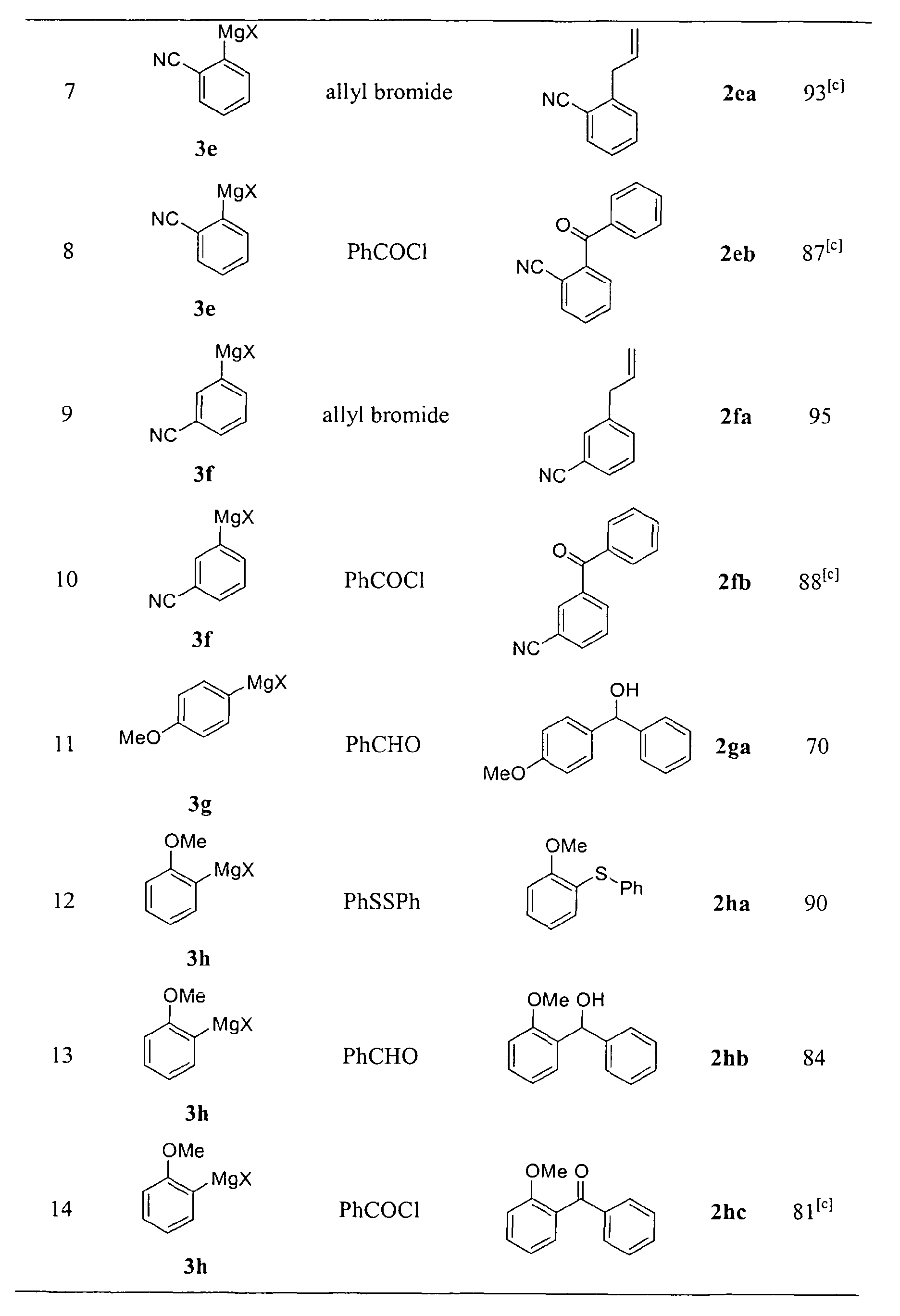
- the Grignard reagents 3e, f is formed within 3h at 0°C and showed good yields after the reactions with various electrophiles (entries 5-10). Usually unreactive compounds like bromonaphthalene and bromophenanthrene derivatives are readily converted into the corresponding Grignard reagents 3m, n (entries 22-25) that easily react both with benzaldehyde (entries 22, 24) and with allyl bromide in good yields (entry 23).
- the iodine-magnesium exchange reaction may be unique way of preparing stereochemically pure E- or Z -alkenylmagnesium derivatives.
- Reagent 4c is completely stable at room temperature for weeks, but addition of catalitical amounts of Cu(I) or Cu(II) leads to the formation of cyclopentine that in the presence of additional equivalent of magnesium or lithium compounds reacts with the formation of new Grignard spieces 4d,e . Addition of benzaldehyde gave corresponding alcoholes in good yields.
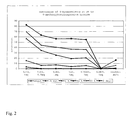
- lithium salts like lithium perchlorate, lithium acetylacetonate, lithium bromide, lithium iodide and lithium tetrafluoroborate were also tested, but gave less efficient catalysis (Fig. 2).
- the inventors found a simple procedure for catalyzing the Br/Mg-exchange reaction of aryl and heteroaryl bromides with the complex i -PrMgCl ⁇ LiCl. It allows to prepare a range of new polyfunctional organomagnesium compounds starting from cheap aryl and heteroaryl bromides containing the most important functionalities for organic synthesis.
Landscapes
- Chemical & Material Sciences (AREA)
- Organic Chemistry (AREA)
- Chemical Kinetics & Catalysis (AREA)
- Organic Low-Molecular-Weight Compounds And Preparation Thereof (AREA)
- Pyridine Compounds (AREA)
- Heterocyclic Compounds Containing Sulfur Atoms (AREA)
- Thiazole And Isothizaole Compounds (AREA)
- Steroid Compounds (AREA)
Abstract
The present invention is directed to a reagent for use in the preparation of organomagnesium compounds as well as to a method of preparing such organomagnesium compounds. The present invention furthermore provides a method of preparing functionalized or unfunctionalized organic compounds as well as the use of the reagents of the present invention in the preparation of organometallic compounds and their reaction with electrophiles. Finally, the present invention is directed to the use of lithium salts - LiY in the preparation of organometallic compounds and their reactions with electrophiles and to an organometallic compound which is obtainable by the disclosed method.
Description
The present invention is directed to a reagent for use in the preparation of
organomagnesium compounds as well as to a method of preparing such organomagnesium
compounds. The present invention furthermore provides a method of preparing organic
compounds. It further provides the use of the reagents of the present invention in the
preparation of organometallic compounds and their reaction with electrophiles. Finally, the
present invention is directed to the use of lithium salts - LiY in the preparation of
organometallic compounds and their reactions with electrophiles and to an organometallic
compound which is obtainable by the disclosed method.
Polyfunctionalized organometallics are important intermediates in modem organic
synthesis.[1]
One of the best preparative methods of these reagents is the halogen-metal exchange
reaction. Whereas the Br/Li-exchange is a fast reaction which occurs at low temperature,
the corresponding Br/Mg-exchange is considerably slower which is a severe synthetic
limitation for several reasons:
Recently, the inventors have shown that highly functionalized aryl- and heteroaryl-magnesium
halides can be readily prepared by using an iodine-magnesium exchange
reaction.[2] As exchange reagent i-PrMgX (X = Cl, Br) proves to be most convenient. In
some cases, this exchange reaction could be extended to some aryl and heteroaryl bromides
when a powerful electron-withdrawing and (or) a chelating group was present to
coordinate i-PrMgX and make the Br-Mg exchange "intramolecular".[3]
Basically, the I/Mg-exchange reaction is an excellent method for preparing functionalized
aryl and heteroaryl compounds. It has as main drawback the need of using sometimes
unstable, often expensive or commercially not available organic iodides. The alternative of
using aryl bromides as substrates for the Br/Mg-exchange is known, but was strongly
limited to only highly reactive aryl bromides (bearing several electron-withdrawing
groups) due to the low rate of the exchange reaction using either i-PrMgCl or i-Pr2Mg.
Therefore, it is a problem underlying the present invention to provide an improved method
of preparing organomagnesium compounds. It is a further problem underlying the present
invention to provide an organomagnesium compound, which has a higher reactivity with
an electrophile (E+).
These problems are solved by the subject-matter of the independent claims. Preferred
embodiments are set forth in the dependent claims.
The inventors found that by using the mixed organometallic R1(MgX)n·LiY, a fast
exchange reaction occurs leading to the desired Grignard reagents in high yields under
mild conditions and allowing the preparation of many functionalized Grignard compounds
which were previously only available via Br/Mg-exchange reactions in mediocre yields.
The method of the present invention considerably facilitates in particular the preparation of
aryl-, heteroaryl-, alkenyl-, alkinyl or alkyl- magnesium compounds and finds broad
applications in university as well as in industrial laboratories for large scale use. Basically,
the method of the present invention corresponds to the following reaction scheme:
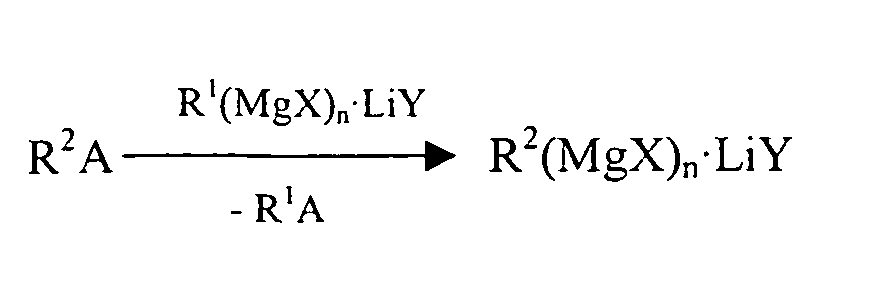
According to a first aspect, the invention is directed to a reagent for use in the preparation
of organomagnesium compounds, the reagent having the general formula
R1(MgX)n·LiY
wherein
n is 1 or 2;
R1 is a substituted or unsubstituted C4-C24 aryl or C3-C24 heteroaryl, containing one or more heteroatoms as B, O, N, S, Se, P; linear or branched, substituted or unsubstituted C1-C20 alkyl, C1-C20 alkenyl or C1-C20 alkinyl; or substituted or unsubstituted C3-C20 cycloalkyl; or a derivative thereof;
X and Y are independently or both Cl, Br or I, preferably Cl; HalOn (where n = 3, 4); carboxylate of formula RCO2; alkoxide or phenoxide of formula RO; dialkoxide of formula LiO-R-O; disilazide of formula (R3Si)2N; thiolate of formula SR; RP(O)O2; or SCOR; where R is defined as R1 above;
C1-C20 linear or branched, substituted or unsubstituted alkyl or C3-C20 cycloalkyl amine of formula RNH; dialkyllarylamine of formula R2N (where R is defined as above or R2N represents a heterocyclic alkylamine); phosphine of formula PR2 (where R is defined as above or PR2 represents a heterocyclic phosphine); OnSR (where n = 2 or 3 and R is defined as above); or NOn (where n = 2 or 3); and a derivative thereof.
n is 1 or 2;
R1 is a substituted or unsubstituted C4-C24 aryl or C3-C24 heteroaryl, containing one or more heteroatoms as B, O, N, S, Se, P; linear or branched, substituted or unsubstituted C1-C20 alkyl, C1-C20 alkenyl or C1-C20 alkinyl; or substituted or unsubstituted C3-C20 cycloalkyl; or a derivative thereof;
X and Y are independently or both Cl, Br or I, preferably Cl; HalOn (where n = 3, 4); carboxylate of formula RCO2; alkoxide or phenoxide of formula RO; dialkoxide of formula LiO-R-O; disilazide of formula (R3Si)2N; thiolate of formula SR; RP(O)O2; or SCOR; where R is defined as R1 above;
C1-C20 linear or branched, substituted or unsubstituted alkyl or C3-C20 cycloalkyl amine of formula RNH; dialkyllarylamine of formula R2N (where R is defined as above or R2N represents a heterocyclic alkylamine); phosphine of formula PR2 (where R is defined as above or PR2 represents a heterocyclic phosphine); OnSR (where n = 2 or 3 and R is defined as above); or NOn (where n = 2 or 3); and a derivative thereof.
It is explicitly noted that the present invention also comprises compounds of formula
XMg-R1-MgX·LiY (i.e., where n = 2). Furthermore, whenever "R2" is indicated in this
application (for example in R2N or PR2), both R's may be the same or may be different
according to the definition indicated above.
According to one embodiment, the reagent comprises R1(MgX)n and LiY in a molar ratio
of between 0,05-6,0.
According to a preferred embodiment, Y is Cl in R1(MgX)n·LiY or LiY. In an even more
preferred embodiment, R1(MgX)n·LiY is i-PrMgCl·LiCl.
According to a further preferred embodiment, Y in R1(MgX)n·LiY or LiY is tert-butylate
or sec-butylate. Other lithium salts like lithium perchlorate, lithium acetylacetonate,
lithium bromide, lithium iodide and lithium tetrafluoroborate are also included in this
invention, however, are less preferred embodiments.
According to a second aspect, the present invention provides a method of preparing
organomagnesium compounds, comprising the following steps:
R2 is defined as R1 or is a substituted or unsubstituted metallocene such as ferrocene; or a derivative thereof.
A is Cl, Br, I, preferably Br, or a group of the general formula:
n=0, 1 or 2
or a group of the general formula:
or P(O)R3 2 represents a heterocyclic phosphinoxide;
The organomagnesium compound obtained in c) can additionally be isolated.
It is noted that, if R2 is an aryl or heteroaryl compound, it may be substituted by one or
more groups FG, wherein FG is preferably selected from F, Cl, Br, CN, CO2R, OR, OH,
NR2, NHR, NH2, PR2, P(O)R2, CONR2, CONHR, SR, SH, CF3, NO2, C=NR, R (wherein R
is defined as R1 above). Preferred examples of R2A are bromonapthalene,
bromophenanthrene, bromoanisole, bromothiophene, bromothiazole, bromopyridine, 1-bromo-3-fluorobenzene,
3-bromobenzothiophene, 1,2-dibromobenzene, 1,2,4
tribrombenzene and derivatives thereof as well as the further compounds disclosed
hereinafter.
Principally it is possible to use all kinds of functional groups FG that are, for example,
cited in the following references, but are not limited thereto:
According to a further embodiment, the reagent of the general formula R1(MgX)n·LiY is
provided by reacting R1X, Mg and LiY or by reacting R1(MgX)n and LiY. It is noted that
some components for use in this reaction are commercially available and thus, are not
required to be synthesized de novo (for example, i-PrMgCl for R1MgX is commercially
available from Aldrich or Strem CAS [1068-55-9])
According to an embodiment, the reagent provided in step b) is used in a molar amount of
0,4-6,0 mole per mole of the compound provided in step a). In general, the reagent of the
present invention having the general formula R1(MgX)n·LiY can be added up to 6,0 mole
of the reagent to 1 mole of compound provided in a) (general formula R2A). The lower
limit of 0,4 mole per mole R2A means that the effects of the present invention, i.e. the
spectacular rate increase in the conversion reaction:
 may not be achieved, if values lower than this limit will be used.
It is noted that in the above formula, n may be different in R1(MgX)n·LiY and
R2(MgX)n·LiY.
The above reaction is carried out in a suitable solvent. Preferably, the solvent, in which
R1MgX)n·LiY is solved is an inert aprotic solvent, for example tetrahydrofurane, diethyl
ether, tert-butylmethyl ether, dimethoxyethane, dioxane, triethylamine, pyridine,
ethyldiisopropylamine, dichlormethane, 1,2-dichlorethane, dimethylsulfide, dibutylsulfide,
benzene, toluene, xylene, pentane, hexane or heptane, or combinations thereof and/or
solvents usually used for performing of Grignard reactions that are indicated in the
literature cited above.
According to a further embodiment, the above solution of R1(MgX)n·LiY is 0,05 to 3,0 M,
preferably 1,0-2,5 M. As a general rule, the higher the concentration of the solution is, the
better the overall reaction will work. However, generally, more than 3 M solutions of
R1(MgX)n·LiY will no more be soluble and thus will not function in this invention.
The use of R1(MgX)n·LiY as a powder (without solvents) is also possible and especially
convenient for storage.
According to a further aspect, the invention provides a method for preparing functionalized
or unfunctionalized organic compounds, comprising steps a)-c) as defined above, and
d) reacting the obtained organomagnesium compound with an organic or inorganic
electrophile (E+).
The reaction follows the reaction scheme:

Examples of electrophiles which are commonly used for the reaction with Grignard
reagents are cited in references a) - d) mentioned above, but not limited thereto.
Specific examples for the electrophile are RCHO, RCOX, XnPR3-n (n = 1, 2, 3), XnP(O)R3-n
(n = 1, 2, 3), RX, RCO2R, RCN, RnSi-X4-n (n = 0, 1, 2, 3), RnSnX4-n (n = 0, 1, 2, 3) or
RSSOnR (n = 0, 1, 2), RNO2, RNO, RN=NSO2R, RC=NR, B(OR)3,
wherein
X is a halogen or S(O)nR group, wherein n = 0, 1 or 2, and R is generally defined as R1 above.
wherein
X is a halogen or S(O)nR group, wherein n = 0, 1 or 2, and R is generally defined as R1 above.
Again, it is noted that, where two or three R's are contained in one formula, they can be the
same or different from each other.
However, the invention is not restricted to these examples and improved reactions of the
Grignard reagents complexed with LiY with various electrophiles are observed for all
types of electrophiles.
The methods mentioned above are performed at a temperature in a range between -78°C to
80°C, preferably at room temperature. The upper limit of the temperature range generally
is the boiling temperature of the respective solvent used.
According to a further aspect the invention is directed to the use of the reagent
R1(MgX)n·LiY in the preparation of organometallic compounds and their reaction with
electrophiles.
A further aspect of the invention is directed to the use of LiY in the preparation of
organometallic compounds and their reaction with electrophiles, wherein Y is defined as
above. It is noted that in particular LiCl turned out to dramatically increase the conversion
rates in the above exchange methods. For comparison, see enclosed Table 2.
According to a final aspect, the invention provides an organometallic compound, which is
obtainable by the method in accordance with the second aspect as defined above. It is
noted that the complexed product of this reaction, i.e. a product of general formula
R2(MgX)n·LiY, has a much higher reactivity with electrophile (E+) than the prior art
reagents and also its solubility in the respective suitable solvents (see above) is superior.
Thus, by the methods of the present invention it is possible to achieve conversion rates of
up to 84 % compared to only mediocre yields of the prior art methods.
The present invention will be further described with reference to the following figures and
examples; however, it is to be understood that the present invention is not limited to such
figures and examples.
The present invention will now be described more fully hereinafter with reference to the
accompanying figures. The following embodiments are rather provided so that this
disclosure will be thorough and complete, and will fully convey the scope of the invention
to those skilled in the art.
Unless otherwise defined, all technical and scientific terms used herein have the same
meaning as commonly understood by one of ordinary skill in the art to which this
invention belongs. All publications and other references mentioned herein are incorporated
by reference in their entirety.
As used herein, the terms "alkyl", "alkenyl" and "alkinyl" refer to linear and branched,
substituted and unsubstitued C1-C20 compounds. Preferred ranges for these compounds are
C1-C10, preferably C1-C5 (lower alkyl). The term "cycloalkyl" generally refers to linear and
branched, substituted and unsubstitued C3-C20. Here, preferred ranges are C3-C15, more
preferably C3-C8.
The term "aryl" as used herein refers to substituted or unsubstituted C4-C24 aryl. By
"heteroaryl", a substituted or unsubstituted C3-C24 heteroaryl, containing one or more
heteroatoms as B, O, N, S, Se, P, is meant. Preferred ranges for both are C4-C15, more
preferably C4-C10.
The inventors now found that it is possible to catalyze exchange reactions, for example the
Br/M5 exchange reaction by using the complex R1(MgX)n·LiY, for example
i-PrMgCl·LiCl. As an example, 1-bromo-3-fluorobenzene (1a) undergoes only a slow
incomplete exchange reaction with i-Pr2Mg (1.1 equiv, rt, 3h) leading after the reaction
with benzaldehyde to the corresponding alcohol 2a in 50% isolated yield.[3a] On the other
hand, the reaction with i-PrMgCl·LiCl under the same conditions provides the intermediate
magnesium reagent 3a with 95% yield as judged by GC-analysis using tetradecane as
internal standard. After a reaction with benzaldehyde, the alcohol 2a is obtained in 85%
isolated yield (Scheme 1).

Various fluoro- and chloro-substituted aryl bromides are readily converted into the
corresponding magnesium reagents at room temperature using i-PrMgCl·LiCl. The
conversion is completed without 0.5-3h which is in strong contrast with the previous
procedure involving i-PrMgCl or i-Pr2Mg (Scheme 2).

Similarly, this catalysis can be applied to heterocyclic systems like 2,6-dibromopyridine
(1b). This dibromide requires also the use of i-Pr2Mg[3a] or i-PrMgCl[3f] for performing the
Br/Mg-exchange reaction. Under these conditions, the reaction with benzaldehyde
provides the desired alcohol 2ba in only 42% yield.[3f] We have observed again the
superiority of i-PrMgCl·LiCl as exchange reagent and have observed a conversion of 92%
after reaction time of 1h at 25°C whereas the use of i-Pr2Mg requires a reaction time of 4h.
Using the new reagent i-PrMgCl·LiCl, the desired reaction product (2ba) is obtained in
89% isolated yield (Scheme 1). Also good results were obtained in the reactions of formed
Grignard reagent (3b) from 2,6-dibromopyridine (1b) with other electrophiles (Table 1,
entries 1-3). The Br/Mg-exchange in the case of 3,5-dibromopyridine can be performed in
15 min at -10°C and the reaction with allyl bromide provides allylated pyridine 2ca in
excellent yield (Table 1, entry 4). Less activated 3-bromopyridine can be also easily
converted to the corresponding Grignard reagent 3v within 5 min. at room temperature and
led after the reaction with allyl bromide to the 3-allylpyridine 2va with almost quantitative
yield. Other heterocyclic systems such as 2-bromothiophene, 3-bromothiophene, 3-bromobenzothiophene
and 2-bromothiazole react easily with i-PrMgCl-LiCl at room
temperature and after reaction with various electrophiles provide corresponding products
2ra-2ua with good to excellent yields (Table 1, entries 29-32). It should be especially
noted that our approach opened way for the synthesis of different aldehydes through the
reaction of Grignard reagent 3r with different electrophiles because thiazole group can be
easily converted to the aldehyde function.
This behavior is general and the use i-PrMgCl·LiCl allows a faster Br/Mg-exchange
compared to i-PrMgCl or i-Pr2Mg. Also, it increases dramatically the conversion leading to
the desired organomagnesium reagent without the need of an excess of reagent (usually 1.1
or 1.05 equiv of i-PrMgCl•LiCl is used). Furthermore, the reactivity of the resulting
magnesium reagent seems also to be improved and leads to higher yields in trapping
reactions with electrophiles. Sterically hindered Grignard reagents bearing a substituent in
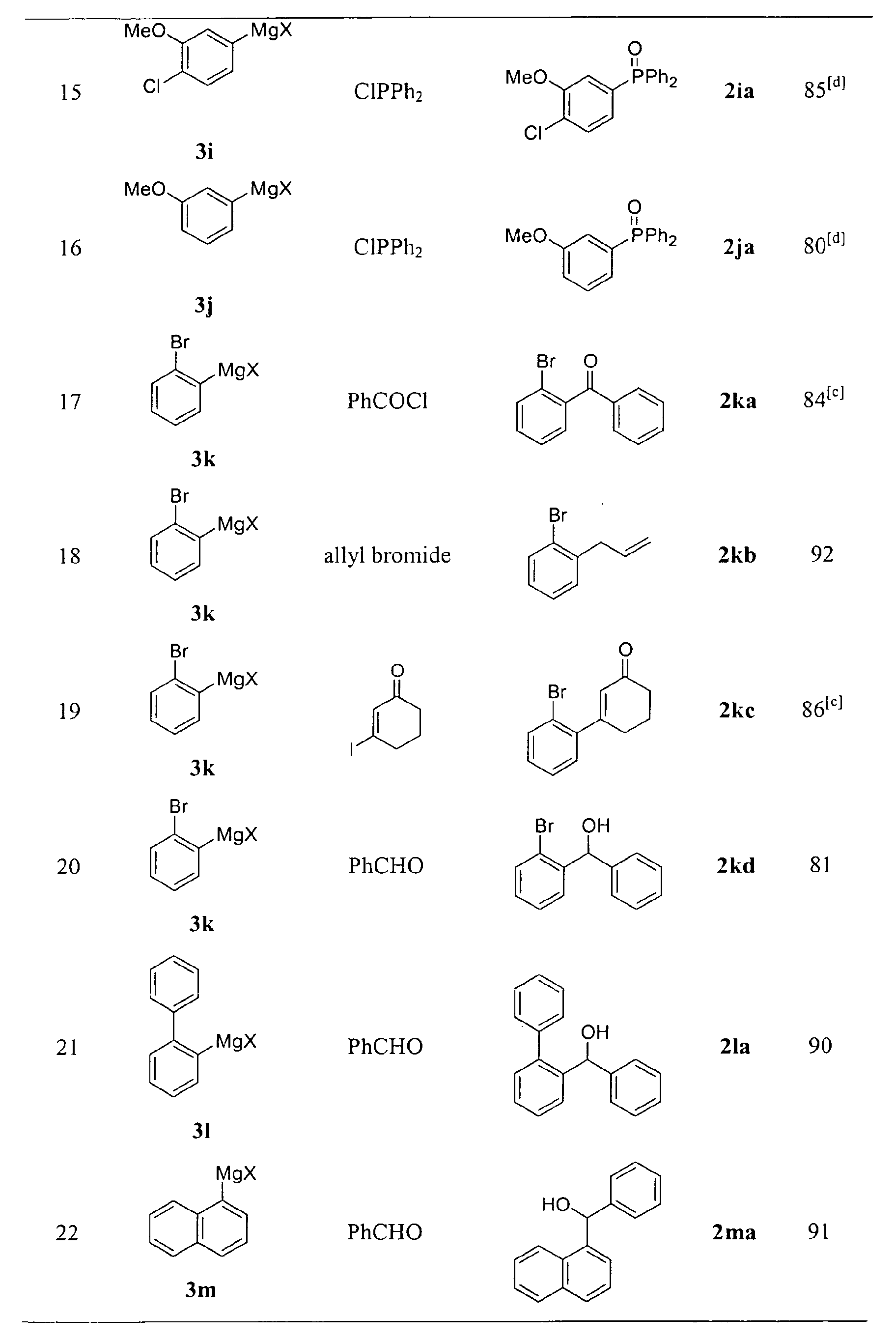
ortho position like 31 are obtained within 12h reaction time at rt furnishing after the
addition of benzaldehyde the desired alcohol 21a in 90% yield (Table 1, entry 21). The
more electron-rich the aromatic ring is, so slower the exchange reaction using i-PrMgCl. 2-Methoxy-1-bromobenzene
(1h) is however converted to the desired magnesium reagent 3h
in more than 90% yield after a reaction time of 24h at rt. After its reaction with PhSSPh the
thioether 2ha is obtained in 90% yield (entry 12). A range of different electrophiles reacts
with these Grignard reagents after a transmetalation step with CuCN•2LiCl[4] allowing the
performance of allylations and acylations (entry 14).
Highly substituted chloro and methoxy aryl bromides can readily be converted into the
desired Grignard reagents 3i, j. After the reaction with ClPPh2 and oxidative work-up, the
phosphine oxides 2ia, ja are obtained in good yields (entry 15, 16). This type of compound
is of interest in relation with P-ligands for asymmetric catalysis.[5] Also functions like a
cyano group are tolerated. Thus, the reaction of 4-bromobenzonitrile in THF at -7°C leads
to the desired arylmagnesium reagent (3d) in only 50% conversion using i-PrMgCl
whereas over 90% is observed with i-PrMgCl·LiCl (Scheme 3). The addition of
benzaldehyde provides the alcohol 2da in 81 % yield whereas allylation of arylmagnesium
reagent (3d) with allyl bromide leads to the corresponding 4-allylbenzonitrile in 92% yield
(entry 5,6 of Table 1). See Fig. 3 for additional information.
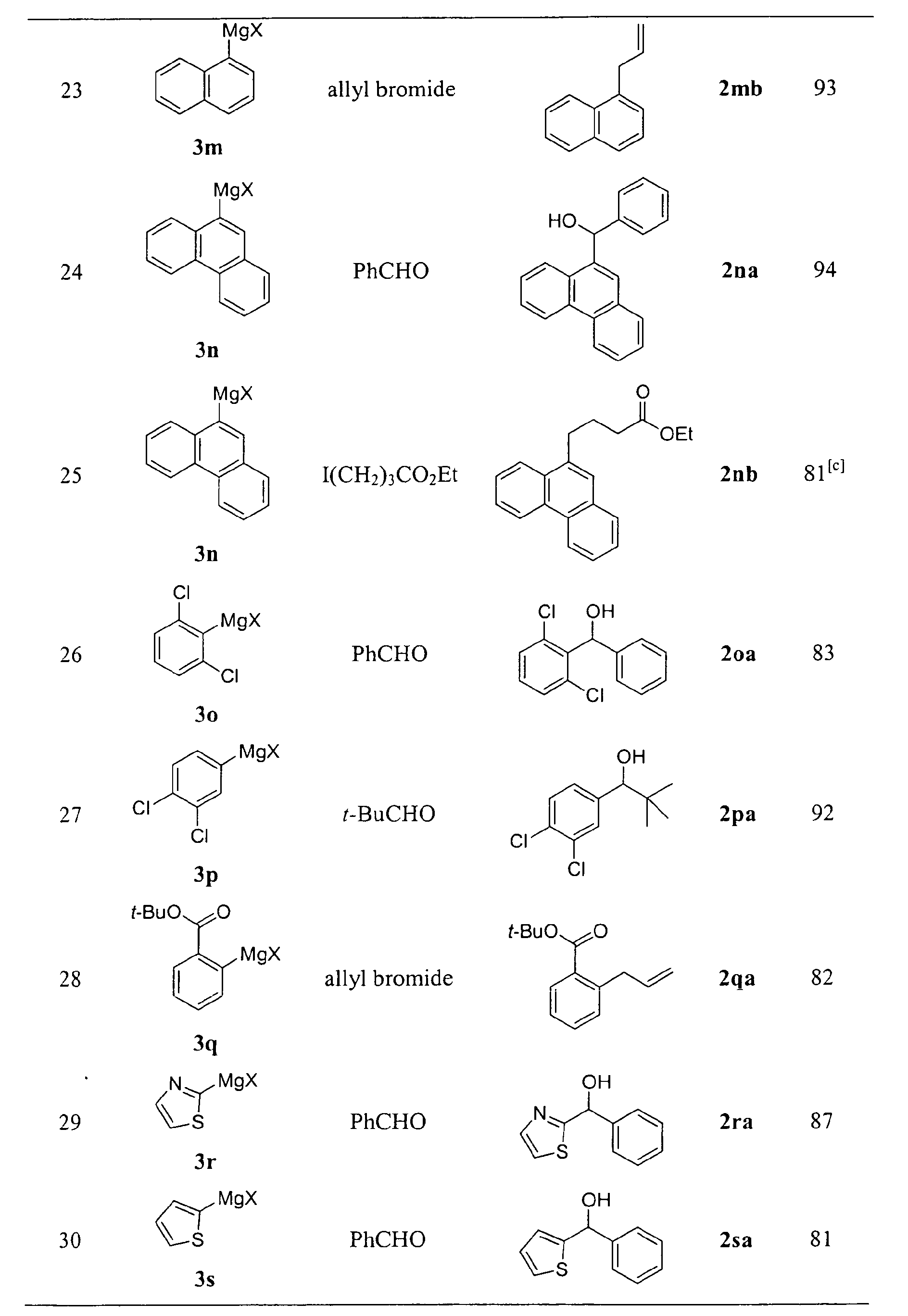
The Grignard reagents 3e, f is formed within 3h at 0°C and showed good yields after the
reactions with various electrophiles (entries 5-10). Usually unreactive compounds like
bromonaphthalene and bromophenanthrene derivatives are readily converted into the
corresponding Grignard reagents 3m, n (entries 22-25) that easily react both with
benzaldehyde (entries 22, 24) and with allyl bromide in good yields (entry 23). After
catalytic transmetallation with CuCN·2LiCl (0.2 equiv.) and reaction with ethyl 4-iodobutyrate
4h at -10°C, the desired cross-coupling product 2nb is obtained in 81% yield
(entry 25). As noticed above, various dichloro-substituted Grignard reagents like 3o and 3p
can be readily prepared and react with aromatic and aliphatic aldehydes furnishing the
corresponding alcohols 2oa, 2pa in 83 and 92% yield (entries 26, 27). Also ester function
can be tolerated in ortho-position, thus magnesium reagent 3q was prepared within 12h at
-45°C and reaction with allyl bromide leads to the formation of corresponding allylated
ester 2qa in 82% yield.
Remarkably, in the case of 1,2-dibromobenzenes only a mono exchange reaction occurs
providing the desired Grignard reagent (3k) (-15°C, 1.5h) in almost quantitative yield as
indicated by GC-analysis of reaction aliquots. The reaction of 2-bromophenylmagnesium
chloride (3k) with 3-iodo-2-cyclohexen-1-one produces the expected enone (2kc) in 86%
yield. The Grignard reagent 3k also showed good activity towards different electrophiles
(entries 17-20). Various variations of these reactions and several important new
magnesium reagents are reported in entries 21-33 of Table 1.
Since the stereoselective preparation of stereochemically well defined E- or Z-alkenylmagnesium
compounds is not possible by the direct insertion of magnesium into the
E- or Z-alkenyl halides, the iodine-magnesium exchange reaction may be unique way of
preparing stereochemically pure E- or Z-alkenylmagnesium derivatives.[6] Recently, we
have shown that the iodine-magnesium exchange reactions in case of alkenyl iodides
demand the presence of electron withdrawing group in α- or β-position to facilitate the
exchange reaction.[7] This led us to investigate the stereoselective preparation of
alkenylmagnesium reagents via I/Mg-exchange from non activated iodo- alkenes. Thus, the
reaction of (E)-1-bromohexene exchange reaction occurs providing the (E)-1-hexenymagnesium
chloride (4a) (-25°C, 10h) in almost quantitative yield (GC-analysis of
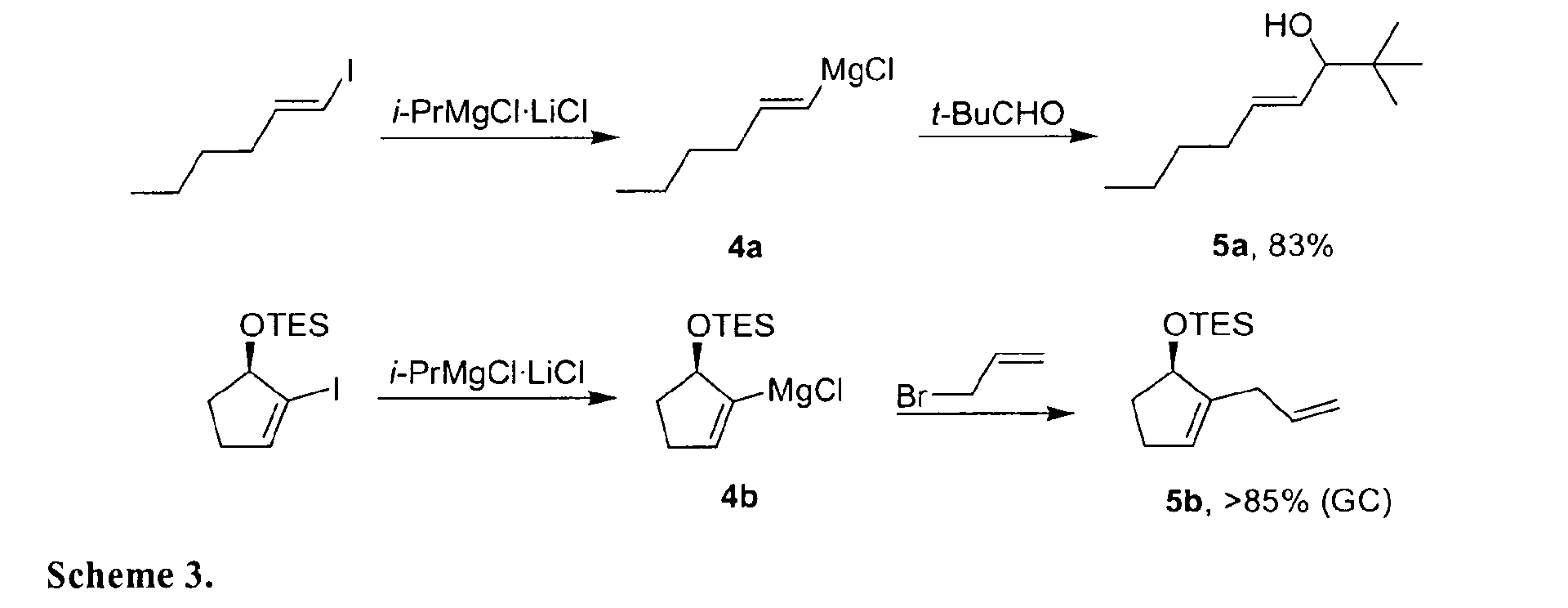
reaction aliquots). The reaction of Grignard reagent 4a with t-BuCHO led to the formation
of corresponding alcohols 5a with excellent yield. This remarkably low temperature will
allow the presence of numerous functional groups. Also, we observed a fast exchange
reaction with good coversion (GC) in the case of a chiral cyclic alkenyl iodide. Subsequent
reaction of magnesium reagent 4b with allyl bromide proceed in good yield that opened the
access to the different α-substituted chiral allylic alcohols (Scheme 3).
It is also possible to do Br/Mg-exchange in vinylic systems. Thus 1,2-dibromocyclopenten
easily react with i-PrMgCl·LiCl at room temperature to produce stable Grignard reagent 4c
that after reaction with cyclohexyl aldehyde gave corresponding alcohol 5b in good yield.

Reagent 4c is completely stable at room temperature for weeks, but addition of catalitical
amounts of Cu(I) or Cu(II) leads to the formation of cyclopentine that in the presence of
additional equivalent of magnesium or lithium compounds reacts with the formation of
new Grignard spieces 4d,e. Addition of benzaldehyde gave corresponding alcoholes in
good yields.

Other lithium salts like lithium perchlorate, lithium acetylacetonate, lithium bromide,
lithium iodide and lithium tetrafluoroborate were also tested, but gave less efficient
catalysis (Fig. 2).
Although the mechanism of the catalysis is not elucidated, the inventors assume that the
role of lithium chloride is to activate i-PrMgCl by increasing the nucleophilic character of
the isopropyl group by forming a magnesiate species of type 6 leading to the ate-intermediate
of type 7 and finally to the organomagnesium species PhMgCl·LiCl (8).

The complexation of the arylmagnesium species with LiCl as indicated for 8 (Scheme 6)
may also be responsible for the enhanced reactivity of these magnesium organometallics.[4]
As an example, the inventors found a simple procedure for catalyzing the Br/Mg-exchange
reaction of aryl and heteroaryl bromides with the complex i-PrMgCl·LiCl. It allows to
prepare a range of new polyfunctional organomagnesium compounds starting from cheap
aryl and heteroaryl bromides containing the most important functionalities for organic
synthesis.
Preparation of the reagent i -PrMgCl·LiCl: Magnesium turnings (110 mmole) were
placed in an Ar-flushed flask with anhydrous LiCl (100 mmole) and 50 ml of THF were
added. The solution of i-PrCl (100 mmole) in 50 ml of THF was added slowly and the
mixture was stirred at rt and the Grignard formation starts within a few minutes. The
reaction mixture was stirred after the completing of exothermical reaction for additional 12
h at rt. Slightly dark solution of i-PrMgCl·LiCl was transferred to a new flask under Ar and
removed in this way from excess of Mg.
A dry and argon flushed 10 mL flask, equipped with a magnetic stirrer and a septum, was
charged with 4-bromobenzonitrile (182 mg, 1 mmole). Dry THF (1 mL) was added, the
reaction mixture was cooled to -7 °C and
i-PrMgCl-LiCl (1 mL, 1.1 M in THF, 1.1 mmole) was then added dropwise. The Br/Mg-exchange
was complete after 3 h (checked by GC analysis of reaction aliquots, conversion
more than 90%) and benzaldehyde (116.6 mg, 1.1 mmole) was added. The reaction
mixture was stirred for 0.5 h at -7°C and was then quenched with sat. NH4Cl solution
(2 mL). The aqueous phase was extracted with ether (3 x 4 mL) and the organic fractions
were washed with brine (5 mL), dried (Na2SO4) and concentrated in vacuo. The crude
residue was purified by flash chromatography (dichloromethane) yielding the benzylic
alcohol (2da) as a colourless oil (169.5 mg, 81 %). 1 H-NMR (CDCl 3 , 200 MHz): δ =
7.91-7.85 (m, 2 H); 7.65 - 7.46 (m, 3 H); 7.38 - 7.30 (m, 4 H); 5.86 (s, 1 H); 2.42 (s, 1 H,
OH).
A dry and argon flushed 10 mL flask, equipped with a magnetic stirrer and a septum, was
charged with i-PrMgCl·LiCl (1 mL, 1.05 M in THF, 1.05 mmole), the reaction mixture was
cooled to -15°C and 3,5-dibromopyridine (236.9 mg, 1 mmole) was then added at one
portion. The temperature than increased till -10°C and the Br/Mg-exchange was complete
after 15 min (checked by GC analysis of reaction aliquots, conversion more than 98%),
allyl bromide (140.6 mg, 1 mmole) was added. The reaction mixture was stirred for 1 h at
-10°C and was then quenched with sat. NH4Cl solution (2 mL). The aqueous phase was
extracted with ether (3 x 4 mL), dried (Na2SO4) and concentrated in vacuo. The crude
residue was purified by flash chromatography (dichloromethane) yielding the 3-allyl-5-bromopyridine
(2ca) as a colourless oil (184.2 mg, 93%). 1 H-NMR (CDCl 3 , 200 MHz): δ
= 8.48 (d, J = 2.2 Hz, 1 H); 8.32 (d, J = 1.6 Hz, 1 H); 7.61 (dd, J = 2.2 Hz, J = 1.6 Hz,
1 H); 5.89 - 5.68 (m, 1 H); 5.08-5.01 (m, 1 H); 3.32 (brd, J = 6.8 Hz, 1 H).
A dry and argon flushed 10 mL flask, equipped with a magnetic stirrer and a septum, was
charged with i-PrMgCl·LiCl (1 mL, 1.05 M in THF, 1.05 mmole), the reaction mixture was
cooled to -15°C and 1,2-dibromobenzene (235.9 mg, 1 mmole) was then added dropwise.
The Br/Mg-exchange was complete after 1.5 h (checked by GC analysis of reaction
aliquots, conversion more than 98%) and solution of CuCN·2LiCl (0.1 mL, 1.0 M in THF,
0.1 mmole) was added. After stirring for 10 min at -15°C benzoyl chloride (140.6 mg,
1 mmole) was added. The reaction mixture was stirred for 1 h at -15°C and was then
quenched with sat. NH4Cl solution (2 mL) and also 5 drops of concentrated NH3 was
added. The aqueous phase was extracted with ether (3 x 4 mL) and the organic fractions
were washed with brine (5 mL), dried (Na2SO4) and concentrated in vacuo. The crude
residue was purified by flash chromatography (dichloromethane) yielding the ketone (2ka)
as a white cristals (219.3 mg, 84 %). 1 H-NMR (CDCl 3 , 200 MHz): δ = 7.86-7.78 (m, 2 H);
7.68 - 7.56 (m, 2 H); 7.52 - 7.30 (m, 5 H).


| Entry | Additive | Equiv. | Conversion. [%] |
| 1 | - | - | 18 |
| 2 | LiBF4 | 1.0 | 5 |
| 3 | LiBr | 1.0 | 40 |
| 4 | LiI | 1.0 | 38 |
| 5 | LiClO4 | 1.0 | 38 |
| 6 | LiCl | 1.0 | 70 |
| 7 | LiCl | 0.25 | 22 |
| 8 | LiCl | 0.5 | 43 |
| 9 | LiCl | 1.5 | 73 |
| 10 | LiCl | 2.0 | 74 |
| 11 | LiCl | 1.0 | 84 |
Claims (15)
- A reagent having the general formula
n is 1 or 2;
R1 is a substituted or unsubstituted C4-C24 aryl or C3-C24 heteroaryl, containing one or more heteroatoms as B, O, N, S, Se, P; linear or branched, substituted or unsubstituted C1-C20 alkyl, C1-C20 alkenyl or C1-C20 alkinyl; or substituted or unsubstituted C3-C20 cycloalkyl; or a derivative thereof;
X and Y are independently or both Cl, Br or I, preferably Cl; HalOn (where n = 3, 4); carboxylate of formula RCO2; alkoxide or phenoxide of formula RO; dialkoxide of formula LiO-R-O; disilazide of formula (R3Si)2N; thiolate of formula SR; RP(O)O2; or SCOR; where R is defined as R1 above;
linear or branched, substituted or unsubstituted C1-C20 alkyl or C3-C20 cycloalkyl amine of formula RNH; dialkyl/arylamine of formula R2N (where R is defined as above or R2N represents a heterocyclic alkylamine); phosphine of formula PR2 (where R is defined as above or PR2 represents a heterocyclic phosphine); OnSR (where n = 2 or 3 and R is defined as above); or NOn (where n = 2 or 3); and a derivative thereof. - The reagent of claim 1, wherein the reagent comprises R1(MgX)n and LiY in a molar ratio of 0,05-6,0.
- The reagent of claim 1 or 2, wherein Y is Cl, tert-butylate or sec-butylate.
- The reagent of one or more of claims 1-3, which is i-PrMgCl·LiCl.
- A method of preparing organomagnesium compounds,
comprising the following steps:a) providing a compound having the general formula:
R2 is defined as R1; or a substituted or unsubstituted metallocene such as ferrocene; or a derivative thereof.
A is Cl, Br, I, preferably Br, or a group of the general formula:
n=0, 1 or 2
or a group of the general formula:
or P(O)R3 2 represents a heterocyclic phosphinoxide;b) providing a reagent according to one ore more of claims 1-4;c) reacting the compounds provided in step a) and b) under suitable conditions; thereby obtaining the respective organomagnesium compound. - The method of claim 5, wherein the reagent according to one or more of claims 1-4 is provided by reacting R1X, Mg and LiY or by reacting R1(MgX)n and LiY.
- The method of one or more of claims 5 and 6, wherein the compound provided in step b) is used in a molar amount of 0,4-6,0 per mole of the compound provided in step a).
- The method of one or more of claims 5-7, wherein the compound provided in step b) is used as a solution in a suitable solvent.
- The method of claim 8, wherein the solvent is an inert aprotic solvent, preferably tetrahydrofurane, diethyl ether, tert-butylmethyl ether, dimethoxyethane, dioxane, triethylamine, pyridine, ethyldiisopropylamine, dichlormethane, 1,2-dichlorethane, dimethylsulfide, dibutylsulfide, benzene, toluene, xylene, pentane, hexane, heptane or combinations thereof.
- The method of claims 8 or 9, wherein the solution is 0,05 to 3,0 M, preferably 1,0-2,5 M.
- A method for preparing functionalized or unfunctionalized organic compounds, comprising
steps a)-c) of one or more of claims 5-10, and
d) reacting the obtained organomagnesium compound with an organic or inorganic electrophile (E+). - The method of one or more of the preceding claims, which is performed at a temperature in a range between -78 °C to 80°C, preferably at room temperature.
- Use of the reagent of one or more of claims 1-4 in the preparation of organometallic compounds and their reaction with electrophiles.
- Use of LiY in the preparation of organometallic compounds and their reaction with electrophiles, wherein Y is defined as in claim 1.
- An organometallic compound, which is obtainable by the method of one or more of claims 5-10.
Priority Applications (8)
| Application Number | Priority Date | Filing Date | Title |
|---|---|---|---|
| EP04008081A EP1582523A1 (en) | 2004-04-02 | 2004-04-02 | Method of preparing organomagnesium compounds |
| AT05007179T ATE404569T1 (en) | 2004-04-02 | 2005-04-01 | METHOD FOR PRODUCING ORGANOMAGNESIUM COMPOUNDS |
| JP2005106858A JP5059294B2 (en) | 2004-04-02 | 2005-04-01 | Method for producing organomagnesium compound |
| US11/097,707 US7384580B2 (en) | 2004-04-02 | 2005-04-01 | Method of preparing organomagnesium compounds |
| ES05007179T ES2314508T3 (en) | 2004-04-02 | 2005-04-01 | METHOD OF PREPARING ORGANOMAGNETIC COMPOUNDS. |
| EP20050007179 EP1582524B1 (en) | 2004-04-02 | 2005-04-01 | Method of preparing organomagnesium compounds |
| DE602005008793T DE602005008793D1 (en) | 2004-04-02 | 2005-04-01 | Process for the preparation of organomagnesium compounds |
| US11/787,974 US7387751B2 (en) | 2004-04-02 | 2007-04-18 | Method of preparing organomagnesium compounds |
Applications Claiming Priority (1)
| Application Number | Priority Date | Filing Date | Title |
|---|---|---|---|
| EP04008081A EP1582523A1 (en) | 2004-04-02 | 2004-04-02 | Method of preparing organomagnesium compounds |
Publications (1)
| Publication Number | Publication Date |
|---|---|
| EP1582523A1 true EP1582523A1 (en) | 2005-10-05 |
Family
ID=34878257
Family Applications (1)
| Application Number | Title | Priority Date | Filing Date |
|---|---|---|---|
| EP04008081A Withdrawn EP1582523A1 (en) | 2004-04-02 | 2004-04-02 | Method of preparing organomagnesium compounds |
Country Status (6)
| Country | Link |
|---|---|
| US (2) | US7384580B2 (en) |
| EP (1) | EP1582523A1 (en) |
| JP (1) | JP5059294B2 (en) |
| AT (1) | ATE404569T1 (en) |
| DE (1) | DE602005008793D1 (en) |
| ES (1) | ES2314508T3 (en) |
Cited By (23)
| Publication number | Priority date | Publication date | Assignee | Title |
|---|---|---|---|---|
| EP1810974A1 (en) * | 2006-01-18 | 2007-07-25 | Ludwig-Maximilians-Universität München | Preparation and use of magnesium amides |
| WO2007140965A1 (en) * | 2006-06-08 | 2007-12-13 | Schwarz Pharma Ltd. | Accelerated synthesis of substituted hydroxymethyl phenols |
| WO2007144091A1 (en) * | 2006-06-12 | 2007-12-21 | Schwarz Pharma Ltd. | Shortened synthesis using paraformaldehyde or trioxane |
| WO2008028166A1 (en) * | 2006-09-01 | 2008-03-06 | Carnegie Mellon University | Universal grignard metathesis polymerization |
| WO2008080993A2 (en) | 2006-12-28 | 2008-07-10 | Ivars Kalvinsh | A method for preparation of substituted adamantylarylmagnesium halides |
| WO2010118370A1 (en) * | 2009-04-10 | 2010-10-14 | Plextronics, Inc. | Dehalogenation |
| US7825252B2 (en) | 2006-09-12 | 2010-11-02 | Gilead Sciences, Inc. | Process and intermediates for preparing integrase inhibitors |
| US7838624B2 (en) * | 2007-05-15 | 2010-11-23 | Plextronics, Inc. | Mixed halogen polymerization |
| WO2012041858A1 (en) | 2010-09-30 | 2012-04-05 | Basf Se | A process for the synthesis of thio-triazolo-group containing compounds |
| US8153801B2 (en) | 2007-09-11 | 2012-04-10 | Gilead Sciences, Inc. | Process and intermediates for preparing integrase inhibitors |
| JP2013032369A (en) * | 2005-10-17 | 2013-02-14 | Novartis Ag | Derivative of 3-alkyl-5-(4-alkyl-5-oxo-tetrahydrofuran-2-yl) pyrrolidin-2-one as intermediate in synthesis of renin inhibitor |
| US8445708B2 (en) | 2005-10-28 | 2013-05-21 | Reuter Chemischer Apparatebau Kg | Process for preparing chiral octenoic acid derivatives |
| ITMI20121390A1 (en) * | 2012-08-06 | 2014-02-07 | F I S Fabbrica Italiana Sint P A | PROCEDURE FOR THE PREPARATION OF 2-CYANOPHENYLBORONIC ACID AND ITS ESTERS, INTERMEDIATE OF THE PERAMPANEL OR E2040 |
| US8877931B2 (en) | 2012-08-03 | 2014-11-04 | Gilead Sciences, Inc. | Process and intermediates for preparing integrase inhibitors |
| WO2018166855A1 (en) | 2017-03-16 | 2018-09-20 | Basf Se | Heterobicyclic substituted dihydroisoxazoles |
| WO2018224455A1 (en) | 2017-06-07 | 2018-12-13 | Basf Se | Substituted cyclopropyl derivatives |
| WO2018234488A1 (en) | 2017-06-23 | 2018-12-27 | Basf Se | SUBSTITUTED CYCLOPROPYL DERIVATIVES |
| WO2019121143A1 (en) | 2017-12-20 | 2019-06-27 | Basf Se | Substituted cyclopropyl derivatives |
| EP3560934A1 (en) * | 2018-04-26 | 2019-10-30 | F.I.S.- Fabbrica Italiana Sintetici S.p.A. | Process for the preparation of pure 2-cyanophenylboronic acid and esters thereof, intermediates of perampanel or of e2040 |
| WO2021234082A1 (en) * | 2020-05-21 | 2021-11-25 | Syngenta Crop Protection Ag | Chemical process |
| WO2022069553A1 (en) | 2020-10-01 | 2022-04-07 | Bayer Aktiengesellschaft | Benzaldehyde oximes and method for producing same |
| CN114394926A (en) * | 2022-02-28 | 2022-04-26 | 大连大学 | High-yield synthesis method of N, 3-disubstituted-1-isoindolinone compounds |
| CN114539124A (en) * | 2022-02-28 | 2022-05-27 | 大连大学 | Method for enantioselectively synthesizing N, 3-disubstituted-1-isoindolinone compound |
Families Citing this family (12)
| Publication number | Priority date | Publication date | Assignee | Title |
|---|---|---|---|---|
| JP4489532B2 (en) * | 2004-08-03 | 2010-06-23 | セントラル硝子株式会社 | 3-Formyl-5-trifluoromethylbenzonitrile derivative and process for producing the same |
| DE102006015378A1 (en) * | 2006-04-03 | 2007-10-04 | Ludwig-Maximilians-Universität München | Process for the synthesis of organoelement compounds |
| US20100113816A1 (en) * | 2006-12-29 | 2010-05-06 | Ivars Kalvinsh | Method for prepartion of substituted adamantylarymagnesium halides |
| EP2396337B1 (en) | 2009-02-13 | 2016-07-13 | Ludwig-Maximilians-Universität München | Preparation and use of zinc-amides |
| CA2789079A1 (en) * | 2010-02-09 | 2011-08-18 | Saltigo Gmbh | Method for allylating and vinylating aryl, heteroaryl, alkyl, and alkene halogenides using transition metal catalysis |
| WO2013152476A1 (en) | 2012-04-10 | 2013-10-17 | Theracos, Inc. | Process for the preparation of benzylbenzene sglt2 inhibitors |
| EP3688000B1 (en) * | 2017-09-27 | 2023-11-08 | Albemarle Germany GmbH | Hydrocarbon-soluble halogen and thiolate/magnesium exchange reagents |
| CN109020784B (en) * | 2018-08-04 | 2020-04-28 | 浙江大学 | Preparation method of 2-methyl-1-phenyl-1-propanol |
| CN112028739A (en) * | 2019-06-04 | 2020-12-04 | 湖北大学 | Method for functionalizing o-dihalogenated aromatic compounds |
| JP7509573B2 (en) * | 2019-08-27 | 2024-07-02 | 東ソー・ファインケム株式会社 | Method for producing oxystyrene compounds having polysubstituted ether substituents |
| JP7654493B2 (en) * | 2021-07-08 | 2025-04-01 | 関東化学株式会社 | Method for producing cyclopentadienyl group-containing hydrocarbon compounds or cyclopentadienyl group-containing silicon-substituted hydrocarbon compounds using magnesium halide |
| JP2024046451A (en) * | 2022-09-22 | 2024-04-03 | 株式会社トクヤマ | Method for producing ketone derivatives |
Family Cites Families (9)
| Publication number | Priority date | Publication date | Assignee | Title |
|---|---|---|---|---|
| EP0162908A4 (en) * | 1983-11-15 | 1986-04-15 | Lithium Corp | Preparation of alkaline earth metal organometallic compounds. |
| JPS6367481A (en) * | 1986-09-10 | 1988-03-26 | Nippon Benkan Kogyo Kk | Diaphragm valve |
| JPS63238086A (en) * | 1987-03-13 | 1988-10-04 | リチウム コーポレーション オブ アメリカ | Ether-free organometal amide composition |
| US4976886A (en) * | 1987-03-30 | 1990-12-11 | Lithium Corporation Of America | Preparation of organometallic and organobimetallic compounds |
| US4887740A (en) * | 1988-06-03 | 1989-12-19 | Bar-Master International | Valve for beverage dispenser and the like |
| JPH07103189A (en) * | 1993-10-04 | 1995-04-18 | Mitsubishi Heavy Ind Ltd | Oil film seal oil supply device |
| US5610227A (en) * | 1995-06-07 | 1997-03-11 | Bridgestone/Firestone, Inc. | Lithium amino magnesiate polymerization initiators and elastomers having reduced hysteresis |
| AU2001228805A1 (en) * | 2000-02-02 | 2001-08-14 | Banyu Pharmaceutical Co. Ltd. | Method of converting functional group through halogen-metal exchange reaction |
| JP2001354605A (en) * | 2000-06-09 | 2001-12-25 | Idemitsu Petrochem Co Ltd | Method for producing tertiary alcohol |
-
2004
- 2004-04-02 EP EP04008081A patent/EP1582523A1/en not_active Withdrawn
-
2005
- 2005-04-01 ES ES05007179T patent/ES2314508T3/en not_active Expired - Lifetime
- 2005-04-01 AT AT05007179T patent/ATE404569T1/en active
- 2005-04-01 JP JP2005106858A patent/JP5059294B2/en not_active Expired - Lifetime
- 2005-04-01 US US11/097,707 patent/US7384580B2/en not_active Expired - Lifetime
- 2005-04-01 DE DE602005008793T patent/DE602005008793D1/en not_active Expired - Lifetime
-
2007
- 2007-04-18 US US11/787,974 patent/US7387751B2/en not_active Expired - Lifetime
Non-Patent Citations (2)
| Title |
|---|
| ANGEWANDTE CHEMIE, INTERNATIONAL EDITION, 21 June 2004 (2004-06-21), pages 3333 - 3336, XP002294441 * |
| ANGEWANDTE CHEMIE, vol. 115, 2003, pages 4438 - 4456, XP002294440 * |
Cited By (40)
| Publication number | Priority date | Publication date | Assignee | Title |
|---|---|---|---|---|
| JP2014196312A (en) * | 2005-10-17 | 2014-10-16 | ノバルティス アーゲー | Derivative of 3-alkyl-5-(4-alkyl-5-oxo-tetrahydrofuran-2-yl)pyrrolidin-2-one as synthetic intermediate for renin inhibitor |
| JP2013032369A (en) * | 2005-10-17 | 2013-02-14 | Novartis Ag | Derivative of 3-alkyl-5-(4-alkyl-5-oxo-tetrahydrofuran-2-yl) pyrrolidin-2-one as intermediate in synthesis of renin inhibitor |
| US8450519B2 (en) | 2005-10-28 | 2013-05-28 | Reuter Chemischer Apparatebau Kg | Process for preparing octenoic acid derivatives |
| US8445708B2 (en) | 2005-10-28 | 2013-05-21 | Reuter Chemischer Apparatebau Kg | Process for preparing chiral octenoic acid derivatives |
| CN101370815B (en) * | 2006-01-18 | 2012-05-23 | 慕尼黑路德维格-马克西米利安斯大学 | Preparation and use of magnesium amides |
| EP1810974A1 (en) * | 2006-01-18 | 2007-07-25 | Ludwig-Maximilians-Universität München | Preparation and use of magnesium amides |
| EP2360161A1 (en) | 2006-01-18 | 2011-08-24 | Ludwig-Maximilians-Universität München | Preparation and use of magnesium amides |
| US8299306B2 (en) | 2006-06-08 | 2012-10-30 | Ennis Seth C | Accelerated synthesis of substituted hydroxymethyl phenols |
| WO2007140965A1 (en) * | 2006-06-08 | 2007-12-13 | Schwarz Pharma Ltd. | Accelerated synthesis of substituted hydroxymethyl phenols |
| US8115028B2 (en) | 2006-06-12 | 2012-02-14 | Ennis Seth C | Shortened synthesis using paraformaldehyde or trioxane |
| WO2007144091A1 (en) * | 2006-06-12 | 2007-12-21 | Schwarz Pharma Ltd. | Shortened synthesis using paraformaldehyde or trioxane |
| US8288508B2 (en) | 2006-09-01 | 2012-10-16 | Carnegie Mellon University | Universal grignard metathesis polymerization |
| WO2008028166A1 (en) * | 2006-09-01 | 2008-03-06 | Carnegie Mellon University | Universal grignard metathesis polymerization |
| US8324244B2 (en) | 2006-09-12 | 2012-12-04 | Gilead Sciences, Inc. | Process and intermediates for preparing integrase inhibitors |
| US7825252B2 (en) | 2006-09-12 | 2010-11-02 | Gilead Sciences, Inc. | Process and intermediates for preparing integrase inhibitors |
| US8796459B2 (en) | 2006-09-12 | 2014-08-05 | Gilead Sciences, Inc. | Process and intermediates for preparing integrase inhibitors |
| WO2008080993A2 (en) | 2006-12-28 | 2008-07-10 | Ivars Kalvinsh | A method for preparation of substituted adamantylarylmagnesium halides |
| US7838624B2 (en) * | 2007-05-15 | 2010-11-23 | Plextronics, Inc. | Mixed halogen polymerization |
| US8153801B2 (en) | 2007-09-11 | 2012-04-10 | Gilead Sciences, Inc. | Process and intermediates for preparing integrase inhibitors |
| US8440831B2 (en) | 2007-09-11 | 2013-05-14 | Gilead Sciences, Inc. | Process and intermediates for preparing integrase inhibitors |
| US8759525B2 (en) | 2007-09-11 | 2014-06-24 | Gilhead Sciences, Inc. | Process and intermediates for preparing integrase inhibitors |
| WO2010118370A1 (en) * | 2009-04-10 | 2010-10-14 | Plextronics, Inc. | Dehalogenation |
| WO2012041858A1 (en) | 2010-09-30 | 2012-04-05 | Basf Se | A process for the synthesis of thio-triazolo-group containing compounds |
| US8877931B2 (en) | 2012-08-03 | 2014-11-04 | Gilead Sciences, Inc. | Process and intermediates for preparing integrase inhibitors |
| ITMI20121390A1 (en) * | 2012-08-06 | 2014-02-07 | F I S Fabbrica Italiana Sint P A | PROCEDURE FOR THE PREPARATION OF 2-CYANOPHENYLBORONIC ACID AND ITS ESTERS, INTERMEDIATE OF THE PERAMPANEL OR E2040 |
| WO2014023576A1 (en) * | 2012-08-06 | 2014-02-13 | F.I.S. - Fabbrica Italiana Sintetici S.P.A. | Process for the preparation of 2-cyanophenylboronic acid and esters thereof |
| CN104144933A (en) * | 2012-08-06 | 2014-11-12 | 意大利合成制造有限公司 | Process for the preparation of 2-cyanophenylboronic acid and esters thereof |
| US9000205B2 (en) | 2012-08-06 | 2015-04-07 | F.I.S.—Fabbrica Italiana Sintetici S.p.A. | Process for the preparation of 2-cyanophenylboronic acid and esters thereof |
| WO2018166855A1 (en) | 2017-03-16 | 2018-09-20 | Basf Se | Heterobicyclic substituted dihydroisoxazoles |
| WO2018224455A1 (en) | 2017-06-07 | 2018-12-13 | Basf Se | Substituted cyclopropyl derivatives |
| WO2018234488A1 (en) | 2017-06-23 | 2018-12-27 | Basf Se | SUBSTITUTED CYCLOPROPYL DERIVATIVES |
| WO2019121143A1 (en) | 2017-12-20 | 2019-06-27 | Basf Se | Substituted cyclopropyl derivatives |
| EP3560934A1 (en) * | 2018-04-26 | 2019-10-30 | F.I.S.- Fabbrica Italiana Sintetici S.p.A. | Process for the preparation of pure 2-cyanophenylboronic acid and esters thereof, intermediates of perampanel or of e2040 |
| WO2021234082A1 (en) * | 2020-05-21 | 2021-11-25 | Syngenta Crop Protection Ag | Chemical process |
| WO2022069553A1 (en) | 2020-10-01 | 2022-04-07 | Bayer Aktiengesellschaft | Benzaldehyde oximes and method for producing same |
| US12630499B2 (en) | 2020-10-01 | 2026-05-19 | Bayer Aktiengesellschaft | Benzaldehyde oximes and method for producing same |
| CN114394926A (en) * | 2022-02-28 | 2022-04-26 | 大连大学 | High-yield synthesis method of N, 3-disubstituted-1-isoindolinone compounds |
| CN114539124A (en) * | 2022-02-28 | 2022-05-27 | 大连大学 | Method for enantioselectively synthesizing N, 3-disubstituted-1-isoindolinone compound |
| CN114394926B (en) * | 2022-02-28 | 2023-06-27 | 大连大学 | High-yield synthesis method of N, 3-disubstituted-1-isoindolinone compound |
| CN114539124B (en) * | 2022-02-28 | 2023-07-21 | 大连大学 | A method for enantioselective synthesis of N,3-disubstituted-1-isoindolinone compounds |
Also Published As
| Publication number | Publication date |
|---|---|
| US20050218532A1 (en) | 2005-10-06 |
| US20070194468A1 (en) | 2007-08-23 |
| JP2005290001A (en) | 2005-10-20 |
| US7384580B2 (en) | 2008-06-10 |
| JP5059294B2 (en) | 2012-10-24 |
| US7387751B2 (en) | 2008-06-17 |
| ATE404569T1 (en) | 2008-08-15 |
| ES2314508T3 (en) | 2009-03-16 |
| DE602005008793D1 (en) | 2008-09-25 |
Similar Documents
| Publication | Publication Date | Title |
|---|---|---|
| US7387751B2 (en) | Method of preparing organomagnesium compounds | |
| CN101410404B (en) | Methods for the synthesis of organic elemental compounds | |
| Dohle et al. | Copper-mediated cross-coupling of functionalized arylmagnesium reagents with functionalized alkyl and benzylic halides | |
| US20100144516A1 (en) | Preparation and use of magnesium amides | |
| Giovannini et al. | An Efficient Nickel‐Catalyzed Cross‐Coupling Between sp3 Carbon Centers | |
| US8513416B2 (en) | Bisamide-zinc bases | |
| EP2235023B1 (en) | An efficient process to induce enantioselectivity in procarbonyl compounds | |
| EP1582524A1 (en) | Method of preparing organomagnesium compounds | |
| WO2007128601A2 (en) | Method for the preparation of a compound of the general formula r1-r1 and/or r1-r2 using homo and hetero coupling reactions | |
| JP7391837B2 (en) | Hydrocarbon Soluble Halogen and Thiolate/Magnesium Exchange Reagents | |
| CA2073342C (en) | Transmetalations from zirconium to copper intermediates | |
| CN114085174A (en) | One-pot synthesis method of benzyl methyl aryl sulfide | |
| Hashimoto et al. | Allylation of carbonyl compounds mediated by germanium (II) iodide | |
| KR101536041B1 (en) | Method for allylating and vinylating aryl, heteroaryl, alkyl, and alkene halogenides using transition metal catalysis | |
| US5166382A (en) | Transmetalations from zirconium to copper intermediates | |
| Hoffmann‐Röder et al. | Metal‐Mediated Synthesis of Allenes | |
| JP3762994B2 (en) | Alkynyl S, N-acetal derivative and method for producing the same | |
| CN101544672A (en) | Organic antimony compound bearing a nitrogen-bridged ligand and its preparation and application | |
| CN121342656A (en) | Synthesis method of BCN-OSu and its intermediates | |
| EP2142556A1 (en) | Preparation and use of magnesium amides | |
| JPH11158095A (en) | Production of alcohols | |
| JP2014024777A (en) | Method for producing polycyclic aromatic compound having halogen atom | |
| WO2008023658A1 (en) | Process for isomerization of alkyl grignard reagents and process for production of organic compounds |
Legal Events
| Date | Code | Title | Description |
|---|---|---|---|
| PUAI | Public reference made under article 153(3) epc to a published international application that has entered the european phase |
Free format text: ORIGINAL CODE: 0009012 |
|
| AK | Designated contracting states |
Kind code of ref document: A1 Designated state(s): AT BE BG CH CY CZ DE DK EE ES FI FR GB GR HU IE IT LI LU MC NL PL PT RO SE SI SK TR |
|
| AX | Request for extension of the european patent |
Extension state: AL HR LT LV MK |
|
| AKX | Designation fees paid | ||
| STAA | Information on the status of an ep patent application or granted ep patent |
Free format text: STATUS: THE APPLICATION IS DEEMED TO BE WITHDRAWN |
|
| 18D | Application deemed to be withdrawn |
Effective date: 20060406 |
|
| REG | Reference to a national code |
Ref country code: DE Ref legal event code: 8566 |