EP1582514A1 - Processes for producing glutamic acid derivative and pyroglutamic acid derivative and novel intermediate for production - Google Patents
Processes for producing glutamic acid derivative and pyroglutamic acid derivative and novel intermediate for production Download PDFInfo
- Publication number
- EP1582514A1 EP1582514A1 EP03815609A EP03815609A EP1582514A1 EP 1582514 A1 EP1582514 A1 EP 1582514A1 EP 03815609 A EP03815609 A EP 03815609A EP 03815609 A EP03815609 A EP 03815609A EP 1582514 A1 EP1582514 A1 EP 1582514A1
- Authority
- EP
- European Patent Office
- Prior art keywords
- group
- stands
- formula
- acid derivative
- salt
- Prior art date
- Legal status (The legal status is an assumption and is not a legal conclusion. Google has not performed a legal analysis and makes no representation as to the accuracy of the status listed.)
- Granted
Links
- 238000004519 manufacturing process Methods 0.000 title claims abstract description 47
- 150000002306 glutamic acid derivatives Chemical class 0.000 title claims abstract description 20
- 238000000034 method Methods 0.000 title claims description 79
- ODHCTXKNWHHXJC-VKHMYHEASA-N 5-oxo-L-proline Chemical class OC(=O)[C@@H]1CCC(=O)N1 ODHCTXKNWHHXJC-VKHMYHEASA-N 0.000 title description 7
- -1 4-protected hydroxyl pyroglutamic acid Chemical class 0.000 claims abstract description 271
- 125000006239 protecting group Chemical group 0.000 claims abstract description 109
- 238000005804 alkylation reaction Methods 0.000 claims abstract description 32
- RMLYXMMBIZLGAQ-HZMBPMFUSA-N (2s,4s)-4-amino-2-hydroxy-2-(1h-indol-3-ylmethyl)pentanedioic acid Chemical compound C1=CC=C2C(C[C@](O)(C[C@H](N)C(O)=O)C(O)=O)=CNC2=C1 RMLYXMMBIZLGAQ-HZMBPMFUSA-N 0.000 claims abstract description 28
- RMLYXMMBIZLGAQ-UHFFFAOYSA-N (-)-monatin Natural products C1=CC=C2C(CC(O)(CC(N)C(O)=O)C(O)=O)=CNC2=C1 RMLYXMMBIZLGAQ-UHFFFAOYSA-N 0.000 claims abstract description 26
- 239000002168 alkylating agent Substances 0.000 claims abstract description 8
- 229940100198 alkylating agent Drugs 0.000 claims abstract description 8
- 239000002253 acid Substances 0.000 claims abstract description 7
- 125000001797 benzyl group Chemical group [H]C1=C([H])C([H])=C(C([H])=C1[H])C([H])([H])* 0.000 claims description 98
- 150000003839 salts Chemical class 0.000 claims description 84
- 125000001183 hydrocarbyl group Chemical group 0.000 claims description 74
- 125000004432 carbon atom Chemical group C* 0.000 claims description 69
- 125000001584 benzyloxycarbonyl group Chemical group C(=O)(OCC1=CC=CC=C1)* 0.000 claims description 67
- 125000004435 hydrogen atom Chemical group [H]* 0.000 claims description 64
- FFUAGWLWBBFQJT-UHFFFAOYSA-N hexamethyldisilazane Chemical compound C[Si](C)(C)N[Si](C)(C)C FFUAGWLWBBFQJT-UHFFFAOYSA-N 0.000 claims description 54
- 238000006460 hydrolysis reaction Methods 0.000 claims description 48
- 125000002887 hydroxy group Chemical group [H]O* 0.000 claims description 45
- 125000001841 imino group Chemical group [H]N=* 0.000 claims description 42
- 238000010511 deprotection reaction Methods 0.000 claims description 41
- 125000000217 alkyl group Chemical group 0.000 claims description 40
- 230000007062 hydrolysis Effects 0.000 claims description 40
- 125000001041 indolyl group Chemical group 0.000 claims description 31
- 125000000999 tert-butyl group Chemical group [H]C([H])([H])C(*)(C([H])([H])[H])C([H])([H])[H] 0.000 claims description 31
- 125000000026 trimethylsilyl group Chemical group [H]C([H])([H])[Si]([*])(C([H])([H])[H])C([H])([H])[H] 0.000 claims description 31
- 238000006243 chemical reaction Methods 0.000 claims description 27
- 125000001424 substituent group Chemical group 0.000 claims description 25
- 229910052727 yttrium Inorganic materials 0.000 claims description 25
- 125000000623 heterocyclic group Chemical group 0.000 claims description 21
- 229910052698 phosphorus Inorganic materials 0.000 claims description 20
- 125000005843 halogen group Chemical group 0.000 claims description 19
- ZCSHNCUQKCANBX-UHFFFAOYSA-N lithium diisopropylamide Chemical compound [Li+].CC(C)[N-]C(C)C ZCSHNCUQKCANBX-UHFFFAOYSA-N 0.000 claims description 18
- WKBOTKDWSSQWDR-UHFFFAOYSA-N Bromine atom Chemical group [Br] WKBOTKDWSSQWDR-UHFFFAOYSA-N 0.000 claims description 17
- 229910052801 chlorine Inorganic materials 0.000 claims description 14
- ZCYVEMRRCGMTRW-UHFFFAOYSA-N 7553-56-2 Chemical group [I] ZCYVEMRRCGMTRW-UHFFFAOYSA-N 0.000 claims description 13
- 229910052740 iodine Inorganic materials 0.000 claims description 13
- 159000000000 sodium salts Chemical class 0.000 claims description 13
- 125000001309 chloro group Chemical group Cl* 0.000 claims description 12
- 125000002496 methyl group Chemical group [H]C([H])([H])* 0.000 claims description 12
- 229910003002 lithium salt Inorganic materials 0.000 claims description 9
- 159000000002 lithium salts Chemical class 0.000 claims description 9
- XAEFZNCEHLXOMS-UHFFFAOYSA-M potassium benzoate Chemical compound [K+].[O-]C(=O)C1=CC=CC=C1 XAEFZNCEHLXOMS-UHFFFAOYSA-M 0.000 claims description 9
- WRIKHQLVHPKCJU-UHFFFAOYSA-N sodium bis(trimethylsilyl)amide Chemical compound C[Si](C)(C)N([Na])[Si](C)(C)C WRIKHQLVHPKCJU-UHFFFAOYSA-N 0.000 claims description 9
- NAWXUBYGYWOOIX-SFHVURJKSA-N (2s)-2-[[4-[2-(2,4-diaminoquinazolin-6-yl)ethyl]benzoyl]amino]-4-methylidenepentanedioic acid Chemical compound C1=CC2=NC(N)=NC(N)=C2C=C1CCC1=CC=C(C(=O)N[C@@H](CC(=C)C(O)=O)C(O)=O)C=C1 NAWXUBYGYWOOIX-SFHVURJKSA-N 0.000 claims description 8
- DLEDOFVPSDKWEF-UHFFFAOYSA-N lithium butane Chemical compound [Li+].CCC[CH2-] DLEDOFVPSDKWEF-UHFFFAOYSA-N 0.000 claims description 8
- FMMYTMPRUGLGBL-STYMGOOTSA-N (2r)-4-hydroxy-5-oxopyrrolidine-2-carboxylic acid Chemical class OC1C[C@H](C(O)=O)NC1=O FMMYTMPRUGLGBL-STYMGOOTSA-N 0.000 claims description 7
- QQIRAVWVGBTHMJ-UHFFFAOYSA-N [dimethyl-(trimethylsilylamino)silyl]methane;lithium Chemical compound [Li].C[Si](C)(C)N[Si](C)(C)C QQIRAVWVGBTHMJ-UHFFFAOYSA-N 0.000 claims description 7
- 125000003710 aryl alkyl group Chemical group 0.000 claims description 7
- 125000003118 aryl group Chemical group 0.000 claims description 7
- FYJKEHKQUPSJDH-UHFFFAOYSA-N [dimethyl-(trimethylsilylamino)silyl]methane;potassium Chemical compound [K].C[Si](C)(C)N[Si](C)(C)C FYJKEHKQUPSJDH-UHFFFAOYSA-N 0.000 claims description 6
- 229910052799 carbon Inorganic materials 0.000 claims description 6
- HGHGHRORRVDFRJ-JHJMLUEUSA-N 1-o-tert-butyl 2-o-methyl (2r)-4-[tert-butyl(dimethyl)silyl]oxy-5-oxopyrrolidine-1,2-dicarboxylate Chemical compound COC(=O)[C@H]1CC(O[Si](C)(C)C(C)(C)C)C(=O)N1C(=O)OC(C)(C)C HGHGHRORRVDFRJ-JHJMLUEUSA-N 0.000 claims description 5
- 125000001981 tert-butyldimethylsilyl group Chemical group [H]C([H])([H])[Si]([H])(C([H])([H])[H])[*]C(C([H])([H])[H])(C([H])([H])[H])C([H])([H])[H] 0.000 claims description 5
- YNESATAKKCNGOF-UHFFFAOYSA-N lithium bis(trimethylsilyl)amide Chemical compound [Li+].C[Si](C)(C)[N-][Si](C)(C)C YNESATAKKCNGOF-UHFFFAOYSA-N 0.000 claims description 4
- SEJLXHZBTLQYCV-HOYKHHGWSA-N 1-o-tert-butyl 2-o-methyl (2r,4r)-4-benzyl-4-[tert-butyl(dimethyl)silyl]oxy-5-oxopyrrolidine-1,2-dicarboxylate Chemical compound O=C1N(C(=O)OC(C)(C)C)[C@@H](C(=O)OC)C[C@]1(O[Si](C)(C)C(C)(C)C)CC1=CC=CC=C1 SEJLXHZBTLQYCV-HOYKHHGWSA-N 0.000 claims description 3
- IUBQJLUDMLPAGT-UHFFFAOYSA-N potassium bis(trimethylsilyl)amide Chemical compound C[Si](C)(C)N([K])[Si](C)(C)C IUBQJLUDMLPAGT-UHFFFAOYSA-N 0.000 claims description 3
- 230000029936 alkylation Effects 0.000 abstract description 10
- PMMYEEVYMWASQN-UHFFFAOYSA-N dl-hydroxyproline Natural products OC1C[NH2+]C(C([O-])=O)C1 PMMYEEVYMWASQN-UHFFFAOYSA-N 0.000 abstract description 8
- 230000003287 optical effect Effects 0.000 abstract description 7
- PMMYEEVYMWASQN-DMTCNVIQSA-N Hydroxyproline Chemical compound O[C@H]1CN[C@H](C(O)=O)C1 PMMYEEVYMWASQN-DMTCNVIQSA-N 0.000 abstract description 6
- 229960002591 hydroxyproline Drugs 0.000 abstract description 4
- 230000003301 hydrolyzing effect Effects 0.000 abstract 1
- FGMPLJWBKKVCDB-UHFFFAOYSA-N trans-L-hydroxy-proline Natural products ON1CCCC1C(O)=O FGMPLJWBKKVCDB-UHFFFAOYSA-N 0.000 abstract 1
- 150000001875 compounds Chemical class 0.000 description 24
- 125000003178 carboxy group Chemical group [H]OC(*)=O 0.000 description 14
- 239000000243 solution Substances 0.000 description 13
- LFQSCWFLJHTTHZ-UHFFFAOYSA-N Ethanol Chemical compound CCO LFQSCWFLJHTTHZ-UHFFFAOYSA-N 0.000 description 10
- XEKOWRVHYACXOJ-UHFFFAOYSA-N Ethyl acetate Chemical compound CCOC(C)=O XEKOWRVHYACXOJ-UHFFFAOYSA-N 0.000 description 9
- HEMHJVSKTPXQMS-UHFFFAOYSA-M Sodium hydroxide Chemical compound [OH-].[Na+] HEMHJVSKTPXQMS-UHFFFAOYSA-M 0.000 description 9
- WYURNTSHIVDZCO-UHFFFAOYSA-N Tetrahydrofuran Chemical compound C1CCOC1 WYURNTSHIVDZCO-UHFFFAOYSA-N 0.000 description 9
- XLYOFNOQVPJJNP-UHFFFAOYSA-N water Substances O XLYOFNOQVPJJNP-UHFFFAOYSA-N 0.000 description 8
- VEXZGXHMUGYJMC-UHFFFAOYSA-N Hydrochloric acid Chemical compound Cl VEXZGXHMUGYJMC-UHFFFAOYSA-N 0.000 description 6
- CSNNHWWHGAXBCP-UHFFFAOYSA-L Magnesium sulfate Chemical compound [Mg+2].[O-][S+2]([O-])([O-])[O-] CSNNHWWHGAXBCP-UHFFFAOYSA-L 0.000 description 6
- KWYUFKZDYYNOTN-UHFFFAOYSA-M Potassium hydroxide Chemical compound [OH-].[K+] KWYUFKZDYYNOTN-UHFFFAOYSA-M 0.000 description 6
- HEDRZPFGACZZDS-MICDWDOJSA-N Trichloro(2H)methane Chemical compound [2H]C(Cl)(Cl)Cl HEDRZPFGACZZDS-MICDWDOJSA-N 0.000 description 6
- 125000004453 alkoxycarbonyl group Chemical group 0.000 description 6
- 239000002904 solvent Substances 0.000 description 6
- 238000001228 spectrum Methods 0.000 description 6
- 238000005160 1H NMR spectroscopy Methods 0.000 description 5
- 230000015572 biosynthetic process Effects 0.000 description 5
- 238000002330 electrospray ionisation mass spectrometry Methods 0.000 description 5
- 238000000655 nuclear magnetic resonance spectrum Methods 0.000 description 5
- 230000001590 oxidative effect Effects 0.000 description 5
- 239000000126 substance Substances 0.000 description 5
- 238000003786 synthesis reaction Methods 0.000 description 5
- QGZKDVFQNNGYKY-UHFFFAOYSA-N Ammonia Chemical compound N QGZKDVFQNNGYKY-UHFFFAOYSA-N 0.000 description 4
- XKRFYHLGVUSROY-UHFFFAOYSA-N Argon Chemical compound [Ar] XKRFYHLGVUSROY-UHFFFAOYSA-N 0.000 description 4
- RTZKZFJDLAIYFH-UHFFFAOYSA-N Diethyl ether Chemical compound CCOCC RTZKZFJDLAIYFH-UHFFFAOYSA-N 0.000 description 4
- KFZMGEQAYNKOFK-UHFFFAOYSA-N Isopropanol Chemical compound CC(C)O KFZMGEQAYNKOFK-UHFFFAOYSA-N 0.000 description 4
- GDTBXPJZTBHREO-UHFFFAOYSA-N bromine Chemical compound BrBr GDTBXPJZTBHREO-UHFFFAOYSA-N 0.000 description 4
- PMMYEEVYMWASQN-IMJSIDKUSA-N cis-4-Hydroxy-L-proline Chemical compound O[C@@H]1CN[C@H](C(O)=O)C1 PMMYEEVYMWASQN-IMJSIDKUSA-N 0.000 description 4
- 238000000605 extraction Methods 0.000 description 4
- 125000004029 hydroxymethyl group Chemical group [H]OC([H])([H])* 0.000 description 4
- 239000000543 intermediate Substances 0.000 description 4
- 239000011734 sodium Substances 0.000 description 4
- YLQBMQCUIZJEEH-UHFFFAOYSA-N tetrahydrofuran Natural products C=1C=COC=1 YLQBMQCUIZJEEH-UHFFFAOYSA-N 0.000 description 4
- PPSCTWNANZJDHZ-BXKDBHETSA-N (2r,4r)-4-amino-2-benzyl-2-hydroxypentanedioic acid Chemical compound OC(=O)[C@H](N)C[C@@](O)(C(O)=O)CC1=CC=CC=C1 PPSCTWNANZJDHZ-BXKDBHETSA-N 0.000 description 3
- 0 *C(CC(*)(*)C1=O)N1P Chemical compound *C(CC(*)(*)C1=O)N1P 0.000 description 3
- QTBSBXVTEAMEQO-UHFFFAOYSA-N Acetic acid Chemical compound CC(O)=O QTBSBXVTEAMEQO-UHFFFAOYSA-N 0.000 description 3
- WEVYAHXRMPXWCK-UHFFFAOYSA-N Acetonitrile Chemical compound CC#N WEVYAHXRMPXWCK-UHFFFAOYSA-N 0.000 description 3
- WMFOQBRAJBCJND-UHFFFAOYSA-M Lithium hydroxide Chemical compound [Li+].[OH-] WMFOQBRAJBCJND-UHFFFAOYSA-M 0.000 description 3
- OKKJLVBELUTLKV-UHFFFAOYSA-N Methanol Chemical compound OC OKKJLVBELUTLKV-UHFFFAOYSA-N 0.000 description 3
- YXFVVABEGXRONW-UHFFFAOYSA-N Toluene Chemical compound CC1=CC=CC=C1 YXFVVABEGXRONW-UHFFFAOYSA-N 0.000 description 3
- 238000009903 catalytic hydrogenation reaction Methods 0.000 description 3
- PMMYEEVYMWASQN-QWWZWVQMSA-N cis-4-hydroxy-D-proline Chemical compound O[C@H]1C[NH2+][C@@H](C([O-])=O)C1 PMMYEEVYMWASQN-QWWZWVQMSA-N 0.000 description 3
- 238000001914 filtration Methods 0.000 description 3
- 238000004128 high performance liquid chromatography Methods 0.000 description 3
- 239000012046 mixed solvent Substances 0.000 description 3
- 125000002924 primary amino group Chemical group [H]N([H])* 0.000 description 3
- 238000000425 proton nuclear magnetic resonance spectrum Methods 0.000 description 3
- 239000007858 starting material Substances 0.000 description 3
- NRFDZZBPGMUOQD-UHFFFAOYSA-N tert-butyl 3-(bromomethyl)indole-1-carboxylate Chemical compound C1=CC=C2N(C(=O)OC(C)(C)C)C=C(CBr)C2=C1 NRFDZZBPGMUOQD-UHFFFAOYSA-N 0.000 description 3
- NLXLAEXVIDQMFP-UHFFFAOYSA-N Ammonia chloride Chemical compound [NH4+].[Cl-] NLXLAEXVIDQMFP-UHFFFAOYSA-N 0.000 description 2
- IJGRMHOSHXDMSA-UHFFFAOYSA-N Atomic nitrogen Chemical compound N#N IJGRMHOSHXDMSA-UHFFFAOYSA-N 0.000 description 2
- KZBUYRJDOAKODT-UHFFFAOYSA-N Chlorine Chemical compound ClCl KZBUYRJDOAKODT-UHFFFAOYSA-N 0.000 description 2
- KRHYYFGTRYWZRS-UHFFFAOYSA-M Fluoride anion Chemical compound [F-] KRHYYFGTRYWZRS-UHFFFAOYSA-M 0.000 description 2
- MZRVEZGGRBJDDB-UHFFFAOYSA-N N-Butyllithium Chemical compound [Li]CCCC MZRVEZGGRBJDDB-UHFFFAOYSA-N 0.000 description 2
- FAPWRFPIFSIZLT-UHFFFAOYSA-M Sodium chloride Chemical class [Na+].[Cl-] FAPWRFPIFSIZLT-UHFFFAOYSA-M 0.000 description 2
- 125000003277 amino group Chemical group 0.000 description 2
- 229910021529 ammonia Inorganic materials 0.000 description 2
- 238000004458 analytical method Methods 0.000 description 2
- 239000007864 aqueous solution Substances 0.000 description 2
- 229910052786 argon Inorganic materials 0.000 description 2
- 229910052794 bromium Inorganic materials 0.000 description 2
- 239000003153 chemical reaction reagent Substances 0.000 description 2
- 239000000460 chlorine Substances 0.000 description 2
- 238000004587 chromatography analysis Methods 0.000 description 2
- WGLPBDUCMAPZCE-UHFFFAOYSA-N chromium trioxide Inorganic materials O=[Cr](=O)=O WGLPBDUCMAPZCE-UHFFFAOYSA-N 0.000 description 2
- GAMDZJFZMJECOS-UHFFFAOYSA-N chromium(6+);oxygen(2-) Chemical compound [O-2].[O-2].[O-2].[Cr+6] GAMDZJFZMJECOS-UHFFFAOYSA-N 0.000 description 2
- 239000013078 crystal Substances 0.000 description 2
- 238000002425 crystallisation Methods 0.000 description 2
- 230000008025 crystallization Effects 0.000 description 2
- GUVUOGQBMYCBQP-UHFFFAOYSA-N dmpu Chemical compound CN1CCCN(C)C1=O GUVUOGQBMYCBQP-UHFFFAOYSA-N 0.000 description 2
- 230000032050 esterification Effects 0.000 description 2
- 238000005886 esterification reaction Methods 0.000 description 2
- 150000002148 esters Chemical class 0.000 description 2
- 125000001495 ethyl group Chemical group [H]C([H])([H])C([H])([H])* 0.000 description 2
- 239000000706 filtrate Substances 0.000 description 2
- 235000003599 food sweetener Nutrition 0.000 description 2
- GNOIPBMMFNIUFM-UHFFFAOYSA-N hexamethylphosphoric triamide Chemical compound CN(C)P(=O)(N(C)C)N(C)C GNOIPBMMFNIUFM-UHFFFAOYSA-N 0.000 description 2
- 229910052943 magnesium sulfate Inorganic materials 0.000 description 2
- 235000019341 magnesium sulphate Nutrition 0.000 description 2
- BDAGIHXWWSANSR-UHFFFAOYSA-N methanoic acid Natural products OC=O BDAGIHXWWSANSR-UHFFFAOYSA-N 0.000 description 2
- SYSQUGFVNFXIIT-UHFFFAOYSA-N n-[4-(1,3-benzoxazol-2-yl)phenyl]-4-nitrobenzenesulfonamide Chemical class C1=CC([N+](=O)[O-])=CC=C1S(=O)(=O)NC1=CC=C(C=2OC3=CC=CC=C3N=2)C=C1 SYSQUGFVNFXIIT-UHFFFAOYSA-N 0.000 description 2
- 239000012044 organic layer Substances 0.000 description 2
- 238000012746 preparative thin layer chromatography Methods 0.000 description 2
- 108090000765 processed proteins & peptides Proteins 0.000 description 2
- 230000035484 reaction time Effects 0.000 description 2
- JQWHASGSAFIOCM-UHFFFAOYSA-M sodium periodate Chemical compound [Na+].[O-]I(=O)(=O)=O JQWHASGSAFIOCM-UHFFFAOYSA-M 0.000 description 2
- 239000003765 sweetening agent Substances 0.000 description 2
- PMMYEEVYMWASQN-IUYQGCFVSA-N trans-4-hydroxy-D-proline Chemical compound O[C@@H]1CN[C@@H](C(O)=O)C1 PMMYEEVYMWASQN-IUYQGCFVSA-N 0.000 description 2
- FMMYTMPRUGLGBL-SCQFTWEKSA-N (2s)-4-hydroxy-5-oxopyrrolidine-2-carboxylic acid Chemical class OC1C[C@@H](C(O)=O)NC1=O FMMYTMPRUGLGBL-SCQFTWEKSA-N 0.000 description 1
- WORJRXHJTUTINR-UHFFFAOYSA-N 1,4-dioxane;hydron;chloride Chemical compound Cl.C1COCCO1 WORJRXHJTUTINR-UHFFFAOYSA-N 0.000 description 1
- VXZRKBMRNRLOGT-SLGOVJDISA-N 1-o-tert-butyl 2-o-methyl (2r,4r)-4-[tert-butyl(dimethyl)silyl]oxy-4-[[1-[(2-methylpropan-2-yl)oxycarbonyl]indol-3-yl]methyl]-5-oxopyrrolidine-1,2-dicarboxylate Chemical compound O=C1N(C(=O)OC(C)(C)C)[C@@H](C(=O)OC)C[C@]1(O[Si](C)(C)C(C)(C)C)CC1=CN(C(=O)OC(C)(C)C)C2=CC=CC=C12 VXZRKBMRNRLOGT-SLGOVJDISA-N 0.000 description 1
- OSWFIVFLDKOXQC-UHFFFAOYSA-N 4-(3-methoxyphenyl)aniline Chemical compound COC1=CC=CC(C=2C=CC(N)=CC=2)=C1 OSWFIVFLDKOXQC-UHFFFAOYSA-N 0.000 description 1
- 239000004215 Carbon black (E152) Substances 0.000 description 1
- XTHFKEDIFFGKHM-UHFFFAOYSA-N Dimethoxyethane Chemical compound COCCOC XTHFKEDIFFGKHM-UHFFFAOYSA-N 0.000 description 1
- DGAQECJNVWCQMB-PUAWFVPOSA-M Ilexoside XXIX Chemical compound C[C@@H]1CC[C@@]2(CC[C@@]3(C(=CC[C@H]4[C@]3(CC[C@@H]5[C@@]4(CC[C@@H](C5(C)C)OS(=O)(=O)[O-])C)C)[C@@H]2[C@]1(C)O)C)C(=O)O[C@H]6[C@@H]([C@H]([C@@H]([C@H](O6)CO)O)O)O.[Na+] DGAQECJNVWCQMB-PUAWFVPOSA-M 0.000 description 1
- 229930006000 Sucrose Natural products 0.000 description 1
- CZMRCDWAGMRECN-UGDNZRGBSA-N Sucrose Chemical compound O[C@H]1[C@H](O)[C@@H](CO)O[C@@]1(CO)O[C@@H]1[C@H](O)[C@@H](O)[C@H](O)[C@@H](CO)O1 CZMRCDWAGMRECN-UGDNZRGBSA-N 0.000 description 1
- 239000000654 additive Substances 0.000 description 1
- 230000000996 additive effect Effects 0.000 description 1
- 230000001476 alcoholic effect Effects 0.000 description 1
- 125000003545 alkoxy group Chemical group 0.000 description 1
- 150000001347 alkyl bromides Chemical class 0.000 description 1
- 150000001348 alkyl chlorides Chemical class 0.000 description 1
- 150000001350 alkyl halides Chemical class 0.000 description 1
- 150000001351 alkyl iodides Chemical class 0.000 description 1
- 230000002152 alkylating effect Effects 0.000 description 1
- 150000003862 amino acid derivatives Chemical class 0.000 description 1
- 235000019270 ammonium chloride Nutrition 0.000 description 1
- AGEZXYOZHKGVCM-UHFFFAOYSA-N benzyl bromide Chemical compound BrCC1=CC=CC=C1 AGEZXYOZHKGVCM-UHFFFAOYSA-N 0.000 description 1
- 125000000484 butyl group Chemical group [H]C([*])([H])C([H])([H])C([H])([H])C([H])([H])[H] 0.000 description 1
- 239000007810 chemical reaction solvent Substances 0.000 description 1
- 229940117975 chromium trioxide Drugs 0.000 description 1
- 125000004122 cyclic group Chemical group 0.000 description 1
- 229940079593 drug Drugs 0.000 description 1
- 239000003814 drug Substances 0.000 description 1
- PQVSTLUFSYVLTO-UHFFFAOYSA-N ethyl n-ethoxycarbonylcarbamate Chemical compound CCOC(=O)NC(=O)OCC PQVSTLUFSYVLTO-UHFFFAOYSA-N 0.000 description 1
- 229910052731 fluorine Inorganic materials 0.000 description 1
- 125000001153 fluoro group Chemical group F* 0.000 description 1
- 235000019253 formic acid Nutrition 0.000 description 1
- 239000007789 gas Substances 0.000 description 1
- 229930195733 hydrocarbon Natural products 0.000 description 1
- 239000012535 impurity Substances 0.000 description 1
- 125000006301 indolyl methyl group Chemical group 0.000 description 1
- 238000009776 industrial production Methods 0.000 description 1
- 239000011261 inert gas Substances 0.000 description 1
- PNDPGZBMCMUPRI-UHFFFAOYSA-N iodine Chemical compound II PNDPGZBMCMUPRI-UHFFFAOYSA-N 0.000 description 1
- GLXDVVHUTZTUQK-UHFFFAOYSA-M lithium hydroxide monohydrate Substances [Li+].O.[OH-] GLXDVVHUTZTUQK-UHFFFAOYSA-M 0.000 description 1
- 229940040692 lithium hydroxide monohydrate Drugs 0.000 description 1
- 229910052751 metal Inorganic materials 0.000 description 1
- 239000002184 metal Substances 0.000 description 1
- 150000007522 mineralic acids Chemical class 0.000 description 1
- 239000000203 mixture Substances 0.000 description 1
- 229910052757 nitrogen Inorganic materials 0.000 description 1
- 150000007524 organic acids Chemical class 0.000 description 1
- 239000003960 organic solvent Substances 0.000 description 1
- 238000002360 preparation method Methods 0.000 description 1
- 239000000047 product Substances 0.000 description 1
- HNJBEVLQSNELDL-UHFFFAOYSA-N pyrrolidin-2-one Chemical group O=C1CCCN1 HNJBEVLQSNELDL-UHFFFAOYSA-N 0.000 description 1
- 230000000717 retained effect Effects 0.000 description 1
- 238000007142 ring opening reaction Methods 0.000 description 1
- 229910001925 ruthenium oxide Inorganic materials 0.000 description 1
- WOCIAKWEIIZHES-UHFFFAOYSA-N ruthenium(iv) oxide Chemical compound O=[Ru]=O WOCIAKWEIIZHES-UHFFFAOYSA-N 0.000 description 1
- 229910052708 sodium Inorganic materials 0.000 description 1
- 239000007787 solid Substances 0.000 description 1
- 238000011915 stereoselective alkylation Methods 0.000 description 1
- 239000005720 sucrose Substances 0.000 description 1
- 230000002194 synthesizing effect Effects 0.000 description 1
- ILMRJRBKQSSXGY-UHFFFAOYSA-N tert-butyl(dimethyl)silicon Chemical group C[Si](C)C(C)(C)C ILMRJRBKQSSXGY-UHFFFAOYSA-N 0.000 description 1
- 230000001988 toxicity Effects 0.000 description 1
- 231100000419 toxicity Toxicity 0.000 description 1
Classifications
-
- C—CHEMISTRY; METALLURGY
- C07—ORGANIC CHEMISTRY
- C07C—ACYCLIC OR CARBOCYCLIC COMPOUNDS
- C07C227/00—Preparation of compounds containing amino and carboxyl groups bound to the same carbon skeleton
- C07C227/22—Preparation of compounds containing amino and carboxyl groups bound to the same carbon skeleton from lactams, cyclic ketones or cyclic oximes, e.g. by reactions involving Beckmann rearrangement
-
- C—CHEMISTRY; METALLURGY
- C07—ORGANIC CHEMISTRY
- C07D—HETEROCYCLIC COMPOUNDS
- C07D207/00—Heterocyclic compounds containing five-membered rings not condensed with other rings, with one nitrogen atom as the only ring hetero atom
- C07D207/02—Heterocyclic compounds containing five-membered rings not condensed with other rings, with one nitrogen atom as the only ring hetero atom with only hydrogen or carbon atoms directly attached to the ring nitrogen atom
- C07D207/18—Heterocyclic compounds containing five-membered rings not condensed with other rings, with one nitrogen atom as the only ring hetero atom with only hydrogen or carbon atoms directly attached to the ring nitrogen atom having one double bond between ring members or between a ring member and a non-ring member
- C07D207/22—Heterocyclic compounds containing five-membered rings not condensed with other rings, with one nitrogen atom as the only ring hetero atom with only hydrogen or carbon atoms directly attached to the ring nitrogen atom having one double bond between ring members or between a ring member and a non-ring member with hetero atoms or with carbon atoms having three bonds to hetero atoms with at the most one bond to halogen, e.g. ester or nitrile radicals, directly attached to ring carbon atoms
- C07D207/24—Oxygen or sulfur atoms
- C07D207/26—2-Pyrrolidones
- C07D207/273—2-Pyrrolidones with hetero atoms or with carbon atoms having three bonds to hetero atoms with at the most one bond to halogen, e.g. ester or nitrile radicals, directly attached to other ring carbon atoms
- C07D207/277—Carbon atoms having three bonds to hetero atoms with at the most one bond to halogen, e.g. ester or nitrile radicals
- C07D207/28—2-Pyrrolidone-5- carboxylic acids; Functional derivatives thereof, e.g. esters, nitriles
-
- C—CHEMISTRY; METALLURGY
- C07—ORGANIC CHEMISTRY
- C07C—ACYCLIC OR CARBOCYCLIC COMPOUNDS
- C07C229/00—Compounds containing amino and carboxyl groups bound to the same carbon skeleton
- C07C229/02—Compounds containing amino and carboxyl groups bound to the same carbon skeleton having amino and carboxyl groups bound to acyclic carbon atoms of the same carbon skeleton
- C07C229/34—Compounds containing amino and carboxyl groups bound to the same carbon skeleton having amino and carboxyl groups bound to acyclic carbon atoms of the same carbon skeleton the carbon skeleton containing six-membered aromatic rings
- C07C229/36—Compounds containing amino and carboxyl groups bound to the same carbon skeleton having amino and carboxyl groups bound to acyclic carbon atoms of the same carbon skeleton the carbon skeleton containing six-membered aromatic rings with at least one amino group and one carboxyl group bound to the same carbon atom of the carbon skeleton
-
- C—CHEMISTRY; METALLURGY
- C07—ORGANIC CHEMISTRY
- C07D—HETEROCYCLIC COMPOUNDS
- C07D209/00—Heterocyclic compounds containing five-membered rings, condensed with other rings, with one nitrogen atom as the only ring hetero atom
- C07D209/02—Heterocyclic compounds containing five-membered rings, condensed with other rings, with one nitrogen atom as the only ring hetero atom condensed with one carbocyclic ring
- C07D209/04—Indoles; Hydrogenated indoles
- C07D209/10—Indoles; Hydrogenated indoles with substituted hydrocarbon radicals attached to carbon atoms of the hetero ring
- C07D209/18—Radicals substituted by carbon atoms having three bonds to hetero atoms with at the most one bond to halogen, e.g. ester or nitrile radicals
- C07D209/20—Radicals substituted by carbon atoms having three bonds to hetero atoms with at the most one bond to halogen, e.g. ester or nitrile radicals substituted additionally by nitrogen atoms, e.g. tryptophane
-
- Y—GENERAL TAGGING OF NEW TECHNOLOGICAL DEVELOPMENTS; GENERAL TAGGING OF CROSS-SECTIONAL TECHNOLOGIES SPANNING OVER SEVERAL SECTIONS OF THE IPC; TECHNICAL SUBJECTS COVERED BY FORMER USPC CROSS-REFERENCE ART COLLECTIONS [XRACs] AND DIGESTS
- Y02—TECHNOLOGIES OR APPLICATIONS FOR MITIGATION OR ADAPTATION AGAINST CLIMATE CHANGE
- Y02P—CLIMATE CHANGE MITIGATION TECHNOLOGIES IN THE PRODUCTION OR PROCESSING OF GOODS
- Y02P20/00—Technologies relating to chemical industry
- Y02P20/50—Improvements relating to the production of bulk chemicals
- Y02P20/55—Design of synthesis routes, e.g. reducing the use of auxiliary or protecting groups
Definitions
- This invention relates to a process for manufacturing a glutamic acid derivative and a pyroglutamic acid derivative, typically monatin, and a novel intermediate used in the manufacture thereof by that process.
- This method involves complicated procedures including reducing the carboxyl group of a pyroglutamic acid derivative into a hydroxymethyl group, converting it to a protecting hydroxymethyl group and introducing a hydroxyl group into the 4-position for the preparation of compound (16), and after the alkylation of compound (16), conducting the deprotection of the protecting hydroxymethyl group into a hydroxymethyl group and oxidizing it back into a carboxyl group, though the compound represented by formula (16) is capable of regioselective alkylation as it has only a single active hydrogen atom.
- Chromium trioxide (CrO 3 ) is used in the oxidizing reaction, but the reaction using it presents a great many problems as a method of manufacture, since this reagent is dangerous because of toxicity, etc. Moreover, it is desirable for no process of manufacture to include any oxidizing reaction of any compound having an indole ring, since the indole ring is easily oxidizable.
- the relative configuration at the 2- and 4-positions of a 4-protected hydroxy-4-substituted pyroglutamic acid derivative as obtained by an alkylation reaction coincides with the relative configuration at the 2- and 4-positions of (2S, 4S) or (2R, 4R) -monatin among four kinds of stereoisomers of monatin and it is possible to derive monatin having the corresponding configuration.
- monatin While it is known that naturally occurring monatin presents the (2S, 4S) form in its stereostructure, the term “monatin” as herein used covers all the compounds having the same structural formula, but differing in configuration.
- the individual stereoisomers may be called by designations indicating their stereoisomerism like “(2S, 4S) -monatin” and "(2R, 4R)-monatin”.
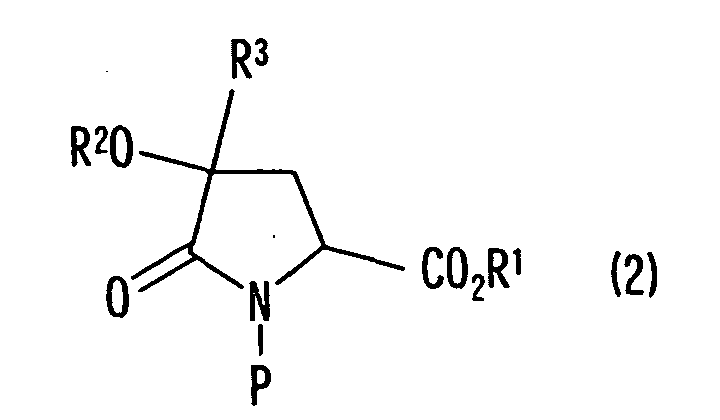
- a glutamic acid derivative represented by formula (3) is manufactured by subjecting a 4-protected hydroxy-pyroglutamic acid derivative represented by formula (1) to an alkylation reaction to prepare a 4-protected hydroxy-4-substituted pyroglutamic acid derivative represented by formula (2) and subjecting the derivative to hydrolysis and deprotection steps.
- the compounds represented by formulas (1), (2) and (3) may each be in the form of a salt. Any reference made herein to any of those compounds covers its salts unless otherwise noted.
- the 4-protected hydroxypyroglutamic acid derivative as represented by formula (1) in the event that at least one of R 1 , R 4 and R 5 is a hydrogen atom, i.e. in the event that the compound has a carboxyl group, the 4-protected hydroxypyroglutamic acid derivative as represented by formula (1), the 4-protected hydroxyl-4-substituted pyroglutamic acid derivative as represented by formula (2) and the 4-protected hydroxyl-4-substituted glutamic acid derivative (glutamic acid derivative) as represented by formula (3) may be in the form of their salts.
- the salt may, for example, be a salt formed by reacting any such compound with a base, such as sodium hydroxide, potassium hydroxide or ammonia, or a salt formed by adding thereto an inorganic acid, such as hydrochloric acid, or an organic acid, such as acetic acid.
- a base such as sodium hydroxide, potassium hydroxide or ammonia
- an inorganic acid such as hydrochloric acid
- an organic acid such as acetic acid.
- R 1 , R 4 and R 5 stand independently of one another for a group selected from a hydrogen atom and a hydrocarbon group.
- a group selected from an alkyl group having 1 to 5 carbon atoms and a benzyl group is preferably selected as R 1 .
- a hydrogen atom is preferably selected as R 4 and R 5 .
- R 2 stands for a protecting group for a hydroxyl group.
- Groups which are usually employed in the art may be used as protecting groups for hydroxyl groups, and are, for example, a t-butyldimethylsilyl group, a trimethylsilyl group, a t-butyldiphenylsilyl group, a benzyl group, a t-butyl group, a benzyloxycarbonyl group and a t-butoxycarbonyl group.
- P stands for a protecting group for an imino group.
- Groups which are usually employed in the art as protecting groups for amino and imino s may be used as protecting groups for imino groups, and are, for example, a t-butoxycarbonyl group, a benzyloxycarbonyl group and a benzyl group.
- R 3 stands for a group selected from a hydrocarbon group optionally having a substituent and a heterocyclic hydrocarbon group optionally having a substituent.
- the hydrocarbon group may, for example, be a hydrocarbon group having 1 to 20 carbon atoms and is preferably an alkyl group having 1 to 20 carbon atoms, an aryl group having 1 to 20 carbon atoms, an aralkyl group having 1 to 20 carbon atoms or a heterocyclic hydrocarbon group having 1 to 20 carbon atoms.
- the heterocyclic hydrocarbon group may, for example, be a heterocyclic hydrocarbon group having 1 to 20 carbon atoms.
- the hydrocarbon group (or heterocyclic hydrocarbon group) may have any of a chain structure, a cyclic structure, or both. In the event that it has a chain structure, it may be a straight or branched chain.
- the substituent which it may optionally have may, for example, be a halogen atom (an iodine, bromine, chlorine or fluorine atom, etc.), a hydroxyl group, an alkyl group having 1 to 3 carbon atoms, an alkoxy group having 1 to 3 carbon atoms or an amino group.
- a substituent such as an amino, imino or hydroxyl group
- the substituent may be protected by a protecting group for an amino, imino or hydroxyl group, etc. as mentioned above.
- the group represented by R 3 has an indolyl group in its skeleton as an indolylmethyl group does, the indolyl group may be protected by a protecting group for an imino group as mentioned above.
- Preferred groups represented by R 3 are, for example, a benzyl group and an N-protected-3-indolylmethyl group.
- this invention is suitable for use as a method of manufacturing monatin.
- the protecting group for an imino group as mentioned above can be mentioned as a protecting group for the indolyl group in the N-protected-3-indolylmethyl group .
- the 4-protected hydroxypyroglutamic acid derivative used according to this invention and represented by formula (1) can be prepared easily from 4-hydroxyproline by using the same method as described by X. Zhang et al (See Tetrahedron Letters 42, 5335-5338 (2001)), or a method similar thereto, or a method for synthesis used commonly in peptide chemistry if required.
- the intended 4-protected hydroxypyroglutamic acid derivative can be obtained, for example, by introducing a protecting group (for example, a t-butoxycarbonyl group) into the imino group in 4-hydroxyproline and a protecting group (for example, a t-butyldimethylsilyl group) into its hydroxyl group preferably after its esterification (for example, methyl esterification), and subjecting it to an oxidizing reaction with ruthenium oxide and sodium periodate.
- a protecting group for example, a t-butoxycarbonyl group
- a protecting group for example, a t-butyldimethylsilyl group
- 4-hydroxyproline it is possible to use each of its optical isomers, i.e. cis-4-hydroxy-L-proline, trans-4-hydroxy-L-proline, cis-4-hydroxy-D-proline and trans-4-hydroxy-D-proline, depending on the intended compound.
- (2S, 4S) -monatin for example, cis- or trans-4-hydroxy-L-proline is used to prepare a (2S)-4-hydroxypyroglutamic acid derivative as the starting material for the manufacturing method of this invention, and for the manufacture of (2R, 4R)-monatin, cis- or trans-4-hydroxy-D-proline is used to prepare a (2R)-4-hydroxypyroglutamic acid derivative as the starting material for the manufacturing method of this invention.
- the 4-protected hydroxypyroglutamic acid derivative represented by formula (1) it is possible to mention as a preferred example a compound having a methyl group as R 1 , a t-butyldimethylsilyl group as R 2 and a t-butoxycarbonyl group as P.
- the 4-protected hydroxyl-4-substituted pyroglutamic acid derivative represented by formula (2) it is possible to mention as a preferred example a compound having a methyl group as R 1 , a t-butyldimethylsilyl group as R 2 , an N-t-butoxycarbonyl-3-indolylmethyl group as R 3 and a t-butoxycarbonyl group as P.
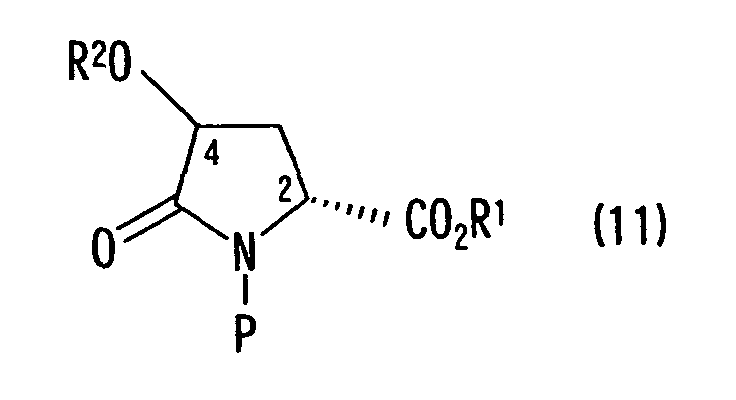
- the (2R)-4-protected hydroxypyroglutamic acid derivative represented by formula (11) in which the stereochemistry at the 2-position is (R) (including one in the form of a salt) is a novel substance.
- alkylation reaction of the 4-protected hydroxypyroglutamic acid derivative represented by formula (1) can be performed in the presence of an alkylating agent.
- alkylation does not mean the introduction of an alkyl group alone in the narrow sense of the word, such as a methyl, ethyl or butyl group, but includes, for example, the introduction of a residual hydrocarbon group optionally having a substituent, and more specifically, means the introduction of a group represented by R 3 into the 4-protected hydroxypyroglutamic acid derivative represented by formula (1) .
- the "alkylating agent” means a reagent used in the alkylation.
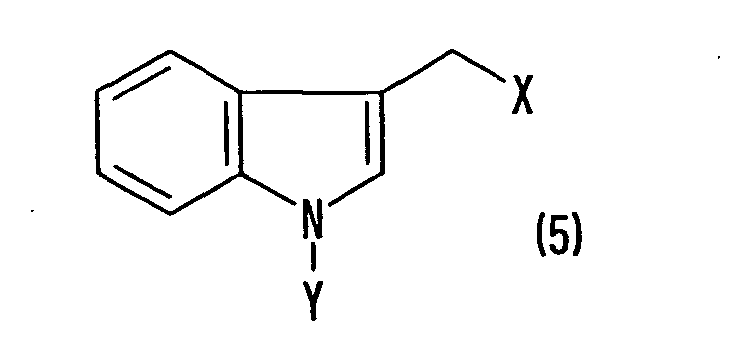
- alkylating agent it is possible to mention an alkyl halide (alkyl chloride, alkyl bromide, alkyl iodide, etc.), and more specifically, a compound represented by formula (4) below: R 3 -X [where R 3 stands for a group selected from a hydrocarbon group optionally having a substituent and a heterocyclic hydrocarbon group optionally having a substituent and X stands for a halogen atom.]
- R 3 As a preferred halogen atom represented by X, it is possible to mention a chlorine, bromine or iodine atom.
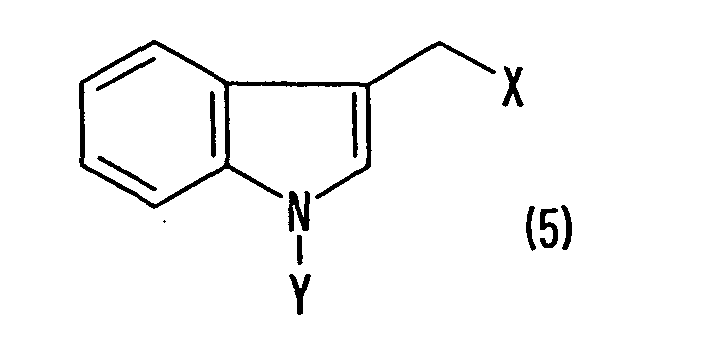
- Groups which are usually employed in the art as protecting groups for amino and imino groups may be used as protecting groups for indolyl groups represented by Y, and are, for example, a t-butoxycarbonyl group, a benzyloxycarbonyl group and a benzyl group.
- the halogen atom represented by X is as mentioned above.
- N-t-butoxycarbonyl-3-bromomethylindole having a t-butoxycarbonyl group as Y and a bromine atom as X is preferred as the N-protected-3-halogenomethylindole represented by formula (5).
- a base in the alkylation reaction according to this invention.
- any base it is possible to mention as examples a lithium salt of hexamethyldisilazane [lithium hexamethyldi silazanide ], a potassium salt of hexamethyldisilazane [potassium hexamethyl-disilazanide], a sodium salt of hexamethyldisilazane [sodium hexamethyldisilazanide], lithium diisopropylamide and n-butyl lithium.
- the amount of the base to be used can be selected in a molar ratio of preferably, say, between 1.0 and 2.0 and more preferably, say, between 1.0 and 1.3 to 1 of the 4-protected hydroxypyroglutamic acid derivative as the starting substance.
- the molar ratio can be appropriately selected from the range stated above by considering the molar amount of the 4-protected hydroxypyroglutamic acid derivative in its free form.
- the alkylation reaction according to this invention is preferably performed in the presence of a solvent.
- a solvent can be used without any particular limitation if it is inert in the reaction. It is possible to mention tetrahydrofuran, ether, dimethoxyethane, toluene and any mixture thereof as preferred solvents.
- HMPA hexamethylphosphoramide
- DMPU 1,3-dimethyl-3,4,5,6-tetrahydro-2(1H)-pyrimidinone
- reaction time for the alkylation reaction is not specifically limited, it is possible to select preferably, say, about 0.5 to 24 hours and more preferably, say, about 1 to 5 hours. While the reaction temperature is not specifically limited, either, it is possible to select preferably, say, about -80°C to 50°C and more preferably about -78°C to 30°C.
- the 4-protected hydroxyl-4-substituted pyroglutamic acid derivative represented by formula (2) is a novel substance.
- the 4-protected hydroxyl-4-substituted pyroglutamic acid derivative represented by formula (2) and obtained as described can be led through hydrolysis and deprotection steps to form the glutamic acid derivative represented by formula (3) .
- hydrolysis and deprotection steps means more specifically the steps of performing a hydrolysis reaction and a deprotection reaction for the protecting groups to thereby lead the 4-protected hydroxy-4-substituted pyroglutamic acid derivative represented by formula (2) to the glutamic acid derivative represented by formula (3).
- the hydrolysis in the hydrolysis and deprotection steps is defined principally as a reaction for decomposing the bond forming a lactum ring.
- the deprotection in the hydrolysis and deprotection steps is defined principally as a reaction for deprotecting the protecting group for the hydroxyl group as represented by R 2 and the protecting group for the imino group as represented by P.
- hydrolysis and deprotection reactions There is no particular limitation in the order of the hydrolysis and deprotection reactions. It is likely that hydrolysis serves as a deprotection reaction, too (or that the deprotection reaction serves as a hydrolysis reaction, too), and the "hydrolysis and deprotection steps" according to this invention includes such cases where the hydrolysis and deprotection reactions cannot be distinguished clearly from each other.
- the ring-opening reaction of the lactum ring by hydrolysis usually produces a carboxyl group at the 4-position having a hydrogen atom as R 5 in formula (3), but the carboxyl group at the 4-position may form an ester with alcohol in the event, for example, that hydrolysis is performed in the presence of an alcoholic solvent.
- R 5 in formula (3) will be an alcohol-derived hydrocarbon group.
- R 1 in formula (2) stands for a hydrocarbon group, i. e. when -COOR 1 is an alkoxycarbonyl group, the alkoxycarbonyl group may be converted to a carboxyl group after hydrolysis and deprotection steps.
- R 4 in formula (3) will be a hydrogen atom even when R 1 in formula (2) is a hydrocarbon group. It is possible to include the step of converting the alkoxycarbonyl group to a carboxyl group before the hydrolysis and deprotection steps.
- -COOR 1 is a benzyloxycarbonyl group (R 1 is a benzyl group), for example, it can be led to a carboxyl group (R 1 is a hydrogen atom) by a catalytic hydrogenation reaction prior to the hydrolysis and deprotection steps.
- a compound having a hydrocarbon group as R 2 and/or R 3 in formula (3) i.e. a compound having an alkoxycarbonyl group in formula (3) can be led to a compound having a hydrogen atom as R 2 and/or R 3 by having its alkoxycarbonyl group converted to a carboxyl group by a method known in the art, such as hydrolysis with an acid or base.
- R 3 in formula (2) When the group represented by R 3 in formula (2) has a protected imino group, a protected amino group, a protected indolyl group, a protected hydroxyl group, etc. in its structure, it is likely that the protecting group for any such imino, amino, indolyl or hydroxyl group, etc. may undergo deprotection through the hydrolysis and deprotection steps. It is, therefore, likely that R 3 in formula (3) and R 2 in formula (2) may not stand for the same group.
- the hydrolysis reaction can be performed by a reaction with a base, a reaction with an acid, a catalytic hydrogenation reaction, a reaction with a fluoride, etc.
- the deprotection reaction can also be performed by any such reaction.
- a hydrolysis reaction with a base is preferably employed for the hydrolysis reaction of the lactum ring. It is preferable to use lithium hydroxide, sodium hydroxide, potassium hydroxide, etc. as the base.
- a base When a base is used, its amount can be selected in a molar ratio of preferably, say, about 1 to 50 and more preferably, say, about 5 to 20 of base to 1 of the compound (in its free form).
- the molar ratio can be appropriately selected from the range stated above by considering the molar amount of the 4-protected hydroxy-4-substituted pyroglutamic acid derivative in its free form.
- the solvent to be used in the hydrolysis reaction it is possible to use a mixed solvent of water and an organic solvent miscible with water, as a reaction solvent, such as methanol, ethanol, isopropanol or other alcohol, tetrahydrofuran or acetonitrile.
- a reaction solvent such as methanol, ethanol, isopropanol or other alcohol, tetrahydrofuran or acetonitrile.
- the hydrolysis reaction usually causes the hydrolysis of the ester bond, as well as the lactum ring, and converts the alkoxycarbonyl group existing in the compound to a carboxyl group.
- the reaction time for hydrolysis may be selected from preferably, say, about 1 to 48 hours and more preferably, say, about 3 to 15 hours.
- the reaction temperature for hydrolysis may be selected from preferably, say, about 0°C to 100°C and more preferably, say, about 20°C to 50°C.
- any method of deprotection that is usually employed in peptide chemistry, etc. may be followed for the deprotection of the protecting groups in the 4-protected hydroxy-4-substituted pyroglutamic acid derivative represented by formula (2), for example, for the removal of the protecting groups for the imino group, amino grouo, indolyl group, hydroxyl group, etc.
- it can be performed in the same way with the hydrolysis reaction as described above.
- the t-butoxycarbonyl and t-butyldimethylsilyl groups can be removed with an acid, and the benzyloxycarbonyl group by a catalytic hydrogenation reaction.
- a fluoride can be used for the deprotection of only the t-butyldimethylsilyl group, for example.
- the reaction is over, it is possible to apply appropriate methods known in the art, such as extraction, chromatography and crystallization, to isolate and refine the glutamic acid derivative manufactured by the method of this invention and represented by formula (3). It is preferably obtained as a crystal by crystallizing the product from water, alcohol or a mixed solvent thereof in the form of its salt with an acid, such as hydrochloric acid, its salt with a base, such as ammonia, or its salt with a metal, such as sodium, or in its free form.
- an acid such as hydrochloric acid
- a base such as ammonia
- a metal such as sodium
- the glutamic acid derivative When the glutamic acid derivative has been obtained in the form of a salt, it is possible to convert its salt to its free form or change it to another salt, or when it has been obtained in its free form, it is possible to convert it to a salt, by employing any appropriate reaction known in the art, such as a free body forming reaction, a reaction for forming another salt or a salt changing reaction.
- the alkylation reaction in the method of this invention makes it possible to have an intended group react selectively with the 4-position of the 4-protected hydroxypyroglutamic acid derivative represented by formula (1) and this reaction proceeds stereoselectively. Its configuration is retained until after the hydrolysis and deprotection steps. Accordingly, the method of this invention is very useful as a method of manufacturing a 4-protected hydroxyl-4-substituted pyroglutamic acid derivative having optical activity, a glutamic acid derivative having optical activity and partricularly optically active monatin.
- N-t-butoxycarbonyl-4-t-butyldimethylsilyloxy-D-pyroglutamic acid methyl ester was obtained as a colorless oily substance at a total yield of 66% from cis-4-hydroxy-D-proline as a starting material in accordance with the method of X.
- Zhang et al See Tetrahedron Letters, 42, 5335-5338 (2001)).
- N-t-butoxycarbonyl-(4R)-4-t-butyldimethylsilyloxy-4-benzyl-D-pyroglutamic acid methyl ester was obtained as a solid at a yield of 46.0% by using benzyl bromide instead of N-t-butoxycarbonyl-3-bromomethylindole and otherwise repeating Example 2. Its 1 H-NMR spectrum showed a single stereoisomer. (MS spectrum) ESI-MS: 464.8 (M+H) + , 486.8 (M+Na) + .
- a glutamic acid derivative known as a sweetener typically monatin
- a 4-protected hydroxyl pyroglutamic acid derivative as an intermediate in the manufacture thereof.
- the alkylation reaction of the 4-protected hydroxyl pyroglutamic acid derivative according to this invention is suitable for use as a method of manufacturing a glutamic acid derivative having optical activity, particularly optically active monatin, since it can be carried out selectively at the 4-position and stereoselectively.
Landscapes
- Chemical & Material Sciences (AREA)
- Organic Chemistry (AREA)
- Chemical Kinetics & Catalysis (AREA)
- Indole Compounds (AREA)
- Organic Low-Molecular-Weight Compounds And Preparation Thereof (AREA)
- Plural Heterocyclic Compounds (AREA)
- Pyrrole Compounds (AREA)
- Preparation Of Compounds By Using Micro-Organisms (AREA)
Abstract
Description
- This invention relates to a process for manufacturing a glutamic acid derivative and a pyroglutamic acid derivative, typically monatin, and a novel intermediate used in the manufacture thereof by that process.
- Specific glutamic acid derivatives including monatin as a typical example are compounds expected to be useful as sweeteners, or intermediates in the manufacture of drugs, etc. Monatin is a naturally occurring amino acid derivative isolated from the bark of the root of Schlerochiton ilicifolius, a plant growing naturally in the northern Transvaal area of South Africa and its structure has been reported by R. Vleggaar et al as being of (2S,4S)-2-amino-4-carboxy-4-hydroxy-5-(3-indolyl) pentanoic acid ((2S,4S)-4-hydroxy-4-(3-indolylmethyl) -glutamic acid; see formula (19) below) (see R. Vleggaar et al, J. Chem. Soc. Perkin Trans., 3095-3098 (1992)).
- The same literature reports that the (2S, 4S) form of monatin reportedly obtainable from a natural plant has a sweetness (or sweetness intensity) which is 800 or 1,400 times that of sucrose. Several methods have been reported as methods of synthesizing monatin, but there has not been any industrially suitable method (for examples of synthesis, reference is made to Republic of South Africa Patent Application No. 87/4288 (P.J. van Wyk et al, ZA87/4288), C.W. Holzapfel et al: Synthetic Communications, 24(22), 3197-3211 (1994), United States Patent No. 5, 994, 559, K. Nakamura et al: Organic Letters, 2, 2967-2970 (2000), etc.).
- D.J. Oliveira et al (See Tetrahedron Letters, 42, 6793-6796 (2001)) have reported that a monatin derivative having a protective group as shown by formula (17) below can be synthesized stereoselectively by alkylating a lactum derivative as shown by formula (16) below and subjecting it to hydrolysis and an oxidizing reaction.[where TBDMS stands for a t-butyldimethylsilyl group, Cbz stands for a benzyloxycarbonyl group, tBoc stands for a t-butoxycarbonyl group and Et stands for an ethyl group.]
 [where tBoc is as defined above.]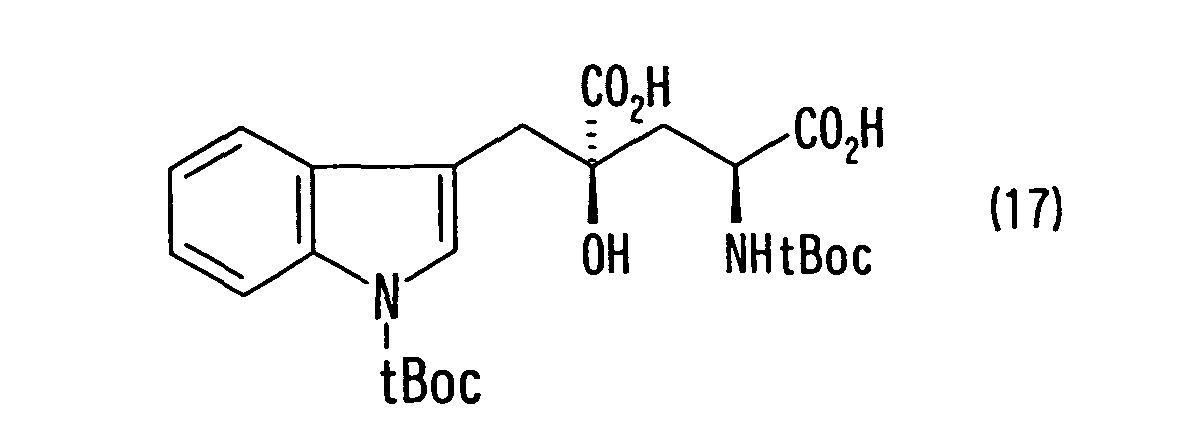
- This method involves complicated procedures including reducing the carboxyl group of a pyroglutamic acid derivative into a hydroxymethyl group, converting it to a protecting hydroxymethyl group and introducing a hydroxyl group into the 4-position for the preparation of compound (16), and after the alkylation of compound (16), conducting the deprotection of the protecting hydroxymethyl group into a hydroxymethyl group and oxidizing it back into a carboxyl group, though the compound represented by formula (16) is capable of regioselective alkylation as it has only a single active hydrogen atom.
- Chromium trioxide (CrO3) is used in the oxidizing reaction, but the reaction using it presents a great many problems as a method of manufacture, since this reagent is dangerous because of toxicity, etc. Moreover, it is desirable for no process of manufacture to include any oxidizing reaction of any compound having an indole ring, since the indole ring is easily oxidizable.
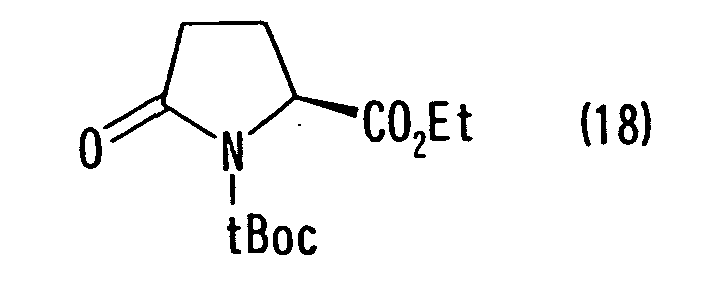
- As regards the alkylation at the 4-position of a pyroglutamic acid derivative having its carboxyl group not reduced, which differs from the above case, J. Ezquerra et al (See J. Org. Chem., 59, 4327-4331 (1994)) have, for example, reported a method of producing a 4, 4-dialkylpyroglutamic acid derivative by dialkylating the 4-position of a pyroglutamic acid derivative represented by formula (18) below.[where tBoc and Et are as defined above.]
- However, there has not been reported any case of the selective alkylation at the 4-position of a pyroglutamic acid derivative having a protected hydroxyl group at the 4-position and not having its carboxyl group reduced like a compound represented by formula (1) below.
- It is an object of this invention to provide a method which can efficiently and easily manufacture a glutamic acid derivative, typically monatin, and a compound useful as an intermediate in the manufacture thereof, and which is suitable for industrial production.
- As a result of our intensive study made to attain the above object, we, the inventors of this invention, have paid attention to a 4-protected hydroxy-pyroglutamic acid derivative having a protected hydroxyl group at the 4-position and not having its carboxyl group reduced, as represented by formula (1), and have found that when the derivative is subjected to an alkylation reaction, its regio- and stereoselective alkylation at the 4-position is possible.
- Although two sites, i.e. the 2- and 4-positions, have been considered as the reaction sites for alkylation performed by causing an alkylating agent to react with a 4-protected hydroxypyroglutamic acid derivative as represented by formula (1), we have found from our study that it is possible to alkylate selectively the 4-position of the 4-protected hydroxyl-pyroglutamic acid derivative. We have also found that the alkylation at the 4-position of the 4-protected hydroxypyroglutamic acid derivative proceeds stereoselectively. More specifically, its alkylation at the 4-position proceeds from the opposite side of the pyrrolidone ring from the substituent (-CO2R1) at the 2-position. Accordingly, the relative configuration at the 2- and 4-positions of a 4-protected hydroxy-4-substituted pyroglutamic acid derivative as obtained by an alkylation reaction coincides with the relative configuration at the 2- and 4-positions of (2S, 4S) or (2R, 4R) -monatin among four kinds of stereoisomers of monatin and it is possible to derive monatin having the corresponding configuration.
- We have also found that the 4-protected hydroxy-4-substituted pyroglutamic acid derivative obtained by an alkylation reaction makes it possible to manufacture easily a glutamic acid derivative, typically monatin, simply by the lactum hydrolysis and deprotection of the protecting group.
- We have completed this invention based on our findings. Thus, this invention covers the following:
- [1] A method of manufacturing a glutamic acid derivative
represented by formula (3) below (including one in the form
of a salt), characterized by subjecting a 4-protected
hydroxy-pyroglutamic acid derivative represented by formula
(1) below (including one in the form of a salt) to an alkylation
reaction to prepare a 4-protected hydroxy-4-substituted
pyroglutamic acid derivative represented by formula (2) below
(including one in the form of a salt) and subjecting the
derivative to hydrolysis and deprotection steps:

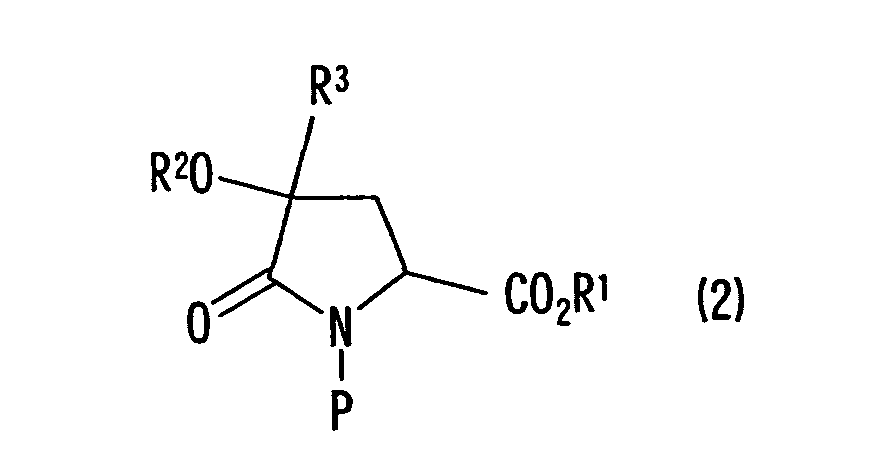 where R1, R4 and R5 stand independently of one another for a group selected from a hydrogen atom and a hydrocarbon group, R2 stands for a protecting group for a hydroxyl group, R3 stands for a group selected from a hydrocarbon group optionally having a substituent and a heterocyclic hydrocarbon group optionally having a substituent and P stands for a protecting group for an imino group.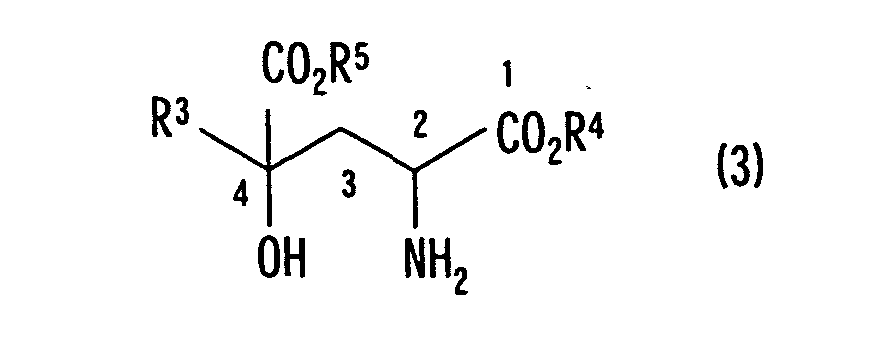
- [2] A method of manufacturing a 4-protected
hydroxy-4-substituted pyroglutamic acid derivative
represented by formula (2) below (including one in the form
of a salt), characterized by subjecting a 4-protected
hydroxypyroglutamic acid derivative represented by formula
(1) below (including one in the form of a salt) to an alkylation
reaction:
 where R1 stands for a group selected from a hydrogen atom and a hydrocarbon group, R2 stands for a protecting group for a hydroxyl group, R3 stands for a group selected from a hydrocarbon group optionally having a substituent and a heterocyclic hydrocarbon group and P stands for a protecting group for an imino group.
- [3] A method of manufacturing a glutamic acid derivative
represented by formula (3) below (including one in the form
of a salt), characterized by subjecting a 4-protected
hydroxy-4-substituted pyroglutamic acid derivative
represented by formula (2) below (including one in the form
of a salt) to hydrolysis and deprotection steps:
 where R1, R4 and R5 stand independently of one another for a group selected from a hydrogen atom and a hydrocarbon group, R2 stands for a protecting group for a hydroxyl group, R3 stands for a group selected from a hydrocarbon group optionally having a substituent and a heterocyclic hydrocarbon group optionally having a substituent and P stands for a protecting group for an imino group.
- [4] A method as set forth at [1] or [3] above, wherein R1 stands for a group selected from an alkyl group having 1 to 5 carbon atoms and a benzyl group, R4 and R5 stand for a hydrogen atom each, R2 stands for a group selected from a t-butyldimethylsilyl group, a trimethylsilyl group, a t-butyldiphenylsilyl group, a benzyl group, a t-butyl group, a benzyloxycarbonyl group and a t-butoxycarbonyl group, R3 stands for a group selected from an alkyl group having 1 to 20 carbon atoms, an aryl group having 1 to 20 carbon atoms, an aralkyl group having 1 to 20 carbon atoms and a heterocyclic hydrocarbon group having 1 to 20 carbon atoms and P stands for a group selected from a t-butoxycarbonyl group, a benzyloxycarbonyl group and a benzyl group.
- [5] A method as set forth at [2] above, wherein R1 stands for a group selected from an alkyl group having 1 to 5 carbon atoms and a benzyl group, R2 stands for a group selected from a t-butyldimethylsilyl group, a trimethylsilyl group, a t-butyldiphenylsilyl group, a benzyl group, a t-butyl group, a benzyloxycarbonyl group and a t-butoxycarbonyl group, R3 stands for a group selected from an alkyl group having 1 to 20 carbon atoms, an aryl group having 1 to 20 carbon atoms, an aralkyl group having 1 to 20 carbon atoms and a heterocyclic hydrocarbon group having 1 to 20 carbon atoms and P stands for a group selected from a t-butoxycarbonyl group, a benzyloxycarbonyl group and a benzyl group.
- [6] A method as set forth at any of [1] to [3] above, wherein R3 is a benzyl group or an N-protected-3-indolylmethyl group.
- [7] A method as set forth at [1] or [2] above, wherein the
alkylation reaction is performed in the presence of an
alkylating agent represented by formula (4) below:
- [8] A method as set forth at [7] above, wherein the alkylation reaction is performed in the presence of a base.
- [9] A method as set forth at [7] above, wherein the base is one or more kinds of base selected from a lithium salt of hexamethyldisilazane, lithium hexamethyldisilazanide, a potassium salt of hexamethyldisilazane, potassium hexamethyl-disilazanide, a sodium salt of hexamethyldisilazane, sodium hexamethyldisilazanide, lithium diisopropylamide and normal-butyl lithium.
- [10] A method as set forth at [7] above, wherein the base is used in a molar ratio of between 1.0 and 2.0 to 1 relative to the 4-protected hydroxyglutamic acid derivative.
- [11] A method of manufacturing a monatin derivative
represented by formula (7) below (including one in the form
of a salt), characterized by reacting a 4-protected
hydroxy-pyroglutamic acid derivative represented by formula
(1) below (including one in the form of a salt) with
N-protected-3-halogenomethylindole represented by formula
(5) below to prepare a 4-protected hydroxy-4-substituted
pyroglutamic acid derivative represented by formula (6) below
(including one in the form of a salt) and subjecting the
derivative to hydrolysis and deprotection steps:

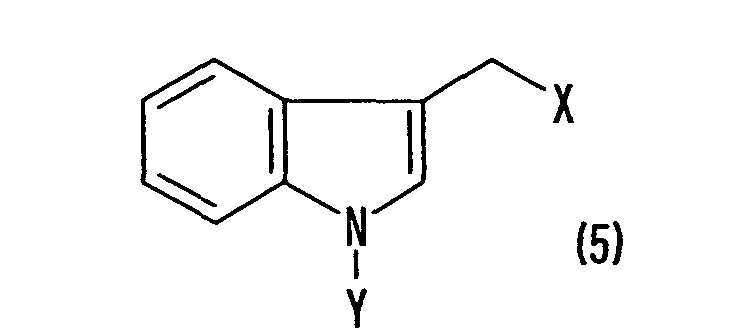
 where R1, R4 and R5 stand independently of one another for a group selected from a hydrogen atom and a hydrocarbon group, R2 stands for a protecting group for a hydroxyl group, X stands for a halogen atom, P stands for a protecting group for an imino group and Y stands for a protecting group for an indolyl group.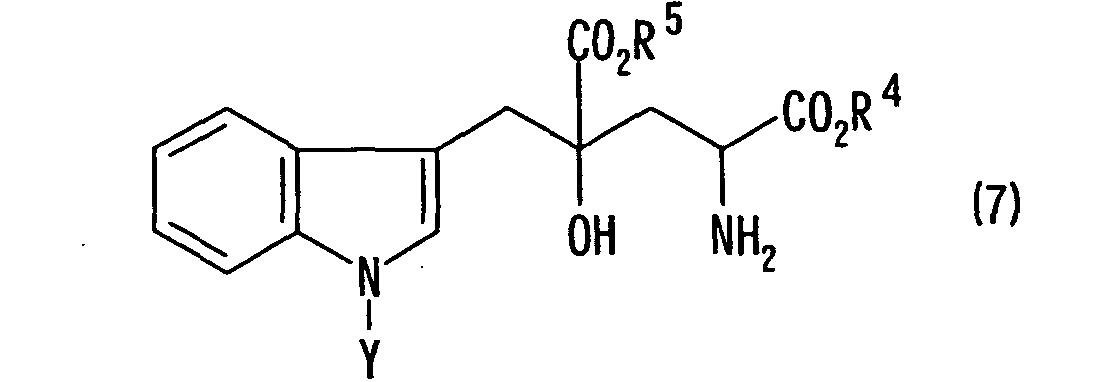
- [12] A method of manufacturing a 4-protected
hydroxy-4-substituted pyroglutamic acid derivative
represented by formula (6) below (including one in the form
of a salt), characterized by reacting a 4-protected
hydroxypyroglutamic acid derivative represented by formula
(1) below (including one in the form of a salt) with
N-protected-3-halogeno-methylindole represented by formula
(5) below:

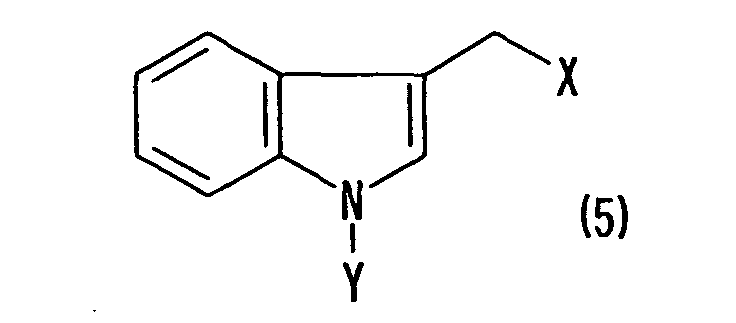 where R1 stands for a group selected from a hydrogen atom and a hydrocarbon group, R2 stands for a protecting group for a hydroxyl group, X stands for a halogen atom, P stands for a protecting group for an imino group and Y stands for a protecting group for an indolyl group.
- [13] A method of manufacturing a monatin derivative
represented by formula (7) below (including one in the form
of a salt), characterized by subjecting a 4-protected
hydroxy-4-substituted pyroglutamic acid derivative
represented by formula (6) below (including one in the form
of a salt) to hydrolysis and deprotection steps:
 where R1, R4 and R5 stand independently of one another for a group selected from a hydrogen atom and a hydrocarbon group, R2 stands for a protecting group for a hydroxyl group, P stands for a protecting group for an imino group and Y stands for a protecting group for an indolyl group.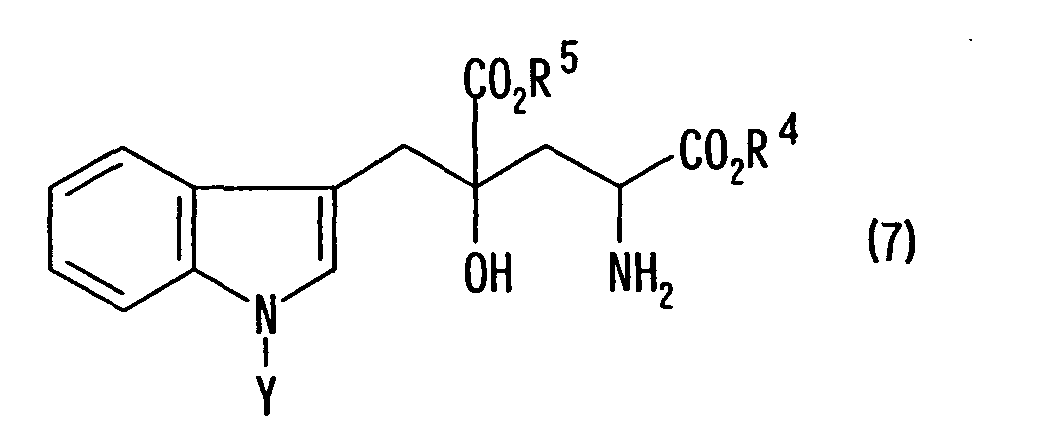
- [14] A method as set forth at [11] above, wherein R1 stands for a group selected from an alkyl group having 1 to 5 carbon atoms and a benzyl group, R4 and R5 stand for a hydrogen atom each, R2 stands for a group selected from a t-butyldimethylsilyl group, a trimethylsilyl group, a t-butyldiphenylsilyl group, a benzyl group, a t-butyl group, a benzyloxycarbonyl group and a t-butoxycarbonyl group, X stands for a group selected from a chlorine atom, a bromine atom and an iodine atom and P and Y stand independently of each other for a group selected from a t-butoxycarbonyl group, a benzyloxycarbonyl group and a benzyl group.
- [15] A method as set forth at [12] above, wherein R1 stands for a group selected from a hydrogen atom, an alkyl group having 1 to 5 carbon atoms and a benzyl group, R2 stands for a group selected from a t-butyldimethylsilyl group, a trimethylsilyl group, a t-butyldiphenylsilyl group, a benzyl group, a t-butyl group, a benzyloxycarbonyl group and a t-butoxycarbonyl group, X stands for a group selected from a chlorine atom, a bromine atom and an iodine atom and P and Y stand independently of each other for a group selected from a t-butoxycarbonyl group, a benzyloxycarbonyl group and a benzyl group.
- [16] A method as set forth at [13] above, wherein R1 stands for a group selected from an alkyl group having 1 to 5 carbon atoms and a benzyl group, R4 and R5 stand for a hydrogen atom each, R2 stands for a group selected from a t-butyldimethylsilyl group, a trimethylsilyl group, a t-butyldiphenylsilyl group, a benzyl group, a t-butyl group, a benzyloxycarbonyl group and a t-butoxycarbonyl group and P and Y stand independently of each other for a group selected from a t-butoxycarbonyl group, a benzyloxycarbonyl group and a benzyl group.
- [17] A method as set forth at [11] or [12] above, wherein the alkylation reaction is performed in the presence of a base.
- [18] A method as set forth at [17] above, wherein the base is one or more kinds of base selected from a lithium salt of hexamethyldisilazane, lithium hexamethyldisilazane, a potassium salt of hexamethyldisilazane, potassium hexamethyl-disilazane, a sodium salt of hexamethyldisilazane, sodium hexamethyldisilazane, lithium diisopropylamide and normal butyl lithium.
- [19] A method as set forth at [17] above, wherein the base is used in a molar ratio of between 1.0 and 2.0 to 1 relative to the 4-protected hydroxyglutamic acid derivative.
- [20] A method of manufacturing an optically active monatin
derivative represented by formula (10) below (including one
in the form of a salt), characterized by reacting an optically
active 4-protected hydroxy-pyroglutamic acid derivative
represented by formula (8) below (including one in the form
of a salt) with N-protected-3-halogenomethylindole
represented by formula (5) below to prepare an optically active
4-protected hydroxy-4-substituted pyroglutamic acid
derivative represented by formula (9) below (including one in
the form of a salt) and subjecting the derivative to hydrolysis
and deprotection steps:


 where R1, R4 and R5 stand independently of one another for a group selected from a hydrogen atom and a hydrocarbon group, R2 stands for a protecting group for a hydroxyl group, X stands for a halogen atom, P stands for a protecting group for an imino group, Y stands for a protecting group for an indolyl group, * stands for an asymmetric carbon atom, the configuration at the 2-position in formula (8) is R or S, the configuration at the 4-position is R, S or RS, so that when the configuration at the 2-position in formula (8) is R, the configurations in formulas (9) and (10) are (2R, 4R), respectively, and when the configuration at the 2-position in formula (8) is S, the configurations in formulas (9) and (10) are (2S, 4S), respectively.
- [21] A method of manufacturing an optically active
4-protected hydroxy-4-substituted pyroglutamic acid
derivative represented by formula (9) below (including one in
the form of a salt), characterized by reacting an optically
active 4-protected hydroxy-pyroglutamic acid derivative
represented by formula (8) below (including one in the form
of a salt) with N-protected-3-halogenomethylindole
represented by formula (5) below:
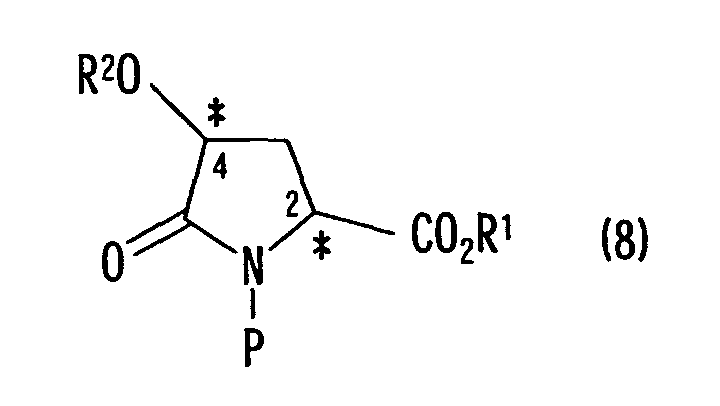
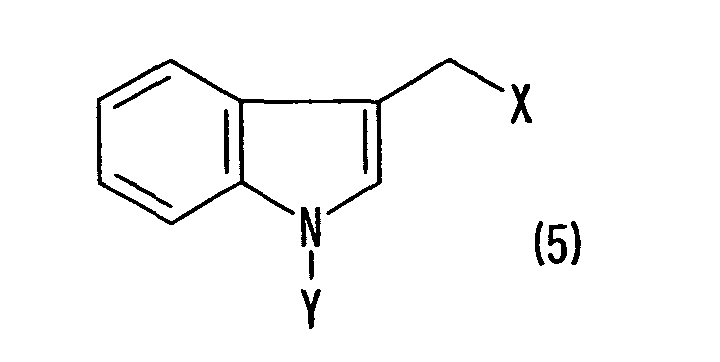 where R1 stands for a group selected from a hydrogen atom and a hydrocarbon group, R2 stands for a protecting group for a hydroxyl group, X stands for a halogen atom, P stands for a protecting group for an imino group, Y stands for a protecting group for an indolyl group, * stands for an asymmetric carbon atom, the configuration at the 2-position in formula (8) is R or S, the configuration at the 4-position is R, S or RS, so that when the configuration at the 2-position in formula (8) is R, the configurations in formula (9) are (2R, 4R), respectively, and when the configuration at the 2-position in formula (8) is S, the configurations in formula (9) are (2S, 4S), respectively.
- [22] A method of manufacturing an optically active monatin
derivative represented by formula (10) below (including one
in the form of a salt), characterized by subjecting an optically
active 4-protected hydroxy-4-substituted pyroglutamic acid
derivative represented by formula (9) below (including one in
the form of a salt) to hydrolysis and deprotection steps:
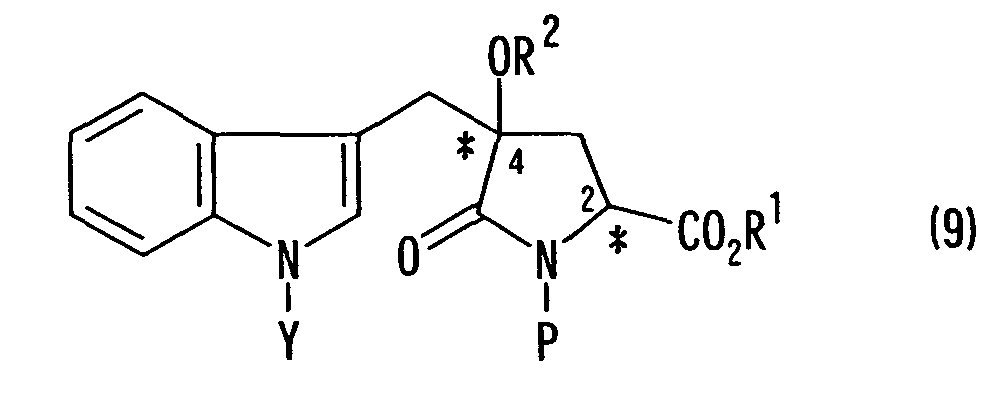 where R1, R4 and R5 stand independently of one another for a group selected from a hydrogen atom and a hydrocarbon group, R2 stands for a protecting group for a hydroxyl group, P stands for a protecting group for an imino group, Y stands for a protecting group for an indolyl group, * stands for an asymmetric carbon atom, and when the configuration in formula (9) is (2R, 4R), the configuration in formula (10) is (2R, 4R), and when the configuration in formula (9) is (2S, 4S), the configuration in formula (10) is (2S, 4S).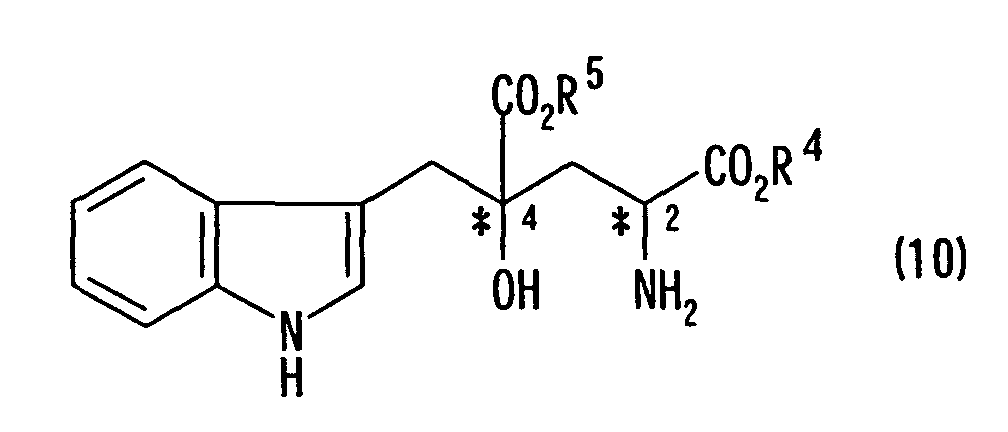
- [23] A method as set forth at [20] above, wherein R1 stands for a group selected from an alkyl group having 1 to 5 carbon atoms and a benzyl group, R4 and R5 stand for a hydrogen atom each, R2 stands for a group selected from a t-butyldimethylsilyl group, a trimethylsilyl group, a t-butyldiphenylsilyl group, a benzyl group, a t-butyl group, a benzyloxycarbonyl group and a t-butoxycarbonyl group, X stands for a group selected from a chlorine atom, a bromine atom and an iodine atom and P and Y stand independently of each other for a group selected from a t-butoxycarbonyl group, a benzyloxycarbonyl group and a benzyl group.
- [24] A method as set forth at [21] above, wherein R1 stands for a group selected from a hydrogen atom, an alkyl group having 1 to 5 carbon atoms and a benzyl group, R2 stands for a group selected from a t-butyldimethylsilyl group, a trimethylsilyl group, a t-butyldiphenylsilyl group, a benzyl group, a t-butyl group, a benzyloxycarbonyl group and a t-butoxycarbonyl group, X stands for a group selected from a chlorine atom, a bromine atom and an iodine atom and P and Y stand independently of each other for a group selected from a t-butoxycarbonyl group, a benzyloxycarbonyl group and a benzyl group.
- [25] A method as set forth at [22] above, wherein R1 stands for a group selected from an alkyl group having 1 to 5 carbon atoms and a benzyl group, R4 and R5 stand for a hydrogen atom each, R2 stands for a group selected from a t-butyldimethylsilyl group, a trimethylsilyl group, a t-butyldiphenylsilyl group, a benzyl group, a t-butyl group, a benzyloxycarbonyl group and a t-butoxycarbonyl group and P and Y stand independently of each other for a group selected from a t-butoxycarbonyl group, a benzyloxycarbonyl group and a benzyl group.
- [26] A method as set forth at [20] or [21] above, wherein the reaction of an optically active 4-protected hydroxypyroglutamic acid derivative represented by formula (8) with N-protected-3-halogenomethylindole represented by formula (5) is performed in the presence of a base.
- [27] A method as set forth at [26] above, wherein the base is one or more kinds of base selected from a lithium salt of hexamethyldisilazane, lithium hexamethyldisilazane, a potassium salt of hexamethyldisilazane, potassium hexamethyl-disilazane, a sodium salt of hexamethyldisilazane, sodium hexamethyldisilazane, lithium diisopropylamide and normal butyl lithium.
- [28] A method as set forth at [26] above, wherein the base is used in a molar ratio of between 1.0 and 2.0 to 1 relative to the 4-protected hydroxyglutamic acid derivative.
- [29] A method of manufacturing a (2R, 4R) -monatin derivative
represented by formula (13) below (including one in the form
of a salt), characterized by reacting a (2R)-4-protected
hydroxy-pyroglutamic acid derivative represented by formula
(11) below (including one in the form of a salt) with
N-protected-3-halogenomethylindole represented by formula
(15) below to prepare a (2R, 4R)-4-protected
hydroxy-4-substituted pyroglutamic acid derivative
represented by formula (12) below (including one in the form
of a salt) and subjecting the derivative to hydrolysis and
deprotection steps:
 where R1, R4 and R5 stand independently of one another for a group selected from a hydrogen atom and a hydrocarbon group, R2 stands for a protecting group for a hydroxyl group, X stands for a halogen atom, P stands for a protecting group for an imino group, Y stands for a protecting group for an indolyl group and the configuration at the 4-position in formula (11) is R, S or RS.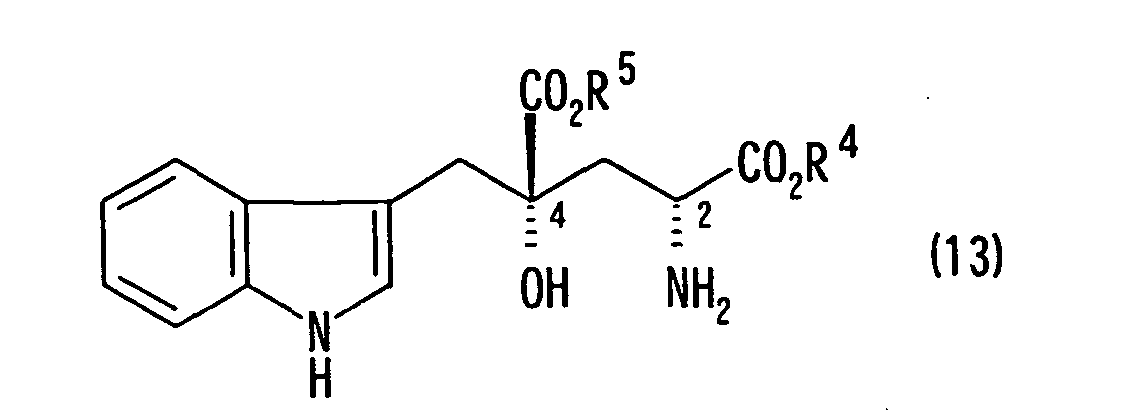
- [30] A method of manufacturing a (2R, 4R)-4-protected
hydroxy-4-substituted pyroglutamic acid derivative
represented by formula (12) below (including one in the form
of a salt), characterized by reacting a (2R)-4-protected
hydroxypyroglutamic acid derivative represented by formula
(11) below (including one in the form of a salt) with
N-protected-3-halogenomethylindole represented by formula
(5) below:

 where R1 stands for a group selected from a hydrogen atom and a hydrocarbon group, R2 stands for a protecting group for a hydroxyl group, X stands for a halogen atom, P stands for a protecting group for an imino group, Y stands for a protecting group for an indolyl group and the configuration at the 4-position in formula (11) is R, S or RS.
- [31] A method of manufacturing a (2R, 4R) -monatin derivative
represented by formula (13) below (including one in the form
of a salt), characterized by subjecting a (2R, 4R)-4-protected
hydroxy-4-substituted pyroglutamic acid derivative
represented by formula (12) below (including one in the form
of a salt) to hydrolysis and deprotection steps:
 where R1, R4 and R5 stand independently of one another for a group selected from a hydrogen atom and a hydrocarbon group, R2 stands for a protecting group for a hydroxyl group, P stands for a protecting group for an imino group, Y stands for a protecting group for an indolyl group.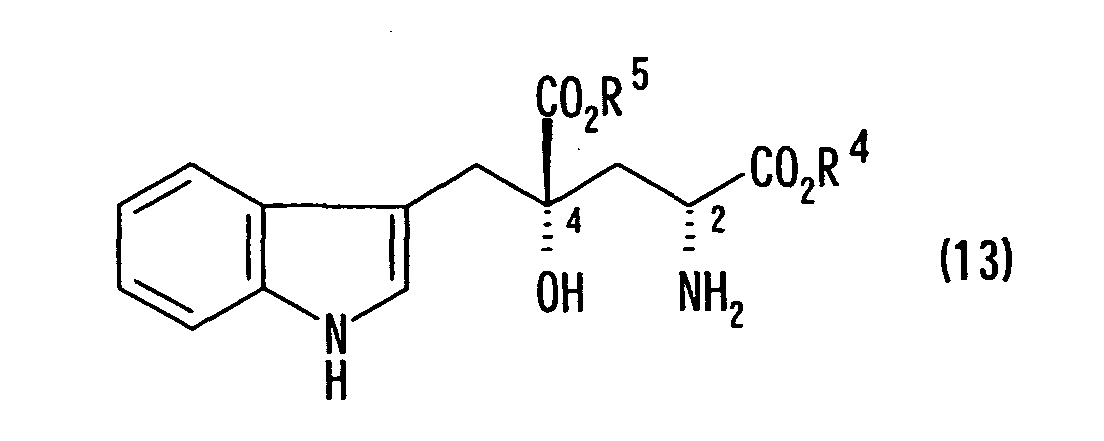
- [32] A method as set forth at [29] above, wherein R1 stands for a group selected from an alkyl group having 1 to 5 carbon atoms and a benzyl group, R4 and R5 stand for a hydrogen atom each, R2 stands for a group selected from a t-butyldimethylsilyl group, a trimethylsilyl group, a t-butyldiphenylsilyl group, a benzyl group, a t-butyl group, a benzyloxycarbonyl group and a t-butoxycarbonyl group, X stands for a group selected from a chlorine atom, a bromine atom and an iodine atom and P and Y stand independently of each other for a group selected from a t-butoxycarbonyl group, a benzyloxycarbonyl group and a benzyl group.
- [33] A method as set forth at [30] above, wherein R1 stands for a group selected from a hydrogen atom, an alkyl group having 1 to 5 carbon atoms and a benzyl group, R2 stands for a group selected from a t-butyldimethylsilyl group, a trimethylsilyl group, a t-butyldiphenylsilyl group, a benzyl group, a t-butyl group, a benzyloxycarbonyl group and a t-butoxycarbonyl group, X stands for a group selected from a chlorine atom, a bromine atom and an iodine atom and P and Y stand independently of each other for a group selected from a t-butoxycarbonyl group, a benzyloxycarbonyl group and a benzyl group.
- [34] A method as set forth at [31] above, wherein R1 stands for a group selected from an alkyl group having 1 to 5 carbon atoms and a benzyl group, R4 and R5 stand for a hydrogen atom each, R2 stands for a group selected from a t-butyldimethylsilyl group, a trimethylsilyl group, a t-butyldiphenylsilyl group, a benzyl group, a t-butyl group, a benzyloxycarbonyl group and a t-butoxycarbonyl group and P and Y stand independently of each other for a group selected from a t-butoxycarbonyl group, a benzyloxycarbonyl group and a benzyl group.
- [35] A method as set forth at [29] or [30] above, wherein the reaction of a (2R)-4-protected hydroxypyroglutamic acid derivative represented by formula (11) with N-protected-3-halogenomethylindole represented by formula (5) is performed in the presence of a base.
- [36] A method as set forth at [26] above, wherein the base is one or more kinds of base selected from a lithium salt of hexamethyldisilazane, lithium hexamethyldisilazane, a potassium salt of hexamethyldisilazane, potassium hexamethyl-disilazane, a sodium salt of hexamethyldisilazane, sodium hexamethyldisilazane, lithium diisopropylamide and normal butyl lithium.
- [37] A method as set forth at [26] above, wherein the base is used in a molar ratio of between 1.0 and 2.0 to 1 relative to the 4-protected hydroxyglutamic acid derivative.
- [38] A method as set forth at [29] above, wherein R1 stands for a methyl group, R4 and R5 stand for a hydrogen atom each, R2 stands for a t-butyldimethylsilyl group, X stands for a bromine atom and P and Y stand for a t-butoxycarbonyl group each.
- [39] A method as set forth at [30] above, wherein R1 stands for a methyl group, R2 stands for a t-butyldimethylsilyl group, X stands for a bromine atom and P and Y stand for a t-butoxycarbonyl group each.
- [40] A method as set forth at [31] above, wherein R1 stands for a methyl group, R4 and R5 stand for a hydrogen atom each, R2 stands for a t-butyldimethylsilyl group and P and Y stand for a t-butoxycarbonyl group each.
- [41] A (2R)-4-hydroxypyroglutamic acid derivative
represented by formula (11) below (including one in the form
of a salt):
where R1 stands for a group selected from a hydrogen atom and a hydrocarbon group, R2 stands for a protecting group for a hydroxyl group, P stands for a protecting group for an imino group and the configuration at the 4-position in formula (11) is R, S or RS.

- [42] A (2R)-4-hydroxypyroglutamic acid derivative as set forth at [41] above, wherein R1 stands for a group selected from an alkyl group having 1 to 5 carbon atoms and a benzyl group, R2 stands for a group selected from a t-butyldimethylsilyl group, a trimethylsilyl group, a t-butyldiphenylsilyl group, a benzyl group, a t-butyl group, a benzyloxycarbonyl group and a t-butoxycarbonyl group and P stands for a group selected from a t-butoxycarbonyl group, a benzyloxycarbonyl group and a benzyl group.
- [43] A (2R)-4-hydroxypyroglutamic acid derivative as set forth at [41] above, wherein R1 stands for a methyl group, R2 stands for a t-butyldimethylsilyl group and P stands for a t-butoxycarbonyl group.
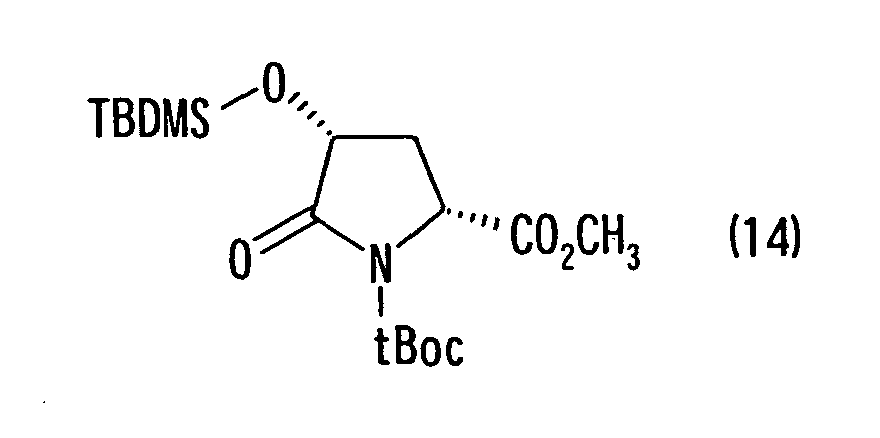
- [44] An
N-t-butoxycarbonyl-4-t-butyldimethylsilyloxy-D-pyroglutami
c acid methyl ester represented by formula (14) below:
where tBoc stands for a t-butoxycarbonyl group and TBDMS stands for a t-butyldimethylsilyloxy group.
- [45] A 4-protected hydroxyl-4-substituted pyroglutamic acid
derivative represented by formula (2) (including one in the
form of a salt):
where R1 stands for a group selected from a hydrogen atom and a hydrocarbon group, R2 stands for a protecting group for a hydroxyl group, R3 stands for a group selected from a hydrocarbon group optionally having a substituent and a heterocyclic hydrocarbon group and P stands for a protecting group for an imino group.
- [46] A 4-protected hydroxyl-4-substituted pyroglutamic acid derivative as set forth at [45] above, wherein R1 stands for a group selected from an alkyl group having 1 to 5 carbon atoms and a benzyl group, R2 stands for a group selected from a t-butyldimethylsilyl group, a trimethylsilyl group, a t-butyldiphenylsilyl group, a benzyl group, a t-butyl group, a benzyloxycarbonyl group and a t-butoxycarbonyl group, R3 stands for a group selected from an alkyl group having 1 to 20 carbon atoms, an aryl group having 1 to 20 carbon atoms, an aralkyl group having 1 to 20 carbon atoms and a heterocyclic hydrocarbon group having 1 to 20 carbon atoms and P stands for a group selected from a t-butoxycarbonyl group, a benzyloxycarbonyl group and a benzyl group.
- [47] A 4-protected hydroxy-4-substituted pyroglutamic acid
derivative represented by formula (6) (including one in the
form of a salt) :
where R1 stands for a group selected from a hydrogen atom and a hydrocarbon group, R2 stands for a protecting group for a hydroxyl group, P stands for a protecting group for an imino group and Y stands for a protecting group for an indolyl group.

- [48] A 4-protected hydroxy-4-substituted pyroglutamic acid derivative as set forth at [47] above, wherein R1 stands for a group selected from an alkyl group having 1 to 5 carbon atoms and a benzyl group, R2 stands for a group selected from a t-butyldimethylsilyl group, a trimethylsilyl group, a t-butyldiphenylsilyl group, a benzyl group, a t-butyl group, a benzyloxycarbonyl group and a t-butoxycarbonyl group and P stands for a group selected from a t-butoxycarbonyl group, a benzyloxycarbonyl group and a benzyl group.
- [49] A (2R, 4R)-4-protected hydroxy-4-substituted
pyroglutamic acid derivative represented by formula (12)
(including one in the form of a salt):
where R1 stands for a group selected from a hydrogen atom and a hydrocarbon group, R2 stands for a protecting group for a hydroxyl group, P stands for a protecting group for an imino group and Y stands for a protecting group for an indolyl group.

- [50] A (2R, 4R)-4-protected hydroxy-4-substituted pyroglutamic acid derivative as set forth at [49] above, wherein R1 stands for a group selected from an alkyl group having 1 to 5 carbon atoms and a benzyl group, R2 stands for a group selected from a t-butyldimethylsilyl group, a trimethylsilyl group, a t-butyldiphenylsilyl group, a benzyl group, a t-butyl group, a benzyloxycarbonyl group and a t-butoxycarbonyl group and P and Y stand independently of each other for a group selected from a t-butoxycarbonyl group, a benzyloxycarbonyl group and a benzyl group.
- [51] An
N-t-butoxycarbonyl-(4R)-4-t-butyldimethylsilyloxy-4-benzyl
-D-pyroglutamic acid methyl ester represented by formula (15)
below:
where tBoc stands for a t-butoxycarbonyl group and TBDMS stands for a t-butyldimethylsilyloxy group.
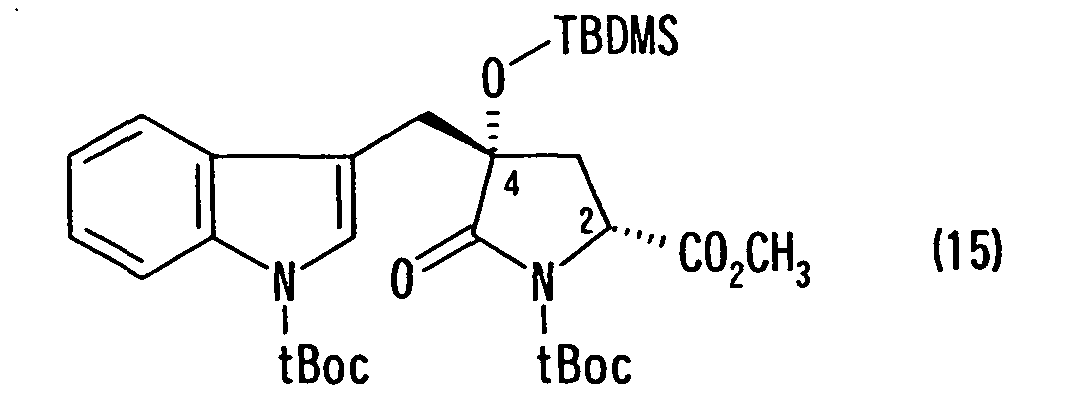
-
- While it is known that naturally occurring monatin presents the (2S, 4S) form in its stereostructure, the term "monatin" as herein used covers all the compounds having the same structural formula, but differing in configuration. The individual stereoisomers may be called by designations indicating their stereoisomerism like "(2S, 4S) -monatin" and "(2R, 4R)-monatin".
- According to this invention, a glutamic acid derivative represented by formula (3) is manufactured by subjecting a 4-protected hydroxy-pyroglutamic acid derivative represented by formula (1) to an alkylation reaction to prepare a 4-protected hydroxy-4-substituted pyroglutamic acid derivative represented by formula (2) and subjecting the derivative to hydrolysis and deprotection steps.
- The compounds represented by formulas (1), (2) and (3) may each be in the form of a salt. Any reference made herein to any of those compounds covers its salts unless otherwise noted. For example, in the event that at least one of R1, R4 and R5 is a hydrogen atom, i.e. in the event that the compound has a carboxyl group, the 4-protected hydroxypyroglutamic acid derivative as represented by formula (1), the 4-protected hydroxyl-4-substituted pyroglutamic acid derivative as represented by formula (2) and the 4-protected hydroxyl-4-substituted glutamic acid derivative (glutamic acid derivative) as represented by formula (3) may be in the form of their salts. The salt may, for example, be a salt formed by reacting any such compound with a base, such as sodium hydroxide, potassium hydroxide or ammonia, or a salt formed by adding thereto an inorganic acid, such as hydrochloric acid, or an organic acid, such as acetic acid.
- In formulas (1) to (3), R1, R4 and R5 stand independently of one another for a group selected from a hydrogen atom and a hydrocarbon group. A group selected from an alkyl group having 1 to 5 carbon atoms and a benzyl group is preferably selected as R1. A hydrogen atom is preferably selected as R4 and R5.
- In formulas (1) and (2), R2 stands for a protecting group for a hydroxyl group. Groups which are usually employed in the art may be used as protecting groups for hydroxyl groups, and are, for example, a t-butyldimethylsilyl group, a trimethylsilyl group, a t-butyldiphenylsilyl group, a benzyl group, a t-butyl group, a benzyloxycarbonyl group and a t-butoxycarbonyl group.
- In formulas (1) and (2), P stands for a protecting group for an imino group. Groups which are usually employed in the art as protecting groups for amino and imino grups may be used as protecting groups for imino groups, and are, for example, a t-butoxycarbonyl group, a benzyloxycarbonyl group and a benzyl group.
- In formulas (2) and (3), R3 stands for a group selected from a hydrocarbon group optionally having a substituent and a heterocyclic hydrocarbon group optionally having a substituent.
- The hydrocarbon group may, for example, be a hydrocarbon group having 1 to 20 carbon atoms and is preferably an alkyl group having 1 to 20 carbon atoms, an aryl group having 1 to 20 carbon atoms, an aralkyl group having 1 to 20 carbon atoms or a heterocyclic hydrocarbon group having 1 to 20 carbon atoms. The heterocyclic hydrocarbon group may, for example, be a heterocyclic hydrocarbon group having 1 to 20 carbon atoms. The hydrocarbon group (or heterocyclic hydrocarbon group) may have any of a chain structure, a cyclic structure, or both. In the event that it has a chain structure, it may be a straight or branched chain.
- The substituent which it may optionally have may, for example, be a halogen atom (an iodine, bromine, chlorine or fluorine atom, etc.), a hydroxyl group, an alkyl group having 1 to 3 carbon atoms, an alkoxy group having 1 to 3 carbon atoms or an amino group. In the event that the group represented by R3 has a substituent, such as an amino, imino or hydroxyl group, the substituent may be protected by a protecting group for an amino, imino or hydroxyl group, etc. as mentioned above. In the event that the group represented by R3 has an indolyl group in its skeleton as an indolylmethyl group does, the indolyl group may be protected by a protecting group for an imino group as mentioned above.
- Preferred groups represented by R3 are, for example, a benzyl group and an N-protected-3-indolylmethyl group.
- In the event that an N-protected-3-indolylmethyl group is used as R3, this invention is suitable for use as a method of manufacturing monatin. The protecting group for an imino group as mentioned above can be mentioned as a protecting group for the indolyl group in the N-protected-3-indolylmethyl group .
- The 4-protected hydroxypyroglutamic acid derivative used according to this invention and represented by formula (1) can be prepared easily from 4-hydroxyproline by using the same method as described by X. Zhang et al (See Tetrahedron Letters 42, 5335-5338 (2001)), or a method similar thereto, or a method for synthesis used commonly in peptide chemistry if required. The intended 4-protected hydroxypyroglutamic acid derivative can be obtained, for example, by introducing a protecting group (for example, a t-butoxycarbonyl group) into the imino group in 4-hydroxyproline and a protecting group (for example, a t-butyldimethylsilyl group) into its hydroxyl group preferably after its esterification (for example, methyl esterification), and subjecting it to an oxidizing reaction with ruthenium oxide and sodium periodate.
- As 4-hydroxyproline, it is possible to use each of its optical isomers, i.e. cis-4-hydroxy-L-proline, trans-4-hydroxy-L-proline, cis-4-hydroxy-D-proline and trans-4-hydroxy-D-proline, depending on the intended compound. For the manufacture of (2S, 4S) -monatin, for example, cis- or trans-4-hydroxy-L-proline is used to prepare a (2S)-4-hydroxypyroglutamic acid derivative as the starting material for the manufacturing method of this invention, and for the manufacture of (2R, 4R)-monatin, cis- or trans-4-hydroxy-D-proline is used to prepare a (2R)-4-hydroxypyroglutamic acid derivative as the starting material for the manufacturing method of this invention.
- As the 4-protected hydroxypyroglutamic acid derivative represented by formula (1), it is possible to mention as a preferred example a compound having a methyl group as R1, a t-butyldimethylsilyl group as R2 and a t-butoxycarbonyl group as P. As the 4-protected hydroxyl-4-substituted pyroglutamic acid derivative represented by formula (2), it is possible to mention as a preferred example a compound having a methyl group as R1, a t-butyldimethylsilyl group as R2, an N-t-butoxycarbonyl-3-indolylmethyl group as R3 and a t-butoxycarbonyl group as P.
- The (2R)-4-protected hydroxypyroglutamic acid derivative represented by formula (11) in which the stereochemistry at the 2-position is (R) (including one in the form of a salt) is a novel substance.
- The alkylation reaction of the 4-protected hydroxypyroglutamic acid derivative represented by formula (1) can be performed in the presence of an alkylating agent. In the context of this invention, "alkylation" does not mean the introduction of an alkyl group alone in the narrow sense of the word, such as a methyl, ethyl or butyl group, but includes, for example, the introduction of a residual hydrocarbon group optionally having a substituent, and more specifically, means the introduction of a group represented by R3 into the 4-protected hydroxypyroglutamic acid derivative represented by formula (1) . The "alkylating agent" means a reagent used in the alkylation. As the alkylating agent, it is possible to mention an alkyl halide (alkyl chloride, alkyl bromide, alkyl iodide, etc.), and more specifically, a compound represented by formula (4) below:
- A more detailed description has been made of R3 before. As a preferred halogen atom represented by X, it is possible to mention a chlorine, bromine or iodine atom.
- For the manufacture of monatin according to this invention, it is possible to use an N-protected-3-halogeno-methylindole represented by formula (5) below as the alkylating agent:[where Y stands for a protecting group for an indolyl group and X stands for a halogen atom.]

- Groups which are usually employed in the art as protecting groups for amino and imino groups may be used as protecting groups for indolyl groups represented by Y, and are, for example, a t-butoxycarbonyl group, a benzyloxycarbonyl group and a benzyl group. The halogen atom represented by X is as mentioned above. N-t-butoxycarbonyl-3-bromomethylindole having a t-butoxycarbonyl group as Y and a bromine atom as X is preferred as the N-protected-3-halogenomethylindole represented by formula (5).
- It is preferable to use a base in the alkylation reaction according to this invention. In the event that any base is used, it is possible to mention as examples a lithium salt of hexamethyldisilazane [lithium hexamethyldisilazanide], a potassium salt of hexamethyldisilazane [potassium hexamethyl-disilazanide], a sodium salt of hexamethyldisilazane [sodium hexamethyldisilazanide], lithium diisopropylamide and n-butyl lithium.
- The amount of the base to be used can be selected in a molar ratio of preferably, say, between 1.0 and 2.0 and more preferably, say, between 1.0 and 1.3 to 1 of the 4-protected hydroxypyroglutamic acid derivative as the starting substance. In the event that the starting substance is in the form of its salt or contains its salt, the molar ratio can be appropriately selected from the range stated above by considering the molar amount of the 4-protected hydroxypyroglutamic acid derivative in its free form.
- The alkylation reaction according to this invention is preferably performed in the presence of a solvent. Any solvent can be used without any particular limitation if it is inert in the reaction. It is possible to mention tetrahydrofuran, ether, dimethoxyethane, toluene and any mixture thereof as preferred solvents.
- In the alkylation reaction according to this invention, it is possible to add HMPA (hexamethylphosphoramide) or DMPU (1,3-dimethyl-3,4,5,6-tetrahydro-2(1H)-pyrimidinone).
- In the alkylation reaction according to this invention, it is desirable to use any solvent or additive after removing water therefrom as much as possible in order to have the reaction promoted. It is also desirable to have it performed in the atmosphere of an inert gas, such as nitrogen or argon.
- While the reaction time for the alkylation reaction according to this invention is not specifically limited, it is possible to select preferably, say, about 0.5 to 24 hours and more preferably, say, about 1 to 5 hours. While the reaction temperature is not specifically limited, either, it is possible to select preferably, say, about -80°C to 50°C and more preferably about -78°C to 30°C.
- After the reaction is over, it is possible to apply appropriate methods known in the art, such as extraction, chromatography and crystallization, to isolate and refine the intended object. The 4-protected hydroxyl-4-substituted pyroglutamic acid derivative represented by formula (2) is a novel substance.
- The 4-protected hydroxyl-4-substituted pyroglutamic acid derivative represented by formula (2) and obtained as described can be led through hydrolysis and deprotection steps to form the glutamic acid derivative represented by formula (3) .
- The "hydrolysis and deprotection steps" according to this invention means more specifically the steps of performing a hydrolysis reaction and a deprotection reaction for the protecting groups to thereby lead the 4-protected hydroxy-4-substituted pyroglutamic acid derivative represented by formula (2) to the glutamic acid derivative represented by formula (3).
- The hydrolysis in the hydrolysis and deprotection steps is defined principally as a reaction for decomposing the bond forming a lactum ring. The deprotection in the hydrolysis and deprotection steps is defined principally as a reaction for deprotecting the protecting group for the hydroxyl group as represented by R2 and the protecting group for the imino group as represented by P.
- There is no particular limitation in the order of the hydrolysis and deprotection reactions. It is likely that hydrolysis serves as a deprotection reaction, too (or that the deprotection reaction serves as a hydrolysis reaction, too), and the "hydrolysis and deprotection steps" according to this invention includes such cases where the hydrolysis and deprotection reactions cannot be distinguished clearly from each other.
- The ring-opening reaction of the lactum ring by hydrolysis usually produces a carboxyl group at the 4-position having a hydrogen atom as R5 in formula (3), but the carboxyl group at the 4-position may form an ester with alcohol in the event, for example, that hydrolysis is performed in the presence of an alcoholic solvent. In the event that such an ester is not converted to a carboxyl group by hydrolysis and deprotection steps, R5 in formula (3) will be an alcohol-derived hydrocarbon group.
- When R1 in formula (2) stands for a hydrocarbon group, i. e. when -COOR1 is an alkoxycarbonyl group, the alkoxycarbonyl group may be converted to a carboxyl group after hydrolysis and deprotection steps. In such a case, R4 in formula (3) will be a hydrogen atom even when R1 in formula (2) is a hydrocarbon group. It is possible to include the step of converting the alkoxycarbonyl group to a carboxyl group before the hydrolysis and deprotection steps. When -COOR1 is a benzyloxycarbonyl group (R1 is a benzyl group), for example, it can be led to a carboxyl group (R1 is a hydrogen atom) by a catalytic hydrogenation reaction prior to the hydrolysis and deprotection steps.
- A compound having a hydrocarbon group as R2 and/or R3 in formula (3), i.e. a compound having an alkoxycarbonyl group in formula (3) can be led to a compound having a hydrogen atom as R2 and/or R3 by having its alkoxycarbonyl group converted to a carboxyl group by a method known in the art, such as hydrolysis with an acid or base.
- When the group represented by R3 in formula (2) has a protected imino group, a protected amino group, a protected indolyl group, a protected hydroxyl group, etc. in its structure, it is likely that the protecting group for any such imino, amino, indolyl or hydroxyl group, etc. may undergo deprotection through the hydrolysis and deprotection steps. It is, therefore, likely that R3 in formula (3) and R2 in formula (2) may not stand for the same group.
- The hydrolysis reaction can be performed by a reaction with a base, a reaction with an acid, a catalytic hydrogenation reaction, a reaction with a fluoride, etc. The deprotection reaction can also be performed by any such reaction.
- A hydrolysis reaction with a base is preferably employed for the hydrolysis reaction of the lactum ring. It is preferable to use lithium hydroxide, sodium hydroxide, potassium hydroxide, etc. as the base.
- When a base is used, its amount can be selected in a molar ratio of preferably, say, about 1 to 50 and more preferably, say, about 5 to 20 of base to 1 of the compound (in its free form). In the event that the 4-protected hydroxy-4-substituted pyro-glutamic acid derivative is in the form of its salt or contains its salt, the molar ratio can be appropriately selected from the range stated above by considering the molar amount of the 4-protected hydroxy-4-substituted pyroglutamic acid derivative in its free form.
- As the solvent to be used in the hydrolysis reaction, it is possible to use a mixed solvent of water and an organic solvent miscible with water, as a reaction solvent, such as methanol, ethanol, isopropanol or other alcohol, tetrahydrofuran or acetonitrile.
- The hydrolysis reaction usually causes the hydrolysis of the ester bond, as well as the lactum ring, and converts the alkoxycarbonyl group existing in the compound to a carboxyl group.
- The reaction time for hydrolysis may be selected from preferably, say, about 1 to 48 hours and more preferably, say, about 3 to 15 hours. The reaction temperature for hydrolysis may be selected from preferably, say, about 0°C to 100°C and more preferably, say, about 20°C to 50°C.
- Any method of deprotection that is usually employed in peptide chemistry, etc. may be followed for the deprotection of the protecting groups in the 4-protected hydroxy-4-substituted pyroglutamic acid derivative represented by formula (2), for example, for the removal of the protecting groups for the imino group, amino grouo, indolyl group, hydroxyl group, etc. For example, it can be performed in the same way with the hydrolysis reaction as described above. For example, the t-butoxycarbonyl and t-butyldimethylsilyl groups can be removed with an acid, and the benzyloxycarbonyl group by a catalytic hydrogenation reaction. A fluoride can be used for the deprotection of only the t-butyldimethylsilyl group, for example.
- After the reaction is over, it is possible to apply appropriate methods known in the art, such as extraction, chromatography and crystallization, to isolate and refine the glutamic acid derivative manufactured by the method of this invention and represented by formula (3). It is preferably obtained as a crystal by crystallizing the product from water, alcohol or a mixed solvent thereof in the form of its salt with an acid, such as hydrochloric acid, its salt with a base, such as ammonia, or its salt with a metal, such as sodium, or in its free form.
- When the glutamic acid derivative has been obtained in the form of a salt, it is possible to convert its salt to its free form or change it to another salt, or when it has been obtained in its free form, it is possible to convert it to a salt, by employing any appropriate reaction known in the art, such as a free body forming reaction, a reaction for forming another salt or a salt changing reaction.
- The alkylation reaction in the method of this invention makes it possible to have an intended group react selectively with the 4-position of the 4-protected hydroxypyroglutamic acid derivative represented by formula (1) and this reaction proceeds stereoselectively. Its configuration is retained until after the hydrolysis and deprotection steps. Accordingly, the method of this invention is very useful as a method of manufacturing a 4-protected hydroxyl-4-substituted pyroglutamic acid derivative having optical activity, a glutamic acid derivative having optical activity and partricularly optically active monatin.
- For example, the use of a (2S)-4-protected hydroxy pyroglutamic acid derivative as a 4-protected hydroxyl pyroglutamic acid derivative represented by formula (1) permits the selective manufacture of (2S, 4S)-monatin represented by formula (19) below and the use of a (2R)-4-protected hydroxyl pyroglutamic acid derivative permits the selective manufacture of (2R, 4R)-monatin represented by formula (20) below:

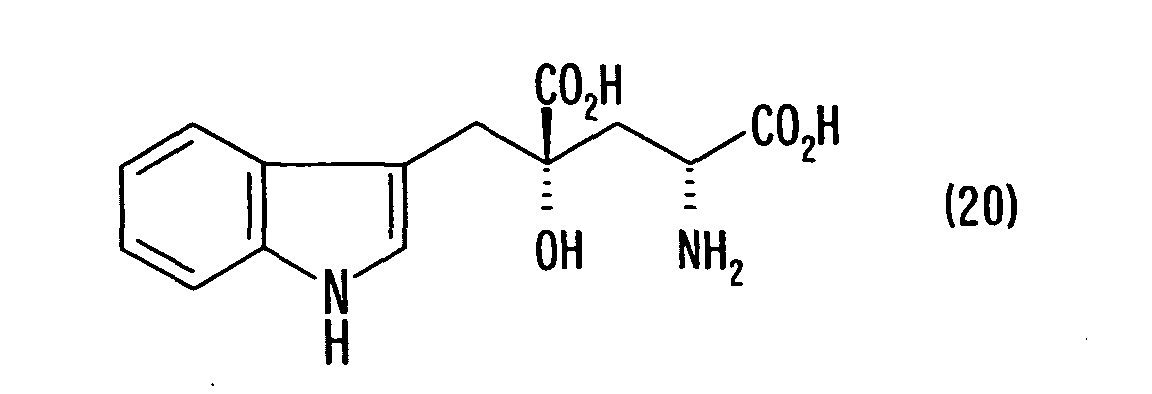
- The invention will now be described in detail by examples of carrying it out, though these examples are not intended to limit this invention in any way.
- 1H-NMR spectra were determined by Bruker AVANCE400 (400 MHz) and MS spectra by Thermo Quest TSQ700.
-

- N-t-butoxycarbonyl-4-t-butyldimethylsilyloxy-D-pyroglutamic acid methyl ester was obtained as a colorless oily substance at a total yield of 66% from cis-4-hydroxy-D-proline as a starting material in accordance with the method of X. Zhang et al (See Tetrahedron Letters, 42, 5335-5338 (2001)).
(MS spectrum)
ESI-MS: 374.6 (M+H)+, 396.59 (M+Na)+.
(NMR spectrum)
1H-NMR (CDCl3, 400 MHz) δ ppm: 0.11 (s, 3H), 0.16 (s, 3H), 0.89 (s, 9H), 1.50 (s, 9H), 1.99 (m, 1H), 2.57 (m, 1H), 3.76 (s, 3H), 4.28 (t, 1H), 4.46 (t, 1H) . -

- 1.45 g (3.9 mmol) of the above N-t-butoxycarbonyl-4-t-butyldimethylsilyloxy-D-pyro-glutamic acid methyl ester was dissolved in 15 ml of anhydrous THF (tetrahydrofuran) in an atmosphere of argon gas. The resulting solution was cooled to -78°C, 2.8 ml (4.8 mmol; 1.7 mM/ml) of LHMDS (lithium hexamethyldisilazane) were added to it and it was stirred for an hour. A solution obtained by dissolving 1.30 g (4.2 mmol) of N-t-butoxycarbonyl-3-bromomethylindole in 4 ml of THF was dropped into the reacted solution and it was stirred at -78°C for 25 minutes and at room temperature for two hours. An aqueous solution of ammonium chloride was added to the reacted solution and two times of extraction were performed with 50 ml of ethyl acetate. An organic layer was washed with 50 ml of water and 50 ml of a saturated saline solution and was dried with anhydrous magnesium sulfate. Magnesium sulfate was removed by filtration and the filtrate was concentrated under reduced pressure. The residue was refined by PTLC (preparative thin-layer chromatography) to yield 1.21 g (2.01 mmol) of N-t-butoxycarbonyl-(4R)-4-t-butyldimethylsilyloxy-4-(N-t-butoxycarbonyl-3-indolylmethyl)-D-pyroglutamic acid methyl ester. Its 1H-NMR spectrum showed a peak marked by a very small amount (several percent) of impurity beside the isomers of the compound.
(MS spectrum)
ESI-MS: 626.0 (M+Na)+.
(NMR spectrum)
1H-NMR (CDCl3, 400 MHz) δ ppm: 0.14 (s, 3H), 0.30 (s, 3H), 0.87 (s, 9H), 1.45 (s, 9H), 1.66 (s, 9H), 2.09 (dd, 1H), 2.42 (dd, 1H), 3.02 (d, 1H), 3.19 (d, 1H), 3.71 (s, 3H), 4.16 (m, 1H), 7.22-7.32 (m, 2H), 7.49 (m, 2H), 8.17 (brd, 1H). - 544 mg (0.90 mmol) of the above compound were dissolved in a mixed solvent prepared from 6 ml of isopropanol, 3 ml of THF and 8 ml of water and the solution was kept at 0°C. 605 mg (14.43 mmol) of lithium hydroxide monohydrate were added to the reacted solution and it was stirred at room temperature for five hours. The reacted solution was concentrated under reduced pressure, 15 ml of water were added to the residue and the solution had its pH adjusted to 3 with a 2N solution of hydrochloric acid. Two times of extraction were performed with 50 ml of ethyl acetate and an organic layer was washed with a saturated saline solution and was dried with anhydrous magnesium sulfate. Magnesium sulfate was removed by filtration and the filtrate was concentrated under reduced pressure.
- The residue was dissolved in 4 ml of formic acid and the reacted solution was kept at 0°C. 4 ml of a 4N HCl/dioxane solution were added to it and it was stirred at room temperature for 30 minutes. The reacted solution was concentrated under reduced pressure and the residue was dissolved in 10 ml of water and washed with 20 ml of ether and 20 ml of ethyl acetate. The aqueous solution was neutralized with a 2N solution of NaOH and after it was concentrated to about one-fifth, 20 ml of ethanol were added to it. The resulting crystal was collected by filtration and dried under reduced pressure to yield 155 mg (0.49 mmol) of (2R, 4R)-monatin as a sodium salt. Its analysis for optical isomers was conducted by HPLC (high performance liquid chromatography) using a chiral column and revealed only (2R, 4R) and (2R, 4S) forms of isomers having an integrated peak ratio of 98:2.
(MS spectrum)
ESI-MS: 291 (M-H)-.
(NMR spectrum)
1H-NMR (D2O, 400 MHz) δ ppm: - 1.99 (dd, 1H, J=11.8 Hz, J=15.2 Hz), 2.60 (dd, 1H, J=1.9 Hz, J=15.2 Hz), 3.02 (d, 1H, J=14.6 Hz), 3.22 (d, 1H, J=14.6 Hz), 3.57 (d, 1H, J=10.2 Hz), 7.08 (t, 1H, J=7.2 Hz), 7.15 (t, 1H, J-7.2 Hz), 7.16 (s, 1H), 7.42 (d, 1H, J=8.0 Hz), 7.66 (d, 1H, J=8.0 Hz).
- N-t-butoxycarbonyl-(4R)-4-t-butyldimethylsilyloxy-4-benzyl-D-pyroglutamic acid methyl ester was obtained as a solid at a yield of 46.0% by using benzyl bromide instead of N-t-butoxycarbonyl-3-bromomethylindole and otherwise repeating Example 2. Its 1H-NMR spectrum showed a single stereoisomer.

(MS spectrum)
ESI-MS: 464.8 (M+H)+, 486.8 (M+Na)+.
(NMR spectrum)
1H-NMR (CDCl3, 400 MHz) δ ppm: 0.13 (s, 3H), 0.29 (s, 3H), 0.86 (s, 9H), 1.46 (s, 9H), 1.96 (dd, 1H), 2.45 (dd, 1H), 2.88 (d, 1H), 3.16 (d, 1H), 3.71 (s, 3H), 3.80 (m, 1H), 7.20-7.31 (m, 5H). - A sodium salt of (2R, 4R)-4-hydroxy-4-benzylglutamic acid was obtained at a yield of 57.4% by using the above compound and otherwise repeating Example 2. Its analysis for optical isomers was conducted by HPLC using a chiral column and revealed only (2R, 4R) and (2R, 4S) forms of isomers having an integrated peak ratio of 99:1 or higher.
(MS spectrum)
ESI-MS: 252 (M-H)-.
(NMR spectrum)
1H-NMR (400 MHz, D2O) δ ppm: - 1.95 (dd, 1H, J=11.8 Hz, J=15.3 Hz), 2.56 (d, 1H, J=15.2 Hz), 2.81 (d, 1H, J=13 .6 Hz), 3.07 (d, 1H, J=13.6 Hz), 3.55 (d, 1H, J=11.8 Hz), 7.19-7.31 (m, 5H).
- According to this invention, it is possible to manufacture efficiently and easily a glutamic acid derivative known as a sweetener, typically monatin, and a 4-protected hydroxyl pyroglutamic acid derivative as an intermediate in the manufacture thereof. The alkylation reaction of the 4-protected hydroxyl pyroglutamic acid derivative according to this invention is suitable for use as a method of manufacturing a glutamic acid derivative having optical activity, particularly optically active monatin, since it can be carried out selectively at the 4-position and stereoselectively.
Claims (51)
- A method of manufacturing a glutamic acid derivative represented by formula (3) below (including one in the form of a salt), characterized by subjecting a 4-protected hydroxy-pyroglutamic acid derivative represented by formula (1) below (including one in the form of a salt) to an alkylation reaction to prepare a 4-protected hydroxy-4-substituted pyroglutamic acid derivative represented by formula (2) below (including one in the form of a salt) and subjecting the derivative to hydrolysis and deprotection steps:

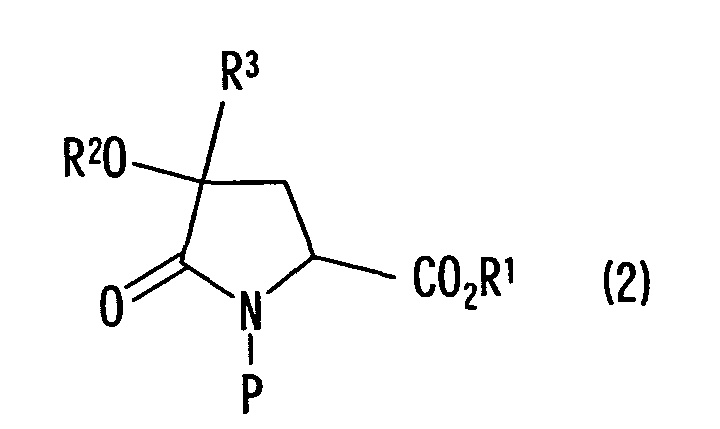 where R1, R4 and R5 stand independently of one another for a group selected from a hydrogen atom and a hydrocarbon group, R2 stands for a protecting group for a hydroxyl group, R3 stands for a group selected from a hydrocarbon group optionally having a substituent and a heterocyclic hydrocarbon group optionally having a substituent and P stands for a protecting group for an imino group.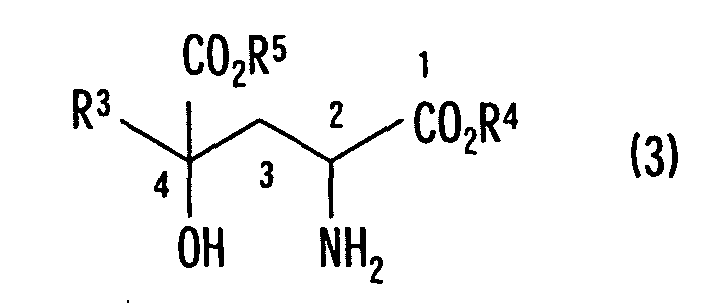
- A method of manufacturing a 4-protected hydroxy-4-substituted pyroglutamic acid derivative represented by formula (2) below (including one in the form of a salt), characterized by subjecting a 4-protected hydroxypyroglutamic acid derivative represented by formula (1) below (including one in the form of a salt) to an alkylation reaction:
 where R1 stands for a group selected from a hydrogen atom and a hydrocarbon group, R2 stands for a protecting group for a hydroxyl group, R3 stands for a group selected from a hydrocarbon group optionally having a substituent and a heterocyclic hydrocarbon group and P stands for a protecting group for an imino group.
- A method of manufacturing a glutamic acid derivative represented by formula (3) below (including one in the form of a salt), characterized by subjecting a 4-protected hydroxy-4-substituted pyroglutamic acid derivative represented by formula (2) below (including one in the form of a salt) to hydrolysis and deprotection steps:
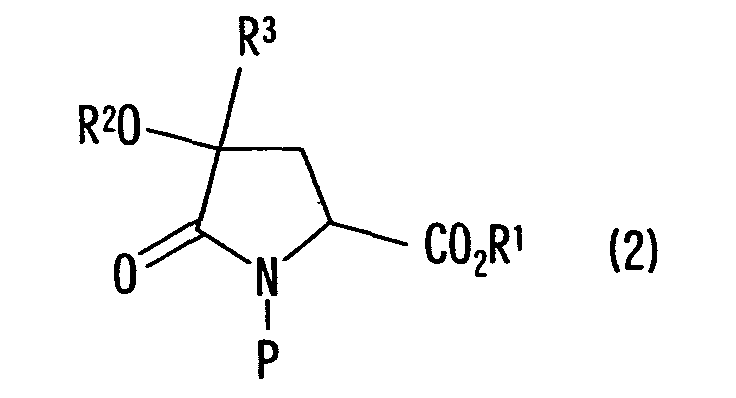 where R1, R4 and R5 stand independently of one another for a group selected from a hydrogen atom and a hydrocarbon group, R2 stands for a protecting group for a hydroxyl group, R3 stands for a group selected from a hydrocarbon group optionally having a substituent and a heterocyclic hydrocarbon group optionally having a substituent and P stands for a protecting group for an imino group.
- A method as set forth in claim 1 or 3, wherein R1 stands for a group selected from an alkyl group having 1 to 5 carbon atoms and a benzyl group, R4 and R5 stand for a hydrogen atom each, R2 stands for a group selected from a t-butyldimethylsilyl group, a trimethylsilyl group, a t-butyldiphenylsilyl group, a benzyl group, a t-butyl group, a benzyloxycarbonyl group and a t-butoxycarbonyl group, R3 stands for a group selected from an alkyl group having 1 to 20 carbon atoms, an aryl group having 1 to 20 carbon atoms, an aralkyl group having 1 to 20 carbon atoms and a heterocyclic hydrocarbon group having 1 to 20 carbon atoms and P stands for a group selected from a t-butoxycarbonyl group, a benzyloxycarbonyl group and a benzyl group.
- A method as set forth in claim 2, wherein R1 stands for a group selected from an alkyl group having 1 to 5 carbon atoms and a benzyl group, R2 stands for a group selected from a t-butyldimethylsilyl group, a trimethylsilyl group, a t-butyldiphenylsilyl group, a benzyl group, a t-butyl group, a benzyloxycarbonyl group and a t-butoxycarbonyl group, R3 stands for a group selected from an alkyl group having 1 to 20 carbon atoms, an aryl group having 1 to 20 carbon atoms, an aralkyl group having 1 to 20 carbon atoms and a heterocyclic hydrocarbon group having 1 to 20 carbon atoms and P stands for a group selected from a t-butoxycarbonyl group, a benzyloxycarbonyl group and a benzyl group.
- A method as set forth in any of claims 1 to 3, wherein R3 is a benzyl group or an N-protected-3-indolylmethyl group.
- A method as set forth in claim 1 or 2, wherein the alkylation reaction is performed in the presence of an alkylating agent represented by formula (4) below:
- A method as set forth in claim 7, wherein the alkylation reaction is performed in the presence of a base.
- A method as set forth in claim 7, wherein the base is one or more kinds of base selected from a lithium salt of hexamethyldisilazane, lithium hexamethyldisilazanide, a potassium salt of hexamethyldisilazane, potassium hexamethyl-disilazanide, a sodium salt of hexamethyldisilazane, sodium hexamethyldisilazanide, lithium diisopropylamide and normal butyl lithium.
- A method as set forth in claim 7, wherein the base is used in a molar ratio of between 1.0 and 2.0 to 1 relative to the 4-protected hydroxyglutamic acid derivative.
- A method of manufacturing a monatin acid derivative represented by formula (7) below (including one in the form of a salt), characterized by reacting a 4-protected hydroxy-pyroglutamic acid derivative represented by formula (1) below (including one in the form of a salt) with N-protected-3-halogenomethylindole represented by formula (5) below to prepare a 4-protected hydroxy-4-substituted pyroglutamic acid derivative represented by formula (6) below (including one in the form of a salt) and subjecting the derivative to hydrolysis and deprotection steps:


 where R1, R4 and R5 stand independently of one another for a group selected from a hydrogen atom and a hydrocarbon group, R2 stands for a protecting group for a hydroxyl group, X stands for a halogen atom, P stands for a protecting group for an imino group and Y stands for a protecting group for an indolyl group.
- A method of manufacturing a 4-protected hydroxy-4-substituted pyroglutamic acid derivative represented by formula (6) below (including one in the form of a salt), characterized by reacting a 4-protected hydroxypyroglutamic acid derivative represented by formula (1) below (including one in the form of a salt) with N-protected-3-halogeno-methylindole represented by formula (5) below:

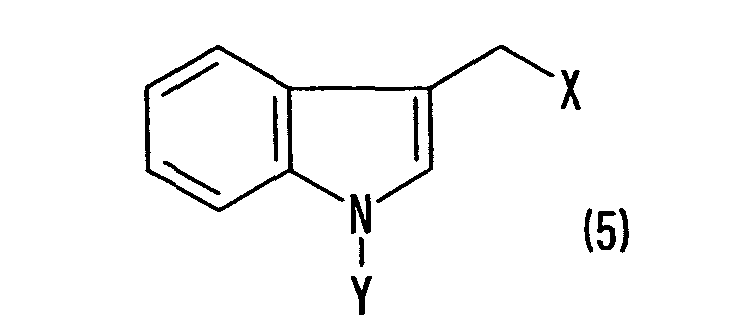 where R1 stands for a group selected from a hydrogen atom and a hydrocarbon group, R2 stands for a protecting group for a hydroxyl group, X stands for a halogen atom, P stands for a protecting group for an imino group and Y stands for a protecting group for an indolyl group.
- A method of manufacturing a monatin derivative represented by formula (7) below (including one in the form of a salt), characterized by subjecting a 4-protected hydroxy-4-substituted pyroglutamic acid derivative represented by formula (6) below (including one in the form of a salt) to hydrolysis and deprotection steps:
 where R1, R4 and R5 stand independently of one another for a group selected from a hydrogen atom and a hydrocarbon group, R2 stands for a protecting group for a hydroxyl group, P stands for a protecting group for an imino group and Y stands for a protecting group for an indolyl group.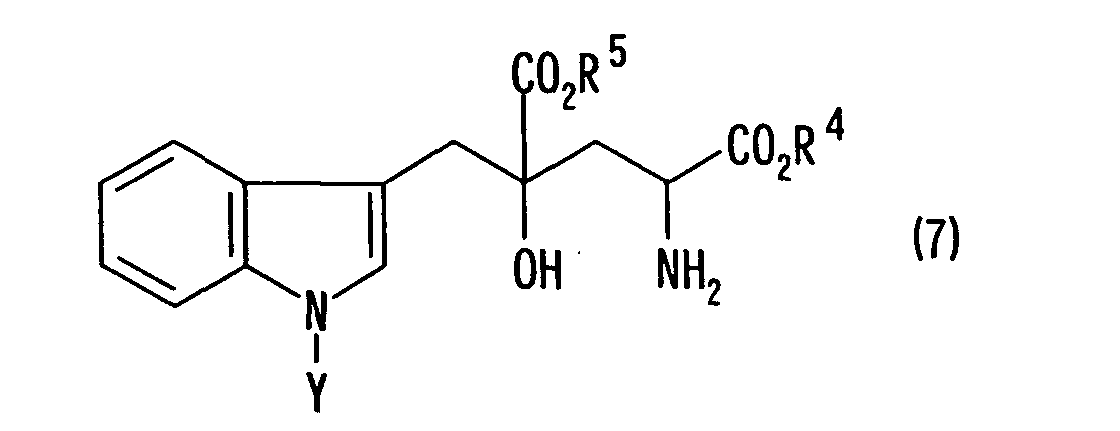
- A method as set forth in claim 11, wherein R1 stands for a group selected from an alkyl group having 1 to 5 carbon atoms and a benzyl group, R4 and R5 stand for a hydrogen atom each, R2 stands for a group selected from a t-butyldimethylsilyl group, a trimethylsilyl group, a t-butyldiphenylsilyl group, a benzyl group, a t-butyl group, a benzyloxycarbonyl group and a t-butoxycarbonyl group, X stands for a group selected from a chlorine atom, a bromine atom and an iodine atom and P and Y stand independently of each other for a group selected from a t-butoxycarbonyl group, a benzyloxycarbonyl group and a benzyl group.
- A method as set forth in claim 12, wherein R1 stands for a group selected from a hydrogen atom, an alkyl group having 1 to 5 carbon atoms and a benzyl group, R2 stands for a group selected from a t-butyldimethylsilyl group, a trimethylsilyl group, a t-butyldiphenylsilyl group, a benzyl group, a t-butyl group, a benzyloxycarbonyl group and a t-butoxycarbonyl group, X stands for a group selected from a chlorine atom, a bromine atom and an iodine atom and P and Y stand independently of each other for a group selected from a t-butoxycarbonyl group, a benzyloxycarbonyl group and a benzyl group.
- A method as set forth in claim 13, wherein R1 stands for a group selected from an alkyl group having 1 to 5 carbon atoms and a benzyl group, R4 and R5 stand for a hydrogen atom each, R2 stands for a group selected from a t-butyldimethylsilyl group, a trimethylsilyl group, a t-butyldiphenylsilyl group, a benzyl group, a t-butyl group, a benzyloxycarbonyl group and a t-butoxycarbonyl group and P and Y stand independently of each other for a group selected from a t-butoxycarbonyl group, a benzyloxycarbonyl group and a benzyl group.
- A method as set forth in claim 11 or 12, wherein the alkylation reaction is performed in the presence of a base.
- A method as set forth in claim 17, wherein the base is one or more kinds of base selected from a lithium salt of hexamethyldisilazane, lithium hexamethyldisilazane, a potassium salt of hexamethyldisilazane, potassium hexamethyl-disilazane, a sodium salt of hexamethyldisilazane, sodium hexamethyldisilazane, lithium diisopropylamide and normal butyl lithium.
- A method as set forth in claim 17, wherein the base is used in a molar ratio of between 1.0 and 2.0 to 1 relative to the 4-protected hydroxyglutamic acid derivative.
- A method of manufacturing an optically active monatin derivative represented by formula (10) below (including one in the form of a salt), characterized by reacting an optically active 4-protected hydroxy-pyroglutamic acid derivative represented by formula (8) below (including one in the form of a salt) with N-protected-3-halogenomethylindole represented by formula (5) below to prepare an optically active 4-protected hydroxy-4-substituted pyroglutamic acid derivative represented by formula (9) below (including one in the form of a salt) and subjecting the derivative to hydrolysis and deprotection steps:

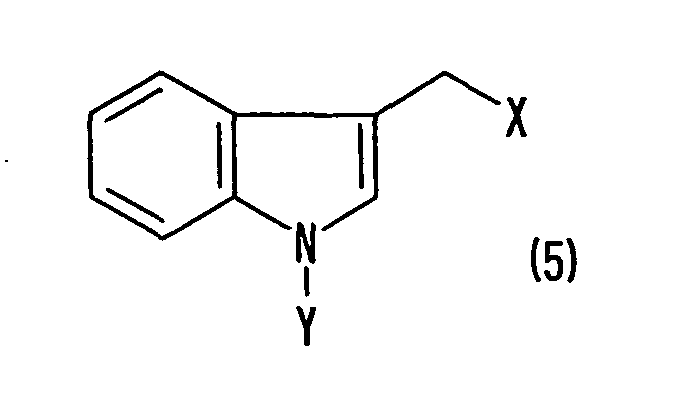
 where R1, R4 and R5 stand independently of one another for a group selected from a hydrogen atom and a hydrocarbon group, R2 stands for a protecting group for a hydroxyl group, X stands for a halogen atom, P stands for a protecting group for an imino group, Y stands for a protecting group for an indolyl group, * stands for an asymmetric carbon atom, the configuration at the 2-position in formula (8) is R or S, the configuration at the 4-position is R, S or RS, so that when the configuration at the 2-position in formula (8) is R, the configurations in formulas (9) and (10) are (2R, 4R), respectively, and when the configuration at the 2-position in formula (8) is S, the configurations in formulas (9) and (10) are (2S, 4S), respectively.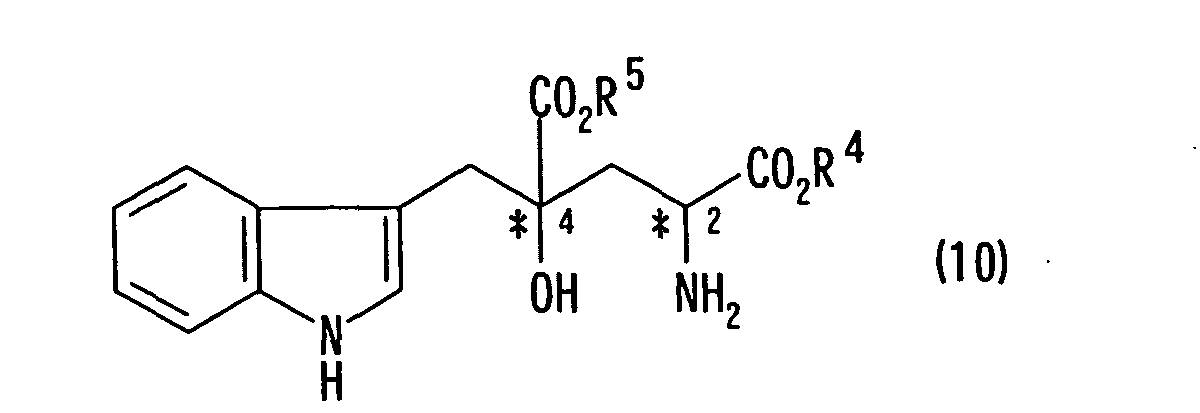
- A method of manufacturing an optically active 4-protected hydroxy-4-substituted pyroglutamic acid derivative represented by formula (9) below (including one in the form of a salt), characterized by reacting an optically active 4-protected hydroxy-pyroglutamic acid derivative represented by formula (8) below (including one in the form of a salt) with N-protected-3-halogenomethylindole represented by formula (5) below:

 where R1 stands for a group selected from a hydrogen atom and a hydrocarbon group, R2 stands for a protecting group for a hydroxyl group, X stands for a halogen atom, P stands for a protecting group for an imino group, Y stands for a protecting group for an indolyl group, * stands for an asymmetric carbon atom, the configuration at the 2-position in formula (8) is R or S, the configuration at the 4-position is R, S or RS, so that when the configuration at the 2-position in formula (8) is R, the configurations in formula (9) are (2R, 4R), respectively, and when the configuration at the 2-position in formula (8) is S, the configurations in formula (9) are (2S, 4S), respectively.
- A method of manufacturing an optically active monatin derivative represented by formula (10) below (including one in the form of a salt), characterized by subjecting an optically active 4-protected hydroxy-4-substituted pyroglutamic acid derivative represented by formula (9) below (including one in the form of a salt) to hydrolysis and deprotection steps:
 where R1, R4 and R5 stand independently of one another for a group selected from a hydrogen atom and a hydrocarbon group, R2 stands for a protecting group for a hydroxyl group, P stands for a protecting group for an imino group, Y stands for a protecting group for an indolyl group, * stands for an asymmetric carbon atom, and when the configuration in formula (9) is (2R, 4R), the configuration in formula (10) is (2R, 4R), and when the configuration in formula (9) is (2S, 4S), the configuration in formula (10) is (2S, 4S).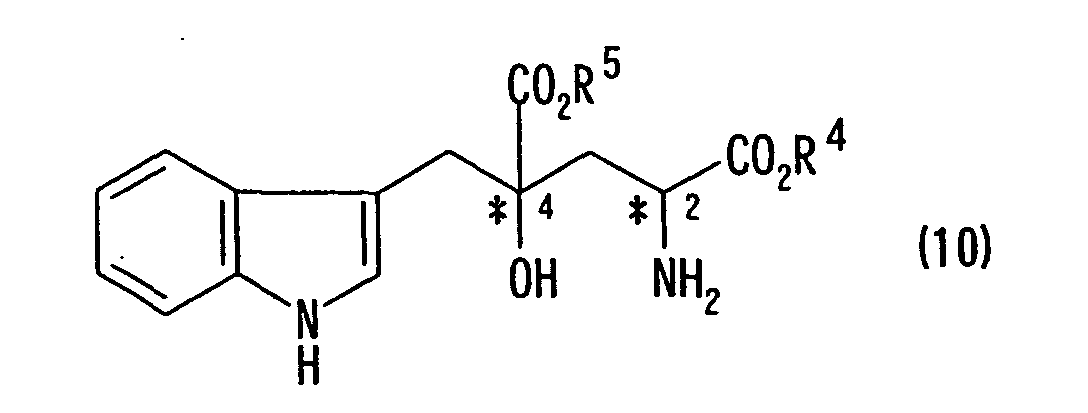
- A method as set forth in claim 20, wherein R1 stands for a group selected from an alkyl group having 1 to 5 carbon atoms and a benzyl group, R4 and R5 stand for a hydrogen atom each, R2 stands for a group selected from a t-butyldimethylsilyl group, a trimethylsilyl group, a t-butyldiphenylsilyl group, a benzyl group, a t-butyl group, a benzyloxycarbonyl group and a t-butoxycarbonyl group, X stands for a group selected from a chlorine atom, a bromine atom and an iodine atom and P and Y stand independently of each other for a group selected from a t-butoxycarbonyl group, a benzyloxycarbonyl group and a benzyl group.
- A method as set forth in claim 21, wherein R1 stands for a group selected from a hydrogen atom, an alkyl group having 1 to 5 carbon atoms and a benzyl group, R2 stands for a group selected from a t-butyldimethylsilyl group, a trimethylsilyl group, a t-butyldiphenylsilyl group, a benzyl group, a t-butyl group, a benzyloxycarbonyl group and a t-butoxycarbonyl group, X stands for a group selected from a chlorine atom, a bromine atom and an iodine atom and P and Y stand independently of each other for a group selected from a t-butoxycarbonyl group, a benzyloxycarbonyl group and a benzyl group.
- A method as set forth in claim 22, wherein R1 stands for a group selected from an alkyl group having 1 to 5 carbon atoms and a benzyl group, R4 and R5 stand for a hydrogen atom each, R2 stands for a group selected from a t-butyldimethylsilyl group, a trimethylsilyl group, a t-butyldiphenylsilyl group, a benzyl group, a t-butyl group, a benzyloxycarbonyl group and a t-butoxycarbonyl group and P and Y stand independently of each other for a group selected from a t-butoxycarbonyl group, a benzyloxycarbonyl group and a benzyl group.
- A method as set forth in claim 20 or 21, wherein the reaction of an optically active 4-protected hydroxypyroglutamic acid derivative represented by formula (8) with N-protected-3-halogenomethylindole represented by formula (5) is performed in the presence of a base.
- A method as set forth in claim 26, wherein the base is one or more kinds of base selected from a lithium salt of hexamethyldisilazane, lithium hexamethyldisilazane, a potassium salt of hexamethyldisilazane, potassium hexamethyl-disilazane, a sodium salt of hexamethyldisilazane, sodium hexamethyldisilazane, lithium diisopropylamide and normal butyl lithium.
- A method as set forth in claim 26, wherein the base is used in a molar ratio of between 1.0 and 2.0 to 1 relative to the 4-protected hydroxyglutamic acid derivative.
- A method of manufacturing a (2R, 4R)-monatin derivative represented by formula (13) below (including one in the form of a salt), characterized by reacting a (2R)-4-protected hydroxy-pyroglutamic acid derivative represented by formula (11) below (including one in the form of a salt) with N-protected-3-halogenomethylindole represented by formula (15) below to prepare a (2R, 4R)-4-protected hydroxy-4-substituted pyroglutamic acid derivative represented by formula (12) below (including one in the form of a salt) and subjecting the derivative to hydrolysis and deprotection steps:
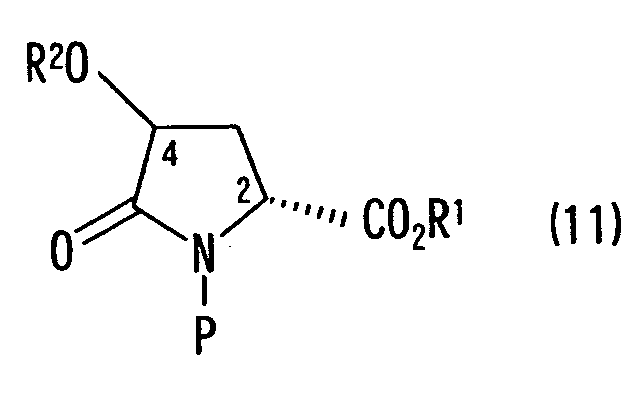

 where R1, R4 and R5 stand independently of one another for a group selected from a hydrogen atom and a hydrocarbon group, R2 stands for a protecting group for a hydroxyl group, X stands for a halogen atom, P stands for a protecting group for an imino group, Y stands for a protecting group for an indolyl group and the configuration at the 4-position in formula (11) is R, S or RS.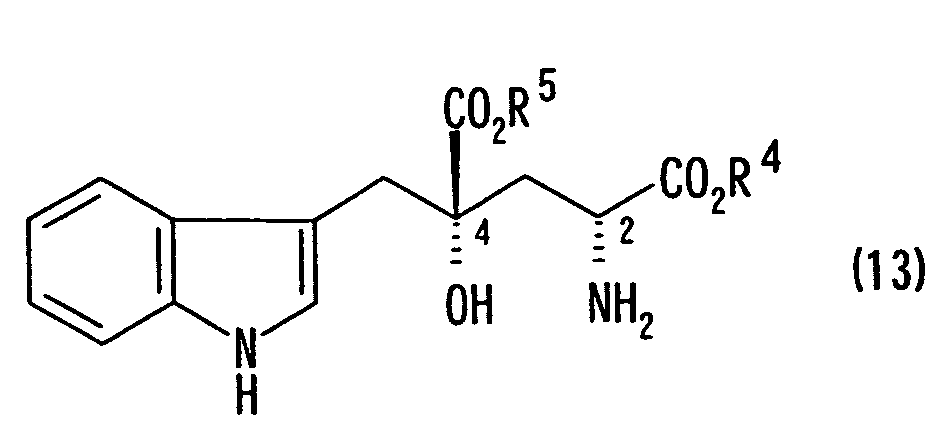
- A method of manufacturing a (2R, 4R)-4-protected hydroxy-4-substituted pyroglutamic acid derivative represented by formula (12) below (including one in the form of a salt), characterized by reacting a (2R)-4-protected hydroxypyroglutamic acid derivative represented by formula (11) below (including one in the form of a salt) with N-protected-3-halogenomethylindole represented by formula (5) below:

 where R1 stands for a group selected from a hydrogen atom and a hydrocarbon group, R2 stands for a protecting group for a hydroxyl group, X stands for a halogen atom, P stands for a protecting group for an imino group, Y stands for a protecting group for an indolyl group and the configuration at the 4-position in formula (11) is R, S or RS.
- A method of manufacturing a (2R, 4R)-monatin derivative represented by formula (13) below (including one in the form of a salt), characterized by subjecting a (2R, 4R)-4-protected hydroxy-4-substituted pyroglutamic acid derivative represented by formula (12) below (including one in the form of a salt) to hydrolysis and deprotection steps:
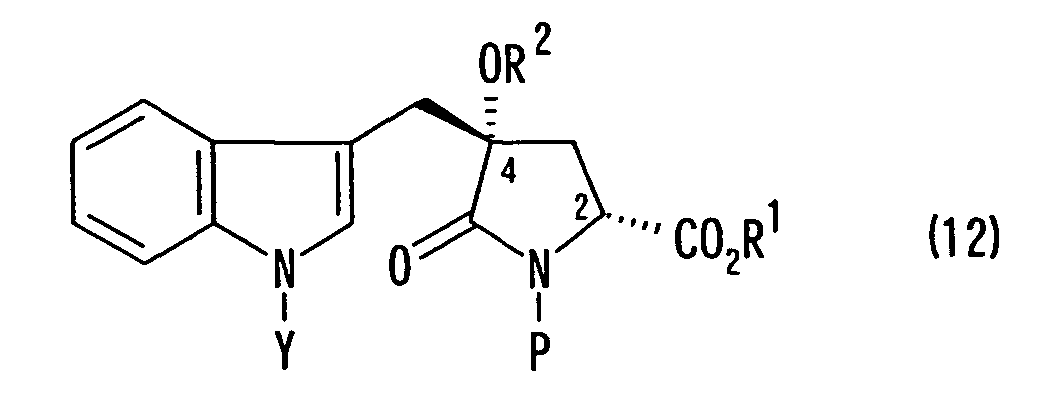 where R1, R4 and R5 stand independently of one another for a group selected from a hydrogen atom and a hydrocarbon group, R2 stands for a protecting group for a hydroxyl group, P stands for a protecting group for an imino group, Y stands for a protecting group for an indolyl group.
- A method as set forth in claim 29, wherein R1 stands for a group selected from an alkyl group having 1 to 5 carbon atoms and a benzyl group, R4 and R5 stand for a hydrogen atom each, R2 stands for a group selected from a t-butyldimethylsilyl group, a trimethylsilyl group, a t-butyldiphenylsilyl group, a benzyl group, a t-butyl group, a benzyloxycarbonyl group and a t-butoxycarbonyl group, X stands for a group selected from a chlorine atom, a bromine atom and an iodine atom and P and Y stand independently of each other for a group selected from a t-butoxycarbonyl group, a benzyloxycarbonyl group and a benzyl group.
- A method as set forth in claim 30, wherein R1 stands for a group selected from a hydrogen atom, an alkyl group having 1 to 5 carbon atoms and a benzyl group, R2 stands for a group selected from a t-butyldimethylsilyl group, a trimethylsilyl group, a t-butyldiphenylsilyl group, a benzyl group, a t-butyl group, a benzyloxycarbonyl group and a t-butoxycarbonyl group, X stands for a group selected from a chlorine atom, a bromine atom and an iodine atom and P and Y stand independently of each other for a group selected from a t-butoxycarbonyl group, a benzyloxycarbonyl group and a benzyl group.
- A method as set forth in claim 31, wherein R1 stands for a group selected from an alkyl group having 1 to 5 carbon atoms and a benzyl group, R4 and R5 stand for a hydrogen atom each, R2 stands for a group selected from a t-butyldimethylsilyl group, a trimethylsilyl group, a t-butyldiphenylsilyl group, a benzyl group, a t-butyl group, a benzyloxycarbonyl group and a t-butoxycarbonyl group and P and Y stand independently of each other for a group selected from a t-butoxycarbonyl group, a benzyloxycarbonyl group and a benzyl group.
- A method as set forth in claim 29 or 30, wherein the reaction of a (2R)-4-protected hydroxypyroglutamic acid derivative represented by formula (11) with N-protected-3-halogenomethylindole represented by formula (5) is performed in the presence of a base.
- A method as set forth in claim 26, wherein the base is one or more kinds of base selected from a lithium salt of hexamethyldisilazane, lithium hexamethyldisilazane, a potassium salt of hexamethyldisilazane, potassium hexamethyl-disilazane, a sodium salt of hexamethyldisilazane, sodium hexamethyldisilazane, lithium diisopropylamide and normal butyl lithium.
- A method as set forth in claim 26, wherein the base is used in a molar ratio of between 1.0 and 2.0 to 1 relative to the 4-protected hydroxyglutamic acid derivative.
- A method as set forth in claim 29, wherein R1 stands for a methyl group, R4 and R5 stand for a hydrogen atom each, R2 stands for a t-butyldimethylsilyl group, X stands for a bromine atom and P and Y stand for a t-butoxycarbonyl group each.
- A method as set forth in claim 30, wherein R1 stands for a methyl group, R2 stands for a t-butyldimethylsilyl group, X stands for a bromine atom and P and Y stand for a t-butoxycarbonyl group each.
- A method as set forth in claim 31, wherein R1 stands for a methyl group, R4 and R5 stand for a hydrogen atom each, R2 stands for a t-butyldimethylsilyl group and P and Y stand for a t-butoxycarbonyl group each.
- A (2R)-4-hydroxypyroglutamic acid derivative represented by formula (11) below (including one in the form of a salt):where R1 stands for a group selected from a hydrogen atom and a hydrocarbon group, R2 stands for a protecting group for a hydroxyl group, P stands for a protecting group for an imino group and the configuration at the 4-position in formula (11) is R, S or RS.

- A (2R)-4-hydroxypyroglutamic acid derivative as set forth in claim 41, wherein R1 stands for a group selected from an alkyl group having 1 to 5 carbon atoms and a benzyl group, R2 stands for a group selected from a t-butyldimethylsilyl group, a trimethylsilyl group, a t-butyldiphenylsilyl group, a benzyl group, a t-butyl group, a benzyloxycarbonyl group and a t-butoxycarbonyl group and P stands for a group selected from a t-butoxycarbonyl group, a benzyloxycarbonyl group and a benzyl group.
- A (2R)-4-hydroxypyroglutamic acid derivative as set forth in claim 41, wherein R1 stands for a methyl group, R2 stands for a t-butyldimethylsilyl group and P stands for a t-butoxycarbonyl group.
- An N-t-butoxycarbonyl-4-t-butyldimethylsilyloxy-D-pyroglutami c acid methyl ester represented by formula (14) below:where tBoc stands for a t-butoxycarbonyl group and TBDMS stands for a t-butyldimethylsilyloxy group.

- A 4-protected hydroxyl-4-substituted pyroglutamic acid derivative represented by formula (2) (including one in the form of a salt):where R1 stands for a group selected from a hydrogen atom and a hydrocarbon group, R2 stands for a protecting group for a hydroxyl group, R3 stands for a group selected from a hydrocarbon group optionally having a substituent and a heterocyclic hydrocarbon group and P stands for a protecting group for an imino group.

- A 4-protected hydroxyl-4-substituted pyroglutamic acid derivative as set forth in claim 45, wherein R1 stands for a group selected from an alkyl group having 1 to 5 carbon atoms and a benzyl group, R2 stands for a group selected from a t-butyldimethylsilyl group, a trimethylsilyl group, a t-butyldiphenylsilyl group, a benzyl group, a t-butyl group, a benzyloxycarbonyl group and a t-butoxycarbonyl group, R3 stands for a group selected from an alkyl group having 1 to 20 carbon atoms, an aryl group having 1 to 20 carbon atoms, an aralkyl group having 1 to 20 carbon atoms and a heterocyclic hydrocarbon group having 1 to 20 carbon atoms and P stands for a group selected from a t-butoxycarbonyl group, a benzyloxycarbonyl group and a benzyl group.
- A 4-protected hydroxy-4-substituted pyroglutamic acid derivative represented by formula (6) (including one in the form of a salt):where R1 stands for a group selected from a hydrogen atom and a hydrocarbon group, R2 stands for a protecting group for a hydroxyl group, P stands for a protecting group for an imino group and Y stands for a protecting group for an indolyl group.
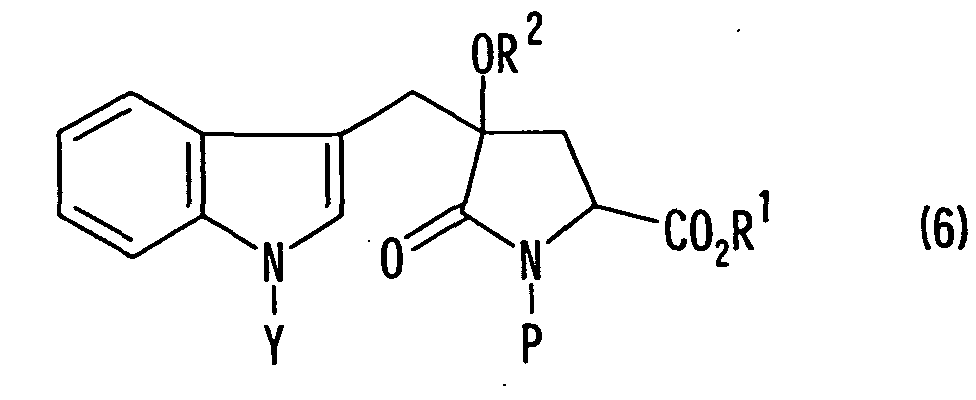
- A 4-protected hydroxy-4-substituted pyroglutamic acid derivative as set forth in claim 47, wherein R1 stands for a group selected from an alkyl group having 1 to 5 carbon atoms and a benzyl group, R2 stands for a group selected from a t-butyldimethylsilyl group, a trimethylsilyl group, a t-butyldiphenylsilyl group, a benzyl group, a t-butyl group, a benzyloxycarbonyl group and a t-butoxycarbonyl group and P stands for a group selected from a t-butoxycarbonyl group, a benzyloxycarbonyl group and a benzyl group.
- A (2R, 4R)-4-protected hydroxy-4-substituted pyroglutamic acid derivative represented by formula (12) (including one in the form of a salt):where R1 stands for a group selected from a hydrogen atom and a hydrocarbon group, R2 stands for a protecting group for a hydroxyl group, P stands for a protecting group for an imino group and Y stands for a protecting group for an indolyl group.

- A (2R, 4R)-4-protected hydroxy-4-substituted pyroglutamic acid derivative as set forth in claim 49, wherein R1 stands for a group selected from an alkyl group having 1 to 5 carbon atoms and a benzyl group, R2 stands for a group selected from a t-butyldimethylsilyl group, a trimethylsilyl group, a t-butyldiphenylsilyl group, a benzyl group, a t-butyl group, a benzyloxycarbonyl group and a t-butoxycarbonyl group and P and Y stand independently of each other for a group selected from a t-butoxycarbonyl group, a benzyloxycarbonyl group and a benzyl group.
- An N-t-butoxycarbonyl-(4R)-4-t-butyldimethylsilyloxy-4-benzyl -D-pyroglutamic acid methyl ester represented by formula (15) below:where tBoc stands for a t-butoxycarbonyl group and TBDMS stands for a t-butyldimethylsilyloxy group.

Applications Claiming Priority (3)
| Application Number | Priority Date | Filing Date | Title |
|---|---|---|---|
| JP2003003626 | 2003-01-09 | ||
| JP2003003626 | 2003-01-09 | ||
| PCT/JP2003/017016 WO2004067494A1 (en) | 2003-01-09 | 2003-12-26 | Processes for producing glutamic acid derivative and pyroglutamic acid derivative and novel intermediate for production |
Publications (3)
| Publication Number | Publication Date |
|---|---|
| EP1582514A1 true EP1582514A1 (en) | 2005-10-05 |
| EP1582514A4 EP1582514A4 (en) | 2006-09-13 |
| EP1582514B1 EP1582514B1 (en) | 2011-08-31 |
Family
ID=32820504
Family Applications (1)
| Application Number | Title | Priority Date | Filing Date |
|---|---|---|---|
| EP03815609A Expired - Lifetime EP1582514B1 (en) | 2003-01-09 | 2003-12-26 | Processes for producing glutamic acid derivative, a pyroglutamic acid derivative and a novel intermediate for production |
Country Status (11)
| Country | Link |
|---|---|
| US (2) | US7674915B2 (en) |
| EP (1) | EP1582514B1 (en) |
| JP (1) | JP4770174B2 (en) |
| KR (1) | KR101160473B1 (en) |
| CN (1) | CN100408552C (en) |
| AT (1) | ATE522497T1 (en) |
| AU (1) | AU2003301508A1 (en) |
| BR (1) | BR0317958A (en) |
| CA (1) | CA2512752C (en) |
| RU (1) | RU2342360C2 (en) |
| WO (1) | WO2004067494A1 (en) |
Cited By (1)
| Publication number | Priority date | Publication date | Assignee | Title |
|---|---|---|---|---|
| EP2107053A1 (en) * | 2008-03-11 | 2009-10-07 | Ajinomoto Co., Inc. | Hydrate crystals of (2R,4R)-Monatin monosodium salt |
Families Citing this family (23)
| Publication number | Priority date | Publication date | Assignee | Title |
|---|---|---|---|---|
| US7297800B2 (en) | 2001-12-27 | 2007-11-20 | Ajinomoto Co., Inc. | Process of producing glutamate derivatives |
| US7572607B2 (en) * | 2002-04-23 | 2009-08-11 | Cargill, Incorporated | Polypeptides and biosynthetic pathways for the production of monatin and its precursors |
| US8372989B2 (en) | 2002-04-23 | 2013-02-12 | Cargill, Incorporated | Polypeptides and biosynthetic pathways for the production of monatin and its precursors |
| DK1533376T3 (en) | 2002-08-26 | 2010-07-19 | Ajinomoto Kk | Novel aldolases and processes for preparing substituted alpha-keto acid |
| CN1723281B (en) | 2002-12-09 | 2012-08-15 | 味之素株式会社 | Mutated d-aminotransferase and method for producing optically active glutamic acid derivatives using the same |
| AU2003301508A1 (en) | 2003-01-09 | 2004-08-23 | Ajinomoto Co., Inc. | Processes for producing glutamic acid derivative and pyroglutamic acid derivative and novel intermediate for production |
| US20050112260A1 (en) * | 2003-08-01 | 2005-05-26 | Cargill, Inc. | Monatin tabletop sweetener compositions and methods of making same |
| US20050106305A1 (en) * | 2003-08-25 | 2005-05-19 | Cargill, Inc. | Beverage compositions comprising monatin and methods of making same |
| CN1890377B (en) * | 2003-10-21 | 2013-06-05 | 嘉吉有限公司 | Production of monatin and monatin precursors |
| US7935377B2 (en) * | 2004-06-04 | 2011-05-03 | Ajinomoto Co., Inc. | Crystals of free (2R, 4R)-monatin and use thereof |
| RU2392834C2 (en) | 2004-10-15 | 2010-06-27 | Адзиномото Ко., Инк. | Composition of sweetener |
| WO2006113897A2 (en) * | 2005-04-20 | 2006-10-26 | Cargill, Incorporated | Products and methods for in vivo secretion of monatin |
| US8158389B2 (en) * | 2005-04-20 | 2012-04-17 | Cargill, Incorporated | Products and methods for in vivo secretion of monatin |
| US8076108B2 (en) * | 2005-04-26 | 2011-12-13 | Cargill, Incorporated | Polypeptides and biosynthetic pathways for the production of stereoisomers of monatin and their precursors |
| US7582455B2 (en) * | 2005-04-26 | 2009-09-01 | Cargill, Incorporated | Polypeptides and biosynthetic pathways for the production of stereoisomers of monatin and their precursors |
| EP2112227B1 (en) * | 2006-03-07 | 2013-05-15 | Cargill, Incorporated | Aldolases, nucleic acids encoding them and methods for making and using them |
| CN101490249A (en) * | 2006-05-24 | 2009-07-22 | 嘉吉公司 | Methods and systems for increasing production of equilibrium reactions |
| US20090198072A1 (en) * | 2006-05-24 | 2009-08-06 | Cargill, Incorporated | Methods and systems for increasing production of equilibrium reactions |
| CN101239941B (en) | 2007-02-08 | 2012-02-29 | 味之素株式会社 | Process for producing optically active compound |
| US8367847B2 (en) * | 2007-10-01 | 2013-02-05 | Cargill, Incorporated | Production of monatin enantiomers |
| US8076107B2 (en) * | 2007-10-01 | 2011-12-13 | Cargill, Incorporated | Production of monatin stereoisomers |
| US8003361B2 (en) * | 2007-10-01 | 2011-08-23 | Cargill Incorporated | Production of monatin enantiomers |
| CN107398303B (en) * | 2016-05-19 | 2018-08-07 | 兰州金润宏成石油化工科技有限公司 | Catalyst carrier for producing ethylene oxide and preparation method and application thereof |
Family Cites Families (12)
| Publication number | Priority date | Publication date | Assignee | Title |
|---|---|---|---|---|
| GB2205834B (en) * | 1987-06-15 | 1990-10-31 | South African Inventions | 3-(1-amino-1,3-dicarboxy-3-hydroxy-but-4-yl)-indole compounds |
| DK172753B1 (en) * | 1988-05-25 | 1999-06-28 | Lilly Co Eli | N- (5,6,7,8-tetrahydropyrido [2,3-d] pyrimidin-6-yl-alkanoyl) -glutamic acid derivatives, their use, pharmaceutical preparations |
| JPH02311491A (en) * | 1989-05-26 | 1990-12-27 | Ajinomoto Co Inc | Production of nucleoside derivative |
| DE69101791T2 (en) * | 1990-01-19 | 1994-08-11 | Technology Finance Corp | Process for the preparation of 3- (1-amino-1,3-dicarboxy-3-hydroxy-but-4-yl) indole. |
| US5994559A (en) | 1998-08-06 | 1999-11-30 | The Board Of Governors For Higher Education, State Of Rhode Island And Providence Plantations | Synthesis of monatin-A high intensity natural sweetener |
| WO2001018034A1 (en) * | 1999-09-07 | 2001-03-15 | Ajinomoto Co., Inc. | Process for producing aspartame derivative, method of purifying the same, crystals thereof and use of the same |
| AU7321900A (en) * | 1999-10-07 | 2001-05-10 | Ajinomoto Co., Inc. | Process for the production of aspartyldipeptide ester derivatives, novel intermediates therefor and process for the production of the intermediates |
| JP2002060382A (en) * | 2000-08-22 | 2002-02-26 | Ajinomoto Co Inc | Monatin stereoisomers and their use, as well as a process for producing monatins and intermediates therefor |
| JP4196832B2 (en) * | 2001-12-27 | 2008-12-17 | 味の素株式会社 | Glutamic acid compounds, process for producing the production intermediates thereof, and novel intermediates therefor |
| JP2003292484A (en) * | 2002-04-01 | 2003-10-15 | Ajinomoto Co Inc | METHOD FOR PRODUCING gamma-HYDROXYAMINO ACID DERIVATIVE AND MONATINS |
| AU2003301508A1 (en) | 2003-01-09 | 2004-08-23 | Ajinomoto Co., Inc. | Processes for producing glutamic acid derivative and pyroglutamic acid derivative and novel intermediate for production |
| JP4217954B2 (en) | 2003-02-12 | 2009-02-04 | 富士ゼロックス株式会社 | Image search device |
-
2003
- 2003-12-26 AU AU2003301508A patent/AU2003301508A1/en not_active Abandoned
- 2003-12-26 EP EP03815609A patent/EP1582514B1/en not_active Expired - Lifetime
- 2003-12-26 AT AT03815609T patent/ATE522497T1/en not_active IP Right Cessation
- 2003-12-26 CA CA2512752A patent/CA2512752C/en not_active Expired - Fee Related
- 2003-12-26 KR KR1020057012825A patent/KR101160473B1/en not_active Expired - Fee Related
- 2003-12-26 RU RU2005125207/04A patent/RU2342360C2/en not_active IP Right Cessation
- 2003-12-26 JP JP2004567573A patent/JP4770174B2/en not_active Expired - Fee Related
- 2003-12-26 CN CNB2003801100191A patent/CN100408552C/en not_active Expired - Fee Related
- 2003-12-26 BR BR0317958-3A patent/BR0317958A/en not_active Application Discontinuation
- 2003-12-26 WO PCT/JP2003/017016 patent/WO2004067494A1/en not_active Ceased
-
2005
- 2005-06-30 US US11/169,677 patent/US7674915B2/en not_active Expired - Fee Related
-
2009
- 2009-07-09 US US12/500,135 patent/US8394970B2/en not_active Expired - Fee Related
Non-Patent Citations (2)
| Title |
|---|
| MERINO, P. ET AL: "1,3-Dipolar Cycloaddition of Furfuryl Nitrones with Acrylates. A Convenient Approach to Protected 4-Hydroxypyroglutamic Acids" JOURNAL OF ORGANIC CHEMISTRY , 65(5), 1590-1596 CODEN: JOCEAH; ISSN: 0022-3263, 10 March 2000 (2000-03-10), XP002391640 * |
| See also references of WO2004067494A1 * |
Cited By (2)
| Publication number | Priority date | Publication date | Assignee | Title |
|---|---|---|---|---|
| EP2107053A1 (en) * | 2008-03-11 | 2009-10-07 | Ajinomoto Co., Inc. | Hydrate crystals of (2R,4R)-Monatin monosodium salt |
| US7973070B2 (en) | 2008-03-11 | 2011-07-05 | Ajinomoto Co., Inc. | Monatin hydrate crystals |
Also Published As
| Publication number | Publication date |
|---|---|
| KR20050091773A (en) | 2005-09-15 |
| JPWO2004067494A1 (en) | 2006-05-18 |
| ATE522497T1 (en) | 2011-09-15 |
| US20060009394A1 (en) | 2006-01-12 |
| WO2004067494A1 (en) | 2004-08-12 |
| CN1756734A (en) | 2006-04-05 |
| EP1582514B1 (en) | 2011-08-31 |
| BR0317958A (en) | 2005-11-29 |
| CA2512752A1 (en) | 2004-08-12 |
| EP1582514A4 (en) | 2006-09-13 |
| US20100010234A1 (en) | 2010-01-14 |
| CA2512752C (en) | 2012-05-29 |
| JP4770174B2 (en) | 2011-09-14 |
| AU2003301508A1 (en) | 2004-08-23 |
| US8394970B2 (en) | 2013-03-12 |
| US7674915B2 (en) | 2010-03-09 |
| KR101160473B1 (en) | 2012-06-28 |
| RU2342360C2 (en) | 2008-12-27 |
| RU2005125207A (en) | 2006-01-10 |
| CN100408552C (en) | 2008-08-06 |
Similar Documents
| Publication | Publication Date | Title |
|---|---|---|
| US8394970B2 (en) | Process for manufacturing a glutamic acid derivative and a pyroglutamic acid derivative and a novel intermediate in the manufacture thereof | |
| EP1719758B1 (en) | Process for producing monatin | |
| US8367847B2 (en) | Production of monatin enantiomers | |
| WO2005115978A1 (en) | Process for the preparation of optically pure 4-hydroxy-2-oxo-1-pyrrolidine acetamide | |
| EP3078665A1 (en) | Efficient method for the preparation of tofacitinib citrate | |
| AU2008307573A1 (en) | Production of monatin stereoisomers | |
| AU2004236009A1 (en) | Method for the synthesis of 4-hydroxyisoleucine and the derivatives thereof | |
| US20030232989A1 (en) | Process for the preparation of specific aromatic aldehydes | |
| KR102255357B1 (en) | A process for the preparation of 2-amino-1,3-propane diol compounds and salts thereof | |
| EP2473492B1 (en) | Process for the preparation of (1s,4r)-2-oxa-3-azabicyclo[2,2.1]hept-5-enes | |
| US6806384B2 (en) | Production method of β-amino-α-hydroxycarboxylic acid | |
| Amino | Concise Synthesis of (2R, 4R)-Monatin | |
| EP1817273B1 (en) | Method for preparing diastereoisomers of 4-hydroxy isoleucine | |
| US20040220417A1 (en) | Processes for preparation of n-protected-beta-amino alcohols and n-protected-beta-amino epoxides | |
| KR100532042B1 (en) | Process for the preparation of n,n-substituted-7-amino-3,5-dihydroxy heptanoic acid derivatives | |
| JP5981719B2 (en) | Process for producing optically active thiazolyl alanine derivative and salt thereof | |
| JP2008231022A (en) | Method for producing optically active carbamoylpyrrolidine derivative | |
| WO2007029267A1 (en) | Process for industrially viable preparation of imidapril hydrochloride | |
| JP2005298337A (en) | Process for producing β-hydroxyamino acid derivative and its intermediate | |
| JP2002212155A (en) | Process for producing optically active asparagine ester derivative, optically active 3-aminopyrrolidine-2,5-dione derivative and optically active 3-aminopyrrolidine derivative | |
| US20100010225A1 (en) | Isoquinuclidine derivative and method for manufacturing 1-cyclohexene-1-carboxylic acid derivative using the same | |
| CA2578721A1 (en) | Process for preparation of 4-fluoro-.alpha.-[2-methyl-1-oxopropyl].gamma.-oxo-n-.beta.-diphenylbenzene butane amide | |
| JPH11199562A (en) | Method for producing 1- (3-alkanoylthio-2-alkylpropanoyl) -prolylphenylalanine |
Legal Events
| Date | Code | Title | Description |
|---|---|---|---|
| PUAI | Public reference made under article 153(3) epc to a published international application that has entered the european phase |
Free format text: ORIGINAL CODE: 0009012 |
|
| 17P | Request for examination filed |
Effective date: 20050719 |
|
| AK | Designated contracting states |
Kind code of ref document: A1 Designated state(s): AT BE BG CH CY CZ DE DK EE ES FI FR GB GR HU IE IT LI LU MC NL PT RO SE SI SK TR |
|
| AX | Request for extension of the european patent |
Extension state: AL LT LV MK |
|
| DAX | Request for extension of the european patent (deleted) | ||
| A4 | Supplementary search report drawn up and despatched |
Effective date: 20060811 |
|
| 17Q | First examination report despatched |
Effective date: 20080911 |
|
| GRAP | Despatch of communication of intention to grant a patent |
Free format text: ORIGINAL CODE: EPIDOSNIGR1 |
|
| RIN1 | Information on inventor provided before grant (corrected) |
Inventor name: AMINO, YUSUKE |
|
| RTI1 | Title (correction) |
Free format text: PROCESSES FOR PRODUCING GLUTAMIC ACID DERIVATIVE, A PYROGLUTAMIC ACID DERIVATIVE AND A NOVEL INTERMEDIATE FOR PRODUCTION |
|
| GRAS | Grant fee paid |
Free format text: ORIGINAL CODE: EPIDOSNIGR3 |
|
| GRAA | (expected) grant |
Free format text: ORIGINAL CODE: 0009210 |
|
| AK | Designated contracting states |
Kind code of ref document: B1 Designated state(s): AT BE BG CH CY CZ DE DK EE ES FI FR GB GR HU IE IT LI LU MC NL PT RO SE SI SK TR |
|
| REG | Reference to a national code |
Ref country code: GB Ref legal event code: FG4D Ref country code: CH Ref legal event code: EP |
|
| REG | Reference to a national code |
Ref country code: IE Ref legal event code: FG4D |
|
| REG | Reference to a national code |
Ref country code: DE Ref legal event code: R096 Ref document number: 60338309 Country of ref document: DE Effective date: 20111103 |
|
| REG | Reference to a national code |
Ref country code: NL Ref legal event code: VDEP Effective date: 20110831 |
|
| PG25 | Lapsed in a contracting state [announced via postgrant information from national office to epo] |
Ref country code: NL Free format text: LAPSE BECAUSE OF FAILURE TO SUBMIT A TRANSLATION OF THE DESCRIPTION OR TO PAY THE FEE WITHIN THE PRESCRIBED TIME-LIMIT Effective date: 20110831 Ref country code: SE Free format text: LAPSE BECAUSE OF FAILURE TO SUBMIT A TRANSLATION OF THE DESCRIPTION OR TO PAY THE FEE WITHIN THE PRESCRIBED TIME-LIMIT Effective date: 20110831 Ref country code: FI Free format text: LAPSE BECAUSE OF FAILURE TO SUBMIT A TRANSLATION OF THE DESCRIPTION OR TO PAY THE FEE WITHIN THE PRESCRIBED TIME-LIMIT Effective date: 20110831 |
|
| REG | Reference to a national code |
Ref country code: AT Ref legal event code: MK05 Ref document number: 522497 Country of ref document: AT Kind code of ref document: T Effective date: 20110831 |
|
| PG25 | Lapsed in a contracting state [announced via postgrant information from national office to epo] |
Ref country code: SI Free format text: LAPSE BECAUSE OF FAILURE TO SUBMIT A TRANSLATION OF THE DESCRIPTION OR TO PAY THE FEE WITHIN THE PRESCRIBED TIME-LIMIT Effective date: 20110831 Ref country code: GR Free format text: LAPSE BECAUSE OF FAILURE TO SUBMIT A TRANSLATION OF THE DESCRIPTION OR TO PAY THE FEE WITHIN THE PRESCRIBED TIME-LIMIT Effective date: 20111201 Ref country code: CY Free format text: LAPSE BECAUSE OF FAILURE TO SUBMIT A TRANSLATION OF THE DESCRIPTION OR TO PAY THE FEE WITHIN THE PRESCRIBED TIME-LIMIT Effective date: 20110831 Ref country code: AT Free format text: LAPSE BECAUSE OF FAILURE TO SUBMIT A TRANSLATION OF THE DESCRIPTION OR TO PAY THE FEE WITHIN THE PRESCRIBED TIME-LIMIT Effective date: 20110831 |
|
| PG25 | Lapsed in a contracting state [announced via postgrant information from national office to epo] |
Ref country code: BE Free format text: LAPSE BECAUSE OF FAILURE TO SUBMIT A TRANSLATION OF THE DESCRIPTION OR TO PAY THE FEE WITHIN THE PRESCRIBED TIME-LIMIT Effective date: 20110831 |
|
| PG25 | Lapsed in a contracting state [announced via postgrant information from national office to epo] |
Ref country code: CZ Free format text: LAPSE BECAUSE OF FAILURE TO SUBMIT A TRANSLATION OF THE DESCRIPTION OR TO PAY THE FEE WITHIN THE PRESCRIBED TIME-LIMIT Effective date: 20110831 Ref country code: SK Free format text: LAPSE BECAUSE OF FAILURE TO SUBMIT A TRANSLATION OF THE DESCRIPTION OR TO PAY THE FEE WITHIN THE PRESCRIBED TIME-LIMIT Effective date: 20110831 |
|
| PG25 | Lapsed in a contracting state [announced via postgrant information from national office to epo] |
Ref country code: EE Free format text: LAPSE BECAUSE OF FAILURE TO SUBMIT A TRANSLATION OF THE DESCRIPTION OR TO PAY THE FEE WITHIN THE PRESCRIBED TIME-LIMIT Effective date: 20110831 Ref country code: RO Free format text: LAPSE BECAUSE OF FAILURE TO SUBMIT A TRANSLATION OF THE DESCRIPTION OR TO PAY THE FEE WITHIN THE PRESCRIBED TIME-LIMIT Effective date: 20110831 Ref country code: IT Free format text: LAPSE BECAUSE OF FAILURE TO SUBMIT A TRANSLATION OF THE DESCRIPTION OR TO PAY THE FEE WITHIN THE PRESCRIBED TIME-LIMIT Effective date: 20110831 Ref country code: PT Free format text: LAPSE BECAUSE OF FAILURE TO SUBMIT A TRANSLATION OF THE DESCRIPTION OR TO PAY THE FEE WITHIN THE PRESCRIBED TIME-LIMIT Effective date: 20120102 |
|
| PG25 | Lapsed in a contracting state [announced via postgrant information from national office to epo] |
Ref country code: DK Free format text: LAPSE BECAUSE OF FAILURE TO SUBMIT A TRANSLATION OF THE DESCRIPTION OR TO PAY THE FEE WITHIN THE PRESCRIBED TIME-LIMIT Effective date: 20110831 |
|
| PLBE | No opposition filed within time limit |
Free format text: ORIGINAL CODE: 0009261 |
|
| STAA | Information on the status of an ep patent application or granted ep patent |
Free format text: STATUS: NO OPPOSITION FILED WITHIN TIME LIMIT |
|
| PG25 | Lapsed in a contracting state [announced via postgrant information from national office to epo] |
Ref country code: MC Free format text: LAPSE BECAUSE OF NON-PAYMENT OF DUE FEES Effective date: 20111231 |
|
| REG | Reference to a national code |
Ref country code: CH Ref legal event code: PL |
|
| 26N | No opposition filed |
Effective date: 20120601 |
|
| REG | Reference to a national code |
Ref country code: IE Ref legal event code: MM4A |
|
| REG | Reference to a national code |
Ref country code: DE Ref legal event code: R097 Ref document number: 60338309 Country of ref document: DE Effective date: 20120601 |
|
| PG25 | Lapsed in a contracting state [announced via postgrant information from national office to epo] |
Ref country code: IE Free format text: LAPSE BECAUSE OF NON-PAYMENT OF DUE FEES Effective date: 20111226 Ref country code: CH Free format text: LAPSE BECAUSE OF NON-PAYMENT OF DUE FEES Effective date: 20111231 Ref country code: LI Free format text: LAPSE BECAUSE OF NON-PAYMENT OF DUE FEES Effective date: 20111231 |
|
| PG25 | Lapsed in a contracting state [announced via postgrant information from national office to epo] |
Ref country code: ES Free format text: LAPSE BECAUSE OF FAILURE TO SUBMIT A TRANSLATION OF THE DESCRIPTION OR TO PAY THE FEE WITHIN THE PRESCRIBED TIME-LIMIT Effective date: 20111211 |
|
| PG25 | Lapsed in a contracting state [announced via postgrant information from national office to epo] |
Ref country code: LU Free format text: LAPSE BECAUSE OF NON-PAYMENT OF DUE FEES Effective date: 20111226 |
|
| PG25 | Lapsed in a contracting state [announced via postgrant information from national office to epo] |
Ref country code: BG Free format text: LAPSE BECAUSE OF FAILURE TO SUBMIT A TRANSLATION OF THE DESCRIPTION OR TO PAY THE FEE WITHIN THE PRESCRIBED TIME-LIMIT Effective date: 20111130 |
|
| PG25 | Lapsed in a contracting state [announced via postgrant information from national office to epo] |
Ref country code: TR Free format text: LAPSE BECAUSE OF FAILURE TO SUBMIT A TRANSLATION OF THE DESCRIPTION OR TO PAY THE FEE WITHIN THE PRESCRIBED TIME-LIMIT Effective date: 20110831 |
|
| PG25 | Lapsed in a contracting state [announced via postgrant information from national office to epo] |
Ref country code: HU Free format text: LAPSE BECAUSE OF FAILURE TO SUBMIT A TRANSLATION OF THE DESCRIPTION OR TO PAY THE FEE WITHIN THE PRESCRIBED TIME-LIMIT Effective date: 20110831 |
|
| PGFP | Annual fee paid to national office [announced via postgrant information from national office to epo] |
Ref country code: DE Payment date: 20131218 Year of fee payment: 11 Ref country code: GB Payment date: 20131227 Year of fee payment: 11 |
|
| PGFP | Annual fee paid to national office [announced via postgrant information from national office to epo] |
Ref country code: FR Payment date: 20131209 Year of fee payment: 11 |
|
| REG | Reference to a national code |
Ref country code: DE Ref legal event code: R119 Ref document number: 60338309 Country of ref document: DE |
|
| GBPC | Gb: european patent ceased through non-payment of renewal fee |
Effective date: 20141226 |
|
| REG | Reference to a national code |
Ref country code: FR Ref legal event code: ST Effective date: 20150831 |
|
| PG25 | Lapsed in a contracting state [announced via postgrant information from national office to epo] |
Ref country code: DE Free format text: LAPSE BECAUSE OF NON-PAYMENT OF DUE FEES Effective date: 20150701 Ref country code: GB Free format text: LAPSE BECAUSE OF NON-PAYMENT OF DUE FEES Effective date: 20141226 |
|
| PG25 | Lapsed in a contracting state [announced via postgrant information from national office to epo] |
Ref country code: FR Free format text: LAPSE BECAUSE OF NON-PAYMENT OF DUE FEES Effective date: 20141231 |