EP1582510A1 - Process for producing alcohol and/or ketone - Google Patents
Process for producing alcohol and/or ketone Download PDFInfo
- Publication number
- EP1582510A1 EP1582510A1 EP03786307A EP03786307A EP1582510A1 EP 1582510 A1 EP1582510 A1 EP 1582510A1 EP 03786307 A EP03786307 A EP 03786307A EP 03786307 A EP03786307 A EP 03786307A EP 1582510 A1 EP1582510 A1 EP 1582510A1
- Authority
- EP
- European Patent Office
- Prior art keywords
- catalyst
- reaction
- oxide catalyst
- amount
- reactor
- Prior art date
- Legal status (The legal status is an assumption and is not a legal conclusion. Google has not performed a legal analysis and makes no representation as to the accuracy of the status listed.)
- Withdrawn
Links
Images
Classifications
-
- C—CHEMISTRY; METALLURGY
- C07—ORGANIC CHEMISTRY
- C07C—ACYCLIC OR CARBOCYCLIC COMPOUNDS
- C07C27/00—Processes involving the simultaneous production of more than one class of oxygen-containing compounds
- C07C27/10—Processes involving the simultaneous production of more than one class of oxygen-containing compounds by oxidation of hydrocarbons
- C07C27/12—Processes involving the simultaneous production of more than one class of oxygen-containing compounds by oxidation of hydrocarbons with oxygen
- C07C27/14—Processes involving the simultaneous production of more than one class of oxygen-containing compounds by oxidation of hydrocarbons with oxygen wholly gaseous reactions
-
- B—PERFORMING OPERATIONS; TRANSPORTING
- B01—PHYSICAL OR CHEMICAL PROCESSES OR APPARATUS IN GENERAL
- B01J—CHEMICAL OR PHYSICAL PROCESSES, e.g. CATALYSIS OR COLLOID CHEMISTRY; THEIR RELEVANT APPARATUS
- B01J23/00—Catalysts comprising metals or metal oxides or hydroxides, not provided for in group B01J21/00
- B01J23/14—Catalysts comprising metals or metal oxides or hydroxides, not provided for in group B01J21/00 of germanium, tin or lead
-
- B—PERFORMING OPERATIONS; TRANSPORTING
- B01—PHYSICAL OR CHEMICAL PROCESSES OR APPARATUS IN GENERAL
- B01J—CHEMICAL OR PHYSICAL PROCESSES, e.g. CATALYSIS OR COLLOID CHEMISTRY; THEIR RELEVANT APPARATUS
- B01J23/00—Catalysts comprising metals or metal oxides or hydroxides, not provided for in group B01J21/00
- B01J23/16—Catalysts comprising metals or metal oxides or hydroxides, not provided for in group B01J21/00 of arsenic, antimony, bismuth, vanadium, niobium, tantalum, polonium, chromium, molybdenum, tungsten, manganese, technetium or rhenium
- B01J23/24—Chromium, molybdenum or tungsten
- B01J23/28—Molybdenum
-
- C—CHEMISTRY; METALLURGY
- C07—ORGANIC CHEMISTRY
- C07C—ACYCLIC OR CARBOCYCLIC COMPOUNDS
- C07C29/00—Preparation of compounds having hydroxy or O-metal groups bound to a carbon atom not belonging to a six-membered aromatic ring
- C07C29/03—Preparation of compounds having hydroxy or O-metal groups bound to a carbon atom not belonging to a six-membered aromatic ring by addition of hydroxy groups to unsaturated carbon-to-carbon bonds, e.g. with the aid of H2O2
- C07C29/04—Preparation of compounds having hydroxy or O-metal groups bound to a carbon atom not belonging to a six-membered aromatic ring by addition of hydroxy groups to unsaturated carbon-to-carbon bonds, e.g. with the aid of H2O2 by hydration of carbon-to-carbon double bonds
-
- C—CHEMISTRY; METALLURGY
- C07—ORGANIC CHEMISTRY
- C07C—ACYCLIC OR CARBOCYCLIC COMPOUNDS
- C07C29/00—Preparation of compounds having hydroxy or O-metal groups bound to a carbon atom not belonging to a six-membered aromatic ring
- C07C29/48—Preparation of compounds having hydroxy or O-metal groups bound to a carbon atom not belonging to a six-membered aromatic ring by oxidation reactions with formation of hydroxy groups
- C07C29/50—Preparation of compounds having hydroxy or O-metal groups bound to a carbon atom not belonging to a six-membered aromatic ring by oxidation reactions with formation of hydroxy groups with molecular oxygen only
-
- C—CHEMISTRY; METALLURGY
- C07—ORGANIC CHEMISTRY
- C07C—ACYCLIC OR CARBOCYCLIC COMPOUNDS
- C07C45/00—Preparation of compounds having >C = O groups bound only to carbon or hydrogen atoms; Preparation of chelates of such compounds
- C07C45/002—Preparation of compounds having >C = O groups bound only to carbon or hydrogen atoms; Preparation of chelates of such compounds by dehydrogenation
-
- C—CHEMISTRY; METALLURGY
- C07—ORGANIC CHEMISTRY
- C07C—ACYCLIC OR CARBOCYCLIC COMPOUNDS
- C07C45/00—Preparation of compounds having >C = O groups bound only to carbon or hydrogen atoms; Preparation of chelates of such compounds
- C07C45/27—Preparation of compounds having >C = O groups bound only to carbon or hydrogen atoms; Preparation of chelates of such compounds by oxidation
- C07C45/28—Preparation of compounds having >C = O groups bound only to carbon or hydrogen atoms; Preparation of chelates of such compounds by oxidation of CHx-moieties
-
- C—CHEMISTRY; METALLURGY
- C07—ORGANIC CHEMISTRY
- C07C—ACYCLIC OR CARBOCYCLIC COMPOUNDS
- C07C45/00—Preparation of compounds having >C = O groups bound only to carbon or hydrogen atoms; Preparation of chelates of such compounds
- C07C45/27—Preparation of compounds having >C = O groups bound only to carbon or hydrogen atoms; Preparation of chelates of such compounds by oxidation
- C07C45/32—Preparation of compounds having >C = O groups bound only to carbon or hydrogen atoms; Preparation of chelates of such compounds by oxidation with molecular oxygen
- C07C45/33—Preparation of compounds having >C = O groups bound only to carbon or hydrogen atoms; Preparation of chelates of such compounds by oxidation with molecular oxygen of CHx-moieties
- C07C45/34—Preparation of compounds having >C = O groups bound only to carbon or hydrogen atoms; Preparation of chelates of such compounds by oxidation with molecular oxygen of CHx-moieties in unsaturated compounds
- C07C45/35—Preparation of compounds having >C = O groups bound only to carbon or hydrogen atoms; Preparation of chelates of such compounds by oxidation with molecular oxygen of CHx-moieties in unsaturated compounds in propene or isobutene
-
- C—CHEMISTRY; METALLURGY
- C07—ORGANIC CHEMISTRY
- C07C—ACYCLIC OR CARBOCYCLIC COMPOUNDS
- C07C2601/00—Systems containing only non-condensed rings
- C07C2601/12—Systems containing only non-condensed rings with a six-membered ring
- C07C2601/14—The ring being saturated
-
- Y—GENERAL TAGGING OF NEW TECHNOLOGICAL DEVELOPMENTS; GENERAL TAGGING OF CROSS-SECTIONAL TECHNOLOGIES SPANNING OVER SEVERAL SECTIONS OF THE IPC; TECHNICAL SUBJECTS COVERED BY FORMER USPC CROSS-REFERENCE ART COLLECTIONS [XRACs] AND DIGESTS
- Y02—TECHNOLOGIES OR APPLICATIONS FOR MITIGATION OR ADAPTATION AGAINST CLIMATE CHANGE
- Y02P—CLIMATE CHANGE MITIGATION TECHNOLOGIES IN THE PRODUCTION OR PROCESSING OF GOODS
- Y02P20/00—Technologies relating to chemical industry
- Y02P20/50—Improvements relating to the production of bulk chemicals
- Y02P20/582—Recycling of unreacted starting or intermediate materials
Definitions
- the present invention relates to a process for producing an alcohol and/or a ketone from a corresponding alkene(s) in a gas phase in the presence of water vapor by the use of an oxide catalyst.
- the production of an alcohol and/or a ketone from a corresponding alkene by a gas phase reaction in the presence of water vapor includes, for example, the production of acetone from propylene, the production of methyl ethyl ketone (MEK) from 1-butene or 2-butene, the production of cyclohexanone from cyclohexene and the production of tert-butanol from isobutene. All of these products are industrially very important chemical substances as chemical starting materials or solvents.
- MEK methyl ethyl ketone
- JP-A-49-72209 discloses the production of methyl ethyl ketone (MEK) from 1-butene by the use of a catalyst obtained by supporting palladium chloride and copper chloride on silica.
- JP-A-59-163335 discloses the production of acetone from propylene by the use of a catalyst obtained by supporting palladium sulfate and vanadyl sulfate on active carbon.
- JP-B-47-8046 discloses the production of acetone from propylene by the use of a catalyst obtained by supporting tin dioxide and molybdenum trioxide on silica.
- JP-A-49-61112 discloses the production of MEK from trans-butene by the use of a catalyst obtained by supporting tin dioxide, molybdenum trioxide and sodium on silica.
- JP-B-49-34652 discloses the production of MEK from n-butene by the use of a catalyst obtained by supporting tin dioxide and molybdenum trioxide on silica.
- the present invention is directed to provide a production process in which in a reaction for producing an alcohol and/or a ketone from a corresponding alkene(s) in a gas phase in the presence of water vapor by the use of an oxide catalyst, the selectivity of the desired product(s) (the alcohol and/or the ketone) is greatly improved by suppressing the production of carbonaceous substances which are accumulated on the catalyst during the reaction.
- the present inventors earnestly investigated in order to solve the above problem, and consequently found that it is adequate to the above purpose to use a catalyst which is as follows: (a) it comprises an oxide(s) of molybdenum and/or tin and (b) the amount of carbonaceous substances accumulated on the catalyst is controlled to be within a specific range. On the basis of this finding, the present invention has been accomplished.
- the present invention relates to the production processes described below.
- the catalyst used in the process of the present invention is a catalyst containing an oxide(s) of molybdenum and/or tin.
- the elements of group 4 are titanium and zirconium
- the elements of group 5 are vanadium and niobium
- the elements of group 6 are tungsten and chromium
- the element of group 8 is iron
- the element of group 9 is cobalt
- the element of group 10 is nickel
- the element of group 11 is copper
- the element of group 14 is lead
- the elements of group 15 are bismuth, antimony and phosphorus.
- the periodic table referred to here is the 18-group type periodic table described in Chemical Society of Japan, "Kagaku Binran Kisohen I Fourth Revised Eddition", Maruzen Co., Ltd. (1993), p. I-56.
- a slight amount of any of oxides of alkali metals e.g. sodium, potassium and rubidium
- alkaline earth metals e.g. magnesium, calcium and barium
- the oxides described above are preferably used after being supported on a suitable carrier.
- the carrier is preferably an inorganic oxide such as silica, silica-alumina, alumina, titania, silica-titania, zirconia, silica-zirconia or the like, in particular, silica.
- clay such as kaolin, talc or the like may be added for increasing the mechanical strength of the catalyst.
- X When X is less than 0.01, the catalytic activity tends to be low. When X is 0.29 or more, the selectivity tends to be lowered. In addition, when X is 0.51 or more, crystals of molybdenum precipitate outsides the catalyst during the calcination of the catalyst, so that the crystals tend to lower the fluidity of the catalyst when the catalyst is used in a reaction carried out by a fluidized bed system.
- a range preferable for both the fluidity of the catalyst and the selectivity of the desired substance(s) is 0.01 ⁇ X ⁇ 0.24.
- the preparation of the catalyst is composed mainly of 1) a step of preparing a starting solution for the catalyst, and 2) a step of drying the starting solution for the catalyst and a step of calcining a precursor of the catalyst.
- the chemical form(s) of a starting material(s) for the formation of an oxide(s) as active species for the catalyst is not particularly limited.
- the starting material(s) there are preferably used salts and compounds, which form the oxide at 200 to 1000°C.
- the salts and compounds include, for example, nitrates, sulfates, acetates, oxalates, ammonium salts, chlorides and hydroxides.
- commercial oxides may be used as they are.
- one or more starting materials are thoroughly dissolved in water or a suitable solvent at 20 to 80°C.
- the solution may be controlled so as to be acidic or alkaline, in order to increase the solubility of the starting material(s).
- hydrogen peroxide or the like is added in some cases.
- the starting solution may be dried as it is, it is preferable to mix the solution thoroughly with powder, a solution, a sol, a gel or the like, which contains a carrier component, in order to support the oxide(s) on a suitable carrier as described above.
- a nitrate, sulfate, chloride or the like is used as the starting material for the oxide, such a compound is preferably converted to a hydroxide by the addition of aqueous ammonia because it gives a corrosive gas in the subsequent calcination step.
- the mixture obtained above may be adjusted to an acidic pH or an alkaline pH in order to adjust a viscosity or the like.
- starting solution for the catalyst hereinafter also includes starting solutions for the catalyst which contain a carrier component
- drying to obtain a precursor of the catalyst, and then converting the precursor to the oxide catalyst by a treatment such as calcination.
- a method for drying the starting solution for the catalyst is not particularly limited.
- this method there are exemplified a method of removing the solvent from the starting solution for the catalyst with an evaporator under reduced pressure at 50 to 90°C, and then drying the residue in a vacuum dryer at 50 to 150°C for 1 to 48 hours; a method of spraying the starting solution for the catalyst on a hot plate heated at 150 to 300°C, through a nozzle to dry the solution; and a method of drying the starting solution for the catalyst in a spray dryer (a spray hot-air dryer).
- the drying in a spray dryer is preferable.
- the spray dryer refers to a hot-air dryer composed of a drying chamber, a starting- solution spraying portion, a hot-air inhalation / evacuation portion and a dry-powder recovering portion.
- Preferable spray drying conditions are as follows: said starting solution for the catalyst is fed by the use of a pump and sprayed in the drying chamber with a rotary atomizer (a centrifugal atomizer), a pressure nozzle, a two-fluid nozzle (a gas atomizer) or the like.
- Droplets of said starting solution for the catalyst sprayed are brought into contact with hot air controlled so as to have an inlet temperature of 150 to 500°C, in a counter-current manner or a parallel-current manner to be freed from the solvent by evaporation, and the residue was recovered as dry powder.
- a method for calcining the thus obtained dry precursor of the catalyst is not particularly limited.
- the precursor is preferably calcined in an electric furnace at 400 to 1000°C for 0.5 to 48 hours while introducing an inert gas (e.g. nitrogen) and/or an oxygen-containing gas.
- an inert gas e.g. nitrogen
- the precursor may be treated with water vapor at 150 to 500°C for 0.5 to 48 hours before or after the calcination in order to disperse a catalytically active species on the catalyst.
- the catalyst in the present invention is used in the reaction after being molded or shaped, for example, in a columnar, cylindrical or spherical form according to the system of the reaction by a known molding or shaping method such as tablet compression, extrusion molding, spray molding or the like. Either the catalyst precursor or its calcination product may be subjected to the molding or shaping.
- the reaction according to the present invention is carried out in a fluidized bed reaction system, it is especially preferable to adopt a method comprising drying a starting solution for the catalyst in a spray dryer, obtaining a molded or shaped catalyst precursor, and calcining the catalyst precursor at 500 to 800°C for 1 to 24 hours while introducing an oxygen-containing gas.
- the catalyst used in the reaction carried out in the present invention is such that the amount of carbonaceous substances accumulated on the catalyst (defined hereinafter) is controlled to be within a range of 0.1 to 10% by mass during the reaction.
- the carbonaceous substances refer to heavy substances which are composed mainly of carbon, are accumulated on the catalyst by a chemical reaction taking place through an organic compound, and are accumulated on the catalyst during the reaction without being scattered from the catalyst.
- Examples thereof are heavy substances accumulated on the catalyst in the production of an alcohol and/or a ketone from a corresponding alkene(s) or by their contact with a highly reactive organic compound which takes place separately from the above-mentioned reaction.
- the amount of carbonaceous substances accumulated on the catalyst should be controlled to be within a range of 0.1 to 10% by mass as described above, and is preferably 0.3 to 8% by mass, more preferably 0.3 to 5% by mass, still more preferably 0.5 to 5% by mass, especially preferably 1 to 5% by mass.
- the amount of carbonaceous substances accumulated is less than 0.1% by mass, the inhibitory effect on the production of carbonaceous substances by the reaction described hereinafter tends to be insufficient.
- the amount is more than 10% by mass, the catalytic activity tends to be insufficient.
- the amount of carbonaceous substances accumulated on the catalyst is defined by the following equation by measuring the mass of carbon of the catalyst having the carbonaceous substances accumulated thereon, with a CHN corder used for organic elemental analysis:
- Conditions of the analysis with the CHN corder may be general conditions of measurement with the CHN corder. Specifically, several milligrams to ten odd milligrams (increased or decreased depending on the amount of carbonaceous substances accumulated on the catalyst) of a sample is placed in a combustion furnace at 850°C to burn organic components in the sample in a helium stream containing a definite amount of oxygen gas, and the mass of carbon is measured using the combustion gas.
- the amount can be controlled to be within the above-mentioned range, for example, by choosing suitable reaction conditions represented by the reaction conditions described in the present specification.
- suitable regeneration conditions represented by the regeneration conditions described in the present specification in regenerating the catalyst after the reaction having carbonaceous substances accumulated thereon, the amount of the carbonaceous substances accumulated on the regenerated catalyst to be reused in the reaction is controlled and as a result, the amount of the carbonaceous substances accumulated on the catalyst in a reactor can be controlled to be within the above-mentioned range.
- the amount of carbonaceous substances accumulated on the catalyst to be returned to the reactor from the regenerator is preferably controlled to be within the above-mentioned range under the following regeneration conditions. That is, the catalyst is kept in an oxygen-gas-containing atmosphere having an oxygen gas concentration of 10 ppm by volume to 21% by volume, at 100 to 550°C for 10 seconds to 10 Hr.
- the temperature is more preferably 270 to 550°C, in particular, 270 to 500°C.
- the lattice oxygen of the oxide catalyst is used as an oxygen source at the time of the reaction.
- the lattice oxygen can be advantageously replenished simultaneously with the regeneration, by treating the catalyst under the regeneration conditions described above.
- the amount of carbonaceous substances accumulated on the catalyst can be controlled also by bringing the catalyst into contact with a highly reactive organic compound such as an aromatic hydrocarbon or a diene under suitable treating conditions (for example, the treatment is preferably carried out at 130 to 500°C in an atmosphere of gas of the above-mentioned compound).
- a highly reactive organic compound such as an aromatic hydrocarbon or a diene under suitable treating conditions
- the amount of carbonaceous substances accumulated on the catalyst should be controlled to be within a range of 0.1 to 10% by mass during the reaction by properly choosing the reaction conditions, regeneration conditions, treatment conditions and the like.
- the catalyst used in the present invention on which the amount of carbonaceous substances accumulated thereon is controlled to be within a specific range, the accumulation on the catalyst of the carbonaceous substances produced by the reaction can be markedly suppressed and as a result, the selectivity of the desired product(s) can be greatly improved. Furthermore, the catalyst used in the present invention makes it possible to increase the productivity for the desired product(s) to that attained by the use of a fresh catalyst.
- the catalyst should be frequently regenerated in an oxygen-gas-containing atmosphere in order to retain the catalytic activity. This is because the lattice oxygen of the oxide catalyst used as an oxygen source for the reaction should be replenished.
- the carbonaceous substances accumulated on the catalyst are nearly perfectly removed as before for restoring the catalytic activity, the production of carbonaceous substances by the reaction and their excessive accumulation on the catalyst are caused again.
- loss of the starting material caused by its conversion to unnecessary carbonaceous substances is increased in proportion to the frequency of regeneration of the catalyst and moreover, the utility cost is increased.
- the catalyst used in the present invention permits remarkable suppression of the losses described above.
- the process of the present invention is a process for producing an alcohol and/or a ketone from a corresponding alkene(s) by bringing a starting material containing the alkene(s), as a gas phase into contact with an oxide catalyst in the presence of water vapor to carry out the reaction.
- the present inventors conjecture as follows: at first, the alcohol is produced by the hydration reaction of the alkene(s) with water vapor, and then the alcohol produced and molecular oxygen in the gas phase or oxygen in the solid phase (i.e. the lattice oxygen of the oxide catalyst) undergo oxidative dehydrogenation reaction to produce the ketone.
- alkene(s) contained in the starting material for the reaction are propylene, 1-butene, 2-butene (cis and/or trans), pentene, hexene, cyclohexene, heptene, octene and cyclooctene. More preferable examples of the alkene(s) are propylene, 1-butene, 2-butene (cis and/or trans) and cyclohexene. Especially preferable examples of the alkene(s) are 1-butene and 2-butene (cis and/or trans). These may be used singly or as a mixture thereof.
- C 4 raffinate-1 obtained by removing butadiene (1,2-butadiene and/or 1,3-butadiene) from C 4 distillate obtained by thermal cracking of naphtha, by extraction
- C 4 raffinate-2 obtained by reacting C 4 raffinate-1 with H 2 O or methanol to remove isobutene contained therein, by its conversion to tert-butyl alcohol or methyl tert-butyl ether are useful starting materials.
- isobutene, butadiene, tert-butyl alcohol and methyl tert-butyl ether cannot be completely removed, they may be contained in an amount of 1 mol or less, preferably 0.5 mol or less, more preferably 0.1 mol or less, especially preferably 0.05 mol or less, per mol of 1-butene and/or 2-butene. This is a beneficial characteristic which permits reduction of the purification cost of the starting material.
- any of gases inert to the reaction such as nitrogen gas, argon gas, carbon dioxide gas, methane gas, ethane gas, propane gas, butane gas and the like may be mixed with or allowed to accompany the starting material for the reaction as a diluent gas or a carrier gas.
- the molar ratio of the amount of water vapor fed to a reactor to the amount of alkene(s) fed to the reactor is preferably in a range of 0.05 to 10.0, more preferably in a range of 0.2 to 5.0, especially preferably in a range of 0.5 to 2.0.
- the reaction rate tends to be decreased.
- the reaction rate tends to be increased. Even when the molar ratio is adjusted to more than 10.0, the effect of this increase is especially small and surplus energy for producing water vapor becomes necessary.
- the above-mentioned reaction may be carried out in either the presence or the absence of molecular oxygen.
- the present inventors conjecture that when no molecular oxygen is present in the gas phase, the lattice oxygen of the oxide catalyst is used as an oxygen source for the reaction.
- the molar ratio of the amount of oxygen gas fed to the reactor to the amount of the alkene(s) fed to the reactor is preferably in a range of 0.0 to 5.0, more preferably in a range of 0.0 to 1.0, still more preferably in a range of 0.0 to 0.5, especially preferably in a range of 0.0 to 0.3.
- the molar ratio is 0.0 when no molecular oxygen is present and the lattice oxygen of the oxide catalyst is used in the reaction. In the reaction according to the present invention, the above case where no molecular oxygen is present is most preferable.
- the amount of the alkene(s) fed to the catalyst is not particularly limited.
- the amount is preferably 0.01 to 10 Hr -1 , more preferably 0.05 to 5 Hr -1 , especially preferably 0.1 to 2Hr -1 .
- WHSV weight hourly space velocity
- the preferable range of the reaction temperature varies depending on the starting material.
- the reaction temperature is preferably 130 to 500°C, more preferably 200 to 450°C, especially preferably 230 to 350°C.
- the reaction pressure is not particularly limited. It is preferably 0.01 to 1 MPa, more preferably 0.03 to 0.5 MPa, especially preferably 0.05 to 0.3 MPa.
- reaction system adopted in the process of the present invention there are exemplified a fixed bed reaction system, a moving bed reaction system and a fluidized bed reaction system.
- the reaction according to the present invention is often an exothermic reaction, the fluidized bed reaction system is preferable which permits easy control of the reaction temperature.
- An especially preferable reaction system is such that a fluidized bed reaction is carried out by a so-called catalyst recycling system in which the following procedure is repeated: while carrying out the reaction by a fluidized bed reaction system, the catalyst used in the reaction is continuously or intermittently taken out to a regenerator and is regenerated under the above-mentioned conditions to replenish the lattice oxygen of the catalyst to be returned to a reactor from the regenerator, and simultaneously with these operations, the amount of carbonaceous substances accumulated on the catalyst is controlled to be within a range of 0.1 to 10% by mass and the whole or a portion of the catalyst is continuously or intermittently returned to the fluidized bed reactor.
- the mass ratio of the amount of the oxide catalyst returned to the reactor to the amount of the alkene(s) fed to the reactor is preferably 0.5 to 100, more preferably 2 to 100, especially preferably 10 to 100.
- the mass ratio is less than 0.5, the steady activity of the catalyst tends to be low.
- the mass ratio is 100 or more, insufficient enhancing effect on the steady activity of the catalyst tends to be obtained.
- the amount of carbonaceous substances accumulated on the catalyst is likely to be locally distributed though the catalyst inside the reactor or regenerator is stirred by a flowing gas.
- the amount of carbonaceous substances accumulated on the catalyst which is in the reactor or is returned to the reactor from the regenerator is defined by sampling the catalyst from a line for taking out the catalyst to the regenerator from the reactor or a line for returning the catalyst to the reactor from the regenerator, to obtain as homogeneous a sample as possible, and measuring the amount of carbonaceous substances accumulated on this catalyst sample.
- the following is preferable: at least 1 g each of three or more samples of the catalyst are obtained, the amount of carbonaceous substances on each sample is measured, and the arithmetic mean of the measured values is calculated.
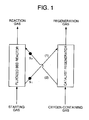
- Fig. 1 shows a schematic view of the fluidized bed reactor and the catalyst regenerator. That is, in Fig. 1, the catalyst is sampled from S 1 on a catalyst taking-out line (1) and S 2 on a catalyst recycling line (2) and the amount of carbonaceous substances accumulated on the catalyst is measured.
- the amount of carbonaceous substances accumulated on the catalyst in the reactor is controlled to be within a range of 0.1 to 10% by mass, preferably 0.3 to 5% by mass, it is sufficient that the amount of carbonaceous substances on each of the samples from S 1 and/or S 2 is within the above-mentioned range or that the mean of the amount values of carbonaceous substances on the samples from S 1 and S 2 is within this range.
- the alcohol and/or the ketone can be recovered by known recovery, separation and purification procedures such as cooling, distillation, extraction and the like.
- the unreacted alkene(s) is separated from the reaction mixture and then can, if necessary, be utilized as a portion of the starting material for the reaction by recycling.
- Recovered water obtained by liquefaction by cooling of the whole or a portion of water vapor used in the reaction can be reused in the reaction even if it contains reaction by-products to a certain extent.
- recovered water containing by-products such as acetone and acetic acid produced by the reaction of 1-butene can be reused in the reaction. This is a beneficial characteristic which permits marked reduction of a load of the disposal of a waste solution.
- the reaction mixture is cooled to condense MEK and water vapor.
- the cooled mixture was subjected to gas-liquid separation and then MEK is recovered from the condensate by distillation.
- the whole or a portion of recovered water containing by-products after the recovery of MEK is recycled to be fed to the reactor in the form of water vapor.
- MEK accompanying the gas phase is liquefied and recovered by compression and cooling, and the unreacted 1-butene and/or 2-butene are separated from light gases such as carbon dioxide and recycled to be fed to the reactor.
- the present invention is more specifically illustrated with the following examples and comparative examples.
- the present invention is not limited by these examples.
- Catalyst B having a different composition was prepared by substantially the same process as in Reference Example 1.
- the composition of this catalyst B was as follows: SnO 2 48% by mass, MoO 3 11% by mass, and SiO 2 41% by mass.
- the Mo/(Sn + Mo) atomic ratio of this catalyst B was 0.19, and catalyst B had a smoothly globular shape suitable for a fluidized bed catalyst and had a sufficient mechanical strength.
- Catalyst C having a different composition was prepared by substantially the same process as in Reference Example 1.
- the composition of this catalyst C was as follows: SnO 2 65% by mass, MoO 3 5% by mass, and SiO 2 30% by mass.
- the Mo/(Sn + Mo) atomic ratio of this catalyst C was 0.07, and catalyst C had a smoothly globular shape suitable for a fluidized bed catalyst and had a sufficient mechanical strength.
- Catalyst D was prepared by substantially the same process as in Reference Example 1.
- the composition of this catalyst D was as follows: SnO 2 31% by mass, MoO 3 30% by mass, and SiO 2 39% by mass.
- the Mo/(Sn + Mo) atomic ratio of this catalyst D was 0.50.
- molded product powder formed a mass and hence could not be uniformly calcined. Thus, catalyst D was unsuitable as a fluidized bed catalyst.
- Mo/(Sn + Mo) is preferably less than 0.50, more preferably 0.24 or less.
- Catalyst E comprising oxides of Cr and Mo was prepared by substantially the same process as in Reference Example 1 except for using chromium trichloride hexahydrate in place of stannic chloride pentahydrate.
- the composition of this catalyst E was as follows: Cr 2 O 3 42% by mass, MoO 3 17% by mass, and SiO 2 41% by mass.
- the Mo/(Cr + Mo) atomic ratio of this catalyst E was 0.18, and catalyst E had a smoothly globular shape suitable for a fluidized bed catalyst and had a sufficient mechanical strength.
- Catalyst F comprising oxides of Ti and Mo was prepared by substantially the same process as in Reference Example 1 except for using titanium tetrachloride in place of stannic chloride pentahydrate.
- the composition of this catalyst F was as follows: TiO 2 44% by mass, MoO 3 17% by mass, and SiO 2 39% by mass.
- the Mo/(Ti + Mo) atomic ratio of this catalyst F was 0.18, and catalyst F had a smoothly globular shape suitable for a fluidized bed catalyst and had a sufficient mechanical strength.
- Catalyst G comprising only an oxide of Sn was prepared by substantially the same process as in Reference Example 1 except for omitting ammonium molybdate.
- the composition of this catalyst G was as follows: SnO 2 45% by mass and SiO 2 55% by mass. This catalyst G had a smoothly globular shape suitable for a fluidized bed catalyst and had a sufficient mechanical strength.
- Catalyst H was prepared by substantially the same process as in Reference Example 1 except for using alumina sol as a portion of a carrier.
- the composition of this catalyst H was as follows: SnO 2 51% by mass, MoO 3 7% by mass, SiO 2 28% by mass, and Al 2 O 3 14% by mass.
- the Mo/(Sn + Mo) atomic ratio of this catalyst H was 0.13, and catalyst H had a smoothly globular shape suitable for a fluidized bed catalyst and had a mechanical strength higher than that attained by the use of a carrier composed of only silica.
- Catalyst A was packed into a reaction apparatus composed of a fluidized bed reactor and a catalyst regenerator and shown in Fig. 1, and fluidized bed reaction was carried out by a catalyst recycling system in which the reaction and the regeneration of the catalyst were continuously carried out while circulating catalyst A between the reactor and the regenerator.
- the reaction temperature was 250°C.
- a mixed gas of air and N 2 was fed to the regenerator.
- the regeneration temperature was 320°C.
- the ratio of the amount of the catalyst recycled i.e.
- the amount of the catalyst returned to the reactor from the regenerator) to the amount of 1-butene fed was 15 by mass, and the amount of carbonaceous substances accumulated on the catalyst to be returned to the reactor from the regenerator was 3.5% by mass.
- the above-mentioned reaction was continued for about 10 hours.
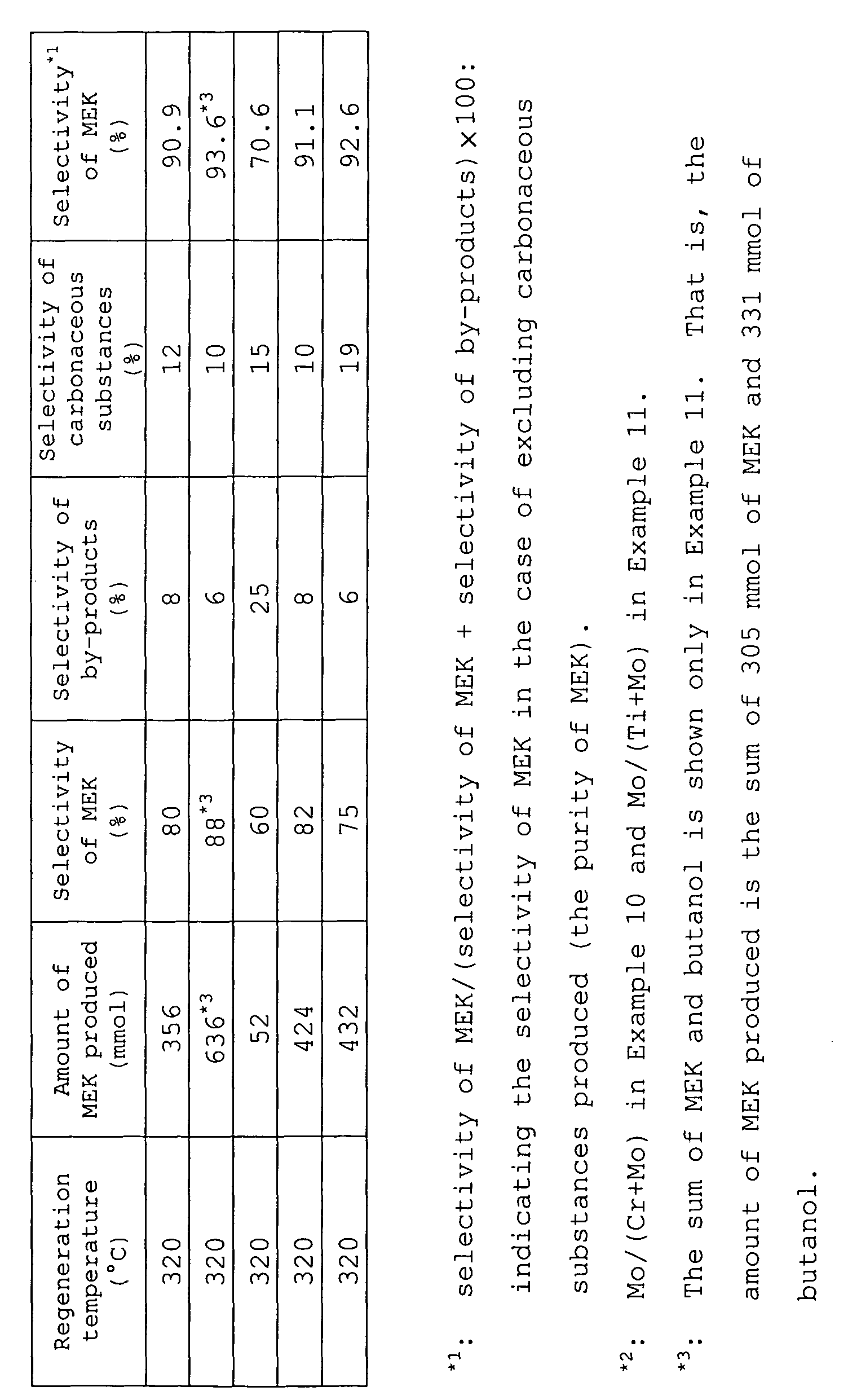
- a part of the reaction results obtained for 1 hour at any period during the reaction is shown in Table 1. The reaction results were substantially constant during the reaction.
- by-products in the table means CO 2 , CO, acetone, acetic acid, butyl alcohol, oligomers having 5 or more carbon atoms, and the like.
- Fluidized bed reaction was carried out by the catalyst recycling system under substantially the same conditions as in Example 1 except for changing the regeneration temperature to 600°C.
- the amount of carbonaceous substances accumulated on the catalyst to be returned to the reactor from the regenerator was 0.03% by mass, namely, carbonaceous substances on the catalyst had been substantially completely removed.
- the above-mentioned reaction was continued for about 10 hours.
- a part of the reaction results obtained for 1 hour at any period during the reaction is shown in Table 1. The reaction results were substantially constant during the reaction.
- Example 1 From comparison of Example 1 with Comparative Example 1, it can be seen that when the amount of carbonaceous substances accumulated on the catalyst to be returned to the reactor from the regenerator was controlled to be within a range of 0.1 to 10% by mass, the selectivity of MEK was greatly improved in spite of the equal amount of MEK produced because the production of fresh carbonaceous substances was suppressed.
- Example 1 reveals that the value of the selectivity of MEK obtained in the case of excluding carbonaceous substances produced, which indicates the purity of MEK produced, is very high, namely, the separation and purification of MEK is easy.
- Fluidized bed reaction was carried out by the catalyst recycling system under substantially the same conditions as in Example 1 except for reducing the amount of air fed to the regenerator.
- the amount of carbonaceous substances accumulated on the catalyst to be returned to the reactor from the regenerator was 3.3% by mass.
- the above-mentioned reaction was continued for about 10 hours.
- a part of the reaction results obtained for 1 hour at any period during the reaction is shown in Table 1. The reaction results were substantially constant during the reaction.
- WHSV weight hourly space velocity
- the amount of carbonaceous substances accumulated on the catalyst to be returned to the reactor from the regenerator was 3.1% by mass.
- the above-mentioned reaction was continued for about 10 hours.
- a part of the reaction results obtained for 1 hour at any period during the reaction is shown in Table 1. The reaction results were substantially constant during the reaction.
- Example 4 (the case where catalyst B was used and the ratio of the amount of the catalyst recycled to the amount of an alkene was 60)
- Fluidized bed reaction was carried out by the catalyst recycling system under substantially the same conditions as in Example 1 except for using catalyst B, changing the regeneration temperature to 280°C and changing the ratio of the amount of the catalyst recycled to the amount of 1-butene fed to 60 by mass.
- the amount of carbonaceous substances accumulated on the catalyst to be returned to the reactor from the regenerator was 3.7% by mass.
- the above-mentioned reaction was continued for about 10 hours.
- a part of the reaction results obtained for 1 hour at any period during the reaction is shown in Table 1. The reaction results were substantially constant during the reaction.
- Example 5 (the case where catalyst B was used and the amount of carbonaceous substances accumulated was 0.5% by mass)
- WHSV weight hourly space velocity
- the amount of carbonaceous substances accumulated on the catalyst to be returned to the reactor from the regenerator was 0.5% by mass.
- the above-mentioned reaction was continued for about 10 hours.
- a part of the reaction results obtained for 1 hour at any period during the reaction is shown in Table 1. The reaction results were substantially constant during the reaction.
- the amount of carbonaceous substances accumulated on the catalyst to be returned to the reactor from the regenerator was 2.5% by mass.
- the above-mentioned reaction was continued for about 10 hours. A part of the reaction results obtained for 1 hour at any period during the reaction is shown in Table 1. The reaction results were substantially constant during the reaction.
- Example 7 (the case where a solution recovered after the reaction and containing reaction by-products was reused)
- Fluidized bed reaction was carried out by the catalyst recycling system under substantially the same 5 conditions as in Example 1 except for using a residue obtained by separating MEK by distillation from the reaction solution described in Example 1, in place of water.
- This residue contained 4% by mass of acetic acid as by-product and 0.5% by mass of a high-boiling component.
- the amount of carbonaceous substances accumulated on the catalyst to be returned to the reactor from the regenerator was 3.5% by mass.
- the above-mentioned reaction was continued for about 10 hours. A part of the reaction results obtained for 1 hour at any period during the reaction is shown in Table 1. The reaction results were substantially constant during the reaction.
- Example 8 (the case where the starting alkene was replaced with C 4 raffinate-2)
- Fluidized bed reaction was carried out by the catalyst recycling system under substantially the same conditions as in Example 1 except for using C 4 raffinate-2 in place of 1-butene.
- C 4 raffinate-2 contained 78% of 1-butene and 2-butene (cis and trans), 18% of n-butane and isobutane, 1% of isobutene, 2% of 1,2- and 1,3-butadienes and a slight amount of minor constituents.
- the amount of carbonaceous substances accumulated on the catalyst to be returned to the reactor from the regenerator was 4.5% by mass.
- the above-mentioned reaction was continued for about 10 hours. A part of the reaction results obtained for 1 hour at any period during the reaction is shown in Table 1. The reaction results were substantially constant during the reaction.
- Example 9 (the case where a starting material contained TBA and MTBE)
- TSA tert-butyl alcohol
- MTBE methyl tert-butyl ether
- the above-mentioned reaction was continued for about 10 hours.
- a part of the reaction results obtained for 1 hour at any period during the reaction is shown in Table 1. The reaction results were substantially constant during the reaction.
- Example 10 (the case where catalyst E comprising oxides of Mo and Cr was used)
- Fluidized bed reaction was carried out by the catalyst recycling system under substantially the same conditions as in Example 1 except for using catalyst E.
- the amount of carbonaceous substances accumulated on the catalyst to be returned to the reactor from the regenerator was 3.3% by mass.
- the above-mentioned reaction was continued for about 10 hours.
- a part of the reaction results obtained for 1 hour at any period during the reaction is shown in Table 1. The reaction results were substantially constant during the reaction.
- Fluidized bed reaction was carried out by the catalyst recycling system under substantially the same conditions as in Example 1 except for using catalyst F.
- the amount of carbonaceous substances accumulated on the catalyst to be returned to the reactor from the regenerator was 3.7% by mass.
- the above-mentioned reaction was continued for about 10 hours.
- a part of the reaction results obtained for 1 hour at any period during the reaction is shown in Table 1. The reaction results were substantially constant during the reaction.
- Fluidized bed reaction was carried out by the catalyst recycling system under substantially the same conditions as in Example 1 except for using catalyst G.
- the amount of carbonaceous substances accumulated on the catalyst to be returned to the reactor from the regenerator was 1.0% by mass.
- the above-mentioned reaction was continued for about 10 hours.
- a part of the reaction results obtained for 1 hour at any period during the reaction is shown in Table 1. The reaction results were substantially constant during the reaction.
- Example 13 (the case of using a catalyst in which a carrier was silica-alumina)
- Fluidized bed reaction was carried out by the catalyst recycling system under substantially the same conditions as in Example 1 except for using catalyst H.
- the amount of carbonaceous substances accumulated on the catalyst to be returned to the reactor from the regenerator was 4.2% by mass.
- the above-mentioned reaction was continued for about 10 hours.
- a part of the reaction results obtained for 1 hour at any period during the reaction is shown in Table 1. The reaction results were substantially constant during the reaction.
- Example 14 (the case where carbonaceous substances were accumulated by pretreatment of a catalyst)
- a pretreater was provided between the regenerator and the reactor, and reaction was carried out in substantially the same manner as in Example 1.
- the amount of carbonaceous substances accumulated on the catalyst to be introduced into the pretreater from the regenerator was adjusted to such an amount that carbonaceous substances had been substantially completely removed as in Comparative Example 1.
- the catalyst was brought into contact with a gas consisting of 30% by volume of benzene, 20% by volume of 1,2- and 1,3-butadienes and 50 by volume of N 2 at 350°C to accumulate carbonaceous substances on the catalyst.
- the amount of carbonaceous substances accumulated on the catalyst to be returned to the reactor from the pretreater was 2.0% by mass.
- the above-mentioned reaction was continued for about 10 hours.
- a part of the reaction results obtained for 1 hour at any period during the reaction is shown in Table 1. The reaction results were substantially constant during the reaction.
- the production method of the present invention has an inhibitory effect on the accumulation of carbonaceous substances on the catalyst during the reaction and hence permits great improvement of the selectivity of the desired product(s). Therefore, it becomes possible to limit loss of the starting alkene(s) caused by the production of carbonaceous substances and reduce utility cost necessary for the regeneration of the catalyst, and the like.
- said method is provided as a production method of the above-mentioned desired product(s) which has a very high productivity.
Landscapes
- Chemical & Material Sciences (AREA)
- Organic Chemistry (AREA)
- Chemical Kinetics & Catalysis (AREA)
- Engineering & Computer Science (AREA)
- Materials Engineering (AREA)
- Health & Medical Sciences (AREA)
- Emergency Medicine (AREA)
- Organic Low-Molecular-Weight Compounds And Preparation Thereof (AREA)
- Low-Molecular Organic Synthesis Reactions Using Catalysts (AREA)
Abstract
Description
said oxide catalyst satisfies the following requirements:
- Gas chromatography:
- Shimadzu GC-17A (mfd. by Shimadzu Corp.)
- Capillary column:
- SPB-1 (Φ0.25 x 60 m) (mfd. by SPELCO Inc.)
- INJ temperature:
- 250°C FID temperature: 250°C
- Column temperature:
- 40°C x 10 min, heated at a rate of 5°C/min and maintained at 200°C for 8 min.
- Gas chromatography:
- Shimadzu GC-8A (mfd. by Shimadzu Corp.)
- Packed columns:
- parallel columns, i.e., Porapac Q
(Φ3 x 2 m) (Waters Co.) and MS-5A
(Φ3 x 3 m) (mfd. by Shimadzu Corp.) - INJ temperature:
- 70°C TCD temperature: 70°C
- Column temperature:
- maintained at 70°C
- CHN corder analyzer:
- Model MT-5 (mfd. by Yanaco)
- Chemical composition analyzer:
- EMPA (Scanning Electron Microanalyzer), X-650 (mfd. by Hitachi Ltd.)
- Amount of MEK produced (C mol) :
- the amount of MEK produced for 1 hour
- Selectivity of each component (mol%) :
- P/(F-L) x 100
- F:
- the amount of 1-butene and/or 2-butene fed (C mol)
- L:
- the amount of unreacted 1-butene and/or 2-butene (C mol)
- P:
- the amount of each component produced (C mol) 2-Butene, a product of isomerization of 1-butene was considered as an unreacted material because it can be reused as a starting material.


Claims (15)
- A method for producing an alcohol and/or a ketone from at least one corresponding alkene by bringing a starting material containing the alkene(s), as a gas phase into contact with an oxide catalyst in the presence of water vapor to carry out the reaction, wherein
said oxide catalyst satisfies the following requirements:(a) it comprises an oxide(s) of molybdenum and/or tin, and(b) the amount of carbonaceous substances accumulated on said oxide catalyst is controlled to be within a range of 0.1 to 10% by mass, during said reaction. - A method according to claim 1, which comprises recovering the unreacted alkene(s) and the alcohol and/or ketone from a reaction mixture obtained by said reaction, and recycling the unreacted alkene(s) as a portion of the starting material.
- A method according to claim 1 or 2, wherein in carrying out said reaction by a fluidized bed reaction system, a catalyst recycling system is adopted which comprises taking out the oxide catalyst used in the reaction from a reactor, regenerating said oxide catalyst in the presence of an oxygen-containing gas, and returning the regenerated oxide catalyst to the reactor.
- A method according to claim 3, wherein the amount of carbonaceous substances accumulated on the oxide catalyst to be returned to the reactor is controlled to be within a range of 0.1 to 10% by mass.
- A method according to claim 3 or 4, wherein the temperature at the regeneration of the oxide catalyst in the presence of the oxygen-containing gas is 270 to 550°C.
- A method according to any one of claims 3 to 5, wherein the mass ratio of the amount of the oxide catalyst returned to the reactor to the amount of the alkene(s) fed to the reactor ranges from 0.5 to 100.
- A method according to any one of claims 1 to 6, wherein the amount of carbonaceous substances accumulated on the oxide catalyst is controlled to be within a range of 0.3 to 5% by mass.
- A method according to any one of claims 1 to 7, wherein the atomic ratio X of molybdenum to the sum of tin and molybdenum in the oxide catalyst {Mo/(Sn + Mo); wherein Mo is the number of atoms of molybdenum in said oxide catalyst, and Sn is the number of atoms of tin in said oxide catalyst} is in a range excluding 0.29 and 0.51.
- A method according to any one of claims 1 to 7, wherein the atomic ratio X of molybdenum to the sum of tin and molybdenum in the oxide catalyst {Mo/(Sn + Mo); wherein Mo is the number of atoms of molybdenum in said oxide catalyst, and Sn is the number of atoms of tin in said oxide catalyst} is in a range of 0 ≤ X < 0.50 (excluding 0.29).
- A method according to any one of claims 1 to 7, wherein the atomic ratio X of molybdenum to the sum of tin and molybdenum in the oxide catalyst {Mo/(Sn + Mo); wherein Mo is the number of atoms of molybdenum in said oxide catalyst, and Sn is the number of atoms of tin in said oxide catalyst} is in a range of 0.01 ≤ X ≤ 0.24.
- A method according to any one of claims 1 to 10, wherein the molar ratio of the amount of oxygen gas fed to the reactor to the amount of the alkene(s) fed to the reactor ranges from 0.0 to 0.5.
- A method according to any one of claims 1 to 11, wherein the molar ratio of the amount of water vapor fed to the reactor to the amount of the alkene(s) fed to the reactor ranges from 0.05 to 10.0.
- A method according to any one of claims 1 to 12, wherein the whole or a portion of recovered water after said reaction is reused in said reaction.
- A method according to any one of claims 1 to 13, wherein the alkene(s) is 1-butene and/or 2-butene.
- A method according to claim 14, wherein the starting material containing 1-butene and/or 2-butene as the alkene(s) contains at least one compound selected from the group consisting of isobutene, butadiene, tert-butyl alcohol and methyl tert-butyl ether.
Applications Claiming Priority (3)
| Application Number | Priority Date | Filing Date | Title |
|---|---|---|---|
| JP2003000110 | 2003-01-06 | ||
| JP2003000110 | 2003-01-06 | ||
| PCT/JP2003/016722 WO2004060843A1 (en) | 2003-01-06 | 2003-12-25 | Process for producing alcohol and/or ketone |
Publications (2)
| Publication Number | Publication Date |
|---|---|
| EP1582510A1 true EP1582510A1 (en) | 2005-10-05 |
| EP1582510A4 EP1582510A4 (en) | 2006-07-05 |
Family
ID=32708760
Family Applications (1)
| Application Number | Title | Priority Date | Filing Date |
|---|---|---|---|
| EP03786307A Withdrawn EP1582510A4 (en) | 2003-01-06 | 2003-12-25 | PROCESS FOR PRODUCING ALCOHOL AND / OR KETONE |
Country Status (8)
| Country | Link |
|---|---|
| US (1) | US7291755B2 (en) |
| EP (1) | EP1582510A4 (en) |
| JP (1) | JP4547270B2 (en) |
| KR (1) | KR100636570B1 (en) |
| CN (1) | CN1735578A (en) |
| AU (1) | AU2003296112A1 (en) |
| TW (1) | TWI293291B (en) |
| WO (1) | WO2004060843A1 (en) |
Cited By (2)
| Publication number | Priority date | Publication date | Assignee | Title |
|---|---|---|---|---|
| EP1714954A4 (en) * | 2004-02-10 | 2008-02-13 | Maruzen Petrochem Co Ltd | PROCESS FOR PREPARING AN ALCOHOL AND / OR KETONE |
| US8581007B2 (en) | 2011-04-04 | 2013-11-12 | Exxonmobil Chemical Patents Inc. | Use of steam to reduce coking and/or metal dusting |
Families Citing this family (7)
| Publication number | Priority date | Publication date | Assignee | Title |
|---|---|---|---|---|
| US7482497B2 (en) * | 2007-06-27 | 2009-01-27 | H R D Corporation | Method of making alcohols |
| US7491856B2 (en) | 2007-06-27 | 2009-02-17 | H R D Corporation | Method of making alkylene glycols |
| AP2014008114A0 (en) * | 2012-05-09 | 2014-12-31 | Stranded Solutions Llc | Method of making oxygenates from a non-catalytic chemical reaction |
| CN108369162B (en) * | 2015-12-16 | 2021-08-27 | 环球油品公司 | Method and apparatus for catalyst sampling |
| CN108002967B (en) * | 2017-11-28 | 2021-01-29 | 万华化学集团股份有限公司 | Preparation method of tiglic aldehyde derivative |
| US11091701B2 (en) * | 2019-01-10 | 2021-08-17 | Saudi Arabian Oil Company | Conversion of olefinic naphthas by hydration to produce middle distillate fuel blending components |
| KR102325331B1 (en) * | 2019-12-20 | 2021-11-10 | 한화토탈 주식회사 | Method for isobutylene from tert-butanol |
Family Cites Families (12)
| Publication number | Priority date | Publication date | Assignee | Title |
|---|---|---|---|---|
| NL6713663A (en) * | 1967-10-07 | 1969-04-09 | ||
| US3636156A (en) * | 1968-04-25 | 1972-01-18 | Idemitsu Petrochemical Co | Process for the direct production of ketones from olefins |
| NL163764C (en) * | 1969-11-12 | 1980-10-15 | Stamicarbon | PROCESS FOR PREPARING ALKANONES FROM OLEFINS |
| US4022837A (en) * | 1970-07-24 | 1977-05-10 | Chevron Research Company | Production of ketones from alkenes, hydrated molybdenum(VI) oxide and water |
| JPS478046U (en) | 1971-02-23 | 1972-09-29 | ||
| NL7207938A (en) * | 1972-06-12 | 1973-12-14 | ||
| JPS5211782B2 (en) | 1972-08-03 | 1977-04-02 | ||
| JPS5320485B2 (en) | 1972-11-22 | 1978-06-27 | ||
| US4737482A (en) * | 1983-07-25 | 1988-04-12 | Exxon Research & Engineering Co. | Catalysts for oxidation of olefins to ketones |
| US4560804A (en) * | 1982-09-21 | 1985-12-24 | Exxon Research & Engineering Co. | Catalytic process for the manufacture of ketones |
| JPS59163335A (en) | 1983-03-09 | 1984-09-14 | Tokuyama Soda Co Ltd | Gas phase oxidation method for olefins |
| JP2610090B2 (en) | 1993-03-12 | 1997-05-14 | 株式会社日本触媒 | How to remove solid organic matter |
-
2003
- 2003-12-25 EP EP03786307A patent/EP1582510A4/en not_active Withdrawn
- 2003-12-25 AU AU2003296112A patent/AU2003296112A1/en not_active Abandoned
- 2003-12-25 CN CNA200380108304XA patent/CN1735578A/en active Pending
- 2003-12-25 WO PCT/JP2003/016722 patent/WO2004060843A1/en not_active Ceased
- 2003-12-25 JP JP2004564523A patent/JP4547270B2/en not_active Expired - Fee Related
- 2003-12-25 KR KR1020057012608A patent/KR100636570B1/en not_active Expired - Fee Related
- 2003-12-25 US US10/541,367 patent/US7291755B2/en not_active Expired - Lifetime
- 2003-12-30 TW TW092137509A patent/TWI293291B/en not_active IP Right Cessation
Cited By (2)
| Publication number | Priority date | Publication date | Assignee | Title |
|---|---|---|---|---|
| EP1714954A4 (en) * | 2004-02-10 | 2008-02-13 | Maruzen Petrochem Co Ltd | PROCESS FOR PREPARING AN ALCOHOL AND / OR KETONE |
| US8581007B2 (en) | 2011-04-04 | 2013-11-12 | Exxonmobil Chemical Patents Inc. | Use of steam to reduce coking and/or metal dusting |
Also Published As
| Publication number | Publication date |
|---|---|
| WO2004060843A1 (en) | 2004-07-22 |
| AU2003296112A1 (en) | 2004-07-29 |
| TW200418780A (en) | 2004-10-01 |
| KR20050088246A (en) | 2005-09-02 |
| JPWO2004060843A1 (en) | 2006-05-11 |
| KR100636570B1 (en) | 2006-10-19 |
| JP4547270B2 (en) | 2010-09-22 |
| CN1735578A (en) | 2006-02-15 |
| US20060173220A1 (en) | 2006-08-03 |
| EP1582510A4 (en) | 2006-07-05 |
| TWI293291B (en) | 2008-02-11 |
| US7291755B2 (en) | 2007-11-06 |
Similar Documents
| Publication | Publication Date | Title |
|---|---|---|
| EP2830758B1 (en) | Process for making ethylene and acetic acid | |
| JP5529547B2 (en) | Selective oxidation of alkanes and / or alkenes to beneficial oxygenates | |
| US20020123647A1 (en) | Recycle process | |
| RU2725646C2 (en) | Oxidative dehydrogenation of ethane and extraction of acetic acid | |
| UA104257C2 (en) | ONE-STAGE METHOD OF OBTAINING BUTADIEN | |
| KR20120025471A (en) | A process for producing an unsaturated carboxylic acid from an alkane | |
| UA129024C2 (en) | OXIDATIVE DEHYDROGENATION OF ETHANE | |
| US7291755B2 (en) | Process for producing alcohol and/or ketone | |
| CN103596909B (en) | Aliphatic ketone and/or other oxygenatedchemicalss are prepared in alkane heterogeneous catalysis gaseous oxidation | |
| KR19980071834A (en) | Process for preparing Icrylic acid from acrolein by redox reaction and use of solid mixed oxide composition as redox system in the reaction | |
| KR20080096686A (en) | Use of chemical reactions to produce acetic acid by separating ethylene from ethane in ethane-based processes | |
| JPH06228073A (en) | Nitrile manufacturing method | |
| EP0428413B1 (en) | Method for preparing unsaturated compounds | |
| KR100757719B1 (en) | Method for producing alcohol and/or ketone | |
| JP2005225781A (en) | Method for producing butyl alcohol and / or methyl ethyl ketone | |
| Idriss et al. | Reductive coupling of cyclic ketones on reduced TiO2 (001) single crystal surfaces | |
| JP2005225779A (en) | Method for producing alcohol and / or ketone | |
| JP2005225778A (en) | Process for producing alcohol and / or ketone | |
| JP2005225780A (en) | Method for producing alcohol and / or ketone | |
| JPS6366141A (en) | Production of methacrolein | |
| JPH1081660A (en) | Method for producing unsaturated nitrile | |
| JPH0741439A (en) | Purification method of monoalkenylbenzenes | |
| BE614404A (en) | ||
| JPH0729974B2 (en) | Method for producing 2-methyl-1,4-naphthoquinone | |
| JPH0653692B2 (en) | Process for producing β-methyl-δ-valerolactone and 3-methylpentane-1,5-diol |
Legal Events
| Date | Code | Title | Description |
|---|---|---|---|
| PUAI | Public reference made under article 153(3) epc to a published international application that has entered the european phase |
Free format text: ORIGINAL CODE: 0009012 |
|
| 17P | Request for examination filed |
Effective date: 20050615 |
|
| AK | Designated contracting states |
Kind code of ref document: A1 Designated state(s): AT BE BG CH CY CZ DE DK EE ES FI FR GB GR HU IE IT LI LU MC NL PT RO SE SI SK TR |
|
| AX | Request for extension of the european patent |
Extension state: AL LT LV MK |
|
| DAX | Request for extension of the european patent (deleted) | ||
| RAP1 | Party data changed (applicant data changed or rights of an application transferred) |
Owner name: MARUZEN PETROCHEMICAL CO. LTD. |
|
| A4 | Supplementary search report drawn up and despatched |
Effective date: 20060601 |
|
| 17Q | First examination report despatched |
Effective date: 20090630 |
|
| GRAC | Information related to communication of intention to grant a patent modified |
Free format text: ORIGINAL CODE: EPIDOSCIGR1 |
|
| GRAP | Despatch of communication of intention to grant a patent |
Free format text: ORIGINAL CODE: EPIDOSNIGR1 |
|
| RIC1 | Information provided on ipc code assigned before grant |
Ipc: C07C 45/28 20060101ALI20111109BHEP Ipc: C07C 29/04 20060101ALI20111109BHEP Ipc: C07B 61/00 20060101ALI20111109BHEP Ipc: C07C 49/10 20060101ALI20111109BHEP Ipc: C07C 45/35 20060101ALI20111109BHEP Ipc: C07C 31/12 20060101ALI20111109BHEP Ipc: C07C 27/14 20060101AFI20111109BHEP |
|
| STAA | Information on the status of an ep patent application or granted ep patent |
Free format text: STATUS: THE APPLICATION IS DEEMED TO BE WITHDRAWN |
|
| 18D | Application deemed to be withdrawn |
Effective date: 20120403 |