EP1580739A1 - An object comprising a functional layer - Google Patents
An object comprising a functional layer Download PDFInfo
- Publication number
- EP1580739A1 EP1580739A1 EP04075894A EP04075894A EP1580739A1 EP 1580739 A1 EP1580739 A1 EP 1580739A1 EP 04075894 A EP04075894 A EP 04075894A EP 04075894 A EP04075894 A EP 04075894A EP 1580739 A1 EP1580739 A1 EP 1580739A1
- Authority
- EP
- European Patent Office
- Prior art keywords
- macro
- rotaxane
- functional layer
- polymer
- chain
- Prior art date
- Legal status (The legal status is an assumption and is not a legal conclusion. Google has not performed a legal analysis and makes no representation as to the accuracy of the status listed.)
- Withdrawn
Links
Classifications
-
- G—PHYSICS
- G11—INFORMATION STORAGE
- G11B—INFORMATION STORAGE BASED ON RELATIVE MOVEMENT BETWEEN RECORD CARRIER AND TRANSDUCER
- G11B7/00—Recording or reproducing by optical means, e.g. recording using a thermal beam of optical radiation by modifying optical properties or the physical structure, reproducing using an optical beam at lower power by sensing optical properties; Record carriers therefor
- G11B7/24—Record carriers characterised by shape, structure or physical properties, or by the selection of the material
- G11B7/241—Record carriers characterised by shape, structure or physical properties, or by the selection of the material characterised by the selection of the material
- G11B7/242—Record carriers characterised by shape, structure or physical properties, or by the selection of the material characterised by the selection of the material of recording layers
- G11B7/244—Record carriers characterised by shape, structure or physical properties, or by the selection of the material characterised by the selection of the material of recording layers comprising organic materials only
- G11B7/245—Record carriers characterised by shape, structure or physical properties, or by the selection of the material characterised by the selection of the material of recording layers comprising organic materials only containing a polymeric component
-
- G—PHYSICS
- G11—INFORMATION STORAGE
- G11B—INFORMATION STORAGE BASED ON RELATIVE MOVEMENT BETWEEN RECORD CARRIER AND TRANSDUCER
- G11B7/00—Recording or reproducing by optical means, e.g. recording using a thermal beam of optical radiation by modifying optical properties or the physical structure, reproducing using an optical beam at lower power by sensing optical properties; Record carriers therefor
- G11B7/24—Record carriers characterised by shape, structure or physical properties, or by the selection of the material
- G11B7/241—Record carriers characterised by shape, structure or physical properties, or by the selection of the material characterised by the selection of the material
- G11B7/242—Record carriers characterised by shape, structure or physical properties, or by the selection of the material characterised by the selection of the material of recording layers
- G11B7/244—Record carriers characterised by shape, structure or physical properties, or by the selection of the material characterised by the selection of the material of recording layers comprising organic materials only
Definitions
- Objects comprising a functional layer are known.
- Such an object for example is a CD or a DVD, which are used for the storage of data, for example as music, as pictures and films or as computer programs and files.
- Object of the present invention therefore is to provide an object comprising a functional layer in which layer data storage with a high density is possible.
- the functional layer comprises a polymer, which polymer comprises rotaxane and/or catenane units.
- rotaxane units Polymers comprising rotaxane units and their preparation are for example described by J. Kidd, J.A. Loontjens et. al. in Angewandte Chemie, International Edition, Ed. 2003, 42, p.3379-3383.
- the rotaxane units for example are part of a polymeric chain or a molecular network. It is for example also possible for the rotaxane units to be present as side groups of a polymeric chain.
- the skilled person knows how to apply the functional layer on an object, for example a carrier, for example by applying the polymers as a coating.
- the invention also relates to an object comprising a functional layer, which layer has been functionalized, for example by applying information to the layer.
- a functional layer which layer has been functionalized, for example by applying information to the layer.
- This is for example possible by using an external stimulus, for example a very fine laser beam.
- the information is applied by using a 2 foton exitation laser beam or by using Atomic Force Microscopy (AFM), which technologies make it possible to apply the external stimulus to obtain a very fine pattern.
- FAM Atomic Force Microscopy
- By using the external stimulus it is possible to change the morphology of the surface of the functional layer, so that if the layer is treated in a pattern, the pattern is brought onto the functional layer.
- the layer It is also possible to provide further functionalities to the layer. It is for example possible to provide a surface roughness on a nano scale, so that for example the layer obtains anti-reflective properties.
- a still further improved object comprising the functional layer is obtained, if the functional layer comprises a polymer comprising rotaxane or catenane units, in which units the macro-cyclic compound can be located at a first as well as at a second position. Such a position is also referred to as station. In this way it is even possible to store information at a molecular level.
- the polymer comprises rotaxane units for this purpose.
- a rotaxane suitable for that purpose is obtained, if the rotaxane comprises a first and a second group that are both suitable to physically bind the macro-cyclic compound, and at least one of the groups is prone to an external stimulus to alter its attraction to the macro-cyclic compound. In this way the groups act as the stations. Groups that are prone to external stimuli are for example described by David A. Leigh in Nature, Vol. 424, 10 July 2003, p. 174-179.
- the macro-cyclic compound By applying a first external stimulus, for example reducing the attraction for the macro-cyclic compound of the first group, the macro-cyclic compound will move away from the first group to the second group and be physically bonded by that group. If for example the attraction of the second group is reduced by a second external stimulus the macro-cyclic compound will move from the second to the first group and be physically bonded by that. In this way it is possible to place the macro-cyclic compound at one of two positions, providing a 0 or 1 position for data storage.
- the macro-cyclic compound is also understood to be at one of the two positions, if it is preferentially at this one position, for example if the compound is translating frequently from the first to the second position, but if it is for more than 50% located at the first position.
- the polyrotaxanes are pressed for 20 minutes at 180 °C between two mylar foils to get a flat film with a low roughness.
- the films did not adhere to the mylar foils, so that it easily could be removed.
- the resulting films have a thickness of 0.4 mm and average roughness of 4 nm.
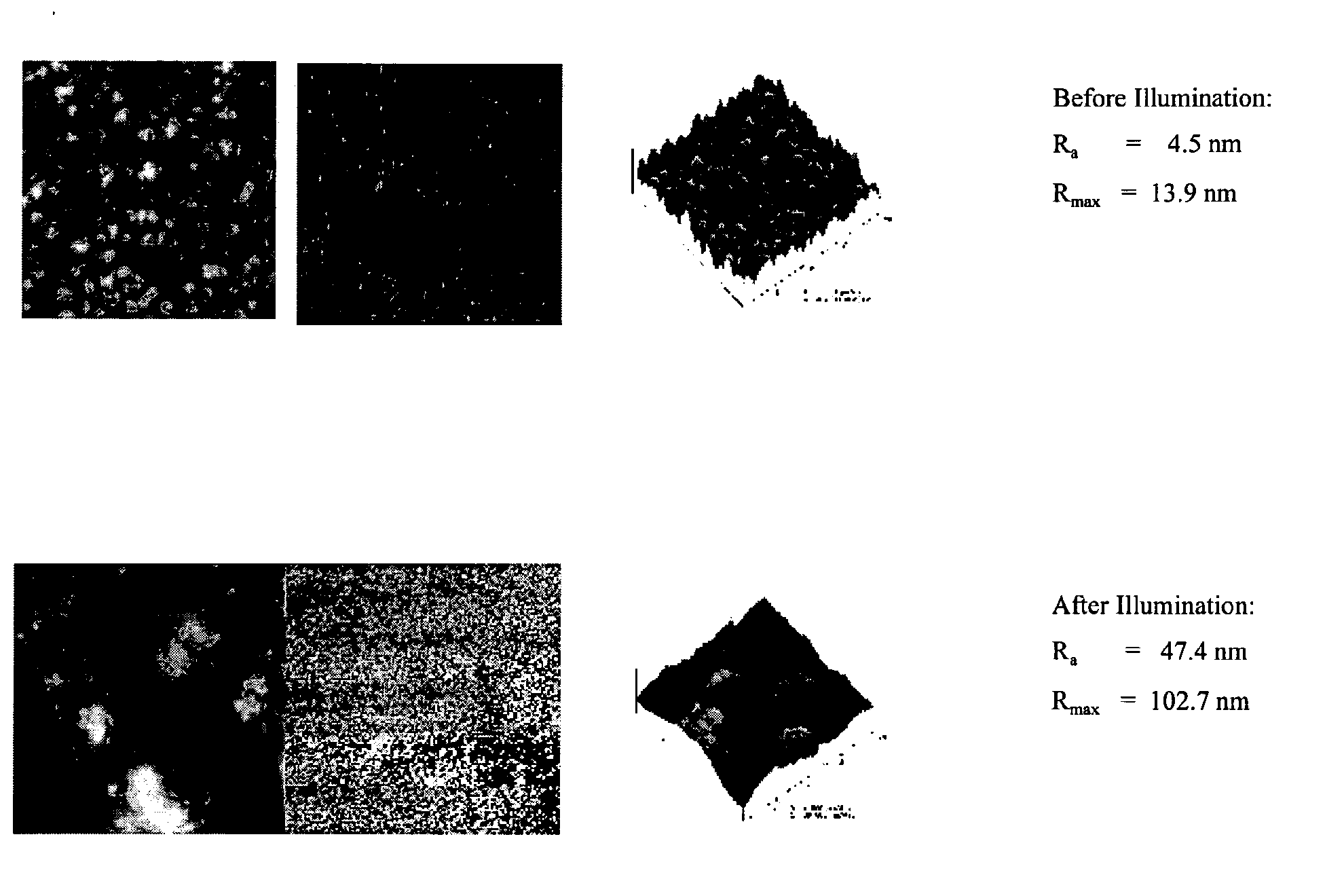
- the roughness of the films was measured before and after UV-illumination.
- AFM images were taken in air using a NanoscopeTM llla (digital instrument) equipped with a J-Scanner. The scan were carried out in the Tapping Mode. The images are shown below.
- the film is irradiated with UV-Light (254 nm) for 15 minutes.
- the surface of the film before UV- illumination has a mean roughness of approx. 4 nm and a maximum height of 14 nm.
- Blank samples (same system without macro-cycle and other polymers containing a fumaric-/maleic acid system) show no changes in surface properties.
- Example 2 Polymer comprising rotaxane, suitable for storage of information at molecular level:
- the polymer comprising the rotaxane is prepared according to the method described earlier. We obtained comparable yields.
- the polymer comprising the rotaxane is heated under Nitrogen for 6 days at 120°C.
- the heated polyrotaxane is irradiated for 1 h with UV-Light (254 nm).
- H-NMR proves that the macro-cycle is moved from station A (succinamid) to Station B (maleic amid/fumaric amid) and back by external stimulation. This allows storing information on a molecular level by moving the macro-cycle.
Landscapes
- Heterocyclic Compounds That Contain Two Or More Ring Oxygen Atoms (AREA)
Abstract
Object comprising a functional layer in which layer data storage with
a high density is possible. The functional layer comprises a polymer, which polymer
comprises rotaxane and/or catenane units.
A rotaxane comprises a molecular chain, around which chain a
macro-cyclic compound is located, having no chemical bonding with the chain. For this
reason the macro-cyclic compound is able to rotate around and/or translate along the
chain. Preferably the macro-cyclic compound is locked up between two bulky groups
attached to the chain.
Description
- The invention relates to an object comprising a functional layer and an object comprising such a functional layer, which functional layer has been functionalized.
- Objects comprising a functional layer are known. Such an object for example is a CD or a DVD, which are used for the storage of data, for example as music, as pictures and films or as computer programs and files.
- There is a need for such objects comprising a functional layer suitable for data storage with a high density, or even higher density than the known objects for that purpose. This makes it possible to make equipment smaller and it increases the possibilities in use.
- Object of the present invention therefore is to provide an object comprising a functional layer in which layer data storage with a high density is possible.
- Surprisingly this object is achieved because the functional layer comprises a polymer, which polymer comprises rotaxane and/or catenane units.
- A rotaxane and a catenane comprise a molecular chain, around which chain a macro-cyclic compound is located, having no chemical bonding with the chain. For this reason the macro-cyclic compound is able to rotate around and/or translate along the chain. The molecular chain is also referred to in literature as "thread". Preferably the functional layer comprises a polymer, which polymer comprises rotaxane units. In a rotaxe the macro-cyclic compound is locked up between two bulky groups attached to each end of the thread.
- Rotaxane is for example described by David A. Leigh et al. in Angewandte Chemie, Int. Ed. Engl. 36, No. 7 (1997), p. 728 - 731 and by Albert M. Brouwer et. al. in Science, Vol. 291, 16 maart 2001, p. 2124 - 2128. Catanene is for example described by David A. Leigh in Nature, Vol. 424, 10 July 2003, p. 174-179.
- Polymers comprising rotaxane units and their preparation are for example described by J. Kidd, J.A. Loontjens et. al. in Angewandte Chemie, International Edition, Ed. 2003, 42, p.3379-3383. The rotaxane units for example are part of a polymeric chain or a molecular network. It is for example also possible for the rotaxane units to be present as side groups of a polymeric chain.
- The skilled person knows how to apply the functional layer on an object, for example a carrier, for example by applying the polymers as a coating.
- Good results are obtained by dissolving the polymer in a solvent, applying the so obtained solution to the object with one of the known coating techniques and by finally evaporating the solvent.
- By J. Kidd, J.A. Loontjens et. al. it is described in Angewandte Chemie, International Edition, Ed. 2003, 42, p.3379-3383 to attach to both ends of a rotaxane a blocked isocynate group, to mix the so obtained rotaxane with a comonomer, for example jeffamine and to polymerize the mixture to obtain a polymer, comprising the rotaxane units. Applying the mixture to an object as a coating and by polymerizing the mixture afterwards is also a suitable process for obtaining an object comprising a functional layer according to the invention.
- The invention also relates to an object comprising a functional layer, which layer has been functionalized, for example by applying information to the layer. This is for example possible by using an external stimulus, for example a very fine laser beam. Preferably the information is applied by using a 2 foton exitation laser beam or by using Atomic Force Microscopy (AFM), which technologies make it possible to apply the external stimulus to obtain a very fine pattern. By using the external stimulus it is possible to change the morphology of the surface of the functional layer, so that if the layer is treated in a pattern, the pattern is brought onto the functional layer.
- It is also possible to provide further functionalities to the layer. It is for example possible to provide a surface roughness on a nano scale, so that for example the layer obtains anti-reflective properties.
- A still further improved object comprising the functional layer is obtained, if the functional layer comprises a polymer comprising rotaxane or catenane units, in which units the macro-cyclic compound can be located at a first as well as at a second position. Such a position is also referred to as station. In this way it is even possible to store information at a molecular level. Preferably the polymer comprises rotaxane units for this purpose. A rotaxane suitable for that purpose is obtained, if the rotaxane comprises a first and a second group that are both suitable to physically bind the macro-cyclic compound, and at least one of the groups is prone to an external stimulus to alter its attraction to the macro-cyclic compound. In this way the groups act as the stations. Groups that are prone to external stimuli are for example described by David A. Leigh in Nature, Vol. 424, 10 July 2003, p. 174-179.
- It is also possible that two or more of the groups are prone to an external stimulus to alter their attraction to the macro-cyclic compound. In this case best results are obtained if the different groups are prone to different stimuli.
- By applying a first external stimulus, for example reducing the attraction for the macro-cyclic compound of the first group, the macro-cyclic compound will move away from the first group to the second group and be physically bonded by that group. If for example the attraction of the second group is reduced by a second external stimulus the macro-cyclic compound will move from the second to the first group and be physically bonded by that. In this way it is possible to place the macro-cyclic compound at one of two positions, providing a 0 or 1 position for data storage. The macro-cyclic compound is also understood to be at one of the two positions, if it is preferentially at this one position, for example if the compound is translating frequently from the first to the second position, but if it is for more than 50% located at the first position.
- Example of the invention will be given below, however without limiting the scoop of the invention.
- Three different rotaxanes (one suitable for positioning the macro-cycle in the mainchain, the second one suitable for positioning the macro-cycle in the sidechain and the third one for positioning the macro-cycle in a network) were prepared according to J. Kidd, J.A. Loontjens and co-authors in Angewandte Chemie, International Edition, Ed. 2003, 42, p.3379-3383. About the same yields were obtained.
- A mixture of the rotaxane and Jeffamine® D400 (1.0 eq for the first and the second rotaxane, 2.0 eq for the third rotaxane) were dissolved in dichloromethane and mixed thoroughly. The solvent was removed under reduced pressure and the dry mixture heated to 175 °C under an atmosphere of nitrogen for one hour. After cooling at room temperature a colorless solid was obtained that was dissolved in dichloromethane, followed by precipitation into diethylether. The resultant solid was filtered and dried to obtain the polymer comprising the rotaxane units as a colorless solid.
- The polyrotaxanes are pressed for 20 minutes at 180 °C between two mylar foils to get a flat film with a low roughness. The films did not adhere to the mylar foils, so that it easily could be removed. The resulting films have a thickness of 0.4 mm and average roughness of 4 nm.
- The roughness of the films was measured before and after UV-illumination. For this purpose AFM images were taken in air using a Nanoscope™ llla (digital instrument) equipped with a J-Scanner. The scan were carried out in the Tapping Mode. The images are shown below.
- To change the surface properties the film is irradiated with UV-Light (254 nm) for 15 minutes.
- The surface of the film before UV- illumination has a mean roughness of approx. 4 nm and a maximum height of 14 nm.
- After UV illumination the mean Roughness becomes approx. 47 nm and the maximum height increases to more than 100 nm.
- Blank samples (same system without macro-cycle and other polymers containing a fumaric-/maleic acid system) show no changes in surface properties.
- It was clearly observed by the surface roughness measurements that the films comprising the polymer comprising the rotaxane units can easily be surface modified, suitable for example for data storage, while the film not comprising this polymer was not affected.
-
-
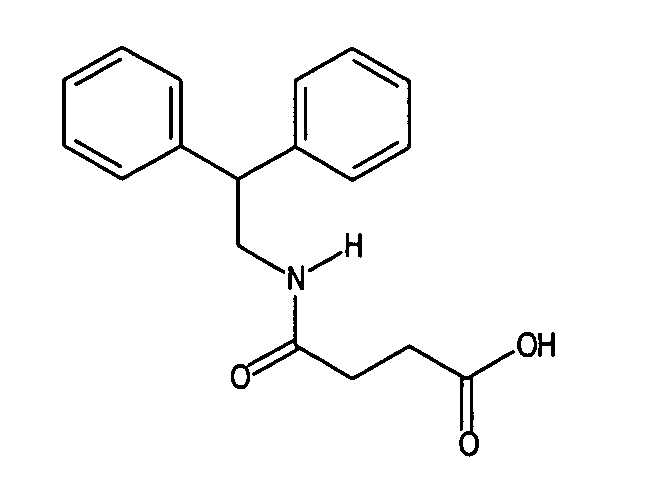
- To a stirred solution of succinic anhydride (5.06 g, 50.6 mmol) in anhydrous THF (50 mL) was added at RT drop wise a solution of 2,2-Diphenylethylamine (10.0 g, 50.6 g) in anhydrous THF (60 mL). After 16 h the solvent was removed under reduced pressure and the resulting colorless solid recrystallized in dichloromethane. Yield: 83 %
-
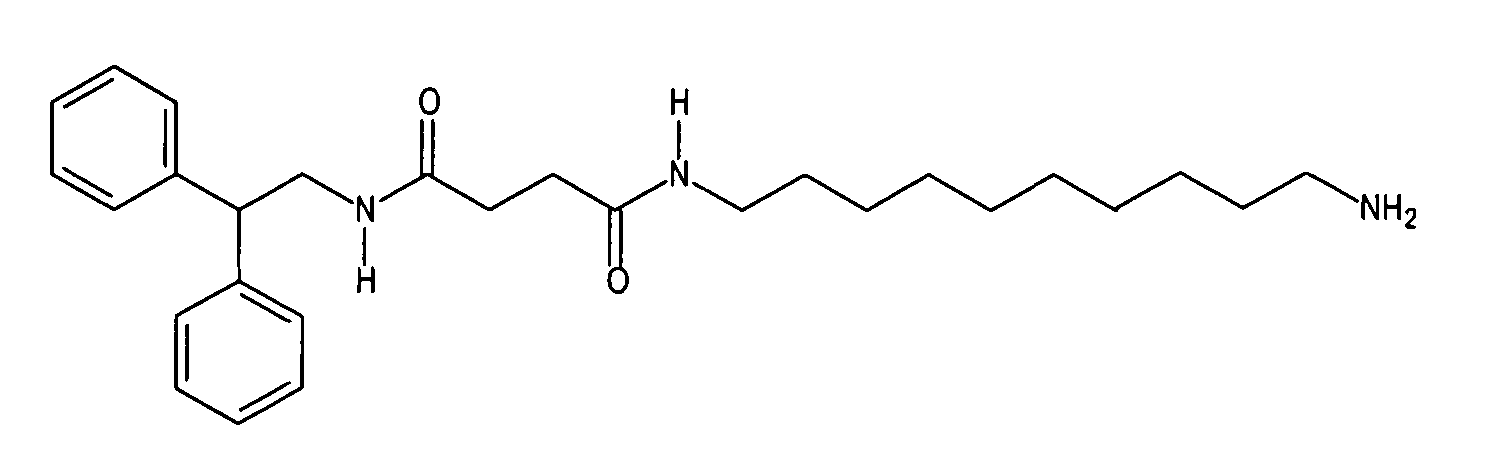
- A solution of N-(2,2-diphenylethyl)-succinamic acid (2.5 g, 8.5 mmol), N-BOC-decyldiamine (2.4 g, 8.5 mmol) and 4- dimethylaminopyridin (0.2 g, 1.5 mmol) in Chloroform (150 mL) was stirred at 0°C for 10 minutes followed by addition of EDCI-HCI (1.5 g, 8 mmol). After 16 h the reaction mixture was washed with 1 N HCI, saturated NaHCO3 and brine. After that the product was dried over MgSO4, filtered and the filtrate concentrated to give a colorless solid. 100 mL of ethyl acetate and 100 mL 4 N HCI were added and the mixture stirred at room temperature. After 6 h the solution was neutralized with 3 N NaOH and washed with 1 N NaOH, brine, dried over anhydrous MgSO4, filtered and the filtrate concentrated to give the product as a colorless solid. Yield: 45 %
-

- To a stirred solution of maleic acid anhydride (5.0 g, 50.6 mmol) in anhydrous THF (50 mL) was added at room tempearature drop wise a solution of 2-oxo-N-{6-[(6-{{(2-oxo-1-azepanyl)carbonyl}amino} hexyl)amino]hexyl}-1-azepane carboxamide (38.0 g, 50.6 mmol) in anhydrous THF (150 mL). After 16 h the THF was removed under reduced pressure and the resulting product taken up with chloroform (100 mL) and washed with a solution of 1 N NaOH and Water. After that the so obtained mixture comprising the product and the chloroform was dried over magnesiumsulfate, filtered and the cloroform was removed under reduced pressure to obtain a colorless solid, which was recrystallized from dichloromethane. Yield: 91 %
-

- Dicyclohexylcarbodiimide (1.21 g, 5.9 mmol) was added to a stirred solution of N4,N4-bis(6-{[(2-oxo-1-azepanyl)carbonyl]amino}hexyl)-malenamid acid (3.37 g, 5.9 mmol), N-(10-Aminodecyl)-N'-(2,2-diphenylethyl)-succinamide (2.5 g, 5.7 mmol) and 4-dimethylaminopyridine (0.15 g, 1.2 mmol) in anhydrous tetrahydrofuran (20 mL). The resultant mixture was stirred for twelve hours at room temperature and then filtered to remove precipitated dicyclohexylurea. After that the mixture was dried over MgSO4, filtered and the filtrate concentrated to give a yellow solid that was subjected to column chromatography using a solvent gradient of chloroform to chloroform/methanol (95/5) to obtain a colorless solid. Yield: 28 %
-

- Separate solutions of isophthaloyl chloride (1.98 g, 9.7 mmol) and p-xylylene diamine (1.32 g, 9.7 mmol) in anhydrous chloroform (50 mL each) were added drop wise via syringe to a stirred solution of the "thread" (0.75 g, 0.8 mmol) and triethylamine (1.97 g, 19.5 mmol) also in anhydrous chloroform (100 mL) over a period of two hours. After which time, ethanol (10 mL) was added and the reaction filtered. The resultant solution was washed with distilled water (2 x 250 mL) followed by 0.2 M hydrochloride acid (2 x 250 mL) and the saturated aqueous sodium hydrogen carbonate solution (2 x 250 mL). The resulting product was then dried over magnesium sulfate and the solvent was removed under reduced pressure to afford a pale yellow solid that was subjected to column chromatography using a solvent THF/chloroform (1/2) to obtain a colorless solid.
Yield: 25 % - (H-NMR proves that the macro-cycle is at the succinamid (Station A; protons are shifting from 2.39 ppm to 0.95 ppm in CHCl3) while the signals from the maleic amid (Station B) are still at the same position (6.2 and 5.9 ppm).
- The polymer comprising the rotaxane is prepared according to the method described earlier. We obtained comparable yields.
- The polymer comprising the rotaxane is heated under Nitrogen for 6 days at 120°C.
- H-NMR proves that the macro-cycle moved away from station A to station B. (Signals from succinamid with macro-cycle close to it 0.95 ppm in CHCl3 vanishes)
- The heated polyrotaxane is irradiated for 1 h with UV-Light (254 nm).
- (H-NMR proves that the macro-cycle moved again to station A. (Signals from succinamid with macro-cycle close to it at 0.95 ppm in CHCl3 are visible))
- H-NMR proves that the macro-cycle is moved from station A (succinamid) to Station B (maleic amid/fumaric amid) and back by external stimulation. This allows storing information on a molecular level by moving the macro-cycle.
Claims (2)
- Object comprising a functional layer, characterized in that the functional layer comprises a polymer, which polymer comprises rotaxane and/or catenane units.
- Object comprising a functional layer as claimed in claim 1, which functional layer has been functionalized.
Priority Applications (1)
| Application Number | Priority Date | Filing Date | Title |
|---|---|---|---|
| EP04075894A EP1580739A1 (en) | 2004-03-23 | 2004-03-23 | An object comprising a functional layer |
Applications Claiming Priority (1)
| Application Number | Priority Date | Filing Date | Title |
|---|---|---|---|
| EP04075894A EP1580739A1 (en) | 2004-03-23 | 2004-03-23 | An object comprising a functional layer |
Publications (1)
| Publication Number | Publication Date |
|---|---|
| EP1580739A1 true EP1580739A1 (en) | 2005-09-28 |
Family
ID=34854656
Family Applications (1)
| Application Number | Title | Priority Date | Filing Date |
|---|---|---|---|
| EP04075894A Withdrawn EP1580739A1 (en) | 2004-03-23 | 2004-03-23 | An object comprising a functional layer |
Country Status (1)
| Country | Link |
|---|---|
| EP (1) | EP1580739A1 (en) |
Cited By (1)
| Publication number | Priority date | Publication date | Assignee | Title |
|---|---|---|---|---|
| WO2024165039A1 (en) * | 2023-02-08 | 2024-08-15 | Shanghai Circode Biomed Co., Ltd. | Lipid compounds, lipid nanoparticles, and pharmaceutical compositions |
Citations (5)
| Publication number | Priority date | Publication date | Assignee | Title |
|---|---|---|---|---|
| US6096464A (en) * | 2000-01-27 | 2000-08-01 | Xerox Corporation | Photoreceptor including rotaxanes |
| US20020105897A1 (en) * | 2001-01-05 | 2002-08-08 | Mccreery Richard L. | Chemical monolayer and micro-electronic junctions and devices containing same |
| US20020172072A1 (en) * | 2001-03-27 | 2002-11-21 | Yong Chen | Molecular memory systems and methods |
| US20030168675A1 (en) * | 2000-08-09 | 2003-09-11 | Franz Hofmann | Memory element and method for fabricating a memory element |
| EP1376606A1 (en) * | 2002-06-20 | 2004-01-02 | STMicroelectronics S.r.l. | A molecular memory obtained using DNA strand molecular switches and carbon nanotubes, and manufacturing method thereof |
-
2004
- 2004-03-23 EP EP04075894A patent/EP1580739A1/en not_active Withdrawn
Patent Citations (5)
| Publication number | Priority date | Publication date | Assignee | Title |
|---|---|---|---|---|
| US6096464A (en) * | 2000-01-27 | 2000-08-01 | Xerox Corporation | Photoreceptor including rotaxanes |
| US20030168675A1 (en) * | 2000-08-09 | 2003-09-11 | Franz Hofmann | Memory element and method for fabricating a memory element |
| US20020105897A1 (en) * | 2001-01-05 | 2002-08-08 | Mccreery Richard L. | Chemical monolayer and micro-electronic junctions and devices containing same |
| US20020172072A1 (en) * | 2001-03-27 | 2002-11-21 | Yong Chen | Molecular memory systems and methods |
| EP1376606A1 (en) * | 2002-06-20 | 2004-01-02 | STMicroelectronics S.r.l. | A molecular memory obtained using DNA strand molecular switches and carbon nanotubes, and manufacturing method thereof |
Cited By (1)
| Publication number | Priority date | Publication date | Assignee | Title |
|---|---|---|---|---|
| WO2024165039A1 (en) * | 2023-02-08 | 2024-08-15 | Shanghai Circode Biomed Co., Ltd. | Lipid compounds, lipid nanoparticles, and pharmaceutical compositions |
Similar Documents
| Publication | Publication Date | Title |
|---|---|---|
| Li et al. | Synthesis and characterization of a novel double cross-linked hydrogel based on Diels-Alder click reaction and coordination bonding | |
| Chujo et al. | Synthesis and redox gelation of disulfide-modified polyoxazoline | |
| Hanabusa et al. | Low molecular weight gelators for organic fluids: gelation using a family of cyclo (dipeptide) s | |
| JPH0425505A (en) | Cyclodextrain polymer and production of cyclodextrin membrane | |
| EP1477499A4 (en) | HIGH FLUIDITE 1-BUTENE POLYMER AND PROCESS FOR PRODUCING THE SAME | |
| US7067586B2 (en) | Methods of making ABA-type block copolymers having a random block of hydrophobic and hydrophilic monomers | |
| CN111040202A (en) | Combined hybrid dynamic polymer and application thereof | |
| EP3663328A1 (en) | Hydrophilic polyamide or polyimide | |
| Li et al. | Synthesis, Characterization, and Morphology Studies of Biodegradable Amphiphilic Poly [(R)-3-hydroxybutyrate]-a lt-Poly (ethylene glycol) Multiblock Copolymers | |
| Fan et al. | Dual network interpenetrating degradable waterborne polyurethanes with hydrogen bonded cross‐linked modified β‐cyclodextrin hydrophobic cavities | |
| Zeng-guo et al. | Synthesis and characterization of biodegradable hydrogels based on photopolymerizable acrylate-terminated CL-PEG-CL macromers with supramolecular assemblies of α-cyclodextrins | |
| CN110621707B (en) | Self-healing functional polyethylene compound and preparation method thereof | |
| JPH01138236A (en) | Formation of thin layer | |
| JP3026629B2 (en) | Method for producing poly-γ-glutamic acid grafted product | |
| US4822860A (en) | Fluorine-containing polymeric amine-amide compound and a method for the preparation thereof | |
| Reemers et al. | Novel route to dendritic structures and their application for surface modification | |
| JPH04106101A (en) | Cyclodextrin polymer and its production | |
| KR101836967B1 (en) | Self-healing polyethers and process for the preparation thereof | |
| JPH02214726A (en) | Polypeptide thin film and production of material carrying same | |
| JPH03221504A (en) | Synthesis of cyclodextrin polymer and production of cyclodextrin film | |
| Chuang et al. | Temperature Dependence of Positron Lifetimes in Linear Polyethylene | |
| CN120247877B (en) | Branched triazole compounds for use in aluminum surface adhesives, aluminum surface adhesives, resin compositions and resin curings | |
| JP3971610B2 (en) | Preparation of condensation compounds | |
| Davey et al. | Crystallisation in polymer films: control of morphology and kinetics of an organic dye in a polysilicone matrix | |
| CN117603604B (en) | Preparation method of printing gloss oil with amino-terminated hyperbranched self-assembled polyamide as main component |
Legal Events
| Date | Code | Title | Description |
|---|---|---|---|
| PUAI | Public reference made under article 153(3) epc to a published international application that has entered the european phase |
Free format text: ORIGINAL CODE: 0009012 |
|
| AK | Designated contracting states |
Kind code of ref document: A1 Designated state(s): AT BE BG CH CY CZ DE DK EE ES FI FR GB GR HU IE IT LI LU MC NL PL PT RO SE SI SK TR |
|
| AX | Request for extension of the european patent |
Extension state: AL LT LV MK |
|
| AKX | Designation fees paid | ||
| REG | Reference to a national code |
Ref country code: DE Ref legal event code: 8566 |
|
| STAA | Information on the status of an ep patent application or granted ep patent |
Free format text: STATUS: THE APPLICATION IS DEEMED TO BE WITHDRAWN |
|
| 18D | Application deemed to be withdrawn |
Effective date: 20060329 |