EP1580690A2 - Image information correction apparatus, correction method, correction program, and image input device - Google Patents
Image information correction apparatus, correction method, correction program, and image input device Download PDFInfo
- Publication number
- EP1580690A2 EP1580690A2 EP05006607A EP05006607A EP1580690A2 EP 1580690 A2 EP1580690 A2 EP 1580690A2 EP 05006607 A EP05006607 A EP 05006607A EP 05006607 A EP05006607 A EP 05006607A EP 1580690 A2 EP1580690 A2 EP 1580690A2
- Authority
- EP
- European Patent Office
- Prior art keywords
- pixel information
- information
- corrected
- abnormality determination
- determination processing
- Prior art date
- Legal status (The legal status is an assumption and is not a legal conclusion. Google has not performed a legal analysis and makes no representation as to the accuracy of the status listed.)
- Withdrawn
Links
Images


Classifications
-
- G—PHYSICS
- G06—COMPUTING OR CALCULATING; COUNTING
- G06T—IMAGE DATA PROCESSING OR GENERATION, IN GENERAL
- G06T3/00—Geometric image transformations in the plane of the image
- G06T3/40—Scaling of whole images or parts thereof, e.g. expanding or contracting
- G06T3/4015—Image demosaicing, e.g. colour filter arrays [CFA] or Bayer patterns
-
- G—PHYSICS
- G06—COMPUTING OR CALCULATING; COUNTING
- G06T—IMAGE DATA PROCESSING OR GENERATION, IN GENERAL
- G06T5/00—Image enhancement or restoration
- G06T5/20—Image enhancement or restoration using local operators
-
- G—PHYSICS
- G06—COMPUTING OR CALCULATING; COUNTING
- G06T—IMAGE DATA PROCESSING OR GENERATION, IN GENERAL
- G06T5/00—Image enhancement or restoration
- G06T5/77—Retouching; Inpainting; Scratch removal
-
- H—ELECTRICITY
- H04—ELECTRIC COMMUNICATION TECHNIQUE
- H04N—PICTORIAL COMMUNICATION, e.g. TELEVISION
- H04N25/00—Circuitry of solid-state image sensors [SSIS]; Control thereof
- H04N25/60—Noise processing, e.g. detecting, correcting, reducing or removing noise
- H04N25/68—Noise processing, e.g. detecting, correcting, reducing or removing noise applied to defects
- H04N25/683—Noise processing, e.g. detecting, correcting, reducing or removing noise applied to defects by defect estimation performed on the scene signal, e.g. real time or on the fly detection
Definitions
- the present invention relates to an apparatus, a method, and a program for correcting image information, and an image input device.
- Solid-state image pickup devices such as CCD or CMOS sensors have been employed in an image input device for use with various products such as digital cameras or image scanners. These image pickup devices are key components to produce electronic image information.
- the solid-state image pickup device includes a plurality of pixels to output sensed information on a pixel-by-pixel basis (hereinafter the information detected pixel by pixel is referred to as "pixel information"). In some cases, the pixel information contains noise. To remove the noise, a white level correction (correction for variations in sensitivity) or a black level correction (correction for dark noise) is generally made to the output from the solid-state image pickup device.
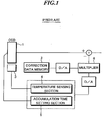
- Fig. 1 is an explanatory view showing a conventional technique disclosed in Japanese Patent Application Laid-Open No. Hei 8-237480, showing a correction apparatus for making a black level correction to the output from a CCD.
- the conventional correction apparatus includes a correction data memory 2 in which pre-stored is correction data for correcting the black level of a CCD 1.
- the apparatus subtracts the correction data from an output of the CCD 1, thereby making a correction to the output level.
- the noise to which a black level correction is made is caused by dark current in the CCD 1, and thus varies in level depending on the temperature and the accumulation time of the CCD 1.
- a temperature sensing section 4 for receiving outputs from a temperature sensor 3 which measures the temperature of the CCD 1, and an accumulation time setting section 5 for setting the accumulation time of the CCD 1.
- outputs from the correction data memory 2 as well as from the temperature sensing section 4 and the accumulation time setting section 5 are converted from digital to analog. Based on the resulting outputs, an amount of correction corresponding to the temperature and the accumulation time of the CCD 1 is created at a multiplier 6 and then subtracted from the output of the CCD 1, thereby providing control to the amount of correction.
- the conventional technique allows correction data to be pre-stored, thereby eliminating the need of an operation and a facility for acquiring correction data every time an image is captured. This in turn allows the time required for capturing images to be shortened as well as proper corrections to be always made even in the presence of variations in temperature or service condition.
- a correction method is conceivable which allows noise-bearing pixel information to be extracted as abnormal pixel information with respect to surrounding pixel information and then interpolated using the surrounding pixel information.
- the pixels to be used for the comparison with the abnormal pixel may contain noise thereby yielding an improper result of comparison. It is thus not always possible to properly interpolate the abnormal pixel information in a simple manner.
- the present invention was developed to address these problems in one aspect. It is therefore an object of the present invention to provide an apparatus for correcting image information which can correct images by effectively removing long-cycle or sudden noise occurring pixel by pixel, as well as a method, and a program for correcting image information. It is another object of the invention to provide an apparatus for correcting image information which can properly interpolate abnormal pixel information using surrounding pixels as well as a method, and a program for correcting image information. It is still another object of the invention to provide an image input device which incorporates the image information correction apparatus.
- the present invention includes the features at least according to each of the following independent claims.
- an image information correction apparatus is one for correcting image information sensed by a solid-state image pickup device which includes a plurality of pixels.
- the image information correction apparatus comprises abnormality determination processing means for receiving pixel information sensed by the solid-state image pickup device to be compared between pixel information to be corrected and its surrounding pixel information, thereby determining whether the pixel information to be corrected is abnormal, normality determination processing means for receiving the pixel information sensed by the solid-state image pickup device to be compared between pieces of surrounding pixel information of the pixel information to be corrected, thereby determining whether the pieces of surrounding pixel information are normal, and interpolation processing means for interpolating the pixel information to be corrected in accordance with an abnormality determination output from the abnormality determination processing means and a normality determination output from the normality determination processing means.
- an image information correction method is one for correcting image information sensed by a solid-state image pickup device which includes a plurality of pixels.
- the image information correction method comprises an abnormality determination processing step of comparing pixel information sensed by the solid-state image pickup device between pixel information to be corrected and its surrounding pixel information, thereby determining whether the pixel information to be corrected is abnormal, a normality determination processing step of comparing the pixel information sensed by the solid-state image pickup device between pieces of surrounding pixel information of the pixel information to be corrected, thereby determining whether the pieces of surrounding pixel information are normal, and an interpolation processing step of interpolating the pixel information to be corrected in accordance with an abnormality determination output from the abnormality determination processing step and a normality determination output from the normality determination processing step.
- a computer-readable medium contains an image information correction program for allowing a computer to realize a function of correcting image information sensed by a solid-state image pickup device which includes a plurality of pixels.
- the image information correction program allows the computer to be functioned as abnormality determination processing means for comparing pixel information sensed by the solid-state image pickup device between pixel information to be corrected and its surrounding pixel information, thereby determining whether the pixel information to be corrected is abnormal, normality determination processing means for comparing the pixel information sensed by the solid-state image pickup device between pieces of surrounding pixel information of the pixel information to be corrected, thereby determining whether the pieces of surrounding pixel information are normal, and interpolation processing means for interpolating the pixel information to be corrected in accordance with an abnormality determination output from the abnormality determination processing means and a normality determination output from the normality determination processing means.
- FIG. 2 is an explanatory view showing the principal configuration of an image information correction apparatus according to an embodiment of the present invention.
- An image information correction apparatus 10 is adapted to correct image information sensed by a solid-state image pickup device 11 (such as a CCD) which includes a plurality of pixels.
- the apparatus 10 includes an abnormality determination processing section (abnormality determination processing means) 12 which receives pixel information sensed by the solid-state image pickup device 11 to be compared between pixel information to be corrected and its surrounding pixel information, thereby determining whether the pixel information to be corrected is abnormal.
- abnormality determination processing section abnormality determination processing means
- the apparatus 10 also includes a normality determination processing section (normality determination processing means) 13 which receives pixel information sensed by the solid-state image pickup device 11 to be compared between pieces of surrounding pixel information of the pixel information to be corrected, thereby determining whether the surrounding pixel information is normal.
- the apparatus 10 further includes an interpolation processing section (interpolation processing means) 14 for interpolating the pixel information to be corrected in accordance with an abnormality determination output from the abnormality determination processing section 12 and a normality determination output from the normality determination processing section 13.
- pixel information "p" sensed by the solid-state image pickup device 11 is sequentially supplied pixel by pixel to the abnormality determination processing section 12, the normality determination processing section 13, and the interpolation processing section 14. Then, the abnormality determination processing section 12 sequentially determines whether all pieces of pixel information "p", received in the order of pixel array and serving as pixel information to be corrected, are abnormal information (i.e., noise-bearing information). If true, an abnormality determination output signal q1 is generated for output. The abnormality determination processing section 12 thus determines whether the pixel information "p" to be corrected is abnormal.
- the normality determination processing section 13 sequentially determines whether pieces of surrounding pixel information of the pixel information to be corrected are normal information (i.e., noise-free information). If true, a normality determination output signal q2 is generated for output.
- the abnormality determination processing section 12 outputs the abnormality determination output signal q1 and the normality determination processing section 13 outputs the normality determination output signal q2, an interpolation control signal q3 is outputted, so that the interpolation processing section 14 interpolates the pixel information to be corrected for delivery of interpolated pixel information ps.
- Fig. 3 is an explanatory view showing the effects of the image information correction apparatus 10 according to an embodiment of the present invention, in which the output level of pieces of pixel information sequentially delivered from the solid-state image pickup device 11 is shown in time sequence.
- the image information correction apparatus 10 takes advantage of a fact that pixel information which is delivered by the solid-state image pickup device 11 after having captured an image has no big difference in output level between surrounding pixels so long as the pixels contain no noise on a pixel-by-pixel basis.
- a comparison between pixel information a1, b1, and c1 shows that these pieces of pixel information have small differences in output level and can be determined to be noise-free or normal information.
- a comparison between pixel information a2, b2, and c2 shows that the pixel information b2 is significantly different in output level from the other pieces of pixel information and thus can be determined to be noise-bearing or abnormal information.
- the pixel information a2, b2, and c2 provides a small difference in output level between a2 and c2, these pieces of pixel information can be determined to be normal information.
- the pixel information b2 can be properly determined to be abnormal when compared with a2 or c2. Accordingly, only when a proper determination is made in this manner, the pixel information b2 is interpolated and the resulting interpolated pixel information bs is delivered in place of the pixel information b2.
- the image information correction apparatus 10 can correct images by effectively removing long-cycle or sudden noise occurring pixel by pixel. Furthermore, pieces of pixel information used for comparison and interpolation are determined to be normal before abnormal pixel information is interpolated using the surrounding pixels. This allows for making a proper determination of the abnormal pixel information and accurately interpolating the abnormal pixel information.
- Fig. 4 is an explanatory view showing the aforementioned abnormality determination processing section 12.
- the abnormality determination processing section 12 determines the difference in output level between pixel information to be corrected and pixel information of its surrounding pixels and then compares the difference in output level with an abnormality determination reference signal, thereby making an abnormality determination.
- Shown in Fig. 4 is an example which employs three adjacent pixels as surrounding pixels.
- the abnormality determination processing section 12 includes a first memory section 12a, a second memory section 12b, a third memory section 12c, a computation processing section 12d, and a comparison processing section 12e.
- pieces of pixel information delivered from the solid-state image pickup device 11 are sequentially supplied in the order of pixel array to the first memory section 12a, the second memory section 12b, and the third memory section 12c.
- the pixel information stored in the first memory section 12a, the second memory section 12b, and the third memory section 12c is then computed at the computation processing section 12d.
- the comparison processing section 12e performs a comparison between the computation result provided by the computation processing section 12d and the abnormality determination reference signal.
- the computation processing section 12d computes
- the pixel information "b" stored in the second memory section 12b is to be corrected.
- the difference (i.e., the absolute value of the difference) between the pixel information "b” and the average value of pieces of pixel information before and after it, i.e., (a + c)/2 is determined and then compared with the abnormality determination reference signal at the comparison processing section 12e .
- the comparison processing section 12e then provides an abnormality determination output if the computation result determined at the computation processing section 12d is greater than the abnormality determination reference signal. That is, if the output level of the pixel information "b" to be corrected is more separated from those of the pixel information before and after it than a reference, the pixel information "b" is determined to be abnormal.
- Fig. 5 is an explanatory view showing the aforementioned normality determination processing section 13.
- the normality determination processing section 13 determines the mutual differences in output level of pixel information between surrounding pixels of a pixel to be corrected and then compares the resulting differences in output level with a normality determination reference signal, thereby making a normality determination.
- the normality determination processing section 13 includes a first memory section 13a, a second memory section 13b, a third memory section 13c, a computation processing section 13d, and a comparison processing section 13e.
- pieces of pixel information delivered from the solid-state image pickup device 11 are sequentially supplied in the order of pixel array to the first memory section 13a, the second memory section 13b, and the third memory section 13c.
- the pixel information stored in the first memory section 13a and the third memory section 13c is then computed at the computation processing section 13d.
- the comparison processing section 13e performs a comparison between the computation result provided by the computation processing section 13d and the normality determination reference signal.
- the computation processing section 13d computes
- the pixel information "b" stored in the second memory section 13b is to be corrected.
- the difference (the absolute value of the difference) of pixel information between pixels before and after it is determined and then compared with the normality determination reference signal at the comparison processing section 13e.
- the comparison processing section 13e then provides a normality determination output if the computation result determined at the computation processing section 13d is less than the normality determination reference signal. That is, if the difference in output level between the pixels before and after the pixel information "b" to be corrected is not separated more than a reference, the pixel information "a" and "c" of the pixels before and after it is determined to be normal.
- first memory sections 12a and 13a, the second memory sections 12b and 13b, and the third memory sections 12c and 13c may be separately implemented in their respective processing sections as described above, or alternatively the three memory sections may be shared among the processing sections.
- abnormality determination reference signal and/or normality determination reference signal may be made variably settable.
- the level of the abnormality determination reference signal may be reduced to provide a higher sensitivity to the abnormality determination.
- a lower level of the abnormality determination reference signal may cause a higher probability of erroneous detection of abnormalities.
- the probability of extracting abnormal pixels is increased, the definition of images may be impaired because normal pixels could be more likely determined to be abnormal as well.
- the abnormality determination reference signal is set to a slightly higher level.
- the abnormality determination reference signal is set to a slightly lower level.
- the normality determination reference signal is set to a slightly lower level because there is no big difference in output level between the surrounding pixels.
- the normality determination reference signal is set to a slightly higher level because there is a significant difference in output level between the surrounding pixels.
- Fig. 6 is an explanatory view showing the aforementioned interpolation processing section 14.
- the interpolation processing section 14 interpolates the pixel information to be corrected, which has been determined to be abnormal, using its surrounding pixel information.
- the average value of the surrounding pixel information "a" and "c,” i.e., (a+c) / 2 is outputted in place of the pixel information "b".
- the interpolation processing section 14 includes a first memory section 14a, a second memory section 14b, a third memory section 14c, a computation processing section 14d, a selection processing section 14e, and a delay processing section 14f.
- Pieces of pixel information delivered from the solid-state image pickup device 11 are sequentially supplied in the order of pixel array to the first memory section 14a, the second memory section 14b, and the third memory section 14c.
- the pixel information stored in the first memory section 14a and the third memory section 14c is then computed at the computation processing section 14d.
- the computation result provided by the computation processing section 14d is delayed at the delay processing section 14f and then supplied to the selection processing section 14e in sync with the pixel information "b" stored in the second memory section 14b.
- an ANDed signal of the abnormality determination output signal q1 from the abnormality determination processing section 12 and the normality determination output signal q2 from the normality determination processing section 13 is supplied to the selection processing section 14e as the interpolation control signal q3.
- the selection processing section 14e outputs the interpolated pixel information ps which has been interpolated by replacing the pixel information "b" determined to be abnormal with the computation result (a + b) /2.
- the interpolation processing section 14 is not limited to the example shown in Fig. 6 but may also employ an interpolation technique such as a pre-position interpolation (for replacement for the pixel information "a" of Fig. 6) or a post-position interpolation (for replacement for the pixel information "c" of Fig. 6) .
- an interpolation technique such as a pre-position interpolation (for replacement for the pixel information "a" of Fig. 6) or a post-position interpolation (for replacement for the pixel information "c" of Fig. 6) .
- the solid-state image pickupdevice 11 is a two-dimensional sensor
- the pixel information to be corrected can be interpolated, e.g., by two-dimensionally using its surrounding pixels to determine the average value of the pixels. In this case, it is necessary to determine in the aforementioned manner whether the pixel information of the surrounding pixels is normal.
- Fig. 7 is an explanatory view showing an embodiment in which the aforementioned image information correction apparatus 10 is incorporated into a conventional correction apparatus.
- the conventional technique is as described above.
- the conventional correction apparatus precedes the image information correction apparatus 10 according to an embodiment of the present invention.
- the image information correction apparatus 10 may acquire the output from the CCD to add controlled correction data to the output from the image information correction apparatus 10.
- the conventional correction apparatus makes a black level correction to stable output noises, while the image information correction apparatus 10 makes an image correction to sudden noises or very-long-cycle noises.
- This arrangement makes it possible to effectively remove various types of noises.
- Fig. 8 is a view showing another embodiment of the present invention (in which like reference symbols indicate the same components as described above, and some of the components will not be explained repeatedly).
- a particular pixel is determined to be abnormal several times, its pixel information is determined to be definitely abnormal and then interpolated.
- an abnormal pixel may often show its abnormality through a plurality of times of successive exposures.
- a linear sensor would successively output a plurality of line outputs during scanning, in the case of which successive abnormal outputs from a particular pixel would result in an image having a linear defect.
- the aforementioned abnormality determination and normality determination are to be made while the pixel information sensed by the solid-state image pickup device 11 is stored in an image memory 15. Subsequently, an ANDed signal q30 of the abnormality determination output signal q1 from the abnormality determination processing section 12 and the normality determination output signal q2 from the normality determination processing section 13 is associated with pixel location information and stored in an interpolation control signal memory 16. Thus, data concerning which pixel and how many times the pixel has been determined to be abnormal is stored. When the pixel is determined to be abnormal a predetermined number of times, the interpolation control signal q3 is delivered to the interpolation processing section 14. The pixel which has been determined to be abnormal several times is interpolated in the image stored in the image memory 15, thereby making it possible to provide interpolations with reliability.
- pixels before and after the pixel to be corrected are extracted using the three memory sections (the first, second, and third memory sections); however, the invention is not limited thereto. It is also possible to extract a larger number of pixels to make the aforementioned abnormality and normality determinations. This makes it possible to construct a system which is effective when consecutive pixels are both abnormal.
- Fig. 9 shows another embodiment which includes four memory sections (a first memory section 20a, a second memory section 20b, a third memory section 20c, and a fourth memory section 20d) which are shared among the abnormality determination processing sections 12 1 and 12 2 , the normality determination processing section 13, and the interpolation processing section 14.
- the abnormality determination processing section 12 1 employs the pixel information "b" stored in the second memory section 20baspixel information tobecorrected, and then makes an abnormality determination thereto based on the pixel information "a" stored in the first memory section 20a and the pixel information "d" stored in the fourth memory section 20d.
- the abnormality determination processing section 12 2 employs the pixel information "c" stored in the third memory section 20c as pixel information to be corrected, and then makes an abnormality determination thereto based on the pixel information "a" stored in the first memory section 20a and the pixel information "d” stored in the fourth memory section 20d. Furthermore, the normality determination processing section 13 makes a normality determination to the pixel information "a” stored in the first memory section 20a and the pixel information "d” stored in the fourth memory section 20d, on which the abnormality determination was based.
- the interpolation processing section 14 performs interpolating processing to replace the pixel information "b” and “c” with the average value (a + d)/2 of the pixel information "a” and "d".
- Such an embodiment makes it possible to effectively correct abnormal pixel information even when two successive pixels are both abnormal. Naturally, this embodiment makes it also possible to make an effective correction not only when two successive pixels are abnormal but also when only one pixel is abnormal.
- the image information correction apparatus 10 may be installed on the output side of a solid-state image pickup device in an image input device to acquire input image information via the interpolation processing section 14.
- This arrangement can thus realize an image input device which incorporates an image information correction apparatus. It is also possible to implement the function of each section according to the aforementioned embodiments using a computer program and thereby realize on the computer the function of correcting image information detected by a solid-state image pickup device which includes a plurality of pixels. This arrangement makes it possible to perform software processing on and thereby make an image correction to image information which has been once captured by the personal computer or the like.
- the aforementioned apparatus, method, and program for correcting image information, and an image input device which incorporates the image information correction apparatus make it possible to correct images by effectively removing long-cycle noise or sudden noise occurring pixel by pixel. It is also possible to properly correct abnormal pixel information using surrounding pixels.
- the level of a reference signal can be variably adjusted to perform appropriate determination processing on a captured image depending on its brightness, definition or the like, thereby effectively correcting for defects in the image.
Landscapes
- Engineering & Computer Science (AREA)
- Physics & Mathematics (AREA)
- General Physics & Mathematics (AREA)
- Theoretical Computer Science (AREA)
- Multimedia (AREA)
- Signal Processing (AREA)
- Transforming Light Signals Into Electric Signals (AREA)
- Facsimile Image Signal Circuits (AREA)
- Image Input (AREA)
- Facsimile Scanning Arrangements (AREA)
Abstract
Description
Claims (9)
- An image information correction apparatus (10) for correcting image information sensed by a solid-state image pickup device (11) which comprises a plurality of pixels, characterized by:abnormality determination processing means (12) for receiving pixel information sensed by the solid-state image pickup device to be compared between pixel information to be corrected and its surrounding pixel information, thereby determining whether the pixel information to be corrected is abnormal;normality determination processing means (13) for receiving the pixel information sensed by the solid-state image pickup device to be compared between pieces of surrounding pixel information of the pixel information to be corrected, thereby determining whether the pieces of surrounding pixel information are normal; andinterpolation processing means (14) for interpolating the pixel information to be corrected in accordance with an abnormality determination output from the abnormality determination processing means and a normality determination output from the normality determination processing means.
- The image information correction apparatus according to claim 1, characterized in that
the abnormality determination processing means (12) determines a difference in output level between the pixel information to be corrected and the surrounding pixel information to compare the difference in output level with an abnormality determination reference signal, thereby making an abnormality determination. - The image information correction apparatus according to claim 2, characterized in that
the abnormality determination reference signal is made variably settable. - The image information correction apparatus according to any one of claims 1 to 3, characterized in that
the normality determination processing means (13) determines differences in output level between the pieces of surrounding pixel information to compare the differences in output level with a normality determination reference signal, thereby making a normality determination. - The image information correction apparatus according to claim 4, characterized in that
the normality determination reference signal is made variably settable. - The image information correction apparatus according to any one of claims 1 to 5, further characterized by:storage means (15) for storing the image information sensed by the solid-state image pickup device, the image information stored in the storage means being supplied to the interpolation processing means on a pixel information by pixel information basis; andinterpolation control means (16) for allowing the interpolation processing means to perform interpolation processing when the abnormality determination processing means has delivered abnormality determination outputs several times.
- An image information correction method for correcting image information sensed by a solid-state image pickup device which comprises a plurality of pixels, characterized by:an abnormality determination processing step of comparing pixel information sensed by the solid-state image pickup device between pixel information to be corrected and its surrounding pixel information, thereby determining whether the pixel information to be corrected is abnormal;a normality determination processing step of comparing the pixel information sensed by the solid-state image pickup device between pieces of surrounding pixel information of the pixel information to be corrected, thereby determining whether the pieces of surrounding pixel information are normal; andan interpolation processing step of interpolating the pixel information to be corrected in accordance with an abnormality determination output from the abnormality determination processing step and a normality determination output from the normality determination processing step.
- A computer-readable medium containing an image information correction program for allowing a computer to realize a function of correcting image information sensed by a solid-state image pickup device (11) which comprises a plurality of pixels, the image information correction program allowing the computer to be functioned as:abnormality determination processing means (12) for comparing pixel information sensed by the solid-state image pickup device between pixel information to be corrected and its surrounding pixel information, thereby determining whether the pixel information to be corrected is abnormal;normality determination processing means (13) for comparing the pixel information sensed by the solid-state image pickup device between pieces of surrounding pixel information of the pixel information to be corrected, thereby determining whether the pieces of surrounding pixel information are normal; andinterpolation processing means (14) for interpolating the pixel information to be corrected in accordance with an abnormality determination output from the abnormality determination processing means and a normality determination output from the normality determination processing means.
- An image input device comprising the image information correction apparatus according to any one of claims 1 to 6, wherein input image information is acquired via the interpolation processing means.
Applications Claiming Priority (2)
| Application Number | Priority Date | Filing Date | Title |
|---|---|---|---|
| JP2004093069A JP2005284355A (en) | 2004-03-26 | 2004-03-26 | Image information correcting device and method, correcting program and image input device |
| JP2004093069 | 2004-03-26 |
Publications (2)
| Publication Number | Publication Date |
|---|---|
| EP1580690A2 true EP1580690A2 (en) | 2005-09-28 |
| EP1580690A3 EP1580690A3 (en) | 2006-10-04 |
Family
ID=34858518
Family Applications (1)
| Application Number | Title | Priority Date | Filing Date |
|---|---|---|---|
| EP05006607A Withdrawn EP1580690A3 (en) | 2004-03-26 | 2005-03-24 | Image information correction apparatus, correction method, correction program, and image input device |
Country Status (2)
| Country | Link |
|---|---|
| EP (1) | EP1580690A3 (en) |
| JP (1) | JP2005284355A (en) |
Cited By (1)
| Publication number | Priority date | Publication date | Assignee | Title |
|---|---|---|---|---|
| CN115222667A (en) * | 2022-06-21 | 2022-10-21 | Oppo广东移动通信有限公司 | Image processing method and device, computer readable storage medium and electronic device |
Families Citing this family (1)
| Publication number | Priority date | Publication date | Assignee | Title |
|---|---|---|---|---|
| JP2011209087A (en) * | 2010-03-30 | 2011-10-20 | Hitachi High-Technologies Corp | Defect inspection apparatus, method of inspecting defect, and inspection system |
Family Cites Families (8)
| Publication number | Priority date | Publication date | Assignee | Title |
|---|---|---|---|---|
| JP2808813B2 (en) * | 1990-04-13 | 1998-10-08 | ソニー株式会社 | Video information interpolation circuit |
| JPH05260386A (en) * | 1992-03-16 | 1993-10-08 | Sony Corp | Defective pixel detection circuit for solid-state image sensor |
| JP3304162B2 (en) * | 1993-05-06 | 2002-07-22 | 松下電器産業株式会社 | Scratch correction circuit |
| US5854655A (en) * | 1995-08-29 | 1998-12-29 | Sanyo Electric Co., Ltd. | Defective pixel detecting circuit of a solid state image pick-up device capable of detecting defective pixels with low power consumption and high precision, and image pick-up device having such detecting circuit |
| US6529618B1 (en) * | 1998-09-04 | 2003-03-04 | Konica Corporation | Radiation image processing apparatus |
| JP3773773B2 (en) * | 1999-10-27 | 2006-05-10 | 三洋電機株式会社 | Image signal processing apparatus and pixel defect detection method |
| US6747697B1 (en) * | 2000-07-12 | 2004-06-08 | Koninklijke Philips Electronics, N.V. | Method and apparatus for digital image defect correction and noise filtering |
| JP4297651B2 (en) * | 2002-07-01 | 2009-07-15 | 三洋電機株式会社 | Image signal processing device |
-
2004
- 2004-03-26 JP JP2004093069A patent/JP2005284355A/en active Pending
-
2005
- 2005-03-24 EP EP05006607A patent/EP1580690A3/en not_active Withdrawn
Cited By (1)
| Publication number | Priority date | Publication date | Assignee | Title |
|---|---|---|---|---|
| CN115222667A (en) * | 2022-06-21 | 2022-10-21 | Oppo广东移动通信有限公司 | Image processing method and device, computer readable storage medium and electronic device |
Also Published As
| Publication number | Publication date |
|---|---|
| JP2005284355A (en) | 2005-10-13 |
| EP1580690A3 (en) | 2006-10-04 |
Similar Documents
| Publication | Publication Date | Title |
|---|---|---|
| JP3984936B2 (en) | Imaging apparatus and imaging method | |
| JP4374488B2 (en) | Digital image system and method for combining demosaicing and bad pixel correction | |
| US8508611B2 (en) | Image processing apparatus, image capturing apparatus, image processing method, and program for performing a comparison process on combined images and a motion area detection process | |
| EP0350328B1 (en) | Offset, gain and bad pixel correction in electronic scanning arrays | |
| TWI458333B (en) | Method and apparatus for image noise reduction using noise models | |
| JP5335327B2 (en) | Defect detection and correction apparatus and defect detection and correction method | |
| US20030128285A1 (en) | Image pickup apparatus | |
| US8964069B2 (en) | Image processing device and solid-state imaging device including a defect correcting function | |
| US20080252756A1 (en) | Circuit and method for correction of defect pixel | |
| EP1525744A1 (en) | Device and method of detection of erroneous image sample data of defective image samples | |
| JP3717725B2 (en) | Pixel defect detection method and image processing apparatus | |
| EP2161919B1 (en) | Read out method for a CMOS imager with reduced dark current | |
| EP1723781A1 (en) | Imaging system with adjusted dark floor correction | |
| JP4554504B2 (en) | Image data processing circuit and image data processing method | |
| US8000549B2 (en) | Digital image processing apparatus and method for the same | |
| US20050030412A1 (en) | Image correction processing method and image capture system using the same | |
| JP5262953B2 (en) | Image processing apparatus, image processing method, and program | |
| JP2002344814A (en) | Defect correction device and defect correction method for solid-state imaging device | |
| EP1580690A2 (en) | Image information correction apparatus, correction method, correction program, and image input device | |
| US7567278B2 (en) | Circuit and method for detecting pixel defect | |
| JP4166974B2 (en) | Pixel scratch detection / correction device | |
| US11272172B2 (en) | Image processing apparatus, failure detection method performed by image processing apparatus, and non-transitory recording medium | |
| JP2002271806A (en) | Pixel defect signal correction circuit for CCD image sensor | |
| JP5186937B2 (en) | Image processing apparatus, electronic camera, and allowable value setting method | |
| US6661932B2 (en) | Image input apparatus |
Legal Events
| Date | Code | Title | Description |
|---|---|---|---|
| PUAI | Public reference made under article 153(3) epc to a published international application that has entered the european phase |
Free format text: ORIGINAL CODE: 0009012 |
|
| AK | Designated contracting states |
Kind code of ref document: A2 Designated state(s): AT BE BG CH CY CZ DE DK EE ES FI FR GB GR HU IE IS IT LI LT LU MC NL PL PT RO SE SI SK TR |
|
| AX | Request for extension of the european patent |
Extension state: AL BA HR LV MK YU |
|
| PUAL | Search report despatched |
Free format text: ORIGINAL CODE: 0009013 |
|
| AK | Designated contracting states |
Kind code of ref document: A3 Designated state(s): AT BE BG CH CY CZ DE DK EE ES FI FR GB GR HU IE IS IT LI LT LU MC NL PL PT RO SE SI SK TR |
|
| AX | Request for extension of the european patent |
Extension state: AL BA HR LV MK YU |
|
| 17P | Request for examination filed |
Effective date: 20061017 |
|
| AKX | Designation fees paid |
Designated state(s): FR |
|
| REG | Reference to a national code |
Ref country code: DE Ref legal event code: 8566 |
|
| GRAP | Despatch of communication of intention to grant a patent |
Free format text: ORIGINAL CODE: EPIDOSNIGR1 |
|
| STAA | Information on the status of an ep patent application or granted ep patent |
Free format text: STATUS: THE APPLICATION HAS BEEN WITHDRAWN |
|
| 18W | Application withdrawn |
Effective date: 20080108 |