EP1579833A1 - Indicator for body fluid absorbable article - Google Patents
Indicator for body fluid absorbable article Download PDFInfo
- Publication number
- EP1579833A1 EP1579833A1 EP03780988A EP03780988A EP1579833A1 EP 1579833 A1 EP1579833 A1 EP 1579833A1 EP 03780988 A EP03780988 A EP 03780988A EP 03780988 A EP03780988 A EP 03780988A EP 1579833 A1 EP1579833 A1 EP 1579833A1
- Authority
- EP
- European Patent Office
- Prior art keywords
- water
- core
- sheet
- indicator
- indicator according
- Prior art date
- Legal status (The legal status is an assumption and is not a legal conclusion. Google has not performed a legal analysis and makes no representation as to the accuracy of the status listed.)
- Withdrawn
Links
- 210000001124 body fluid Anatomy 0.000 title claims abstract description 15
- 239000010839 body fluid Substances 0.000 title claims abstract description 15
- 239000002250 absorbent Substances 0.000 claims abstract description 37
- 229920001169 thermoplastic Polymers 0.000 claims abstract description 32
- 239000004416 thermosoftening plastic Substances 0.000 claims abstract description 32
- 230000002745 absorbent Effects 0.000 claims abstract description 19
- 238000002834 transmittance Methods 0.000 claims abstract description 16
- 239000000463 material Substances 0.000 claims description 13
- 239000010954 inorganic particle Substances 0.000 claims description 10
- 238000010521 absorption reaction Methods 0.000 claims description 7
- 239000003607 modifier Substances 0.000 claims description 7
- 239000011248 coating agent Substances 0.000 claims description 6
- 238000000576 coating method Methods 0.000 claims description 6
- 239000002245 particle Substances 0.000 claims description 5
- 230000000873 masking effect Effects 0.000 description 42
- 210000002700 urine Anatomy 0.000 description 13
- 239000002985 plastic film Substances 0.000 description 7
- 229920006255 plastic film Polymers 0.000 description 7
- XLYOFNOQVPJJNP-UHFFFAOYSA-N water Chemical compound O XLYOFNOQVPJJNP-UHFFFAOYSA-N 0.000 description 6
- 230000027939 micturition Effects 0.000 description 5
- 239000000203 mixture Substances 0.000 description 4
- 238000000149 argon plasma sintering Methods 0.000 description 3
- 229920001684 low density polyethylene Polymers 0.000 description 3
- 239000004702 low-density polyethylene Substances 0.000 description 3
- 238000000034 method Methods 0.000 description 3
- 239000004745 nonwoven fabric Substances 0.000 description 3
- 208000019901 Anxiety disease Diseases 0.000 description 2
- VTYYLEPIZMXCLO-UHFFFAOYSA-L Calcium carbonate Chemical compound [Ca+2].[O-]C([O-])=O VTYYLEPIZMXCLO-UHFFFAOYSA-L 0.000 description 2
- 239000004831 Hot glue Substances 0.000 description 2
- VYPSYNLAJGMNEJ-UHFFFAOYSA-N Silicium dioxide Chemical compound O=[Si]=O VYPSYNLAJGMNEJ-UHFFFAOYSA-N 0.000 description 2
- 230000036506 anxiety Effects 0.000 description 2
- 239000012153 distilled water Substances 0.000 description 2
- 230000001747 exhibiting effect Effects 0.000 description 2
- 230000002093 peripheral effect Effects 0.000 description 2
- 206010021639 Incontinence Diseases 0.000 description 1
- 239000002202 Polyethylene glycol Substances 0.000 description 1
- QAOWNCQODCNURD-UHFFFAOYSA-L Sulfate Chemical compound [O-]S([O-])(=O)=O QAOWNCQODCNURD-UHFFFAOYSA-L 0.000 description 1
- GWEVSGVZZGPLCZ-UHFFFAOYSA-N Titan oxide Chemical compound O=[Ti]=O GWEVSGVZZGPLCZ-UHFFFAOYSA-N 0.000 description 1
- 239000000853 adhesive Substances 0.000 description 1
- 230000001070 adhesive effect Effects 0.000 description 1
- PNEYBMLMFCGWSK-UHFFFAOYSA-N aluminium oxide Inorganic materials [O-2].[O-2].[O-2].[Al+3].[Al+3] PNEYBMLMFCGWSK-UHFFFAOYSA-N 0.000 description 1
- 238000005452 bending Methods 0.000 description 1
- 229910000019 calcium carbonate Inorganic materials 0.000 description 1
- AAOVKJBEBIDNHE-UHFFFAOYSA-N diazepam Chemical compound N=1CC(=O)N(C)C2=CC=C(Cl)C=C2C=1C1=CC=CC=C1 AAOVKJBEBIDNHE-UHFFFAOYSA-N 0.000 description 1
- -1 for example Polymers 0.000 description 1
- 229920001903 high density polyethylene Polymers 0.000 description 1
- 239000004700 high-density polyethylene Substances 0.000 description 1
- 229920000092 linear low density polyethylene Polymers 0.000 description 1
- 239000004707 linear low-density polyethylene Substances 0.000 description 1
- 238000005259 measurement Methods 0.000 description 1
- 229920003023 plastic Polymers 0.000 description 1
- 239000004033 plastic Substances 0.000 description 1
- 229920001223 polyethylene glycol Polymers 0.000 description 1
- 229920000642 polymer Polymers 0.000 description 1
- 229920000098 polyolefin Polymers 0.000 description 1
- 239000000377 silicon dioxide Substances 0.000 description 1
- 239000004094 surface-active agent Substances 0.000 description 1
- OGIDPMRJRNCKJF-UHFFFAOYSA-N titanium oxide Inorganic materials [Ti]=O OGIDPMRJRNCKJF-UHFFFAOYSA-N 0.000 description 1
- 229940072690 valium Drugs 0.000 description 1
Images
Classifications
-
- A—HUMAN NECESSITIES
- A61—MEDICAL OR VETERINARY SCIENCE; HYGIENE
- A61F—FILTERS IMPLANTABLE INTO BLOOD VESSELS; PROSTHESES; DEVICES PROVIDING PATENCY TO, OR PREVENTING COLLAPSING OF, TUBULAR STRUCTURES OF THE BODY, e.g. STENTS; ORTHOPAEDIC, NURSING OR CONTRACEPTIVE DEVICES; FOMENTATION; TREATMENT OR PROTECTION OF EYES OR EARS; BANDAGES, DRESSINGS OR ABSORBENT PADS; FIRST-AID KITS
- A61F13/00—Bandages or dressings; Absorbent pads
- A61F13/15—Absorbent pads, e.g. sanitary towels, swabs or tampons for external or internal application to the body; Supporting or fastening means therefor; Tampon applicators
- A61F13/42—Absorbent pads, e.g. sanitary towels, swabs or tampons for external or internal application to the body; Supporting or fastening means therefor; Tampon applicators with wetness indicator or alarm
Definitions
- the present invention relates to indicators used in combination with body fluid absorbent articles such as disposable diapers and making it visually perceivable whether a body fluid absorbent core of the articles is in a wet state or not.
- an indicator disclosed in Japanese Patent Application Publication No. 1997-299401A is interposed between the backsheet and the body fluid absorbent core.
- This indicator comprises an ink layer adapted to be observable as this layer is wetted and an ink carrying layer interposed between the ink layer and the backsheet so as to be held in close contact with the ink layer.
- the ink carrying layer contains a surfactant.
- the above-cited Publication discloses an embodiment of the indicator in which the ink carrying layer is made of paper materials and, in addition to the first ink layer, a second ink layer is provided.
- the water-absorbent paper is required to keep a sufficient dimensional stability and strength during a step of printing as well as during various steps of making diaper.
- the water-absorbent paper used for this application has usually been apt to have a basis weight and a bending stiffness both higher than those of nonwoven fabrics and plastic films used as stock materials for the top- and backsheets, respectively, of the diaper.
- Such paper interposed between the backsheet and the core inevitably makes a region of the backsheet overlapping the absorbent paper relatively stiff. Sometimes, such relatively stiff backsheet may deteriorate a desired soft touch for the wearer.
- the water-absorbent paper used for such purpose generally allows the amount of urine absorbed thereby to spread easily in this paper.
- information a mother wishes to acquire is not limited to the information whether urination has occurred or not.
- the other important information the mother wishes to acquire is how many repeated urinations have occurred and how wide range of the core has been wetted.
- the mother may determine to exchange the used diaper with a fresh diaper.
- the wetted range of the core does not often coincide with the wetted range of the indicator and it is difficult to specify the range of the core that is actually wetted on the basis of the wetted range of the indicator.
- the known indicator can not sometimes provide the adequate information the mother wishes to acquire.
- a body fluid absorbent article comprising a liquid-pervious sheet, a liquid-impervious sheet and a body fluid absorbent core interposed therebetween, an indicator interposed between the liquid-impervious sheet and the core and comprising a water-absorbent sheet which allows the core in a wet state to be visually perceived from outside the liquid-impervious sheet and indication elements temporarily concealed by the water-absorbent sheet.
- the article further comprises the water-absorbent sheet which comprises a porous thermoplastic film having an inner surface facing the core and an outer surface facing the liquid-impervious sheet, the film having a total luminous transmittance of 40 % or lower in a dry state and 60 % or higher in a wet state; and the indication elements being held in close contact with the inner surface.
- the water-absorbent sheet which comprises a porous thermoplastic film having an inner surface facing the core and an outer surface facing the liquid-impervious sheet, the film having a total luminous transmittance of 40 % or lower in a dry state and 60 % or higher in a wet state; and the indication elements being held in close contact with the inner surface.
- total luminous transmittances are values determined by the method specified in JIS (Japanese Industrial Standard) K 7105 and Klemm's water-absorbencies are values determined by the method specified in JIS P 8141.
- Dry state, wet state and water-absorption (wt%) of a thermoplastic film are defined as following: water-absorption is calculated from an equation of ⁇ (W 0 - W 1 ) /W 0 ⁇ x 100, where W 0 represents a weight of a thermoplastic film in a dry state after let stand for 48 hours at a temperature of 23°C and a R.H.
- W 1 represents a weight of this thermoplastic film in a wet state obtained by immersing this film in distilled water at a temperature of 23°C for 1 minute and then draining off excessive water from the film held between two filter paper sheets under a surface pressure of 0.14 g/cm 2 for 2 seconds.
- pieces of the thermoplastic film each having a size of 5 x 5 cm are used.
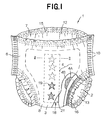
- a disposable pants-type diaper 1 shown by Fig. 1 in a partially cutaway perspective view comprises a liquid-pervious topsheet 2, a liquid-impervious backsheet 3 and an absorbent core 4 interposed between the two sheets 2, 3. Portions of the top- and backsheets 2, 3 extending outward beyond a peripheral edge of the core 4 are overlapped and joined together.
- the diaper 1 has a front waist region 6, a rear waist region 7 and a crotch region 8 extending between the waist regions 6, 7. Lateral marginal zones of the front and rear waist regions 6, 7 are overlapped and joined together with the topsheet 2 inside at a plurality of spots 10 arranged intermittently in a vertical direction as viewed in Fig. 1.
- the diaper 1 further has a waist-hole 12 and a pair of leg-holes 13.
- a waist elastic member 15 and leg elastic members 16 are attached in a stretched state to the inner surface of at least one of the top- and backsheets 2, 3.
- an indicator 18 is interposed between the backsheet 3 and the core 4 so that this indicator 18 may inform a wearer's mother of urination occurring.
- Stock materials for the topsheet 2 may be selected from a group consisting of a nonwoven fabric and an aperture plastic film. Each of apertures formed through the plastic film preferably has an aperture diameter in a range of 0.5 to 3 mm.
- Stock materials for the backsheet 3 may be selected from a group consisting of a plastic film and a plastic film laminated on its outer surface with a nonwoven fabric. When the plastic film is in a dry state or the inner surface of the plastic film contacting the core 4 is wetted with urine, the backsheet 3 has a total luminous transmittance in a range of 20 to 80 % and allows a display content of the indicator 18, for example, star marks contoured by solid lines in Fig. 1 to be visually perceived from outside the backsheet 3.
- the core 4 comprises an absorbent material 4A such as fluff pulp or a mixture of fluff pulp and super-absorbent polymer particles and a tissue paper 4B with which the absorbent material 4A is wrapped.
- the indicator 18 shown in Fig. 1 includes a masking sheet 21 supporting thereon indication elements 19 in the form of five star marks. In the state illustrated by Fig. 1, two of these star marks contoured by solid lines have become visually perceivable from outside the backsheet 3 and remaining three star marks contoured by imaginary lines are not visually perceivable from outside the backsheet 3.
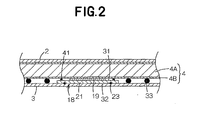
- Fig. 2 is a sectional view taken along the line II-II in Fig. 1.
- the indicator 18 comprises the masking sheet 21 and the indication elements 19 held in close contact with the masking sheet 21.
- the masking sheet 21 is relatively long in the vertical direction as viewed in Fig. 1 and has an outer surface 32 facing the backsheet 3 and an inner surface 31 facing the core 4.
- the indication elements 19 comprise layers of ink or the other coating material forming five star marks (See Fig. 1) arranged in the vertical direction on the inner surface 31 of the masking sheet 21.
- the masking sheet 21 is joined to the backsheet 3 by means of intermittently provided adhesives 23 and substantially held in close contact with the backsheet 3.
- the masking sheet 21 is also held together with the indication elements 19 in close contact with the core 4, preferably joined to the tissue paper 4B by means of hot melt adhesives 41.
- the backsheet 3 and the tissue paper 4B are joined to each other by means of hot melt adhesives 33.
- the masking sheet 21 is formed from water-absorbent thermoplastic films having a plurality of fine apertures and this sheet 21 has total luminous transmittance of 40 % or lower in its dry state and 60 % or higher in its wet state.
- dry state thermoplastic film refers to a thermoplastic film after left stand for 48 hours at a temperature of 23°C and a R.H. of 75 %.
- wet state thermoplastic film refers to a dry state thermoplastic film having been immersed in distilled water for 1 minute and thereafter drained off with the film held between two filter paper sheets under a surface pressure of 0.14 g/cm 2 for 2 seconds.
- a preferred thermoplastic film has a water-absorption in a range of 5 to 100 wt% on the basis of a weight of a dry state thermoplastic film.
- a preferred thermoplastic film has a Klemm's water-absorbency in a range of 1 to 10 mm and retains absorbed water substantially without spreading.
- thermoplastic film is based on polyolefin, for example, high density polyethylene, low density polyethylene or linear low density polyethylene, and obtained by extruding a composition including 20 to 80 wt% of inorganic particles having a particle diameter in a range of 0.1 to 10 ⁇ such as valium sulfate, calcium carbonate or titanium oxide and 0.5 to 5 wt% of polyethylene glycol or the like modifying the composition to be hydrophilic to form a starting film which is then monoaxially or biaxially stretched at a ratio in a range of 100 to 300 % until a basis weight in a range of 15 to 80 g/m 2 is achieved.
- polyolefin for example, high density polyethylene, low density polyethylene or linear low density polyethylene
- thermoplastic film at least one of the inner and outer surfaces 31, 32 becomes a light scattering rough surface due to the presence of plural inorganic particles and between the inner and outer surfaces 31, 32, moisture-permeable fine apertures are formed around these fine apertures.
- the maximum particle diameter of the fine aperture is in the order of 10 ⁇ .
- Moisture-permeability of the plural fine apertures as measured by the method specified in JIS (Japanese Industrial Standard) Z 0208 reflects the number of these fine apertures and a preferred moisture-permeability of the thermoplastic film is in a range of 1000 to 6000 g/m 2 ⁇ 24 hrs.
- the masking sheet 21 comprising such thermoplastic film contains the hydrophilic modifier and the plural fine apertures, so these fine apertures are flooded and retain water as the film is immersed in water. Thus a high water-absorption is immediately achieved.
- the total luminous transmittance exhibited by the masking sheet 21 easily rises up to 60 % or higher as the inner and outer surfaces 31, 32 are wetted and the water-absorption rises. While it is difficult for the observer to see the indication elements 19 through the outer surface 32 so far as the total luminous transmittance of the masking sheet 21 is 40 % or lower, it is easy for the observer to see the indication elements 19 through the masking sheet 21 from its outer surface 32 as the total luminous transmittance reaches 60 % or higher.
- the indication elements 19 preferably have a color tone distinguished from those of the masking sheet 21 and the backsheet 3.
- Print ink or coating materials used to form the indication elements 19 preferably is of hydrophilic type and preferably contains light scattering inorganic particles such as silica or alumina so that the indication elements scatter light and make it further difficult to see the indication elements through the masking sheet 21 from its outer surface 32 so far as the core is in a dry state and, when the core is wetted, light scattering is sufficiently reduced to facilitate the observer to see the indication elements 19 through the masking sheet 21 from its outer surface 32.
- Shape of the indication elements 19 is not limited to that as illustrated and optionally selected.
- the masking sheet 21 may be formed, for example, a low density polyethylene film having a basis weight in a range of 15 to 50 g/m 2 to avoid an anxiety that this masking sheet 21 might deteriorate a soft touch of the backsheet 3 with which the masking sheet 21 closely contacts. This is for the reason that the low density polyethylene film usually used as stock materials for the backsheet 3 has also a basis weight similar to that of the masking sheet 21.
- Urine absorbed by the core 4 immediately reaches the masking sheet 21. Thereupon, the inner and outer surfaces 31, 32 of the masking sheet 21 is wetted with urine and simultaneously the plurality of fine apertures formed through the masking sheet 21 are flood with urine.
- the inner and outer surfaces 31, 32 of the masking sheet 21 as well as the inner surfaces of the respective fine apertures which have been rough become smooth and the total luminous transmittance of the masking sheet 21 correspondingly rises to 60 % or higher. Consequently, it is now possible for the observer to see the indication elements 19 through the backsheet 3 and the masking sheet 21.
- the masking sheet 21 having a water-absorbency in a range of 1 to 10 mm practically does not spread any quantity of urine. This means that only the portion of the masking sheet 21 contacting the portion of the core 4 wetted with urine exhibits a relatively high total luminous transmittance and one or more of the indication elements 19 lying in this portion become visually perceivable.
- the indicator 18 makes it possible to determine the portion or the area of the core 4 actually wetted with urine based on the visually perceivable one or more indication elements 19.
- the indicator 18 may extend in a transverse direction or both in the vertical direction and in the transverse direction, instead of extending in the vertical direction of the diaper 1.
- the masking sheet 21 is preferably wetted with urine from its inner surface 31 contacting the core 4.
- these layers are preferably locally, i.e., intermittently distributed on the inner surface 31 of the masking sheet 21.
- each of the star marks may be preferably gravure printed on the inner surface 31 in the form of an assembly of plural spaced dots or the respective star marks are spaced one from another and thereby the area of the masking sheet 21 free from the print ink or the other coating material may be positively defined.
- the indication elements 19 can be defined as the elements adapted to be visually perceivable as the total luminous transmittance of the masking sheet 21 rises up to the determined level and the masking sheet 21 is also defined as the sheet adapted to temporarily conceal the indication elements 19 and to make the indication elements 19 visually perceivable as the masking sheet 21 is wetted and its total luminous transmittance rises to the predetermined level.
- the masking sheet 21 may be held in close contact with the core 4 so that the masking sheet 21 is wetted to rise its total luminous transmittance as the core is wetted and the zone exhibiting a sufficient total luminous transmittance to make the core 4 visually perceivable and the zone exhibiting an insufficient total luminous transmittance to make the core 4 visually perceivable may appear on the masking sheet 21.
- a boundary between these two zones suggests a range of the core 4 wetted with urine.
- the core 4 itself serves as the indication element 19. While the present invention has been described with respect to the disposable pants-type diaper, the invention is applicable also to the indicator on body fluid absorbent articles such as open-type diapers, incontinent diapers or body fluid absorbent pads.
- the indicator according to the present invention used with the body fluid absorbent article comprises the masking sheet and the indication elements wherein the masking sheet is formed from flexible thermoplastic films, so there is no anxiety that the presence of the indicator might deteriorate a desired soft touch of the body fluid absorbent article. Furthermore, urine absorbed in the masking sheet substantially does not spread, so it is ensured that the range indicated by the indication elements reliably coincides with the range of the core actually wetted with urine.
Landscapes
- Health & Medical Sciences (AREA)
- Epidemiology (AREA)
- Engineering & Computer Science (AREA)
- Biomedical Technology (AREA)
- Heart & Thoracic Surgery (AREA)
- Vascular Medicine (AREA)
- Life Sciences & Earth Sciences (AREA)
- Animal Behavior & Ethology (AREA)
- General Health & Medical Sciences (AREA)
- Public Health (AREA)
- Veterinary Medicine (AREA)
- Absorbent Articles And Supports Therefor (AREA)
- Orthopedics, Nursing, And Contraception (AREA)
- Laminated Bodies (AREA)
Abstract
Description
Claims (9)
- In a body fluid absorbent article comprising:a liquid-pervious sheet;a liquid-impervious sheet;a body fluid absorbent core interposed therebetween;an indicator interposed between said liquid-impervious sheet and said core and comprising a water-absorbent sheet which allows said core in a wet state to be visually perceived from outside said liquid-impervious sheet and indication elements temporarily concealed by said water-absorbent sheet;said water-absorbent sheet comprising a porous thermoplastic film having an inner surface facing said core and an outer surface facing said liquid-impervious sheet;said film having a total luminous transmittance of 40 % or lower in a dry state and 60 % or higher in a wet state; andsaid indication elements being held in close contact with said inner surface.
- The indicator according to Claim 1, wherein said thermoplastic film exhibits a Klemm's water-absorbency in a range of 1 to 10 mm.
- The indicator according to Claim 1 or 2, wherein said thermoplastic film contains 20 to 80 wt% of inorganic particles each having a particle diameter in a range of 0.1 to 10µ.
- The indicator according to any one of Claims 1 through 3, wherein said thermoplastic film contains 0.5 to 5 wt% of modifier for hydrophilicity.
- The indicator according to Claim 4, wherein said inorganic particles are coated with at least a part of said modifier for hydrophilicity.
- The indicator according to any one of Claims 3 through 5, wherein said thermoplastic film is obtained by extruding thermoplastic containing said inorganic particles to form a starting film and then monoaxially or biaxially stretching said starting film at a ratio of 100 to 300 %.
- The indicator according to any one of Claims 1 through 6, wherein said indication elements comprise layers of print ink or other coating materials intermittently formed on an inner surface of said water-absorbent sheet.
- The indicator according to any one of Claims 1 through 6, wherein said indication elements is defined by said core itself.
- The indicator according to any one of Claims 1 through 8, wherein said thermoplastic film has a water-absorption in a range of 5 to 100 wt%.
Applications Claiming Priority (3)
| Application Number | Priority Date | Filing Date | Title |
|---|---|---|---|
| JP2002380202 | 2002-12-27 | ||
| JP2002380202A JP4426754B2 (en) | 2002-12-27 | 2002-12-27 | Body fluid absorbent article indicator |
| PCT/JP2003/016468 WO2004060246A1 (en) | 2002-12-27 | 2003-12-22 | Indicator for body fluid absorbable article |
Publications (2)
| Publication Number | Publication Date |
|---|---|
| EP1579833A1 true EP1579833A1 (en) | 2005-09-28 |
| EP1579833A4 EP1579833A4 (en) | 2010-09-15 |
Family
ID=32708423
Family Applications (1)
| Application Number | Title | Priority Date | Filing Date |
|---|---|---|---|
| EP03780988A Withdrawn EP1579833A4 (en) | 2002-12-27 | 2003-12-22 | Indicator for body fluid absorbable article |
Country Status (11)
| Country | Link |
|---|---|
| US (1) | US7154019B2 (en) |
| EP (1) | EP1579833A4 (en) |
| JP (1) | JP4426754B2 (en) |
| KR (1) | KR100658474B1 (en) |
| CN (1) | CN100488477C (en) |
| AU (1) | AU2003289483B2 (en) |
| BR (1) | BR0316884A (en) |
| CA (1) | CA2510901C (en) |
| MY (1) | MY135130A (en) |
| TW (1) | TWI227667B (en) |
| WO (1) | WO2004060246A1 (en) |
Cited By (1)
| Publication number | Priority date | Publication date | Assignee | Title |
|---|---|---|---|---|
| CN104956422A (en) * | 2012-11-16 | 2015-09-30 | 益升华包装与安全有限公司 | Moisture control label |
Families Citing this family (90)
| Publication number | Priority date | Publication date | Assignee | Title |
|---|---|---|---|---|
| EP1447067B1 (en) | 2003-02-12 | 2007-12-05 | The Procter & Gamble Company | Thin and dry diaper |
| ES2314137T3 (en) | 2003-02-12 | 2009-03-16 | THE PROCTER & GAMBLE COMPANY | COMFORTABLE diaper. |
| JP4558356B2 (en) * | 2004-03-16 | 2010-10-06 | 大王製紙株式会社 | Absorbent articles |
| MY140200A (en) * | 2004-07-28 | 2009-11-30 | Uni Charm Corp | Absorbent article with indicator |
| JP4315449B2 (en) * | 2004-10-07 | 2009-08-19 | 花王株式会社 | Absorbent articles |
| US20060149204A1 (en) * | 2004-12-30 | 2006-07-06 | Niemeyer Michael J | Disposable absorbent article having absorbent core exhibiting planar growth when wet |
| US7750202B2 (en) * | 2004-12-30 | 2010-07-06 | Kimberly-Clark Worldwide, Inc. | Disposable absorbent article having interactive graphics |
| JP4560415B2 (en) | 2005-01-20 | 2010-10-13 | ユニ・チャーム株式会社 | Absorbent articles |
| US8378166B2 (en) * | 2005-04-04 | 2013-02-19 | The Procter & Gamble Company | Absorbent article with time variable appearing graphics |
| US7834234B2 (en) * | 2005-04-07 | 2010-11-16 | The Procter & Gamble Company | Absorbent article having a wetness event counter |
| US8158848B2 (en) * | 2005-06-03 | 2012-04-17 | Paul Hartmann Ag | Absorbent single use article |
| JP2006341020A (en) * | 2005-06-10 | 2006-12-21 | Kao Corp | Absorbent article and manufacturing method thereof |
| JP5123478B2 (en) | 2005-10-24 | 2013-01-23 | ユニ・チャーム株式会社 | Absorbent articles |
| JP5170951B2 (en) | 2005-10-31 | 2013-03-27 | ユニ・チャーム株式会社 | Absorbent articles |
| US20070142800A1 (en) * | 2005-12-20 | 2007-06-21 | The Procter & Gamble Company | Disposable absorbent articles having a partially visible graphic |
| CN101652120A (en) | 2007-03-09 | 2010-02-17 | 宝洁公司 | Absorbent article with potty training readiness indicator |
| ES2443535T3 (en) | 2007-06-18 | 2014-02-19 | The Procter & Gamble Company | Disposable absorbent article with substantially continuous continuously distributed particle-shaped polymeric material and method |
| DE112008000011B4 (en) | 2007-06-18 | 2013-11-28 | The Procter & Gamble Company | Disposable absorbent articles and their use |
| US8383875B2 (en) | 2007-08-30 | 2013-02-26 | Kimberly-Clark Worldwide, Inc. | Wetness indicator with hydrophanous element for an absorbent article |
| JP5099761B2 (en) * | 2007-11-29 | 2012-12-19 | 花王株式会社 | Disposable diapers |
| US8710291B2 (en) | 2007-12-28 | 2014-04-29 | Kimberly-Clark Worldwide, Inc. | Translucent internal graphics enhancement |
| CN102014826A (en) | 2008-04-29 | 2011-04-13 | 宝洁公司 | Method of making absorbent core with strain resistant core cover |
| US8859839B2 (en) * | 2008-12-30 | 2014-10-14 | The Procter & Gamble Company | Disposable wearable absorbent articles with gender specific indicating |
| US8552250B2 (en) | 2008-12-30 | 2013-10-08 | The Procter & Gamble Company | Absorbent articles with multiple indicating widths |
| US9895272B2 (en) | 2008-12-30 | 2018-02-20 | The Procter & Gamble Company | Absorbent articles with primary and secondary indicating |
| US8383876B2 (en) * | 2008-12-30 | 2013-02-26 | The Procter & Gamble Company | Absorbent articles with patterns of indicating |
| US20100168701A1 (en) * | 2008-12-30 | 2010-07-01 | Mattias Schmidt | Absorbent Articles With Primary and Secondary Indicia |
| US9452090B2 (en) * | 2008-12-30 | 2016-09-27 | The Procter & Gamble Company | Disposable wearable absorbent articles with gender specific indicia |
| US8674168B2 (en) * | 2008-12-30 | 2014-03-18 | The Procter & Gamble Company | Disposable wearable absorbent articles with multiple indicating colors |
| US8927801B2 (en) * | 2009-04-13 | 2015-01-06 | The Procter & Gamble Company | Absorbent articles comprising wetness indicators |
| EP2329803B1 (en) | 2009-12-02 | 2019-06-19 | The Procter & Gamble Company | Apparatus and method for transferring particulate material |
| JP5711491B2 (en) * | 2010-09-29 | 2015-04-30 | 大王製紙株式会社 | Absorbent articles |
| JP5688271B2 (en) * | 2010-11-10 | 2015-03-25 | 花王株式会社 | Disposable diapers |
| US8671739B2 (en) * | 2010-12-10 | 2014-03-18 | Clariant Prosukte (Deutschland) GmbH | Indicator material and indicator device comprising said indicator material |
| US9907707B2 (en) * | 2011-06-03 | 2018-03-06 | The Procter & Gamble Company | Sensor systems comprising auxiliary articles |
| ES2484695T5 (en) * | 2011-06-10 | 2018-02-13 | The Procter & Gamble Company | Disposable diaper that has a reduced joint between the absorbent core and the backing sheet |
| EP2717822B1 (en) | 2011-06-10 | 2019-06-05 | The Procter and Gamble Company | Absorbent core for disposable absorbent articles |
| WO2012170781A1 (en) | 2011-06-10 | 2012-12-13 | The Procter & Gamble Company | Disposable diapers |
| EP2532329B1 (en) | 2011-06-10 | 2018-09-19 | The Procter and Gamble Company | Method and apparatus for making absorbent structures with absorbent material |
| PH12013502575A1 (en) | 2011-06-10 | 2014-02-10 | Procter & Gamble | Absorbent structure for absorbent articles |
| PL2532328T3 (en) | 2011-06-10 | 2014-07-31 | Procter & Gamble | Method and apparatus for making absorbent structures with absorbent material |
| PL3111903T5 (en) | 2011-06-10 | 2022-02-14 | The Procter And Gamble Company | Absorbent structure for absorbent articles |
| US9241839B2 (en) * | 2011-07-15 | 2016-01-26 | Kimberly-Clark Worldwide, Inc. | Absorbent article fullness indicator |
| MX348890B (en) | 2012-11-13 | 2017-07-03 | Procter & Gamble | Absorbent articles with channels and signals. |
| EP2740449B1 (en) | 2012-12-10 | 2019-01-23 | The Procter & Gamble Company | Absorbent article with high absorbent material content |
| EP2740452B1 (en) | 2012-12-10 | 2021-11-10 | The Procter & Gamble Company | Absorbent article with high absorbent material content |
| US8979815B2 (en) | 2012-12-10 | 2015-03-17 | The Procter & Gamble Company | Absorbent articles with channels |
| US9216118B2 (en) | 2012-12-10 | 2015-12-22 | The Procter & Gamble Company | Absorbent articles with channels and/or pockets |
| US9216116B2 (en) | 2012-12-10 | 2015-12-22 | The Procter & Gamble Company | Absorbent articles with channels |
| US10639215B2 (en) | 2012-12-10 | 2020-05-05 | The Procter & Gamble Company | Absorbent articles with channels and/or pockets |
| EP2740450B1 (en) | 2012-12-10 | 2025-12-31 | The Procter & Gamble Company | Absorbent item with a high proportion of superabsorbent material |
| EP3254656B1 (en) | 2013-06-14 | 2021-11-10 | The Procter & Gamble Company | Absorbent article and absorbent core forming channels when wet |
| CN110013386B (en) | 2013-08-27 | 2021-10-01 | 宝洁公司 | Absorbent article with channels |
| US9987176B2 (en) | 2013-08-27 | 2018-06-05 | The Procter & Gamble Company | Absorbent articles with channels |
| CA2924828C (en) | 2013-09-16 | 2017-07-18 | The Procter & Gamble Company | Absorbent articles with channels and signals |
| US11207220B2 (en) | 2013-09-16 | 2021-12-28 | The Procter & Gamble Company | Absorbent articles with channels and signals |
| EP3351225B1 (en) | 2013-09-19 | 2021-12-29 | The Procter & Gamble Company | Absorbent cores having material free areas |
| JP5996511B2 (en) * | 2013-11-09 | 2016-09-21 | ユニ・チャーム株式会社 | Pants-type wearing items |
| US9789009B2 (en) | 2013-12-19 | 2017-10-17 | The Procter & Gamble Company | Absorbent articles having channel-forming areas and wetness indicator |
| FR3015228B1 (en) * | 2013-12-19 | 2018-03-09 | Commissariat A L'energie Atomique Et Aux Energies Alternatives | ARTICLE TO BE APPLIED ON THE SKIN, MUCOSES OR A WOUND |
| ES2606320T3 (en) | 2013-12-19 | 2017-03-23 | The Procter & Gamble Company | Absorbent cores that have channel-forming areas and wrapping joints in c |
| EP2905001B1 (en) | 2014-02-11 | 2017-01-04 | The Procter and Gamble Company | Method and apparatus for making an absorbent structure comprising channels |
| JP5944433B2 (en) * | 2014-05-07 | 2016-07-05 | 大王製紙株式会社 | Absorbent articles |
| EP2949300B1 (en) | 2014-05-27 | 2017-08-02 | The Procter and Gamble Company | Absorbent core with absorbent material pattern |
| EP2949299B1 (en) | 2014-05-27 | 2017-08-02 | The Procter and Gamble Company | Absorbent core with absorbent material pattern |
| EP2949302B1 (en) | 2014-05-27 | 2018-04-18 | The Procter and Gamble Company | Absorbent core with curved channel-forming areas |
| EP2949301B1 (en) | 2014-05-27 | 2018-04-18 | The Procter and Gamble Company | Absorbent core with curved and straight absorbent material areas |
| JP6129124B2 (en) * | 2014-06-27 | 2017-05-17 | ユニ・チャーム株式会社 | Wearing article |
| EP3232905B1 (en) * | 2014-12-18 | 2021-02-17 | Koninklijke Philips N.V. | Hydration state indicator |
| RU2017133027A (en) | 2015-03-16 | 2019-04-16 | Дзе Проктер Энд Гэмбл Компани | Rugged Absorbent Products |
| CN107405242A (en) | 2015-03-16 | 2017-11-28 | 宝洁公司 | Absorbent article with improved core |
| MX2017014428A (en) | 2015-05-12 | 2018-04-10 | Procter & Gamble | Absorbent article with improved core-to-backsheet adhesive. |
| US10543129B2 (en) | 2015-05-29 | 2020-01-28 | The Procter & Gamble Company | Absorbent articles having channels and wetness indicator |
| USD813382S1 (en) | 2015-07-14 | 2018-03-20 | Ricardo Guadron | Diaper with litmus indicator |
| EP3167859B1 (en) | 2015-11-16 | 2020-05-06 | The Procter and Gamble Company | Absorbent cores having material free areas |
| EP3238678B1 (en) | 2016-04-29 | 2019-02-27 | The Procter and Gamble Company | Absorbent core with transversal folding lines |
| EP3238676B1 (en) | 2016-04-29 | 2019-01-02 | The Procter and Gamble Company | Absorbent core with profiled distribution of absorbent material |
| JP2018102870A (en) * | 2016-12-28 | 2018-07-05 | 日本製紙クレシア株式会社 | Absorbent articles |
| US12102514B2 (en) | 2017-12-21 | 2024-10-01 | Essity Hygiene And Health Aktiebolag | Absorbent article and method for manufacturing an absorbent article |
| ES2973311T3 (en) | 2017-12-21 | 2024-06-19 | Essity Hygiene & Health Ab | Absorbent article with a seal arrangement comprising tack welds and method of manufacturing the absorbent article |
| MY196125A (en) | 2017-12-21 | 2023-03-15 | Essity Hygiene & Health Ab | Absorbent Article and Method for Manufacturing an Absorbent Article |
| US11612525B2 (en) | 2017-12-21 | 2023-03-28 | Essity Hygiene And Health Aktiebolag | Absorbent article and method for manufacturing an absorbent article |
| US11229561B2 (en) | 2017-12-21 | 2022-01-25 | Essity Hygiene And Health Aktiebolag | Absorbent article and method for manufacturing an absorbent article |
| MY197309A (en) | 2017-12-21 | 2023-06-12 | Essity Hygiene & Health Ab | An absorbent article for newborns and a method for manufacturing the absorbent article |
| EP3727258B1 (en) | 2017-12-21 | 2023-11-15 | Essity Hygiene and Health Aktiebolag | Absorbent article with reduced sagging |
| CN111465377A (en) | 2017-12-21 | 2020-07-28 | 易希提卫生与保健公司 | Absorbent article including strong channel sealing bond |
| JP7166877B2 (en) * | 2018-11-05 | 2022-11-08 | 花王株式会社 | absorbent article |
| WO2021085415A1 (en) * | 2019-11-01 | 2021-05-06 | ユニ・チャーム株式会社 | Absorbent article |
| JP2021069873A (en) * | 2019-11-01 | 2021-05-06 | ユニ・チャーム株式会社 | Absorbent article |
| CN115103807B (en) * | 2020-03-31 | 2024-09-24 | 尤妮佳股份有限公司 | Container for absorbent article |
Family Cites Families (13)
| Publication number | Priority date | Publication date | Assignee | Title |
|---|---|---|---|---|
| JPS59199801A (en) * | 1983-04-20 | 1984-11-13 | 三島製紙株式会社 | Urinaton discriminable diaper |
| JPH0340272Y2 (en) * | 1985-02-14 | 1991-08-23 | ||
| JPS6293309U (en) * | 1985-12-02 | 1987-06-15 | ||
| US4705513A (en) * | 1986-06-27 | 1987-11-10 | Sidney Sheldon | Disposable diaper with wetness indicator |
| US4810562A (en) * | 1986-12-16 | 1989-03-07 | Mishima Paper Co., Ltd. | Image changeable sheet with water |
| JPH05200063A (en) * | 1992-01-28 | 1993-08-10 | Uni Charm Corp | Breathable liquid-impermeable back sheet for body fluid treatment article, and method for producing the same |
| US5955187A (en) * | 1995-06-06 | 1999-09-21 | Kimberly-Clark Worldwide, Inc. | Microporous film with liquid triggered barrier feature |
| JP3533285B2 (en) * | 1996-05-16 | 2004-05-31 | ユニ・チャーム株式会社 | Disposable diapers |
| JP3510145B2 (en) * | 1999-04-13 | 2004-03-22 | ユニ・チャーム株式会社 | Disposable diapers |
| JP2001054536A (en) * | 1999-08-20 | 2001-02-27 | Uni Charm Corp | Disposable diaper having pattern sheet and method for manufacturing the same |
| JP3819657B2 (en) * | 1999-12-22 | 2006-09-13 | ユニ・チャーム株式会社 | Sanitary napkin provided with a backsheet and method for producing the backsheet |
| US6949689B2 (en) * | 2000-04-19 | 2005-09-27 | Kao Corporation | Absorbent article |
| JP3811010B2 (en) * | 2001-01-12 | 2006-08-16 | ユニ・チャーム株式会社 | Disposable wearing items |
-
2002
- 2002-12-27 JP JP2002380202A patent/JP4426754B2/en not_active Expired - Fee Related
-
2003
- 2003-12-22 EP EP03780988A patent/EP1579833A4/en not_active Withdrawn
- 2003-12-22 WO PCT/JP2003/016468 patent/WO2004060246A1/en not_active Ceased
- 2003-12-22 BR BR0316884-0A patent/BR0316884A/en not_active Application Discontinuation
- 2003-12-22 KR KR1020057012020A patent/KR100658474B1/en not_active Expired - Fee Related
- 2003-12-22 AU AU2003289483A patent/AU2003289483B2/en not_active Ceased
- 2003-12-22 CN CNB200380107741XA patent/CN100488477C/en not_active Expired - Fee Related
- 2003-12-22 CA CA002510901A patent/CA2510901C/en not_active Expired - Fee Related
- 2003-12-24 US US10/743,720 patent/US7154019B2/en not_active Expired - Fee Related
- 2003-12-24 MY MYPI20034975A patent/MY135130A/en unknown
- 2003-12-26 TW TW092137116A patent/TWI227667B/en not_active IP Right Cessation
Cited By (1)
| Publication number | Priority date | Publication date | Assignee | Title |
|---|---|---|---|---|
| CN104956422A (en) * | 2012-11-16 | 2015-09-30 | 益升华包装与安全有限公司 | Moisture control label |
Also Published As
| Publication number | Publication date |
|---|---|
| MY135130A (en) | 2008-02-29 |
| TWI227667B (en) | 2005-02-11 |
| JP2004208833A (en) | 2004-07-29 |
| EP1579833A4 (en) | 2010-09-15 |
| US7154019B2 (en) | 2006-12-26 |
| JP4426754B2 (en) | 2010-03-03 |
| TW200416018A (en) | 2004-09-01 |
| AU2003289483B2 (en) | 2009-01-29 |
| BR0316884A (en) | 2005-10-25 |
| AU2003289483A1 (en) | 2004-07-29 |
| CA2510901A1 (en) | 2004-07-22 |
| CN1731966A (en) | 2006-02-08 |
| KR100658474B1 (en) | 2006-12-19 |
| KR20050090418A (en) | 2005-09-13 |
| CA2510901C (en) | 2008-02-05 |
| WO2004060246A1 (en) | 2004-07-22 |
| CN100488477C (en) | 2009-05-20 |
| US20040138633A1 (en) | 2004-07-15 |
Similar Documents
| Publication | Publication Date | Title |
|---|---|---|
| US7154019B2 (en) | Indicator on body fluid absorbent article | |
| US7511186B2 (en) | Absorbent article with displace element between backsheet and absorbent core | |
| EP1919423B1 (en) | Disposable garment with biaxially stretchable inner layer | |
| US20010039034A1 (en) | Method for labeling individual cells | |
| EP1447065A1 (en) | Absorber in a sheet form and absorber product using the same | |
| JP4558356B2 (en) | Absorbent articles | |
| JP2004337385A (en) | Absorbent articles | |
| EP2272476B2 (en) | Absorbent Article | |
| JP4076450B2 (en) | Absorbent articles | |
| JP2002000657A (en) | Absorbent articles | |
| JP3835923B2 (en) | Disposable wearing items | |
| JP5170951B2 (en) | Absorbent articles | |
| US6648867B2 (en) | Disposable diaper with breathable and liquid-resistant side flaps | |
| JP5155003B2 (en) | Absorbent articles | |
| JP4124350B2 (en) | Absorbent articles | |
| AU2005290286B2 (en) | Disposable garment with system for reducing humidity |
Legal Events
| Date | Code | Title | Description |
|---|---|---|---|
| PUAI | Public reference made under article 153(3) epc to a published international application that has entered the european phase |
Free format text: ORIGINAL CODE: 0009012 |
|
| 17P | Request for examination filed |
Effective date: 20050725 |
|
| AK | Designated contracting states |
Kind code of ref document: A1 Designated state(s): AT BE BG CH CY CZ DE DK EE ES FI FR GB GR HU IE IT LI LU MC NL PT RO SE SI SK TR |
|
| AX | Request for extension of the european patent |
Extension state: AL LT LV MK |
|
| DAX | Request for extension of the european patent (deleted) | ||
| A4 | Supplementary search report drawn up and despatched |
Effective date: 20100813 |
|
| 17Q | First examination report despatched |
Effective date: 20110204 |
|
| GRAP | Despatch of communication of intention to grant a patent |
Free format text: ORIGINAL CODE: EPIDOSNIGR1 |
|
| INTG | Intention to grant announced |
Effective date: 20130821 |
|
| STAA | Information on the status of an ep patent application or granted ep patent |
Free format text: STATUS: THE APPLICATION IS DEEMED TO BE WITHDRAWN |
|
| 18D | Application deemed to be withdrawn |
Effective date: 20140103 |