EP1577998A1 - Controllable AC/DC adapter for battery powered devices - Google Patents

Controllable AC/DC adapter for battery powered devices Download PDF

Info

Publication number
EP1577998A1
EP1577998A1 EP04006551A EP04006551A EP1577998A1 EP 1577998 A1 EP1577998 A1 EP 1577998A1 EP 04006551 A EP04006551 A EP 04006551A EP 04006551 A EP04006551 A EP 04006551A EP 1577998 A1 EP1577998 A1 EP 1577998A1
Authority
EP
European Patent Office
Prior art keywords
signal
adapter
power
electronic device
feedback signal
Prior art date
Legal status (The legal status is an assumption and is not a legal conclusion. Google has not performed a legal analysis and makes no representation as to the accuracy of the status listed.)
Withdrawn
Application number
EP04006551A
Other languages
German (de)
French (fr)
Inventor
William Lewis Densham Iii
Vlad Popescu-Stanesti
Constantin Spiridon
Current Assignee (The listed assignees may be inaccurate. Google has not performed a legal analysis and makes no representation or warranty as to the accuracy of the list.)
O2Micro Inc
Original Assignee
O2Micro Inc
Priority date (The priority date is an assumption and is not a legal conclusion. Google has not performed a legal analysis and makes no representation as to the accuracy of the date listed.)
Filing date
Publication date
Application filed by O2Micro Inc filed Critical O2Micro Inc
Priority to EP04006551A priority Critical patent/EP1577998A1/en
Publication of EP1577998A1 publication Critical patent/EP1577998A1/en
Withdrawn legal-status Critical Current

Links

Images

Classifications

    • HELECTRICITY
    • H02GENERATION; CONVERSION OR DISTRIBUTION OF ELECTRIC POWER
    • H02JELECTRIC POWER NETWORKS; CIRCUIT ARRANGEMENTS OR SYSTEMS FOR SUPPLYING OR DISTRIBUTING ELECTRIC POWER; SYSTEMS FOR STORING ELECTRIC ENERGY
    • H02J7/00Circuit arrangements for charging or discharging batteries or for supplying loads from batteries
    • H02J7/02Circuit arrangements for charging or discharging batteries or for supplying loads from batteries for charging batteries from AC mains by converters
    • HELECTRICITY
    • H02GENERATION; CONVERSION OR DISTRIBUTION OF ELECTRIC POWER
    • H02JELECTRIC POWER NETWORKS; CIRCUIT ARRANGEMENTS OR SYSTEMS FOR SUPPLYING OR DISTRIBUTING ELECTRIC POWER; SYSTEMS FOR STORING ELECTRIC ENERGY
    • H02J2207/00Details of circuit arrangements for charging or discharging batteries or supplying loads from batteries
    • H02J2207/20Charging or discharging characterised by the power electronics converter

Definitions

  • the present invention relates to power management for battery powered devices, and more particularly, to a power management topology that includes an external AC/DC adapter that is controlled by battery charge controller associated with a portable device.
  • AC adapters have two present designs:
  • PWM circuitry and controllers including power switches and DC/DC converter circuitry such as Buck, flyback, boost, bridge, or other type of converter topology
  • Battery Chargers in systems like notebook computers, cellular phones and PDA's are generally used to control battery charging and/or power distribution to a system.
  • Battery chargers generally have three popular designs:
  • FIG. 1 depicts a conventional power management topology for a portable device.
  • the system includes a portable device 10 that includes one or more batteries 30 and one or more active systems 18, 20, and/or 22 coupled to an AC/DC adapter 12.
  • the adapter 12 operates to deliver controlled power to both charge the batteries and power any systems coupled thereto.
  • a battery charger circuit 14 is provided to provide regulated power (voltage and/or current) to the battery 30 based on, for example, battery charging current, battery voltage, and/or available power from the adapter 12.
  • FIG. 1A a block diagram of a conventional battery charger circuit 14 is depicted.
  • the charger generally includes a plurality of error amplifiers 34 that monitor battery voltage and/or current and generate an error signal if the battery voltage and/or current exceed some predetermined threshold. Additionally, an error amplifier may be included to monitor input power availability and generate an error signal if the available power from the adapter 12 is exceeded.
  • the charger 14 also includes a PWM generator and controller 36. The error signals generated by the error amplifiers are received by the controller 36 and operate to adjust the duty cycle of the PWM generator. The PWM signal is supplied to power switches and DC/DC converter 38 to generate a regulated DC source for charging the batteries.
  • the AC/DC adapter 12 includes a PWM generator and controller, and further includes power switches and a DC/DC converter to provide a regulated output power source.
  • the adapter 12 and the charger 14 include a PWM generator and controller, power switches and a DC/DC converter.
  • the present invention provides a power management topology that includes an external AC/DC adapter that is controlled by battery charge controller.
  • the charge controller includes the error amplifiers to generate a feedback control signal, while the AC/DC adapter is modified to receive the control feedback signal to regulate the duty cycle of the PWM generator associated with the adapter.
  • System exemplary embodiments include a power management topology for a portable electronic device, comprising a portable electronic device comprising a rechargeable battery and a charge controller comprising circuitry generating a feedback signal indicative of battery voltage and/or battery charging current.
  • the topology also includes an external AC/DC adapter generating a DC source signal from an AC source, said adapter comprising a PWM generator generating a PWM signal and controller.
  • the controller receives the feedback signal and adjusts the duty cycle of the PWM signal thereby adjusting the voltage and/or current value of the DC source signal.
  • the present invention provides an AC/DC adapter comprising a PWM generator generating a PWM signal, a controller receiving a feedback signal generated by an external portable electronic device, and a DC/DC converter circuit generating a DC source signal.
  • the controller adjusts the duty cycle of the PWM signal based on the feedback signal thereby adjusting the voltage and/or current value of the DC source signal.
  • FIG. 2 depicts a block diagram of an exemplary power management topology according to the present invention.
  • the topology of Figure 2 includes a system 10 powered by an AC/DC adapter 32.
  • the adapter 32 is feedback enabled to receive one or more feedback control signals generated by the error amplifiers associated with the charger.
  • the charger it is only necessary for the charger to include error amplifiers, and is thus generalized as a charge controller 24.
  • the charge controller 24 includes a plurality of error amplifiers that monitor battery voltage and/or current and generate an error signal if the battery voltage and/or current exceed some predetermined threshold.
  • an error amplifier may be included to monitor input power availability and generate an error signal based on the charging requirement of the battery balanced with the power requirement of the active system.
  • error signals are generally defined herein as feedback control signals 26, and are used to adjust the duty cycle of a PWM generator.
  • One such battery charger topology is disclosed in U.S. Application Serial No. 09/948,828 entitled “Voltage Mode, High Accuracy Battery Charger," now US Patent No. 6,498,461, assigned to the same Assignee, and hereby incorporated by reference in its entirety.
  • feedback control signals are generated for battery voltage, battery charging current, and/or available power from the DC source to adjust the duty cycle of the PWM generator, thereby adjusting power delivered to the battery.
  • Other charge topologies are well-known in the art, and all such battery charging circuits are deemed interchangeable and equivalent circuitry for the charge controller 24 of the present invention.
  • a conventional switched mode power supply (SWPS) AC/DC adapter includes PWM circuitry (generator and controller), power switches and DC/DC converter circuitry for generating a constant DC source.
  • the PWM controller of the AC/DC adapter is adapted to receive the feedback information generated by the charge controller 24 to adjust the DC output.
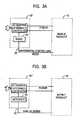
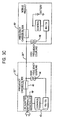
  • Figures 3A, 3B and 3C depict exemplary communication topologies to facilitate communication between the charge controller 24 associated with the portable system 10 and the adapter 32 of the present invention.
  • the adapter 32' is modified to include a serial communications interface 38 (e.g., RS232, RS434, Firewire, USB, etc.) to receive a serial control signal 26' generated by the charge controller.
  • the feedback control signal generated by the charge control is converted into serial communication data and forwarded to the adapter 32'.
  • the control signal 26" is an analog signal generated by the error amplifiers, and accordingly, an appropriate analog interface (e.g., buffer) may be provided in the adapter 32".
  • Figure 3C does not utilize a separate control signal line, but rather, modulates the feedback signal 26'" onto the power line.
  • both the adapter 32'" and system 10' are adapted with modulation/demodulation circuitry (42 and 44, respectively) to generate a feedback signal 26'" that is transposed on the power line.
  • the present invention provides power management topologies that obviate the need for power circuitry associated with a conventional battery charger circuit, and instead utilize the power circuitry already present in an AC/DC adapter to generate regulated controllable power to charge a battery and/or power a portable device.
  • the costs of power switches and power dissipation within the appliance have been eliminated.
  • the cost of an additional controller has been eliminated.
  • Printed circuit board space has been saved within the appliance as there is no need for bulky power switches.
  • optimum charge algorithms can be implemented resulting in short battery charge times with full charge.

Landscapes

  • Engineering & Computer Science (AREA)
  • Power Engineering (AREA)
  • Charge And Discharge Circuits For Batteries Or The Like (AREA)

Abstract

A power management topology for portable electronic devices that includes a feed-enabled AC/DC adapter that receives feedback data from a charge controller associated with the portable device. The feedback data can include battery charging current, battery voltage, or power requirements of the portable device. Using the feedback data, the external AC/DC adapter can adjust the DC output to meet the charging requirement of the battery and/or the power requirements of the portable device.

Description

Background of the Invention 1. Field of the Invention
The present invention relates to power management for battery powered devices, and more particularly, to a power management topology that includes an external AC/DC adapter that is controlled by battery charge controller associated with a portable device.
2. Background Description
Present battery charging topologies are divided into two separate designs and implementation: AC adapters and battery charging topologies.
AC adapters have two present designs:
  • 1) 60 Hz -- Low cost transformers with full wave rectifiers and a filter capacitor. The windings of the transformer usually have high resistance that results in a quasi constant current source.
  • 2) Hi Frequency -- Promoted as the travel version of AC adapters with high frequency usually >100KHz. As reactive impedance is a direct function of frequency (Xl = 2 π f L and Xc= 1/2 π f C) for the same impedance L and C are smaller by the ratio of frequencies. For example the size of an inductor for 600,000 Hz vs 60 Hz is the ratio of 60/600,000 or 1/10,000 = 0.0001. These travel versions of AC adapters are designed with high frequency Switch Mode Power Supplies (SMPS). Hence the benefits are small size and light weight, highly valued by travelers, but may cost more than other types of adapters.
  • Most adapters in use today include PWM circuitry and controllers (including power switches and DC/DC converter circuitry such as Buck, flyback, boost, bridge, or other type of converter topology) to generate a regulated output.
    Battery Chargers in systems like notebook computers, cellular phones and PDA's are generally used to control battery charging and/or power distribution to a system. Battery chargers generally have three popular designs:
  • 1) Simple switched adapter charger uses a single electronic switch to directly connect the adapter to the battery. Then turning the switch off when the final charge voltage is reached. While relatively inexpensive, this type of charger circuitry must use a constant current AC Adapter generally the heavy, 60 Hz type. The battery charging algorithm is highly compromised, resulting in long charge times, perhaps never reaching full charge and limited ability to adapt to multiple battery chemistries like LiIon, NiMH and NiCd.
  • 2) Linear regulators -- Creation of a fixed output voltage is developed by dissipating excess input voltage within the regulating component. This usually results in efficiencies of 50% or less. The wasted power is dissipated within the regulator increasing the temperature within the small, tightly enclosed product. Additionally the wasted power significantly shortens the battery life which is of paramount importance to anyone carrying these products around. The only benefit for a consumer product with a dead battery is as an expensive piece of exercise equipment. The benefits of linear regulators are simplicity and low cost. The negatives include short battery life and high internal temperatures.
  • 3) Switchmode Regulators -- As described above, this method uses a switched mode power supply to efficiently (90 to 95%) convert the input voltage to the battery charge voltage. Optimum charging algorithms can be applied like constant current mode switching to constant voltage mode. Benefits of this type of design are rapid charging, high efficiency and adaptability to varying adapters and battery chemistries, but may cost more than linear regulators.
  • Figure 1 depicts a conventional power management topology for a portable device. The system includes a portable device 10 that includes one or more batteries 30 and one or more active systems 18, 20, and/or 22 coupled to an AC/DC adapter 12. The adapter 12 operates to deliver controlled power to both charge the batteries and power any systems coupled thereto. A battery charger circuit 14 is provided to provide regulated power (voltage and/or current) to the battery 30 based on, for example, battery charging current, battery voltage, and/or available power from the adapter 12. Referring to Figure 1A, a block diagram of a conventional battery charger circuit 14 is depicted. As is well understood in the art, the charger generally includes a plurality of error amplifiers 34 that monitor battery voltage and/or current and generate an error signal if the battery voltage and/or current exceed some predetermined threshold. Additionally, an error amplifier may be included to monitor input power availability and generate an error signal if the available power from the adapter 12 is exceeded. The charger 14 also includes a PWM generator and controller 36. The error signals generated by the error amplifiers are received by the controller 36 and operate to adjust the duty cycle of the PWM generator. The PWM signal is supplied to power switches and DC/DC converter 38 to generate a regulated DC source for charging the batteries.
    Similarly, the AC/DC adapter 12 includes a PWM generator and controller, and further includes power switches and a DC/DC converter to provide a regulated output power source. Thus, a redundancy exists since both the adapter 12 and the charger 14 include a PWM generator and controller, power switches and a DC/DC converter.
    SUMMARY OF THE INVENTION
    Accordingly, the present invention provides a power management topology that includes an external AC/DC adapter that is controlled by battery charge controller. In the exemplary embodiments, the charge controller includes the error amplifiers to generate a feedback control signal, while the AC/DC adapter is modified to receive the control feedback signal to regulate the duty cycle of the PWM generator associated with the adapter. Thus, in the exemplary embodiments, the need for a PWM generator and controller, as well as power switches and a DC/DC converter are eliminated in the charger circuit, thereby economizing power topologies, as well as removing heat-generating portions of a conventional battery charger circuit to the external AC/DC adapter.
    System exemplary embodiments include a power management topology for a portable electronic device, comprising a portable electronic device comprising a rechargeable battery and a charge controller comprising circuitry generating a feedback signal indicative of battery voltage and/or battery charging current. The topology also includes an external AC/DC adapter generating a DC source signal from an AC source, said adapter comprising a PWM generator generating a PWM signal and controller. The controller receives the feedback signal and adjusts the duty cycle of the PWM signal thereby adjusting the voltage and/or current value of the DC source signal.
    In other exemplary embodiments, the present invention provides an AC/DC adapter comprising a PWM generator generating a PWM signal, a controller receiving a feedback signal generated by an external portable electronic device, and a DC/DC converter circuit generating a DC source signal. The controller adjusts the duty cycle of the PWM signal based on the feedback signal thereby adjusting the voltage and/or current value of the DC source signal.
    It will be appreciated by those skilled in the art that although the following Detailed Description will proceed with reference being made to preferred embodiments and methods of use, the present invention is not intended to be limited to these preferred embodiments and methods of use. Rather, the present invention is of broad scope and is intended to be limited as only set forth in the accompanying claims.
    Other features and advantages of the present invention will become apparent as the following Detailed Description proceeds, and upon reference to the Drawings, wherein like numerals depict like parts, and wherein:
    Brief Description of the Drawings
  • Figure 1 is a block diagram of a conventional power management circuit;
  • Figure 1A is a block diagram of a conventional battery charger circuit;
  • Figure 2 is a block diagram of one exemplary of the power management topology of the present invention; and
  • Figure 3A, 3B and 3C depict block diagrams of exemplary AC/DC adapter topologies according to the present invention.
  • Detailed Description of Exemplary Embodiments
    Figure 2 depicts a block diagram of an exemplary power management topology according to the present invention. As with the conventional power management topology of Figure 1, the topology of Figure 2 includes a system 10 powered by an AC/DC adapter 32. However, in this exemplary embodiment, the adapter 32 is feedback enabled to receive one or more feedback control signals generated by the error amplifiers associated with the charger. Thus, in this exemplary embodiment, it is only necessary for the charger to include error amplifiers, and is thus generalized as a charge controller 24. The charge controller 24 includes a plurality of error amplifiers that monitor battery voltage and/or current and generate an error signal if the battery voltage and/or current exceed some predetermined threshold. Additionally, an error amplifier may be included to monitor input power availability and generate an error signal based on the charging requirement of the battery balanced with the power requirement of the active system. These error signals are generally defined herein as feedback control signals 26, and are used to adjust the duty cycle of a PWM generator. One such battery charger topology is disclosed in U.S. Application Serial No. 09/948,828 entitled "Voltage Mode, High Accuracy Battery Charger," now US Patent No. 6,498,461, assigned to the same Assignee, and hereby incorporated by reference in its entirety. In the '461 patent, feedback control signals are generated for battery voltage, battery charging current, and/or available power from the DC source to adjust the duty cycle of the PWM generator, thereby adjusting power delivered to the battery. Other charge topologies are well-known in the art, and all such battery charging circuits are deemed interchangeable and equivalent circuitry for the charge controller 24 of the present invention.
    As set forth above, a conventional switched mode power supply (SWPS) AC/DC adapter includes PWM circuitry (generator and controller), power switches and DC/DC converter circuitry for generating a constant DC source. In the exemplary embodiment, the PWM controller of the AC/DC adapter is adapted to receive the feedback information generated by the charge controller 24 to adjust the DC output.
    Figures 3A, 3B and 3C depict exemplary communication topologies to facilitate communication between the charge controller 24 associated with the portable system 10 and the adapter 32 of the present invention. In Figure 3A, the adapter 32' is modified to include a serial communications interface 38 (e.g., RS232, RS434, Firewire, USB, etc.) to receive a serial control signal 26' generated by the charge controller. In this embodiment, the feedback control signal generated by the charge control is converted into serial communication data and forwarded to the adapter 32'. In Figure 3B, the control signal 26" is an analog signal generated by the error amplifiers, and accordingly, an appropriate analog interface (e.g., buffer) may be provided in the adapter 32". Figure 3C does not utilize a separate control signal line, but rather, modulates the feedback signal 26'" onto the power line. In this embodiment, both the adapter 32'" and system 10' are adapted with modulation/demodulation circuitry (42 and 44, respectively) to generate a feedback signal 26'" that is transposed on the power line.
    Thus, the present invention provides power management topologies that obviate the need for power circuitry associated with a conventional battery charger circuit, and instead utilize the power circuitry already present in an AC/DC adapter to generate regulated controllable power to charge a battery and/or power a portable device. Advantageously, the costs of power switches and power dissipation within the appliance have been eliminated. The cost of an additional controller has been eliminated. Printed circuit board space has been saved within the appliance as there is no need for bulky power switches. Additionally, optimum charge algorithms can be implemented resulting in short battery charge times with full charge. Those skilled in the art will recognize numerous modifications to the present invention. These and all other modifications as may be apparent to one skilled in the art are deemed within the spirit and scope of the present invention, only as limited by the appended claims.

    Claims (29)

    1. A power management topology for a portable electronic device, comprising:
      a portable electronic device comprising a rechargeable battery and a charge controller comprising circuitry generating a feedback signal indicative of battery charging power; and
      an external AC/DC adapter generating a DC source signal from an AC source, said adapter comprising a PWM generator generating a PWM signal, and a controller receiving said feedback signal and adjusting the duty cycle of said PWM signal thereby adjusting the power of said DC source signal, wherein only said external AC/DC adapter, among said AC/DC adapter and said charge controller, comprises said PWM generator.
    2. A topology as claimed in claim 1, wherein said portable electronic device further comprising a serial data interface and said feedback signal being generated as serial data, and said AC/DC adapter further comprising a serial communications interface for receiving said serial data.
    3. A topology as claimed in claim 1, wherein said feedback signal comprises an analog signal.
    4. A topology as claimed in claim 1, wherein said portable electronic device further comprises modulation circuitry to modulate said feedback signal on top of said DC source signal, and said AC/DC adapter further comprises demodulation circuitry coupled to said DC source signal to demodulate said feedback signal.
    5. A topology as claimed in claim 1, wherein the charge controller further comprises circuitry to generate a feedback signal indicative of power requirements of said portable electronic device and battery charge current.
    6. An adapter for providing an output DC signal, said adapter comprising:
      a PWM generator and a DC to DC converter, said PWM generator generating a PWM signal in response to a feedback signal from an external device representative of a power condition of said external device, said DC to DC configured to receive said PWM signal and adjust said output DC signal in response to said PWM signal.
    7. The adapter of claim 6, wherein said PWM generator adjusts a duty cycle of said PWM signal in response to said feedback signal.
    8. The adapter of claim 6, wherein said power condition of said external device is a power condition of a battery of said external device.
    9. The adapter of claim 8, wherein said power condition of said battery is a battery voltage level.
    10. The adapter of claim 8, wherein said power condition of said battery is a battery charging current level.
    11. The adapter of claim 6, wherein said power condition of said external device is a power requirement of at least one active system of said external device.
    12. An electronic device comprising:
      a controller configured to generate a feedback signal representative of a power condition of said electronic device, wherein an adapter adjusts an output DC signal from said adapter in response to said feedback signal.
    13. The electronic device of claim 12, further comprising a rechargeable battery and wherein said controller provides said output DC signal from said adapter to said rechargeable battery in a battery charging supply mode.
    14. The electronic device of claim 12, wherein said controller comprises at least one error amplifier configured to compare a signal representative of said power condition of said electronic device to an associated threshold level, wherein said controller provides said feedback signal in response to a difference between said power condition and said associated threshold level.
    15. The electronic device of claim 12, wherein said controller comprises a serial data interface and said feedback signal comprises a serial data signal.
    16. The electronic device of claim 12, wherein said controller comprises an analog interface and said feedback signal comprises an analog signal.
    17. The electronic device of claim 12, wherein said controller comprises a modulation circuit to modulate said feedback signal on top of said DC signal.
    18. The electronic device of claim 12, wherein said power condition of said external device is a power condition of a rechargeable battery of said external device.
    19. The electronic device of claim 18, wherein said power condition of said rechargeable battery is a battery voltage level.
    20. The electronic device of claim 18, wherein said power condition of said rechargeable battery is a battery charging current level.
    21. The electronic device of claim 12, wherein said power condition of said external device is a power requirement of at least one active system of said electronic device.
    22. A method of adjusting a DC power signal from an adapter, said method comprising:
      monitoring a power condition of an external device coupled to said adapter;
      providing a feedback signal to said adapter representative of said power condition of said external device;
      adjusting a PWM signal generated by said adapter in response to said feedback signal; and
      adjusting said DC power signal provided by said adapter in response to said PWM signal.
    23. The method of claim 22, wherein said power condition of said external device is a power condition of a rechargeable battery of said external device.
    24. The method of claim 23, wherein said power condition of said rechargeable battery is a battery voltage level.
    25. The method of claim 23, wherein said power condition of said rechargeable battery is a battery charging current level.
    26. The method of claim 22, wherein said power condition of said external device is a power requirement of at least one active system of said external device.
    27. The method of claim 22, wherein said feedback signal comprises an analog signal.
    28. The method of claim 22, wherein said feedback signal comprises a serial data signal.
    29. An AC/DC adapter comprising: a PWM generator generating a PWM signal; a controller receiving a feedback signal generated by an external portable electronic device; and a DC/DC converter circuit generating a DC source signal, said controller adjusting a duty cycle of said PWM signal based on said feedback signal thereby adjusting a power level of said DC source signal.
    EP04006551A 2004-03-18 2004-03-18 Controllable AC/DC adapter for battery powered devices Withdrawn EP1577998A1 (en)

    Priority Applications (1)

    Application Number Priority Date Filing Date Title
    EP04006551A EP1577998A1 (en) 2004-03-18 2004-03-18 Controllable AC/DC adapter for battery powered devices

    Applications Claiming Priority (1)

    Application Number Priority Date Filing Date Title
    EP04006551A EP1577998A1 (en) 2004-03-18 2004-03-18 Controllable AC/DC adapter for battery powered devices

    Publications (1)

    Publication Number Publication Date
    EP1577998A1 true EP1577998A1 (en) 2005-09-21

    Family

    ID=34833643

    Family Applications (1)

    Application Number Title Priority Date Filing Date
    EP04006551A Withdrawn EP1577998A1 (en) 2004-03-18 2004-03-18 Controllable AC/DC adapter for battery powered devices

    Country Status (1)

    Country Link
    EP (1) EP1577998A1 (en)

    Cited By (5)

    * Cited by examiner, † Cited by third party
    Publication number Priority date Publication date Assignee Title
    WO2010057338A1 (en) * 2008-11-24 2010-05-27 克立欧电子有限公司 Output voltage feedback device for power supply and power supply
    US8686588B2 (en) 2008-12-03 2014-04-01 Fujitsu Technology Solutions Intellectual Property Gmbh Device arrangement comprising an electronic device and a power adapter and method for connecting a power adapter
    GB2514269A (en) * 2009-06-23 2014-11-19 Hewlett Packard Development Co Power distribution to computer systems
    GB2483420B (en) * 2009-06-23 2015-02-18 Hewlett Packard Development Co Power distribution to computer systems
    CN107005074A (en) * 2014-12-23 2017-08-01 英特尔公司 Apparatus and method for providing selectable charging voltage

    Citations (5)

    * Cited by examiner, † Cited by third party
    Publication number Priority date Publication date Assignee Title
    US5504454A (en) * 1995-01-30 1996-04-02 Westinghouse Elec. Corp. Demodulator for powerline carrier communications
    US5572110A (en) * 1994-12-15 1996-11-05 Intel Corporation Smart battery charger system
    US5684382A (en) * 1996-07-19 1997-11-04 Compaq Computer Corporation Control of computer AC adapter output voltage via battery pack feedback
    US6498461B1 (en) * 2001-08-17 2002-12-24 O2 Micro International Limited Voltage mode, high accuracy battery charger
    EP1447897A1 (en) * 2003-02-11 2004-08-18 O2 Micro, Inc. Power management topologies

    Patent Citations (5)

    * Cited by examiner, † Cited by third party
    Publication number Priority date Publication date Assignee Title
    US5572110A (en) * 1994-12-15 1996-11-05 Intel Corporation Smart battery charger system
    US5504454A (en) * 1995-01-30 1996-04-02 Westinghouse Elec. Corp. Demodulator for powerline carrier communications
    US5684382A (en) * 1996-07-19 1997-11-04 Compaq Computer Corporation Control of computer AC adapter output voltage via battery pack feedback
    US6498461B1 (en) * 2001-08-17 2002-12-24 O2 Micro International Limited Voltage mode, high accuracy battery charger
    EP1447897A1 (en) * 2003-02-11 2004-08-18 O2 Micro, Inc. Power management topologies

    Cited By (9)

    * Cited by examiner, † Cited by third party
    Publication number Priority date Publication date Assignee Title
    WO2010057338A1 (en) * 2008-11-24 2010-05-27 克立欧电子有限公司 Output voltage feedback device for power supply and power supply
    US8686588B2 (en) 2008-12-03 2014-04-01 Fujitsu Technology Solutions Intellectual Property Gmbh Device arrangement comprising an electronic device and a power adapter and method for connecting a power adapter
    GB2514269A (en) * 2009-06-23 2014-11-19 Hewlett Packard Development Co Power distribution to computer systems
    GB2514269B (en) * 2009-06-23 2015-02-18 Hewlett Packard Development Co Power distribution to computer systems
    GB2483420B (en) * 2009-06-23 2015-02-18 Hewlett Packard Development Co Power distribution to computer systems
    US9116676B2 (en) 2009-06-23 2015-08-25 Hewlett-Packard Development Company, L.P. Power distribution to computer system
    CN107005074A (en) * 2014-12-23 2017-08-01 英特尔公司 Apparatus and method for providing selectable charging voltage
    EP3238321A4 (en) * 2014-12-23 2018-08-08 Intel Corporation Apparatus and methods to provide a selectable charging voltage
    CN107005074B (en) * 2014-12-23 2021-07-06 英特尔公司 Apparatus and method for providing selectable charging voltage

    Similar Documents

    Publication Publication Date Title
    US6741066B1 (en) Power management for battery powered appliances
    US20060291259A1 (en) Power Management for Battery Powered Appliances
    KR101312869B1 (en) Power converter with automatic mode switching
    US7679943B2 (en) Uninterruptable power supply
    US10340689B2 (en) System and method for power management
    US8659263B2 (en) Power supply circuit having low idle power dissipation
    US9490644B2 (en) Reconfigurable compensator with large-signal stabilizing network
    EP3382845B1 (en) Intelligent uninterruptible power charging apparatus and method of operating the same
    US20150207336A1 (en) Power receiver, wireless power system and related method of transmitting information with a power receiver
    US20130187595A1 (en) Circuit for a system for contactless inductive power transmission
    CN107888087A (en) Power supply including logic circuit
    US7199552B2 (en) Control circuit apparatus and power supply circuit control method
    US11777338B2 (en) AC switch PFC with integrated charger and DC-DC for online UPS systems
    CN100401616C (en) Plower supply managing circuit for battery power supply device
    CN111525676B (en) DC output uninterrupted power supply
    EP1577998A1 (en) Controllable AC/DC adapter for battery powered devices
    WO2004097958A2 (en) Electrical energy systems, power supply apparatuses and electrical energy supply methods
    US12062938B2 (en) Parallel charging
    JP4202956B2 (en) Power management for battery-powered appliances
    CN1118917C (en) Control device and method for changing charging current with system load
    US12587101B2 (en) Power management system with distributed error feedback
    KR100611871B1 (en) Power Management Apparatus and Method for Battery Powered Applications
    EP4734331A1 (en) Wireless charging receiver
    TW202030968A (en) Uninterruptible power supply with dc output
    KR20250052240A (en) Hybrid buck converter and operating method thereof, power management integrated circuit including the same

    Legal Events

    Date Code Title Description
    PUAI Public reference made under article 153(3) epc to a published international application that has entered the european phase

    Free format text: ORIGINAL CODE: 0009012

    AK Designated contracting states

    Kind code of ref document: A1

    Designated state(s): AT BE BG CH CY CZ DE DK EE ES FI FR GB GR HU IE IT LI LU MC NL PL PT RO SE SI SK TR

    AX Request for extension of the european patent

    Extension state: AL LT LV MK

    17P Request for examination filed

    Effective date: 20051109

    AKX Designation fees paid

    Designated state(s): AT BE BG CH CY CZ DE DK EE ES FI FR GB GR HU IE IT LI LU MC NL PL PT RO SE SI SK TR

    17Q First examination report despatched

    Effective date: 20051207

    STAA Information on the status of an ep patent application or granted ep patent

    Free format text: STATUS: THE APPLICATION HAS BEEN WITHDRAWN

    18W Application withdrawn

    Effective date: 20090528