EP1577328A1 - Polymer-immobilized formamides, catalysts containing the same and allylation process - Google Patents
Polymer-immobilized formamides, catalysts containing the same and allylation process Download PDFInfo
- Publication number
- EP1577328A1 EP1577328A1 EP03780853A EP03780853A EP1577328A1 EP 1577328 A1 EP1577328 A1 EP 1577328A1 EP 03780853 A EP03780853 A EP 03780853A EP 03780853 A EP03780853 A EP 03780853A EP 1577328 A1 EP1577328 A1 EP 1577328A1
- Authority
- EP
- European Patent Office
- Prior art keywords
- polymer
- immobilized
- allylation
- compound
- formamide
- Prior art date
- Legal status (The legal status is an assumption and is not a legal conclusion. Google has not performed a legal analysis and makes no representation as to the accuracy of the status listed.)
- Granted
Links
- 0 CCCC=NN** Chemical compound CCCC=NN** 0.000 description 1
Classifications
-
- C—CHEMISTRY; METALLURGY
- C08—ORGANIC MACROMOLECULAR COMPOUNDS; THEIR PREPARATION OR CHEMICAL WORKING-UP; COMPOSITIONS BASED THEREON
- C08F—MACROMOLECULAR COMPOUNDS OBTAINED BY REACTIONS ONLY INVOLVING CARBON-TO-CARBON UNSATURATED BONDS
- C08F8/00—Chemical modification by after-treatment
- C08F8/30—Introducing nitrogen atoms or nitrogen-containing groups
-
- B—PERFORMING OPERATIONS; TRANSPORTING
- B01—PHYSICAL OR CHEMICAL PROCESSES OR APPARATUS IN GENERAL
- B01J—CHEMICAL OR PHYSICAL PROCESSES, e.g. CATALYSIS OR COLLOID CHEMISTRY; THEIR RELEVANT APPARATUS
- B01J31/00—Catalysts comprising hydrides, coordination complexes or organic compounds
- B01J31/02—Catalysts comprising hydrides, coordination complexes or organic compounds containing organic compounds or metal hydrides
- B01J31/0234—Nitrogen-, phosphorus-, arsenic- or antimony-containing compounds
- B01J31/0235—Nitrogen containing compounds
- B01J31/0237—Amines
-
- B—PERFORMING OPERATIONS; TRANSPORTING
- B01—PHYSICAL OR CHEMICAL PROCESSES OR APPARATUS IN GENERAL
- B01J—CHEMICAL OR PHYSICAL PROCESSES, e.g. CATALYSIS OR COLLOID CHEMISTRY; THEIR RELEVANT APPARATUS
- B01J31/00—Catalysts comprising hydrides, coordination complexes or organic compounds
- B01J31/02—Catalysts comprising hydrides, coordination complexes or organic compounds containing organic compounds or metal hydrides
- B01J31/0234—Nitrogen-, phosphorus-, arsenic- or antimony-containing compounds
- B01J31/0235—Nitrogen containing compounds
- B01J31/0245—Nitrogen containing compounds being derivatives of carboxylic or carbonic acids
- B01J31/0247—Imides, amides or imidates (R-C=NR(OR))
-
- B—PERFORMING OPERATIONS; TRANSPORTING
- B01—PHYSICAL OR CHEMICAL PROCESSES OR APPARATUS IN GENERAL
- B01J—CHEMICAL OR PHYSICAL PROCESSES, e.g. CATALYSIS OR COLLOID CHEMISTRY; THEIR RELEVANT APPARATUS
- B01J31/00—Catalysts comprising hydrides, coordination complexes or organic compounds
- B01J31/02—Catalysts comprising hydrides, coordination complexes or organic compounds containing organic compounds or metal hydrides
- B01J31/06—Catalysts comprising hydrides, coordination complexes or organic compounds containing organic compounds or metal hydrides containing polymers
-
- B—PERFORMING OPERATIONS; TRANSPORTING
- B01—PHYSICAL OR CHEMICAL PROCESSES OR APPARATUS IN GENERAL
- B01J—CHEMICAL OR PHYSICAL PROCESSES, e.g. CATALYSIS OR COLLOID CHEMISTRY; THEIR RELEVANT APPARATUS
- B01J31/00—Catalysts comprising hydrides, coordination complexes or organic compounds
- B01J31/40—Regeneration or reactivation
- B01J31/4007—Regeneration or reactivation of catalysts containing polymers
-
- C—CHEMISTRY; METALLURGY
- C07—ORGANIC CHEMISTRY
- C07C—ACYCLIC OR CARBOCYCLIC COMPOUNDS
- C07C243/00—Compounds containing chains of nitrogen atoms singly-bound to each other, e.g. hydrazines, triazanes
- C07C243/24—Hydrazines having nitrogen atoms of hydrazine groups acylated by carboxylic acids
- C07C243/38—Hydrazines having nitrogen atoms of hydrazine groups acylated by carboxylic acids with acylating carboxyl groups bound to carbon atoms of six-membered aromatic rings
-
- C—CHEMISTRY; METALLURGY
- C07—ORGANIC CHEMISTRY
- C07C—ACYCLIC OR CARBOCYCLIC COMPOUNDS
- C07C29/00—Preparation of compounds having hydroxy or O-metal groups bound to a carbon atom not belonging to a six-membered aromatic ring
- C07C29/36—Preparation of compounds having hydroxy or O-metal groups bound to a carbon atom not belonging to a six-membered aromatic ring increasing the number of carbon atoms by reactions with formation of hydroxy groups, which may occur via intermediates being derivatives of hydroxy, e.g. O-metal
- C07C29/38—Preparation of compounds having hydroxy or O-metal groups bound to a carbon atom not belonging to a six-membered aromatic ring increasing the number of carbon atoms by reactions with formation of hydroxy groups, which may occur via intermediates being derivatives of hydroxy, e.g. O-metal by reaction with aldehydes or ketones
-
- B—PERFORMING OPERATIONS; TRANSPORTING
- B01—PHYSICAL OR CHEMICAL PROCESSES OR APPARATUS IN GENERAL
- B01J—CHEMICAL OR PHYSICAL PROCESSES, e.g. CATALYSIS OR COLLOID CHEMISTRY; THEIR RELEVANT APPARATUS
- B01J2231/00—Catalytic reactions performed with catalysts classified in B01J31/00
- B01J2231/30—Addition reactions at carbon centres, i.e. to either C-C or C-X multiple bonds
- B01J2231/34—Other additions, e.g. Monsanto-type carbonylations, addition to 1,2-C=X or 1,2-C-X triplebonds, additions to 1,4-C=C-C=X or 1,4-C=-C-X triple bonds with X, e.g. O, S, NH/N
- B01J2231/341—1,2-additions, e.g. aldol or Knoevenagel condensations
-
- C—CHEMISTRY; METALLURGY
- C07—ORGANIC CHEMISTRY
- C07C—ACYCLIC OR CARBOCYCLIC COMPOUNDS
- C07C2601/00—Systems containing only non-condensed rings
- C07C2601/12—Systems containing only non-condensed rings with a six-membered ring
- C07C2601/16—Systems containing only non-condensed rings with a six-membered ring the ring being unsaturated
-
- Y—GENERAL TAGGING OF NEW TECHNOLOGICAL DEVELOPMENTS; GENERAL TAGGING OF CROSS-SECTIONAL TECHNOLOGIES SPANNING OVER SEVERAL SECTIONS OF THE IPC; TECHNICAL SUBJECTS COVERED BY FORMER USPC CROSS-REFERENCE ART COLLECTIONS [XRACs] AND DIGESTS
- Y02—TECHNOLOGIES OR APPLICATIONS FOR MITIGATION OR ADAPTATION AGAINST CLIMATE CHANGE
- Y02P—CLIMATE CHANGE MITIGATION TECHNOLOGIES IN THE PRODUCTION OR PROCESSING OF GOODS
- Y02P20/00—Technologies relating to chemical industry
- Y02P20/50—Improvements relating to the production of bulk chemicals
- Y02P20/584—Recycling of catalysts
Definitions
- the present relates to polymer-immobilized formamide and catalyst containing the same, and allylation process.
- the present inventors have proposed a method of synthesizing from an aldehyde compound and an allyl trihalogenosilane compound, a corresponding allyl alcohol compound by allylation in the presence of a Lewis base such as N,N-dimethylformamide (DMF) without using a metallic catalyst (Documents 2 and 3). This method is very advantageous in synthesis of an allyl alcohol compound.
- a Lewis base such as N,N-dimethylformamide (DMF) without using a metallic catalyst
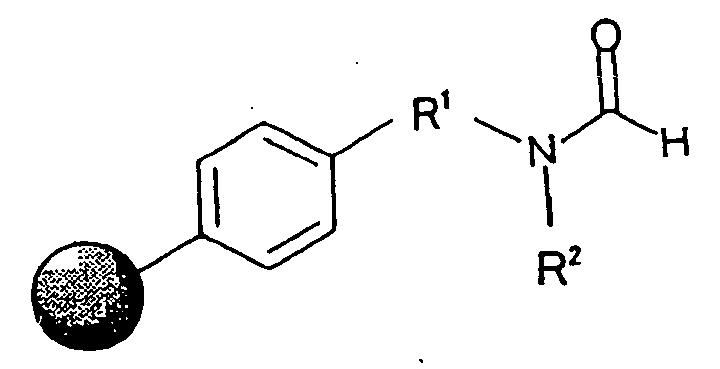
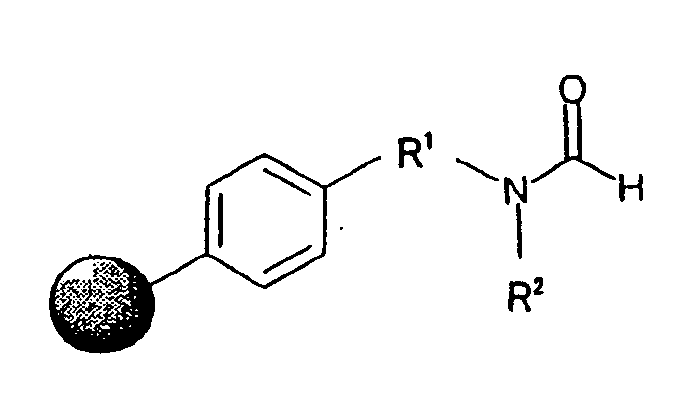
- a first aspect of the present invention provides polymer-immobilized formamides represented by the formula: (wherein, R 1 is an optionally substituted hydrocarbon chain which may have a cyclic moiety or a heteroatom; R 2 is an optionally substituted hydrocarbon group or an optionally substituted hydrocarbon chain which is bounded to R 1 to form a ring; and the solid circle represents a polymer).
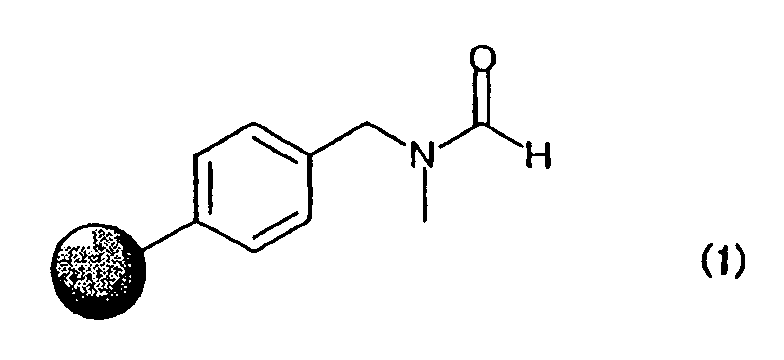
- the present invention provides polymer-immobilized formamides represented by the following formula (1): ; and in a third aspect, the present invention provides polymer-immobilized formamides represented by the following formula (2):
- the present invention provides a reaction catalyst comprising any one of the forgoing polymer-immobilized formamides, as an active ingredient.
- the present invention provides a process for allylation of an aldehyde compound characterized by allylating an aldehyde compound with an allyl trihalogenosilane in the presence of any one of the above polymer-immobilized formamides, thereby generating an allyl alcohol compound, and in a sixth aspect, the present invention provides a process for allylation in which the allylation is conducted in the presence of a polar solvent.
- the present invention provides a process for allylation of a hydrazone compound characterized by allylating a hydrazone compound with an allyl trihalogenosilane in the presence of any one of the above polymer-immobilized formamides, thereby generating an allyl hydrazine compound
- the present invention provides a process for allylation of a hydrazone compound in which the allylation is conducted in the presence of a polar solvent.
- the present invention has the features as described above, and embodiments thereof will be explained below.
- R 1 is an optionally substituted hydrocarbon chain which may have a cyclic moiety or a heteroatom other than carbon.
- hydrocarbon chain include those having saturated or unsaturated, straight or branched chains such as alkylene, alkynylene and the like; those having an alicyclic moiety such as cycloalkylene or an aromatic moiety such as phenylene; and those having a hetero atom like nitrogen or oxygen.
- R 2 is an optionally substituted hydrocarbon group or a hydrocarbon chain which may be bounded to R 1 to form a ring.
- R 1 and R 2 may have a variety of substituents that are acceptable in application and synthesis.
- the solid circle shown in the general formula usually represents a polymer.
- the polymer used herein may be selected from various kinds of polymers that are reaction insoluble depending on the application and synthesis method, and examples of the polymer include cross-linked polystyrene polymers which are commercially available and hence easily obtainable.
- polymer-immobilized formamides of the present invention include those represented by the general formulas (1) and (2).
- the polymer-immobilized formamide of the present invention may be produced, for example, by preparing a chloromethylated polymer, and causing the same to react with formamide or its derivative.
- the chloromethylated polymer include those obtained by reacting cross-linked polystyrene and chloromethylmethylether in the presence of a catalytic amount of SnCl 4 (for example, S. Kobayashi, et al., Tetrahedron Lett., 1997, 38, 425) or commercially available Merrifield' s resin. These resins may have controlled quantity of chloromethyl groups.
- a prepared chloromethylated polymer such as chloromethylated cross-linked polystyrene
- the polymer is caused to react with N-methyl formaldehyde in DMF in the presence of NaH, to obtain a polymer-immobilized formamide represented by the general formula (1) with very high yield in the range of 99% to quantitative yield.
- Various polymer-immobilized formamides represented by the formula (2) may be produced in a similar manner.
- Polymer-immobilized formamides according to the present invention may be utilized as catalysts, e.g., Lewis bases, for various organic synthetic reactions. Since they impose a small burden on the environment because they are organic catalysts free from metallic components, and they are immobilized on a polymer, they are very easy for separation, recovery from products after synthetic reaction and reuse.
- the polymer-immobilized formamides of the present invention are not only useful as catalysts or reaction promoters, but also applicable as intermediates of synthetic reaction.
- the present invention also provides a novel method that uses the above-described polymer-immobilized formamide as a catalyst or a reaction promoter for allylation of an aldehyde compound or a hydrazone compound.
- a method of synthesizing an allyl alcohol compound by causing an aldehyde compound to react with an allyl trihalogenosilane compound in the presence of the polymer-immobilized formamide of the present invention as described above.
- a method for synthesizing an allyl hydrazine compound by causing a hydrazone compound to react with an allyl trihalogenosilane compound.
- an aldehyde compound represented by the formula (3): (wherein R represents an optionally substituted hydrocarbon group or heterocyclic group, and the hydrocarbon group may be chain or cyclic, or combination thereof) is caused to react, in the presence of the polymer-immobilized formamide, with an allyl trihalogenosilane compound represented by the formula (4): (wherein X represents a halogen atom), to synthesize an allyl alcohol compound represented by the formula (5):
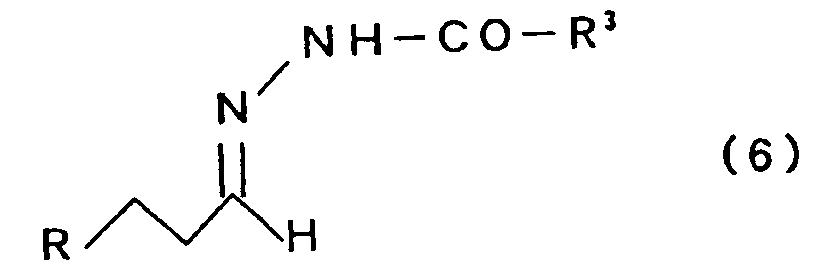
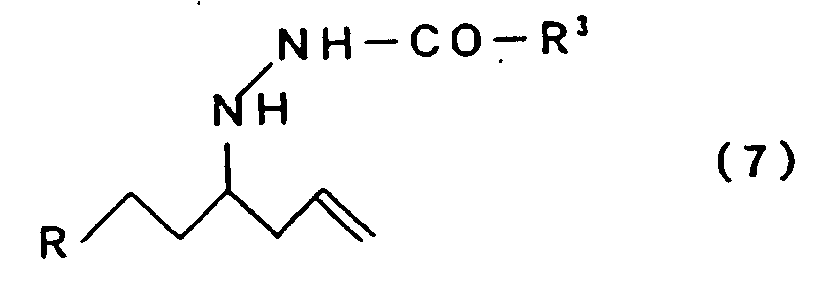
- a hydrazone compound represented by the formula (6): (wherein R and R 3 each represents an optionally substituted hydrocarbon group or heterocyclic group, and the hydrocarbon group may be chain or cyclic, or combination thereof) is caused to react, in the presence of the polymer-immobilized formamide, with an allyl trihalogenosilane compound represented by the formula (4), to synthesize a allyl hydrazine compound represented by the formula (7):
- hydrocarbon groups, heterocyclic groups, as well as substituents may be variable.
- substituents include alkyl groups, cycloalkyl groups, cycloalkylalkyl groups, phenyl group, phenylalkyl groups, phenyl alkenyl groups, tolyl group, naphthyl group, nitrophenyl group, methoxyphenyl group, biphenyl group, furyl group, piperidyl group and pyridinyl group.
- allylation as described above is conducted in a solvent, in particular, in a polar solvent such as nitriles, amides, sulfoxides, alcohols, halogeno hydrocarbons and the like.
- a polar solvent such as nitriles, amides, sulfoxides, alcohols, halogeno hydrocarbons and the like.
- the polymer-immobilized formamide may be generally used in an amount of more than or equal to 5% by mole, or relatively high ratio, for example about 50% by mole to 500% by mole, relative to a reaction substrate in an non -limiting manner.
- reaction temperature, reaction time, use ratios of aldehyde compound, hydrazone compound and allyl trihalogenosilane compound and the like differ depending on the types thereof, and may be appropriately selected.
- the reaction in allylation of an aldehyde compound, the reaction may be conducted at 5 to 30°C for 2 hours or more.
- allylation of a hydrazone compound it may be reacted at a temperature of equal to or less than -20°C, for example. Air or inert gas atmosphere may be used.
- Cross-linked polystyrene and chloromethylmethylether were caused to react in the presence of a catalytic amount of SnCl 4 , to prepare chloromethylated cross-linked polystyrene in which chloromethyl groups are introduced and bound in a range of 2.22 to 5.11 mmol/g.
- Commercially available Morrifield's resins included binding of chloromethyl groups of 0.63 mmol/g and 1.20 mmol/g.
- polymer-immobilized formamide represented by the formula (2) was obtained.
- the symbols x and y represent existence ratio and existence amount of formamide derivative groups introduced and bound to cross-linked polystyrene.
- PS-Formamide 1 having a ratio of 300% by mole of formamide derived groups as a catalyst, allylation of different kinds of aldehyde compound was conducted.
- PS-Formamide 1 catalyst was examined for reusability, and the results are shown in Table 3.
- the present invention provides a novel organic catalyst which does not use a metal component and is very easily recovered from a product of synthesis reaction and reused; a polymer-immobilized organic substance which is useful as a synthetic intermediate or the like; a catalyst containing the polymer-immobilized organic substance as an active ingredient; a process for allylation of an aldehyde compound or a hydrazone compound in good reaction yield by using the catalyst.
Landscapes
- Chemical & Material Sciences (AREA)
- Organic Chemistry (AREA)
- Chemical Kinetics & Catalysis (AREA)
- Engineering & Computer Science (AREA)
- Materials Engineering (AREA)
- Health & Medical Sciences (AREA)
- Medicinal Chemistry (AREA)
- Polymers & Plastics (AREA)
- General Chemical & Material Sciences (AREA)
- Catalysts (AREA)
- Organic Low-Molecular-Weight Compounds And Preparation Thereof (AREA)
- Low-Molecular Organic Synthesis Reactions Using Catalysts (AREA)
- Addition Polymer Or Copolymer, Post-Treatments, Or Chemical Modifications (AREA)
Abstract
Description
- The present relates to polymer-immobilized formamide and catalyst containing the same, and allylation process.
- Conventionally, from the viewpoint of reducing loads on the natural environment by metal components, attentions have been directed to develop and use organic catalysts which are free from metallic components. Using an organic compound as a catalyst will be a solution for the difficulty in treating metallic catalyst components in waste liquids or waste products and loads on the natural environment exerted by the metallic catalyst components.
- However, in the case where an organic compound is used as a catalyst, separation of the organic catalyst from products of synthesis reaction is not easy, and separation of such organic catalyst poses a great problem in practical organic synthesis process.
- In these circumstances, immobilizing an organic compound serving as a catalytic component to a polymer so as to facilitate separation from products has been proposed. However, only few examples of polymer-immobilized organic catalysts have proved effective (Document 1).
- On the other hand, the present inventors have proposed a method of synthesizing from an aldehyde compound and an allyl trihalogenosilane compound, a corresponding allyl alcohol compound by allylation in the presence of a Lewis base such as N,N-dimethylformamide (DMF) without using a metallic catalyst (Documents 2 and 3). This method is very advantageous in synthesis of an allyl alcohol compound.
- With regard to this method, if the catalytic Lewis base or the like could be recovered from reaction products more efficiently, more excellent practical efficiency and catalyst recovery, as well as improved reusability would be expected.
- Document 1: M. Benaglia, et al., Adv. Synth. Catal., 2002, 344, 533
- Document 2: S. Kobayashi, et al., Tetrahedron Lett., 1993, 34, 3453
- Document 3: S. Kobayashi, et al., J. Org. Chem. 1994, 59, 6620
-
- In view of the forgoing circumstance, it is an object of the present invention to provide a novel organic catalyst which is useful as an organic catalyst which is free from metallic components and very easy of recovery from reaction mixture of synthesis and reuse; a polymer-immobilized organic substance which is useful as a synthetic intermediate or the like; a catalyst containing the same as an active ingredient; and an allylation process of aldehyde compound using the same.
- As a solution for the forgoing problems, a first aspect of the present invention provides polymer-immobilized formamides represented by the formula:(wherein, R1 is an optionally substituted hydrocarbon chain which may have a cyclic moiety or a heteroatom; R2 is an optionally substituted hydrocarbon group or an optionally substituted hydrocarbon chain which is bounded to R1 to form a ring; and the solid circle represents a polymer).
- In a second aspect, the present invention provides polymer-immobilized formamides represented by the following formula (1):; and in a third aspect, the present invention provides polymer-immobilized formamides represented by the following formula (2):

- In a fourth aspect, the present invention provides a reaction catalyst comprising any one of the forgoing polymer-immobilized formamides, as an active ingredient.
- In a fifth aspect, the present invention provides a process for allylation of an aldehyde compound characterized by allylating an aldehyde compound with an allyl trihalogenosilane in the presence of any one of the above polymer-immobilized formamides, thereby generating an allyl alcohol compound, and in a sixth aspect, the present invention provides a process for allylation in which the allylation is conducted in the presence of a polar solvent.
- Further, in a seventh aspect, the present invention provides a process for allylation of a hydrazone compound characterized by allylating a hydrazone compound with an allyl trihalogenosilane in the presence of any one of the above polymer-immobilized formamides, thereby generating an allyl hydrazine compound, and in an eighth aspect, the present invention provides a process for allylation of a hydrazone compound in which the allylation is conducted in the presence of a polar solvent.
- The present invention has the features as described above, and embodiments thereof will be explained below.
- In a polymer-immobilized formamide according to the present invention represented by the above general formula, R1 is an optionally substituted hydrocarbon chain which may have a cyclic moiety or a heteroatom other than carbon. Examples of such hydrocarbon chain include those having saturated or unsaturated, straight or branched chains such as alkylene, alkynylene and the like; those having an alicyclic moiety such as cycloalkylene or an aromatic moiety such as phenylene; and those having a hetero atom like nitrogen or oxygen.
- R2 is an optionally substituted hydrocarbon group or a hydrocarbon chain which may be bounded to R1 to form a ring.
- R1 and R2 may have a variety of substituents that are acceptable in application and synthesis.
- The solid circle shown in the general formula usually represents a polymer. The polymer used herein may be selected from various kinds of polymers that are reaction insoluble depending on the application and synthesis method, and examples of the polymer include cross-linked polystyrene polymers which are commercially available and hence easily obtainable.
- Concrete examples of the polymer-immobilized formamides of the present invention include those represented by the general formulas (1) and (2).
- The polymer-immobilized formamide of the present invention may be produced, for example, by preparing a chloromethylated polymer, and causing the same to react with formamide or its derivative. Examples of the chloromethylated polymer include those obtained by reacting cross-linked polystyrene and chloromethylmethylether in the presence of a catalytic amount of SnCl4 (for example, S. Kobayashi, et al., Tetrahedron Lett., 1997, 38, 425) or commercially available Merrifield' s resin. These resins may have controlled quantity of chloromethyl groups.
- In the case where a prepared chloromethylated polymer such as chloromethylated cross-linked polystyrene is used, the polymer is caused to react with N-methyl formaldehyde in DMF in the presence of NaH, to obtain a polymer-immobilized formamide represented by the general formula (1) with very high yield in the range of 99% to quantitative yield. Various polymer-immobilized formamides represented by the formula (2) may be produced in a similar manner.
- Polymer-immobilized formamides according to the present invention may be utilized as catalysts, e.g., Lewis bases, for various organic synthetic reactions. Since they impose a small burden on the environment because they are organic catalysts free from metallic components, and they are immobilized on a polymer, they are very easy for separation, recovery from products after synthetic reaction and reuse. The polymer-immobilized formamides of the present invention are not only useful as catalysts or reaction promoters, but also applicable as intermediates of synthetic reaction.
- The present invention also provides a novel method that uses the above-described polymer-immobilized formamide as a catalyst or a reaction promoter for allylation of an aldehyde compound or a hydrazone compound. To be more specific, provided is a method of synthesizing an allyl alcohol compound by causing an aldehyde compound to react with an allyl trihalogenosilane compound in the presence of the polymer-immobilized formamide of the present invention as described above. Also provided is a method for synthesizing an allyl hydrazine compound by causing a hydrazone compound to react with an allyl trihalogenosilane compound.
- In the present reaction method, an aldehyde compound represented by the formula (3):(wherein R represents an optionally substituted hydrocarbon group or heterocyclic group, and the hydrocarbon group may be chain or cyclic, or combination thereof) is caused to react, in the presence of the polymer-immobilized formamide, with an allyl trihalogenosilane compound represented by the formula (4):
 (wherein X represents a halogen atom), to synthesize an allyl alcohol compound represented by the formula (5):

- Alternatively, for example, a hydrazone compound represented by the formula (6):(wherein R and R3 each represents an optionally substituted hydrocarbon group or heterocyclic group, and the hydrocarbon group may be chain or cyclic, or combination thereof) is caused to react, in the presence of the polymer-immobilized formamide, with an allyl trihalogenosilane compound represented by the formula (4), to synthesize a allyl hydrazine compound represented by the formula (7):
- The foregoing hydrocarbon groups, heterocyclic groups, as well as substituents may be variable. Examples of such groups include alkyl groups, cycloalkyl groups, cycloalkylalkyl groups, phenyl group, phenylalkyl groups, phenyl alkenyl groups, tolyl group, naphthyl group, nitrophenyl group, methoxyphenyl group, biphenyl group, furyl group, piperidyl group and pyridinyl group.
- Preferably, allylation as described above is conducted in a solvent, in particular, in a polar solvent such as nitriles, amides, sulfoxides, alcohols, halogeno hydrocarbons and the like. As a catalyst, the polymer-immobilized formamide may be generally used in an amount of more than or equal to 5% by mole, or relatively high ratio, for example about 50% by mole to 500% by mole, relative to a reaction substrate in an non -limiting manner.
- Also, reaction temperature, reaction time, use ratios of aldehyde compound, hydrazone compound and allyl trihalogenosilane compound and the like differ depending on the types thereof, and may be appropriately selected. For example, in allylation of an aldehyde compound, the reaction may be conducted at 5 to 30°C for 2 hours or more. In allylation of a hydrazone compound, it may be reacted at a temperature of equal to or less than -20°C, for example. Air or inert gas atmosphere may be used.
- The present invention will be now described in more detail by way of examples. It is to be noted that the following examples will not limit the present invention.
- Cross-linked polystyrene and chloromethylmethylether were caused to react in the presence of a catalytic amount of SnCl4, to prepare chloromethylated cross-linked polystyrene in which chloromethyl groups are introduced and bound in a range of 2.22 to 5.11 mmol/g. Commercially available Morrifield's resins included binding of chloromethyl groups of 0.63 mmol/g and 1.20 mmol/g.
- These chloromethylated cross-linked polystyrenes were caused to react with N-methyl formamide under a basic condition.
- The reaction was conducted in the presence of NaH in DMF solvent. Polymer-immobilized formamide (PS-Formamide 1) represented by the formula (1) was obtained in yield of 99%. This product was examined for the structure by 13C Swollen Resin. Magic Angle Spinnig (SR-MAS) and IR analysis.
- Likewise, polymer-immobilized formamide (PS-Formamide 2) represented by the formula (2) was obtained..
- Using these products, allylation of aldehyde compound was effected according to the reaction indicated by the following formula. The results are shown in Table 1.


Optimization of the Reaction Conditions Entry Polymer x y z Conc. (M) Yield (%) 1 1 100 0.61 3 0.06 40 2 2 100 0.61 3 0.06 26 3 1 50 0.62 1.5 0.33 43 4 1 50 1.10 1.5 0.33 49 5 1 50 2.12 1.5 0.33 56 6 1 50 3.22 1.5 0.33 58 7 1 50 4.66 1.5 0.33 58 8 1 100 3.22 1.5 0.33 73 9 1 100 3.22 3 0.33 91 10 1 200 3.22 3 0.33 92 11 1 10 3.22 3 0.33 54 12 1 10 3.22 3 0.66 79 - The symbols x and y represent existence ratio and existence amount of formamide derivative groups introduced and bound to cross-linked polystyrene.
- The results demonstrate that PS-Formamide 1 having a ratio of more than or equal to 100% by mole give high reaction yield.
- Using PS-Formamide 1 having a ratio of 300% by mole of formamide derived groups as a catalyst, allylation of different kinds of aldehyde compound was conducted.
- The results are shown in Table 2.


- PS-Formamide 1 catalyst was examined for reusability, and the results are shown in Table 3.
- The results of Table 3 demonstrate quantitative recovery of catalyst and high reaction yield by recycle use. The recovered PS-Formamide 1 catalyst was determined as being the same with that before use by 13C-NMR spectrum

- Using PS-Formamide 1 catalyst (200% by mol), allylation of hydrazone compound was conducted according to the following reaction formula, to obtain an allyl hydrazine compound in a reaction yield of 50%.

- As specifically described above, the present invention provides a novel organic catalyst which does not use a metal component and is very easily recovered from a product of synthesis reaction and reused; a polymer-immobilized organic substance which is useful as a synthetic intermediate or the like; a catalyst containing the polymer-immobilized organic substance as an active ingredient; a process for allylation of an aldehyde compound or a hydrazone compound in good reaction yield by using the catalyst.
Claims (8)
- Polymer-immobilized formamide characterized by being represented by the general formula:(wherein R1 is an optionally substituted hydrocarbon chain which may have a cyclic moiety or a heteroatom; R2 is an optionally substituted hydrocarbon group or an optionally substituted hydrocarbon chain which is bound to R1 to form a ring; and the solid circle represents a polymer).
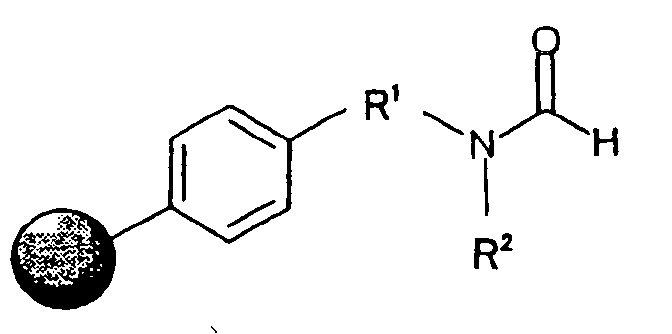
- The polymer-immobilized formamide according to claim 1, characterized by being represented by the formula:

- The polymer-immobilized formamide according to claim 1, characterized by being represented by the formula:
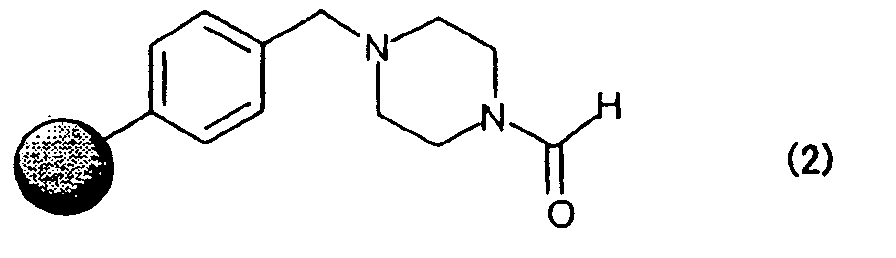
- A reaction catalyst comprising any one of the polymer-immobilized formamides according to claims 1-3 as an active ingredient.
- A process for allylation of an aldehyde compound characterized by causing an aldehyde compound to react with allyl trihalogenosilane in the presence of the polymer-immobilized formamides according to claims 1-3, to synthesize an allyl alcohol compound.
- The allylation process according to claim 5, wherein the reaction is conducted in the presence of a polar solvent.
- A process for allylation of a hydrazone compound characterized by causing a hydrazone compound to react with allyl trihalogenosilane in the presence of the polymer-immobilized formamides according to claims 1-3, to synthesize an allyl hydrazine compound.
- The allylation process according to claim 7, wherein the reaction is conducted in the presence of a polar solvent.
Applications Claiming Priority (3)
| Application Number | Priority Date | Filing Date | Title |
|---|---|---|---|
| JP2002365954 | 2002-12-17 | ||
| JP2002365954A JP3955257B2 (en) | 2002-12-17 | 2002-12-17 | Polymer-fixed formamide, its catalyst and allylation method |
| PCT/JP2003/016187 WO2004055066A1 (en) | 2002-12-17 | 2003-12-17 | Polymer-immobilized formamides, catalysts containing the same and allylation process |
Publications (3)
| Publication Number | Publication Date |
|---|---|
| EP1577328A1 true EP1577328A1 (en) | 2005-09-21 |
| EP1577328A4 EP1577328A4 (en) | 2006-10-11 |
| EP1577328B1 EP1577328B1 (en) | 2010-08-11 |
Family
ID=32588286
Family Applications (1)
| Application Number | Title | Priority Date | Filing Date |
|---|---|---|---|
| EP03780853A Expired - Lifetime EP1577328B1 (en) | 2002-12-17 | 2003-12-17 | Polymer-immobilized formamides, catalysts containing the same and allylation process |
Country Status (5)
| Country | Link |
|---|---|
| US (1) | US20060111590A1 (en) |
| EP (1) | EP1577328B1 (en) |
| JP (1) | JP3955257B2 (en) |
| DE (1) | DE60333789D1 (en) |
| WO (1) | WO2004055066A1 (en) |
Family Cites Families (4)
| Publication number | Priority date | Publication date | Assignee | Title |
|---|---|---|---|---|
| US3791996A (en) * | 1971-11-01 | 1974-02-12 | Rohm & Haas | Direct acylaminomethylation of aromatic polymers |
| US5198531A (en) * | 1991-06-14 | 1993-03-30 | Research Diagnostic Antibodies | Polymeric resin for peptide synthesis |
| US6310244B1 (en) * | 1998-07-23 | 2001-10-30 | Pharmacopeia, Inc. | Photocleavable and acid cleavable linkers for combinatorial chemistry |
| WO2002083606A1 (en) * | 2001-04-17 | 2002-10-24 | University Of Alberta | A linker system for the synthesis and screening of combinatorial libraries of polyamine derivatives on water compatible supports |
-
2002
- 2002-12-17 JP JP2002365954A patent/JP3955257B2/en not_active Expired - Fee Related
-
2003
- 2003-12-17 DE DE60333789T patent/DE60333789D1/en not_active Expired - Lifetime
- 2003-12-17 US US10/539,615 patent/US20060111590A1/en not_active Abandoned
- 2003-12-17 WO PCT/JP2003/016187 patent/WO2004055066A1/en not_active Ceased
- 2003-12-17 EP EP03780853A patent/EP1577328B1/en not_active Expired - Lifetime
Non-Patent Citations (4)
| Title |
|---|
| KOBAYASHI, SHU ET AL: "Facile and highly stereoselective allylation of aldehydes using allyltrichlorosilanes in DMF" TETRAHEDRON LETTERS , 34(21), 3453-6 CODEN: TELEAY; ISSN: 0040-4039, 1993, XP002397097 * |
| KOBAYASHI, SHU ET AL: "Highly Stereoselective Synthesis of Homoallylic Amines Based on Addition of Allyltrichlorosilanes to Benzoylhydrazones under Neutral Conditions" JOURNAL OF THE AMERICAN CHEMICAL SOCIETY , 121(29), 6942-6943 CODEN: JACSAT; ISSN: 0002-7863, 1999, XP002397098 * |
| KONDO SHUJI ET AL: "SYNTHESIS OF POLYMERIC FORMAMIDES AND THEIR USE AS PHASE TRANSFER CATALYSTS" J POLYM SCI POLYM LETT ED MAY 1984, vol. 22, no. 5, May 1984 (1984-05), pages 249-254, XP002397096 * |
| See also references of WO2004055066A1 * |
Also Published As
| Publication number | Publication date |
|---|---|
| JP2004196924A (en) | 2004-07-15 |
| DE60333789D1 (en) | 2010-09-23 |
| JP3955257B2 (en) | 2007-08-08 |
| WO2004055066A1 (en) | 2004-07-01 |
| EP1577328B1 (en) | 2010-08-11 |
| US20060111590A1 (en) | 2006-05-25 |
| EP1577328A4 (en) | 2006-10-11 |
Similar Documents
| Publication | Publication Date | Title |
|---|---|---|
| KR101654731B1 (en) | Ionic Liquid System Catalysts Fixed to Polymer Resins and Preparation of N, N '' - Substituted Ureas Using the Same | |
| GB1578238A (en) | Hydrocarbylation of aliphatic secondary amines | |
| Iwao et al. | Methodology for the efficient synthesis of 3, 4-differentially substituted indoles. Fluoride ion-induced elimination-addition reaction of 1-triisopropylsilylgramine methiodides | |
| GB2037767A (en) | Preparation of methacrolein | |
| WO2013163130A1 (en) | Methods for producing 1,5,7-triazabicyclo[4.4.0] dec-5-ene by reaction of a disubstituted carbodiimide and dipropylene triamine | |
| JP4142861B2 (en) | Cyanoethylation of cycloaliphatic primary vicinal diamines | |
| US9994720B2 (en) | Methods for producing 1,5,7-triazabicyclo[4.4.0]dec-5-ene by reaction of a disubstituted carbodiimide and dipropylene triamine | |
| US20060111590A1 (en) | Polymer-immobilized formamides, catalyst containing the same and allylation process | |
| Kobayashi et al. | Lewis acid-catalyzed allylation reactions of acylhydrazones with tetraallyltin in aqueous media | |
| US3951996A (en) | Process for making nicotinic acid hydrazides | |
| US6380420B1 (en) | Process for making fatty acid nitriles and fatty amines by cross-metathesis of normal alpha olefins | |
| JP4307106B2 (en) | Process for producing 5-alkylidene-2-oxazolidinones | |
| KR900007781A (en) | Manufacturing method of ethylene diamine | |
| CN109331867B (en) | Application of 2, 6-dimethylanilinium to catalysis of imine and borane hydroboration reaction | |
| CN109369515B (en) | Synthetic method of unsaturated double-bond substituted carbocyclic derivative | |
| JP2003525264A (en) | Process for producing amines by hydroaminomethylation of olefins in the presence of ionic liquids | |
| JP3860167B2 (en) | Process for producing N'-homoallylacyl hydrazides | |
| US6011156A (en) | Process for removing primary amines from an amine-containing stream | |
| KR101083935B1 (en) | Trifluoroacetylation for amines | |
| KR820002078B1 (en) | Method for the denitrosation of n-nitroso compounds | |
| JP3768905B2 (en) | Method for producing allyl alcohol | |
| JPS5938957B2 (en) | Synthesis method of silatrane derivatives | |
| EP1072584A1 (en) | Amine derivative fixed to resin and method for synthesizing beta-aminocarbonyl compound in a solid phase | |
| JPS5822468B2 (en) | Nikiyuuaminekagobutsunoseizouhou | |
| CN112479936A (en) | Preparation method of benzil derivative nitrone |
Legal Events
| Date | Code | Title | Description |
|---|---|---|---|
| PUAI | Public reference made under article 153(3) epc to a published international application that has entered the european phase |
Free format text: ORIGINAL CODE: 0009012 |
|
| 17P | Request for examination filed |
Effective date: 20050624 |
|
| AK | Designated contracting states |
Kind code of ref document: A1 Designated state(s): AT BE BG CH CY CZ DE DK EE ES FI FR GB GR HU IE IT LI LU MC NL PT RO SE SI SK TR |
|
| RBV | Designated contracting states (corrected) |
Designated state(s): DE FR GB |
|
| A4 | Supplementary search report drawn up and despatched |
Effective date: 20060913 |
|
| 17Q | First examination report despatched |
Effective date: 20070911 |
|
| GRAP | Despatch of communication of intention to grant a patent |
Free format text: ORIGINAL CODE: EPIDOSNIGR1 |
|
| GRAS | Grant fee paid |
Free format text: ORIGINAL CODE: EPIDOSNIGR3 |
|
| GRAA | (expected) grant |
Free format text: ORIGINAL CODE: 0009210 |
|
| AK | Designated contracting states |
Kind code of ref document: B1 Designated state(s): DE FR GB |
|
| REG | Reference to a national code |
Ref country code: GB Ref legal event code: FG4D |
|
| REF | Corresponds to: |
Ref document number: 60333789 Country of ref document: DE Date of ref document: 20100923 Kind code of ref document: P |
|
| PLBE | No opposition filed within time limit |
Free format text: ORIGINAL CODE: 0009261 |
|
| STAA | Information on the status of an ep patent application or granted ep patent |
Free format text: STATUS: NO OPPOSITION FILED WITHIN TIME LIMIT |
|
| 26N | No opposition filed |
Effective date: 20110512 |
|
| REG | Reference to a national code |
Ref country code: DE Ref legal event code: R097 Ref document number: 60333789 Country of ref document: DE Effective date: 20110512 |
|
| PGFP | Annual fee paid to national office [announced via postgrant information from national office to epo] |
Ref country code: DE Payment date: 20141111 Year of fee payment: 12 Ref country code: FR Payment date: 20141111 Year of fee payment: 12 Ref country code: GB Payment date: 20141111 Year of fee payment: 12 |
|
| REG | Reference to a national code |
Ref country code: DE Ref legal event code: R119 Ref document number: 60333789 Country of ref document: DE |
|
| GBPC | Gb: european patent ceased through non-payment of renewal fee |
Effective date: 20151217 |
|
| REG | Reference to a national code |
Ref country code: FR Ref legal event code: ST Effective date: 20160831 |
|
| PG25 | Lapsed in a contracting state [announced via postgrant information from national office to epo] |
Ref country code: DE Free format text: LAPSE BECAUSE OF NON-PAYMENT OF DUE FEES Effective date: 20160701 Ref country code: GB Free format text: LAPSE BECAUSE OF NON-PAYMENT OF DUE FEES Effective date: 20151217 |
|
| PG25 | Lapsed in a contracting state [announced via postgrant information from national office to epo] |
Ref country code: FR Free format text: LAPSE BECAUSE OF NON-PAYMENT OF DUE FEES Effective date: 20151231 |