EP1577236A1 - Air mixed cargo control system and control method - Google Patents
Air mixed cargo control system and control method Download PDFInfo
- Publication number
- EP1577236A1 EP1577236A1 EP03789609A EP03789609A EP1577236A1 EP 1577236 A1 EP1577236 A1 EP 1577236A1 EP 03789609 A EP03789609 A EP 03789609A EP 03789609 A EP03789609 A EP 03789609A EP 1577236 A1 EP1577236 A1 EP 1577236A1
- Authority
- EP
- European Patent Office
- Prior art keywords
- cargo
- data
- owner
- small
- loads
- Prior art date
- Legal status (The legal status is an assumption and is not a legal conclusion. Google has not performed a legal analysis and makes no representation as to the accuracy of the status listed.)
- Withdrawn
Links
Images

Classifications
-
- G—PHYSICS
- G06—COMPUTING OR CALCULATING; COUNTING
- G06Q—INFORMATION AND COMMUNICATION TECHNOLOGY [ICT] SPECIALLY ADAPTED FOR ADMINISTRATIVE, COMMERCIAL, FINANCIAL, MANAGERIAL OR SUPERVISORY PURPOSES; SYSTEMS OR METHODS SPECIALLY ADAPTED FOR ADMINISTRATIVE, COMMERCIAL, FINANCIAL, MANAGERIAL OR SUPERVISORY PURPOSES, NOT OTHERWISE PROVIDED FOR
- G06Q10/00—Administration; Management
- G06Q10/04—Forecasting or optimisation specially adapted for administrative or management purposes, e.g. linear programming or "cutting stock problem"
- G06Q10/043—Optimisation of two dimensional placement, e.g. cutting of clothes or wood
-
- B—PERFORMING OPERATIONS; TRANSPORTING
- B64—AIRCRAFT; AVIATION; COSMONAUTICS
- B64D—EQUIPMENT FOR FITTING IN OR TO AIRCRAFT; FLIGHT SUITS; PARACHUTES; ARRANGEMENT OR MOUNTING OF POWER PLANTS OR PROPULSION TRANSMISSIONS IN AIRCRAFT
- B64D9/00—Equipment for handling freight; Equipment for facilitating passenger embarkation or the like
-
- G—PHYSICS
- G06—COMPUTING OR CALCULATING; COUNTING
- G06Q—INFORMATION AND COMMUNICATION TECHNOLOGY [ICT] SPECIALLY ADAPTED FOR ADMINISTRATIVE, COMMERCIAL, FINANCIAL, MANAGERIAL OR SUPERVISORY PURPOSES; SYSTEMS OR METHODS SPECIALLY ADAPTED FOR ADMINISTRATIVE, COMMERCIAL, FINANCIAL, MANAGERIAL OR SUPERVISORY PURPOSES, NOT OTHERWISE PROVIDED FOR
- G06Q10/00—Administration; Management
- G06Q10/02—Reservations, e.g. for tickets, services or events
- G06Q10/025—Coordination of plural reservations, e.g. plural trip segments, transportation combined with accommodation
Definitions
- This invention relates to a consolidated-air-cargo-management system that is applied to the transport of consolidated cargo using aircraft.
- Direct cargo is cargo for which the cargo owner directly entrusts the transport of the cargo with an air transport company or business that exclusively handles air cargo.
- Consolidated cargo is a plurality of small cargo loads that have been sorted according to each transport destination or flight of the same aircraft or that have been arranged into one cargo load. This consolidated cargo is widely used as a way of transporting small cargo loads at low cost.
- Japanese Patent Publication No. 2002-193450 proposes setting up a transfer area between the airport cargo terminal and cargo owner, or in other words, to set up a transfer base where the branch offices of a forwarder or each forwarder collect and deliver to jointly, and the consolidated cargo is made at that transfer area.
- the unit fee for air cargo is set according to classification of pallet or container, and is a set amount up until the consolidated cargo loaded on the pallet or in the container reaches a fixed weight.
- the type of pallet or container used for aircraft transportation is called a unit-load device according to IATA (a unit load device for aircraft), or ULD (unit load devices), and various ULD have been developed since the adoption of using large jets.
- the ULD for air cargo there are pallets, nets, containers, igloos, or the like that can be fastened directly to the cargo mounting apparatus of the aircraft, and some are used for through transport.
- the cargo is sorted according to route selection and flight type, and loaded onto pallets or into containers based on a load plan that takes into consideration the weight or balance of the entire consolidated cargo, however, skill and experience are required for that loading work.
- the present invention takes into consideration this kind of situation and provides a consolidated-air-cargo-management system that makes it possible to easily and accurately perform the work of loading consolidated cargo without requiring skill and experience, and makes it possible to reduce the transport cost for each small cargo load.
- the consolidated-air-cargo-management system of this invention comprises: terminals for each cargo owner that have a function for sending cargo data for a plurality of small cargo loads; and a server on the side of a business that handles air cargo and that is connected to the terminals for each cargo owner over a network, and extracts small cargo loads that match the specified load amount of a pallet based on the respective cargo data from the terminals of each cargo owner.
- the server can comprise: an owner-cargo-data-storage unit that stores respective cargo data from the terminals of each cargo owner; a detail-data-extraction unit that extracts detail data from the cargo data stored in the owner-cargo-data-storage unit that gives at least the cargo owner's name, transport destination, product contents, weight of outside packages, size of outside packages and outside package ID Nos.; and a loadable-cargo-extraction unit that extracts a plurality of small cargo loads from the detail data extracted by the detail-data-extraction unit and the basic data stored in the database such that the external dimensions and weight of the entire consolidated cargo matches the specified load amount of the pallet.
- the server can comprise: a simulation-execution unit that executes simulation of a consolidated load of small cargo loads loaded on the pallet based on the weight of the outside packages and the size of the outside packages of the extracted small cargo loads, and determines whether the arrangement of the small cargo loads is the most efficient; and a cargo-load-information-output unit that outputs cargo load information based on the simulation results from the simulation-execution unit, that shows which small cargo loads are loaded in which location of which layer on the pallet using the outside-package ID numbers.
- the consolidated-air-cargo-management method of this invention comprises: a process of sending cargo data from terminals of each cargo owner for a plurality of small cargo loads; and a process of extracting small cargo loads, which match the specified load amount of a pallet based on the respective cargo data from the terminals of each cargo owner, from a server that is connected to the terminals of each cargo owner over a network.
- a process of storing basic data that indicates the type of pallet, the specified load amount that is specified by the load weight and dimensions for each air carrier, and the unit fee a process of storing respective cargo data from the terminals of each cargo owner; a process of extracting detail data from the stored cargo data that gives at least the cargo owner's name, transport destination, product contents, weight of outside packages, size of outside packages and outside package ID Nos.; and a process of extracting a plurality of small cargo loads from the extracted detail data and the basic data such that the external dimensions and weight of the entire consolidated cargo matches the specified load amount of the pallet.
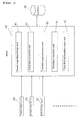
- Fig. 1 is a drawing for explaining the concept of the consolidated-air-cargo-management system of this invention
- Fig. 2 is a block diagram for explaining the details of the consolidated-air-cargo-management system shown in Fig. 1
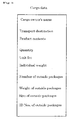
- Fig. 3 is a drawing showing the cargo data used in the consolidated-air-cargo-management system shown in Fig. 1
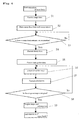
- Fig. 4 to Fig. 6 are drawings for explaining the consolidated-air-cargo-management method by the consolidated-air-cargo-management system shown in Fig. 1.
- the consolidated-air-cargo-management system shown in Fig. 1 comprises a terminal 10 on the side of a cargo owner A, a terminal 20 of a cargo owner B, a terminal 30 of a cargo owner C, server 40 and database 46.
- the terminals located on the side of the cargo owners are not limited to three as shown in the figure.
- the terminal 10 on the side of cargo owner A, terminal 20 on the side of cargo owner B and terminal 30 on the side of cargo owner C and the server 40 are constructed such that they can communicate with each other over a network such as the Internet, exclusive line, etc.
- the terminal 10 on the side of cargo owner A, terminal 20 on the side of cargo owner B and terminal 30 on the side of cargo owner C are each owned by the respective cargo owner, and have the function of sending cargo data (described later) for a plurality of small cargo loads to the server 40 over the network. It is possible to use an electronic device such as a desktop personal computer, notebook personal computer, PDA or the like as the terminal 10 on the side of cargo owner A, terminal 20 on the side of cargo owner B and terminal 30 on the side of cargo owner C.
- the server 40 has a function for receiving the respective cargo data from the terminal 10 on the side of cargo owner A, terminal 20 on the side of cargo owner B and terminal 30 on the side of cargo owner C, and extracting a plurality of small cargo loads based on that cargo data that match the specified load amount of the pallet 70 described later, and these will be described in detail later.
- the server 40 for example, can belong to a business that handles air cargo such as a storage business, consolidation business, customs business or the like; and is set up at a bonded-storage facility 50 for example.
- Basic data that indicates the type of pallet, the specified load amount that is specified by the load weight and dimensions for each air carrier, and the unit fee, is stored in the database 46.
- the small cargo loads from each cargo owner A to C are delivered to the bonded-storage facility 50 by a delivery company.
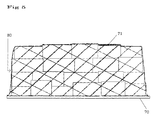
- the small cargo loads from each cargo owner A to C that are delivered to the bonded-storage facility 50 are sorted or arranged at the bonded-storage facility 50 for each transport destination or flight, and as shown in Fig. 5, they are loaded onto a pallet 70, for example, as consolidated cargo 80.
- the consolidated cargo 80 is covered by a net 71.
- the server 40 takes into consideration the entire weight or balance of the consolidated cargo 80, and obtains cargo-loading information showing an efficient way of arranging the small cargo load on one pallet 70, and the consolidated cargo 80 is made up based on that cargo-loading information.
- the business that handles air cargo performs the work for clearing customs, and after export permission is obtained, the consolidated cargo 80 is moved to a certain location at the airport 60 that is specified by the air carrier.
- the server 40 comprises an owner-cargo-data-storage unit 41, a detail-data-extraction unit 42, a loadable-cargo-extraction unit 43, a simulation-execution unit 44 and a cargo-load-information-output unit 45.
- Cargo data from the terminal 10 of cargo owner A, terminal 20 of cargo owner B and terminal 30 of cargo owner C are stored in the owner-cargo-data-storage unit 41 for each cargo owner.
- the cargo data can contain, for example, detail data such as the cargo owner's name, transport destination, product contents, quantity, unit cost, individual weight, number of outside packages, weight of outside packages, size of outside packages, outside package ID Nos., etc.
- the detail-data-extraction unit 42 extracts the detail data in the cargo data that is stored in the owner-cargo-data-storage unit 41.
- the extracted detail data is at least the cargo owner's name, transport destination, product contents, weight of outside packages, size of outside packages and outside package ID Nos.
- the loadable-cargo-extraction unit 43 extracts a plurality of small cargo loads from the detail data extracted by the detail-data-extraction unit 42 and the type of pallet 70 and basic data for each air carrier that are stored in the database 46 such that the outer dimensions and weight of the overall consolidated cargo 80 match the specified load amount of the pallet 70.
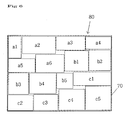
- the extracted small cargo loads are identified by the outside package ID Nos. such as a1 to a6, b1 to b5 and c1 to c5 as shown in Fig. 6 looking down from above the pallet 70, for example.
- a1 to a6 indicate the attributes of cargo owner A
- b1 to b5 indicate the attributes of cargo owner B
- c1 to c5 indicate the attributes of cargo owner C.
- the simulation-execution unit 44 executes a simulation of the consolidated cargo 80 of small cargo loads loaded on the pallet 70, as shown in Fig. 5, based on the outside package weights and outside package sizes of the small cargo loads that were extracted by the loadable-cargo-extraction unit 43. From this simulation, the weight and balance of the entire consolidated cargo 80 are taken into consideration to further determine whether or not it is the most efficient method of arranging the small cargo loads on one pallet 70.
- the balance takes into consideration, for example, whether or not the height of the top level of the pallet 70 is uniform, whether or not there are small cargo loads protruding from the sides, and whether or not small cargo loads with weak packaging are loaded on the bottom level.
- the cargo-load-information-output unit 45 outputs the cargo load information of the small cargo loads that are loaded on one pallet 70, for example, based on the simulation results of the simulation-execution unit 44.
- the respective cargo data is stored for each cargo owner in the owner-cargo-data-storage unit 41 (step S2).
- the cargo data comprises detail data giving the cargo owner's name, transport destination, product contents, quantity, unit cost, individual weight, number of outside packages, weight of outside packages, size of outside packages, outside package ID Nos., etc.
- the detail-data-extraction unit 42 extracts detail data from the cargo data stored in the owner-cargo-data-storage unit 41 (step S4).
- the extracted detail data contains at least the cargo owner's name, transport destination, product contents, weight of outside packages, size of outside packages and outside package ID Nos.
- the loadable-cargo-extraction unit 43 obtains basic data stored in the database 46 for the type of pallets 70 (step S5), and from that obtained basic data and the detail data extracted by the detail-data-extraction unit 42, it performs extraction of small cargo loads such that the outer dimension and weight of the entire consolidated cargo 80 matches the specified load amount for the pallet 70 (step S6).
- the extracted small cargo loads are identified by the outer package ID numbers a1, b1, c1 ... as shown in Fig. 6.
- the simulation-execution unit 44 executes simulation of the consolidated cargo 80 of small cargo loads loaded on the pallet 70 based on the outside-package weights and outside-package sizes of the small cargo loads extracted by the loadable-cargo-extraction unit 43 as shown in Fig. 5 for example (step S7). From this simulation, the weight and balance of the entire consolidated cargo 80 are taken into consideration to further determine whether or not it is the most efficient method of arranging the small cargo loads on one pallet 70 (step S8). The balance takes into consideration, for example, whether or not the height of the top level of the pallet 70 is uniform, whether or not there are small cargo loads protruding from the sides, and whether or not small cargo loads with weak packaging are loaded on the bottom level.
- step S6 when the method of arranging the small cargo loads is not good, the process returns to step S6 again and the loadable-cargo-extraction unit 43 performs extraction of different small cargo loads such that the outer dimension and weight of the entire consolidated cargo 80 matches the specified load amount for the pallet 70.
- the cargo-load-information-output unit 45 outputs the cargo load information of the small cargo loads that are loaded on one pallet 70 based on the simulation results from the simulation-execution unit 44. That is, cargo load information showing the small cargo loads of the consolidated cargo and their arrangement on the first layer on the pallet 70 as shown in Fig. 6 looking down from above the pallet 70, for example, is output. In this way, it is possible to identify the position on the pallet 70 of outside-package ID numbers a1 to a6 having the attributes of owner A, outside-package ID numbers b1 to b5 having the attributes of owner B, and outside-package ID numbers c1 to c5 having the attributes of owner C.
- this embodiment comprises: a terminal 10 on the side of a cargo owner A, a terminal 20 on the side of a cargo owner B and a terminal 30 on the side of a cargo owner C that have the function of sending cargo data related to a plurality of small cargo loads; a server 40 on the side of a business that handles air cargo and that is connected to these terminals, and that has a function of extracting small cargo loads based on the cargo data that will match the specified load amount of the a pallet 70; and a database 46 that stores basic data that gives the types of pallets 70, the specified load amounts that specify the load weight and dimensions for each air carrier, and the unit fee.
- the server 40 stores cargo data from the terminal 10 of cargo owner A, terminal 20 of cargo owner B and terminal 30 of cargo owner C in an owner-cargo-data-storage unit 41, and when there is a cargo-load-extraction instruction, the detail-data-extraction unit 42 extracts detail data from the cargo data stored in the owner-cargo-data-storage unit 41 that gives at least the cargo owner's name, transport destination, product contents, weight of outside packages, size of outside packages and outside package ID Nos., the loadable-cargo-extraction unit 43 extracts a plurality of small cargo loads from the detail data extracted by the detail-data-extraction unit 42 and the basic data stored in the database 46 such that the external dimensions and weight of the entire consolidated cargo matches the specified load amount of the pallet, and the simulation-execution unit 44 executes simulation of a consolidated load of small cargo loads loaded on the pallet 70 and determines whether the arrangement of the small cargo loads is the most efficient, so it is possible to increase the number of small cargo loads that are loaded on the pallet 70 and reduce
- cargo load information is output that shows which small cargo loads are loaded in which location of which layer on the pallet using the outside-package ID Nos. a1 to a6 having the attributes of cargo owner A, the outside-package ID Nos. b1 to b5 having the attributes of cargo owner B and the outside-package ID Nos. c1 to c5 having the attributes of cargo owner C, so it is possible to perform the work of loading the consolidated cargo easily and accurately without the need for skill and experience.
- the server connected to the terminals of each of the cargo owners by way of a network extracts small cargo loads that meet the loading specifications for the pallet based on the respective cargo data from the terminals of each of the cargo owners, so it is possible to perform the work of loading consolidated cargo easily and accurately without the need for skill and experience, and it is also possible to reduce the transport cost for each small cargo load.
Landscapes
- Business, Economics & Management (AREA)
- Engineering & Computer Science (AREA)
- Human Resources & Organizations (AREA)
- Tourism & Hospitality (AREA)
- Strategic Management (AREA)
- Economics (AREA)
- Entrepreneurship & Innovation (AREA)
- General Physics & Mathematics (AREA)
- Operations Research (AREA)
- Quality & Reliability (AREA)
- Development Economics (AREA)
- Physics & Mathematics (AREA)
- General Business, Economics & Management (AREA)
- Marketing (AREA)
- Theoretical Computer Science (AREA)
- Aviation & Aerospace Engineering (AREA)
- Game Theory and Decision Science (AREA)
- Management, Administration, Business Operations System, And Electronic Commerce (AREA)
- Stacking Of Articles And Auxiliary Devices (AREA)
- Warehouses Or Storage Devices (AREA)
Abstract
The invention makes it possible to easily and accurately perform the
work of loading consolidated cargo without requiring skill and experience,
and makes it possible to reduce the transport cost for each small cargo load.
The invention comprises: a terminal (10) on the side of a cargo owner A,
a terminal (20) on the side of a cargo owner B and a terminal (30) on the side
of a cargo owner C that have the function of sending cargo data related to a
plurality of small cargo loads; a server (40) on the side of a business that
handles air cargo and that is connected to these terminals, and that has a
function of extracting small cargo loads based on the cargo data that will
match the specified load amount of the a pallet (70); and a database (46) that
stores basic data that gives the types of pallets (70), the specified load
amounts that specify the load weight and dimensions for each air carrier,
and the unit fee.
Description
This invention relates to a consolidated-air-cargo-management system
that is applied to the transport of consolidated cargo using aircraft.
As cargo transported by aircraft there is direct cargo and consolidated
cargo. Direct cargo is cargo for which the cargo owner directly entrusts the
transport of the cargo with an air transport company or business that
exclusively handles air cargo. Consolidated cargo is a plurality of small
cargo loads that have been sorted according to each transport destination or
flight of the same aircraft or that have been arranged into one cargo load.
This consolidated cargo is widely used as a way of transporting small cargo
loads at low cost. As a method of making the consolidated load, Japanese
Patent Publication No. 2002-193450 proposes setting up a transfer area
between the airport cargo terminal and cargo owner, or in other words, to set
up a transfer base where the branch offices of a forwarder or each forwarder
collect and deliver to jointly, and the consolidated cargo is made at that
transfer area.
In Japanese Patent Publication No. 2002-193450 mentioned above,
there is no system created for efficiently making the small cargo loads for
making the consolidated load at the transfer area. In other words, the unit
fee for air cargo is set according to classification of pallet or container, and is
a set amount up until the consolidated cargo loaded on the pallet or in the
container reaches a fixed weight. Here, the type of pallet or container used
for aircraft transportation is called a unit-load device according to IATA (a
unit load device for aircraft), or ULD (unit load devices), and various ULD
have been developed since the adoption of using large jets. Moreover, of the
ULD for air cargo, there are pallets, nets, containers, igloos, or the like that
can be fastened directly to the cargo mounting apparatus of the aircraft, and
some are used for through transport.
Therefore, even though the weight of consolidated cargo loaded onto a
pallet or container is a fixed amount, the larger the number of small cargo
loads is the cheaper the transport cost is for each small cargo load. In this
case, the cargo is sorted according to route selection and flight type, and
loaded onto pallets or into containers based on a load plan that takes into
consideration the weight or balance of the entire consolidated cargo, however,
skill and experience are required for that loading work.
The present invention takes into consideration this kind of situation
and provides a consolidated-air-cargo-management system that makes it
possible to easily and accurately perform the work of loading consolidated
cargo without requiring skill and experience, and makes it possible to reduce
the transport cost for each small cargo load.
The consolidated-air-cargo-management system of this invention
comprises: terminals for each cargo owner that have a function for sending
cargo data for a plurality of small cargo loads; and a server on the side of a
business that handles air cargo and that is connected to the terminals for
each cargo owner over a network, and extracts small cargo loads that match
the specified load amount of a pallet based on the respective cargo data from
the terminals of each cargo owner.
Also, it comprises a database that stores basic data that indicates the
type of pallet, the specified load amount that is specified by the load weight
and dimensions for each air carrier, and the unit fee; and the server can
comprise: an owner-cargo-data-storage unit that stores respective cargo data
from the terminals of each cargo owner; a detail-data-extraction unit that
extracts detail data from the cargo data stored in the owner-cargo-data-storage
unit that gives at least the cargo owner's name, transport
destination, product contents, weight of outside packages, size of outside
packages and outside package ID Nos.; and a loadable-cargo-extraction unit
that extracts a plurality of small cargo loads from the detail data extracted
by the detail-data-extraction unit and the basic data stored in the database
such that the external dimensions and weight of the entire consolidated
cargo matches the specified load amount of the pallet.
Moreover, the server can comprise: a simulation-execution unit that
executes simulation of a consolidated load of small cargo loads loaded on the
pallet based on the weight of the outside packages and the size of the outside
packages of the extracted small cargo loads, and determines whether the
arrangement of the small cargo loads is the most efficient; and a cargo-load-information-output
unit that outputs cargo load information based on the
simulation results from the simulation-execution unit, that shows which
small cargo loads are loaded in which location of which layer on the pallet
using the outside-package ID numbers.
The consolidated-air-cargo-management method of this invention
comprises: a process of sending cargo data from terminals of each cargo
owner for a plurality of small cargo loads; and a process of extracting small
cargo loads, which match the specified load amount of a pallet based on the
respective cargo data from the terminals of each cargo owner, from a server
that is connected to the terminals of each cargo owner over a network.
Also, it possible to comprise: a process of storing basic data that
indicates the type of pallet, the specified load amount that is specified by the
load weight and dimensions for each air carrier, and the unit fee; a process of
storing respective cargo data from the terminals of each cargo owner; a
process of extracting detail data from the stored cargo data that gives at
least the cargo owner's name, transport destination, product contents,
weight of outside packages, size of outside packages and outside package ID
Nos.; and a process of extracting a plurality of small cargo loads from the
extracted detail data and the basic data such that the external dimensions
and weight of the entire consolidated cargo matches the specified load
amount of the pallet.
Moreover, it is possible to comprise: a process of executing simulation of
a consolidated load of small cargo loads loaded on the pallet based on the
weight of the outside packages and the size of the outside packages of the
extracted small cargo loads, and determining whether the arrangement of
the small cargo loads is the most efficient; and a process of outputting cargo
load information based on the simulation results that shows which small
cargo loads are loaded in which location of which layer on the pallet using
the outside-package ID numbers.
The preferred embodiment of the invention will be explained below.
Fig. 1 is a drawing for explaining the concept of the consolidated-air-cargo-management
system of this invention, Fig. 2 is a block diagram for
explaining the details of the consolidated-air-cargo-management system
shown in Fig. 1, Fig. 3 is a drawing showing the cargo data used in the
consolidated-air-cargo-management system shown in Fig. 1, and Fig. 4 to Fig.
6 are drawings for explaining the consolidated-air-cargo-management
method by the consolidated-air-cargo-management system shown in Fig. 1.
The consolidated-air-cargo-management system shown in Fig. 1
comprises a terminal 10 on the side of a cargo owner A, a terminal 20 of a
cargo owner B, a terminal 30 of a cargo owner C, server 40 and database 46.
The terminals located on the side of the cargo owners are not limited to three
as shown in the figure. The terminal 10 on the side of cargo owner A,
terminal 20 on the side of cargo owner B and terminal 30 on the side of cargo
owner C and the server 40 are constructed such that they can communicate
with each other over a network such as the Internet, exclusive line, etc.
The terminal 10 on the side of cargo owner A, terminal 20 on the side of
cargo owner B and terminal 30 on the side of cargo owner C are each owned
by the respective cargo owner, and have the function of sending cargo data
(described later) for a plurality of small cargo loads to the server 40 over the
network. It is possible to use an electronic device such as a desktop
personal computer, notebook personal computer, PDA or the like as the
terminal 10 on the side of cargo owner A, terminal 20 on the side of cargo
owner B and terminal 30 on the side of cargo owner C.
The server 40 has a function for receiving the respective cargo data
from the terminal 10 on the side of cargo owner A, terminal 20 on the side of
cargo owner B and terminal 30 on the side of cargo owner C, and extracting a
plurality of small cargo loads based on that cargo data that match the
specified load amount of the pallet 70 described later, and these will be
described in detail later. The server 40, for example, can belong to a
business that handles air cargo such as a storage business, consolidation
business, customs business or the like; and is set up at a bonded-storage
facility 50 for example. Basic data that indicates the type of pallet, the
specified load amount that is specified by the load weight and dimensions for
each air carrier, and the unit fee, is stored in the database 46.
Here, to briefly explain the flow of the small cargo loads from each
cargo owner A to C, first, the small cargo loads from each cargo owner A to C
are delivered to the bonded-storage facility 50 by a delivery company. The
small cargo loads from each cargo owner A to C that are delivered to the
bonded-storage facility 50 are sorted or arranged at the bonded-storage
facility 50 for each transport destination or flight, and as shown in Fig. 5,
they are loaded onto a pallet 70, for example, as consolidated cargo 80. In
order to prevent the load from collapsing, the consolidated cargo 80 is
covered by a net 71. When doing this, the server 40 takes into consideration
the entire weight or balance of the consolidated cargo 80, and obtains cargo-loading
information showing an efficient way of arranging the small cargo
load on one pallet 70, and the consolidated cargo 80 is made up based on that
cargo-loading information. Next, the business that handles air cargo
performs the work for clearing customs, and after export permission is
obtained, the consolidated cargo 80 is moved to a certain location at the
airport 60 that is specified by the air carrier.
Next, details of the server 40 will be explained.
As shown in Fig. 2, the server 40 comprises an owner-cargo-data-storage
unit 41, a detail-data-extraction unit 42, a loadable-cargo-extraction
unit 43, a simulation-execution unit 44 and a cargo-load-information-output
unit 45.
Cargo data from the terminal 10 of cargo owner A, terminal 20 of cargo
owner B and terminal 30 of cargo owner C are stored in the owner-cargo-data-storage
unit 41 for each cargo owner. As shown in Fig. 3, the cargo
data can contain, for example, detail data such as the cargo owner's name,
transport destination, product contents, quantity, unit cost, individual
weight, number of outside packages, weight of outside packages, size of
outside packages, outside package ID Nos., etc.
After a cargo-load-extraction instruction is output, the detail-data-extraction
unit 42 extracts the detail data in the cargo data that is stored in
the owner-cargo-data-storage unit 41. The extracted detail data is at least
the cargo owner's name, transport destination, product contents, weight of
outside packages, size of outside packages and outside package ID Nos.
The loadable-cargo-extraction unit 43 extracts a plurality of small
cargo loads from the detail data extracted by the detail-data-extraction unit
42 and the type of pallet 70 and basic data for each air carrier that are stored
in the database 46 such that the outer dimensions and weight of the overall
consolidated cargo 80 match the specified load amount of the pallet 70. The
extracted small cargo loads are identified by the outside package ID Nos.
such as a1 to a6, b1 to b5 and c1 to c5 as shown in Fig. 6 looking down from
above the pallet 70, for example. Here, a1 to a6 indicate the attributes of
cargo owner A, b1 to b5 indicate the attributes of cargo owner B and c1 to c5
indicate the attributes of cargo owner C.
The simulation-execution unit 44 executes a simulation of the
consolidated cargo 80 of small cargo loads loaded on the pallet 70, as shown
in Fig. 5, based on the outside package weights and outside package sizes of
the small cargo loads that were extracted by the loadable-cargo-extraction
unit 43. From this simulation, the weight and balance of the entire
consolidated cargo 80 are taken into consideration to further determine
whether or not it is the most efficient method of arranging the small cargo
loads on one pallet 70. Here, the balance takes into consideration, for
example, whether or not the height of the top level of the pallet 70 is uniform,
whether or not there are small cargo loads protruding from the sides, and
whether or not small cargo loads with weak packaging are loaded on the
bottom level.
The cargo-load-information-output unit 45 outputs the cargo load
information of the small cargo loads that are loaded on one pallet 70, for
example, based on the simulation results of the simulation-execution unit 44.
Next, the consolidated-air-cargo-management method will be
explained.
First, as shown in Fig. 4, after the cargo data from terminal 10 of cargo
owner A, terminal 20 of cargo owner B and terminal 30 of cargo owner C has
been received by the server (step S1), the respective cargo data is stored for
each cargo owner in the owner-cargo-data-storage unit 41 (step S2). As
mentioned above, the cargo data comprises detail data giving the cargo
owner's name, transport destination, product contents, quantity, unit cost,
individual weight, number of outside packages, weight of outside packages,
size of outside packages, outside package ID Nos., etc.
Here, after a cargo-load-extraction instruction is output (step S3), the
detail-data-extraction unit 42 extracts detail data from the cargo data stored
in the owner-cargo-data-storage unit 41 (step S4). As mentioned above, the
extracted detail data contains at least the cargo owner's name, transport
destination, product contents, weight of outside packages, size of outside
packages and outside package ID Nos.
Next, the loadable-cargo-extraction unit 43 obtains basic data stored in
the database 46 for the type of pallets 70 (step S5), and from that obtained
basic data and the detail data extracted by the detail-data-extraction unit 42,
it performs extraction of small cargo loads such that the outer dimension and
weight of the entire consolidated cargo 80 matches the specified load amount
for the pallet 70 (step S6). Here, the extracted small cargo loads are
identified by the outer package ID numbers a1, b1, c1 ... as shown in Fig. 6.
Next, the simulation-execution unit 44 executes simulation of the
consolidated cargo 80 of small cargo loads loaded on the pallet 70 based on
the outside-package weights and outside-package sizes of the small cargo
loads extracted by the loadable-cargo-extraction unit 43 as shown in Fig. 5
for example (step S7). From this simulation, the weight and balance of the
entire consolidated cargo 80 are taken into consideration to further
determine whether or not it is the most efficient method of arranging the
small cargo loads on one pallet 70 (step S8). The balance takes into
consideration, for example, whether or not the height of the top level of the
pallet 70 is uniform, whether or not there are small cargo loads protruding
from the sides, and whether or not small cargo loads with weak packaging
are loaded on the bottom level.
Here, when the method of arranging the small cargo loads is not good,
the process returns to step S6 again and the loadable-cargo-extraction unit
43 performs extraction of different small cargo loads such that the outer
dimension and weight of the entire consolidated cargo 80 matches the
specified load amount for the pallet 70.
On the other hand, when the method of arranging the small cargo loads
is good, the cargo-load-information-output unit 45 outputs the cargo load
information of the small cargo loads that are loaded on one pallet 70 based on
the simulation results from the simulation-execution unit 44. That is, cargo
load information showing the small cargo loads of the consolidated cargo and
their arrangement on the first layer on the pallet 70 as shown in Fig. 6
looking down from above the pallet 70, for example, is output. In this way,
it is possible to identify the position on the pallet 70 of outside-package ID
numbers a1 to a6 having the attributes of owner A, outside-package ID
numbers b1 to b5 having the attributes of owner B, and outside-package ID
numbers c1 to c5 having the attributes of owner C. Therefore, small cargo
loads that match the outside-package ID Nos. can be loaded on the pallet 70
such that they match the positions of the outside-package ID Nos. The
consolidated cargo is loaded on the pallet 70 in this way and covered by a net
as shown in Fig. 5 to secure the load so that it does not collapse.
In this way, this embodiment comprises: a terminal 10 on the side of a
cargo owner A, a terminal 20 on the side of a cargo owner B and a terminal
30 on the side of a cargo owner C that have the function of sending cargo
data related to a plurality of small cargo loads; a server 40 on the side of a
business that handles air cargo and that is connected to these terminals, and
that has a function of extracting small cargo loads based on the cargo data
that will match the specified load amount of the a pallet 70; and a database
46 that stores basic data that gives the types of pallets 70, the specified load
amounts that specify the load weight and dimensions for each air carrier,
and the unit fee.
Moreover, the server 40 stores cargo data from the terminal 10 of cargo
owner A, terminal 20 of cargo owner B and terminal 30 of cargo owner C in
an owner-cargo-data-storage unit 41, and when there is a cargo-load-extraction
instruction, the detail-data-extraction unit 42 extracts detail data
from the cargo data stored in the owner-cargo-data-storage unit 41 that gives
at least the cargo owner's name, transport destination, product contents,
weight of outside packages, size of outside packages and outside package ID
Nos., the loadable-cargo-extraction unit 43 extracts a plurality of small cargo
loads from the detail data extracted by the detail-data-extraction unit 42 and
the basic data stored in the database 46 such that the external dimensions
and weight of the entire consolidated cargo matches the specified load
amount of the pallet, and the simulation-execution unit 44 executes
simulation of a consolidated load of small cargo loads loaded on the pallet 70
and determines whether the arrangement of the small cargo loads is the
most efficient, so it is possible to increase the number of small cargo loads
that are loaded on the pallet 70 and reduce the transport cost for each small
cargo load.
Also, based on the simulation results by the simulation-execution unit
44, cargo load information is output that shows which small cargo loads are
loaded in which location of which layer on the pallet using the outside-package
ID Nos. a1 to a6 having the attributes of cargo owner A, the
outside-package ID Nos. b1 to b5 having the attributes of cargo owner B and
the outside-package ID Nos. c1 to c5 having the attributes of cargo owner C,
so it is possible to perform the work of loading the consolidated cargo easily
and accurately without the need for skill and experience.
In the consolidated-air-cargo-management system of this invention,
after cargo data related to a plurality of small cargo loads are sent from the
terminals of each of the cargo owners, the server connected to the terminals
of each of the cargo owners by way of a network extracts small cargo loads
that meet the loading specifications for the pallet based on the respective
cargo data from the terminals of each of the cargo owners, so it is possible to
perform the work of loading consolidated cargo easily and accurately without
the need for skill and experience, and it is also possible to reduce the
transport cost for each small cargo load.
Claims (6)
- A consolidated-air-cargo-management system comprising:terminals for each cargo owner that have a function for sending cargo data for a plurality of small cargo loads; anda server on the side of a business that handles air cargo and that is connected to the terminals for each said cargo owner over a network, and extracts small cargo loads that match the specified load amount of a pallet based on said respective cargo data from the terminals of each said cargo owner.
- The consolidated-air-cargo-management system of claim 1 further comprising:a database that stores basic data that indicates the type of said pallet, the specified load amount that is specified by the load weight and dimensions for each air carrier, and the unit fee, is stored in the database, and whereinsaid server comprises:an owner-cargo-data-storage unit that stores respective cargo data from the terminals of each said cargo owner;a detail-data-extraction unit that extracts detail data from the cargo data stored in the said owner-cargo-data-storage unit that gives at least the cargo owner's name, transport destination, product contents, weight of outside packages, size of outside packages and outside package ID Nos.; anda loadable-cargo-extraction unit that extracts a plurality of small cargo loads from the detail data extracted by said detail-data-extraction unit and the basic data stored in said database such that the external dimensions and weight of the entire consolidated cargo matches the specified load amount of said pallet.
- The consolidated-air-cargo-management system of claim 1 or claim 2 wherein
said server comprises:a simulation-execution unit that executes simulation of a consolidated load of small cargo loads loaded on said pallet based on the weight of the outside packages and the size of the outside packages of said extracted small cargo loads, and determines whether the arrangement of the small cargo loads is the most efficient; anda cargo-load-information-output unit that outputs cargo load information based on the simulation results from the simulation-execution unit, that shows which small cargo loads are loaded in which location of which layer on said pallet using the outside-package ID numbers. - A consolidated-air-cargo-management method comprising:a process of sending cargo data from terminals of each cargo owner for a plurality of small cargo loads; anda process of extracting small cargo loads, which match the specified load amount of a pallet based on the respective cargo data from the terminals of each said cargo owner, from a server that is connected to the terminals of each said cargo owner over a network.
- The consolidated-air-cargo-management method of claim 4 further comprising:a process of storing basic data that indicates the type of said pallet, the specified load amount that is specified by the load weight and dimensions for each air carrier, and the unit fee;a process of storing respective cargo data from the terminals of each said cargo owner;a process of extracting detail data from said stored cargo data that gives at least the cargo owner's name, transport destination, product contents, weight of outside packages, size of outside packages and outside package ID Nos.; anda process of extracting a plurality of small cargo loads from said extracted detail data and said basic data such that the external dimensions and weight of the entire consolidated cargo matches the specified load amount of said pallet.
- The consolidated-air-cargo-management method of claim 4 or claim 5 further comprising:a process of executing simulation of a consolidated load of small cargo loads loaded on said pallet based on the weight of the outside packages and the size of the outside packages of said extracted small cargo loads, and determining whether the arrangement of the small cargo loads is the most efficient; anda process of outputting cargo load information based on said simulation results that shows which small cargo loads are loaded in which location of which layer on said pallet using said outside-package ID numbers.
Applications Claiming Priority (3)
| Application Number | Priority Date | Filing Date | Title |
|---|---|---|---|
| JP2002378146A JP3935427B2 (en) | 2002-12-26 | 2002-12-26 | Air cargo management system |
| JP2002378146 | 2002-12-26 | ||
| PCT/JP2003/016230 WO2004058608A1 (en) | 2002-12-26 | 2003-12-18 | Air mixed cargo control system and control method |
Publications (2)
| Publication Number | Publication Date |
|---|---|
| EP1577236A1 true EP1577236A1 (en) | 2005-09-21 |
| EP1577236A4 EP1577236A4 (en) | 2006-10-11 |
Family
ID=32677418
Family Applications (1)
| Application Number | Title | Priority Date | Filing Date |
|---|---|---|---|
| EP03789609A Withdrawn EP1577236A4 (en) | 2002-12-26 | 2003-12-18 | Air mixed cargo control system and control method |
Country Status (6)
| Country | Link |
|---|---|
| US (1) | US20040143465A1 (en) |
| EP (1) | EP1577236A4 (en) |
| JP (1) | JP3935427B2 (en) |
| CN (1) | CN1720186A (en) |
| BR (1) | BR0316477A (en) |
| WO (1) | WO2004058608A1 (en) |
Cited By (1)
| Publication number | Priority date | Publication date | Assignee | Title |
|---|---|---|---|---|
| WO2019207208A1 (en) * | 2018-04-27 | 2019-10-31 | Juha Tuominen | Method of and system for preparing a plurality of items for air transport |
Families Citing this family (19)
| Publication number | Priority date | Publication date | Assignee | Title |
|---|---|---|---|---|
| JP2005025730A (en) * | 2003-06-13 | 2005-01-27 | Ns Solutions Corp | Information processing apparatus, information processing method, and program |
| US20060195349A1 (en) * | 2005-02-25 | 2006-08-31 | Inventec Corporation | Weight estimating system and method for products of orders |
| US20060230003A1 (en) * | 2005-03-31 | 2006-10-12 | Inventec Corporation | Weight detection system for ordered goods and method using the same |
| US7831586B2 (en) * | 2006-06-09 | 2010-11-09 | Ebay Inc. | System and method for application programming interfaces for keyword extraction and contextual advertisement generation |
| US8001105B2 (en) * | 2006-06-09 | 2011-08-16 | Ebay Inc. | System and method for keyword extraction and contextual advertisement generation |
| WO2007145775A2 (en) * | 2006-06-09 | 2007-12-21 | Ebay Inc. | Keyword extraction and contextual advertisement generation |
| US8209320B2 (en) | 2006-06-09 | 2012-06-26 | Ebay Inc. | System and method for keyword extraction |
| AU2007269597C1 (en) * | 2006-07-05 | 2012-03-01 | Paypal, Inc. | System and method for category-based contextual advertisement generation and management |
| US20080221987A1 (en) * | 2007-03-07 | 2008-09-11 | Ebay Inc. | System and method for contextual advertisement and merchandizing based on an automatically generated user demographic profile |
| US20090018904A1 (en) | 2007-07-09 | 2009-01-15 | Ebay Inc. | System and method for contextual advertising and merchandizing based on user configurable preferences |
| CN102142107B (en) * | 2010-01-29 | 2016-03-09 | 国际商业机器公司 | Logistics information disposal route and device |
| JP6729217B2 (en) * | 2016-09-07 | 2020-07-22 | 株式会社ダイフク | Equipment for loading goods |
| JP6841686B2 (en) * | 2017-03-02 | 2021-03-10 | 株式会社オービック | Costing device for each shipper, costing method for each shipper, and costing program for each shipper |
| CN112368728B (en) * | 2018-07-02 | 2024-09-20 | 首选网络株式会社 | Information processing device, model generation processing device and information processing method |
| CN110310066A (en) * | 2019-07-05 | 2019-10-08 | 上海中通吉网络技术有限公司 | Cargo piles up location determining method, device, equipment and storage medium |
| CN112396360A (en) * | 2019-08-12 | 2021-02-23 | 北京京东乾石科技有限公司 | Tallying method and device for multi-cargo mixed storage |
| CN110654761B (en) * | 2019-10-10 | 2022-03-29 | 中国烟草总公司天津市公司物流中心 | Multi-family combined cigarette coding machine, C-type cigarette sorting system and method |
| CN111285126B (en) * | 2020-02-18 | 2021-07-06 | 北京九曜智能科技有限公司 | Cargo handling method |
| JP7717032B2 (en) * | 2021-06-28 | 2025-08-01 | 株式会社ロジネットジャパン | Management systems and programs |
Family Cites Families (10)
| Publication number | Priority date | Publication date | Assignee | Title |
|---|---|---|---|---|
| CA2116515C (en) * | 1993-03-05 | 1999-03-30 | Walter P. Demonte | Palletizer trailer and storage container |
| AU4219200A (en) * | 1999-04-09 | 2000-11-14 | Optimum Logistics, Ltd. | System and method for interactively managing transportation of cargo and data associated therewith |
| US20020019759A1 (en) * | 2000-06-16 | 2002-02-14 | Sundararajan Arunapuram | Transportation planning, execution, and freight payments managers and related methods |
| JP2002019963A (en) * | 2000-07-07 | 2002-01-23 | Sekisui Chem Co Ltd | Loading simulation method |
| JP2002029631A (en) * | 2000-07-12 | 2002-01-29 | Suehiro Giken Kk | Loading method and loading system |
| JP2002193450A (en) * | 2000-12-27 | 2002-07-10 | Toyota Motor Corp | Transport freight logistics control method and logistics control system |
| US6937992B1 (en) * | 2000-12-29 | 2005-08-30 | Arrowstream, Inc. | Transport vehicle capacity maximization logistics system and method of same |
| US7353181B2 (en) * | 2001-08-15 | 2008-04-01 | Hewlett-Packard Development Company, L.P. | Allocating freight haulage jobs |
| JP4744877B2 (en) * | 2002-09-26 | 2011-08-10 | 豊田スチールセンター株式会社 | Cargo distribution management method, and computer-readable storage medium and program used therefor |
| US8452671B2 (en) * | 2003-10-01 | 2013-05-28 | Sap Aktiengesellschaft | Load builder |
-
2002
- 2002-12-26 JP JP2002378146A patent/JP3935427B2/en not_active Expired - Fee Related
-
2003
- 2003-12-18 BR BR0316477-2A patent/BR0316477A/en not_active Application Discontinuation
- 2003-12-18 US US10/738,223 patent/US20040143465A1/en not_active Abandoned
- 2003-12-18 EP EP03789609A patent/EP1577236A4/en not_active Withdrawn
- 2003-12-18 CN CNA2003801052376A patent/CN1720186A/en active Pending
- 2003-12-18 WO PCT/JP2003/016230 patent/WO2004058608A1/en not_active Ceased
Cited By (2)
| Publication number | Priority date | Publication date | Assignee | Title |
|---|---|---|---|---|
| WO2019207208A1 (en) * | 2018-04-27 | 2019-10-31 | Juha Tuominen | Method of and system for preparing a plurality of items for air transport |
| US11840359B2 (en) | 2018-04-27 | 2023-12-12 | Juha Tuominen | Method of and system for preparing a plurality of items for air transport |
Also Published As
| Publication number | Publication date |
|---|---|
| EP1577236A4 (en) | 2006-10-11 |
| JP3935427B2 (en) | 2007-06-20 |
| BR0316477A (en) | 2005-10-11 |
| US20040143465A1 (en) | 2004-07-22 |
| WO2004058608A1 (en) | 2004-07-15 |
| CN1720186A (en) | 2006-01-11 |
| JP2004203603A (en) | 2004-07-22 |
Similar Documents
| Publication | Publication Date | Title |
|---|---|---|
| EP1577236A1 (en) | Air mixed cargo control system and control method | |
| US8560461B1 (en) | Shipment splitting analyzer | |
| US8924007B2 (en) | Three dimensional load packing | |
| CN111573292B (en) | Stacking method and device, electronic equipment and computer readable storage medium | |
| US7979359B1 (en) | System and method for selectively applying an item sortation process | |
| JP6196342B2 (en) | Custom containers at transportation management facilities | |
| US9342811B2 (en) | System and method for filling an order | |
| US8086344B1 (en) | Predictive router for materials handling | |
| US11292241B2 (en) | 3-D packaging and shipping based on aggregate data | |
| CN104364806B (en) | pickup location | |
| CN104246801B (en) | Container selection in material process facility | |
| JP7733124B2 (en) | Picking task processing method, device, medium, and electronic device | |
| US20180150798A1 (en) | Systems and Methods for Distribution or Delivery of Retail Products | |
| CN109740909A (en) | A kind of part load intelligent goods dispatch method and system based on freight logistics platform | |
| CN113525987A (en) | Lightweight logistics cargo sorting and transporting method and device based on Internet of things technology and electronic equipment | |
| CN114529236B (en) | A storage management method, device, electronic device and storage medium for shelves | |
| CN116157344A (en) | Container storage planning device, container storage planning system and container storage planning method | |
| CN110232551A (en) | Freight classification method and device, storage medium, electronic device | |
| CN114580996A (en) | Method for discharging bin | |
| JP2020511305A (en) | Parcel sorting platform, system, method and data processing for article sorting system | |
| JP2025065433A (en) | Joint delivery support device, joint delivery support system, joint delivery support method and program | |
| US20250103999A1 (en) | Information processing system and server, information processing method, and program | |
| JP2004161479A (en) | Picking list preparation system, picking list preparation method, and picking list preparation program | |
| JP2007246223A (en) | Delivery operation support system | |
| CN102381504B (en) | A kind of shipping container loading and unloading method |
Legal Events
| Date | Code | Title | Description |
|---|---|---|---|
| PUAI | Public reference made under article 153(3) epc to a published international application that has entered the european phase |
Free format text: ORIGINAL CODE: 0009012 |
|
| 17P | Request for examination filed |
Effective date: 20050511 |
|
| AK | Designated contracting states |
Kind code of ref document: A1 Designated state(s): BE GB IT |
|
| A4 | Supplementary search report drawn up and despatched |
Effective date: 20060911 |
|
| STAA | Information on the status of an ep patent application or granted ep patent |
Free format text: STATUS: THE APPLICATION IS DEEMED TO BE WITHDRAWN |
|
| 18D | Application deemed to be withdrawn |
Effective date: 20061209 |