EP1577161A2 - Combination switch for a vehicle and assembly method of the same - Google Patents

Combination switch for a vehicle and assembly method of the same Download PDF

Info

Publication number
EP1577161A2
EP1577161A2 EP05004773A EP05004773A EP1577161A2 EP 1577161 A2 EP1577161 A2 EP 1577161A2 EP 05004773 A EP05004773 A EP 05004773A EP 05004773 A EP05004773 A EP 05004773A EP 1577161 A2 EP1577161 A2 EP 1577161A2
Authority
EP
European Patent Office
Prior art keywords
connection cord
section
bottom cover
cord
outer peripheral
Prior art date
Legal status (The legal status is an assumption and is not a legal conclusion. Google has not performed a legal analysis and makes no representation as to the accuracy of the status listed.)
Granted
Application number
EP05004773A
Other languages
German (de)
French (fr)
Other versions
EP1577161B1 (en
EP1577161A3 (en
Inventor
Toshiyuki Adachi
Tetsuya Inotsuka
Current Assignee (The listed assignees may be inaccurate. Google has not performed a legal analysis and makes no representation or warranty as to the accuracy of the list.)
Valeo Japan Co Ltd
Original Assignee
Niles Co Ltd
Priority date (The priority date is an assumption and is not a legal conclusion. Google has not performed a legal analysis and makes no representation as to the accuracy of the date listed.)
Filing date
Publication date
Application filed by Niles Co Ltd filed Critical Niles Co Ltd
Publication of EP1577161A2 publication Critical patent/EP1577161A2/en
Publication of EP1577161A3 publication Critical patent/EP1577161A3/en
Application granted granted Critical
Publication of EP1577161B1 publication Critical patent/EP1577161B1/en
Anticipated expiration legal-status Critical
Expired - Lifetime legal-status Critical Current

Links

Images

Classifications

    • BPERFORMING OPERATIONS; TRANSPORTING
    • B60VEHICLES IN GENERAL
    • B60BVEHICLE WHEELS; CASTORS; AXLES FOR WHEELS OR CASTORS; INCREASING WHEEL ADHESION
    • B60B33/00Castors in general ; Anti-clogging castors
    • B60B33/006Castors in general ; Anti-clogging castors characterised by details of the swivel mechanism
    • B60B33/0065Castors in general ; Anti-clogging castors characterised by details of the swivel mechanism characterised by details of the swivel axis
    • B60B33/0071Castors in general ; Anti-clogging castors characterised by details of the swivel mechanism characterised by details of the swivel axis the swivel axis being inclined
    • BPERFORMING OPERATIONS; TRANSPORTING
    • B60VEHICLES IN GENERAL
    • B60QARRANGEMENT OF SIGNALLING OR LIGHTING DEVICES, THE MOUNTING OR SUPPORTING THEREOF OR CIRCUITS THEREFOR, FOR VEHICLES IN GENERAL
    • B60Q1/00Arrangement of optical signalling or lighting devices, the mounting or supporting thereof or circuits therefor
    • B60Q1/02Arrangement of optical signalling or lighting devices, the mounting or supporting thereof or circuits therefor the devices being primarily intended to illuminate the way ahead or to illuminate other areas of way or environments
    • B60Q1/04Arrangement of optical signalling or lighting devices, the mounting or supporting thereof or circuits therefor the devices being primarily intended to illuminate the way ahead or to illuminate other areas of way or environments the devices being headlights
    • B60Q1/14Arrangement of optical signalling or lighting devices, the mounting or supporting thereof or circuits therefor the devices being primarily intended to illuminate the way ahead or to illuminate other areas of way or environments the devices being headlights having dimming means
    • B60Q1/1446Arrangement of optical signalling or lighting devices, the mounting or supporting thereof or circuits therefor the devices being primarily intended to illuminate the way ahead or to illuminate other areas of way or environments the devices being headlights having dimming means controlled by mechanically actuated switches
    • B60Q1/1453Hand actuated switches
    • B60Q1/1461Multifunction switches for dimming headlights and controlling additional devices, e.g. for controlling direction indicating lights

Definitions

  • a combination switch for a vehicle according to the present invention is characterized in that a cord engagement section is projected on an outer peripheral section of the bottom cover, and the connection cord is engaged to the outer peripheral section of the cord engagement section to be disposed along a peripheral side of the bottom cover. Accordingly the cord cover can be omitted, as well as a space to assemble other members on the lower face of the bottom cover can be ensured, to provide a spacious advantage.
  • a tip end of the central nail is formed close to the wall section of the body to form a clearance between the tip end of the central nail and the wall section of the body so as to be smaller than a diameter of the connection cord. Accordingly the central section of the connection cord can be securely held between the central nail and the wall section of the body and the loosening and the catching in of the connection cord can be securely restricted, to dispose the connection cord with an easy assembly. In case the connection cord includes a plurality of twisted thin wires, the loosening and the catching in of the connection cord can be securely restricted, to dispose the connection cord with an easy assembly.
  • the body 1 is made of non-conductible resin and is mounted to a bracket of the vehicle body side.
  • Mounting sections 19, 21 are disposed in the body 1 at the right and left sides.
  • a lever switch shown in FIG.11 as the switch main body is mounted respectively to the mounting sections 19, 21.
  • a step section 10 receiving/supporting the bottom cover 3 is formed in an inner peripheral side of the body 1.
  • a plurality of snap stationary angle windows 23 are disposed spaced by a predetermined interval in an inner circumference of the step 10 of the body 1.
  • a support section 12 continuously formed with the step 10 is mounted in one side to the body 1.
  • a body engagement section 47 engaging the body 1 to the bracket of the vehicle body side is disposed to the body 1 on the opposite side of the support section 12. The body engagement section 47 engages the body 1 to the bracket temporarily.
  • connection cord 5 is formed by twisting a plurality of thin wires and is equipped with connector 15, 17 at the both ends.
  • the connectors 15, 17 are engaged and supported by the right and left connector support sections 11, 13, and are connected to a right and left lever switches.
  • the connection cord 5 may be not twisted.

Landscapes

  • Engineering & Computer Science (AREA)
  • Mechanical Engineering (AREA)
  • Steering Controls (AREA)
  • Switches With Compound Operations (AREA)
  • Switch Cases, Indication, And Locking (AREA)

Abstract

A combination switch comprising a body 1 mounted in a bracket of a vehicle body side, the body 1 including lever switches on a right side and a left side of the body 1, a bottom cover 3 detachably mounted to the body 1, the bottom cover 3 supporting a flat cable for supplying power from the vehicle body side to a steering wheel side, as well as including a right and a left connector support section 11, 13 corresponding to the lever switches on the right and the left side and a connection cord 5, wherein both ends of connectors 15, 17 are supported to the connector support sections 11, 13 and the connectors 15, 17 are connected to the lever switches by the connection cord 5, is characterized in that a cord engagement section 27 is projected on an outer peripheral section of the bottom cover 1, and the connection cord 5 is engaged to the outer peripheral section of the cord engagement section 27 to be disposed along an outer peripheral side of the bottom cover 3 so as to bypass the bottom cover 3.

Description

[TECHNICAL FIELD]
The present invention relates to a combination switch for a vehicle and a method of assembling the same.
[BACKGROUND INFORMATION]
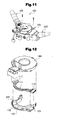
A conventional combination switch for a vehicle is shown for example, in FIG.11 and 12. FIG. 11 is a perspective view of a combination switch for a vehicle and FIG.12 is an exploded perspective view of a bottom cover, a connection cord, and a cord cover.
As shown in FIG. 11, a combination switch 101 for a vehicle includes a right and a left lever switch mounted in a body 103. A bottom cover 109 is detachably mounted to a lower face of the body 103 in FIG.12. The bottom cover 109 supports a flat cable received inside the body 103 from the lower face thereof.
A connection cord 111 is disposed in a lower face of the bottom cover 109. The connection cord 111 is received in a receiving space 115 of a cord cover 113 and connectors 117, 119 in both ends are engaged with connector support sections 121, 123 in both ends of the cord cover 113. The cord cover 113 is mounted on a lower face of the bottom cover 109 and the connection cord 111 is disposed on the lower face of the bottom cover 109.
The connectors 117, 119 are connected respectively to sides of lever switches 105, 107. Accordingly action instructions for a wiper and a washer can be performed by an operation of the lever switch 105, and instructions for a turn signal, a passing switch, a main dim switch, and an on/off of a head light and a fog lamp can be made by an operation of the lever switch 107. However, since in such construction, the connection cord 111 is disposed on the lower face of the bottom cover 109 through the cord cover 113, there is not a sufficient space on the lower face of the bottom cover 109, and as a result there is the problem with an increase in an entire construction size of the combination switch.
And for example, in case of assembling a slip ring for a heater under the lower face of the bottom cover 109, the slip ring is assembled between the connection cord 111 and lower face of the bottom cover 109. Therefore, the assembly can not be made or is extremely difficult to make.
Further, the connection cord is disposed on the lower face of the bottom cover 109 by receiving the connection cord inside a receiving space 115 of the cord cover 113, and the connection cord 111 is easy to be loosened on assembly, and the loosened cord is sandwiched between the cord cover 113 and the bottom cover 109, to deteriorate durability of the connection cord 111. And attention should be paid to prevent the loosened connection cord 11 from being caught in between the bottom cover 109 and the cord cover 113, to cause difficulty on assembly.
[Patent Document 1] : Japanese Unexamined Patent Publication No. 2002 - 150864
[DISCLOSURE OF THE INVENTION] [The PROBLEMS TO BE SOLVED BY THE INVENTION]
There are the problems with lack of the space, impairment of durability due to the connection cord being caught in caused by loosened connection cord, and the difficulty on assembly.
[MEANS TO SOLVE THE PROBLEMS]
The present invention is, for the purpose of an spacious advantage and an easy assembly due to preventing the connection cord from being caught in by the loosening of the connection cord, characterized mainly in that a cord engagement section is projected on an outer peripheral section of a bottom cover and a connection cord is engaged with an outer peripheral section of the cord engagement section to be disposed along the bottom cover so as to bypass the bottom cover.
[ADVANTAGES OF THE INVENTION]
A combination switch for a vehicle according to the present invention is characterized in that a cord engagement section is projected on an outer peripheral section of the bottom cover, and the connection cord is engaged to the outer peripheral section of the cord engagement section to be disposed along a peripheral side of the bottom cover. Accordingly the cord cover can be omitted, as well as a space to assemble other members on the lower face of the bottom cover can be ensured, to provide a spacious advantage.
The connection cord is engaged with an outer peripheral section of the cord engagement section to be disposed so as to bypass the cord cover, thereby to restrict the loosening of the connection cord and prevent the connection cord from being caught in. As a result the durability of the connection cord can be improved. Attention is needed not to be paid to the connection cord on assembly, as a result to perform an easy assembly.
The cord engagement section includes a central nail and hookup nails disposed between the central nail and the right and left connector support sections, and the body includes a wall section opposite to an outer peripheral section of the central nail and groove sections located in both sides of the wall section to communicate between an inner side and an outer side of the wall section. Accordingly the connection cord can be securely disposed along the periphery of the bottom cover by the central nail and the hookup nails.
And on assembly, both sides of the connection cord are taken out to the wall section of the body by engaging a central section of the connection cord to the body engagement section of the body. Accordingly the bottom cover can be easily mounted to the body without catching in the connection cord.
After the bottom cover is mounted, connectors in both ends are supported at the connector support sections by drawing back and pulling both side sections of the connection cord from the groove sections to an inner side of the body by reversing the both side sections. Thereby the connection cord can be easily disposed along a periphery of the bottom cover.
In case where the wall section is formed at the body engagement section to engage the body to the bracket, the groove sections are spaced by an interval in the body engagement section and in both sides of the body engagement section and are formed between a body-positioning projector to be positioned relative to the bracketandasensor-positioningprojectortopositionasteering angle sensor relative to the body, the wall section and the groove sections can be formed by the existing sections without particularly forming the wall section and the groove sections, thereby to provide an easy manufacturing and a simple construction.
A tip end of the central nail is formed close to the wall section of the body to form a clearance between the tip end of the central nail and the wall section of the body so as to be smaller than a diameter of the connection cord. Accordingly the central section of the connection cord can be securely held between the central nail and the wall section of the body and the loosening and the catching in of the connection cord can be securely restricted, to dispose the connection cord with an easy assembly. In case the connection cord includes a plurality of twisted thin wires, the loosening and the catching in of the connection cord can be securely restricted, to dispose the connection cord with an easy assembly.
An assembly method for a combination switch for a vehicle according to the present invention, comprises:
  • a first step of taking out both sides of the connection cord to an outer peripheral side of the body by engaging a central section of the connection cord to the body engagement section of the body;
  • a second step of supporting the central section of the connection cord between the wall section and the cord engagement section by mounting the bottom cover to the body; and
  • a third step of reversing both side sections of the connection cord to draw back the both side sections of the connection cord from the groove sections to an inner peripheral side of the body, as well as pulling the connection cord around the outer peripheral side of the cord engagement section to support the connectors in both ends at the connector support sections.
  • Accordingly when the bottom cover is mounted with the body cord still being held, the connection cord can be pulled out to an outer peripheral side of the body so that the connection cord does not block the bottom cover mounting. After the bottom cover is mounted to the body, the connection cord is pulled back from the groove sections to an inner side of the body by reversing both sides of the connection cord, to easily dispose the connection cord so as to be bypassed.
    [BEST MODE TO CARRY OUT THE INVENTION]
    The objects of a spacious advantage, a durability improvement, and an easy assembly by restricting the loosening and the catching in of the connection cord are achieved with the minimum number of components without an increase in size.
    [BRIEF EXPLANATION OF THE DRAWINGS]
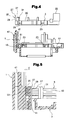
  • FIG. 1 is a perspective view showing a state where a body, a bottom cover and a connection cord are assembled (Embodiment 1) .
  • FIG. 2 is a cross sectional view showing a relation between the body, the bottom cover and the connection cord.
  • FIG. 3 is a cross sectional view at a position different from FIG. 2 showing the relation between the body, the bottom cover and the connection cord (Embodiment 1).
  • FIG. 4 is a partial cross sectional exploded view showing the relation between the body and the bottom cover (Embodiment 1) .
  • FIG. 5 is a partial cross sectional enlarged explanation view of a key section (Embodiment 1).
  • FIG. 6 is an exploded perspective view of the body, the bottom cover, and the connection cord (Embodiment).
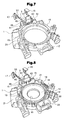
  • FIG. 7 is a perspective view showing a first step (Embodiment 1) .
  • FIG. 8 is a perspective view showing a second step (Embodiment 1) .
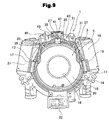
  • FIG. 9 is a perspective view showing a third step (Embodiment 1).
  • FIG. 10 is an exploded perspective view showing a relation of the body into which the bottom cover and the connection cord are incorporated, the slip ring, and the steering angle sensor (Embodiment 1).
  • FIG. 11 is a perspective view of a combination switch for a vehicle (conventional example).
  • FIG. 12 is an exploded perspective view of a bottom cover, a connection cord, and a cord cover (conventional example).
  • [Embodiment 1]
    FIGS. 1 - 5 show a key part of a combination switch for a vehicle to which an embodiment 1 of the present invention is applied, FIG.1 is a perspective view of a mounting state of a body, a bottom cover, and a connection cord, FIG.2 is a cross sectional view showing a relation between the body and the bottom cover, FIG.3 is a cross sectional view at a different position of the same, FIG.4 is an exploded view with a cross section of a part showing a relation between the body and the bottom cover, and FIG. 5 is an enlarged explanation view of a key part with a partial cross section. Further, in FIG. 1 - 5, for explanation, the upward and downward relation of the body or the like shows a reverse relation to a mounting state to a vehicle body. For example, an upward side shown in FIG.1 is a lower side in the mounting state to the vehicle body. And an entire construction of a combination switch for a vehicle is substantially the same as in FIG.11.
    As shown in FIG.1 - 4, the combination switch for the vehicle of the embodiment includes a body 1, a bottom cover 3, and a connection cord 5.
    In the combination switch for the vehicle, the bottom cover 3 is detachably mounted to the body 1, and the connection cord 5 is disposed along an outer periphery side of the bottom cover 3. Further, a rotor housing 6 to be disposed in a steering wheel side is rotatably mounted to the body 1 by an attachment 8. A flat cable for supplying power from the vehicle body side to the steering wheel side is received in a cable-receiving space 7 formed between the body 1 and the bottom cover 3, and is supported to the bottom cover 3 by a sliding sheet 9. It is to be noted that the sliding sheet 9 can be omitted depending on the type of the flat cable.
    The body 1 is made of non-conductible resin and is mounted to a bracket of the vehicle body side. Mounting sections 19, 21 are disposed in the body 1 at the right and left sides. A lever switch shown in FIG.11 as the switch main body is mounted respectively to the mounting sections 19, 21. A step section 10 receiving/supporting the bottom cover 3 is formed in an inner peripheral side of the body 1. A plurality of snap stationary angle windows 23 are disposed spaced by a predetermined interval in an inner circumference of the step 10 of the body 1. A support section 12 continuously formed with the step 10 is mounted in one side to the body 1. A body engagement section 47 engaging the body 1 to the bracket of the vehicle body side is disposed to the body 1 on the opposite side of the support section 12. The body engagement section 47 engages the body 1 to the bracket temporarily. A body-positioning projector 49 and a sensor-positioning projector 51 are spaced in both sides of the body engagement section 47. The body-positioning projector 49 determines a position of the body 1 relative to the bracket, and the sensor-positioning projector 51 determines a position of the steering angle sensor to detect a steering angle of the steering wheel relative to the body 1.
    The bottom cover 3 is formed mainly of a doughnut-like plate section 14 made of non-conductible resin and is equipped with a penetrating bore 16 disposed in the inner circumference, enabling mounting the rotor housing 6 and is equipped with double circumferential ribs 18, 20 formed in the periphery. Right and left connector support sections 11, 13 are mounted to the bottom lever 3 corresponding to the right and left lever switches. The right and left connector support sections are disposed over the double circumferential ribs 18, 20. A connector section 22 is disposed in an outer peripheral face of the circumferential rib 20.
    A plurality of stationary nails 25, for example, 4 stationary nails are disposed on the outer peripheral face of the circumferential rib 20 in the circumferential direction by a predetermined interval. The mounting and the removal of the bottom cover 3 to the body 1 are performed by the stationary nails 25 and the snap stationary angle window 23. Namely the bottom cover 3 is mounted to be inserted into the body 1 and the stationary nail 25s are snap-engaged with the snap stationary angle window 23, thereby to detachably mount the bottom cover 3 to the body 1.
    And in the combination switch for the vehicle, in particular, a cord engagement section 27 is disposed in an outer periphery of the bottom cover 3 and the connection cord 5 is engaged to an outer peripheral section of the cord engagement section 27 to dispose the connection cord 5 along the outer peripheral section of the bottom cover 3 so as to bypass the bottom cover 3.
    Namely the cord engagement section 27 is disposed opposite to the connector section 22 and is constructed of a central nail 29 and hookup nails 31, 33 between the central nail 29 and the right and left connector support sections 11, 13. The central nail and the hookup nails 31, 33 are projected on the circumferential rib 20. The central nail 29 is almost as tall as the hookup nails 31, 33, but the central nail is wider than the hookup nails 31, 33.
    In the embodiment, the hookup nails 31, 33 are formed substantially in the center between the central nail 29 and the right and left connector support sections 11, 13 . Tip end tongues 35, 37, 39 are disposed at tip ends in the central nail 29 and the hookup nails 31, 33. The tip end tongues 35, 37, 39 are projected toward the outer periphery side of the bottom cover 3.
    A wall section 41 opposite to the outer peripheral side of the central nail 29 and groove sections 43, 45 communicating between an inner and an outer side of the body 1 positioned at both sides of the wall section 41 are disposed in the body 1
    The wall section 41 is constructed of a part of the body engagement section 47 engaging the body with the bracket of the vehicle body side. The groove section 43 is formed between the body engagement section 47 and the sensor-positioning projector 51 and the groove section 45 is formed between the body engagement section 47 and the body-positioning projector 49.
    As shown in FIG.5, in a state where the bottom cover 3 is mounted to the body 1, the tip end of the central nail 29 is formed close to the wall section 41 of the body 1 to form an clearance between the tip end of the central nail 29 and the wall section 41 of the body 1, the clearance being smaller than a diameter of the connection cord 5. Namely a clearance C between the tip end tongue 35 as the tip end of the central nail 29 and the wall section 41 of the body engagement section 47 is formed to be smaller than a diameter of one thin wire 53 of the connection cord 5.
    The connection cord 5 is formed by twisting a plurality of thin wires and is equipped with connector 15, 17 at the both ends. The connectors 15, 17 are engaged and supported by the right and left connector support sections 11, 13, and are connected to a right and left lever switches. In addition, the connection cord 5 may be not twisted.
    An assembly method of the combination switch for the vehicle is performed as shown in FIGS.6 - 9.
    FIG.6 is an exploded perspective view of the body and the bottom cover. FIG.7 is a perspective view showing a first step. FIG. 8 is a perspective view showing a second step. FIG.9 is a perspective view showing a third step.
    As FIG.6, in a state where the body 1, the bottom cover 3, and the connection cord 5 are not assembled, according to the first step, the central section of the connection cord 5 is hooked by the body engagement section 47 of the body 1 and both sides of the connection cord 5 are pulled out to the outer peripheral side of the body 1 through the groove sections 43, 45 as shown in FIG.7.
    In the second step in FIG.8, the bottom cover 3 is mounted to the body 1 to support the central section of the connection cord 5 between the wall section 41 and the central nail 29. The fixation of the bottom cover 3 to the body 1 is performed by the stationary nails 25 being snap-engaged with the snap stationary angle window 23 as described above. Then, the connection cord 5 is the twisted thin wires 53 and restricts the mutual loosening of the thin wires 53.
    Accordingly it is easy to perform the withdrawal of the connection cord 5 through the groove sections 43, 45. And the central section of the connection cord 5 can be securely held between the wall section 41 and the central nail 29. In this case, as shown in FIG.5, the clearance C between the tip end tongue 35 of the central nail 29 and the wall section 41 is formed to be smaller than a diameter of the thin wire 53. Accordingly even if the thin wires 53 are loosened and separated, it prevents the thin wires 53 from tearing loose from the central nail 29 through the clearance C, thereby to securely hold the connection cord 5 between the central nail 29 and the wall section 41. Even if the connection cord 5 are untwisted and are easily separated with each other, the clearance C prevents the thin wires 53 from tearing loose from the clearance between the central nail 29 and the wall section 41 thereby to securely hold the connection cords 5 between the central nail 29 and the wall section 41.
    According to the third step of FIG. 9, in the second step of FIG. 8, the connectors 15, 17 as both sides of the connection cord 5 are reversely rotated to the inner peripheral side of the body 1, and the connection cord 5 is pulled back to the inner peripheral side from the groove sections 43, 45, as well as pulled and rotated to the outer peripheral side of the hookup nails 31, 33 to engage the connectors 15, 17 at the both ends to the connector support sections 11, 13, whereby the connection cord 5 is securely located around the outer peripheral side of the bottom cover 3 so as to bypass the bottom cover 3.
    As described above, since the combination switch in the embodiment of the present invention is constructed such that the cord engagement section 27 is projected in the outer peripheral section of the bottom cover 3 and the connection cord 5 is engaged to the outer peripheral section of the cord engagement section 27 thereby to locate the connection cord 5 along the outer peripheral side of the bottom cover 3 so as to bypass the bottom cover 3, which enables omission of a cord cover, as well as ensures spaces for incorporating other members under a lower face of the bottom cover 3 and a spatial advantageous structure. Engaging the connection cord 5 to the outer peripheral section of the cord engagement section 27 for location prevents the thin wires of the connection cord 5 from being loosened and from being caught in, thereby to improve durability of the connection cord 5.
    Since the loosening of the connection cord 5 is prevented, the assembly is easy to perform without attention being paid to the connection cord 5 on assembly.
    Since the cord engagement section 27 is formed of the central nail 29 and the hookup nails 31, 33 between the central nail 29, and the right and left connector support sections 11, 13, and the body 1 is provided with the wall section 41 opposite to the outer peripheral side of the central nail 29 and the groove sections 43, 45 located in both sides of the wall section 41 to form communication between an inside and an outside of the body 1, the connection cord 5 can be securely located and bypassed along the outer periphery of the bottom cover 3 by the central nail 29 and the hookup nails 31, 33.
    And on assembly, the central section of the connection cord 5 is hooked on the wall section 41 of the body 1, and the both sides of the connection cord 5 are pulled out to the outer peripheral side of the body 1 through the groove sections 43, 45. Thereby the bottom cover 3 can be easily mounted on the body 1 without the connection cord 5 being caught in. After the bottom cover 3 is mounted, the both sides of the connection cord 5 are turned reversely and pulled back from the groove sections 43, 45 to the inner peripheral side of the body 1 and pulled around the outer peripheral side of the hookup nails 31, 33, and the connectors 15, 17 at both ends are supported by the connector support sections 11, 13. Thereby the connection cord 5 can be easily located and bypassed along the outer peripheral side of the bottom cover 3.
    Since the wall section 41 is formed with the body engagement section 47 to engage the body 1 to a bracket of the body side, and the groove sections 43, 45 are formed at both the sides of the body engagement section 47 and formed between the body-positioning projector 49 for bracket-positioning and the sensor-positioning projector 51 for the steering angle sensor-positioning which are spaced at both the sides of the body engagement section 47, the wall section 41 and the groove sections 43, 45 can be formed at the existing sections without especially forming the wall section 41 and the groove sections 43, 45, which allows an easy manufacture and a simple structure of the combination switch.
    A tip section of the central nail 29 is formed close to the wall section 41 of the body 1 and the clearance between the tip section of the central nail 29 and the wall section 41 of the body 1 is formed to be smaller than a diameter of the thin wires 53 of the connection cord 5. Therefore, the central section of the connection cord 5 is securely held between the central nail 29 and the wall section 41 of the body 1, and the loosening and catching-in of the connection cord 5 can be securely prevented to securely locate the connection cord 5 so as to bypass the bottom cover 3 and the connection cord 5 can be easily incorporated.
    Since the connection cord 5 is formed by twisting a plurality of thin wires 53, the loosening and the catching-in of the connection cord 5 can be more securely prevented, and the secure location of the connection cord 5 are more easily performed, to be more easily assembled.
    FIG. 10 is an exploded perspective view showing the body in which the bottom cover and the connection cord are incorporated, and a relation between a slip ring and a steering angle sensor. FIG. 10 shows a structure where a slip ring 55 and a steering angle sensor 57 are in order incorporated to the body 1 in which the bottom cover and the connection cord have been incorporated. As described above, when the connection cord 5 is located in the outer peripheral side of the bottom cover 3, the connection cord 5 does not exist under the lower face of the bottom cover 3 and accordingly the corresponding space becomes provided. Accordingly the slip ring 55 for a handle heater can be easily incorporated at the corresponding space under the lower side of the bottom cover 3. Further accommodation of the slip ring 55 for a heater in the corresponding space of the bottom cover 3 allows an easy, compact incorporation of the steering angle sensor 57.
    It is noted that the cord engagement section 27 may be formed by separately providing the central nail 29 and the hookup nails 31, 33. Or the central nail 29 and the hookup nails 31, 33 may be sequentially formed, and the cord engagement section 27 may be sequentially formed from the central nail 29 to the right and left connector support sections 11, 13, and the slits may be formed in the connector support sections 11, 13 to pull out the connection cord 5 through the slits to the inner peripheral side.
    The clearance C may be formed to be larger than the thin wires 53. In this case it is preferable that the connection cord 5 is twisted.
    The wall section 41 and the groove sections 43, 45 may be formed with no relation to the body engagement section 47, the body-positioning projector 49, and the sensor-positioning projector 51.
    [EXPLANATION OF THE REFERENCE NEMERICALS]
    1
    BODY
    3
    BOTTOM COVER
    5
    CONNECTION CORD
    11, 13
    CONNECTOR SUPPORT SECTION
    15, 17
    CONNECTOR
    27
    CORD ENGAGEMENT SECTION
    29
    CENTRAL NAIL
    31, 33
    HOOKUP NAIL
    35
    TIP NAIL SECTION (TIP)
    41
    WALL SECTION
    43, 45
    GROOVE SECTION
    47
    BODY ENGAGEMENT SECTION
    49
    BODY-POSITIONING PROJECTOR
    51
    SENSOR-POSITIONING PROJECTOR
    53
    THIN WIRE

    Claims (6)

    1. A combination switch, comprising:
      a body mounted in a bracket of a vehicle body side, the body including switch main bodies on a right side and a left side of the body;
      a bottom cover detachably mounted to the body, the bottom cover supporting a flat cable for supplying power from the vehicle body side to a steering wheel side, as well as including a right and a left connector support section corresponding to the switch main bodies on the right and the left side; and
      a connection cord, wherein:
      connectors are supported at both ends to the right and left connector support sections and the connectors are connected to the right and left switch main bodies by the connection cord, wherein:
      a cord engagement section is projected on an outer peripheral section of the bottom cover, and the connection cord is engaged to the outer peripheral section of the cord engagement section to be disposed along a peripheral side of the bottom cover so as to bypass the bottom cover.
    2. The combination switch for the vehicle as defined in claim 1, wherein:
      the cord engagement section includes:
      a central nail and; and
      hookup nails disposed between the central nail and the connector support sections, and
      the body includes:
      a wall section opposite to an outer peripheral side of the central nail; and
      groove sections located in both sides of the wall section to communicate between an inner side and an outer side of the wall section.
    3. The combination switch for the vehicle as defined in claim 2, wherein:
      the wall section is formed with the body engagement section to engage the body to the bracket, and the groove sections are spaced by an interval in the body engagement section and in both sides of the body engagement section and are formed between a body-positioning projector to be positioned relative to the bracketandasensor-positioningprojectortopositionasteering angle sensor relative to the body.
    4. The combination switch as defined in claim 2 or 3, wherein:
      a tip end of the central nail is formed close to the wall section of the body to form a clearance between the front end of the central nail and the wall section of the body, the clearance being smaller than a diameter of the connection cord.
    5. The combination switch as defined in any of claims 1 to 4, wherein:
      the connection cord includes a plurality of twisted thin wires.
    6. An assembly method for the combination switch for the vehicle as defined in any of claims 2 to 4, comprising:
      a first step of taking out both sides of the connection cord to an outer peripheral side of the body by engaging a central section of the connection cord to the body engagement section of the body;
      a second step of supporting the central section of the connection cord between the wall section and the cord engagement section by mounting the bottom cover to the body; and
      a third step of reversing both side sections of the connection cord to draw back the both side sections of the connection cord from the groove sections to an inner peripheral side of the body, as well as pulling the connection cord around the outer peripheral side of the cord engagement section to support the connectors in both ends at the connector support sections.
    EP05004773A 2004-03-17 2005-03-04 Combination switch for a vehicle and assembly method of the same Expired - Lifetime EP1577161B1 (en)

    Applications Claiming Priority (2)

    Application Number Priority Date Filing Date Title
    JP2004075961 2004-03-17
    JP2004075961A JP4301981B2 (en) 2004-03-17 2004-03-17 Combination switch for vehicle and its assembly method

    Publications (3)

    Publication Number Publication Date
    EP1577161A2 true EP1577161A2 (en) 2005-09-21
    EP1577161A3 EP1577161A3 (en) 2006-09-20
    EP1577161B1 EP1577161B1 (en) 2008-02-20

    Family

    ID=34836534

    Family Applications (1)

    Application Number Title Priority Date Filing Date
    EP05004773A Expired - Lifetime EP1577161B1 (en) 2004-03-17 2005-03-04 Combination switch for a vehicle and assembly method of the same

    Country Status (5)

    Country Link
    US (1) US7262378B2 (en)
    EP (1) EP1577161B1 (en)
    JP (1) JP4301981B2 (en)
    KR (1) KR101057549B1 (en)
    DE (1) DE602005004820T2 (en)

    Families Citing this family (4)

    * Cited by examiner, † Cited by third party
    Publication number Priority date Publication date Assignee Title
    US7946612B2 (en) * 2006-12-27 2011-05-24 Autoliv Development Ab Safety arrangement
    KR101026624B1 (en) * 2009-10-27 2011-04-04 대성전기공업 주식회사 Automotive Multifunction Switch Unit
    KR101118851B1 (en) 2009-12-14 2012-03-16 주식회사 신창전기 Multi-function stalk module switch unit for vehicle
    CN115891858B (en) * 2023-01-19 2024-11-19 江铃汽车股份有限公司 Combined switch shield mounting structure and vehicle

    Family Cites Families (9)

    * Cited by examiner, † Cited by third party
    Publication number Priority date Publication date Assignee Title
    JPH10199375A (en) * 1997-01-17 1998-07-31 Yazaki Corp Combination switch device
    JPH10228844A (en) 1997-02-14 1998-08-25 Niles Parts Co Ltd Combination switch structure for vehicle
    DE69835136T2 (en) * 1997-05-20 2006-11-09 Matsushita Electric Industrial Co., Ltd., Kadoma MULTIPLE SWITCH FOR MOTOR VEHICLE
    DE19958505C2 (en) * 1999-12-04 2003-04-10 Delphi Tech Inc Steering column switch assembly
    KR100318483B1 (en) * 1999-12-15 2002-01-05 박재범 Combination switch assembly for vehicle
    JP4629854B2 (en) * 2000-11-14 2011-02-09 ナイルス株式会社 Combination switch for vehicle
    JP3958645B2 (en) * 2001-08-10 2007-08-15 株式会社東海理化電機製作所 Flat cable mounting structure
    JP2003141972A (en) 2001-11-01 2003-05-16 Niles Parts Co Ltd Combination switch
    US6854977B2 (en) * 2002-09-13 2005-02-15 Trw Inc. Steering wheel rotary connector

    Also Published As

    Publication number Publication date
    US7262378B2 (en) 2007-08-28
    KR101057549B1 (en) 2011-08-17
    JP4301981B2 (en) 2009-07-22
    DE602005004820T2 (en) 2009-02-19
    KR20060043649A (en) 2006-05-15
    DE602005004820D1 (en) 2008-04-03
    EP1577161B1 (en) 2008-02-20
    US20050208800A1 (en) 2005-09-22
    JP2005262945A (en) 2005-09-29
    EP1577161A3 (en) 2006-09-20

    Similar Documents

    Publication Publication Date Title
    US5226831A (en) Fixing structure of a flat cable connecting portion in a rotary connector
    US6574922B2 (en) Door trimming panel having a window-lift mechanism
    JP3556677B2 (en) Cable window lifter
    US5836212A (en) Interlocking grommet with gross hole and method of assembly
    EP1731373B1 (en) Wiring harness holding device
    EP1577161B1 (en) Combination switch for a vehicle and assembly method of the same
    US7214094B2 (en) Twist mount wiring receiver
    JP5408043B2 (en) Grommet
    EP0974493A2 (en) Cable reel and assembling method thereof
    EP0926009B1 (en) Column switch with rotary connector
    US12319199B2 (en) Lighting device of steering wheel and assembling method thereof
    JP4223920B2 (en) Interior lighting
    US6406194B1 (en) Expanding mount system for light emitting cable leads
    US5785450A (en) Structure for coupling steering wheel and rotary connector of vehicle
    JP2001008344A (en) Wire harness winding device
    JP3787276B2 (en) Wire type window regulator
    AU2003203426B2 (en) Cover for connector insertion
    JP2001114476A (en) Wire harness winding device
    JP2007508982A (en) Shift device for transmitting a shift command to an automobile transmission
    JPH05280247A (en) Wire wind-up device for window regulator
    JP2001004888A (en) Optical cable traction tool
    JP2001008347A (en) Wire harness winding device
    KR102921258B1 (en) Gear system assembly structure of electronic parking brake
    JPH11329576A (en) Connector
    KR200389887Y1 (en) Structure For Assembling The Cover Of The Band Cable For Fixing The Wire

    Legal Events

    Date Code Title Description
    PUAI Public reference made under article 153(3) epc to a published international application that has entered the european phase

    Free format text: ORIGINAL CODE: 0009012

    AK Designated contracting states

    Kind code of ref document: A2

    Designated state(s): AT BE BG CH CY CZ DE DK EE ES FI FR GB GR HU IE IS IT LI LT LU MC NL PL PT RO SE SI SK TR

    AX Request for extension of the european patent

    Extension state: AL BA HR LV MK YU

    PUAL Search report despatched

    Free format text: ORIGINAL CODE: 0009013

    AK Designated contracting states

    Kind code of ref document: A3

    Designated state(s): AT BE BG CH CY CZ DE DK EE ES FI FR GB GR HU IE IS IT LI LT LU MC NL PL PT RO SE SI SK TR

    AX Request for extension of the european patent

    Extension state: AL BA HR LV MK YU

    17P Request for examination filed

    Effective date: 20070117

    17Q First examination report despatched

    Effective date: 20070212

    AKX Designation fees paid

    Designated state(s): DE FR GB

    GRAP Despatch of communication of intention to grant a patent

    Free format text: ORIGINAL CODE: EPIDOSNIGR1

    RIN1 Information on inventor provided before grant (corrected)

    Inventor name: INOTSUKA, TETSUYA

    Inventor name: ADACHI, TOSHIYUKI

    GRAS Grant fee paid

    Free format text: ORIGINAL CODE: EPIDOSNIGR3

    GRAA (expected) grant

    Free format text: ORIGINAL CODE: 0009210

    AK Designated contracting states

    Kind code of ref document: B1

    Designated state(s): DE FR GB

    REG Reference to a national code

    Ref country code: GB

    Ref legal event code: FG4D

    REF Corresponds to:

    Ref document number: 602005004820

    Country of ref document: DE

    Date of ref document: 20080403

    Kind code of ref document: P

    ET Fr: translation filed
    PLBE No opposition filed within time limit

    Free format text: ORIGINAL CODE: 0009261

    STAA Information on the status of an ep patent application or granted ep patent

    Free format text: STATUS: NO OPPOSITION FILED WITHIN TIME LIMIT

    26N No opposition filed

    Effective date: 20081121

    REG Reference to a national code

    Ref country code: DE

    Ref legal event code: R082

    Ref document number: 602005004820

    Country of ref document: DE

    Representative=s name: MAI, OPPERMANN & PARTNER I. L., DE

    Ref country code: DE

    Ref legal event code: R082

    Ref document number: 602005004820

    Country of ref document: DE

    Representative=s name: OANDO OPPERMANN & OPPERMANN LLP, DE

    REG Reference to a national code

    Ref country code: DE

    Ref legal event code: R082

    Ref document number: 602005004820

    Country of ref document: DE

    Representative=s name: MAI, OPPERMANN & PARTNER I. L., DE

    Ref country code: DE

    Ref legal event code: R082

    Ref document number: 602005004820

    Country of ref document: DE

    Representative=s name: OANDO OPPERMANN & OPPERMANN LLP, DE

    Ref country code: FR

    Ref legal event code: PLFP

    Year of fee payment: 11

    REG Reference to a national code

    Ref country code: DE

    Ref legal event code: R082

    Ref document number: 602005004820

    Country of ref document: DE

    Representative=s name: OANDO OPPERMANN & OPPERMANN LLP, DE

    REG Reference to a national code

    Ref country code: FR

    Ref legal event code: PLFP

    Year of fee payment: 12

    REG Reference to a national code

    Ref country code: FR

    Ref legal event code: PLFP

    Year of fee payment: 13

    REG Reference to a national code

    Ref country code: FR

    Ref legal event code: PLFP

    Year of fee payment: 14

    PGFP Annual fee paid to national office [announced via postgrant information from national office to epo]

    Ref country code: DE

    Payment date: 20190219

    Year of fee payment: 15

    Ref country code: GB

    Payment date: 20190227

    Year of fee payment: 15

    PGFP Annual fee paid to national office [announced via postgrant information from national office to epo]

    Ref country code: FR

    Payment date: 20190213

    Year of fee payment: 15

    REG Reference to a national code

    Ref country code: DE

    Ref legal event code: R119

    Ref document number: 602005004820

    Country of ref document: DE

    PG25 Lapsed in a contracting state [announced via postgrant information from national office to epo]

    Ref country code: FR

    Free format text: LAPSE BECAUSE OF NON-PAYMENT OF DUE FEES

    Effective date: 20200331

    Ref country code: DE

    Free format text: LAPSE BECAUSE OF NON-PAYMENT OF DUE FEES

    Effective date: 20201001

    GBPC Gb: european patent ceased through non-payment of renewal fee

    Effective date: 20200304

    PG25 Lapsed in a contracting state [announced via postgrant information from national office to epo]

    Ref country code: GB

    Free format text: LAPSE BECAUSE OF NON-PAYMENT OF DUE FEES

    Effective date: 20200304