EP1575363B1 - Magnetically polarisable metallic particles for pest control - Google Patents
Magnetically polarisable metallic particles for pest control Download PDFInfo
- Publication number
- EP1575363B1 EP1575363B1 EP03778593A EP03778593A EP1575363B1 EP 1575363 B1 EP1575363 B1 EP 1575363B1 EP 03778593 A EP03778593 A EP 03778593A EP 03778593 A EP03778593 A EP 03778593A EP 1575363 B1 EP1575363 B1 EP 1575363B1
- Authority
- EP
- European Patent Office
- Prior art keywords
- particles
- pest
- pesticide
- chemical
- insect
- Prior art date
- Legal status (The legal status is an assumption and is not a legal conclusion. Google has not performed a legal analysis and makes no representation as to the accuracy of the status listed.)
- Expired - Lifetime
Links
- 241000607479 Yersinia pestis Species 0.000 title claims abstract description 42
- 239000013528 metallic particle Substances 0.000 title description 9
- 239000002245 particle Substances 0.000 claims abstract description 62
- 238000000034 method Methods 0.000 claims abstract description 30
- 239000000126 substance Substances 0.000 claims abstract description 19
- 239000000575 pesticide Substances 0.000 claims abstract description 18
- 239000000203 mixture Substances 0.000 claims abstract description 16
- 239000000463 material Substances 0.000 claims abstract description 14
- 241000238631 Hexapoda Species 0.000 claims description 58
- XEEYBQQBJWHFJM-UHFFFAOYSA-N Iron Chemical compound [Fe] XEEYBQQBJWHFJM-UHFFFAOYSA-N 0.000 claims description 40
- 229910052742 iron Inorganic materials 0.000 claims description 20
- 239000002917 insecticide Substances 0.000 claims description 19
- 239000003016 pheromone Substances 0.000 claims description 19
- 150000002632 lipids Chemical class 0.000 claims description 11
- 239000000696 magnetic material Substances 0.000 claims description 7
- PXHVJJICTQNCMI-UHFFFAOYSA-N Nickel Chemical compound [Ni] PXHVJJICTQNCMI-UHFFFAOYSA-N 0.000 claims description 5
- 241000894006 Bacteria Species 0.000 claims description 4
- 241000700605 Viruses Species 0.000 claims description 4
- 230000000895 acaricidal effect Effects 0.000 claims description 4
- 239000000642 acaricide Substances 0.000 claims description 4
- 235000013305 food Nutrition 0.000 claims description 4
- 241000233866 Fungi Species 0.000 claims description 3
- 239000003627 allelochemical Substances 0.000 claims description 3
- 239000005667 attractant Substances 0.000 claims description 3
- 229910017052 cobalt Inorganic materials 0.000 claims description 3
- 239000010941 cobalt Substances 0.000 claims description 3
- GUTLYIVDDKVIGB-UHFFFAOYSA-N cobalt atom Chemical compound [Co] GUTLYIVDDKVIGB-UHFFFAOYSA-N 0.000 claims description 3
- 235000014113 dietary fatty acids Nutrition 0.000 claims description 3
- 150000002148 esters Chemical class 0.000 claims description 3
- 229930195729 fatty acid Natural products 0.000 claims description 3
- 239000000194 fatty acid Substances 0.000 claims description 3
- 150000004665 fatty acids Chemical class 0.000 claims description 3
- 150000003839 salts Chemical class 0.000 claims description 3
- 239000002975 chemoattractant Substances 0.000 claims description 2
- 230000031902 chemoattractant activity Effects 0.000 claims description 2
- 230000003559 chemosterilizing effect Effects 0.000 claims description 2
- 230000000855 fungicidal effect Effects 0.000 claims description 2
- 239000000417 fungicide Substances 0.000 claims description 2
- 239000003630 growth substance Substances 0.000 claims description 2
- 229910052759 nickel Inorganic materials 0.000 claims description 2
- 229920000642 polymer Polymers 0.000 claims description 2
- 229920005989 resin Polymers 0.000 claims description 2
- 239000011347 resin Substances 0.000 claims description 2
- 239000003206 sterilizing agent Substances 0.000 claims description 2
- 230000000007 visual effect Effects 0.000 claims description 2
- 239000000843 powder Substances 0.000 description 22
- 241000894007 species Species 0.000 description 16
- 241001674044 Blattodea Species 0.000 description 12
- 241000238657 Blattella germanica Species 0.000 description 10
- 239000004480 active ingredient Substances 0.000 description 9
- 239000003620 semiochemical Substances 0.000 description 9
- 238000000576 coating method Methods 0.000 description 8
- 239000011248 coating agent Substances 0.000 description 7
- 150000001875 compounds Chemical class 0.000 description 7
- 238000002474 experimental method Methods 0.000 description 7
- 239000005944 Chlorpyrifos Substances 0.000 description 6
- SBPBAQFWLVIOKP-UHFFFAOYSA-N chlorpyrifos Chemical compound CCOP(=S)(OCC)OC1=NC(Cl)=C(Cl)C=C1Cl SBPBAQFWLVIOKP-UHFFFAOYSA-N 0.000 description 6
- 230000005684 electric field Effects 0.000 description 6
- 241000255588 Tephritidae Species 0.000 description 5
- 241000255925 Diptera Species 0.000 description 4
- ISRUGXGCCGIOQO-UHFFFAOYSA-N Rhoden Chemical compound CNC(=O)OC1=CC=CC=C1OC(C)C ISRUGXGCCGIOQO-UHFFFAOYSA-N 0.000 description 4
- 230000013011 mating Effects 0.000 description 4
- 230000001568 sexual effect Effects 0.000 description 4
- 241000238876 Acari Species 0.000 description 3
- 241000257303 Hymenoptera Species 0.000 description 3
- 238000004891 communication Methods 0.000 description 3
- 230000009193 crawling Effects 0.000 description 3
- 239000006249 magnetic particle Substances 0.000 description 3
- 230000005389 magnetism Effects 0.000 description 3
- 239000003921 oil Substances 0.000 description 3
- 241000238421 Arthropoda Species 0.000 description 2
- 241000254173 Coleoptera Species 0.000 description 2
- 241000256602 Isoptera Species 0.000 description 2
- 241001465754 Metazoa Species 0.000 description 2
- 208000032370 Secondary transmission Diseases 0.000 description 2
- 230000009471 action Effects 0.000 description 2
- 210000000038 chest Anatomy 0.000 description 2
- 239000000356 contaminant Substances 0.000 description 2
- 230000001186 cumulative effect Effects 0.000 description 2
- 230000000694 effects Effects 0.000 description 2
- IPCSVZSSVZVIGE-UHFFFAOYSA-N hexadecanoic acid Chemical compound CCCCCCCCCCCCCCCC(O)=O IPCSVZSSVZVIGE-UHFFFAOYSA-N 0.000 description 2
- 230000014759 maintenance of location Effects 0.000 description 2
- 239000002923 metal particle Substances 0.000 description 2
- -1 neem extract Substances 0.000 description 2
- 230000000361 pesticidal effect Effects 0.000 description 2
- 238000002360 preparation method Methods 0.000 description 2
- 230000008569 process Effects 0.000 description 2
- 230000000284 resting effect Effects 0.000 description 2
- 238000012360 testing method Methods 0.000 description 2
- 241000193388 Bacillus thuringiensis Species 0.000 description 1
- 241000196324 Embryophyta Species 0.000 description 1
- CWYNVVGOOAEACU-UHFFFAOYSA-N Fe2+ Chemical compound [Fe+2] CWYNVVGOOAEACU-UHFFFAOYSA-N 0.000 description 1
- 241000257324 Glossina <genus> Species 0.000 description 1
- 241000258937 Hemiptera Species 0.000 description 1
- 241000223201 Metarhizium Species 0.000 description 1
- 241000257226 Muscidae Species 0.000 description 1
- 235000021314 Palmitic acid Nutrition 0.000 description 1
- 244000178231 Rosmarinus officinalis Species 0.000 description 1
- 239000000877 Sex Attractant Substances 0.000 description 1
- 235000021355 Stearic acid Nutrition 0.000 description 1
- 240000002657 Thymus vulgaris Species 0.000 description 1
- 235000007303 Thymus vulgaris Nutrition 0.000 description 1
- 239000011149 active material Substances 0.000 description 1
- 230000001070 adhesive effect Effects 0.000 description 1
- 230000002776 aggregation Effects 0.000 description 1
- 238000004220 aggregation Methods 0.000 description 1
- 239000000009 alarm pheromone Substances 0.000 description 1
- 229940082880 azadirachta indica flower extract Drugs 0.000 description 1
- 229940097012 bacillus thuringiensis Drugs 0.000 description 1
- 230000009286 beneficial effect Effects 0.000 description 1
- 235000015895 biscuits Nutrition 0.000 description 1
- 239000010624 camphor oil Substances 0.000 description 1
- 229960000411 camphor oil Drugs 0.000 description 1
- 239000000969 carrier Substances 0.000 description 1
- 239000012876 carrier material Substances 0.000 description 1
- 239000010627 cedar oil Substances 0.000 description 1
- 238000011109 contamination Methods 0.000 description 1
- 238000013461 design Methods 0.000 description 1
- 238000011161 development Methods 0.000 description 1
- 201000010099 disease Diseases 0.000 description 1
- 208000037265 diseases, disorders, signs and symptoms Diseases 0.000 description 1
- 230000005672 electromagnetic field Effects 0.000 description 1
- 230000007613 environmental effect Effects 0.000 description 1
- 238000009472 formulation Methods 0.000 description 1
- 230000002538 fungal effect Effects 0.000 description 1
- 239000011521 glass Substances 0.000 description 1
- 238000003898 horticulture Methods 0.000 description 1
- 238000010348 incorporation Methods 0.000 description 1
- 239000002054 inoculum Substances 0.000 description 1
- 230000003993 interaction Effects 0.000 description 1
- 230000009545 invasion Effects 0.000 description 1
- 150000002500 ions Chemical class 0.000 description 1
- 230000033001 locomotion Effects 0.000 description 1
- 230000007246 mechanism Effects 0.000 description 1
- 239000012528 membrane Substances 0.000 description 1
- 229910052751 metal Inorganic materials 0.000 description 1
- 239000002184 metal Substances 0.000 description 1
- 239000007769 metal material Substances 0.000 description 1
- 244000005700 microbiome Species 0.000 description 1
- 238000005065 mining Methods 0.000 description 1
- WQEPLUUGTLDZJY-UHFFFAOYSA-N n-Pentadecanoic acid Natural products CCCCCCCCCCCCCCC(O)=O WQEPLUUGTLDZJY-UHFFFAOYSA-N 0.000 description 1
- QIQXTHQIDYTFRH-UHFFFAOYSA-N octadecanoic acid Chemical compound CCCCCCCCCCCCCCCCCC(O)=O QIQXTHQIDYTFRH-UHFFFAOYSA-N 0.000 description 1
- OQCDKBAXFALNLD-UHFFFAOYSA-N octadecanoic acid Natural products CCCCCCCC(C)CCCCCCCCC(O)=O OQCDKBAXFALNLD-UHFFFAOYSA-N 0.000 description 1
- 230000001151 other effect Effects 0.000 description 1
- 150000002942 palmitic acid derivatives Chemical class 0.000 description 1
- 239000011236 particulate material Substances 0.000 description 1
- 244000052769 pathogen Species 0.000 description 1
- 239000000419 plant extract Substances 0.000 description 1
- 229920000058 polyacrylate Polymers 0.000 description 1
- 239000012254 powdered material Substances 0.000 description 1
- 230000005180 public health Effects 0.000 description 1
- 239000005871 repellent Substances 0.000 description 1
- 230000002940 repellent Effects 0.000 description 1
- 230000035945 sensitivity Effects 0.000 description 1
- 230000001953 sensory effect Effects 0.000 description 1
- 210000000697 sensory organ Anatomy 0.000 description 1
- 210000002265 sensory receptor cell Anatomy 0.000 description 1
- 102000027509 sensory receptors Human genes 0.000 description 1
- 108091008691 sensory receptors Proteins 0.000 description 1
- 239000007779 soft material Substances 0.000 description 1
- 239000008117 stearic acid Substances 0.000 description 1
- 230000000638 stimulation Effects 0.000 description 1
- 229910052712 strontium Inorganic materials 0.000 description 1
- CIOAGBVUUVVLOB-UHFFFAOYSA-N strontium atom Chemical compound [Sr] CIOAGBVUUVVLOB-UHFFFAOYSA-N 0.000 description 1
- 230000008685 targeting Effects 0.000 description 1
- 239000001585 thymus vulgaris Substances 0.000 description 1
- 231100000331 toxic Toxicity 0.000 description 1
- 230000002588 toxic effect Effects 0.000 description 1
- 238000012546 transfer Methods 0.000 description 1
- 239000000341 volatile oil Substances 0.000 description 1
- XLYOFNOQVPJJNP-UHFFFAOYSA-N water Substances O XLYOFNOQVPJJNP-UHFFFAOYSA-N 0.000 description 1
- XOOUIPVCVHRTMJ-UHFFFAOYSA-L zinc stearate Chemical class [Zn+2].CCCCCCCCCCCCCCCCCC([O-])=O.CCCCCCCCCCCCCCCCCC([O-])=O XOOUIPVCVHRTMJ-UHFFFAOYSA-L 0.000 description 1
- 229910000859 α-Fe Inorganic materials 0.000 description 1
Images


Classifications
-
- A—HUMAN NECESSITIES
- A01—AGRICULTURE; FORESTRY; ANIMAL HUSBANDRY; HUNTING; TRAPPING; FISHING
- A01N—PRESERVATION OF BODIES OF HUMANS OR ANIMALS OR PLANTS OR PARTS THEREOF; BIOCIDES, e.g. AS DISINFECTANTS, AS PESTICIDES OR AS HERBICIDES; PEST REPELLANTS OR ATTRACTANTS; PLANT GROWTH REGULATORS
- A01N57/00—Biocides, pest repellants or attractants, or plant growth regulators containing organic phosphorus compounds
- A01N57/10—Biocides, pest repellants or attractants, or plant growth regulators containing organic phosphorus compounds having phosphorus-to-oxygen bonds or phosphorus-to-sulfur bonds
- A01N57/16—Biocides, pest repellants or attractants, or plant growth regulators containing organic phosphorus compounds having phosphorus-to-oxygen bonds or phosphorus-to-sulfur bonds containing heterocyclic radicals
-
- A—HUMAN NECESSITIES
- A01—AGRICULTURE; FORESTRY; ANIMAL HUSBANDRY; HUNTING; TRAPPING; FISHING
- A01N—PRESERVATION OF BODIES OF HUMANS OR ANIMALS OR PLANTS OR PARTS THEREOF; BIOCIDES, e.g. AS DISINFECTANTS, AS PESTICIDES OR AS HERBICIDES; PEST REPELLANTS OR ATTRACTANTS; PLANT GROWTH REGULATORS
- A01N25/00—Biocides, pest repellants or attractants, or plant growth regulators, characterised by their forms, or by their non-active ingredients or by their methods of application, e.g. seed treatment or sequential application; Substances for reducing the noxious effect of the active ingredients to organisms other than pests
- A01N25/24—Biocides, pest repellants or attractants, or plant growth regulators, characterised by their forms, or by their non-active ingredients or by their methods of application, e.g. seed treatment or sequential application; Substances for reducing the noxious effect of the active ingredients to organisms other than pests containing ingredients to enhance the sticking of the active ingredients
-
- A—HUMAN NECESSITIES
- A01—AGRICULTURE; FORESTRY; ANIMAL HUSBANDRY; HUNTING; TRAPPING; FISHING
- A01N—PRESERVATION OF BODIES OF HUMANS OR ANIMALS OR PLANTS OR PARTS THEREOF; BIOCIDES, e.g. AS DISINFECTANTS, AS PESTICIDES OR AS HERBICIDES; PEST REPELLANTS OR ATTRACTANTS; PLANT GROWTH REGULATORS
- A01N25/00—Biocides, pest repellants or attractants, or plant growth regulators, characterised by their forms, or by their non-active ingredients or by their methods of application, e.g. seed treatment or sequential application; Substances for reducing the noxious effect of the active ingredients to organisms other than pests
- A01N25/26—Biocides, pest repellants or attractants, or plant growth regulators, characterised by their forms, or by their non-active ingredients or by their methods of application, e.g. seed treatment or sequential application; Substances for reducing the noxious effect of the active ingredients to organisms other than pests in coated particulate form
-
- A—HUMAN NECESSITIES
- A01—AGRICULTURE; FORESTRY; ANIMAL HUSBANDRY; HUNTING; TRAPPING; FISHING
- A01N—PRESERVATION OF BODIES OF HUMANS OR ANIMALS OR PLANTS OR PARTS THEREOF; BIOCIDES, e.g. AS DISINFECTANTS, AS PESTICIDES OR AS HERBICIDES; PEST REPELLANTS OR ATTRACTANTS; PLANT GROWTH REGULATORS
- A01N59/00—Biocides, pest repellants or attractants, or plant growth regulators containing elements or inorganic compounds
- A01N59/16—Heavy metals; Compounds thereof
-
- Y—GENERAL TAGGING OF NEW TECHNOLOGICAL DEVELOPMENTS; GENERAL TAGGING OF CROSS-SECTIONAL TECHNOLOGIES SPANNING OVER SEVERAL SECTIONS OF THE IPC; TECHNICAL SUBJECTS COVERED BY FORMER USPC CROSS-REFERENCE ART COLLECTIONS [XRACs] AND DIGESTS
- Y02—TECHNOLOGIES OR APPLICATIONS FOR MITIGATION OR ADAPTATION AGAINST CLIMATE CHANGE
- Y02A—TECHNOLOGIES FOR ADAPTATION TO CLIMATE CHANGE
- Y02A50/00—TECHNOLOGIES FOR ADAPTATION TO CLIMATE CHANGE in human health protection, e.g. against extreme weather
- Y02A50/30—Against vector-borne diseases, e.g. mosquito-borne, fly-borne, tick-borne or waterborne diseases whose impact is exacerbated by climate change
Definitions
- the present invention relates to a method of controlling insects and other arthropod pests, such as ticks and mites, by contaminating the pests with fine coated metallic particles formulated with biologically active compounds, such that the contamination is disseminated to other individuals in the population by contact.
- This process known as autodissemination, is analogous to the spread of disease-causing microorganisms in man by contact.
- the method is particularly suitable for flying or crawling insects, mites and ticks, including pests encountered in agriculture, horticulture, forestry and public health.
- pests include (among others) ants and termites, lepidopteran pests (moths), flies (e.g. fruit flies, tsetse flies, biting flies, houseflies and mosquitoes), cockroaches and coleopteran pests (e.g. beetle pests of forestry plantations.
- WO 94/00980 describes a method of controlling pests, such as insects, involving the use of electrostatically charged powders, in which the powders are used to adhere to the insect cuticle and also act as carriers for pesticides or other biologically active compounds.
- electrostatically charged particles are that they must first be charged before they can be applied to the pests, such as for example by friction.
- Another disadvantage is that the particles can be dislodged or removed from baited surfaces by wind or by shaking.
- the electrostatic charge of the particles may also be undermined in conditions of high humidity and when moisture films develop.
- WO 00/01236 describes a method of controlling pests, such as insects, by trapping and/or killing them wherein the pest is exposed to a composition comprising particles containing or consisting of at least one magnetic material.
- the said application also describes particles which have an inert core which acts as a carrier for biologically active materials, the core being coated with a permanently magnetic material.
- the use of magnetic materials of the form as described in WO 00/01236 has the following disadvantages.
- the magnetic surface has very poor retention properties for active ingredients, especially if, as is commonly the case, the active ingredients are very volatile.
- active ingredients contained within the inner core of a magnetically-coated particle are not easily accessible to the surface of the pest.
- the magnetic particles are "hard” magnets which retain their magnetism, as opposed to "soft" magnets of the type used, for example, in solenoids, in which the magnetism is lost immediately that they are removed from a magnetic or electric field.
- Hard magnetic particles are difficult to produce in a specified size range, weight or shape because they lose their magnetism, when milled.
- toxic metallic salts may be present as contaminants, and it would be undesirable to introduce these into a crop environment.
- US-A-3767783 describes self-destructing pesticidal formulations and methods for their use.
- EP-A-0118667 describes a marking material containing metallic particles.
- the present invention provides a method of controlling pests, which method comprises:
- pesticide as used herein is meant an insecticide, acaricide, fungicide, insect growth regulator, chemosterilant, bacterium, fungus or virus.
- the particles may be milled down to a preferred size range, weight or shape, such that they may, if desired, detach easily from the surface of the insect on contact. Furthermore, the particles may be prepared from metallic iron, for example, which is free from possible contaminants.
- a preferred aspect of the present invention is the use of metallic particles coated with a material which acts as a carrier for a pesticide or a behaviour modifying compound such as a pheromone or a compound with a similar action (semiochemicals).
- Suitable carrier materials are lipids, including fatty acids and their esters, such as stearic acid, stearates, palmitic acid, palmitates etc. which form a coating on the particles and permit the incorporation of any active ingredient which has some lipid solubility therein. In this way, active ingredients are placed in direct contact with the surface of the insect when a coated particle is resting on the insect cuticle.
- the efficacy and power of adhesion of electrostatically charged particles depends on their ability to attach to the insect cuticle because it is an electret, i.e. it is permanently electrically polarised.
- the efficacy of certain metallic particles to attach to the cuticle is believed to be due to their property of interaction with the weak electric field generated by the movement of ions within the body of the insect.
- the metal particles become magnetically polarised in the presence of the electric field at the surface of the living insect and this serves to hold the metal particles against the insect cuticle. It is important to note that the particles acquire their adhesive properties only when they are in contact with the outer surface of the insect and when they are thus acting as miniature solenoids. This is a mode of action distinct from that described in WO 00/01236 , in which the particles are premagnetised.
- Pesticides in the lipid coating of the attached particles are then able to diffuse into the lipid layers of the insect cuticle and enter the body of the insect.
- Particles formulated with volatile semiochemicals remain on the surface of the insect acting as emitting sources and biopathogens are anchored onto the body of the insect for long periods thereby facilitating their invasion of the body tissues.
- a further preferred aspect of the present invention is the use of powders of a selected size and mass, such that the mass is low enough when the particle is at rest not to overcome the magnetic attraction to the surface of the insect, but high enough to become detached and transferred on contact with the cuticle of a second insect. In this way the optimum amount of transfer of particles will occur between insects, and few particles will fall off when the insect is walking, or in flight.
- the biologically active compounds used to effect control of insects include conventional chemical insecticides, biological insecticides, naturally-occurring insecticides and behaviour-modifying compounds, including attractants.
- Chemical insecticides are preferably slow-acting, so that the insects survive exposure to the material long enough to pass on the particles to one or more other insects.
- Naturally-occurring insecticides include materials such as plant extracts and essential oils, including oil of thyme, oil of rosemary, cedarwood oil, neem extract, camphor oil, camomile oil, etc.
- Biological insecticides are understood to include entomopathogens such as viruses, bacteria (i.e. Bacillus thuringiensis), and fungal spores (e.g. Metarhizium and Beauvaria species). Behaviour modifying compounds are also known as semiochemicals.
- a semiochemical is a chemical that affects the behaviour of an organism.
- Semiochemicals used in communication between members of the same species are known as pheromones, and those involved in communication between members of different species are classed as allelochemicals.
- Allelochemicals may be involved, for example in, communication between different species of animals, or between plants and animals.
- Semiochemicals may be attractive or repellent, or have other effects on behaviour.
- Insect pheromones may be, for example species-specific sex pheromones which can be used to interfere with mate-seeking, aggregation pheromones and alarm pheromones, which can be used to attract insects to baits.
- the amount of active ingredient formulated in the particles will range from 0.001 to 20% by weight. Where an entomopathogen is used, the quantity may be greater, because of the size of the pathogenic organism involved, reaching up to 40% by weight.
- a semiochemical the amount of material required to affect the behaviour of the organism when the particulate material is resting on the body surface may be extremely low in view of the extremely high sensitivity of insect chemical sense organs to certain semiochemicals.
- a semiochemical present in amounts from 0.1 picograms per particle to 1 microgram per particle will affect behaviour, where the overall particle averages 0.1 to 50 micrometres.
- the preferred coating on the metallic particles is lipid in nature, of a material which does not confer strong electrostatic properties, and in which the active ingredients can be absorbed or to which they can be adsorbed.
- coatings of lipid including fatty acids, their salts and esters, are highly suitable.
- Other materials which may be used include resins, and polymers with weak tribocharging properties, such as acrylic polymers.
- the thickness of the coating must satisfy the requirement of permitting the metallic core to come as close as possible to the insect cuticle and that of being of sufficient thickness to sequester the required quantities of the active ingredient. In general, the thickness of the coating will be between 100 nanometres and five micrometres.
- the physico-chemical nature of the active ingredient may also make the use of a coating unnecessary, for example an oily material can be applied directly to the metallic particles.
- the metallic material consists of soft iron. In its natural state this is not magnetic and becomes magnetically polarised only when placed in a magnetic or electric field.
- the particles are unmagnetised and when they are transferred to the insect cuticle by contact they are subject to the weak electric field across the cuticle and so become weakly polarised.
- Soft iron is one of the group of substances capable of being magnetised, which also includes nickel and cobalt. Metallic nickel and cobalt particles may also be used in the present invention but these are an order of magnitude less susceptible to an electromagnetic field and so are not preferred.
- the mass of iron is very high and therefore particles of large size will not stay on the pest.
- the particles must therefore have a low unit weight, corresponding to that of a sphere of diameter between 0.1 and 50 micrometres.
- a spherical form is not essential, and fine flakes of an equivalent volume are preferred because they will give a greater area of contact with the cuticular surface and are more likely to lodge in folds in the flexible intersegmental membranes of arthropods.
- the mode of application of the method of the invention differs according to the type of pest, but in all cases relies on part of the body of the pest coming into contact with powdered material on a coated surface.
- the insects In order to control household insect pests such as cockroaches, ants and termites it is desirable to attract the insects into a dispenser, similar to a bait station, into which the insects can easily enter and leave, and in which they are exposed to surfaces coated with the metallic powder.
- a dispenser similar to a bait station
- the powder may be placed in a container into which the insects can easily enter and leave, but come into contact with a layer or coating of lipid-coated particles when they are inside the container.
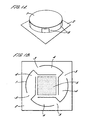
- a shallow container 1 is closed at its top and attached to a base plate 2.
- the container has four separate openings, 3 each of which function as an entrance and an exit for crawling insects, such as ants or cockroaches.
- the entrances lead through passageways 4 inside the container to a central area 5 which is coated with a powder which comprises soft iron particles coated with a lipid material which is impregnated with a slow-acting insecticide.
- the soft iron particles are held in place by incorporating a material with conducting or magnetic properties in the central area 5 to which the soft iron particles become attached (not encompassed by the method of claim 1).
- insects such as cockroaches
- cockroaches are attracted into the container by a chemical or food-based attractant, and in the process of exploration pick up the soft iron particles on their feet and bodies. Individual cockroaches then return to their harbourages and spread the powder to other cockroaches in the harbourage through the mutual contact. The slow-acting insecticide in the lipid layer of the particles is thus spread throughout the colony of cockroaches.
- FIG. 2 A second piece of apparatus is illustrated in Figure 2 .
- a flying insect pest such as a moth or fruit fly
- dispensers are placed in the crop where the moth or fruit fly is a pest.
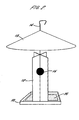
- the dispenser consists of a shallow tray 10, to which are attached cross vanes 12.
- a lid 13 is placed over the cross vanes 12 in order to divert rainwater and debris from landing on the tray.
- the dispenser is suspended from a branch or other suitable support by the hanger 14.
- a source 15 of the sexual attractive pheromone of the species is attached to the cross vanes 12 and the vanes 12 are coated with a soft material with a very low coefficient of friction.
- the tray 10 contains a layer 16 of several grams of coated iron particles formulated with the sexual pheromone of the species.
- the flying insects attracted by the pheromone source attempt to alight on the cross vanes 12 but are unable to do so because of the slippery surface thereof. They fall into the tray 10, thereby receiving an inoculum of the powder before flying off.
- the presence of the pheromone emitting sources on the body of the insect interferes with its ability to detect females of the same species by locating the aerial pheromone trail they produce, and mating does not occur.
- the mechanisms of interference may include overstimulation or imbalance of stimulation to the sensory receptors, and confusion effects on both male and females produced by males, emitting female signals.
- the soft iron particles 16 contained in the tray 10 may be formulated with a slow acting insecticide. Males of the flying insect pest species attracted by the pheromone source alight on the tray 10 and pick up the soft iron particles 16 formulated with the insecticide on their bodies before flying off. During mating quantities of the powder will be spread to other insects of the same species and the slow acting insecticide formulated with the soft iron particles will be spread throughout the local species.
- a third piece of apparatus is illustrated in Figure 3 .
- dispensers are placed in the crop where the moth or fruit fly is a pest.
- the dispenser (not encompassed by the method of claim 1) consists of a strip of material 20 with conducting or magnetic properties-which is coated with soft iron particles 21.
- the soft iron particles are anchored virtue of the conducting or magnetic properties of the strip 20.
- a lid 22 is placed or suspended over the strip in order to divert rainwater and debris.
- the dispenser is suspended from a branch or other suitable support by the hanger 23.
- a source of the sexual attractive pheromone of the species is attached to the strip 24.
- the soft iron particles anchored to the strip 21 are formulated with the sexual pheromone of the species.
- the soft iron particles 21 anchored to the strip 20 may be formulated with a slow acting insecticide.
- Males of the flying insect pest species attracted by the pheromone source alight on the strip 20 and pick up the soft iron particles formulated with the slow acting insecticide 21 on their bodies before flying off.
- quantities of the powder will be spread to other insects of the same species and the slow acting insecticide formulated with the soft iron particles will be spread throughout the local species.
- the devices described with reference to Figure 1A, 1B , 2 or 3 may be modified in their design to take account of differences in the behaviour among the pests that it is desire to control.
- the means of attracting pests into such devices are not limited to chemical attractants or pheromones. They may include food sources, light, colour, visual patterns, infra-red sources, and acoustic sources or a combination of sensory signals, depending upon the attractive power of the signal to the pest concerned.
Landscapes
- Life Sciences & Earth Sciences (AREA)
- Health & Medical Sciences (AREA)
- General Health & Medical Sciences (AREA)
- Wood Science & Technology (AREA)
- Environmental Sciences (AREA)
- Engineering & Computer Science (AREA)
- Dentistry (AREA)
- Pest Control & Pesticides (AREA)
- Agronomy & Crop Science (AREA)
- Zoology (AREA)
- Plant Pathology (AREA)
- Toxicology (AREA)
- Chemical & Material Sciences (AREA)
- Inorganic Chemistry (AREA)
- Agricultural Chemicals And Associated Chemicals (AREA)
- Catching Or Destruction (AREA)
- Acyclic And Carbocyclic Compounds In Medicinal Compositions (AREA)
Applications Claiming Priority (3)
| Application Number | Priority Date | Filing Date | Title |
|---|---|---|---|
| GBGB0228421.4A GB0228421D0 (en) | 2002-12-05 | 2002-12-05 | Lipid carriers |
| GB0228421 | 2002-12-05 | ||
| PCT/GB2003/005311 WO2004049807A1 (en) | 2002-12-05 | 2003-12-05 | Lipid carriers |
Publications (2)
| Publication Number | Publication Date |
|---|---|
| EP1575363A1 EP1575363A1 (en) | 2005-09-21 |
| EP1575363B1 true EP1575363B1 (en) | 2011-07-27 |
Family
ID=9949146
Family Applications (1)
| Application Number | Title | Priority Date | Filing Date |
|---|---|---|---|
| EP03778593A Expired - Lifetime EP1575363B1 (en) | 2002-12-05 | 2003-12-05 | Magnetically polarisable metallic particles for pest control |
Country Status (13)
| Country | Link |
|---|---|
| US (1) | US8399004B2 (enExample) |
| EP (1) | EP1575363B1 (enExample) |
| JP (1) | JP4964415B2 (enExample) |
| CN (1) | CN100521942C (enExample) |
| AT (1) | ATE517549T1 (enExample) |
| AU (2) | AU2003285594A1 (enExample) |
| BR (1) | BR0316970B1 (enExample) |
| CA (1) | CA2508422C (enExample) |
| ES (1) | ES2370295T3 (enExample) |
| GB (1) | GB0228421D0 (enExample) |
| IL (1) | IL168770A (enExample) |
| WO (1) | WO2004049807A1 (enExample) |
| ZA (1) | ZA200504316B (enExample) |
Families Citing this family (9)
| Publication number | Priority date | Publication date | Assignee | Title |
|---|---|---|---|---|
| GB9814507D0 (en) * | 1998-07-03 | 1998-09-02 | Univ Southampton | A method and apparatus for controlling pests |
| GB2425954A (en) * | 2005-05-12 | 2006-11-15 | Exosect Ltd | Method of delivering a biologically active agent |
| EP2500429A3 (en) * | 2005-05-31 | 2015-10-28 | Devgen N.V. | RNAi for the control of insects and arachnids |
| WO2011148144A1 (en) * | 2010-05-27 | 2011-12-01 | Exosect Limited | Liquid compositions comprising a sustained release system for insecticides |
| GB201106741D0 (en) | 2011-04-20 | 2011-06-01 | Exosect Ltd | Coating compositions for pathogen control in monocotyledonous plants |
| EP2699686B1 (en) | 2011-04-20 | 2017-11-29 | Devgen NV | Plants resistant to insect pests |
| RU2619219C2 (ru) | 2011-07-18 | 2017-05-12 | Девген Нв | Подавление экспрессии генов у насекомых-вредителей |
| EP3407714A4 (en) * | 2016-01-29 | 2019-12-04 | The United States Of America As Represented By The Secretary Of The Navy | FERROMAGNETIC PESTS TRAY |
| CN110114223B (zh) * | 2016-12-28 | 2020-12-04 | 京瓷办公信息系统株式会社 | 图像形成装置 |
Family Cites Families (11)
| Publication number | Priority date | Publication date | Assignee | Title |
|---|---|---|---|---|
| US3767783A (en) | 1970-12-23 | 1973-10-23 | Us Interior | Self destructing pesticidal formulations and methods for their use |
| SE418247B (sv) * | 1975-11-17 | 1981-05-18 | Haessle Ab | Sett att framstella kroppar med reglerad frigoring av en aktiv komponent |
| DE3301357C1 (de) | 1983-01-18 | 1984-08-16 | Plast-Labor S.A., 1630 Bulle | Markierungsmittel,Verfahren zu ihrer Herstellung und ihre Verwendung zur Markierung von feindispersen Systemen |
| US5162014A (en) * | 1991-05-03 | 1992-11-10 | Moore Lawrence W | Magnetic treating of honeybees infested with mites or other parasites |
| GB9214956D0 (en) | 1992-07-14 | 1992-08-26 | Univ Southampton | A method of trapping and/or killing insects |
| US5885486A (en) * | 1993-03-05 | 1999-03-23 | Pharmaciaand Upjohn Ab | Solid lipid particles, particles of bioactive agents and methods for the manufacture and use thereof |
| JPH11512097A (ja) * | 1995-08-29 | 1999-10-19 | イー・アイ・デユポン・ドウ・ヌムール・アンド・カンパニー | 水に不溶なコーティング材料で被覆されている固体状の作物保護剤粒子を含む作物保護剤組成物およびそれを含む作物保護剤混合物 |
| GB9605203D0 (en) | 1996-03-12 | 1996-05-15 | Univ Southampton | Control agent |
| US5771628A (en) * | 1996-10-25 | 1998-06-30 | Jeunique International, Inc. | Insect and pest trap |
| CN1220826A (zh) * | 1997-12-23 | 1999-06-30 | 叶麒 | 农用杀虫灭菌磁极化高电压离子水的生产方法及其装置 |
| GB9814507D0 (en) * | 1998-07-03 | 1998-09-02 | Univ Southampton | A method and apparatus for controlling pests |
-
2002
- 2002-12-05 GB GBGB0228421.4A patent/GB0228421D0/en not_active Ceased
-
2003
- 2003-12-05 AU AU2003285594A patent/AU2003285594A1/en not_active Abandoned
- 2003-12-05 ES ES03778593T patent/ES2370295T3/es not_active Expired - Lifetime
- 2003-12-05 BR BRPI0316970-7A patent/BR0316970B1/pt not_active IP Right Cessation
- 2003-12-05 US US10/537,210 patent/US8399004B2/en not_active Expired - Fee Related
- 2003-12-05 JP JP2004556550A patent/JP4964415B2/ja not_active Expired - Fee Related
- 2003-12-05 CA CA2508422A patent/CA2508422C/en not_active Expired - Fee Related
- 2003-12-05 EP EP03778593A patent/EP1575363B1/en not_active Expired - Lifetime
- 2003-12-05 CN CNB2003801052342A patent/CN100521942C/zh not_active Expired - Fee Related
- 2003-12-05 AT AT03778593T patent/ATE517549T1/de not_active IP Right Cessation
- 2003-12-05 WO PCT/GB2003/005311 patent/WO2004049807A1/en not_active Ceased
-
2005
- 2005-05-24 IL IL168770A patent/IL168770A/en active IP Right Grant
- 2005-05-26 ZA ZA200504316A patent/ZA200504316B/en unknown
-
2010
- 2010-05-03 AU AU2010201758A patent/AU2010201758B2/en not_active Ceased
Also Published As
| Publication number | Publication date |
|---|---|
| CA2508422A1 (en) | 2004-06-17 |
| WO2004049807A1 (en) | 2004-06-17 |
| ZA200504316B (en) | 2006-07-26 |
| AU2010201758A1 (en) | 2010-05-20 |
| GB0228421D0 (en) | 2003-01-08 |
| US20060051388A1 (en) | 2006-03-09 |
| US8399004B2 (en) | 2013-03-19 |
| JP4964415B2 (ja) | 2012-06-27 |
| BR0316970B1 (pt) | 2015-01-27 |
| IL168770A (en) | 2009-12-24 |
| BR0316970A (pt) | 2005-10-25 |
| JP2006509009A (ja) | 2006-03-16 |
| AU2003285594A1 (en) | 2004-06-23 |
| CA2508422C (en) | 2012-01-10 |
| CN1719976A (zh) | 2006-01-11 |
| ES2370295T3 (es) | 2011-12-14 |
| ATE517549T1 (de) | 2011-08-15 |
| CN100521942C (zh) | 2009-08-05 |
| EP1575363A1 (en) | 2005-09-21 |
| AU2010201758B2 (en) | 2012-05-03 |
Similar Documents
| Publication | Publication Date | Title |
|---|---|---|
| AU2010201758B2 (en) | Lipid carriers | |
| JP4602549B2 (ja) | 害虫を抑制する方法および装置 | |
| EP0888048B1 (en) | Pesticidal or herbicidal compositions | |
| US9693561B2 (en) | Compositions and methods for attracting mosquitoes and repelling sand flies | |
| US7343710B2 (en) | Method and apparatus for controlling pests | |
| EP1890534B1 (en) | A method of delivering a biologically active agent | |
| Howse et al. | Autodissemination of semiochemicals and pesticides: a new concept compatible with the sterile insect technique | |
| CA2242781C (en) | Pesticidal or herbicidal compositions | |
| HK1017235B (en) | Pesticidal or herbicidal compositions | |
| AU2006202675A1 (en) | A method and apparatus for controlling pests |
Legal Events
| Date | Code | Title | Description |
|---|---|---|---|
| PUAI | Public reference made under article 153(3) epc to a published international application that has entered the european phase |
Free format text: ORIGINAL CODE: 0009012 |
|
| 17P | Request for examination filed |
Effective date: 20050704 |
|
| AK | Designated contracting states |
Kind code of ref document: A1 Designated state(s): AT BE BG CH CY CZ DE DK EE ES FI FR GB GR HU IE IT LI LU MC NL PT RO SE SI SK TR |
|
| AX | Request for extension of the european patent |
Extension state: AL LT LV MK |
|
| DAX | Request for extension of the european patent (deleted) | ||
| RIC1 | Information provided on ipc code assigned before grant |
Ipc: A01N 59/16 20060101AFI20060706BHEP Ipc: A01N 25/12 20060101ALI20060706BHEP Ipc: A01N 25/08 20060101ALI20060706BHEP Ipc: A01N 25/24 20060101ALI20060706BHEP Ipc: A01N 25/26 20060101ALI20060706BHEP |
|
| 19A | Proceedings stayed before grant |
Effective date: 20060807 |
|
| REG | Reference to a national code |
Ref country code: GB Ref legal event code: 712F |
|
| REG | Reference to a national code |
Ref country code: GB Ref legal event code: 712F |
|
| 19F | Resumption of proceedings before grant (after stay of proceedings) |
Effective date: 20101201 |
|
| GRAP | Despatch of communication of intention to grant a patent |
Free format text: ORIGINAL CODE: EPIDOSNIGR1 |
|
| GRAS | Grant fee paid |
Free format text: ORIGINAL CODE: EPIDOSNIGR3 |
|
| GRAA | (expected) grant |
Free format text: ORIGINAL CODE: 0009210 |
|
| AK | Designated contracting states |
Kind code of ref document: B1 Designated state(s): AT BE BG CH CY CZ DE DK EE ES FI FR GB GR HU IE IT LI LU MC NL PT RO SE SI SK TR |
|
| REG | Reference to a national code |
Ref country code: GB Ref legal event code: FG4D |
|
| REG | Reference to a national code |
Ref country code: CH Ref legal event code: EP |
|
| REG | Reference to a national code |
Ref country code: DE Ref legal event code: R096 Ref document number: 60337850 Country of ref document: DE Effective date: 20110915 |
|
| RAP2 | Party data changed (patent owner data changed or rights of a patent transferred) |
Owner name: EXOSECT LIMITED |
|
| REG | Reference to a national code |
Ref country code: NL Ref legal event code: VDEP Effective date: 20110727 |
|
| REG | Reference to a national code |
Ref country code: ES Ref legal event code: FG2A Ref document number: 2370295 Country of ref document: ES Kind code of ref document: T3 Effective date: 20111214 |
|
| REG | Reference to a national code |
Ref country code: AT Ref legal event code: MK05 Ref document number: 517549 Country of ref document: AT Kind code of ref document: T Effective date: 20110727 |
|
| PG25 | Lapsed in a contracting state [announced via postgrant information from national office to epo] |
Ref country code: NL Free format text: LAPSE BECAUSE OF FAILURE TO SUBMIT A TRANSLATION OF THE DESCRIPTION OR TO PAY THE FEE WITHIN THE PRESCRIBED TIME-LIMIT Effective date: 20110727 Ref country code: SE Free format text: LAPSE BECAUSE OF FAILURE TO SUBMIT A TRANSLATION OF THE DESCRIPTION OR TO PAY THE FEE WITHIN THE PRESCRIBED TIME-LIMIT Effective date: 20110727 Ref country code: FI Free format text: LAPSE BECAUSE OF FAILURE TO SUBMIT A TRANSLATION OF THE DESCRIPTION OR TO PAY THE FEE WITHIN THE PRESCRIBED TIME-LIMIT Effective date: 20110727 Ref country code: PT Free format text: LAPSE BECAUSE OF FAILURE TO SUBMIT A TRANSLATION OF THE DESCRIPTION OR TO PAY THE FEE WITHIN THE PRESCRIBED TIME-LIMIT Effective date: 20111128 Ref country code: BE Free format text: LAPSE BECAUSE OF FAILURE TO SUBMIT A TRANSLATION OF THE DESCRIPTION OR TO PAY THE FEE WITHIN THE PRESCRIBED TIME-LIMIT Effective date: 20110727 |
|
| PG25 | Lapsed in a contracting state [announced via postgrant information from national office to epo] |
Ref country code: AT Free format text: LAPSE BECAUSE OF FAILURE TO SUBMIT A TRANSLATION OF THE DESCRIPTION OR TO PAY THE FEE WITHIN THE PRESCRIBED TIME-LIMIT Effective date: 20110727 Ref country code: GR Free format text: LAPSE BECAUSE OF FAILURE TO SUBMIT A TRANSLATION OF THE DESCRIPTION OR TO PAY THE FEE WITHIN THE PRESCRIBED TIME-LIMIT Effective date: 20111028 Ref country code: SI Free format text: LAPSE BECAUSE OF FAILURE TO SUBMIT A TRANSLATION OF THE DESCRIPTION OR TO PAY THE FEE WITHIN THE PRESCRIBED TIME-LIMIT Effective date: 20110727 Ref country code: CY Free format text: LAPSE BECAUSE OF FAILURE TO SUBMIT A TRANSLATION OF THE DESCRIPTION OR TO PAY THE FEE WITHIN THE PRESCRIBED TIME-LIMIT Effective date: 20110727 |
|
| PG25 | Lapsed in a contracting state [announced via postgrant information from national office to epo] |
Ref country code: CZ Free format text: LAPSE BECAUSE OF FAILURE TO SUBMIT A TRANSLATION OF THE DESCRIPTION OR TO PAY THE FEE WITHIN THE PRESCRIBED TIME-LIMIT Effective date: 20110727 Ref country code: SK Free format text: LAPSE BECAUSE OF FAILURE TO SUBMIT A TRANSLATION OF THE DESCRIPTION OR TO PAY THE FEE WITHIN THE PRESCRIBED TIME-LIMIT Effective date: 20110727 |
|
| PG25 | Lapsed in a contracting state [announced via postgrant information from national office to epo] |
Ref country code: EE Free format text: LAPSE BECAUSE OF FAILURE TO SUBMIT A TRANSLATION OF THE DESCRIPTION OR TO PAY THE FEE WITHIN THE PRESCRIBED TIME-LIMIT Effective date: 20110727 Ref country code: RO Free format text: LAPSE BECAUSE OF FAILURE TO SUBMIT A TRANSLATION OF THE DESCRIPTION OR TO PAY THE FEE WITHIN THE PRESCRIBED TIME-LIMIT Effective date: 20110727 |
|
| PLBE | No opposition filed within time limit |
Free format text: ORIGINAL CODE: 0009261 |
|
| STAA | Information on the status of an ep patent application or granted ep patent |
Free format text: STATUS: NO OPPOSITION FILED WITHIN TIME LIMIT |
|
| REG | Reference to a national code |
Ref country code: DE Ref legal event code: R081 Ref document number: 60337850 Country of ref document: DE Owner name: EXOSECT LTD., COLDEN COMMON, GB Free format text: FORMER OWNER: EXOSECT LIMITED, SOUTHAMPTON, GB Effective date: 20120412 Ref country code: DE Ref legal event code: R081 Ref document number: 60337850 Country of ref document: DE Owner name: EXOSECT LTD., COLDEN COMMON, GB Free format text: FORMER OWNER: EXOSECT LTD., SOUTHAMPTON, GB Effective date: 20110726 |
|
| PG25 | Lapsed in a contracting state [announced via postgrant information from national office to epo] |
Ref country code: DK Free format text: LAPSE BECAUSE OF FAILURE TO SUBMIT A TRANSLATION OF THE DESCRIPTION OR TO PAY THE FEE WITHIN THE PRESCRIBED TIME-LIMIT Effective date: 20110727 |
|
| 26N | No opposition filed |
Effective date: 20120502 |
|
| PG25 | Lapsed in a contracting state [announced via postgrant information from national office to epo] |
Ref country code: MC Free format text: LAPSE BECAUSE OF NON-PAYMENT OF DUE FEES Effective date: 20111231 |
|
| REG | Reference to a national code |
Ref country code: CH Ref legal event code: PL |
|
| REG | Reference to a national code |
Ref country code: DE Ref legal event code: R097 Ref document number: 60337850 Country of ref document: DE Effective date: 20120502 |
|
| REG | Reference to a national code |
Ref country code: IE Ref legal event code: MM4A |
|
| PG25 | Lapsed in a contracting state [announced via postgrant information from national office to epo] |
Ref country code: IE Free format text: LAPSE BECAUSE OF NON-PAYMENT OF DUE FEES Effective date: 20111205 Ref country code: LI Free format text: LAPSE BECAUSE OF NON-PAYMENT OF DUE FEES Effective date: 20111231 Ref country code: CH Free format text: LAPSE BECAUSE OF NON-PAYMENT OF DUE FEES Effective date: 20111231 |
|
| PG25 | Lapsed in a contracting state [announced via postgrant information from national office to epo] |
Ref country code: LU Free format text: LAPSE BECAUSE OF NON-PAYMENT OF DUE FEES Effective date: 20111205 |
|
| PG25 | Lapsed in a contracting state [announced via postgrant information from national office to epo] |
Ref country code: BG Free format text: LAPSE BECAUSE OF FAILURE TO SUBMIT A TRANSLATION OF THE DESCRIPTION OR TO PAY THE FEE WITHIN THE PRESCRIBED TIME-LIMIT Effective date: 20111027 |
|
| PG25 | Lapsed in a contracting state [announced via postgrant information from national office to epo] |
Ref country code: HU Free format text: LAPSE BECAUSE OF FAILURE TO SUBMIT A TRANSLATION OF THE DESCRIPTION OR TO PAY THE FEE WITHIN THE PRESCRIBED TIME-LIMIT Effective date: 20110727 |
|
| REG | Reference to a national code |
Ref country code: FR Ref legal event code: PLFP Year of fee payment: 13 |
|
| REG | Reference to a national code |
Ref country code: FR Ref legal event code: PLFP Year of fee payment: 14 |
|
| REG | Reference to a national code |
Ref country code: FR Ref legal event code: PLFP Year of fee payment: 15 |
|
| PGFP | Annual fee paid to national office [announced via postgrant information from national office to epo] |
Ref country code: TR Payment date: 20171203 Year of fee payment: 15 Ref country code: FR Payment date: 20171228 Year of fee payment: 15 |
|
| PGFP | Annual fee paid to national office [announced via postgrant information from national office to epo] |
Ref country code: GB Payment date: 20171220 Year of fee payment: 15 |
|
| PGFP | Annual fee paid to national office [announced via postgrant information from national office to epo] |
Ref country code: ES Payment date: 20180129 Year of fee payment: 15 Ref country code: DE Payment date: 20180102 Year of fee payment: 15 |
|
| PGFP | Annual fee paid to national office [announced via postgrant information from national office to epo] |
Ref country code: IT Payment date: 20171221 Year of fee payment: 15 |
|
| REG | Reference to a national code |
Ref country code: DE Ref legal event code: R119 Ref document number: 60337850 Country of ref document: DE |
|
| GBPC | Gb: european patent ceased through non-payment of renewal fee |
Effective date: 20181205 |
|
| PG25 | Lapsed in a contracting state [announced via postgrant information from national office to epo] |
Ref country code: IT Free format text: LAPSE BECAUSE OF NON-PAYMENT OF DUE FEES Effective date: 20181205 Ref country code: FR Free format text: LAPSE BECAUSE OF NON-PAYMENT OF DUE FEES Effective date: 20181231 Ref country code: DE Free format text: LAPSE BECAUSE OF NON-PAYMENT OF DUE FEES Effective date: 20190702 |
|
| PG25 | Lapsed in a contracting state [announced via postgrant information from national office to epo] |
Ref country code: GB Free format text: LAPSE BECAUSE OF NON-PAYMENT OF DUE FEES Effective date: 20181205 |
|
| REG | Reference to a national code |
Ref country code: ES Ref legal event code: FD2A Effective date: 20200131 |
|
| PG25 | Lapsed in a contracting state [announced via postgrant information from national office to epo] |
Ref country code: ES Free format text: LAPSE BECAUSE OF NON-PAYMENT OF DUE FEES Effective date: 20181206 |
|
| PG25 | Lapsed in a contracting state [announced via postgrant information from national office to epo] |
Ref country code: TR Free format text: LAPSE BECAUSE OF NON-PAYMENT OF DUE FEES Effective date: 20181205 |