EP1575331A2 - Beamsteerer - Google Patents
Beamsteerer Download PDFInfo
- Publication number
- EP1575331A2 EP1575331A2 EP05251419A EP05251419A EP1575331A2 EP 1575331 A2 EP1575331 A2 EP 1575331A2 EP 05251419 A EP05251419 A EP 05251419A EP 05251419 A EP05251419 A EP 05251419A EP 1575331 A2 EP1575331 A2 EP 1575331A2
- Authority
- EP
- European Patent Office
- Prior art keywords
- beamsteerer
- array
- sensors
- source
- microphone
- Prior art date
- Legal status (The legal status is an assumption and is not a legal conclusion. Google has not performed a legal analysis and makes no representation as to the accuracy of the status listed.)
- Ceased
Links
Images


Classifications
-
- G—PHYSICS
- G10—MUSICAL INSTRUMENTS; ACOUSTICS
- G10K—SOUND-PRODUCING DEVICES; METHODS OR DEVICES FOR PROTECTING AGAINST, OR FOR DAMPING, NOISE OR OTHER ACOUSTIC WAVES IN GENERAL; ACOUSTICS NOT OTHERWISE PROVIDED FOR
- G10K11/00—Methods or devices for transmitting, conducting or directing sound in general; Methods or devices for protecting against, or for damping, noise or other acoustic waves in general
- G10K11/18—Methods or devices for transmitting, conducting or directing sound
- G10K11/26—Sound-focusing or directing, e.g. scanning
- G10K11/34—Sound-focusing or directing, e.g. scanning using electrical steering of transducer arrays, e.g. beam steering
- G10K11/341—Circuits therefor
- G10K11/346—Circuits therefor using phase variation
-
- G—PHYSICS
- G01—MEASURING; TESTING
- G01S—RADIO DIRECTION-FINDING; RADIO NAVIGATION; DETERMINING DISTANCE OR VELOCITY BY USE OF RADIO WAVES; LOCATING OR PRESENCE-DETECTING BY USE OF THE REFLECTION OR RERADIATION OF RADIO WAVES; ANALOGOUS ARRANGEMENTS USING OTHER WAVES
- G01S3/00—Direction-finders for determining the direction from which infrasonic, sonic, ultrasonic or electromagnetic waves, or particle emission, not having a directional significance, are being received
- G01S3/80—Direction-finders for determining the direction from which infrasonic, sonic, ultrasonic or electromagnetic waves, or particle emission, not having a directional significance, are being received using ultrasonic, sonic or infrasonic waves
- G01S3/8006—Multi-channel systems specially adapted for direction-finding, i.e. having a single aerial system capable of giving simultaneous indications of the directions of different signals
-
- G—PHYSICS
- G10—MUSICAL INSTRUMENTS; ACOUSTICS
- G10K—SOUND-PRODUCING DEVICES; METHODS OR DEVICES FOR PROTECTING AGAINST, OR FOR DAMPING, NOISE OR OTHER ACOUSTIC WAVES IN GENERAL; ACOUSTICS NOT OTHERWISE PROVIDED FOR
- G10K11/00—Methods or devices for transmitting, conducting or directing sound in general; Methods or devices for protecting against, or for damping, noise or other acoustic waves in general
- G10K11/18—Methods or devices for transmitting, conducting or directing sound
- G10K11/26—Sound-focusing or directing, e.g. scanning
- G10K11/34—Sound-focusing or directing, e.g. scanning using electrical steering of transducer arrays, e.g. beam steering
- G10K11/341—Circuits therefor
- G10K11/348—Circuits therefor using amplitude variation
-
- H—ELECTRICITY
- H04—ELECTRIC COMMUNICATION TECHNIQUE
- H04R—LOUDSPEAKERS, MICROPHONES, GRAMOPHONE PICK-UPS OR LIKE ACOUSTIC ELECTROMECHANICAL TRANSDUCERS; ELECTRIC HEARING AIDS; PUBLIC ADDRESS SYSTEMS
- H04R3/00—Circuits for transducers
- H04R3/005—Circuits for transducers for combining the signals of two or more microphones
Definitions
- the invention relates generally to sensor arrays, and more particularly to a beamsteerer for high precision, broadband sound source location in an audio-video conference system, which ignores sound reflections off of walls.
- Estimating the bearing of a source is a problem for applications such as passive sonar (in underwater antenna alignment) and in video conferencing (speaker location).
- the use of sensor arrays is well known in the art for addressing this problem.
- the array information is used to synthesize a beam that is aimed at various points in a domain of interest.
- An estimate of the source location is derived from the point of maximum received energy.
- Zakavauskas (US Patent 5,526,433) teaches the use of a plurality of microphones to aim a highly directional microphone based on differences between the signals from the microphones emanating from the selected source. As with the approaches set forth above, source location is based on a maximum energy search.
- Baker sets forth a multi-microphone system for detecting the source based on the loudest microphone output. For an effective system, each participant requires a microphone. Because the audio detection mechanism is limited in its ability to detect sound, a special camera is used to enhance the peripheral portion of the field of view.
- TDOA time delay of arrival
- Huang et al also disclose a system used for speech that is fairly robust against errors, but is large in that it spans 0.8 ⁇ 0.8 m.
- Branstein (US Patent 5,581,620) teaches a method for location of a speaker by using of the phase alignment of the input signals.
- this approach requires intensive computation and a large array.
- a beamsteerer for steering a narrow null toward a domain of interest.
- the lowest energy point corresponds to the location of a source of audio.
- the beamsteerer uses an array of only a few sensors that are compact, and provides a null with high angular resolution and reasonable error robustness (e.g. a resolution finer than 5 degrees).
- the array is configured with an optimal geometry for generating specific 3D beam patterns each having a unique and deep null in the domain of interest for unambiguously detecting a source azimuth and latitude.
- the array can be in free field, over a rigid plane (e.g. wall) or embedded in a small obstacle, allowing a unique null on a broad frequency band in the direction of the domain of interest, (i.e. where the source to be detected is).
- An algorithm and a specific array design are set forth, by which specific beam patterns are created, allowing an accurate detection of the main source while rejecting side reflections of sound off of walls, etc.
- a beamformer is provided having several look directions, with a constraint imposed and an array geometry and microphone configuration to create the unique null.
- the frequency range of operation is between 1000-1500 Hz in air (wavelength: 0.22 ⁇ ⁇ ⁇ 0.35m) although this can be extended.
- This frequency range is chosen for detecting speech and is based on the following considerations:
- the simplest embodiment of the inventive beamsteerer is implemented in an audio-video conferencing system as shown in Figure 1, comprising a planar microphone array 1 on a reflecting plane 3.
- the reflecting plane 3 is a wall toward which most of the participants look during an audio-video conference (e.g. a video screen above which a video camera (not shown) is placed).
- the microphone spacing is selected to respect the well known ⁇ /2 criterion.
- the two-dimensional array 1 is capable of providing a unique null in a plane normal to the plane 3 of the array (i.e. in the direction of the speaker in both azimuth and latitude).
- microphones 5 in an obstacle 7 gives rise to several nulls, but they are arranged according to the invention so that they occur behind the source locator. Thus, it is important that no sound sources (computer, fan, etc.) be present in this area.
- the embodiment of Figure 1 with a plane array 1 over a rigid plane 3 provides a beamformer having dipoles (unique null sector) steered in both vertical and horizontal directions, whereas the three-dimensional array of Figure 4 is preferable, resulting in a beamformer having a located null.
- the three-dimensional array can be embedded in an obstacle ( Figure 4) or over a rigid plane, which guarantees the null uniqueness.
- a set of beampatterns are generated, each having a null oriented in a specific direction
- the nulls are located every 10 degrees (from 30 to 150 degrees) in a horizontal and a vertical plane.
- building the N beampatterns comprises generating a set of N optimal weight vectors W i in a frequency band of interest (1000 to 1500 Hz in the preferred embodiment).
- the beampatterns can be designed such that they keep the same geometric properties throughout the frequency band (i.e. the same shape and the same null sector width).
- the minimization problem is subjected to additional constraints using one or more microphone signal vectors d 0 i corresponding to different look directions.
- the beamsteerer of the present invention can be sensitive to microphone phases and amplitudes errors, and therefore requires calibration, at least in amplitude in a range of about 1 dB.
- Microphones used in the preferred embodiment can have phase deviation from +/- 1.5 degrees at about 400 Hz up to +/- 4 degrees at 1600 Hz.
- the steering index has a very distinct maximum as the beam is steered at the source.
- the steering index is used as an input signal to point the beamsteerer to a video.
- the array is ideally also coupled to a voice activity detector, which can detect a source using only one microphone or in conjunction with the microphone array steering a beam (rather than a null) to detect a valid signal, as is known in the art.
- Figure 11 is the same plot of SI performance as Figure 10, but with microphone induced amplitude errors of +/- 1dB and phase errors of +/- 4 degrees. It will be noted that there is some loss of selectivity and a consistent two-degree shift up for both sectors, when compared to Figure 10. Nonetheless, by limiting the errors a very usable implementation is possible.
- Figure 12 illustrates the output from the SI detector for a source at 65 degrees and 1 meter from the center of the array.
- the detection still works in spite of microphone errors of about 8 degrees in phase and +/- 1 dB in amplitude.
- the SI is calculated and plotted at every possible location (in this case every 5 degrees).
- Figure 12A the ideal beam shape is used and the detection is very sharp.
- Figure 12B errors are introduced yet the detection remains reasonably clear.
- the effect of the two-degree shift is evident, as the peak is not symmetric about 65 degrees. Even without correction for this effect a very sharp transition is seen.
Landscapes
- Physics & Mathematics (AREA)
- Engineering & Computer Science (AREA)
- Acoustics & Sound (AREA)
- Multimedia (AREA)
- Remote Sensing (AREA)
- Radar, Positioning & Navigation (AREA)
- General Physics & Mathematics (AREA)
- Health & Medical Sciences (AREA)
- General Health & Medical Sciences (AREA)
- Otolaryngology (AREA)
- Signal Processing (AREA)
- Circuit For Audible Band Transducer (AREA)
- Measurement Of Velocity Or Position Using Acoustic Or Ultrasonic Waves (AREA)
- Obtaining Desirable Characteristics In Audible-Bandwidth Transducers (AREA)
- Variable-Direction Aerials And Aerial Arrays (AREA)
Abstract
Description
- The invention relates generally to sensor arrays, and more particularly to a beamsteerer for high precision, broadband sound source location in an audio-video conference system, which ignores sound reflections off of walls.
- Estimating the bearing of a source is a problem for applications such as passive sonar (in underwater antenna alignment) and in video conferencing (speaker location). The use of sensor arrays is well known in the art for addressing this problem. In one approach, the array information is used to synthesize a beam that is aimed at various points in a domain of interest. An estimate of the source location is derived from the point of maximum received energy.
- N. Strobel, S. Spors & R Rabenstein "Joint Audio-Video Signal Processing for Object Localization and Tracking", Chapter 10 in Microphone Arrays by Branstein & Ward, Springer, 2001, discusses a number of sophisticated methods for sound source location according to the prior art.
- Guner Arslan and F. Ayhan Sakarya, "A Unified Neural Networks Based Speaker Localization Technique", IEEE Transaction on Neural Networks, Vol. 11 no 4 July 2000, sets forth a neural network to generate a source location estimate based on a maximum energy search.
- Kerri Harmonic, Joseph Tabriakan and Jeffrey L. Krolik: "Relationships Between Adaptive Minimum Variance Beamforming and Optimal Source Localization", IEEE Transaction on Signal Processing, Vol. 48, no 1 January 2000, discloses adaptive minimum variance beam forming for source localization.
- Zakavauskas (US Patent 5,526,433) teaches the use of a plurality of microphones to aim a highly directional microphone based on differences between the signals from the microphones emanating from the selected source. As with the approaches set forth above, source location is based on a maximum energy search.
- Beaucoup and Tetelbaum (US Patent Application 2003/0051532A1) also discloses a talker localization system that is based on maximum energy. To deal with reverberation, an energy history is retained to determine when a new signal starts thereby permitting reliable detection of the direct path.
- There are two principal disadvantages of prior art sound localization systems, as set forth above. Firstly it is very difficult to create a main beam with a very narrow beam angle, giving rise to expensive solutions in order to achieve high resolution. Secondly, such highly directional beam patterns are generally accompanied by significant side lobes, which can lead to erroneous look directions. Stated otherwise, a simple beamformer (in free field or in an obstacle) is characterized by multiple side lobes and a limited beam width depending on the geometry of the array and the number of microphones. A source locator based on such a beamformer cannot efficiently discriminate side reflections.
- Baker (US Patent 5,686,957) sets forth a multi-microphone system for detecting the source based on the loudest microphone output. For an effective system, each participant requires a microphone. Because the audio detection mechanism is limited in its ability to detect sound, a special camera is used to enhance the peripheral portion of the field of view.
- Another prior art approach to estimating source location involves measuring the time delay of arrival (TDOA) between sensor pairs. The major difficulties in these systems are that there is a need for very accurate knowledge of the position of the sensors, and the sensors must be spaced apart by a significant distance to obtain a reasonable time delay from one sensor to another.
- Yiteng Huang, Jacob Benesty, G. Elko and Russell M. Mersereau: "Real-time Passive Source Localisation: A Practical Linear-Correction Least-Squares Approach ", IEEE Transactions on Speech and Audio Processing, Vol. 9, no 8, November 2001, provides a good survey of the state of the art in TDOA-based source localization. Huang et al also disclose a system used for speech that is fairly robust against errors, but is large in that it spans 0.8 × 0.8 m.
- Chu (US Patent 5,778,082) determines the location of a speaker by a cross-correlation method, which improves the source detection in a reverberant environment.
- Branstein (US Patent 5,581,620) teaches a method for location of a speaker by using of the phase alignment of the input signals. However, this approach requires intensive computation and a large array.
- In both Chu and Branstein, the strongest signal is typically sought out. In instances where there are strong echoes it is possible to make an erroneous detection. The beam width possible with a limited number of transducers is restricted. Conventionally, the directivity of an array is proportional to the number of elements in the array. This problem is somewhat overcome with TDOA systems but in order to obtain a good estimation, the sensors must be spatially separated so that a significant portion of the wavelength separates them. These devices are also critically affected by phase and amplitude errors.
- According to the present invention, a beamsteerer is provided for steering a narrow null toward a domain of interest. The lowest energy point corresponds to the location of a source of audio. The beamsteerer uses an array of only a few sensors that are compact, and provides a null with high angular resolution and reasonable error robustness (e.g. a resolution finer than 5 degrees).
- According to the preferred embodiment, the array is configured with an optimal geometry for generating specific 3D beam patterns each having a unique and deep null in the domain of interest for unambiguously detecting a source azimuth and latitude. The array can be in free field, over a rigid plane (e.g. wall) or embedded in a small obstacle, allowing a unique null on a broad frequency band in the direction of the domain of interest, (i.e. where the source to be detected is).
- An algorithm and a specific array design are set forth, by which specific beam patterns are created, allowing an accurate detection of the main source while rejecting side reflections of sound off of walls, etc. Specifically, a beamformer is provided having several look directions, with a constraint imposed and an array geometry and microphone configuration to create the unique null.
- The characteristic size of the array (ka) is used to describe the behaviour through this disclosure. It is defined as follows: k is the wavenumber =2π/λ where A is the wavelength of interest and a is the characteristic radius of the array. For a circular array this is the actual radius of the array.
- Embodiments of the present invention will now be described more fully with reference to the accompanying drawings, in which:
- Figure 1 is a schematic representation of a six-microphone array forming a plane array on a wall.
- Figure 2 shows a beam pattern with a steering direction of 90 degrees and one null sector, using the plane microphone array of Figure 1.
- Figure 3 is a representation of the array gain in the plane XOZ in a domain of 1.6 x 3.2 meters for the beam pattern designed in Figure 2.
- Figure 4 shows a 3D four-microphone array embedded in an obstacle, for use in free field.
- Figure 5 shows unique null beam patterns steered in the plane XOY at two different angles, 30 degrees (Figure 5A) and 70 degrees (Figure 5B), for the microphone array of Figure 4.
- Figure 6 shows a beam pattern with a null sector at 70 degrees for the microphone array of Figure 4.
- Figure 7 depicts array gain in the 1.6 x 3.2 m domain for the beam pattern designed in Figure 6 with ka =0.92.
- Figure 8 shows a beam pattern with a null sector at 70 degrees for ka=2.77.
- Figure 9 depicts array gain in the 1.6 x 3.2 m domain for the beam pattern designed in Figure 8 with ka =2.77.
- Figure 10 is a log10(SI) graph for two sources at 35 degrees (Figure 10A) and 90 degrees (Figure 10B) at 1 meter from the center of the array of Figure 4 with ideal microphones.
- Figure 11 is a log10(SI) graph for two sources at 35 degrees (Figure 11A) and 90 degrees (Figure 11B) at 1 meter from the center of the array of Figure 4, and microphones with errors of about 8 degrees in phase and +/- 1 dB.
- Figure 12 is a log10(SI) graph similar to Figure 11 for a source at 65 degrees and 1 meter from the center of the array, where ka=0.92.
-
- In the preferred embodiment, the frequency range of operation is between 1000-1500 Hz in air (wavelength: 0.22 < λ < 0.35m) although this can be extended. This frequency range is chosen for detecting speech and is based on the following considerations:
- 1. The background noise level diminishes with frequency.
- 2. The speech intelligibility is reasonably important in this band.
- 3. Reverberation also diminishes with frequency although it is important in the low end of the chosen interval.
-
- The simplest embodiment of the inventive beamsteerer is implemented in an audio-video conferencing system as shown in Figure 1, comprising a planar microphone array 1 on a reflecting plane 3. Ideally, the reflecting plane 3 is a wall toward which most of the participants look during an audio-video conference (e.g. a video screen above which a video camera (not shown) is placed). The microphone spacing is selected to respect the well known λ/2 criterion. The two-dimensional array 1 is capable of providing a unique null in a plane normal to the plane 3 of the array (i.e. in the direction of the speaker in both azimuth and latitude).
- Figure 2 shows a one-null sector beampattern for a planar array using a source look direction d(,)=(90°,0°).
- As illustrated in Figure 3, which is a rrepresentation of the array gain in the plane XOZ in a domain of 1.6 x 3.2 meters for the beampattern of Figure 2, this null is very distinct and remains well defined even in close range.
- Better results are achieved with a reduced number of microphones in three dimensions, either in free field (over a television set or on a wall) or embedded in an obstacle. The configuration of microphones 5 in an obstacle 7, as shown in Figure 4, gives rise to several nulls, but they are arranged according to the invention so that they occur behind the source locator. Thus, it is important that no sound sources (computer, fan, etc.) be present in this area.
- Using a source look direction d(,)=(70°,0°) the preferred configuration of Figure 4 results in the beampattern shown in Figure 5 at ka=0.92, wherein unique null beampatterns are steered in the plane XOY at two different angles, 30 degrees (Figure 5A) and 70 degrees (Figure 5B).
- The embodiment of Figure 1, with a plane array 1 over a rigid plane 3 provides a beamformer having dipoles (unique null sector) steered in both vertical and horizontal directions, whereas the three-dimensional array of Figure 4 is preferable, resulting in a beamformer having a located null. The three-dimensional array can be embedded in an obstacle (Figure 4) or over a rigid plane, which guarantees the null uniqueness.
- Although several embodiments of beamsteerer are possible, only the embodiments of Figures 1 and 4 are set forth in detail herein. It would be well within the abilities of a person skilled in the art to design other geometries. Further improvement can be achieved through the use of directional microphones or omnidirectional microphones in cavities.
- According to the present invention, a set of beampatterns are generated, each having a null oriented in a specific direction In the preferred embodiment, the nulls are located every 10 degrees (from 30 to 150 degrees) in a horizontal and a vertical plane.
- Assuming N sectors (horizontal and vertical), building the N beampatterns comprises generating a set of N optimal weight vectors W i in a frequency band of interest (1000 to 1500 Hz in the preferred embodiment). In this range, the beampatterns can be designed such that they keep the same geometric properties throughout the frequency band (i.e. the same shape and the same null sector width). The beam patterns are designed using a LCMP method, starting with the definition of a conventional minimization problem
i corresponding to different look directions. These constraints are a set of linear constraintsThe constraint in (3) synthesises the constraints defined in (1) and (2). The optimal weight vector w opt under these conditions is given by: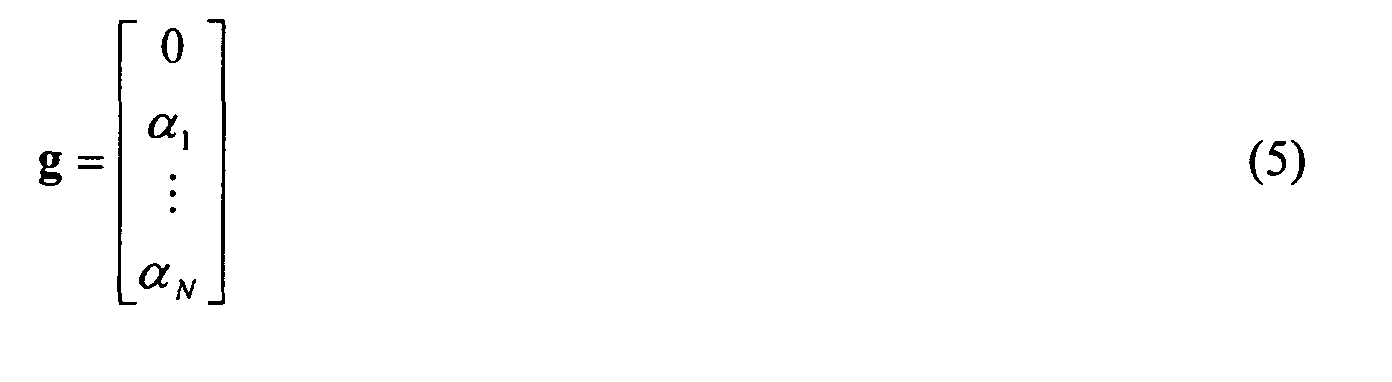

- The benefit derived from the three dimensional array of Figure 4, is evident in Figure 6 (showing a null sector at 70 degrees for ka = 0.92), and Figure 7 (showing the array gain in the 1.6 x 3.2 m domain for the beampattern of Figure 6). As expected, the sharpness of the null is increased with frequency (increase in ka). This is evident by comparing Figures 6 and 8 and Figures 7 and 9, where Figure 8 shows a null sector at 70 degrees for ka=2.77, and Figure 9 shows the array gain in the 1.6 x 3.2 m domain for the beampattern of Figure 8.
- The beamsteerer of the present invention can be sensitive to microphone phases and amplitudes errors, and therefore requires calibration, at least in amplitude in a range of about 1 dB. Microphones used in the preferred embodiment can have phase deviation from +/- 1.5 degrees at about 400 Hz up to +/- 4 degrees at 1600 Hz.
- This sensitivity is more important in the case of unique null design than in the case of dipoles. Several ways of overcoming this sensitivity are:
- Using a delay and sum beamformer, R nn =I . Including the constraints discussed above, the null can be maintained even if its amplitude is less important. It should be noted that the phase and amplitude errors induce an angular error for the source locator. This angle is consistent from one sector to another, making it possible to perform calibration of the source locator with its error.
- Increasing the size of the array to avoid redundant information at the microphone. An array of about 20 cm diameter is sufficient at 400 Hz.
- Reducing the number of microphones to a minimum.
- The regularization technique for the minimization problem affects the steering angle and must therefore be part of the beampattern design.
- Detecting the source at a position (,) requires the computation of the steering index (SI) for each optimal weight W i :
- The steering index has a very distinct maximum as the beam is steered at the source. In the preferred embodiment, the steering index is used as an input signal to point the beamsteerer to a video. The array is ideally also coupled to a voice activity detector, which can detect a source using only one microphone or in conjunction with the microphone array steering a beam (rather than a null) to detect a valid signal, as is known in the art.
- As explained in Section III, above, the beamsteerer of the present invention is quite robust to phase and amplitude errors. Figure 10 is a plot of log10(SI) for two sources at 35 degrees (Figure 10A) and 90 degrees (Figure 10B) at 1 meter from the center of the array, where the microphones are assumed to be perfect (ka=1.85). The resulting SI performance shows no errors.
- Figure 11 is the same plot of SI performance as Figure 10, but with microphone induced amplitude errors of +/- 1dB and phase errors of +/- 4 degrees. It will be noted that there is some loss of selectivity and a consistent two-degree shift up for both sectors, when compared to Figure 10. Nonetheless, by limiting the errors a very usable implementation is possible.
- Figure 12 illustrates the output from the SI detector for a source at 65 degrees and 1 meter from the center of the array. The detection still works in spite of microphone errors of about 8 degrees in phase and +/- 1 dB in amplitude. The SI is calculated and plotted at every possible location (in this case every 5 degrees). In the first instance (Figure 12A) the ideal beam shape is used and the detection is very sharp. In the second case (Figure 12B) errors are introduced yet the detection remains reasonably clear. The effect of the two-degree shift is evident, as the peak is not symmetric about 65 degrees. Even without correction for this effect a very sharp transition is seen.
- Variations and alternative embodiments will be understood by a person of skill in the art. Indeed, there may be significant variations for applications of the invention to different sensor systems (e.g. RF, Sonar, etc.) All such embodiments and variations are believed to be within the sphere and scope of the present invention as defined by the claims appended hereto.
Claims (7)
- A beamsteerer for broadband energy source location, comprising:an array of sensors, each of said sensors generating a signal vector d within one of N sectors in a domain of interest; anda beamformer for receiving and multiplying each said signal vector d by a set of N optimal weight vectors W i in said domain of interest to generate a plurality of beampatterns in said N sectors, each of said beampatterns being characterized by a null having high angular resolution, and detecting said source at a position (,) by selecting a maximum steering index (SI) where
- The beamsteerer of claim 1, wherein sensors are arranged in two-dimensions on a reflecting plane.
- The beamsteerer of claim 1, wherein said sensors are arranged in three-dimensions in free field.
- The beamsteerer of claim 1, wherein said sensors are arranged in three-dimensions on an obstacle.
- The beamsteerer of any of claims 1 to 4, wherein each of said sensors is a microphone.
- The beamsteerer of any of claims 1 to 4, further comprising a voice activity detector connected to said beamformer for detecting voice activity to thereby distinguish human voice from noise.
- Use of the beamsteerer of any of claims 1 to 4, wherein detection of said source is used to steer one of either a video camera or a directional microphone or microphone array.
Applications Claiming Priority (2)
| Application Number | Priority Date | Filing Date | Title |
|---|---|---|---|
| GBGB0405455.7A GB0405455D0 (en) | 2004-03-11 | 2004-03-11 | High precision beamsteerer based on fixed beamforming approach beampatterns |
| GB0405455 | 2004-03-11 |
Publications (2)
| Publication Number | Publication Date |
|---|---|
| EP1575331A2 true EP1575331A2 (en) | 2005-09-14 |
| EP1575331A3 EP1575331A3 (en) | 2007-01-24 |
Family
ID=32117449
Family Applications (1)
| Application Number | Title | Priority Date | Filing Date |
|---|---|---|---|
| EP05251419A Ceased EP1575331A3 (en) | 2004-03-11 | 2005-03-09 | Beamsteerer |
Country Status (4)
| Country | Link |
|---|---|
| US (1) | US7792313B2 (en) |
| EP (1) | EP1575331A3 (en) |
| CA (1) | CA2498444C (en) |
| GB (1) | GB0405455D0 (en) |
Cited By (1)
| Publication number | Priority date | Publication date | Assignee | Title |
|---|---|---|---|---|
| CN108344967A (en) * | 2018-01-20 | 2018-07-31 | 中国人民解放军战略支援部队信息工程大学 | 2-d direction finding method for quick estimating based on relatively prime face battle array |
Families Citing this family (15)
| Publication number | Priority date | Publication date | Assignee | Title |
|---|---|---|---|---|
| US9030153B2 (en) * | 2008-12-22 | 2015-05-12 | General Electric Company | Systems and methods for delivering energy to an electric vehicle with parking fee collection |
| KR101782050B1 (en) * | 2010-09-17 | 2017-09-28 | 삼성전자주식회사 | Apparatus and method for enhancing audio quality using non-uniform configuration of microphones |
| EP2448289A1 (en) * | 2010-10-28 | 2012-05-02 | Fraunhofer-Gesellschaft zur Förderung der angewandten Forschung e.V. | Apparatus and method for deriving a directional information and computer program product |
| US9973848B2 (en) * | 2011-06-21 | 2018-05-15 | Amazon Technologies, Inc. | Signal-enhancing beamforming in an augmented reality environment |
| CN103325384A (en) | 2012-03-23 | 2013-09-25 | 杜比实验室特许公司 | Harmonicity estimation, audio classification, pitch definition and noise estimation |
| EP2828855B1 (en) | 2012-03-23 | 2016-04-27 | Dolby Laboratories Licensing Corporation | Determining a harmonicity measure for voice processing |
| US9313453B2 (en) * | 2012-08-20 | 2016-04-12 | Mitel Networks Corporation | Localization algorithm for conferencing |
| EP2884491A1 (en) * | 2013-12-11 | 2015-06-17 | Fraunhofer-Gesellschaft zur Förderung der angewandten Forschung e.V. | Extraction of reverberant sound using microphone arrays |
| US10255927B2 (en) | 2015-03-19 | 2019-04-09 | Microsoft Technology Licensing, Llc | Use case dependent audio processing |
| US10349169B2 (en) * | 2017-10-31 | 2019-07-09 | Bose Corporation | Asymmetric microphone array for speaker system |
| US10433086B1 (en) | 2018-06-25 | 2019-10-01 | Biamp Systems, LLC | Microphone array with automated adaptive beam tracking |
| US10210882B1 (en) | 2018-06-25 | 2019-02-19 | Biamp Systems, LLC | Microphone array with automated adaptive beam tracking |
| US10694285B2 (en) * | 2018-06-25 | 2020-06-23 | Biamp Systems, LLC | Microphone array with automated adaptive beam tracking |
| CN112946564B (en) * | 2021-04-12 | 2024-02-02 | 西北大学 | DOA estimation method, device and computer storage medium of beam space based on DNN |
| CN116528112A (en) * | 2023-04-04 | 2023-08-01 | 中科上声(苏州)电子有限公司 | Zero position-based constant beam width forming method, pickup device and sound equipment |
Family Cites Families (19)
| Publication number | Priority date | Publication date | Assignee | Title |
|---|---|---|---|---|
| JPS56150370A (en) * | 1980-04-23 | 1981-11-20 | Hitachi Ltd | Measuring circuit for incoming direction of acoustic signal |
| US4802227A (en) * | 1987-04-03 | 1989-01-31 | American Telephone And Telegraph Company | Noise reduction processing arrangement for microphone arrays |
| WO1994026075A1 (en) * | 1993-05-03 | 1994-11-10 | The University Of British Columbia | Tracking platform system |
| US5581620A (en) * | 1994-04-21 | 1996-12-03 | Brown University Research Foundation | Methods and apparatus for adaptive beamforming |
| US5508734A (en) * | 1994-07-27 | 1996-04-16 | International Business Machines Corporation | Method and apparatus for hemispheric imaging which emphasizes peripheral content |
| US5737431A (en) * | 1995-03-07 | 1998-04-07 | Brown University Research Foundation | Methods and apparatus for source location estimation from microphone-array time-delay estimates |
| US5625697A (en) * | 1995-05-08 | 1997-04-29 | Lucent Technologies Inc. | Microphone selection process for use in a multiple microphone voice actuated switching system |
| US5742693A (en) * | 1995-12-29 | 1998-04-21 | Lucent Technologies Inc. | Image-derived second-order directional microphones with finite baffle |
| US5778082A (en) * | 1996-06-14 | 1998-07-07 | Picturetel Corporation | Method and apparatus for localization of an acoustic source |
| US5825898A (en) * | 1996-06-27 | 1998-10-20 | Lamar Signal Processing Ltd. | System and method for adaptive interference cancelling |
| DE59801138D1 (en) * | 1997-04-10 | 2001-09-06 | Interkom Electronic Kock & Mre | SOUND RECORDING DEVICE, IN PARTICULAR FOR AN INTERCOM |
| US6178248B1 (en) * | 1997-04-14 | 2001-01-23 | Andrea Electronics Corporation | Dual-processing interference cancelling system and method |
| US6469732B1 (en) * | 1998-11-06 | 2002-10-22 | Vtel Corporation | Acoustic source location using a microphone array |
| US6594367B1 (en) * | 1999-10-25 | 2003-07-15 | Andrea Electronics Corporation | Super directional beamforming design and implementation |
| US6473362B1 (en) * | 2001-04-30 | 2002-10-29 | Information System Laboratories, Inc. | Narrowband beamformer using nonlinear oscillators |
| US6584203B2 (en) * | 2001-07-18 | 2003-06-24 | Agere Systems Inc. | Second-order adaptive differential microphone array |
| GB0120450D0 (en) * | 2001-08-22 | 2001-10-17 | Mitel Knowledge Corp | Robust talker localization in reverberant environment |
| US6980485B2 (en) * | 2001-10-25 | 2005-12-27 | Polycom, Inc. | Automatic camera tracking using beamforming |
| US7394907B2 (en) * | 2003-06-16 | 2008-07-01 | Microsoft Corporation | System and process for sound source localization using microphone array beamsteering |
-
2004
- 2004-03-11 GB GBGB0405455.7A patent/GB0405455D0/en not_active Ceased
-
2005
- 2005-02-25 CA CA002498444A patent/CA2498444C/en not_active Expired - Lifetime
- 2005-03-09 EP EP05251419A patent/EP1575331A3/en not_active Ceased
- 2005-03-10 US US11/075,811 patent/US7792313B2/en active Active
Non-Patent Citations (1)
| Title |
|---|
| None |
Cited By (2)
| Publication number | Priority date | Publication date | Assignee | Title |
|---|---|---|---|---|
| CN108344967A (en) * | 2018-01-20 | 2018-07-31 | 中国人民解放军战略支援部队信息工程大学 | 2-d direction finding method for quick estimating based on relatively prime face battle array |
| CN108344967B (en) * | 2018-01-20 | 2020-05-26 | 中国人民解放军战略支援部队信息工程大学 | Fast estimation method of two-dimensional direction of arrival based on coprime array |
Also Published As
| Publication number | Publication date |
|---|---|
| CA2498444C (en) | 2009-12-15 |
| GB0405455D0 (en) | 2004-04-21 |
| CA2498444A1 (en) | 2005-09-11 |
| EP1575331A3 (en) | 2007-01-24 |
| US20050201204A1 (en) | 2005-09-15 |
| US7792313B2 (en) | 2010-09-07 |
Similar Documents
| Publication | Publication Date | Title |
|---|---|---|
| CA2498444C (en) | High precision beamsteerer based on fixed beamforming approach beampatterns | |
| US12342127B2 (en) | Microphone array system | |
| Brandstein et al. | A practical methodology for speech source localization with microphone arrays | |
| Plinge et al. | Acoustic microphone geometry calibration: An overview and experimental evaluation of state-of-the-art algorithms | |
| US6243471B1 (en) | Methods and apparatus for source location estimation from microphone-array time-delay estimates | |
| US20200021910A1 (en) | Conference System with a Microphone Array System and a Method of Speech Acquisition in a Conference System | |
| US20050008169A1 (en) | Arrangement and method for audio source tracking | |
| US20080267422A1 (en) | Microphone Array and Digital Signal Processing System | |
| Yang | Superdirective beamforming applied to SWellEx96 horizontal arrays data for source localization | |
| US8824699B2 (en) | Method of, and apparatus for, planar audio tracking | |
| US6894642B2 (en) | Doubly constrained robust capon beamformer | |
| US8369550B2 (en) | Artificial ear and method for detecting the direction of a sound source using the same | |
| US5596550A (en) | Low cost shading for wide sonar beams | |
| US11895478B2 (en) | Sound capture device with improved microphone array | |
| Yadav et al. | Study of MVDR beamformer for a single acoustic vector sensor | |
| EP1526755A2 (en) | Detecting acoustic echoes using microphone arrays | |
| Hughes | Aspects of cardioid processing | |
| CN111024208A (en) | Vertical array sound pressure gradient beam forming and signal detecting method | |
| Mabande et al. | On 2D localization of reflectors using robust beamforming techniques | |
| Cox | Super-directivity revisited | |
| JP7447513B2 (en) | Sonar device and target direction calculation method and program | |
| US7400736B2 (en) | Method for extending the frequency range of a beamformer without spatial aliasing | |
| JP2006162461A (en) | Sound source position detection apparatus and method | |
| Dey et al. | Microphone array principles | |
| Alghassi et al. | The audio surveillance eye |
Legal Events
| Date | Code | Title | Description |
|---|---|---|---|
| PUAI | Public reference made under article 153(3) epc to a published international application that has entered the european phase |
Free format text: ORIGINAL CODE: 0009012 |
|
| AK | Designated contracting states |
Kind code of ref document: A2 Designated state(s): AT BE BG CH CY CZ DE DK EE ES FI FR GB GR HU IE IS IT LI LT LU MC NL PL PT RO SE SI SK TR |
|
| AX | Request for extension of the european patent |
Extension state: AL BA HR LV MK YU |
|
| PUAL | Search report despatched |
Free format text: ORIGINAL CODE: 0009013 |
|
| AK | Designated contracting states |
Kind code of ref document: A3 Designated state(s): AT BE BG CH CY CZ DE DK EE ES FI FR GB GR HU IE IS IT LI LT LU MC NL PL PT RO SE SI SK TR |
|
| AX | Request for extension of the european patent |
Extension state: AL BA HR LV MK YU |
|
| RIC1 | Information provided on ipc code assigned before grant |
Ipc: G01S 3/80 20060101ALI20061220BHEP Ipc: G10K 11/34 20060101ALI20061220BHEP Ipc: H04R 3/00 20060101AFI20050621BHEP |
|
| 17P | Request for examination filed |
Effective date: 20070621 |
|
| AKX | Designation fees paid |
Designated state(s): DE FR GB |
|
| 17Q | First examination report despatched |
Effective date: 20071017 |
|
| STAA | Information on the status of an ep patent application or granted ep patent |
Free format text: STATUS: THE APPLICATION HAS BEEN REFUSED |
|
| 18R | Application refused |
Effective date: 20101226 |