EP1574531A1 - Method of determining trace metal - Google Patents
Method of determining trace metal Download PDFInfo
- Publication number
- EP1574531A1 EP1574531A1 EP02808256A EP02808256A EP1574531A1 EP 1574531 A1 EP1574531 A1 EP 1574531A1 EP 02808256 A EP02808256 A EP 02808256A EP 02808256 A EP02808256 A EP 02808256A EP 1574531 A1 EP1574531 A1 EP 1574531A1
- Authority
- EP
- European Patent Office
- Prior art keywords
- group
- porphyrin
- polymerizable monomer
- radically polymerizable
- metal
- Prior art date
- Legal status (The legal status is an assumption and is not a legal conclusion. Google has not performed a legal analysis and makes no representation as to the accuracy of the status listed.)
- Withdrawn
Links
Images











Classifications
-
- C—CHEMISTRY; METALLURGY
- C08—ORGANIC MACROMOLECULAR COMPOUNDS; THEIR PREPARATION OR CHEMICAL WORKING-UP; COMPOSITIONS BASED THEREON
- C08F—MACROMOLECULAR COMPOUNDS OBTAINED BY REACTIONS ONLY INVOLVING CARBON-TO-CARBON UNSATURATED BONDS
- C08F226/00—Copolymers of compounds having one or more unsaturated aliphatic radicals, each having only one carbon-to-carbon double bond, and at least one being terminated by a single or double bond to nitrogen or by a heterocyclic ring containing nitrogen
- C08F226/06—Copolymers of compounds having one or more unsaturated aliphatic radicals, each having only one carbon-to-carbon double bond, and at least one being terminated by a single or double bond to nitrogen or by a heterocyclic ring containing nitrogen by a heterocyclic ring containing nitrogen
-
- C—CHEMISTRY; METALLURGY
- C08—ORGANIC MACROMOLECULAR COMPOUNDS; THEIR PREPARATION OR CHEMICAL WORKING-UP; COMPOSITIONS BASED THEREON
- C08F—MACROMOLECULAR COMPOUNDS OBTAINED BY REACTIONS ONLY INVOLVING CARBON-TO-CARBON UNSATURATED BONDS
- C08F246/00—Copolymers in which the nature of only the monomers in minority is defined
-
- G—PHYSICS
- G01—MEASURING; TESTING
- G01N—INVESTIGATING OR ANALYSING MATERIALS BY DETERMINING THEIR CHEMICAL OR PHYSICAL PROPERTIES
- G01N31/00—Investigating or analysing non-biological materials by the use of the chemical methods specified in the subgroup; Apparatus specially adapted for such methods
- G01N31/22—Investigating or analysing non-biological materials by the use of the chemical methods specified in the subgroup; Apparatus specially adapted for such methods using chemical indicators
Definitions
- the present invention relates to a method for measuring the concentration of a trace metal contained in a sample by measuring a change in absorbance caused by the complex forming reaction between a specific porphyrin-nucleus introduced polymer and a metal ion. More specifically, the invention pertains to a method capable of conveniently measuring the concentrations of many heavy metals simultaneously.
- Heavy metals are classified as "industrial wastes requiring specific management" and they have their respective environmental quality standards. There is a demand for easy measurement of the concentration of each of various heavy metals existing in rivers, lakes, marshes, sewage or factory effluent. It is the common practice to employ atomic absorption spectrometry or inductively-coupled plasma emission spectrometry (ICP) for quantitatively determining heavy metals. These methods, however, are not usable for general purposes, because they involve problems such as high cost and necessity of pipe arrangement or exhaust system. On the other hand, the absorptiometry is not cost-effective and permits measurement through a relatively simple apparatus, but it is susceptible to many substances which exist in a sample but are not measuring objects so that pretreatment for removal of them is necessary.
- ICP inductively-coupled plasma emission spectrometry
- Porphyrin compounds are colorimetric reagents used in absorption spectroscopy. To their porphyrin ring, several metals are bonded to form complexes. These metals are affected by, as well as an external factors such as pH, a substituent or functional group in the molecule of the porphyrin compounds.
- porphyrin compounds involve problems such as poor solubility in water.
- problems such as poor solubility in water.
- attempts have been made to substitute the reaction center, functional group in the vicinity thereof or side chain, bringing about great effects.
- synthesis of water soluble porphyrins having various side chains has been reported (J. Amer. Chem. Soc., 94(1972)4511; J. Amer. Chem. Soc., 93(1971)3162; Inorg. Chem., 9(1970)1757; J. Amer. Chem. Soc., 91(1969)607; J. Heterocycl. Chem., 6(1969)927).
- An object of the present invention is therefore to provide a technique capable of imparting desired properties or reactivity to easily available porphyrin compounds without substitution, and to provide a highly sensitive method for measuring heavy metals by use of the technique.
- the present inventors have found that by performing radical copolymerization of a specific porphyrin compound having a vinyl monomer and a radically polymerizable monomer, thereby introducing the porphyrin nucleus into the principal chain of the polymer having various side chains.
- various porphyrin-nucleus introduced polymers different in the stereostructure are available without using a porphyrin derivative having various substituents and functional groups in the periphery of the porphyrin nucleus, and thus water-solubility and reactivity in the complex formation with a metal of the resultant porphyrin-nucleus introduced polymer can be changed.
- They have also found that highly sensitive measurement of a target metal can be attained easily by the use of the above-described polymer as a measuring reagent. As a result, they have completed the present invention.
- a trace metal measuring method by measuring a change in absorbance caused by complex forming reaction between a porphyrin-nucleus introduced polymer, which has been obtained by radical copolymerization of a vinyl-containing porphyrin compound and a radically polymerizable monomer, and a heavy metal ion, said radically polymerizable monomer being selected so as to heighten reaction selectivity of the porphyrin-nucleus introduced polymer to the target metal.
- protoporphyrin IX (hereinafter be abbreviated as "PPfacid") of the formula (1) wherein R represents H, protoporphyrin IX dimethyl ester of the formula (1) wherein R represents a methyl group (hereinafter be abbreviated as "PPDE”), and 5,10,15,20-tetrakis[4-(allyloxy)phenyl]-21H,23H-porphyrin of the formula (2) (hereinafter be abbreviated as "TAPP").
- PPfacid protoporphyrin IX
- R represents H
- TAPP 5,10,15,20-tetrakis[4-(allyloxy)phenyl]-21H,23H-porphyrin of the formula (2)
- TAPP 5,10,15,20-tetrakis[4-(allyloxy)phenyl]-21H,23H-por
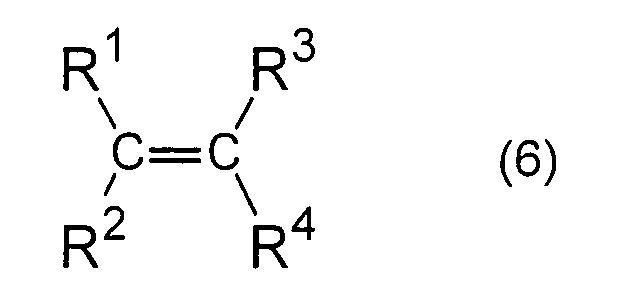
- R 1 , R 2 , R 3 and R 4 each independently represents a hydrogen atom, a C 1-5 alkyl group, -(CH 2 ) n COOR 5 , -(CH 2 ) n OCOR 5 , - (CH 2 ) n N (R 5 ) (R 6 ), - (CH 2 ) n CON (R 5 ) (R 6 ), - (CH 2 ) n A
- R 5 and R 6 each represents a hydrogen atom, a C 1-5 alkyl group, a carboxymethyl group, or a phenyl or phenylalkyl group which may have a substituent
- A represents a halogen atom, a hydroxy group, a formyl group, a cyano group or a carbonyl halide group
- n stands for an integer
- the above-described compound having one polymerizable carbon-carbon double bond and a compound having at least two polymerizable carbon-carbon double bonds and serving as a crosslinking agent in combination polymers having various performances such as a polymer gel which has grown three-dimensionally are available.
- a radically polymerizable monomer having at least two polymerizable carbon-carbon double bonds compounds represented by the following formula (7): wherein R 1 , R 2 and R 3 have the same meanings as described above, Y is a single bond, -(CH 2 ) n COO-, -(CH 2 ) n OCO-, -(CH 2 ) n NR 5 , -(CH 2 ) n CONR 5 -, -(CH 2 ) n O-, or -(CH 2 ) n CO- (in which R 5 and n have the same meaning as described above), X is -(CH 2 ) n -, -(CH 2 ) n S-S(CH 2 ) n -, [-(CH 2 ) n -] 3 CR 5 , [-(CH 2 ) n -] 4 C, - ⁇ -, or - ⁇ (in which R 5 and n have the same meaning as described above, ⁇
- crosslinking agent examples include the following compounds.
- a weight ratio of the porphyrin compound to the radically polymerizable monomer in the present invention preferably ranges from 1:100 to 1:10,000, with 1:200 to 1:1,000 being more preferred.
- the molecular weight of the porphyrin-nucleus introduced polymer obtained by radical copolymerization of a porphyrin compound and a radically polymerizable monomer is not particular limitation imposed on the molecular weight of the porphyrin-nucleus introduced polymer obtained by radical copolymerization of a porphyrin compound and a radically polymerizable monomer. If it is used as a measuring reagent, the resulting polymer preferably has a weight average molecular weight, as measured by the light scattering method, ranging from 50,000 to 5,000,000, with 100,000 to 1,000,000 being more preferred.
- the radical copolymerization of the porphyrin compound and radically polymerizable monomer is effected in an organic solvent in the presence of a polymerization initiator.
- organic solvent include dimethylsulfoxide (DMSO), tetrahydrofuran (THF), benzene, chloroform and dimethylformamide (DMF).
- DMSO dimethylsulfoxide
- THF tetrahydrofuran
- benzene chloroform and dimethylformamide
- DMSO dimethylsulfoxide
- THF tetrahydrofuran
- THF chloroform and dimethylformamide
- TAPP dimethylformamide
- AIBN 2,2'-azobis(4-methoxy-2,4-dimethylvalelonitrile
- the reaction is preferably carried out for 5 to 30 hours, more preferably 15 to 25 hours at 30 to 80°C, more preferably 55 to 65°C. After completion of the reaction, the reaction mixture may be dialyzed for isolation and washing.
- the porphyrin-nucleus introduced polymers of the present invention differ in reactivity with a metal, depending on the kind of the radically polymerizable monomer added upon radical copolymerization.
- the porphyrin-nucleus introduced polymers of the invention are used as a trace metal measuring reagent, highly sensitive and convenient measurement can be attained by using a polymer having high selectivity to a metal to be measured and measuring a change in absorbance caused by complex formation with a heavy metal ion.
- Use in combination of two or more polymers different in reaction selectivity to metals enables simultaneous measurement of plural metals.
- the mixture grows three dimensionally into a polymer (gel) in various forms such as sheet, film, tube, beads and paste, making it possible to adapt it to a variety of measuring conditions.
- a trace metal in a sample can be measured, for example, by adding a porphyrin-nucleus introduced polymer to a buffer solution, measuring absorbance of the resulting mixture by a spectrophotometer, adding the sample containing the trace metal, measuring absorbance again after a lapse of a predetermined time and deriving a metal concentration from the difference in absorbance based on the regression equation or calibration curve built by multiple regression analysis using the value of a standard sample.
- porphyrin-nucleus introduced polymers of the invention are used as a trace metal measuring reagent
- the heavy metal ion to be measured include Ca 2+ , Cd 2+ , Co 2+ , Cr 3+ , Cu 2+ , Fe 3+ , Fe 2+ , Mg 2+ , Mn 2+ , Ni 2+ , Zn 2+ and Pb 2+ .
- This reagent is applicable to measurement of any samples taken from rivers, lakes, marshes, sewage, factory effluent, leachate from waste incinerators and the like which need control by environmental quality standards.
- porphyrin compound PPfacid, PPDE and TAPP were employed, while as the radically polymerizable monomer, the below-described 13 compounds were employed among the above-exemplified ones (the abbreviation in parentheses will hereinafter be used).
- a vessel 10 ml of a 0.6 mM porphyrin solution, an adequate amount of a radically polymerizable monomer and 0.4 ml of 500 mM AIBN were charged, followed by the addition of an organic solvent to give the total amount of 20 ml.
- the radically polymerizable monomer was added so that the concentration after filling would become 1M.
- DMSO was used for the synthesis of a PPfacid- or PPDE-introduced polymer, while THF was used for the synthesis of a TAPP-introduced polymer.
- the vessel having the reaction mixture therein was immersed in cold water filled in an ultrasonic cleaner, followed by degassing for 30 minutes. Rightly after bubbling by a nitrogen gas for 2 minutes, the vessel was hermetically sealed. It was placed in an incubator of 60°C and polymerization was initiated. After 21 hours, the polymer solution was encapsulated in a dialysis membrane (molecular cutoff: 12000 to 14000) for isolation and washing of the polymer and dialyzed against miliQ water in a room at low temperature (4°C). The polymer insoluble in water precipitated or produced turbidity so that it was dissolved in methanol. In the end, the insoluble matter was removed by filtration through a 0.2 ⁇ m filter, whereby solutions of various porphyrin-nucleus introduced polymers were prepared.
- a dialysis membrane molecular cutoff: 12000 to 14000
- Table 1 shows the results of infrared spectroscopic analysis, melting-point measurement and molecular-weight measurement (weight-average molecular weight as measured by light scattering method) of each of the porphyrin-nucleus introduced polymers thus prepared. Polymer Average Mw IR Absorp.
- the porphyrin introduced polymer solution and a diluent were added to give the total amount of 1 ml.
- a buffer solution 100 mM 2-(N-morpholino)ethanesulfonic acid (MES) of pH 5.5 and 100 mM 3-cyclohexylamino-1-propanesulfonic acid (CAPS) of pH 11 were employed, respectively.
- MES 2-(N-morpholino)ethanesulfonic acid
- CAS 3-cyclohexylamino-1-propanesulfonic acid
- diluent miliQ water was used for a water soluble polymer, while methanol was used for another polymer. A ratio of the diluent to the polymer solution was adjusted so that the maximum absorbance would become about 1.
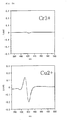
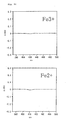
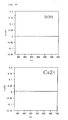
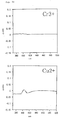
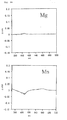
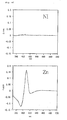
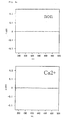
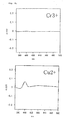
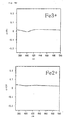
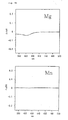
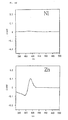
- FIG. 1 a-g show a difference in the absorbance of a TAPP - methacrylic acid copolymer (TAPP-MAcid) at pH 5.5; and FIG. 2 a-g show a difference in the absorbance of TAPP-MAcid at pH 11.
- Metals causing a large absorbance difference were Cu 2+ and Zn 2+ at pH 5.5, and Cu 2+ , Zn 2+ , Cd 2+ , and Co 2+ at pH 11.
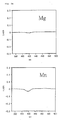
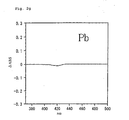
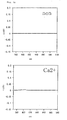
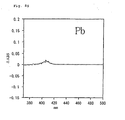
- FIG. 3 a-g show a difference in the absorbance of a PPDE - acrylamide copolymer (PPDE-AAm) at pH 11.
- PPDE-AAm PPDE - acrylamide copolymer
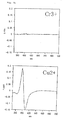
- FIG. 4 a-g show a difference in the absorbance of a PPDE - methacrylic acid copolymer (PPDE-MAcid) at pH 11. As well as a large absorbance difference caused by Zn 2+ and Cu 2+ , an absorbance difference by Co 2+ and Mn 2+ which did not occur in PPDE-AAm were observed.
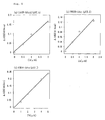
- the polymers exhibited linear reactivity with any metal.
- the leachate from an ash depository of a waste incinerator was used as a sample and its absorbance was measured using the above-described polymers.
- a metal concentration was calculated by multiple regression analysis.
- the analytical results are shown in Table 5, together with the results measured by an atomic absorption spectrophotometer. The analytical results coincided with the results of atomic absorbance spectrophotometry.
- PPfacid and PPDE used as a porphyrin compound were PPfacid and PPDE; as a radically polymerizable monomer, four monomers, that is, acrylamide (AAm), methacrylic acid (MAcid), acrylic acid (AAcid) and N,N-dimethylacrylamide (DMAAm); and as a crosslinking agent, N,N'-methylenebisacrylamide (MBAA).
- AAm acrylamide
- MAcid methacrylic acid
- DMAAm N,N-dimethylacrylamide
- MBAA N,N'-methylenebisacrylamide
- a vessel were charged 5 ml of a 0.6 mM porphyrin solution, an adequate amount of a radically polymerizable monomer, 2 ml of 200 mM N,N'-methylenebisacrylamide and 0.2 ml of 500 mM AIBN, followed by the addition of DMSO to give the total amount of 10 ml.
- the radically polymerizable monomer was added so that the concentration after filling would be 1.5 M.
- the vessel having the polymer solution therein was immersed in cold water filled in an ultrasonic cleaner, followed by degassing for 30 minutes. Bubbling by a nitrogen gas was then conducted for 2 minutes.
- the polymer solution was poured in a space of 1 mm between glass plates.
- the resulting plates were placed in an incubator of 60 °C, whereby polymerization was initiated.
- the gel sheet of 1 mm thick was removed from the glass plates and cut into a piece of 5 mm square.
- the resulting gel was washed well with pure water. In this manner, various porphyrin-nucleus introduced gels were prepared.
- MES 2-(N-morpholino)ethanesulfonic acid
- CAS 3-cyclohexylamino-1-propanesulfonic acid
- a radically polymerizable monomer which is a raw material of porphyrine-introduced polymer as a reagent, water-solubility of the reagent and reactivity with a metal in complex formation can be changed, and species of the target metal can be measured highly sensitively and easily.
Landscapes
- Chemical & Material Sciences (AREA)
- Health & Medical Sciences (AREA)
- Life Sciences & Earth Sciences (AREA)
- Chemical Kinetics & Catalysis (AREA)
- Organic Chemistry (AREA)
- Polymers & Plastics (AREA)
- Medicinal Chemistry (AREA)
- Physics & Mathematics (AREA)
- General Health & Medical Sciences (AREA)
- General Physics & Mathematics (AREA)
- Immunology (AREA)
- Pathology (AREA)
- Biochemistry (AREA)
- Analytical Chemistry (AREA)
- Molecular Biology (AREA)
- Biophysics (AREA)
- Addition Polymer Or Copolymer, Post-Treatments, Or Chemical Modifications (AREA)
- Investigating Or Analysing Materials By Optical Means (AREA)
Abstract
Provided are a method, upon radical copolymerization of a
vinyl-containing porphyrin compound and a radically
polymerizable monomer, thereby obtaining a porphyrin-nucleus
introduced polymer, of controlling reactivity of the porphyrin-nucleus
introduced polymer with a metal by selecting the
radically polymerizable monomer; and a method for measuring a
trace metal by measuring a change in absorbance caused by
complex forming reaction between a porphyrin-nucleus introduced
polymer, which has been obtained by radical copolymerization of
a vinyl-containing porphyrin compound and a radically
polymerizable monomer, and a heavy metal ion, said radically
polymerizable monomer being selected so as to heighten reaction
selectivity of the porphyrin-nucleus introduced polymer to a
metal to be measured.
The present invention, by selecting the radically
polymerizable monomer as a raw material for the porphyrin-neucleus
introduced polymer as a measuring reagent, makes it
possible to change the water-solubility or the reactivity of
the measuring reagent with the metal in complex formation so
that the target metal can be measured highly sensitively and
easily.
Description
The present invention relates to a method for measuring the
concentration of a trace metal contained in a sample by measuring
a change in absorbance caused by the complex forming reaction
between a specific porphyrin-nucleus introduced polymer and a
metal ion. More specifically, the invention pertains to a method
capable of conveniently measuring the concentrations of many heavy
metals simultaneously.
Heavy metals are classified as "industrial wastes requiring
specific management" and they have their respective environmental
quality standards. There is a demand for easy measurement of the
concentration of each of various heavy metals existing in rivers,
lakes, marshes, sewage or factory effluent. It is the common
practice to employ atomic absorption spectrometry or inductively-coupled
plasma emission spectrometry (ICP) for quantitatively
determining heavy metals. These methods, however, are not usable
for general purposes, because they involve problems such as high
cost and necessity of pipe arrangement or exhaust system. On the
other hand, the absorptiometry is not cost-effective and permits
measurement through a relatively simple apparatus, but it is
susceptible to many substances which exist in a sample but are not
measuring objects so that pretreatment for removal of them is
necessary.
Porphyrin compounds are colorimetric reagents used in
absorption spectroscopy. To their porphyrin ring, several metals
are bonded to form complexes. These metals are affected by, as
well as an external factors such as pH, a substituent or
functional group in the molecule of the porphyrin compounds.
As a colorimetric reagent, porphyrin compounds involve
problems such as poor solubility in water. For improving their
properties including water solubility or reactivity with metals,
attempts have been made to substitute the reaction center,
functional group in the vicinity thereof or side chain, bringing
about great effects. In recent years, synthesis of water soluble
porphyrins having various side chains has been reported (J. Amer.
Chem. Soc., 94(1972)4511; J. Amer. Chem. Soc., 93(1971)3162;
Inorg. Chem., 9(1970)1757; J. Amer. Chem. Soc., 91(1969)607; J.
Heterocycl. Chem., 6(1969)927). There is also a report on the
application of these porphyrins to analysis of metals contained at
a trace level (ppb level) by making use of a change in
fluorescence after formation of a complex with various metals
(Analytica Chimica Acta, 74(1975)53-60; Bull. Chem. Soc. Japan,
1978, (5), 686-690; Bull. Chem. Soc. Japan, 1979, (5), 602-606;
BUNSEKI KAGAKU vol. 25(1976)781; JP-A-1995-082285; JP-A-1980-054307).
Under the above-described techniques, however, it is
necessary to substitute the side chain of a porphyrin ring in
order to impart the porphyrin compound with water solubility or to
change reactivity with a metal.
An object of the present invention is therefore to provide a
technique capable of imparting desired properties or reactivity to
easily available porphyrin compounds without substitution, and to
provide a highly sensitive method for measuring heavy metals by
use of the technique.
With the foregoing in view, the present inventors have found
that by performing radical copolymerization of a specific
porphyrin compound having a vinyl monomer and a radically
polymerizable monomer, thereby introducing the porphyrin nucleus
into the principal chain of the polymer having various side
chains. Upon copolymerization, by the selection of the proper
polymer capable of radical polymerization, various porphyrin-nucleus
introduced polymers different in the stereostructure are
available without using a porphyrin derivative having various
substituents and functional groups in the periphery of the
porphyrin nucleus, and thus water-solubility and reactivity in the
complex formation with a metal of the resultant porphyrin-nucleus
introduced polymer can be changed. They have also found that
highly sensitive measurement of a target metal can be attained
easily by the use of the above-described polymer as a measuring
reagent. As a result, they have completed the present invention.
In one aspect of the present invention, there is thus
provided a method of controlling the reactivity of the porphyrin-nucleus
introduced polymer with a metal, upon radical
copolymerization of a vinyl-containing porphyrin compound and a
radically polymerizable monomer, by selecting the radically
polymerizable monomer.
In another aspect of the present invention, there is also
provided a trace metal measuring method by measuring a change in
absorbance caused by complex forming reaction between a porphyrin-nucleus
introduced polymer, which has been obtained by radical
copolymerization of a vinyl-containing porphyrin compound and a
radically polymerizable monomer, and a heavy metal ion, said
radically polymerizable monomer being selected so as to heighten
reaction selectivity of the porphyrin-nucleus introduced polymer
to the target metal.
Although no particular limitation is imposed on the vinyl-containing
porphyrin compound to be used in the present invention,
those represented by the following formulas (1) to (5) can be
employed.
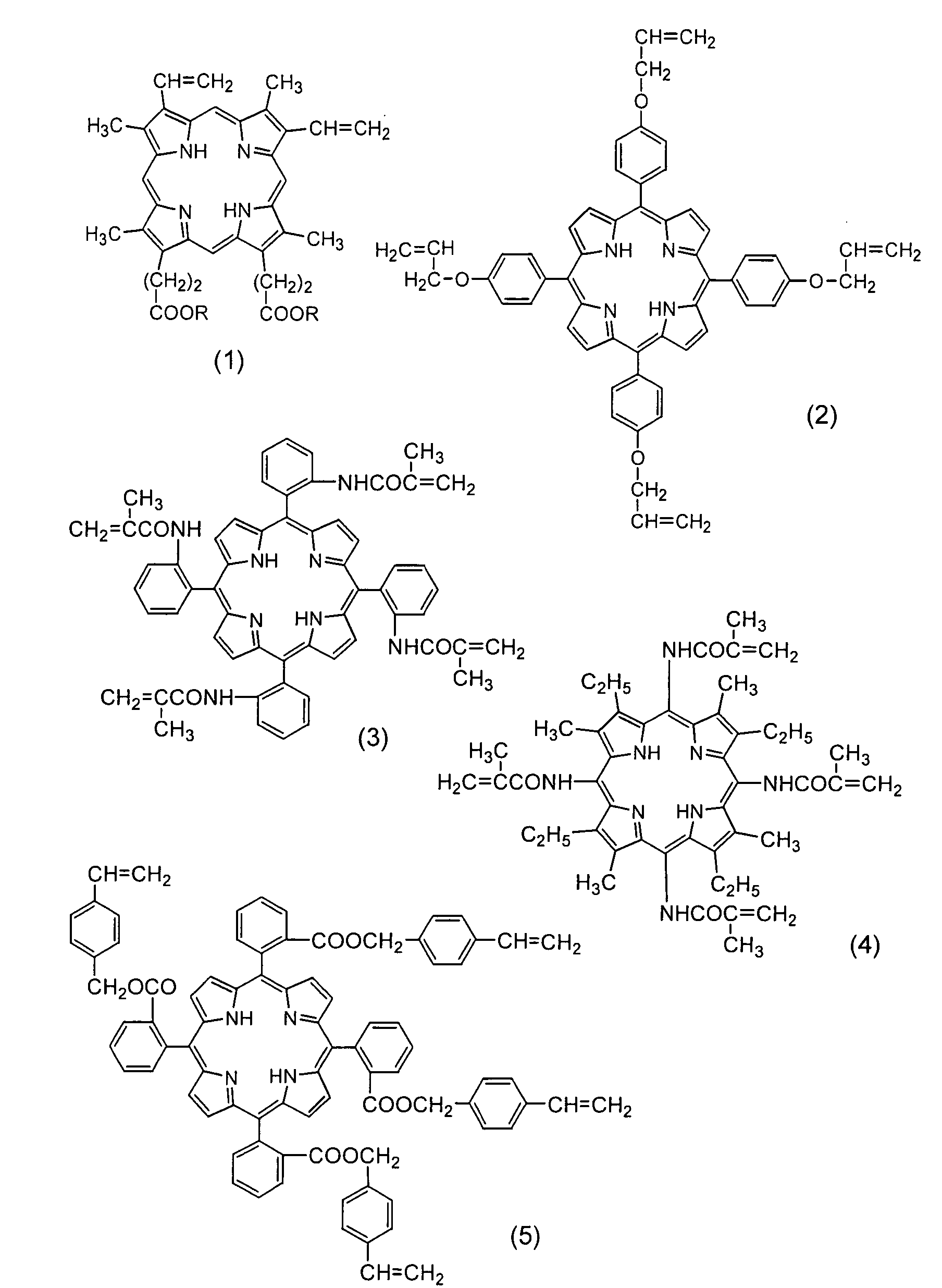 wherein, R represents a hydrogen atom or a C1-6 alkyl group.
Among them, preferred ones include protoporphyrin IX
(hereinafter be abbreviated as "PPfacid") of the formula (1)
wherein R represents H, protoporphyrin IX dimethyl ester of the
formula (1) wherein R represents a methyl group (hereinafter be
abbreviated as "PPDE"), and 5,10,15,20-tetrakis[4-(allyloxy)phenyl]-21H,23H-porphyrin
of the formula (2)
(hereinafter be abbreviated as "TAPP"). These porphyrin compounds
are commercially available or can be synthesized by converting the
functional group of the commercially available product.
Although no particular limitation is imposed on the
radically polymerizable monomer to be used in the present
invention, usable are, for example, the following compound (6):
 wherein R1, R2, R3 and R4 each independently represents a hydrogen
atom, a C1-5 alkyl group, -(CH2)nCOOR5, -(CH2)nOCOR5, -
(CH2)nN (R5) (R6), - (CH2)nCON (R5) (R6), - (CH2)nA (in which R5 and R6 each
represents a hydrogen atom, a C1-5 alkyl group, a carboxymethyl
group, or a phenyl or phenylalkyl group which may have a
substituent, A represents a halogen atom, a hydroxy group, a
formyl group, a cyano group or a carbonyl halide group, and n
stands for an integer of 0 to 6), or an imidazolyl, pyridyl or
phenyl group which may have a substituent.
wherein R1, R2, R3 and R4 each independently represents a hydrogen
atom, a C1-5 alkyl group, -(CH2)nCOOR5, -(CH2)nOCOR5, -
(CH2)nN (R5) (R6), - (CH2)nCON (R5) (R6), - (CH2)nA (in which R5 and R6 each
represents a hydrogen atom, a C1-5 alkyl group, a carboxymethyl
group, or a phenyl or phenylalkyl group which may have a
substituent, A represents a halogen atom, a hydroxy group, a
formyl group, a cyano group or a carbonyl halide group, and n
stands for an integer of 0 to 6), or an imidazolyl, pyridyl or
phenyl group which may have a substituent.
Specific examples include acrylamide, methacrylic acid,
acrylic acid, 5-hexenoic acid, allylamine, 3-butenoic acid, β-methallyl
alcohol, allyl alcohol, N,N-dimethylacrylamide, 1-vinylimidazole,
2-vinylpyridine, 4-vinylpyridine, allyl chloride,
vinyl acetate, maleamide, maleic acid, dimethyl maleate, diethyl
maleate, maleinamic acid, methyl hydrogen maleate, ethyl hydrogen
maleate, fumaramide, fumaric acid, dimethyl fumarate, diethyl
fumarate, ethyl hydrogen famarate, fumaronitrile, fumaryl
chloride, crotonamide, crotonic acid, crotonaldehyde, methyl
crotonate, ethyl crotonate, crotononitrile, crotonoyl bromide,
crotonoyl chloride, crotyl alcohol, crotyl bromide, crotyl
chloride, isocrotonic acid, trans-1,2-dichloroethylene, citraconic
acid, dimethyl citraconate, mesaconic acid, angelic acid, methyl
angelate, tiglic acid, methyl tiglate, ethyl tiglate, tigloyl
chloride, tiglic aldehyde, N-tigloylglycine, cinnamaldehyde,
cinnamamide, cinnamic acid, ethyl cinnamate, methyl cinnamate,
cinnamonitrile, cinnamoyl chloride, cinnamyl bromide, cinnamyl
chloride, 3-methyl-2-butenol, 2-methyl-2-butene, 2-methyl-2-butenenitrile,
3-methyl-2-buten-1-ol, and cis-1,2-dichloroethylene.
By using, as the radically polymerizable monomer, the
above-described compound having one polymerizable carbon-carbon
double bond and a compound having at least two polymerizable
carbon-carbon double bonds and serving as a crosslinking agent in
combination, polymers having various performances such as a
polymer gel which has grown three-dimensionally are available. As
such a radically polymerizable monomer having at least two
polymerizable carbon-carbon double bonds, compounds represented by
the following formula (7):
 wherein R1, R2 and R3 have the same meanings as described above, Y
is a single bond, -(CH2)nCOO-, -(CH2)nOCO-, -(CH2)nNR5,
wherein R1, R2 and R3 have the same meanings as described above, Y
is a single bond, -(CH2)nCOO-, -(CH2)nOCO-, -(CH2)nNR5,
-(CH2)nCONR5-, -(CH2)nO-, or -(CH2)nCO- (in which R5 and n have the same meaning as described above), X is -(CH2)n-,
-(CH2)nS-S(CH2)n-, [-(CH2)n-]3CR5, [-(CH2)n-]4C, -ϕ-, or -ϕ< (in which R5 and n have the same meaning as described above, ϕ is a benzene ring), m stands for an integer of 2 to 4 can be given as examples.
-(CH2)nCONR5-, -(CH2)nO-, or -(CH2)nCO- (in which R5 and n have the same meaning as described above), X is -(CH2)n-,
-(CH2)nS-S(CH2)n-, [-(CH2)n-]3CR5, [-(CH2)n-]4C, -ϕ-, or -ϕ< (in which R5 and n have the same meaning as described above, ϕ is a benzene ring), m stands for an integer of 2 to 4 can be given as examples.
Specific examples of such a crosslinking agent include the
following compounds.

A weight ratio of the porphyrin compound to the radically
polymerizable monomer in the present invention preferably ranges
from 1:100 to 1:10,000, with 1:200 to 1:1,000 being more
preferred.
There is no particular limitation imposed on the molecular
weight of the porphyrin-nucleus introduced polymer obtained by
radical copolymerization of a porphyrin compound and a radically
polymerizable monomer. If it is used as a measuring reagent, the
resulting polymer preferably has a weight average molecular
weight, as measured by the light scattering method, ranging from
50,000 to 5,000,000, with 100,000 to 1,000,000 being more
preferred.
The radical copolymerization of the porphyrin compound and
radically polymerizable monomer is effected in an organic solvent
in the presence of a polymerization initiator. Examples of the
organic solvent include dimethylsulfoxide (DMSO), tetrahydrofuran
(THF), benzene, chloroform and dimethylformamide (DMF). In
particular, DMSO is suited when PPfacid or PPDE is used as the
porphyrin compound, while THF is suited when TAPP is used. As the
polymerization initiator, azobisisobutyronitrile (AIBN) and 2,2'-azobis(4-methoxy-2,4-dimethylvalelonitrile)
can be given as
examples.
The reaction is preferably carried out for 5 to 30 hours,
more preferably 15 to 25 hours at 30 to 80°C, more preferably 55
to 65°C. After completion of the reaction, the reaction mixture
may be dialyzed for isolation and washing.
The porphyrin-nucleus introduced polymers of the present
invention thus obtained differ in reactivity with a metal,
depending on the kind of the radically polymerizable monomer added
upon radical copolymerization. When the porphyrin-nucleus
introduced polymers of the invention are used as a trace metal
measuring reagent, highly sensitive and convenient measurement can
be attained by using a polymer having high selectivity to a metal
to be measured and measuring a change in absorbance caused by
complex formation with a heavy metal ion. Use in combination of
two or more polymers different in reaction selectivity to metals
enables simultaneous measurement of plural metals. When a
compound having at least two vinylene groups is used as the
radically polymerizable monomer as described above, the mixture
grows three dimensionally into a polymer (gel) in various forms
such as sheet, film, tube, beads and paste, making it possible to
adapt it to a variety of measuring conditions.
A trace metal in a sample can be measured, for example, by
adding a porphyrin-nucleus introduced polymer to a buffer
solution, measuring absorbance of the resulting mixture by a
spectrophotometer, adding the sample containing the trace metal,
measuring absorbance again after a lapse of a predetermined time
and deriving a metal concentration from the difference in
absorbance based on the regression equation or calibration curve
built by multiple regression analysis using the value of a
standard sample.
When the porphyrin-nucleus introduced polymers of the
invention are used as a trace metal measuring reagent, examples of
the heavy metal ion to be measured include Ca2+, Cd2+, Co2+, Cr3+,
Cu2+, Fe3+, Fe2+, Mg2+, Mn2+, Ni2+, Zn2+ and Pb2+. This reagent is
applicable to measurement of any samples taken from rivers, lakes,
marshes, sewage, factory effluent, leachate from waste
incinerators and the like which need control by environmental
quality standards.
The present invention will hereinafter be described in
further detail by the following examples. It should however be
borne in mind that the present invention is not limited to or by
them.
Example 1 Synthesis of a porphyrin-nucleus introduced polymer
As the porphyrin compound, PPfacid, PPDE and TAPP were
employed, while as the radically polymerizable monomer, the below-described
13 compounds were employed among the above-exemplified
ones (the abbreviation in parentheses will hereinafter be used).
| Acrylamide (AAm) | Methacrylic acid (MAcid) |
| Acrylic acid (AAcid) | 5-Hexenoic acid (5HAcid) |
| Allylamine (AAmine) | 3-Butenoic acid (3BAcid) |
| β-Methallyl alcohol (βMA1) | Allyl alcohol (AAl) |
| N,N-dimethylacrylamide (DMAAm) | 1-vinylimidazole (1VImida) |
| 4-Vinylpyridine (4VPyr) | Allyl chloride (AChlo) |
| Vinyl acetate (VAce) |
In a vessel, 10 ml of a 0.6 mM porphyrin solution, an
adequate amount of a radically polymerizable monomer and 0.4 ml of
500 mM AIBN were charged, followed by the addition of an organic
solvent to give the total amount of 20 ml. The radically
polymerizable monomer was added so that the concentration after
filling would become 1M. As the solvent, DMSO was used for the
synthesis of a PPfacid- or PPDE-introduced polymer, while THF was
used for the synthesis of a TAPP-introduced polymer.
The vessel having the reaction mixture therein was immersed
in cold water filled in an ultrasonic cleaner, followed by
degassing for 30 minutes. Rightly after bubbling by a nitrogen
gas for 2 minutes, the vessel was hermetically sealed. It was
placed in an incubator of 60°C and polymerization was initiated.
After 21 hours, the polymer solution was encapsulated in a
dialysis membrane (molecular cutoff: 12000 to 14000) for isolation
and washing of the polymer and dialyzed against miliQ water in a
room at low temperature (4°C). The polymer insoluble in water
precipitated or produced turbidity so that it was dissolved in
methanol. In the end, the insoluble matter was removed by
filtration through a 0.2 µm filter, whereby solutions of various
porphyrin-nucleus introduced polymers were prepared.
Table 1 shows the results of infrared spectroscopic analysis,
melting-point measurement and molecular-weight measurement
(weight-average molecular weight as measured by light scattering
method) of each of the porphyrin-nucleus introduced polymers thus
prepared.
| Polymer | Average Mw | IR Absorp. peak (cm-1) | Group | mp(°C) |
| PPDE-AAm | 276100 | 1655 | -CONH2 | 249-279 |
| PPDE-MAcid | 290700 | 1701 | -COOH | 240-261 |
| 1261 | ||||
| PPDE-AAcid | 1720 | -COOH | - | |
| 1248 | ||||
| PPDE-1VImida | ||||
| 1601 | ||||
| PPDE-4VPyr | 1420 | Pyridine ring | 168-255 | |
| 824 | ||||
| PPDE-5HAcid | ||||
| PPDE-3BAcid | ||||
| PPDE-VAce | 1736 | -CO-O- | 78-126 | |
| 1240 | ||||
| PPDE-AAmine | ||||
| PPDE-AChlo | 689 | C-Cl | ||
| PPDE-AAl | 1067 | C-O stretching vibration | ||
| PPDE-βMAl | 1055 | C-O stretching vibration | ||
| PPDE-DMAAm | 1624 | -CO-N tertiary amide | ||
| PPfacid-AAm | 1655 | -CONH2 | ||
| TAPP-AAm | 1655 | -CONH2 | 198-246 | |
| TAPP-MAcid | 563700 | 1701 | -COOH | 239-244 |
| 1263 | ||||
| TAPP-AAcid | 1720 | -COOH | - | |
| 1244 | ||||
| TAPP-DMAAm | 1618 | -CO-N tertiary amide |
To 200 µl of a buffer solution, the porphyrin introduced
polymer solution and a diluent were added to give the total amount
of 1 ml. As the buffer solution, 100 mM 2-(N-morpholino)ethanesulfonic
acid (MES) of pH 5.5 and 100 mM 3-cyclohexylamino-1-propanesulfonic
acid (CAPS) of pH 11 were
employed, respectively. As the diluent, miliQ water was used for
a water soluble polymer, while methanol was used for another
polymer. A ratio of the diluent to the polymer solution was
adjusted so that the maximum absorbance would become about 1.
By a spectrophotometer, absorbance at 370 to 500 nm was
measured with miliQ water or methanol as a blank. Then, 10 µl of
a 200 µM aqueous metal salt solution as shown in Table 2 was
added. After 15 minutes at 80°C, absorbance was measured again in
a similar manner. At this time, a volumetric change due to
addition of the metal was considered to be negligible.
| Metal salt | Metal ion |
| Calcium chloride | Ca2+ |
| Cadmium chloride | Cd2+ |
| Cobalt chloride | Co2+ |
| Chromium (III) chloride | Cr3+ |
| Copper sulfate | Cu2+ |
| Iron (III) chloride | Fe3+ |
| Iron (II) chloride | Fe2+ |
| Magnesium chloride | Mg2+ |
| Manganese chloride | Mn2+ |
| Nickel chloride | Ni2+ |
| Zinc sulfate | Zn2+ |
| Lead nitrate | Pb2+ |
i) Differences in the absorbance caused by the addition of
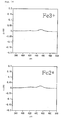
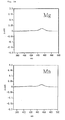
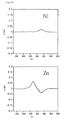
metal salts at pH 5.5 or pH 11 are shown in FIGS. 1 to 4.
FIG. 1 a-g show a difference in the absorbance of a TAPP -
methacrylic acid copolymer (TAPP-MAcid) at pH 5.5; and FIG. 2 a-g
show a difference in the absorbance of TAPP-MAcid at pH 11.
Metals causing a large absorbance difference were Cu2+ and Zn2+ at
pH 5.5, and Cu2+, Zn2+, Cd2+, and Co2+ at pH 11.
FIG. 3 a-g show a difference in the absorbance of a PPDE -
acrylamide copolymer (PPDE-AAm) at pH 11. A large absorbance
difference was caused by Cd2+, Zn2+ and Pb2+ and Cu2+ also caused a
slight absorbance difference.
FIG. 4 a-g show a difference in the absorbance of a PPDE -
methacrylic acid copolymer (PPDE-MAcid) at pH 11. As well as a
large absorbance difference caused by Zn2+ and Cu2+, an absorbance
difference by Co2+ and Mn2+ which did not occur in PPDE-AAm were
observed.
ii) A change in the absorbance due to complex formation
between each of all the porphyrin-nucleus introduced polymers
synthesized above and a metal, and wavelength are shown in Tables
3 and 4. For comparison, the absorbance of a porphyrin compound
itself was measured in a similar manner after dissolving it in
DMSO when it was PPDE and in THF when it was TAPP, and then
adjusting the pH of the resulting solution. The results are
collectively shown in Tables 3 and 4 (the blank column of this
table indicates that a peak of difference in absorbance was not
observed).
| Polymer | pH | Cd2+ | nm | Co2+ | nm | Cu2+ | nm | Fe2+ | nm | Mn2+ | nm | Zn2+ | nm | Pb2+ | nm |
| PPDE(not Polymer) | 5.5 | -0.1339 | 409 | 0.024 | 413 | ||||||||||
| PPDE-AAm | 5.5 | 0.0283 | 402 | 0.0956 | 413 | ||||||||||
| PPDE-MAcid | 5.5 | 0.14 | 399 | 0.0505 | 411 | ||||||||||
| PPDE-AAcid | 5.5 | 0.1473 | 400 | 0.026 | 410 | ||||||||||
| PPDE-1VImida | 5.5 | 0.0157 | 403 | -0.025 | 471 | 0.0054 | 418 | ||||||||
| PPDE-4VPyr | 5.5 | 0.1866 | 400 | 0.0341 | 402 | ||||||||||
| PPDE-5HAcid | 5.5 | 0.0326 | 399 | 0.1439 | 413 | ||||||||||
| PPDE-3BAcid | 5.5 | 0.1245 | 397 | 0.2373 | 410 | ||||||||||
| PPDE-VAce | 5.5 | ||||||||||||||
| PPDE-AAmine | 5.5 | 0.0421 | 395 | 0.0304 | 407 | ||||||||||
| PPDE-Achlo | 5.5 | ||||||||||||||
| PPDE-AAl | 5.5 | 0.0576 | 396 | 0.0306 | 408 | ||||||||||
| PPDE-βMAl | 5.5 | 0.1432 | 397 | 0.0221 | 410 | ||||||||||
| PPDE-DMAAm | 5.5 | 0.0709 | 401 | 0.0182 | 414 | ||||||||||
| PPfacid-AAm | 5.5 | 0.0199 | 425 | 0.0234 | 401 | -0.1114 | 402 | 0.1919 | 412 | ||||||
| TAPP(not Polymer) | 5.5 | 0.0402 | 409 | ||||||||||||
| TAPP-AAm | 5.5 | 0.0516 | 419 | 0.0178 | 430 | ||||||||||
| TAPP-Macid | 5.5 | 0.1663 | 419 | 0.0636 | 428 | ||||||||||
| TAPP-Aacid | 5.5 | 0.3197 | 419 | ||||||||||||
| TAPP-DMAAm | 5.5 | 0.0408 | 418 |
| Polymer | pH | Cd2+ | nm | Co2+ | nm | Cu2+ | nm | Fe2+ | nm | Mn2+ | nm | Zn2+ | nm | Pb2+ | nm |
| PPDE(not Polymer) | 11 | 0.0114 | 422 | 0.0456 | 399 | 0.0117 | 465 | ||||||||
| PPDE-AAm | 11 | 0.1646 | 426 | -0.0188 | 415 | 0.1158 | 415 | 0.0973 | 465 | ||||||
| PPDE-MAcid | 11 | 0.015 | 420 | 0.1798 | 398 | 0.0126 | 459 | 0.1646 | 409 | ||||||
| PPDE-AAcid | 11 | 0.1323 | 399 | 0.0525 | 409 | ||||||||||
| PPDE-1Vimida | 11 | 0.0334 | 426 | 0.0191 | 420 | 0.0198 | 468 | ||||||||
| PPDE-4VPyr | 11 | 0.0712 | 402 | ||||||||||||
| PPDE-5HAcid | 11 | 0.1946 | 421 | 0.0126 | 422 | 0.0276 | 458 | 0.1722 | 410 | 0.0842 | 462 | ||||
| PPDE-3BAcid | 11 | 0.1405 | 421 | 0.0703 | 397 | 0.0111 | 458 | 0.0245 | 410 | 0.0396 | 462 | ||||
| PPDE-VAce | 11 | ||||||||||||||
| PPDE-AAmine | 11 | 0.0098 | 422 | 0.0093 | 461 | ||||||||||
| PPDE-AChlo | 11 | ||||||||||||||
| PPDE-AAl | 11 | 0.0071 | 420 | 0.0265 | 396 | 0.003 | 462 | ||||||||
| PPDE-βMAl | 11 | 0.076 | 397 | 0.0316 | 398 | 0.0074 | 462 | ||||||||
| PPDE-DMAAm | 11 | 0.0344 | 421 | 0.0394 | 400 | 0.0214 | 413 | 0.0398 | 464 | ||||||
| PPfacid-AAm | 11 | 0.1611 | 426 | 0.0217 | 404 | 0.1002 | 415 | 0.1129 | 465 | ||||||
| TAPP(not Polymer) | 11 | ||||||||||||||
| TAPP-AAm | 11 | 0.0944 | 442 | 0.0237 | 418 | 0.0534 | 436 | 0.0582 | 469 | ||||||
| TAPP-MAcid | 11 | 0.0738 | 435 | 0.0555 | 431 | 0.1339 | 411 | 0.2602 | 425 | ||||||
| TAPP-AAcid | 11 | 0.0578 | 430 | 0.3934 | 417 | 0.0179 | 471 | 0.3892 | 424 | ||||||
| TAPP-DMAAm | 11 | 0.0472 | 434 | 0.0359 | 419 | 0.0383 | 425 | 0.0371 | 470 |
The above-described results indicate that the kind of a
metal with which the polymer reacted, difference in absorbance
and absorption wavelength each differs depending on the kind of
the porphyrin compound and the kind of the radically
polymerizable monomer copolymerized therewith. They also
indicate that by incorporation of a porphyrin nucleus in a
polymer, the resulting compound forms a complex with a metal to
which a porphyrin compound itself does not bond and some
polymers cause a large difference in absorbance.
Example 3 Measurement of the concentration of heavy metals by
using a porphyrin-nucleus introduced polymer
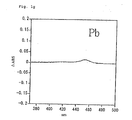
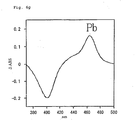
In FIG. 5, shown are reaction curves of TAPP-MAcid with
Cu2+ at pH 5.5, PPDE-AAm with Zn2+ at pH 5.5 and PPDE-AAm with
Pb2+ at pH 11. The polymers exhibited linear reactivity with
any metal. The leachate from an ash depository of a waste
incinerator was used as a sample and its absorbance was
measured using the above-described polymers. A metal
concentration was calculated by multiple regression analysis.
The analytical results are shown in Table 5, together with the
results measured by an atomic absorption spectrophotometer.
The analytical results coincided with the results of atomic
absorbance spectrophotometry. The multiple correlation
coefficient r in regression analysis available from the
standard sample used for the measurement of Cu2+ was 0.98937 (r2
= 0.97885), while that available from the standard sample used
for the measurement of Zn2+ was 0.97727 (r2 = 0.95505)
| Sample | Cu2+ | Zn2+ | Pb2+ | |||
| Polymer | Atomic absorption | Polymer | Atomic absorption | Polymer | Atomic absorption | |
| Leachate from ash depository | 186.3 | 174.8 | 3021 | 4917 | 38.4 | 56.4 |
| Unit: µM "Polymer": absorption spectrophotometry using a porphyrin-introduced polymer "Atomic absorption": Atomic absorption spectrometry |
Used as a porphyrin compound were PPfacid and PPDE; as a
radically polymerizable monomer, four monomers, that is,
acrylamide (AAm), methacrylic acid (MAcid), acrylic acid
(AAcid) and N,N-dimethylacrylamide (DMAAm); and as a
crosslinking agent, N,N'-methylenebisacrylamide (MBAA).
In a vessel were charged 5 ml of a 0.6 mM porphyrin
solution, an adequate amount of a radically polymerizable
monomer, 2 ml of 200 mM N,N'-methylenebisacrylamide and 0.2 ml
of 500 mM AIBN, followed by the addition of DMSO to give the
total amount of 10 ml. In consideration of the maintenance of
the gel form, the radically polymerizable monomer was added so
that the concentration after filling would be 1.5 M.
The vessel having the polymer solution therein was
immersed in cold water filled in an ultrasonic cleaner,
followed by degassing for 30 minutes. Bubbling by a nitrogen
gas was then conducted for 2 minutes. The polymer solution was
poured in a space of 1 mm between glass plates. The resulting
plates were placed in an incubator of 60 °C, whereby
polymerization was initiated. After 21 hours, the gel sheet of
1 mm thick was removed from the glass plates and cut into a
piece of 5 mm square. The resulting gel was washed well with
pure water. In this manner, various porphyrin-nucleus
introduced gels were prepared.
To each of 5 ml a buffer solution containing 20 mM 2-(N-morpholino)ethanesulfonic
acid (MES) and having a pH of 5.5 and
5 ml of a buffer solution containing 20 mM 3-cyclohexylamino-1-propanesulfonic
acid (CAPS) and having a pH of 11, 50 µl of
each of 500 µM aqueous solutions of metal salts shown in Table
2 was added. After the porphyrin-nucleus introduced gel sheet
was immersed in the aqueous solution of a metal salt at 60 °C
for 1 hour, the gel was takedn out and absorbance of it (at 370
to 500 nm) in the thickness direction was measured.
| Gel | pH | Cd2+ | nm | Cu2+ | nm | Zn2+ | nm | Pb2+ | nm |
| PPDE(not Gel)-MBAA | 5.5 | -0.0627 | 399 | 0.024 | 413 | ||||
| PPDE-AAm-MBAA | 5.5 | 0.0611 | 399 | 0.0616 | 412 | ||||
| PPDE-MAcid-MBAA | 5.5 | 0.2231 | 398 | -0.0277 | 415 | ||||
| PPDE-AAcid-MBAA | 5.5 | 0.0512 | 399 | 0.0148 | 410 | ||||
| PPDE-DMAAm-MBAA | 5.5 | 0.0326 | 399 | ||||||
| PPfacid-AAm-MBAA | 5.5 | 0.0345 | 399 | 0.0824 | 411 | ||||
| PPDE(not Gel) | 11 | 0.0114 | 422 | 0.0456 | 399 | 0.0117 | 465 | ||
| PPDE-AAm-MBAA | 11 | 0.2126 | 424 | 0.0629 | 400 | 0.0993 | 413 | 0.1614 | 484 |
| PPDE-MAcid-MBAA | 11 | -0.0237 | 395 | ||||||
| PPDE-AAcid-MBAA | 11 | -0.0243 | 398 | ||||||
| PPDE-DMAAm-MBAA | 11 | 0.0346 | 423 | 0.0276 | 399 | 0.0364 | 464 | ||
| PPfacid-AAm-MBAA | 11 | 0.1158 c | 423 | 0.042 | 400 | 0.0687 | 413 | 0.1105 | 464 |
According to the method of measuring a trace metal of the
present invention, by selecting a radically polymerizable
monomer which is a raw material of porphyrine-introduced
polymer as a reagent, water-solubility of the reagent and
reactivity with a metal in complex formation can be changed,
and species of the target metal can be measured highly
sensitively and easily.
Claims (9)
- Upon radical copolymerization of a vinyl-containing porphyrin compound and a radically polymerizable monomer, a method of controlling reactivity of the porphyrin-nucleus introduced polymer with a metal by selecting the radically polymerizable monomer.
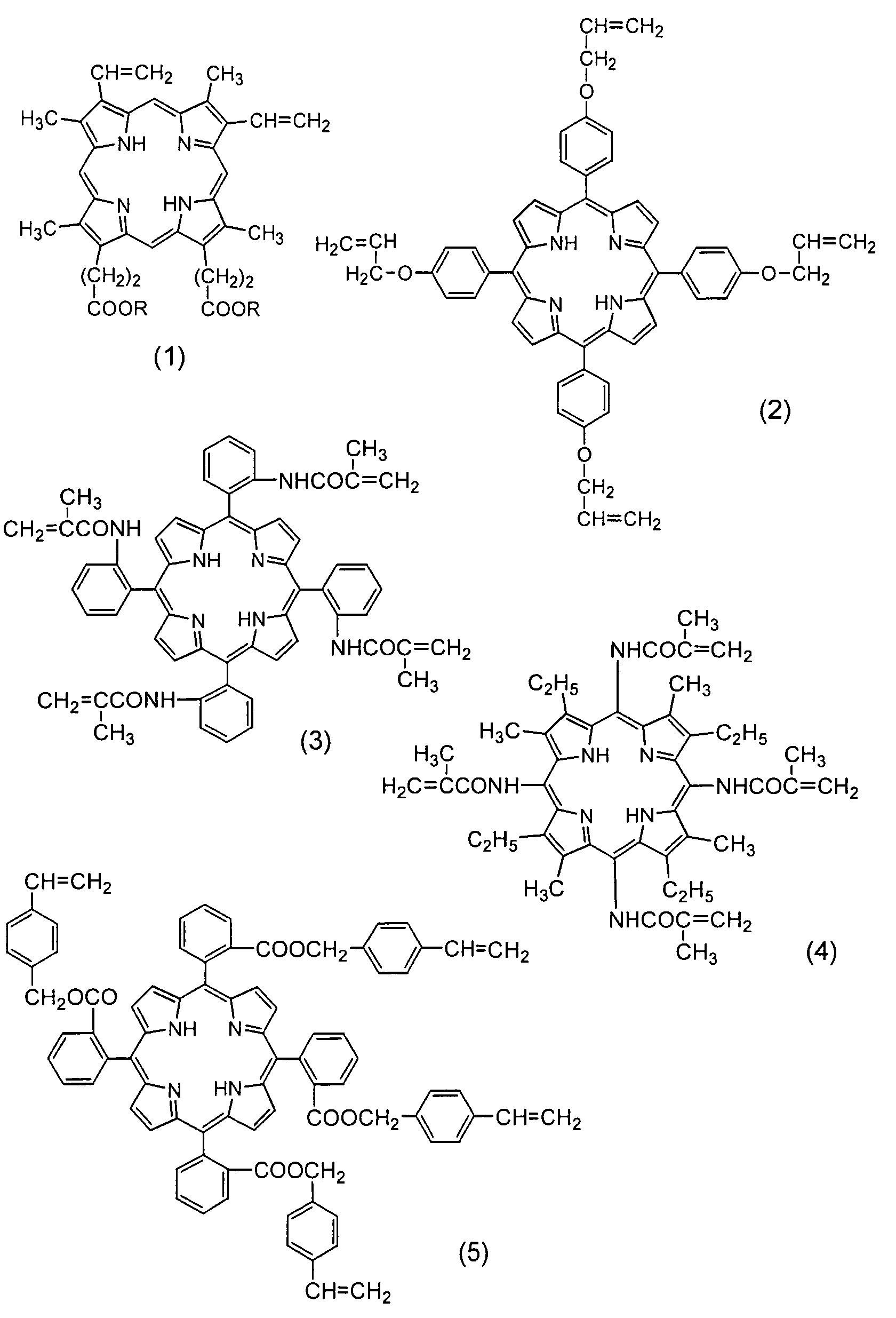
- The method according to claim 1, wherein the vinyl-containing porphyrin compound is selected from the group consisting of the following compounds (1) to (5):wherein R is a hydrogen atom or a C1-6 alkyl group.

- The method of claim 1, wherein the radically polymerizable monomer is compound represented by formula (6):wherein R1, R2, R3 and R4 each independently represents a hydrogen atom, a C1-5 alkyl group, -(CH2)nCOOR5, -(CH2)nOCOR5, - (CH2)nN(R5) (R6), -(CH2)nCON (R5) (R6), -(CH2)nA (in which R5 and R6 each represent a hydrogen atom, a C1-5 alkyl group, a carboxymethyl group, or a phenyl or phenylalkyl group which may have a substituent, A represents a halogen atom, a hydroxy group, a formyl group, a cyano group or a carbonyl halide group, and n stands for an integer of 0 to 6), or an imidazolyl, pyridyl or phenyl group which may have a substituent.

- The method of claim 3, wherein the radically polymerizable monomer is a compound serving as a cross-linking agent, and having two or more polymerizable carbon-carbon double bonds.
- A method for measuring a trace metal by measuring a change in absorbance caused by complex forming reaction between a porphyrin-nucleus introduced polymer, which has been obtained by radical copolymerization of a vinyl-containing porphyrin compound and a radically polymerizable monomer, and a heavy metal ion, said radically polymerizable monomer being selected so as to heighten reaction selectivity of the porphyrin-nucleus introduced polymer to a metal to be measured.
- The method according to claim 5, wherein the vinyl-containing porphyrin compound is selected from the group consisting of the following compounds (1)-(5):wherein R is a hydrogen atom or a C1-6 alkyl group.
- The method of claim 5, wherein the radically polymerizable monomer is compound represented by formula (6):wherein R1, R2, R3 and R4 each independently represents a hydrogen atom, a C1-5 alkyl group, -(CH2)nCOOR5, -(CH2)nOCOR5, - (CH2)nN(R5) (R6), -(CH2)nCON(R5) (R6), -(CH2)nA (in which R5 and R6 each represents a hydrogen atom, a C1-5 alkyl group, a carboxymethyl group, or a phenyl or phenylalkyl group which may have a substituent, A represents a halogen atom, a hydroxy group, a formyl group, a cyano group or a carbonyl halide group, and n stands for an integer of 0 to 6), or an imidazolyl, pyridyl, or phenyl group which may have a substituent.
- The method according to claim 7, wherein the radically polymerizable monomer is a compound serving as a cross-linking agent, and having two or more polymerizable carbon-carbon double bonds.
- The method according to any one of claims 5-8, wherein plural trace metals are measured simultaneously by using plural porphyrin-nucleus introduced polymers in combination.
Applications Claiming Priority (1)
| Application Number | Priority Date | Filing Date | Title |
|---|---|---|---|
| PCT/JP2002/013224 WO2004055072A1 (en) | 2002-12-18 | 2002-12-18 | Method of determining trace metal |
Publications (2)
| Publication Number | Publication Date |
|---|---|
| EP1574531A1 true EP1574531A1 (en) | 2005-09-14 |
| EP1574531A4 EP1574531A4 (en) | 2006-03-15 |
Family
ID=32587967
Family Applications (1)
| Application Number | Title | Priority Date | Filing Date |
|---|---|---|---|
| EP02808256A Withdrawn EP1574531A4 (en) | 2002-12-18 | 2002-12-18 | METHOD FOR DETERMINING METAL-TRACE |
Country Status (4)
| Country | Link |
|---|---|
| EP (1) | EP1574531A4 (en) |
| JP (1) | JP3898720B2 (en) |
| AU (1) | AU2002357596A1 (en) |
| WO (1) | WO2004055072A1 (en) |
Cited By (2)
| Publication number | Priority date | Publication date | Assignee | Title |
|---|---|---|---|---|
| EP1772730A4 (en) * | 2004-07-29 | 2011-05-18 | Kowa Co | REAGENT FOR LEAD ASSAY |
| EP2169399A4 (en) * | 2007-07-20 | 2011-05-18 | Kowa Co | REAGENT FOR MEASURING LEAD CONCENTRATION AND METHOD FOR MEASURING LEAD CONCENTRATION |
Families Citing this family (5)
| Publication number | Priority date | Publication date | Assignee | Title |
|---|---|---|---|---|
| WO2009116669A1 (en) | 2008-03-21 | 2009-09-24 | アークレイ株式会社 | Dry test instrument, method of measuring metal and method of producing dry test instrument |
| JP5202443B2 (en) * | 2009-06-01 | 2013-06-05 | 興和株式会社 | Hazardous metal measuring reagent and measuring method |
| JP5650993B2 (en) * | 2010-11-19 | 2015-01-07 | 国立大学法人九州大学 | Water-soluble hyperbranched polymer with paramagnetism |
| JP6281901B2 (en) * | 2014-01-22 | 2018-02-21 | 国立大学法人埼玉大学 | Water-soluble porphyrin derivatives and methods for producing them |
| CN117088916B (en) * | 2022-05-11 | 2026-03-20 | 中国科学院上海有机化学研究所 | Fluorine-containing probes for detecting trace analytes, their preparation and applications |
Family Cites Families (5)
| Publication number | Priority date | Publication date | Assignee | Title |
|---|---|---|---|---|
| JPS5439099A (en) * | 1977-08-31 | 1979-03-24 | Hidetoshi Tsuchida | Polymerizable porphyrin derivative and polymers therefrom |
| JPH0796575B2 (en) * | 1987-08-28 | 1995-10-18 | 汪芳 白井 | Polymer liquid crystal material |
| JP2763612B2 (en) * | 1989-09-08 | 1998-06-11 | 株式会社トクヤマ | Porphyrin derivative having polymerizable group and method for producing the same |
| JP3131785B2 (en) * | 1990-07-06 | 2001-02-05 | ジ オーストラリアン ナショナル ユニバーシティ | Polymerizable porphyrin |
| US6437067B1 (en) * | 2001-11-30 | 2002-08-20 | Kowa Co., Ltd. | Porphyrin-nucleus introduced polymers |
-
2002
- 2002-12-18 WO PCT/JP2002/013224 patent/WO2004055072A1/en not_active Ceased
- 2002-12-18 AU AU2002357596A patent/AU2002357596A1/en not_active Abandoned
- 2002-12-18 EP EP02808256A patent/EP1574531A4/en not_active Withdrawn
- 2002-12-18 JP JP2004560584A patent/JP3898720B2/en not_active Expired - Fee Related
Cited By (3)
| Publication number | Priority date | Publication date | Assignee | Title |
|---|---|---|---|---|
| EP1772730A4 (en) * | 2004-07-29 | 2011-05-18 | Kowa Co | REAGENT FOR LEAD ASSAY |
| EP2169399A4 (en) * | 2007-07-20 | 2011-05-18 | Kowa Co | REAGENT FOR MEASURING LEAD CONCENTRATION AND METHOD FOR MEASURING LEAD CONCENTRATION |
| US8133739B2 (en) | 2007-07-20 | 2012-03-13 | Kowa Co., Ltd. | Reagent for measurement of concentration of lead, and method for measurement of concentration of lead |
Also Published As
| Publication number | Publication date |
|---|---|
| EP1574531A4 (en) | 2006-03-15 |
| JP3898720B2 (en) | 2007-03-28 |
| WO2004055072A1 (en) | 2004-07-01 |
| JPWO2004055072A1 (en) | 2006-04-20 |
| AU2002357596A1 (en) | 2004-07-09 |
Similar Documents
| Publication | Publication Date | Title |
|---|---|---|
| US5852126A (en) | Polymerisable composition and the use thereof | |
| Xu et al. | Fluorescent ion-imprinted sensor for selective and sensitive detection of copper (II) ions | |
| DE69507465T2 (en) | OPTICAL SENSOR SYSTEM FOR DETERMINING pH AND ION STRENGTH | |
| US6437067B1 (en) | Porphyrin-nucleus introduced polymers | |
| US6515089B1 (en) | Trace metal measuring method | |
| US20090263907A1 (en) | Reagent for lead concentration determination and method of determining lead concentration | |
| Spiniello et al. | Synthesis and characterization of fluorescently labeled core cross‐linked star polymers | |
| Flejszar et al. | Following principles of green chemistry: Low ppm photo-ATRP of DMAEMA in water/ethanol mixture | |
| René et al. | Influence of the synthesis parameters on the efficiency of fluorescent ion-imprinted polymers for lead detection | |
| JP3898720B2 (en) | Trace metal measurement method | |
| Cui et al. | Synthesis of telechelic PNIPAM ended with 9, 10-dihydroacridine group as a recyclable and specific Fe3+ detection fluorescent sensor | |
| JP2000508648A (en) | Covalently immobilized fluoroionophores as optical ion sensors | |
| EP2251687A1 (en) | Colorimetric anion sensor element | |
| US5866660A (en) | Polyvinyl prolidone and crosslinker with divinyl and chelation group | |
| JP5665187B2 (en) | Copolymer for pH indication, pH monitoring device and pH measurement method using the same | |
| CN117003688A (en) | A kind of fluorescent monomer based on tetrastyrene and its preparation method and application | |
| Zhang et al. | Water soluble β-CD-PMAA/PMAm/PHEMA-Coumarin macromolecular fluorescent probes prepared via RAFT method and their sensing ability to Fe3+/Fe2+ and Cu2+ ions | |
| CN100545653C (en) | Reagent for lead assay | |
| Wang et al. | Synthesis and photophysical properties of a blue water-soluble fluorescent polymer for Ni2+ and proton sensing | |
| Orriach-Fernández et al. | Hg 2+-selective sensing film based on the incorporation of a rhodamine 6G derivative into a novel hydrophilic water-insoluble copolymer | |
| Bignozzi et al. | Syntheses and Characterization of Luminescent Polymers Containing Rhenium (i) Pyridinyl‐Carbonyl Complexes | |
| Yao et al. | Intermolecular approach to metal ion indicators based on polymer phase transitions coupled to fluorescence resonance energy transfer | |
| Eckstein et al. | Microwave-assisted synthesis, transesterification and polymerization of N-(2-acetoxy-ethyl-) maleimide | |
| Zhang et al. | Synthesis of well‐defined naphthalene and photo‐labile group‐labeled polystyrene via ATRP | |
| Gramain et al. | Polyacrylamides with coloured groups for trace analysis in water |
Legal Events
| Date | Code | Title | Description |
|---|---|---|---|
| PUAI | Public reference made under article 153(3) epc to a published international application that has entered the european phase |
Free format text: ORIGINAL CODE: 0009012 |
|
| 17P | Request for examination filed |
Effective date: 20050411 |
|
| AK | Designated contracting states |
Kind code of ref document: A1 Designated state(s): AT BE BG CH CY CZ DE DK EE ES FI FR GB GR IE IT LI LU MC NL PT SE SI SK TR |
|
| AX | Request for extension of the european patent |
Extension state: AL LT LV MK RO |
|
| A4 | Supplementary search report drawn up and despatched |
Effective date: 20060127 |
|
| DAX | Request for extension of the european patent (deleted) | ||
| 17Q | First examination report despatched |
Effective date: 20061212 |
|
| STAA | Information on the status of an ep patent application or granted ep patent |
Free format text: STATUS: THE APPLICATION IS DEEMED TO BE WITHDRAWN |
|
| 18D | Application deemed to be withdrawn |
Effective date: 20070424 |