EP1574521A1 - Method of protecting thiol group of protein - Google Patents
Method of protecting thiol group of protein Download PDFInfo
- Publication number
- EP1574521A1 EP1574521A1 EP03780938A EP03780938A EP1574521A1 EP 1574521 A1 EP1574521 A1 EP 1574521A1 EP 03780938 A EP03780938 A EP 03780938A EP 03780938 A EP03780938 A EP 03780938A EP 1574521 A1 EP1574521 A1 EP 1574521A1
- Authority
- EP
- European Patent Office
- Prior art keywords
- protein
- antibody
- activity
- thiol group
- molecule
- Prior art date
- Legal status (The legal status is an assumption and is not a legal conclusion. Google has not performed a legal analysis and makes no representation as to the accuracy of the status listed.)
- Granted
Links
Images




Classifications
-
- C—CHEMISTRY; METALLURGY
- C07—ORGANIC CHEMISTRY
- C07K—PEPTIDES
- C07K1/00—General methods for the preparation of peptides, i.e. processes for the organic chemical preparation of peptides or proteins of any length
- C07K1/06—General methods for the preparation of peptides, i.e. processes for the organic chemical preparation of peptides or proteins of any length using protecting groups or activating agents
- C07K1/061—General methods for the preparation of peptides, i.e. processes for the organic chemical preparation of peptides or proteins of any length using protecting groups or activating agents using protecting groups
- C07K1/066—General methods for the preparation of peptides, i.e. processes for the organic chemical preparation of peptides or proteins of any length using protecting groups or activating agents using protecting groups for omega-amido functions
-
- A—HUMAN NECESSITIES
- A61—MEDICAL OR VETERINARY SCIENCE; HYGIENE
- A61P—SPECIFIC THERAPEUTIC ACTIVITY OF CHEMICAL COMPOUNDS OR MEDICINAL PREPARATIONS
- A61P35/00—Antineoplastic agents
-
- C—CHEMISTRY; METALLURGY
- C07—ORGANIC CHEMISTRY
- C07K—PEPTIDES
- C07K1/00—General methods for the preparation of peptides, i.e. processes for the organic chemical preparation of peptides or proteins of any length
- C07K1/006—General methods for the preparation of peptides, i.e. processes for the organic chemical preparation of peptides or proteins of any length of peptides containing derivatised side chain amino acids
-
- C—CHEMISTRY; METALLURGY
- C07—ORGANIC CHEMISTRY
- C07K—PEPTIDES
- C07K1/00—General methods for the preparation of peptides, i.e. processes for the organic chemical preparation of peptides or proteins of any length
- C07K1/107—General methods for the preparation of peptides, i.e. processes for the organic chemical preparation of peptides or proteins of any length by chemical modification of precursor peptides
- C07K1/1072—General methods for the preparation of peptides, i.e. processes for the organic chemical preparation of peptides or proteins of any length by chemical modification of precursor peptides by covalent attachment of residues or functional groups
- C07K1/1077—General methods for the preparation of peptides, i.e. processes for the organic chemical preparation of peptides or proteins of any length by chemical modification of precursor peptides by covalent attachment of residues or functional groups by covalent attachment of residues other than amino acids or peptide residues, e.g. sugars, polyols, fatty acids
Definitions
- the present invention relates to a method for efficiently and effectively forming a protein by protecting a thiol group in a protein having a free cysteine residue. More specifically, the present invention relates to a useful medicament which comprises a protein obtained by the method.
- a method in which the thiol group of a cysteine residue is protected by modifying it with a certain compound can be considered.
- the reagent for modifying the thiol group of a cysteine residue of a protein include 1) oxidizing agents such as 5',5-dithiobis(2-nitrobenzoic acid) (DTNB), 2,2'(4,4')-dipyridyl sulfide, tetrathionic acid, 2,6-dichlorophenolindophenol (DCIP) and oxidized glutathione, 2) mercaptide forming agents such as p-mercuribenzoic acid (PMB) and p-mercuribenzenesulfonic acid (PMBS), and 3) alkylating agents such as iodoacetic acid, iodoacetamide and N-ethylmaleimide (NEM) ( Seikagaku Jiten (Biochemical Dictionary), 3rd edition, edited by Tokyo Kagaku Dojin,
- a serum-free culture medium which does not use serum.
- serum when serum is not used in culturing an animal cell, it frequently results in a case in which supplement of components necessary for maintaining functions of the cell cannot be carried out sufficiently so that a sufficient useful protein cannot be secured, and it also results in a case in which the produced protein is delicately changed physically, biochemically or biologically from the protein of interest, thus posing problems in that, for example, a polymer is apt to be formed and the like.
- Objects of the present invention are to establish a method for efficiently and effectively forming a protein by protecting a thiol group in a protein having a free cysteine residue, and to provide a medicament which contains the protein.
- the present inventors have accomplished the present invention by carrying out studies on the agents for protecting free cysteine residue and studies on the reaction conditions, and by resolving such problems through in-depth analyses of the reaction products.
- the present invention is as follows.
- examples of the compound which has a disulfide bond in the molecule and exerts substantially no influence on the activity of the protein include cystine, homocystine, lipoic acid, oxidized glutathione and glutathione disulfide, and cystine is preferred.
- a method in which compounds which have thiol groups in the molecules and exert substantially no influence on the activity of the protein are simultaneously or separately added can also be exemplified.
- examples of the compound which has a thiol group in the molecule and exerts substantially no influence on the activity of the protein include cysteine, homocysteine, glutathione and dihydrolipoic acid, and cysteine is particularly preferred.
- the term "the compound which exerts substantially no influence on the activity of the protein” means that it does not increase or decrease the activity of the protein.
- the protein is an antibody
- a case in which reactivity of the antigen-antibody reaction does not increase or decrease can be exemplified.
- the protein in the present invention is characterized in that it has a free cysteine residue in its molecular structure.
- free as used herein means a state in which the cysteine residue has unpaired electron, is unstable and is rich in reactivity.
- thiol group of the cysteine residue is rich in reactivity.
- thiol group in the present invention a case in which it is concerned directly or indirectly in the activity of the protein can be exemplified, and direct concern is more preferred.
- the activity of the protein as used herein include the reactivity in an antigen-antibody reaction and the reactivity in an enzyme reaction.
- Examples of the direct concern include a case in which the activity of the protein is reduced when the thiol group is modified with a modifying reagent or the like.
- an example of the indirect concern is a case in which the activity of the protein is reduced due to interrupting of the formation of the higher-order structure by modification of the thiol group.
- inhibition of the polymerization, modification or exchange which exerts substantial influence on the protein activity can be exemplified. More specifically, examples include inhibition of the formation of a polymer due to formation of a disulfide bond between proteins via thiol groups, inhibition of the modification of a free cysteine residue, and inhibition of the exchange reaction with a disulfide bond formed in a molecule or between molecules by the thiol groups of the free cysteine residues. The inhibition of the formation of a polymer due to formation of a disulfide bond between proteins via thiol groups is more preferred.
- a thiol-disulfide exchange reaction of the following reaction occurs through the reaction of a compound having a disulfide bond, such as cystine, with the thiol group in a protein having a free cysteine residue.
- a compound having a disulfide bond such as cystine
- Pr-S-S-R formed by the reaction is stably present even after elimination of the R-S-S-R, the reaction via Pr-SH, such as polymerization of proteins, is inhibited.
- the compound which has a disulfide bond in the molecule and exerts substantially no influence on the activity of the protein may be added at any stage at the time of the protein production.
- examples include the methods in which cystine is added to the final purified products of F(ab') 2 (Examples 1 to 3) or immediately after the activation of its whole antibody (Examples 4 to 6).
- a solvent is used in the methods of the present invention.
- the solvent is not particularly limited, a liquid capable of causing exchange of the thiol group of a cysteine residue in a protein with disulfide of cystine is preferred.
- a buffer of weakly acidic to alkaline preferably a buffer of neutral to weakly alkaline, is suitable.
- the concentration of the adding compound which has a disulfide bond in the molecule and exerts substantially no influence on the activity of the protein is not particularly limited, but in the case of cystine, for example, a cystine concentration capable of causing exchange of the thiol group of cysteine residue of a protein with disulfide of cystine is preferred. Specifically, a concentration of 0.01 to 100 mM, preferably from 0.1 to 10 mM, is suitable.
- the protein concentration is not particularly limited, a concentration capable of causing exchange of the thiol group of a cysteine residue of a protein with disulfide of a compound which has a disulfide bond in the molecule and exerts substantially no influence on the activity of the protein is preferred. Specifically, a concentration of 0.01 to 1,000 mg/ml, preferably from 0.1 to 100 mg/ml, is suitable.
- reaction temperature is not particularly limited, for example, a temperature capable of causing exchange of the thiol group of a cysteine residue of a protein with disulfide of cystine as a compound which has a disulfide bond in the molecule and exerts substantially no influence on the activity of the protein is preferred. Specifically, a temperature of -20 to 60°C, preferably from 0°C to 50°C is suitable.
- Examples of the polymerization in the present invention include a change in the higher-order structure of a protein, a change in the activity of the protein, and formation of a dimer, a trimer and the like, which occur when the protein forms an intermolecular disulfide bond via thiol groups.
- Preferred are a change in the activity of the protein and formation of a dimer and a trimer, and more preferred is formation of a dimer and a trimer.
- Examples of the modification in the present invention include a change in the higher-order structure of a protein, a change in the activity of the protein and the like, which occur when a compound capable of exerting substantial influence on the activity is linked to the thiol group in a protein having a free cysteine residue.
- a change in the activity of the protein can be exemplified.
- Examples of the exchange in the present invention include a change in the higher-order structure of a protein, a change in the activity of the protein and the like, which occur when the thiol group in a protein having a free cysteine residue forms a thiol-disulfide bond formed in a molecule or between molecules of the protein.
- a change in the activity of the protein can be exemplified.
- Examples of the recombinant protein in the present invention include antibodies, enzymes, growth factors, cytokines and the like, and antibodies can be exemplified more preferably.
- antibody in the present invention examples include whole antibodies (full length antibody, whole antibody), antibody fragments (antibody fragments such as F(ab'), F(ab') 2 and scFv (single chain antibody)) and antibody derivatives, and an F(ab') 2 antibody is more preferred.
- An example of the monoclonal antibody in the present invention is an antibody which comprises the amino acid sequences represented by SEQ ID NOs:1, 2 and 3 in the Sequence Listing in its heavy chain hypervariable region, and the amino acid sequences represented by SEQ ID NOs:4, 5 and 6 in the Sequence Listing in its light chain hypervariable region.
- these amino acid sequences are respectively contained in three hypervariable regions of each chain of the heavy chain and light chain, in order of SEQ ID NOs: 1, 2 and 3 and SEQ ID NOs:4, 5 and 6 starting from the N-terminal side.
- the hypervariable region determines specificity of immunoglobulin as an antibody and binding affinity of an antigenic determinant with the antibody, and is also called complementarity determining region.
- the regions other than such hypervariable regions may be derived from other antibody. That is, those in which modification of partial amino acids, such as substitution, insertion, deletion or addition, is carried out within such a range that the binding activity (reactivity) with antigens are not spoiled are included in the monoclonal antibodies which can be used in the present invention.
- More specific examples include an antibody which comprises a heavy chain variable region comprising the amino acid sequence represented by SEQ ID NO:7 in the Sequence Listing and a light chain variable region comprising the amino acid sequence represented by SEQ ID NO:8 in the Sequence Listing, namely the GAH antibody.
- the GAH antibody is a human monoclonal antibody which specifically binds to cancers screened based on the reactivity with gastric cancer and large bowel cancer (EP526700 or EP520499), and this antibody can be obtained by preparing hybridomas of cancer patient-derived lymphocytes with mouse myeloma cells, and selecting a hybridoma having the above-described specified amino acid sequences, or can also be prepared by genetic engineering techniques (EP520499).
- the GAH antibody When compared with the position of cysteine in conventionally known human amino acid sequences, the GAH antibody is characterized by the 32nd position cysteine in SEQ ID NO:7 in the Sequence Listing. That is, this is considered to be a free cysteine which is not concerned in the disulfide bond formation in the molecule. Since the cysteine residue corresponds to the 4th position in the sequence shown in SEQ ID NO:1 in the Sequence Listing and is positioned in a heavy chain hypervariable region, it is considered that this is concerned in the binding with its antigen.
- serum-free medium in the present invention examples include those media which do not contain sera such as (fetal) bovine serum in the medium components.
- serum-free media CD CHO manufactured by Invitrogen
- ExCell 325-PF manufactured by JRH
- the present invention provides a medicament which comprises, as an active ingredient, a protein, including the above-described antibody, obtained by the method of the present invention, for example, a pharmaceutical composition which comprises the above-described substance and a pharmaceutically acceptable carrier, and provides a therapeutic preparation having various dosage forms.
- pharmaceutically acceptable means that unpreferable side effects, such as nausea, vertigo and qualm, accompanied by the administration, immune response against a pharmaceutical preparation at the time of its frequent administration, and the like do not occur.
- an antibody prepared by binding a substance such as a toxin to the protein of the present invention can also be used as a medicament.
- Examples include those in which a protein such as an antibody is bound to liposome or the like into which an agent such as an antitumor agent, e.g., doxorubicin, is encapsulated (EP526700, EP520499 and EP1174126).
- the antibody-bound anti-neoplastic substance-containing liposome can be made into pharmaceutical preparations by conventionally known methods such as a dehydration method (WO88/06441), a method in which it is used as solutions by adding a stabilizing agent (TP-A-64-9931), a freeze drying method (JP-A-64-9931) and the like, and can be administered to patients by a method such as intravascular administration or topical administration.
- the dose can be optionally selected in response to the kinds of anti-neoplastic substance as the active ingredient, and when a doxorubicin-encapsulated liposome is administered for example, it can be used at a dose of 50 mg/kg or less, preferably 10 mg/kg or less, more preferably 5 mg/kg or less, in terms of the amount of the active ingredient.
- GAH whole antibody whole antibody of GAH antibody
- a cell culture medium was prepared by dissolving 4 mmol of glutamine (manufactured by SIGMA) and 10 mg of insulin (manufactured by SIGMA) in 1 liter of each of serum-free media CD CHO (manufactured by Invitrogen) and ExCell 325-PF (manufactured by JRH) and carrying out aseptic filtration of the solution using a 0.22 ⁇ m bottle top filter (manufactured by Corning Coaster).
- the thus prepared cell medium was aseptically charged in a 1 liter capacity spinner flask (manufactured by Belco) which had been sterilized in advance using an autoclave (manufactured by Sakura Seiki), and the flask was arranged on a culture controlling device (manufactured by Biott) to adjust the temperature to 37°C, and the dissolved oxygen concentration to 3.0 mg/l, the pH to 7.4 and the agitation speed to 60 rpm.
- a culture controlling device manufactured by Biott
- a recombinant GAH antibody producing CHO cell 1-6R (cf. Examples of EP520499) cultured in advance using a roller bottle (manufactured by Falcon) was treated with trypsin to peel off the cells, the supernatant was discarded after centrifugation, and the cells were washed twice with the corresponding serum-free medium. Thereafter, the cells were suspended in the corresponding serum-free medium and aseptically inoculated into a 1 liter capacity spinner flask to start the culturing.
- the culturing was completed after 353 hours of the inoculation, and the culture medium was recovered.
- the culture medium was centrifuged (3,000 rpm, 20 min) and then filtered using a 0.22 ⁇ m bottle top filter to obtain about 800 ml of an unpurified bulk.
- WO03/048357 can be used as a reference.
- the activation-treated sample obtained in (3) was adjusted to pH 4.0 and then digested with pepsin. That is, pepsin (manufactured by SIGMA) was added thereto to a concentration of 1.2 mg/g GAH, followed by aseptic filtration using Mylex filter (manufactured by Millipore, 0.22 ⁇ m) and then gently stirring for 17 hours under heating at 37°C.
- pepsin manufactured by SIGMA
- Mylex filter manufactured by Millipore, 0.22 ⁇ m
- a GAH antibody F(ab') 2 was purified using cation exchange column chromatography. That is, the XK16 column was packed with 15.3 ml of a cation exchange resin SP-Sepharose FF (manufactured by Amersham Bioscience), and the antibody-containing liquid after pepsin digestion was applied thereto. Thereafter, washing was carried out using 40 mM acetate buffer (pH 4.0) containing 20 mM NaCl, and peak of the antibody was fractionated while gradually increasing the salt concentration. The flow rate was 1.58 ml/min. Volumes of the samples of CD CHO and ExCell 325-PF were 10.5 ml and 11.6 ml, respectively.
- a cystine solution was added to a GAH antibody F(ab') 2 solution prepared to a concentration of about 5 mg/ml, to a final concentration of 1 mM.
- the cystine solution was used by dissolving cystine in 0.5 N hydrochloric acid to a concentration of 40 mM.
- This solution was divided into two, 1/4 volume of 1 M sodium phosphate buffer (pH 7.5) was added to one of them (final pH 7.5), nothing was added to the other (final pH 4.7), and they were used as a cystine-added pH 7.5 treated solution and a cystine-added pH 4.7 treated solution, respectively.
- cystine-added solutions and a cystine-un-added solution were allowed to stand at 37°C for 3 hours, and then cystine was removed using an ultrafiltration membrane of nominal molecular weight cutoff of 30 K, and the solvent was replaced by 20 mM acetate buffer (pH 4.7).
- gel filtration HPLC analysis was carried out.
- each of these solutions was mixed with 1/4 volume of I M sodium phosphate buffer (pH 7.5) (final pH 7.5), allowed to stand at 37°C for 45 minutes, and then gel filtration HPLC analysis was carried out.
- Fig. 1 The results are shown in Fig. 1.
- the monomer content was 86 to 87% in each of the cystine-un-added solution, cystine-added pH 4.7 treated solution and cystine-added pH 7.5 treated solution.
- the monomer content of the cystine-un-added solution was reduced to 73%, while that of the cystine-added pH 4.7 treated solution was 78% showing a slight polymerization inhibition.
- that of the cystine-added pH 7.5 treated solution was 87%, completely inhibiting the polymerization.
- a cystine solution was added to a GAH antibody F(ab') 2 solution prepared to a concentration of about 5 mg/ml, to a final concentration of 1 mM.
- the cystine solution was used by dissolving cystine in 0.5 N hydrochloric acid to a concentration of 40 mM.
- This solution was mixed with 1/4 volume of 1 M sodium phosphate buffer (pH 7.5) (final pH 7.5), divided into two, and one of them was allowed to stand at 37°C for 3 hours, and the other at 4°C for a whole day and night. They were used as a cystine-added 37°C treated solution and a cystine-added 4°C treated solution, respectively.
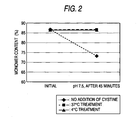
- Cystine was removed from these two types of solutions and a cystine-un-added solution using an ultrafiltration membrane of nominal molecular weight cutoff of 30 K, and the solvent was replaced by 20 mM acetate buffer (pH 4.7). Using this stage as initial, gel filtration HPLC analysis was carried out. Next, each of these three types of solutions was mixed with 1/4 volume of 1 M sodium phosphate buffer (pH 7.5) (final pH 7.5), allowed to stand at 37°C for 45 minutes, and then gel filtration HPLC analysis was carried out.
- Fig. 2 The results are shown in Fig. 2.
- the monomer content was 86 to 87% in each of the cystine-un-added solution, cystine-added 37°C treated: solution and cystine-added 4°C treated solution.
- these solutions were adjusted to pH 7.5 and allowed to stand at 37°C for 45 minutes, the monomer content of the cystine-un-added solution was reduced to 73%, while that of the cystine-added 37°C treated solution was 87% and that of the cystine-added 4°C treated solution was 86%, completely inhibiting the polymerization in both cases.
- reaction temperature at the time of the addition of cystine was either 37°C or 4°C.
- a cystine solution was added to a GAH antibody F(ab') 2 solution prepared to a concentration of about 5 mg/ml, to a final concentration of 1 mM or 0.54 mM
- the cystine solution was used by dissolving cystine in 0.5 N hydrochloric acid to a concentration of 40 mM or 20 mM.
- the monomer content was 86 to 87% in each of the cystine-un-added solution and 1 mM cystine-added solution, while that in the 0.5 mM cystine-added solution was a slightly lower value of 84%.
- the monomer content of the cystine-un-added solution was reduced to 73%, while that of the 1 mM cystine-added solution was 86% and that of the 0.5 mM cystine-added solution was 84%, each showing no change from the initial.
- a cell culture medium was prepared by dissolving a serum-free medium ExCell 325-PF (JRH) in 30 L in total of milli-Q water, 4 mM of glutamine (manufactured by SIGMA), 1.6 g/l of sodium bicarbonate (manufactured by Invitrogen) and 10 mg/l of insulin (manufactured by SIGMA) were dissolved therein and carrying out aseptic filtration of the solution using a 0.22 ⁇ m Milli-pack 40 filter (manufactured by Millipore).
- a recombinant GAH antibody producing CHO cell 1-6R (cf. Examples of WO03/048357) was cultured in advance in a 7 L (working volume: 6 L) capacity spinner flask (manufactured by Belco) using a serum-free medium ExCell 325-PF, and the total volume of the culture medium was aseptically inoculated into a 50 L capacity fermentor. Thereafter, the culturing was carried out by supplementing the vessel with 5 L of the serum-free medium ExCell 325-PF after 1 day, 15 L after 2 days and 1 L after 4 days.
- the culturing was completed after 307 hours of the inoculation, and the culture medium was recovered.
- the culture medium was subjected to cell separation by Prostack (manufactured by Millipore) and then filtered using a 0.22 ⁇ m Millipack 40 to obtain about 26 L of an unpurified bulk.
- a 17 L portion of the unpurified bulks obtained in (1) was divided into 12 portions and subjected to purification by column chromatography using XK16 column (i.d. 16 mm, manufactured by Amersham Bioscience) packed with 14.3 ml of Prosep-A resin (manufactured by Millipore), thereby obtaining about 1.7 g of GAH whole antibody.
- a 640 ml portion of the GAH whole antibody solution obtained in Production Example 2 was diluted with 40 mM acetic acid-sodium acetate solution (pH 4.0) containing 40 mM sodium chloride to an antibody concentration of 1 mg/ml. Reagents were added to this antibody solution to obtain a composition of 30 mM Tris-HCl buffer (pH 9.0) containing 1.0 M sodium chloride, 2 mM L-cysteine and 12 mM ascorbic acid in final concentrations. This liquid was adjusted to pH 7.5 with 5 N sodium hydroxide aqueous solution, and then gently stirred at room temperature for 3 hours to complete the activation reaction.
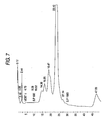
- the chromatogram before the activation is an inactive type because of the presence of a large number of molecular species originated from the heterogeneity as shown in Fig. 4, but it becomes a chromatogram of active type GAH when the activation reaction is carried out as shown in Fig. 5. Thereafter, differences from the chromatogram of after the activation reaction cannot be found in the chromatogram after carrying out the treatment of the present invention as shown in Fig. 6. In addition, changes cannot be found even when the desalting and concentration treatment is carried out as shown in Fig. 7.
- Example 4 Using the GAH whole antibody solution obtained in Example 4, a gel filtration HPLC analysis was carried out to compare amounts of a monomer of the antibody before and after the polymerization inhibition treatment.
- the operation conditions are the same as in Example 1.
- the purified GAH whole antibody to which the treatment of the present invention was not applied forms a polymer in a large amount at the desalting and concentration step.
- the monomer content increases after the activation treatment though slight, and polymer is not formed at the desalting and concentration step.
- a 150 ml portion of a sample was taken off from the solution obtained in Example 4 and digested with pepsin. That is, pepsin (manufactured by SIGMA) was added thereto to a concentration of 1.2 mg/g GAH, followed by aseptic filtration using a bottle top filter (Corning Coaster, 0.22 ⁇ m) and then gently stirring for 19 hours under heating at 37°C.
- pepsin manufactured by SIGMA
- the GAH antibody F(ab') 2 was purified using cation exchange column chromatography. That is, the XK16 column was packed with 15.3 ml of a cation exchange resin SP-Sepharose HP (manufactured by Amersham Bioscience), and the antibody-containing liquid after pepsin digestion was applied thereto. Thereafter, washing was carried out using 40 mM acetate buffer (pH 4.0) containing 20 mM NaCl, and peak of the antibody was fractionated while gradually increasing the salt concentration. The flow rate was 4.17 ml/min.
- the mixture was adjusted to pH 7.0 by carrying out buffer exchange to 5 mM phosphate buffer (pH 4.0) using Saltocon of nominal molecular weight cutoff of 30 kDa, and then the GAH antibody F(ab') 2 was purified by anion exchange column chromatography. That is, the XK16 column was packed with 31 ml of an anion exchange resin Q-Sepharose FF (manufactured by Amersham Bioscience), the antibody-containing solution after buffer exchange was applied thereto and peak of the antibody was fractionated. Thereafter, the mixture was adjusted to pH 4.0 and the antibody concentration was adjusted to about 5 mg/ml using Saltocon of nominal molecular weight cutoff of 30-kDa to thereby obtaining a purified GAH antibody F(ab') 2 .
- Cation exchange liquid chromatography was carried out by applying the GAH antibody F(ab') 2 obtained in Example 7 to TSKgel CM-5PW (7.5 mm in inner diameter, 7.5 cm in length; manufactured by Tosoh). The operation conditions are the same as shown in Example 4.
- the GAH antibody F(ab') 2 obtained in Example 7 was subjected to the measurement of amounts of monomer by using a gel filtration HPLC method.
- the monomer content was 93.8%, thus revealing that the antibody sufficiently satisfying the purification specification was obtained.
- the treatment of the present invention inhibited formation of polymer throughout the entire purification process, and it was found that sharp improvement of the purification yield was attained.
Landscapes
- Chemical & Material Sciences (AREA)
- Organic Chemistry (AREA)
- Health & Medical Sciences (AREA)
- General Health & Medical Sciences (AREA)
- Life Sciences & Earth Sciences (AREA)
- Medicinal Chemistry (AREA)
- Proteomics, Peptides & Aminoacids (AREA)
- Genetics & Genomics (AREA)
- Biophysics (AREA)
- Molecular Biology (AREA)
- Biochemistry (AREA)
- Analytical Chemistry (AREA)
- Chemical Kinetics & Catalysis (AREA)
- General Chemical & Material Sciences (AREA)
- Pharmacology & Pharmacy (AREA)
- Nuclear Medicine, Radiotherapy & Molecular Imaging (AREA)
- Animal Behavior & Ethology (AREA)
- Public Health (AREA)
- Veterinary Medicine (AREA)
- Peptides Or Proteins (AREA)
- Medicines Containing Antibodies Or Antigens For Use As Internal Diagnostic Agents (AREA)
- Preparation Of Compounds By Using Micro-Organisms (AREA)
- Medicines That Contain Protein Lipid Enzymes And Other Medicines (AREA)
Abstract
Description
- Detector:
- Ultraviolet absorption photometer (measuring wavelength: 215 nm)
- Column:
- TSKgel G3000SWXL (about 8 mm in inner diameter × about 30 cm in length) manufactured by Tosoh
- Pre-column:
- TSKgel guardcolumnSWXL (about 6 mm in inner diameter × about 4 cm in length) manufactured by Tosoh
- Column temp:
- Constant temperature of around 25°C
- Mobile phase:
- 50 mM sodium phosphate buffer (pH 7.0)/300 mM sodium sulfate
- Flow rate:
- 0.3 ml/min
| Detector | Ultraviolet absorption photometer (measuring wavelength: 280 nm) |
| Column | TSKgel CM-5PW (7.5 mm in inner diameter × 7.5 cm in length) manufactured by Tosoh |
| Column temperature | Constant temperature of around 30°C |
| Mobile phase A | 5.0 mM sodium phosphate buffer (pH 7.0) |
| |
50 mM sodium phosphate buffer (pH 7.0)/0.5 M sodium chloride |
| Time (min) after injection | Mobile phase A (%) | Mobile phase B (%) |
| 0-40 | 100 → 50 | 0 → 50 |
| 40-41 | 50 → 100 | 50 → 0 |
- Flow rate:
- 1.0 ml/min
| Comparison of the effect of polymerization inhibition treatment | ||||
| Polymerization inhibition treatment | No polymerization inhibition treatment | |||
| Monomer (%) | Polymer (%) | Monomer (%) | Polymer (%) | |
| Before activation reaction | 96.8 | 3.18 | 96.8 | 3.18 |
| After activation reaction | 94.6 | 5.05 | 94.6 | 5.05 |
| After polymerization inhibition treatment | 97.5 | 2.28 | - | - |
| After desalting and concentration | 97.3 | 2.56 | 83.8 | 13.8 |


Claims (21)
- A method for protecting a thiol group in a protein having a free cysteine residue, which comprises adding a compound which has a disulfide bond in the molecule and exerts substantially no influence on the activity of the protein.
- A method for inhibiting a polymerization reaction of proteins via thiol groups, which comprises protecting a thiol group in a protein having a free cysteine residue by adding a compound which has a disulfide bond in the molecule and exerts substantially no influence on the activity of the protein.
- A method for inhibiting modification of a protein, which comprises protecting a thiol group in a protein having a free cysteine residue by adding a compound which has a disulfide bond in the molecule and exerts substantially no influence on the activity of the protein.
- A method for inhibiting an exchange reaction of a thiol group in a protein with a disulfide bond formed in the molecule or between the molecules of the protein, which comprises protecting a thiol group in a protein having a free cysteine residue by adding a compound which has a disulfide bond in the molecule and exerts substantially no influence on the activity of the protein.
- The method according to any one of claims 1 to 4, wherein the compound which has a disulfide bond in the molecule and exerts substantially no influence on the activity of the protein is cystine, homocystine, lipoic acid or oxidized glutathione.
- The method according to any one of claims 1 to 5, wherein the compound which has a disulfide bond in the molecule and exerts substantially no influence on the activity of the protein is cystine.
- A method for protecting a thiol group in a protein having a free cysteine residue, which comprises adding a compound which has a disulfide bond in the molecule and exerts substantially no influence on the activity of the protein simultaneously or separately from a compound which has a thiol group in the molecule and exerts substantially no influence on the activity of the protein.
- The method according to claim 7, wherein the compound which has a thiol group in the molecule and exerts substantially no influence on the activity of the protein is cysteine, homocysteine, glutathione or dihydrolipoic acid.
- The method according to claim 7 or 8, wherein the compound which has a thiol group in the molecule and exerts substantially no influence on the activity of the protein is cysteine.
- The method according to any one of claims 1 to 9, wherein the protein is a recombinant protein.
- The method according to any one of claims 1 to 9, wherein the protein is an antibody.
- The method according to claim 11, wherein the antibody is an F(ab')2 antibody.
- The method according to claim 11 or 12, wherein the antibody is a monoclonal antibody.
- The method according to claim 13, wherein the monoclonal antibody has a thiol group in its variable region.
- The method according to claim 13 or 14, wherein the monoclonal antibody has a free cysteine residue in its variable region.
- The method according to any one of claims 13 to 15, wherein the monoclonal antibody comprises the amino acid sequences represented by SEQ ID NOs:1, 2 and 3 in the Sequence Listing in its heavy chain hypervariable region, and the amino acid sequences represented by SEQ ID NOs:4, 5 and 6 in the Sequence Listing in its light chain hypervariable region.
- The method according to any one of claims 13 to 16, wherein the monoclonal antibody comprises a heavy chain variable region comprising the amino acid sequence represented by SEQ ID NO:7 in the Sequence Listing and a light chain variable region containing the amino acid sequence represented by SEQ ID NO:8 in the Sequence Listing.
- The method according to any one of claims 1 to 17, wherein the protein is produced by using a cell cultured in a serum-free medium.
- A protein which is obtainable by the method according to claim 18.
- A pharmaceutical composition which comprises the protein according to claim 19.
- The pharmaceutical composition according to claim 20, which is an antitumor agent.
Applications Claiming Priority (3)
| Application Number | Priority Date | Filing Date | Title |
|---|---|---|---|
| JP2002370822 | 2002-12-20 | ||
| JP2002370822 | 2002-12-20 | ||
| PCT/JP2003/016362 WO2004056872A1 (en) | 2002-12-20 | 2003-12-19 | Method of protecting thiol group of protein |
Publications (3)
| Publication Number | Publication Date |
|---|---|
| EP1574521A1 true EP1574521A1 (en) | 2005-09-14 |
| EP1574521A4 EP1574521A4 (en) | 2006-04-12 |
| EP1574521B1 EP1574521B1 (en) | 2009-05-20 |
Family
ID=32677181
Family Applications (1)
| Application Number | Title | Priority Date | Filing Date |
|---|---|---|---|
| EP03780938A Expired - Lifetime EP1574521B1 (en) | 2002-12-20 | 2003-12-19 | Method of protecting of thiol groups in antibodies |
Country Status (9)
| Country | Link |
|---|---|
| US (1) | US20060257393A1 (en) |
| EP (1) | EP1574521B1 (en) |
| JP (1) | JPWO2004056872A1 (en) |
| AT (1) | ATE431835T1 (en) |
| AU (1) | AU2003289455A1 (en) |
| CA (1) | CA2511228A1 (en) |
| DE (1) | DE60327715D1 (en) |
| ES (1) | ES2326076T3 (en) |
| WO (1) | WO2004056872A1 (en) |
Families Citing this family (2)
| Publication number | Priority date | Publication date | Assignee | Title |
|---|---|---|---|---|
| AR103173A1 (en) | 2014-12-22 | 2017-04-19 | Novarits Ag | PHARMACEUTICAL PRODUCTS AND STABLE LIQUID COMPOSITIONS OF ANTIBODIES IL-17 |
| AR103172A1 (en) | 2014-12-22 | 2017-04-19 | Novartis Ag | SELECTIVE REDUCTION OF CYSTEINE WASTE IN ANTIBODIES IL-17 |
Family Cites Families (13)
| Publication number | Priority date | Publication date | Assignee | Title |
|---|---|---|---|---|
| US4734362A (en) * | 1986-02-03 | 1988-03-29 | Cambridge Bioscience Corporation | Process for purifying recombinant proteins, and products thereof |
| DE3851685D1 (en) * | 1987-10-13 | 1994-11-03 | Thomae Gmbh Dr K | Process for the production of proteins. |
| US5130418A (en) * | 1989-05-02 | 1992-07-14 | California Biotechnology Inc. | Method to stabilize basic fibroblast growth factor |
| CA2094378A1 (en) * | 1990-10-25 | 1992-04-26 | Paul B. Fisher | Development of dna probes and immunological reagents of human tumor associated antigens |
| US5284830A (en) * | 1991-02-13 | 1994-02-08 | The Board Of Trustees Of The Leland Stanford Junior University | Thyroid-derived chondrocyte-stimulating factor |
| JP3220180B2 (en) * | 1991-05-23 | 2001-10-22 | 三菱化学株式会社 | Drug-containing protein-bound liposomes |
| JP3236667B2 (en) * | 1991-06-28 | 2001-12-10 | 三菱化学株式会社 | Human monoclonal antibody and gene encoding the same, hybridoma and antitumor agent |
| CA2072249C (en) * | 1991-06-28 | 2003-06-17 | Saiko Hosokawa | Human monoclonal antibody specifically binding to surface antigen of cancer cell membrane |
| CA2137561C (en) * | 1992-07-06 | 2001-10-23 | Thomas R. Sykes | Photoactivation of proteins for conjugation purposes |
| DE69636739T2 (en) * | 1995-12-21 | 2007-10-18 | Ajinomoto Co., Inc. | PROCESS FOR THE RECONSTRUCTION OF HUMAN ACTIVIN A |
| TR199802584T2 (en) * | 1996-06-11 | 1999-03-22 | Boehringer Mannheim Gmbh | Method for activating denatured protein. |
| US20030120042A1 (en) * | 2000-03-30 | 2003-06-26 | Takao Yamada | Process for producing recombinant protein |
| JP4249028B2 (en) * | 2001-12-04 | 2009-04-02 | 田辺三菱製薬株式会社 | Protein activation method |
-
2003
- 2003-12-19 JP JP2004562060A patent/JPWO2004056872A1/en not_active Withdrawn
- 2003-12-19 AU AU2003289455A patent/AU2003289455A1/en not_active Abandoned
- 2003-12-19 CA CA002511228A patent/CA2511228A1/en not_active Abandoned
- 2003-12-19 EP EP03780938A patent/EP1574521B1/en not_active Expired - Lifetime
- 2003-12-19 ES ES03780938T patent/ES2326076T3/en not_active Expired - Lifetime
- 2003-12-19 DE DE60327715T patent/DE60327715D1/en not_active Expired - Fee Related
- 2003-12-19 WO PCT/JP2003/016362 patent/WO2004056872A1/en not_active Ceased
- 2003-12-19 US US10/539,756 patent/US20060257393A1/en not_active Abandoned
- 2003-12-19 AT AT03780938T patent/ATE431835T1/en not_active IP Right Cessation
Also Published As
| Publication number | Publication date |
|---|---|
| ES2326076T3 (en) | 2009-09-30 |
| ATE431835T1 (en) | 2009-06-15 |
| CA2511228A1 (en) | 2004-07-08 |
| DE60327715D1 (en) | 2009-07-02 |
| US20060257393A1 (en) | 2006-11-16 |
| EP1574521A4 (en) | 2006-04-12 |
| AU2003289455A1 (en) | 2004-07-14 |
| WO2004056872A1 (en) | 2004-07-08 |
| JPWO2004056872A1 (en) | 2006-04-20 |
| EP1574521B1 (en) | 2009-05-20 |
Similar Documents
| Publication | Publication Date | Title |
|---|---|---|
| Edelman et al. | Studies on structural units of the γ-globulins | |
| JP2881499B2 (en) | Stabilized antibody | |
| Radoff et al. | Isolation of surface binding protein specific for advanced glycosylation end products from mouse macrophage-derived cell line RAW 264.7 | |
| Carlson et al. | Antibody assisted protein refolding | |
| JP6865209B2 (en) | Capped and uncapped antibody cysteines, and their use in antibody-drug conjugation | |
| JP2017502085A (en) | Purification method of Cys-linked antibody-drug conjugate | |
| EP0112720A2 (en) | Conjugate having cytotoxicity and process for the preparation thereof | |
| TWI643871B (en) | Human antibody kappa-type light chain complex-containing composition and method of manufacturing the same | |
| US20260103739A1 (en) | Composition comprising aflibercept and a variant thereof, and related methods and uses | |
| US8394368B2 (en) | Method for producing a composition for promoting survival of transplanted hematopoietic stem cell | |
| EP1574521A1 (en) | Method of protecting thiol group of protein | |
| EP4501345B1 (en) | A composition comprising aflibercept and a variant thereof and related methods and uses | |
| JPS58192896A (en) | Interferon | |
| EP0499541A1 (en) | Process for the purification of a highly glycosylated protein | |
| EP0132021B1 (en) | Tgf polypeptides, antigenic oligopeptides derived therefrom and antibodies produced therefrom | |
| JP4249028B2 (en) | Protein activation method | |
| AU601168B2 (en) | Novel cell growth regulatory factor | |
| JP2001510848A (en) | Refolding method using foldase and chaperone | |
| JPWO1992014832A1 (en) | Purification method for human BCDF | |
| CZ116495A3 (en) | Production of human monoclonal antibodies against hepatitis b surface antigen | |
| IL250148B2 (en) | Methods of conjugating an agent to a thiol moiety in a protein that contains at least one trisulfide bond | |
| JP2519561B2 (en) | Acidic glycoprotein | |
| HK40077434B (en) | Humanized single domain antibody and its application and drugs | |
| HK40077434A (en) | Humanized single domain antibody and its application and drugs | |
| JPH02171199A (en) | Monoclonal antibody against interleukin 2 receptor and hybridoma producing the same |
Legal Events
| Date | Code | Title | Description |
|---|---|---|---|
| PUAI | Public reference made under article 153(3) epc to a published international application that has entered the european phase |
Free format text: ORIGINAL CODE: 0009012 |
|
| 17P | Request for examination filed |
Effective date: 20050620 |
|
| AK | Designated contracting states |
Kind code of ref document: A1 Designated state(s): AT BE BG CH CY CZ DE DK EE ES FI FR GB GR HU IE IT LI LU MC NL PT RO SE SI SK TR |
|
| AX | Request for extension of the european patent |
Extension state: AL LT LV MK |
|
| A4 | Supplementary search report drawn up and despatched |
Effective date: 20060224 |
|
| DAX | Request for extension of the european patent (deleted) | ||
| 17Q | First examination report despatched |
Effective date: 20060602 |
|
| 17Q | First examination report despatched |
Effective date: 20060602 |
|
| RAP1 | Party data changed (applicant data changed or rights of an application transferred) |
Owner name: MITSUBISHI TANABE PHARMA CORPORATION |
|
| GRAP | Despatch of communication of intention to grant a patent |
Free format text: ORIGINAL CODE: EPIDOSNIGR1 |
|
| RTI1 | Title (correction) |
Free format text: METHOD OF PROTECTING OF THIOL GROUPS IN ANTIBODIES |
|
| GRAS | Grant fee paid |
Free format text: ORIGINAL CODE: EPIDOSNIGR3 |
|
| GRAA | (expected) grant |
Free format text: ORIGINAL CODE: 0009210 |
|
| AK | Designated contracting states |
Kind code of ref document: B1 Designated state(s): AT BE BG CH CY CZ DE DK EE ES FI FR GB GR HU IE IT LI LU MC NL PT RO SE SI SK TR |
|
| REG | Reference to a national code |
Ref country code: GB Ref legal event code: FG4D |
|
| REG | Reference to a national code |
Ref country code: CH Ref legal event code: EP |
|
| REG | Reference to a national code |
Ref country code: IE Ref legal event code: FG4D |
|
| REF | Corresponds to: |
Ref document number: 60327715 Country of ref document: DE Date of ref document: 20090702 Kind code of ref document: P |
|
| REG | Reference to a national code |
Ref country code: ES Ref legal event code: FG2A Ref document number: 2326076 Country of ref document: ES Kind code of ref document: T3 |
|
| PG25 | Lapsed in a contracting state [announced via postgrant information from national office to epo] |
Ref country code: FI Free format text: LAPSE BECAUSE OF FAILURE TO SUBMIT A TRANSLATION OF THE DESCRIPTION OR TO PAY THE FEE WITHIN THE PRESCRIBED TIME-LIMIT Effective date: 20090520 Ref country code: PT Free format text: LAPSE BECAUSE OF FAILURE TO SUBMIT A TRANSLATION OF THE DESCRIPTION OR TO PAY THE FEE WITHIN THE PRESCRIBED TIME-LIMIT Effective date: 20090920 Ref country code: AT Free format text: LAPSE BECAUSE OF FAILURE TO SUBMIT A TRANSLATION OF THE DESCRIPTION OR TO PAY THE FEE WITHIN THE PRESCRIBED TIME-LIMIT Effective date: 20090520 |
|
| NLV1 | Nl: lapsed or annulled due to failure to fulfill the requirements of art. 29p and 29m of the patents act | ||
| PG25 | Lapsed in a contracting state [announced via postgrant information from national office to epo] |
Ref country code: NL Free format text: LAPSE BECAUSE OF FAILURE TO SUBMIT A TRANSLATION OF THE DESCRIPTION OR TO PAY THE FEE WITHIN THE PRESCRIBED TIME-LIMIT Effective date: 20090520 Ref country code: SI Free format text: LAPSE BECAUSE OF FAILURE TO SUBMIT A TRANSLATION OF THE DESCRIPTION OR TO PAY THE FEE WITHIN THE PRESCRIBED TIME-LIMIT Effective date: 20090520 Ref country code: SE Free format text: LAPSE BECAUSE OF FAILURE TO SUBMIT A TRANSLATION OF THE DESCRIPTION OR TO PAY THE FEE WITHIN THE PRESCRIBED TIME-LIMIT Effective date: 20090820 |
|
| PG25 | Lapsed in a contracting state [announced via postgrant information from national office to epo] |
Ref country code: RO Free format text: LAPSE BECAUSE OF FAILURE TO SUBMIT A TRANSLATION OF THE DESCRIPTION OR TO PAY THE FEE WITHIN THE PRESCRIBED TIME-LIMIT Effective date: 20090520 Ref country code: EE Free format text: LAPSE BECAUSE OF FAILURE TO SUBMIT A TRANSLATION OF THE DESCRIPTION OR TO PAY THE FEE WITHIN THE PRESCRIBED TIME-LIMIT Effective date: 20090520 Ref country code: DK Free format text: LAPSE BECAUSE OF FAILURE TO SUBMIT A TRANSLATION OF THE DESCRIPTION OR TO PAY THE FEE WITHIN THE PRESCRIBED TIME-LIMIT Effective date: 20090520 Ref country code: CZ Free format text: LAPSE BECAUSE OF FAILURE TO SUBMIT A TRANSLATION OF THE DESCRIPTION OR TO PAY THE FEE WITHIN THE PRESCRIBED TIME-LIMIT Effective date: 20090520 |
|
| PG25 | Lapsed in a contracting state [announced via postgrant information from national office to epo] |
Ref country code: SK Free format text: LAPSE BECAUSE OF FAILURE TO SUBMIT A TRANSLATION OF THE DESCRIPTION OR TO PAY THE FEE WITHIN THE PRESCRIBED TIME-LIMIT Effective date: 20090520 Ref country code: BE Free format text: LAPSE BECAUSE OF FAILURE TO SUBMIT A TRANSLATION OF THE DESCRIPTION OR TO PAY THE FEE WITHIN THE PRESCRIBED TIME-LIMIT Effective date: 20090520 |
|
| PLBE | No opposition filed within time limit |
Free format text: ORIGINAL CODE: 0009261 |
|
| STAA | Information on the status of an ep patent application or granted ep patent |
Free format text: STATUS: NO OPPOSITION FILED WITHIN TIME LIMIT |
|
| PG25 | Lapsed in a contracting state [announced via postgrant information from national office to epo] |
Ref country code: BG Free format text: LAPSE BECAUSE OF FAILURE TO SUBMIT A TRANSLATION OF THE DESCRIPTION OR TO PAY THE FEE WITHIN THE PRESCRIBED TIME-LIMIT Effective date: 20090820 |
|
| 26N | No opposition filed |
Effective date: 20100223 |
|
| PG25 | Lapsed in a contracting state [announced via postgrant information from national office to epo] |
Ref country code: MC Free format text: LAPSE BECAUSE OF NON-PAYMENT OF DUE FEES Effective date: 20100701 |
|
| REG | Reference to a national code |
Ref country code: CH Ref legal event code: PL |
|
| GBPC | Gb: european patent ceased through non-payment of renewal fee |
Effective date: 20091219 |
|
| REG | Reference to a national code |
Ref country code: FR Ref legal event code: ST Effective date: 20100831 |
|
| PG25 | Lapsed in a contracting state [announced via postgrant information from national office to epo] |
Ref country code: LI Free format text: LAPSE BECAUSE OF NON-PAYMENT OF DUE FEES Effective date: 20091231 Ref country code: IE Free format text: LAPSE BECAUSE OF NON-PAYMENT OF DUE FEES Effective date: 20091219 Ref country code: GR Free format text: LAPSE BECAUSE OF FAILURE TO SUBMIT A TRANSLATION OF THE DESCRIPTION OR TO PAY THE FEE WITHIN THE PRESCRIBED TIME-LIMIT Effective date: 20090821 Ref country code: CH Free format text: LAPSE BECAUSE OF NON-PAYMENT OF DUE FEES Effective date: 20091231 Ref country code: FR Free format text: LAPSE BECAUSE OF NON-PAYMENT OF DUE FEES Effective date: 20091231 |
|
| PG25 | Lapsed in a contracting state [announced via postgrant information from national office to epo] |
Ref country code: DE Free format text: LAPSE BECAUSE OF NON-PAYMENT OF DUE FEES Effective date: 20100701 |
|
| PG25 | Lapsed in a contracting state [announced via postgrant information from national office to epo] |
Ref country code: GB Free format text: LAPSE BECAUSE OF NON-PAYMENT OF DUE FEES Effective date: 20091219 |
|
| REG | Reference to a national code |
Ref country code: ES Ref legal event code: FD2A Effective date: 20110303 |
|
| PG25 | Lapsed in a contracting state [announced via postgrant information from national office to epo] |
Ref country code: IT Free format text: LAPSE BECAUSE OF NON-PAYMENT OF DUE FEES Effective date: 20091219 |
|
| PG25 | Lapsed in a contracting state [announced via postgrant information from national office to epo] |
Ref country code: LU Free format text: LAPSE BECAUSE OF NON-PAYMENT OF DUE FEES Effective date: 20091219 |
|
| PG25 | Lapsed in a contracting state [announced via postgrant information from national office to epo] |
Ref country code: HU Free format text: LAPSE BECAUSE OF FAILURE TO SUBMIT A TRANSLATION OF THE DESCRIPTION OR TO PAY THE FEE WITHIN THE PRESCRIBED TIME-LIMIT Effective date: 20091121 |
|
| PG25 | Lapsed in a contracting state [announced via postgrant information from national office to epo] |
Ref country code: ES Free format text: LAPSE BECAUSE OF NON-PAYMENT OF DUE FEES Effective date: 20110228 |
|
| PG25 | Lapsed in a contracting state [announced via postgrant information from national office to epo] |
Ref country code: TR Free format text: LAPSE BECAUSE OF FAILURE TO SUBMIT A TRANSLATION OF THE DESCRIPTION OR TO PAY THE FEE WITHIN THE PRESCRIBED TIME-LIMIT Effective date: 20090520 |
|
| PG25 | Lapsed in a contracting state [announced via postgrant information from national office to epo] |
Ref country code: CY Free format text: LAPSE BECAUSE OF FAILURE TO SUBMIT A TRANSLATION OF THE DESCRIPTION OR TO PAY THE FEE WITHIN THE PRESCRIBED TIME-LIMIT Effective date: 20090520 Ref country code: ES Free format text: LAPSE BECAUSE OF NON-PAYMENT OF DUE FEES Effective date: 20091220 |