EP1574515A2 - Production method of 2-deoxy-L-ribose compound - Google Patents
Production method of 2-deoxy-L-ribose compound Download PDFInfo
- Publication number
- EP1574515A2 EP1574515A2 EP05005276A EP05005276A EP1574515A2 EP 1574515 A2 EP1574515 A2 EP 1574515A2 EP 05005276 A EP05005276 A EP 05005276A EP 05005276 A EP05005276 A EP 05005276A EP 1574515 A2 EP1574515 A2 EP 1574515A2
- Authority
- EP
- European Patent Office
- Prior art keywords
- group
- hydroxyl
- formula
- deoxy
- production method
- Prior art date
- Legal status (The legal status is an assumption and is not a legal conclusion. Google has not performed a legal analysis and makes no representation as to the accuracy of the status listed.)
- Withdrawn
Links
- -1 2-deoxy-L-ribose compound Chemical class 0.000 title claims abstract description 121
- 238000004519 manufacturing process Methods 0.000 title claims abstract description 83
- 125000002887 hydroxy group Chemical group [H]O* 0.000 claims abstract description 54
- 125000000217 alkyl group Chemical group 0.000 claims abstract description 37
- 238000005903 acid hydrolysis reaction Methods 0.000 claims abstract description 31
- 125000003710 aryl alkyl group Chemical group 0.000 claims abstract description 26
- 125000003118 aryl group Chemical group 0.000 claims abstract description 23
- 125000006165 cyclic alkyl group Chemical group 0.000 claims abstract description 21
- 150000002902 organometallic compounds Chemical class 0.000 claims abstract description 20
- 238000010511 deprotection reaction Methods 0.000 claims abstract description 12
- 125000003808 silyl group Chemical group [H][Si]([H])([H])[*] 0.000 claims abstract description 7
- ASJSAQIRZKANQN-UHNVWZDZSA-N 2-deoxy-L-arabinose Chemical compound OC[C@H](O)[C@H](O)CC=O ASJSAQIRZKANQN-UHNVWZDZSA-N 0.000 claims description 59
- OKKJLVBELUTLKV-UHFFFAOYSA-N Methanol Chemical compound OC OKKJLVBELUTLKV-UHFFFAOYSA-N 0.000 claims description 54
- 150000002243 furanoses Chemical class 0.000 claims description 45
- 239000000203 mixture Substances 0.000 claims description 38
- 125000005843 halogen group Chemical group 0.000 claims description 22
- 239000002253 acid Substances 0.000 claims description 18
- 239000003960 organic solvent Substances 0.000 claims description 18
- 229910052801 chlorine Inorganic materials 0.000 claims description 17
- 125000001309 chloro group Chemical group Cl* 0.000 claims description 17
- CSCPPACGZOOCGX-UHFFFAOYSA-N Acetone Chemical compound CC(C)=O CSCPPACGZOOCGX-UHFFFAOYSA-N 0.000 claims description 14
- LFQSCWFLJHTTHZ-UHFFFAOYSA-N Ethanol Chemical compound CCO LFQSCWFLJHTTHZ-UHFFFAOYSA-N 0.000 claims description 14
- DHKHKXVYLBGOIT-UHFFFAOYSA-N acetaldehyde Diethyl Acetal Natural products CCOC(C)OCC DHKHKXVYLBGOIT-UHFFFAOYSA-N 0.000 claims description 13
- 125000006239 protecting group Chemical group 0.000 claims description 13
- 150000001299 aldehydes Chemical class 0.000 claims description 11
- XLYOFNOQVPJJNP-UHFFFAOYSA-N water Substances O XLYOFNOQVPJJNP-UHFFFAOYSA-N 0.000 claims description 11
- 229910052751 metal Inorganic materials 0.000 claims description 9
- 239000002184 metal Substances 0.000 claims description 9
- 125000005440 p-toluyl group Chemical group [H]C1=C([H])C(=C([H])C([H])=C1C(*)=O)C([H])([H])[H] 0.000 claims description 6
- 150000003839 salts Chemical class 0.000 claims description 6
- 238000000926 separation method Methods 0.000 claims description 6
- 125000004429 atom Chemical class 0.000 claims description 4
- 125000002485 formyl group Chemical class [H]C(*)=O 0.000 abstract 1
- 150000001875 compounds Chemical class 0.000 description 45
- 238000006243 chemical reaction Methods 0.000 description 42
- YMWUJEATGCHHMB-UHFFFAOYSA-N Dichloromethane Chemical compound ClCCl YMWUJEATGCHHMB-UHFFFAOYSA-N 0.000 description 40
- VLKZOEOYAKHREP-UHFFFAOYSA-N n-Hexane Chemical compound CCCCCC VLKZOEOYAKHREP-UHFFFAOYSA-N 0.000 description 36
- RTZKZFJDLAIYFH-UHFFFAOYSA-N Diethyl ether Chemical compound CCOCC RTZKZFJDLAIYFH-UHFFFAOYSA-N 0.000 description 26
- 125000002496 methyl group Chemical group [H]C([H])([H])* 0.000 description 26
- 125000001424 substituent group Chemical group 0.000 description 26
- XEKOWRVHYACXOJ-UHFFFAOYSA-N Ethyl acetate Chemical compound CCOC(C)=O XEKOWRVHYACXOJ-UHFFFAOYSA-N 0.000 description 24
- WYURNTSHIVDZCO-UHFFFAOYSA-N Tetrahydrofuran Chemical compound C1CCOC1 WYURNTSHIVDZCO-UHFFFAOYSA-N 0.000 description 18
- HEDRZPFGACZZDS-MICDWDOJSA-N Trichloro(2H)methane Chemical compound [2H]C(Cl)(Cl)Cl HEDRZPFGACZZDS-MICDWDOJSA-N 0.000 description 18
- 238000000034 method Methods 0.000 description 18
- QTBSBXVTEAMEQO-UHFFFAOYSA-N Acetic acid Chemical compound CC(O)=O QTBSBXVTEAMEQO-UHFFFAOYSA-N 0.000 description 15
- 125000004432 carbon atom Chemical group C* 0.000 description 13
- 238000004809 thin layer chromatography Methods 0.000 description 13
- OKTJSMMVPCPJKN-UHFFFAOYSA-N Carbon Chemical compound [C] OKTJSMMVPCPJKN-UHFFFAOYSA-N 0.000 description 12
- 125000004036 acetal group Chemical group 0.000 description 12
- 229910052799 carbon Inorganic materials 0.000 description 12
- 239000007858 starting material Substances 0.000 description 11
- 238000005160 1H NMR spectroscopy Methods 0.000 description 10
- MEKOFIRRDATTAG-UHFFFAOYSA-N 2,2,5,8-tetramethyl-3,4-dihydrochromen-6-ol Chemical compound C1CC(C)(C)OC2=C1C(C)=C(O)C=C2C MEKOFIRRDATTAG-UHFFFAOYSA-N 0.000 description 10
- 238000012790 confirmation Methods 0.000 description 10
- YXFVVABEGXRONW-UHFFFAOYSA-N Toluene Chemical compound CC1=CC=CC=C1 YXFVVABEGXRONW-UHFFFAOYSA-N 0.000 description 9
- YLQBMQCUIZJEEH-UHFFFAOYSA-N tetrahydrofuran Natural products C=1C=COC=1 YLQBMQCUIZJEEH-UHFFFAOYSA-N 0.000 description 9
- VEXZGXHMUGYJMC-UHFFFAOYSA-N Hydrochloric acid Chemical compound Cl VEXZGXHMUGYJMC-UHFFFAOYSA-N 0.000 description 8
- 125000003545 alkoxy group Chemical group 0.000 description 8
- 238000004587 chromatography analysis Methods 0.000 description 8
- 229910052731 fluorine Inorganic materials 0.000 description 8
- 125000001153 fluoro group Chemical group F* 0.000 description 8
- 125000000956 methoxy group Chemical group [H]C([H])([H])O* 0.000 description 8
- 238000000746 purification Methods 0.000 description 8
- 150000003215 pyranoses Chemical class 0.000 description 8
- YSGPYVWACGYQDJ-RXMQYKEDSA-N (4s)-2,2-dimethyl-1,3-dioxolane-4-carbaldehyde Chemical compound CC1(C)OC[C@@H](C=O)O1 YSGPYVWACGYQDJ-RXMQYKEDSA-N 0.000 description 7
- 125000000654 isopropylidene group Chemical group C(C)(C)=* 0.000 description 7
- 239000007788 liquid Substances 0.000 description 7
- NLXLAEXVIDQMFP-UHFFFAOYSA-N Ammonia chloride Chemical compound [NH4+].[Cl-] NLXLAEXVIDQMFP-UHFFFAOYSA-N 0.000 description 6
- HEDRZPFGACZZDS-UHFFFAOYSA-N Chloroform Chemical compound ClC(Cl)Cl HEDRZPFGACZZDS-UHFFFAOYSA-N 0.000 description 6
- VYPSYNLAJGMNEJ-UHFFFAOYSA-N Silicium dioxide Chemical compound O=[Si]=O VYPSYNLAJGMNEJ-UHFFFAOYSA-N 0.000 description 6
- FAPWRFPIFSIZLT-UHFFFAOYSA-M Sodium chloride Chemical compound [Na+].[Cl-] FAPWRFPIFSIZLT-UHFFFAOYSA-M 0.000 description 6
- 125000001797 benzyl group Chemical group [H]C1=C([H])C([H])=C(C([H])=C1[H])C([H])([H])* 0.000 description 6
- 125000001495 ethyl group Chemical group [H]C([H])([H])C([H])([H])* 0.000 description 6
- 239000010410 layer Substances 0.000 description 6
- 238000012544 monitoring process Methods 0.000 description 6
- 125000000449 nitro group Chemical group [O-][N+](*)=O 0.000 description 6
- 239000000047 product Substances 0.000 description 6
- 239000000741 silica gel Substances 0.000 description 6
- 229910002027 silica gel Inorganic materials 0.000 description 6
- 238000000638 solvent extraction Methods 0.000 description 6
- IKHGUXGNUITLKF-UHFFFAOYSA-N Acetaldehyde Chemical class CC=O IKHGUXGNUITLKF-UHFFFAOYSA-N 0.000 description 5
- WKBOTKDWSSQWDR-UHFFFAOYSA-N Bromine atom Chemical group [Br] WKBOTKDWSSQWDR-UHFFFAOYSA-N 0.000 description 5
- 230000015572 biosynthetic process Effects 0.000 description 5
- 239000002904 solvent Substances 0.000 description 5
- 238000003786 synthesis reaction Methods 0.000 description 5
- 125000000999 tert-butyl group Chemical group [H]C([H])([H])C(*)(C([H])([H])[H])C([H])([H])[H] 0.000 description 5
- 125000000026 trimethylsilyl group Chemical group [H]C([H])([H])[Si]([*])(C([H])([H])[H])C([H])([H])[H] 0.000 description 5
- 239000005977 Ethylene Substances 0.000 description 4
- 0 OC[C@@]1O*C[C@]1O Chemical compound OC[C@@]1O*C[C@]1O 0.000 description 4
- JUJWROOIHBZHMG-UHFFFAOYSA-N Pyridine Chemical compound C1=CC=NC=C1 JUJWROOIHBZHMG-UHFFFAOYSA-N 0.000 description 4
- UIIMBOGNXHQVGW-UHFFFAOYSA-M Sodium bicarbonate Chemical compound [Na+].OC([O-])=O UIIMBOGNXHQVGW-UHFFFAOYSA-M 0.000 description 4
- QAOWNCQODCNURD-UHFFFAOYSA-N Sulfuric acid Chemical compound OS(O)(=O)=O QAOWNCQODCNURD-UHFFFAOYSA-N 0.000 description 4
- DTQVDTLACAAQTR-UHFFFAOYSA-N Trifluoroacetic acid Chemical compound OC(=O)C(F)(F)F DTQVDTLACAAQTR-UHFFFAOYSA-N 0.000 description 4
- 125000001584 benzyloxycarbonyl group Chemical group C(=O)(OCC1=CC=CC=C1)* 0.000 description 4
- 239000013078 crystal Substances 0.000 description 4
- 125000000219 ethylidene group Chemical group [H]C(=[*])C([H])([H])[H] 0.000 description 4
- 150000002632 lipids Chemical class 0.000 description 4
- IERSPCAGKAOLSQ-UHFFFAOYSA-M magnesium;2-methanidyl-1,3-dioxolane;bromide Chemical compound [Mg+2].[Br-].[CH2-]C1OCCO1 IERSPCAGKAOLSQ-UHFFFAOYSA-M 0.000 description 4
- 125000004184 methoxymethyl group Chemical group [H]C([H])([H])OC([H])([H])* 0.000 description 4
- 125000000325 methylidene group Chemical group [H]C([H])=* 0.000 description 4
- 125000004092 methylthiomethyl group Chemical group [H]C([H])([H])SC([H])([H])* 0.000 description 4
- 238000006386 neutralization reaction Methods 0.000 description 4
- 239000012044 organic layer Substances 0.000 description 4
- 125000001436 propyl group Chemical group [H]C([*])([H])C([H])([H])C([H])([H])[H] 0.000 description 4
- 239000011541 reaction mixture Substances 0.000 description 4
- 230000035484 reaction time Effects 0.000 description 4
- 238000010898 silica gel chromatography Methods 0.000 description 4
- JOXIMZWYDAKGHI-UHFFFAOYSA-N toluene-4-sulfonic acid Chemical compound CC1=CC=C(S(O)(=O)=O)C=C1 JOXIMZWYDAKGHI-UHFFFAOYSA-N 0.000 description 4
- 125000002221 trityl group Chemical group [H]C1=C([H])C([H])=C([H])C([H])=C1C([*])(C1=C(C(=C(C(=C1[H])[H])[H])[H])[H])C1=C([H])C([H])=C([H])C([H])=C1[H] 0.000 description 4
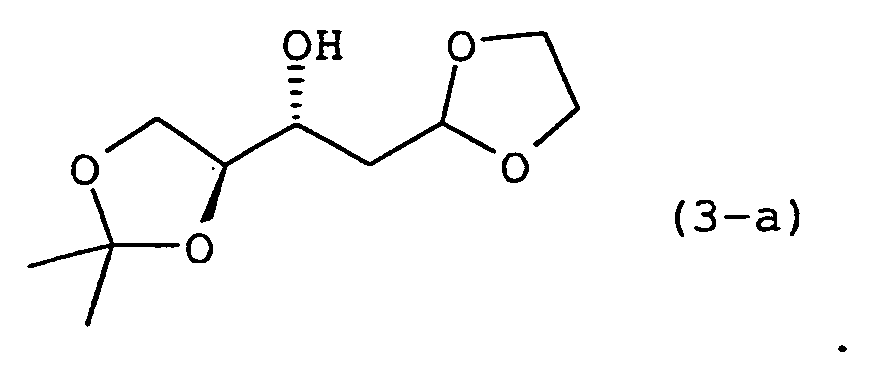
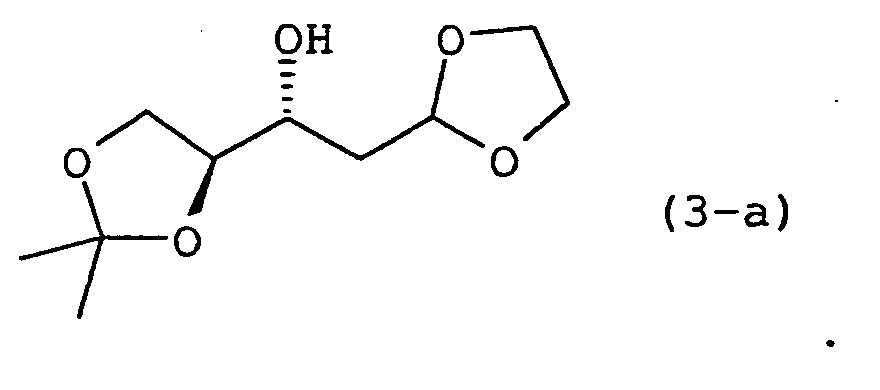
- VCPVNCWWVULCKM-UHFFFAOYSA-N 1-(2,2-dimethyl-1,3-dioxolan-4-yl)-2-(1,3-dioxolan-2-yl)ethanol Chemical compound O1C(C)(C)OCC1C(O)CC1OCCO1 VCPVNCWWVULCKM-UHFFFAOYSA-N 0.000 description 3
- CKIIJIDEWWXQEA-UHFFFAOYSA-N 2-(bromomethyl)-1,3-dioxolane Chemical compound BrCC1OCCO1 CKIIJIDEWWXQEA-UHFFFAOYSA-N 0.000 description 3
- ZCYVEMRRCGMTRW-UHFFFAOYSA-N 7553-56-2 Chemical group [I] ZCYVEMRRCGMTRW-UHFFFAOYSA-N 0.000 description 3
- UHOVQNZJYSORNB-UHFFFAOYSA-N Benzene Chemical compound C1=CC=CC=C1 UHOVQNZJYSORNB-UHFFFAOYSA-N 0.000 description 3
- WVDDGKGOMKODPV-UHFFFAOYSA-N Benzyl alcohol Chemical compound OCC1=CC=CC=C1 WVDDGKGOMKODPV-UHFFFAOYSA-N 0.000 description 3
- KFZMGEQAYNKOFK-UHFFFAOYSA-N Isopropanol Chemical compound CC(C)O KFZMGEQAYNKOFK-UHFFFAOYSA-N 0.000 description 3
- MNQZXJOMYWMBOU-GSVOUGTGSA-N L-(-)-glyceraldehyde Chemical compound OC[C@H](O)C=O MNQZXJOMYWMBOU-GSVOUGTGSA-N 0.000 description 3
- PMZURENOXWZQFD-UHFFFAOYSA-L Sodium Sulfate Chemical compound [Na+].[Na+].[O-]S([O-])(=O)=O PMZURENOXWZQFD-UHFFFAOYSA-L 0.000 description 3
- ZMANZCXQSJIPKH-UHFFFAOYSA-N Triethylamine Chemical compound CCN(CC)CC ZMANZCXQSJIPKH-UHFFFAOYSA-N 0.000 description 3
- 125000002777 acetyl group Chemical group [H]C([H])([H])C(*)=O 0.000 description 3
- 235000019270 ammonium chloride Nutrition 0.000 description 3
- 239000012300 argon atmosphere Substances 0.000 description 3
- 125000003236 benzoyl group Chemical group [H]C1=C([H])C([H])=C(C([H])=C1[H])C(*)=O 0.000 description 3
- 230000008034 disappearance Effects 0.000 description 3
- 238000004090 dissolution Methods 0.000 description 3
- 238000001914 filtration Methods 0.000 description 3
- 229910052740 iodine Inorganic materials 0.000 description 3
- 238000002955 isolation Methods 0.000 description 3
- 239000011777 magnesium Substances 0.000 description 3
- 229910052749 magnesium Inorganic materials 0.000 description 3
- OFBQJSOFQDEBGM-UHFFFAOYSA-N n-pentane Natural products CCCCC OFBQJSOFQDEBGM-UHFFFAOYSA-N 0.000 description 3
- 239000000825 pharmaceutical preparation Substances 0.000 description 3
- 229940127557 pharmaceutical product Drugs 0.000 description 3
- 239000011780 sodium chloride Substances 0.000 description 3
- 229910052938 sodium sulfate Inorganic materials 0.000 description 3
- 235000011152 sodium sulphate Nutrition 0.000 description 3
- 238000003756 stirring Methods 0.000 description 3
- 125000005425 toluyl group Chemical group 0.000 description 3
- 125000004044 trifluoroacetyl group Chemical group FC(C(=O)*)(F)F 0.000 description 3
- 229910052725 zinc Inorganic materials 0.000 description 3
- 239000011701 zinc Substances 0.000 description 3
- MTCFGRXMJLQNBG-REOHCLBHSA-N (2S)-2-Amino-3-hydroxypropansäure Chemical compound OC[C@H](N)C(O)=O MTCFGRXMJLQNBG-REOHCLBHSA-N 0.000 description 2
- SPEUIVXLLWOEMJ-UHFFFAOYSA-N 1,1-dimethoxyethane Chemical compound COC(C)OC SPEUIVXLLWOEMJ-UHFFFAOYSA-N 0.000 description 2
- 125000004182 2-chlorophenyl group Chemical group [H]C1=C([H])C(Cl)=C(*)C([H])=C1[H] 0.000 description 2
- ASJSAQIRZKANQN-CRCLSJGQSA-N 2-deoxy-D-ribose Chemical compound OC[C@@H](O)[C@@H](O)CC=O ASJSAQIRZKANQN-CRCLSJGQSA-N 0.000 description 2
- 125000004198 2-fluorophenyl group Chemical group [H]C1=C([H])C(F)=C(*)C([H])=C1[H] 0.000 description 2
- 125000004179 3-chlorophenyl group Chemical group [H]C1=C([H])C(*)=C([H])C(Cl)=C1[H] 0.000 description 2
- 125000004180 3-fluorophenyl group Chemical group [H]C1=C([H])C(*)=C([H])C(F)=C1[H] 0.000 description 2
- 125000001255 4-fluorophenyl group Chemical group [H]C1=C([H])C(*)=C([H])C([H])=C1F 0.000 description 2
- 125000004172 4-methoxyphenyl group Chemical group [H]C1=C([H])C(OC([H])([H])[H])=C([H])C([H])=C1* 0.000 description 2
- KZMGYPLQYOPHEL-UHFFFAOYSA-N Boron trifluoride etherate Chemical compound FB(F)F.CCOCC KZMGYPLQYOPHEL-UHFFFAOYSA-N 0.000 description 2
- LCGLNKUTAGEVQW-UHFFFAOYSA-N Dimethyl ether Chemical compound COC LCGLNKUTAGEVQW-UHFFFAOYSA-N 0.000 description 2
- SRBFZHDQGSBBOR-HWQSCIPKSA-N L-arabinopyranose Chemical compound O[C@H]1COC(O)[C@H](O)[C@H]1O SRBFZHDQGSBBOR-HWQSCIPKSA-N 0.000 description 2
- CSNNHWWHGAXBCP-UHFFFAOYSA-L Magnesium sulfate Chemical compound [Mg+2].[O-][S+2]([O-])([O-])[O-] CSNNHWWHGAXBCP-UHFFFAOYSA-L 0.000 description 2
- AFVFQIVMOAPDHO-UHFFFAOYSA-N Methanesulfonic acid Chemical compound CS(O)(=O)=O AFVFQIVMOAPDHO-UHFFFAOYSA-N 0.000 description 2
- LRHPLDYGYMQRHN-UHFFFAOYSA-N N-Butanol Chemical compound CCCCO LRHPLDYGYMQRHN-UHFFFAOYSA-N 0.000 description 2
- IMNFDUFMRHMDMM-UHFFFAOYSA-N N-Heptane Chemical compound CCCCCCC IMNFDUFMRHMDMM-UHFFFAOYSA-N 0.000 description 2
- CBENFWSGALASAD-UHFFFAOYSA-N Ozone Chemical compound [O-][O+]=O CBENFWSGALASAD-UHFFFAOYSA-N 0.000 description 2
- NBIIXXVUZAFLBC-UHFFFAOYSA-N Phosphoric acid Chemical compound OP(O)(O)=O NBIIXXVUZAFLBC-UHFFFAOYSA-N 0.000 description 2
- ISAKRJDGNUQOIC-UHFFFAOYSA-N Uracil Chemical compound O=C1C=CNC(=O)N1 ISAKRJDGNUQOIC-UHFFFAOYSA-N 0.000 description 2
- 230000002378 acidificating effect Effects 0.000 description 2
- 125000002947 alkylene group Chemical group 0.000 description 2
- 239000011260 aqueous acid Substances 0.000 description 2
- SRBFZHDQGSBBOR-UHFFFAOYSA-N beta-D-Pyranose-Lyxose Natural products OC1COC(O)C(O)C1O SRBFZHDQGSBBOR-UHFFFAOYSA-N 0.000 description 2
- 239000006227 byproduct Substances 0.000 description 2
- 239000000356 contaminant Substances 0.000 description 2
- 230000018044 dehydration Effects 0.000 description 2
- 238000006297 dehydration reaction Methods 0.000 description 2
- 125000003438 dodecyl group Chemical group [H]C([H])([H])C([H])([H])C([H])([H])C([H])([H])C([H])([H])C([H])([H])C([H])([H])C([H])([H])C([H])([H])C([H])([H])C([H])([H])C([H])([H])* 0.000 description 2
- 150000002148 esters Chemical class 0.000 description 2
- 150000002170 ethers Chemical class 0.000 description 2
- 238000000605 extraction Methods 0.000 description 2
- UYTPUPDQBNUYGX-UHFFFAOYSA-N guanine Chemical compound O=C1NC(N)=NC2=C1N=CN2 UYTPUPDQBNUYGX-UHFFFAOYSA-N 0.000 description 2
- 150000008282 halocarbons Chemical class 0.000 description 2
- 238000009776 industrial production Methods 0.000 description 2
- 125000000959 isobutyl group Chemical group [H]C([H])([H])C([H])(C([H])([H])[H])C([H])([H])* 0.000 description 2
- 125000001449 isopropyl group Chemical group [H]C([H])([H])C([H])(*)C([H])([H])[H] 0.000 description 2
- 229910052744 lithium Inorganic materials 0.000 description 2
- 150000002641 lithium Chemical group 0.000 description 2
- AMXOYNBUYSYVKV-UHFFFAOYSA-M lithium bromide Chemical compound [Li+].[Br-] AMXOYNBUYSYVKV-UHFFFAOYSA-M 0.000 description 2
- ZCSHNCUQKCANBX-UHFFFAOYSA-N lithium diisopropylamide Chemical compound [Li+].CC(C)[N-]C(C)C ZCSHNCUQKCANBX-UHFFFAOYSA-N 0.000 description 2
- 125000000040 m-tolyl group Chemical group [H]C1=C([H])C(*)=C([H])C(=C1[H])C([H])([H])[H] 0.000 description 2
- 230000004048 modification Effects 0.000 description 2
- 238000012986 modification Methods 0.000 description 2
- 125000004108 n-butyl group Chemical group [H]C([H])([H])C([H])([H])C([H])([H])C([H])([H])* 0.000 description 2
- 125000004123 n-propyl group Chemical group [H]C([H])([H])C([H])([H])C([H])([H])* 0.000 description 2
- 150000007523 nucleic acids Chemical class 0.000 description 2
- 102000039446 nucleic acids Human genes 0.000 description 2
- 108020004707 nucleic acids Proteins 0.000 description 2
- 239000002777 nucleoside Substances 0.000 description 2
- 125000003835 nucleoside group Chemical group 0.000 description 2
- 239000002773 nucleotide Substances 0.000 description 2
- 125000003729 nucleotide group Chemical group 0.000 description 2
- 125000003261 o-tolyl group Chemical group [H]C1=C([H])C(*)=C(C([H])=C1[H])C([H])([H])[H] 0.000 description 2
- 238000007254 oxidation reaction Methods 0.000 description 2
- 125000003854 p-chlorophenyl group Chemical group [H]C1=C([H])C(*)=C([H])C([H])=C1Cl 0.000 description 2
- 125000000636 p-nitrophenyl group Chemical group [H]C1=C([H])C(=C([H])C([H])=C1*)[N+]([O-])=O 0.000 description 2
- 125000001037 p-tolyl group Chemical group [H]C1=C([H])C(=C([H])C([H])=C1*)C([H])([H])[H] 0.000 description 2
- 238000005192 partition Methods 0.000 description 2
- 125000001997 phenyl group Chemical group [H]C1=C([H])C([H])=C(*)C([H])=C1[H] 0.000 description 2
- 239000002244 precipitate Substances 0.000 description 2
- 238000010926 purge Methods 0.000 description 2
- UMJSCPRVCHMLSP-UHFFFAOYSA-N pyridine Natural products COC1=CC=CN=C1 UMJSCPRVCHMLSP-UHFFFAOYSA-N 0.000 description 2
- 125000002914 sec-butyl group Chemical group [H]C([H])([H])C([H])([H])C([H])(*)C([H])([H])[H] 0.000 description 2
- 235000017557 sodium bicarbonate Nutrition 0.000 description 2
- 229910000030 sodium bicarbonate Inorganic materials 0.000 description 2
- 238000010189 synthetic method Methods 0.000 description 2
- RWQNBRDOKXIBIV-UHFFFAOYSA-N thymine Chemical compound CC1=CNC(=O)NC1=O RWQNBRDOKXIBIV-UHFFFAOYSA-N 0.000 description 2
- YSGPYVWACGYQDJ-YFKPBYRVSA-N (4r)-2,2-dimethyl-1,3-dioxolane-4-carbaldehyde Chemical compound CC1(C)OC[C@H](C=O)O1 YSGPYVWACGYQDJ-YFKPBYRVSA-N 0.000 description 1
- MIOPJNTWMNEORI-GMSGAONNSA-N (S)-camphorsulfonic acid Chemical compound C1C[C@@]2(CS(O)(=O)=O)C(=O)C[C@@H]1C2(C)C MIOPJNTWMNEORI-GMSGAONNSA-N 0.000 description 1
- NWUYHJFMYQTDRP-UHFFFAOYSA-N 1,2-bis(ethenyl)benzene;1-ethenyl-2-ethylbenzene;styrene Chemical compound C=CC1=CC=CC=C1.CCC1=CC=CC=C1C=C.C=CC1=CC=CC=C1C=C NWUYHJFMYQTDRP-UHFFFAOYSA-N 0.000 description 1
- RYHBNJHYFVUHQT-UHFFFAOYSA-N 1,4-Dioxane Chemical compound C1COCCO1 RYHBNJHYFVUHQT-UHFFFAOYSA-N 0.000 description 1
- DURPTKYDGMDSBL-UHFFFAOYSA-N 1-butoxybutane Chemical compound CCCCOCCCC DURPTKYDGMDSBL-UHFFFAOYSA-N 0.000 description 1
- VNJOEUSYAMPBAK-UHFFFAOYSA-N 2-methylbenzenesulfonic acid;hydrate Chemical compound O.CC1=CC=CC=C1S(O)(=O)=O VNJOEUSYAMPBAK-UHFFFAOYSA-N 0.000 description 1
- GPZXFICWCMCQPF-UHFFFAOYSA-N 2-methylbenzoyl chloride Chemical compound CC1=CC=CC=C1C(Cl)=O GPZXFICWCMCQPF-UHFFFAOYSA-N 0.000 description 1
- ZKBQDFAWXLTYKS-UHFFFAOYSA-N 6-Chloro-1H-purine Chemical compound ClC1=NC=NC2=C1NC=N2 ZKBQDFAWXLTYKS-UHFFFAOYSA-N 0.000 description 1
- 229930024421 Adenine Natural products 0.000 description 1
- GFFGJBXGBJISGV-UHFFFAOYSA-N Adenine Chemical compound NC1=NC=NC2=C1N=CN2 GFFGJBXGBJISGV-UHFFFAOYSA-N 0.000 description 1
- QESZADOKMONMEU-AXDSSHIGSA-N CC(C)(OC1)O[C@@H]1C(CC1OCCO1)[O]=C=C Chemical compound CC(C)(OC1)O[C@@H]1C(CC1OCCO1)[O]=C=C QESZADOKMONMEU-AXDSSHIGSA-N 0.000 description 1
- YSGPYVWACGYQDJ-UHFFFAOYSA-N D-glyceraldehyde acetonide Natural products CC1(C)OCC(C=O)O1 YSGPYVWACGYQDJ-UHFFFAOYSA-N 0.000 description 1
- ZAFNJMIOTHYJRJ-UHFFFAOYSA-N Diisopropyl ether Chemical compound CC(C)OC(C)C ZAFNJMIOTHYJRJ-UHFFFAOYSA-N 0.000 description 1
- 239000002841 Lewis acid Substances 0.000 description 1
- FYYHWMGAXLPEAU-UHFFFAOYSA-N Magnesium Chemical compound [Mg] FYYHWMGAXLPEAU-UHFFFAOYSA-N 0.000 description 1
- BZLVMXJERCGZMT-UHFFFAOYSA-N Methyl tert-butyl ether Chemical compound COC(C)(C)C BZLVMXJERCGZMT-UHFFFAOYSA-N 0.000 description 1
- PZFVMUVKMIXATL-RQOWECAXSA-N NCC/C=C\ON Chemical compound NCC/C=C\ON PZFVMUVKMIXATL-RQOWECAXSA-N 0.000 description 1
- CTQNGGLPUBDAKN-UHFFFAOYSA-N O-Xylene Chemical compound CC1=CC=CC=C1C CTQNGGLPUBDAKN-UHFFFAOYSA-N 0.000 description 1
- PDWIQYODPROSQH-OVEKKEMJSA-N OC[C@@H]([C@@H](C1)O)OC1O Chemical compound OC[C@@H]([C@@H](C1)O)OC1O PDWIQYODPROSQH-OVEKKEMJSA-N 0.000 description 1
- ZLMJMSJWJFRBEC-UHFFFAOYSA-N Potassium Chemical group [K] ZLMJMSJWJFRBEC-UHFFFAOYSA-N 0.000 description 1
- 229910021627 Tin(IV) chloride Inorganic materials 0.000 description 1
- XTXRWKRVRITETP-UHFFFAOYSA-N Vinyl acetate Chemical compound CC(=O)OC=C XTXRWKRVRITETP-UHFFFAOYSA-N 0.000 description 1
- HCHKCACWOHOZIP-UHFFFAOYSA-N Zinc Chemical compound [Zn] HCHKCACWOHOZIP-UHFFFAOYSA-N 0.000 description 1
- LOJRLQRGBKTHDB-UHFFFAOYSA-M [Br-].[Zn+]CC1OCCO1 Chemical compound [Br-].[Zn+]CC1OCCO1 LOJRLQRGBKTHDB-UHFFFAOYSA-M 0.000 description 1
- UEDAJTVQWUTTNK-UHFFFAOYSA-N [Li]CC1OCCO1 Chemical compound [Li]CC1OCCO1 UEDAJTVQWUTTNK-UHFFFAOYSA-N 0.000 description 1
- IKHGUXGNUITLKF-XPULMUKRSA-N acetaldehyde Chemical class [14CH]([14CH3])=O IKHGUXGNUITLKF-XPULMUKRSA-N 0.000 description 1
- 150000001241 acetals Chemical group 0.000 description 1
- 239000003377 acid catalyst Substances 0.000 description 1
- 150000007513 acids Chemical class 0.000 description 1
- 229960000643 adenine Drugs 0.000 description 1
- 150000001298 alcohols Chemical class 0.000 description 1
- 125000003172 aldehyde group Chemical group 0.000 description 1
- 229910000147 aluminium phosphate Inorganic materials 0.000 description 1
- VSCWAEJMTAWNJL-UHFFFAOYSA-K aluminium trichloride Chemical compound Cl[Al](Cl)Cl VSCWAEJMTAWNJL-UHFFFAOYSA-K 0.000 description 1
- 125000003277 amino group Chemical group 0.000 description 1
- 230000033115 angiogenesis Effects 0.000 description 1
- 239000003443 antiviral agent Substances 0.000 description 1
- 150000004945 aromatic hydrocarbons Chemical class 0.000 description 1
- SRSXLGNVWSONIS-UHFFFAOYSA-N benzenesulfonic acid Chemical compound OS(=O)(=O)C1=CC=CC=C1 SRSXLGNVWSONIS-UHFFFAOYSA-N 0.000 description 1
- 229940092714 benzenesulfonic acid Drugs 0.000 description 1
- 235000019445 benzyl alcohol Nutrition 0.000 description 1
- SIPUZPBQZHNSDW-UHFFFAOYSA-N bis(2-methylpropyl)aluminum Chemical compound CC(C)C[Al]CC(C)C SIPUZPBQZHNSDW-UHFFFAOYSA-N 0.000 description 1
- 239000001273 butane Substances 0.000 description 1
- 125000002915 carbonyl group Chemical group [*:2]C([*:1])=O 0.000 description 1
- 125000003178 carboxy group Chemical group [H]OC(*)=O 0.000 description 1
- 239000003153 chemical reaction reagent Substances 0.000 description 1
- 238000001816 cooling Methods 0.000 description 1
- 150000004292 cyclic ethers Chemical class 0.000 description 1
- 230000008030 elimination Effects 0.000 description 1
- 238000003379 elimination reaction Methods 0.000 description 1
- MVEAAGBEUOMFRX-UHFFFAOYSA-N ethyl acetate;hydrochloride Chemical compound Cl.CCOC(C)=O MVEAAGBEUOMFRX-UHFFFAOYSA-N 0.000 description 1
- 238000001704 evaporation Methods 0.000 description 1
- 230000008020 evaporation Effects 0.000 description 1
- 239000007789 gas Substances 0.000 description 1
- 230000002140 halogenating effect Effects 0.000 description 1
- 230000026030 halogenation Effects 0.000 description 1
- 238000005658 halogenation reaction Methods 0.000 description 1
- 238000005984 hydrogenation reaction Methods 0.000 description 1
- 230000003301 hydrolyzing effect Effects 0.000 description 1
- FUKUFMFMCZIRNT-UHFFFAOYSA-N hydron;methanol;chloride Chemical compound Cl.OC FUKUFMFMCZIRNT-UHFFFAOYSA-N 0.000 description 1
- 239000012535 impurity Substances 0.000 description 1
- 239000011261 inert gas Substances 0.000 description 1
- 230000002401 inhibitory effect Effects 0.000 description 1
- 229910052500 inorganic mineral Inorganic materials 0.000 description 1
- 239000003456 ion exchange resin Substances 0.000 description 1
- 229920003303 ion-exchange polymer Polymers 0.000 description 1
- 150000007517 lewis acids Chemical class 0.000 description 1
- 239000011981 lindlar catalyst Substances 0.000 description 1
- 229910052943 magnesium sulfate Inorganic materials 0.000 description 1
- 235000019341 magnesium sulphate Nutrition 0.000 description 1
- 229940098779 methanesulfonic acid Drugs 0.000 description 1
- 125000005948 methanesulfonyloxy group Chemical group 0.000 description 1
- DOWWCCDWPKGNGX-YFKPBYRVSA-N methyl (4s)-2,2-dimethyl-1,3-dioxolane-4-carboxylate Chemical compound COC(=O)[C@@H]1COC(C)(C)O1 DOWWCCDWPKGNGX-YFKPBYRVSA-N 0.000 description 1
- 235000010755 mineral Nutrition 0.000 description 1
- 239000011707 mineral Substances 0.000 description 1
- IJDNQMDRQITEOD-UHFFFAOYSA-N n-butane Chemical compound CCCC IJDNQMDRQITEOD-UHFFFAOYSA-N 0.000 description 1
- 239000012434 nucleophilic reagent Substances 0.000 description 1
- 230000003287 optical effect Effects 0.000 description 1
- 150000007524 organic acids Chemical class 0.000 description 1
- 235000005985 organic acids Nutrition 0.000 description 1
- 239000003208 petroleum Substances 0.000 description 1
- 238000005191 phase separation Methods 0.000 description 1
- 239000000843 powder Substances 0.000 description 1
- 238000001556 precipitation Methods 0.000 description 1
- ZDYVRSLAEXCVBX-UHFFFAOYSA-N pyridinium p-toluenesulfonate Chemical compound C1=CC=[NH+]C=C1.CC1=CC=C(S([O-])(=O)=O)C=C1 ZDYVRSLAEXCVBX-UHFFFAOYSA-N 0.000 description 1
- 238000010791 quenching Methods 0.000 description 1
- 239000011347 resin Substances 0.000 description 1
- 229920005989 resin Polymers 0.000 description 1
- 229960001153 serine Drugs 0.000 description 1
- 238000007086 side reaction Methods 0.000 description 1
- 229910052708 sodium Inorganic materials 0.000 description 1
- 239000011734 sodium Substances 0.000 description 1
- 125000004436 sodium atom Chemical group 0.000 description 1
- 238000006467 substitution reaction Methods 0.000 description 1
- 230000002194 synthesizing effect Effects 0.000 description 1
- 229940113082 thymine Drugs 0.000 description 1
- HPGGPRDJHPYFRM-UHFFFAOYSA-J tin(iv) chloride Chemical compound Cl[Sn](Cl)(Cl)Cl HPGGPRDJHPYFRM-UHFFFAOYSA-J 0.000 description 1
- XJDNKRIXUMDJCW-UHFFFAOYSA-J titanium tetrachloride Chemical compound Cl[Ti](Cl)(Cl)Cl XJDNKRIXUMDJCW-UHFFFAOYSA-J 0.000 description 1
- 230000017105 transposition Effects 0.000 description 1
- 125000005951 trifluoromethanesulfonyloxy group Chemical group 0.000 description 1
- 125000000025 triisopropylsilyl group Chemical group C(C)(C)[Si](C(C)C)(C(C)C)* 0.000 description 1
- 229940035893 uracil Drugs 0.000 description 1
- 238000001291 vacuum drying Methods 0.000 description 1
- 239000008096 xylene Substances 0.000 description 1
Classifications
-
- C—CHEMISTRY; METALLURGY
- C07—ORGANIC CHEMISTRY
- C07H—SUGARS; DERIVATIVES THEREOF; NUCLEOSIDES; NUCLEOTIDES; NUCLEIC ACIDS
- C07H3/00—Compounds containing only hydrogen atoms and saccharide radicals having only carbon, hydrogen, and oxygen atoms
- C07H3/08—Deoxysugars; Unsaturated sugars; Osones
-
- C—CHEMISTRY; METALLURGY
- C07—ORGANIC CHEMISTRY
- C07H—SUGARS; DERIVATIVES THEREOF; NUCLEOSIDES; NUCLEOTIDES; NUCLEIC ACIDS
- C07H13/00—Compounds containing saccharide radicals esterified by carbonic acid or derivatives thereof, or by organic acids, e.g. phosphonic acids
- C07H13/02—Compounds containing saccharide radicals esterified by carbonic acid or derivatives thereof, or by organic acids, e.g. phosphonic acids by carboxylic acids
- C07H13/08—Compounds containing saccharide radicals esterified by carbonic acid or derivatives thereof, or by organic acids, e.g. phosphonic acids by carboxylic acids having the esterifying carboxyl radicals directly attached to carbocyclic rings
-
- C—CHEMISTRY; METALLURGY
- C07—ORGANIC CHEMISTRY
- C07H—SUGARS; DERIVATIVES THEREOF; NUCLEOSIDES; NUCLEOTIDES; NUCLEIC ACIDS
- C07H15/00—Compounds containing hydrocarbon or substituted hydrocarbon radicals directly attached to hetero atoms of saccharide radicals
- C07H15/02—Acyclic radicals, not substituted by cyclic structures
- C07H15/04—Acyclic radicals, not substituted by cyclic structures attached to an oxygen atom of the saccharide radical
-
- C—CHEMISTRY; METALLURGY
- C07—ORGANIC CHEMISTRY
- C07H—SUGARS; DERIVATIVES THEREOF; NUCLEOSIDES; NUCLEOTIDES; NUCLEIC ACIDS
- C07H9/00—Compounds containing a hetero ring sharing at least two hetero atoms with a saccharide radical
- C07H9/02—Compounds containing a hetero ring sharing at least two hetero atoms with a saccharide radical the hetero ring containing only oxygen as ring hetero atoms
- C07H9/04—Cyclic acetals
-
- Y—GENERAL TAGGING OF NEW TECHNOLOGICAL DEVELOPMENTS; GENERAL TAGGING OF CROSS-SECTIONAL TECHNOLOGIES SPANNING OVER SEVERAL SECTIONS OF THE IPC; TECHNICAL SUBJECTS COVERED BY FORMER USPC CROSS-REFERENCE ART COLLECTIONS [XRACs] AND DIGESTS
- Y02—TECHNOLOGIES OR APPLICATIONS FOR MITIGATION OR ADAPTATION AGAINST CLIMATE CHANGE
- Y02P—CLIMATE CHANGE MITIGATION TECHNOLOGIES IN THE PRODUCTION OR PROCESSING OF GOODS
- Y02P20/00—Technologies relating to chemical industry
- Y02P20/50—Improvements relating to the production of bulk chemicals
- Y02P20/55—Design of synthesis routes, e.g. reducing the use of auxiliary or protecting groups
Definitions
- the present invention relates to a production method of a 2-deoxy-L-ribose compound, namely, 2-deoxy-L-ribose itself and a protected form thereof, and reactive derivatives thereof and the like, and a novel intermediate compound useful for the production of these.
- 2-Deoxy-L-ribose (L-deoxyribose) is known to be a compound useful as a starting material for the production of an L type nucleic acid derivative that is drawing attention in recent years as a pharmaceutical product such as an antiviral agent and the like (WO 01/034618 and WO 02/044194).
- 2-deoxy-L-ribose itself has been reported to have an angiogenesis inhibitory activity (WO 02/051423).
- L-glyceraldehyde As a production method that does not use sugar as a starting material, a method using L-glyceraldehyde as a starting material has been reported (Chinese Journal of Chemistry, 20, 1358-1362 (2002)). According to this method, L-glyceraldehyde is propargylated, hydroxyl group is protected, hydrogenation using a Lindlar catalyst and ozone oxidization are performed to give an aldehyde compound, and finally, the protected hydroxyl group is deprotected to synthesize 2-deoxy-L-ribose.
- the present invention aims at provision of an efficient production method suitable for industrial production of 2-deoxy-L-ribose, a protected form thereof and the like, and a novel intermediate compound useful for the production of these.
- the present inventors have conducted intensive studies in an attempt to solve the above-mentioned problems and found that 2-deoxy-L-ribose can be obtained by reacting an aldehyde compound represented by the formula (1) to be mentioned later with an organometallic compound represented by the formula (2) to be mentioned later to give an alcohol compound represented by the formula (3) to be mentioned later, and subjecting this compound to deprotection of hydroxyl group and aldehyde production by acid hydrolysis. Furthermore, a hydroxyl group of 2-deoxy-L-ribose can be protected easily to afford a more stable protected form. Moreover, the present inventors have found a method of conveniently purifying a hydroxyl-protected form of the obtained 2-deoxy-L-ribose, which resulted in the completion of the present invention.
- the present invention provides the following.
- 2-deoxy-L-ribose and a protected form thereof can be efficiently produced by a small number of steps, and this method is an industrially suitable method.
- the 2-deoxy-L-ribose compound of the present invention encompasses the 2-deoxy-L-ribose itself and a hydroxyl-protected form thereof.
- the production method of the 2-deoxy-L-ribose compound of the present invention essentially comprises Steps (a) and (b).
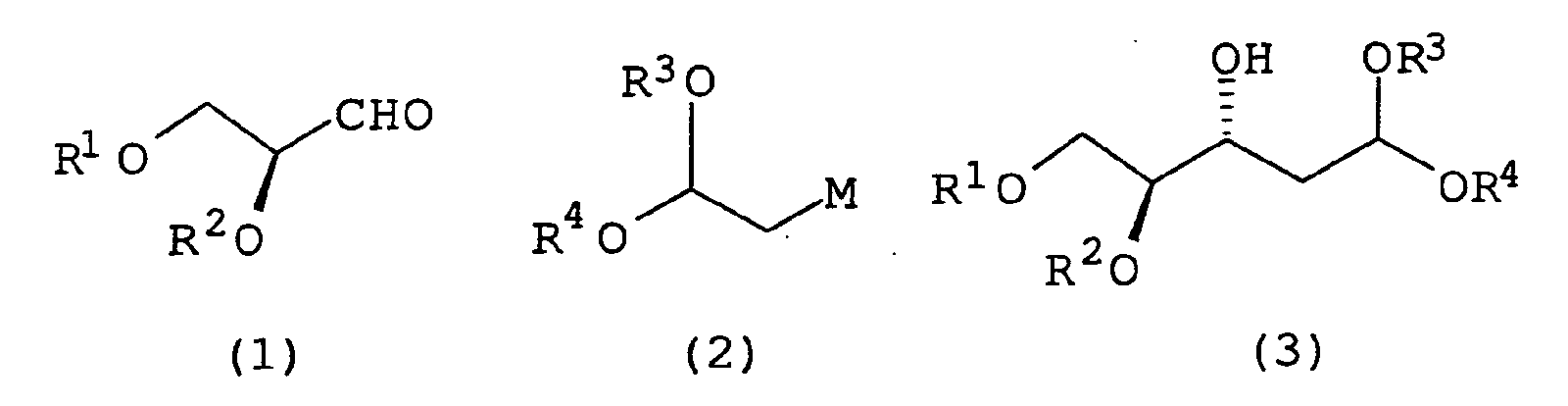
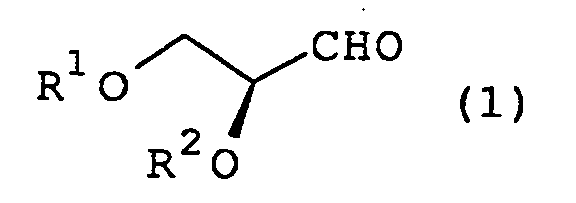
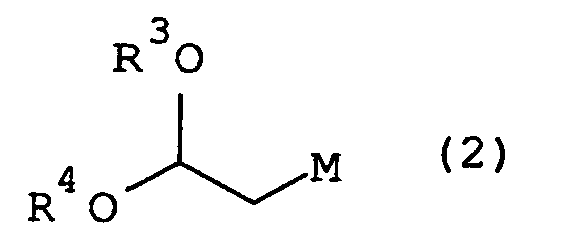
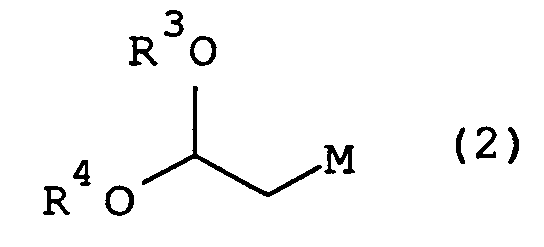
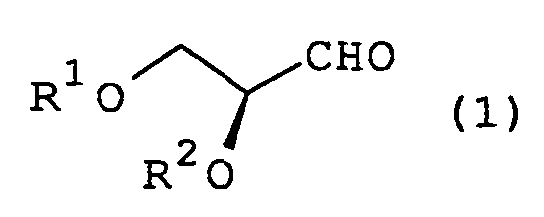
- an aldehyde compound represented by the formula (1) wherein R 1 and R 2 are each independently a hydroxyl-protecting group or R 1 and R 2 in combination show a hydroxyl-protecting group is reacted with an organometallic compound represented by the formula (2): wherein R 3 and R 4 are each independently an alkyl group, an aralkyl group, an aryl group or a silyl group or R 3 and R 4 in combination show a cyclic alkyl group, M is a metal atom or a metal salt to give an alcohol compound represented by the formula (3): wherein R 1 , R 2 , R 3 and R 4 are as defined above.
- the aldehyde compound represented by the formula (1) can be produced easily by converting an amino group of L-serine to a hydroxyl group, esterifying a carboxyl group, protecting the hydroxyl group to synthesize methyl 2,3-O-protected-L-glycerate (see Helvetica Chimica Acta, vol. 68, pp. 1863-1871 (1985) etc.), and reducing this compound to give a 2,3-O-protected-L-glyceraldehyde compound.
- the organometallic compound represented by the formula (2) can be synthesized easily by halogenation of vinyl acetate as a starting material in a methanol solution to give a dimethyl acetal of halogenated acetaldehyde, which is followed by conversion of the protecting group to give a protected form of halogenated acetaldehyde (see GB patent publication No. 2146016), which is then reacted with metal to give the object compound. It can be also synthesized by synthesizing protected acetaldehyde using acetaldehyde as a starting material and halogenating the same (see WO99/217346 and EP-A-413558 etc.).
- the hydroxyl-protecting group for R 1 or R 2 is not particularly limited as long as it is a hydroxyl-protecting group and, for example, cyclic acetal type protecting groups such as methoxymethylene acetal group, isopropylidene group, methylene acetal group, ethylidene acetal group, methyl group, benzyl group, benzoyl group, t-butyl group, acetyl group, methoxymethyl group, 2-methoxyethoxymethyl group, trimethylsilyl group, triethylsilyl group, t-butyldimethylsilyl group, methylthiomethyl group, trifluoroacetyl group, benzyloxycarbonyl group, t-butoxycarbonyl group, triphenylmethyl group, toluoyl group, 4-methoxymethylphenyl group and the like can be mentioned.
- cyclic acetal type protecting groups such as methoxymethylene acetal
- hydroxyl-protecting group for R 1 or R 2 a hydroxyl-protecting group, which can be deprotected by acid hydrolysis, is preferable.
- a hydroxyl-protecting group, which can be deprotected by acid hydrolysis for example, cyclic acetal type protecting groups such as methoxymethylene acetal group, isopropylidene group, methylene acetal group and ethylidene acetal group, methoxymethyl group, trimethylsilyl group, triethylsilyl group, t-butyldimethylsilyl group, methylthiomethyl group, benzyloxycarbonyl group, t-butoxycarbonyl group, triphenylmethyl group and the like can be mentioned.
- cyclic acetal type protecting groups such as methoxymethylene acetal group, isopropylidene group, methylene acetal group and ethylidene acetal group are preferable, which are formed by R 1 and R 2 in combination, and an isopropylidene group is particularly preferable.
- alkyl group for R 3 or R 4 , a linear or branched chain alkyl group having preferably 1-20, more preferably 1-7, carbon atoms can be mentioned. Specifically, for example, alkyl group such as methyl group, ethyl group, n-propyl group, isopropyl group, n-butyl group, isobutyl group, sec-butyl group, tert-butyl group, lauryl group and the like can be mentioned.
- the alkyl group is optionally substituted by one or more substituents below.
- substituents for example, a linear or branched chain alkoxy group (preferable carbon number: 1-6, e.g.: methoxy group and the like), a halogen atom (e.g., chlorine atom, fluorine atom and the like), a hydroxyl group and the like can be mentioned. It is needless to say that the "alkyl group having substituent" is encompassed in the "alkyl group” in the present invention.
- the "aralkyl group" for R 3 or R 4 is one wherein the aryl moiety preferably has 6-12, more preferably 6-8, carbon atoms, and the alkyl moiety is a linear or branched chain alkyl group preferably having 1-6, more preferably 1-3, carbon atoms. Specific examples of the aralkyl group preferably include a benzyl group.
- the aralkyl group is optionally substituted by one or more substituents below.
- substituents for example, a nitro group, a linear or branched chain alkoxy group (preferable carbon number: 1-6, e.g.: methoxy group and the like), a halogen atom (e.g., chlorine atom, fluorine atom and the like), a hydroxyl group and the like can be mentioned. It is needless to say that the "aralkyl group having substituent" is encompassed in the "aralkyl group” in the present invention.
- aryl group for R 3 or R 4 , an aryl group preferably having 6-20, more preferably 6-8, carbon atoms can be mentioned.
- the aryl group is optionally substituted by one or more substituents below.
- substituent here, for example, a nitro group, a linear or branched chain alkoxy group (preferable carbon number: 1-6, e.g.: methoxy group and the like), a halogen atom (e.g., chlorine atom, fluorine atom and the like), a linear or branched chain alkyl group (preferable carbon number: 1-4, e.g.: methyl group, ethyl group, propyl group and the like), a hydroxyl group and the like can be mentioned.
- aryl group having substituent is encompassed in the "aryl group” in the present invention.
- aryl group optionally having substituents include a phenyl group, o-, m- or p-nitrophenyl group, o-, m- or p-methoxyphenyl group, o-, m- or p-chlorophenyl group, o-, m- or p-fluorophenyl group, o-, m- or p-tolyl group and the like.
- silica group for example, a trimethylsilyl group, a triethylsilyl group, triisopropylsilyl and a t-butyldimethylsilyl group can be mentioned. Particularly, a t-butyldimethylsilyl group is preferable.
- a cyclic alkyl group having 2-6 carbon atoms is preferable.
- the "cyclic alkyl group” means an "alkylene group”.
- the cyclic alkyl group is optionally substituted by one or more substituents below.
- substituent for example, a nitro group, a linear or branched chain alkoxy group (preferable carbon number: 1-6, e.g., methoxy group and the like), a halogen atom (e.g., chlorine atom, fluorine atom and the like), a linear or branched chain alkyl group (preferable carbon number: 1-4, e.g., methyl group, ethyl group, propyl group and the like), a hydroxyl group and the like can be mentioned.
- a nitro group e.g., a linear or branched chain alkoxy group (preferable carbon number: 1-6, e.g., methoxy group and the like), a halogen atom (e.g., chlorine atom, fluorine atom and the like), a linear or branched chain alkyl group (preferable carbon number: 1-4, e.g., methyl group, ethyl group, propyl group and the like
- metal atom for M lithium atom (Li), sodium atom (Na), potassium atom (K) and the like can be mentioned.
- metal salt for M magnesium halide (MgX 2 ), zinc halide (ZnX 2 ) and the like can be mentioned.
- M lithium atom, magnesium halide (MgX 2 ) and zinc halide (ZnX 2 ) are particularly preferable.
- X 2 means a halogen atom, and as the halogen atom, bromine atom, chlorine atom and iodine atom are preferable, and bromine atom is particularly preferable.
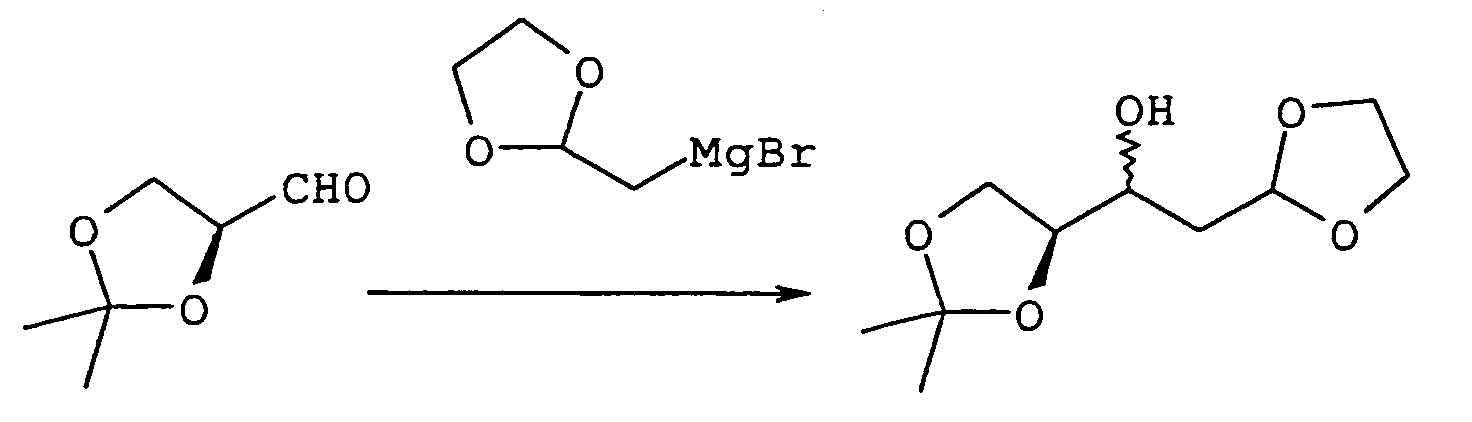
- an aldehyde compound represented by the formula (1) an aldehyde compound represented by the formula (1-a) wherein a hydroxyl group is protected by an isopropylidene group, is preferable in view of the stereoselectivity of the reaction and comparatively easy production and availability.
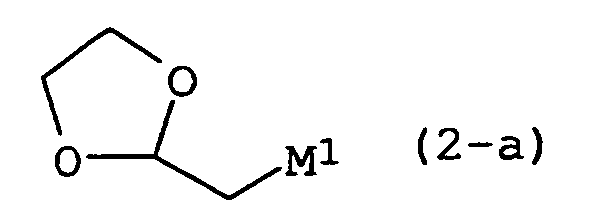
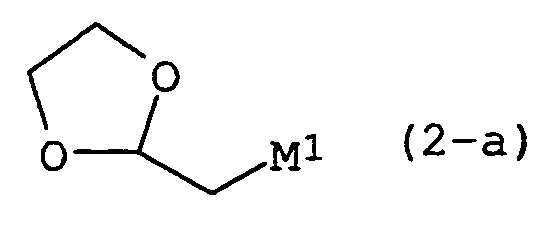
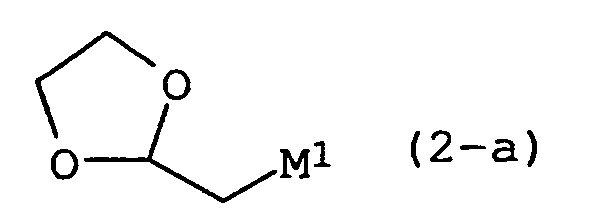
- an organometallic compound represented by the formula (2) an organometallic compound represented by the following formula (2-a) wherein M 1 is Li, MgX 2 or ZnX 2 , wherein X 2 is a halogen atom and R 3 and R 4 in combination show a cyclic alkyl group having 2 carbon atoms, is particularly preferable, in view of comparatively easy production and availability.
- halogen atom shown by X 2 a chlorine atom, a bromine atom and an iodine atom are preferable, and bromine atom is particularly preferable.
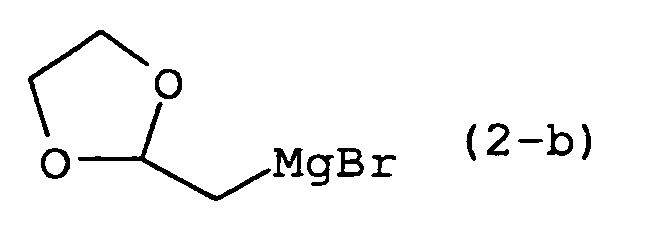
- organometallic compounds represented by the formula (2-a) an organometallic compound represented by the following formula (2-b) is preferable.
- the organometallic compound represented by the formula (2) is used at a ratio of generally 0.5 molar equivalent - 2 molar equivalents, preferably 1 molar equivalent - 1.5 molar equivalents, relative to an aldehyde compound represented by the formula (1).
- the reaction is generally carried out in a suitable organic solvent.
- the organic solvent to be used is not particularly limited as long as it is inactive to the reaction and, for example, ethers such as diethyl ether, diisopropyl ether, dimethyl ether, t-butyl methyl ether, dibutyl ether, petroleum ether and the like, cyclic ethers such as tetrahydrofuran (THF), dioxane and the like, benzene, toluene, xylene, butane, pentane, hexane, heptane and the like can be mentioned. Particularly, tetrahydrofuran and diethyl ether are preferable. These organic solvents are preferably used after dehydration and purge with an inactive gas.
- the amount of the solvent to be used is not particularly limited but generally used at a weight ratio of 0.5- to 200-fold, preferably 1- to 10-fold, relative to an aldehyde compound.
- the reaction temperature is generally -78°C to 100°C, preferably -30°C to 66°C.
- the reaction time is not particularly limited but generally 10 min - 24 hr, preferably 30 min - 5 hr, in the above-mentioned temperature range.
- an organometallic compound represented by the formula (2) may be prepared in a reaction vessel by a reaction with a suitable reagent.
- 2-bromomethyl-1,3-dioxolane is reacted with magnesium in a reaction vessel to give (1,3-dioxolan-2-ylmethyl)-magnesium bromide.
- 2-bromomethyl-1,3-dioxolane is reacted with zinc to give (1,3-dioxolan-2-ylmethyl)-zinc bromide.
- 2-bromomethyl-1,3-dioxolane is reacted with lithium diisopropylamide to give (1,3-dioxolan-2-ylmethyl)-lithium.
- an alcohol compound represented by the formula (3) is isolated from the reaction solution by a method known to those of ordinary skill in the art, such as chromatography and the like. It is also possible to use the reaction solution as it is for the next step without isolation, and, where necessary, a different solvent may be added after concentration or evaporation of the reaction solution and used for the next step.
- the alcohol compound represented by the formula (3) which is obtained in Step (a)
- the 3-position S form which is generated as a minor component, can be removed by chromatography.
- An embodiment of the synthesis of an alcohol compound which comprises reacting 2,3-O-isopropylidene-D-glyceraldehyde, which is an optical isomer of an aldehyde compound represented by the formula (1-a) in the present invention, with (1,3-dioxolan-2-ylmethyl)-magnesium bromide is described in WO 03/000200 (Fig. 1 and Example 1 on page 66).
- production of a compound having the same steric configuration as the alcohol compound represented by the formula (3) has not been known.
- WO 03/000200 does not describe stereoselectivity of the above-mentioned reaction and it was first found in the present invention that a compound represented by the formula (3), which has a 3-position steric configuration of R, can be obtained stereoselectively.
- the obtained alcohol compound is oxidized to convert to a carbonyl group and therefore, it is clear that this invention does not aim at production of 2-deoxyribose utilizing stereoselectivity of alcohol compound as in the present invention.
- Step (b) comprises subjecting an alcohol compound represented by the formula (3) to elimination of a hydroxyl-protecting group and production of aldehyde by acid hydrolysis.
- An alcohol compound represented by the formula (3) can be led to 2-deoxy-L-ribose by eliminating a hydroxyl-protecting group represented by R 1 or R 2 to give a hydroxyl group, and hydrolyzing a group represented by R 3 or R 4 with an acid to give an aldehyde group.
- the hydroxyl-protecting group represented by R 1 or R 2 is a hydroxyl-protecting group, which can be deprotected by acid hydrolysis, deprotection of the hydroxyl group and generation of aldehyde can be simultaneously performed by acid hydrolysis and 2-deoxy-L-ribose can be produced in a single step.
- deprotection of the hydroxyl group is performed independently of the aldehyde producing reaction. This deprotection is preferably performed before aldehyde producing reaction. Deprotection of the hydroxyl group is performed by a method known to those of ordinary skill in the art.
- acetic acid trifluoroacetic acid, hydrochloric acid, sulfuric acid, strong acidic resin and the like can be mentioned, and acetic acid and hydrochloric acid are particularly preferable.
- the amount of the acid to be used is not particularly limited, but it is generally preferably 0.1 molar equivalent to 200 molar equivalents, preferably 1 molar equivalent to 50 molar equivalents, relative to an alcohol compound represented by the formula (3).
- the acid hydrolysis can be performed by, for example, dropwise addition of an acid to a solvent in which an alcohol compound represented by the formula (3) has been dissolved.
- an organic solvent immiscible with water it is preferable to dissolve an alcohol compound represented by the formula (3) in an organic solvent immiscible with water and dropwise add an aqueous acid solution, so as to suppress side reaction by the acid.
- organic solvent methylene chloride, chloroform, tetrahydrofuran and the like can be mentioned. Methylene chloride is particularly preferable.
- the amount of the organic solvent to be used is not particularly limited but generally used in a weight ratio of 1- to 200-fold, preferably 10- to 50-fold, relative to an alcohol compound represented by the formula (3). While the concentration of the aqueous acid solution is not particularly limited, either, the acid is generally used in a volume ratio of 0.1-100%, preferably 5-80%, of the water.
- the reaction temperature of the acid hydrolysis is generally 0°C-100°C, preferably 10°C-50°C.
- the reaction time is not particularly limited but the reaction completes in the above-mentioned temperature range generally for 10 min-6 hr, preferably 30 min-2 hr.
- reaction solution is isolated by a method known to those of ordinary skill in the art, such as chromatography and the like.
- the reaction solution may be used as it is in the next step without isolation, and where necessary, the reaction solution may be concentrated or evaporated, added with a different solvent and used in the next step.
- Step (c) at least one hydroxyl group of 2-deoxy-L-ribose obtained in Step (b) is protected to give a hydroxyl-protected form of 2-deoxy-L-ribose.
- This step is optionally employed when producing a protected form of 2-deoxy-L-ribose.
- a hydroxyl group of 2-deoxy-L-ribose can be protected by a method known to those of ordinary skill in the art.
- the protecting group those known as a hydroxyl-protecting group can be used, such as methyl group, benzyl group, 4-methoxymethylphenyl group, methoxymethyl group, trimethylsilyl group, triethylsilyl group, t-butyldimethylsilyl group, acetyl group, benzoyl group, toluoyl group, isopropylidene group, methylthiomethyl group, 2-methoxyethoxymethyl group, trifluoroacetyl group, t-butyl group, benzyloxycarbonyl group, t-butoxycarbonyl group, triphenylmethyl group and the like.
- Step (b) the 1-position hydroxyl group is selectively protected in the co-presence of an acid and an alcohol, whereby Step (c) can be performed simultaneously.
- a 1-position hydroxyl-protected form of 2-deoxy-L-ribose wherein the 1-position hydroxyl group is protected by an alkyl group corresponding to the alcohol used, can be produced in a single step.
- the 1-position hydroxyl-protected form can fix the skeleton of 2-deoxy-L-ribose in an equilibrium state. Therefore, it is advantageous for isolation and purification and derivaritization thereafter.
- alcohol having 1-8 carbon atoms can be mentioned.
- alcohols such as methanol, ethanol, isopropyl alcohol, butyl alcohol, benzyl alcohol and the like can be mentioned, with particular preference given to methanol.
- the amount of the alcohol to be used is not particularly limited, but generally used in a weight ratio of 1- to 200-fold, preferably 5- to 50-fold, relative to an alcohol compound represented by the formula (3).
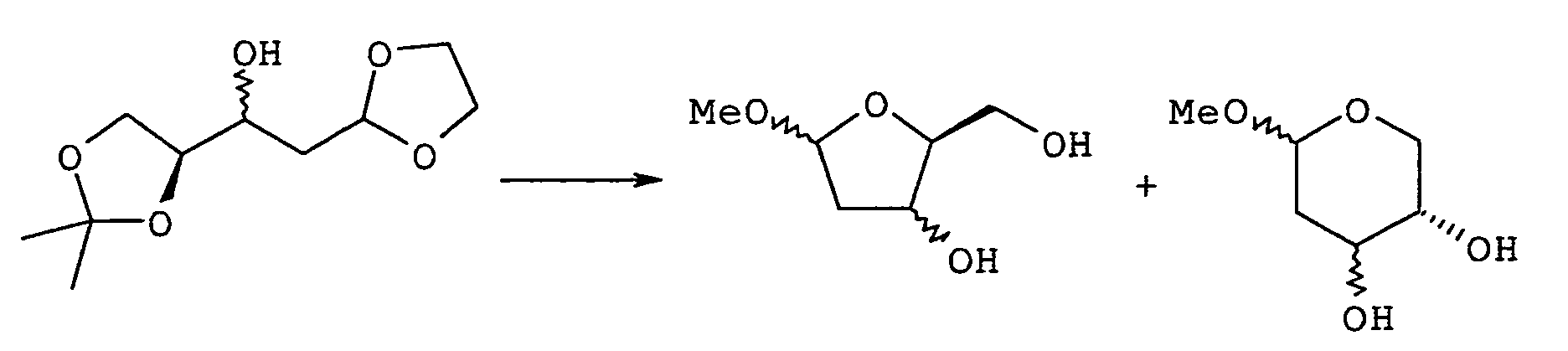
- R 7 OH When R 7 OH is the alcohol used, the thus-obtained 1-position hydroxyl-protected form of 2-deoxy-L-ribose is generally obtained as a mixture of a furanose type represented by the following formula (4) and a pyranose type represented by the formula (4').
- a furanose type As a starting material of a pharmaceutical product, a furanose type is preferable, wherein R 7 is an alkyl group or an aralkyl group. An alkyl group and an aralkyl group having 1-8 carbon atoms are preferable.
- R 7 is an alkyl group or an aralkyl group.
- An alkyl group and an aralkyl group having 1-8 carbon atoms are preferable.
- the specific alcohol those mentioned above can be mentioned.
- Step (c) a hydroxyl-protected form of 2-deoxy-L-ribose is isolated from the reaction solution by a method known to those of ordinary skill in the art such as chromatography and the like.
- the object product of Step (c) is the above-mentioned furanose type 1-position hydroxyl-protected form of 2-deoxy-L-ribose represented by the formula (4) (hereinafter to be also referred to as compound (4))
- the furanose type 1-position hydroxyl-protected form of 2-deoxy-L-xylose represented by the following formula (4-a) hereinafter to be also referred to as compound (4-a)
- compound (4-a) derived from the 3-position S form of an alcohol compound represented by the formula (3) by-produced in the above-mentioned Step (a) is mixed in the reaction mixture
- compound (4) can be efficiently isolated by performing the following Step (d).
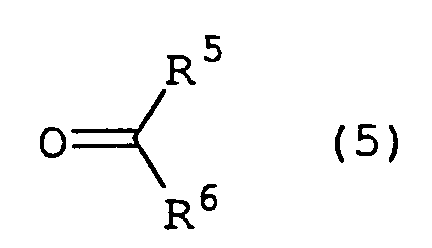
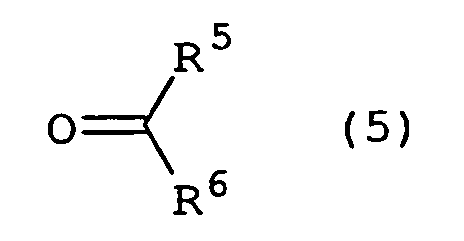
- Step (d) a mixture containing compound (4) and compound (4-a) is reacted with a ketone compound represented by the formula (5) (hereinafter to be also referred to as ketone compound (5)) in the presence of an acid to preferentially protect the 3-position and the 5-position hydroxyl groups of compound (4-a) to give a furanose type 2-deoxy-L-xylose compound represented by the formula (6) (hereinafter to be also referred to as compound (6)), and then unreacted compound (4) and compound (6) are separated.
- a ketone compound represented by the formula (5) hereinafter to be also referred to as ketone compound (5)
- an acid to preferentially protect the 3-position and the 5-position hydroxyl groups of compound (4-a) to give a furanose type 2-deoxy-L-xylose compound represented by the formula (6) (hereinafter to be also referred to as compound (6))
- compound (6) furanose type 2-deoxy-L-xylose compound represented by the formula
- R 5 and R 6 are each independently an alkyl group, an aralkyl group or an aryl group, or R 5 and R 6 in combination show a cyclic alkyl group and R 7 is an alkyl group or an aralkyl group.
- Step (d) The 3-position and the 4-position hydroxyl groups of the pyranose type 2-deoxy-L-ribose represented by the formula (4') are also considered to be easily protected in Step (d).
- the protected form thereof is also advantageously separated from compound (4) along with compound (6) and other lipid soluble byproducts can be also removed by Step (d).
- alkyl group for R 5 or R 6 is a linear or branched chain alkyl group preferably having 1-20, more preferably 1-7, carbon atoms.
- alkyl groups such as methyl group, ethyl group, n-propyl group, isopropyl group, n-butyl group, isobutyl group, sec-butyl group, tert-butyl group, lauryl group and the like can be mentioned.
- the alkyl group is optionally substituted by the one or more substituents below.
- substituents for example, linear or branched chain alkoxy groups (preferable carbon number: 1-6, e.g. : methoxy group and the like), halogen atoms (e.g.,: chlorine atom, fluorine atom and the like), hydroxyl group and the like can be mentioned. It is needless to say that the "alkyl group having substituent" is encompassed in the "alkyl group” in the context of the present invention.
- aralkyl group for R 5 or R 6 , is an aralkyl group wherein the aryl moiety preferably has 6-12, more preferably 6-8, carbon atoms and the alkyl moiety is a linear or branched chain alkyl group preferably having 1-6, more preferably 1-3, carbon atoms.
- the aralkyl group is optionally substituted by one or more substituents below.
- substituents for example, a nitro group, a linear or branched chain alkoxy group (preferable carbon number: 1-6, e.g.: methoxy group and the like), halogen atoms (e.g.,: chlorine atom, fluorine atom and the like), hydroxyl groups and the like can be mentioned.
- aralkyl group having substituent is encompassed in the "aralkyl group of the present invention”.
- Specific examples of the aralkyl group include substituted benzyl group such as p-methoxybenzyl group, dimethoxybenzyl group and the like and a benzyl group.
- aryl group for R 5 or R 6 , an aryl group preferably having 6-20, more preferably 6-8, carbon atoms can be mentioned.
- the aryl group is optionally substituted by one or more substituents below.
- substituent for example, nitro group, linear or branched chain alkoxy group (preferable carbon number: 1-6, e.g.: methoxy group and the like), halogen atom (e.g.: chlorine atom, fluorine atom and the like), linear or branched chain alkyl group (preferable carbon number: 1-4, e.g.: methyl group, ethyl group, propyl group and the like), hydroxyl group and the like can be mentioned.
- aryl group having substituent is encompassed in the "aryl group of the present invention.
- aryl group optionally having substituents include phenyl group, o-, m- or p-nitrophenyl group, o-, m- or p-methoxyphenyl group, o-, m- or p-chlorophenyl group, o-, m- or p-fluorophenyl group, o-, m- or p-tolyl group and the like.
- a cyclic alkyl group having 2-6 carbon atoms is preferable.
- the "cyclic alkyl group” means an "alkylene group”.
- the cyclic alkyl group is optionally substituted by one or more substituents below.
- substituent for example, a nitro group, a linear or branched chain alkoxy group (preferable carbon number: 1-6, e.g.: methoxy group and the like), halogen atom (e.g.,: chlorine atom, fluorine atom and the like), linear or branched chain alkyl group (preferable carbon number: 1-4, e.g.: methyl group, ethyl group, propyl group and the like), hydroxyl group and the like can be mentioned.
- cyclic alkyl group having substituent is encompassed in the "cyclic alkyl of the present invention.
- ketone compound (5) is preferably acetone.
- alkyl group and “aralkyl group” for R 7 are as defined above, and are preferably a methyl group.
- the ketone compound (5) is used in an amount of generally 0.5 molar equivalent to 10 molar equivalents, preferably 0.8 molar equivalent to 2 molar equivalents, relative to compound (4-a). When the amount of the ketone compound (5) to be used is greater than this range, compound (4) is also likely to be protected, which is not preferable.
- an acid use as an acid catalyst in an acetalized reaction can be mentioned.
- mineral acids such as hydrochloric acid, sulfuric acid, phosphoric acid and the like
- organic acids such as methanesulfonic acid, benzenesulfonic acid, p-toluenesulfonic acid, pyridinium p-toluenesulfonate, camphorsulfonic acid, trifluoroacetic acid and the like
- Lewis acid such as boron trifluoride etherate, aluminum trichloride, tin tetrachloride, titanium tetrachloride and the like, strong acidic ion exchange resin, and the like can be mentioned.
- p-toluenesulfonic acid is preferable.
- the amount of the acid to be used is not particularly limited, but it is preferably used in an amount of generally 0.001 molar equivalent to 1 molar equivalent, preferably 0.01 molar equivalent to 0.2 molar equivalent, relative to compound (4-a). When the amount of the acid to be used is greater than this range, compound (4) unpreferably is likely to be protected.
- the reaction may be carried out in a suitable organic solvent, it is preferably carried out without solvent.
- the organic solvent to be used is not particularly limited as long as it is inert to the reaction.
- esters such as ethyl acetate and the like, aromatic hydrocarbons such as toluene and the like, halogenated hydrocarbons such as methylene chloride, chloroform and the like are preferable.
- These organic solvents are preferably subjected to dehydration and purge with an inert gas before use.
- the reaction temperature of Step (d) is generally 5°C-100°C, preferably 10°C-50°C. When the reaction temperature is higher than this range, compound (4) may be also protected.
- the reaction time is not particularly limited and the time is appropriately determined by monitoring the reaction until almost complete disappearance of compound (4-a) by TLC and the like.
- the reaction time is generally 30 min-24 hr, preferably 1 hr-6 hr, in the above-mentioned temperature range.
- compound (4) since compound (4) has a considerably high water solubility, it is easily partitioned into an aqueous layer by the above-mentioned partitioning operation, compound (6) and other lipid soluble contaminants are easily partitioned into an organic layer, they can be separated easily.
- the partitioning operation can be performed by sufficiently stirring a mixture containing compound (4) and compound (6) in water and an organic solvent and standing the mixture to allow phase separation.
- the organic solvent to be used for the partitioning operation can be appropriately determined in consideration of the coefficient of partition of compound (4) and the like and, for example, when R 7 is a methyl group, halogenated hydrocarbons such as methylene chloride, chloroform and the like, esters such as ethyl acetate and the like, ethers such as diethyl ether and the like, and the like can be mentioned, with preference given to methylene chloride.
- the ratio of the amounts of water and organic solvent in the partitioning operation can be also appropriately determined in consideration of the coefficient of partition of compound (4) and the like and, for example, when R 7 is a methyl group and methylene chloride is used as an organic solvent, the volume ratio of water:methylene chloride is preferably 90:10-50:50.
- the compound (4) partitioned into the aqueous layer by the partitioning operation can be isolated by a method known to those of ordinary skill in the art.
- compound (4) is re-extracted with an organic solvent permitting extraction from the aqueous layer, or a method comprising concentrating the aqueous layer and the like can be mentioned.
- the furanose type 1-position hydroxyl-protected form of 2-deoxy-L-ribose [compound (4)] obtained by the present invention can be led to a furanose type 2-deoxy-L-ribose compound represented by the formula (8), which is more preferable as an intermediate for a pharmaceutical product, by, as shown in the following reaction scheme, protecting the 3-position and the 5-position hydroxyl groups and converting the protected 1-position hydroxyl group (-OR 7 in the following formula) to a leaving group: wherein X 1 is a leaving group, R 8 and R 9 are each independently a hydroxyl-protecting group or R 8 and R 9 in combination show a hydroxyl-protecting group.
- the hydroxyl-protecting group for R 8 or R 9 is not particularly limited as long as it is a hydroxyl-protecting group and, for example, cyclic acetal type protecting groups such as methoxymethylene acetal group, isopropylidene group, methylene acetal group and ethylidene acetal group, methyl group, benzyl group, benzoyl group, t-butyl group, acetyl group, methoxymethyl group, 2-methoxyethoxymethyl group, trimethylsilyl group, triethylsilyl group, t-butyldimethylsilyl group, methylthiomethyl group, trifluoroacetyl group, benzyloxycarbonyl group, t-butoxycarbonyl group, triphenylmethyl group, toluoyl group, 4-methoxymethylphenyl group and the like can be mentioned.
- cyclic acetal type protecting groups such as methoxymethylene acetal
- the leaving group for X 1 is not particularly limited as long as it can leave during, for example, a substitution reaction of a nucleophilic reagent (e.g., nucleic acid basic derivative such as adenine, guanine, 6-chloropurine, uracil, thymine etc.) when a furanose type 2-deoxy-L-ribose compound represented by the formula (8) is leading to a desired compound and, for example, halogen atom (e.g., chlorine atom, bromine atom, iodine atom etc.), sulfonyloxy group (e.g., methanesulfonyloxy group, trifluoromethanesulfonyloxy group, benzenesulfonyloxy group, p-toluenesulfonyloxy group etc.) and the like can be mentioned.
- a nucleophilic reagent e.g., nucleic acid basic derivative such as aden
- R 8 and R 9 are preferably p-toluoyl groups, and X 1 is preferably a halogen atom, and more preferably a chlorine atom.
- Protection of the 3-position and the 5-position hydroxyl groups of compound (4), and conversion of -OR 7 to a leaving group can be performed according to a synthetic method of sugar, which is conventionally known to hose of ordinary skill in the art (e.g., Nucleosides & Nucleotides, 18(11 & 12), 2357-2365 (1999)).
- R 8 and R 9 are p-toluoyl groups and X 1 is a chlorine atom, they can be performed according to a method described in Nucleosides & Nucleotides, 18(11 & 12), 2357-2365(1999).
- reaction mixture was filtered and extracted with diethyl ether.
Landscapes
- Chemical & Material Sciences (AREA)
- Organic Chemistry (AREA)
- Engineering & Computer Science (AREA)
- Health & Medical Sciences (AREA)
- Biochemistry (AREA)
- Biotechnology (AREA)
- General Health & Medical Sciences (AREA)
- Genetics & Genomics (AREA)
- Molecular Biology (AREA)
- Life Sciences & Earth Sciences (AREA)
- Crystallography & Structural Chemistry (AREA)
- Saccharide Compounds (AREA)
- Low-Molecular Organic Synthesis Reactions Using Catalysts (AREA)
- Organic Low-Molecular-Weight Compounds And Preparation Thereof (AREA)
Abstract
Description











1H-NMR (CDCl3, 400MHz) δ 1.36 (s, 3H), 1.42 (s, 3H), 1.77-1.84 (m, 1H), 2.04-2.09(m, 1H), 3.84-4.08 (m, 8H), 5.08(t, 1H, J = 4.6Hz)

1H-NMR(CDCl3, 400MHz) δ 1.89(dd, 2H, J=2.7Hz, J=4.2Hz), 2.04(d, 1H, J=7.3Hz), 2.21(d, 1H, J=6.0Hz), 3.35(s, 3H), 3.73-3.75(m, 3H), 4.02-4.05(m, 1H), 4.78(dd, 1H, J=2.7Hz, J=3.0Hz), furanose 1-position H(5.12): pyranose 1-position H(4.78)=1:4

1H-NMR (D2O, 400MHz) δ 1.70-2.40(m, 2H), 3.56-4.25(m, 4H), 5.30(dd, 1H, J=3.3Hz, J=3.0Hz)
1H-NMR(CDCl3, 400MHz) δ 1.89(dd, 2H, J=2.7Hz, J=4.2Hz), 2.04(d, 1H, J=7.3Hz), 2.21(d, 1H, J=6.0Hz), 3.35(s, 3H), 3.73-3.75(m, 3H), 4.02-4.05(m, 1H), 4.78(dd, 1H, J=2.7Hz, J=3.0Hz)
1H-NMR (CDCl3, 400MHz)δ1.42(s, 3H), 1.49(s, 3H), 4.07-4.20(m, 2H), 4.40(dt, 1H, J=1.8Hz, J=7.0Hz), 9.72(d, 1H, J=1.8Hz)
1H-NMR(CDCl3, 400MHz) δ 1.36 (s, 3H), 1.42(s, 3H), 1.77-1.84(m, 1H), 2.04-2.09(m, 1H), 3.84-4.08(m, 8H), 5.08 (t, 1H, J=4.6Hz)
1H-NMR (CDCl3, 400MHz) δ 2.02-2.30(m, 2H), 3.38 and 3.39 (2s, 3H), 3.60-3.73(m, 2H), 4.03-4.20(m, 1H), 4.50(m, 1H), furanose 1-position H(5.12):pyranose 1-position H(4.78)=10:1
1H-NMR (CDCl3, 400MHz) δ 2.02-2.30(m, 2H), 3.38 and 3.39(2s, 3H), 3.60-3.73 (m, 2H), 4.03-4.20 (m, 1H), 4.50 (m, 1H), 5.12 (H1-α) and 5.25 (H1-β) (t, 1H)
1H-NMR (CDCl3, 400MHz) δ 2.41 (s, 6H), 3.36 (s, 3H), 3.42 (s, 3H), 4.46-4.65(m, 3H), 5.19(dd, 1H, H1-α, J=0.95, 5.3Hz), 5.23(dd, 1H, H1-β, J=2.1, 5.4Hz), 5.41(m, 1H, H3-α), 5.59 (m, 1H, H3-β), 7.20-8.05(m, 8H)
1H-NMR(CDCl3, 400MHz) δ 2.41 (s, 6H), 2.80 (m, 2H), 4. 64 (m, 2H), 4.86(q, 1H), 5.55 (m, 1H), 6.47(d, 1H, J=5.1Hz), 7.24 (2d, 4H, J=8.6Hz), 7.94 (2d, 4H, J=8.3Hz)
Claims (25)
- A production method of a 2-deoxy-L-ribose compound, which comprises the following Steps (a) and (b):(a) reacting an aldehyde compound represented by the formula (1) :wherein R1 and R2 are each independently a hydroxyl-protecting group or R1 and R2 in combination show a hydroxyl-protecting group, with an organometallic compound represented by the formula (2):
 wherein R3 and R4 are each independently an alkyl group, an aralkyl group, an aryl group or a silyl group or R3 and R4 in combination show a cyclic alkyl group, and M is a metal atom or a metal salt, to give an alcohol compound represented by the formula (3):
 wherein R1, R2, R3 and R4 are as defined above, and
 (b) subjecting the alcohol compound represented by the formula (3) to deprotection of the hydroxyl group and production of aldehyde by acid hydrolysis.
 - The production method of claim 1, which affords 2-deoxy-L-ribose.
- The production method of claim 1, which further comprises Step (c) comprising introducing a protecting group into at least one hydroxyl group of 2-deoxy-L-ribose to give a hydroxyl-protected form of 2-deoxy-L-ribose.
- The production method of claim 3, wherein, in Step (c), a protecting group is introduced into the 1-position hydroxyl group of 2-deoxy-L-ribose to give a 1-position hydroxyl-protected form of 2-deoxy-L-ribose.
- The production method of claim 4, wherein, in Step (c), the protecting group of the 1-position hydroxyl group is introduced by the acid hydrolysis in Step (b), which is performed in the co-presence of an acid and an alcohol.
- The production method of claim 5, wherein the alcohol is methanol.
- The production method of any of claims 4 to 6, wherein the 1-position hydroxyl-protected form of 2-deoxy-L-ribose is of a furanose type.
- A production method of a furanose type 2-deoxy-L-ribose compound represented by the formula (8)wherein X1 is a leaving group, R8 and R9 are each independently a hydroxyl-protecting group or R8 and R9 in combination show a hydroxyl-protecting group, which comprises protecting the 3-position and the 5-position hydroxyl groups of the furanose type 1-position hydroxyl-protected form of 2-deoxy-L-ribose obtained by the production method of claim 7, and then converting the protected 1-position hydroxyl group to a leaving group.

- The production method of claim 8, wherein X1 is a chlorine atom and R8 and R9 are each a p-toluoyl group.
- The production method of any of claims 1 to 9, wherein R1 and R2 are each independently a hydroxyl-protecting group, which can be deprotected by acid hydrolysis, or R1 and R2 in combination show a hydroxyl-protecting group, which can be deprotected by acid hydrolysis, and the deprotection of the hydroxyl group and the production of aldehyde by acid hydrolysis of Step (b) are simultaneously performed.
- The production method of claim 10, wherein R1 and R2 in combination show a cyclic acetal type hydroxyl-protecting group, which can be deprotected by acid hydrolysis.
- The production method of any of claims 1 to 11, wherein M is Li, MgX2 or ZnX2 (X2 is a halogen atom).
- The production method of claim 11, wherein the aldehyde compound represented by the formula (1) is an aldehyde compound represented by the formula (1-a):the organometallic compound represented by the formula (2) is an organometallic compound represented by the formula (2-a):
 wherein M1 is Li, MgX2 or ZnX2 (X2 is a halogen atom), and the alcohol compound represented by the formula (3) is an alcohol compound represented by the formula (3-a):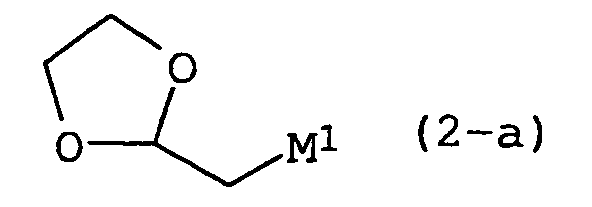

- A production method of a furanose type 1-position hydroxyl-protected form of 2-deoxy-L-ribose, which comprises reacting a mixture of a furanose type 1-position hydroxyl-protected form of 2-deoxy-L-ribose and a furanose type 1-position hydroxyl-protected form of 2-deoxy-L-xylose with a ketone compound represented by the formula (5)wherein R5 and R6 are each independently an alkyl group, an aralkyl group or an aryl group, or R5 and R6 in combination show a cyclic alkyl group, in the presence of an acid, to preferentially protect the 3-position and the 5-position hydroxyl groups of the furanose type 1-position hydroxyl-protected form of 2-deoxy-L-xylose and give a furanose type 2-deoxy-L-xylose compound represented by the formula (6)
 wherein R5 and R6 are as defined above and R7 is an alkyl group or an aralkyl group, and then separating an unreacted furanose type 1-position hydroxyl-protected form of 2-deoxy-L-ribose from the furanose type 2-deoxy-L-xylose compound represented by the formula (6).
- The production method of claim 14, wherein the ketone compound represented by the formula (5) is acetone.
- The production method of claim 14 or 15, wherein the separation comprises separation of water from an organic solvent.
- A production method of a furanose type 2-deoxy-L-ribose represented by the formula (8)wherein X1 is a leaving group, R8 and R9 are each independently a hydroxy-protecting group or R8 and R9 in combination show a hydroxyl-protecting group, which comprises protecting the 3-position and the 5-position hydroxyl groups of the furanose type 1-position hydroxyl-protected form of 2-deoxy-L-ribose obtained by the production method of any of claims 14 to 16, and then converting the protected 1-position hydroxyl group to a leaving group.

- The production method of claim 17, wherein X1 is a chlorine atom and R8 and R9 are p-toluoyl groups.
- The production method of any of claims 14 to 18, wherein the mixture containing a furanose type 1-position hydroxyl-protected form of 2-deoxy-L-ribose and a furanose type 1-position hydroxyl-protected form of 2-deoxy-L-xylose are obtained by the production method of any of claims 4 to 6.
- The production method of claim 19, wherein R1 and R2 are each independently a hydroxyl-protecting group, which can be deprotected by acid hydrolysis, or R1 and R2 in combination show a hydroxyl-protecting group, which can be deprotected by acid hydrolysis, and the deprotection of the hydroxyl group and the production of aldehyde by acid hydrolysis of Step (b) are simultaneously performed.
- The production method of claim 20, wherein R1 and R2 in combination show a cyclic acetal type hydroxyl-protecting group, which can be deprotected by acid hydrolysis.
- The production method of any of claims 19 to 21, wherein M is Li, MgX2 or ZnX2 (X2 is a halogen atom).
- The production method of claim 21, wherein the aldehyde compound represented by the formula (1) is an aldehyde compound represented by the formula (1-a):the organometallic compound represented by the formula (2) is an organometallic compound represented by the formula (2-a):
 wherein M1 is Li, MgX2 or ZnX2 (X2 is a halogen atom), and the alcohol compound represented by the formula (3) is an alcohol compound represented by the formula (3-a):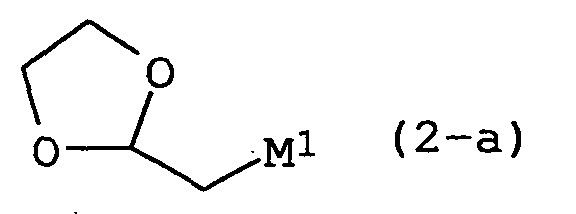

- An alcohol compound represented by the formula (3):wherein R1 and R2 are each independently a hydroxyl-protecting group or R1 and R2 in combination show a hydroxyl-protecting group, R3 and R4 are each independently an alkyl group, an aralkyl group, an aryl group or a silyl group or R3 and R4 in combination show a cyclic alkyl group.

- An alcohol compound represented by the formula (3-a):

Applications Claiming Priority (4)
| Application Number | Priority Date | Filing Date | Title |
|---|---|---|---|
| JP2004071101 | 2004-03-12 | ||
| JP2004071101 | 2004-03-12 | ||
| JP2004272619 | 2004-09-17 | ||
| JP2004272619A JP2005289964A (en) | 2004-03-12 | 2004-09-17 | Production method of 2-deoxy-l-ribose compound |
Publications (2)
| Publication Number | Publication Date |
|---|---|
| EP1574515A2 true EP1574515A2 (en) | 2005-09-14 |
| EP1574515A3 EP1574515A3 (en) | 2007-05-23 |
Family
ID=34829512
Family Applications (1)
| Application Number | Title | Priority Date | Filing Date |
|---|---|---|---|
| EP05005276A Withdrawn EP1574515A3 (en) | 2004-03-12 | 2005-03-10 | Production method of 2-deoxy-L-ribose compound |
Country Status (2)
| Country | Link |
|---|---|
| EP (1) | EP1574515A3 (en) |
| JP (1) | JP2005289964A (en) |
Cited By (1)
| Publication number | Priority date | Publication date | Assignee | Title |
|---|---|---|---|---|
| CN118812465A (en) * | 2024-09-18 | 2024-10-22 | 天津兴博润生物制药有限公司 | A method for preparing tetrahydrofuran derivatives |
Family Cites Families (2)
| Publication number | Priority date | Publication date | Assignee | Title |
|---|---|---|---|---|
| US6949522B2 (en) * | 2001-06-22 | 2005-09-27 | Pharmasset, Inc. | β-2′- or 3′-halonucleosides |
| RU2361875C2 (en) * | 2003-06-30 | 2009-07-20 | Айденикс (Кайман) Лимитед | SYNTHESIS OF β-L-2'-DESOXYNUCLEOSIDES |
-
2004
- 2004-09-17 JP JP2004272619A patent/JP2005289964A/en not_active Abandoned
-
2005
- 2005-03-10 EP EP05005276A patent/EP1574515A3/en not_active Withdrawn
Cited By (1)
| Publication number | Priority date | Publication date | Assignee | Title |
|---|---|---|---|---|
| CN118812465A (en) * | 2024-09-18 | 2024-10-22 | 天津兴博润生物制药有限公司 | A method for preparing tetrahydrofuran derivatives |
Also Published As
| Publication number | Publication date |
|---|---|
| EP1574515A3 (en) | 2007-05-23 |
| JP2005289964A (en) | 2005-10-20 |
Similar Documents
| Publication | Publication Date | Title |
|---|---|---|
| EP2594569B1 (en) | Entecavir synthesis method and intermediate compound thereof | |
| JP7025064B2 (en) | Stereoselective synthesis of 4'-substituted nucleoside derivatives | |
| GB2172287A (en) | Fluoro desoxycarbohydrates | |
| EP0285884A2 (en) | Process to produce 2', 3'-Dideoxynucleosides | |
| JP4518422B2 (en) | Process for the preparation of OH-protected [4- (2,6-diamino-9H-purin-9-yl) -1,3-dioxolan-2-yl] methanol derivatives | |
| CN86101400A (en) | Preparation of cytidine nucleosides | |
| US20090221811A1 (en) | Process for preparing gemcitabine and associated intermediates | |
| CA2168080C (en) | Process for the preparation of 1-(2'-deoxy-2',2'-difluoro- d-ribopentofuranosyl)-cytosine from 2-deoxy-2,2-difluoro- beta-d-ribo-pentopyranose | |
| US8193354B2 (en) | Process for preparation of Gemcitabine hydrochloride | |
| CN118359621B (en) | Preparation method of intermediates of Li Siwei and Li Siwei and corresponding intermediates of Li Siwei | |
| US20050228175A1 (en) | Production method of 2-deoxy-L-ribose compound | |
| WO2001018003A1 (en) | Carbocyclic nucleosides and process for obtaining such | |
| JP2005289964A (en) | Production method of 2-deoxy-l-ribose compound | |
| US5602262A (en) | Process for the preparation of 2-deoxy-2,2-difluoro-β-D-ribo-pentopyranose | |
| JP4691101B2 (en) | 1-α-halo-2,2-difluoro-2-deoxy-D-ribofuranose derivative and method for producing the same | |
| JP4383126B2 (en) | Process for producing 4'-C-ethynyl-2'-deoxypurine nucleoside | |
| CN105985370B (en) | Prepare key intermediate and its application of limaprost | |
| US7858761B2 (en) | 1-α-halo-2,2-difluoro-2-deoxy-D-ribofuranose derivatives and process for the preparation thereof | |
| KR101259637B1 (en) | A process of 1-(2´-Deoxy-2´,2´-difluoro-D-ribofuranosyl)-4-aminopyrimidin-2-on or thereof HCl salt | |
| JP2007137843A (en) | Method for producing ribofuranose compound and purine nucleoside compound | |
| JPH05178880A (en) | Process for producing 4'-demethylepipodophyllotoxin glucoside 4'-phosphate | |
| CN101356165A (en) | Process for preparing gemcitabine and related intermediates | |
| HK1013829A (en) | Process for the preparation of 2-deoxy-2,2-difluoro-beta-d-ribo-pentopyranose | |
| JPH07145093A (en) | Process for producing synthetic intermediate of vitamin D derivative | |
| WO2003051904A1 (en) | Process for producing pregnane derivative |
Legal Events
| Date | Code | Title | Description |
|---|---|---|---|
| PUAI | Public reference made under article 153(3) epc to a published international application that has entered the european phase |
Free format text: ORIGINAL CODE: 0009012 |
|
| AK | Designated contracting states |
Kind code of ref document: A2 Designated state(s): AT BE BG CH CY CZ DE DK EE ES FI FR GB GR HU IE IS IT LI LT LU MC NL PL PT RO SE SI SK TR |
|
| AX | Request for extension of the european patent |
Extension state: AL BA HR LV MK YU |
|
| PUAL | Search report despatched |
Free format text: ORIGINAL CODE: 0009013 |
|
| AK | Designated contracting states |
Kind code of ref document: A3 Designated state(s): AT BE BG CH CY CZ DE DK EE ES FI FR GB GR HU IE IS IT LI LT LU MC NL PL PT RO SE SI SK TR |
|
| AX | Request for extension of the european patent |
Extension state: AL BA HR LV MK YU |
|
| RIC1 | Information provided on ipc code assigned before grant |
Ipc: C07H 15/04 20060101ALI20070419BHEP Ipc: C07H 9/04 20060101ALI20070419BHEP Ipc: C07H 13/08 20060101ALI20070419BHEP Ipc: C07D 317/26 20060101ALI20070419BHEP Ipc: C07H 3/08 20060101AFI20050720BHEP |
|
| 17P | Request for examination filed |
Effective date: 20071113 |
|
| AKX | Designation fees paid |
Designated state(s): AT BE BG CH CY CZ DE DK EE ES FI FR GB GR HU IE IS IT LI LT LU MC NL PL PT RO SE SI SK TR |
|
| 17Q | First examination report despatched |
Effective date: 20080201 |
|
| STAA | Information on the status of an ep patent application or granted ep patent |
Free format text: STATUS: THE APPLICATION HAS BEEN WITHDRAWN |
|
| 18W | Application withdrawn |
Effective date: 20080725 |