EP1574448A1 - Fuel tank closure with cap ejector spring - Google Patents
Fuel tank closure with cap ejector spring Download PDFInfo
- Publication number
- EP1574448A1 EP1574448A1 EP05075919A EP05075919A EP1574448A1 EP 1574448 A1 EP1574448 A1 EP 1574448A1 EP 05075919 A EP05075919 A EP 05075919A EP 05075919 A EP05075919 A EP 05075919A EP 1574448 A1 EP1574448 A1 EP 1574448A1
- Authority
- EP
- European Patent Office
- Prior art keywords
- filler neck
- lower housing
- housing
- spring
- cap
- Prior art date
- Legal status (The legal status is an assumption and is not a legal conclusion. Google has not performed a legal analysis and makes no representation as to the accuracy of the status listed.)
- Withdrawn
Links
- 239000002828 fuel tank Substances 0.000 title description 13
- 239000000945 filler Substances 0.000 claims abstract description 108
- 239000000446 fuel Substances 0.000 claims abstract description 21
- 230000006835 compression Effects 0.000 claims description 15
- 238000007906 compression Methods 0.000 claims description 15
- 238000009434 installation Methods 0.000 description 16
- 230000015572 biosynthetic process Effects 0.000 description 3
- 238000005755 formation reaction Methods 0.000 description 3
- 230000000295 complement effect Effects 0.000 description 2
- 230000008961 swelling Effects 0.000 description 2
- 230000000903 blocking effect Effects 0.000 description 1
- 239000000969 carrier Substances 0.000 description 1
- 230000008878 coupling Effects 0.000 description 1
- 238000010168 coupling process Methods 0.000 description 1
- 238000005859 coupling reaction Methods 0.000 description 1
- 238000012986 modification Methods 0.000 description 1
- 230000004048 modification Effects 0.000 description 1
- 230000000452 restraining effect Effects 0.000 description 1
Images


Classifications
-
- B—PERFORMING OPERATIONS; TRANSPORTING
- B60—VEHICLES IN GENERAL
- B60K—ARRANGEMENT OR MOUNTING OF PROPULSION UNITS OR OF TRANSMISSIONS IN VEHICLES; ARRANGEMENT OR MOUNTING OF PLURAL DIVERSE PRIME-MOVERS IN VEHICLES; AUXILIARY DRIVES FOR VEHICLES; INSTRUMENTATION OR DASHBOARDS FOR VEHICLES; ARRANGEMENTS IN CONNECTION WITH COOLING, AIR INTAKE, GAS EXHAUST OR FUEL SUPPLY OF PROPULSION UNITS IN VEHICLES
- B60K15/00—Arrangement in connection with fuel supply of combustion engines or other fuel consuming energy converters, e.g. fuel cells; Mounting or construction of fuel tanks
- B60K15/03—Fuel tanks
- B60K15/04—Tank inlets
- B60K15/0406—Filler caps for fuel tanks
Definitions
- the present invention relates to fuel tank closures. More particularly, the present invention relates to a fuel tank closure having a housing assembly and a seal coupled to the housing assembly. The seal is positioned to engage a tank filler neck to provide a sealed closure of the tank filler neck.
- a fuel cap for a filler .neck a vehicle fuel system includes an upper housing and a lower housing configured to be inserted into the filler neck.
- the upper housing and lower housing are cooperatively configured to allow both rotational and axial relative movement with respect to one another.
- a seal is positioned to lie between the lower housing and the filler neck, thereby creating a seal when the fuel cap is moved to a tightened position.
- a spring mount is coupled to the lower housing.
- a spring preferably a compression spring, engages both the spring mount and the upper housing to bias the lower housing axially toward the upper housing. This bias assists in loosening contact of the seal and filler neck during removal of the fuel cap.
- a cam and cam follower connection is provided between the upper and lower housing.
- the cam and cam follower connection includes at least one cam arranged on an upper surface of the lower housing and positioned on the upper surface so that the cam slopes upward toward the upper surface to engage a cam follower depending from a lower flange of the upper housing.
- these locations may be reversed: the cam may be configured on the upper housing and the cam follower may be configured on the lower housing. In either embodiment, the cam and cam follower cooperate to generate relative axial movement as the upper housing is rotated relative to the lower housing.
- Each cam includes a wall at a lower end of the cam and a detent formed adjacent an upper end and configured to receive a lower end of the cam follower.
- the cap includes at least one lug extending radially outwardly from the outer surface of the lower housing. Each lug engages a respective notch in the filler neck when the cap is moved to the tightened position to prevent rotation of the lower housing relative the filler neck when the cap is in the tightened position.
- Closure 10 is movable relative to a fuel tank filler neck 12 between a disengaged position, as shown in Fig. 2, and an installed position as shown in Fig. 3.
- Closure 10 includes a housing assembly 14 and a seal 16 coupled to housing assembly 14. While closure 10 is in the installed position, seal 16 engages filler neck 12 and cooperates with housing assembly 14 to substantially seal filler neck 12.
- seal 16 While seal 16 is engaged with filler neck 12, fuel (not shown) in communication with filler neck 12 can cause seal 16 to swell. This swelling increases the compression force between seal 16 and filler neck 12. This increased force creates more resistance to removal of seal 16 from filler neck 12 making closure 10 more difficult to remove from filler neck 12.
- Closure 10 includes an ejector spring 24 that provides this force.
- Ejector spring 24 stores energy during installation of closure 10 in filler neck 12. During removal of closure 10, this stored energy is released to aid in pulling seal 16 from filler neck 12.
- Ejector spring 24 could be any force generator configured to provide the seal pulling force described herein and is a compression spring in the illustrated embodiment.
- Housing assembly 14 includes an upper housing 18 that receives ejector spring 24 and a lower housing 20 that carriers seal 16.
- Closure 10 further includes a spring mount 22 positioned within upper housing or upper body 18 and coupled to lower housing or lower body 20.
- Spring 24 is positioned between spring mount 22 and upper housing 18.
- Spring mount 22 couples lower housing 20 to upper housing 18 so that lower housing 20 can move axially relative to upper housing 18 as shown, for example, in Figs. 2 and 3. While in the disengaged position, lower housing 20 is positioned to lie adjacent to upper housing 18 as shown in Fig. 2. While in the engaged position, lower housing 20 is spaced apart from upper housing 18 as shown in Fig. 3.
- Spring 24 biases lower housing 20 toward upper housing 18 through spring mount 22. As lower housing 20 moves away from upper housing 18, spring 24 is compressed so that the biasing force provided by spring 24 increases. As previously mentioned, this additional biasing force aids in pulling seal 16 and lower housing 20 out off engagement with filler neck 12.
- Upper housing 18 includes a cylindrical body 26 and an upper flange 28 coupled to cylindrical body 26.
- a handle 13 is coupled to upper flange 28 of upper housing 18 for a user to grip and turn upper housing 18.
- a suitable handle is disclosed in PCT Patent Application Serial No. PCT/US98/00863 to Jeffery Griffin and titled Quick-On Filler Neck Cap which is expressly incorporated by reference herein.
- Other handle configurations may also be used including handles having lost motion and/or breakaway features.
- Upper flange 28 includes a plurality of flexible arms 30 having pawl teeth 32 providing a torque-override feature between the handle 13 and upper housing 18. Additional description of the torque-override feature is disclosed in PCT Patent Application Serial No. PCT/US98/00863, which disclosure is incorporated by reference herein. Other forms of torque-override may also be used with the presently preferred closure.
- upper housing 18 includes a pair of helical cap mounting members 36 coupled to cylindrical body 26 and lower housing 18 includes a pair of position-locator lugs 50 coupled to cylindrical body 21.
- mounting members 36 engage complementary formations 37 on filler neck 12 to pull closure 10 axially into filler neck 12. Additional description of mounting members 36 and position-locator lugs 50 is disclosed in PCT Patent Application Serial No. PCT/US98/00863, which disclosure is incorporated by reference herein.
- Upper housing 18 further includes a middle flange 38 coupled to cylindrical body 26.
- Middle flange 38 engages an upper end 45 of filler neck 12 to provide a stop for the axially inward movement of upper housing 18 as the handle 13 is turned in a clockwise cap-installation direction 39.
- a C-shaped seal is coupled to an underside of the middle flange to engage and seal with the upper end of the filler neck.
- upper housing 18 also includes a lower flange 40 that extends radially inwardly.
- Lower flange 40 includes an inner edge 41 having an inside diameter that is less than the diameter of spring 24 so that spring 24 pushes against lower flange 40 when closure 10 is assembled.
- Inner edge 41 defines an aperture 43 in which spring mount 22 is positioned after assembly of closure 10.
- Upper housing 18 also includes several axially downwardly extending cam followers 42 appended to an underside of lower flange 40 that engage cams 54 provided on lower housing 20 to provide the axial movement between upper and lower housings 18, 20.
- cams 54 are the “driven members” and the cam followers 42 are the “drivers” since rotation of the cam followers 42 about a central axis 11 of closure 10 (in response to rotation of handle 13 and upper housing 18 about central axis 11) causes cam follower 42 to ride on cams 54 and urge lower housing 20 downwardly along central axis 11 and in direction 21 (as shown in Fig. 3) to cause the seal 16 to seal against an inner wall of filler neck 12.
- Lower housing 20 includes a snap-receiving portion 46 that extends upwardly from upper surface 44 of lower housing 20. Snap-receiving portion 46 includes a groove 47 formed at a lower end thereof for engaging spring mount 22. Lower housing 20 includes a seal-receiving groove 48 sized to receive seal 16 as shown in Fig. 2. As shown in Fig. 3, a pair of lugs 50 (one shown) are coupled to cylindrical body 21 of lower housing 20. Lugs 50 engage a formation defining a notch 52 formed in filler neck 12 to prevent rotation of lower housing 20 during rotation of upper housing 18 by the handle 113. Additional detail of the relationship between and configuration of lugs 50 and filler neck 12 is disclosed in PCT Patent Application Serial No. PCT/US96/19589 to Robert S. Harris and Jeffery Griffin and titled Quick-On Fuel Cap which is expressly incorporated by reference herein.
- lower housing 20 includes several cams 54 (two shown) positioned on upper surface 44 to engage cam followers 42 of upper housing 18 to provide the axial movement between upper and lower housings 18, 20. Additional detail of the relationship between and configuration of cam followers 42 and cams 54 is disclosed in PCT Patent Application Serial No. PCT/US95/01561 to Robert S. Harris and Jeffery Griffin and tided Quick-On Cap with Removal Delay Mechanism which is expressly incorporated by reference herein.
- the cam 54 is shown to extend upward toward an upper surface 44 of the lower body 20, and configured to engage a cam follower 42 depending from a lower flange 40 of the upper body 18.
- the cam 54 and cam follower 42 positions may be reversed; specifically, the cam 54 may depend downwardly from a lower flange 40 of the upper body 18 and the cam follower 42 may extend upwardly from an upper surface 44 of the lower body 20.
- a pressure/vacuum-relief valve may also be provided with closure 10.
- a pressure/vacuum-relief valve, a pressure-relief valve, or a vacuum-relief valve may be positioned within the body of the lower housing.
- a suitable pressure/vacuum-relief valve is described in PCT Patent Application Serial No. PCT/US95/10561, which disclosure is incorporated by reference herein. Other configurations of pressure/vacuum-relief valves may also be used.
- Spring mount 22 includes a cylindrical body 56 and a flange 58 coupled to an upper end of cylindrical body 56 as shown in Fig. 1.
- Flange 58 has an outside diameter that is greater than the diameter of spring 24 so that ejector spring 24 pushes against flange 58 to bias spring mount 22 upwardly.
- Spring mount 22 also includes a snap ridge 60 coupled to a lower end of cylindrical body 56 to rigidly couple spring mount 22 to lower housing 20.
- body 56 of spring mount 22 is positioned within spring 24, as shown in Fig. 1, and inserted through aperture 43 of upper housing 18. Snap ridge 60 is forced over snap-receiving portion 46 into groove 47 to couple spring mount 22 to lower housing 20.
- ejector spring 24 is positioned between flange 58 of spring mount 22 and lower flange 40 of upper housing 18. Spring 24 is slight compressed to provide an upward bias of spring mount 22 relative to upper housing 18. Because of the coupling of spring mount 22 to lower housing 20, lower housing 20 is also provided with an upward bias toward upper housing 18.
- lower housing 20 moves downwardly in direction 21 away from upper housing 18 as shown in Fig. 3 as upper housing 18 is rotated in clockwise direction 39 relative to filler neck 12 in response to clockwise rotation of the handle 39 that is coupled to upper housing 18.
- Lower housing 20 and seal 16 do not rotate relative to filler neck 12 during rotation of the handle 13 and the upper housing 18 in the clockwise cap-installation direction 39. Instead, lug 50 carried on lower housing 20 engages notch 52 on filler neck 12 to prevent any substantial rotation of lower housing 20 in clockwise direction 39 relative to filler neck 12 so that upper housing 18 is allowed to rotate relative to lower housing 20.
- cam followers 42 ofupper housing 18 ride on cams 54 of lower housing 20 to drive lower housing 20 and seal 16 axially inward in direction 21 further into filler neck 12.
- Cam followers 42 continue to ride on cams 54 until each cam follower 42 overrides a detent 62 provided on upper surface 44 adjacent the top of the cam slope defined by cams 54, and is stopped by stop 64.
- Detents 62 cooperate with cam followers 42 to provide latching engagement between upper and lower housings 18, 20 and cooperate with stops 64 to prevent accidental sliding of cam followers 42 back down cams 54 in the loosening direction 72.
- upper and lower housings18, 20 are pulled into filler neck 12 by the rotational engagement of helical mounting members 36 of upper housing 1'8 and lower housing 20 is pushed further into filler neck 12 by the engagement of the "driving" cam followers 42 of upper housing 18 with “driven” cams 54 of lower housing 20.
- upper and lower housings 18, 20 move a first distance 66 into filler neck 12 during installation and upper housing 18 pushes lower housing 20 into filler neck 12 by an additional distance 68 so that lower housing 20 and seal 16 travel a total distance equal to the sum of distances 66,68 during rotation of the handle 13 in cap-installation direction 39.
- seal 16 engages filler neck 12 to form a substantial seal therewith to block the flow of fuel and fuel vapor from escaping from filler neck 12 between seal 16 and filler neck 12.
- ejector spring 24 creates additional upward biasing of lower housing 18 and seal 16 toward upper housing 13 and out of filler neck 12.
- this additional force is not able to move lower housing 18 and seal 16 relative to upper housing 18 and filler neck 12 because of the latching engagement provided by detent 62 of lower housing 20 for each cam follower 42, which latching engagement blocks counterclockwise rotation of upper housing 18 relative to filler neck 12 and thus movement of upper housing 18 out of the filler neck under the urging of the ejector spring 24.
- a detent 62 and stop 64 are positioned to lie adjacent to an end of each cam surface 54 in order to prevent accidental sliding of the cam followers 42 down the cam surfaces 54.
- the cap' may move in the loosening direction 72 if one applies sufficient torque to overcome the restraining force created by the cam followers 42 engaging the detents 62. Once sufficient torque is applied to the handle 13 in the loosening direction 72, the cam followers 42 will move past the detents 62 and will travel along the cam surfaces 54 toward the wall 63 (shown in Fig. 1).
- Compressed ejector spring 24 aids in the removal of closure 10 by releasing the stored energy at the proper time during cap removal.
- cam followers 42 are forced over detents 62 and cam followers 42 continue to ride along cams 54 so that lower housing 20 moves upwardly to a position adjacent upper housing 18 as shown in Fig. 2. This movement of lower housing 20 relative to upper housing 18 is assisted by the additional compression applied to ejector spring 24 during installation of the cap.
- Ejector spring 24 provides a force that pushes up on spring mount 22 to pull lower housing 20 toward upper housing 18 to assist in ejecting closure 10 from filler neck 12 during cap removal.
- This force also aids in pulling seal 16 along filler neck 12 so that a user of closure 10 does not have to apply as much force during removal of closure 10 from filler neck 12.
- the user must apply an amount of torque to closure 10 to turn upper housing 18 relative to filler neck 12. A portion of this torque is used to pull seal 16 axially along filler neck 12.
- the stored energy in ejector spring 24 reduces the amount of torque required to remove closure 10 by pulling lower housing 18 and seal out of filler neck 12.
- this stored energy may be released to aid in removal of closure 10 during removal.
- the ejector spring may also be positioned in other locations to aid in removal of the closure from the filler neck.
- the ejector spring may be positioned between the lower housing member and the filler neck so that the spring is compressed between the filler neck and the lower housing member during installation. This compression will aid in removal of the closure by urging the lower housing member and the seal out of the filler neck.
- the ejector spring may be positioned between the filler neck and the upper housing or the handle so that the spring is compressed between the filler neck and the upper housing or the handle during installation. This compression will aid in removal of the closure by urging the upper housing, the lower housing, and the seal from the filler neck.
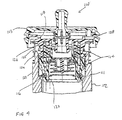
- a fuel tank closure 110 in accordance with an alternative embodiment of the present disclosure is shown in Fig. 4.
- Closure 110 is movable between a disengaged position (not shown) and an installed position as shown in Fig. 4 with closure 110 positioned in a fuel tank filler neck 112.
- Closure 110 includes a housing assembly 114 and a seal 116 coupled to housing assembly 114. While closure 110 is in the installed position, seal 116 engages filler neck 112 to substantially seal filler neck 112.
- seal 116 While seal 116 is engaged with filler neck 112, fuel (not shown) can cause seal 116 to swell. This swelling increases the compression force between seal 116 and filler neck 112. This increased force creates more resistance to removal of seal 116 from filler neck 112 making closure 110 more difficult to remove from filler neck 112.
- closure 110 and seal 116 are axially biased outwardly to provide a force that assists in pulling seal 116 from filler neck 112.
- Filler neck 112 includes a compression spring 124 that provides this force. Spring 124 is compressed to store energy during installation of closure 110 112. During removal of closure 110, this stored energy is released to aid in pulling closure 110 and seal 116 from filler neck 112.
- Housing assembly 114 includes an upper housing 118 and a lower housing 120 that carries seal 116.
- Lower housing 120 can move rotationally relative to upper housing 18. Further details of the operation of upper and lower housing 113, 120 and the remainder of closure 110 is disclosed in PCT Patent Application Serial No. PCT/US96/19589 which has been expressly incorporated herein.
- spring 124 is compressed to urge upper housing 118 of closure 110 upwardly out of filler neck 112.
- Upper housing 118 includes a cylindrical body 126 and an upper flange 128 coupled to cylindrical body 126.
- a handle is coupled to upper flange 128 for a user to grip and turn upper housing 118 when installing closure 110 into filler neck 112.
- spring 124 is compressed to provide the biasing force between closure 110 and filler neck 112.
- Filler neck 112 includes a body portion 111 having a spring-receiving groove 122. As shown in Fig. 4, spring 124 is positioned in groove 122 to support spring 124 during compression. Filler neck 112 further includes a spring guide 130 having a body portion 132 and a flange 134 coupled to body portion 132. During rotation of the handle 13, housing assembly 114 is pulled into filler neck 112. Axially inward movement of housing assembly 114 into filler neck 112 causes seal 116 to engage filler neck 112 to form the seal blocking the flow of fuel and fuel vapor from escaping from filler neck 112 between seal 116 and filler neck 112.
- This force also aids in pulling seal 116 along filler neck 112 so that a user of closure 110 does not have to apply as much force during removal of closure 110 from filler neck 112.
- the user must apply an amount of torque to closure 110 to turn upper housing 118 relative to filler neck 112. A portion ofthis torque is used to pull seal 116 axially along filler neck 112.
- seal 116 is swollen, the amount of torque required to remove closure 110 increases due to the increased compressive force applied to seal 116.
- the stored energy in spring 124 reduces the amount of torque required to remove closure 10 by biasing housing assembly 114 and seal 116 out of filler neck 112. Thus, by compressing spring 124 to store energy during installation of closure 110, the stored energy may be used to aid in remove of closure 110.
- the spring may also be positioned in other locations to aid in removal of the closure from the filler neck.
- the spring may be positioned between the lower housing member and the filler neck so that the spring is compressed between the filler neck and the lower housing member during installation. This compression will aid in removal of the closure by urging the lower housing member and the seal out of the filler neck.
- the spring may be directly coupled to the closure to move into engagement with the filler neck to provide the biasing force.
Landscapes
- Engineering & Computer Science (AREA)
- Life Sciences & Earth Sciences (AREA)
- Sustainable Development (AREA)
- Sustainable Energy (AREA)
- Chemical & Material Sciences (AREA)
- Combustion & Propulsion (AREA)
- Transportation (AREA)
- Mechanical Engineering (AREA)
- Closures For Containers (AREA)
- Cooling, Air Intake And Gas Exhaust, And Fuel Tank Arrangements In Propulsion Units (AREA)
Abstract
Description
- The present invention relates to fuel tank closures. More particularly, the present invention relates to a fuel tank closure having a housing assembly and a seal coupled to the housing assembly. The seal is positioned to engage a tank filler neck to provide a sealed closure of the tank filler neck.
- A fuel cap for a filler .neck a vehicle fuel system includes an upper housing and a lower housing configured to be inserted into the filler neck. The upper housing and lower housing are cooperatively configured to allow both rotational and axial relative movement with respect to one another.
- A seal is positioned to lie between the lower housing and the filler neck, thereby creating a seal when the fuel cap is moved to a tightened position. A spring mount is coupled to the lower housing. A spring, preferably a compression spring, engages both the spring mount and the upper housing to bias the lower housing axially toward the upper housing. This bias assists in loosening contact of the seal and filler neck during removal of the fuel cap.
- In preferred embodiments, a cam and cam follower connection is provided between the upper and lower housing. The cam and cam follower connection includes at least one cam arranged on an upper surface of the lower housing and positioned on the upper surface so that the cam slopes upward toward the upper surface to engage a cam follower depending from a lower flange of the upper housing. In other embodiments, these locations may be reversed: the cam may be configured on the upper housing and the cam follower may be configured on the lower housing. In either embodiment, the cam and cam follower cooperate to generate relative axial movement as the upper housing is rotated relative to the lower housing.
- Each cam includes a wall at a lower end of the cam and a detent formed adjacent an upper end and configured to receive a lower end of the cam follower.
- The cap includes at least one lug extending radially outwardly from the outer surface of the lower housing. Each lug engages a respective notch in the filler neck when the cap is moved to the tightened position to prevent rotation of the lower housing relative the filler neck when the cap is in the tightened position.
- Additional features of the invention will become apparent to those of ordinary skill in the art upon consideration of the following detailed description of preferred embodiments exemplifying the best mode of carrying out the invention as presently perceived.
- The detailed description particularly refers to the accompanying figures in which:
- Fig. 1 is an exploded assembly view of a fuel tank closure positioned above a filler neck;
- Fig. 2 is a side elevation view of the fuel tank closure of Fig. 1 showing the fuel tank closure assembled and in a position prior to installation;
- Fig. 3 is a side elevation view similar to Fig. 2 showing the fuel tank closure in an installed position within the filler neck; and
- Fig. 4 is a side elevation view of a fuel tank closure according to an alternative embodiment showing the closure positioned in a fuel tank filler neck and biased against the filler neck by a compression spring.
-
- A
fuel tank closure 10 in accordance with the present disclosure is shown in Fig. 1. Closure 10 is movable relative to a fueltank filler neck 12 between a disengaged position, as shown in Fig. 2, and an installed position as shown in Fig. 3. Closure 10 includes a housing assembly 14 and aseal 16 coupled to housing assembly 14. Whileclosure 10 is in the installed position, seal 16 engagesfiller neck 12 and cooperates with housing assembly 14 to substantially sealfiller neck 12. - While
seal 16 is engaged withfiller neck 12, fuel (not shown) in communication withfiller neck 12 can causeseal 16 to swell. This swelling increases the compression force betweenseal 16 andfiller neck 12. This increased force creates more resistance to removal ofseal 16 fromfiller neck 12 makingclosure 10 more difficult to remove fromfiller neck 12. - To aid in removal of
seal 16 fromfiller neck 12,seal 16 is axially biased outwardly to provide a force that assists in pullingseal 16 fromfiller neck 12. Closure 10 includes anejector spring 24 that provides this force. Ejector spring 24 stores energy during installation ofclosure 10 infiller neck 12. During removal ofclosure 10, this stored energy is released to aid in pullingseal 16 fromfiller neck 12.Ejector spring 24 could be any force generator configured to provide the seal pulling force described herein and is a compression spring in the illustrated embodiment. - Housing assembly 14 includes an
upper housing 18 that receivesejector spring 24 and alower housing 20 that carriers seal 16. Closure 10 further includes aspring mount 22 positioned within upper housing orupper body 18 and coupled to lower housing orlower body 20.Spring 24 is positioned betweenspring mount 22 andupper housing 18. -
Spring mount 22 coupleslower housing 20 toupper housing 18 so thatlower housing 20 can move axially relative toupper housing 18 as shown, for example, in Figs. 2 and 3. While in the disengaged position,lower housing 20 is positioned to lie adjacent toupper housing 18 as shown in Fig. 2. While in the engaged position,lower housing 20 is spaced apart fromupper housing 18 as shown in Fig. 3. -
Spring 24 biaseslower housing 20 towardupper housing 18 throughspring mount 22. Aslower housing 20 moves away fromupper housing 18,spring 24 is compressed so that the biasing force provided byspring 24 increases. As previously mentioned, this additional biasing force aids in pullingseal 16 andlower housing 20 out off engagement withfiller neck 12. -
Upper housing 18 includes a cylindrical body 26 and anupper flange 28 coupled to cylindrical body 26. Ahandle 13 is coupled toupper flange 28 ofupper housing 18 for a user to grip and turnupper housing 18. A suitable handle is disclosed in PCT Patent Application Serial No. PCT/US98/00863 to Jeffery Griffin and titled Quick-On Filler Neck Cap which is expressly incorporated by reference herein. Other handle configurations may also be used including handles having lost motion and/or breakaway features. -
Upper flange 28 includes a plurality of flexible arms 30 having pawl teeth 32 providing a torque-override feature between thehandle 13 andupper housing 18. Additional description of the torque-override feature is disclosed in PCT Patent Application Serial No. PCT/US98/00863, which disclosure is incorporated by reference herein. Other forms of torque-override may also be used with the presently preferred closure. - As shown in Fig. 2,
upper housing 18 includes a pair of helicalcap mounting members 36 coupled to cylindrical body 26 andlower housing 18 includes a pair of position-locator lugs 50 coupled tocylindrical body 21. As thehandle 13 andupper housing 18 are rotated in a cap-installation direction 39, mountingmembers 36 engagecomplementary formations 37 onfiller neck 12 to pullclosure 10 axially intofiller neck 12. Additional description of mountingmembers 36 and position-locator lugs 50 is disclosed in PCT Patent Application Serial No. PCT/US98/00863, which disclosure is incorporated by reference herein. -
Upper housing 18 further includes amiddle flange 38 coupled to cylindrical body 26.Middle flange 38 engages anupper end 45 offiller neck 12 to provide a stop for the axially inward movement ofupper housing 18 as thehandle 13 is turned in a clockwise cap-installation direction 39. According to an alternative embodiment, a C-shaped seal is coupled to an underside of the middle flange to engage and seal with the upper end of the filler neck. - As shown in Fig. 1,
upper housing 18 also includes alower flange 40 that extends radially inwardly.Lower flange 40 includes an inner edge 41 having an inside diameter that is less than the diameter ofspring 24 so thatspring 24 pushes againstlower flange 40 whenclosure 10 is assembled. Inner edge 41 defines anaperture 43 in whichspring mount 22 is positioned after assembly ofclosure 10.Upper housing 18 also includes several axially downwardly extendingcam followers 42 appended to an underside oflower flange 40 that engagecams 54 provided onlower housing 20 to provide the axial movement between upper andlower housings cams 54 are the "driven members" and thecam followers 42 are the "drivers" since rotation of thecam followers 42 about acentral axis 11 of closure 10 (in response to rotation ofhandle 13 andupper housing 18 about central axis 11) causescam follower 42 to ride oncams 54 and urgelower housing 20 downwardly alongcentral axis 11 and in direction 21 (as shown in Fig. 3) to cause theseal 16 to seal against an inner wall offiller neck 12. -
Lower housing 20 includes a snap-receivingportion 46 that extends upwardly fromupper surface 44 oflower housing 20. Snap-receivingportion 46 includes a groove 47 formed at a lower end thereof for engagingspring mount 22.Lower housing 20 includes a seal-receivinggroove 48 sized to receiveseal 16 as shown in Fig. 2. As shown in Fig. 3, a pair of lugs 50 (one shown) are coupled tocylindrical body 21 oflower housing 20.Lugs 50 engage a formation defining anotch 52 formed infiller neck 12 to prevent rotation oflower housing 20 during rotation ofupper housing 18 by thehandle 113. Additional detail of the relationship between and configuration oflugs 50 andfiller neck 12 is disclosed in PCT Patent Application Serial No. PCT/US96/19589 to Robert S. Harris and Jeffery Griffin and titled Quick-On Fuel Cap which is expressly incorporated by reference herein. - As shown in Fig. 1,
lower housing 20 includes several cams 54 (two shown) positioned onupper surface 44 to engagecam followers 42 ofupper housing 18 to provide the axial movement between upper andlower housings cam followers 42 andcams 54 is disclosed in PCT Patent Application Serial No. PCT/US95/01561 to Robert S. Harris and Jeffery Griffin and tided Quick-On Cap with Removal Delay Mechanism which is expressly incorporated by reference herein. - In a preferred embodiment, the
cam 54 is shown to extend upward toward anupper surface 44 of thelower body 20, and configured to engage acam follower 42 depending from alower flange 40 of theupper body 18. In another preferred embodiment, thecam 54 andcam follower 42 positions may be reversed; specifically, thecam 54 may depend downwardly from alower flange 40 of theupper body 18 and thecam follower 42 may extend upwardly from anupper surface 44 of thelower body 20. - A pressure/vacuum-relief valve may also be provided with
closure 10. For example, a pressure/vacuum-relief valve, a pressure-relief valve, or a vacuum-relief valve may be positioned within the body of the lower housing. A suitable pressure/vacuum-relief valve is described in PCT Patent Application Serial No. PCT/US95/10561, which disclosure is incorporated by reference herein. Other configurations of pressure/vacuum-relief valves may also be used. -
Spring mount 22 includes acylindrical body 56 and aflange 58 coupled to an upper end ofcylindrical body 56 as shown in Fig. 1.Flange 58 has an outside diameter that is greater than the diameter ofspring 24 so thatejector spring 24 pushes againstflange 58 to biasspring mount 22 upwardly. -
Spring mount 22 also includes a snap ridge 60 coupled to a lower end ofcylindrical body 56 to rigidly couplespring mount 22 tolower housing 20. During assembly ofclosure 10,body 56 ofspring mount 22 is positioned withinspring 24, as shown in Fig. 1, and inserted throughaperture 43 ofupper housing 18. Snap ridge 60 is forced over snap-receivingportion 46 into groove 47 to couplespring mount 22 tolower housing 20.. - After assembly,
ejector spring 24 is positioned betweenflange 58 ofspring mount 22 andlower flange 40 ofupper housing 18.Spring 24 is slight compressed to provide an upward bias ofspring mount 22 relative toupper housing 18. Because of the coupling ofspring mount 22 tolower housing 20,lower housing 20 is also provided with an upward bias towardupper housing 18. - During installation,
lower housing 20 moves downwardly indirection 21 away fromupper housing 18 as shown in Fig. 3 asupper housing 18 is rotated inclockwise direction 39 relative tofiller neck 12 in response to clockwise rotation of thehandle 39 that is coupled toupper housing 18.Lower housing 20 and seal 16 do not rotate relative tofiller neck 12 during rotation of thehandle 13 and theupper housing 18 in the clockwise cap-installation direction 39. Instead, lug 50 carried onlower housing 20 engagesnotch 52 onfiller neck 12 to prevent any substantial rotation oflower housing 20 inclockwise direction 39 relative tofiller neck 12 so thatupper housing 18 is allowed to rotate relative to lowerhousing 20. - During rotation of
upper housing 18 in the tightening or cap-installation direction 39 with respect tolower housing 20,cam followers 42ofupper housing 18 ride oncams 54 oflower housing 20 to drivelower housing 20 andseal 16 axially inward indirection 21 further intofiller neck 12.Cam followers 42 continue to ride oncams 54 until eachcam follower 42 overrides a detent 62 provided onupper surface 44 adjacent the top of the cam slope defined bycams 54, and is stopped bystop 64. Detents 62 cooperate withcam followers 42 to provide latching engagement between upper andlower housings stops 64 to prevent accidental sliding ofcam followers 42 back downcams 54 in the looseningdirection 72. - During rotation of the
handle 13 in theclockwise tightening direction 39, upper and lower housings18, 20 are pulled intofiller neck 12 by the rotational engagement of helical mountingmembers 36 of upper housing 1'8 andlower housing 20 is pushed further intofiller neck 12 by the engagement of the "driving"cam followers 42 ofupper housing 18 with "driven"cams 54 oflower housing 20. As illustrated in Fig. 3, upper andlower housings first distance 66 intofiller neck 12 during installation andupper housing 18 pusheslower housing 20 intofiller neck 12 by an additional distance 68 so thatlower housing 20 and seal 16 travel a total distance equal to the sum ofdistances 66,68 during rotation of thehandle 13 in cap-installation direction 39. During the axially inward movement,seal 16 engagesfiller neck 12 to form a substantial seal therewith to block the flow of fuel and fuel vapor from escaping fromfiller neck 12 betweenseal 16 andfiller neck 12. - During the movement of
lower housing 20 away fromupper housing 18,ejector spring 24 is compressed by distance 68 to store energy. Becausespring mount 22 is coupled tolower housing 20,lower housing 20 also moves axially inward relative toupper housing 18 so thatflange 58 ofspring mount 22 andlower flange 40 ofupper housing 18compress ejector spring 24 there between. - The additional compression of
ejector spring 24 creates additional upward biasing oflower housing 18 and seal 16 towardupper housing 13 and out offiller neck 12. However, this additional force is not able to movelower housing 18 and seal 16 relative toupper housing 18 andfiller neck 12 because of the latching engagement provided by detent 62 oflower housing 20 for eachcam follower 42, which latching engagement blocks counterclockwise rotation ofupper housing 18 relative tofiller neck 12 and thus movement ofupper housing 18 out of the filler neck under the urging of theejector spring 24. - When the
handle 13 is rotated in a counterclockwise cap-removal direction 72,lower housing 20 is pulled upwardly to a position adjacentupper housing 18 so thatseal 16 is pulled from engagement withfiller neck 12. Furthermore, engagement of helical mountingmembers 36 ofupper housing 18 andcomplementary formations 37 offiller neck 12 pull upper andlower housings filler neck 12 so thatclosure 10 can be removed fromfiller neck 12. - As mentioned above, a detent 62 and stop 64 are positioned to lie adjacent to an end of each
cam surface 54 in order to prevent accidental sliding of thecam followers 42 down the cam surfaces 54. Of course, the cap' may move in the looseningdirection 72 if one applies sufficient torque to overcome the restraining force created by thecam followers 42 engaging the detents 62. Once sufficient torque is applied to thehandle 13 in the looseningdirection 72, thecam followers 42 will move past the detents 62 and will travel along the cam surfaces 54 toward the wall 63 (shown in Fig. 1). -
Compressed ejector spring 24 aids in the removal ofclosure 10 by releasing the stored energy at the proper time during cap removal. During rotation of thehandle 13 ofclosure 10,cam followers 42 are forced over detents 62 andcam followers 42 continue to ride alongcams 54 so thatlower housing 20 moves upwardly to a position adjacentupper housing 18 as shown in Fig. 2. This movement oflower housing 20 relative toupper housing 18 is assisted by the additional compression applied toejector spring 24 during installation of the cap.Ejector spring 24 provides a force that pushes up onspring mount 22 to pulllower housing 20 towardupper housing 18 to assist in ejectingclosure 10 fromfiller neck 12 during cap removal. - This force also aids in pulling
seal 16 alongfiller neck 12 so that a user ofclosure 10 does not have to apply as much force during removal ofclosure 10 fromfiller neck 12. During removal, the user must apply an amount of torque toclosure 10 to turnupper housing 18 relative tofiller neck 12. A portion of this torque is used to pullseal 16 axially alongfiller neck 12. As previously mentioned, whenseal 16 is swollen, the amount of torque required to removeclosure 10 increases due to the increased compressive force applied to seal 12. The stored energy inejector spring 24 reduces the amount of torque required to removeclosure 10 by pullinglower housing 18 and seal out offiller neck 12. Thus, by compressingejector spring 24 to store energy during installation ofclosure 10, this stored energy may be released to aid in removal ofclosure 10 during removal. - The ejector spring may also be positioned in other locations to aid in removal of the closure from the filler neck. For example, the ejector spring may be positioned between the lower housing member and the filler neck so that the spring is compressed between the filler neck and the lower housing member during installation. This compression will aid in removal of the closure by urging the lower housing member and the seal out of the filler neck. Furthermore, the ejector spring may be positioned between the filler neck and the upper housing or the handle so that the spring is compressed between the filler neck and the upper housing or the handle during installation. This compression will aid in removal of the closure by urging the upper housing, the lower housing, and the seal from the filler neck.
- A fuel tank closure 110 in accordance with an alternative embodiment of the present disclosure is shown in Fig. 4. Closure 110 is movable between a disengaged position (not shown) and an installed position as shown in Fig. 4 with closure 110 positioned in a fuel tank filler neck 112. Closure 110 includes a housing assembly 114 and a seal 116 coupled to housing assembly 114. While closure 110 is in the installed position, seal 116 engages filler neck 112 to substantially seal filler neck 112.
- While seal 116 is engaged with filler neck 112, fuel (not shown) can cause seal 116 to swell. This swelling increases the compression force between seal 116 and filler neck 112. This increased force creates more resistance to removal of seal 116 from filler neck 112 making closure 110 more difficult to remove from filler neck 112.
- To aid in removal of seal 116 from
filler neck 12, closure 110 and seal 116 are axially biased outwardly to provide a force that assists in pulling seal 116 from filler neck 112. Filler neck 112 includes acompression spring 124 that provides this force.Spring 124 is compressed to store energy during installation of closure 110 112. During removal of closure 110, this stored energy is released to aid in pulling closure 110 and seal 116 from filler neck 112. - Housing assembly 114 includes an
upper housing 118 and alower housing 120 that carries seal 116.Lower housing 120 can move rotationally relative toupper housing 18. Further details of the operation of upper andlower housing - As previously mentioned,
spring 124 is compressed to urgeupper housing 118 of closure 110 upwardly out of filler neck 112.Upper housing 118 includes acylindrical body 126 and anupper flange 128 coupled tocylindrical body 126. A handle is coupled toupper flange 128 for a user to grip and turnupper housing 118 when installing closure 110 into filler neck 112. As the handle of closure 110 is rotated,spring 124 is compressed to provide the biasing force between closure 110 and filler neck 112. - Filler neck 112 includes a body portion 111 having a spring-receiving groove 122. As shown in Fig. 4,
spring 124 is positioned in groove 122 to supportspring 124 during compression. Filler neck 112 further includes a spring guide 130 having a body portion 132 and a flange 134 coupled to body portion 132. During rotation of thehandle 13, housing assembly 114 is pulled into filler neck 112. Axially inward movement of housing assembly 114 into filler neck 112 causes seal 116 to engage filler neck 112 to form the seal blocking the flow of fuel and fuel vapor from escaping from filler neck 112 between seal 116 and filler neck 112. -
Upper flange 128 ofupper housing 118 is pushed into engagement with support flange 134 of spring guide 130. As spring guide 130 is pushed downwardly,spring 124 is compressed to store energy. The compression ofspring 124 creates the upward bias against housing assembly 114 and seal 116. As previously mentioned, the compression later aids in the removal of closure 110 by releasing the stored energy to provide the force that pushes up onupper flange 128 and the remainder of closure 110 to help push closure 110 from filler neck 112. - This force also aids in pulling seal 116 along filler neck 112 so that a user of closure 110 does not have to apply as much force during removal of closure 110 from filler neck 112. During removal, the user must apply an amount of torque to closure 110 to turn
upper housing 118 relative to filler neck 112. A portion ofthis torque is used to pull seal 116 axially along filler neck 112. When seal 116 is swollen, the amount of torque required to remove closure 110 increases due to the increased compressive force applied to seal 116. The stored energy inspring 124 reduces the amount of torque required to removeclosure 10 by biasing housing assembly 114 and seal 116 out of filler neck 112. Thus, by compressingspring 124 to store energy during installation of closure 110, the stored energy may be used to aid in remove of closure 110. - The spring may also be positioned in other locations to aid in removal of the closure from the filler neck. For example, the spring may be positioned between the lower housing member and the filler neck so that the spring is compressed between the filler neck and the lower housing member during installation. This compression will aid in removal of the closure by urging the lower housing member and the seal out of the filler neck. Furthermore, the spring may be directly coupled to the closure to move into engagement with the filler neck to provide the biasing force.
- Although the invention has been described in detail with reference to certain preferred embodiments, variations and modifications exist within the scope and spirit of the invention as described and defined in the following claims
Claims (6)
- A fuel cap (10) for a filler neck (12) of a vehicle fuel system, the cap (10) comprising:an upper housing (18) and a lower housing (20), each of the upper and lower housing being adapted to be at least partially inserted into the filler neck (12) of a vehicle fuel system, the upper housing and lower housing cooperatively configured to allow both rotational and axial relative movement with respect to one another,a seal (16) located on the lower housing (20) and configured to be sealingly engaged with the filler neck (12) when the fuel cap (10) is moved to a tightened position,a spring mount (22) coupled to the upper housing (18) and,a spring (24) engaging the spring mount (22) and being positioned to assist in loosening the seal (16) from the filler neck (12) during removal of the fuel cap (10).
- The cap of claim 1, further comprising a cam (54) and cam follower (42) connection between the upper and lower housing (18, 20) to provide said relative axial movement.
- The cap of claim 1, further comprising at least one cam (54) on an upper surface (44) of the lower housing (20), the cam sloping upward toward the upper surface and configured to engage a respective cam follower (42) depending from a lower flange of the upper housing, the cam and cam follower cooperatively configured such that the upper housing is rotated relative to the lower housing, the upper housing and the lower housing are moved axially with respect to one another.
- The cap of claim 1, further comprising at least one lug (50) extending radially outwardly from the outer surface of the lower housing (20) and wherein the at least one lug (50) is configured to engage a respective notch (52) in the filler neck (12) when the cap is moved to the lightened position to prevent rotation of the lower housing relative to the filler neck when the cap is in the tightened position.
- The cap of claim 1, wherein the spring (24) is a compression spring.
- The cap of claim 1, wherein the spring mount (22) has a body (56) with a flange (58) extending outwardly and engaging an end of the spring and the body (56) is configured to pass through the spring (24) and engage the lower housing (20).
Applications Claiming Priority (3)
| Application Number | Priority Date | Filing Date | Title |
|---|---|---|---|
| US15342099P | 1999-09-10 | 1999-09-10 | |
| US153420P | 1999-09-10 | ||
| EP00960030A EP1232098B1 (en) | 1999-09-10 | 2000-09-08 | Cap with ejector spring for closing a filler neck |
Related Parent Applications (1)
| Application Number | Title | Priority Date | Filing Date |
|---|---|---|---|
| EP00960030A Division EP1232098B1 (en) | 1999-09-10 | 2000-09-08 | Cap with ejector spring for closing a filler neck |
Publications (1)
| Publication Number | Publication Date |
|---|---|
| EP1574448A1 true EP1574448A1 (en) | 2005-09-14 |
Family
ID=34828398
Family Applications (1)
| Application Number | Title | Priority Date | Filing Date |
|---|---|---|---|
| EP05075919A Withdrawn EP1574448A1 (en) | 1999-09-10 | 2000-09-08 | Fuel tank closure with cap ejector spring |
Country Status (1)
| Country | Link |
|---|---|
| EP (1) | EP1574448A1 (en) |
Cited By (1)
| Publication number | Priority date | Publication date | Assignee | Title |
|---|---|---|---|---|
| US20220227222A1 (en) * | 2021-01-19 | 2022-07-21 | Magna Energy Storage Systems GmbH | Fuel filler cap |
Citations (1)
| Publication number | Priority date | Publication date | Assignee | Title |
|---|---|---|---|---|
| WO1997020747A1 (en) * | 1995-12-04 | 1997-06-12 | Stant Manufacturing Inc. | Quick-on fuel cap |
-
2000
- 2000-09-08 EP EP05075919A patent/EP1574448A1/en not_active Withdrawn
Patent Citations (1)
| Publication number | Priority date | Publication date | Assignee | Title |
|---|---|---|---|---|
| WO1997020747A1 (en) * | 1995-12-04 | 1997-06-12 | Stant Manufacturing Inc. | Quick-on fuel cap |
Cited By (2)
| Publication number | Priority date | Publication date | Assignee | Title |
|---|---|---|---|---|
| US20220227222A1 (en) * | 2021-01-19 | 2022-07-21 | Magna Energy Storage Systems GmbH | Fuel filler cap |
| US11613176B2 (en) * | 2021-01-19 | 2023-03-28 | Magna Energy Storage Systems Gesmbh | Fuel filler cap |
Similar Documents
| Publication | Publication Date | Title |
|---|---|---|
| US6286704B1 (en) | Fuel tank closure with cap ejector spring | |
| US5520300A (en) | Lockable pressure relief fuel cap | |
| US5480055A (en) | Quick-on cap with removal delay mechanism | |
| US6095363A (en) | Quick-on fuel cap | |
| US20030098307A1 (en) | Cap device | |
| US5395004A (en) | Quick-on fuel cap | |
| US4887733A (en) | Pressure-release fuel cap | |
| US5529201A (en) | Cam-on filler neck cap | |
| US5829620A (en) | Quick-on cap with one-part closure body | |
| US8567628B2 (en) | Fuel cap with fuel-tank pressure/vacuum dissipation control system | |
| EP0889834B1 (en) | Fuel cap and filler neck firment | |
| EP1810864A1 (en) | Locking cap | |
| CA1125531A (en) | Torque override threaded locking cap | |
| EP0723516A1 (en) | Delayed actuation fuel cap | |
| EP1154935A1 (en) | Quick-on torque-override filler neck cap | |
| EP1070009B1 (en) | Quick-on filler neck cap | |
| US20040129706A1 (en) | Cap device | |
| US7516867B2 (en) | Cap device having torque mechanism | |
| KR100571112B1 (en) | Vent valve assembly | |
| US7484636B2 (en) | Fuel cap with high sealing properties | |
| EP1831023B1 (en) | A tool for assisting the removal from an ink jet printer of a container used to supply fluid to the printer | |
| US20050051556A1 (en) | Cap device | |
| JP2001163068A (en) | Fuel feeder for fuel tank | |
| JP2001341537A (en) | Oil feeder for fuel tank | |
| GB2066222A (en) | A locking cap for a threaded filler neck |
Legal Events
| Date | Code | Title | Description |
|---|---|---|---|
| PUAI | Public reference made under article 153(3) epc to a published international application that has entered the european phase |
Free format text: ORIGINAL CODE: 0009012 |
|
| 17P | Request for examination filed |
Effective date: 20050419 |
|
| AC | Divisional application: reference to earlier application |
Ref document number: 1232098 Country of ref document: EP Kind code of ref document: P |
|
| AK | Designated contracting states |
Kind code of ref document: A1 Designated state(s): DE FR GB |
|
| AKX | Designation fees paid |
Designated state(s): DE FR GB |
|
| 17Q | First examination report despatched |
Effective date: 20051129 |
|
| STAA | Information on the status of an ep patent application or granted ep patent |
Free format text: STATUS: THE APPLICATION IS DEEMED TO BE WITHDRAWN |
|
| 18D | Application deemed to be withdrawn |
Effective date: 20061201 |