EP1574401A1 - Méthode de classification d'un occupant basée sur la mesure du poids s'exerçant sur le siège - Google Patents
Méthode de classification d'un occupant basée sur la mesure du poids s'exerçant sur le siège Download PDFInfo
- Publication number
- EP1574401A1 EP1574401A1 EP05075529A EP05075529A EP1574401A1 EP 1574401 A1 EP1574401 A1 EP 1574401A1 EP 05075529 A EP05075529 A EP 05075529A EP 05075529 A EP05075529 A EP 05075529A EP 1574401 A1 EP1574401 A1 EP 1574401A1
- Authority
- EP
- European Patent Office
- Prior art keywords
- weight
- average
- occupant
- child seat
- mass
- Prior art date
- Legal status (The legal status is an assumption and is not a legal conclusion. Google has not performed a legal analysis and makes no representation as to the accuracy of the status listed.)
- Granted
Links
Images


Classifications
-
- B—PERFORMING OPERATIONS; TRANSPORTING
- B60—VEHICLES IN GENERAL
- B60R—VEHICLES, VEHICLE FITTINGS, OR VEHICLE PARTS, NOT OTHERWISE PROVIDED FOR
- B60R21/00—Arrangements or fittings on vehicles for protecting or preventing injuries to occupants or pedestrians in case of accidents or other traffic risks
- B60R21/01—Electrical circuits for triggering passive safety arrangements, e.g. airbags, safety belt tighteners, in case of vehicle accidents or impending vehicle accidents
- B60R21/015—Electrical circuits for triggering passive safety arrangements, e.g. airbags, safety belt tighteners, in case of vehicle accidents or impending vehicle accidents including means for detecting the presence or position of passengers, passenger seats or child seats, and the related safety parameters therefor, e.g. speed or timing of airbag inflation in relation to occupant position or seat belt use
- B60R21/01512—Passenger detection systems
- B60R21/01516—Passenger detection systems using force or pressure sensing means
-
- B—PERFORMING OPERATIONS; TRANSPORTING
- B60—VEHICLES IN GENERAL
- B60N—SEATS SPECIALLY ADAPTED FOR VEHICLES; VEHICLE PASSENGER ACCOMMODATION NOT OTHERWISE PROVIDED FOR
- B60N2/00—Seats specially adapted for vehicles; Arrangement or mounting of seats in vehicles
- B60N2/002—Seats provided with an occupancy detection means mounted therein or thereon
- B60N2/0021—Seats provided with an occupancy detection means mounted therein or thereon characterised by the type of sensor or measurement
- B60N2/0024—Seats provided with an occupancy detection means mounted therein or thereon characterised by the type of sensor or measurement for identifying, categorising or investigation of the occupant or object on the seat
- B60N2/0025—Seats provided with an occupancy detection means mounted therein or thereon characterised by the type of sensor or measurement for identifying, categorising or investigation of the occupant or object on the seat by using weight measurement
-
- B—PERFORMING OPERATIONS; TRANSPORTING
- B60—VEHICLES IN GENERAL
- B60R—VEHICLES, VEHICLE FITTINGS, OR VEHICLE PARTS, NOT OTHERWISE PROVIDED FOR
- B60R21/00—Arrangements or fittings on vehicles for protecting or preventing injuries to occupants or pedestrians in case of accidents or other traffic risks
- B60R21/01—Electrical circuits for triggering passive safety arrangements, e.g. airbags, safety belt tighteners, in case of vehicle accidents or impending vehicle accidents
- B60R21/015—Electrical circuits for triggering passive safety arrangements, e.g. airbags, safety belt tighteners, in case of vehicle accidents or impending vehicle accidents including means for detecting the presence or position of passengers, passenger seats or child seats, and the related safety parameters therefor, e.g. speed or timing of airbag inflation in relation to occupant position or seat belt use
- B60R21/01556—Child-seat detection systems
-
- B—PERFORMING OPERATIONS; TRANSPORTING
- B60—VEHICLES IN GENERAL
- B60N—SEATS SPECIALLY ADAPTED FOR VEHICLES; VEHICLE PASSENGER ACCOMMODATION NOT OTHERWISE PROVIDED FOR
- B60N2210/00—Sensor types, e.g. for passenger detection systems or for controlling seats
- B60N2210/40—Force or pressure sensors
- B60N2210/42—Strain gauges
-
- B—PERFORMING OPERATIONS; TRANSPORTING
- B60—VEHICLES IN GENERAL
- B60N—SEATS SPECIALLY ADAPTED FOR VEHICLES; VEHICLE PASSENGER ACCOMMODATION NOT OTHERWISE PROVIDED FOR
- B60N2210/00—Sensor types, e.g. for passenger detection systems or for controlling seats
- B60N2210/40—Force or pressure sensors
- B60N2210/44—Force or pressure sensors using fluids
Definitions
- This invention relates to a method of characterizing the occupant of a motor vehicle seat for purposes of allowing or suppressing air bag deployment based on sensed occupant seated weight, and more particularly to a method of detecting the presence of a child seat and cinching of the same with a seat belt or child seat anchor.
- Various systems and methods have been devised for characterizing the occupant of a motor vehicle seat for purposes of determining whether air bag deployment should be allowed or suppressed in the event of a crash.
- deployment is generally allowed in the case of a normally seated adult occupant, and suppressed in the case of a child seat placed on the vehicle seat and cinched down with a seat belt or child seat anchor.
- the occupant can usually be accurately and reliably characterized by measuring the occupant's seated weight, either with a fluid-filled seat bladder or a set of seat frame tension sensors.
- the occupant status can be ambiguous in the case of a child seat because cinching increases the apparent weight of the occupant.
- auxiliary sensors to measure parameters such as the seat belt tension, and to recognize and distinguish between forward-facing and rearward-facing infant seats. Since such auxiliary sensors significantly increase the cost and installation complexity of an occupant detection system, it would be more desirable to devise a method for accurately and reliably characterizing seat occupants, including child seats, without auxiliary sensors.
- the present invention is directed to an improved method of characterizing the occupant of a vehicle seat based on seat weight responsive sensors from which the seated weight of the occupant and the occupant's apparent longitudinal (i.e., fore-aft) center-of-mass can be determined.
- the seated weight, the variation of the seated weight, and the apparent center-of-mass are used at system initialization to distinguish between adults and child seats, to distinguish between forward-facing and rearward-facing child seats, and to recognize cinching of a child seat.
- the present invention is disclosed in the context of a restraint system for an occupant of a vehicle passenger seat 10, where the occupant weight and apparent center-of-mass are detected based on the fluid pressures in the chambers of a multiple-chamber seat cushion bladder 12.
- the occupant weight and apparent center-of-mass can alternatively be detected using a different type of sensing system, such as a system that senses the strain in the frame 14 of seat 10, or a system that includes a network of pressure sensitive cells distributed over the seating area of seat 10.
- the vehicle seat 10 is supported on a frame 14, and includes foam cushions 16 and 18 on the seat bottom and back.
- Bladder 12 is disposed in or under foam cushion 16 substantially parallel with the central seating surface, and includes multiple physically isolated chambers ⁇ in the illustrated embodiment, the four chambers 12a, 12b, 12c and 12d.
- Each of the chambers 12a, 12b, 12c, 12d is filled with a fluid such as silicone, and each is coupled to a respective pressure sensor 20a, 20b, 20c, 20d responsive to the fluid pressure therein.
- the sum of the measured pressures provides a measure of the occupant's seated weight, and the magnitudes of the pressures in the forward chambers 12c, 12d relative to the magnitudes of the pressures in the rearward chambers 12a, 12b provide an indication of the occupant's apparent center-of-mass.
- similar information can be achieved with fewer or more chambers, or with a different type of sensing system such as a frame-based sensing system, and it will be understood that the present invention is not limited to the bladder-based system depicted in Figure 1.
- the electrical outputs of pressure sensors 20a-20d are provided as inputs via line 22 to a passive occupant detection system electronic control unit (PODS ECU) 24, which in turn, is coupled to an airbag control module (ACM) 26 via bi-directional communication bus 28.
- the ACM 26 may be conventional in nature, and operates to deploy one or more airbags or other restraint devices (not shown) for vehicle occupant protection based on measured vehicle deceleration and occupant characterization data obtained from PODS ECU 24. In general, ACM 26 deploys the restraints if the vehicle deceleration is indicative of a severe crash, unless the PODS ECU 24 indicates that deployment should be suppressed.
- ACM 26 optionally communicates the suppression status to a driver display device 30 to enable the driver to verify proper system operation.
- the PODS ECU 24 periodically samples the pressure sensor outputs on line 22 to determine the occupant's seated weight, the variation of the weight, and the occupant's apparent center-of-mass.
- the information is determined at least when the presence of an occupant is initially detected, and thereafter when the detected weight stabilizes unless it is clear that the occupant is an adult.
- the apparent center-of-mass is used to initially distinguish between forward-facing and rearward-facing orientations, and shifting in the apparent center-of-mass is used to detect cinching.
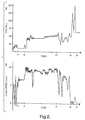
- Graphs A and B of Figure 2 respectively illustrate the seated weight (WT) and longitudinal center-of-mass (COM) measured when a rearward-facing child seat is placed on the seat 10 and then cinched down with a seat belt or child seat anchor.
- the seated weight WT is indicated in weight units (as opposed to pressure), and center-of-mass (COM) is depicted as an offset relative to an arbitrary zero point near the rear of the seat cushion 16.
- WT increases and then stabilizes at about 12 pounds in the interval t1-t2, while COM shifts forward by about 6.5 inches.
- the interval t1-t2 represents an initial period of weight measurement stability, and is followed by a period t2-t4 of weight measurement instability.
- the child seat is positioned for cinching in the interval t2-t3, and cinching occurs in the interval t3-t4.
- cinching produces a significant increase in WT and a concurrent significant decrease in COM.
- the significant increase in WT from the initial period t1-t2 of weight measurement stability to the secondary period of weight measurement stability following time t5 coupled with the concurrent significant rearward shifting of COM, indicates the occurrence of child seat cinching.
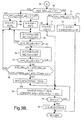
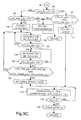
- FIGS 3A-3C set forth a flow diagram of a software routine executed by PODS ECU 24 in carrying out the method of this invention.
- execution of the routine commences when the seated weight WT exceeds an occupancy threshold such as 5 pounds, as indicated by the block 40.
- an occupancy threshold such as 5 pounds
- the routine is exited (as designated by a RETURN block) whenever an averaged value of the weight WT returns substantially to zero, and the routine is re-entered when the occupancy threshold of block 40 is subsequently exceeded.
- the blocks 42-62 are executed to accumulate weight, weight variance and center-of-mass data based on numerous samples of the output signals of pressure sensors 20a-20d.
- the blocks 42 and 44 initialize a pair of loop counter variables m and n to one and zero, respectively.
- the blocks 46 and 48 then increment the loop counter variable n, sample the pressure signals, and compute and store corresponding values of seated weight WT and center-of-mass COM.
- the blocks 44-48 are re-executed until the loop counter variable n has been incremented to 10, as indicated by the block 50.
- the block 52 averages the ten successive values of WT to form a first weight measurement WM(1), computes a standard deviation (SD) of the ten successive values of WT to form SD(1), and averages the ten successive values of COM to form a first center-of-mass measurement COMM(1). If the weight measurement WM indicates that the seat 10 is empty, the blocks 54 and 56 clear the occupancy status settings and the routine is exited.
- SD standard deviation
- the block 58 increments the loop counter variable m, and the block 60 checks to see if m has been incremented to six.
- the blocks 44-58 are re-executed to collect another ten successive WT and COM readings, and to compute and store a second weight measurement WM(2), a second standard deviation SD(2) and a second center-of-mass measurement COMM(2).
- the block 64 determines if the weight data is stable by comparing AVG_SD_pds to a reference value such as 0.2. If AVG_SD_pds ⁇ 0.2, the weight data is considered to be stable, and the portion of the routine designated by the flow diagram of Figure 3B is executed as indicated by the connector block 66; otherwise, the weight data is considered to be unstable, and the portion of the routine designated by the flow diagram of Figure 3C is executed as indicated by the connector block 68.
- the blocks 76-78 then compute and monitor the seated weight to detect a return to zero; this is done by computing a weight measurement WM as described above in reference to blocks 44-52, and comparing WM to zero.
- the blocks 78-80 clear the occupancy status settings if WM returns to zero, whereafter the routine is exited. If AVG_WM_pds is less than 76 pounds, but greater than a child seat threshold such as 15 pounds, the block 82 sets STATUS to INDETERMINATE, and the routine is exited.
- block 70 determines that AVG_WM_pds is less than the child seat threshold of 15 pounds, the blocks 84-88 characterize the occupant as either a rearward-facing child seat (RFCS) or a forward-facing child seat (FFCS) depending on the primary data set center-of-mass term AVG_COMM_pds. If AVG_COMM_pds exceeds a threshold such as five inches, the block 86 sets STATUS to RFCS; otherwise, the block 88 sets STATUS to FFCS. In either event, the blocks 90-100 are then executed to monitor for cinching of the child seat.
- RFCS rearward-facing child seat
- FFCS forward-facing child seat
- the blocks 90 and 94 acquire a secondary data set (sds) comprising the terms AVG_WM_sds, AVG_SD_sds and AVG_COMM_sds by executing a process corresponding to the blocks 42-62 of Figure 3A.
- the block 90 repeats the secondary data accumulation process until the block 92 detects a transition to unstable weight measurement, as indicated by a value of AVG_SD_sds in excess of 0.2.
- the block 94 repeats the secondary data accumulation process until the block 96 detects a transition to stable weight measurement, as indicated by a value of AVG_SD_sds of 0.2 or less. If block 98 does not detect cinching, the blocks 90-96 are re-executed until cinching is detected or the measured weight returns substantially to zero (as with blocks 54-56 of Figure 3A). If cinching is detected at block 98, the block 100 is executed to set a CINCH EVENT flag to TRUE, and the blocks 76-80 are executed as described above to monitor the seated weight for an empty seat condition.
- the blocks 102, 104 and 106 set the occupant STATUS to CHILD SEAT to indicate the presence of a generic child seat if AVG_SD_pds is less than a medium threshold such as 8.1 and AVG_WM_pds is less than a child seat threshold such as 17.7 pounds.
- a medium threshold such as 8.1
- AVG_WM_pds is less than a child seat threshold such as 17.7 pounds.
- the blocks 120-136 are executed to monitor for cinching of the child seat or an empty seat condition.
- the blocks 120 and 124 acquire a secondary data set (sds) comprising the terms AVG_WM_sds, AVG_SD_sds and AVG_COMM_sds by executing a process corresponding to the blocks 42-62 of Figure 3A.
- block 122 will be immediately answered in the affirmative due to the relative instability of the weight data, and the accumulation of secondary data is repeated at block 124 until the block 126 detects a transition to stable weight measurement, as indicated by a value of AVG_SD_sds of 0.2 or less.
- the block 128 checks for cinching, as indicated by a concurrent increase in measured occupant weight and decrease (rearward shift) in measured center-of-mass, compared to the primary data set computed and stored at block 62. If block 128 does not detect cinching, the blocks 120-128 are re-executed until cinching is detected or the measured weight returns substantially to zero.
- the block 130 is executed to set the CINCH EVENT flag to TRUE, and the blocks 132-136 are executed to monitor the seated weight to detect an empty seat condition. If it is determined at block 138 that AVG_SD_pds exceeds a threshold such as 23.5 and AVG_WM_pds exceeds a threshold such as 76 pounds, the occupant is considered to be an adult, and block 140 sets occupancy STATUS to ADULT. As with the child seat characterization, the blocks 132-136 are then executed to monitor the seated weight to detect an empty seat condition.
- blocks 104 or 138 are answered in the negative, the occupancy status cannot be reliably classified, and the block 142 is executed to set the occupant STATUS to INDETERMINATE; is this case, the routine is exited, and then re-entered at block 40, provided that the sensed weight WT still exceeds the occupancy threshold of five pounds.
- the method of the present invention utilizes the seated weight of an occupant, the variation of the seated weight, and the apparent longitudinal center-of-mass of the occupant during system initialization to reliably distinguish between an adult and a child seat, to distinguish between forward-facing and rearward-facing child seats, and to recognize cinching of a child seat. While the method has been described in reference to the illustrated embodiment, it will be recognized that many of the threshold levels and computation techniques are presented by way of example, and are not intended to be limiting. Additionally, the method is applicable to systems incorporating different weight sensing mechanisms, such as seat frame-based sensing systems, and so on. Various other modifications will also occur to persons skilled in the art. Accordingly, it will be understood that methods incorporating these and other modifications may fall within the scope of this invention, which is defined by the appended claims.
Landscapes
- Engineering & Computer Science (AREA)
- Mechanical Engineering (AREA)
- Aviation & Aerospace Engineering (AREA)
- Transportation (AREA)
- Seats For Vehicles (AREA)
- Air Bags (AREA)
- Geophysics And Detection Of Objects (AREA)
- Switches Operated By Changes In Physical Conditions (AREA)
Applications Claiming Priority (2)
| Application Number | Priority Date | Filing Date | Title |
|---|---|---|---|
| US10/797,407 US7039514B2 (en) | 2004-03-10 | 2004-03-10 | Occupant classification method based on seated weight measurement |
| US797407 | 2004-03-10 |
Publications (2)
| Publication Number | Publication Date |
|---|---|
| EP1574401A1 true EP1574401A1 (fr) | 2005-09-14 |
| EP1574401B1 EP1574401B1 (fr) | 2009-09-30 |
Family
ID=34827632
Family Applications (1)
| Application Number | Title | Priority Date | Filing Date |
|---|---|---|---|
| EP05075529A Expired - Lifetime EP1574401B1 (fr) | 2004-03-10 | 2005-03-03 | Méthode de classification d'un occupant basée sur la mesure du poids s'exerçant sur le siège |
Country Status (4)
| Country | Link |
|---|---|
| US (1) | US7039514B2 (fr) |
| EP (1) | EP1574401B1 (fr) |
| AT (1) | ATE444212T1 (fr) |
| DE (1) | DE602005016856D1 (fr) |
Cited By (1)
| Publication number | Priority date | Publication date | Assignee | Title |
|---|---|---|---|---|
| EP1800965A1 (fr) * | 2005-12-22 | 2007-06-27 | Calsonic Kansei Corporation | Dispositif de détection de passagers adapté aux véhicules à moteur |
Families Citing this family (14)
| Publication number | Priority date | Publication date | Assignee | Title |
|---|---|---|---|---|
| US20050184496A1 (en) | 2003-10-03 | 2005-08-25 | Speckhart Frank H. | Sensor pad for controlling airbag deployment and associated support |
| US9187010B2 (en) * | 2004-11-18 | 2015-11-17 | Ford Global Technologies | Method and system for detecting occupant seat weight sensor measurement error |
| EP1661767B1 (fr) * | 2004-11-25 | 2007-03-14 | Delphi Technologies, Inc. | Dispositif et procédé pour détecter l'occupation d'un siège |
| KR100641037B1 (ko) * | 2005-09-12 | 2006-11-02 | 현대모비스 주식회사 | 차량의 승원분류방법 |
| US20070135983A1 (en) * | 2005-12-12 | 2007-06-14 | Automotive Systems Laboratory, Inc. | Initialization process for an occupant classification initialization |
| US20080136227A1 (en) * | 2006-12-11 | 2008-06-12 | 3M Innovative Properties Company | Vehicle seat sensor assembly |
| US20080319697A1 (en) * | 2007-06-19 | 2008-12-25 | Gray Charles A | System and method for determining an amount of pressure applied by an occupant on a vehicle seat |
| US8170745B1 (en) | 2007-09-10 | 2012-05-01 | Jean-Pierre Lors | Seat occupancy verification system for motor vehicles |
| US20100191390A1 (en) * | 2009-01-28 | 2010-07-29 | Delphi Technologies, Inc. | System and method for detecting the occupancy of a vehicle seat |
| TW201136784A (en) * | 2010-04-21 | 2011-11-01 | Hon Hai Prec Ind Co Ltd | Automobile seat system |
| US9579998B2 (en) * | 2013-07-25 | 2017-02-28 | Ford Global Technologies, Llc | Flexible vehicle seat |
| US11504293B2 (en) * | 2016-11-08 | 2022-11-22 | Lear Corporation | Seat assembly having massage bladders with reduced pressure sensor count |
| IT201900022221A1 (it) | 2019-11-26 | 2020-02-26 | Univ Degli Studi Di Modena E Reggio Emilia | Sedile di veicolo con sistema di rilevamento passeggeri |
| DE102020006794B4 (de) * | 2020-11-05 | 2022-09-22 | Mercedes-Benz Group AG | Verfahren zum Betreiben einer Identifizierungsvorrichtung eines Sitzes, sowie Identifizierungsvorrichtung |
Citations (5)
| Publication number | Priority date | Publication date | Assignee | Title |
|---|---|---|---|---|
| EP0721863A2 (fr) * | 1995-01-10 | 1996-07-17 | Delco Electronics Corporation | Système de retenue d'un occupant de véhicule avec détecteur de pression pour siège |
| US20020024257A1 (en) * | 2000-01-11 | 2002-02-28 | Toyota Jidosha Kabushiki Kaisha | Apparatus and method for detecting a child seat |
| US20030033065A1 (en) * | 2001-08-09 | 2003-02-13 | Trw Vehicle Safety Systems Inc. | Weight based occupant classification system for controlling enablement of a protection device |
| US20030105570A1 (en) * | 2001-12-04 | 2003-06-05 | Basir Otman A. | Child seat detection system |
| US20040016577A1 (en) * | 2000-09-29 | 2004-01-29 | Harald Lichtinger | Weight classification system |
Family Cites Families (12)
| Publication number | Priority date | Publication date | Assignee | Title |
|---|---|---|---|---|
| US6757602B2 (en) * | 1997-02-06 | 2004-06-29 | Automotive Technologies International, Inc. | System for determining the occupancy state of a seat in a vehicle and controlling a component based thereon |
| US6476516B1 (en) * | 1999-09-03 | 2002-11-05 | Siemens Vdo Automotive Inc. | Method and apparatus for classifying seat occupant weight |
| US6735508B2 (en) * | 2000-07-12 | 2004-05-11 | Siemens Ag | Hardware independent mapping of multiple sensor configurations for classification of persons |
| JP2002267524A (ja) * | 2001-03-08 | 2002-09-18 | Takata Corp | シート重量計測装置 |
| US6578871B2 (en) | 2001-10-09 | 2003-06-17 | Delphi Technologies, Inc. | Vehicle occupant weight detection system with occupant position compensation |
| US6662094B2 (en) | 2002-02-15 | 2003-12-09 | Delphi Technologies, Inc. | Method of initially characterizing an occupant of a vehicle seat based on weight and seat belt tension |
| US6697723B2 (en) * | 2002-02-27 | 2004-02-24 | Ford Global Technologies, Llc | Occupant based frequency analysis algorithm |
| US6682095B2 (en) * | 2002-06-21 | 2004-01-27 | Breed Automotive Technology, Inc. | Non-safety vehicle systems control using occupant classification |
| US7088113B2 (en) * | 2002-07-08 | 2006-08-08 | Intelligent Mechatronic Systems Inc. | Integrated occupant sensory system |
| US7009502B2 (en) * | 2002-08-26 | 2006-03-07 | Automotive Technologies International, Inc. | Method for controlling output of a classification algorithm |
| US6889146B2 (en) * | 2002-09-04 | 2005-05-03 | Delphi Technologies, Inc. | Seat belt tension determination using multiple belt tension sensors |
| US6771175B1 (en) * | 2002-12-06 | 2004-08-03 | Daimlerchrysler Corporation | Method for demonstrating reliability of occupant classification systems |
-
2004
- 2004-03-10 US US10/797,407 patent/US7039514B2/en not_active Expired - Lifetime
-
2005
- 2005-03-03 DE DE602005016856T patent/DE602005016856D1/de not_active Expired - Lifetime
- 2005-03-03 EP EP05075529A patent/EP1574401B1/fr not_active Expired - Lifetime
- 2005-03-03 AT AT05075529T patent/ATE444212T1/de not_active IP Right Cessation
Patent Citations (5)
| Publication number | Priority date | Publication date | Assignee | Title |
|---|---|---|---|---|
| EP0721863A2 (fr) * | 1995-01-10 | 1996-07-17 | Delco Electronics Corporation | Système de retenue d'un occupant de véhicule avec détecteur de pression pour siège |
| US20020024257A1 (en) * | 2000-01-11 | 2002-02-28 | Toyota Jidosha Kabushiki Kaisha | Apparatus and method for detecting a child seat |
| US20040016577A1 (en) * | 2000-09-29 | 2004-01-29 | Harald Lichtinger | Weight classification system |
| US20030033065A1 (en) * | 2001-08-09 | 2003-02-13 | Trw Vehicle Safety Systems Inc. | Weight based occupant classification system for controlling enablement of a protection device |
| US20030105570A1 (en) * | 2001-12-04 | 2003-06-05 | Basir Otman A. | Child seat detection system |
Cited By (2)
| Publication number | Priority date | Publication date | Assignee | Title |
|---|---|---|---|---|
| EP1800965A1 (fr) * | 2005-12-22 | 2007-06-27 | Calsonic Kansei Corporation | Dispositif de détection de passagers adapté aux véhicules à moteur |
| US7562735B2 (en) | 2005-12-22 | 2009-07-21 | Calsonic Kansei Corporation | Passenger detecting device adapted for motor vehicle |
Also Published As
| Publication number | Publication date |
|---|---|
| ATE444212T1 (de) | 2009-10-15 |
| US7039514B2 (en) | 2006-05-02 |
| US20050203687A1 (en) | 2005-09-15 |
| EP1574401B1 (fr) | 2009-09-30 |
| DE602005016856D1 (de) | 2009-11-12 |
Similar Documents
| Publication | Publication Date | Title |
|---|---|---|
| EP1574401B1 (fr) | Méthode de classification d'un occupant basée sur la mesure du poids s'exerçant sur le siège | |
| US6542802B2 (en) | Vehicle occupant characterization method with rough road compensation | |
| US6644689B2 (en) | Method for suppressing deployment of an inflatable restraint based on sensed occupant capacitance | |
| US6850825B2 (en) | Method for suppressing deployment of an inflatable restraint based on sensed occupant weight | |
| US6662094B2 (en) | Method of initially characterizing an occupant of a vehicle seat based on weight and seat belt tension | |
| US6438476B1 (en) | Vehicle seat occupant characterization method including ultralight child seat detection | |
| US6587770B1 (en) | Vehicle seat occupant weight estimation method with floor weight compensation | |
| US6438477B1 (en) | Vehicle seat occupant characterization method including empty seat detection | |
| US6012007A (en) | Occupant detection method and apparatus for air bag system | |
| US5987370A (en) | Vehicle occupant weight estimation apparatus having fluid-filled seat bladder | |
| US5474327A (en) | Vehicle occupant restraint with seat pressure sensor | |
| US7024294B2 (en) | Vehicle seat occupant status classification using multiple sensors | |
| US6578871B2 (en) | Vehicle occupant weight detection system with occupant position compensation | |
| EP1114986B1 (fr) | Siege de vehicule | |
| US6689960B2 (en) | Seat weight measuring apparatus which determines the weight value based on a value other than the adder output when sensor output exceeds a predetermined value | |
| EP1190916B1 (fr) | Détermination d'un poids pour siège de véhicule | |
| US7333023B2 (en) | Occupant classification system and method | |
| EP1189787B1 (fr) | Ensemble capteur de poids permettant de determiner le poids de l'occupant d'un siege | |
| EP1491387B1 (fr) | Dispositif avec poche ramenée au cadre pour la détermination du poids d'un occupant de siège | |
| US7233852B2 (en) | Method of distinguishing between adult and cinched car seat occupants of a vehicle seat | |
| KR101611097B1 (ko) | 차량용 승객 식별장치 | |
| US7120527B2 (en) | Vehicle occupant characterization method based on the power spectrum of a seat sensor output signal | |
| US7133752B2 (en) | Method of characterizing an adult occupant of a vehicle seat based on a measure of seated weight | |
| US9302640B2 (en) | Seat apparatus for vehicle | |
| US20060106517A1 (en) | Method and system for detecting occupant seat weight sensor measurement error |
Legal Events
| Date | Code | Title | Description |
|---|---|---|---|
| PUAI | Public reference made under article 153(3) epc to a published international application that has entered the european phase |
Free format text: ORIGINAL CODE: 0009012 |
|
| AK | Designated contracting states |
Kind code of ref document: A1 Designated state(s): AT BE BG CH CY CZ DE DK EE ES FI FR GB GR HU IE IS IT LI LT LU MC NL PL PT RO SE SI SK TR |
|
| AX | Request for extension of the european patent |
Extension state: AL BA HR LV MK YU |
|
| 17P | Request for examination filed |
Effective date: 20060314 |
|
| AKX | Designation fees paid |
Designated state(s): AT BE BG CH CY CZ DE DK EE ES FI FR GB GR HU IE IS IT LI LT LU MC NL PL PT RO SE SI SK TR |
|
| 17Q | First examination report despatched |
Effective date: 20060612 |
|
| 17Q | First examination report despatched |
Effective date: 20060612 |
|
| APBN | Date of receipt of notice of appeal recorded |
Free format text: ORIGINAL CODE: EPIDOSNNOA2E |
|
| APBR | Date of receipt of statement of grounds of appeal recorded |
Free format text: ORIGINAL CODE: EPIDOSNNOA3E |
|
| APBV | Interlocutory revision of appeal recorded |
Free format text: ORIGINAL CODE: EPIDOSNIRAPE |
|
| GRAP | Despatch of communication of intention to grant a patent |
Free format text: ORIGINAL CODE: EPIDOSNIGR1 |
|
| GRAS | Grant fee paid |
Free format text: ORIGINAL CODE: EPIDOSNIGR3 |
|
| GRAA | (expected) grant |
Free format text: ORIGINAL CODE: 0009210 |
|
| AK | Designated contracting states |
Kind code of ref document: B1 Designated state(s): AT BE BG CH CY CZ DE DK EE ES FI FR GB GR HU IE IS IT LI LT LU MC NL PL PT RO SE SI SK TR |
|
| REG | Reference to a national code |
Ref country code: GB Ref legal event code: FG4D Ref country code: CH Ref legal event code: EP |
|
| REG | Reference to a national code |
Ref country code: IE Ref legal event code: FG4D |
|
| REF | Corresponds to: |
Ref document number: 602005016856 Country of ref document: DE Date of ref document: 20091112 Kind code of ref document: P |
|
| PG25 | Lapsed in a contracting state [announced via postgrant information from national office to epo] |
Ref country code: FI Free format text: LAPSE BECAUSE OF FAILURE TO SUBMIT A TRANSLATION OF THE DESCRIPTION OR TO PAY THE FEE WITHIN THE PRESCRIBED TIME-LIMIT Effective date: 20090930 Ref country code: SE Free format text: LAPSE BECAUSE OF FAILURE TO SUBMIT A TRANSLATION OF THE DESCRIPTION OR TO PAY THE FEE WITHIN THE PRESCRIBED TIME-LIMIT Effective date: 20090930 Ref country code: LT Free format text: LAPSE BECAUSE OF FAILURE TO SUBMIT A TRANSLATION OF THE DESCRIPTION OR TO PAY THE FEE WITHIN THE PRESCRIBED TIME-LIMIT Effective date: 20090930 |
|
| LTIE | Lt: invalidation of european patent or patent extension |
Effective date: 20090930 |
|
| PG25 | Lapsed in a contracting state [announced via postgrant information from national office to epo] |
Ref country code: PL Free format text: LAPSE BECAUSE OF FAILURE TO SUBMIT A TRANSLATION OF THE DESCRIPTION OR TO PAY THE FEE WITHIN THE PRESCRIBED TIME-LIMIT Effective date: 20090930 Ref country code: SI Free format text: LAPSE BECAUSE OF FAILURE TO SUBMIT A TRANSLATION OF THE DESCRIPTION OR TO PAY THE FEE WITHIN THE PRESCRIBED TIME-LIMIT Effective date: 20090930 |
|
| NLV1 | Nl: lapsed or annulled due to failure to fulfill the requirements of art. 29p and 29m of the patents act | ||
| PG25 | Lapsed in a contracting state [announced via postgrant information from national office to epo] |
Ref country code: RO Free format text: LAPSE BECAUSE OF FAILURE TO SUBMIT A TRANSLATION OF THE DESCRIPTION OR TO PAY THE FEE WITHIN THE PRESCRIBED TIME-LIMIT Effective date: 20090930 Ref country code: CZ Free format text: LAPSE BECAUSE OF FAILURE TO SUBMIT A TRANSLATION OF THE DESCRIPTION OR TO PAY THE FEE WITHIN THE PRESCRIBED TIME-LIMIT Effective date: 20090930 Ref country code: ES Free format text: LAPSE BECAUSE OF FAILURE TO SUBMIT A TRANSLATION OF THE DESCRIPTION OR TO PAY THE FEE WITHIN THE PRESCRIBED TIME-LIMIT Effective date: 20100110 Ref country code: PT Free format text: LAPSE BECAUSE OF FAILURE TO SUBMIT A TRANSLATION OF THE DESCRIPTION OR TO PAY THE FEE WITHIN THE PRESCRIBED TIME-LIMIT Effective date: 20100201 Ref country code: EE Free format text: LAPSE BECAUSE OF FAILURE TO SUBMIT A TRANSLATION OF THE DESCRIPTION OR TO PAY THE FEE WITHIN THE PRESCRIBED TIME-LIMIT Effective date: 20090930 Ref country code: IS Free format text: LAPSE BECAUSE OF FAILURE TO SUBMIT A TRANSLATION OF THE DESCRIPTION OR TO PAY THE FEE WITHIN THE PRESCRIBED TIME-LIMIT Effective date: 20100130 |
|
| PG25 | Lapsed in a contracting state [announced via postgrant information from national office to epo] |
Ref country code: SK Free format text: LAPSE BECAUSE OF FAILURE TO SUBMIT A TRANSLATION OF THE DESCRIPTION OR TO PAY THE FEE WITHIN THE PRESCRIBED TIME-LIMIT Effective date: 20090930 Ref country code: CY Free format text: LAPSE BECAUSE OF FAILURE TO SUBMIT A TRANSLATION OF THE DESCRIPTION OR TO PAY THE FEE WITHIN THE PRESCRIBED TIME-LIMIT Effective date: 20090930 |
|
| PGFP | Annual fee paid to national office [announced via postgrant information from national office to epo] |
Ref country code: FR Payment date: 20100324 Year of fee payment: 6 |
|
| PG25 | Lapsed in a contracting state [announced via postgrant information from national office to epo] |
Ref country code: BE Free format text: LAPSE BECAUSE OF FAILURE TO SUBMIT A TRANSLATION OF THE DESCRIPTION OR TO PAY THE FEE WITHIN THE PRESCRIBED TIME-LIMIT Effective date: 20090930 Ref country code: AT Free format text: LAPSE BECAUSE OF FAILURE TO SUBMIT A TRANSLATION OF THE DESCRIPTION OR TO PAY THE FEE WITHIN THE PRESCRIBED TIME-LIMIT Effective date: 20090930 |
|
| PGFP | Annual fee paid to national office [announced via postgrant information from national office to epo] |
Ref country code: GB Payment date: 20100303 Year of fee payment: 6 |
|
| PG25 | Lapsed in a contracting state [announced via postgrant information from national office to epo] |
Ref country code: DK Free format text: LAPSE BECAUSE OF FAILURE TO SUBMIT A TRANSLATION OF THE DESCRIPTION OR TO PAY THE FEE WITHIN THE PRESCRIBED TIME-LIMIT Effective date: 20090930 Ref country code: NL Free format text: LAPSE BECAUSE OF FAILURE TO SUBMIT A TRANSLATION OF THE DESCRIPTION OR TO PAY THE FEE WITHIN THE PRESCRIBED TIME-LIMIT Effective date: 20090930 |
|
| PLBE | No opposition filed within time limit |
Free format text: ORIGINAL CODE: 0009261 |
|
| STAA | Information on the status of an ep patent application or granted ep patent |
Free format text: STATUS: NO OPPOSITION FILED WITHIN TIME LIMIT |
|
| PGFP | Annual fee paid to national office [announced via postgrant information from national office to epo] |
Ref country code: DE Payment date: 20100312 Year of fee payment: 6 |
|
| 26N | No opposition filed |
Effective date: 20100701 |
|
| PG25 | Lapsed in a contracting state [announced via postgrant information from national office to epo] |
Ref country code: GR Free format text: LAPSE BECAUSE OF FAILURE TO SUBMIT A TRANSLATION OF THE DESCRIPTION OR TO PAY THE FEE WITHIN THE PRESCRIBED TIME-LIMIT Effective date: 20091231 Ref country code: MC Free format text: LAPSE BECAUSE OF NON-PAYMENT OF DUE FEES Effective date: 20100331 |
|
| REG | Reference to a national code |
Ref country code: CH Ref legal event code: PL |
|
| PG25 | Lapsed in a contracting state [announced via postgrant information from national office to epo] |
Ref country code: IE Free format text: LAPSE BECAUSE OF NON-PAYMENT OF DUE FEES Effective date: 20100303 |
|
| PG25 | Lapsed in a contracting state [announced via postgrant information from national office to epo] |
Ref country code: LI Free format text: LAPSE BECAUSE OF NON-PAYMENT OF DUE FEES Effective date: 20100331 Ref country code: CH Free format text: LAPSE BECAUSE OF NON-PAYMENT OF DUE FEES Effective date: 20100331 |
|
| PG25 | Lapsed in a contracting state [announced via postgrant information from national office to epo] |
Ref country code: IT Free format text: LAPSE BECAUSE OF FAILURE TO SUBMIT A TRANSLATION OF THE DESCRIPTION OR TO PAY THE FEE WITHIN THE PRESCRIBED TIME-LIMIT Effective date: 20090930 |
|
| GBPC | Gb: european patent ceased through non-payment of renewal fee |
Effective date: 20110303 |
|
| REG | Reference to a national code |
Ref country code: FR Ref legal event code: ST Effective date: 20111130 |
|
| PG25 | Lapsed in a contracting state [announced via postgrant information from national office to epo] |
Ref country code: DE Free format text: LAPSE BECAUSE OF NON-PAYMENT OF DUE FEES Effective date: 20111001 Ref country code: FR Free format text: LAPSE BECAUSE OF NON-PAYMENT OF DUE FEES Effective date: 20110331 |
|
| REG | Reference to a national code |
Ref country code: DE Ref legal event code: R119 Ref document number: 602005016856 Country of ref document: DE Effective date: 20111001 |
|
| PG25 | Lapsed in a contracting state [announced via postgrant information from national office to epo] |
Ref country code: GB Free format text: LAPSE BECAUSE OF NON-PAYMENT OF DUE FEES Effective date: 20110303 |
|
| PG25 | Lapsed in a contracting state [announced via postgrant information from national office to epo] |
Ref country code: BG Free format text: LAPSE BECAUSE OF FAILURE TO SUBMIT A TRANSLATION OF THE DESCRIPTION OR TO PAY THE FEE WITHIN THE PRESCRIBED TIME-LIMIT Effective date: 20090930 Ref country code: HU Free format text: LAPSE BECAUSE OF FAILURE TO SUBMIT A TRANSLATION OF THE DESCRIPTION OR TO PAY THE FEE WITHIN THE PRESCRIBED TIME-LIMIT Effective date: 20100401 Ref country code: LU Free format text: LAPSE BECAUSE OF NON-PAYMENT OF DUE FEES Effective date: 20100303 |
|
| PG25 | Lapsed in a contracting state [announced via postgrant information from national office to epo] |
Ref country code: TR Free format text: LAPSE BECAUSE OF FAILURE TO SUBMIT A TRANSLATION OF THE DESCRIPTION OR TO PAY THE FEE WITHIN THE PRESCRIBED TIME-LIMIT Effective date: 20090930 |