EP1573586B1 - Lernen von assoziationen für automatisierte empfehlungen - Google Patents
Lernen von assoziationen für automatisierte empfehlungen Download PDFInfo
- Publication number
- EP1573586B1 EP1573586B1 EP03772601.5A EP03772601A EP1573586B1 EP 1573586 B1 EP1573586 B1 EP 1573586B1 EP 03772601 A EP03772601 A EP 03772601A EP 1573586 B1 EP1573586 B1 EP 1573586B1
- Authority
- EP
- European Patent Office
- Prior art keywords
- data
- feature
- correlation
- pair
- adaptation
- Prior art date
- Legal status (The legal status is an assumption and is not a legal conclusion. Google has not performed a legal analysis and makes no representation as to the accuracy of the status listed.)
- Expired - Lifetime
Links
Images




Classifications
-
- G—PHYSICS
- G06—COMPUTING OR CALCULATING; COUNTING
- G06Q—INFORMATION AND COMMUNICATION TECHNOLOGY [ICT] SPECIALLY ADAPTED FOR ADMINISTRATIVE, COMMERCIAL, FINANCIAL, MANAGERIAL OR SUPERVISORY PURPOSES; SYSTEMS OR METHODS SPECIALLY ADAPTED FOR ADMINISTRATIVE, COMMERCIAL, FINANCIAL, MANAGERIAL OR SUPERVISORY PURPOSES, NOT OTHERWISE PROVIDED FOR
- G06Q10/00—Administration; Management
- G06Q10/10—Office automation; Time management
-
- G—PHYSICS
- G06—COMPUTING OR CALCULATING; COUNTING
- G06F—ELECTRIC DIGITAL DATA PROCESSING
- G06F16/00—Information retrieval; Database structures therefor; File system structures therefor
- G06F16/30—Information retrieval; Database structures therefor; File system structures therefor of unstructured textual data
- G06F16/33—Querying
- G06F16/332—Query formulation
-
- G—PHYSICS
- G06—COMPUTING OR CALCULATING; COUNTING
- G06F—ELECTRIC DIGITAL DATA PROCESSING
- G06F16/00—Information retrieval; Database structures therefor; File system structures therefor
- G06F16/90—Details of database functions independent of the retrieved data types
- G06F16/95—Retrieval from the web
- G06F16/951—Indexing; Web crawling techniques
-
- G—PHYSICS
- G06—COMPUTING OR CALCULATING; COUNTING
- G06F—ELECTRIC DIGITAL DATA PROCESSING
- G06F16/00—Information retrieval; Database structures therefor; File system structures therefor
- G06F16/90—Details of database functions independent of the retrieved data types
- G06F16/95—Retrieval from the web
- G06F16/954—Navigation, e.g. using categorised browsing
Definitions
- This disclosure relates to association learning and automated recommendations.
- Information retrieval refers to searching for relevant information in information systems that may contain numerous documents. Some information retrieval systems are based on keywords that index documents and a query language to retrieve documents from centralized document repositories according to those keywords. Typically, a text search engine is utilized that executes a query formulated by a user and returns a set of documents matching the keywords identified within the query. Some search engines may even predict what information is relevant to a user based on keywords identified in such a query. The above-mentioned techniques, however, are insufficient to meet diversified information retrieval needs of some users. In addition, traditional information retrieval systems seldom identify the vast amount of potentially relevant documents that may best answer a particular user's need.
- Document CRESTANI F ET AL "Searching the web by constrained spreading activation", INFORMATION PROCESSING & MANAGEMENT, ELSEVIER, BARKING, GB, vol. 36, no. 4, 1 July 2000 (2000-07-01), pages 585-605, XP004195725, ISSN: 0306-4573, DOI: 10.1016/S0306-4573(99)00073-4 discloses a system for intelligent information retrieval and its underlying model.
- a search profile is constructed by downloading textual content of web pages and combining said content into a single text file. Terms in the text are weighted using a function of their page frequency and their position in the pages, and a list of weighted index terms that form the search profile is generated.
- Document US 6,169,986 B1 discloses a system and a method for refining search queries.
- a search engine is disclosed which suggests related terms, generated using query term correlation data which reflects the frequencies with which specific terms have previously appeared within the same query, to the user to allow the user to refine a search.
- the related terms are added to and selected from a table so as to guarantee that the modified queries will not produce a NULL query result.
- Document US 6,389,405 B1 discloses a system and a method for identifying relationships between concepts within an expert system
- a spreading activation module utilizes the knowledge base, which is set oriented with named relationships between concepts to traverse the knowledge base efficiently.
- a system is disclosed to provide associative learning and recommendations.
- the system includes a learning engine recommendation process that provides one or more recommendations based on user input, a learning engine initiation process that generates initial training data, and a learning engine training process that transforms initial training data and subsequent training data into entity-pair relationships.
- the system may include user interfaces that allow each user to request and receive recommendations and a confirmation process that captures and stores training data based on user feedback regarding recommendations.
- Various aspects of the system relate to generating entity-pair relationships from both implicit and explicit feedback mechanisms and providing recommendations from a directed graph.
- a method includes generating correlation data from initialization data representing relations between entities, generating a directed graph from the correlation data, providing one or more recommendations from the directed graph using a request as input, storing training data in response to user activity, and adapting the correlation data using the training data as input
- the method also may include spreading activation through nodes of the directed graph to provide recommendations.
- a method in another aspect, includes receiving the request from a user, accessing a first set of one or more nodes on the directed graph matching the request, traversing one or more arcs connected to the first set of one or more nodes, accessing a second set of one or more nodes connected to one or more arcs, and recommending the second set of one or more nodes to the user.
- a method in another aspect, includes displaying an interface prompting feedback from the user regarding the quality of recommendations and determing whether to store the request and one or more recommendations as the training data based upon the feedback.
- the method may also include observing selected actions by a user based on one or more recommendations.
- a method in another aspect, includes adapting correlation data by accessing training data using access controls, generating adaptation data from a learning rule using the training data as input, and adapting the correlation data using the adaptation data as input.
- a system as well as articles that include a machine readable medium storing machine-readable instructions for implementing the various techniques, are disclosed. Details of various implementations are discussed in greater detail below.
- the system may provide cross-selling opportunities by leveraging the knowledge learned from other customers. For example, if one customer is interested in purchasing a particular book, the system may provide recommendations of other books that customers may have purchased in connection with that particular book.
- the system may also be used in the context of the World Wide Web ("WEB"). For example, a user searching the WEB may be interested in identifying similar websites relating to a topic.
- WEB World Wide Web
- the system may record websites visited by other users in connection to the same topic and provide website recommendations thereof.
- Another benefit of the system may be in a call center environment. For example, as experienced call center agents respond to customer questions, responses to those questions may be stored as training data in the system. Inexperienced agents responding to customers may benefit from the system by receiving recommendations based on experienced agent interactions with customers.
- a computer-based system provides for associative learning and automated recommendations.
- the system is designed to provide learning by updating correlations based upon user feedback.
- the system includes a knowledge base 10 that serves as a repository for information. Although only a single knowledge base 10 is illustrated in FIG. 1 , the system may be configured to support multiple knowledge bases.
- the knowledge base 10 may include a collection of documents such as electronic mail (e-mail messages), web pages, business documents, etc. that may be searched and organized for users.
- a compilation service 20 manages the transformation of textual based information in a knowledge base 10 into an index 30.
- the compilation service represents each document in a knowledge base as a vector.
- the components of a vector may correspond to a concept or term that may appear in the document and are commonly known as features.
- Feature vectors may be compiled into the index 30 which may be used as input by a search service 80.
- the clustering service 40 may partition the index 30 into groups of documents similar in content, for example, into groups of feature vectors reflecting some minimum level of similarity.
- the partitioning of index 30 may provide an additional layer of organization to provide an overview of the contents of a knowledge base 10.
- the clustering service 40 may support various types of clustering including document partitioning algorithms such as k-means clustering, probabilistic clustering, etc. and hierarchical clustering algorithms such as agglomerative clustering and star clustering.
- the clustering service 40 may use a hierarchical clustering algorithm to determine an initial clustering which may be further refined using a k-means clustering algorithm. Many variants of the k-means algorithm may be used by the clustering service 40.
- a star algorithm may be used in the clustering service 40.
- the star algorithm may provide a hierarchical cluster depending upon the contents of the index 30. Each level in the hierarchy may be determined by a threshold minimum level of similarity between pairs of documents within a cluster at a particular level in the hierarchy.
- the star algorithm may reveal the topic-subtopic structure of the knowledge base 10. A topic summary for each cluster is provided by the center of the underlying star for the cluster.
- Other implementations may use alternate partitioning and hierarchical clustering algorithms.
- a mapping 50 is provided by the clustering service 40.
- the mapping 50 contains information as to what documents belong to a particular cluster and what document features have been associated with a particular cluster.
- the mapping 50 may be used as input to a learning engine initialization process 60.
- the learning engine initialization process 60 provides for learning of each entity type defined within the knowledge base 10 and may use the mapping 50 for initialization. In one implementation, the learning engine initialization process 60 transforms the feature relationships induced by the cluster structure into initial training data 70.
- the generation of initial training data 70 may be implemented in various manners.
- identifying the relationship between features in the cluster structure may create feature-pairs. For example, if feature A and feature B reside in the same cluster, an entry for the feature-pair (A, B) will be created in the initial training data.
- feature-pairs may be created using the frequency proportional to their occurrence in the documents. For example, if feature A and feature B co-occur in the same document over five different documents, five entries for feature-pair (A, B) will be created in the initial training data.
- the generation of training data may use other heuristics to reflect the structure of the entity relationships given as input to initialization.
- the training process 90 of the learning engine generates an associative network 100 using the initial training data 70 as input. Details of the learning engine training process are described below. In one implementation, the initial training data 70 is accessed only once and the associative network 100 is used for recommendations.
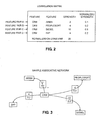
- the associative network 100 may be represented as a correlation matrix. As shown in FIG. 2 , a correlation matrix containing four feature-pairs is illustrated. For each feature-pair, a strength of association may be recorded. Referring to FIG. 2 , feature-pair A has a strength of two, which after initial training indicates that feature-pair A has been observed two times in the initial training data 70.
- the learning engine training process 90 may perform a data normalization process using feature-pair strengths as input.
- the learning engine training process 90 may calculate a normalization constant by summing all the strengths associated with feature-pairs in the correlation matrix.
- the learning engine training process 90 may then calculate a normalized strength for each feature-pair by dividing a feature-pair's strength by the normalization constant. For example, referring to FIG. 2 , the normalized strength for feature-pair B is 0.2.
- a benefit of normalizing feature-pair strengths is that it may enhance the speed of learning and may facilitate comparison between feature-pairs during the learning engine recommendation process 140 described below.
- normalizing feature-pair strengths may allow for a proper derivation of higher order associations that may be used as spreading activation described below.
- the learning engine training process 90 may update the associative network 100 using the observed training data 170.
- the associative network 100 may be a directed graph containing nodes and weighted edges and may serve as a data source for providing recommendations. Nodes in the associative network 100 may represent features identified in the initial training data 70 and training data 170 and edges of the associative network may represent normalized strengths between stored feature-pairs.
- FIG. 3 illustrates a sample associative network represented by the correlation matrix illustrated in FIG. 2 .
- five nodes representing distinct features i.e. "CRM”, “Ariba”, “SAP”, “PeopleSoft”, and “Siebel”
- Arcs of the associative network may correspond to the normalized strengths calculated in the correlation matrix.
- the arc between "CRM” and “Siebel” in FIG. 3 corresponds to the normalized strength of the "CRM-Siebel" feature-pair in the correlation matrix 70.
- spreading activation may be employed to make recommendations from the associative network.
- Spreading activation may be characterized as a process that identifies knowledge assumed to be relevant to some focus of attention.
- a decay constant also may be defined to dampen the effect of activation that may spread through the associative network.
- Activation may be pumped into one or more nodes of the associative network representing some starting input focus one or more times. Referring to FIG. 4 , activation is being pumped once through the "CRM" node. The activation flows through the arcs of the graph structure with the amount of flow modulated by the arc strengths and dampened by the value selected for the decay variable. In one implementation, the following formula may be used for a 1-step activation:
- the number of spread activations and the value of the decay constant may be configurable parameters stored in a database.
- the learning engine training process 90 may store the spread activation network in a database table for subsequent access.
- Spreading activation may be useful to deduce associations from an amount of data that is small in comparison to the overall number of possible feature-pairs.
- FIG. 5 illustrates the effect of pumping multiple activations through the "CRM" node.
- the following formula may be used for pumping multiple activations:
- activation spreading may reveal an association between the "CRM” node and "SAPPortals" node even though no such association may exist in the correlation matrix.
- FIG. 5 illustrates features related to one particular feature, spreading activation may also be applied to multiple nodes and may reveal features related to a particular set of features.
- multiple associative networks may be supported by the system.
- a user application 120 that interfaces with the learning engine recommendation process 140 may be provided.
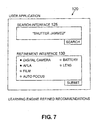
- the user application 120 may have a search interface 125, a refinement interface 130, and a confirmation process 135.
- the search interface 125 allows a user 128 to compose and submit a query to the search service 80 to receive information.
- the search service 80 may execute the query by accessing the index 30 and retrieving as a search result a list of documents that match the query features in descending sort order by similarity rank. For each document in the search result, information about the cluster assigned to the document may be passed.
- the search service 80 may pass the search result to the search interface 125 and also to a query mapping service 160.
- the query mapping service 160 may use the search result and mapping 50 to identify document features corresponding to the cluster identified in the search result.
- the query mapping service may pass these document features to the learning engine recommendation process 140 as an initial point of focus for recommendations.
- the refinement interface 130 of the user application 120 interacts directly with the learning engine recommendation process 140 and may provide additional input focus for recommendations.
- an initial query may be composed of the query feature "shutter jammed".
- initial recommendations from the learning engine may include "Digital Camera”, “AFLA”, “Pointer”, and “Video Camera”.
- a user may select one or more recommendations and submit these recommendations along with query features to the learning engine recommendation process 140.
- a user selecting the recommendations of "Digital Camera” and “AFLA” in combination with the query feature “shutter jammed” may result in the learning engine refining its recommendations to the following set: “Digital Camera”, “AFLA”, “Film”, “Autofocus”, “Battery” and “Lens”.
- the learning engine recommendation process may access the association network 100 to retrieve recommendations.
- the confirmation process 135 provides a method for collecting training-data 170 for learning algorithms. Collecting training-data 170 data may be done either in explicit form by posing questions to the user, or in an implicit form by observing selected actions by the user. Either method of feedback, implicit, explicit, or both may be supported by the system.
- the confirmation process 135 may store both the initial input focus and the final set of recommendations from the learning engine recommendation process 140. For example, a user may begin searching the Internet for information relating to automobiles and petroleum. Using the refinement interface 130, the user may conclude the search by focusing on a learning engine recommendation of "motor oil”. The confirmation process 135 may store the initial input focus (e.g. "automobiles” and “petroleum”) and final recommendation ("motor oil”) in a database table and use this data as training-data 170 for subsequent learning.
- the initial input focus e.g. "automobiles" and "petroleum
- motor oil final recommendation
- the learning engine training process 90 may, in an asynchronous fashion, create a copy of the correlation matrix representing the associative network 100, transform the stored training-data 170 into adaptation data comprising feature-pairs, update the copy of the correlation data using the feature-pairs as input, and replace the correlation matrix representing the associative network 100 with the updated copy.
- the learning engine training process 90 may update the associative network 100 by modifying the underlying correlation matrix directly.
- the transformation of data may be triggered by the amount of training-data 170 that may be stored. For example, a counter 180 may be incremented each time training-data 170 is stored. Once a threshold level is reached, the transformation of training-data 170 into feature-pairs and the corresponding updates to the correlation matrix 70 may commence. Other implementations may transform training-data 170 into feature-pairs and update the correlation matrix 70 each time new training data 170 is stored by the confirmation process 135.
- Learning rules may be applied to the training-data 170 to generate entity-pairs.
- Various types of learning rules may be implemented by the learning engine and may be used in combination. Although only three learning rules are discussed below, the learning engine training process 90 may implement additional or different rules.
- Co-occurrence based correlation-learning means that for each given set of entities the co-occurrence weight of all contained pairs of different elements are strengthened.
- the learning rule may be formulated as forming all pairs of different entities contained in a submitted set of entities and adding them to the correlation matrix.
- collected training-data 170 may be composed of the final set of training data ⁇ a, b, c ⁇ . Applying the co-occurrence learning rule to the final set may yield the following feature-pairs ⁇ (a,b), (a,c), (b,a), (b,c), (c,a), (c,b) ⁇ .
- the correlation strengths may converge to the probability of a pair of entities being present in such a set averaged over the given distribution of sets.
- the distributions of co-occurrence sets may be dynamic.
- Navigation-based correlation learning means that for given initial and final sets of entities, a reduced path through the sets of entities may be interpreted which may reflect knowledge.
- the learning rule can be formulated as forming all pairs of different entities where a first entity is from a submitted initial set of entities, the second entity is from a submitted final set, neither the first entity nor second entity appears in both the initial set and final set of entities, and adding all pairs of different entities to the correlation matrix.
- collected training-data 170 from the confirmation process 135 may be composed of an initial set training-data composed of ⁇ a, b, c ⁇ and a final set of training-data composed of ⁇ b, d, e ⁇ .
- Applying the navigation based learning rule to the training-data may yield the following feature-pairs ⁇ (a, d), (a, e), (c, d), (c, e) ⁇ .
- a benefit of navigation-based correlation learning may be that recommendations based on these reduced paths may be explorative and may be driven by navigational patterns pointing a user in new directions.
- Sequence-based correlation learning means that a given sequence of entities is interpreted as a directed path through the space of all entities.
- the learning rule may be formulated as forming all pairs of different entities where the second entity is a successor in the entity sequence compared to the first entity and adding pairs of different entities to the adaptation-data.
- collected training-data may be composed of a sequence-based set of training data composed of ⁇ A > B > C > D ⁇ . Applying the sequence-based correlation-learning rule to this set may yield the following feature-pairs ⁇ (A > B), (B > C), (C > D) ⁇ .
- Learning engine recommendations based on sequences may be strongly directed to "specialization" as long as the correlations of entities exhibit a directed hierarchical structure and the nodes correspond to "specialized" entities. For example, products from a product catalogue, where the catalogue structure can be interpreted as defining such a correlation structure.
- Each learning engine configuration may be identified by a name.
- the customization parameters for each learning engine configuration may include: name of database-table containing correlations, name of database-table containing activation-spread correlations, name of database-table containing training-data, learning rules that may be applied, and activation spreading parameters such as depth of spreading and decay constant.
- Various features of the system may be implemented in hardware, software, or a combination of hardware and software.
- some features of the system may be implemented in computer programs executing on programmable computers.
- Each program may be implemented in a high level procedural or object-oriented programming language to communicate with a computer system or other machine.
- each such computer program may be stored on a storage medium such as read-only-memory (ROM) readable by a general or special purpose programmable computer or processor, for configuring and operating the computer to perform the functions described above.
- ROM read-only-memory
Landscapes
- Engineering & Computer Science (AREA)
- Theoretical Computer Science (AREA)
- Databases & Information Systems (AREA)
- Physics & Mathematics (AREA)
- Data Mining & Analysis (AREA)
- General Physics & Mathematics (AREA)
- Business, Economics & Management (AREA)
- General Engineering & Computer Science (AREA)
- Strategic Management (AREA)
- Human Resources & Organizations (AREA)
- Entrepreneurship & Innovation (AREA)
- Remote Sensing (AREA)
- Radar, Positioning & Navigation (AREA)
- Computational Linguistics (AREA)
- Mathematical Physics (AREA)
- Economics (AREA)
- Marketing (AREA)
- Operations Research (AREA)
- Quality & Reliability (AREA)
- Tourism & Hospitality (AREA)
- General Business, Economics & Management (AREA)
- Information Retrieval, Db Structures And Fs Structures Therefor (AREA)
Claims (9)
- Ein computerimplementiertes Verfahren zum assoziativen Lernen für automatisierte Empfehlungen, wobei das Verfahren Folgendes umfasst:Erzeugen von Korrelationsdaten aus Initialisierungsdaten, die Beziehungen oder Assoziationen zwischen Merkmalen darstellen, wobei das Erzeugen der Korrelationsdaten Folgendes umfasst:Bilden eines Merkmal-Paares aus den Initialisierungsdaten;Berechnen einer Stärke der Assoziation für das Merkmal-Paar, wobei das Berechnen einer Stärke der Assoziation das Berechnen einer Häufigkeit des Auftretens für das Merkmal-Paar in den Initialisierungsdaten umfasst; undBerechnen einer normierten Assoziationsstärke für das Merkmal-Paar, wobei die Korrelationsdaten die normierte Assoziationsstärke enthalten;Erzeugen eines gerichteten Graphen aus den Korrelationsdaten, wobei das Erzeugen des gerichteten Graphen Folgendes umfasst:- Erzeugen von Knoten aus den Korrelationsdaten unter Verwendung von Merkmal-Paaren als Eingabe; und- Erzeugung von Bögen, die die Knoten verbinden, unter Verwendung der Assoziationsstärken zwischen den Feature-Paaren als Eingabe;Bereitstellen einer oder mehrerer Empfehlungen aus dem gerichteten Graphen unter Verwendung einer Anforderung als Eingabe, wobei das Bereitstellen von Empfehlungen Folgendes umfasst:- Empfangen einer Anforderung ausgehend von einem Benutzer über eine Benutzerschnittstelle;- Zugreifen auf einen ersten Satz aus einem oder mehreren Knoten im gerichteten Graphen, der mit der Anforderung übereinstimmt;- Durchlaufen eines oder mehrerer Bögen, die mit dem ersten Satz aus einem oder mehreren Knoten verbunden sind, wobei das Durchlaufen eines oder mehrerer Bögen, die mit dem ersten Satz aus einem oder mehreren Knoten verbunden sind, Folgendes umfasst:Erhalten einer Bogenstärke von einem Bogen;Vergleichen der Bogenstärke mit einem vordefinierten Wert; undBestimmen, ob der Bogen aufgrund des Vergleichs durchlaufen werden soll;- Zugreifen auf einen zweiten Satz aus einem oder mehreren Knoten, die mit einem oder mehreren Bögen verbunden sind; und- dem Benutzer den zweiten Satz aus einem oder mehreren Knoten empfehlen;Sammeln von Trainingsdaten durch explizite oder implizite Rückmeldung der Benutzeraktivität, wobei die explizite Rückmeldung die Anzeige einer Schnittstelle umfasst, die den Benutzer auffordert eine Rückmeldung hinsichtlich der Qualität der Empfehlungen zu geben, während das implizite Feedback die Beobachtung ausgewählter Aktionen umfasst, die ein Benutzer aufgrund einer oder mehrerer Empfehlungen ausführt;Bestimmen, ob die Anforderung und die Empfehlungen in einer Datenbank als Trainingsdaten auf der Grundlage des Feedbacks gespeichert werden sollen; undAnpassen der Korrelationsdaten unter Verwendung der Trainingsdaten als Eingabe, wobei das Anpassen der Korrelationsdaten Folgendes umfasst:Zugreifen auf die Trainingsdaten unter Verwendung von Zugriffskontrollen;Erzeugen von Anpassungsdaten aus einer Lernregel unter Verwendung der Trainingsdaten als Eingabe; undAnpassen der Korrelationsdaten mit den Anpassungsdaten als Eingabe,wobei das Erzeugen von Anpassungsdaten aus der Lernregel Operationen gemäß einer oder mehreren der folgenden Lemregeln umfasst:eine auf Kookkurrenz bzw. dem gemeinsamen Auftreten (co-occurrence) basierende Korrelations-Lemregel;eine navigationsbasierte Korrelations-Lernregel; undeine sequenzbasierte Korrelations-Lernregel,wobei das Erzeugen von Anpassungsdaten aus der kookkurrenzbasierten Korrelations-Lernregel Folgendes umfasst:Zugreifen auf einen Datensatz in den Trainingsdaten;Bilden eines Merkmal-Paares basierend auf der Kookkurrenz von Elementen im Datensatz;Bestimmen, ob das Merkmal-Paar in den Anpassungsdaten vorhanden ist; undHinzufügen des Merkmal-Paares zu den Anpassungsdaten, wenn das Merkmal-Paar in den Anpassungsdaten nicht vorhanden ist;wobei das Erzeugen der Anpassungsdaten aus der navigationsbasierten Korrelations-Lernregel Folgendes umfasst:Zugreifen auf einen ersten Datensatz in den Trainingsdaten;Zugreifen auf einen zweiten Datensatz in den Trainingsdaten, der dem anfänglichen Satz entspricht;Bilden eines Merkmal-Paares, wobei ein erstes Merkmal im ersten Datensatz ist, ein zweites Merkmal im zweiten Datensatz ist und das erste Merkmal und das zweite Merkmal in Kombination weder im ersten Datensatz noch im zweiten Datensatz sind;Bestimmen, ob das Merkmal-Paar in den Anpassungsdaten vorhanden ist; undHinzufügen des Merkmal-Paares zu den Anpassungsdaten, wenn das Merkmal-Paar in den Anpassungsdaten nicht vorhanden ist; undwobei das Erzeugen der Anpassungsdaten aus der sequenzbasierten Korrelations-Lernregel Folgendes umfasst:Zugreifen auf einen sequenzierten Datensatz in den Trainingsdaten;Bilden eines Merkmal-Paares, das besteht aus einem ersten und einem zweiten Merkmal aus dem sequenzierten Datensatz, wobei das zweite Merkmal dem ersten Merkmal unmittelbar folgt;Bestimmen, ob das Merkmal-Paar in den Anpassungsdaten vorhanden ist; undHinzufügen des Merkmal-Paares zu den Anpassungsdaten, wenn das Merkmal-Paar in den Anpassungsdaten nicht vorhanden ist.
- Das Verfahren nach Anspruch 1, wobei die Berechnung der normalisierten Assoziationsstärke Folgendes umfasst:Berechnen einer Normalisierungskonstante durch Summieren der Assoziationsstärke für jedes Merkmal-Paar; undBerechnen der normalisierten Assoziationsstärke durch Division der Assoziationsstärke durch die Normalisierungskonstante.
- Das Verfahren nach Anspruch 1, wobei das Bereitstellen einer oder mehrerer Empfehlungen das Anwenden einer Spread-Aktivierung (spread activation) auf den ersten Satz aus einem oder mehreren Knoten umfasst.
- Das Verfahren nach Anspruch 3, wobei das Anwenden der Spread-Aktivierung Folgendes umfasst:Erhalten eines Aktivierungsgrades (level of activation) aus einer Datenbanktabelle;Erhalten einer Abklingkonstante (decay constant) aus einer Datenbanktabelle;Anwenden eines Spread-Aktivierungs-Algorithmus auf den ersten Satz aus einem oder mehreren Knoten.
- Das Verfahren nach Anspruch 1, wobei das Anpassen von Korrelationsdaten unter Verwendung der Anpassungsdaten als Eingabe Folgendes umfasst:Auslösen einer Kopie der Korrelationsdaten zu zweiten Korrelationsdaten;Hinzufügen von Merkmal-Paaren aus den Anpassungsdaten zu den zweiten Korrelationsdaten;Berechnen einer Assoziationsstärke für die Merkmal-Paare in den zweiten Korrelationsdaten;Berechnen einer normalisierten Assoziationsstärke für die Merkmal-Paare in den zweiten Korrelationsdaten; undÜberlagern der Korrelationsdaten mit den zweiten Korrelationsdaten.
- Das Verfahren nach Anspruch 5, wobei das Anpassen von Korrelationsdaten unter Verwendung der Anpassungsdaten als Eingabe ferner das Bestimmen umfasst, ob eine Schwellenmenge von Trainingsdaten gesammelt wird.
- Das Verfahren nach Anspruch 5, wobei das Anpassen von Korrelationsdaten unter Verwendung der Anpassungsdaten als Eingabe asynchron durchgeführt wird.
- Ein Artikel, der ein maschinenlesbares Medium umfasst, das maschinenlesbare Anweisungen speichert, die, wenn sie auf die Maschine angewendet werden, die Maschine veranlassen, einen Vorgang auszuführen, der die Schritte gemäß dem Verfahren nach irgendeinem der Ansprüche von 1 bis 7 umfasst.
- Ein System, das Folgendes umfasst:ein Computernetzwerk;ein mit dem Netzwerk gekoppeltes Verzeichnis, wobei das Verzeichnis Korrelationsdaten, Trainingsdaten und Konfigurationsdaten speichert;Benutzerschnittstellen, die mit dem Netzwerk gekoppelt sind, um es jedem Benutzer zu ermöglichen, unabhängig voneinander Empfehlungen anzufordern und zu empfangen; undeine mit dem Netzwerk gekoppelte Dienstbereitstellungs-Vorrichtung, wobei die Dienstbereitstellungs-Vorrichtung einen Prozessor und Speicher enthält, der Anweisungen speichert, die als Reaktion auf das Empfangen einer Anforderung von Empfehlungen den Prozessor veranlassen, eine Operation durchzuführen, die die Schritte gemäß dem Verfahren nach irgendeinem der Ansprüche von 1 bis 7 umfasst.
Applications Claiming Priority (5)
| Application Number | Priority Date | Filing Date | Title |
|---|---|---|---|
| US42165002P | 2002-10-25 | 2002-10-25 | |
| US421650P | 2002-10-25 | ||
| US320005 | 2002-12-16 | ||
| US10/320,005 US20040083232A1 (en) | 2002-10-25 | 2002-12-16 | Association learning for automated recommendations |
| PCT/IB2003/005528 WO2004038610A2 (en) | 2002-10-25 | 2003-10-24 | Association learning for automated recommendations |
Publications (2)
| Publication Number | Publication Date |
|---|---|
| EP1573586A2 EP1573586A2 (de) | 2005-09-14 |
| EP1573586B1 true EP1573586B1 (de) | 2020-03-11 |
Family
ID=32109865
Family Applications (1)
| Application Number | Title | Priority Date | Filing Date |
|---|---|---|---|
| EP03772601.5A Expired - Lifetime EP1573586B1 (de) | 2002-10-25 | 2003-10-24 | Lernen von assoziationen für automatisierte empfehlungen |
Country Status (4)
| Country | Link |
|---|---|
| US (1) | US20040083232A1 (de) |
| EP (1) | EP1573586B1 (de) |
| AU (1) | AU2003279494A1 (de) |
| WO (1) | WO2004038610A2 (de) |
Families Citing this family (27)
| Publication number | Priority date | Publication date | Assignee | Title |
|---|---|---|---|---|
| US20030200135A1 (en) * | 2002-04-19 | 2003-10-23 | Wright Christine Ellen | System and method for predicting and preventing customer churn |
| GB0428482D0 (en) * | 2004-12-30 | 2005-02-02 | Ibm | Method and apparatus for managing feedback in a group resource environment |
| US8379830B1 (en) | 2006-05-22 | 2013-02-19 | Convergys Customer Management Delaware Llc | System and method for automated customer service with contingent live interaction |
| US20080133681A1 (en) * | 2006-10-13 | 2008-06-05 | Jackson Troy V | System and method for diagnosis of and recommendations for remote processor system |
| US8156059B2 (en) * | 2007-02-02 | 2012-04-10 | Dunning Ted E | Indicator-based recommendation system |
| US8090621B1 (en) * | 2007-06-27 | 2012-01-03 | Amazon Technologies, Inc. | Method and system for associating feedback with recommendation rules |
| CA2726083A1 (en) * | 2008-06-14 | 2009-12-17 | Corp One, Ltd. | Searching using patterns of usage |
| US9542436B2 (en) * | 2009-02-09 | 2017-01-10 | The Boeing Company | Employing associative memory for enhanced lifecycle management |
| US20100268673A1 (en) * | 2009-04-16 | 2010-10-21 | The Boeing Company | Associate memory learning agent technology for travel optimization and monitoring |
| US8071869B2 (en) * | 2009-05-06 | 2011-12-06 | Gracenote, Inc. | Apparatus and method for determining a prominent tempo of an audio work |
| US8996538B1 (en) | 2009-05-06 | 2015-03-31 | Gracenote, Inc. | Systems, methods, and apparatus for generating an audio-visual presentation using characteristics of audio, visual and symbolic media objects |
| US8805854B2 (en) | 2009-06-23 | 2014-08-12 | Gracenote, Inc. | Methods and apparatus for determining a mood profile associated with media data |
| US8577754B1 (en) | 2010-11-19 | 2013-11-05 | Amazon Technologies, Inc. | Identifying low utility item-to-item association mappings |
| US9355110B1 (en) | 2011-07-14 | 2016-05-31 | Google Inc. | Dynamic presentation of data items based on prioritized associations |
| US8996549B2 (en) | 2011-10-11 | 2015-03-31 | Microsoft Technology Licensing, Llc | Recommending data based on user and data attributes |
| US20130091163A1 (en) * | 2011-10-11 | 2013-04-11 | Microsoft Corporation | Discovering and consuming related data |
| CN102750346B (zh) * | 2012-06-08 | 2015-05-20 | 腾讯科技(深圳)有限公司 | 软件推荐方法和系统、终端设备 |
| US9110969B2 (en) * | 2012-07-25 | 2015-08-18 | Sap Se | Association acceleration for transaction databases |
| CN103077220B (zh) * | 2012-12-29 | 2016-06-29 | 中国科学院深圳先进技术研究院 | 一种基于用户群关联度的个性化推荐方法及系统 |
| US20140201134A1 (en) * | 2013-01-16 | 2014-07-17 | Monk Akarshala Design Private Limited | Method and system for establishing user network groups |
| CN104239020A (zh) | 2013-06-21 | 2014-12-24 | Sap欧洲公司 | 决策做出标准驱动的推荐 |
| US10817545B2 (en) * | 2017-12-04 | 2020-10-27 | Accenture Global Solutions Limited | Cognitive decision system for security and log analysis using associative memory mapping in graph database |
| US11651245B2 (en) * | 2018-12-12 | 2023-05-16 | Sap Se | User interface (UI) design compliance determination |
| KR102447806B1 (ko) | 2019-09-06 | 2022-09-27 | 삼성전자주식회사 | 무선 통신 시스템에서 네트워크 자동화를 위한 장치 및 방법 |
| WO2022133178A1 (en) * | 2020-12-18 | 2022-06-23 | Northwestern University | Systems and methods for knowledge distillation using artificial intelligence |
| US11755596B2 (en) * | 2021-01-05 | 2023-09-12 | Salesforce, Inc. | Personalized NLS query suggestions using language models |
| CN116450925B (zh) * | 2022-12-27 | 2023-12-15 | 深圳市网新新思软件有限公司 | 基于人工智能的用户关系分析方法及系统 |
Citations (2)
| Publication number | Priority date | Publication date | Assignee | Title |
|---|---|---|---|---|
| US6169986B1 (en) * | 1998-06-15 | 2001-01-02 | Amazon.Com, Inc. | System and method for refining search queries |
| US6389405B1 (en) * | 1996-06-17 | 2002-05-14 | Yy Software Corporation | Processing system for identifying relationships between concepts |
Family Cites Families (4)
| Publication number | Priority date | Publication date | Assignee | Title |
|---|---|---|---|---|
| JPH06131188A (ja) * | 1992-10-22 | 1994-05-13 | Hitachi Ltd | ファジィルール獲得方法およびファジィ推論システム |
| JP2501771B2 (ja) * | 1993-01-19 | 1996-05-29 | インターナショナル・ビジネス・マシーンズ・コーポレイション | 不所望のソフトウェア・エンティティの複数の有効なシグネチャを得る方法及び装置 |
| US6807537B1 (en) * | 1997-12-04 | 2004-10-19 | Microsoft Corporation | Mixtures of Bayesian networks |
| US6381628B1 (en) * | 1998-10-02 | 2002-04-30 | Microsoft Corporation | Summarized application profiling and quick network profiling |
-
2002
- 2002-12-16 US US10/320,005 patent/US20040083232A1/en not_active Abandoned
-
2003
- 2003-10-24 EP EP03772601.5A patent/EP1573586B1/de not_active Expired - Lifetime
- 2003-10-24 AU AU2003279494A patent/AU2003279494A1/en not_active Abandoned
- 2003-10-24 WO PCT/IB2003/005528 patent/WO2004038610A2/en not_active Ceased
Patent Citations (2)
| Publication number | Priority date | Publication date | Assignee | Title |
|---|---|---|---|---|
| US6389405B1 (en) * | 1996-06-17 | 2002-05-14 | Yy Software Corporation | Processing system for identifying relationships between concepts |
| US6169986B1 (en) * | 1998-06-15 | 2001-01-02 | Amazon.Com, Inc. | System and method for refining search queries |
Non-Patent Citations (1)
| Title |
|---|
| CRESTANI F ET AL: "Searching the web by constrained spreading activation", INFORMATION PROCESSING & MANAGEMENT, ELSEVIER, BARKING, GB, vol. 36, no. 4, 1 July 2000 (2000-07-01), pages 585 - 605, XP004195725, ISSN: 0306-4573, DOI: 10.1016/S0306-4573(99)00073-4 * |
Also Published As
| Publication number | Publication date |
|---|---|
| US20040083232A1 (en) | 2004-04-29 |
| AU2003279494A1 (en) | 2004-05-13 |
| WO2004038610A2 (en) | 2004-05-06 |
| AU2003279494A8 (en) | 2004-05-13 |
| WO2004038610A8 (en) | 2006-03-02 |
| EP1573586A2 (de) | 2005-09-14 |
Similar Documents
| Publication | Publication Date | Title |
|---|---|---|
| US20040083232A1 (en) | Association learning for automated recommendations | |
| US10242103B2 (en) | Dynamic faceted search | |
| US7240049B2 (en) | Systems and methods for search query processing using trend analysis | |
| US10157233B2 (en) | Search engine that applies feedback from users to improve search results | |
| US8468156B2 (en) | Determining a geographic location relevant to a web page | |
| US8244725B2 (en) | Method and apparatus for improved relevance of search results | |
| CA2528887C (en) | Search query categorization for business listings search | |
| CA2618156C (en) | Programmable search engine | |
| US7885918B2 (en) | Creating a taxonomy from business-oriented metadata content | |
| US8380721B2 (en) | System and method for context-based knowledge search, tagging, collaboration, management, and advertisement | |
| US8452746B2 (en) | Detecting spam search results for context processed search queries | |
| US7584177B2 (en) | Determination of a desired repository | |
| US8126888B2 (en) | Methods for enhancing digital search results based on task-oriented user activity | |
| US10755179B2 (en) | Methods and apparatus for identifying concepts corresponding to input information | |
| US20050149507A1 (en) | Systems and methods for identifying an internet resource address | |
| US20020016786A1 (en) | System and method for searching and recommending objects from a categorically organized information repository | |
| US10078702B1 (en) | Personalizing aggregated news content | |
| US20100138414A1 (en) | Methods and systems for associative search | |
| US20120130972A1 (en) | Concept disambiguation via search engine search results | |
| US8103659B1 (en) | Perspective-based item navigation | |
| Rana et al. | Analysis of web mining technology and their impact on semantic web | |
| Blumberg et al. | More than search | |
| Calvo-Bartolomé et al. | CASE: Large Scale Topic Exploitation for Decision Support Systems | |
| Adla | Real Estate Loan Knowledge-Based Recommender System. | |
| Zhao et al. | ShoppingCat: relocating products from the Web in online shopping |
Legal Events
| Date | Code | Title | Description |
|---|---|---|---|
| PUAI | Public reference made under article 153(3) epc to a published international application that has entered the european phase |
Free format text: ORIGINAL CODE: 0009012 |
|
| 17P | Request for examination filed |
Effective date: 20050519 |
|
| AK | Designated contracting states |
Kind code of ref document: A2 Designated state(s): AT BE BG CH CY CZ DE DK EE ES FI FR GB GR HU IE IT LI LU MC NL PT RO SE SI SK TR |
|
| AX | Request for extension of the european patent |
Extension state: AL LT LV MK |
|
| RAP1 | Party data changed (applicant data changed or rights of an application transferred) |
Owner name: SAP AG |
|
| DAX | Request for extension of the european patent (deleted) | ||
| PUAK | Availability of information related to the publication of the international search report |
Free format text: ORIGINAL CODE: 0009015 |
|
| 17Q | First examination report despatched |
Effective date: 20110523 |
|
| RAP1 | Party data changed (applicant data changed or rights of an application transferred) |
Owner name: SAP SE |
|
| STAA | Information on the status of an ep patent application or granted ep patent |
Free format text: STATUS: EXAMINATION IS IN PROGRESS |
|
| REG | Reference to a national code |
Ref country code: DE Ref legal event code: R079 Ref document number: 60352410 Country of ref document: DE Free format text: PREVIOUS MAIN CLASS: G06F0017300000 Ipc: G06F0016300000 |
|
| GRAP | Despatch of communication of intention to grant a patent |
Free format text: ORIGINAL CODE: EPIDOSNIGR1 |
|
| STAA | Information on the status of an ep patent application or granted ep patent |
Free format text: STATUS: GRANT OF PATENT IS INTENDED |
|
| RIC1 | Information provided on ipc code assigned before grant |
Ipc: G06F 16/30 20190101AFI20190926BHEP Ipc: G06Q 10/10 20120101ALI20190926BHEP |
|
| INTG | Intention to grant announced |
Effective date: 20191024 |
|
| GRAS | Grant fee paid |
Free format text: ORIGINAL CODE: EPIDOSNIGR3 |
|
| GRAA | (expected) grant |
Free format text: ORIGINAL CODE: 0009210 |
|
| STAA | Information on the status of an ep patent application or granted ep patent |
Free format text: STATUS: THE PATENT HAS BEEN GRANTED |
|
| AK | Designated contracting states |
Kind code of ref document: B1 Designated state(s): AT BE BG CH CY CZ DE DK EE ES FI FR GB GR HU IE IT LI LU MC NL PT RO SE SI SK TR |
|
| REG | Reference to a national code |
Ref country code: GB Ref legal event code: FG4D |
|
| REG | Reference to a national code |
Ref country code: CH Ref legal event code: EP |
|
| REG | Reference to a national code |
Ref country code: AT Ref legal event code: REF Ref document number: 1244039 Country of ref document: AT Kind code of ref document: T Effective date: 20200315 |
|
| REG | Reference to a national code |
Ref country code: DE Ref legal event code: R096 Ref document number: 60352410 Country of ref document: DE |
|
| REG | Reference to a national code |
Ref country code: IE Ref legal event code: FG4D |
|
| PG25 | Lapsed in a contracting state [announced via postgrant information from national office to epo] |
Ref country code: FI Free format text: LAPSE BECAUSE OF FAILURE TO SUBMIT A TRANSLATION OF THE DESCRIPTION OR TO PAY THE FEE WITHIN THE PRESCRIBED TIME-LIMIT Effective date: 20200311 |
|
| REG | Reference to a national code |
Ref country code: NL Ref legal event code: MP Effective date: 20200311 |
|
| PG25 | Lapsed in a contracting state [announced via postgrant information from national office to epo] |
Ref country code: GR Free format text: LAPSE BECAUSE OF FAILURE TO SUBMIT A TRANSLATION OF THE DESCRIPTION OR TO PAY THE FEE WITHIN THE PRESCRIBED TIME-LIMIT Effective date: 20200612 Ref country code: BG Free format text: LAPSE BECAUSE OF FAILURE TO SUBMIT A TRANSLATION OF THE DESCRIPTION OR TO PAY THE FEE WITHIN THE PRESCRIBED TIME-LIMIT Effective date: 20200611 Ref country code: SE Free format text: LAPSE BECAUSE OF FAILURE TO SUBMIT A TRANSLATION OF THE DESCRIPTION OR TO PAY THE FEE WITHIN THE PRESCRIBED TIME-LIMIT Effective date: 20200311 |
|
| PG25 | Lapsed in a contracting state [announced via postgrant information from national office to epo] |
Ref country code: NL Free format text: LAPSE BECAUSE OF FAILURE TO SUBMIT A TRANSLATION OF THE DESCRIPTION OR TO PAY THE FEE WITHIN THE PRESCRIBED TIME-LIMIT Effective date: 20200311 |
|
| PG25 | Lapsed in a contracting state [announced via postgrant information from national office to epo] |
Ref country code: CZ Free format text: LAPSE BECAUSE OF FAILURE TO SUBMIT A TRANSLATION OF THE DESCRIPTION OR TO PAY THE FEE WITHIN THE PRESCRIBED TIME-LIMIT Effective date: 20200311 Ref country code: PT Free format text: LAPSE BECAUSE OF FAILURE TO SUBMIT A TRANSLATION OF THE DESCRIPTION OR TO PAY THE FEE WITHIN THE PRESCRIBED TIME-LIMIT Effective date: 20200805 Ref country code: EE Free format text: LAPSE BECAUSE OF FAILURE TO SUBMIT A TRANSLATION OF THE DESCRIPTION OR TO PAY THE FEE WITHIN THE PRESCRIBED TIME-LIMIT Effective date: 20200311 Ref country code: SK Free format text: LAPSE BECAUSE OF FAILURE TO SUBMIT A TRANSLATION OF THE DESCRIPTION OR TO PAY THE FEE WITHIN THE PRESCRIBED TIME-LIMIT Effective date: 20200311 Ref country code: RO Free format text: LAPSE BECAUSE OF FAILURE TO SUBMIT A TRANSLATION OF THE DESCRIPTION OR TO PAY THE FEE WITHIN THE PRESCRIBED TIME-LIMIT Effective date: 20200311 |
|
| REG | Reference to a national code |
Ref country code: AT Ref legal event code: MK05 Ref document number: 1244039 Country of ref document: AT Kind code of ref document: T Effective date: 20200311 |
|
| REG | Reference to a national code |
Ref country code: DE Ref legal event code: R097 Ref document number: 60352410 Country of ref document: DE |
|
| PLBE | No opposition filed within time limit |
Free format text: ORIGINAL CODE: 0009261 |
|
| STAA | Information on the status of an ep patent application or granted ep patent |
Free format text: STATUS: NO OPPOSITION FILED WITHIN TIME LIMIT |
|
| PG25 | Lapsed in a contracting state [announced via postgrant information from national office to epo] |
Ref country code: IT Free format text: LAPSE BECAUSE OF FAILURE TO SUBMIT A TRANSLATION OF THE DESCRIPTION OR TO PAY THE FEE WITHIN THE PRESCRIBED TIME-LIMIT Effective date: 20200311 Ref country code: DK Free format text: LAPSE BECAUSE OF FAILURE TO SUBMIT A TRANSLATION OF THE DESCRIPTION OR TO PAY THE FEE WITHIN THE PRESCRIBED TIME-LIMIT Effective date: 20200311 Ref country code: AT Free format text: LAPSE BECAUSE OF FAILURE TO SUBMIT A TRANSLATION OF THE DESCRIPTION OR TO PAY THE FEE WITHIN THE PRESCRIBED TIME-LIMIT Effective date: 20200311 Ref country code: ES Free format text: LAPSE BECAUSE OF FAILURE TO SUBMIT A TRANSLATION OF THE DESCRIPTION OR TO PAY THE FEE WITHIN THE PRESCRIBED TIME-LIMIT Effective date: 20200311 |
|
| 26N | No opposition filed |
Effective date: 20201214 |
|
| PG25 | Lapsed in a contracting state [announced via postgrant information from national office to epo] |
Ref country code: SI Free format text: LAPSE BECAUSE OF FAILURE TO SUBMIT A TRANSLATION OF THE DESCRIPTION OR TO PAY THE FEE WITHIN THE PRESCRIBED TIME-LIMIT Effective date: 20200311 |
|
| REG | Reference to a national code |
Ref country code: CH Ref legal event code: PL |
|
| PG25 | Lapsed in a contracting state [announced via postgrant information from national office to epo] |
Ref country code: MC Free format text: LAPSE BECAUSE OF FAILURE TO SUBMIT A TRANSLATION OF THE DESCRIPTION OR TO PAY THE FEE WITHIN THE PRESCRIBED TIME-LIMIT Effective date: 20200311 Ref country code: LU Free format text: LAPSE BECAUSE OF NON-PAYMENT OF DUE FEES Effective date: 20201024 |
|
| REG | Reference to a national code |
Ref country code: BE Ref legal event code: MM Effective date: 20201031 |
|
| PG25 | Lapsed in a contracting state [announced via postgrant information from national office to epo] |
Ref country code: BE Free format text: LAPSE BECAUSE OF NON-PAYMENT OF DUE FEES Effective date: 20201031 Ref country code: CH Free format text: LAPSE BECAUSE OF NON-PAYMENT OF DUE FEES Effective date: 20201031 Ref country code: LI Free format text: LAPSE BECAUSE OF NON-PAYMENT OF DUE FEES Effective date: 20201031 |
|
| PG25 | Lapsed in a contracting state [announced via postgrant information from national office to epo] |
Ref country code: IE Free format text: LAPSE BECAUSE OF NON-PAYMENT OF DUE FEES Effective date: 20201024 |
|
| PG25 | Lapsed in a contracting state [announced via postgrant information from national office to epo] |
Ref country code: TR Free format text: LAPSE BECAUSE OF FAILURE TO SUBMIT A TRANSLATION OF THE DESCRIPTION OR TO PAY THE FEE WITHIN THE PRESCRIBED TIME-LIMIT Effective date: 20200311 Ref country code: CY Free format text: LAPSE BECAUSE OF FAILURE TO SUBMIT A TRANSLATION OF THE DESCRIPTION OR TO PAY THE FEE WITHIN THE PRESCRIBED TIME-LIMIT Effective date: 20200311 |
|
| PGFP | Annual fee paid to national office [announced via postgrant information from national office to epo] |
Ref country code: FR Payment date: 20221028 Year of fee payment: 20 |
|
| PGFP | Annual fee paid to national office [announced via postgrant information from national office to epo] |
Ref country code: GB Payment date: 20221019 Year of fee payment: 20 Ref country code: DE Payment date: 20220620 Year of fee payment: 20 |
|
| REG | Reference to a national code |
Ref country code: DE Ref legal event code: R071 Ref document number: 60352410 Country of ref document: DE |
|
| REG | Reference to a national code |
Ref country code: GB Ref legal event code: PE20 Expiry date: 20231023 |
|
| PG25 | Lapsed in a contracting state [announced via postgrant information from national office to epo] |
Ref country code: GB Free format text: LAPSE BECAUSE OF EXPIRATION OF PROTECTION Effective date: 20231023 |
|
| PG25 | Lapsed in a contracting state [announced via postgrant information from national office to epo] |
Ref country code: GB Free format text: LAPSE BECAUSE OF EXPIRATION OF PROTECTION Effective date: 20231023 |