EP1571639A1 - Label and method of producing the same - Google Patents
Label and method of producing the same Download PDFInfo
- Publication number
- EP1571639A1 EP1571639A1 EP03769941A EP03769941A EP1571639A1 EP 1571639 A1 EP1571639 A1 EP 1571639A1 EP 03769941 A EP03769941 A EP 03769941A EP 03769941 A EP03769941 A EP 03769941A EP 1571639 A1 EP1571639 A1 EP 1571639A1
- Authority
- EP
- European Patent Office
- Prior art keywords
- label
- foam
- outer side
- layer
- container
- Prior art date
- Legal status (The legal status is an assumption and is not a legal conclusion. Google has not performed a legal analysis and makes no representation as to the accuracy of the status listed.)
- Granted
Links
- 238000000034 method Methods 0.000 title description 3
- 239000006260 foam Substances 0.000 claims abstract description 82
- 238000003825 pressing Methods 0.000 claims abstract description 23
- 238000004519 manufacturing process Methods 0.000 claims abstract description 21
- 239000010410 layer Substances 0.000 claims description 65
- 239000012790 adhesive layer Substances 0.000 claims description 31
- 229920005989 resin Polymers 0.000 claims description 27
- 239000011347 resin Substances 0.000 claims description 27
- 229920006248 expandable polystyrene Polymers 0.000 claims description 8
- 230000000694 effects Effects 0.000 abstract description 12
- 235000012171 hot beverage Nutrition 0.000 abstract description 5
- 239000000853 adhesive Substances 0.000 description 22
- 230000001070 adhesive effect Effects 0.000 description 22
- 238000007639 printing Methods 0.000 description 20
- 239000002184 metal Substances 0.000 description 16
- 229910052751 metal Inorganic materials 0.000 description 16
- 239000000463 material Substances 0.000 description 15
- -1 ethylene acrylic ester Chemical class 0.000 description 10
- 239000002966 varnish Substances 0.000 description 10
- 239000004698 Polyethylene Substances 0.000 description 8
- 238000003848 UV Light-Curing Methods 0.000 description 8
- 229920000573 polyethylene Polymers 0.000 description 7
- 229920003002 synthetic resin Polymers 0.000 description 6
- 239000000057 synthetic resin Substances 0.000 description 6
- 238000003851 corona treatment Methods 0.000 description 5
- 238000004049 embossing Methods 0.000 description 5
- 238000010438 heat treatment Methods 0.000 description 5
- PPBRXRYQALVLMV-UHFFFAOYSA-N Styrene Chemical compound C=CC1=CC=CC=C1 PPBRXRYQALVLMV-UHFFFAOYSA-N 0.000 description 4
- 239000011521 glass Substances 0.000 description 4
- 229920005990 polystyrene resin Polymers 0.000 description 4
- 229920001200 poly(ethylene-vinyl acetate) Polymers 0.000 description 3
- 230000002265 prevention Effects 0.000 description 3
- 230000005855 radiation Effects 0.000 description 3
- KAKZBPTYRLMSJV-UHFFFAOYSA-N Butadiene Chemical compound C=CC=C KAKZBPTYRLMSJV-UHFFFAOYSA-N 0.000 description 2
- PEDCQBHIVMGVHV-UHFFFAOYSA-N Glycerine Chemical compound OCC(O)CO PEDCQBHIVMGVHV-UHFFFAOYSA-N 0.000 description 2
- 239000004743 Polypropylene Substances 0.000 description 2
- 239000004793 Polystyrene Substances 0.000 description 2
- 229910000831 Steel Inorganic materials 0.000 description 2
- NIXOWILDQLNWCW-UHFFFAOYSA-N acrylic acid group Chemical group C(C=C)(=O)O NIXOWILDQLNWCW-UHFFFAOYSA-N 0.000 description 2
- 230000003213 activating effect Effects 0.000 description 2
- 239000000654 additive Substances 0.000 description 2
- 230000000996 additive effect Effects 0.000 description 2
- 230000000903 blocking effect Effects 0.000 description 2
- 239000003086 colorant Substances 0.000 description 2
- 238000005520 cutting process Methods 0.000 description 2
- 229920001971 elastomer Polymers 0.000 description 2
- 239000005038 ethylene vinyl acetate Substances 0.000 description 2
- 239000012943 hotmelt Substances 0.000 description 2
- 239000000178 monomer Substances 0.000 description 2
- 229920000728 polyester Polymers 0.000 description 2
- 229920001155 polypropylene Polymers 0.000 description 2
- 229920002223 polystyrene Polymers 0.000 description 2
- 239000005060 rubber Substances 0.000 description 2
- 239000010959 steel Substances 0.000 description 2
- 239000000758 substrate Substances 0.000 description 2
- 238000011282 treatment Methods 0.000 description 2
- SMZOUWXMTYCWNB-UHFFFAOYSA-N 2-(2-methoxy-5-methylphenyl)ethanamine Chemical compound COC1=CC=C(C)C=C1CCN SMZOUWXMTYCWNB-UHFFFAOYSA-N 0.000 description 1
- NIXOWILDQLNWCW-UHFFFAOYSA-M Acrylate Chemical compound [O-]C(=O)C=C NIXOWILDQLNWCW-UHFFFAOYSA-M 0.000 description 1
- 239000004925 Acrylic resin Substances 0.000 description 1
- 229920000178 Acrylic resin Polymers 0.000 description 1
- NLHHRLWOUZZQLW-UHFFFAOYSA-N Acrylonitrile Chemical compound C=CC#N NLHHRLWOUZZQLW-UHFFFAOYSA-N 0.000 description 1
- 229910000838 Al alloy Inorganic materials 0.000 description 1
- 101100081771 Apis mellifera UVOP gene Proteins 0.000 description 1
- 229910001369 Brass Inorganic materials 0.000 description 1
- 239000005977 Ethylene Substances 0.000 description 1
- 239000002253 acid Substances 0.000 description 1
- 125000005396 acrylic acid ester group Chemical group 0.000 description 1
- 239000004411 aluminium Substances 0.000 description 1
- 229910052782 aluminium Inorganic materials 0.000 description 1
- XAGFODPZIPBFFR-UHFFFAOYSA-N aluminium Chemical compound [Al] XAGFODPZIPBFFR-UHFFFAOYSA-N 0.000 description 1
- 230000015572 biosynthetic process Effects 0.000 description 1
- 239000010951 brass Substances 0.000 description 1
- 239000003795 chemical substances by application Substances 0.000 description 1
- 239000011248 coating agent Substances 0.000 description 1
- 238000000576 coating method Methods 0.000 description 1
- 238000001816 cooling Methods 0.000 description 1
- 229920001577 copolymer Polymers 0.000 description 1
- 238000007334 copolymerization reaction Methods 0.000 description 1
- 238000001723 curing Methods 0.000 description 1
- 230000003111 delayed effect Effects 0.000 description 1
- 239000002270 dispersing agent Substances 0.000 description 1
- 150000002148 esters Chemical class 0.000 description 1
- UHESRSKEBRADOO-UHFFFAOYSA-N ethyl carbamate;prop-2-enoic acid Chemical compound OC(=O)C=C.CCOC(N)=O UHESRSKEBRADOO-UHFFFAOYSA-N 0.000 description 1
- 229920006242 ethylene acrylic acid copolymer Polymers 0.000 description 1
- 238000001125 extrusion Methods 0.000 description 1
- 238000007765 extrusion coating Methods 0.000 description 1
- 239000004088 foaming agent Substances 0.000 description 1
- 235000011187 glycerol Nutrition 0.000 description 1
- 238000007756 gravure coating Methods 0.000 description 1
- 238000007542 hardness measurement Methods 0.000 description 1
- 239000002654 heat shrinkable material Substances 0.000 description 1
- 238000007757 hot melt coating Methods 0.000 description 1
- 239000005457 ice water Substances 0.000 description 1
- 238000009413 insulation Methods 0.000 description 1
- 150000002576 ketones Chemical class 0.000 description 1
- 239000000113 methacrylic resin Substances 0.000 description 1
- 238000002156 mixing Methods 0.000 description 1
- 239000000203 mixture Substances 0.000 description 1
- 238000007645 offset printing Methods 0.000 description 1
- 239000000049 pigment Substances 0.000 description 1
- 229920003023 plastic Polymers 0.000 description 1
- 239000004033 plastic Substances 0.000 description 1
- 239000002985 plastic film Substances 0.000 description 1
- 229920013716 polyethylene resin Polymers 0.000 description 1
- 239000003505 polymerization initiator Substances 0.000 description 1
- 229920000098 polyolefin Polymers 0.000 description 1
- KCTAWXVAICEBSD-UHFFFAOYSA-N prop-2-enoyloxy prop-2-eneperoxoate Chemical compound C=CC(=O)OOOC(=O)C=C KCTAWXVAICEBSD-UHFFFAOYSA-N 0.000 description 1
- 230000003014 reinforcing effect Effects 0.000 description 1
- 238000007789 sealing Methods 0.000 description 1
- 239000002904 solvent Substances 0.000 description 1
- 229920003048 styrene butadiene rubber Polymers 0.000 description 1
- 229920001909 styrene-acrylic polymer Polymers 0.000 description 1
- 238000004381 surface treatment Methods 0.000 description 1
- 229920002725 thermoplastic elastomer Polymers 0.000 description 1
- 239000004636 vulcanized rubber Substances 0.000 description 1
Images




Classifications
-
- G—PHYSICS
- G09—EDUCATION; CRYPTOGRAPHY; DISPLAY; ADVERTISING; SEALS
- G09F—DISPLAYING; ADVERTISING; SIGNS; LABELS OR NAME-PLATES; SEALS
- G09F3/00—Labels, tag tickets, or similar identification or indication means; Seals; Postage or like stamps
- G09F3/04—Labels, tag tickets, or similar identification or indication means; Seals; Postage or like stamps to be fastened or secured by the material of the label itself, e.g. by thermo-adhesion
-
- B—PERFORMING OPERATIONS; TRANSPORTING
- B65—CONVEYING; PACKING; STORING; HANDLING THIN OR FILAMENTARY MATERIAL
- B65D—CONTAINERS FOR STORAGE OR TRANSPORT OF ARTICLES OR MATERIALS, e.g. BAGS, BARRELS, BOTTLES, BOXES, CANS, CARTONS, CRATES, DRUMS, JARS, TANKS, HOPPERS, FORWARDING CONTAINERS; ACCESSORIES, CLOSURES, OR FITTINGS THEREFOR; PACKAGING ELEMENTS; PACKAGES
- B65D25/00—Details of other kinds or types of rigid or semi-rigid containers
- B65D25/34—Coverings or external coatings
- B65D25/36—Coverings or external coatings formed by applying sheet material
-
- B—PERFORMING OPERATIONS; TRANSPORTING
- B65—CONVEYING; PACKING; STORING; HANDLING THIN OR FILAMENTARY MATERIAL
- B65D—CONTAINERS FOR STORAGE OR TRANSPORT OF ARTICLES OR MATERIALS, e.g. BAGS, BARRELS, BOTTLES, BOXES, CANS, CARTONS, CRATES, DRUMS, JARS, TANKS, HOPPERS, FORWARDING CONTAINERS; ACCESSORIES, CLOSURES, OR FITTINGS THEREFOR; PACKAGING ELEMENTS; PACKAGES
- B65D81/00—Containers, packaging elements, or packages, for contents presenting particular transport or storage problems, or adapted to be used for non-packaging purposes after removal of contents
- B65D81/38—Containers, packaging elements, or packages, for contents presenting particular transport or storage problems, or adapted to be used for non-packaging purposes after removal of contents with thermal insulation
- B65D81/3876—Containers, packaging elements, or packages, for contents presenting particular transport or storage problems, or adapted to be used for non-packaging purposes after removal of contents with thermal insulation insulating sleeves or jackets for cans, bottles, barrels, etc.
- B65D81/3879—Containers, packaging elements, or packages, for contents presenting particular transport or storage problems, or adapted to be used for non-packaging purposes after removal of contents with thermal insulation insulating sleeves or jackets for cans, bottles, barrels, etc. formed of foam material
-
- G—PHYSICS
- G09—EDUCATION; CRYPTOGRAPHY; DISPLAY; ADVERTISING; SEALS
- G09F—DISPLAYING; ADVERTISING; SIGNS; LABELS OR NAME-PLATES; SEALS
- G09F3/00—Labels, tag tickets, or similar identification or indication means; Seals; Postage or like stamps
- G09F3/02—Forms or constructions
-
- Y—GENERAL TAGGING OF NEW TECHNOLOGICAL DEVELOPMENTS; GENERAL TAGGING OF CROSS-SECTIONAL TECHNOLOGIES SPANNING OVER SEVERAL SECTIONS OF THE IPC; TECHNICAL SUBJECTS COVERED BY FORMER USPC CROSS-REFERENCE ART COLLECTIONS [XRACs] AND DIGESTS
- Y10—TECHNICAL SUBJECTS COVERED BY FORMER USPC
- Y10T—TECHNICAL SUBJECTS COVERED BY FORMER US CLASSIFICATION
- Y10T428/00—Stock material or miscellaneous articles
- Y10T428/24—Structurally defined web or sheet [e.g., overall dimension, etc.]
- Y10T428/24479—Structurally defined web or sheet [e.g., overall dimension, etc.] including variation in thickness
- Y10T428/24496—Foamed or cellular component
Definitions
- This invention relates to a label adapted to be attached a body of a glass bottle, a metal can or a synthetic resin container and a method of manufacturing labels.
- a label made of foam sheet such as foamed polystyrene. It is known that such a label can be used as a label adapted to be attached to such as a glass bottle, a metal can or a plastic container so as to provide them with heat insulating capacity and cushioning capacity.
- the label of this type has an outer side on which a trade name, a pattern or other designs are printed to have a printed layer.
- the surface of the printed layer is frequently coated with varnish (overcoat) having excellent slipping and heat-resisting characteristics for protection of the printed layer such as design, prevention of blocking with a printed surface of a different container, as well as for bringing a container conveyor into a good condition or prevention of blocking-up of the conveyor.
- a thus produced design only by printing has a flattened appearance and is hard to have a perspective effect.
- protrusions and recesses are formed with ink, the height or depth of the protrusions and recesses is also limited.
- this varnish can protect a printed layer or prevent blocking between labels; however is extremely slippy.
- the present invention has been conceived in consideration of the above problems. It is an object of the present invention to provide a label that is capable of preventing the hand of a person who holds a container body from being heated when used for such as a hot drink, while making a bottle body with the label applied thereto hard to slip off from the hand when the bottle body has been picked up, as well as providing a method of manufacturing such a label.
- a label for being attached to a main part of the body of a container is characterized in that the label is made of foam sheet having a foam layer, in which an outer side of the label has linear depressions formed by pressing the foam sheet so as to have partially thinned portions and hence provide an uneven surface portion.
- the label having the foam layer even when a drink filled in the body of the container is heated, heat of the drink is hard to be transferred to the hand because of the heat insulating capacity of the label attached to the body of the container.
- the body of the container is picked up through the label by the hand, it is hard to slip and hence hard to drop from the hand thanks to the uneven surface portion of the outer side of the label, which also creates a decorative effect.
- a heat sensitive adhesive layer is preferably formed on the inner side of the label.
- the heat sensitive adhesive layer formed on the inner side facilitates the label to be attached to the body of the container and securely prevents the label from being displaced after the attachment because the label is bonded to the body of the container.
- the adhesive which is of a heat sensitive type, can easily and instantly make the label to be attached to the body of the container by activating the heat sensitive adhesive by the application of heat.
- the heat sensitive adhesive layer When the heat sensitive adhesive layer is provided entirely on the inner side of the label, it has an advantage of easily producing a bonding strength with the body of the container; on the other hand, where the heat sensitive adhesive layer is provided only along the opposite edges of the label, the amount of the adhesive can be reduced. Where the heat sensitive adhesive layer is provided only along the opposite edges, it is possible to employ an arrangement where the label is formed into a cylindrical shape with its opposite edges overlapped to each other and then fitted around the container, as well as the arrangement where the opposite edges of the label are respectively bonded the body of the container via the heat sensitive adhesive layer.
- the heat sensitive adhesive layer is entirely provided on the inner side of the label or provided only along the opposite edges, it is possible to have one end of the label bonded to the body of the container, then place the label around the body of the container and then have another end of the label overlapped to the one end of the label and bonded thereto.
- the foam layer is preferably made of foamed polystyrene resin and the linear depressions each having a width of 0.5 - 3.0 mm.
- the foamed polystyrene resin has stiffness and therefore causes less deformation around each linear depression.
- such a narrow width, namely 0.5 - 3.0 mm width of each depression makes it less likely to have the thinner portions of the linear depressions of the foam sheet touched by the hand when the body of the container is held by that hand. As a result, the heat insulating capacity is unlikely to be reduced.
- the characteristics of the label manufacturing method lies in that it comprises pressing an outer side of a label made of foam sheet having a foam layer with a resin plate having linear protrusions, thereby producing an embossed portion made up of linear depressions on the outer side of the label.
- the label Since the label has the outer side pressed with the resin plate having the linear protrusions, it is unlikely to cause scratches or cracks on the outer side of the label and therefore unlikely to damage a printed portion of the label.
- an embossed portion on the outer side of the label made of foam sheet having the foam layer, while providing an adhesive layer on an inner side of the label. Since the embossed portion is provided on the foam sheet with the adhesive layer formed thereon, it is not necessary to form an adhesive layer in a separate step after providing the embossed portion, thus facilitating formation of the adhesive layer thereon.
- a method of manufacturing labels of the present invention is also characterized in that it comprises pressing an outer side of each label made of foam sheet having a foam layer and a heat sensitive adhesive layer on an inner side of the label with a pressing plate having linear protrusions, while applying no heat to the pressing plate, thereby producing an embossed portion made of linear depressions on the outer side of the label.
- a label for being attached to a main part of the body of a container which is characterized in that the label is made of foam sheet having a foam layer, in which an outer side of the label has linear protrusions that are formed by pressing the foam sheet in the thickness direction thereof so as to provide an uneven surface portion.
- the above label which also has the foam layer
- heat of the drink is hard to be transferred to the hand for its heat insulating capacity in the same manner as above.
- the body of the container is picked up by the hand through the label, it is hard to slip and hence hard to drop from the hand thanks to the uneven surface portion of the outer side of the label.
- the uneven surface portion also creates a decorative effect.
- a method of manufacturing labels is characterized in that it comprises pressing an inner side of a label made of foam sheet having a foam layer with a pressing plate having linear protrusions, thereby producing an embossed portion made up of linear protrusions on an outer side of the label.
- the label since the label has the inner side pressed with the pressing plate having the linear protrusions, it is possible to create a decorative effect on the outer side of the label by the protrusions, as well as preventing slippage and improving heat insulating capacity.
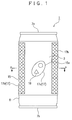
- FIG. 1 illustrates a metal can as a container.
- the metal can is made up of a body (a can body) 1 to be filled with a hot drink and a label 3 attached to a main part 6 of the can body 1.
- the can body 1 includes a top lid 7a and a bottom 7b of a bottom lid respectively closing upper and lower openings of the main part 6, in which the top lid 7a and the bottom 7b are secured to the upper and lower ends of the main part 7 such as by fastening them with threaded portions.
- the main part 6 is so sized as to be held by the hand, and for example has a diameter of 40 mm - 100 mm.
- the can body 1 is formed by using a metal thin plate having a thickness of 0.1 mm - 0.4 mm such as an aluminium alloy plate or surface-treated steel plate for plate working.
- the label 3 is placed around substantially the entire circumference of the main part 6 of the can body 1, as illustrated in FIG. 5(a).
- the opposite edges 3a, 3b may be overlapped to each other, as illustrated in FIG. 5(b).
- the label 3 is made of synthetic resin foam sheet that has a foam layer 10, which provides an excellent heat insulation to a content.
- the label 3 is made up of the foam layer 10 as a label substrate, and non-foam layers 11a, 11b laminated on the front and rear sides (outer and inner sides) of the foam layer 10.
- the outer non-foam layer 11a is subjected to front printing to have print 12, and an overcoat layer 13 coated on the entire surface of the non-foam layer 11a and the print 12.
- an adhesive layer (a heat sensitive adhesive layer) 14 made of heat sensitive adhesive such as hot melt or delayed tack that contains as a main component ethylene-vinyl acetate copolymer, ethylene acrylic acid copolymer, ethylene acrylic ester resin or the like by melt extrusion coating, hot melt coating, gravure coating, roll coating or the like process.
- the adhesive layer 14 may be formed only along the opposite edges 3a, 3b of the label 3.
- the adhesive layer is formed only along the opposite edges 3a, 3b of the label 3, in which the adhesive layer 14 of the first edge 3a allows the label 3 to be bonded to the can body 1 therethrough, while the adhesive layer 14 of the second edge 3b allows the opposite edges 3a, 3b to be bonded together.
- the adhesive layer 14 can be formed on the entire surface of the inner side of the label 3.
- heat sensitive adhesive those having such adhesive force as not to be weakened at a temperature between 60°C and 65°C (or having such adhesive force as not to be easily peeled away) are used. It is also possible to use acrylic or rubber adhesive for the adhesive layer 14.
- the foam layer 10 is made of foamed polystyrene resin having an expansion ratio of 2 to 10 times and preferably 3 to 7 times, and a thickness of 120 ⁇ m to 400 ⁇ m.
- the foamed polystyrene resin general purpose resin can be used.
- a resin that contains as a main component copolymer obtained by copolymerization of polystyrene with butadiene, acrylonitrile, mathacrylic acid, acrylic acid, acrylic acid ester or the like has a different resin or additive blended therein, and contains 60 % by weight or more (preferably 80 % by weight or more) of styrene is preferably used. These are expanded by various foaming agents.
- the non-foam layers 11a, 11b are provided for the purpose of protecting the inwardly located foam layer 10 against scratches and for the reason that printing thereon is better than printing directly on the foam layer 10.
- the non-foam layers 11a, 11b each have a thickness of 3 - 20 ⁇ m.
- the non-foam layers 11a, 11b are made of polystyrene resin. Specifically, they are made of solely polystyrene, styrene butadiene copolymer or styrene acrylic copolymer, or a mixture thereof, and preferably those formed by blending polyethylene or ethylene-vinyl acetate copolymer therein and contains 60 % by weight or more of styrene.
- the non-foam layers 11a, 11b are formed along with the foam layer 10 by co-extrusion.
- the non-foam layers may be made of polyethylene or polypropylene resin. Alternatively, a non-foam layer may be formed on either side, or no non-foam layer may be formed on both sides.
- the outer side of the label 3 is embossed.
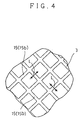
- linear depressions 15 are formed thereon, as illustrated in FIGS. 2 and 4.
- the linear depressions 15 each preferably have a width L of 0.5 mm - 3.0 mm and more preferably 0.5 mm - 2.0 mm.
- the reason for setting the width L to these ranges is to make the hand hard to touch thinner portions caused by the depressions where a heat insulating effect is lowered. Setting the width of the linear depressions to these ranges makes the depressions easy to be formed and easy to create a decorative effect.
- the depth of the depressions is for example about 30 ⁇ m - 50 ⁇ m. That is, the thickness of the linear depressions of the label 3 is thinner than that of the residual portion of the label 3.
- planar depressions 15a may be formed on the outer side of the label.
- An embossed portion 17 having the linear depressions 15 may be formed in a given portion.
- an embossed portion 17a arranged around a display area 18 such as a graphic with the curving (circular) linear depressions 15a formed along the edge of the display area 18, or an embossed portion 17b having linear depressions 15b arranged in lattice pattern.
- the embossed portion 17b having the linear depressions 15b arranged in lattice pattern is formed on each side of the label 3, while the embossed portion 17a around the display area 18 with the linear depressions 15a along the edge of the display area is formed in the center portion of the label 3.
- the embossed portions 17b formed on the opposite sides of the label 3 is so arranged as to provide a gripping area along a diametrical direction of the main part 6 of the can body 1 when the label 3 is attached to the main part 6.
- embossed portions 17a, 17c may be formed only in portions close to the both ends of the label 3.
- the embossed portion 17c may be made up of linear depressions 15c along the edge of each character.
- an embossed portion 17d may be formed along the entire length of the label 3 in the lengthwise direction of the label 3 (a feeding direction of the label).
- a lengthwise material sheet (a sheet with the foam layer 10, the non-foam layers 11a, 11b formed on the front and rear sides of the foam layer 10, and the adhesive layer (heat sensitive adhesive layer) 14 coated on the non-foam layer 11b) 3A is fed so as to have a surface (an outer side) thereof subjected to corona discharge treatment by a corona discharge treatment device 20, while activating the surface of the material sheet 3A as moving the same.
- the surface treatment of the material sheet 3A is made so as to be able to increase affinity to ink.
- a printing step the outer side of the material sheet 3A is subjected to printing by an offset printing press, a flexographic press, a relief rotary press or other conventional printing machine 21 with UV curing ink or the like.
- UV curing ink having excellent heat resistance as printing ink for use so as not to be damaged by heat that activates the heat sensitive adhesive layer 14.
- Plural printing machines 21 are arranged respectively for given colors.
- UV curing step subsequent to the printing step the printing layer is exposed to UV radiation by a UV lamp 23 for UV curing.
- UV curing ink UV ink
- known UV ink can be used.
- UV curing ink it can be cited “161", “STP”, “171” and “VECTA” of T&K TOKA COMPANY, "UVACE” of KUBOI-INK CO., LTD., "CP-UV” of MATSUI CHEMICAL CO., LTD and the like.
- the surface of the ink layer is coated with varnish by a varnish printing machine 25 and then subjected to UV curing treatment.
- Varnish as used herein may be "UVOP VARNISH SERIES” of T&K TOKA COMPANY, "UVACEOP VARNISH” OF KUBOI-INK CO., LTD or the like.
- the printing ink and the varnish used herein may be of electron curing type, in place of UV curing type.
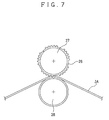
- the material sheet 3A which has been subjected to the printing and subsequent treatments, is fed between an embossing cylinder 27 that has a metal roll, on which a resin plate 26 as a pressing plate with linear depressions having predetermined shape formed thereon is provided, and a receiving cylinder 28, and embossed on given portions of the sheet 3A according to the respective labels 3.
- the resin plate 26 is made of rigid synthetic resin and made up of such as a base layer of plastic sheet or the like and a rigid photosensitive resin layer (acrylic resin, methacrylic resin or the like).
- the synthetic resin (the photosensitive resin) has a D-type durometer (Shore hardness) of about 50 - 80 is used, and preferably has a hardness of 60 - 70 (according to JIS-K-6253 (1997) "Method of Hardness Testing of Vulcanized Rubber and Thermoplastic Rubber”).
- the thus formed resin plate 26 while not being heated, presses the material sheet 3A against the receiving cylinder 28 by a given force.
- the resin plate 26 Since the resin plate 26 is used, it is unlikely to cause scratches or cracks on the printing layer and a varnish layer respectively made of rigid coats cured by UV radiation, as compared with a case where a metal plate is used, and it is also unlikely to cause cracks on the surface of a polystyrene resin foam sheet having poor impact strength.
- the receiving cylinder 28 may be formed by using a metal roll having a surface provided with resin or rigid rubber, or a metal roll with a thin sheet of paper wound in multiple layers.
- the surface of the receiving cylinder 28 may have shallow depressions substantially matched to the linear depressions of the resin plate 26.
- linear depressions are formed on the side of the material sheet 3A facing to the receiving cylinder 28.
- the inner side of the label has linear depressions while the outer side of the label has linear protrusions corresponding in position to the linear depressions.
- a material sheet having no heat sensitive adhesive layer is used. Even when the inner side of the label has liner depressions and the outer side of the label has linear protrusions, the height of the linear protrusions is smaller than the depth of the linear depressions, since the foam layer 10 is compressed by pressure.
- the resin plate 26, the receiving cylinder 28 and the material sheet 3A each are set at such a temperature as to make the heat sensitive adhesive hard to become activated, namely 60°C or lower, and preferably 50°C or lower.
- the material sheet 3A having been subjected to the embossing is rolled up.
- a rolled material sheet 3B is slit to a given width, and cut into a given shape while being fed out of the slit roll by a label attaching machine (not illustrated), thereby producing labels 3.
- a transfer means such as a suction drum
- the labels 3, which have been cut into a given shape have the heat sensitive adhesive heated and activated by blasts of hot air or infra-red radiation, and then each fitted around the main part 6 of the can body 1 filled with drink.
- the thus drink filled metal cans are warmed by a hot vending machine or hot warmer and sold as hot drink.
- the heat sensitive adhesive of the label 3 has an adhesive force that is not likely to be reduced when it is heated to 60 to 65°C by a hot vending machine or the like, so that the label 3 is not removed from the main part 6 but held thereon in a secured condition.
- the can body 1 which is also heated to a high temperature in the same manner as the drink therein, allows a person to hold the can body 1 through the label 3 by the hand and hence preventing the hand from being heated.
- the arrangement with the embossed portion to be held by the hand is unlikely to cause slippage and hence allows for secured holding of the can body 1 by the hand.
- the label 3 having the foam layer 10 of foamed polystyrene has a rigidity higher than a label having a foam layer 10 of polyethylene or polypropyrene, and bonded to the main part 6 of the metal can 1 along the entire circumference by the heat sensitive adhesive.
- This arrangement is preferable because of the reinforcing effect applied to the main part 6 of a metal can of thin steel or aluminium.
- the thus structured label 3 may be applicable to various fields in addition to the above.
- the foam layer 10 may be made of foamed polyolefin such as polyethylene resin or polypropylene resin.
- the foam layer 10 made of foamed polyethylene is used as a label substrate having a rear side provided with the adhesive layer 14 and a front side provided with a polyethylene layer as the non-foam layer 11a, in which the polyethylene layer is provided thereon with the print 12 and the overcoat layer 13 is further provided on the polyethylene layer and the print 12.
- the foam layer using foamed polystyrene resin is preferable since it has an excellent rigidity and workability in embossing by the resin plate 26 or is easy to be embossed as compared with foamed polyethylene.
- the body of the container may be a glass bottle or a synthetic resin container other than a metal can.
- a glass bottle there is provided an effect of preventing bottle breakage.
- a label of the present invention is also preferably used as a label for a cup-shaped container of synthetic resin adapted to contain food to be served after being heated by a microwave oven.
- the body of the container may contain those adapted to be cooled, in addition to such as a drink adapted to be heated. Particularly, a slippage prevention effect is remarkable for a freezer container of such as ice water, while the content is not limited to a specific one.
- the pressing plate 26 which is made of resin as described above, allows for ease of manufacturing labels with no scratches or the like thereon at low cost.
- a plate may be made of metal such as brass.
- metal such as brass.
- it is preferable to form an edge of each depression into R-shape so as not to cause scratch or the like on the surface of an material label.
- the surface of the material sheet 3A is subjected to corona discharge treatment and printing in the same step.
- the label 3 in the above embodiment is a heat sensitive adhesive applied label which has a heat sensitive adhesive applied to the foam sheet
- a heat shrinkable foam sheet may be used for the label 3.
- the heat shrinkable foam sheet may have a non-foam layer provided only on one side (a printing side), or may have non-foam layers provided respectively on both sides.
- the material, thickness or expansion ratio of each of the foam layer and the non-foam layers are all may be the same as those as described above, and the shrinkage ratio of the heat shrinkable foam sheet is in the range of 30% to 70% at 120°C (immersed in a glycerin bath for 10 seconds).
- the label 3 is thus made of a heat shrinkable foam sheet, it is possible to achieve attachment of the label on the container body 1 by feeding the sheet from the roll and cutting the same into individual labels 3; forming the adhesive layer 14 on the first edge 3a of the inner side of each label 3 by applying adhesive such as hot melt thereon; applying solvent being capable of dissolving polystyrene resin (ketone or ester) to the second edge 3b, placing the label 3 around the container body 1 with the first edge 3a bonded thereto and the second edge 3b overlapped to the first edge 3a and bonded thereto, thus forming the label 3 into a cylindrical shape; and heating the label 3 by a heater such as blasts of hot air, thereby making the label 3 shrink and hence allowing the same to be fully attached to the main part 6 of the container body 1.
- a heater such as blasts of hot air
- the attachment of each label is achieved by feeding the sheet from the roll and cutting the same into individual labels 3; placing each label 3 around a cylindrical mandrel or the like and having the opposite edges 3a, 3b overlapped to each other and bonded together along the bonded portion by heat sealing, thereby forming the label 3 into a cylindrical shape; fitting the cylindrical label 3 on the container body 1; and heating the label 3 by a heating means such as a heater so as to allow the same to shrink, so that the attachment of the label 3 to the container body 1 can be achieved without the necessity to bond the label 3 to the container body 1.
- a heating means such as a heater
- a label of the present invention allows for holding of a container body by the hand while preventing heating or cooling of the hand when it is attached to the container body.
- the linear depressions formed in the outer side of the label provide an uneven surface portion that makes the label hard to slip and hence the container body to slip off from the hand, as well as creates a decorative effect, produces a high quality feeling and provides a design having a perspective and three dimensional effect.
- the outer side of each label is pressed by a resin plate having linear protrusions and therefore it is possible to prevent scratches or cracks on the outer side of the label, so that labels can be manufactured by a simple arrangement.
- the label manufacturing method of the present invention does not require a pressing plate to be heated, and therefore is advantageous in the fact that labels with heat sensitive adhesive applied as adhesive for bonding of the labels can be easily manufactured.
Landscapes
- Engineering & Computer Science (AREA)
- Mechanical Engineering (AREA)
- Physics & Mathematics (AREA)
- General Physics & Mathematics (AREA)
- Theoretical Computer Science (AREA)
- Details Of Rigid Or Semi-Rigid Containers (AREA)
- Making Paper Articles (AREA)
- Containers Having Bodies Formed In One Piece (AREA)
Abstract
Description
Claims (8)
- A label for being attached to a main part of the body of a container is characterized in that it is made of foam sheet having a foam layer, in which an outer side of the label has linear depressions formed by pressing the foam sheet so as to have partially thinned portions and hence provide an uneven surface portion.
- A label according to claim 1 further comprising a heat sensitive adhesive layer on an inner side of the label.
- A label according to claim 1, wherein the foam layer is made of foamed polystyrene resin and the linear depressions each have a width of 0.5 - 3.0 mm.
- A method of manufacturing labels is characterizes in that it comprises pressing an outer side of each label made of foam sheet having a foam layer with a resin plate having linear protrusions, thereby producing an embossed portion made up of linear depressions on the outer side of the label.
- A method of manufacturing labels according to claim 4, wherein an embossed portion is provided on the outer side of the label made of foam sheet, while an adhesive layer is provided on an inner side of the label.
- A method of manufacturing labels is characterized in that it comprises pressing an outer side of each label made of foam sheet having a foam layer and a heat sensitive adhesive layer on an inner side of the label with a pressing plate having linear protrusions, while applying no heat to the pressing plate, thereby producing an embossed portion made up of linear depressions on the outer side of the label.
- A label for being attached to a main part of the body of a container is characterized in that the label is made of foam sheet having a foam layer, in which an outer side of the label has linear protrusions that are formed by pressing the foam sheet in the thickness direction thereof so as to provide an uneven surface portion.
- A method of manufacturing labels is characterized in that it comprises pressing an inner side of each label made of foam sheet having a foam layer with a pressing plate having linear protrusions, thereby producing an embossed portion made up of linear protrusions on an outer side of the label.
Applications Claiming Priority (3)
| Application Number | Priority Date | Filing Date | Title |
|---|---|---|---|
| JP2002315564 | 2002-10-30 | ||
| JP2002315564 | 2002-10-30 | ||
| PCT/JP2003/013828 WO2004040535A1 (en) | 2002-10-30 | 2003-10-29 | Label and method of producing the same |
Publications (3)
| Publication Number | Publication Date |
|---|---|
| EP1571639A1 true EP1571639A1 (en) | 2005-09-07 |
| EP1571639A4 EP1571639A4 (en) | 2007-07-25 |
| EP1571639B1 EP1571639B1 (en) | 2012-04-11 |
Family
ID=32211659
Family Applications (1)
| Application Number | Title | Priority Date | Filing Date |
|---|---|---|---|
| EP03769941A Expired - Lifetime EP1571639B1 (en) | 2002-10-30 | 2003-10-29 | Label and method of producing the same |
Country Status (6)
| Country | Link |
|---|---|
| US (1) | US20060019071A1 (en) |
| EP (1) | EP1571639B1 (en) |
| JP (1) | JP4527541B2 (en) |
| AU (1) | AU2003280588A1 (en) |
| ES (1) | ES2386993T3 (en) |
| WO (1) | WO2004040535A1 (en) |
Cited By (2)
| Publication number | Priority date | Publication date | Assignee | Title |
|---|---|---|---|---|
| EP2446429A4 (en) * | 2009-06-26 | 2014-11-19 | Labcon North America | ENHANCED CONTAINER LABELS |
| US9637264B2 (en) | 2010-01-28 | 2017-05-02 | Avery Dennison Corporation | Label applicator belt system |
Families Citing this family (10)
| Publication number | Priority date | Publication date | Assignee | Title |
|---|---|---|---|---|
| US20060000882A1 (en) * | 2004-07-01 | 2006-01-05 | Raymond Darzinskas | Cup holder |
| US8932706B2 (en) * | 2005-10-27 | 2015-01-13 | Multi-Color Corporation | Laminate with a heat-activatable expandable layer |
| US20110198024A1 (en) * | 2007-04-05 | 2011-08-18 | Avery Dennison Corporation | Systems and Processes for Applying Heat Transfer Labels |
| US8282754B2 (en) | 2007-04-05 | 2012-10-09 | Avery Dennison Corporation | Pressure sensitive shrink label |
| WO2008124581A1 (en) | 2007-04-05 | 2008-10-16 | Avery Dennison Corporation | Pressure sensitive shrink label |
| US20090214837A1 (en) * | 2008-02-21 | 2009-08-27 | Multi-Color Corporation | Insulating Label |
| US8389080B2 (en) * | 2008-07-16 | 2013-03-05 | Ws Packaging Group, Inc. | Label-wrapped foam cups with patterned adhesive |
| US20110154699A1 (en) * | 2009-08-03 | 2011-06-30 | Avery Dennison Corporation | Preprinted Roll-On Shrink-On Label |
| JP2016137922A (en) * | 2015-01-28 | 2016-08-04 | 秀哲 具志堅 | Method of manufacturing packing box, and confectionery packing box manufactured by the same |
| KR102302751B1 (en) * | 2019-02-01 | 2021-09-16 | 인탑스 주식회사 | Name plate for cosmetic containers and manufacturing method of the same |
Family Cites Families (21)
| Publication number | Priority date | Publication date | Assignee | Title |
|---|---|---|---|---|
| US2917217A (en) * | 1956-04-30 | 1959-12-15 | St Regis Paper Co | Foamed polystyrene article |
| US3496043A (en) * | 1966-04-07 | 1970-02-17 | Robert O Ragan | Method of manufacturing an embossed laminated foam |
| US3677874A (en) * | 1970-03-24 | 1972-07-18 | Grace W R & Co | Insulation product and method |
| US4071597A (en) * | 1974-09-13 | 1978-01-31 | Owens-Illinois, Inc. | Container with improved heat-shrunk cellular sleeve |
| JPS57207016A (en) * | 1981-06-17 | 1982-12-18 | Teijin Ltd | Preparation of surface coating material |
| DE3236459C1 (en) * | 1982-10-01 | 1984-03-29 | Windmöller & Hölscher, 4540 Lengerich | Process for the production of sanitary paper webs coated with plastic |
| JPH0430614Y2 (en) * | 1986-04-16 | 1992-07-23 | ||
| JPH0497272A (en) * | 1990-08-10 | 1992-03-30 | Toppan Printing Co Ltd | Label |
| US5226585A (en) * | 1991-11-19 | 1993-07-13 | Sherwood Tool, Inc. | Disposable biodegradable insulated container and method for making |
| JPH0637816U (en) * | 1992-10-20 | 1994-05-20 | オリンパス光学工業株式会社 | Vertical focusing microscope |
| KR960005298B1 (en) * | 1992-10-27 | 1996-04-23 | 미쓰이도오아쓰가가쿠 가부시키가이샤 | Complex molded article and manufacturing method |
| US5589016A (en) * | 1994-04-29 | 1996-12-31 | The Boeing Company | Prescored foam for panel fabrication |
| JP3547177B2 (en) * | 1994-09-08 | 2004-07-28 | 株式会社ユポ・コーポレーション | Delayed label |
| US5713512A (en) * | 1996-09-03 | 1998-02-03 | Polytainers, Inc. | Polymeric insulated container |
| JP3870452B2 (en) | 1996-10-01 | 2007-01-17 | 東ソー株式会社 | Compression molding method of polyolefin resin foam |
| JP3720153B2 (en) * | 1996-11-26 | 2005-11-24 | 株式会社ユポ・コーポレーション | Manufacturing method of label sticking container |
| AU5339898A (en) * | 1996-12-26 | 1998-07-31 | Sekisui Chemical Co., Ltd. | Foamable thermoplastic sheet-like synthetic resin, thermoplastic foame d resin and their production method |
| US6224954B1 (en) * | 1997-03-26 | 2001-05-01 | Fort James Corporation | Insulating stock material and containers and methods of making the same |
| JP2001150886A (en) * | 1999-11-26 | 2001-06-05 | Dainippon Printing Co Ltd | Transfer method |
| US7070841B2 (en) * | 2001-04-11 | 2006-07-04 | E. I. Du Pont De Nemours And Company | Insulating label stock |
| JP2003098968A (en) * | 2001-09-26 | 2003-04-04 | Toyo Science Co Ltd | In-mold molding label, in-mold molded product using the same, and in-mold molding method |
-
2003
- 2003-10-29 WO PCT/JP2003/013828 patent/WO2004040535A1/en not_active Ceased
- 2003-10-29 US US10/533,220 patent/US20060019071A1/en not_active Abandoned
- 2003-10-29 AU AU2003280588A patent/AU2003280588A1/en not_active Abandoned
- 2003-10-29 EP EP03769941A patent/EP1571639B1/en not_active Expired - Lifetime
- 2003-10-29 JP JP2004548064A patent/JP4527541B2/en not_active Expired - Fee Related
- 2003-10-29 ES ES03769941T patent/ES2386993T3/en not_active Expired - Lifetime
Non-Patent Citations (2)
| Title |
|---|
| No further relevant documents disclosed * |
| See also references of WO2004040535A1 * |
Cited By (2)
| Publication number | Priority date | Publication date | Assignee | Title |
|---|---|---|---|---|
| EP2446429A4 (en) * | 2009-06-26 | 2014-11-19 | Labcon North America | ENHANCED CONTAINER LABELS |
| US9637264B2 (en) | 2010-01-28 | 2017-05-02 | Avery Dennison Corporation | Label applicator belt system |
Also Published As
| Publication number | Publication date |
|---|---|
| EP1571639B1 (en) | 2012-04-11 |
| JPWO2004040535A1 (en) | 2006-03-02 |
| AU2003280588A1 (en) | 2004-05-25 |
| ES2386993T3 (en) | 2012-09-10 |
| WO2004040535A1 (en) | 2004-05-13 |
| JP4527541B2 (en) | 2010-08-18 |
| US20060019071A1 (en) | 2006-01-26 |
| EP1571639A4 (en) | 2007-07-25 |
Similar Documents
| Publication | Publication Date | Title |
|---|---|---|
| EP1571639B1 (en) | Label and method of producing the same | |
| US6620281B1 (en) | Method for making insulating label and wrap for beverage container | |
| US6200663B1 (en) | Rough surface packaging element | |
| US20090214837A1 (en) | Insulating Label | |
| JP7069005B2 (en) | Manufacturing method of packaging | |
| US20160214362A1 (en) | Process for forming transfer film | |
| EP1516302B1 (en) | Adhesive coated label having tactile feel | |
| EP1398149B1 (en) | Printable thermoplastic multilayer laminate for vacuum skin packaging applications | |
| JP4194672B2 (en) | Acrylic insert molding and its manufacturing method, multilayer film for insert molding | |
| US20150013273A1 (en) | Expanded Content Heat Shrinkable Label | |
| KR20210031712A (en) | Improved gripping of the tab seal | |
| WO2007047650A1 (en) | Shrink sleeve for an article closure | |
| JP4612278B2 (en) | Insulating label and labeled container | |
| JP4679126B2 (en) | Container with cylindrical label | |
| JP4866096B2 (en) | Manufacturing method of labeled container | |
| JP2006213341A (en) | Heat-shrinkable cylindrical label | |
| JP3720153B2 (en) | Manufacturing method of label sticking container | |
| JP2005193984A (en) | Container with tubular label and heat shrink type tubular label | |
| JP2008225293A (en) | In-mold label | |
| JP5948912B2 (en) | Easily tearable embossed film and packaging material using the same | |
| JP4382443B2 (en) | Shrink label and container with the label | |
| JPH08146879A (en) | Labels for in-mold molding | |
| JP4847080B2 (en) | Heat-shrinkable laminated film and heat-shrinkable cylindrical label | |
| JP4764211B2 (en) | Labeled container and manufacturing method thereof | |
| JPH03111885A (en) | Label |
Legal Events
| Date | Code | Title | Description |
|---|---|---|---|
| PUAI | Public reference made under article 153(3) epc to a published international application that has entered the european phase |
Free format text: ORIGINAL CODE: 0009012 |
|
| 17P | Request for examination filed |
Effective date: 20050422 |
|
| AK | Designated contracting states |
Kind code of ref document: A1 Designated state(s): AT BE BG CH CY CZ DE DK EE ES FI FR GB GR HU IE IT LI LU MC NL PT RO SE SI SK TR |
|
| AX | Request for extension of the european patent |
Extension state: AL LT LV MK |
|
| DAX | Request for extension of the european patent (deleted) | ||
| RBV | Designated contracting states (corrected) |
Designated state(s): DE ES FR GB IT NL |
|
| A4 | Supplementary search report drawn up and despatched |
Effective date: 20070626 |
|
| RIC1 | Information provided on ipc code assigned before grant |
Ipc: B65D 25/36 20060101ALI20070621BHEP Ipc: B65D 81/38 20060101ALI20070621BHEP Ipc: G09F 3/00 20060101AFI20040514BHEP Ipc: G09F 3/04 20060101ALI20070621BHEP Ipc: G09F 3/02 20060101ALI20070621BHEP |
|
| GRAP | Despatch of communication of intention to grant a patent |
Free format text: ORIGINAL CODE: EPIDOSNIGR1 |
|
| GRAS | Grant fee paid |
Free format text: ORIGINAL CODE: EPIDOSNIGR3 |
|
| GRAA | (expected) grant |
Free format text: ORIGINAL CODE: 0009210 |
|
| AK | Designated contracting states |
Kind code of ref document: B1 Designated state(s): DE ES FR GB IT NL |
|
| REG | Reference to a national code |
Ref country code: GB Ref legal event code: FG4D |
|
| REG | Reference to a national code |
Ref country code: DE Ref legal event code: R096 Ref document number: 60340590 Country of ref document: DE Effective date: 20120531 |
|
| REG | Reference to a national code |
Ref country code: NL Ref legal event code: T3 |
|
| REG | Reference to a national code |
Ref country code: ES Ref legal event code: FG2A Ref document number: 2386993 Country of ref document: ES Kind code of ref document: T3 Effective date: 20120910 |
|
| PLBE | No opposition filed within time limit |
Free format text: ORIGINAL CODE: 0009261 |
|
| STAA | Information on the status of an ep patent application or granted ep patent |
Free format text: STATUS: NO OPPOSITION FILED WITHIN TIME LIMIT |
|
| 26N | No opposition filed |
Effective date: 20130114 |
|
| REG | Reference to a national code |
Ref country code: DE Ref legal event code: R097 Ref document number: 60340590 Country of ref document: DE Effective date: 20130114 |
|
| REG | Reference to a national code |
Ref country code: FR Ref legal event code: PLFP Year of fee payment: 13 |
|
| PGFP | Annual fee paid to national office [announced via postgrant information from national office to epo] |
Ref country code: ES Payment date: 20150915 Year of fee payment: 13 |
|
| PGFP | Annual fee paid to national office [announced via postgrant information from national office to epo] |
Ref country code: FR Payment date: 20150908 Year of fee payment: 13 |
|
| PGFP | Annual fee paid to national office [announced via postgrant information from national office to epo] |
Ref country code: GB Payment date: 20151028 Year of fee payment: 13 Ref country code: DE Payment date: 20151020 Year of fee payment: 13 Ref country code: IT Payment date: 20151026 Year of fee payment: 13 |
|
| PGFP | Annual fee paid to national office [announced via postgrant information from national office to epo] |
Ref country code: NL Payment date: 20150909 Year of fee payment: 13 |
|
| REG | Reference to a national code |
Ref country code: DE Ref legal event code: R119 Ref document number: 60340590 Country of ref document: DE |
|
| REG | Reference to a national code |
Ref country code: NL Ref legal event code: MM Effective date: 20161101 |
|
| GBPC | Gb: european patent ceased through non-payment of renewal fee |
Effective date: 20161029 |
|
| REG | Reference to a national code |
Ref country code: FR Ref legal event code: ST Effective date: 20170630 |
|
| PG25 | Lapsed in a contracting state [announced via postgrant information from national office to epo] |
Ref country code: GB Free format text: LAPSE BECAUSE OF NON-PAYMENT OF DUE FEES Effective date: 20161029 Ref country code: DE Free format text: LAPSE BECAUSE OF NON-PAYMENT OF DUE FEES Effective date: 20170503 Ref country code: FR Free format text: LAPSE BECAUSE OF NON-PAYMENT OF DUE FEES Effective date: 20161102 |
|
| PG25 | Lapsed in a contracting state [announced via postgrant information from national office to epo] |
Ref country code: NL Free format text: LAPSE BECAUSE OF NON-PAYMENT OF DUE FEES Effective date: 20161101 |
|
| PG25 | Lapsed in a contracting state [announced via postgrant information from national office to epo] |
Ref country code: IT Free format text: LAPSE BECAUSE OF NON-PAYMENT OF DUE FEES Effective date: 20161029 |
|
| PG25 | Lapsed in a contracting state [announced via postgrant information from national office to epo] |
Ref country code: ES Free format text: LAPSE BECAUSE OF NON-PAYMENT OF DUE FEES Effective date: 20161030 |
|
| REG | Reference to a national code |
Ref country code: ES Ref legal event code: FD2A Effective date: 20181122 |