EP1571233A1 - Method of hardening a beta titanium member - Google Patents
Method of hardening a beta titanium member Download PDFInfo
- Publication number
- EP1571233A1 EP1571233A1 EP05004743A EP05004743A EP1571233A1 EP 1571233 A1 EP1571233 A1 EP 1571233A1 EP 05004743 A EP05004743 A EP 05004743A EP 05004743 A EP05004743 A EP 05004743A EP 1571233 A1 EP1571233 A1 EP 1571233A1
- Authority
- EP
- European Patent Office
- Prior art keywords
- approximately
- beta titanium
- titanium member
- minutes
- heating
- Prior art date
- Legal status (The legal status is an assumption and is not a legal conclusion. Google has not performed a legal analysis and makes no representation as to the accuracy of the status listed.)
- Withdrawn
Links
- 229910001040 Beta-titanium Inorganic materials 0.000 title claims abstract description 62
- 238000000034 method Methods 0.000 title claims abstract description 54
- QVGXLLKOCUKJST-UHFFFAOYSA-N atomic oxygen Chemical compound [O] QVGXLLKOCUKJST-UHFFFAOYSA-N 0.000 claims abstract description 40
- 239000001301 oxygen Substances 0.000 claims abstract description 40
- 229910052760 oxygen Inorganic materials 0.000 claims abstract description 40
- 238000010438 heat treatment Methods 0.000 claims abstract description 29
- 239000007789 gas Substances 0.000 claims abstract description 11
- 239000011261 inert gas Substances 0.000 claims abstract description 10
- 239000000203 mixture Substances 0.000 claims abstract description 9
- 230000008569 process Effects 0.000 claims description 16
- XKRFYHLGVUSROY-UHFFFAOYSA-N Argon Chemical compound [Ar] XKRFYHLGVUSROY-UHFFFAOYSA-N 0.000 claims description 10
- 238000009792 diffusion process Methods 0.000 claims description 6
- 229910052786 argon Inorganic materials 0.000 claims description 5
- 239000010410 layer Substances 0.000 description 24
- 229910052719 titanium Inorganic materials 0.000 description 15
- 239000010936 titanium Substances 0.000 description 15
- RTAQQCXQSZGOHL-UHFFFAOYSA-N Titanium Chemical compound [Ti] RTAQQCXQSZGOHL-UHFFFAOYSA-N 0.000 description 14
- VVTSZOCINPYFDP-UHFFFAOYSA-N [O].[Ar] Chemical compound [O].[Ar] VVTSZOCINPYFDP-UHFFFAOYSA-N 0.000 description 5
- 238000002844 melting Methods 0.000 description 4
- 230000008018 melting Effects 0.000 description 4
- 239000000843 powder Substances 0.000 description 4
- 229910052751 metal Inorganic materials 0.000 description 3
- 239000002184 metal Substances 0.000 description 3
- 238000007747 plating Methods 0.000 description 3
- 229910001069 Ti alloy Inorganic materials 0.000 description 2
- 230000032683 aging Effects 0.000 description 2
- 229910021535 alpha-beta titanium Inorganic materials 0.000 description 2
- 230000008901 benefit Effects 0.000 description 2
- 230000015572 biosynthetic process Effects 0.000 description 2
- 238000005255 carburizing Methods 0.000 description 2
- 238000010276 construction Methods 0.000 description 2
- 238000010586 diagram Methods 0.000 description 2
- 150000002739 metals Chemical class 0.000 description 2
- 238000005121 nitriding Methods 0.000 description 2
- 239000002250 absorbent Substances 0.000 description 1
- 229910045601 alloy Inorganic materials 0.000 description 1
- 239000000956 alloy Substances 0.000 description 1
- 238000001816 cooling Methods 0.000 description 1
- 238000004519 manufacturing process Methods 0.000 description 1
- 239000000463 material Substances 0.000 description 1
- 238000012986 modification Methods 0.000 description 1
- 230000004048 modification Effects 0.000 description 1
- 230000009467 reduction Effects 0.000 description 1
- 239000002344 surface layer Substances 0.000 description 1
- 150000003608 titanium Chemical class 0.000 description 1
Images



Classifications
-
- C—CHEMISTRY; METALLURGY
- C23—COATING METALLIC MATERIAL; COATING MATERIAL WITH METALLIC MATERIAL; CHEMICAL SURFACE TREATMENT; DIFFUSION TREATMENT OF METALLIC MATERIAL; COATING BY VACUUM EVAPORATION, BY SPUTTERING, BY ION IMPLANTATION OR BY CHEMICAL VAPOUR DEPOSITION, IN GENERAL; INHIBITING CORROSION OF METALLIC MATERIAL OR INCRUSTATION IN GENERAL
- C23C—COATING METALLIC MATERIAL; COATING MATERIAL WITH METALLIC MATERIAL; SURFACE TREATMENT OF METALLIC MATERIAL BY DIFFUSION INTO THE SURFACE, BY CHEMICAL CONVERSION OR SUBSTITUTION; COATING BY VACUUM EVAPORATION, BY SPUTTERING, BY ION IMPLANTATION OR BY CHEMICAL VAPOUR DEPOSITION, IN GENERAL
- C23C8/00—Solid state diffusion of only non-metal elements into metallic material surfaces; Chemical surface treatment of metallic material by reaction of the surface with a reactive gas, leaving reaction products of surface material in the coating, e.g. conversion coatings, passivation of metals
- C23C8/06—Solid state diffusion of only non-metal elements into metallic material surfaces; Chemical surface treatment of metallic material by reaction of the surface with a reactive gas, leaving reaction products of surface material in the coating, e.g. conversion coatings, passivation of metals using gases
- C23C8/08—Solid state diffusion of only non-metal elements into metallic material surfaces; Chemical surface treatment of metallic material by reaction of the surface with a reactive gas, leaving reaction products of surface material in the coating, e.g. conversion coatings, passivation of metals using gases only one element being applied
- C23C8/10—Oxidising
Definitions
- the present invention is directed to metal hardening processes and, more particularly, to a method of hardening a beta titanium member.
- titanium and titanium alloy are active metals and have low wear resistance. Also, surface processing of either material is extremely difficult.
- Such methods include forming an outer hardened layer via surface plating or hardening the product surface itself via nitriding or carburizing.
- plating processes encounter the problems of poor adhesion between the plating layer and the titanium surface and damage to the appearance of the titanium, and surface hardening via nitriding or carburizing encounter the problems of coarsening of the product surface and extended processing times.
- JP 2003-73796 discloses a surface hardening method wherein a titanium member is heated while buried in a highly oxygen-absorbent powder. The powder reduces the oxygen concentration of the atmosphere surrounding the titanium member by physically preventing the titanium surface from coming into contact with oxygen. As a result, a TiO oxygen diffusion layer is formed in the surface of the titanium member while minimizing the formation of an oxidized outer surface layer.
- the surface hardness can be increased using such methods, because the titanium member must be buried in oxygen-absorbing powder each time processing is carried out, the process is relatively inefficient and costly. Furthermore, because the titanium member is buried in the oxygen-absorbing powder, the desired cooling rate cannot be obtained following the heat processing, so an appropriate aging treatment cannot be performed.
- a method of hardening the surface of a beta titanium member comprises the step of heating the beta titanium member in a gas mixture consisting essentially of an inert gas and oxygen. Additional inventive features will become apparent from the description below, and such features alone or in combination with the above features may form the basis of further inventions as recited in the claims and their equivalents.
- Fig. 1 shows the basic construction of a particular embodiment of a beta titanium surface hardening apparatus 10 in the form of a titanium melting furnace for surface hardening a beta titanium member 11.
- beta titanium member 11 is placed in a processing chamber S of beta titanium surface hardening apparatus 10, and then beta titanium member 11 is heated in an atmosphere comprising a gas mixture comprising oxygen and an inert gas such as argon gas.
- an atmosphere comprising a gas mixture comprising oxygen and an inert gas such as argon gas.
- the oxygen concentration ranges from approximately 0.05 vol% to approximately 20 vol% (preferably approximately 1.0 vol% to approximately 10 vol%)
- the heating temperature ranges from approximately 700°C to approximately 1000°C (preferably approximately 850°C to approximately 950°C)
- the heat processing time ranges from approximately 10 minutes to approximately 30 minutes (preferably approximately 15 minutes to approximately 25 minutes).
- titanium member 11 undergoes an aging treatment at an ambient temperature of from approximately 400°C to approximately 550°C (preferably approximately 850°C to approximately 950°C) for a time of from approximately 6 hours to approximately 16 hours (preferably approximately 10 hours to approximately 14 hours).
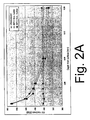
- Figs. 2A and 2B are graphs of surface hardness for various heat treating methods.
- one line represents an unprocessed beta titanium member
- another line represents a beta titanium member subjected to an Argon-Oxygen atmosphere of 5 vol% oxygen at 850°C for 10 minutes
- another line represents a beta titanium member subjected to an Argon-Oxygen atmosphere of 10 vol% oxygen at 850°C for 10 minutes.
- Fig. 2A one line represents an unprocessed beta titanium member
- another line represents a beta titanium member subjected to an Argon-Oxygen atmosphere of 5 vol% oxygen at 850°C for 10 minutes
- another line represents a beta titanium member subjected to an Argon-Oxygen atmosphere of 10 vol% oxygen at 850°C for 10 minutes.
- one line represents an unprocessed beta titanium member
- another line represents a beta titanium member subjected to an Argon-Oxygen atmosphere of 1.7 vol% oxygen at 900°C for 10 minutes
- another line represents a beta titanium member subjected to an Argon-Oxygen atmosphere of 5 vol% oxygen at 900°C for 10 minutes
- another line represents a beta titanium member subjected to an Argon-Oxygen atmosphere of 10 vol% oxygen at 900°C for 10 minutes.
- a beta titanium member that was processed at a temperature of 850°C for 10 minutes in an atmosphere having an oxygen concentration of 5 vol% exhibited an HV hardness of 570-400 down to a depth of 0.10 mm (100 ⁇ m) below the surface, as compared to the more or less fixed HV hardness of 400 for an unprocessed beta titanium member.
- the HV hardness increased to 570-400 from the surface down to a depth of 0.05 mm (50 ⁇ m) below the surface.
- a beta titanium member that was processed at a temperature of 850°C for 10 minutes in an atmosphere having an oxygen concentration of 10 vol% also exhibited an HV hardness of 570-400 down to a depth of 0.10 mm (100 ⁇ m) below the surface.
- the HV hardness increased to 570-450 from the surface down to a depth of 0.05 mm (50 ⁇ m) below the surface.
- a beta titanium member that was processed at a temperature of 900°C for 10 minutes in an atmosphere having an oxygen concentration of 1.7 vol% exhibited an HV hardness of 590-420 from the surface down to a depth of 0.10 mm (100 ⁇ m) below the surface, as compared to the more or less fixed HV hardness of 450 for an unprocessed beta titanium member.
- the HV hardness increased to 590-495 from the surface down to a depth of 0.05 mm (50 ⁇ m) below the surface.
- a beta titanium member that was processed at a temperature of 900°C for 10 minutes in an atmosphere having an oxygen concentration of 5 vol% exhibited an HV hardness of 580-470 from the surface down to a depth of 0.10 mm (100 ⁇ m) below the surface.
- the HV hardness increased to 585-515 from the surface down to a depth of 0.05 mm (50 ⁇ m) from the surface.
- a beta titanium member that was processed at a temperature of 900°C for 10 minutes in an atmosphere having an oxygen concentration of 10 vol% exhibited an HV hardness of 545-395 down to a depth of 0.10 mm (100 ⁇ m) from the surface.
- the HV hardness increased to 545-490 from the surface down to a depth of 0.05 mm (50 ⁇ m) below the surface.
- a temperature of 900°C resulted in a greater increase in hardness over a greater range than a temperature of 850°C. More specifically, when the beta titanium member was subjected to a processing temperature of 900°C, the HV hardness declined more gradually beyond a depth of 0.02 mm (20 m) below the surface than it did when the beta titanium member was subjected to a processing temperature of 800°C. Therefore, taking into consideration the melting temperature of beta titanium, it is preferable that processing be carried out at a temperature in the range of from approximately 850°C to approximately 950°C.
- Fig. 2B shows that HV hardness increases to a greater degree when the oxygen concentration is 1.7 vol% than when it is 5 vol%. The same is true when the oxygen concentration is 5 vol% than when it is 10 vol%. Therefore, in order to minimize the formation of an oxidized layer while increasing HV hardness, it is preferable that processing be carried out within an oxygen concentration in a range of from approximately 1 vol% to approximately 10 vol%.
- Fig. 3 is a bar graph of the results of friction testing beta titanium members when subjected to the methods shown in Figs. 2A and 2B.
- the beta titanium member that was heated at 850°C for 10 minutes in an oxygen concentration of 5 vol% is referred to as a first sample
- the beta titanium member that was heated at 900°C for 10 minutes in an oxygen concentration of 10 vol% is referred to as a second sample
- a beta titanium member that was heated at 900°C for 10 minutes in an oxygen concentration of 5 vol% is referred to as a third sample
- a beta titanium member that was heated at 900°C for 10 minutes in an oxygen concentration of 1.7 vol% is referred to as a fourth sample.
- the average amount of wear was 0.15 mm for the unprocessed beta titanium member, 0.138 mm for the first sample, 0.132 mm for the second sample, 0.110 mm for the third sample, and 0.104 mm for the fourth sample.
- the average wear amount was lower for the processed beta titanium members than for the unprocessed beta titanium member.
- processing at a temperature in a range of from approximately 850°C to approximately 900°C results in wear resistance and surface hardness values that are higher than the equivalent values for an unprocessed beta titanium member.
- the average amount of wear can be reduced when heating is carried out at 850°C than at 900°C. Accordingly, heating at a temperature of 850°C may be preferred in some applications.
- the average amount of wear can be reduced by reducing the oxygen concentration from 10 vol% to 1.7 vol%, so such oxygen concentration reduction also may be prefererable in some applications.
- Fig. 4 is a cross sectional diagram of a surface hardened beta titanium member 11 formed according to the methods taught herein.
- beta titanium member 11 comprises a topmost oxidized layer 11a, a hardened oxygen diffusion layer 11b having a thickness of approximately 100 ⁇ m below oxidized layer 11a, and an unprocessed layer 11c below hardened layer 11b.
- Oxidized layer 11a has a thickness of from approximately 0 ⁇ m to approximately 5 ⁇ m.
- Such a layer is significantly thinner than the oxidized layers formed in the prior art processes that heat the titanium member in atmospheric air.
- removal of oxidized layer 11a created by the teachings herein is very easy.
- hardened layer 11b can be formed to a thickness of at least 70 ⁇ m (preferably 100 ⁇ m) while minimizing the thickness of oxidized layer 11a, a beta titanium member 11 having increased surface hardness can be efficiently obtained.
- a hardened layer may be formed to a thickness of 300 ⁇ m with an increased HV hardness of 500, but an oxidized layer having a thickness of 100 ⁇ m is formed on top of the hardened layer.
- An oxidized layer on the surface of the product is undesirable because it tarnishes the product's appearance. Since the oxidized layer is hard and brittle, removal of such a thick layer is extremely cumbersome and impairs production efficiency.
Landscapes
- Chemical & Material Sciences (AREA)
- Chemical Kinetics & Catalysis (AREA)
- Engineering & Computer Science (AREA)
- Materials Engineering (AREA)
- Mechanical Engineering (AREA)
- Metallurgy (AREA)
- Organic Chemistry (AREA)
- Solid-Phase Diffusion Into Metallic Material Surfaces (AREA)
Abstract
Description
Claims (22)
- A method of hardening the surface of a beta titanium member (11) comprising the step of process heating the beta titanium member (11) in a gas mixture consisting essentially of an inert gas and oxygen.
- The method according to claim 1 wherein the gas mixture has an oxygen concentration in a range of from approximately 0.05 vol% to approximately 20 vol%.
- The method according to claim 1 or 2 wherein the gas mixture has an oxygen concentration in a range of from approximately 1.0 vol% to approximately 10 vol%.
- The method according to any of claims 1 to 3 wherein the inert gas comprises argon.
- The method according to claim 4 wherein the inert gas consists of argon.
- The method according to any of the preceding claims wherein the process heating step comprises the step of heating the beta titanium member (11) at a temperature from approximately 700°C to approximately 1000°C.
- The method according to claim 6 wherein the process heating step comprises the step of heating the beta titanium member (11) at a temperature from approximately 700°C to approximately 1000°C for a time period of from approximately 10 minutes to approximately 30 minutes.
- The method according to claim 7 wherein the time period is from approximately 15 minutes to approximately 25 minutes.
- The method according to claim 6 wherein the process heating step comprises the step of heating the beta titanium member (11) at a temperature from approximately 850°C to approximately 950°C.
- The method according to claim 9 wherein the process heating step comprises the step of heating the beta titanium member (11) at a temperature from approximately 850°C to approximately 950°C for a time period of from approximately 10 minutes to approximately 30 minutes.
- The method according to claim 10 wherein the time period is from approximately 15 minutes to approximately 25 minutes.
- The method according to any of the preceding claims further comprising the step of subsequently heating the beta titanium member (11) in a temperature range of from approximately 400°C to approximately 550°C after the process heating step.
- The method according to claim 12 wherein the subsequent heating step comprises the step of heating the beta titanium member (11) in a temperature range of from approximately 400°C to approximately 550°C for a time period of from approximately 6 hours to approximately 16 hours.
- The method according to claim 13 wherein the time period is from approximately 10 hours to approximately 14 hours.
- The method according to claim 12 wherein the subsequent heating step comprises the step of heating the beta titanium member (11) in a temperature range of from approximately 450°C to approximately 500°C.
- The method according to claim 15 wherein the subsequent heating step comprises the step of heating the beta titanium member (11) in a temperature range of from approximately 450°C to approximately 500°C for a time period of from approximately 6 hours to approximately 16 hours after the process heating step.
- The method according to claim 16 wherein time period is from approximately 10 hours to approximately 14 hours.
- A method of hardening the surface of a beta titanium member (11) comprising the steps of:process heating the beta titanium member (11) in a gas mixture consisting essentially of an inert gas and oxygen at a temperature from approximately 700°C to approximately 1000°C for a time period of from approximately 10 minutes to approximately 30 minutes to form an oxygen diffusion layer (11b); andsubsequently heating the beta titanium member (11) in a temperature range of from approximately 400°C to approximately 550°C for a time period of from approximately 6 hours to approximately 16 hours.
- The method according to claim 18 wherein the time period for the process heating step is from approximately 15 minutes to approximately 25 minutes, and wherein the time period for the subsequent heating step is from approximately 10 hours to approximately 14 hours.
- The method according to claim 19 wherein the gas mixture has an oxygen concentration in a range of from approximately 1.0 vol% to approximately 10 vol%.
- A method of hardening the surface of a beta titanium member (11) comprising the step of heating the beta titanium member (11) in a gas mixture consisting essentially of an inert gas and oxygen to form a hardened layer (11b) and an oxidized layer (11a) above the hardened layer (11b), wherein the oxidized layer (11a) has a thickness less than or equal to approximately 0.5 µm after the heating has completed.
- The method according to claim 20 wherein the hardened layer (11b) has a thickness in a range of from approximately 70 µm to approximately 100 µm.
Applications Claiming Priority (2)
| Application Number | Priority Date | Filing Date | Title |
|---|---|---|---|
| JP2004060523 | 2004-03-04 | ||
| JP2004060523A JP2005248256A (en) | 2004-03-04 | 2004-03-04 | SURFACE HARDENING TREATMENT METHOD FOR beta TYPE TITANIUM, beta TYPE TITANIUM BASED MEMBER AND SURFACE HARDENING TREATMENT DEVICE FOR beta TYPE TITANIUM |
Publications (1)
| Publication Number | Publication Date |
|---|---|
| EP1571233A1 true EP1571233A1 (en) | 2005-09-07 |
Family
ID=34747667
Family Applications (1)
| Application Number | Title | Priority Date | Filing Date |
|---|---|---|---|
| EP05004743A Withdrawn EP1571233A1 (en) | 2004-03-04 | 2005-03-03 | Method of hardening a beta titanium member |
Country Status (5)
| Country | Link |
|---|---|
| US (1) | US20050194075A1 (en) |
| EP (1) | EP1571233A1 (en) |
| JP (1) | JP2005248256A (en) |
| CN (1) | CN1664160A (en) |
| TW (1) | TW200536960A (en) |
Families Citing this family (8)
| Publication number | Priority date | Publication date | Assignee | Title |
|---|---|---|---|---|
| US8566943B2 (en) * | 2009-10-01 | 2013-10-22 | Kaspersky Lab, Zao | Asynchronous processing of events for malware detection |
| CN102162080A (en) * | 2011-03-31 | 2011-08-24 | 戚培毅 | Medicinal titanium implanting apparatus surface modification layer and preparation method thereof |
| CN105349934B (en) * | 2015-07-03 | 2018-03-20 | 苏州大学 | A kind of method for surface hardening of titanium alloy |
| CN106637049A (en) * | 2017-01-03 | 2017-05-10 | 中山源谥真空科技有限公司 | Pure titanium or titanium alloy and surface hardening method thereof |
| WO2018128160A1 (en) * | 2017-01-03 | 2018-07-12 | カシオ計算機株式会社 | Alloy member and method for hardening surface thereof |
| JP7107501B2 (en) * | 2018-07-11 | 2022-07-27 | 株式会社オー・ケー・シー | β-type titanium alloy and its manufacturing method |
| CN113174511A (en) * | 2021-04-02 | 2021-07-27 | 西安交通大学 | Beta titanium alloy material with excellent mechanical property and preparation method thereof |
| CN115969209B (en) * | 2021-10-15 | 2026-05-19 | 羽钛有限公司 | Antibacterial and non-stick titanium tableware and its manufacturing method |
Citations (2)
| Publication number | Priority date | Publication date | Assignee | Title |
|---|---|---|---|---|
| WO1998002595A1 (en) * | 1996-07-17 | 1998-01-22 | The University Of Birmingham | Surface oxidation of a titanium or titanium alloy article |
| WO2002008623A1 (en) * | 2000-07-18 | 2002-01-31 | Nsk Ltd. | Rolling apparatus |
Family Cites Families (5)
| Publication number | Priority date | Publication date | Assignee | Title |
|---|---|---|---|---|
| DE69529178T2 (en) * | 1995-09-13 | 2003-10-02 | Boehler Schmiedetechnik Ges.M.B.H. & Co. Kg, Kapfenberg | METHOD FOR PRODUCING A TITANIUM ALLOY TURBINE BLADE AND TITANIUM ALLOY TURBINE BLADE |
| JPH11223221A (en) * | 1997-07-01 | 1999-08-17 | Nippon Seiko Kk | Rolling bearing |
| FR2778845B1 (en) * | 1998-05-25 | 2001-05-04 | Oreal | DYE COMPOSITION FOR KERATINIC FIBERS WITH CATIONIC DIRECT DYE AND SUBSTANTIVE POLYMER |
| JP2002097914A (en) * | 2000-07-18 | 2002-04-05 | Fuji Oozx Inc | Titanium alloy engine valve and method of manufacturing the same |
| JP2003073796A (en) * | 2001-09-03 | 2003-03-12 | Fuji Oozx Inc | Surface treatment method for titanium-based materials |
-
2004
- 2004-03-04 JP JP2004060523A patent/JP2005248256A/en active Pending
- 2004-12-27 TW TW093140826A patent/TW200536960A/en unknown
-
2005
- 2005-03-02 US US10/906,696 patent/US20050194075A1/en not_active Abandoned
- 2005-03-03 EP EP05004743A patent/EP1571233A1/en not_active Withdrawn
- 2005-03-04 CN CN200510051900XA patent/CN1664160A/en active Pending
Patent Citations (3)
| Publication number | Priority date | Publication date | Assignee | Title |
|---|---|---|---|---|
| WO1998002595A1 (en) * | 1996-07-17 | 1998-01-22 | The University Of Birmingham | Surface oxidation of a titanium or titanium alloy article |
| WO2002008623A1 (en) * | 2000-07-18 | 2002-01-31 | Nsk Ltd. | Rolling apparatus |
| EP1225353A1 (en) * | 2000-07-18 | 2002-07-24 | Nsk Ltd., | Rolling apparatus |
Non-Patent Citations (2)
| Title |
|---|
| LIU Z ET AL: "EFFECTS OF OXYGEN AND HEAT TREATMENT ON THE MECHANICAL PROPERTIES OF ALPHA AND BETA TITANIUM ALLOYS", METALLURGICAL TRANSACTIONS A. PHYSICAL METALLURGY AND MATERIALS SCIENCE, METALLURGICAL SOCIETY OF AIME. NEW YORK, US, vol. 19A, March 1988 (1988-03-01), pages 527 - 542, XP002041099 * |
| MUSHIAKE M ET AL: "DEVELOPMENT OF TITANIUM ALLOY VALVE SPRING RETAINERS", SAE SPECIAL PUBLICATIONS, no. 864, 25 February 1991 (1991-02-25), pages 41 - 49, XP009046186, ISSN: 0099-5908 * |
Also Published As
| Publication number | Publication date |
|---|---|
| CN1664160A (en) | 2005-09-07 |
| JP2005248256A (en) | 2005-09-15 |
| US20050194075A1 (en) | 2005-09-08 |
| TW200536960A (en) | 2005-11-16 |
Similar Documents
| Publication | Publication Date | Title |
|---|---|---|
| US6833197B1 (en) | Method of case hardening | |
| CN1312314C (en) | Method for making titanium alloy lift valve | |
| KR920003630B1 (en) | Surface treatment method of titanium or titanium alloy | |
| KR100292651B1 (en) | Surface Hardening Titanium Materials and Surface Hardening Methods of Titanium Materials | |
| US20050194075A1 (en) | Method of hardening a beta titanium member | |
| US8349093B2 (en) | Method of plasma nitriding of alloys via nitrogen charging | |
| EP1288327B1 (en) | TI alloy surface treatment | |
| JP2943626B2 (en) | Surface hardening method for titanium material | |
| JPH10226873A (en) | Fe-Cr-Ni diffusion-treated steel excellent in weather resistance and method for producing the same | |
| JPH059703A (en) | Surface hardening treatment method for titanium material | |
| JP2982579B2 (en) | Surface treatment method for titanium bolts or nuts | |
| JP6344194B2 (en) | Titanium member excellent in oxidation resistance and method for producing titanium member excellent in oxidation resistance | |
| JP4658843B2 (en) | Method for manufacturing titanium or titanium alloy decorative member | |
| JP5606453B2 (en) | Method for nitriding maraging steel | |
| JP3551749B2 (en) | Manufacturing method of surface hardened parts | |
| JP2005046854A (en) | Hot working method of high Nb alloy | |
| JP3736135B2 (en) | Hardening heat treatment method for titanium alloy member | |
| JPH0310060A (en) | Surface treatment for titanium or titanium alloy | |
| JPH10195612A (en) | Hardening treatment method for metal decorative members | |
| JP2592961B2 (en) | Wear-resistant Ti or Ti-based alloy members | |
| JP2008231559A (en) | Decorative member and its manufacturing method | |
| JP2004052075A (en) | Erosion resistant composite material | |
| JPH10306365A (en) | Surface-hardened titanium material, surface hardening method of titanium material and product thereof | |
| JP3097508B2 (en) | Dice having nitride layer excellent in oxidation resistance and method of manufacturing the same | |
| JPH0650429A (en) | Piston ring of titanium alloy and its manufacture |
Legal Events
| Date | Code | Title | Description |
|---|---|---|---|
| PUAI | Public reference made under article 153(3) epc to a published international application that has entered the european phase |
Free format text: ORIGINAL CODE: 0009012 |
|
| AK | Designated contracting states |
Kind code of ref document: A1 Designated state(s): AT BE BG CH CY CZ DE DK EE ES FI FR GB GR HU IE IS IT LI LT LU MC NL PL PT RO SE SI SK TR |
|
| AX | Request for extension of the european patent |
Extension state: AL BA HR LV MK YU |
|
| 17P | Request for examination filed |
Effective date: 20051017 |
|
| AKX | Designation fees paid |
Designated state(s): AT BE BG CH CY CZ DE DK EE ES FI FR GB GR HU IE IS IT LI LT LU MC NL PL PT RO SE SI SK TR |
|
| RAP1 | Party data changed (applicant data changed or rights of an application transferred) |
Owner name: SHIMANO INC. |
|
| 17Q | First examination report despatched |
Effective date: 20070914 |
|
| STAA | Information on the status of an ep patent application or granted ep patent |
Free format text: STATUS: THE APPLICATION HAS BEEN WITHDRAWN |
|
| 18W | Application withdrawn |
Effective date: 20080220 |