EP1571041A1 - Actuator for exterior rear view mirror - Google Patents
Actuator for exterior rear view mirror Download PDFInfo
- Publication number
- EP1571041A1 EP1571041A1 EP05250503A EP05250503A EP1571041A1 EP 1571041 A1 EP1571041 A1 EP 1571041A1 EP 05250503 A EP05250503 A EP 05250503A EP 05250503 A EP05250503 A EP 05250503A EP 1571041 A1 EP1571041 A1 EP 1571041A1
- Authority
- EP
- European Patent Office
- Prior art keywords
- actuator
- mirror
- motor
- worm wheel
- worm
- Prior art date
- Legal status (The legal status is an assumption and is not a legal conclusion. Google has not performed a legal analysis and makes no representation as to the accuracy of the status listed.)
- Withdrawn
Links
- 230000003247 decreasing effect Effects 0.000 description 4
- 238000010276 construction Methods 0.000 description 2
- 238000003780 insertion Methods 0.000 description 2
- 230000037431 insertion Effects 0.000 description 2
- 238000004519 manufacturing process Methods 0.000 description 2
- 230000002411 adverse Effects 0.000 description 1
- 230000015572 biosynthetic process Effects 0.000 description 1
- 238000012986 modification Methods 0.000 description 1
- 230000004048 modification Effects 0.000 description 1
- 238000003908 quality control method Methods 0.000 description 1
- 102220023217 rs387907538 Human genes 0.000 description 1
Images

Classifications
-
- B—PERFORMING OPERATIONS; TRANSPORTING
- B60—VEHICLES IN GENERAL
- B60R—VEHICLES, VEHICLE FITTINGS, OR VEHICLE PARTS, NOT OTHERWISE PROVIDED FOR
- B60R1/00—Optical viewing arrangements; Real-time viewing arrangements for drivers or passengers using optical image capturing systems, e.g. cameras or video systems specially adapted for use in or on vehicles
- B60R1/02—Rear-view mirror arrangements
- B60R1/06—Rear-view mirror arrangements mounted on vehicle exterior
- B60R1/062—Rear-view mirror arrangements mounted on vehicle exterior with remote control for adjusting position
- B60R1/07—Rear-view mirror arrangements mounted on vehicle exterior with remote control for adjusting position by electrically powered actuators
- B60R1/072—Rear-view mirror arrangements mounted on vehicle exterior with remote control for adjusting position by electrically powered actuators for adjusting the mirror relative to its housing
Definitions
- the present invention relates to an actuator for a vehicle exterior rear view mirror, which adjusts an angle of a mirror surface possessed by the exterior rear view mirror.
- the application is based on Japanese Patent Application No. 2004-057180, filed on March 2, 2004.
- FIG. 4 is an exploded perspective view showing an actuator for an exterior rear view mirror disclosed in Japanese Patent Laid-Open No. 2002-67795.
- an actuator 11 for an exterior rear view mirror (hereinafter simply referred to as "actuator") has a motor 13A serving as a first angle adjusting mechanism (for example, adjustment of an angle of the vertical direction), a worm wheel 14A and a rod 15A provided within an actuator housing 12.
- the actuator 11 also possesses, as a second angle adjusting mechanism (for example, adjustment of an angle of the horizontal direction), a motor 13B, a worm wheel 14B, and a rod 15B.
- the motor 13A (13B) is placed within the actuator housing 12, and power is supplied from an external power source to the motor 13A (13B) to rotate a worm 13A 2 (13B 2 ).
- the worm wheel 14A (14B) possesses a gear portion 14A 1 (14B 1 ).
- the gear portion 14A 1 (13B 2 ) is engaged with the worm 13A 2 (13B 2 ).
- the rod 15A (15B) is fitted to the worm wheel 14A (14B) in the state where it is not rotated, and is screwed to a female screw formed on an inner wall of a cylindrical portion 12A (12B) of the actuator housing 12.
- the motor 13A (13B) When the motor 13A (13B) is driven, the worm 13A 2 (13B 2 ) is rotated. The rotation of the worm 13A 2 (13B 2 ) allows the rod 15A (15B) for moving in the front or rear direction, to thereby fluctuate the mirror.
- the actuator 11 is much more miniaturized. Particularly, there is a demand that any other parts and members are accommodated at vertical sides and horizontal sides of the actuator 11 (see FIG. 1), i.e., around directions parallel to the mirror surface.
- the motor 13A and the motor 13B are placed on the same surface parallel to the mirror surface in the conventional actuator 11, the miniaturization of the actuator 11 is strictly restricted.
- An object of at least the preferred embodiments of the present invention is, therefore, to provide an actuator for an exterior rear view mirror, which makes it possible to miniaturize the extent of the actuator parallel to the mirror surface.
- an actuator for an exterior rear view mirror accommodated within a mirror housing comprising a first motor for adjusting a first angle of the mirror and a second motor for adjusting a second angle of the mirror: said first motor and said second motor being placed so as to be at least partially overlapped with each other when the mirror surface is viewed from the vertical direction.
- the adjustment of two angles of mirror i.e., the first angle and the second angle intended herein means the adjustment so that the mirror can be fluctuated 360° around the fluctuation center of the mirror as the axis.
- the combination of the adjustment of the first angle in the vertical direction with the adjustment of the second angle in the horizontal direction or vice versa is proven to be preferable.
- the actuator may further possess a first worm wheel and a second worm wheel each comprising a gear portion, which can be engaged with the worm of the motor, a first cylindrical portion having a first height provided on one side of said gear portion, and a second cylindrical portion having a second height provided on another side of said gear portion, wherein the gear portion of said gear portion of the first worm wheel is engaged with the worm of the first motor, and the gear portion of said second worm wheel is engaged with the worm of said second motor in the state that said first gear wheel is reversed.
- first height used herein means a height that the gear portion is engaged with the worm of the first motor when the first cylindrical portion is at a front side within the actuator housing.
- second height used herein means a height that the gear portion is engaged with the worm of the second motor when the second cylindrical portion is at a front side within the actuator housing
- an exterior rear view mirror at the right side is exemplified.
- the expression relating to the directions, i.e., upside, downside, right side, left side, front side, and rear side, is based on the use state of the exterior rear view mirror.
- the same portions are assigned to the same numbers or symbols, and repeated description will be omitted.
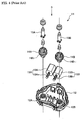
- FIG. 1 is an exploded perspective view showing a main portion of the exterior rear view mirror having the actuator for an exterior rear view mirror according to an embodiment of the present invention
- FIG. 2 is a schematic view showing the actuator for an exterior rear view mirror of FIG. 1.
- an exterior rear view mirror OM possesses a mirror housing MH, a frame SB, an actuator 1 for an exterior rear view mirror (hereinafter simply referred to as "actuator"), a mirror holder H, and a mirror M.
- the mirror housing MH is supported by a stay (not shown), which is fixed onto a side body of a vehicle, in a state of capable of being fluctuated. Since the support construction of the mirror holder H by the actuator 1 is well known in the art, the description of how to support the mirror holder H by the actuator 1 will be omitted (As for the support construction of the mirror see for example, Japanese Patent Laid-Open No. 2002-67795).
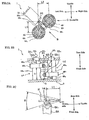
- FIG. 2A is a drawing viewing from line A-A of FIG. 1 which explains the motors, the worm wheels and the rod of the actuator
- FIG. 2B is a drawing viewing from line B-B of FIG. 2A, which explains the motors and the worm wheels
- FIG. 2C is a drawing viewing from line C-C of FIG. 2A, which explains an adjust pan.
- the actuator 1 possesses a first angle-adjusting mechanism and a second angle-adjusting mechanism within the actuator housing 2.
- the first angle-adjusting mechanism is a mechanism that fluctuates the holder H and the mirror M taking a fluctuation center P1 as an axis whereby the angle of the mirror M in the vertical direction is adjusted.
- the second angle-adjusting mechanism is a mechanism that fluctuates the holder H and the mirror M taking a fluctuation center P1 as an axis whereby the angle of the mirror M in the horizontal direction is adjusted.
- the actuator 1 possesses a first motor 3A, a first worm wheel 4A, and a first rod 5A as the first angle-adjusting mechanism.
- the first motor 3A possesses a body 3A 1 of the motor, which is driven by supplying a power from an outer power source thereto, and a worm 3A 2 , which is rotated by driving the body 3A 1 of the motor.
- the first motor 3A is accommodated within the actuator housing 2 in a state that the direction of the axis line of the worm 3A 2 is in the direction of 45° towards the lower right side.
- the first motor 3A and a second motor 3B which will be described later on, are placed so that they are overlapped with each other when the mirror (see FIG. 1) is viewed from the vertical side.
- the first motor 3A is placed at a rear side of the actuator housing 2
- the second motor 3B is placed at a front side of the first motor 3A.
- the first worm wheel 4A is a cylindrical member, and possesses a gear portion 4A 1 , a first cylindrical portion 4A 2 (long cylindrical portion), and a second cylindrical portion 4A 2 (short cylindrical portion).
- the first worm wheel 4A is provided at an upper right portion of the worm 3A 2 in the state that the rotation axis thereof becomes the front and rear direction.
- the gear portion 4A 1 is engaged with the worm 3A 2 , and is rotated by the rotation of the worm 3A 2 .
- the first cylindrical portion 4A 2 extends towards the rotation axis from the gear portion 4A 1 to the first worm wheel 4A.
- the first cylindrical portion 4A 2 is at a front side.
- the first cylindrical portion 4A 2 possesses such a height that, in such a state as just mentioned, the gear portion 4A 1 can be engaged with the worm 3A 2 (first height h 1 ).
- the second cylindrical portion 4A 3 extends towards the direction reversed to that of the first cylindrical portion 4A 2 .
- the second cylindrical portion 4A 3 is at a rear side.
- the second cylindrical portion 4A 3 possesses a second height h 2 [see the third paragraph of column (Second Angle-Regulating Mechanism)]. It is noted that here the first height h 1 is larger than the second height h 2 .
- the first worm wheel 4A is configured so that the rods can be fitted to both the side of the first cylindrical portion 4A 2 and the side of the second cylindrical portion 4A 3 .
- a first rod 5A is fitted to a side of the second cylindrical portion 4A 3 .
- the first rod 5A is fitted to a side of the second cylindrical portion 4A 3 of the first worm wheel 4A in the state that it cannot be rotated relative to the first worm wheel 4A, and moves in the front direction or rear direction according to the rotation of the first worm wheel 4A to adjust the first angle of the mirror M (see FIG. 1) (in this embodiment, an angle in the vertical direction).
- a fitting structure is well known in the art, and, for example, a communicating piece provided on a circumferential surface of the first rod 5A is communicated with a concave portion provided on an inner circumferential portion of the first worm wheel, whereby the first rod 5A can be fitted in the state that it cannot be rotated relative to the first worm wheel 4A.
- the end of the first rod 5A may be screwed onto a male screw portion or a female screw portion standing on an inside of the front surface of the mirror housing 2, so that the first rod 5A may move in the front and rear direction according to the rotation of the first wheel worm 4.
- a pivot 5A 1 provided on the end of the first rod 5A is inserted into a concave portion HA provided on a front surface of the mirror holder H.
- Such an insertion portion is set so as to be positioned at a lower side of the horizontal direction of the fluctuation center P1.
- the actuator 1 possesses a second motor 3B, a second worm wheel 4B, and a second rod 5B as the second angle-adjusting mechanism.
- the second motor 3B comprises a member having the same shape as that of the first motor 3A, and possesses a body 3B 1 of the motor, which is driven by supplying a power from an outer power source thereto, and a worm 3B 2 , which is rotated by driving the body 3B 1 of the motor.
- the second motor 3A is accommodated within the actuator housing 2 in a state that the direction of the axis line of the worm 3B 2 is in the direction of 45° towards the lower right side.
- the second worm wheel 4B is used by reversing a worm wheel having the same shape as that of the first worm wheel 4A into the front side and the rear side, and possesses a gear portion 4B 1 , a first cylindrical portion 4B 2 (long cylindrical portion), and a second cylindrical portion 4B 3 (short cylindrical portion).
- the second worm wheel 4B is provided at a lower left portion of the worm 3B 2 in the state that the rotation axis thereof becomes the front and rear direction.
- the gear portion 4B 1 is engaged with the worm 3B 2 , and is rotated by the rotation of the worm 3B 2 .
- the first cylindrical portion 4B 2 extends towards the rotation axis from the gear portion 4B 1 to the second worm wheel 4B.
- the first cylindrical portion 4B 2 is at a rear side.
- the first cylindrical portion 4B 2 possesses the first height hi.
- the second cylindrical portion 4B 3 extends towards the direction reversed to that of the first cylindrical portion 4B 2 .
- the second cylindrical portion 4B 3 is at a front side.
- the second cylindrical portion 4B 3 possesses such a height that, in such a state, the gear portion 4B 1 can be engaged with the worm 3B 2 (second height h 2 ).
- the second rod 5B comprises a member having the same shape as that of the first rod 5A, is fitted to a side of the second cylindrical portion 4B 3 of the second worm wheel 4B in the state that it cannot be rotated relative to the second worm wheel 4B, and moves in the front direction or the rear direction according to the rotation of the second worm wheel 4B to adjust the second angle of the mirror M (see FIG. 1) (in this embodiment, an angle in the horizontal direction).
- a pivot 5B 1 provided on the end of the second rod 5B is inserted into a concave portion (not shown) provided on a front surface of the mirror holder H. Such an insertion portion is set so as to be positioned at a right side of the horizontal direction of the fluctuation center P1.
- the wheel having the same shape is used as the first worm wheel 4A and the second worm wheel 4B.
- the gear portion 4A 1 , the first cylindrical portion 4A 2 and the second cylindrical portion 4A 3 of the first worm wheel 4A have the same shapes as those of the gear portion 4B 1 , the first cylindrical portion 4B 2 and the second cylindrical portion 4B 3 of the second worm wheel 4B, respectively.
- the worm wheel which has been reversed, is used to make common use of a single component for the worm wheel 4A and 4B.
- the actuator 1 is formed into a line symmetry taking the fluctuation axis line of the worm as the symmetric axis, viewing the mirror M from the vertical side, when clockwise rotating 90° in FIG. 2A, the actuator is applicable to the exterior rear view mirror for a vehicle at a left side.
- the actuator of a preferred embodiment of the present invention will be compared with the actuator of the prior art referring to FIG. 2 and FIG. 3.
- a first motor 13A and a second motor 13B in the prior art have the same shape.
- the worms 3A 2 , 3B 2 , 13A 2 , 13B 2 in a preferred embodiment of the present invention and in the prior art are made up of the same part and, in other words, the modules for the worm gear (combination of the worm with the worm gear) are the same.
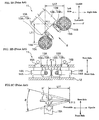
- FIG. 3 schematically shows the motors, the worm wheels and the rods of the conventional actuator. Specifically, FIG.
- FIG. 3A is a is a drawing viewing from line D-D of FIG. 4, which schematically explains the motors, the worm wheels and the rod;
- FIG. 3B is a drawing viewing from line E-E of FIG. 3A, which explains the motors and the worm wheels;
- FIG. 3C is a drawing viewing from line C-C of FIG. 3A, which explains an adjust pan.
- the symbol “Pll” represents a fluctuation center of the mirror in the exterior rear view mirror having the conventional actuator.
- the symbol “H” is a mirror holder in the exterior rear view mirror having the conventional actuator.
- adjust pan means a distance from the fluctuation center to the position where the mirror is pushed or drawn for fluctuating the mirror. By decreasing the adjust pan, the actuation for fluctuating the mirror to a desired angle can be decreased.
- the first motor 3A and the second motor 3B are motors each having the same shape.
- the first motor 3A is placed at a rear side of the actuator housing 2.
- the second motor 3B is placed at a front side of the actuator housing 2.
- These motors 3A and 3B are placed so that they are overlapped with each other when the mirror surface is viewed from the vertical direction (i.e. perpendicular to the mirror surface).
- these motors 3A and 3B are arranged in the same state in the vertical direction of the mirror surface.
- the motors 13A and 13B in the conventional actuator shown in FIG. 2A and FIG. 2B are motors having the same shape.
- motors 13A and 13B are arranged so that they are aligned in the horizontal direction of the mirror surface. As shown in FIG. 2, in the actuator 1 according to this embodiment, only one motor is placed in the horizontal direction of the mirror M. This makes it possible to miniaturize the actuator in the horizontal direction.
- the actuator 1 In comparison with the conventional actuator 11, the actuator 1 has a large thickness in the front and rear direction. However, since there is a relatively large space in the front and rear direction of the mirror housing MH (see FIG.1), and since it is difficult to effectively use such a space, for example placement of any other parts, enlargement in the front and rear spaces does not have any adverse influence upon an exterior rear view mirror OM (see FIG. 1).
- an adjust pan of the actuator 1 according to a preferred embodiment of the present invention in the vertical direction is LI
- an adjust pan of the conventional actuator 11 in the vertical direction is L11
- the first motor 3A and the second motor 3B are perfectly overlapped with each other when the mirror surface is viewed from the vertical direction, and the fluctuation center P1 of the actuator 1 is positioned at these motors when the mirror surface is viewed from the vertical direction.
- the first motor 13A and the second motor 13B are arranged in the side way direction, when the mirror surface is viewed from the vertical direction, and the fluctuation center P 11 of the actuator 11 is positioned between the first motor 13A and the second motor 13B.
- the relation of the adjust pans are: L1>L11; and L2>L12. Consequently, as shown in FIG. 2C and FIG. 3C, when the mirror M (and the mirror holder H) is fluctuated to a desired angle G, the amount of the movement of the rod in the actuator 1 is smaller than that of the actuator 11. Specifically, the amounts of driving the motors in the actuator in the actuator 1 may be decreased, making it possible to realize much more economic, and rapid angle adjustment.
- the actuator 1 according to the present invention may be made up of the same motors as those of the conventional actuator 11. Consequently, the actuator 1 can be miniaturized without miniaturizing the motors. Accordingly, various problems associated with miniaturization of the motors (including investment in plant and equipment, and production cost) can be avoided.
- the actuator 1 according to the present invention can be produced in the same modules as those of the conventional actuator 11. For this reason, the actuator 1 can be miniaturized without miniaturizing the module of the worm gear. Accordingly, various problems associated with miniaturization of the moduble of the worm gear (including investment in plant and equipment, production cost, decrease in the formation precision, and quality control of operation) can be avoided. These descriptions are not intended to the miniaturization of the motors and the miniaturization of the module.
- the actuator when two motors, which has hitherto been arranged so as to aligned in the sideway direction, are placed so that they are overlapped with each other when the mirror surface is viewed from the vertical direction, i.e., when the motors are arranged in the direction perpendicular to the mirror surface, the actuator whose dimension in a direction parallel to the mirror surface has been miniaturized can be obtained.
- the first cylindrical portion is placed at a front side, and the gear portion is engaged with the worm of the first motor. Then, the first worm wheel is fitted so as to project from the second cylindrical portion where the rod resides at a rear portion.
- the second cylindrical portion is placed at a front side, and the gear portion is engaged with the worm of the second motor.
- the second worm wheel is fitted so as to project from the first cylindrical portion where the rod resides at a rear portion Specifically, two worm wheels each having the same shape are ready, and they are used in such a manner that they are placed in the reversed state with each other. This makes it possible to commonly use the parts of the first worm wheel and the second worm wheel.
- the actuator in which the direction parallel to the mirror surface can be miniaturized is provided. Also, spaces, which can be effectively used, can be provided within the mirror housing.
- the miniaturization which can be attained by the conventional parts such as motors and worm wheels, avoids the need for investment in plant and equipment due to alternation of design. Of course, when the parts such as the motors and the worm wheels are miniaturized, much more miniaturization can be attained. Also, according to the preferred embodiments of present invention, the actuation required for fluctuation of the mirror to a desired angle can be decreased.
- the mirror M and the mirror holder MH may be unified type.
- the shapes of the mirror housing MH and the frame SB are not restricted to those depicted on the figure. How to fit the actuator 1 to the mirror housing MH may also be changed.
- the embodiment where the first motor 3A and the second motor 3B are perfectly overlapped with each other when the mirror surface is viewed from the vertical direction has been described, they may be placed so that they are partially overlapped, or the shapes of these motors may be different from each other.
Landscapes
- Engineering & Computer Science (AREA)
- Multimedia (AREA)
- Mechanical Engineering (AREA)
- Rear-View Mirror Devices That Are Mounted On The Exterior Of The Vehicle (AREA)
- Connection Of Motors, Electrical Generators, Mechanical Devices, And The Like (AREA)
Abstract
An actuator 1 for an exterior rear view mirror possesses a first motor 3A, a
first worm wheel 4A, and a first rod 5A as the first angle-adjusting mechanism. It
also possesses and a second motor 3B, a second worm wheel 4B, and a second rod
5B as the second angle-adjusting mechanism. The first motor 3A and the second
motor 3B have the same shape. The first motor 3A is accommodated within an
actuator housing 2 at a front side. The second motor 3B is accommodated within an
actuator housing 2 at a rear side. These motors 3A and 3B are placed so that they are
overlapped with each other when viewed in a direction perpendicular to the mirror
surface.
Description
The present invention relates to an actuator for a vehicle exterior rear view
mirror, which adjusts an angle of a mirror surface possessed by the exterior rear
view mirror. The application is based on Japanese Patent Application No. 2004-057180,
filed on March 2, 2004.
In order to adjust an angle of a vehicle exterior rear view mirror, an actuator
has been placed within a housing for an exterior rear view mirror (for example, see
Japanese Patent Laid-Open No. 2002-67795). FIG. 4 is an exploded perspective
view showing an actuator for an exterior rear view mirror disclosed in Japanese
Patent Laid-Open No. 2002-67795.
As shown in FIG. 4, an actuator 11 for an exterior rear view mirror
(hereinafter simply referred to as "actuator") has a motor 13A serving as a first angle
adjusting mechanism (for example, adjustment of an angle of the vertical direction),
a worm wheel 14A and a rod 15A provided within an actuator housing 12. The
actuator 11 also possesses, as a second angle adjusting mechanism (for example,
adjustment of an angle of the horizontal direction), a motor 13B, a worm wheel 14B,
and a rod 15B.
The motor 13A (13B) is placed within the actuator housing 12, and power is
supplied from an external power source to the motor 13A (13B) to rotate a worm
13A2 (13B2). The worm wheel 14A (14B) possesses a gear portion 14A1 (14B1). The
gear portion 14A1 (13B2) is engaged with the worm 13A2 (13B2). The rod 15A
(15B) is fitted to the worm wheel 14A (14B) in the state where it is not rotated, and
is screwed to a female screw formed on an inner wall of a cylindrical portion 12A
(12B) of the actuator housing 12.
When the motor 13A (13B) is driven, the worm 13A2 (13B2) is rotated. The
rotation of the worm 13A2 (13B2) allows the rod 15A (15B) for moving in the front
or rear direction, to thereby fluctuate the mirror.
Accompanying the exterior rear view mirror which has multi- functions,
various parts and members are also accommodated within the mirror housing.
Accordingly, it has been desired that the actuator 11 is much more miniaturized.
Particularly, there is a demand that any other parts and members are accommodated
at vertical sides and horizontal sides of the actuator 11 (see FIG. 1), i.e., around
directions parallel to the mirror surface. However, since the motor 13A and the
motor 13B are placed on the same surface parallel to the mirror surface in the
conventional actuator 11, the miniaturization of the actuator 11 is strictly restricted.
An object of at least the preferred embodiments of the present invention is,
therefore, to provide an actuator for an exterior rear view mirror, which makes it
possible to miniaturize the extent of the actuator parallel to the mirror surface.
According to the present invention, there is provided an actuator for an
exterior rear view mirror accommodated within a mirror housing, comprising a first
motor for adjusting a first angle of the mirror and a second motor for adjusting a
second angle of the mirror: said first motor and said second motor being placed so as
to be at least partially overlapped with each other when the mirror surface is viewed
from the vertical direction.
The term "the adjustment of two angles of mirror", i.e., the first angle and the
second angle intended herein means the adjustment so that the mirror can be
fluctuated 360° around the fluctuation center of the mirror as the axis. The
combination of the adjustment of the first angle in the vertical direction with the
adjustment of the second angle in the horizontal direction or vice versa is proven to
be preferable.
In the actuator according to preferred embodiments of the present invention,
the actuator may further possess a first worm wheel and a second worm wheel each
comprising a gear portion, which can be engaged with the worm of the motor, a first
cylindrical portion having a first height provided on one side of said gear portion,
and a second cylindrical portion having a second height provided on another side of
said gear portion, wherein the gear portion of said gear portion of the first worm
wheel is engaged with the worm of the first motor, and the gear portion of said
second worm wheel is engaged with the worm of said second motor in the state that
said first gear wheel is reversed.
The term "first height" used herein means a height that the gear portion is
engaged with the worm of the first motor when the first cylindrical portion is at a
front side within the actuator housing. The term "second height" used herein means
a height that the gear portion is engaged with the worm of the second motor when
the second cylindrical portion is at a front side within the actuator housing
Preferred embodiments of the present invention will now be described by
way of example only and with reference to the accompanying drawings, in which:
In the following embodiments, an exterior rear view mirror at the right side
is exemplified. The expression relating to the directions, i.e., upside, downside, right
side, left side, front side, and rear side, is based on the use state of the exterior rear
view mirror. The same portions are assigned to the same numbers or symbols, and
repeated description will be omitted.
FIG. 1 is an exploded perspective view showing a main portion of the
exterior rear view mirror having the actuator for an exterior rear view mirror
according to an embodiment of the present invention, and FIG. 2 is a schematic view
showing the actuator for an exterior rear view mirror of FIG. 1.
As shown in FIG. 1, an exterior rear view mirror OM possesses a mirror
housing MH, a frame SB, an actuator 1 for an exterior rear view mirror (hereinafter
simply referred to as "actuator"), a mirror holder H, and a mirror M.
The mirror housing MH is supported by a stay (not shown), which is fixed
onto a side body of a vehicle, in a state of capable of being fluctuated. Since the
support construction of the mirror holder H by the actuator 1 is well known in the
art, the description of how to support the mirror holder H by the actuator 1 will be
omitted (As for the support construction of the mirror see for example, Japanese
Patent Laid-Open No. 2002-67795).
Subsequently, referring to FIG. 2, the arrangement of the motors and worm
wheels in the actuator 1 will now be described (also referring to FIG. 1, as occasion
may demand). FIG. 2A is a drawing viewing from line A-A of FIG. 1 which
explains the motors, the worm wheels and the rod of the actuator; FIG. 2B is a
drawing viewing from line B-B of FIG. 2A, which explains the motors and the
worm wheels; and FIG. 2C is a drawing viewing from line C-C of FIG. 2A, which
explains an adjust pan.
The actuator 1 possesses a first angle-adjusting mechanism and a second
angle-adjusting mechanism within the actuator housing 2. The first angle-adjusting
mechanism is a mechanism that fluctuates the holder H and the mirror M taking a
fluctuation center P1 as an axis whereby the angle of the mirror M in the vertical
direction is adjusted. The second angle-adjusting mechanism is a mechanism that
fluctuates the holder H and the mirror M taking a fluctuation center P1 as an axis
whereby the angle of the mirror M in the horizontal direction is adjusted.
The actuator 1 possesses a first motor 3A, a first worm wheel 4A, and a first
rod 5A as the first angle-adjusting mechanism.
As shown in FIG. 2A and FIG. 2B the first motor 3A possesses a body 3A1
of the motor, which is driven by supplying a power from an outer power source
thereto, and a worm 3A2, which is rotated by driving the body 3A1 of the motor. The
first motor 3A is accommodated within the actuator housing 2 in a state that the
direction of the axis line of the worm 3A2 is in the direction of 45° towards the
lower right side. The first motor 3A and a second motor 3B, which will be described
later on, are placed so that they are overlapped with each other when the mirror (see
FIG. 1) is viewed from the vertical side. In this embodiment, the first motor 3A is
placed at a rear side of the actuator housing 2, and the second motor 3B is placed at
a front side of the first motor 3A.
As shown in FIG. 2B, the first worm wheel 4A is a cylindrical member, and
possesses a gear portion 4A1, a first cylindrical portion 4A2 (long cylindrical
portion), and a second cylindrical portion 4A2 (short cylindrical portion). The first
worm wheel 4A is provided at an upper right portion of the worm 3A2 in the state
that the rotation axis thereof becomes the front and rear direction. The gear portion
4A1, is engaged with the worm 3A2, and is rotated by the rotation of the worm 3A2.
The first cylindrical portion 4A2 extends towards the rotation axis from the gear
portion 4A1 to the first worm wheel 4A. In this embodiment, the first cylindrical
portion 4A2 is at a front side. The first cylindrical portion 4A2 possesses such a
height that, in such a state as just mentioned, the gear portion 4A1 can be engaged
with the worm 3A2 (first height h1). The second cylindrical portion 4A3 extends
towards the direction reversed to that of the first cylindrical portion 4A2. In this
embodiment, the second cylindrical portion 4A3 is at a rear side. The second
cylindrical portion 4A3 possesses a second height h2 [see the third paragraph of
column (Second Angle-Regulating Mechanism)]. It is noted that here the first height
h1 is larger than the second height h2. The first worm wheel 4A is configured so that
the rods can be fitted to both the side of the first cylindrical portion 4A2 and the side
of the second cylindrical portion 4A3. In this embodiment, a first rod 5A is fitted to a
side of the second cylindrical portion 4A3.
As shown in FIG. 2B, the first rod 5A is fitted to a side of the second
cylindrical portion 4A3 of the first worm wheel 4A in the state that it cannot be
rotated relative to the first worm wheel 4A, and moves in the front direction or rear
direction according to the rotation of the first worm wheel 4A to adjust the first
angle of the mirror M (see FIG. 1) (in this embodiment, an angle in the vertical
direction). Such a fitting structure is well known in the art, and, for example, a
communicating piece provided on a circumferential surface of the first rod 5A is
communicated with a concave portion provided on an inner circumferential portion
of the first worm wheel, whereby the first rod 5A can be fitted in the state that it
cannot be rotated relative to the first worm wheel 4A. Also, the end of the first rod
5A may be screwed onto a male screw portion or a female screw portion standing on
an inside of the front surface of the mirror housing 2, so that the first rod 5A may
move in the front and rear direction according to the rotation of the first wheel worm
4. As shown in FIG. 2C, a pivot 5A1 provided on the end of the first rod 5A is
inserted into a concave portion HA provided on a front surface of the mirror holder
H. Such an insertion portion is set so as to be positioned at a lower side of the
horizontal direction of the fluctuation center P1. When the first rod 5A moves in the
rear direction, then the mirror M and the mirror holder H fluctuate so that they are
directed toward an upside. Conversely, when the first rod 5A moves in the front
direction, then the mirror M and the mirror holder H fluctuate so that they are
directed toward a downside.
The actuator 1 possesses a second motor 3B, a second worm wheel 4B, and a
second rod 5B as the second angle-adjusting mechanism.
As shown in FIG. 2A. the second motor 3B comprises a member having the
same shape as that of the first motor 3A, and possesses a body 3B1 of the motor,
which is driven by supplying a power from an outer power source thereto, and a
worm 3B2, which is rotated by driving the body 3B1 of the motor. The second motor
3A is accommodated within the actuator housing 2 in a state that the direction of the
axis line of the worm 3B2 is in the direction of 45° towards the lower right side.
As shown in FIG. 2B, the second worm wheel 4B is used by reversing a
worm wheel having the same shape as that of the first worm wheel 4A into the front
side and the rear side, and possesses a gear portion 4B1, a first cylindrical portion
4B2 (long cylindrical portion), and a second cylindrical portion 4B3 (short
cylindrical portion). The second worm wheel 4B is provided at a lower left portion
of the worm 3B2 in the state that the rotation axis thereof becomes the front and rear
direction. The gear portion 4B1, is engaged with the worm 3B2, and is rotated by the
rotation of the worm 3B2. The first cylindrical portion 4B2 extends towards the
rotation axis from the gear portion 4B1 to the second worm wheel 4B. In this
embodiment, the first cylindrical portion 4B2 is at a rear side. The first cylindrical
portion 4B2 possesses the first height hi. The second cylindrical portion 4B3 extends
towards the direction reversed to that of the first cylindrical portion 4B2. In this
embodiment, the second cylindrical portion 4B3 is at a front side. The second
cylindrical portion 4B3 possesses such a height that, in such a state, the gear portion
4B1 can be engaged with the worm 3B2 (second height h2).
As shown in FIG. 2B, the second rod 5B comprises a member having the
same shape as that of the first rod 5A, is fitted to a side of the second cylindrical
portion 4B3 of the second worm wheel 4B in the state that it cannot be rotated
relative to the second worm wheel 4B, and moves in the front direction or the rear
direction according to the rotation of the second worm wheel 4B to adjust the second
angle of the mirror M (see FIG. 1) (in this embodiment, an angle in the horizontal
direction). A pivot 5B1 provided on the end of the second rod 5B is inserted into a
concave portion (not shown) provided on a front surface of the mirror holder H.
Such an insertion portion is set so as to be positioned at a right side of the horizontal direction of the fluctuation center P1. When thesecond rod 5B moves in the rear
direction, then the mirror M (see FIG. 1) and the mirror holder H fluctuate so that
they are directed toward a left side. Conversely, when the second rod 5B moves in
the front direction, then the mirror M and the mirror holder H fluctuate so that they
are directed toward a right side.
Such an insertion portion is set so as to be positioned at a right side of the horizontal direction of the fluctuation center P1. When the
In this embodiment, the wheel having the same shape is used as the first
worm wheel 4A and the second worm wheel 4B. Specifically, the gear portion 4A1,
the first cylindrical portion 4A2 and the second cylindrical portion 4A3 of the first
worm wheel 4A have the same shapes as those of the gear portion 4B1, the first
cylindrical portion 4B2 and the second cylindrical portion 4B3 of the second worm
wheel 4B, respectively. The worm wheel, which has been reversed, is used to make
common use of a single component for the worm wheel 4A and 4B.
It is noted that, as shown in FIG. 2A, since the actuator 1 is formed into a
line symmetry taking the fluctuation axis line of the worm as the symmetric axis,
viewing the mirror M from the vertical side, when clockwise rotating 90° in FIG.
2A, the actuator is applicable to the exterior rear view mirror for a vehicle at a left
side.
The actuator of a preferred embodiment of the present invention will be
compared with the actuator of the prior art referring to FIG. 2 and FIG. 3. In this
comparison, it is assumed that all of the first motor 3A and the second motor 3B in a
preferred embodiment of the present invention, a first motor 13A and a second
motor 13B in the prior art have the same shape. Specifically, the worms 3A2, 3B2,
13A2, 13B2 in a preferred embodiment of the present invention and in the prior art
are made up of the same part and, in other words, the modules for the worm gear
(combination of the worm with the worm gear) are the same. FIG. 3 schematically
shows the motors, the worm wheels and the rods of the conventional actuator.
Specifically, FIG. 3A is a is a drawing viewing from line D-D of FIG. 4, which
schematically explains the motors, the worm wheels and the rod; FIG. 3B is a
drawing viewing from line E-E of FIG. 3A, which explains the motors and the worm
wheels; and FIG. 3C is a drawing viewing from line C-C of FIG. 3A, which explains
an adjust pan. In these figures, the symbol "Pll" represents a fluctuation center of the
mirror in the exterior rear view mirror having the conventional actuator. The
symbol "H" is a mirror holder in the exterior rear view mirror having the
conventional actuator.
The term "adjust pan" used herein means a distance from the fluctuation
center to the position where the mirror is pushed or drawn for fluctuating the mirror.
By decreasing the adjust pan, the actuation for fluctuating the mirror to a desired
angle can be decreased.
In the actuator according to a preferred embodiment of the present invention
shown in FIG. 2A and FIG. 2B, the first motor 3A and the second motor 3B are
motors each having the same shape. The first motor 3A is placed at a rear side of the
actuator housing 2. The second motor 3B is placed at a front side of the actuator
housing 2. These motors 3A and 3B are placed so that they are overlapped with each
other when the mirror surface is viewed from the vertical direction (i.e.
perpendicular to the mirror surface). Specifically, these motors 3A and 3B are
arranged in the same state in the vertical direction of the mirror surface. On the other
hand, the motors 13A and 13B in the conventional actuator shown in FIG. 2A and
FIG. 2B are motors having the same shape. These motors 13A and 13B are arranged
so that they are aligned in the horizontal direction of the mirror surface. As shown in
FIG. 2, in the actuator 1 according to this embodiment, only one motor is placed in
the horizontal direction of the mirror M. This makes it possible to miniaturize the
actuator in the horizontal direction.
In comparison with the conventional actuator 11, the actuator 1 has a large
thickness in the front and rear direction. However, since there is a relatively large
space in the front and rear direction of the mirror housing MH (see FIG.1), and since
it is difficult to effectively use such a space, for example placement of any other
parts, enlargement in the front and rear spaces does not have any adverse influence
upon an exterior rear view mirror OM (see FIG. 1).
As shown in FIG. 2A an adjust pan of the actuator 1 according to a preferred
embodiment of the present invention in the vertical direction is LI, and an adjust pan
in the horizontal direction is L2 (in this embodiment, L1=L2). On the other hand, as
shown in FIG. 3A, an adjust pan of the conventional actuator 11 in the vertical
direction is L11, and an adjust pan in the horizontal direction is L12 (in this
embodiment, L11=L12). In the actuator 1 according to the present invention, the
first motor 3A and the second motor 3B are perfectly overlapped with each other
when the mirror surface is viewed from the vertical direction, and the fluctuation
center P1 of the actuator 1 is positioned at these motors when the mirror surface is
viewed from the vertical direction. On the other hand, in the conventional actuator
11, the first motor 13A and the second motor 13B are arranged in the side way
direction, when the mirror surface is viewed from the vertical direction, and the
fluctuation center P 11 of the actuator 11 is positioned between the first motor 13A
and the second motor 13B. For this reason, the relation of the adjust pans are:
L1>L11; and L2>L12. Consequently, as shown in FIG. 2C and FIG. 3C, when the
mirror M (and the mirror holder H) is fluctuated to a desired angle G, the amount of
the movement of the rod in the actuator 1 is smaller than that of the actuator 11.
Specifically, the amounts of driving the motors in the actuator in the actuator 1 may
be decreased, making it possible to realize much more economic, and rapid angle
adjustment.
The actuator 1 according to the present invention may be made up of the
same motors as those of the conventional actuator 11. Consequently, the actuator 1
can be miniaturized without miniaturizing the motors. Accordingly, various
problems associated with miniaturization of the motors (including investment in
plant and equipment, and production cost) can be avoided. The actuator 1 according
to the present invention can be produced in the same modules as those of the
conventional actuator 11. For this reason, the actuator 1 can be miniaturized without
miniaturizing the module of the worm gear. Accordingly, various problems
associated with miniaturization of the moduble of the worm gear (including
investment in plant and equipment, production cost, decrease in the formation
precision, and quality control of operation) can be avoided. These descriptions are
not intended to the miniaturization of the motors and the miniaturization of the
module.
According to the present invention, when two motors, which has hitherto
been arranged so as to aligned in the sideway direction, are placed so that they are
overlapped with each other when the mirror surface is viewed from the vertical
direction, i.e., when the motors are arranged in the direction perpendicular to the
mirror surface, the actuator whose dimension in a direction parallel to the mirror
surface has been miniaturized can be obtained.
The arrangement of two motors so that they are overlapped with each other
when the mirror surface is viewed from the vertical direction makes an adjust pan
small.
In the worm wheel (first worm wheel) at the side of the first motor, the first
cylindrical portion is placed at a front side, and the gear portion is engaged with the
worm of the first motor. Then, the first worm wheel is fitted so as to project from the
second cylindrical portion where the rod resides at a rear portion. On the other hand,
in the worm wheel (second worm wheel) at the side of the second motor, the second
cylindrical portion is placed at a front side, and the gear portion is engaged with the
worm of the second motor. Then, the second worm wheel is fitted so as to project
from the first cylindrical portion where the rod resides at a rear portion Specifically,
two worm wheels each having the same shape are ready, and they are used in such a
manner that they are placed in the reversed state with each other. This makes it
possible to commonly use the parts of the first worm wheel and the second worm
wheel.
According to the present invention, the actuator in which the direction
parallel to the mirror surface can be miniaturized is provided. Also, spaces, which
can be effectively used, can be provided within the mirror housing. The
miniaturization, which can be attained by the conventional parts such as motors and
worm wheels, avoids the need for investment in plant and equipment due to
alternation of design. Of course, when the parts such as the motors and the worm
wheels are miniaturized, much more miniaturization can be attained. Also,
according to the preferred embodiments of present invention, the actuation required
for fluctuation of the mirror to a desired angle can be decreased.
While the embodiments of the present invention have been described, it
should be understood that the present invention is not restricted thereto, and various
modifications and alternations of design can be made without departing from the
scope of the present invention. For example, the mirror M and the mirror holder MH
may be unified type. Also, the shapes of the mirror housing MH and the frame SB
are not restricted to those depicted on the figure. How to fit the actuator 1 to the
mirror housing MH may also be changed. Furthermore, while the embodiment
where the first motor 3A and the second motor 3B are perfectly overlapped with
each other when the mirror surface is viewed from the vertical direction has been
described, they may be placed so that they are partially overlapped, or the shapes of
these motors may be different from each other.
Claims (8)
- An actuator for an exterior rear view mirror accommodated within a mirror housing, the actuator comprising a first motor for adjusting a first angle of the mirror and a second motor for adjusting a second angle of the mirror, said first motor and said second motor being placed so as to be at least partially overlapped with each other when viewed in a direction perpendicular to the mirror surface.
- An actuator as claimed in claim 1, which further comprises a first worm wheel and a second worm wheel each comprising a gear portion, which is engaged with a worm of a respective motor, a first cylindrical portion having a first height provided on one side of said gear portion, and a second cylindrical portion having a second height provided on another side of said gear portion, wherein the first worm wheel is inverted relative to the second worm wheel.
- An actuator as claimed in claim 2, wherein the first worm wheel and the second worm wheel have the same shape.
- An actuator as claimed in claim 2 or 3, wherein all of the worms and all of the gear portions comprise the same parts.
- An actuator as claimed in claim 2, 3 or 4, wherein a communicating piece provided on a circumferential surface of a first rod is communicated with a concave portion provided on an inner circumferential portion of the first worm wheel, whereby the first rod is fitted in a state such that it cannot be rotated relative to the first worm wheel.
- An actuator as claimed in any preceding claim, wherein the first motor adjusts the angle of the mirror in the vertical direction, and the second motor adjusts the angle of the mirror in the horizontal direction.
- The actuator as claimed in any preceding claim, wherein the first motor and said second motor are placed so as to be substantially overlapped with each other when viewed in a direction perpendicular to the mirror surface.
- A vehicle exterior rear view mirror, having the actuator as claimed in any one of claims 1 to 7 provided within the mirror housing thereof.
Applications Claiming Priority (2)
| Application Number | Priority Date | Filing Date | Title |
|---|---|---|---|
| JP2004057180A JP2005247032A (en) | 2004-03-02 | 2004-03-02 | Actuator for outer mirror |
| JP2004057180 | 2004-03-02 |
Publications (1)
| Publication Number | Publication Date |
|---|---|
| EP1571041A1 true EP1571041A1 (en) | 2005-09-07 |
Family
ID=34747617
Family Applications (1)
| Application Number | Title | Priority Date | Filing Date |
|---|---|---|---|
| EP05250503A Withdrawn EP1571041A1 (en) | 2004-03-02 | 2005-01-31 | Actuator for exterior rear view mirror |
Country Status (3)
| Country | Link |
|---|---|
| US (1) | US7237918B2 (en) |
| EP (1) | EP1571041A1 (en) |
| JP (1) | JP2005247032A (en) |
Cited By (1)
| Publication number | Priority date | Publication date | Assignee | Title |
|---|---|---|---|---|
| CN101524982B (en) * | 2008-03-04 | 2012-02-15 | 市光工业株式会社 | Side rearview mirror for vehicle |
Families Citing this family (1)
| Publication number | Priority date | Publication date | Assignee | Title |
|---|---|---|---|---|
| JP2019073194A (en) * | 2017-10-17 | 2019-05-16 | 株式会社デンソー | Vehicle wiper device |
Citations (4)
| Publication number | Priority date | Publication date | Assignee | Title |
|---|---|---|---|---|
| JPS56108329A (en) * | 1980-02-01 | 1981-08-27 | Koito Mfg Co Ltd | Mirror operation device |
| US4598605A (en) * | 1982-05-13 | 1986-07-08 | Manzoni Bouchot | Mechanism with torque-limiting device for controlling a rearview-mirror |
| EP1020328A2 (en) * | 1999-01-11 | 2000-07-19 | Donnelly Corporation | Vehicular mirror actuator |
| JP2002067795A (en) * | 2000-08-31 | 2002-03-08 | Ichikoh Ind Ltd | Holder base structure of vehicle mirror drive |
Family Cites Families (2)
| Publication number | Priority date | Publication date | Assignee | Title |
|---|---|---|---|---|
| SE7610437L (en) * | 1975-09-30 | 1977-03-31 | Wunsch Erich | ADJUSTMENT OR ADJUSTMENT DEVICE ON MOTOR VEHICLE MIRRORS |
| US4971430A (en) * | 1989-07-19 | 1990-11-20 | Lynas Robert M | Rearview mirror targeting and repositioning system |
-
2004
- 2004-03-02 JP JP2004057180A patent/JP2005247032A/en active Pending
-
2005
- 2005-01-31 EP EP05250503A patent/EP1571041A1/en not_active Withdrawn
- 2005-03-02 US US11/069,549 patent/US7237918B2/en not_active Expired - Fee Related
Patent Citations (4)
| Publication number | Priority date | Publication date | Assignee | Title |
|---|---|---|---|---|
| JPS56108329A (en) * | 1980-02-01 | 1981-08-27 | Koito Mfg Co Ltd | Mirror operation device |
| US4598605A (en) * | 1982-05-13 | 1986-07-08 | Manzoni Bouchot | Mechanism with torque-limiting device for controlling a rearview-mirror |
| EP1020328A2 (en) * | 1999-01-11 | 2000-07-19 | Donnelly Corporation | Vehicular mirror actuator |
| JP2002067795A (en) * | 2000-08-31 | 2002-03-08 | Ichikoh Ind Ltd | Holder base structure of vehicle mirror drive |
Non-Patent Citations (2)
| Title |
|---|
| PATENT ABSTRACTS OF JAPAN vol. 005, no. 189 (M - 099) 28 November 1981 (1981-11-28) * |
| PATENT ABSTRACTS OF JAPAN vol. 2002, no. 07 3 July 2002 (2002-07-03) * |
Cited By (1)
| Publication number | Priority date | Publication date | Assignee | Title |
|---|---|---|---|---|
| CN101524982B (en) * | 2008-03-04 | 2012-02-15 | 市光工业株式会社 | Side rearview mirror for vehicle |
Also Published As
| Publication number | Publication date |
|---|---|
| US20050231837A1 (en) | 2005-10-20 |
| JP2005247032A (en) | 2005-09-15 |
| US7237918B2 (en) | 2007-07-03 |
Similar Documents
| Publication | Publication Date | Title |
|---|---|---|
| JP2001341577A (en) | Vehicle headlight system and irradiation axis adjustment device for vehicle headlight | |
| JP2005070505A (en) | Camera device | |
| CN1872588B (en) | Exterior rear mirror with reversible housing | |
| EP1571041A1 (en) | Actuator for exterior rear view mirror | |
| JP2019143641A (en) | Linear-moving expansion mechanism | |
| CN101419328B (en) | Lens module, camera module and portable electronic products | |
| JPS6220742A (en) | Head lamp for automobile | |
| CN101657324B (en) | Press machine | |
| CN102092346A (en) | Manually retractable vehicle door mirror | |
| US20140098437A1 (en) | Assembly for adjusting the outside mirror | |
| CN110095924A (en) | Lens displacement self-reacting device and projection arrangement | |
| CN216354697U (en) | Coupling adjusting device and filter | |
| CN112517933A (en) | Main shaft structure and machine tool with same | |
| CN116946018A (en) | Exterior rearview mirrors and rearview mirror sets for vehicles | |
| CN109803853A (en) | For the transmission device of spindle driver, spindle driver and vehicle seat | |
| JP3800864B2 (en) | Electric tilt steering device | |
| JP2004053854A (en) | Lens driving device | |
| EP1279987B1 (en) | Binoculars | |
| US20090193608A1 (en) | Drive mechanism especially for a window wiping device with an elliptical wiping motion | |
| JP5334537B2 (en) | Vehicle door mirror | |
| US20080068734A1 (en) | Mirror Surface Control Actuator and Process for Manufacturing Same | |
| CN114069176B (en) | Coupling adjusting device and filter | |
| JP2005172951A (en) | Lens driving device | |
| JPH0743583A (en) | Lens drive | |
| EP1013502B1 (en) | An external rear-view mirror of a vehicle, in particular an industrial vehicle |
Legal Events
| Date | Code | Title | Description |
|---|---|---|---|
| PUAI | Public reference made under article 153(3) epc to a published international application that has entered the european phase |
Free format text: ORIGINAL CODE: 0009012 |
|
| AK | Designated contracting states |
Kind code of ref document: A1 Designated state(s): AT BE BG CH CY CZ DE DK EE ES FI FR GB GR HU IE IS IT LI LT LU MC NL PL PT RO SE SI SK TR |
|
| AX | Request for extension of the european patent |
Extension state: AL BA HR LV MK YU |
|
| AKX | Designation fees paid | ||
| REG | Reference to a national code |
Ref country code: DE Ref legal event code: 8566 |
|
| STAA | Information on the status of an ep patent application or granted ep patent |
Free format text: STATUS: THE APPLICATION IS DEEMED TO BE WITHDRAWN |
|
| 18D | Application deemed to be withdrawn |
Effective date: 20060308 |