EP1570622B1 - Procede permettant d'eviter la compression de donnees utiles chiffrees - Google Patents
Procede permettant d'eviter la compression de donnees utiles chiffrees Download PDFInfo
- Publication number
- EP1570622B1 EP1570622B1 EP03777056A EP03777056A EP1570622B1 EP 1570622 B1 EP1570622 B1 EP 1570622B1 EP 03777056 A EP03777056 A EP 03777056A EP 03777056 A EP03777056 A EP 03777056A EP 1570622 B1 EP1570622 B1 EP 1570622B1
- Authority
- EP
- European Patent Office
- Prior art keywords
- data packet
- network element
- encrypted
- compression
- case
- Prior art date
- Legal status (The legal status is an assumption and is not a legal conclusion. Google has not performed a legal analysis and makes no representation as to the accuracy of the status listed.)
- Expired - Lifetime
Links
- 238000007906 compression Methods 0.000 title claims description 76
- 230000006835 compression Effects 0.000 title claims description 75
- 238000000034 method Methods 0.000 claims abstract description 64
- 238000013467 fragmentation Methods 0.000 description 7
- 238000006062 fragmentation reaction Methods 0.000 description 7
- 230000004044 response Effects 0.000 description 7
- 239000012634 fragment Substances 0.000 description 6
- 230000006870 function Effects 0.000 description 3
- 230000007246 mechanism Effects 0.000 description 3
- 238000012545 processing Methods 0.000 description 3
- 238000012546 transfer Methods 0.000 description 3
- 101150030531 POP3 gene Proteins 0.000 description 2
- 238000013459 approach Methods 0.000 description 2
- 230000015556 catabolic process Effects 0.000 description 2
- 238000006731 degradation reaction Methods 0.000 description 2
- 230000008569 process Effects 0.000 description 2
- 101100042793 Gallus gallus SMC2 gene Proteins 0.000 description 1
- 230000002159 abnormal effect Effects 0.000 description 1
- 230000008901 benefit Effects 0.000 description 1
- 230000005540 biological transmission Effects 0.000 description 1
- 230000008859 change Effects 0.000 description 1
- 230000006837 decompression Effects 0.000 description 1
- 239000003550 marker Substances 0.000 description 1
- 238000005259 measurement Methods 0.000 description 1
- 230000009467 reduction Effects 0.000 description 1
- 238000010561 standard procedure Methods 0.000 description 1
- 239000002699 waste material Substances 0.000 description 1
Images


Classifications
-
- H—ELECTRICITY
- H04—ELECTRIC COMMUNICATION TECHNIQUE
- H04L—TRANSMISSION OF DIGITAL INFORMATION, e.g. TELEGRAPHIC COMMUNICATION
- H04L63/00—Network architectures or network communication protocols for network security
- H04L63/04—Network architectures or network communication protocols for network security for providing a confidential data exchange among entities communicating through data packet networks
- H04L63/0428—Network architectures or network communication protocols for network security for providing a confidential data exchange among entities communicating through data packet networks wherein the data content is protected, e.g. by encrypting or encapsulating the payload
- H04L63/045—Network architectures or network communication protocols for network security for providing a confidential data exchange among entities communicating through data packet networks wherein the data content is protected, e.g. by encrypting or encapsulating the payload wherein the sending and receiving network entities apply hybrid encryption, i.e. combination of symmetric and asymmetric encryption
-
- H—ELECTRICITY
- H04—ELECTRIC COMMUNICATION TECHNIQUE
- H04L—TRANSMISSION OF DIGITAL INFORMATION, e.g. TELEGRAPHIC COMMUNICATION
- H04L69/00—Network arrangements, protocols or services independent of the application payload and not provided for in the other groups of this subclass
- H04L69/04—Protocols for data compression, e.g. ROHC
-
- H—ELECTRICITY
- H04—ELECTRIC COMMUNICATION TECHNIQUE
- H04L—TRANSMISSION OF DIGITAL INFORMATION, e.g. TELEGRAPHIC COMMUNICATION
- H04L63/00—Network architectures or network communication protocols for network security
- H04L63/16—Implementing security features at a particular protocol layer
- H04L63/164—Implementing security features at a particular protocol layer at the network layer
-
- H—ELECTRICITY
- H04—ELECTRIC COMMUNICATION TECHNIQUE
- H04L—TRANSMISSION OF DIGITAL INFORMATION, e.g. TELEGRAPHIC COMMUNICATION
- H04L63/00—Network architectures or network communication protocols for network security
- H04L63/16—Implementing security features at a particular protocol layer
- H04L63/166—Implementing security features at a particular protocol layer at the transport layer
-
- H—ELECTRICITY
- H04—ELECTRIC COMMUNICATION TECHNIQUE
- H04L—TRANSMISSION OF DIGITAL INFORMATION, e.g. TELEGRAPHIC COMMUNICATION
- H04L69/00—Network arrangements, protocols or services independent of the application payload and not provided for in the other groups of this subclass
- H04L69/22—Parsing or analysis of headers
Definitions
- the present invention relates to a method and a network element for conveying data packets in a network.
- the present invention relates to compression of payload carried in data packets, e.g., IP (Internet Protocol) packets and/or UDP and TCP packets.
- IP Internet Protocol
- UDP User Datagram Protocol
- TCP Transmission Control Protocol
- the purpose of such compression is to reduce IP traffic throughput, especially over bandwidth limited links (e.g. air interface, radio links).
- the compression/decompression can be performed either a) end-to-end, or b) only on a segment of the packet traversal path that has limited bandwidth.
- the compression is not performed end-to-end. Instead, it is applied in an intermediate node on the traversal path of IP packets. If the source or another node before the compressor already applied encryption, compression will not reduce the packet size due to the nature of encryption. Therefore, the Central Processing Unit CPU resource is simply wasted.
- ESP Encapsulating Security Payload
- Document US 2002/0078242 A1 discloses a method of selectively compressing data packets.
- a compression process of data packets is bypassed when it is detected that these specific data packets are already compressed.
- a compressed data packet as such is detected by a first marker which is present in the header of the data packet. That is, document D1 discloses to avoid a new compression of already compressed data packets.
- the object underlying the present invention resides in further improving the performance of the compression function when handling data packets that have already been encrypted before the compressor.
- the examining step may be performed by detecting whether the use of a particular encryption algorithm is indicated in the header of the data packet.
- a decision whether a data packet is encrypted can simply be performed by checking the header of the data packet, which needs to be read anyway by, for example, a router which forwards the data packet.
- the particular encryption algorithm may be Encapsulating Security Payload (ESP).
- ESP Encapsulating Security Payload
- the encryption can be indicated in the header of the data packet, for example, such that this would lead to the impression that the data packet is encrypted, even if the encryption algorithm used is the NULL algorithm.
- the NULL encryption does nothing with the data packet, so that a compression thereof would be effective.
- the data packet encrypted with the NULL encryption algorithm is compressed although it is encrypted.
- Information regarding the group of data packets may be listed in a lookup table, wherein the information may comprise at least a destination address of the data packet and the compression indication.
- the corresponding data packets encrypted with the NULL algorithm can easily be identified by the destination address, and from the compression indication it can easily be derived whether the particular data packet is to be compressed or not.
- the compression indication may be a flag.
- the data packets may be identified by the above destination address and a Security Parameters Index (SPI) which is also to be stored in the lookup table. That is, the group of data packets may be identified by using the concept of Security Association (SA).
- SA Security Association
- a new entry in the lookup table may be created, wherein the group of data packets may be identified by a destination address of the packet, and wherein a compression may be performed, and the result of compression may be evaluated, wherein the compression indication may be set according to the result of the compression.
- the result of compression is evaluated by checking a percentage of compression. Namely, a certain threshold X% ⁇ 100% can be set, and wherein in case the percentage of compression is smaller than X, it can be decided that the compression was successful and that the other data packets belonging to that particular group identified by the destination address should also be compressed.
- a table for fragmented data packets may be provided, a data packet being identified therein by at least a source address, a destination address and a compression indication indicating whether this data packet should be compressed or not, wherein in the examining step, the following steps may be carried out:
- the problem of fragmented data packets can be handled, the headers of which do not indicate whether they are encrypted or not.
- the fragmented data packets can be identified and it can be decided from the table (i.e., the compression indication, which may be a flag) whether the data packet should be compressed or not.
- a new entry in the table for fragmented data packets may be created, wherein the compression indication is set depending on whether the encrypted data packet should be compressed or not.
- the table for fragmented data packets can reliably be updated.
- the examining step it may be checked whether the data packet belongs to a group of encrypted data packets, and when the data packet belongs to a group of encrypted data packets, the data packet is not compressed.
- groups of data packets may be formed, for which it is clear that compression is to be performed or not to be performed. Hence, it is not necessary to carry out further examination whether this particular data packet is encrypted or not.
- a table may provided in which connections in a network using encryption are stored, wherein for each entry a source address, a destination address and a destination connection type indication is stored.
- connection types may be identified which convey only encrypted data packet.
- a connection may be TLS/SSL (Transport Layer Security/Security Sockets Layer).
- the data packet is searched for an indication of a specific encryption procedure, and in case the indication is found, a new entry is created in the table with the source address, destination address and connection type of the data packet.
- connection type may be defined by a port number.
- port number For example, in IP, the "normal" port number for the HTTP (Hypertext Transfer Layer) protocol is 80, whereas HTTP protocol over TLS uses port number 443.
- the specific encryption procedure may be a Transport Layer Security (TLS) protocol.
- TLS Transport Layer Security
- the indication for this may be a specific message included in a data packet, e.g., a so-called 101 response.
- Compression of payload in data packets is an effective approach to reduce IP traffic throughput, especially over the air interface where bandwidth is limited.
- the compression is not performed end-to-end. Instead, it is applied in an intermediate node on the traversal path of IP packets.
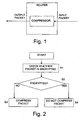
- An example is shown in Fig. 1 , where a compressor is located in a router.
- a procedure is employed by which compression of IP packets that have already been compressed is avoided.
- ESP Encapsulating Security Payload
- IETF Internet Task Engineering Force
- the compressor incorporated in the router as shown in Fig. 1 is used. Nevertheless, the compressor can be located in any other network element forwarding data packets.
- the procedure according to the first embodiment works perfectly in case the encryption can be reliably recognized by checking the header.
- the so-called NULL encryption algorithm is used for an ESP packet.
- the NULL encryption algorithm is described in Glenn, R., and S. Kent, "The NULL Encryption Algorithm and Its Use With Ipsec", RFC 2410, November 1998 .
- SA Security Association
- An SA is uniquely identified by a triple ⁇ Security Parameters Index (SPI), destination IP address, security protocol identifier>.
- the security protocol may be ESP (Encapsulating Security Payload) as described above, for example.
- the encryption algorithm (among many other security parameters) does not change for packets that have the same SA. Therefore, if the compressor can detect or guess if NULL encryption is used for the first ESP packet associated with a particular SA, it then knows whether it should compress the subsequent packets for that SA.
- Step B5 will lead a compressor to believe incorrectly that the SA uses non-NULL encryption algorithm.
- the result would be that the compressor does not compress the subsequent packets for that SA although they may be compressible.
- such possibility is too small to have any significant impact over the overall compression ratio.
- scheme B according to the second embodiment requires additional memory than Scheme A according to the first embodiment, since the SA lookup table has to be stored.
- the lookup table only needs about 9 bytes per entry for IPv4 (Internet Protocol version 4) and 21 bytes for IPv6 (Internet Protocol version 6), for example.
- the reward is the savings of CPU consumption that would be wasted otherwise to compress all packets belonging to that SA. This benefit outweighs the cost.
- scheme A it may be desirable to use scheme A according to the first embodiment instead of scheme B according to the second embodiment for its simplicity.
- SA Security Association
- a procedure is presented to solve the problem regarding the handling of fragmented ESP packets. This solution is presented in the following by referring to a flowchart in Fig. 4 .
- the procedure according to the first or the second embodiment can be extended with a fragmentation lookup table (similar to the SA lookup table).
- Each entry of the table consists of tuple ⁇ source IP address, destination IP address, IP Identification, protocol, C-flag> in case of Ipv4, or ⁇ source IP address, destination IP address and IP Identification, C-flag> in case of Ipv6. Note that the tuple uniquely identifies all fragments belonging to one original IP packet.
- the compressor Upon receiving an ESP packet, the compressor creates an entry in the table corresponding to the packet. When receiving a non-ESP packet, the compressor searches the table for a match. If a match is found, that means the received packet is a fragment of an original ESP packet even though itself does not carry an ESP header. Then the compressor can decide whether to compress it according to the C-flag.
- the compressor checks in step S21 whether an ESP packet or a non-ESP packet has been received.
- the new entry in the fragmentation lookup table fragmentation LUT
- the compression of the packet is carried out in step S26 as described in the first or second embodiment. In case the first embodiment is applied, this means that the packet is simply compressed, since it is already determined that this packet is encrypted (due to the ESP header found).
- steps S5 and subsequent may follow.
- the C-Flag is set in step S27. That is, in case the packet was compressed in step S26, the C-flag is set true, otherwise the C-flag is set false.
- step S21 If a non-ESP packet is received (no in step S21), it is possible that this packet is a fragmented packet. Hence, the fragmentation lookup table is searched for the same source IP address, the same destination IP address, the same IP identification and the same protocol in step S23. If a match is found in step S24, then the compression is carried out according to the C-flag (S25) which is part of the found entry (part of the above-described tuple). On the other hand, if no match is found, the compression is carried out as described above in the first or second embodiment.
- the a fragmented data packet is identified by the tuple ⁇ source IP address, destination IP address, IP Identification, protocol, C-flag> in case of Ipv4, or ⁇ source IP address, destination IP address and IP Identification, C-flag> in case of Ipv6.
- the fourth and fifth embodiments are related to compression of payload carried in UDP (User Datagram Protocol) and TCP (Transmission Control Protocol) packets.
- UDP User Datagram Protocol
- TCP Transmission Control Protocol
- procedures are employed which detect and avoid compression of UDP/TCP payload that has been encrypted by TLS/SSL (Transport Layer Security/Secure Sockets Layer).
- the procedure according to the fourth embodiment filters TLS packets based on port numbers.
- a port is an endpoint to a logical connection.
- the port number identifies what type of port it is.
- the historical practice of deploying TLS/SSL is to assign parallel (with respect to "normal") secure port numbers for applications running over TLS/SSL. This allows an endpoint to easily disambiguate between packet flows over TLS/SSL and those that do not.
- the well-known "normal" port number for HTTP protocol is 80 while HTTP protocol over TLS uses port number 443.
- a compressor maintains a list of well-known or registered secure port numbers (see below about where to obtain them).
- the compressor detects the source and destination port number of the packet (step S31). Thereafter, the compressor searches the port number list for the same source and destination port number of the packet (step S32). That is, if either the source or the destination port number equals one of the special value, this is considered as a match. I.e., it is sufficient if only one of them matches. If a match is found (yes in step S33), the packet carries TLS/SSL encrypted data and should not be compressed (step S34). Otherwise (no in step S33), the compressor can compress the packet (S35). Preferably, however, the compressor can base its decision whether to compress the packet or not on other factors (e.g. current CPU load and/or acceptable processing delay).
- the procedure according to the fourth embodiment is not applicable since here the same port number is used for unsecured data (i.e., non-encrypted data packets) and for secured data (i.e., encrypted packets).
- a compressor can detect the upgrade event by scanning HTTP header fields and thus avoid compressing TLS data.
- the key is that before a TLS handshake starts, the HTTP server must send the intermediate "101 Switching Protocol” and must include an Upgrade response header containing "TLS/1.0" as the target protocol ("Upgrading to TLS Within HTTP/1.1", IETF RFC 2817, section 3.3):
- the compressor maintains a lookup table for HTTP connections over TLS.
- Each entry in the table will store a tuple ⁇ server IP address, client IP address, client port number>. Note that, since 80 is known as the port number at the HTTP server, it does not need to be included. Initially, the table is empty.
- the compressor For each received TCP packet, the compressor will take the following procedure:
- step S41 the source and destination port numbers are detected.
- step S42 it is checked whether the source port number is 80. If this is true, the source IP address, the destination IP address and the destination port number are extracted from the packet in step S43. Thereafter, the lookup table for HTTP connection over TLS (abbreviated as TLS-LUT in the figures) is searched for a match.
- TLS-LUT the lookup table for HTTP connection over TLS
- step S45 If a match is found (yes in step S45), the packet carries TLS encrypted data and is not compressed (step S46) and the routine ends. If no match is found, the packet is scanned for the 101 response in step S47. In case it is found (yes in step S48), a new entry is created in the above lookup-table in step S49. Otherwise, the routine ends.
- step S42 If in step S42 the source port number is not 80, the procedure advances to step S51 in Fig. 6B (indicated by the circled 1). In step S51 it is checked whether the destination port number is 80. If this is false, then the TCP packet does not carry HTTP data, i.e., is not encrypted via TLS. Hence, it can be compressed in step S56, or, similar to the procedure according to the fourth embodiment, the decision whether to compress or not can be based on other factors (e.g. current CPU load and/or acceptable processing delay).
- factors e.g. current CPU load and/or acceptable processing delay
- step S51 If, however, the destination port number is 80 (yes in step S51), the source IP address, the destination IP address and the source port number are extracted from the packet in step S52. Then, similar to step S44, the lookup table is searched for a match in step S53. If a match is found (yes in step S54), the packet carries TLS encrypted data and is not compressed (step S55). On the other hand, if no match is found, the packet does not carry TLS encrypted data. Hence, it can be compressed (step S56) or the decision whether to compress it or not can be based on other factors.
- the above scheme works for any port number (other than 80) that the compressor knows is carrying HTTP data.
- a client behind a firewall may be configured to use a different TCP port number X, instead of 80, to talk to a proxy server in order to access external web sites.
- the table lookup time can be reduced by techniques such as binary search and hashing. Creating multiple lookup tables as described above is already a good (divide-and-conquer) way of speed up the lookup procedure.
- An entry of the lookup table can be deleted based on timeout since last time of access, or by detecting close of the connection (e.g. sniffing FIN in TCP header).
- FIN is a control flag in TCP header which indicates that there is no more data from the TCP sender. It is used in the procedure to terminate a TCP connection.
- the port number is only an example for a connection type. That is, in other network types, the connection type may be indicated in an other way.
- the invention can be applied to the handling of IP packets encrypted by any encryption protocols at IP layer, including but not limited to ESP.
- the implementations of the first to third embodiments basically are related to encryption at IP layer (i.e., ESP).
- the fourth and fifth embodiments are related to encryption at TCP or UDP layer, which is above the IP layer.
- a compressor first checks whether a received packet is ESP. Only if not, it may further check if TLS is used. The other way round (i.e., checking if TLS is used and then checking whether an ESP packet is present) is not advantageous, since a packet encrypted by ESP at IP layer means that the TCP or UDP header is also encrypted.
- the invention can be implemented as an enhancement to any compressor. Note that it is strictly a local optimisation and does not require any standardization.
- the invention can be used in any network element (e.g. in GPRS (General Packet Radio Service) network elements like GGSN (Gateway GPRS Support Node) or SGSN (Serving GPRS Support Node) or router) that perform IP payload compression.
- GPRS General Packet Radio Service
- GGSN Gateway GPRS Support Node
- SGSN Serving GPRS Support Node
- router that perform IP payload compression.
Landscapes
- Engineering & Computer Science (AREA)
- Computer Security & Cryptography (AREA)
- Computer Networks & Wireless Communication (AREA)
- Signal Processing (AREA)
- Computer Hardware Design (AREA)
- Computing Systems (AREA)
- General Engineering & Computer Science (AREA)
- Data Exchanges In Wide-Area Networks (AREA)
- Vehicle Body Suspensions (AREA)
- Diaphragms For Electromechanical Transducers (AREA)
- Auxiliary Devices For And Details Of Packaging Control (AREA)
- Two-Way Televisions, Distribution Of Moving Picture Or The Like (AREA)
- Chair Legs, Seat Parts, And Backrests (AREA)
- Apparatus For Radiation Diagnosis (AREA)
Claims (31)
- Procédé pour transporter des paquets de données dans un réseau, comprenant les étapes consistant à :examiner (S1, S2) si un paquet de données reçu est crypté,compresser (S3) le paquet de données dans le cas où il est examiné que le paquet de données n'est pas crypté, etéviter de compresser (S4) dans le cas où il est examiné que le paquet de données est crypté,dans lequel, dans le cas où il est décidé que le paquet de données est crypté, avant l'étape de compression, les étapes suivantes sont effectuées :examiner (S5, S6) si le paquet de données appartient à un groupe de paquets de données qui sont cryptés avec un algorithme NULL,dans le cas où le paquet de données appartient au groupe, compresser (S7, S3, S4) le paquet selon une indication de compression associée au groupe.
- Procédé selon la revendication 1, dans lequel l'étape d'examen est effectuée en détectant si l'utilisation d'un algorithme de cryptage particulier est indiquée dans l'en-tête du paquet de données.
- Procédé selon la revendication 2, dans lequel l'algorithme de cryptage particulier est ESP (Encapsulating Security Payload - encapsulation de charge utile de sécurité).
- Procédé selon la revendication 1, dans lequel les informations concernant le groupe de paquets de données sont listées dans un tableau de consultation, dans lequel les informations comprennent au moins une adresse de destination du paquet de données et l'indication de compression.
- Procédé selon la revendication 4, dans lequel, dans le cas où le paquet de données n'appartient pas à un groupe de paquets de données cryptés avec l'algorithme de cryptage NULL, une nouvelle entrée dans le tableau de consultation est créée (S8), dans lequel le groupe de paquets de données est identifié par une adresse de destination du paquet, et dans lequel
une compression est effectuée (S9), et le résultat de la compression est évalué (S 10), dans lequel l'indication de compression est réglée en fonction du résultat de la compression (S11, S 12). - Procédé selon la revendication 5, dans lequel le résultat de la compression est évalué en contrôlant un pourcentage de compression.
- Procédé selon la revendication 1, dans lequel un tableau pour des paquets de données fragmentés est fourni, un paquet de données étant identifié dans celui-ci par au moins une adresse de source, une adresse de destination et une indication de comparaison indiquant si ce paquet de données doit être compressé ou pas, dans lequel à l'étape d'examen, les étapes suivantes sont effectuées :juger (S23, S24) si l'adresse de source et l'adresse de destination du paquet de données correspondent à une entrée du tableau pour des paquets de données fragmentés, etcompresser ou pas compresser (S25) le paquet de données correspondant à l'indication de compression.
- Procédé selon la revendication 7, dans lequel, dans le cas où il est examiné que le paquet de données est crypté (S21), une nouvelle entrée dans le tableau pour des paquets de données fragmentés est créée, dans lequel l'indication de compression est réglée selon que le paquet de données crypté doit être compressé ou pas (S27).
- Procédé selon la revendication 1, dans lequel à l'étape d'examen il est contrôlé si le paquet de données appartient à un groupe de paquets de données cryptés (S31 à S33), et lorsque le paquet de données appartient à un groupe de paquets de données cryptés, le paquet de données n'est pas compressé.
- Procédé selon la revendication 9, dans lequel il est contrôlé si le paquet de données appartient au groupe de paquets de données cryptés en contrôlant le type de connexion de source et/ou de destination du paquet de données (S31 à S33).
- Procédé selon la revendication 1, dans lequel un tableau est fourni
dans lequel des connexions dans un réseau utilisant un cryptage sont mémorisées, dans lequel pour chaque entrée une adresse de source, une adresse de destination et un type de connexion de destination sont mémorisés. - Procédé selon la revendication 11, dans lequel à l'étape d'examen, les étapes suivantes sont effectuées :décider si un paquet de données est reçu par l'intermédiaire d'un type de connexion de source spécifique (S41, S42) ou doit être envoyé par l'intermédiaire d'un type de connexion de destination spécifique (S51),dans le cas où le paquet de données est reçu par l'intermédiaire du type de connexion de source spécifique ou doit être envoyé au type de connexion de destination spécifique,extraire (S43, S52) l'adresse de source, l'adresse de destination et le type de connexion de destination du paquet de données, etrechercher (S44, S45, S53, S54) une correspondance avec le tableau,dans lequel, dans le cas où une correspondance est trouvée, le paquet de données n'est pas compressé (S46, S55).
- Procédé selon la revendication 12, dans lequel, dans le cas où le paquet de données est reçu par l'intermédiaire d'un type de connexion spécifique (S42) et aucune correspondance n'est trouvée (S45), le paquet de données est recherché pour une indication d'une procédure de cryptage spécifique (S47, S48), et dans le cas où l'indication est trouvée, une nouvelle entrée est créée dans le tableau avec l'adresse de source, l'adresse de destination et le type de connexion de destination du paquet de données (S49).
- Procédé selon la revendication 10 ou 11, dans lequel le type de connexion est défini par un numéro de port.
- Procédé selon la revendication 13, dans lequel la procédure de cryptage spécifique est un protocole TLS (Transport Layer Security - sécurité de couche de transport).
- Elément de réseau adapté pour transporter des paquets de données dans un réseau, dans lequel l'élément de réseau est apte à :examiner si un paquet de données reçu est crypté,compresser le paquet de données dans le cas où il est examiné que le paquet de données n'est pas crypté, etéviter de compresser dans le cas où il est examiné que le paquet de données est crypté,dans lequel l'élément de réseau est apte, dans le cas où il est décidé que le paquet de données est crypté, avant la compression des paquets de données :à examiner si le paquet de données appartient à un groupe de paquets de données qui sont cryptés avec un algorithme NULL, etdans le cas où le paquet de données appartient au groupe, à compresser le paquet selon une indication de compression associée au groupe.
- Elément de réseau selon la revendication 16, dans lequel l'examen est effectué en détectant si l'utilisation d'un algorithme de cryptage particulier est indiquée dans l'en-tête du paquet de données.
- Elément de réseau selon la revendication 17, dans lequel l'algorithme de cryptage particulier est ESP (Encapsulating Security Payload - encapsulation de charge utile de sécurité).
- Elément de réseau selon la revendication 16, dans lequel l'élément de réseau comprend un moyen de mémoire dans lequel un tableau comprenant des informations concernant le groupe de paquets de données est mémorisé,
dans lequel les informations comprennent au moins une adresse de destination du paquet de données et l'indication de compression. - Elément de réseau selon la revendication 19, dans lequel l'élément de réseau est apte, dans le cas où le paquet de données n'appartient pas à un groupe de paquets de données cryptés avec l'algorithme de cryptage NULL, à créer une nouvelle entrée dans le tableau de consultation, pour identifier le groupe de paquets de données par une adresse de destination du paquet,
dans lequel l'élément de réseau est en outre apte à effectuer une compression et à évaluer le résultat de la compression, et à régler l'indication de compression en fonction du résultat de la compression. - Elément de réseau selon la revendication 20, dans lequel l'élément de contrôle de réseau est apte à évaluer le résultat de la compression en contrôlant un pourcentage de compression.
- Elément de réseau selon la revendication 16, dans lequel l'élément de réseau comprend un moyen de mémoire dans lequel un tableau pour des paquets de données fragmentés est mémorisé, un paquet de données étant identifié dans celui-ci par au moins une adresse de source, une adresse de destination et une indication de comparaison indiquant si ce paquet de données doit être compressé ou pas, dans lequel à l'examen, l'élément de réseau est apte à :juger si l'adresse de source et l'adresse de destination du paquet de données correspondent à une entrée du tableau pour des paquets de données fragmentés, etcompresser ou ne pas compresser le paquet de données correspondant à l'indication de compression.
- Elément de réseau selon la revendication 22, dans lequel l'élément de réseau est apte, dans le cas où il est examiné que le paquet de données est crypté, à créer une nouvelle entrée dans le tableau pour des paquets de données fragmentés, dans lequel l'élément de réseau est apte à régler l'indication de compression selon que le paquet de données crypté doit être compressé ou pas.
- Elément de réseau selon la revendication 16, dans lequel l'élément de réseau est apte à contrôler pendant l'examen si le paquet de données appartient à un groupe de paquets de données cryptés, et, lorsque le paquet de données appartient à un groupe de paquets de données cryptés, à éviter de compresser le paquet de données.
- Elément de réseau selon la revendication 24, dans lequel l'élément de réseau est apte à contrôler si le paquet de données appartient au groupe de paquets de données cryptés en contrôlant le type de connexion de source et/ou de destination du paquet de données.
- Elément de réseau selon la revendication 16, dans lequel l'élément de réseau comprend un moyen de mémoire dans lequel un tableau est mémorisé dans lequel des connexions dans un réseau utilisant un cryptage sont mémorisées, dans lequel pour chaque entrée une adresse de source, une adresse de destination et un type de connexion de destination sont mémorisés.
- Elément de réseau selon la revendication 26, dans lequel l'élément de réseau est apte, pendant l'examen :à décider si un paquet de données est reçu par l'intermédiaire d'un numéro de port spécifique ou doit être envoyé par l'intermédiaire d'un type de connexion spécifique,dans le cas où le paquet de données est reçu par l'intermédiaire du type de connexion de source spécifique ou doit être envoyé au type de connexion de destination spécifique,à extraire l'adresse de source, l'adresse de destination et le type de connexion de destination du paquet de données, età rechercher une correspondance avec le tableau, etdans le cas où une correspondance est trouvée, à éviter de compresser le paquet de données.
- Elément de réseau selon la revendication 27, dans lequel l'élément de réseau est apte, dans le cas où le paquet de données est reçu par l'intermédiaire d'un type de connexion spécifique et aucune correspondance n'est trouvée, à rechercher le paquet de données pour une indication d'une procédure de cryptage spécifique, et, dans le cas où l'indication est trouvée, créer une nouvelle entrée dans le tableau avec l'adresse de source, l'adresse de destination et le type de connexion du paquet de données.
- Elément de réseau selon la revendication 25 ou 26, dans lequel le type de connexion est défini par un numéro de port.
- Elément de réseau selon la revendication 28, dans lequel la procédure de cryptage spécifique est un protocole TLS (Transport Layer Security - sécurité de couche de transport).
- Elément de réseau selon la revendication 16, dans lequel l'élément de réseau est un routeur.
Applications Claiming Priority (3)
| Application Number | Priority Date | Filing Date | Title |
|---|---|---|---|
| US316058 | 2002-12-11 | ||
| US10/316,058 US7362780B2 (en) | 2002-12-11 | 2002-12-11 | Avoiding compression of encrypted payload |
| PCT/IB2003/005815 WO2004054202A1 (fr) | 2002-12-11 | 2003-12-10 | Procede permettant d'eviter la compression de donnees utiles chiffrees |
Publications (2)
| Publication Number | Publication Date |
|---|---|
| EP1570622A1 EP1570622A1 (fr) | 2005-09-07 |
| EP1570622B1 true EP1570622B1 (fr) | 2008-10-01 |
Family
ID=32505899
Family Applications (1)
| Application Number | Title | Priority Date | Filing Date |
|---|---|---|---|
| EP03777056A Expired - Lifetime EP1570622B1 (fr) | 2002-12-11 | 2003-12-10 | Procede permettant d'eviter la compression de donnees utiles chiffrees |
Country Status (6)
| Country | Link |
|---|---|
| US (1) | US7362780B2 (fr) |
| EP (1) | EP1570622B1 (fr) |
| AT (1) | ATE410018T1 (fr) |
| AU (1) | AU2003286313A1 (fr) |
| DE (1) | DE60323866D1 (fr) |
| WO (1) | WO2004054202A1 (fr) |
Families Citing this family (22)
| Publication number | Priority date | Publication date | Assignee | Title |
|---|---|---|---|---|
| ITTO20010813A1 (it) * | 2001-08-13 | 2003-02-13 | Telecom Italia Lab Spa | Procedimento per il trasferimento di messaggi tramite udp, relativo sistema e prodotto informatico. |
| US7634572B2 (en) * | 2004-12-22 | 2009-12-15 | Slipstream Data Inc. | Browser-plugin based method for advanced HTTPS data processing |
| JPWO2006093079A1 (ja) * | 2005-02-28 | 2008-08-07 | 日本電気株式会社 | 通信システム、通信装置、通信方法、及びプログラム |
| US20060236124A1 (en) * | 2005-04-19 | 2006-10-19 | International Business Machines Corporation | Method and apparatus for determining whether to encrypt outbound traffic |
| US7492734B2 (en) * | 2005-04-28 | 2009-02-17 | Motorola, Inc. | Method of access to a channelized network from a packet data network |
| US8416788B2 (en) * | 2007-04-26 | 2013-04-09 | Microsoft Corporation | Compression of data packets while maintaining endpoint-to-endpoint authentication |
| US20090204812A1 (en) * | 2008-02-13 | 2009-08-13 | Baker Todd M | Media processing |
| US8111704B2 (en) * | 2009-06-26 | 2012-02-07 | Intel Corporation | Multiple compression techniques for packetized information |
| US8289970B2 (en) * | 2009-07-17 | 2012-10-16 | Microsoft Corporation | IPSec encapsulation mode |
| KR101074010B1 (ko) | 2009-09-04 | 2011-10-17 | (주)이스트소프트 | 블록 단위 데이터 압축 및 복원 방법 및 그 장치 |
| KR101016776B1 (ko) * | 2009-09-21 | 2011-02-25 | (주)이스트소프트 | 상위 호환성 보장형 압축 및 복원 방법 및 장치 |
| WO2012026855A1 (fr) * | 2010-08-25 | 2012-03-01 | Telefonaktiebolaget Lm Ericsson (Publ) | Procédés et agencements pour une communication sécurisée sur un réseau ip |
| US9350676B2 (en) | 2012-12-11 | 2016-05-24 | Qualcomm Incorporated | Method and apparatus for classifying flows for compression |
| US9351195B2 (en) * | 2013-09-23 | 2016-05-24 | Qualcomm Incorporated | Handling incompressible data packets on multiple data flows |
| US9351157B2 (en) * | 2013-10-17 | 2016-05-24 | Motorola Solutions, Inc. | Methods, systems, and devices to reduce audio truncation during transcoding |
| EP3016432B1 (fr) * | 2014-10-30 | 2018-07-04 | Vodafone IP Licensing limited | Compression de contenu dans un réseau mobile |
| JP6451359B2 (ja) * | 2015-02-03 | 2019-01-16 | 富士通株式会社 | 通信記録装置、通信記録システム、通信記録プログラムおよび通信記録方法 |
| US10205787B2 (en) * | 2016-07-14 | 2019-02-12 | Juniper Networks, Inc. | Method, system, and apparatus for reducing the size of route updates |
| US10355944B2 (en) * | 2016-10-31 | 2019-07-16 | Riverbed Technology, Inc. | Minimally invasive monitoring of path quality |
| US12124595B2 (en) * | 2021-02-22 | 2024-10-22 | EMC IP Holding Company LLC | Detecting unauthorized encryptions in data storage systems |
| CN115699598A (zh) * | 2021-04-01 | 2023-02-03 | 北京小米移动软件有限公司 | 一种联合信道估计触发方法及装置 |
| US20240129080A1 (en) * | 2022-10-13 | 2024-04-18 | Pensando Systems Inc. | Methods and systems for selectively applying a transform to a packet |
Family Cites Families (11)
| Publication number | Priority date | Publication date | Assignee | Title |
|---|---|---|---|---|
| US5850526A (en) * | 1996-02-07 | 1998-12-15 | Kingston Technology Co. | LAN station for determining the destination LAN station is capable of decompressing by comparing destination address to block of addresses assigned by a LAN manufacturer |
| US6452602B1 (en) * | 1999-12-13 | 2002-09-17 | Ati International Srl | Method and apparatus for storing compressed data |
| WO2001080063A2 (fr) * | 2000-04-17 | 2001-10-25 | Circadence Corporation | Systeme et procede destines a fournir un site web a partir de serveurs multiples |
| JP2002044135A (ja) * | 2000-07-25 | 2002-02-08 | Mitsubishi Electric Corp | 暗号装置及び暗号通信システム |
| US6630933B1 (en) * | 2000-09-01 | 2003-10-07 | Ati Technologies Inc. | Method and apparatus for compression and decompression of Z data |
| US6618397B1 (en) * | 2000-10-05 | 2003-09-09 | Provisionpoint Communications, Llc. | Group packet encapsulation and compression system and method |
| US20020078242A1 (en) * | 2000-12-15 | 2002-06-20 | Nanjundiah Viswanath | Method of selectively compressing data packets |
| US7383329B2 (en) * | 2001-02-13 | 2008-06-03 | Aventail, Llc | Distributed cache for state transfer operations |
| US7360075B2 (en) * | 2001-02-12 | 2008-04-15 | Aventail Corporation, A Wholly Owned Subsidiary Of Sonicwall, Inc. | Method and apparatus for providing secure streaming data transmission facilities using unreliable protocols |
| KR100888471B1 (ko) * | 2002-07-05 | 2009-03-12 | 삼성전자주식회사 | 링크 접속권한을 등급화 한 암호화 키 차등분배방법 및이를 이용한 로밍방법 |
| US20040083360A1 (en) * | 2002-10-28 | 2004-04-29 | Rod Walsh | System and method for partially-encrypted data transmission and reception |
-
2002
- 2002-12-11 US US10/316,058 patent/US7362780B2/en not_active Expired - Fee Related
-
2003
- 2003-12-10 EP EP03777056A patent/EP1570622B1/fr not_active Expired - Lifetime
- 2003-12-10 AU AU2003286313A patent/AU2003286313A1/en not_active Abandoned
- 2003-12-10 DE DE60323866T patent/DE60323866D1/de not_active Expired - Fee Related
- 2003-12-10 WO PCT/IB2003/005815 patent/WO2004054202A1/fr not_active Ceased
- 2003-12-10 AT AT03777056T patent/ATE410018T1/de not_active IP Right Cessation
Also Published As
| Publication number | Publication date |
|---|---|
| AU2003286313A1 (en) | 2004-06-30 |
| EP1570622A1 (fr) | 2005-09-07 |
| WO2004054202A1 (fr) | 2004-06-24 |
| US20040114634A1 (en) | 2004-06-17 |
| DE60323866D1 (de) | 2008-11-13 |
| ATE410018T1 (de) | 2008-10-15 |
| US7362780B2 (en) | 2008-04-22 |
Similar Documents
| Publication | Publication Date | Title |
|---|---|---|
| EP1570622B1 (fr) | Procede permettant d'eviter la compression de donnees utiles chiffrees | |
| US8782739B2 (en) | Access list key compression | |
| US6496935B1 (en) | System, device and method for rapid packet filtering and processing | |
| US6173364B1 (en) | Session cache and rule caching method for a dynamic filter | |
| US6714985B1 (en) | Method and apparatus for efficiently reassembling fragments received at an intermediate station in a computer network | |
| US10084713B2 (en) | Protocol type identification method and apparatus | |
| US8676955B1 (en) | Method and system for managing network traffic | |
| JP5426545B2 (ja) | 暗号化広域ネットワークトラフィック最適化方法 | |
| JP4664257B2 (ja) | 攻撃検出システム及び攻撃検出方法 | |
| US6141749A (en) | Methods and apparatus for a computer network firewall with stateful packet filtering | |
| US7290283B2 (en) | Network port profiling | |
| US6098172A (en) | Methods and apparatus for a computer network firewall with proxy reflection | |
| EP0910197A2 (fr) | Procédés et dispositif pour un firewall dans un réseau informatique avec traitement dynamique de règles | |
| AU2001241717A1 (en) | System, device and method for rapid packet filtering and processing | |
| US20080320116A1 (en) | Identification of endpoint devices operably coupled to a network through a network address translation router | |
| CN1846409B (zh) | 用于基于传输控制协议话务流特征进行超高速缓存查找的设备和方法 | |
| WO2006000627A1 (fr) | Procede de chainage de service dans un reseau de communication | |
| US20070047457A1 (en) | Method and system for reassembling packets prior to searching | |
| EP0909074A1 (fr) | Procédés et appareil pour un firewall dans un réseau d'ordinateurs qui permet l'utilisation de domaine multiple | |
| US20020196793A1 (en) | End-user communication systems access network | |
| CN101156420B (zh) | 防止来自网络地址端口转换器napt所服务的客户机的重复源的方法 | |
| US20110314179A1 (en) | Session-based sequence checking | |
| US20080101222A1 (en) | Lightweight, Time/Space Efficient Packet Filtering | |
| CN112887211B (zh) | 一种网际协议报文数据转发系统 | |
| JP4263718B2 (ja) | 通信処理装置及び通信処理方法 |
Legal Events
| Date | Code | Title | Description |
|---|---|---|---|
| PUAI | Public reference made under article 153(3) epc to a published international application that has entered the european phase |
Free format text: ORIGINAL CODE: 0009012 |
|
| 17P | Request for examination filed |
Effective date: 20050518 |
|
| AK | Designated contracting states |
Kind code of ref document: A1 Designated state(s): AT BE BG CH CY CZ DE DK EE ES FI FR GB GR HU IE IT LI LU MC NL PT RO SE SI SK TR |
|
| AX | Request for extension of the european patent |
Extension state: AL LT LV MK |
|
| DAX | Request for extension of the european patent (deleted) | ||
| 17Q | First examination report despatched |
Effective date: 20060912 |
|
| GRAP | Despatch of communication of intention to grant a patent |
Free format text: ORIGINAL CODE: EPIDOSNIGR1 |
|
| GRAC | Information related to communication of intention to grant a patent modified |
Free format text: ORIGINAL CODE: EPIDOSCIGR1 |
|
| GRAS | Grant fee paid |
Free format text: ORIGINAL CODE: EPIDOSNIGR3 |
|
| GRAA | (expected) grant |
Free format text: ORIGINAL CODE: 0009210 |
|
| AK | Designated contracting states |
Kind code of ref document: B1 Designated state(s): AT BE BG CH CY CZ DE DK EE ES FI FR GB GR HU IE IT LI LU MC NL PT RO SE SI SK TR |
|
| REG | Reference to a national code |
Ref country code: GB Ref legal event code: FG4D |
|
| REG | Reference to a national code |
Ref country code: CH Ref legal event code: EP |
|
| REG | Reference to a national code |
Ref country code: IE Ref legal event code: FG4D |
|
| REF | Corresponds to: |
Ref document number: 60323866 Country of ref document: DE Date of ref document: 20081113 Kind code of ref document: P |
|
| PG25 | Lapsed in a contracting state [announced via postgrant information from national office to epo] |
Ref country code: SI Free format text: LAPSE BECAUSE OF FAILURE TO SUBMIT A TRANSLATION OF THE DESCRIPTION OR TO PAY THE FEE WITHIN THE PRESCRIBED TIME-LIMIT Effective date: 20081001 |
|
| NLV1 | Nl: lapsed or annulled due to failure to fulfill the requirements of art. 29p and 29m of the patents act | ||
| PG25 | Lapsed in a contracting state [announced via postgrant information from national office to epo] |
Ref country code: AT Free format text: LAPSE BECAUSE OF FAILURE TO SUBMIT A TRANSLATION OF THE DESCRIPTION OR TO PAY THE FEE WITHIN THE PRESCRIBED TIME-LIMIT Effective date: 20081001 Ref country code: ES Free format text: LAPSE BECAUSE OF FAILURE TO SUBMIT A TRANSLATION OF THE DESCRIPTION OR TO PAY THE FEE WITHIN THE PRESCRIBED TIME-LIMIT Effective date: 20090112 Ref country code: BG Free format text: LAPSE BECAUSE OF FAILURE TO SUBMIT A TRANSLATION OF THE DESCRIPTION OR TO PAY THE FEE WITHIN THE PRESCRIBED TIME-LIMIT Effective date: 20090101 |
|
| PG25 | Lapsed in a contracting state [announced via postgrant information from national office to epo] |
Ref country code: PT Free format text: LAPSE BECAUSE OF FAILURE TO SUBMIT A TRANSLATION OF THE DESCRIPTION OR TO PAY THE FEE WITHIN THE PRESCRIBED TIME-LIMIT Effective date: 20090302 Ref country code: NL Free format text: LAPSE BECAUSE OF FAILURE TO SUBMIT A TRANSLATION OF THE DESCRIPTION OR TO PAY THE FEE WITHIN THE PRESCRIBED TIME-LIMIT Effective date: 20081001 Ref country code: FI Free format text: LAPSE BECAUSE OF FAILURE TO SUBMIT A TRANSLATION OF THE DESCRIPTION OR TO PAY THE FEE WITHIN THE PRESCRIBED TIME-LIMIT Effective date: 20081001 |
|
| PG25 | Lapsed in a contracting state [announced via postgrant information from national office to epo] |
Ref country code: EE Free format text: LAPSE BECAUSE OF FAILURE TO SUBMIT A TRANSLATION OF THE DESCRIPTION OR TO PAY THE FEE WITHIN THE PRESCRIBED TIME-LIMIT Effective date: 20081001 Ref country code: RO Free format text: LAPSE BECAUSE OF FAILURE TO SUBMIT A TRANSLATION OF THE DESCRIPTION OR TO PAY THE FEE WITHIN THE PRESCRIBED TIME-LIMIT Effective date: 20081001 Ref country code: MC Free format text: LAPSE BECAUSE OF NON-PAYMENT OF DUE FEES Effective date: 20081231 Ref country code: DK Free format text: LAPSE BECAUSE OF FAILURE TO SUBMIT A TRANSLATION OF THE DESCRIPTION OR TO PAY THE FEE WITHIN THE PRESCRIBED TIME-LIMIT Effective date: 20081001 Ref country code: BE Free format text: LAPSE BECAUSE OF FAILURE TO SUBMIT A TRANSLATION OF THE DESCRIPTION OR TO PAY THE FEE WITHIN THE PRESCRIBED TIME-LIMIT Effective date: 20081001 |
|
| REG | Reference to a national code |
Ref country code: CH Ref legal event code: PL |
|
| PLBE | No opposition filed within time limit |
Free format text: ORIGINAL CODE: 0009261 |
|
| STAA | Information on the status of an ep patent application or granted ep patent |
Free format text: STATUS: NO OPPOSITION FILED WITHIN TIME LIMIT |
|
| PG25 | Lapsed in a contracting state [announced via postgrant information from national office to epo] |
Ref country code: IT Free format text: LAPSE BECAUSE OF FAILURE TO SUBMIT A TRANSLATION OF THE DESCRIPTION OR TO PAY THE FEE WITHIN THE PRESCRIBED TIME-LIMIT Effective date: 20081001 Ref country code: CZ Free format text: LAPSE BECAUSE OF FAILURE TO SUBMIT A TRANSLATION OF THE DESCRIPTION OR TO PAY THE FEE WITHIN THE PRESCRIBED TIME-LIMIT Effective date: 20081001 Ref country code: SE Free format text: LAPSE BECAUSE OF FAILURE TO SUBMIT A TRANSLATION OF THE DESCRIPTION OR TO PAY THE FEE WITHIN THE PRESCRIBED TIME-LIMIT Effective date: 20090101 |
|
| 26N | No opposition filed |
Effective date: 20090702 |
|
| PG25 | Lapsed in a contracting state [announced via postgrant information from national office to epo] |
Ref country code: SK Free format text: LAPSE BECAUSE OF FAILURE TO SUBMIT A TRANSLATION OF THE DESCRIPTION OR TO PAY THE FEE WITHIN THE PRESCRIBED TIME-LIMIT Effective date: 20081001 |
|
| REG | Reference to a national code |
Ref country code: FR Ref legal event code: ST Effective date: 20090831 |
|
| PG25 | Lapsed in a contracting state [announced via postgrant information from national office to epo] |
Ref country code: DE Free format text: LAPSE BECAUSE OF NON-PAYMENT OF DUE FEES Effective date: 20090701 Ref country code: LI Free format text: LAPSE BECAUSE OF NON-PAYMENT OF DUE FEES Effective date: 20081231 Ref country code: CH Free format text: LAPSE BECAUSE OF NON-PAYMENT OF DUE FEES Effective date: 20081231 Ref country code: IE Free format text: LAPSE BECAUSE OF NON-PAYMENT OF DUE FEES Effective date: 20081210 |
|
| PG25 | Lapsed in a contracting state [announced via postgrant information from national office to epo] |
Ref country code: FR Free format text: LAPSE BECAUSE OF NON-PAYMENT OF DUE FEES Effective date: 20081231 |
|
| PGFP | Annual fee paid to national office [announced via postgrant information from national office to epo] |
Ref country code: GB Payment date: 20091209 Year of fee payment: 7 |
|
| PG25 | Lapsed in a contracting state [announced via postgrant information from national office to epo] |
Ref country code: CY Free format text: LAPSE BECAUSE OF FAILURE TO SUBMIT A TRANSLATION OF THE DESCRIPTION OR TO PAY THE FEE WITHIN THE PRESCRIBED TIME-LIMIT Effective date: 20081001 Ref country code: HU Free format text: LAPSE BECAUSE OF FAILURE TO SUBMIT A TRANSLATION OF THE DESCRIPTION OR TO PAY THE FEE WITHIN THE PRESCRIBED TIME-LIMIT Effective date: 20090402 Ref country code: LU Free format text: LAPSE BECAUSE OF NON-PAYMENT OF DUE FEES Effective date: 20081210 |
|
| PG25 | Lapsed in a contracting state [announced via postgrant information from national office to epo] |
Ref country code: TR Free format text: LAPSE BECAUSE OF FAILURE TO SUBMIT A TRANSLATION OF THE DESCRIPTION OR TO PAY THE FEE WITHIN THE PRESCRIBED TIME-LIMIT Effective date: 20081001 |
|
| PG25 | Lapsed in a contracting state [announced via postgrant information from national office to epo] |
Ref country code: GR Free format text: LAPSE BECAUSE OF FAILURE TO SUBMIT A TRANSLATION OF THE DESCRIPTION OR TO PAY THE FEE WITHIN THE PRESCRIBED TIME-LIMIT Effective date: 20090102 |
|
| GBPC | Gb: european patent ceased through non-payment of renewal fee |
Effective date: 20101210 |
|
| PG25 | Lapsed in a contracting state [announced via postgrant information from national office to epo] |
Ref country code: GB Free format text: LAPSE BECAUSE OF NON-PAYMENT OF DUE FEES Effective date: 20101210 |