EP1570600B1 - Verbessertes subset-differenz verfahren für multicast schlüsselaktuallisierung - Google Patents
Verbessertes subset-differenz verfahren für multicast schlüsselaktuallisierung Download PDFInfo
- Publication number
- EP1570600B1 EP1570600B1 EP03796905.2A EP03796905A EP1570600B1 EP 1570600 B1 EP1570600 B1 EP 1570600B1 EP 03796905 A EP03796905 A EP 03796905A EP 1570600 B1 EP1570600 B1 EP 1570600B1
- Authority
- EP
- European Patent Office
- Prior art keywords
- key
- label
- difference
- keys
- users
- Prior art date
- Legal status (The legal status is an assumption and is not a legal conclusion. Google has not performed a legal analysis and makes no representation as to the accuracy of the status listed.)
- Expired - Lifetime
Links
- 238000000034 method Methods 0.000 title claims description 29
- 238000013459 approach Methods 0.000 description 7
- 230000008901 benefit Effects 0.000 description 4
- 238000007726 management method Methods 0.000 description 4
- 238000010586 diagram Methods 0.000 description 3
- 230000000737 periodic effect Effects 0.000 description 2
- 230000008859 change Effects 0.000 description 1
- 238000010367 cloning Methods 0.000 description 1
- 230000000694 effects Effects 0.000 description 1
- 238000005516 engineering process Methods 0.000 description 1
- 230000006872 improvement Effects 0.000 description 1
- 238000012986 modification Methods 0.000 description 1
- 230000004048 modification Effects 0.000 description 1
- 230000003068 static effect Effects 0.000 description 1
Images
Classifications
-
- H—ELECTRICITY
- H04—ELECTRIC COMMUNICATION TECHNIQUE
- H04L—TRANSMISSION OF DIGITAL INFORMATION, e.g. TELEGRAPHIC COMMUNICATION
- H04L9/00—Cryptographic mechanisms or cryptographic arrangements for secret or secure communications; Network security protocols
- H04L9/08—Key distribution or management, e.g. generation, sharing or updating, of cryptographic keys or passwords
- H04L9/0816—Key establishment, i.e. cryptographic processes or cryptographic protocols whereby a shared secret becomes available to two or more parties, for subsequent use
- H04L9/0819—Key transport or distribution, i.e. key establishment techniques where one party creates or otherwise obtains a secret value, and securely transfers it to the other(s)
- H04L9/083—Key transport or distribution, i.e. key establishment techniques where one party creates or otherwise obtains a secret value, and securely transfers it to the other(s) involving central third party, e.g. key distribution center [KDC] or trusted third party [TTP]
- H04L9/0833—Key transport or distribution, i.e. key establishment techniques where one party creates or otherwise obtains a secret value, and securely transfers it to the other(s) involving central third party, e.g. key distribution center [KDC] or trusted third party [TTP] involving conference or group key
- H04L9/0836—Key transport or distribution, i.e. key establishment techniques where one party creates or otherwise obtains a secret value, and securely transfers it to the other(s) involving central third party, e.g. key distribution center [KDC] or trusted third party [TTP] involving conference or group key using tree structure or hierarchical structure
-
- H—ELECTRICITY
- H04—ELECTRIC COMMUNICATION TECHNIQUE
- H04L—TRANSMISSION OF DIGITAL INFORMATION, e.g. TELEGRAPHIC COMMUNICATION
- H04L9/00—Cryptographic mechanisms or cryptographic arrangements for secret or secure communications; Network security protocols
- H04L9/08—Key distribution or management, e.g. generation, sharing or updating, of cryptographic keys or passwords
- H04L9/0816—Key establishment, i.e. cryptographic processes or cryptographic protocols whereby a shared secret becomes available to two or more parties, for subsequent use
- H04L9/0819—Key transport or distribution, i.e. key establishment techniques where one party creates or otherwise obtains a secret value, and securely transfers it to the other(s)
- H04L9/0822—Key transport or distribution, i.e. key establishment techniques where one party creates or otherwise obtains a secret value, and securely transfers it to the other(s) using key encryption key
-
- H—ELECTRICITY
- H04—ELECTRIC COMMUNICATION TECHNIQUE
- H04L—TRANSMISSION OF DIGITAL INFORMATION, e.g. TELEGRAPHIC COMMUNICATION
- H04L9/00—Cryptographic mechanisms or cryptographic arrangements for secret or secure communications; Network security protocols
- H04L9/08—Key distribution or management, e.g. generation, sharing or updating, of cryptographic keys or passwords
- H04L9/0891—Revocation or update of secret information, e.g. encryption key update or rekeying
-
- H—ELECTRICITY
- H04—ELECTRIC COMMUNICATION TECHNIQUE
- H04L—TRANSMISSION OF DIGITAL INFORMATION, e.g. TELEGRAPHIC COMMUNICATION
- H04L2209/00—Additional information or applications relating to cryptographic mechanisms or cryptographic arrangements for secret or secure communication H04L9/00
- H04L2209/60—Digital content management, e.g. content distribution
Definitions
- the present invention generally relates to multicasting in a network, and more specifically, to a method and system for providing improved multicast key management in a network.
- a typical content delivery system includes a caching server responsible for delivering contents and a large number of clients or client applications that are under the control of the users.
- a content delivery system may need to support hundreds of thousands, and possibly even millions, of users viewing a single event or program.
- the programs are lengthy in duration and users are interested in only viewing some portion of a program (e.g., Olympics, shopping channel, news etc.).
- it then becomes necessary to support a pay-by-time model.
- a pay-by-time model a user is charged only for the portion of the program that he or she consumed.
- such pay-by-time functionality may be more easily implemented in a secure manner.
- tamper-proof hardware can be used in the set-top client to report in an accurate manner the amount of time that the client tuned in to a particular program.
- PC personal computer
- a general personal computer (PC) client cannot be trusted to perform such a task securely. This is because such PC client can be easily hacked.
- a program needs to be delivered in a secure manner.
- One way to assure secure delivery of a program is to divide the program into program segments.
- program segment key there is a unique program segment key associated with each program segment, where the program segment key could be either used to encrypt the content within that program segment directly or it can be used to encrypt multiple content keys.
- a user that is authorized for a particular program segment will get the corresponding program segment key and will use it to decrypt the multiple content keys that are in turn used to decrypt the content within the program segment for viewing.
- users that decide to leave a multicast or broadcast program would simply not be given more program segment kéys for the following program segments, while the remaining users would continue receiving new program segment keys to allow them to continue viewing.
- One straight-forward approach to support pay-by-time key management is to individually deliver the next program segment key to each user that remains in the multicast or broadcast group.
- This approach presents a number of problems. For example, for large multicast groups, this approach requires delivering program segment keys well ahead of time to ensure that such keys are delivered in time for each user. Even then, pay-by-time system scalability is severely limited by re-keying and the size of each program segment must be sufficiently large to insure that subsequent program segment keys can be delivered in time.
- a number of multicast re-keying approaches have been proposed in an attempt to solve the foregoing problem. Many of these approaches are efficient at revoking a few users at a time from a multicast group and are based on the assumption that users leave at a constant rate. However, in practical situations, a large number of users may leave and users cannot be expected to leave a multicast group on a constant basis. To the contrary, user departure rate tends to fluctuate widely over the course of a program. For example, a large number of users tend to all want to leave a multicast group after some logical portion of the program is over (e.g., a specific Olympic event). Hence, these existing approaches still do not provide sufficient scalability that would efficiently accommodate varying user departure rate, such as, when a large number of users decide to leave a multicast group within a short period of time (e.g., within the same program segment).
- each user is placed as a leaf into a binary tree and is given a subset of keys in that tree that depends on the user's position in that tree.
- the first time that a subgroup of users needs to be revoked from the group the overhead of removing such subgroup of users from the group is proportional to the size of the to-be-revoked subgroup. This appears to provide as much scalability as can be expected.
- the overhead of removing such subsequent users becomes proportional to the number of users that have left the group since the beginning of the event. Consequently, as more and more users leave the group, the ability to revoke users from the group will likely degrade to an unacceptable level.
- a user can be either a person or a client or client application or device that is under the control of a user.
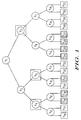
- Fig. 1 is a simplified schematic diagram illustrating a set of users belonging to a particular multicast group that have been arranged into a binary tree according to the subset-difference method.
- the binary tree has a number of nodes V 1 - V 15 and a number of leaves V 16 - V 31 .
- the leaves of the tree V 16 - V 31 represent the actual users and the leaves that are shaded, V 18 , V 19 , V 21 , V 24 , V 25 , V 26 and V 27 , correspond to users that are to be revoked from the group.
- the binary tree is further divided into subtrees that are rooted at nodes V 4 , V 5 and V 3 .
- Each of these subtrees contains an inner subtree, where an inner subtree includes only the to-be-revoked leaves.
- an inner subtree includes only the to-be-revoked leaves.
- V 4 there is an inner subtree rooted at node V 9 that contains only the to-be-revoked leaves, V 18 and V 19 .
- the main idea of the subset-difference method is to have a key for each of the outer subtrees that is known to everyone in the outer subtree but not known to anyone inside the inner (revoked) subtree. This key is designated as L I,J .
- L I,J For example, for the outer subtree rooted at node V 4 , this outer subtree including node V 8 and leaves V 16 and V 17 , there is a key L 4,9 that is known only to leaves V 16 , V 17 but not to leaves V 18 , V 19 .
- a new content key (CK) is sent out encrypted using the following difference keys: L 4,9 , L 5,21 and L 3,6 .
- leaf “u” When a particular leaf “u” is first initialized (i.e., when joining a multicast), this leaf “u” receives the following labels: for every V I ancestor of leaf “u”, leaf “u” receives all difference labels that are "hanging off the path" from V I to leaf “u”. From each of the labels, leaf “u” can derive the keys that it needs. For example, the path from root V 1 to leaf V 22 is as follows: V 1 , V 2 , V 5 , V 11 and V 22 . When leaf V 22 is initialized, it would receive the following difference labels:
- the new content key is sent out encrypted using L 4,9 , L 5,21 and L 3,6 .
- the foregoing can be simplified to O(log(N) 2 ), where O(N) is the number of messages required for one rekeying for N users participating in the multicast.
- each user joining a multicast would get initialized with two hundred and seventy-six (276) keys.
- each key is one hundred and twenty-eight (128) bits (or sixteen (16) bytes) in length, this would require 276*16 ⁇ 4.5Kbytes of key storage.
- these keys would probably have to be stored encrypted outside of the chip. Details of the subset-difference method can be further found in the publication, "Revocation and Tracing Schemes for Stateless Receivers", by D. Naor. et al.
- a subset-difference method as recited in the accompanying claims uses the value of a current content key to help generate the requisite difference keys.
- the requisite difference keys are then used to encrypt the next content key which will be delivered only to users who are supposed to remain in the group. Users who have the current content key are then able to generate the requisite difference keys which they can then use to decrypt the next content key.
- the users are then able to continue to receive contents. Since previously revoked users do not have the current content key, they are unable to determine the next content key and thus are prevented from receiving future contents.
- the present invention can be deployed in systems that rely on secure information delivery where the information is encrypted using a common group key.
- Such systems include, for example, multicast or broadcast content delivery systems.
- the exemplary method of the present invention provides a number of advantages and/or benefits. For example, in order to rekey a group, only O(r) messages are needed, where r is the number of users to be revoked, as compared to the subset-difference method, where O(R) messages are needed to accomplish the same task, only that R is the number of users that have been revoked from the very beginning of a multicast.
- the present invention in the form of one or more exemplary embodiments will now be described.
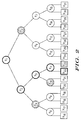
- the subset-difference method as described above is improved such that the overhead of removing members from a multicast group is proportional only to the size of the next set of members that want to leave the group.
- a user that previously left the group may re-join subsequently and gets a different position in the tree.
- the user will have the difference keys for two different leaves and if that user leaves a second time, it may still be able to get content keys using its difference keys from the first period of membership in the group.
- the respective positions of revoked users in the tree are recorded and if a revoked user joins again, it is given the same position as last time when it was in the group.
- the amount of such material can be reduced by not varying the labels for each multicast.
- the tree with all of its labels for inner nodes is kept relatively static, possibly only changing occasionally like the service keys.
- the values of the labels in the tree are globally made the same and are stored in a key distribution center (KDC) database.
- KDC key distribution center
- the KDC database is responsible for maintaining and handing out multicast group keys at a periodic interval.
- the KDC database would return a complete set of labels along with a ticket granting ticket (TGT) to each caching server and would also return an appropriate subset of the labels to each user along with the user's TGT.
- TGT ticket granting ticket
- the user's position in he multicast key hierarchy would be determined during an initial exchange (AS Req/Rep) with the KDC database.
- L I,J G M (LABEL I,J , PSK p ), where PSK p represents the program segment key.
- PSK p represents the program segment key.
- the very first PSK p delivered to a user that joins a group cannot be delivered using the exemplary method, since PSK p-1 is not known at that time to this user.
- the first PSK p would be delivered to a user using the same point-to-point protocol (e.g., Kerberos) that is used to verify the identity of this user and check if the user is authorized for the multicast.
- point-to-point protocol e.g., Kerberos
- the KDC database can change the set of difference labels on a periodic basis, such as once a month or once every several months, and the different sets of labels could be identified with a predetermined version number for synchronization.
- the present invention is implemented in the form of control logic using computer software. Based on the disclosure and teachings provided herein, it will be appreciated by a person of ordinary skill in the art that the present invention can be implemented in other ways and/or methods including, for example, hardware and/or a combination of hardware and software.
Landscapes
- Engineering & Computer Science (AREA)
- Computer Security & Cryptography (AREA)
- Computer Networks & Wireless Communication (AREA)
- Signal Processing (AREA)
- Data Exchanges In Wide-Area Networks (AREA)
- Information Transfer Between Computers (AREA)
- Two-Way Televisions, Distribution Of Moving Picture Or The Like (AREA)
Claims (5)
- Teilmengendifferenzverfahren unter Verwendung mehrerer Differenzschlüssel, um einen Inhaltsschlüssel zu verschlüsseln, wobei jeder der mehreren Differenzschlüssel unter Verwendung einer entsprechenden Kennzeichnung erzeugt wird, und wobei das Verfahren umfasst:Erzeugen von jedem der mehreren Differenzschlüssel L I,J während eines ersten erneuten Schlüsselzuteilens durch Anwenden einer Einwegfunktion G M auf die entsprechende Kennzeichnung LABEL I,J und einen gegenwärtigen Inhaltsschlüssel CK p ;Erzeugen von jedem der mehreren Differenzschlüssel L I,J während eines nächsten erneuten Schlüsselzuteilens durch Anwenden einer Einwegfunktion G M auf die entsprechende Kennzeichnung LABEL I,J und den nächsten gegenwärtigen Inhaltsschlüssel CK P+1 ; undwobei der nächste sequenzielle Inhaltsschlüssel CK P+2 , der durch Anwenden einer Einwegfunktion G M auf die entsprechende Kennzeichnung LABEL I,J und den Inhaltsschlüssel CK P+1 erzeugt wird, verwendet wird, um eine fortgesetzte Lieferung von Inhalten sicherzustellen.
- Verfahren nach Anspruch 1, wobei das Teilmengendifferenzverfahren in einem Inhaltsauslieferungssystem implementiert ist, das Multicasting bereitstellen kann.
- Verfahren nach Anspruch 2, wobei das Inhaltsauslieferungssystem mehrere Clients unter der Steuerung von entsprechenden Benutzern, eine Schlüsselverteilzentrale und einen Cachingserver umfasst; und
wobei die Schlüsselverteilzentrale die entsprechenden Kennzeichnungen, die verwendet werden, um die mehreren Differenzschlüssel zu erzeugen, zu den mehreren Clients und dem Cachingserver liefert. - Verfahren nach Anspruch 1, wobei der Inhaltsschlüssel einen Programmsegmentschlüssel darstellt;
wobei der gegenwärtige Inhaltsschlüssel einen gegenwärtigen Programmsegmentschlüssel darstellt;
wobei der nächste Inhaltsschlüssel einen nächsten Programmsegmentschlüssel darstellt; und
wobei der nächste Programmsegmentschlüssel verwendet wird, um eine fortgesetzte Lieferung eines nächsten Programmsegments sicherzustellen. - Verfahren nach Anspruch 1, wobei das Teilmengendifferenzverfahren unter Verwendung von Computersoftware implementiert wird.
Applications Claiming Priority (3)
| Application Number | Priority Date | Filing Date | Title |
|---|---|---|---|
| US318486 | 2002-12-13 | ||
| US10/318,486 US7450722B2 (en) | 2002-12-13 | 2002-12-13 | Subset difference method for multi-cast rekeying |
| PCT/US2003/039294 WO2004056037A1 (en) | 2002-12-13 | 2003-12-10 | Improved subset difference method for multi-cast rekeying |
Publications (2)
| Publication Number | Publication Date |
|---|---|
| EP1570600A1 EP1570600A1 (de) | 2005-09-07 |
| EP1570600B1 true EP1570600B1 (de) | 2016-09-07 |
Family
ID=32506358
Family Applications (1)
| Application Number | Title | Priority Date | Filing Date |
|---|---|---|---|
| EP03796905.2A Expired - Lifetime EP1570600B1 (de) | 2002-12-13 | 2003-12-10 | Verbessertes subset-differenz verfahren für multicast schlüsselaktuallisierung |
Country Status (5)
| Country | Link |
|---|---|
| US (1) | US7450722B2 (de) |
| EP (1) | EP1570600B1 (de) |
| AU (1) | AU2003297834A1 (de) |
| CA (1) | CA2506146C (de) |
| WO (1) | WO2004056037A1 (de) |
Families Citing this family (21)
| Publication number | Priority date | Publication date | Assignee | Title |
|---|---|---|---|---|
| US7849016B2 (en) * | 2002-12-18 | 2010-12-07 | Vincent So | Internet-based data content rental system and method |
| US7313238B2 (en) * | 2003-01-31 | 2007-12-25 | Hewlett-Packard Development Company, L.P. | Method and system for relating cryptographic keys |
| GB2400526B (en) * | 2003-04-08 | 2005-12-21 | Hewlett Packard Development Co | Cryptographic key update management |
| US7697690B2 (en) * | 2003-07-21 | 2010-04-13 | Hewlett-Packard Development Company, L.P. | Windowed backward key rotation |
| ATE405082T1 (de) * | 2003-12-23 | 2008-08-15 | Motorola Inc | Schlüsselaktualisierung in sicherer multicastkommunikation |
| JP4690420B2 (ja) * | 2004-11-16 | 2011-06-01 | テレフオンアクチーボラゲット エル エム エリクソン(パブル) | 情報への選択的アクセスのためのシステムにおける改善された鍵配信 |
| US7813510B2 (en) * | 2005-02-28 | 2010-10-12 | Motorola, Inc | Key management for group communications |
| JP4599194B2 (ja) * | 2005-03-08 | 2010-12-15 | 株式会社東芝 | 復号装置、復号方法、及びプログラム |
| KR100765750B1 (ko) * | 2005-05-09 | 2007-10-15 | 삼성전자주식회사 | 브로드캐스트 암호화 방식에 따라 효율적으로암호화/복호화하는 방법 및 장치 |
| KR100708133B1 (ko) | 2005-05-25 | 2007-04-17 | 삼성전자주식회사 | 브로드캐스트 암호화 방식에 따라 효율적으로암호화/복호화하는 방법 및 장치 |
| KR100708134B1 (ko) | 2005-05-25 | 2007-04-17 | 삼성전자주식회사 | 브로드캐스트 암호화 방식에 따라 효율적으로암호화/복호화하는 방법 및 장치 |
| EP1890493A1 (de) * | 2006-08-17 | 2008-02-20 | Nagracard S.A. | Verfahren zum Widerrufen von Sicherheitsmodulen zur Sicherung Rundfunknachrichten |
| KR101223499B1 (ko) * | 2006-09-27 | 2013-01-18 | 삼성전자주식회사 | 그룹 키 업데이트 방법 및 이를 이용한 그룹 키 업데이트장치 |
| KR101300843B1 (ko) * | 2006-11-29 | 2013-08-29 | 삼성전자주식회사 | 리키 인덱스 생성 방법 및 이를 이용한 리키 인덱스 생성장치 |
| EP2355503A1 (de) | 2010-02-04 | 2011-08-10 | Nagravision S.A. | Verfahren zur Verwaltung von Elementen von mindestens einer Gruppe von Decodierern mit Zugang zu Audio- / Videodaten |
| US8396896B2 (en) | 2010-11-10 | 2013-03-12 | International Business Machines Corporation | Assigning resources to a binary tree structure |
| US8699486B1 (en) * | 2010-12-07 | 2014-04-15 | Juniper Networks, Inc. | Managing multicast distribution using multicast trees |
| US9071421B2 (en) | 2010-12-15 | 2015-06-30 | Microsoft Technology Licensing, Llc | Encrypted content streaming |
| CN102394744B (zh) * | 2011-11-10 | 2014-04-16 | 香港应用科技研究院有限公司 | 使用广播加密进行内容分发的系统和方法 |
| US10467384B2 (en) | 2016-05-18 | 2019-11-05 | International Business Machines Corporation | Subset-difference broadcast encryption with blacklisting |
| KR102524377B1 (ko) * | 2022-11-25 | 2023-04-21 | 주식회사 유니온플레이스 | 비히클 관제를 위한 비히클 데이터의 통신 방법 |
Family Cites Families (12)
| Publication number | Priority date | Publication date | Assignee | Title |
|---|---|---|---|---|
| US20020002678A1 (en) * | 1998-08-14 | 2002-01-03 | Stanley T. Chow | Internet authentication technology |
| EP1075108A1 (de) * | 1999-07-23 | 2001-02-07 | BRITISH TELECOMMUNICATIONS public limited company | Kryptographische Datenverteilung |
| US7065643B1 (en) * | 2000-03-28 | 2006-06-20 | Motorola, Inc. | Network compromise recovery methods and apparatus |
| EP1290534A2 (de) * | 2000-06-02 | 2003-03-12 | Kinetic Sciences Inc. | Verfahren zur biometrischen verschlüsselung von email |
| WO2002062054A2 (en) * | 2000-10-26 | 2002-08-08 | General Instrument Corporation | Initial viewing period for authorization of multimedia content |
| US7096266B2 (en) * | 2001-01-08 | 2006-08-22 | Akamai Technologies, Inc. | Extending an Internet content delivery network into an enterprise |
| US7684565B2 (en) * | 2001-01-16 | 2010-03-23 | General Instrument Corporation | System for securely communicating information packets |
| US7010125B2 (en) * | 2001-01-26 | 2006-03-07 | Interntional Business Machines Corporation | Method for tracing traitor receivers in a broadcast encryption system |
| US7039803B2 (en) * | 2001-01-26 | 2006-05-02 | International Business Machines Corporation | Method for broadcast encryption and key revocation of stateless receivers |
| US20030126464A1 (en) * | 2001-12-04 | 2003-07-03 | Mcdaniel Patrick D. | Method and system for determining and enforcing security policy in a communication session |
| US7340603B2 (en) * | 2002-01-30 | 2008-03-04 | Sony Corporation | Efficient revocation of receivers |
| US7092527B2 (en) * | 2002-04-18 | 2006-08-15 | International Business Machines Corporation | Method, system and program product for managing a size of a key management block during content distribution |
-
2002
- 2002-12-13 US US10/318,486 patent/US7450722B2/en not_active Expired - Fee Related
-
2003
- 2003-12-10 CA CA2506146A patent/CA2506146C/en not_active Expired - Fee Related
- 2003-12-10 WO PCT/US2003/039294 patent/WO2004056037A1/en not_active Ceased
- 2003-12-10 AU AU2003297834A patent/AU2003297834A1/en not_active Abandoned
- 2003-12-10 EP EP03796905.2A patent/EP1570600B1/de not_active Expired - Lifetime
Also Published As
| Publication number | Publication date |
|---|---|
| US20040114762A1 (en) | 2004-06-17 |
| WO2004056037A1 (en) | 2004-07-01 |
| CA2506146A1 (en) | 2004-07-01 |
| EP1570600A1 (de) | 2005-09-07 |
| US7450722B2 (en) | 2008-11-11 |
| CA2506146C (en) | 2013-07-09 |
| AU2003297834A1 (en) | 2004-07-09 |
Similar Documents
| Publication | Publication Date | Title |
|---|---|---|
| EP1570600B1 (de) | Verbessertes subset-differenz verfahren für multicast schlüsselaktuallisierung | |
| Liu et al. | Efficient self-healing group key distribution with revocation capability | |
| US7599497B2 (en) | Key management protocol | |
| DE60027046T2 (de) | Synchronisierung von sitzungsschlüsseln | |
| DE69902414T2 (de) | Effiziente sichere Mehrfachübertragung mit minimaler Kenntnis | |
| US6785809B1 (en) | Server group key for distributed group key management | |
| US7949135B2 (en) | Key distribution in systems for selective access to information | |
| US20060029226A1 (en) | Method of updating group key of secure group during new member's registration into the secure group and communication system using the method | |
| EP2355503A1 (de) | Verfahren zur Verwaltung von Elementen von mindestens einer Gruppe von Decodierern mit Zugang zu Audio- / Videodaten | |
| KR100968181B1 (ko) | 멀티캐스트를 통한 액세스 제어 | |
| AU2758699A (en) | Method and apparatus for conveying a private message to selected members | |
| Pegueroles et al. | Balanced batch LKH: new proposal, implementation and performance evaluation | |
| US7007040B1 (en) | Method and apparatus for storing and updating information in a multi-cast system | |
| Angamuthu et al. | Balanced key tree management for multi‐privileged groups using (N, T) policy | |
| Bettahar et al. | AKMP: an adaptive key management protocol for secure multicast | |
| Pegueroles et al. | Improved LKH for batch rekeying in multicast groups | |
| Ma et al. | Dynamic access control for multi-privileged group communications | |
| Padmavathi et al. | A security framework for Content-Based Publish–Subscribe system | |
| Baddi et al. | Key management for secure multicast communication: A survey | |
| CN100571270C (zh) | 对组播的访问控制 | |
| Pham et al. | The efficiency of periodic rekeying in dynamic group key management | |
| JP2002300149A (ja) | 同報配信用鍵管理システム | |
| Hassan et al. | Hi-kd: Hash-based hierarchical key distribution for group communication | |
| US20040091103A1 (en) | Method for data transmission | |
| Karandikar et al. | An effective key management approach to differential access control in dynamic environments |
Legal Events
| Date | Code | Title | Description |
|---|---|---|---|
| PUAI | Public reference made under article 153(3) epc to a published international application that has entered the european phase |
Free format text: ORIGINAL CODE: 0009012 |
|
| 17P | Request for examination filed |
Effective date: 20050602 |
|
| AK | Designated contracting states |
Kind code of ref document: A1 Designated state(s): AT BE BG CH CY CZ DE DK EE ES FI FR GB GR HU IE IT LI LU MC NL PT RO SE SI SK TR |
|
| AX | Request for extension of the european patent |
Extension state: AL LT LV MK |
|
| DAX | Request for extension of the european patent (deleted) | ||
| RBV | Designated contracting states (corrected) |
Designated state(s): DE FR GB |
|
| RAP1 | Party data changed (applicant data changed or rights of an application transferred) |
Owner name: MOTOROLA MOBILITY LLC |
|
| 17Q | First examination report despatched |
Effective date: 20150703 |
|
| GRAP | Despatch of communication of intention to grant a patent |
Free format text: ORIGINAL CODE: EPIDOSNIGR1 |
|
| INTG | Intention to grant announced |
Effective date: 20160331 |
|
| RAP1 | Party data changed (applicant data changed or rights of an application transferred) |
Owner name: GOOGLE TECHNOLOGY HOLDINGS LLC |
|
| GRAS | Grant fee paid |
Free format text: ORIGINAL CODE: EPIDOSNIGR3 |
|
| GRAA | (expected) grant |
Free format text: ORIGINAL CODE: 0009210 |
|
| AK | Designated contracting states |
Kind code of ref document: B1 Designated state(s): DE FR GB |
|
| REG | Reference to a national code |
Ref country code: GB Ref legal event code: FG4D |
|
| REG | Reference to a national code |
Ref country code: DE Ref legal event code: R096 Ref document number: 60349376 Country of ref document: DE |
|
| REG | Reference to a national code |
Ref country code: FR Ref legal event code: PLFP Year of fee payment: 14 |
|
| REG | Reference to a national code |
Ref country code: DE Ref legal event code: R097 Ref document number: 60349376 Country of ref document: DE |
|
| PLBE | No opposition filed within time limit |
Free format text: ORIGINAL CODE: 0009261 |
|
| STAA | Information on the status of an ep patent application or granted ep patent |
Free format text: STATUS: NO OPPOSITION FILED WITHIN TIME LIMIT |
|
| 26N | No opposition filed |
Effective date: 20170608 |
|
| REG | Reference to a national code |
Ref country code: FR Ref legal event code: PLFP Year of fee payment: 15 |
|
| REG | Reference to a national code |
Ref country code: FR Ref legal event code: TP Owner name: GOOGLE TECHNOLOGY HOLDINGS LLC, US Effective date: 20180327 |
|
| PGFP | Annual fee paid to national office [announced via postgrant information from national office to epo] |
Ref country code: FR Payment date: 20191226 Year of fee payment: 17 |
|
| PGFP | Annual fee paid to national office [announced via postgrant information from national office to epo] |
Ref country code: GB Payment date: 20201228 Year of fee payment: 18 |
|
| PGFP | Annual fee paid to national office [announced via postgrant information from national office to epo] |
Ref country code: DE Payment date: 20201229 Year of fee payment: 18 |
|
| PG25 | Lapsed in a contracting state [announced via postgrant information from national office to epo] |
Ref country code: FR Free format text: LAPSE BECAUSE OF NON-PAYMENT OF DUE FEES Effective date: 20201231 |
|
| REG | Reference to a national code |
Ref country code: DE Ref legal event code: R119 Ref document number: 60349376 Country of ref document: DE |
|
| GBPC | Gb: european patent ceased through non-payment of renewal fee |
Effective date: 20211210 |
|
| PG25 | Lapsed in a contracting state [announced via postgrant information from national office to epo] |
Ref country code: GB Free format text: LAPSE BECAUSE OF NON-PAYMENT OF DUE FEES Effective date: 20211210 Ref country code: DE Free format text: LAPSE BECAUSE OF NON-PAYMENT OF DUE FEES Effective date: 20220701 |
|
| P01 | Opt-out of the competence of the unified patent court (upc) registered |
Effective date: 20230511 |