EP1570367B1 - Anordnung zum laden mit prädiktiver wahrscheinlichkeit von dateien über eine schnittstelle - Google Patents
Anordnung zum laden mit prädiktiver wahrscheinlichkeit von dateien über eine schnittstelle Download PDFInfo
- Publication number
- EP1570367B1 EP1570367B1 EP03812193A EP03812193A EP1570367B1 EP 1570367 B1 EP1570367 B1 EP 1570367B1 EP 03812193 A EP03812193 A EP 03812193A EP 03812193 A EP03812193 A EP 03812193A EP 1570367 B1 EP1570367 B1 EP 1570367B1
- Authority
- EP
- European Patent Office
- Prior art keywords
- loading
- files
- clips
- energy consumption
- probabilities
- Prior art date
- Legal status (The legal status is an assumption and is not a legal conclusion. Google has not performed a legal analysis and makes no representation as to the accuracy of the status listed.)
- Expired - Lifetime
Links
Images


Classifications
-
- G—PHYSICS
- G06—COMPUTING OR CALCULATING; COUNTING
- G06F—ELECTRIC DIGITAL DATA PROCESSING
- G06F9/00—Arrangements for program control, e.g. control units
- G06F9/06—Arrangements for program control, e.g. control units using stored programs, i.e. using an internal store of processing equipment to receive or retain programs
- G06F9/44—Arrangements for executing specific programs
- G06F9/445—Program loading or initiating
-
- Y—GENERAL TAGGING OF NEW TECHNOLOGICAL DEVELOPMENTS; GENERAL TAGGING OF CROSS-SECTIONAL TECHNOLOGIES SPANNING OVER SEVERAL SECTIONS OF THE IPC; TECHNICAL SUBJECTS COVERED BY FORMER USPC CROSS-REFERENCE ART COLLECTIONS [XRACs] AND DIGESTS
- Y02—TECHNOLOGIES OR APPLICATIONS FOR MITIGATION OR ADAPTATION AGAINST CLIMATE CHANGE
- Y02D—CLIMATE CHANGE MITIGATION TECHNOLOGIES IN INFORMATION AND COMMUNICATION TECHNOLOGIES [ICT], I.E. INFORMATION AND COMMUNICATION TECHNOLOGIES AIMING AT THE REDUCTION OF THEIR OWN ENERGY USE
- Y02D10/00—Energy efficient computing, e.g. low power processors, power management or thermal management
Definitions
- the invention relates to a probability arrangement and particularly to a predictive probability arrangement in data transmission taking place over an interface.
- a mobile phone for instance, is no longer used merely for speaking, but also as a calendar, an Internet browser, a camera or a game device, for example.
- Such numerous user applications require faster data transmission capability and improved efficiency in energy consumption.
- Interfaces between electronic devices and between components of electronic devices, particularly interfaces between memories, have an essential significance for the data transmission capability of the whole electronic device. Larger amounts of data are transmitted over the interfaces, whereby the problem in the solutions according to prior art is, in particular, the limited bandwidth of the interfaces, which makes the data transmission significantly slower.
- an electronic device may have a sufficient nominal bandwidth, but problems due to software, for example, may load the interface so much that the data transmission rate of the interface is insufficient for other functions.
- a problem is, in addition, that a large part of the transmitted data may be unnecessary, which causes undue energy consumption and waste of bandwidth. When the band is loaded with unnecessary data transmission, the data transmission rate is reduced, whereby also the transmission of necessary data slows down.
- a loading factor is determined for loading a file over an interface, the factor being the minimum probability the file must have in order for it to be loaded.
- the problem in these solutions is, however, that the energy consumption caused by the file loading is not estimated, but the loading is carried out only on the basis of joint probabilities.
- An object of the invention is thus to provide a method and a system implementing the method in such way that disadvantages of the above-mentioned problems can be reduced.
- the object of the invention is achieved with a method that is characterized in what is stated in independent claim 1, system that is characterized in what is stated in independent claim 11, device that is characterized in what is stated in independent claim 13 and software that is characterized in what is stated in independent claim 18.
- Preferred embodiments of the invention are described in the dependent claims.
- the invention is based on loading files F i or parts ("clips") C i thereof over an interface IF from a unit FU comprising files F i or clips C i thereof to a data-processing unit DU.
- the unit FU that comprises files F i or clips C i thereof refers to, for example, a server S, memory device M or any other unit comprising data.
- the data-processing unit DU in turn, refers to a mobile station T, memory device M or any other unit arranged to process data.
- the predictive probability system comprises determining joint probabilities JP i of at least two files F i or clips C i thereof, which probabilities express probabilities with which the files F j or clips C i thereof are accessed, and energy consumptions W i caused by the loading of the files F i or clips C i thereof.
- a loading order for the files F i or clips C i thereof is formed as a function of the joint probabilities JP i .
- a value is determined for maximum energy consumption EC MAX , expressing greatest allowed energy consumption caused by the loading.
- Files F i or clips C i thereof are loaded in the loading order, and at the same time, total energy consumption ⁇ W i caused by the loading of said files F i or clips C i thereof is determined until the value of the total energy consumption ⁇ W i exceeds the value of the maximum energy consumption EC MAX .
- the loading probabilities LP i of the files F i or clips C i thereof are determined from the joint probabilities JP i , and according to a second preferred embodiment, the loading probability functions fLP i of the files F i or clips C i thereof are determined either as functions of the loading probabilities LP i or as functions of the energy consumptions W i caused by the loading.
- At least one file F i or a clip C i thereof is loaded over an interface from a first terminal to a second terminal.
- the device comprises proxy functionality, wherein the proxy functionality is arranged to transmit at least one file F i or a clip C i thereof to another data-processing unit as a response to a request from the data-processing unit.
- One advantage is that the predictive probability arrangement enables the user and/or the arrangement to determine a substantially optimal arrangement between the access and loading times and the energy consumption caused by the loading.
- An advantage is also that predictive probability arrangement makes it possible to essentially reduce energy losses by loading in advance files that will be needed most probably; in other words, files are not loaded only in the order in which they appear.
- a further advantage is that as a result of the loading of the files most probably needed, excessive use of bandwidth can be reduced, whereby the operational rates of the interface increase significantly, reaching in some cases even the level of the operational rates of a high-speed interface.
- One advantage is that the arrangement allows efficient use of a slow interface, which can result in significant energy savings and reduced needed bandwidth.
- An advantage is also that the arrangement takes user cost into account for example by using cheap local network for data transmission.
- the proxy can be made mobile as well, which means that the devices involved can function as each other's proxies.
- Interfaces such as interfaces between electronic devices and between components of electronic devices, for example memories
- memories have a great significance for the performance of the whole system, such as a terminal, and particularly for data transmission rates and energy consumption.
- memories are generally used for storing data. Different types of memory differ from each other mostly with regard to their operational rate, storing capacity and preservability of the stored data. Therefore, electronic devices generally comprise several different memories for different objects of use.
- Memories can be divided into volatile and non-volatile memories on the basis of their operation. When the power supply is interrupted, a volatile memory generally loses all data it has stored, but a non-volatile memory typically preserves the data it has stored.
- RAM memories Random Access Memory
- RAM memories are usually volatile memories in which data can be entered and read when the power source is switched on.
- the RAM memories can be further divided into SRAM memories (Static Random Access Memory) and DRAM memories (Dynamic Random Access Memory).
- SRAM memories Static Random Access Memory
- DRAM memories Dynamic Random Access Memory
- data is typically stored in a flip-flop comprising generally four to six transistors.
- the structure of a SRAM memory is thus complex and takes a lot of space.
- a SRAM memory is used particularly for executing a program code and as a cache memory because of its speed and low power consumption.
- a DRAM memory cell typically comprises one capacitor, in which data is stored as electric charge, and a MOSFET transistor (Metal Oxide Semiconductor Field Effect Transistor), which functions as a switch when the capacitor is charged and discharged.
- MOSFET transistor Metal Oxide Semiconductor Field Effect Transistor
- a DRAM memory is small in size and inexpensive.
- refresh functionality i.e. recharging of the capacitor, at given intervals.
- the DRAM memory is fast, and it is used particularly for storing data temporarily.
- Several fast memory types such as a synchronous DRAM memory (Synchronous Dynamic Random Access Memory), have been developed from the DRAM memory.
- a ROM memory (Read Only Memory) is a non-volatile read-only memory, which preserves the data it has stored although the power source is switched off. Storing data in a ROM memory can be permanent or reprogrammable, depending on the manufacturing technology of the ROM memory.
- the ROM memories can be divided into mask ROM memories, PROM memories (Programmable Read Only Memory) and EPROM memories (Erasable and Programmable Read Only Memory). ROM memories are fast and their power consumption is usually low, but they are still rather expensive. ROM memories are used particularly for mass-storing permanent data, such as for storing programs and microcodes.
- the predictive probability arrangement according to the invention can preferably be used to optimize energy-consuming data transmission particularly over a slow interface.
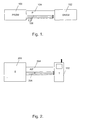
- the predictive probability arrangement according to the invention can be implemented for instance in electronic devices comprising, according to Figure 1 , two memory components M 1 and M 2 , such as a PROM memory (100), which is a large non-volatile memory, and a DRAM memory (102), which is a fast execution memory, there being a slow interface IF (104) between them, over which discrete files F i (106) or clips C 1 thereof are loaded.
- a PROM memory 100
- DRAM memory 102
- IF fast execution memory
- the predictive probability arrangement is advantageous especially when the interface IF (104) is slow compared with the size of the files F i or clips C 1 thereof. Loading large files F i (106) or clips C i thereof over the slow interface IF (104), for example by commanding, would be slow, which would cause a slow access time of the functionality of applications for the user.
- the files F i or clips C i thereof to be loaded have some kind of statistical or logical interdependency.
- the interdependency can be, for example, loading of new web pages on the basis of the hypertext links of one web page.
- the predictive probability arrangement can be used even if such interdependency does not exist.
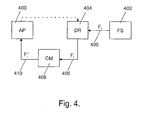
- the predictive probability arrangement according to the invention can be implemented also in the system shown in Figure 2 , comprising for instance a server S (200) and an electronic device, such as a terminal T (202), and an interface IF between them, such as an air interface AIF (204).
- the server S (200) may comprise a large amount of data linked by means of an Internet connection, for example.
- the terminal T (202) can give commands for instance to the server S (200), which can transfer files F i (206) or clips C i thereof to the terminal T (202) over the air interface AIF (204).
- the predictive probability arrangement can also be utilized for instance in game applications.
- a game can be directly programmed to use the arrangement according to the invention, for instance when it is decided which structure is next given to the display.
- the predictive probability arrangement the very high peak rates of data transmission required by game applications can be achieved by loading some of the most probable files F i or clips C i thereof in advance.
- FIG. 3 shows a flow chart of the functionality of the predictive probability method according to a preferred embodiment of the invention.
- energy consumptions W i are determined (300) for possible files F i or clips C i thereof on the basis of, for example, the number of bytes, the energy consumptions having been caused by the loading of the files.
- the energy consumption W i can be determined directly as energy, for example, in which case its unit is generally mJ (millijoule).
- the energy consumption W i expresses the amount of energy that the file*-processing unit DU, such as a terminal T, consumes when it loads a file F i or a clip C i thereof.
- This energy is typically proportional to the length L i of the file F i or a clip C i thereof, whereby the unit of the length is generally kB (kilobyte).
- joint probabilities JP i i.e. probabilities with which one moves to a particular file F i , are determined (302) for the files F i or clips C i thereof. Determination (302) of the joint probabilities is application-specific. If, for instance, the user has loaded a web page, it can be assumed that the user will next move on to one of the hypertext links of the web page. Thus, it is advantageous to consider loading of the hypertext link at the same time. Even if no relative probabilities could be determined, a predictive probability method can be used for determining which web pages should be loaded. On the other hand, the joint probabilities JP i of the files F i or clips C i thereof can be determined by means of the probability system also on the basis of the web page visiting times achieved with the files F i or clips C i thereof.
- the loading probabilities LP i of the files F i or clips C i thereof are determined (304) as products of the joint probabilities JP i of the particular files F i or clips C i thereof and the loading probabilities LP i-1 of files F i-1 or clips C i-1 thereof preceding the particular files F i or clips C i thereof.
- loading probability functions fLP i are determined (306) which are used for determining the loading order.
- the loading probability function fLP i can be, for instance, directly the loading probability LP i of the file F i or a clip C i thereof, the quotient of the loading probability LP i and the energy consumption W i or another function of the loading probability LP i .
- the loading probability function fLP i is thus application-specific and depends on the requirements set by the user.
- maximum energy consumption EC MAX is determined (308) for the predictive probability method, the maximum energy consumption expressing the greatest allowed total energy consumption caused by the loading of the files F i or clips C i thereof.
- the optimal manner of determination and usage of the maximum energy consumption EC MAX depends on the application.
- the maximum energy consumption EC MAX can be determined for example on the basis of the desired standby time of the device.
- Great maximum energy consumption EC MAX usually means, in practice, that the device consumes its battery quickly.
- low maximum energy consumption EC MAX generally means that the algorithm improves the operation of the system only a little, because low maximum energy consumption EC MAX enables loading of only a small amount of data, whereby the probability of the required file F i or a clip C i thereof being already charged in advance is lower.
- the optimal value of maximum energy consumption EC MAX can thus be preferably determined by optimizing these two requirements.
- the energy consumptions W i , joint probabilities JP i , loading probabilities LP i , loading probability functions fLP i and maximum energy consumption EC MAX can be determined in any order relative to each other, with the exception, however, that the loading probability functions fLP i are determined at a later stage than the loading probabilities LP i , and that the loading probabilities LP i are determined at a later stage than the joint probabilities JP i .
- Power consumptions W i , joint probabilities JP i and values of the maximum energy consumption EC MAX can preferably be redetermined periodically, on the basis of which the values of the loading probabilities LP i and the loading probability functions fLP i can preferably be updated.
- Loading (310) of the files F i or clips C i thereof takes place in the order of loading probability functions from the smallest to the greatest, whereby total energy consumption ⁇ W i caused by the loading of the files F i or clips C i thereof is determined.
- the loading order can be selected from among these files, for instance randomly.
- the files F i or clips C i thereof can alternatively be left unloaded, particularly when the joint probabilities JP i of the files F i or clips C i thereof are very low and/or the files F i or clips C i thereof are not followed by other files to be loaded.
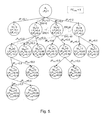
- Figure 4 shows a preferred embodiment of the invention for loading the files F i or clips C i thereof over the interface IF.
- the maximum energy consumption EC MAX 0
- only the files F i ' or clips C i ' thereof that are needed are loaded, whereby no unnecessary energy consumption is caused.
- the system is slow, because the files F i ' or clips C i thereof possibly needed are not loaded in advance.
- the maximum energy consumption EC MAX can also be determined to be greater, which speeds up the operation of the system. If the maximum energy consumption EC MAX > 1, a driver DR (404) preferably in functional connection to an application AP (400) and a file system FS (402), i.e.
- a system comprising files, loads files F i (406) or clips C i thereof in the loading probability function order from the greatest to the smallest from the file system FS (402) to a cache memory CM (408), for instance, until the driver DR (304) detects that the value of the total energy consumption ⁇ W i caused by the loading of the files F i or clips C i thereof exceeds the value of the maximum energy consumption EC MAX , whereby the driver DR (404) interrupts the loading of the files F i (406) or clips C i thereof.
- the files F i ' (410) needed are then, if required, quickly retrievable from the cache memory CM (408) to provide functionality of the application AP (400).
- the invention enables thus a user or system to find a substantially optimal arrangement between the access time of the application AP and the total energy consumption ⁇ W i caused by the loading of the files F i or clips C i thereof. If the file F i ' or a clip C i thereof needed has been loaded in advance in a cache memory CM, for example, the access time for the user is short. If the file F i ' or a clip C i ' thereof needed has not been loaded in advance, its access time is significantly longer. Since, however, the loading of the files F i or clips C i thereof consumes energy W i , it is not advantageous to load all possible files F i or clips C i thereof in advance. Using a predictive probability system can result in, for instance, a significant reduction in energy consumption while, at the same time, preserving good performance of the system.
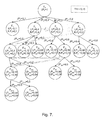
- Energy consumptions (W 1 , W 2 , W 3 , W 4 ) are determined for the first possible files (F 1 , F 2 , F 3 , F 4 ), which energy consumptions have been caused by the loading of these files.
- the loading probability function fLP i of each file F i is directly the loading probability LP i of the file F i .
- the files are arranged as a probability tree PT according to Figure 5 .
- the files are loaded in the loading probability function order from the greatest to the smallest until the value of the total energy consumption ⁇ W i caused by the loading of the files is greater than the value of the maximum energy consumption EC MAX .
- the files are loaded in the order (F 2 , F 3 , F 4 , F 21 ). For instance file F 32 is not loaded, because the maximum energy consumption EC MAX is exceeded during the loading of file F 21 .
- the loading probability function fLP i of each file F i is proportional not only to the loading probability LP i but also to the energy consumption W i caused by the loading.
- the files having a high loading probability LP i and/or low energy consumption are loaded first.
- maximum energy consumption EC MAX is determined, as in the previous embodiments. The above-mentioned values are determined in a corresponding way for other possible files F i .
- Files are loaded in the loading probability function order from the smallest to the greatest until the value of the total energy consumption ⁇ W i caused by the loading of the files is greater than or equal to the value of the maximum energy consumption EC MAX .
- the files are loaded in the order (F 2 , F 3 , F 22 , F 21 , F 321 , F 41 ).
- File F 32 for instance, is not loaded, because the value of the total energy consumption ⁇ W i exceeds the value of the maximum energy consumption EC MAX during the loading of file F 41 .
- energy consumptions (W i ) and the greatest allowed value EC MAX of the energy consumption caused by the loading of the files F i or clips C i thereof are determined for the files F i of clips Ci thereof possibly to be loaded, but the relative probabilities of the files F i or clips C i thereof are not known.
- the loading probability LP i is determined as a function of the joint probability JP i
- the loading probability function fLP i is determined as a function of the loading probability LP i .
- Files F i or clips C i thereof are loaded in a random order, for example, until the value of the total energy consumption ⁇ W i caused by the loading is greater than or equal to the value of the maximum energy consumption EC MAX , at which point the loading is interrupted.
- the loading is carried out in a random order here, a statistically better system performance on average is achieved than would be without the preloading of the files F i or clips C i thereof, because with a predictive probability arrangement the file F i ' needed may have been preloaded, in which case its access and loading times are short.
- Figure 7 shows a third preferred embodiment of the invention, in which a threshold value TH is determined for the probability method, which value the loading probability function fLP i of the file F i or a clip C i thereof must at least have in order for the file F i or a clip C i thereof to be loaded.
- the threshold value TH is determined to be 0.15.
- the algorithm according to the invention determines joint probabilities (JP 1 , JP 2 , JP 3 , JP 4 ) for the files (F 1 , F 2 , F 3 , F 4 ), on the basis of which the loading order is determined for the files F i or clips C i thereof.
- the loading probability function fLP i of each file F i is directly the loading probability LP i of the file F i .
- the above-mentioned values are determined in a corresponding way for other possible files F i .
- the files are arranged as a probability tree PT according to Figure 7 . After this, the files are loaded in the loading order until the probability function JP i of the next file F i to be loaded or its function is lower than the threshold value TH. Thus file F 22 , for example, is not loaded. In this embodiment, the files are loaded in the order (F 2 , F 3 , F 4 , F 21 , F 32 , F 211 ).
- the predictive probability method according to the invention can be implemented with a predictive probability system according to the invention.
- the system comprises means for determining the energy consumptions W i caused by the loading of the files F i or clips C i thereof, joint probabilities JP i of the files F i or clips C i thereof, and maximum energy consumption EC MAX .
- the functions of the system can preferably be performed with a server S or a terminal T, or performance of the functions can be divided between different units, such as the server S and the terminal T.
- the functionality of the system can be implemented with a driver DR comprised by the system, a program code in the driver being arranged to form the files F i or clips C i thereof in the loading order and to control the loading.
- the functionality of the system can also be implemented in such a way, for example, that what are called intelligent functionalities, such as determination of the loading order, are arranged to be performed in the application AP, and the driver DR is arranged to search files F i or clips C i thereof.
- the driver DR can also be what is called an intelligent unit, which performs intelligent functions in addition to searching files F i or clips C i thereof, or the driver DR can perform intelligent functions, being, however, in functional connection to another driver DR', which is arranged to perform the searches of files F i or clips C i thereof.
- the predictive probability functionality can be achieved with a software product which preferably comprises a program code for determining the maximum energy consumption EC MAX , energy consumptions W i caused by the loading of the files F i or clips C i thereof and joint probabilities JP i .
- the software product further comprises a software code for forming the loading order of the files F i or clips C i thereof as functions of the joint probabilities JP i , for loading files F i or clips C i thereof, and for interrupting the loading when the value of the total energy consumption ⁇ W i is greater than or equal to the value of the maximum energy consumption EC MAX .
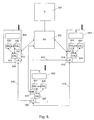
- Figure 8 shows the fourth preferred embodiment of the invention for optimising data transmission.
- the method allows the user or system to optimise, for example, energy and cost per bit according to energy consumption or loading speed, for example.
- One or more of the terminals T 1 , T 2 , T 3 comprising remote network interface RIF 1 (812), RIF 2 (814), RIF 3 (816) are also linked to a data unit, such as data server S (820) comprising files or clips thereof via a remote network RN (822), such as GPRS.
- the server S may comprise a large amount of data linked by means of an Internet connection, for example.
- Files F i or clips C i thereof needed by the terminals T 1 , T 2 , T 3 are chosen and loaded by the earlier described predictive probability method from the data server S over the interface to the terminal T 1 , T 2 , T 3 memory, for example cache memory CM 1 (824), CM 2 (826), CM 3 (828).
- the terminals T 1 , T 2 , T 3 comprise also mass memory MM 1 (830), MM 2 (832), MM 3 (834), in which data can be saved for a longer period.
- Each of the terminals T 1 , T 2 , T 3 can be considered to be a proxy server for the other terminals T 1 , T 2 , T 3 linked to it directly or via one or more other terminals T 1 , T 2, T 3 .
- Files F i or clips C i thereof can be further loaded from terminal T 1 , T 2 , T 3 to other terminals T 1 , T 2 , T 3 cache memories CM 1 (818), CM 2 (820), CM 3 (822) for example via the Bluetooth connection.
- the files F i or clips C i thereof can then be transmitted to the terminal T 1 , T 2 , T 3 executable memory EM 1 (836), EM 2 (838), EM 3 (840) in the terminal T 1 , T 2 , T 3 when needed.
- the proxy functionality may be implemented in some other device than the terminal T such as in an intermediate server between the terminal and the unit FU.
- the loading algorithm described above only needs to be modified such that the maximum energy consumption EC MAX for the file F i or clip C i thereof needs to be modified according to the interface in question.
- the transmission over the local network is cheaper than over the remote network.
- the arrangement makes it possible to take user cost into account.
- the probability tree can be created in a manner other than the one described here.
- the invention can also be applied to systems other than the one described here.
- Two memory components and an arrangement comprising an interface between them is a simplified model from which it is possible to derive other arrangements to which the invention can be applied.
- the invention and its embodiments are not limited to the above examples, but can vary within the scope of the claims.
Landscapes
- Engineering & Computer Science (AREA)
- Software Systems (AREA)
- Theoretical Computer Science (AREA)
- Physics & Mathematics (AREA)
- General Engineering & Computer Science (AREA)
- General Physics & Mathematics (AREA)
- Information Retrieval, Db Structures And Fs Structures Therefor (AREA)
- Information Transfer Between Computers (AREA)
- Compression, Expansion, Code Conversion, And Decoders (AREA)
- Communication Control (AREA)
- Power Sources (AREA)
- Compression Or Coding Systems Of Tv Signals (AREA)
- Data Exchanges In Wide-Area Networks (AREA)
- Computer And Data Communications (AREA)
- Financial Or Insurance-Related Operations Such As Payment And Settlement (AREA)
Claims (15)
- Verfahren zum Laden wenigstens einer Datei (Fi) oder eines Teiles (Ausschnitt bzw. Clip) (Ci) hiervon von einer Dateien (Fi) oder Ausschnitte (Ci) hiervon umfassenden Einheit (FU) über eine Schnittstelle (IF) auf eine Datenverarbeitungseinheit (DU), wobei das Verfahren ein Bestimmen von gemeinsamen Wahrscheinlichkeiten (JPi) von wenigstens zwei Dateien (Fi) oder Ausschnitten (Ci) hiervon umfasst, wobei die gemeinsamen Wahrscheinlichkeiten Wahrscheinlichkeiten darstellen, mit denen auf die Dateien (Fi) oder Ausschnitte (Ci) hiervon zugegriffen wird,
gekennzeichnet durch
Bestimmen von Energieverbräuchen Wi, die durch das über die Schnittstelle (IF) erfolgende Laden der wenigstens zwei Dateien (Fi) oder Ausschnitte (Ci) hiervon verursacht werden;
Bilden einer Ladereihenfolge für die Dateien (Fi) oder Ausschnitte (Ci) hiervon als Funktion der gemeinsamen Wahrscheinlichkeiten (JPi);
Bestimmen eines Wertes für den Höchstenergieverbrauch (ECMAX), wobei der Wert den durch das Laden verursachten größten zulässigen Energieverbrauch darstellt; Laden von Dateien (Fi) oder Ausschnitten (Ci) hiervon in der Ladereihenfolge und Bestimmen des durch das Laden verursachten Gesamtenergieverbrauches ΣWi, bis der Wert des Gesamtenergieverbrauches ΣWi gleich dem Wert des Höchstenergieverbrauches (ECMAX) ist oder diesen übersteigt. - Verfahren nach Anspruch 1,
gekennzeichnet durch
Bestimmen von Ladewahrscheinlichkeiten (LPi) der Dateien (Fi) oder Ausschnitte (Ci) hiervon als Funktion der gemeinsamen Wahrscheinlichkeiten (JPi). - Verfahren nach Anspruch 2,
gekennzeichnet durch
Bestimmen von Ladewahrscheinlichkeitsfunktionen (fLPi) der Dateien (Fi) oder Ausschnitte hiervon als Funktion der Ladewahrscheinlichkeiten (LPi). - Verfahren nach Anspruch 2,
gekennzeichnet durch
Bestimmen von Ladewahrscheinlichkeitsfunktionen (fLPi) der Dateien (Fi) oder Ausschnitte (Ci) hiervon als Funktion der Ladewahrscheinlichkeiten (LPi) und der durch das Laden verursachten Energieverbräuche Wi. - Verfahren nach einem der vorhergehenden Ansprüche,
gekennzeichnet durch
periodisches Neubestimmen des Wertes der Energieverbräuche (Wi), des Höchstenergieverbrauches (ECMAX) und von gemeinsamen Wahrscheinlichkeiten (JPi). - Verfahren nach einem der vorhergehenden Ansprüche,
gekennzeichnet durch
Neubestimmen der Werte des Höchstenergieverbrauches (ECMAX) entsprechend der jeweiligen Schnittstelle (IF). - Verfahren nach Anspruch 5 oder 6,
gekennzeichnet durch
Aktualisieren der Werte der Ladewahrscheinlichkeiten (LPi) und Ladewahrscheinlichkeitsfunktionen (fLPi) als Reaktion auf die Bestimmung. - Verfahren nach einem der vorhergehenden Ansprüche,
gekennzeichnet durch
Laden wenigstens einer Datei (Fi) oder eines Ausschnittes (Ci) hiervon über die Schnittstelle (IF) alternativ von einem Server (S) auf ein Endgerät (T) oder von einer ersten Speicherkomponente (100) auf eine zweite Speicherkomponente (102). - Verfahren nach einem der vorhergehenden Ansprüche,
gekennzeichnet durch
Laden wenigstens einer Datei (Fi) oder eines Ausschnittes (Ci) hiervon über die Schnittstelle (IF) alternativ von einem ersten Endgerät (T1) auf ein zweites Endgerät (T2) über eine lokale Netzwerkschnittstelle (LIF). - Verfahren nach einem der vorhergehenden Ansprüche,
gekennzeichnet durch
Laden wenigstens einer Datei (Fi) oder eines Ausschnittes (Ci) hiervon von einer Massenspeicherkomponente (830) auf eine weitere Speicherkomponente (836) über eine interne Schnittstelle. - System zum Laden wenigstens einer Datei (Fi) oder eines Ausschnittes (Ci) hiervon von einer Dateien (Fi) oder Ausschnitte (Ci) hiervon umfassenden Einheit (FU) über eine Schnittstelle (IF) auf eine Datenverarbeitungseinheit (DU), wobei das System Mittel zum Bestimmen von gemeinsamen Wahrscheinlichkeiten (JPi) von wenigstens zwei Dateien (Fi) oder Ausschnitten (Ci) hiervon umfasst, wobei die gemeinsamen Wahrscheinlichkeiten Wahrscheinlichkeiten darstellen, mit denen auf die Dateien (Fi) oder Ausschnitte (Ci) hiervon zugegriffen wird,
dadurch gekennzeichnet, dass das System umfasst:Mittel zum Bestimmen des Energieverbrauches Wi, der durch das Laden der wenigstens zwei Dateien (Fi) oder Ausschnitte (Ci) hiervon verursacht wird;Mittel zum Bestimmen der Ladereihenfolge der Dateien (Fi) oder Ausschnitte (Ci) hiervon als Funktion der gemeinsamen Wahrscheinlichkeiten (JPi);Mittel zum Bestimmen des Wertes des Höchstenergieverbrauches (ECMAX), der den durch das Laden verursachten größten zulässigen Energieverbrauch darstellt; undMittel zum Laden von Dateien (Fi) oder Ausschnitten (Ci) hiervon und Bestimmen des durch das Laden der Dateien (Fi) oder Ausschnitte (Ci) hiervon verursachten Gesamtenergieverbrauches ΣWi, wobei die Mittel dafür angeordnet sind, Dateien (Fi) oder Ausschnitte (Ci) hiervon zu laden, bis der Wert des Gesamtenergieverbrauches ΣWi gleich dem Wert des Höchstenergieverbrauches (ECMAX) ist oder diesen übersteigt. - System nach Anspruch 11,
dadurch gekennzeichnet, dass
wenigstens ein Teil der Mittel als Programmcode eines von dem System umfassten Treibers (DR) ausgeführt wird. - Vorrichtung zum Laden wenigstens einer Datei (Fi) oder eines Ausschnittes (Ci) hiervon von einer Dateien (Fi) oder Ausschnitte (Ci) hiervon umfassenden Einheit (FU) über eine Schnittstelle (IF), wobei die Vorrichtung Mittel zum Bestimmen von gemeinsamen Wahrscheinlichkeiten (JPi) von wenigstens zwei Dateien (Fi) oder Ausschnitten (Ci) hiervon umfasst, wobei die gemeinsamen Wahrscheinlichkeiten Wahrscheinlichkeiten darstellen, mit denen auf die Dateien (Fi) oder Ausschnitte (Ci) hiervon zugegriffen wird,
dadurch gekennzeichnet, dass die Vorrichtung umfasst:Mittel zum Bestimmen des durch das Laden der wenigstens zwei Dateien (Fi) oder Ausschnitte (Ci) hiervon verursachten Energieverbrauches Wi;Mittel zum Bestimmen der Ladereihenfolge der Dateien (Fi) oder Ausschnitte (Ci) hiervon als Funktion der gemeinsamen Wahrscheinlichkeiten (JPi);Mittel zum Bestimmen des Wertes des Höchstenergieverbrauches (ECMAX), der den durch das Laden verursachten größten zulässigen Energieverbrauch darstellt; undMittel zum Anfordern von Dateien (Fi) oder Ausschnitten (Ci) hiervon und Bestimmen des durch das Laden verursachten Gesamtenergieverbrauches ΣWi, wobei das Mittel dafür angeordnet ist, Dateien (Fi) oder Ausschnitte (Ci) hiervon zu laden, bis der Wert des Gesamtenergieverbrauches ΣWi gleich dem Wert des Höchstenergieverbrauches (ECMAX) ist oder diesen übersteigt. - Vorrichtung nach Anspruch 13,
dadurch gekennzeichnet, dass die Vorrichtung umfasst:eine Proxyfunktionalität, die dafür angeordnet ist, wenigstens eine Datei (Fi) oder einen Ausschnitt (Ci) hiervon an eine weitere Datenverarbeitungseinheit (DU) als Reaktion auf eine Anforderung von der Datenverarbeitungseinheit (DU) zu übertragen. - Softwareerzeugnis zum Laden wenigstens einer Datei (Fi) oder eines Ausschnittes (Ci) hiervon für eine Ladefunktionalität zur Durchführung über eine Schnittstelle (IF), wobei das Softwareerzeugnis Softwarecode zum Bestimmen von gemeinsamen Wahrscheinlichkeiten (JPi) von wenigstens zwei Dateien (Fi) oder Ausschnitten (Ci) hiervon umfasst, wobei die gemeinsamen Wahrscheinlichkeiten Wahrscheinlichkeiten darstellen, mit denen auf die Dateien (Fi) oder Ausschnitte (Ci) hiervon zugegriffen wird,
dadurch gekennzeichnet, dass das Softwareerzeugnis umfasst:einen Softwarecode, der bei Ausführung auf einem Computer die Energieverbräuche Wi der wenigstens zwei Dateien (Fi) oder Ausschnitte (Ci) hiervon bestimmt;einen Softwarecode, der bei Ausführung auf einem Computer die Ladereihenfolge der Dateien (Fi) oder Ausschnitte (Ci) hiervon als Funktion der gemeinsamen Wahrscheinlichkeiten (JPi) bildet;einen Softwarecode, der bei Ausführung auf einem Computer den Wert des Höchstenergieverbrauches (ECMAX) bestimmt, der den durch das Laden verursachten größten zulässigen Energieverbrauch darstellt; undeinen Softwarecode, der Dateien (Fi) oder Ausschnitte (Ci) hiervon lädt und den durch das Laden der Dateien (Fi) oder Ausschnitte (Ci) hiervon verursachten Gesamtenergieverbrauch ΣWi bestimmt, bis der Wert des Gesamtenergieverbrauches ΣWi gleich dem Wert des Höchstenergieverbrauches (ECMAX) ist oder diesen übersteigt.
Applications Claiming Priority (3)
| Application Number | Priority Date | Filing Date | Title |
|---|---|---|---|
| FI20022116A FI114582B (fi) | 2002-11-29 | 2002-11-29 | Ennakoiva todennäköisyysjärjestely tiedostojen lataamiseksi liityntärajapinnan yli |
| FI20022116 | 2002-11-29 | ||
| PCT/FI2003/000913 WO2004051494A1 (en) | 2002-11-29 | 2003-12-01 | Predictive probability arrangement for loading files over an interface |
Publications (2)
| Publication Number | Publication Date |
|---|---|
| EP1570367A1 EP1570367A1 (de) | 2005-09-07 |
| EP1570367B1 true EP1570367B1 (de) | 2010-08-25 |
Family
ID=8565011
Family Applications (1)
| Application Number | Title | Priority Date | Filing Date |
|---|---|---|---|
| EP03812193A Expired - Lifetime EP1570367B1 (de) | 2002-11-29 | 2003-12-01 | Anordnung zum laden mit prädiktiver wahrscheinlichkeit von dateien über eine schnittstelle |
Country Status (8)
| Country | Link |
|---|---|
| US (1) | US7565264B2 (de) |
| EP (1) | EP1570367B1 (de) |
| CN (1) | CN1720513B (de) |
| AT (1) | ATE479151T1 (de) |
| AU (1) | AU2003302514A1 (de) |
| DE (1) | DE60333944D1 (de) |
| FI (1) | FI114582B (de) |
| WO (1) | WO2004051494A1 (de) |
Families Citing this family (3)
| Publication number | Priority date | Publication date | Assignee | Title |
|---|---|---|---|---|
| US20080313115A1 (en) * | 2007-06-12 | 2008-12-18 | Brian Galvin | Behavioral Profiling Using a Behavioral WEB Graph and Use of the Behavioral WEB Graph in Prediction |
| US20110072378A1 (en) * | 2009-09-24 | 2011-03-24 | Nokia Corporation | Method and apparatus for visualizing energy consumption of applications and actions |
| CN119440845A (zh) * | 2024-11-05 | 2025-02-14 | 深圳市云希谷科技有限公司 | 一种优化字库占用内存方法 |
Family Cites Families (6)
| Publication number | Priority date | Publication date | Assignee | Title |
|---|---|---|---|---|
| JPH07319924A (ja) | 1994-05-24 | 1995-12-08 | Matsushita Electric Ind Co Ltd | 手書き電子文書のインデックス付けおよび探索方法 |
| US6567855B1 (en) * | 1998-01-02 | 2003-05-20 | Intel Corporation | Portable processing system with always on, always connected capability |
| JPH11306238A (ja) | 1998-03-30 | 1999-11-05 | Internatl Business Mach Corp <Ibm> | 確率積分システム |
| WO2000072518A1 (en) * | 1999-05-21 | 2000-11-30 | Nokia Corporation | Packet data transmission in third generation mobile system |
| US6687696B2 (en) * | 2000-07-26 | 2004-02-03 | Recommind Inc. | System and method for personalized search, information filtering, and for generating recommendations utilizing statistical latent class models |
| US7437438B2 (en) * | 2001-12-27 | 2008-10-14 | Hewlett-Packard Development Company, L.P. | System and method for energy efficient data prefetching |
-
2002
- 2002-11-29 FI FI20022116A patent/FI114582B/fi not_active IP Right Cessation
-
2003
- 2003-12-01 DE DE60333944T patent/DE60333944D1/de not_active Expired - Lifetime
- 2003-12-01 AT AT03812193T patent/ATE479151T1/de not_active IP Right Cessation
- 2003-12-01 CN CN2003801046286A patent/CN1720513B/zh not_active Expired - Fee Related
- 2003-12-01 EP EP03812193A patent/EP1570367B1/de not_active Expired - Lifetime
- 2003-12-01 US US10/535,074 patent/US7565264B2/en not_active Expired - Lifetime
- 2003-12-01 AU AU2003302514A patent/AU2003302514A1/en not_active Abandoned
- 2003-12-01 WO PCT/FI2003/000913 patent/WO2004051494A1/en not_active Ceased
Also Published As
| Publication number | Publication date |
|---|---|
| FI114582B (fi) | 2004-11-15 |
| CN1720513A (zh) | 2006-01-11 |
| US20060248217A1 (en) | 2006-11-02 |
| DE60333944D1 (de) | 2010-10-07 |
| FI20022116A0 (fi) | 2002-11-29 |
| WO2004051494A1 (en) | 2004-06-17 |
| FI20022116L (fi) | 2004-05-30 |
| US7565264B2 (en) | 2009-07-21 |
| AU2003302514A1 (en) | 2004-06-23 |
| EP1570367A1 (de) | 2005-09-07 |
| CN1720513B (zh) | 2010-04-28 |
| ATE479151T1 (de) | 2010-09-15 |
Similar Documents
| Publication | Publication Date | Title |
|---|---|---|
| US7120806B1 (en) | Method for setting a power operating mode transition interval of a disk drive in a mobile device based on application category | |
| US5794049A (en) | Computer system and method for executing architecture specific code with reduced run-time memory space requirements | |
| US10539996B2 (en) | WiFi memory power minimization | |
| US7565562B2 (en) | Context based power management | |
| CN1178138C (zh) | 多路超高速缓冲存储器装置和方法 | |
| Gu et al. | Adaptive offloading inference for delivering applications in pervasive computing environments | |
| US6732241B2 (en) | Technique for migrating data between storage devices for reduced power consumption | |
| US7739530B2 (en) | Method and program for generating execution code for performing parallel processing | |
| US6993571B2 (en) | Power conservation in a server cluster | |
| US7437438B2 (en) | System and method for energy efficient data prefetching | |
| KR101128234B1 (ko) | 메모리 접근 제어 장치 및 방법 | |
| US7516334B2 (en) | Power management for processing modules | |
| US5859982A (en) | Computer system and method for executing methods of downloaded programs with reduced run-time memory space requirements | |
| Huerta-Canepa et al. | An adaptable application offloading scheme based on application behavior | |
| CN110059024B (zh) | 一种内存空间数据缓存方法及装置 | |
| US6782484B2 (en) | Method and apparatus for lossless resume capability with peripheral devices | |
| KR100207889B1 (ko) | 저 전력 소비 컴퓨터 및 그의 애플리케이션 프로그램 실행 방법 | |
| Kwon et al. | Quantifying the effectiveness of cloud and edge offloading: An optimization study on energy efficiency of mobile real-time systems | |
| US7565264B2 (en) | Predictive probability arrangement for loading files over an interface | |
| Nam et al. | A new resource configuring scheme for variable workload in IoT systems | |
| CN110703897A (zh) | 控制方法、装置、芯片与设备 | |
| CN101739359A (zh) | 存储装置、移动终端及数据访问方法、调频方法 | |
| Nam et al. | Adaptive resource planning for AI workloads with variable real-time tasks | |
| US20040215849A1 (en) | Data transfer with implicit notification | |
| Song et al. | Dynamic Pre-Warm Strategies for Reducing Cold-Start Latency in Serverless Edge Computing |
Legal Events
| Date | Code | Title | Description |
|---|---|---|---|
| PUAI | Public reference made under article 153(3) epc to a published international application that has entered the european phase |
Free format text: ORIGINAL CODE: 0009012 |
|
| 17P | Request for examination filed |
Effective date: 20050510 |
|
| AK | Designated contracting states |
Kind code of ref document: A1 Designated state(s): AT BE BG CH CY CZ DE DK EE ES FI FR GB GR HU IE IT LI LU MC NL PT RO SE SI SK TR |
|
| AX | Request for extension of the european patent |
Extension state: AL LT LV MK |
|
| DAX | Request for extension of the european patent (deleted) | ||
| 17Q | First examination report despatched |
Effective date: 20061106 |
|
| RAP1 | Party data changed (applicant data changed or rights of an application transferred) |
Owner name: SPYDER NAVIGATIONS L.L.C. |
|
| GRAP | Despatch of communication of intention to grant a patent |
Free format text: ORIGINAL CODE: EPIDOSNIGR1 |
|
| RIC1 | Information provided on ipc code assigned before grant |
Ipc: H04L 29/08 20060101ALI20100301BHEP Ipc: G06F 17/30 20060101AFI20100301BHEP |
|
| GRAS | Grant fee paid |
Free format text: ORIGINAL CODE: EPIDOSNIGR3 |
|
| GRAA | (expected) grant |
Free format text: ORIGINAL CODE: 0009210 |
|
| AK | Designated contracting states |
Kind code of ref document: B1 Designated state(s): AT BE BG CH CY CZ DE DK EE ES FI FR GB GR HU IE IT LI LU MC NL PT RO SE SI SK TR |
|
| REG | Reference to a national code |
Ref country code: GB Ref legal event code: FG4D |
|
| REG | Reference to a national code |
Ref country code: CH Ref legal event code: EP |
|
| REG | Reference to a national code |
Ref country code: IE Ref legal event code: FG4D |
|
| REF | Corresponds to: |
Ref document number: 60333944 Country of ref document: DE Date of ref document: 20101007 Kind code of ref document: P |
|
| REG | Reference to a national code |
Ref country code: NL Ref legal event code: VDEP Effective date: 20100825 |
|
| PG25 | Lapsed in a contracting state [announced via postgrant information from national office to epo] |
Ref country code: AT Free format text: LAPSE BECAUSE OF FAILURE TO SUBMIT A TRANSLATION OF THE DESCRIPTION OR TO PAY THE FEE WITHIN THE PRESCRIBED TIME-LIMIT Effective date: 20100825 Ref country code: FI Free format text: LAPSE BECAUSE OF FAILURE TO SUBMIT A TRANSLATION OF THE DESCRIPTION OR TO PAY THE FEE WITHIN THE PRESCRIBED TIME-LIMIT Effective date: 20100825 |
|
| PG25 | Lapsed in a contracting state [announced via postgrant information from national office to epo] |
Ref country code: BG Free format text: LAPSE BECAUSE OF FAILURE TO SUBMIT A TRANSLATION OF THE DESCRIPTION OR TO PAY THE FEE WITHIN THE PRESCRIBED TIME-LIMIT Effective date: 20101125 Ref country code: SI Free format text: LAPSE BECAUSE OF FAILURE TO SUBMIT A TRANSLATION OF THE DESCRIPTION OR TO PAY THE FEE WITHIN THE PRESCRIBED TIME-LIMIT Effective date: 20100825 Ref country code: CY Free format text: LAPSE BECAUSE OF FAILURE TO SUBMIT A TRANSLATION OF THE DESCRIPTION OR TO PAY THE FEE WITHIN THE PRESCRIBED TIME-LIMIT Effective date: 20100825 Ref country code: PT Free format text: LAPSE BECAUSE OF FAILURE TO SUBMIT A TRANSLATION OF THE DESCRIPTION OR TO PAY THE FEE WITHIN THE PRESCRIBED TIME-LIMIT Effective date: 20101227 |
|
| PG25 | Lapsed in a contracting state [announced via postgrant information from national office to epo] |
Ref country code: BE Free format text: LAPSE BECAUSE OF FAILURE TO SUBMIT A TRANSLATION OF THE DESCRIPTION OR TO PAY THE FEE WITHIN THE PRESCRIBED TIME-LIMIT Effective date: 20100825 Ref country code: NL Free format text: LAPSE BECAUSE OF FAILURE TO SUBMIT A TRANSLATION OF THE DESCRIPTION OR TO PAY THE FEE WITHIN THE PRESCRIBED TIME-LIMIT Effective date: 20100825 Ref country code: GR Free format text: LAPSE BECAUSE OF FAILURE TO SUBMIT A TRANSLATION OF THE DESCRIPTION OR TO PAY THE FEE WITHIN THE PRESCRIBED TIME-LIMIT Effective date: 20101126 Ref country code: SE Free format text: LAPSE BECAUSE OF FAILURE TO SUBMIT A TRANSLATION OF THE DESCRIPTION OR TO PAY THE FEE WITHIN THE PRESCRIBED TIME-LIMIT Effective date: 20100825 |
|
| PG25 | Lapsed in a contracting state [announced via postgrant information from national office to epo] |
Ref country code: DK Free format text: LAPSE BECAUSE OF FAILURE TO SUBMIT A TRANSLATION OF THE DESCRIPTION OR TO PAY THE FEE WITHIN THE PRESCRIBED TIME-LIMIT Effective date: 20100825 |
|
| PG25 | Lapsed in a contracting state [announced via postgrant information from national office to epo] |
Ref country code: EE Free format text: LAPSE BECAUSE OF FAILURE TO SUBMIT A TRANSLATION OF THE DESCRIPTION OR TO PAY THE FEE WITHIN THE PRESCRIBED TIME-LIMIT Effective date: 20100825 Ref country code: SK Free format text: LAPSE BECAUSE OF FAILURE TO SUBMIT A TRANSLATION OF THE DESCRIPTION OR TO PAY THE FEE WITHIN THE PRESCRIBED TIME-LIMIT Effective date: 20100825 Ref country code: RO Free format text: LAPSE BECAUSE OF FAILURE TO SUBMIT A TRANSLATION OF THE DESCRIPTION OR TO PAY THE FEE WITHIN THE PRESCRIBED TIME-LIMIT Effective date: 20100825 Ref country code: IT Free format text: LAPSE BECAUSE OF FAILURE TO SUBMIT A TRANSLATION OF THE DESCRIPTION OR TO PAY THE FEE WITHIN THE PRESCRIBED TIME-LIMIT Effective date: 20100825 Ref country code: CZ Free format text: LAPSE BECAUSE OF FAILURE TO SUBMIT A TRANSLATION OF THE DESCRIPTION OR TO PAY THE FEE WITHIN THE PRESCRIBED TIME-LIMIT Effective date: 20100825 |
|
| PG25 | Lapsed in a contracting state [announced via postgrant information from national office to epo] |
Ref country code: ES Free format text: LAPSE BECAUSE OF FAILURE TO SUBMIT A TRANSLATION OF THE DESCRIPTION OR TO PAY THE FEE WITHIN THE PRESCRIBED TIME-LIMIT Effective date: 20101206 |
|
| PLBE | No opposition filed within time limit |
Free format text: ORIGINAL CODE: 0009261 |
|
| STAA | Information on the status of an ep patent application or granted ep patent |
Free format text: STATUS: NO OPPOSITION FILED WITHIN TIME LIMIT |
|
| PG25 | Lapsed in a contracting state [announced via postgrant information from national office to epo] |
Ref country code: MC Free format text: LAPSE BECAUSE OF NON-PAYMENT OF DUE FEES Effective date: 20101231 |
|
| REG | Reference to a national code |
Ref country code: CH Ref legal event code: PL |
|
| 26N | No opposition filed |
Effective date: 20110526 |
|
| REG | Reference to a national code |
Ref country code: DE Ref legal event code: R097 Ref document number: 60333944 Country of ref document: DE Effective date: 20110526 |
|
| PG25 | Lapsed in a contracting state [announced via postgrant information from national office to epo] |
Ref country code: LI Free format text: LAPSE BECAUSE OF NON-PAYMENT OF DUE FEES Effective date: 20101231 Ref country code: IE Free format text: LAPSE BECAUSE OF NON-PAYMENT OF DUE FEES Effective date: 20101201 Ref country code: CH Free format text: LAPSE BECAUSE OF NON-PAYMENT OF DUE FEES Effective date: 20101231 |
|
| PG25 | Lapsed in a contracting state [announced via postgrant information from national office to epo] |
Ref country code: HU Free format text: LAPSE BECAUSE OF FAILURE TO SUBMIT A TRANSLATION OF THE DESCRIPTION OR TO PAY THE FEE WITHIN THE PRESCRIBED TIME-LIMIT Effective date: 20110226 Ref country code: LU Free format text: LAPSE BECAUSE OF NON-PAYMENT OF DUE FEES Effective date: 20101201 |
|
| PG25 | Lapsed in a contracting state [announced via postgrant information from national office to epo] |
Ref country code: TR Free format text: LAPSE BECAUSE OF FAILURE TO SUBMIT A TRANSLATION OF THE DESCRIPTION OR TO PAY THE FEE WITHIN THE PRESCRIBED TIME-LIMIT Effective date: 20100825 |
|
| PGFP | Annual fee paid to national office [announced via postgrant information from national office to epo] |
Ref country code: GB Payment date: 20121128 Year of fee payment: 10 |
|
| PGFP | Annual fee paid to national office [announced via postgrant information from national office to epo] |
Ref country code: FR Payment date: 20121219 Year of fee payment: 10 |
|
| PGFP | Annual fee paid to national office [announced via postgrant information from national office to epo] |
Ref country code: DE Payment date: 20121221 Year of fee payment: 10 |
|
| REG | Reference to a national code |
Ref country code: DE Ref legal event code: R119 Ref document number: 60333944 Country of ref document: DE |
|
| GBPC | Gb: european patent ceased through non-payment of renewal fee |
Effective date: 20131201 |
|
| REG | Reference to a national code |
Ref country code: DE Ref legal event code: R119 Ref document number: 60333944 Country of ref document: DE Effective date: 20140701 |
|
| REG | Reference to a national code |
Ref country code: FR Ref legal event code: ST Effective date: 20140829 |
|
| PG25 | Lapsed in a contracting state [announced via postgrant information from national office to epo] |
Ref country code: DE Free format text: LAPSE BECAUSE OF NON-PAYMENT OF DUE FEES Effective date: 20140701 |
|
| PG25 | Lapsed in a contracting state [announced via postgrant information from national office to epo] |
Ref country code: FR Free format text: LAPSE BECAUSE OF NON-PAYMENT OF DUE FEES Effective date: 20131231 Ref country code: GB Free format text: LAPSE BECAUSE OF NON-PAYMENT OF DUE FEES Effective date: 20131201 |