EP1570348B1 - Verfahren und geräte für die kostbewusste speicherverwaltung während der entwurfzeit/laufzeit - Google Patents
Verfahren und geräte für die kostbewusste speicherverwaltung während der entwurfzeit/laufzeit Download PDFInfo
- Publication number
- EP1570348B1 EP1570348B1 EP03775007.2A EP03775007A EP1570348B1 EP 1570348 B1 EP1570348 B1 EP 1570348B1 EP 03775007 A EP03775007 A EP 03775007A EP 1570348 B1 EP1570348 B1 EP 1570348B1
- Authority
- EP
- European Patent Office
- Prior art keywords
- energy consumption
- time
- task
- execution time
- banks
- Prior art date
- Legal status (The legal status is an assumption and is not a legal conclusion. Google has not performed a legal analysis and makes no representation as to the accuracy of the status listed.)
- Expired - Lifetime
Links
Images










Classifications
-
- G—PHYSICS
- G06—COMPUTING OR CALCULATING; COUNTING
- G06F—ELECTRIC DIGITAL DATA PROCESSING
- G06F8/00—Arrangements for software engineering
- G06F8/40—Transformation of program code
- G06F8/41—Compilation
- G06F8/44—Encoding
- G06F8/443—Optimisation
- G06F8/4432—Reducing the energy consumption
-
- G—PHYSICS
- G06—COMPUTING OR CALCULATING; COUNTING
- G06F—ELECTRIC DIGITAL DATA PROCESSING
- G06F8/00—Arrangements for software engineering
- G06F8/40—Transformation of program code
- G06F8/41—Compilation
- G06F8/44—Encoding
- G06F8/443—Optimisation
- G06F8/4441—Reducing the execution time required by the program code
- G06F8/4442—Reducing the number of cache misses; Data prefetching
-
- Y—GENERAL TAGGING OF NEW TECHNOLOGICAL DEVELOPMENTS; GENERAL TAGGING OF CROSS-SECTIONAL TECHNOLOGIES SPANNING OVER SEVERAL SECTIONS OF THE IPC; TECHNICAL SUBJECTS COVERED BY FORMER USPC CROSS-REFERENCE ART COLLECTIONS [XRACs] AND DIGESTS
- Y02—TECHNOLOGIES OR APPLICATIONS FOR MITIGATION OR ADAPTATION AGAINST CLIMATE CHANGE
- Y02D—CLIMATE CHANGE MITIGATION TECHNOLOGIES IN INFORMATION AND COMMUNICATION TECHNOLOGIES [ICT], I.E. INFORMATION AND COMMUNICATION TECHNOLOGIES AIMING AT THE REDUCTION OF THEIR OWN ENERGY USE
- Y02D10/00—Energy efficient computing, e.g. low power processors, power management or thermal management
Definitions
- the present invention relates to methods, apparatus and software products for design-time data-assignment techniques for hierarchical memories, e.g. multi-banked memories in an essentially digital system as well as methods, apparatus and software products for run-time memory management techniques of such a system.
- Hierarchical memory systems are known for a variety of essentially digital systems which comprise for example a processor and memory for use with the processor.
- a conventional system is described in " VLSI memory Chip Design", Kiyoo Itoh, Springer Verlag, 2001, especially chapter 6 .
- a multi-level memory architecture for a personal computer is shown in Fig. 6.1 of this book. It comprises a processor with an on-chip cache memory L1, an off-chip cache memory L2 and a main memory controlled by a memory controller and connected to the processor by a processor bus.
- a magnetic hard disc memory is accessible via a system bus and is controlled by a hard disc controller.
- the level 1 on-chip cache L1 can be SRAM
- the level 2 off-chip cache L2 can also be SRAM
- the main memory can be DRAM Since computer programs access a relatively small portion of their address space at any instant, items close to an already accessed item are likely to be accessed in the near future. To take advantage of this spatial locality a cache memory must have a block size larger than one word. However, if the block size is increased too much, the time taken to load the block from a memory in a lower level increases. There is thus a trade-off between block size and the number of levels in the hierarchical memory.
- One proposed technique to reduce the cache miss penalty is to use a bank of memories and to interleave the words with the banks. This means that if an item is not available from one bank it is likely to be available from another bank, as adjacent banks have adjacent words to the last accessed word.
- Hierarchical memories can also be used in embedded applications, as described for instance in " ARM system-on-chip architecture", S. Furber, Addison-Wesley, 2nd Ed. 2000, especially chapter 10 on memory hierarchy.
- the ARM processors support paging.
- a page is usually a few kilobytes in size but different architectures have different sizes.
- Overhead can be reduced by using a look-aside buffer which is a cache of recently accessed page translations. The spatial locality of typical program enables a reasonable buffer size to achieve a low miss rate.
- a scalable and fast multi-processor memory manager is presented by, e.g. E. Berger, K. McKinley, R. Blumofe, and P.Wilson, in “Hoard: A Scalable Memory Allocator for Multithreaded Applications", Proc. 8th Asplos, Oct. 1998 , uses private heaps with a shared memory pool. However, the system is unaware of the cost of the underlying memory architecture.
- Run-time memory management solutions as present in conventional operating systems are too inefficient in terms of cost optimization (especially energy consumption). They are also not adapted for the real-time constraints.
- the present invention provides a method for preparing, during design-time, memory allocation of at least two data structures for at least one task to be executed on a substantially digital system having multi-bank storage means, the at least two data structures being accessed by said at least one task, comprising: determining a value of a parameter representing at least a measure of the spatial locality of an access pattern of a data structure when executing each of said tasks, determining at least one allocation of the at least two data structures to one or more banks of the multi-bank storage means in accordance with the determined parameters, and determining, for each of the at least one memory allocations, an associated execution time necessary to execute the task and a corresponding energy consumption when using the determined memory allocation.
- This method is primarily a design time method.
- the method can include storing the at least one allocation, e.g. for use in a target device.
- the parameter can also be a measure of a temporal locality of accesses to said data structure when executing the task.
- the step of determining of at least one allocation can include minimizing a combination of the values of the parameters per bank.
- Such a combination includes weighting said parameter in accordance with the importance of the data structure and may include supping of the values of the parameter.
- the multi-bank storage means may comprise at least at first and a second hierarchical storage level, the first hierarchical level serving as a buffer for the second hierarchical level, and the determining of the value of the parameter includes the step of determining the average time between misses for the first hierarchical level and the average time between accesses to the data structure.
- the first level may be a page buffer or cache associated with a bank of a multi-bank memory.
- a plurality of tasks may be for execution on the substantially digital system having multi-bank storage means, and the method may include the steps of determining the value of the parameter representing an energy benefit for each of said data structures for each of said tasks, and minimizing the combination of values of the parameters per bank.
- the determining of the values of the parameters for said tasks can be performed for a larger set of tasks than for the step of minimizing, which is applied to an active subset only which is to be active when the plurality of tasks is be executed on the substantially digital system.
- the active subset are preferably those which will be actually used on the target device.
- the method can further comprise: determining the values of the parameter for each of the data structures of each of the at least one task for at least a first and a second number of banks with the multi-bank storage means. For each task and its data structures, allocations can be determined at least for the first number of banks and the second number of banks. The reason for considering several numbers of banks is to consider reducing the number of active banks and by this means to save energy by powering down the unused banks.
- the method can include selecting either the first or second number of banks for execution of the at least one task.
- run-time execution time information can be stored with the allocation.
- An example of such information is the expected execution time, e.g. the run-time execution information can be an estimate of the time necessary to execute the at least one task when using the allocation.
- a selection can be made that minimizes the energy consumption for executing all tasks, with the constraint that the amount of banks must be less than a predetermined number of banks while satisfying execution timing constraints.
- the predetermined number of banks can be the number of banks for a target substantially digital device on which the task is to be executed. Satisfying the timing constraints can be determined by comparing the restraint on run time execution time with said run time execution information.
- the selecting of an allocation for each of the banks can comprise: a selected energy consumption and associated execution time is one combination relating to a plurality of energy consumption-execution time operating points of during design-time obtained memory allocations.
- the plurality of energy consumption-execution time operating points can belong to a first trade-off set, wherein for any one combination of energy consumption-execution time for an operating point, all other combinations of energy consumption and execution time for all other operating points in the first trade-off set having a value of the energy consumption which is lower than the value for the one combination, have a value for the execution time which is higher than the value of execution time of the one combination, and all other combinations of energy consumption and execution time for all other operating points in the first trade-off set having a value of the energy consumption which is higher than the value for the one combination, have a value for the execution time which is lower than the value of the execution time for the one combination.
- the trade-off set can be said to be "Pareto optimised".
- a selection of allocations can be made by exploring other aspects of the run-time environment, e.g. a plurality of schedulings of the tasks involved.
- the determining of the allocations can include selecting for first and second schedulings of the at least first and second task, an allocation which is determined by: a selected allocation for a scheduling has an energy consumption and associated execution time which is one combination of a plurality of during design-time obtained energy consumption-execution time operating points of during design-time obtained memory allocations.
- the plurality of energy consumption-execution time operating points can belong to a second trade-off set, wherein for any one combination of energy consumption-execution time for an operating point, all other combinations of energy consumption and execution time for all other operating points in the first trade-off set having a value of the energy consumption which is lower than the value for the one combination, have a value for the execution time which is higher than the value of execution time of the one combination, and all other combinations of energy consumption and execution time for all other operating points in the first trade-off set having a value of the energy consumption which is higher than the value for the one combination, have a value for the execution time which is lower than the value of the execution time for the one combination.
- the second trade-off set may be said to be "Pareto optimised".
- the present invention also includes a method of executing one or more tasks accessing data structures on a substantially digital system having a processor and multi-bank storage means, and a store of memory allocations of the data structures to be accessed, the memory allocations having been determined by any of the memory allocation methods mentioned above and the following steps:
- a selected energy consumption and associated execution time can be one combination of a plurality of energy consumption-execution time operating points of during design-time obtained memory allocations. These may be Pareto optimised as defined above.
- the method may further comprise storing the schedulings and associated memory allocations, further comprising executing at least a first and a second task in accordance with a scheduling associated with the selected memory allocation.
- the present invention also provides an operating system for a digital device having a processor and multi-bank storage, the operating system supporting the execution of any of the above run-time memory allocation methods when the operating system is executed on the digital device.
- the present invention also includes machine readable data carrier having stored thereon software for the operating system.
- the present invention also includes a computer system adapted to carry out any of the design time methods of the present invention.
- the present invention also includes a computer system adapted to carry out any of the run-time methods of the present invention.
- the present invention also includes a digital device having multi-bank memory comprising a number of banks and a processor for executing a task, the multi-bank memory for storing data structure accessed by the task, the number of banks being selected by determining the values of an energy related parameter for each data structure for each of one or more tasks for at least a first and a second number of banks with the multi-bank storage means, and selecting the number of banks based on the parameter.
- the device may be any suitable digital device such as a mobile phone, a personal computer, a laptop or palmtop a PDA, an embedded processor and memory on a PCB, or a single chip or multi-chip cached microprocessor.
- the present invention provides a design phase and an implementation phase for task scheduling and/or data assignment on hierarchical memories, e.g. multibank memories such as those using SDRAM, which can provide reduced energy consumption.
- the present invention differs from conventional run-time techniques that are only focused on processor behavior and are not aware of the energy cost of the memory hierarchy.
- design time characterization of data structures can be used at run-time to elaborate a fast and effective task scheduler and data allocator.
- Algorithms in accordance with the present invention are an efficient solution to the energy-aware run-time scheduling problem. The more that heavy tasks appear at run-time, the longer the total execution time and the higher the energy consumption. Therefore, in accordance with an aspect of the present invention whenever the occurrence probabilities are changed, the algorithms are redefined.
- the present invention relates to methods, apparatus and software products for design-time data-assignment techniques for hierarchical memories, e.g. multi-banked memories in an essentially digital system as well as methods, apparatus and software products for run-time memory management techniques of such a system.
- the target system may be a digital system comprising a processor and a multibank memory which can be accessed by the processor when executing a task.
- One aspect of the present invention can be formalized as a method and apparatus for cost-optimal assigning for an essentially digital system which comprises storage means with at least two hierarchical levels (i.e. a multi-level memory).
- the method comprises determining at run-time a cost-optimal assignment of data groupings to said storage means, by selecting from a plurality of assignments, determined at design-time by loading code describing of at least one application to be executed on said system; and executing a method for determining data groupings.
- the storage means can be characterized in that loading data (content) from a second level into a first level is higher than the reading data (content) from said first level.
- the storage means can have as second hierarchical level a plurality of storage parts or banks.
- the design-time assignments can have a different cost and constraint. The run-time selection of memory allocation depends on the run-time context and constraints.
- a method and apparatus for cost-optimal assigning of data groupings to a storage device that has a plurality of banks is provided.
- the banks can load parts of their data content into a plurality of buffers (assigned to the said storage device), i.e. the memory is a hierarchical memory with at least two levels: buffers and banks.
- the cost of loading data from the bank to one of the buffers is higher than the cost of reading one data word from the buffer.
- the method comprises determining at design-time at least two possible memory assignments with different cost versus constraint trade-offs and using these design-time assignments to select a cost-optimal one at run-time depending on the run-time context and constraints.
- a flow for one aspect of the present invention is:
- the energy benefit parameter may be a measure of the spatial locality of an access pattern of a data structure when executing the task, e.g. a selfishness parameter.
- the algorithm may be implemented in software on a suitable design platform, e.g. a workstation.
- a further flow for an aspect of the present invention when executed in a simulation environment is:
- the energy benefit parameter may be a measure of the spatial locality of an access pattern of a data structure when executing the task, e.g. a selfishness parameter.
- the stored assignments may be used at run time on an essentially digital system to select a suitable assignment for the active tasks accessing data structures at run time.
- a further flow of another aspect for execution on a suitable simulation environment is:
- the energy benefit parameter may be a measure of the spatial locality of an access pattern of a data structure when executing the task, e.g. a selfishness parameter.
- the stored assignments may be used at run time on an essentially digital system to select a suitable assignment for the active tasks accessing data structures at run time.
- the energy benefit parameter may be a measure of the spatial locality of an access pattern of a data structure when executing the task, e.g. a selfishness parameter.
- the stored assignments may be used at run time on an essentially digital system to select a suitable assignment for the active tasks accessing data structures at run time.
- the run-time manager identifies which scenario is active and selects the most execution-cost efficient operating point which satisfies the time-constraints. Thereafter, the run-time manager adapts the task-schedule and data-assignment to the newly selected operating point of the scenario. When no scenario is defined, the run-time manager falls back on an existing task-scheduler.
- the run-time manager combines the most execution-cost/time optimal operating points of the tasks constrained to the time-limitations imposed on the tasks such that an execution cost is minimized.
- the invention relates to memory allocation, in particular for multi-task applications, running on multibank memory architectures.
- the present invention is particularly suited to optimize the multi-task application, or equivalently the substantially simultaneous execution of multiple single task applications, involving the access of various data structures, each of said tasks having at least one.
- Memory allocation is the step of determining which data is stored in which bank in order to optimize certain criteria.
- the memory allocation approach of the invention has as intent to decrease the energy consumption needed for accessing such data.
- a first method for at least one task the data structures accessed by said tasks are assigned a parameter expressing the energy benefits of storing such data structure in a bank alone.
- the assignment of the data structures is then performed such that the sum of the parameters of the data structures per bank is minimized.
- the parameter is a measure of the spatial locality of said data structure. In a further embodiment the parameter is based on the average time between page-misses and the average time between accesses. In an embodiment the parameter is weighted with the importance of the data structure.
- said determining of parameters for said tasks is performed for a larger set of tasks than for the step of minimizing, which is applied to an active subset only.
- a third method the second method is applied for each of the data structures of a task for a varying number of banks within said memory architectures. Hence for each task for its data structures an assignment is determined at least for a first number of banks and a second number of banks. Further for each such assignment the run-time information (the information on the time necessary to execute a task with such data assignment) is added.
- a selection is made, minimizing the energy consumption for executing all active tasks, with the constraint that the amount of banks must be less than a predetermined amount of banks (the amount available within the memory architecture) while satisfying timing contraints (by comparing said run-time information).
- a fourth method the above methods are used while extending the degrees of freedom, in particular by exploring various schedulings of the tasks involved.
- a platform is assumed that consists of a set of processor nodes. Each processor is connected to a local memory and interacts with shared multi-banked (partitioned) memory module, in casu an off-chip SDRAM modules.
- the SDRAMs are used to store data structures which can be large data structures (e.g. audio, video or image data).
- FIG. 1 A simplified view of a typical multi-banked SDRAM architecture is shown in Fig. 1 . It comprises a hierarchical memory 1 with a page buffer 2 associated with a memory bank 4. The page buffer 2 and the memory bank 4 are read/written via row decoders 6, 12 and column decoders 8, 10 respectively. The input/output of the hierarchical memory 1 is provided via an input/output register 14. Although one bank is shown, a multibank memory includes two or more such banks, each with its associated page buffer. Not shown is a memory controller which controls the use of the hierarchical memory 1.
- Fetching or storing data in an SDRAM involves three memory operations.
- An activation operation decodes the row address, selects the appropriate bank 4 and moves a page/row to the page buffer 2 of the corresponding bank.
- a read/write operation moves data to/from the output pins of the SDRAM Only one bank can use the output pins at one time.
- a memory controller does not need to activate the page again (a page hit).
- a page miss precharging the bank is needed first. Only thereafter can the new page be activated and the data can be read.
- the timing behavior of the SDRAM memory can be modeled with a state-machine.
- the timing parameters of the different state transitions have been derived, for example, from a real SDRAM memory or any other memory or from a proposed or prototype memory.
- the static energy consumption is the standby power of the banks, e.g. SDRAM. It depends on which energy states are used during execution.
- An energy state manager controls when the banks should transition to another power state. More in particular, the memory controller traces the idle time of each bank. As soon as the bank idles for more than one cycle, the manager switches the bank to the CS-mode. When the bank is needed again it is switched back to STBY-mode, preferably within a cycle. Finally, a bank can be switched off as soon as it remains idle for longer than a certain time or a certain number of cycles, e.g. 1 000 000 cycles.
- the dynamic energy consumption depends on which operations are needed to fetch/store the data from/into the memory. The energy consumption parameters are presented in Table 1. The remaining parameters) are obtained by simulation.
- the dynamic energy contributes on an average a majority, that is about 68%, of the total energy consumption of an SDRAM.
- the remaining static energy is usually not dominant because the SDRAM is shared by multiple tasks. As a consequence, it is more actively used compared to uni-processor architectures and it consumes less static energy waiting between consecutive accesses.
- leakage energy is likely to increase, many techniques (at the technology, circuit and memory architecture level) are under development by DRAM manufactures to reduce the static energy consumption. Also existing hardware power state controllers can significantly decrease the static energy.
- a small task-set is used by way of example which consists of two parallel executing tasks, Convolve and Cmp threshold. The code of both tasks is presented in Fig.2 .
- Page-misses occur when e.g. kernel and imgin of Convolve are assigned to the same bank. Each consecutive access evicts the open-page of the previous one, causing a page-miss (2.K 2 -misses in total).
- data of different tasks are mapped to the same bank, (e.g. kernel of Convolve and img1 of Cmp threshold), each access to the bank potentially causes a page-miss.
- the number of page-misses depends on how the accesses to the data structures are interleaved. When imgin and imgout are mapped in the same bank, an access to imgout is only scheduled after K 2 accesses to imgin. Therefore, the frequency at which accesses to both data structures interfere is much lower than for kernel and imgin. The resulting number of page-misses in this case is only two.
- the energy benefit of storing a data structure alone in a bank depends on how much spatial locality exists in the access pattern to the data structure. E.g. kernel is a small data structure (it can be mapped on a single page) which is characterized by a large spatial locality.
- embodiments of the present invention provide two dynamic memory allocators which reduce the number of page-misses.
- the first a besteffort allocator shares the SDRAM banks between the tasks. It uses a heuristic parameter, selfishness to steer the data assignment. However, it need not guarantee time-constraints due to page-interference. Therefore, when hard real-timeness is an issue, banks should not be shared among tasks. The number of page-misses can still be reduced by cost-efficiently distributing the available banks to the tasks. This is the main idea behind the second embodiment, the guaranteed performance memory allocator.
- a first embodiment of the present invention provides a best effort memory allocator ( BE ) which searches the most energy-efficient assignment for all the data in a task-set.
- the allocator can map data of different tasks in the same bank in order to minimize the number of page-misses. Hence, accesses from different tasks can interleave at run-time, causing unpredictable page-misses. There is no way ofknowing exactly how much the page misses will increase the execution-time of the tasks. As a consequence, the best effort allocator may be less than optimal when hard real-time constraints need to be guaranteed and little slack is available.
- the goal of the second allocator, the guaranteed performance allocator ( GP ) is to minimize the number of page-misses while still guaranteeing the real-time constraints.
- the algorithm is given in Algorithm 1 ( Fig.16 ) for execution in simulation environment. It consists of a design-time and a run-time phase, each of which is a separate aspect of this embodiment.
- the design-time phase bounds the exploration space of the run-time manager reducing its time and energy penalty.
- At design-time (line 1-7) the data structures of each task are characterized with a heuristical parameter: selfishness (line 4: S ds local ). Selfishness expresses the energy benefits of storing data alone in a bank. When accesses to a selfish data structure are not interleaved with accesses to other data structures in the same bank, page-misses are avoided.
- Selfishness of a data structure is calculated by dividing the average time between page-misses ( ⁇ ds misses ) by the average time between accesses ( ⁇ ds accesses ). This ratio is a measure of the available spatial locality and can be calculated at design-time. It can be weighted with the importance of the data structure. This can be done, for example, by multiplying the ratio by a parameter which represents the importance of the datastructure to the energy consumption, e.g. the number of accesses to the data structure (N ds accesses ). Finally, extra data structures are added to the source code for the design-time information needed at run-time (line 5: Tab info ).
- run-time on an essentially digital system comprising a processor and a hierarchical memory, e.g. a multibank memory
- the algorithm assigns the alive data to the memory banks.
- the run-time algorithm may be included in an operating system for the essentially digital system.
- the source code for operating system known as "LINUX” may be modified to carry out the algorithm and then be re-compiled for the relevant processor.
- An example of a processor is an ARM processor - see the book by Furber.
- a run time operating system may be used which makes use of an existing operating system and makes calls to and from the existing operating system.
- the algorithm assumes that tasks can only be started/deleted at predefined points in the program. However, this is not a severe limitation for most modern multi-media applications.
- the algorithm distributes the data among the banks such that selfishness of all the banks is balanced.
- the selfishness of a bank (S bank ) is the sum of the selfishness of all data structures in the bank.
- the algorithm ranks the data structures according to decreasing selfishness (line 11-15) and then greedily assigns the data to the banks starting from the most selfish one (lines: 15-20). Each data structure is put in the least selfish bank. This strategy puts the most selfish data structures in separate banks and clusters the remaining ones such that the number of page-misses is minimized.
- the complexity of the run-time phase is linear with the number of data structures in the task-set.
- the time guarantees are only possible when no unpredictable page-misses occur as a result of interference between tasks.
- One way to avoid interference is to assign the data of simultaneously active tasks to independent banks. This implies that at least one bank per task is required or extra task scheduling constraints need to be introduced.
- the following two degrees of freedom remain: how to partition the banks among the tasks and how to assign the data of each task to its partition.
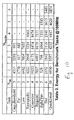
- the number of page-misses of a task heavily depends on the number of banks which are assigned to it (e.g. see tasks in Table 2 ( Fig.10 )).
- the sensitivity of the number of page-misses to the number of banks varies from task to task. Some tasks benefit more from having extra banks assigned to it than others.
- the second embodiment of the present invention provides a guaranteed performance algorithm which allocates more banks to those tasks which benefit most.
- the algorithm generates a data assignment for every task and for any possible (available or planned or potential) number of banks.
- the resulting assignments for each task can be presented in trade-off, e.g. in a Pareto curve which trades off the energy consumption of the task in function of the number of banks. With each point in the curve thus corresponds an assignment, the number of banks required for the assignment and the energy consumption of the assignment. Each point is annotated with the run-time of the task executed according to the corresponding assignment.
- the Pareto curves can be created with the best-effort algorithm based on selfishness.
- the approach consists then of assigning the data of a single task to the SDRAM banks. In this case no run-time information about other tasks is required. As a consequence, at design-time the selfishness of all data structures can be computed and the final data assignment can be generated based on these computations.
- the design time algorithm can be implemented in software application for example, running on a workstation.
- the algorithm distributes the available banks of the platform among the active tasks using the Pareto curves.
- the algorithm selects a point on the Pareto curve of each task such that the energy consumption of all tasks is minimized and that the total number of banks for all tasks is less or equals the available number of banks on the platform.
- a further aspect of this embodiment provides a greedy heuristic which finds a near optimal solution in linear time.
- the execution time of a task-set can be calculated by taking the maximum of the run-times of all tasks within the task-set.
- the run-time algorithm may be included in an operating system for the essentially digital system.
- the source code for operating system known as "LINUX” may be modified to carry out the algorithm and then be re-compiled for the relevant processor.
- An example of a processor is an ARM processor - see the book by Furber.
- a run time operating system may be used which makes use of an existing operating system and makes calls to and from the existing operating system.
- the main goal of the simulation environment represented schematically in Fig. 3 is to study how multi-threaded applications should be mapped on a shared memory hierarchy.
- the processing elements and the memory architecture are simulated independently. This allows quick exploration of different allocations of the data structures on the hierarchical memory, e.g. on e the SDRAM memories, while avoiding long simulation times for the processing elements.
- the processing elements and their performance are simulated using an adapted instruction set simulator.
- the simulator may be implemented as a software program running on a workstation. This simulator dumps a memory access trace for each task in the parallel application. Each memory access in the trace is annotated with its relative issue-time.
- the memory traces are input together with the schedule of the corresponding tasks in the performance and energy evaluation script.
- This script combines the memory access traces in a cycle-accurate way according to the issue-time of each access, the task schedule and the configured memory hierarchy. It outputs the total execution time of each task (including both the processor and memory delay) and the energy consumption of the memory hierarchy.
- the optimal nature of the embodiments of the present invention has been verified against a Monte-Carlo approximation of the best-possible assignment ( MA ). The results of the latter were obtained by measuring 100 different data assignments.
- the memory allocators in accordance with the present invention were compared with three known policies.
- the first reference policy, random allocation (RA ) randomly distributes the data structures across the memory banks and is similar to architecture-unaware allocators. The average energy consumption is shown after 100 runs of the RA policy.
- the SDRAMs are not shared among the processors. Each processor owns an equal number of memory banks. On each processor a local memory allocator manages the private banks (sequential allocation SA ).
- results obtained with embodiments of the present invention are compared a static energy reduction technique.
- This technique clusters the data structures such that the number of active banks is minimized. In the most extreme case, all data is clustered in a single bank (clustered allocation CA ).
- Fig. 4 the energy consumption of the different allocators for the Convolve and Cmp threshold task-set is shown. Note that the SA and GP curves only start from two banks, which is the minimum number of banks needed by these policies. Similar results for other tasks-sets are presented in Table 3 ( Fig.11 ).
- CA clusters the data in as few banks as possible to limit the static energy of memories, but it comes at the cost of extra page-misses and thus more dynamic energy. Therefore, CA increases the total energy consumption when the energy is dominated by the dynamic energy (see Fig. 4 ).
- SA also performs poorly under these conditions. It cannot exploit idle banks owned by other processors to reduce the number of page-misses.
- the difference between SA and MA (an approximation of the best-possible assignment) is large: more than 300% for the Rgb2Yuv / Cmp threshold task-set with 6 banks, indicating that sharing SDRAM memories is an interesting option for heterogeneous multi-processor platforms. It increases the exploration space such that better assignments can be found. When the banks are not too heavily used, there is even no performance penalty (see below).
- Fig. 4 shows how BE (in accordance with the present invention) outperforms RA.
- Results at the top part of Table 3 suggest an improvement up to 50% (see Rgb2Yuv and Cmp threshold with four banks).
- BE often comes close to the MA results.
- the difference between BE and MA is always less than 23%.
- a small energy loss of BE compared to RA for the first task-set is noted when eight banks are used. In this case 50 data structures are allocated in a small amount of banks.
- a limited freedom exists to reduce the number of page-misses, i.e. the energy gap between maximum and minimum energy consumption is small. Note that BE cannot detect the optimal number of banks.
- GP performs equally well for a sufficiently large number of banks.
- the main advantage of this technique is that the execution times of the different tasks can be predicted and guaranteed. Moreover, it will never use more than the optimal number of banks, but its performance breaks down when only few banks are available per task. In this case, it maps (similar to SA) all data structures of each task in a single (or few) banks. It then consumes more energy than RA (29% for Convolve and Cmp threshold with two banks).
- the present invention provides two dynamic memory allocators: a best-effort and a guaranteed performance allocator. Both allocators assign the arrays of dynamically created/deleted tasks to the memory banks, thereby reducing the number of page-misses and thus the energy consumption. The allocators significantly reduce the energy consumption of SDRAMs compared to existing dynamic memory managers.
- Heterogeneous multi-processor platforms potentially offer enough computational performance at a sufficiently low energy consumption, on condition that the applications are intelligently mapped on them.
- a crucial step during the application-to-platform mapping is task-scheduling.
- Task scheduling has been investigated a great deal in the last decades. The emphasis of most prior research has been on how scheduling can be used to improve the performance of a multi-tasked application.
- energy consumption has become a main bottleneck in today's systems. If energy is considered at all in task-scheduling, the focus has been on the processing cores and not on the equally (or more) important memory system.
- a genetic algorithm is presented to explore this trade-off at design-time.
- the design time method according to this embodiment may be carried out on a personal computer or a workstation running software to carry out this method. Results are shown of this algorithm it is indicated how this trade-off can be exploited at run-time to deal with the dynamic behavior of multi-media applications in accordance with a further embodiment of the present invention.
- the run-time aspect of this embodiment is carried out on a target essentially digital system such as a processor with a multibank memory.
- the processor may be an ARM processor core, for example (see book by Furber).
- AN operating system such as the LINUX operating system is adapted to carry out the run-time aspects of this embodiment.
- the source code of LINUX operating system is available and is modified and then re-compiled for the relevant processor.
- a set of energy-optimal implementations are generated for the most common task-sets ( scenarios ). At run-time, as soon as the task-set changes, a best fitting design-time implementation is selected for the newly activated task-set.
- the present invention therefore has a first aim to reduce the dynamic energy.
- Page-misses are the main source of dynamic energy consumption in multi-banked memories (e.g. SDRAMs). They can be avoided by ensuring that consecutive accesses to a memory bank hit in the same page.
- the data-to-bank assignment directly influences the access order seen by each memory bank, and thus the number of page-misses.
- By storing spatial local data structures in banks alone a large number of page-misses can be avoided. Since the number of banks is limited, a careful decision is necessary which data structures benefit most from being stored alone in a bank. This decision depends on several factors: the number of accesses, the time between accesses and the spatial locality that exists in the access pattern of the data structure.
- a heuristic can be built to steer the data allocation process as indicated above. Since the set of tasks which is executing in parallel is only known at run-time, the assignment decisions can not be taken at design-time. Dynamic memory allocators are then a potential solution.
- a task-set is used which consists of four independent small tasks.
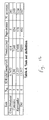
- the number of data structures (N ds ) used by each task, the energy consumption of the SDRAM and execution time of the tasks are presented in Table 4. These numbers are obtained by executing each task independently of the others, and with the data allocation policy for the banks as explained above for the first two embodiments.
- Schedule D in Fig. 5 corresponds to sequential scheduling: the longest execution time with the lowest energy consumption.
- Parallel scheduling corresponds with part A of the figure, following the expected behavior.
- B and C are intermediate solution schedules that can be picked up at run time if suitable.
- FIG. 6 A Pareto trade-off curve of all possible schedules is shown in Fig. 6 .
- Fig. 5 also indicates that the execution time of a task cannot be estimated independent of other tasks running on the platform. The time penalty arising from sharing the SDRAM between several concurrent tasks reaches up to 300% for CMP (in schedule A), compared to its execution time without other tasks executing on the platform ( CMP in schedule B ).
- these Pareto-curves are generated using a simple genetic algorithm (see below).
- execution progress is periodic (e.g. frame based) and deadlines exist. At the start of each period a different dynamic task set can appear, and the deadline will be the maximum execution time for that frame.
- An aspect of the present invention is to quantify the impact of task-scheduling on the data transfer and storage cost for an execution following this pattern and to make use of this information to explore a design space.
- a genetic algorithm (GA) is used, adapted from a generalized genetic algorithm.
- one complete run of the GA algorithm produces an energy optimal Pareto point meeting time constraints. These time constraints are given as a parameter to the algorithm and represent the deadline of the frame.
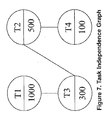
- the population of the GA algorithm consists of several potential partial task-orderings. Each task-ordering is represented with an unordered compatibility graph. The nodes of the graph correspond to the tasks in the application. If an edge between two nodes exists, the two corresponding tasks can be executed in parallel. A random set of these graphs representing inter-task restrictions form the genes of the initial population.
- To evaluate the fitness of a gene a full ordering of the task-set is defined using a list scheduling approach and taking the constraints imposed by the gene into account. Subsequently, the data of the tasks is assigned to the memories and the energy and execution time ofthe schedule with a multi-processor simulator is evaluated. Finally, the fitness of the gene based on the current imposed deadline for the task-set is evaluated as well as its simulated execution time and energy consumption.
- the final solution is chosen as a Pareto point representing a configuration that minimizes the energy consumption for the given deadline.
- the goodness of this point depends on the number of genes per generation and the number of generations.
- a task ordering graph is built. Assuming an unbound number of processors and starting with the restrictions imposed by the current task-graph, a least laxity first ( llf ) policy is applied, but constrained to the compatibility graph. Since only one deadline exists for the entire frame, this approach is equivalent to a longest task first policy. This is illustrated with a small task graph shown in Fig. 7 .
- the execution time of each task is indicated inside each node.
- the first task to schedule is T1, at time 0.
- T2 should be scheduled.
- T1 and T2 are incompatible (see Fig. 7 )
- T2 can only be executed after T1 finishes.
- the algorithm therefore tries to schedule the next candidate task (T3).
- the compatibility graph indicates that T3 and T1 can run in parallel (see schedule in Fig. 8 ).
- An execution phase is an interval of the schedule in which a fixed set of tasks is executed in parallel. For instance, in Fig. 8 , four phases ( ⁇ 0 to ⁇ 3) are present for the four tasks.
- the list scheduler is shown in Algorithm 3 ( Fig.18 ).
- the scheduler picks the candidate task with the highest execution time (line 7). It then verifies whether the candidate task is compatible with the already allocated tasks which are executed in parallel (line 8). If it is possible to schedule the task, the output is updated, a new execution phase is started and the existing ones are adapted and book keep the OL T and OL AT (lines 9-13). If not, the algorithm tries to schedule the remaining candidates in order of decreasing execution time. If no candidates can be found, the time is advanced until a task finishes (lines 17-18).
- the technique of the first two embodiments is used to assign the data to the hierarchical memory, e.g. to the SDRAM banks.
- the data of the tasks is allocated in the longest execution phase first. This algorithm is repeated for the remaining phases by decreasing execution time.
- the algorithm tracks the lifetime of the data structures. For a given phase, the data structures are only allocated which are alive in that phase. When a data structure has already been allocated (during the allocation of a longer phase), the prior allocation decision is maintained. Each data structure is thus allocated only once.
- the process is illustrated with the task set of Fig. 8 .
- the data of the longest phase is allocated, i.e. the data of T1 in ⁇ 1.
- it is determined where to store the data of T2 in (the second longest phase ⁇ 3). Since T1 is not active in ⁇ 3, no constraints are imposed by prior allocation decisions for T1. All banks are thus available to store the data of T2.
- the data of the active tasks (T1,T3) are allocated in ⁇ 0. Because the data structures of T1 have already been allocated in ⁇ 1, it is only necessary to decide where to place the data of T3.
- the data of the remaining phase ( ⁇ 2) is allocated in a similar way.
- the main goal of the simulation environment is to study how multi-threaded applications should be mapped onto a shared memory hierarchy.
- the processing elements and the memory architecture are simulated independently. This allows quick exploration of different allocations of the data structures on the hierarchical memory, e.g. on the SDRAM memories while avoiding long simulation times for the processing elements.
- the processing elements and their performance are simulated using an adapted instruction set simulator. This simulator dumps a memory access trace for each task in the parallel application. Each memory access in the trace is annotated with its relative issue-time.
- the memory traces are input together with the schedule of the corresponding tasks in the performance and energy evaluation script.
- This script combines the memory access traces in a cycle-accurate way according to the issue-time of each access, the task schedule and the configured memory hierarchy. It outputs the total execution time of each task (including both the processor and memory delay) and the energy consumption of the memory hierarchy.
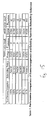
- results are shown for the GA algorithm according to the present invention for the Cmp.Conv.Raw.2Dct task-set. Similar results for other task-sets are presented in Table 6. The results indicate that for a given number of banks a trade-off exists between execution-time and energy consumption. Note that only two out of many intermediate Pareto points are shown. As long as enough bandwidth is available to the SDRAMs, the execution time can be decreased by scheduling tasks in parallel. The more tasks are executed in parallel, the more data is alive at the same time. When the number of data structures becomes large, it becomes difficult to find an energy efficient data assignment.
- a Pareto-set of task-schedules are generated and stored in a memory (see Table 6).
- the scenario which is active is identified and the least energy consuming schedule selected from the Pareto-set which still satisfies the time constraints.
- scenario 2Raw becomes active and the time-budget is 50,000 cycles.
- the scheduler selects then the slow solution from Table 6 with an execution time of 35739 cycles and an average energy consumption of 32 uJ.
- the existing run-time techniques are unaware of the energy cost of the memory hierarchy. As long as enough processors are available, all tasks are scheduled in parallel even when the time budget is relaxed.
- the execution time and energy consumption under the fully parallel reference schedule are shown in the fifth and sixth column of Table 6.
- the energy/performance of the proposed scenario approach has been measured after 1000 frames and compared with the prior art.
- the results are shown in Table 7 ( Fig.15 ). At the start of each frame, either a random task-set or one of the scenarios from Tab. 6 needs to be scheduled.
- the first set of results were obtained under the assumption that all the task-sets (100 % prediction) which can occur at run-time are known at design-time.
- the run-time aspect of this embodiment is carried out on a target essentially digital system such as a processor with a multibank memory.
- the processor may be an ARM processor core, for example (see book by Furber).
- An operating system such as the LINUX operating system is adapted to carry out the run-time aspects of this embodiment.
- the source code of LINUX operating system is available and is modified and then re-compiled for the relevant processor.
- the design environment suitable for use with the present invention may be a personal computer or a workstation on which suitable software is running to carry out the methods of the invention.
- the software may execute on this environment which carries out a method for preparing memory allocation of at least two data structures for at least one task to be executed on a substantially digital system having multi-bank storage means, the at least two data structures being accessed by said at least one task.
- the software can provide means for determining a value of a parameter representing an energy benefit related to accesses required for executing the task for each storing of each of the at least two data structures in one bank alone of the storage means, and means for determining at least one allocation of the at least two data structures to one or more banks in accordance with the determined parameters.
- the software may also facilitate storing of the at least one allocation.
- the determining of at least one allocation can include minimizing a combination of the values of the parameters per bank.
- the software may allow a combination which includes weighting the parameter in accordance with the size of the data structure.
- the multi-bank storage means can comprise at least at first and a second hierarchical storage level, the first hierarchical level serving as a buffer for the second hierarchical level, and the software when executed provides the means for determining the value of the parameter which includes means for determining the average time between misses for the first hierarchical level and the average time between accesses to the data structure.
- the substantially digital system having multi-bank storage means may allow a plurality of tasks to be executed, and the software when executed may comprise means for determining the value of the parameter representing an energy benefit for each of said data structures for each of said tasks, and also for minimizing the combination of values of the parameters per bank.
- the software when executed may comprise means for determining of the values of the parameters for said tasks which performs this determination for a larger set of tasks than for the step of minimizing, which is applied to an active subset only which is to be active when the plurality of tasks is be executed on a substantially digital target system.
- the software when executed may comprise means for determining the values of the parameter for each of the data structures of each of the at least one task for at least a first and a second number of banks of the multi-bank storage means.
- the software when executed may provide means such that for each task for its data structures, allocations are determined at least for the first number of banks and the second number of banks.
- the software when executed can provide means such that from the obtained data allocations a selection is made that minimizes the energy consumption for executing all tasks, with the constraint that the amount of banks must be less than a predetermined number of banks while satisfying execution timing constraints.
- the software when executed may comprise means for selecting of an allocation for each of the banks such that: a selected energy consumption and associated execution time is one combination relating to a plurality of energy consumption-execution time operating points of a predetermined set of optimal energy consumption-execution time operating points.
- the plurality of energy consumption-execution time operating points can belong to a first trade-off set, wherein for any one combination of energy consumption-execution time for an operating point, all other combinations of energy consumption and execution time for all other operating points in the first trade-off set having a value of the energy consumption which is lower than the value for the one combination, have a value for the execution time which is higher than the value of execution time of the one combination, and all other combinations of energy consumption and execution time for all other operating points in the first trade-off set having a value of the energy consumption which is higher than the value for the one combination, have a value for the execution time which is lower than the value of the execution time for the one combination.
- the software when executed may comprise means for a selection of allocations by exploring a plurality of schedulings of the tasks involved.
- the plurality of energy consumption-execution time operating points can belong to a second trade-off set, wherein for any one combination of energy consumption-execution time for an operating point, all other combinations of energy consumption and execution time for all other operating points in the second trade-off set having a value of the energy consumption which is lower than the value for the one combination, have a value for the execution time which is higher than the value of execution time of the one combination, and all other combinations of energy consumption and execution time for all other operating points in the second trade-off set having a value of the energy consumption which is higher than the value for the one combination, have a value for the execution time which is lower than the value of the execution time for the one combination.
- the present invention includes that the same device is used for design and run-time implementations.
Landscapes
- Engineering & Computer Science (AREA)
- General Engineering & Computer Science (AREA)
- Theoretical Computer Science (AREA)
- Software Systems (AREA)
- Physics & Mathematics (AREA)
- General Physics & Mathematics (AREA)
- Power Sources (AREA)
- Debugging And Monitoring (AREA)
- Memory System (AREA)
- Image Input (AREA)
Claims (15)
- Verfahren zum Erstellen einer Speicherzuordnung von mindestens zwei Datenstrukturen für mindestens eine Aufgabe, die auf einem digitalen System mit einem Mehrfachbanken-Speichermittel ausgeführt wird, wobei jede der mindestens zwei Datenstrukturen mit mindestens einer der mindestens einen Aufgabe verknüpft ist, die auf sie zugreift, wobei das Verfahren umfasst:- Bestimmen für jede Datenstruktur des Wertes eines Parameters, der mindestens ein Maß der räumlichen Position eines Zugriffsmusters auf die Datenstruktur darstellt, wenn die Aufgabe, die mit der Datenstruktur verknüpft ist, ausgeführt wird;- Bestimmen für jede Aufgabe für mindestens eine erste und eine zweite Anzahl von Banken einer Zuordnung der mit der Aufgabe verknüpften Datenstrukturen zu den Banken, so dass die Summe der Werte der Parameter aller Datenstrukturen in einer Bank unter den Banken ausgewogen ist;- Bestimmen für jede bestimmte Zuordnung einer verknüpften Ausführungszeit und eines Energieverbrauchs, die notwendig sind, um die Aufgabe bei Verwendung der vorbestimmten Zuordnung auszuführen;wobei die bestimmten Zuordnungen während einer Laufzeit zum Verteilen der verfügbaren Banken unter den aktiven Aufgaben verwendet werden, indem für jede aktive Aufgabe eine vorbestimmte Zuordnung gewählt und ihre Datenstrukturen einer Anzahl von Bänken gemäß der gewählten Zuordnung so zugeordnet werden, dass der Energieverbrauch zur Ausführung aller Aufgaben minimiert ist,
mit der Einschränkung, dass die Gesamtanzahl von zugeordneten Banken geringer als eine vorbestimmte Anzahl von Banken sein muss und dass die Ausführungszeiteinschränkungen der aktiven Aufgaben erfüllt sind. - Verfahren nach Anspruch 1, wobei der Parameter auch ein Maß einer zeitlichen Position von Zugriffen auf die Datenstruktur bei Ausführung der Aufgabe ist.
- Verfahren nach einem der vorangehenden Ansprüche, wobei das Mehrfachbanken-Speichermittel (1) mindestens eine erste und zweite hierarchische Speicherebene umfasst, wobei die erste hierarchische Speicherebene (2) als Zwischenspeicher für die zweite hierarchische Speicherebene (4) dient und wobei die Bestimmung der Werte der Parameter den Schritt des Dividierens der durchschnittlichen Zeit zwischen Seitenfehlschlägen für die erste hierarchische Ebene durch die durchschnittliche Zeit zwischen Zugriffen auf die Datenstruktur enthält.
- Verfahren nach Anspruch 1, wobei der Schritt des Bestimmens der Zuordnungen der mit den Aufgaben verknüpften Datenstrukturen zu den Banken für einen größeren Satz von Aufgaben durchgeführt wird als der Schritt des Minimierens, der nur bei einem Teilsatz von Aufgaben angewendet wird, die aktiv sind, wenn die mindestens eine Aufgabe auf dem digitalen System ausgeführt wird.
- Verfahren nach Anspruch 1, wobei die vorbestimmte Anzahl von Banken die Anzahl von Banken ist, die auf einer digitalen Zielvorrichtung zur Verfügung stehen, auf der die Aufgaben ausgeführt werden sollen.
- Verfahren nach Anspruch 5, wobei durch einen Vergleich der Einschränkungen bezüglich der Laufzeit-Ausführungszeit mit der vorbestimmten verknüpften Ausführungszeit bestimmt wird, ob die Ausführungszeiteinschränkungen erfüllt sind.
- Verfahren nach Anspruch 5, wobei die Auswahl einer Zuordnung zu einem ausgewählten Energieverbrauch und einer verknüpften Ausführungszeit führt, was eine Kombination aus mehreren zuvor erhaltenen Energieverbrauch-Ausführungszeit-Betriebspunkten ist, die mit zuvor erhaltenen Zuordnungen verknüpft sind.
- Verfahren nach Anspruch 7, wobei die mehreren Energ-everbrauch-Ausführungszeit-Betriebspunkte zu einem ersten Ausgleichsatz gehören, wobei für jede Kombination aus Energieverbrauch-Ausführungszeit für einen Betriebspunkt alle anderen Kombinationen aus Energieverbrauch-Ausführungszeit für alle anderen Betriebspunkte im ersten Ausgleichsatz, die einen Wert für den Energieverbrauch haben, der geringer ist als der Wert für die eine Kombination, einen Wert für die Ausführungszeit haben, der höher ist als der Ausführungszeitwert der einen Kombination, und alle anderen Kombinationen aus Energieverbrauch-Ausführungszeit für alle anderen Betriebspunkte im ersten Ausgleichsatz, die einen Werte für den Energieverbrauch haben, der höher ist als der Wert für die eine Kombination, einen Wert für die Ausführungszeit haben, der geringer ist als der Ausführungszeitwert für die eine Kombination.
- Verfahren nach einem der vorangehenden Ansprüche, wobei eine Auswahl von Zuordnungen durch Untersuchung mehrerer Ablaufplanungen der beteiligten aktiven Aufgaben erfolgt.
- Verfahren nach Anspruch 9, wobei mindestens eine erste und eine zweite Aufgabe vorhanden ist und die Bestimmung der Zuordnungen die Auswahl einer Zuordnung für die erste und zweite Ablaufplanung der mindestens ersten und zweiten Aufgabe enthält, die einen Energieverbrauch und eine verknüpfte Ausführungszeit aufweist, die eine Kombination aus mehreren Energieverbrauch-Ausführungszeit-Betriebspunkten ist, die mit zuvor erhaltenen Zuordnungen verknüpft sind.
- Verfahren nach Anspruch 10, wobei die mehreren Energieverbrauch-Ausführungszeit-Betriebspunkten zu einem zweiten Ausgleichsatz gehören, wobei für jede Kombination aus Energieverbrauch-Ausführungszeit für einen Betriebspunkt alle anderen Kombinationen aus Energieverbrauch-Ausführungszeit für alle anderen Betriebspunkte im zweiten Ausgleichsatz, die einen Wert für den Energieverbrauch haben, der geringer ist als der Wert für die eine Kombination, einen Wert für die Ausführungszeit haben, der höher ist als der Ausführungszeitwert der einen Kombination, und alle anderen Kombinationen aus Energieverbrauch-Ausführungszeit für alle anderen Betriebspunkte im zweiten Ausgleichsatz, die einen Werte für den Energieverbrauch haben, der höher ist als der Wert für die eine Kombination, einen Wert für die Ausführungszeit haben, der geringer ist als der Ausführungszeitwert für die eine Kombination.
- Verfahren zum Ausführen mindestens einer Aufgabe, die auf Datenstrukturen auf einem digitalen System zugreift, das einen Prozessor und ein Mehrfachbanken-Speichermittel und einen Speicher von Zuordnungen der Datenstrukturen, auf die zugegriffen wird, hat, wobei die Zuordnungen durch ein Verfahren nach einem der Ansprüche 1 bis 4 bestimmt wurden, wobei das Verfahren umfasst:- Laden der mindestens einen Aufgabe,- Zugreifen auf den Speicher von Zuordnungen und- für jede geladene Aufgabe, Auswählen einer Zuordnung zu dem Mehrfachbanken-Speichermittel der einen oder mehreren Datenstrukturen, auf die die geladene Aufgabe zugreift, und Zuordnen der Datenstrukturen zu einer Anzahl von Bänken gemäß der ausgewählten Zuordnung, so dass der Energieverbrauch für alle geladenen Aufgaben minimiert ist, mit der Einschränkung, dass die Gesamtanzahl von zugeordneten Banken geringer als eine vorbestimmte Anzahl von Banken sein muss und dass die Ausführungszeiteinschränkunqen aller geladenen Aufgaben erfüllt sind.
- Verfahren nach Anspruch 12, wobei ein ausgewählter Energieverbrauch und eine verknüpfte Ausführungszeit eine Kombination aus mehreren Energieverbrauch-Ausführungszeit-Betriebspunkten von zuvor erhaltenen Speicherzuordnungen sind.
- Verfahren nach Anspruch 13, wobei die mehreren Energieverbrauch-Ausführungszeit-Betriebspunkte zu einem dritte Ausgleichsatz gehören, wobei für jede Kombination aus Energieverbrauch-Ausführungszeit für einen Betriebspunkt alle anderen Kombinationen aus Energieverbrauch-Ausführungszeit für alle anderen Betriebspunkte im dritten Ausgleichsatz, die einen Wert für den Energieverbrauch haben, der geringer ist als der Wert für die eine Kombination, einen Wert für die Ausführungszeit haben, der höher ist als der Ausführungszeitwert der einen Kombination, und alle anderen Kombinationen aus Enercieverbrauch-Ausführungszeit für alle anderen Betriebspunkte im dritten Ausgleichsatz, die einen Werte für den Energieverbrauch haben, der höher ist als der Wert für die eine Kombination, einen Wert für die Ausführungszeit haben, der geringer ist als der Ausführungszeitwert für die eine Kombination.
- Verfahren nach einem der Ansprüche 12 bis 14, des Weiteren umfassend das Speichern der Ablaufplanungen und zugehörigen Speicherzuordnungen und das Ausführen mindestens einer ersten und zweiten Aufgabe gemäß einer Ablaufplanung, die mit der ausgewählten Speicherzuordnung verknüpft ist.
Applications Claiming Priority (3)
| Application Number | Priority Date | Filing Date | Title |
|---|---|---|---|
| GBGB0226776.3A GB0226776D0 (en) | 2002-11-18 | 2002-11-18 | Cost-aware design-time/run-time memory management |
| GB0226776 | 2002-11-18 | ||
| PCT/BE2003/000202 WO2004046921A2 (en) | 2002-11-18 | 2003-11-18 | Cost-aware design-time/run-time memory management methods and apparatus |
Publications (2)
| Publication Number | Publication Date |
|---|---|
| EP1570348A2 EP1570348A2 (de) | 2005-09-07 |
| EP1570348B1 true EP1570348B1 (de) | 2013-04-10 |
Family
ID=9947966
Family Applications (1)
| Application Number | Title | Priority Date | Filing Date |
|---|---|---|---|
| EP03775007.2A Expired - Lifetime EP1570348B1 (de) | 2002-11-18 | 2003-11-18 | Verfahren und geräte für die kostbewusste speicherverwaltung während der entwurfzeit/laufzeit |
Country Status (5)
| Country | Link |
|---|---|
| US (1) | US7552304B2 (de) |
| EP (1) | EP1570348B1 (de) |
| AU (1) | AU2003283140A1 (de) |
| GB (1) | GB0226776D0 (de) |
| WO (1) | WO2004046921A2 (de) |
Families Citing this family (16)
| Publication number | Priority date | Publication date | Assignee | Title |
|---|---|---|---|---|
| TWI251171B (en) * | 2004-09-21 | 2006-03-11 | Univ Tsinghua | Task scheduling method with low power consumption and a SOC using the method |
| US20070006223A1 (en) * | 2005-04-18 | 2007-01-04 | Research In Motion Limited | System and method for visual design of resource management references |
| US8694970B2 (en) * | 2005-06-02 | 2014-04-08 | Seagate Technology Llc | Unified debug system with multiple user-configurable trace volumes and trace buffers |
| US20070204179A1 (en) * | 2006-02-28 | 2007-08-30 | Meikang Qiu | Minimize Energy Consumption Using Optimal Voltage Assignment Algorithm |
| US7512507B2 (en) * | 2006-03-23 | 2009-03-31 | Micron Technology, Inc. | Die based trimming |
| US7292487B1 (en) * | 2006-05-10 | 2007-11-06 | Micron Technology, Inc. | Independent polling for multi-page programming |
| US8630934B2 (en) * | 2006-06-20 | 2014-01-14 | Omx Technology Ab | System and method for monitoring trading |
| FR2927438B1 (fr) * | 2008-02-08 | 2010-03-05 | Commissariat Energie Atomique | Methode de prechargement dans une hierarchie de memoires des configurations d'un systeme heterogene reconfigurable de traitement de l'information |
| KR101474597B1 (ko) * | 2008-08-13 | 2014-12-18 | 휴렛-팩커드 디벨롭먼트 컴퍼니, 엘.피. | 가상 메모리 디바이스에 대한 동작 모드 결정 방법 및 시스템 |
| US8930954B2 (en) * | 2010-08-10 | 2015-01-06 | International Business Machines Corporation | Scheduling parallel data tasks |
| CN102135793B (zh) * | 2011-03-29 | 2012-07-04 | 北京工业大学 | 一种面向低功耗的多核共享Cache混合划分方法 |
| US8874893B2 (en) | 2012-03-26 | 2014-10-28 | International Business Machines Corporation | Effect translation and assessment among microarchitecture components |
| US20150039837A1 (en) * | 2013-03-06 | 2015-02-05 | Condusiv Technologies Corporation | System and method for tiered caching and storage allocation |
| US9766681B2 (en) * | 2014-06-17 | 2017-09-19 | Empire Technology Development Llc | Operations related to a retransmission buffer |
| US10970081B2 (en) | 2017-06-29 | 2021-04-06 | Advanced Micro Devices, Inc. | Stream processor with decoupled crossbar for cross lane operations |
| US10620958B1 (en) * | 2018-12-03 | 2020-04-14 | Advanced Micro Devices, Inc. | Crossbar between clients and a cache |
-
2002
- 2002-11-18 GB GBGB0226776.3A patent/GB0226776D0/en not_active Ceased
-
2003
- 2003-11-18 WO PCT/BE2003/000202 patent/WO2004046921A2/en not_active Ceased
- 2003-11-18 AU AU2003283140A patent/AU2003283140A1/en not_active Abandoned
- 2003-11-18 EP EP03775007.2A patent/EP1570348B1/de not_active Expired - Lifetime
-
2005
- 2005-05-18 US US11/133,155 patent/US7552304B2/en not_active Expired - Fee Related
Non-Patent Citations (1)
| Title |
|---|
| DELALUZ V ET AL: "HARDWARE AND SOFTWARE TECHNIQUES FOR CONTROLLING DRAM POWER MODES", IEEE TRANSACTIONS ON COMPUTERS, IEEE SERVICE CENTER, LOS ALAMITOS, CA, US, vol. 50, no. 11, 1 November 2001 (2001-11-01), pages 1154 - 1173, XP008044001, ISSN: 0018-9340, DOI: 10.1109/12.966492 * |
Also Published As
| Publication number | Publication date |
|---|---|
| EP1570348A2 (de) | 2005-09-07 |
| WO2004046921A3 (en) | 2005-05-06 |
| GB0226776D0 (en) | 2002-12-24 |
| US7552304B2 (en) | 2009-06-23 |
| US20060018179A1 (en) | 2006-01-26 |
| AU2003283140A1 (en) | 2004-06-15 |
| WO2004046921A2 (en) | 2004-06-03 |
Similar Documents
| Publication | Publication Date | Title |
|---|---|---|
| US7552304B2 (en) | Cost-aware design-time/run-time memory management methods and apparatus | |
| Delaluz et al. | DRAM energy management using software and hardware directed power mode control | |
| TWI628539B (zh) | 在多核心處理器中執行電源管理 | |
| Hormati et al. | Flextream: Adaptive compilation of streaming applications for heterogeneous architectures | |
| CN104520823A (zh) | 用于混合存储器管理的方法、系统和设备 | |
| Ki et al. | Co-optimizing CPU voltage, memory placement, and task offloading for energy-efficient mobile systems | |
| Jang et al. | Energy reduction in consolidated servers through memory-aware virtual machine scheduling | |
| JP2009503627A (ja) | コンピュータ装置におけるメモリ管理 | |
| Yoon et al. | Supporting swap in real-time task scheduling for unified power-saving in CPU and memory | |
| Spasic et al. | Energy-efficient mapping of real-time applications on heterogeneous MPSoCs using task replication | |
| He et al. | A heuristic energy-aware approach for hard real-time systems on multi-core platforms | |
| KR20240132010A (ko) | Iommu 공동 배치 자원 관리자 | |
| Bahn et al. | Evolution-based real-time job scheduling for co-optimizing processor and memory power savings | |
| Wang et al. | Energy-aware variable partitioning and instruction scheduling for multibank memory architectures | |
| Cho et al. | Adaptive scratch pad memory management for dynamic behavior of multimedia applications | |
| Liang et al. | Data center multidimensional management strategy based on descending neighborhood DBSCAN algorithm in unsupervised learning | |
| Marchal et al. | Integrated task scheduling and data assignment for SDRAMs in dynamic applications | |
| Quan et al. | An iterative multi-application mapping algorithm for heterogeneous mpsocs | |
| Wehmeyer et al. | Fast, efficient and predictable memory accesses: optimization algorithms for memory architecture aware compilation | |
| US20220100257A1 (en) | Compiler directed fine grained power management | |
| Gauthier et al. | Minimizing inter-task interferences in scratch-pad memory usage for reducing the energy consumption of multi-task systems | |
| US20220197649A1 (en) | General purpose register hierarchy system and method | |
| Chang et al. | Array allocation taking into account SDRAM characteristics | |
| Bruns et al. | Empirical study of Amdahl’s law on multicore processors | |
| Hassan | Thermal and Energy Efficiency Management of Mobile MPSoC: A Review |
Legal Events
| Date | Code | Title | Description |
|---|---|---|---|
| PUAI | Public reference made under article 153(3) epc to a published international application that has entered the european phase |
Free format text: ORIGINAL CODE: 0009012 |
|
| 17P | Request for examination filed |
Effective date: 20050614 |
|
| AK | Designated contracting states |
Kind code of ref document: A2 Designated state(s): AT BE BG CH CY CZ DE DK EE ES FI FR GB GR HU IE IT LI LU MC NL PT RO SE SI SK TR |
|
| AX | Request for extension of the european patent |
Extension state: AL LT LV MK |
|
| DAX | Request for extension of the european patent (deleted) | ||
| 17Q | First examination report despatched |
Effective date: 20060705 |
|
| RAP1 | Party data changed (applicant data changed or rights of an application transferred) |
Owner name: IMEC |
|
| GRAP | Despatch of communication of intention to grant a patent |
Free format text: ORIGINAL CODE: EPIDOSNIGR1 |
|
| RIN1 | Information on inventor provided before grant (corrected) |
Inventor name: BRUNI, DAVIDE Inventor name: MARCHAL, PAUL Inventor name: GOMEZ, JOSE IGNACIO Inventor name: CATTHOOR, FRANCKY |
|
| GRAS | Grant fee paid |
Free format text: ORIGINAL CODE: EPIDOSNIGR3 |
|
| GRAA | (expected) grant |
Free format text: ORIGINAL CODE: 0009210 |
|
| AK | Designated contracting states |
Kind code of ref document: B1 Designated state(s): AT BE BG CH CY CZ DE DK EE ES FI FR GB GR HU IE IT LI LU MC NL PT RO SE SI SK TR |
|
| REG | Reference to a national code |
Ref country code: GB Ref legal event code: FG4D |
|
| REG | Reference to a national code |
Ref country code: CH Ref legal event code: EP Ref country code: AT Ref legal event code: REF Ref document number: 606340 Country of ref document: AT Kind code of ref document: T Effective date: 20130415 |
|
| REG | Reference to a national code |
Ref country code: IE Ref legal event code: FG4D |
|
| REG | Reference to a national code |
Ref country code: DE Ref legal event code: R096 Ref document number: 60343756 Country of ref document: DE Effective date: 20130606 |
|
| PG25 | Lapsed in a contracting state [announced via postgrant information from national office to epo] |
Ref country code: SI Free format text: LAPSE BECAUSE OF FAILURE TO SUBMIT A TRANSLATION OF THE DESCRIPTION OR TO PAY THE FEE WITHIN THE PRESCRIBED TIME-LIMIT Effective date: 20130410 |
|
| REG | Reference to a national code |
Ref country code: AT Ref legal event code: MK05 Ref document number: 606340 Country of ref document: AT Kind code of ref document: T Effective date: 20130410 |
|
| REG | Reference to a national code |
Ref country code: NL Ref legal event code: VDEP Effective date: 20130410 |
|
| PG25 | Lapsed in a contracting state [announced via postgrant information from national office to epo] |
Ref country code: ES Free format text: LAPSE BECAUSE OF FAILURE TO SUBMIT A TRANSLATION OF THE DESCRIPTION OR TO PAY THE FEE WITHIN THE PRESCRIBED TIME-LIMIT Effective date: 20130721 Ref country code: PT Free format text: LAPSE BECAUSE OF FAILURE TO SUBMIT A TRANSLATION OF THE DESCRIPTION OR TO PAY THE FEE WITHIN THE PRESCRIBED TIME-LIMIT Effective date: 20130812 Ref country code: NL Free format text: LAPSE BECAUSE OF FAILURE TO SUBMIT A TRANSLATION OF THE DESCRIPTION OR TO PAY THE FEE WITHIN THE PRESCRIBED TIME-LIMIT Effective date: 20130410 Ref country code: SE Free format text: LAPSE BECAUSE OF FAILURE TO SUBMIT A TRANSLATION OF THE DESCRIPTION OR TO PAY THE FEE WITHIN THE PRESCRIBED TIME-LIMIT Effective date: 20130410 Ref country code: GR Free format text: LAPSE BECAUSE OF FAILURE TO SUBMIT A TRANSLATION OF THE DESCRIPTION OR TO PAY THE FEE WITHIN THE PRESCRIBED TIME-LIMIT Effective date: 20130711 Ref country code: FI Free format text: LAPSE BECAUSE OF FAILURE TO SUBMIT A TRANSLATION OF THE DESCRIPTION OR TO PAY THE FEE WITHIN THE PRESCRIBED TIME-LIMIT Effective date: 20130410 Ref country code: BE Free format text: LAPSE BECAUSE OF FAILURE TO SUBMIT A TRANSLATION OF THE DESCRIPTION OR TO PAY THE FEE WITHIN THE PRESCRIBED TIME-LIMIT Effective date: 20130410 Ref country code: AT Free format text: LAPSE BECAUSE OF FAILURE TO SUBMIT A TRANSLATION OF THE DESCRIPTION OR TO PAY THE FEE WITHIN THE PRESCRIBED TIME-LIMIT Effective date: 20130410 |
|
| PG25 | Lapsed in a contracting state [announced via postgrant information from national office to epo] |
Ref country code: CY Free format text: LAPSE BECAUSE OF FAILURE TO SUBMIT A TRANSLATION OF THE DESCRIPTION OR TO PAY THE FEE WITHIN THE PRESCRIBED TIME-LIMIT Effective date: 20130410 Ref country code: BG Free format text: LAPSE BECAUSE OF FAILURE TO SUBMIT A TRANSLATION OF THE DESCRIPTION OR TO PAY THE FEE WITHIN THE PRESCRIBED TIME-LIMIT Effective date: 20130710 |
|
| PG25 | Lapsed in a contracting state [announced via postgrant information from national office to epo] |
Ref country code: CZ Free format text: LAPSE BECAUSE OF FAILURE TO SUBMIT A TRANSLATION OF THE DESCRIPTION OR TO PAY THE FEE WITHIN THE PRESCRIBED TIME-LIMIT Effective date: 20130410 Ref country code: DK Free format text: LAPSE BECAUSE OF FAILURE TO SUBMIT A TRANSLATION OF THE DESCRIPTION OR TO PAY THE FEE WITHIN THE PRESCRIBED TIME-LIMIT Effective date: 20130410 Ref country code: SK Free format text: LAPSE BECAUSE OF FAILURE TO SUBMIT A TRANSLATION OF THE DESCRIPTION OR TO PAY THE FEE WITHIN THE PRESCRIBED TIME-LIMIT Effective date: 20130410 Ref country code: EE Free format text: LAPSE BECAUSE OF FAILURE TO SUBMIT A TRANSLATION OF THE DESCRIPTION OR TO PAY THE FEE WITHIN THE PRESCRIBED TIME-LIMIT Effective date: 20130410 |
|
| PLBE | No opposition filed within time limit |
Free format text: ORIGINAL CODE: 0009261 |
|
| STAA | Information on the status of an ep patent application or granted ep patent |
Free format text: STATUS: NO OPPOSITION FILED WITHIN TIME LIMIT |
|
| PG25 | Lapsed in a contracting state [announced via postgrant information from national office to epo] |
Ref country code: RO Free format text: LAPSE BECAUSE OF FAILURE TO SUBMIT A TRANSLATION OF THE DESCRIPTION OR TO PAY THE FEE WITHIN THE PRESCRIBED TIME-LIMIT Effective date: 20130410 Ref country code: IT Free format text: LAPSE BECAUSE OF FAILURE TO SUBMIT A TRANSLATION OF THE DESCRIPTION OR TO PAY THE FEE WITHIN THE PRESCRIBED TIME-LIMIT Effective date: 20130410 |
|
| 26N | No opposition filed |
Effective date: 20140113 |
|
| REG | Reference to a national code |
Ref country code: DE Ref legal event code: R097 Ref document number: 60343756 Country of ref document: DE Effective date: 20140113 |
|
| REG | Reference to a national code |
Ref country code: DE Ref legal event code: R119 Ref document number: 60343756 Country of ref document: DE |
|
| REG | Reference to a national code |
Ref country code: CH Ref legal event code: PL |
|
| GBPC | Gb: european patent ceased through non-payment of renewal fee |
Effective date: 20131118 |
|
| PG25 | Lapsed in a contracting state [announced via postgrant information from national office to epo] |
Ref country code: CH Free format text: LAPSE BECAUSE OF NON-PAYMENT OF DUE FEES Effective date: 20131130 Ref country code: MC Free format text: LAPSE BECAUSE OF FAILURE TO SUBMIT A TRANSLATION OF THE DESCRIPTION OR TO PAY THE FEE WITHIN THE PRESCRIBED TIME-LIMIT Effective date: 20130410 Ref country code: LI Free format text: LAPSE BECAUSE OF NON-PAYMENT OF DUE FEES Effective date: 20131130 |
|
| REG | Reference to a national code |
Ref country code: FR Ref legal event code: ST Effective date: 20140731 |
|
| REG | Reference to a national code |
Ref country code: IE Ref legal event code: MM4A |
|
| PG25 | Lapsed in a contracting state [announced via postgrant information from national office to epo] |
Ref country code: DE Free format text: LAPSE BECAUSE OF NON-PAYMENT OF DUE FEES Effective date: 20140603 |
|
| REG | Reference to a national code |
Ref country code: DE Ref legal event code: R119 Ref document number: 60343756 Country of ref document: DE Effective date: 20140603 |
|
| PG25 | Lapsed in a contracting state [announced via postgrant information from national office to epo] |
Ref country code: IE Free format text: LAPSE BECAUSE OF NON-PAYMENT OF DUE FEES Effective date: 20131118 |
|
| PG25 | Lapsed in a contracting state [announced via postgrant information from national office to epo] |
Ref country code: FR Free format text: LAPSE BECAUSE OF NON-PAYMENT OF DUE FEES Effective date: 20131202 Ref country code: GB Free format text: LAPSE BECAUSE OF NON-PAYMENT OF DUE FEES Effective date: 20131118 |
|
| PG25 | Lapsed in a contracting state [announced via postgrant information from national office to epo] |
Ref country code: TR Free format text: LAPSE BECAUSE OF FAILURE TO SUBMIT A TRANSLATION OF THE DESCRIPTION OR TO PAY THE FEE WITHIN THE PRESCRIBED TIME-LIMIT Effective date: 20130410 |
|
| PG25 | Lapsed in a contracting state [announced via postgrant information from national office to epo] |
Ref country code: HU Free format text: LAPSE BECAUSE OF FAILURE TO SUBMIT A TRANSLATION OF THE DESCRIPTION OR TO PAY THE FEE WITHIN THE PRESCRIBED TIME-LIMIT; INVALID AB INITIO Effective date: 20031118 Ref country code: LU Free format text: LAPSE BECAUSE OF NON-PAYMENT OF DUE FEES Effective date: 20131118 |