EP1569121A1 - Verfahren und System zur Erkennung von möglichen Blockierungen in Computerprogrammen - Google Patents
Verfahren und System zur Erkennung von möglichen Blockierungen in Computerprogrammen Download PDFInfo
- Publication number
- EP1569121A1 EP1569121A1 EP04251092A EP04251092A EP1569121A1 EP 1569121 A1 EP1569121 A1 EP 1569121A1 EP 04251092 A EP04251092 A EP 04251092A EP 04251092 A EP04251092 A EP 04251092A EP 1569121 A1 EP1569121 A1 EP 1569121A1
- Authority
- EP
- European Patent Office
- Prior art keywords
- resources
- resource
- computer
- selected resource
- requested
- Prior art date
- Legal status (The legal status is an assumption and is not a legal conclusion. Google has not performed a legal analysis and makes no representation as to the accuracy of the status listed.)
- Granted
Links
Images



Classifications
-
- G—PHYSICS
- G06—COMPUTING OR CALCULATING; COUNTING
- G06F—ELECTRIC DIGITAL DATA PROCESSING
- G06F9/00—Arrangements for program control, e.g. control units
- G06F9/06—Arrangements for program control, e.g. control units using stored programs, i.e. using an internal store of processing equipment to receive or retain programs
- G06F9/46—Multiprogramming arrangements
- G06F9/52—Program synchronisation; Mutual exclusion, e.g. by means of semaphores
- G06F9/524—Deadlock detection or avoidance
Definitions
- the present invention relates to computer programming and, in particular, to a method and system for the detection of potential deadlocks in computer programs.
- Multithreaded processing of computer programs has become increasingly common as more popular operating systems provide support for multithreaded processing.
- a thread is a portion of a computer program that may be logically executed in parallel with another portion of the program. Multithreading allows for the effective utilization of processor resources when executing a computer program by having a separate process utilize clock cycles that would otherwise go unused by a concurrently executing process.
- Operating systems that support multithreaded processing typically include a scheduler for coordinating the processing of multiple threads.
- a computer system executing a multithreaded computer program often includes shared resources, such as program objects, to which more than one thread will require access.
- shared resources such as program objects
- shared resources are capable of being locked by a thread, preventing other threads from accessing the resource until it is unlocked.
- Such a shared resource is sometimes referred to as a mutual exclusion object (“mutex").
- a problem that arises with multithreaded computer programs is that two or more threads may include a certain sequence of locks and unlocks upon shared resources that, if executed in a particular sequence relative to each other, could result in a deadlock.
- the scheduler typically ensures only the order of events within each thread, but not the timing of particular events as between threads. Accordingly, the timing of the processing of two threads relative to each other can result in "freeze” or "lock up” behavior, which may only be exhibited intermittently.
- Figure 1 shows a diagram illustrating a potential deadlock situation involving two threads of a computer program.
- a first thread 120 and a second thread 140 both require access to a first resource 100 and a second resource 110.
- the sequence of steps in the first thread 120 includes a first step 122 of locking the second resource 110 and a second step 124 of locking the first resource 100.
- the second thread 140 includes steps in the opposite sequence: a first step 142 locks the first resource 100 and a second step 144 locks the second resource 110.
- Both threads have subsequent steps for performing some processing action 126, 146, and unlocking the shared resources 128, 130, 148, and 150.
- the threads 120, 140 may be executed in many cases without encountering any problems; however, if the threads 120, 140 are executed such that the two first steps 122, 142 in each thread 120, 140 are executed one after the other, a deadlock situation will result. For example, if the first thread 120 locks the second resource 110 and then the second thread 140 locks the first resource 100, neither thread 120, 140 will be capable of advancing to the second steps 124,144 since neither can ever gain access to the other shared resource.
- the conventional tool for identifying deadlocks in computer programs is a graphical analysis of the source code to generate a "resource dependency graph". If the graph is cyclical, a potential deadlock is identified. This technique is usually performed by hand, and is therefore time-consuming and complicated.
- a similar problem of deadlocking may be encountered when a wait-trigger event occurs relative to a lock event, wherein one thread has locked a resource and is stalled at a wait function awaiting a trigger event while a second thread needs access to the resource before the trigger event can occur, thereby freezing operation of both threads.
- the present invention provides a method of detecting a potential deadlock during execution of a computer program that identifies the occurrence of complementary inverse lock sequences on different threads.
- the method records sequenced requests for access to resources and assesses whether previous sequences of requests reveal a potential deadlock situation.
- the present invention provides a method of detecting potential deadlocks in a multithreaded computer program during execution of the computer program on a computer system, the computer system having a plurality of resources and the computer program including a plurality of requests for access to one or more of the resources.
- the method includes the steps of receiving one of the requests for access to a selected resource, recording a list of previously requested and unreleased resources in a data element associated with the selected resource, reading data elements associated with the previously requested and unreleased resources, and generating a deadlock indicator if the selected resource appears in one of the data elements associated with the previously requested and unreleased resources.
- the present invention provides a method of detecting potential deadlocks in a multithreaded computer program during execution of the computer program on a computer system, the computer system having a plurality of shared resources.
- the method includes the steps of recording a request sequence evidencing a first sequence of two or more of the resources concurrently requested by a first thread of the computer program, identifying a second sequence of at least two resources concurrently requested by a second thread of the computer program, and determining whether the at least two resources in the second sequence are included, in inverse order, in the first sequence and, if so, generating a potential deadlock indicator.
- the present invention provides a method of detecting potential deadlocks in a multithreaded computer program during execution of the computer program on a computer system, the computer system having a plurality of resources.
- the method includes the steps of receiving a request for access to a selected resource, receiving a request to wait for an event, determining whether the selected resource has been released, and generating a potential deadlock indicator if the selected resource has not been released.
- the present invention provides a computer system for implementing any of above-described methods.
- the present invention provides a computer software product having a computer-readable medium tangibly embodying computer executable instructions for implementing any of the above-described methods.
- Figure 1 shows a diagram illustrating an example of a potential deadlock situation involving two threads of a software program
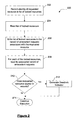
- Figure 2 shows a flowchart depicting a method for detecting potential deadlocks according to the present invention
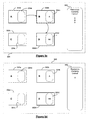
- FIGS 3a to 3f show, in block diagram form, an illustration by way of an example of the steps taken by an embodiment of the present invention.
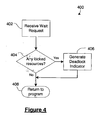
- Figure 4 shows a flowchart depicting another method for detecting potential deadlocks according to the present invention.
- Figure 2 shows a flowchart of a method 200 for detecting potential deadlocks according to the present invention.
- existing functions for locking shared resources may be modified so as to incorporate additional steps to customize the function without renaming the function.
- the Java synchronize statement is typically employed to lock a shared resource.
- the method 200 may be implemented within the JVM to modify the synchronize statement so as to perform the steps of the method 200 in addition to the steps for locking the shared resource that would normally be taken. This provides the implementation with transparency, allowing subsequent developers to incorporate the method 200 without requiring knowledge of a custom function.
- the method 200 may be implemented through "wrapping" the existing lock function with a new deadlock detection lock function that implements the method 200 and calls the existing predefined lock function.
- An example of such an environment is one based upon use of the Microsoft WindowsTM operating system by developers other than the Microsoft Corporation itself.
- the method 200 operates during run-time execution of a computer program. It is triggered when a thread of the computer program requests access to a shared resource. When the computer program requests access to a shared resource a lock function is called (either the customized lock function or the "wrapped" lock function).
- the method 200 begins in step 202 wherein the identity of the requested resource is recorded in a list of currently locked resources.
- the operating system for the computer system will maintain a stack or list of locked resources.
- the JVM maintains a list of which resources have been locked.
- This step 202 is a step which would be taken by the conventional lock function to lock the requested resource.
- the method 200 is implemented in a 'wrapper' function, it may be necessary to maintain a separate data structure identifying which resources have been locked.
- step 204 the stack or list of locked resources is read to determine which resources were locked and have not yet been unlocked prior to the current resource request.
- this list of prior locked and unreleased resources is written to a data element or structure associated with the requested resource. In other words, for each shared resource there is an associated persistent data element that records which other shared resources have been locked and not released each time an attempt is made to lock the resource. This results in a set of records of sequential lock operations contained in the computer program.
- the associated data structure is the requested object itself.
- Other embodiments include a separate data object associated with each shared resource.
- the method 200 then continues at step 208 wherein, for each currently locked and unreleased resource, its associated record of antecedent requests, i.e. previous sequential lock operations, is read.
- the associated record for each locked resource may contain only antecedent requests made during processing of the current thread, or it may contain multiple sequences reflecting multiple requests to access the resource made by multiple threads.
- step 210 an assessment is made as to whether the requested resource appears in the associated records for currently locked and unreleased resources. If it does, then it indicates a potential cycle, which could result in a deadlock situation. Accordingly, if the requested resource is identified in the associated records of locked and unreleased resources, then at step 212 a potential deadlock indicator is generated. At step 214, execution of the computer program is continued.
- the generation of a potential deadlock indicator may include writing the potential deadlock to a log file or otherwise identifying the portion of the computer program code that resulted in the potential deadlock. It may also include displaying an error message and it may include halting execution of the computer program. Other mechanisms for alerting the computer program developer to the identification of a potential deadlock will be apparent to those of ordinary skill in the art.
- the method 200 attempts to detect potential resource dependency cycles in the computer program during run-time execution of the program by recording partial resource lock sequences for each requested resource. With each resource request, prior lock sequences for resources already locked and not released are analyzed to ensure that the requested resource does not appear in a prior lock sequence. If it does, then a potential deadlock scenario is identified.
- the present invention identifies when the computer program performs a sequential lock of, for example, (A ... B), and it assesses whether or not the sequence (B ... A) has previously been encountered on another thread. If it has, then there is the potential for a deadlock to occur.
- the method 200 according to the present invention does not require that an actual deadlock occur in order to identify a potential deadlock.
- a computer system 320 includes four shared resources A, B, C, and D, designated with reference numerals 302a, 302b, 302c, and 302d, respectively.
- Each of the shared resources 302 has an associated data element 304 for storing a list of antecedent lock sequences.
- the data elements 304 are incorporated within the associated resource 302.
- a list 306 of resources currently locked is also present on the computer system 320.
- the list 306 may be maintained and controlled by the operating system of the computer system 320 or it may be a data structure or object created and stored on computer system 320 by a module or function implementing the method 200 (Fig. 2) according to the present invention.
- a first thread (not shown) has locked resource A 302a, as indicated by the heavy outline. Accordingly, the identity of resource A appears in the list 306 of locked resources.
- the first thread locks resource B 302b.
- the identity of resource B is added to the list 306 of locked resources.
- Resource A 302a remains locked.
- the identity of resource A is recorded in the data element 304b associated with resource B 302b, since the list 306 indicates that resource A 302a was locked and not yet unlocked when the first thread requested access to resource B 302b.
- Figure 3c shows that the first thread then locks resource D 302d. Accordingly, the identity of resource D is added to the list 306 of locked resources and the identities of resources A and B 302a, 302b are added to the data element 304d associated with resource D 302d. This evidences the fact that resource D 302d was requested by the first thread at a time when the first thread had already locked resources A and B 302a, 302b.
- the first thread unlocks the locked resources A, B, and D 302a, 302b, and 302d.
- a second thread (not shown) locks resource D 302d, as shown in Figure 3d.
- the lock sequence data, AB from the processing of the first thread continues to exist in the data element 304d associated with resource D 302d.
- the list 306 of locked resources is updated to record the fact that resource D 302d has been locked.
- the second thread then locks resource C 302c.
- the identity of resource C 302c is added to the list 306 of locked resources and the fact that resource D 302d has already been locked by the second thread is recorded in the data element 302c associated with resource C 302c.
- Resource D 302d was on the list 306 of currently locked resources prior to the request to lock resource C 302c, so the contents of the data element 304d associated with the currently locked resource D 302d are read to determine whether or not a previous thread has performed a locking sequence that locked resource C 302c prior to locking resource D 302d.
- the associated data element 304d identifies a lock sequence of AB. Because resource C 302c does not appear in the data element 304d, thus far the lock sequences implemented by the computer program are acyclical, indicating that no potential deadlock exists.
- Figure 3f illustrates that the second thread next locks resource B 302b. Accordingly, the identity of resource B 302b is added to the list 306 of locked resources. The currently locked resources, resource D 302d and resource C 302c, are added to the data element 304b associated with resource B 302b. Thus the data element 304b for resource B 302b now includes two lock sequence records: one corresponding to the first thread, and one corresponding to the second thread.
- the data elements 304c and 304d associated with the previously locked and not yet unlocked resources C and D 302c, 302d are then read to assess whether the requested resource, resource B 302b, appears in prior lock sequences. It will be seen that the data element 304c corresponding to resource C 302c contains only the identity of resource D 302d; however, the data element 304d corresponding to resource D 302d contains the lock sequence AB. Therefore, it is apparent that resource B 302b was locked prior to resource D 302d by a different thread, whereas the present thread has locked resource D 302d prior to resource B 302b. Accordingly, a potential deadlock has been identified. In accordance with step 212 (Fig. 2) of the method 200 (Fig. 2), an appropriate deadlock indicator is generated.
- the method 200 as illustrated by the example shown in Figure 3 records the complete lock sequence in the data element 304 associated with a requested resource 302, it will be appreciated that in another embodiment only the identity of the immediately preceding locked resource could be recorded in the associated data element 304. In this embodiment, the invention recursively steps back through the data elements 304 of preceding locked resources to trace the lock sequence and identify any potential deadlocks. Based upon the foregoing description, other methods and techniques for tracking the occurrence of complementary inverse lock sequences on different threads will be apparent to those of ordinary skill in the art.
- the present invention is not limited to the detection of deadlocks resulting from the use of lock functions for accessing mutually exclusive resources.
- the invention may also be used to detect potential deadlocks related to "event" structures.
- An event includes a function of waiting upon an event and a complementary function of triggering the event.
- the wait function is analogous to a lock and the trigger function is analogous to an unlock.
- An event construct is similar to a lock construct, except whereas a lock-unlock pair occurs within a single thread, a wait-trigger pair occurs across separate threads.
- Mutex A will be locked and the thread will await the triggering of Event B. This trigger can never occur because thread 2 cannot access the locked Mutex A. Accordingly, a deadlock will result.
- the method 400 of detecting a potential deadlock situation involving a wait-trigger event includes a first step 402 of receiving a wait request.
- the wait request has a corresponding trigger event on another thread.
- the method 400 then includes a second step 404 of assessing whether or not the active thread has any resources that have been requested and are unreleased when the wait request is encountered. This step 404 may be performed by consulting the stack to determine if there are any currently locked resources.
- a deadlock indicator is generated. If there are no locked and unreleased resources, then the program continues execution 408.
- the method 400 may be rendered more sophisticated by recording the resource that was locked when the wait request was encountered and then later assessing whether or not the same resource could be locked during the trigger event.
- a lock-unlock sequence may be generally considered a request and release sequence in relation to a resource.
Landscapes
- Engineering & Computer Science (AREA)
- Software Systems (AREA)
- Theoretical Computer Science (AREA)
- Physics & Mathematics (AREA)
- General Engineering & Computer Science (AREA)
- General Physics & Mathematics (AREA)
- Debugging And Monitoring (AREA)
- Hardware Redundancy (AREA)
Priority Applications (4)
| Application Number | Priority Date | Filing Date | Title |
|---|---|---|---|
| DE602004007475T DE602004007475T2 (de) | 2004-02-26 | 2004-02-26 | Verfahren und System zur Erkennung von möglichen Blockierungen in Computerprogrammen |
| EP04251092A EP1569121B1 (de) | 2004-02-26 | 2004-02-26 | Verfahren und System zur Erkennung von möglichen Blockierungen in Computerprogrammen |
| AT04251092T ATE366959T1 (de) | 2004-02-26 | 2004-02-26 | Verfahren und system zur erkennung von möglichen blockierungen in computerprogrammen |
| HK06102289.0A HK1080179B (en) | 2006-02-21 | Method and system for detecting potential deadlocks in computer programs |
Applications Claiming Priority (1)
| Application Number | Priority Date | Filing Date | Title |
|---|---|---|---|
| EP04251092A EP1569121B1 (de) | 2004-02-26 | 2004-02-26 | Verfahren und System zur Erkennung von möglichen Blockierungen in Computerprogrammen |
Publications (2)
| Publication Number | Publication Date |
|---|---|
| EP1569121A1 true EP1569121A1 (de) | 2005-08-31 |
| EP1569121B1 EP1569121B1 (de) | 2007-07-11 |
Family
ID=34746097
Family Applications (1)
| Application Number | Title | Priority Date | Filing Date |
|---|---|---|---|
| EP04251092A Expired - Lifetime EP1569121B1 (de) | 2004-02-26 | 2004-02-26 | Verfahren und System zur Erkennung von möglichen Blockierungen in Computerprogrammen |
Country Status (3)
| Country | Link |
|---|---|
| EP (1) | EP1569121B1 (de) |
| AT (1) | ATE366959T1 (de) |
| DE (1) | DE602004007475T2 (de) |
Cited By (5)
| Publication number | Priority date | Publication date | Assignee | Title |
|---|---|---|---|---|
| US8375367B2 (en) | 2009-08-06 | 2013-02-12 | International Business Machines Corporation | Tracking database deadlock |
| CN103218291A (zh) * | 2013-03-29 | 2013-07-24 | 迈普通信技术股份有限公司 | 多任务操作系统中互斥信号量异常的检测方法及装置 |
| CN113961365A (zh) * | 2021-11-26 | 2022-01-21 | 中国工商银行股份有限公司 | 一种资源死锁的检测方法和装置 |
| CN115373932A (zh) * | 2021-05-20 | 2022-11-22 | 北京字跳网络技术有限公司 | 组件运行的监测方法及装置 |
| CN115495254A (zh) * | 2022-09-23 | 2022-12-20 | 中国工商银行股份有限公司 | 业务资源死锁检测方法、装置、计算机设备和存储介质 |
Families Citing this family (1)
| Publication number | Priority date | Publication date | Assignee | Title |
|---|---|---|---|---|
| CN101576830B (zh) * | 2009-06-04 | 2011-11-30 | 中兴通讯股份有限公司 | 数据库事务锁机制的死锁检测方法及装置 |
Citations (1)
| Publication number | Priority date | Publication date | Assignee | Title |
|---|---|---|---|---|
| EP0864975A2 (de) * | 1997-03-10 | 1998-09-16 | Digital Equipment Corporation | Erkennung von Parallelverarbeitungsfehlern in mehrgängigen Programmen |
-
2004
- 2004-02-26 DE DE602004007475T patent/DE602004007475T2/de not_active Expired - Lifetime
- 2004-02-26 EP EP04251092A patent/EP1569121B1/de not_active Expired - Lifetime
- 2004-02-26 AT AT04251092T patent/ATE366959T1/de not_active IP Right Cessation
Patent Citations (1)
| Publication number | Priority date | Publication date | Assignee | Title |
|---|---|---|---|---|
| EP0864975A2 (de) * | 1997-03-10 | 1998-09-16 | Digital Equipment Corporation | Erkennung von Parallelverarbeitungsfehlern in mehrgängigen Programmen |
Non-Patent Citations (1)
| Title |
|---|
| GADE K: "Portable Data Race and Deadlock Detector", 6 July 2004 (2004-07-06), XP002287577, Retrieved from the Internet <URL:www.scs.cs.nyu.edu/G22.3250/proj/datarace.ps> [retrieved on 20040706] * |
Cited By (5)
| Publication number | Priority date | Publication date | Assignee | Title |
|---|---|---|---|---|
| US8375367B2 (en) | 2009-08-06 | 2013-02-12 | International Business Machines Corporation | Tracking database deadlock |
| CN103218291A (zh) * | 2013-03-29 | 2013-07-24 | 迈普通信技术股份有限公司 | 多任务操作系统中互斥信号量异常的检测方法及装置 |
| CN115373932A (zh) * | 2021-05-20 | 2022-11-22 | 北京字跳网络技术有限公司 | 组件运行的监测方法及装置 |
| CN113961365A (zh) * | 2021-11-26 | 2022-01-21 | 中国工商银行股份有限公司 | 一种资源死锁的检测方法和装置 |
| CN115495254A (zh) * | 2022-09-23 | 2022-12-20 | 中国工商银行股份有限公司 | 业务资源死锁检测方法、装置、计算机设备和存储介质 |
Also Published As
| Publication number | Publication date |
|---|---|
| ATE366959T1 (de) | 2007-08-15 |
| DE602004007475D1 (de) | 2007-08-23 |
| HK1080179A1 (en) | 2006-04-21 |
| DE602004007475T2 (de) | 2008-03-13 |
| EP1569121B1 (de) | 2007-07-11 |
Similar Documents
| Publication | Publication Date | Title |
|---|---|---|
| US6009269A (en) | Detecting concurrency errors in multi-threaded programs | |
| KR101143214B1 (ko) | 멀티스레드된 프로그램에서의 잠재적 레이스를 검출하기위한 방법 및 시스템 | |
| Wang et al. | Runtime analysis of atomicity for multithreaded programs | |
| US6550060B1 (en) | Method and system for dynamic injection of dynamic link libraries into a windowed operating system | |
| US8464261B2 (en) | System and method for executing a transaction using parallel co-transactions | |
| Feldman et al. | A wait-free multi-word compare-and-swap operation | |
| US20110219361A1 (en) | Correct refactoring of concurrent software | |
| US10915424B2 (en) | Defeating deadlocks in production software | |
| US7124405B1 (en) | Class initialization method semantics | |
| Emmi et al. | Weak-consistency specification via visibility relaxation | |
| US8135690B2 (en) | Concurrency object classification | |
| US7917909B2 (en) | Detecting deadlocks in interop-debugging | |
| Gao et al. | Probabilistic concurrency testing for weak memory programs | |
| EP1569121B1 (de) | Verfahren und System zur Erkennung von möglichen Blockierungen in Computerprogrammen | |
| Schwarz et al. | The digest framework: concurrency-sensitivity for abstract interpretation | |
| Lourenço et al. | Discovering concurrency errors | |
| US20080320459A1 (en) | Method And Systems For Providing Concurrency Control For Addressable Entities | |
| CA2459123C (en) | Method and system for detecting potential deadlocks in computer programs | |
| Elmas et al. | Precise race detection and efficient model checking using locksets | |
| Gottschlich et al. | Concurrent predicates: A debugging technique for every parallel programmer | |
| Wolff | Verifying Non-blocking Data Structures with Manual Memory Management | |
| Qadeer et al. | Runtime verification of concurrency-specific correctness criteria | |
| Lev et al. | Debugging with transactional memory | |
| HK1080179B (en) | Method and system for detecting potential deadlocks in computer programs | |
| Elmas et al. | Goldilocks: a race-aware Java runtime |
Legal Events
| Date | Code | Title | Description |
|---|---|---|---|
| PUAI | Public reference made under article 153(3) epc to a published international application that has entered the european phase |
Free format text: ORIGINAL CODE: 0009012 |
|
| 17P | Request for examination filed |
Effective date: 20040312 |
|
| AK | Designated contracting states |
Kind code of ref document: A1 Designated state(s): AT BE BG CH CY CZ DE DK EE ES FI FR GB GR HU IE IT LI LU MC NL PT RO SE SI SK TR |
|
| AX | Request for extension of the european patent |
Extension state: AL LT LV MK |
|
| REG | Reference to a national code |
Ref country code: HK Ref legal event code: DE Ref document number: 1080179 Country of ref document: HK |
|
| AKX | Designation fees paid |
Designated state(s): AT BE BG CH CY CZ DE DK EE ES FI FR GB GR HU IE IT LI LU MC NL PT RO SE SI SK TR |
|
| AXX | Extension fees paid |
Extension state: LV Payment date: 20040312 Extension state: MK Payment date: 20040312 Extension state: LT Payment date: 20040312 Extension state: AL Payment date: 20040312 |
|
| GRAP | Despatch of communication of intention to grant a patent |
Free format text: ORIGINAL CODE: EPIDOSNIGR1 |
|
| GRAS | Grant fee paid |
Free format text: ORIGINAL CODE: EPIDOSNIGR3 |
|
| GRAA | (expected) grant |
Free format text: ORIGINAL CODE: 0009210 |
|
| AK | Designated contracting states |
Kind code of ref document: B1 Designated state(s): AT BE BG CH CY CZ DE DK EE ES FI FR GB GR HU IE IT LI LU MC NL PT RO SE SI SK TR |
|
| AX | Request for extension of the european patent |
Extension state: AL LT LV MK |
|
| REG | Reference to a national code |
Ref country code: GB Ref legal event code: FG4D |
|
| REG | Reference to a national code |
Ref country code: CH Ref legal event code: EP |
|
| REF | Corresponds to: |
Ref document number: 602004007475 Country of ref document: DE Date of ref document: 20070823 Kind code of ref document: P |
|
| REG | Reference to a national code |
Ref country code: IE Ref legal event code: FG4D |
|
| REG | Reference to a national code |
Ref country code: HK Ref legal event code: GR Ref document number: 1080179 Country of ref document: HK |
|
| LTIE | Lt: invalidation of european patent or patent extension |
Effective date: 20070711 |
|
| ET | Fr: translation filed | ||
| PG25 | Lapsed in a contracting state [announced via postgrant information from national office to epo] |
Ref country code: BG Free format text: LAPSE BECAUSE OF FAILURE TO SUBMIT A TRANSLATION OF THE DESCRIPTION OR TO PAY THE FEE WITHIN THE PRESCRIBED TIME-LIMIT Effective date: 20071011 Ref country code: ES Free format text: LAPSE BECAUSE OF FAILURE TO SUBMIT A TRANSLATION OF THE DESCRIPTION OR TO PAY THE FEE WITHIN THE PRESCRIBED TIME-LIMIT Effective date: 20071022 Ref country code: NL Free format text: LAPSE BECAUSE OF FAILURE TO SUBMIT A TRANSLATION OF THE DESCRIPTION OR TO PAY THE FEE WITHIN THE PRESCRIBED TIME-LIMIT Effective date: 20070711 Ref country code: FI Free format text: LAPSE BECAUSE OF FAILURE TO SUBMIT A TRANSLATION OF THE DESCRIPTION OR TO PAY THE FEE WITHIN THE PRESCRIBED TIME-LIMIT Effective date: 20070711 Ref country code: PT Free format text: LAPSE BECAUSE OF FAILURE TO SUBMIT A TRANSLATION OF THE DESCRIPTION OR TO PAY THE FEE WITHIN THE PRESCRIBED TIME-LIMIT Effective date: 20071211 |
|
| REG | Reference to a national code |
Ref country code: CH Ref legal event code: PL |
|
| NLV1 | Nl: lapsed or annulled due to failure to fulfill the requirements of art. 29p and 29m of the patents act | ||
| PG25 | Lapsed in a contracting state [announced via postgrant information from national office to epo] |
Ref country code: LI Free format text: LAPSE BECAUSE OF FAILURE TO SUBMIT A TRANSLATION OF THE DESCRIPTION OR TO PAY THE FEE WITHIN THE PRESCRIBED TIME-LIMIT Effective date: 20070711 Ref country code: AT Free format text: LAPSE BECAUSE OF FAILURE TO SUBMIT A TRANSLATION OF THE DESCRIPTION OR TO PAY THE FEE WITHIN THE PRESCRIBED TIME-LIMIT Effective date: 20070711 Ref country code: CH Free format text: LAPSE BECAUSE OF FAILURE TO SUBMIT A TRANSLATION OF THE DESCRIPTION OR TO PAY THE FEE WITHIN THE PRESCRIBED TIME-LIMIT Effective date: 20070711 |
|
| PG25 | Lapsed in a contracting state [announced via postgrant information from national office to epo] |
Ref country code: BE Free format text: LAPSE BECAUSE OF FAILURE TO SUBMIT A TRANSLATION OF THE DESCRIPTION OR TO PAY THE FEE WITHIN THE PRESCRIBED TIME-LIMIT Effective date: 20070711 |
|
| PG25 | Lapsed in a contracting state [announced via postgrant information from national office to epo] |
Ref country code: DK Free format text: LAPSE BECAUSE OF FAILURE TO SUBMIT A TRANSLATION OF THE DESCRIPTION OR TO PAY THE FEE WITHIN THE PRESCRIBED TIME-LIMIT Effective date: 20070711 Ref country code: GR Free format text: LAPSE BECAUSE OF FAILURE TO SUBMIT A TRANSLATION OF THE DESCRIPTION OR TO PAY THE FEE WITHIN THE PRESCRIBED TIME-LIMIT Effective date: 20071012 |
|
| PLBE | No opposition filed within time limit |
Free format text: ORIGINAL CODE: 0009261 |
|
| STAA | Information on the status of an ep patent application or granted ep patent |
Free format text: STATUS: NO OPPOSITION FILED WITHIN TIME LIMIT |
|
| PG25 | Lapsed in a contracting state [announced via postgrant information from national office to epo] |
Ref country code: CZ Free format text: LAPSE BECAUSE OF FAILURE TO SUBMIT A TRANSLATION OF THE DESCRIPTION OR TO PAY THE FEE WITHIN THE PRESCRIBED TIME-LIMIT Effective date: 20070711 Ref country code: SK Free format text: LAPSE BECAUSE OF FAILURE TO SUBMIT A TRANSLATION OF THE DESCRIPTION OR TO PAY THE FEE WITHIN THE PRESCRIBED TIME-LIMIT Effective date: 20070711 |
|
| 26N | No opposition filed |
Effective date: 20080414 |
|
| PG25 | Lapsed in a contracting state [announced via postgrant information from national office to epo] |
Ref country code: SE Free format text: LAPSE BECAUSE OF FAILURE TO SUBMIT A TRANSLATION OF THE DESCRIPTION OR TO PAY THE FEE WITHIN THE PRESCRIBED TIME-LIMIT Effective date: 20071011 Ref country code: RO Free format text: LAPSE BECAUSE OF FAILURE TO SUBMIT A TRANSLATION OF THE DESCRIPTION OR TO PAY THE FEE WITHIN THE PRESCRIBED TIME-LIMIT Effective date: 20070711 |
|
| PG25 | Lapsed in a contracting state [announced via postgrant information from national office to epo] |
Ref country code: MC Free format text: LAPSE BECAUSE OF NON-PAYMENT OF DUE FEES Effective date: 20080228 |
|
| PG25 | Lapsed in a contracting state [announced via postgrant information from national office to epo] |
Ref country code: EE Free format text: LAPSE BECAUSE OF FAILURE TO SUBMIT A TRANSLATION OF THE DESCRIPTION OR TO PAY THE FEE WITHIN THE PRESCRIBED TIME-LIMIT Effective date: 20070711 Ref country code: IE Free format text: LAPSE BECAUSE OF NON-PAYMENT OF DUE FEES Effective date: 20080226 |
|
| PG25 | Lapsed in a contracting state [announced via postgrant information from national office to epo] |
Ref country code: SI Free format text: LAPSE BECAUSE OF FAILURE TO SUBMIT A TRANSLATION OF THE DESCRIPTION OR TO PAY THE FEE WITHIN THE PRESCRIBED TIME-LIMIT Effective date: 20070711 |
|
| PG25 | Lapsed in a contracting state [announced via postgrant information from national office to epo] |
Ref country code: CY Free format text: LAPSE BECAUSE OF FAILURE TO SUBMIT A TRANSLATION OF THE DESCRIPTION OR TO PAY THE FEE WITHIN THE PRESCRIBED TIME-LIMIT Effective date: 20070711 |
|
| PG25 | Lapsed in a contracting state [announced via postgrant information from national office to epo] |
Ref country code: LU Free format text: LAPSE BECAUSE OF NON-PAYMENT OF DUE FEES Effective date: 20080226 Ref country code: HU Free format text: LAPSE BECAUSE OF FAILURE TO SUBMIT A TRANSLATION OF THE DESCRIPTION OR TO PAY THE FEE WITHIN THE PRESCRIBED TIME-LIMIT Effective date: 20080112 |
|
| PG25 | Lapsed in a contracting state [announced via postgrant information from national office to epo] |
Ref country code: TR Free format text: LAPSE BECAUSE OF FAILURE TO SUBMIT A TRANSLATION OF THE DESCRIPTION OR TO PAY THE FEE WITHIN THE PRESCRIBED TIME-LIMIT Effective date: 20070711 |
|
| PG25 | Lapsed in a contracting state [announced via postgrant information from national office to epo] |
Ref country code: IT Free format text: LAPSE BECAUSE OF NON-PAYMENT OF DUE FEES Effective date: 20080229 |
|
| REG | Reference to a national code |
Ref country code: DE Ref legal event code: R082 Ref document number: 602004007475 Country of ref document: DE Representative=s name: MERH-IP MATIAS ERNY REICHL HOFFMANN, DE |
|
| REG | Reference to a national code |
Ref country code: DE Ref legal event code: R081 Ref document number: 602004007475 Country of ref document: DE Owner name: BLACKBERRY LIMITED, WATERLOO, CA Free format text: FORMER OWNER: RESEARCH IN MOTION LTD., WATERLOO, ONTARIO, CA Effective date: 20140925 Ref country code: DE Ref legal event code: R082 Ref document number: 602004007475 Country of ref document: DE Representative=s name: MERH-IP MATIAS ERNY REICHL HOFFMANN, DE Effective date: 20140925 Ref country code: DE Ref legal event code: R082 Ref document number: 602004007475 Country of ref document: DE Representative=s name: MERH-IP MATIAS ERNY REICHL HOFFMANN PATENTANWA, DE Effective date: 20140925 |
|
| REG | Reference to a national code |
Ref country code: FR Ref legal event code: PLFP Year of fee payment: 13 |
|
| REG | Reference to a national code |
Ref country code: FR Ref legal event code: PLFP Year of fee payment: 14 |
|
| REG | Reference to a national code |
Ref country code: FR Ref legal event code: PLFP Year of fee payment: 15 |
|
| PGFP | Annual fee paid to national office [announced via postgrant information from national office to epo] |
Ref country code: FR Payment date: 20230223 Year of fee payment: 20 |
|
| PGFP | Annual fee paid to national office [announced via postgrant information from national office to epo] |
Ref country code: GB Payment date: 20230227 Year of fee payment: 20 Ref country code: DE Payment date: 20230223 Year of fee payment: 20 |
|
| REG | Reference to a national code |
Ref country code: DE Ref legal event code: R071 Ref document number: 602004007475 Country of ref document: DE |
|
| REG | Reference to a national code |
Ref country code: GB Ref legal event code: PE20 Expiry date: 20240225 |
|
| PG25 | Lapsed in a contracting state [announced via postgrant information from national office to epo] |
Ref country code: GB Free format text: LAPSE BECAUSE OF EXPIRATION OF PROTECTION Effective date: 20240225 |
|
| REG | Reference to a national code |
Ref country code: DE Ref legal event code: R082 Ref document number: 602004007475 Country of ref document: DE Ref country code: DE Ref legal event code: R081 Ref document number: 602004007475 Country of ref document: DE Owner name: MALIKIE INNOVATIONS LTD., IE Free format text: FORMER OWNER: BLACKBERRY LIMITED, WATERLOO, ONTARIO, CA |