EP1569059A1 - Part makeshift planning system and part makeshift planning method - Google Patents
Part makeshift planning system and part makeshift planning method Download PDFInfo
- Publication number
- EP1569059A1 EP1569059A1 EP03775893A EP03775893A EP1569059A1 EP 1569059 A1 EP1569059 A1 EP 1569059A1 EP 03775893 A EP03775893 A EP 03775893A EP 03775893 A EP03775893 A EP 03775893A EP 1569059 A1 EP1569059 A1 EP 1569059A1
- Authority
- EP
- European Patent Office
- Prior art keywords
- production
- inventory
- plan
- ordered
- rehandling
- Prior art date
- Legal status (The legal status is an assumption and is not a legal conclusion. Google has not performed a legal analysis and makes no representation as to the accuracy of the status listed.)
- Withdrawn
Links
Images

Classifications
-
- G—PHYSICS
- G06—COMPUTING OR CALCULATING; COUNTING
- G06Q—INFORMATION AND COMMUNICATION TECHNOLOGY [ICT] SPECIALLY ADAPTED FOR ADMINISTRATIVE, COMMERCIAL, FINANCIAL, MANAGERIAL OR SUPERVISORY PURPOSES; SYSTEMS OR METHODS SPECIALLY ADAPTED FOR ADMINISTRATIVE, COMMERCIAL, FINANCIAL, MANAGERIAL OR SUPERVISORY PURPOSES, NOT OTHERWISE PROVIDED FOR
- G06Q10/00—Administration; Management
- G06Q10/06—Resources, workflows, human or project management; Enterprise or organisation planning; Enterprise or organisation modelling
-
- G—PHYSICS
- G05—CONTROLLING; REGULATING
- G05B—CONTROL OR REGULATING SYSTEMS IN GENERAL; FUNCTIONAL ELEMENTS OF SUCH SYSTEMS; MONITORING OR TESTING ARRANGEMENTS FOR SUCH SYSTEMS OR ELEMENTS
- G05B19/00—Program-control systems
- G05B19/02—Program-control systems electric
- G05B19/418—Total factory control, i.e. centrally controlling a plurality of machines, e.g. direct or distributed numerical control [DNC], flexible manufacturing systems [FMS], integrated manufacturing systems [IMS] or computer integrated manufacturing [CIM]
- G05B19/41865—Total factory control, i.e. centrally controlling a plurality of machines, e.g. direct or distributed numerical control [DNC], flexible manufacturing systems [FMS], integrated manufacturing systems [IMS] or computer integrated manufacturing [CIM] characterised by job scheduling, process planning, material flow
-
- G—PHYSICS
- G06—COMPUTING OR CALCULATING; COUNTING
- G06Q—INFORMATION AND COMMUNICATION TECHNOLOGY [ICT] SPECIALLY ADAPTED FOR ADMINISTRATIVE, COMMERCIAL, FINANCIAL, MANAGERIAL OR SUPERVISORY PURPOSES; SYSTEMS OR METHODS SPECIALLY ADAPTED FOR ADMINISTRATIVE, COMMERCIAL, FINANCIAL, MANAGERIAL OR SUPERVISORY PURPOSES, NOT OTHERWISE PROVIDED FOR
- G06Q10/00—Administration; Management
- G06Q10/08—Logistics, e.g. warehousing, loading or distribution; Inventory or stock management
- G06Q10/087—Inventory or stock management, e.g. order filling, procurement or balancing against orders
-
- G—PHYSICS
- G05—CONTROLLING; REGULATING
- G05B—CONTROL OR REGULATING SYSTEMS IN GENERAL; FUNCTIONAL ELEMENTS OF SUCH SYSTEMS; MONITORING OR TESTING ARRANGEMENTS FOR SUCH SYSTEMS OR ELEMENTS
- G05B2219/00—Program-control systems
- G05B2219/30—Nc systems
- G05B2219/32—Operator till task planning
- G05B2219/32082—Planing, material requiring planning MRP, request
-
- G—PHYSICS
- G05—CONTROLLING; REGULATING
- G05B—CONTROL OR REGULATING SYSTEMS IN GENERAL; FUNCTIONAL ELEMENTS OF SUCH SYSTEMS; MONITORING OR TESTING ARRANGEMENTS FOR SUCH SYSTEMS OR ELEMENTS
- G05B2219/00—Program-control systems
- G05B2219/30—Nc systems
- G05B2219/32—Operator till task planning
- G05B2219/32111—PPS production planning system
-
- Y—GENERAL TAGGING OF NEW TECHNOLOGICAL DEVELOPMENTS; GENERAL TAGGING OF CROSS-SECTIONAL TECHNOLOGIES SPANNING OVER SEVERAL SECTIONS OF THE IPC; TECHNICAL SUBJECTS COVERED BY FORMER USPC CROSS-REFERENCE ART COLLECTIONS [XRACs] AND DIGESTS
- Y02—TECHNOLOGIES OR APPLICATIONS FOR MITIGATION OR ADAPTATION AGAINST CLIMATE CHANGE
- Y02P—CLIMATE CHANGE MITIGATION TECHNOLOGIES IN THE PRODUCTION OR PROCESSING OF GOODS
- Y02P90/00—Enabling technologies with a potential contribution to greenhouse gas [GHG] emissions mitigation
- Y02P90/02—Total factory control, e.g. smart factories, flexible manufacturing systems [FMS] or integrated manufacturing systems [IMS]
Definitions
- This invention relates to a rehandling planning system and rehandling planning method, and more particularly to a rehandling planning system and rehandling planning method for creating a rehandling plan based on the amount of inventory and ordered quantity.
- lot production is performed for mass produced models and small parts.
- the number of parts produced during lot production is a multiple of the number of economic lots, and is a number that exceeds the ordered quantity.
- Parts that are produced at a factory are stored for each customer in a warehouse (depot) on the side of the mass production factory, and then supplied to the factory from there.
- the number of repair parts for a mass produced model is small when compared with the ordered number, so basically the repair parts are shipped from stock in inventory. Therefore, when an order for repair parts is received, first, the depot inventory file is checked to find which warehouse they are stored in, then order forms and removal instructions are made up for each part and sent to each depot. At each depot, the ordered parts are removed from the shelves according to the removal instructions and shipped.
- This invention takes into consideration these kinds of conditions and makes it possible to prevent inventory from becoming minus by predicting changes in inventory when creating a production plan.
- the rehandling system of claim 1 is a rehandling system that creates a rehandling plan from the ordered quantity of a specified part and the inventory quantity, and comprises: an ordered-quantity-memory means of storing the ordered quantity of a specified part; a production-plan-creation means of creating a production plan that sets the daily production quantity for the part; a scheduled-shipping-quantity-output means of outputting the scheduled shipping quantity of the part; an inventory-quantity-memory means of storing the inventory quantity for the part; and a production-plan-list-creation list means of creating a production-plan list for correcting the production plan for the part based on the ordered quantity, production quantity, scheduled shipping quantity and inventory quantity.
- an inventory-amount-memory means of calculating and storing the amount of inventory after shipping the part based on the ordered quantity, production quantity, scheduled shipping quantity and inventory quantity; and a comparison means of comparing which is larger between the amount of inventory of the part that is stored by the inventory-amount-memory means and the ordered quantity of the part that is stored by the ordered-quantity-memory means.
- the rehandling planning method of claim 4 is a rehandling planning method of creating a rehandling plan from the ordered quantity of a specified part and the inventory quantity, and comprises: an ordered-quantity-memory step of storing the ordered quantity of a specified part; a production-plan-creation step of creating a production plan that sets the daily production quantity for the part; a scheduled-shipping-quantity-output step of outputting the scheduled shipping quantity of the part; an inventory-quantity-memory step of storing the inventory quantity for the part; and a production-plan-list-creation step of creating a production-plan list for correcting the production plan for the part based on the ordered quantity, production quantity, scheduled shipping quantity and inventory quantity.
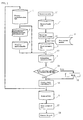
- Fig. 1 is a drawing showing the construction and job flow of the operation of this embodiment.
- Each database is created inside the memory apparatus of the personal computer or workstation (not shown in the figure), and connected over a network such that data can be sent and received.
- step S1 when there is an order for a repair part, the order for the repair part is received.
- received-order data comprising the ordered quantity and the name of the repair part, is supplied to the received-order database 1.
- the received-order database 1 correlates the name of the ordered repair part with the ordered quantity and stores them.
- step S2 the part number of the repair part from the received-order database 1 is read from the part-number master 2, and based on this part number, an inventory location (depot (warehouse)) having this repair part as inventory is searched for from the depot-inventory file 3.
- step S3 the daily production quantity (input quantity) is obtained from the factory-production-plan database 4, and the scheduled shipping quantity is obtained from the shipping-instruction file 6, the inventory quantity is obtained from the depot-inventory file 3, and the ordered quantity is obtained from the received-order database 1. Moreover, the obtained production quantity, scheduled shipping quantity, inventory quantity and ordered quantity are supplied to the rehandling-calculation database 7 and stored.
- step S5 when the amount of inventory is less than the ordered quantity, or in other words, when the ordered quantity is greater than the amount of inventory, a specified mark is given for that day to indicate that the inventory will become '0' or be insufficient.
- step S6 the process advances to step S6.
- step S4 when it is determined that the amount of inventory is greater than the ordered quantity, the process advances to step S6, and a daily rehandling list showing the daily rehandling status is created as shown in Fig. 2.
- the production (stock) quantity is 100
- the scheduled shipping quantity is 45
- the number of orders for the repair part is 0
- the inventory quantity 55 On day 'N+1' the production (stock) quantity is 0, the scheduled shipping quantity is 50, the number of orders for the repair part is 0 and the inventory quantity 5.
- day 'N+2' the production (stock) quantity is 100
- the scheduled shipping quantity is 50
- the number of orders for the repair part is 0 and the inventory quantity 55.
- the production (stock) quantity On day 'N+3' the production (stock) quantity is 0, the scheduled shipping quantity is 50, the number of orders for the repair part is 10 and the inventory quantity -5. On day 'N+4' the production (stock) quantity is 100, the scheduled shipping quantity is 50, the number of orders for the repair part is 0 and the inventory quantity 45.
- the created daily rehandling list is supplied to the factory-production-plan database 4, where it is reflected on the future production plan, and it is supplied to the removal database 8 and stored.
- the factory-production-plan database 4 is able to know on which days there is insufficient inventory, so the production plan is remade, and by increasing the production amount, it is possible to prevent the inventory from becoming insufficient.
- the daily rehandling list as shown in Fig. 2 is stored in the removal database 8.
- step S7 the daily rehandling list is obtained from the removal database 8, and a removal form is created and issued.
- step 8 the removal process is performed according to the removal form.
- the ordered quantity of a specified part is stored, a production plan for setting the daily production quantity for the part is created, the scheduled shipping quantity of the part is output, the inventory quantity of the part is stored and a production-plan for correcting the production plan for the part is created based on the ordered quantity, production quantity, scheduled shipping quantity and inventory quantity, so it is possible to know in advance when the inventory will become insufficient and to remake the production plan, and thus it is possible to keep the inventory from becoming insufficient.
Landscapes
- Business, Economics & Management (AREA)
- Engineering & Computer Science (AREA)
- Economics (AREA)
- General Physics & Mathematics (AREA)
- Entrepreneurship & Innovation (AREA)
- Human Resources & Organizations (AREA)
- Strategic Management (AREA)
- Quality & Reliability (AREA)
- Physics & Mathematics (AREA)
- Theoretical Computer Science (AREA)
- Development Economics (AREA)
- Marketing (AREA)
- Operations Research (AREA)
- Tourism & Hospitality (AREA)
- General Business, Economics & Management (AREA)
- Game Theory and Decision Science (AREA)
- Educational Administration (AREA)
- General Engineering & Computer Science (AREA)
- Manufacturing & Machinery (AREA)
- Automation & Control Theory (AREA)
- Accounting & Taxation (AREA)
- Finance (AREA)
- General Factory Administration (AREA)
- Management, Administration, Business Operations System, And Electronic Commerce (AREA)
Abstract
This invention is capable of knowing in advance when the inventory will be
depleted and reflecting that on the production plan.
Based on the production quantity that is supplied from the factory-production-plan database (D/B) 4, the scheduled shipping quantity supplied from the shipping-instruction file 6, the ordered quantity of repair parts supplied from the received-order database (D/B) 1, and the inventory quantity supplied from the depot-inventory file 3, the days when the inventory will become minus are known, and a production-plan list is created and supplied to the factory-production-plan database (D/B) 4 and reflected in the future production plan.
Based on the production quantity that is supplied from the factory-production-plan database (D/B) 4, the scheduled shipping quantity supplied from the shipping-instruction file 6, the ordered quantity of repair parts supplied from the received-order database (D/B) 1, and the inventory quantity supplied from the depot-inventory file 3, the days when the inventory will become minus are known, and a production-plan list is created and supplied to the factory-production-plan database (D/B) 4 and reflected in the future production plan.
Description
- This invention relates to a rehandling planning system and rehandling planning method, and more particularly to a rehandling planning system and rehandling planning method for creating a rehandling plan based on the amount of inventory and ordered quantity.
- Conventionally, lot production is performed for mass produced models and small parts. The number of parts produced during lot production is a multiple of the number of economic lots, and is a number that exceeds the ordered quantity. Parts that are produced at a factory are stored for each customer in a warehouse (depot) on the side of the mass production factory, and then supplied to the factory from there. The number of repair parts for a mass produced model is small when compared with the ordered number, so basically the repair parts are shipped from stock in inventory. Therefore, when an order for repair parts is received, first, the depot inventory file is checked to find which warehouse they are stored in, then order forms and removal instructions are made up for each part and sent to each depot. At each depot, the ordered parts are removed from the shelves according to the removal instructions and shipped.
There is also a method in which it is possible to accurately follow changes in future demand by storing in advance a number of unit periods of time based on the period of time from when an order for a product is received until it is delivered, and then reading the estimated shipping quantity for that number of unit periods of time and calculating the total value of estimated shipping quantities for the read number of unit periods of time as the proper estimated inventory quantity (for example, refer to Japanese patent publication 2002-297731 (Fig. 1)). - However, in the conventional method, in the case of a product of which there are many models such as a bicycle, mass-produced models are not always being produced, and sometimes one or two months may go by without being produced. Therefore, even though there is an order for repair parts, the inventory at the warehouse may already have hit bottom. Also, after receiving an order it takes time for the factory to set up for production and start production. Therefore, in this kind of case, there was a problem that as result, even though the model is a mass-produced model, the customer who needs a repair part must wait a long time.
Also, in the method disclosed in Japanese patent publication 2002-297731 (Fig. 1), there is the problem in that it may not be able to be applied in the case where there is inventory in a plurality of warehouses, and the part is shipped from the warehouses. - This invention takes into consideration these kinds of conditions and makes it possible to prevent inventory from becoming minus by predicting changes in inventory when creating a production plan.
- The rehandling system of
claim 1 is a rehandling system that creates a rehandling plan from the ordered quantity of a specified part and the inventory quantity, and comprises: an ordered-quantity-memory means of storing the ordered quantity of a specified part; a production-plan-creation means of creating a production plan that sets the daily production quantity for the part; a scheduled-shipping-quantity-output means of outputting the scheduled shipping quantity of the part; an inventory-quantity-memory means of storing the inventory quantity for the part; and a production-plan-list-creation list means of creating a production-plan list for correcting the production plan for the part based on the ordered quantity, production quantity, scheduled shipping quantity and inventory quantity. - Also, it is possible to comprise: an inventory-amount-memory means of calculating and storing the amount of inventory after shipping the part based on the ordered quantity, production quantity, scheduled shipping quantity and inventory quantity; and a comparison means of comparing which is larger between the amount of inventory of the part that is stored by the inventory-amount-memory means and the ordered quantity of the part that is stored by the ordered-quantity-memory means.
- Also, it is possible to issue an instruction for instructing additional production of the part when the comparison result by the comparison means determines that the ordered quantity is greater than the inventory quantity.
- The rehandling planning method of
claim 4 is a rehandling planning method of creating a rehandling plan from the ordered quantity of a specified part and the inventory quantity, and comprises: an ordered-quantity-memory step of storing the ordered quantity of a specified part; a production-plan-creation step of creating a production plan that sets the daily production quantity for the part; a scheduled-shipping-quantity-output step of outputting the scheduled shipping quantity of the part; an inventory-quantity-memory step of storing the inventory quantity for the part; and a production-plan-list-creation step of creating a production-plan list for correcting the production plan for the part based on the ordered quantity, production quantity, scheduled shipping quantity and inventory quantity. -
- Fig. 1 shows the job flow for an embodiment of the rehandling planning system of this invention.
- Fig. 2 is a drawing showing an example of the daily rehandling list.
-
- The construction and operation of an embodiment of the rehandling planning system of this invention is explained below. Fig. 1 is a drawing showing the construction and job flow of the operation of this embodiment.
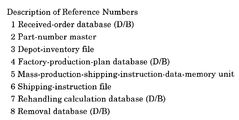
- As shown in the same figure, this embodiment comprises: a received-order database (D/B) 1 that stores the ordered quantity of ordered repair parts; a part-
number master 2 that stores the part numbers given to each type of repair part; a depot-inventory file 3 that stores the quantity of inventory for the repair part at the depot (warehouse); a factory-production-plan database (D/B) 4 that stores and outputs the production plan quantity (daily scheduled production quantity (= production quantity)) for a repair part set according to the production plan of the factory; a mass-production-shipping-instruction-data-memory unit 5 that creates and outputs instruction data for giving instructions for the daily shipping quantity of the repair part; a shipping-instruction file 6 that stores and outputs the daily scheduled shipping quantity for the repair part; a rehandling-calculation database (D/B) 7 that stores the data necessary for performing rehandling calculation that includes: the ordered quantity of the repair part obtained from the received-order database 1, the number of production plans obtained from the factory-production-plan database 4, the scheduled shipping quantity obtained from the shipping-instruction file 6 and the inventory quantity obtained from the depot-inventory file 3; and a removal database (D/B) 8 that stores the number of repair parts actually removed. - Each database is created inside the memory apparatus of the personal computer or workstation (not shown in the figure), and connected over a network such that data can be sent and received.
- Next, the processing procedure of the embodiment will be explained with reference to Fig. 1. First, in step S1, when there is an order for a repair part, the order for the repair part is received. After that, received-order data, comprising the ordered quantity and the name of the repair part, is supplied to the received-
order database 1. The received-order database 1 correlates the name of the ordered repair part with the ordered quantity and stores them. - Next, in step S2, the part number of the repair part from the received-
order database 1 is read from the part-number master 2, and based on this part number, an inventory location (depot (warehouse)) having this repair part as inventory is searched for from the depot-inventory file 3. - In step S3, the daily production quantity (input quantity) is obtained from the factory-production-
plan database 4, and the scheduled shipping quantity is obtained from the shipping-instruction file 6, the inventory quantity is obtained from the depot-inventory file 3, and the ordered quantity is obtained from the received-order database 1. Moreover, the obtained production quantity, scheduled shipping quantity, inventory quantity and ordered quantity are supplied to the rehandling-calculation database 7 and stored. - Next, in step S4, the production quantity is added to the inventory quantity and the scheduled shipping quantity is subtracted for each day, and the resulting inventory amount is then compared with the ordered quantity (= number of orders). As a result, in step S5, when the amount of inventory is less than the ordered quantity, or in other words, when the ordered quantity is greater than the amount of inventory, a specified mark is given for that day to indicate that the inventory will become '0' or be insufficient. After that, the process advances to step S6.
- On the other hand, in step S4, when it is determined that the amount of inventory is greater than the ordered quantity, the process advances to step S6, and a daily rehandling list showing the daily rehandling status is created as shown in Fig. 2. In this example, as shown in the same figure, on day 'N' the production (stock) quantity is 100, the scheduled shipping quantity is 45, the number of orders for the repair part is 0 and the
inventory quantity 55. On day 'N+1' the production (stock) quantity is 0, the scheduled shipping quantity is 50, the number of orders for the repair part is 0 and theinventory quantity 5. On day 'N+2' the production (stock) quantity is 100, the scheduled shipping quantity is 50, the number of orders for the repair part is 0 and theinventory quantity 55. On day 'N+3' the production (stock) quantity is 0, the scheduled shipping quantity is 50, the number of orders for the repair part is 10 and the inventory quantity -5. On day 'N+4' the production (stock) quantity is 100, the scheduled shipping quantity is 50, the number of orders for the repair part is 0 and theinventory quantity 45. The created daily rehandling list is supplied to the factory-production-plan database 4, where it is reflected on the future production plan, and it is supplied to theremoval database 8 and stored. - From the daily rehandling list, the factory-production-
plan database 4 is able to know on which days there is insufficient inventory, so the production plan is remade, and by increasing the production amount, it is possible to prevent the inventory from becoming insufficient. - The daily rehandling list as shown in Fig. 2 is stored in the
removal database 8. In step S7, the daily rehandling list is obtained from theremoval database 8, and a removal form is created and issued. Instep 8, the removal process is performed according to the removal form. - As explained above, in this embodiment, from the ordered quantity and the amount of inventory, it is possible to know beforehand times when the inventory will be insufficient, so it is possible to make a production plan according to the ordered quantity, and thus it is possible to prevent the inventory from becoming insufficient as much as possible, and prevent the user from having to wait a long time for a necessary repair part.
- The construction and operation of the embodiment described above is an example, and needless to say, it is possible to make changes within a range that does not deviate from the scope of the invention.
- As described above, with the rehandling planning system and rehandling planning method of this invention, the ordered quantity of a specified part is stored, a production plan for setting the daily production quantity for the part is created, the scheduled shipping quantity of the part is output, the inventory quantity of the part is stored and a production-plan for correcting the production plan for the part is created based on the ordered quantity, production quantity, scheduled shipping quantity and inventory quantity, so it is possible to know in advance when the inventory will become insufficient and to remake the production plan, and thus it is possible to keep the inventory from becoming insufficient.
Claims (4)
- A rehandling system that creates a rehandling plan from the ordered quantity of a specified part and the inventory quantity, and comprising:an ordered-quantity-memory means of storing the ordered quantity of a specified part;a production-plan-creation means of creating a production plan that sets the daily production quantity for said part;a scheduled-shipping-quantity-output means of outputting the scheduled shipping quantity of said part;an inventory-quantity-memory means of storing the inventory quantity for said part; anda production-plan-list-creation means of creating a production-plan list for correcting the production plan for said part based on said ordered quantity, said production quantity, said scheduled shipping quantity and said inventory quantity.
- The rehandling planning system of claim 1 further comprising:an inventory-amount-memory means of calculating and storing the amount of inventory after shipping said part based on said ordered quantity, said production quantity, said scheduled shipping quantity and said inventory quantity; anda comparison means of comparing which is larger between said amount of inventory of said part that is stored by said inventory-amount-memory means and said ordered quantity of said part that is stored by said ordered-quantity-memory means.
- The rehandling planning system of claim 2 wherein
it is possible to issue an instruction for instructing additional production of said part when the comparison result by said comparison means determines that said ordered quantity is greater than said inventory quantity. - A rehandling planning method of creating a rehandling plan from the ordered quantity of a specified part and the inventory quantity, and comprising:an ordered-quantity-memory step of storing the ordered quantity of a specified part;a production-plan-creation step of creating a production plan that sets the daily production quantity for said part;a scheduled-shipping-quantity-output step of outputting the scheduled shipping quantity of said part;an inventory-quantity-memory step of storing the inventory quantity for said part; anda production-plan-list-creation step of creating a production-plan list for correcting the production plan for said part based on said ordered quantity, said production quantity, said scheduled shipping quantity and said inventory quantity.
Applications Claiming Priority (3)
| Application Number | Priority Date | Filing Date | Title |
|---|---|---|---|
| JP2002348587 | 2002-11-29 | ||
| JP2002348587A JP2004185119A (en) | 2002-11-29 | 2002-11-29 | Delivery planning system and delivery planning method |
| PCT/JP2003/015075 WO2004051385A1 (en) | 2002-11-29 | 2003-11-26 | Part makeshift planning system and part makeshift planning method |
Publications (2)
| Publication Number | Publication Date |
|---|---|
| EP1569059A1 true EP1569059A1 (en) | 2005-08-31 |
| EP1569059A4 EP1569059A4 (en) | 2006-04-05 |
Family
ID=32462923
Family Applications (1)
| Application Number | Title | Priority Date | Filing Date |
|---|---|---|---|
| EP03775893A Withdrawn EP1569059A4 (en) | 2002-11-29 | 2003-11-26 | Part makeshift planning system and part makeshift planning method |
Country Status (6)
| Country | Link |
|---|---|
| US (1) | US20040167831A1 (en) |
| EP (1) | EP1569059A4 (en) |
| JP (1) | JP2004185119A (en) |
| CN (1) | CN1714324A (en) |
| BR (1) | BR0316495A (en) |
| WO (1) | WO2004051385A1 (en) |
Families Citing this family (7)
| Publication number | Priority date | Publication date | Assignee | Title |
|---|---|---|---|---|
| JP5173754B2 (en) * | 2008-11-11 | 2013-04-03 | キヤノンItソリューションズ株式会社 | Information processing apparatus, information processing method, and computer program |
| CN104318417A (en) * | 2014-11-05 | 2015-01-28 | 常熟合正企业管理咨询有限公司 | Finished product inventory and planning system |
| US10929808B2 (en) * | 2017-01-17 | 2021-02-23 | International Business Machines Corporation | Estimation of node processing capacity for order fulfillment |
| CN115587841A (en) * | 2022-10-21 | 2023-01-10 | 鼎捷软件股份有限公司 | Predictive data processing system and predictive data processing method |
| CN115562215A (en) * | 2022-10-28 | 2023-01-03 | 鼎捷软件股份有限公司 | Prediction data balance system and prediction data balance method |
| CN115965129A (en) * | 2022-12-15 | 2023-04-14 | 鼎捷软件股份有限公司 | Backup production deviation data analysis system and backup production deviation data analysis method |
| CN118505018B (en) * | 2024-07-15 | 2024-10-18 | 山东省明锐钢板有限公司 | Cold rolled steel production control management system |
Family Cites Families (5)
| Publication number | Priority date | Publication date | Assignee | Title |
|---|---|---|---|---|
| JPH04362167A (en) * | 1991-06-06 | 1992-12-15 | Kawasaki Steel Corp | Production of galvannealed steel sheet excellent in adhesion |
| JPH10315100A (en) * | 1997-05-14 | 1998-12-02 | Hitachi Ltd | Production planning system |
| JP2000084799A (en) * | 1998-09-11 | 2000-03-28 | Sekisui Chem Co Ltd | Production instruction creation system |
| JP2002015035A (en) * | 2000-04-28 | 2002-01-18 | Fujitsu Ltd | Product supply planning system, product supply planning program and recording medium |
| US20020072988A1 (en) * | 2000-12-13 | 2002-06-13 | Itt Manufacturing Enterprises, Inc. | Supply management system |
-
2002
- 2002-11-29 JP JP2002348587A patent/JP2004185119A/en active Pending
-
2003
- 2003-11-19 US US10/715,832 patent/US20040167831A1/en not_active Abandoned
- 2003-11-26 EP EP03775893A patent/EP1569059A4/en not_active Withdrawn
- 2003-11-26 BR BR0316495-0A patent/BR0316495A/en not_active Application Discontinuation
- 2003-11-26 WO PCT/JP2003/015075 patent/WO2004051385A1/en not_active Ceased
- 2003-11-26 CN CNA2003801040326A patent/CN1714324A/en active Pending
Non-Patent Citations (2)
| Title |
|---|
| No Search * |
| See also references of WO2004051385A1 * |
Also Published As
| Publication number | Publication date |
|---|---|
| US20040167831A1 (en) | 2004-08-26 |
| CN1714324A (en) | 2005-12-28 |
| EP1569059A4 (en) | 2006-04-05 |
| JP2004185119A (en) | 2004-07-02 |
| BR0316495A (en) | 2005-10-11 |
| WO2004051385A1 (en) | 2004-06-17 |
Similar Documents
| Publication | Publication Date | Title |
|---|---|---|
| US6415195B1 (en) | Method and system for providing sufficient availability of manufacturing resources to meet unanticipated demand | |
| US20020087227A1 (en) | System and method for production management | |
| EP1542106A1 (en) | Part ordering amount calculation device | |
| JP2009070016A (en) | Inventory planning system | |
| US20030050870A1 (en) | Capacity-driven production planning tools | |
| EP2610696A1 (en) | Process design/production planning device | |
| EP1569059A1 (en) | Part makeshift planning system and part makeshift planning method | |
| JP5089352B2 (en) | Sales production planning system, operation method of sales production planning system, and computer program | |
| JPH11345267A (en) | Inventory management business support method and system | |
| WO2019163498A1 (en) | Production management device, production management method, and program | |
| JP4753590B2 (en) | Method and system for selecting inventory replenishment model | |
| JP4361846B2 (en) | Shipment planning apparatus and method | |
| Tanaka et al. | Inventory management method with demand forecast in e-commerce | |
| US6970756B2 (en) | Computer-assisted pull flow production management method | |
| KR100780103B1 (en) | Record medium recording method of material requirements and production plan requirements and the program to implement them | |
| EP1569060A1 (en) | Part ordering system and part ordering method | |
| Klug | A hybrid push/pull design of kanban systems during production ramp-up phase | |
| JP3671809B2 (en) | Inventory management support device | |
| US8688547B2 (en) | Lead time and validity based supply determination | |
| JP2005122581A (en) | Delivery time management system | |
| JP4162920B2 (en) | Production plan determination period calculation system, method, and program for causing computer to execute the method | |
| US20060010020A1 (en) | Non-stale incremental planning | |
| JP2003176029A (en) | Inventory control device | |
| WO2000046733A1 (en) | Method for maintaining an inventory | |
| JPH11114784A (en) | Production plan creation device |
Legal Events
| Date | Code | Title | Description |
|---|---|---|---|
| PUAI | Public reference made under article 153(3) epc to a published international application that has entered the european phase |
Free format text: ORIGINAL CODE: 0009012 |
|
| 17P | Request for examination filed |
Effective date: 20050421 |
|
| AK | Designated contracting states |
Kind code of ref document: A1 Designated state(s): BE |
|
| AX | Request for extension of the european patent |
Extension state: AL LT LV MK |
|
| DAX | Request for extension of the european patent (deleted) | ||
| A4 | Supplementary search report drawn up and despatched |
Effective date: 20060222 |
|
| STAA | Information on the status of an ep patent application or granted ep patent |
Free format text: STATUS: THE APPLICATION IS DEEMED TO BE WITHDRAWN |
|
| 18D | Application deemed to be withdrawn |
Effective date: 20060524 |