EP1569031A1 - Phasenkonjugierter Spiegel mit Stimulierter Brillouin-Streuung unter Verwendung eines Wellenleiter mit photonischer Bandlücke - Google Patents
Phasenkonjugierter Spiegel mit Stimulierter Brillouin-Streuung unter Verwendung eines Wellenleiter mit photonischer Bandlücke Download PDFInfo
- Publication number
- EP1569031A1 EP1569031A1 EP05250612A EP05250612A EP1569031A1 EP 1569031 A1 EP1569031 A1 EP 1569031A1 EP 05250612 A EP05250612 A EP 05250612A EP 05250612 A EP05250612 A EP 05250612A EP 1569031 A1 EP1569031 A1 EP 1569031A1
- Authority
- EP
- European Patent Office
- Prior art keywords
- fiber
- medium
- core
- sbs
- band gap
- Prior art date
- Legal status (The legal status is an assumption and is not a legal conclusion. Google has not performed a legal analysis and makes no representation as to the accuracy of the status listed.)
- Withdrawn
Links
- 239000000835 fiber Substances 0.000 claims abstract description 47
- 239000007788 liquid Substances 0.000 claims abstract description 24
- VYPSYNLAJGMNEJ-UHFFFAOYSA-N Silicium dioxide Chemical compound O=[Si]=O VYPSYNLAJGMNEJ-UHFFFAOYSA-N 0.000 claims abstract description 16
- 238000005253 cladding Methods 0.000 claims abstract description 14
- 239000007787 solid Substances 0.000 claims abstract description 13
- 239000000377 silicon dioxide Substances 0.000 claims abstract description 8
- 230000005641 tunneling Effects 0.000 claims abstract description 8
- 239000013307 optical fiber Substances 0.000 claims abstract description 3
- 230000010287 polarization Effects 0.000 abstract description 6
- 239000012071 phase Substances 0.000 description 43
- 230000021615 conjugation Effects 0.000 description 25
- 238000000034 method Methods 0.000 description 16
- 230000003287 optical effect Effects 0.000 description 15
- 238000002310 reflectometry Methods 0.000 description 13
- 230000008569 process Effects 0.000 description 11
- 210000004027 cell Anatomy 0.000 description 8
- QGJOPFRUJISHPQ-UHFFFAOYSA-N Carbon disulfide Chemical compound S=C=S QGJOPFRUJISHPQ-UHFFFAOYSA-N 0.000 description 7
- 239000011521 glass Substances 0.000 description 7
- 230000003993 interaction Effects 0.000 description 6
- 230000028161 membrane depolarization Effects 0.000 description 6
- 230000000737 periodic effect Effects 0.000 description 5
- 230000008901 benefit Effects 0.000 description 4
- 230000004075 alteration Effects 0.000 description 3
- 238000009835 boiling Methods 0.000 description 3
- 230000000694 effects Effects 0.000 description 3
- 230000005684 electric field Effects 0.000 description 3
- 239000000463 material Substances 0.000 description 3
- 229910052751 metal Inorganic materials 0.000 description 3
- 239000002184 metal Substances 0.000 description 3
- 238000012986 modification Methods 0.000 description 3
- 230000004048 modification Effects 0.000 description 3
- XJDNKRIXUMDJCW-UHFFFAOYSA-J titanium tetrachloride Chemical compound Cl[Ti](Cl)(Cl)Cl XJDNKRIXUMDJCW-UHFFFAOYSA-J 0.000 description 3
- 101100456571 Mus musculus Med12 gene Proteins 0.000 description 2
- 238000001069 Raman spectroscopy Methods 0.000 description 2
- 230000003044 adaptive effect Effects 0.000 description 2
- 238000005452 bending Methods 0.000 description 2
- 238000012937 correction Methods 0.000 description 2
- 230000007547 defect Effects 0.000 description 2
- 230000001419 dependent effect Effects 0.000 description 2
- 239000006185 dispersion Substances 0.000 description 2
- 238000003384 imaging method Methods 0.000 description 2
- 239000000203 mixture Substances 0.000 description 2
- 230000000644 propagated effect Effects 0.000 description 2
- 230000005855 radiation Effects 0.000 description 2
- 238000010521 absorption reaction Methods 0.000 description 1
- 230000002411 adverse Effects 0.000 description 1
- 238000013459 approach Methods 0.000 description 1
- 230000005540 biological transmission Effects 0.000 description 1
- 230000015556 catabolic process Effects 0.000 description 1
- 210000002421 cell wall Anatomy 0.000 description 1
- 230000008859 change Effects 0.000 description 1
- 238000004891 communication Methods 0.000 description 1
- 230000008878 coupling Effects 0.000 description 1
- 238000010168 coupling process Methods 0.000 description 1
- 238000005859 coupling reaction Methods 0.000 description 1
- 239000013078 crystal Substances 0.000 description 1
- 230000002939 deleterious effect Effects 0.000 description 1
- 239000012530 fluid Substances 0.000 description 1
- 239000012535 impurity Substances 0.000 description 1
- 238000012423 maintenance Methods 0.000 description 1
- 238000004519 manufacturing process Methods 0.000 description 1
- 238000005259 measurement Methods 0.000 description 1
- 238000011093 media selection Methods 0.000 description 1
- 230000009022 nonlinear effect Effects 0.000 description 1
- 238000001615 p wave Methods 0.000 description 1
- 238000009304 pastoral farming Methods 0.000 description 1
- 239000012782 phase change material Substances 0.000 description 1
- 238000002135 phase contrast microscopy Methods 0.000 description 1
- 230000010363 phase shift Effects 0.000 description 1
- 239000004038 photonic crystal Substances 0.000 description 1
- 230000001902 propagating effect Effects 0.000 description 1
- 238000007789 sealing Methods 0.000 description 1
- 239000003566 sealing material Substances 0.000 description 1
- 229920002379 silicone rubber Polymers 0.000 description 1
- 239000004945 silicone rubber Substances 0.000 description 1
- 239000011343 solid material Substances 0.000 description 1
- 239000012808 vapor phase Substances 0.000 description 1
Images

Classifications
-
- G—PHYSICS
- G02—OPTICS
- G02F—OPTICAL DEVICES OR ARRANGEMENTS FOR THE CONTROL OF LIGHT BY MODIFICATION OF THE OPTICAL PROPERTIES OF THE MEDIA OF THE ELEMENTS INVOLVED THEREIN; NON-LINEAR OPTICS; FREQUENCY-CHANGING OF LIGHT; OPTICAL LOGIC ELEMENTS; OPTICAL ANALOGUE/DIGITAL CONVERTERS
- G02F1/00—Devices or arrangements for the control of the intensity, colour, phase, polarisation or direction of light arriving from an independent light source, e.g. switching, gating or modulating; Non-linear optics
- G02F1/35—Non-linear optics
- G02F1/353—Frequency conversion, i.e. wherein a light beam is generated with frequency components different from those of the incident light beams
- G02F1/3536—Four-wave interaction
- G02F1/3538—Four-wave interaction for optical phase conjugation
-
- G—PHYSICS
- G02—OPTICS
- G02B—OPTICAL ELEMENTS, SYSTEMS OR APPARATUS
- G02B6/00—Light guides; Structural details of arrangements comprising light guides and other optical elements, e.g. couplings
- G02B6/02—Optical fibres with cladding with or without a coating
- G02B6/02295—Microstructured optical fibre
- G02B6/02314—Plurality of longitudinal structures extending along optical fibre axis, e.g. holes
- G02B6/02342—Plurality of longitudinal structures extending along optical fibre axis, e.g. holes characterised by cladding features, i.e. light confining region
- G02B6/02347—Longitudinal structures arranged to form a regular periodic lattice, e.g. triangular, square, honeycomb unit cell repeated throughout cladding
-
- G—PHYSICS
- G02—OPTICS
- G02B—OPTICAL ELEMENTS, SYSTEMS OR APPARATUS
- G02B6/00—Light guides; Structural details of arrangements comprising light guides and other optical elements, e.g. couplings
- G02B6/02—Optical fibres with cladding with or without a coating
- G02B6/02295—Microstructured optical fibre
- G02B6/02314—Plurality of longitudinal structures extending along optical fibre axis, e.g. holes
- G02B6/02385—Comprising liquid, e.g. fluid filled holes
-
- G—PHYSICS
- G02—OPTICS
- G02F—OPTICAL DEVICES OR ARRANGEMENTS FOR THE CONTROL OF LIGHT BY MODIFICATION OF THE OPTICAL PROPERTIES OF THE MEDIA OF THE ELEMENTS INVOLVED THEREIN; NON-LINEAR OPTICS; FREQUENCY-CHANGING OF LIGHT; OPTICAL LOGIC ELEMENTS; OPTICAL ANALOGUE/DIGITAL CONVERTERS
- G02F2202/00—Materials and properties
- G02F2202/32—Photonic crystals
-
- H—ELECTRICITY
- H01—ELECTRIC ELEMENTS
- H01S—DEVICES USING THE PROCESS OF LIGHT AMPLIFICATION BY STIMULATED EMISSION OF RADIATION [LASER] TO AMPLIFY OR GENERATE LIGHT; DEVICES USING STIMULATED EMISSION OF ELECTROMAGNETIC RADIATION IN WAVE RANGES OTHER THAN OPTICAL
- H01S3/00—Lasers, i.e. devices using stimulated emission of electromagnetic radiation in the infrared, visible or ultraviolet wave range
- H01S3/10—Controlling the intensity, frequency, phase, polarisation or direction of the emitted radiation, e.g. switching, gating, modulating or demodulating
- H01S3/10076—Controlling the intensity, frequency, phase, polarisation or direction of the emitted radiation, e.g. switching, gating, modulating or demodulating using optical phase conjugation, e.g. phase conjugate reflection
-
- H—ELECTRICITY
- H01—ELECTRIC ELEMENTS
- H01S—DEVICES USING THE PROCESS OF LIGHT AMPLIFICATION BY STIMULATED EMISSION OF RADIATION [LASER] TO AMPLIFY OR GENERATE LIGHT; DEVICES USING STIMULATED EMISSION OF ELECTROMAGNETIC RADIATION IN WAVE RANGES OTHER THAN OPTICAL
- H01S5/00—Semiconductor lasers
- H01S5/10—Construction or shape of the optical resonator, e.g. extended or external cavity, coupled cavities, bent-guide, varying width, thickness or composition of the active region
- H01S5/14—External cavity lasers
- H01S5/145—Phase conjugate mirrors
Definitions
- the present invention relates to optics. More specifically, the present invention relates to optics required for high power solid-state lasers and other applications requiring correction of optical aberration.
- phase conjugate mirrors have been used to correct for distortion in laser beams resulting from imperfect lasing media and optics. Tools are generally used to create a reversed wavefront needed for correction of aberrations in a beam. Often nonlinear optical phase conjugation techniques are used. One alternative technique involves nonlinear stimulated Brillouin scattering (SBS).
- SBS nonlinear stimulated Brillouin scattering
- a Stokes field is a field of backscattered light that propagates in an opposite direction and at a longer wavelength relative to pump light and interferes therewith.
- the threshold for SBS phase conjugation is related to the field strength as well as the interaction length.
- the focal length is also reduced thereby limiting the interaction length for the nonlinear process. This results in a high peak power threshold for phase conjugation that makes bulk focus SBS impractical for some high average power, high pulse rate applications.
- the short interaction length does not allow good diffractive mixing between different parts of the beam which adversely affects phase conjugation fidelity
- Hollow capillary glass light guides have been demonstrated with higher-index liquid SBS media such that the beam propagates down the guide with very low loss via total internal reflection at the liquid-to-glass interface.
- the numerical aperture of the guide is limited by the difference in refractive indices of the liquid a nd glass. This limiting numerical aperture sets an upper limit on the étendue (area - solid angle product) of the input beam for good phase conjugation. In practice, the allowable étendue may be much lower due to depolarization effects.
- uncoated glass lightguides cannot be used with low index liquid media or gaseous media, as the index of refraction of the glass is greater than that of the SBS media preventing total internal reflection. Gas media may be preferred for high average power applications, particularly with continuous wave or quasi-continuous wave optical signals, due to boiling of the liquid medium through absorption of the optical radiation.
- glass-core fibers have been used for SBS phase conjugation, but these fibers suffer from the same numerical aperture limits as the liquid guides. Depolarization of the beam within the guide degrades the performance of the PCM. Lengthening a conventional guide in order to enhance the nonlinear interaction or bending it to minimize space tends to exacerbate the depolarization problem. Furthermore, glass-core fibers have low SBS gain, high sound velocities, and long acoustic lifetimes, which limit their tolerance to beam aberrations.
- the inventive phase conjugate mirror includes a photonic band gap light guide and a stimulated Brillouin scattering medium disposed in operational relation thereto.
- the light guide is an optical fiber with a cladding transparent at a propagation wavelength and having a hollow or solid core.
- the cladding is microstructured silica, and it supports guide modes through frustrated tunneling photonic band gap guidance or Bragg photonic band gap guidance.
- the fiber has an array of holes or channels disposed around the core.
- the fiber is disposed within a stimulated Brillouin scattering cell containing the SBS medium, which could be a gas, gel, or liquid.
- the medium is a solid disposed at the core of the fiber, and no cell is required.
- the invention provides a means of guiding light with a fluid-filled or solid core structure with high guiding efficiency, without disturbing the polarization state of the light as it propagates.
- Stimulated Brillouin Scattering is a commonly used nonlinear (electric field strength dependent) process for generating the phase conjugate of a narrow-band input optical beam with no external pumps (i.e., self-pumped nonlinear optical phase conjugation).
- the SBS process is well known in the art and is described in several open literature references, including R. A. Fisher's book entitled Optical Phase Conjugation (Academic Press, New York, 1983).
- SBS can be used with simple bulk focusing to provide high phase conjugate mirror (PCM) reflectivity and good phase conjugation fidelity.
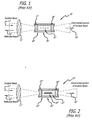
- FIG. 1 is a simplified schematic sectional side view of an SBS phase conjugate mirror using a gaseous medium with a bulk focus geometry in accordance with conventional teachings.
- the mirror 10' includes a focusing lens 12' which focuses an incident beam 14' into an SBS cell 20'.
- the cell 20' has a gas medium 22' which backscatters the incident beam 14' as a reflected beam 16'.
- the cell 20' further includes cell walls 26' to contain the gas under pressure, an entrance window 27' to allow the incident and reflected beams to be transmitted therethrough, and an exit window 28' to allow the unconverted portion of the incident beam to be transmitted out of the cell.
- Phase conjugate mirror (PCM) reflectivity in this context is the ratio of reflected to incident beam powers.
- the maximum achievable value of PCM reflectivity is nearly 100%, which is determined by the incident beam intensity, focusing geometry, SBS medium nonlinear properties, and gas pressure.
- PCM reflectivity is ultimately limited by the percentage of incident power that is converted to acoustic power in the medium (Manley-Rowe limit).
- Phase conjugation fidelity measures the ability of a PCM to return a beam that is an exact conjugate of the input beam.
- the fidelity is the fraction of the reflected power contained in an eigenmode that is conjugate to the incident field.
- the maximum achievable value of phase conjugation fidelity is 100%.
- the bulk focus geometry may provide low reflectivity and/or poor phase conjugation fidelity.
- the low reflectivity is believed to result from the fact that the SBS gain is exponentially dependent on the product of the nonlinear gain of the medium, incident intensity, and interaction length in the focal volume. If the focal length of the focusing lens is shortened to decrease the focal spot size in order to increase the incident beam intensity, the focal volume is foreshortened, thereby reducing the interaction length. Increasing the focal length has the converse effect. The result is that the SBS gain for a given medium c annot be arbitrarily improved in a focusing geometry by simple parametric adjustments.
- the minimum SBS phase conjugate mirror power threshold in a focused geometry is typically in the range of tens of kilowatts.
- the SBS PCM threshold increases proportionally to the beam divergence (étendue) and can be too high for laser applications with long pulse or CW optical waveforms.
- PCM reflectivity/threshold and phase conjugation fidelity can be improved for low power and/or highly aberrated beams by incorporating the SBS medium in a light guide geometry. See for example:
- FIG. 2 is a simplified sectional side view of an SBS phase conjugate mirror 10" using liquid medium in light guide geometry in accordance with conventional teachings.
- the SBS medium 22" is a liquid, such as carbon disulfide (CS 2 ) or titanium tetrachloride (TiCl 4 ), both of which have a high SBS nonlinear gain and a high refractive index.
- the light guide is formed by a small internal diameter ( ⁇ 0.5 mm) glass capillary 24', which is immersed in the liquid SBS medium 22'.
- the index of refraction of the capillary is less than that of the liquid allowing reflection off the inner walls of the capillary via total internal reflection for shallow grazing angles.
- liquid light guide SBS PCM There are several limitations of the liquid light guide SBS PCM described above. First, it is not practical with gas media, as the lower index of refraction of the gas medium will not allow total internal reflection. Metal guides have been used with gas media in an attempt to circumvent this problem, but metal guides are lossy.
- the SBS threshold increases with higher angles of incidence entering the guide, thereby causing the SBS reflectivity to fall off with incidence angle.
- a condition for good phase conjugation fidelity is that all portions of the beam have essentially the same reflectivity. This condition limits the acceptance angle of the guide for phase conjugation to a value well below that determined by geometrical optics (numerical aperture of the guide) restricting the étendue (area - solid angle product) of the incident beam.
- phase conjugation is a scalar process, and depolarization of the incident beam within the lightguide represents a loss of phase information and attendant loss of phase conjugation fidelity.
- Depolarization is caused by phase shifts between the s and p waves reflected via total internal reflection within the guide. Depolarization increases with the length of the guide and is exacerbated by bending/coiling the guide to make the PCM more compact.
- liquids are difficult to purify, and the residual impurities within the medium may absorb enough of the incident radiation to produce a liquid-to-vapor phase change (i.e., boiling of the liquid).
- Pressurizing the liquid has been used in liquid lightguide SBS PCMs to increase the threshold for boiling, however this technique is limited by practical constraints on the applied pressure and adds cost and complexity to the PCM apparatus.
- the concept of a Bragg fiber was proposed in the late 1970's by Amnon Yariv and Pochi Yeh.
- the first microstructured or "holey” fiber was fabricated J.C. Knight, et al., at ORC, Victoria in 1996, and the first microstructured fiber which guided light by a photonic bandgap effect was fabricated by R. F. Cregan, et al, at the University of Bath.
- the "holey” fiber considered in the present invention is typically a silica fiber with a periodic array of small holes running parallel to the fiber axis. These holes strongly affect the optical properties of the fiber.
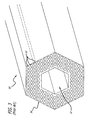
- the center or core of the fiber through which the beam is propagated is either solid silica or has a hole, often larger than the holes in the surrounding periodic array. Figure 3 shows the latter configuration.
- Figure 3 is an illustrative perspective end view of a photonic band gap fiber 30' with a hole in center in accordance with conventional teachings.
- the core 32' is filled with a gaseous medium.
- the core 32' is surrounded by a periodic array 34' of microstructured silica fibers 36'. These microstructured fibers 36' are disposed in small holes or channels in the periodic array 34' and may be fabricated by stacking and fusing glass tubes together then drawing the preform structure into long fibers using conventional fiber manufacturing processes.
- the PBG guidance process does not require a core region with higher index than the cladding, allowing efficient propagation in a gas core fiber.
- This offers several advantages for high p ower fiber transmission, including high thresholds for breakdown and deleterious nonlinear processes such as stimulated Raman scattering.
- Low-index liquid cores may also be used, allowing for a larger SBS media selection with liquid lightguide PCM devices.
- the properties of the PBG fiber, such as dispersion can be readily engineered by tailoring the geometry of the structure (hole spacing and fill factor). Additional advantages include (a) extremely low coupling between propagating modes, even with tight bends in the fiber; (b) single mode operation with large core sizes; and (c) high polarization purity with just slight asymmetry in the structure.
- the performance of the PBG fiber is affected by defects in the structure and the finite extent of the periodic array. Defects, for example, introduce localized discontinuities in the bandgap.
- the present invention builds on the advances in the field of photonic bandgap fibers. Rather than using the large core diameter afforded by the photonic bandgap structure to suppress nonlinear processes, the present invention encourages the nonlinear stimulated Brillouin scattering process by using a suitably small fiber core diameter and by exploiting the high numerical aperture and polarization preserving properties of the PBG guide to enhance nonlinear optical phase conjugation performance.
- PBG fibers for the generation of multiple optical wavelengths by nonlinear processes, and more generally in enhanced nonlinear optics, has been suggested in the open literature references [R.F. Cregan paper cited earlier]
- practical schemes for using PBG structures in guiding SBS PCM devices have not been disclosed.
- Figure 4 is a simplified sectional side view of an SBS PCM with gas core PBG light guide in accordance with an illustrative embodiment of the present teachings.
- the mirror 10 of Figure 4 is adapted for use with a focusing lens 12 which focuses an incident beam 14 onto an SBS cell 20.
- the cell 20 includes a gas core photonic band gap (PBG) fiber 30.
- PBG gas core photonic band gap
- the fiber 30 is filled with a gaseous SBS medium, which may include essentially pure CH 4 , N 2 , or Xe, mixtures thereof, or other gasses and gas mixtures.
- a high index cladding structure is included and is composed of a homogeneous solid material that is transparent at the propagation wavelength, such as silica.
- the PBG cladding supports guided modes in the gas core through either frustrated tunneling PBG guidance or Bragg PBG guidance as described above.
- the PBG structure may be engineered with a degree of asymmetry through techniques known in the art to enhance the birefringence of the fiber and thus maintain the polarization state of the propagated beam. Such asymmetry may be introduced by fabricating the fiber with an elliptical core. This can be accomplished by stacking capillaries with different wall thickness in the preform, as described by J. Knight, et al . in an article entitled "Photonic Crystal Fibers” published in Optics and Photonics News, pp. 26-30 (March 2002).
- the PBG structure may be engineered to support a large number of propagation modes with near equal reflectivity, thereby allowing the PCM to operate with highly aberrated beams (high étendue) with good phase conjugation fidelity.
- the gas-core fiber structure shown in Figure 4 can also be used with liquid and gel SBS media.
- Liquid media may include CS 2 or TiCl 4 or other suitable liquids.
- the small holes in the PBG structure may require sealing at the ends to preserve index homogeneity within these regions.
- DC 93500 silicone rubber, obtained from Dow Coming, may be used as the sealing material at the ends of the fiber.
- Figure 5 is a simplified sectional side view of a SBS PCM with solid core PBG guide in accordance with an illustrative embodiment of the present teachings.
- Figure 5 illustrates an alternate embodiment of the present invention wherein the PBG fiber 130 is fabricated with a solid core.
- the core may be the same material as the high index cladding.
- PC MOPA phase conjugate master oscillator/power amplifier
- the PBG-guided SBS PCM may provide high PCM reflectivity with good phase conjugation fidelity for beams that are highly aberrated by the phase distortions in the power amplifier beamline.
- a second application is in an integrated phase conjugate laser and adaptive optics beam control system such as that described by R. Byren and A. Trafton in copending patent application number 09/965,764, entitled SYSTEM AND METHOD FOR EFFECTING HIGH-POWER BEAM CONTROL WITH ADAPTIVE OPTICS IN LOW POWER BEAM PATH, Atty. Docket No. PD-00W089, the teachings of which are hereby incorporated by reference herein.
- the third application is in a compensated imaging system such as that described by T. O'Meara in " Applications of Nonlinear Phase Conjugation in Compensated Active Imaging” in Optical Engineering, Vol 21, pp. 231-236 (1982).
- Other applications for the present invention may be envisioned by those skilled in the art without restricting the scope of the present invention.
Landscapes
- Physics & Mathematics (AREA)
- Nonlinear Science (AREA)
- General Physics & Mathematics (AREA)
- Optics & Photonics (AREA)
- Optical Modulation, Optical Deflection, Nonlinear Optics, Optical Demodulation, Optical Logic Elements (AREA)
Applications Claiming Priority (2)
| Application Number | Priority Date | Filing Date | Title |
|---|---|---|---|
| US786342 | 2004-02-25 | ||
| US10/786,342 US20050185907A1 (en) | 2004-02-25 | 2004-02-25 | Stimulated brillouin scattering phase conjugate mirror utilizing photonic bandgap guide and method |
Publications (1)
| Publication Number | Publication Date |
|---|---|
| EP1569031A1 true EP1569031A1 (de) | 2005-08-31 |
Family
ID=34750487
Family Applications (1)
| Application Number | Title | Priority Date | Filing Date |
|---|---|---|---|
| EP05250612A Withdrawn EP1569031A1 (de) | 2004-02-25 | 2005-02-03 | Phasenkonjugierter Spiegel mit Stimulierter Brillouin-Streuung unter Verwendung eines Wellenleiter mit photonischer Bandlücke |
Country Status (2)
| Country | Link |
|---|---|
| US (1) | US20050185907A1 (de) |
| EP (1) | EP1569031A1 (de) |
Families Citing this family (4)
| Publication number | Priority date | Publication date | Assignee | Title |
|---|---|---|---|---|
| US7283712B2 (en) * | 2005-05-03 | 2007-10-16 | United States Of America As Represented By The Secretary Of The Navy | Gas filled hollow core chalcogenide photonic bandgap fiber Raman device and method |
| CN102231475B (zh) * | 2011-05-06 | 2012-09-05 | 哈尔滨理工大学 | 一种获取具有高度保真脉冲波形的受激布里渊散射光的方法及装置 |
| US10710412B2 (en) * | 2017-05-10 | 2020-07-14 | The Stanley Works Israel Ltd. | Wheel |
| CN112952545A (zh) * | 2019-12-11 | 2021-06-11 | 中国科学院大连化学物理研究所 | 一种基于空心光子晶体光纤的相位共轭激光放大器 |
Citations (1)
| Publication number | Priority date | Publication date | Assignee | Title |
|---|---|---|---|---|
| US5434942A (en) * | 1993-11-24 | 1995-07-18 | The State Of Israel, Atomic Energy Commission, Soreq Nuclear Research Center | Low threshold Brillouin active devices |
Family Cites Families (9)
| Publication number | Priority date | Publication date | Assignee | Title |
|---|---|---|---|---|
| US6433931B1 (en) * | 1997-02-11 | 2002-08-13 | Massachusetts Institute Of Technology | Polymeric photonic band gap materials |
| EP1305668A2 (de) * | 2000-07-31 | 2003-05-02 | Naomi Matsuura | Konfigurierbares photonisches bauelement |
| US6847477B2 (en) * | 2001-02-28 | 2005-01-25 | Kilolamdia Ip Limited | Optical system for converting light beam into plurality of beams having different wavelengths |
| US6600597B2 (en) * | 2001-03-19 | 2003-07-29 | Jds Uniphase Corporation | Photonic crystal amplifier for optical telecommunications system |
| US6778722B1 (en) * | 2001-04-25 | 2004-08-17 | Raytheon Company | Method and apparatus for switching optical signals with a photon band gap device |
| US7324282B2 (en) * | 2002-05-14 | 2008-01-29 | Arryx, Inc. | Apparatus, system and method for applying optical gradient forces |
| US6847771B2 (en) * | 2002-06-12 | 2005-01-25 | Corning Incorporated | Microstructured optical fibers and preforms and methods for fabricating microstructured optical fibers |
| US6965469B2 (en) * | 2002-11-20 | 2005-11-15 | The Boeing Company | Fiber amplifier having a non-doped inner core and at least one doped gain region |
| US7403689B2 (en) * | 2003-11-19 | 2008-07-22 | Corning Incorporated | Active photonic band-gap optical fiber |
-
2004
- 2004-02-25 US US10/786,342 patent/US20050185907A1/en not_active Abandoned
-
2005
- 2005-02-03 EP EP05250612A patent/EP1569031A1/de not_active Withdrawn
Patent Citations (1)
| Publication number | Priority date | Publication date | Assignee | Title |
|---|---|---|---|---|
| US5434942A (en) * | 1993-11-24 | 1995-07-18 | The State Of Israel, Atomic Energy Commission, Soreq Nuclear Research Center | Low threshold Brillouin active devices |
Non-Patent Citations (4)
| Title |
|---|
| CREGAN R F ET AL: "SINGLE-MODE PHOTONIC BAND GAP GUIDANCE OF LIGHT IN AIR", SCIENCE, AMERICAN ASSOCIATION FOR THE ADVANCEMENT OF SCIENCE,, US, vol. 285, no. 5433, 1999, pages 1537 - 1539, XP000914812, ISSN: 0036-8075 * |
| EICHLER H J ET AL: "Phase conjugate mirrors", JOURNAL OF NONLINEAR OPTICAL PHYSICS AND MATERIALS WORLD SCIENTIFIC SINGAPORE, vol. 10, no. 1, March 2001 (2001-03-01), pages 43 - 52, XP009047903, ISSN: 0218-8635 * |
| JONES D C ET AL: "A stimulated Brillouin scattering phase-conjugate mirror having a peak-power threshold @? 100 W", OPTICS COMMUNICATIONS, NORTH-HOLLAND PUBLISHING CO. AMSTERDAM, NL, vol. 123, no. 1, 15 January 1996 (1996-01-15), pages 175 - 181, XP004006466, ISSN: 0030-4018 * |
| JU HAN LEE ET AL: "INVESTIGATION OF BRILLOUIN EFFECTS IN SMALL-CORE HOLEY OPTICAL FIBER: LASING AND SCATTERING", OPTICS LETTERS, OPTICAL SOCIETY OF AMERICA, WASHINGTON, US, vol. 27, no. 11, 1 June 2002 (2002-06-01), pages 927 - 929, XP001122426, ISSN: 0146-9592 * |
Also Published As
| Publication number | Publication date |
|---|---|
| US20050185907A1 (en) | 2005-08-25 |
Similar Documents
| Publication | Publication Date | Title |
|---|---|---|
| US7403689B2 (en) | Active photonic band-gap optical fiber | |
| Humbert et al. | Hollow core photonic crystal fibers for beam delivery | |
| US7835646B2 (en) | High-order Bragg fiber dispersion correction | |
| US8055109B2 (en) | Single mode propagation in fibers and rods with large leakage channels | |
| US6259717B1 (en) | Asymmetric resonant optical cavity apparatus | |
| Monro et al. | Holey optical fibres: Fundamental properties and device applications | |
| JP2010541006A (ja) | ガラス大コア光ファイバ | |
| JP2007286622A (ja) | バンドギャップ微小構造光ファイバの横断モードの抑制 | |
| US10274671B2 (en) | Fiber structural body and light source device | |
| US9535211B2 (en) | Method and apparatus for fiber delivery of high power laser beams | |
| KR20180128946A (ko) | 제3 고조파 생성을 위한 고효율 레이저 시스템 | |
| Lee et al. | Flexible single-mode delivery of a high-power 2 μm pulsed laser using an antiresonant hollow-core fiber | |
| US20090041062A1 (en) | Fiber-based tunable laser | |
| US9488780B2 (en) | Device for converting the transverse spatial profile of intensity of a light beam, preferably using a microstructured optical fibre | |
| Drachenberg et al. | First multi-watt ribbon fiber oscillator in a high order mode | |
| US20210296841A1 (en) | Multimode wave guide configured to generate a single-mode radiation from a single-mode radiation | |
| CN101512851B (zh) | 功率光纤激光装置 | |
| US20050185907A1 (en) | Stimulated brillouin scattering phase conjugate mirror utilizing photonic bandgap guide and method | |
| Li et al. | Femtosecond-laser-inscribed cladding waveguides in KTiOPO4 crystal for second-harmonic generation and Y-branch splitters | |
| US10739542B2 (en) | Method and apparatus for implementing a rectangular-core laser beam-delivery fiber that provides two orthogonal transverse bending degrees of freedom | |
| Zavyalova et al. | From filaments to light-sheets: tailoring the spectrum of fiber Bragg gratings with femtosecond lasers | |
| Jung et al. | Direct VCSEL interconnection with a hollow core fiber | |
| KR100458677B1 (ko) | 유도 브릴루앙 산란 및 내부 공진기형 2차 조화파 발생을이용한 라만 레이저 발진 장치 및 방법 | |
| Kühlthau et al. | Efficient delivery of sub-ps laser pulses with pulse energies exceeding 100 µJ at average powers of up to 95 W through a hollow-core fiber | |
| US5758001A (en) | System and method for conjugating electromagnetic energy beams based on stimulated brillouin scattering in asymmetric waveguides |
Legal Events
| Date | Code | Title | Description |
|---|---|---|---|
| PUAI | Public reference made under article 153(3) epc to a published international application that has entered the european phase |
Free format text: ORIGINAL CODE: 0009012 |
|
| AK | Designated contracting states |
Kind code of ref document: A1 Designated state(s): AT BE BG CH CY CZ DE DK EE ES FI FR GB GR HU IE IS IT LI LT LU MC NL PL PT RO SE SI SK TR |
|
| AX | Request for extension of the european patent |
Extension state: AL BA HR LV MK YU |
|
| 17P | Request for examination filed |
Effective date: 20060203 |
|
| AKX | Designation fees paid |
Designated state(s): DE FR GB |
|
| STAA | Information on the status of an ep patent application or granted ep patent |
Free format text: STATUS: THE APPLICATION IS DEEMED TO BE WITHDRAWN |
|
| 18D | Application deemed to be withdrawn |
Effective date: 20060822 |