EP1568994A1 - Method of analyzing coenzyme q-10 and two-electron reduction product thereof and analysis system - Google Patents
Method of analyzing coenzyme q-10 and two-electron reduction product thereof and analysis system Download PDFInfo
- Publication number
- EP1568994A1 EP1568994A1 EP03777204A EP03777204A EP1568994A1 EP 1568994 A1 EP1568994 A1 EP 1568994A1 EP 03777204 A EP03777204 A EP 03777204A EP 03777204 A EP03777204 A EP 03777204A EP 1568994 A1 EP1568994 A1 EP 1568994A1
- Authority
- EP
- European Patent Office
- Prior art keywords
- coenzyme
- reduced form
- electron reduced
- specimen
- liquid
- Prior art date
- Legal status (The legal status is an assumption and is not a legal conclusion. Google has not performed a legal analysis and makes no representation as to the accuracy of the status listed.)
- Granted
Links
Images





Classifications
-
- G—PHYSICS
- G01—MEASURING; TESTING
- G01N—INVESTIGATING OR ANALYSING MATERIALS BY DETERMINING THEIR CHEMICAL OR PHYSICAL PROPERTIES
- G01N30/00—Investigating or analysing materials by separation into components using adsorption, absorption or similar phenomena or using ion-exchange, e.g. chromatography or field flow fractionation
- G01N30/02—Column chromatography
- G01N30/88—Integrated analysis systems specially adapted therefor, not covered by a single one of the groups G01N30/04 - G01N30/86
-
- G—PHYSICS
- G01—MEASURING; TESTING
- G01N—INVESTIGATING OR ANALYSING MATERIALS BY DETERMINING THEIR CHEMICAL OR PHYSICAL PROPERTIES
- G01N30/00—Investigating or analysing materials by separation into components using adsorption, absorption or similar phenomena or using ion-exchange, e.g. chromatography or field flow fractionation
- G01N30/02—Column chromatography
- G01N30/26—Conditioning of the fluid carrier; Flow patterns
- G01N30/38—Flow patterns
- G01N30/46—Flow patterns using more than one column
- G01N30/461—Flow patterns using more than one column with serial coupling of separation columns
-
- A—HUMAN NECESSITIES
- A61—MEDICAL OR VETERINARY SCIENCE; HYGIENE
- A61P—SPECIFIC THERAPEUTIC ACTIVITY OF CHEMICAL COMPOUNDS OR MEDICINAL PREPARATIONS
- A61P31/00—Antiinfectives, i.e. antibiotics, antiseptics, chemotherapeutics
- A61P31/04—Antibacterial agents
-
- C—CHEMISTRY; METALLURGY
- C12—BIOCHEMISTRY; BEER; SPIRITS; WINE; VINEGAR; MICROBIOLOGY; ENZYMOLOGY; MUTATION OR GENETIC ENGINEERING
- C12Q—MEASURING OR TESTING PROCESSES INVOLVING ENZYMES, NUCLEIC ACIDS OR MICROORGANISMS; COMPOSITIONS OR TEST PAPERS THEREFOR; PROCESSES OF PREPARING SUCH COMPOSITIONS; CONDITION-RESPONSIVE CONTROL IN MICROBIOLOGICAL OR ENZYMOLOGICAL PROCESSES
- C12Q1/00—Measuring or testing processes involving enzymes, nucleic acids or microorganisms; Compositions therefor; Processes of preparing such compositions
- C12Q1/008—Measuring or testing processes involving enzymes, nucleic acids or microorganisms; Compositions therefor; Processes of preparing such compositions for determining co-enzymes or co-factors, e.g. NAD, ATP
-
- G—PHYSICS
- G01—MEASURING; TESTING
- G01N—INVESTIGATING OR ANALYSING MATERIALS BY DETERMINING THEIR CHEMICAL OR PHYSICAL PROPERTIES
- G01N30/00—Investigating or analysing materials by separation into components using adsorption, absorption or similar phenomena or using ion-exchange, e.g. chromatography or field flow fractionation
- G01N30/02—Column chromatography
- G01N30/04—Preparation or injection of sample to be analysed
- G01N30/06—Preparation
-
- G—PHYSICS
- G01—MEASURING; TESTING
- G01N—INVESTIGATING OR ANALYSING MATERIALS BY DETERMINING THEIR CHEMICAL OR PHYSICAL PROPERTIES
- G01N30/00—Investigating or analysing materials by separation into components using adsorption, absorption or similar phenomena or using ion-exchange, e.g. chromatography or field flow fractionation
- G01N30/02—Column chromatography
- G01N30/62—Detectors specially adapted therefor
- G01N30/78—Detectors specially adapted therefor using more than one detector
-
- G—PHYSICS
- G01—MEASURING; TESTING
- G01N—INVESTIGATING OR ANALYSING MATERIALS BY DETERMINING THEIR CHEMICAL OR PHYSICAL PROPERTIES
- G01N33/00—Investigating or analysing materials by specific methods not covered by groups G01N1/00 - G01N31/00
- G01N33/48—Biological material, e.g. blood, urine; Haemocytometers
- G01N33/50—Chemical analysis of biological material, e.g. blood, urine; Testing involving biospecific ligand binding methods; Immunological testing
-
- G—PHYSICS
- G01—MEASURING; TESTING
- G01N—INVESTIGATING OR ANALYSING MATERIALS BY DETERMINING THEIR CHEMICAL OR PHYSICAL PROPERTIES
- G01N30/00—Investigating or analysing materials by separation into components using adsorption, absorption or similar phenomena or using ion-exchange, e.g. chromatography or field flow fractionation
- G01N30/02—Column chromatography
- G01N30/88—Integrated analysis systems specially adapted therefor, not covered by a single one of the groups G01N30/04 - G01N30/86
- G01N2030/8804—Integrated analysis systems specially adapted therefor, not covered by a single one of the groups G01N30/04 - G01N30/86 automated systems
-
- G—PHYSICS
- G01—MEASURING; TESTING
- G01N—INVESTIGATING OR ANALYSING MATERIALS BY DETERMINING THEIR CHEMICAL OR PHYSICAL PROPERTIES
- G01N30/00—Investigating or analysing materials by separation into components using adsorption, absorption or similar phenomena or using ion-exchange, e.g. chromatography or field flow fractionation
- G01N30/02—Column chromatography
- G01N30/88—Integrated analysis systems specially adapted therefor, not covered by a single one of the groups G01N30/04 - G01N30/86
- G01N2030/8809—Integrated analysis systems specially adapted therefor, not covered by a single one of the groups G01N30/04 - G01N30/86 analysis specially adapted for the sample
- G01N2030/8813—Integrated analysis systems specially adapted therefor, not covered by a single one of the groups G01N30/04 - G01N30/86 analysis specially adapted for the sample biological materials
-
- G—PHYSICS
- G01—MEASURING; TESTING
- G01N—INVESTIGATING OR ANALYSING MATERIALS BY DETERMINING THEIR CHEMICAL OR PHYSICAL PROPERTIES
- G01N30/00—Investigating or analysing materials by separation into components using adsorption, absorption or similar phenomena or using ion-exchange, e.g. chromatography or field flow fractionation
- G01N30/02—Column chromatography
- G01N30/88—Integrated analysis systems specially adapted therefor, not covered by a single one of the groups G01N30/04 - G01N30/86
- G01N2030/8809—Integrated analysis systems specially adapted therefor, not covered by a single one of the groups G01N30/04 - G01N30/86 analysis specially adapted for the sample
- G01N2030/8813—Integrated analysis systems specially adapted therefor, not covered by a single one of the groups G01N30/04 - G01N30/86 analysis specially adapted for the sample biological materials
- G01N2030/8822—Integrated analysis systems specially adapted therefor, not covered by a single one of the groups G01N30/04 - G01N30/86 analysis specially adapted for the sample biological materials involving blood
Definitions
- the present invention relates to an analysis method and analysis system for coenzyme Q-10 and a 2-electron reduced form thereof.
- Coenzyme Q is a benzoquinone derivative and is named as a ubiquinone since it widely exists in the living world.
- a hydroquinone obtained by 1-electron-reducing a ubiquinone is a ubiquinol.
- a ubiquinone of humans, etc. is represented as coenzyme Q-10 and a ubiquinol of humans, etc., is represented as a 2-electron reduced form of coenzyme Q-10, as long as no particular reference is made.
- the 2-electron reduced form of coenzyme Q-10 has a strong oxidative effect and is considered to have an antiaging effect such as the prevention of cellular damage caused by active oxygen.
- Oxidation stress is considered to be an undesired state for an organism in which the balance between oxidation and antioxidation in the organism is disrupted so as to shift toward oxidation, and it is considered that the ratio of the coenzyme Q-10 and the 2-electron reduced form thereof can be a good marker for oxidation stress since it is considered to reflect the degree of oxidation stress.
- an ultraviolet absorption method, etc. is provided but it is easily subjected to the influence of a third substance and, therefore, a complicated pretreatment is required.
- HPLC high-performance liquid chromatography
- FIG. 2 An example of an obtained chromatogram is shown in FIG. 2.
- "1" denotes a peak for the coenzyme Q-10
- "2" denotes a peak for the 2-electron reduced form of the coenzyme Q-10.
- a pretreatment is performed for subjecting the specimen to an extraction treatment with methanol/hexane so as to distribute the water-soluble antioxidation substance into a methanol phase and the coenzyme Q-10, etc., into a hexane phase.
- each temperature indicates a storage temperature of the hexane extraction liquid in FIG. 3.
- a more specific object of the present invention is to realize an analysis method and analysis system which can accurately quantify the contents of coenzyme Q-10 and a 2-electron reduced form thereof in a specimen.
- An analysis method for coenzyme Q-10 and a 2-electron reduced form thereof according to the present invention is characterized in that a specimen containing at least one of coenzyme Q-10 and a 2-electron reduced form thereof is extracted with an water-soluble organic solvent as a pretreatment and the extracted liquid as an analytical sample is analyzed.
- the coenzyme Q-10 indicates a ubiquinone and the 2-electron reduced form of coenzyme Q-10 indicates a ubiquinol, as described above.
- the water-soluble organic solvent is preferably isopropyl alcohol but is not limited to it, and a solvent having a polarity comparable to that of isopropyl alcohol can be employed.
- a mixed solvent of which the polarity is adjusted by mixing methanol, ethanol, butanol, and n-propyl alcohol, etc. can be employed.
- an analysis method for an analytical sample after the pretreatment is not limited to the analysis method according to the present invention as described below, and an appropriate method such as the above-mentioned conventional analysis method can be also employed.
- the variation in a component until the analysis of an analytical sample can be suppressed for an accurate analysis. Also, it is not necessary to perform the analysis immediately after extracting a specimen.
- the extracted liquid is stored at a temperature within a range of the melting point of the extracted liquid through room temperature, more preferably a temperature of around 4 °C, until the extracted liquid is analyzed, then the variation in a component can be suppressed more certainly, which is preferable.
- the melting point of the extracted liquid is substantially equal to the melting point of the water-soluble organic solvent used for the extraction.
- an extracted liquid from a specimen containing both coenzyme Q-10 and a 2-electron reduced form thereof is the analytical sample and the coenzyme Q-10 and the 2-electron reduced form thereof are separated by a column, further subjected to a reduction treatment, and subsequently detected by a detector, then it is not necessary to twice inject the analytical sample into a HPLC as in the conventional technique and an efficient analysis can be performed, which is preferable.
- an analysis system for coenzyme Q-10 and a 2-electron reduced form thereof is an analysis system used for the analysis method for coenzyme Q-10 and a 2-electron reduced form thereof, characterized by having a liquid-sending mechanism that includes a first series for liquid-sending an analytical sample with a first mobile phase and a second series for liquid-sending only a second mobile phase, a switching mechanism for switching liquid-sending routes for the mobile phases of the two series of the liquid-sending mechanisms, a condensation column for receiving the second mobile phase after the mobile phase of the first series is received so as to condense the analytical sample, a separation column for receiving and separating liquid sent from the condensation column, a reduction column for receiving and reducing liquid sent from the separation column, and an electrochemical detector for detection-processing liquid sent from the reduction column.
- human blood plasma is employed as a specimen containing coenzyme Q-10 and a 2-electron reduced form thereof.
- human saliva is employed as a specimen containing coenzyme Q-10 and a 2-electron reduced form thereof.
- the longitudinal axis in regard to coenzyme Q-10 in FIG. 5(b) represents the ratio (molar ratio) of the coenzyme Q-10 occupied in the total quantity of the coenzyme Q-10 and the 2-electron reduced form thereof.
- an analytical sample obtained by extracting coenzyme Q-10 and a 2-electron reduced form thereof from a specimen can be stored at a stable state for a long period of time. Then, as the extracted liquid is an analytical sample, an accurate analysis can be provided. Accordingly, for example, a large amount of specimen can be continuously and automatically processed by setting the extracted liquid as an analytical sample to an auto-sampler of which the temperature is controlled at 4 °C.
- the temperature of 4 °C is a usual operating temperature when a biological sample is the specimen, and the alteration of other components can be prevented by keeping the biological sample at this temperature. If the biological sample is at a temperature significantly over this temperature, the alteration of a component such as the 2-electron reduced form of coenzyme Q-10 cannot be avoided. On the other hand, if the biological sample is frozen and stored, a step of defrosting the biological sample is required for analysis and the continuous and automatic process using the above-mentioned auto-sampler, etc., cannot be easily realized.
- the temperature of around 4 °C in the present invention is intended to include both a temperature higher than 4 °C and a temperature lower than 4 °C, as long as the biological sample as described above can be maintained without alteration. That is, the storage temperature of the extracted liquid may be within a range of the melting point of a water-soluble organic solvent for extraction through ordinary temperature. In the first example, since isopropyl alcohol is employed as the water-soluble organic solvent for extraction, the lower limit of the storage temperature results in -89.5 °C that is the melting point of isopropyl alcohol.
- An analysis system 10 used for an analysis method according to the present invention is described with reference to FIG. 6.
- An analysis system 10 includes a liquid-sending mechanism 12, a switching mechanism 14, a concentration column 16, a separation column 18, a reduction column 20, an electrochemical detector 22, and an ultraviolet absorption detector 24.
- the liquid-sending mechanism 12 is composed of two series, i.e., the first and second series, and each series includes a storage container 25a, 25b for a mobile phase, and a pump 26a, 26 for liquid-sending the mobile phase of the storage container 25a, 25b.
- the first series further includes a sample injector 28.
- a mixed solution of methanol and water (an aqueous solution of 95 % ethanol), which contains 50 mM of sodium perchlorate, is stored as the mobile phase.
- a mixed solution of methanol and isopropyl alcohol (a solution of 90 % ethanol), which contains 50 mM of sodium perchlorate, is stored as the mobile phase.
- Inert Pump 3001 produced by Shiseido Co., Ltd. can be employed.
- This Inert Pump 3001 is a constant flow rate and constant pressure type dual piston pump due to a pulse motor, in which the flux rate is 1 through 3,000 ⁇ l/min and the upper limit of the discharge pressure is 35 MPa.
- the sample injector 28 provided in the first series is for entraining an analytical sample with the mobile phase of the first series, for which an appropriate apparatus can be employed and an auto-sampler is preferably employed.
- Autosampler 3023 produced by Shiseido Co., Ltd. can be employed.
- the sample injection quantity is 0.1 through 400 ⁇ l (controllable by 0.1 ⁇ l)
- the number of treated samples is 100 through 200
- the temperature can be controlled within a range of 4 through 20 °C by means of electron cooling.
- the switching mechanism 14 is for switching liquid-sending routes for the mobile phases of the two series of the liquid-sending mechanism 12.
- mode A1 referred to as mode A1, below
- the mobile phase of the first series is sent to the concentration column 16 and liquid exiting from the concentration column 16 in which coenzyme Q-10, etc., is eliminated is ejected.
- the mobile phase of the second series bypasses the column 16 and is directly sent to the separation column 18.
- mode A2 a mode indicated by an arrow A2
- the mobile phase of the first series is ejected out of the system so as to stop the liquid-sending to the concentration column 16
- the mobile phase of the second series is sent to the concentration column 16
- liquid entraining a concentrated analytical sample liquid based on the second mobile phase
- the concentrated analytical sample is entrained with the mobile phase of the second series and sent to the separation column 18.
- the switching mechanism 14 is composed of, for example, a switching valve and, as such a switching valve, for example, a High-Pressure Six-Way Switching Valve 3011 produced by Shiseido Co., Ltd. can be employed.
- the High-Pressure Six-Way Switching Valve 3011 is a SUS 6-port 2-position valve and the withstand pressure thereof is 35 MPa. Additionally, the connection relation of pipes and the like used in the analysis system 10, which include pipes and the like used in that switching mechanism 14, is apparent from Fig. 6 and SUS is employed as a material for the pipes in order to prevent the adsorption of the coenzyme Q-10 and the 2-electron reduced form thereof.
- the concentration column 16 is for concentrating the analytical sample using, for example, the adsorption effect of filler, etc., and, for example, LC-8 produced by SUPELCO can be employed, as previously described.
- the separation column 18 is for separating liquid sent out from the concentration column 16 and, for example, LC-8 produced by SUPELCO can be employed.
- the reduction column 20 is for reducing liquid sent out from the separation column and, specifically, a column intended to covert the coenzyme Q-10 in the analytical sample to the 2-electron reduced form thereof.
- the reduction column 20 for example, SHISEIDO CQ produced by Shiseido Co., Ltd. can be employed.
- the electrochemical detector 22 is intended to analyze the 2-electron reduced form of coenzyme Q-10, which can be detected electrochemically and with high sensitivity, and, for example, Electrochemical Detector 3005 produced by Shiseido Co., Ltd. can be employed.
- the Electrochemical Detector 3005 is a three-pole potentiostatic type and an applied voltage can be set digitally by 10 mV within a range of ⁇ 1990 mV.
- the ultraviolet absorption detector 24 is for analyzing a component with a high absorption sensitivity to ultraviolet rays such as cholesterol contained in blood plasma being the analytical sample according to need.
- an UV-VIS Detector 3002 produced by Shiseido Co., Ltd. can be employed.
- the UV-VIS Detector 3002 is a double-beam single-cell type and the wavelength range is 195 through 700 nm.
- 40 ⁇ l of the above-mentioned extracted liquid after the pretreatment is prepared as the analytical sample.
- 2.0 ⁇ l of human blood plasma is contained in the 40 ⁇ l analytical sample.
- the switching mechanism 14 is set to the mode A2 and the mobile phase of the second series (a solution of 90 % methanol) stored in the storage container 25b is flown through respective columns of the concentration column 16, the separation column 18, and the reduction column 20 using the pump 26b, so that the respective columns are stabilized. Then, liquid-sending to the separation column 18 and the reduction column 20 may be made at mode A1 according to need.
- the mobile phase of the second series a solution of 90 % methanol
- this column stabilizing operation has only to be performed once and, subsequently, even if plural analytical samples are analyzed sequentially, it is not necessary to repeat the above-mentioned stabilizing operation each time.
- the mobile phase of the second series may be sent to each column before and after switching of the switching mechanism 14, for the purpose of performing an analysis at a more stable state.
- the mobile phase of the first series (an aqueous solution of 95% methanol) stored in the storage container 25a is liquid-sent to the concentration column 16 using the pump 26a, which entrains the above-mentioned analytical sample using the sample injector 28 in mid-flow.
- the flow rate is 400 ⁇ l/min and the discharge pressure of the pump is 1 MPa.
- main components such as coenzyme Q-10 and a 2-electron reduced form thereof in the analytical sample are retained. The residual liquid is ejected out of the system.
- the mobile phase of the second series (the solution of 90% methanol) stored in the storage container 25b is liquid-sent to the concentration column 16 in which the above-mentioned main components are retained, using the pump 26b.
- the flow rate is 800 ⁇ l/min and the discharge pressure of the pump is 10.1 MPa.
- the sample injector 28 when an auto-sampler is employed as the sample injector 28 so as to process the analytical sample kept at a temperature of 4 °C continuously and automatically, it is more preferable to liquid-send the mobile phase of the second series to a column beyond the separation column 18 constantly through the switching mechanism 14 while the concentrated analytical sample is not sent. Then, the flow rate is 800 ⁇ l/min and the discharge pressure of the pump is 7.6 MPa.
- the liquid entraining the analytical sample in which the main components are concentrated is liquid-sent to the separation column 18 and the reduction column 20 in series, the separation of the main components (as object components for analysis) based on the coenzyme Q-10 and the 2-electron reduced form thereof in the analytical sample is performed, and further a component to be reduced based on the coenzyme Q-10 is reduced.
- the liquid treated in the reduction column 20 is sent to the electrochemical detector 22 and the ultraviolet absorption detector 24 in series and detection-processed.
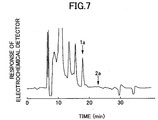
- FIG. 7 One example of a chromatogram using human blood plasma as a specimen, which is obtained by the electrochemical detector 22, is shown in FIG. 7.
- the set applied voltage of the electrochemical detector 22 is 600 mV.
- arrow 1a denotes a peak of the 2-electron reduced form of coenzyme Q-10 (ubiquinol)
- arrow 2a denotes a peak of the coenzyme Q-10 (ubiquinone).
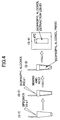
- an extracted liquid in which the coenzyme Q-10, etc., has been extracted is stored at a temperature around 4 °C (S-4 in FIG. 4). Similar to the first example, the alteration of an analytical sample during storage can also be prevented in the second example. Therefore, the analytical sample in which coenzyme Q-10 and a 2-electron reduced form thereof have been extracted can be also stored at a stable state for a long period of time in the second example. Then, the extracted liquid is the analytical sample used to perform an accurate analysis. Additionally, since other conditions are identical to those of the first example as previously described, the description of them is omitted.
- An analysis method in the second example of the present embodiment is basically identical to the analysis method in the first example described above. Therefore, the analysis method in the second example is simply described. Additionally, since those described previously with reference to FIG. 6 are used as a HPLC and analysis system used for analysis without change, the description for the HPLC and analysis system is omitted.
- 40 ⁇ l of the extracted liquid after the above-mentioned pretreatment is prepared as an analytical sample.
- the 40 ⁇ l of the analytical sample contains 2.0 ⁇ l human saliva.
- the switching mechanism 14 is set to the mode A2 and the mobile phase of the second series (a solution of 90 % methanol) stored in the storage container 25b is flown through respective columns of the concentration column 16, the separation column 18, and the reduction column 20 using the pump 26b, so that the respective columns are stabilized.
- Capcel Pack C18 AQ S5 (commercial name) with a diameter of 2.0 mm ⁇ a length of 35 mm can be employed as the concentration column 16.
- Capcel Pack C18 AQ S5 (commercial name) with a diameter of 2.0 mm ⁇ a length of 250 mm can be employed as the separation column 18.
- SHISEIDO CQ (commercial name) with a diameter of 2.0 mm ⁇ a length of 20 mm can be employed as the reduction column 20.
- the mobile phase of the first series (an aqueous solution of 95% methanol) stored in the storage container 25a is liquid-sent to the concentration column 16 using the pump 26a, which entrains the above-mentioned analytical sample using the sample injector 28 in mid-flow.
- the flow rate is, for example, 200 ⁇ l/min.
- main components such as coenzyme Q-10 and a 2-electron reduced form thereof in the analytical sample are retained.
- the residual liquid is ejected out of the system.
- the mobile phase of the second series (the solution of 90% methanol) stored in the storage container 25b is liquid-sent to the concentration column 16 in which the above-mentioned main components are retained, using the pump 26b.
- an auto-sampler is employed as the sample injector 28 and the analytical sample kept at a temperature of 4 °C is continuously provided to the separation column 18.
- the liquid entraining the analytical sample in which the main components are concentrated is liquid-sent to the separation column 18 and the reduction column 20 in series, the separation of the main components (as object components for analysis) based on the coenzyme Q-10 and the 2-electron reduced form thereof in the analytical sample is performed, and further a component to be reduced based on the coenzyme Q-10 is reduced.
- the flow rate is, for example, 400 ⁇ l/min.
- the liquid treated in the reduction column 20 is sent to the electrochemical detector 22 and the ultraviolet absorption detector 24 in series and detection-processed.
- FIG. 8 One example of a chromatogram using human saliva as a specimen, which is obtained by the electrochemical detector 22, is shown in FIG. 8.
- arrow 3a denotes a peak of the coenzyme Q-10.
- coenzyme Q-10 and a 2-electron reduced form thereof are analyzed simultaneously and, preferably, since a large number of specimens are treated continuously and automatically, an efficient analysis can be performed.
- saliva is employed as a specimen. Since the sampling of saliva is noninvasive in contrast to the sampling of blood (plasma), it is possible to perform self-sampling and the amounts of coenzyme Q-10 and a 2-electron reduced form thereof inside the body can be easily detected.
- an analytical method for coenzyme Q-10 and a 2-electron reduced form thereof of the present invention since a specimen containing at least one of coenzyme Q-10 and a 2-electron reduced form thereof is extracted with a water-soluble organic solvent as a pretreatment and the extracted liquid is analyzed as an analytical sample, an accurate analysis can be performed. Also, it is not necessary to perform an analysis immediately after sampling the specimen.
- an analytical method for coenzyme Q-10 and a 2-electron reduced form thereof of the present invention since preparatory treatment for concentrating an analytical sample by a column switching method is performed, even if the concentrations of coenzyme Q-10 and a 2-electron reduced form thereof in the analytical sample are low, an analysis can be performed accurately and with high sensitivity.
- an analytical method for coenzyme Q-10 and a 2-electron reduced form thereof of the present invention since extracted liquid from a specimen containing both coenzyme Q-10 and a 2-electron reduced form thereof is an analytical sample, and the coenzyme Q-10 and the 2-electron reduced form thereof are separated, further subjected to a reduction treatment, and subsequently detected by a detector, an efficient analysis can be performed.
- an analysis method of the present invention can be preferably realized.
Landscapes
- Health & Medical Sciences (AREA)
- Life Sciences & Earth Sciences (AREA)
- Chemical & Material Sciences (AREA)
- General Health & Medical Sciences (AREA)
- Immunology (AREA)
- Analytical Chemistry (AREA)
- Biochemistry (AREA)
- Physics & Mathematics (AREA)
- General Physics & Mathematics (AREA)
- Pathology (AREA)
- Engineering & Computer Science (AREA)
- Organic Chemistry (AREA)
- Zoology (AREA)
- Proteomics, Peptides & Aminoacids (AREA)
- Molecular Biology (AREA)
- Wood Science & Technology (AREA)
- Biotechnology (AREA)
- Microbiology (AREA)
- General Engineering & Computer Science (AREA)
- Medicinal Chemistry (AREA)
- Biophysics (AREA)
- Genetics & Genomics (AREA)
- Urology & Nephrology (AREA)
- Hematology (AREA)
- Bioinformatics & Cheminformatics (AREA)
- Biomedical Technology (AREA)
- Chemical Kinetics & Catalysis (AREA)
- Cell Biology (AREA)
- Pharmacology & Pharmacy (AREA)
- Animal Behavior & Ethology (AREA)
- Public Health (AREA)
- Veterinary Medicine (AREA)
- General Chemical & Material Sciences (AREA)
- Nuclear Medicine, Radiotherapy & Molecular Imaging (AREA)
- Oncology (AREA)
- Communicable Diseases (AREA)
- Food Science & Technology (AREA)
- Investigating Or Analysing Biological Materials (AREA)
- Apparatus Associated With Microorganisms And Enzymes (AREA)
- Sampling And Sample Adjustment (AREA)
Abstract
Description
Claims (18)
- An analysis method for coenzyme Q-10 and a 2-electron reduced form thereof which quantifies coenzyme Q-10 and a 2-electron reduced form thereof comprised in a specimen, characterized in that
the specimen comprising at least one of the coenzyme Q-10 and the 2-electron reduced form thereof is extracted with a water-soluble organic solvent as a pretreatment and
extracted liquid as an analytical sample is analyzed. - An analysis method for coenzyme Q-10 and a 2-electron reduced form thereof which quantifies coenzyme Q-10 and a 2-electron reduced form thereof comprised in a specimen, characterized in that
the specimen comprising at least one of the coenzyme Q-10 and the 2-electron reduced form thereof is extracted with a water-soluble organic solvent comprising isopropyl alcohol as a pretreatment and
extracted liquid as an analytical sample is analyzed. - An analysis method for coenzyme Q-10 and a 2-electron reduced form thereof which quantifies coenzyme Q-10 and a 2-electron reduced form thereof comprised in a specimen, characterized in that
the specimen comprising at least one of the coenzyme Q-10 and the 2-electron reduced form thereof is extracted with a water-soluble organic solvent as a pretreatment,
extracted liquid as an analytical sample is analyzed, and
the extracted liquid is stored at a temperature within a range of a melting point of the extracted liquid through room temperature until the extracted liquid is analyzed. - An analysis method for coenzyme Q-10 and a 2-electron reduced form thereof which quantifies coenzyme Q-10 and a 2-electron reduced form thereof comprised in a specimen, characterized in that
the specimen comprising at least one of the coenzyme Q-10 and the 2-electron reduced form thereof is extracted with a water-soluble organic solvent comprising isopropyl alcohol as a pretreatment,
extracted liquid as an analytical sample is analyzed, and
the extracted liquid is stored at a temperature within a range of a melting point of the extracted liquid through room temperature until the extracted liquid is analyzed. - An analysis method for coenzyme Q-10 and a 2-electron reduced form thereof which quantifies coenzyme Q-10 and a 2-electron reduced form thereof comprised in a specimen, characterized in that
the specimen comprising at least one of the coenzyme Q-10 and the 2-electron reduced form thereof is extracted with a water-soluble organic solvent as a pretreatment,
extracted liquid as an analytical sample is analyzed, and
a preparatory treatment for condensing the analytical sample according to a column switching method is performed. - An analysis method for coenzyme Q-10 and a 2-electron reduced form thereof which quantifies coenzyme Q-10 and a 2-electron reduced form thereof comprised in a specimen, characterized in that
the specimen comprising at least one of the coenzyme Q-10 and the 2-electron reduced form thereof is extracted with a water-soluble organic solvent comprising isopropyl alcohol as a pretreatment,
extracted liquid as an analytical sample is analyzed, and
a preparatory treatment for condensing the analytical sample according to a column switching method is performed. - An analysis method for coenzyme Q-10 and a 2-electron reduced form thereof which quantifies coenzyme Q-10 and a 2-electron reduced form thereof comprised in a specimen, characterized in that
the specimen comprising at least one of the coenzyme Q-10 and the 2-electron reduced form thereof is extracted with a water-soluble organic solvent as a pretreatment,
extracted liquid as an analytical sample is analyzed,
the extracted liquid is stored at a temperature within a range of a melting point of the extracted liquid through room temperature until the extracted liquid is analyzed, and
a preparatory treatment for condensing the analytical sample according to a column switching method is performed. - An analysis method for coenzyme Q-10 and a 2-electron reduced form thereof which quantifies coenzyme Q-10 and a 2-electron reduced form thereof comprised in a specimen, characterized in that
the specimen comprising at least one of the coenzyme Q-10 and the 2-electron reduced form thereof is extracted with a water-soluble organic solvent comprising isopropyl alcohol as a pretreatment,
extracted liquid as an analytical sample is analyzed,
the extracted liquid is stored at a temperature within a range of a melting point of the extracted liquid through room temperature until the extracted liquid is analyzed, and
a preparatory treatment for condensing the analytical sample according to a column switching method is performed. - An analysis method for coenzyme Q-10 and a 2-electron reduced form thereof which quantifies coenzyme Q-10 and a 2-electron reduced form thereof comprised in a specimen, characterized in that
the specimen comprising at least one of the coenzyme Q-10 and the 2-electron reduced form thereof is extracted with a water-soluble organic solvent as a pretreatment,
extracted liquid as an analytical sample is analyzed,
extracted liquid from a specimen comprising both the coenzyme Q-10 and the 2-electron reduced form thereof is the analytical sample, and
the coenzyme Q-10 and the 2-electron reduced form thereof are separated by a column, further subjected to reduction treatment, and subsequently detected by a detector. - An analysis method for coenzyme Q-10 and a 2-electron reduced form thereof which quantifies coenzyme Q-10 and a 2-electron reduced form thereof comprised in a specimen, characterized in that
the specimen comprising at least one of the coenzyme Q-10 and the 2-electron reduced form thereof is extracted with a water-soluble organic solvent comprising isopropyl alcohol as a pretreatment,
extracted liquid as an analytical sample is analyzed,
extracted liquid from a specimen comprising both the coenzyme Q-10 and the 2-electron reduced form thereof is the analytical sample, and
the coenzyme Q-10 and the 2-electron reduced form thereof are separated by a column, further subjected to reduction treatment, and subsequently detected by a detector. - An analysis method for coenzyme Q-10 and a 2-electron reduced form thereof which quantifies coenzyme Q-10 and a 2-electron reduced form thereof comprised in a specimen, characterized in that
the specimen comprising at least one of the coenzyme Q-10 and the 2-electron reduced form thereof is extracted with a water-soluble organic solvent as a pretreatment,
extracted liquid as an analytical sample is analyzed,
the extracted liquid is stored at a temperature within a range of a melting point of the extracted liquid through room temperature until the extracted liquid is analyzed,
extracted liquid from a specimen comprising both the coenzyme Q-10 and the 2-electron reduced form thereof is the analytical sample, and
the coenzyme Q-10 and the 2-electron reduced form thereof are separated by a column, further subjected to reduction treatment, and subsequently detected by a detector. - An analysis method for coenzyme Q-10 and a 2-electron reduced form thereof which quantifies coenzyme Q-10 and a 2-electron reduced form thereof comprised in a specimen, characterized in that
the specimen comprising at least one of the coenzyme Q-10 and the 2-electron reduced form thereof is extracted with a water-soluble organic solvent comprising isopropyl alcohol as a pretreatment,
extracted liquid as an analytical sample is analyzed,
the extracted liquid is stored at a temperature within a range of a melting point of the extracted liquid through room temperature until the extracted liquid is analyzed,
extracted liquid from a specimen comprising both the coenzyme Q-10 and the 2-electron reduced form thereof is the analytical sample, and
the coenzyme Q-10 and the 2-electron reduced form thereof are separated by a column, further subjected to reduction treatment, and subsequently detected by a detector. - An analysis method for coenzyme Q-10 and a 2-electron reduced form thereof which quantifies coenzyme Q-10 and a 2-electron reduced form thereof comprised in a specimen, characterized in that
the specimen comprising at least one of the coenzyme Q-10 and the 2-electron reduced form thereof is extracted with a water-soluble organic solvent as a pretreatment,
extracted liquid as an analytical sample is analyzed,
a preparatory treatment for condensing the analytical sample according to a column switching method is performed,
extracted liquid from a specimen comprising both the coenzyme Q-10 and the 2-electron reduced form thereof is the analytical sample, and
the coenzyme Q-10 and the 2-electron reduced form thereof are separated by a column, further subjected to reduction treatment, and subsequently detected by a detector. - An analysis method for coenzyme Q-10 and a 2-electron reduced form thereof which quantifies coenzyme Q-10 and a 2-electron reduced form thereof comprised in a specimen, characterized in that
the specimen comprising at least one of the coenzyme Q-10 and the 2-electron reduced form thereof is extracted with a water-soluble organic solvent comprising isopropyl alcohol as a pretreatment,
extracted liquid as an analytical sample is analyzed,
a preparatory treatment for condensing the analytical sample according to a column switching method is performed,
extracted liquid from a specimen comprising both the coenzyme Q-10 and the 2-electron reduced form thereof is the analytical sample, and
the coenzyme Q-10 and the 2-electron reduced form thereof are separated by a column, further subjected to reduction treatment, and subsequently detected by a detector. - An analysis method for coenzyme Q-10 and a 2-electron reduced form thereof which quantifies coenzyme Q-10 and a 2-electron reduced form thereof comprised in a specimen, characterized in that
the specimen comprising at least one of the coenzyme Q-10 and the 2-electron reduced form thereof is extracted with a water-soluble organic solvent as a pretreatment,
extracted liquid as an analytical sample is analyzed,
the extracted liquid is stored at a temperature within a range of a melting point of the extracted liquid through room temperature until the extracted liquid is analyzed,
a preparatory treatment for condensing the analytical sample according to a column switching method is performed,
extracted liquid from a specimen comprising both the coenzyme Q-10 and the 2-electron reduced form thereof is the analytical sample, and
the coenzyme Q-10 and the 2-electron reduced form thereof are separated by a column, further subjected to reduction treatment, and subsequently detected by a detector. - An analysis method for coenzyme Q-10 and a 2-electron reduced form thereof which quantifies coenzyme Q-10 and a 2-electron reduced form thereof comprised in a specimen, characterized in that
the specimen comprising at least one of the coenzyme Q-10 and the 2-electron reduced form thereof is extracted with a water-soluble organic solvent comprising isopropyl alcohol as a pretreatment,
extracted liquid as an analytical sample is analyzed,
the extracted liquid is stored at a temperature within a range of a melting point of the extracted liquid through room temperature until the extracted liquid is analyzed,
a preparatory treatment for condensing the analytical sample according to a column switching method is performed,
extracted liquid from a specimen comprising both the coenzyme Q-10 and the 2-electron reduced form thereof is the analytical sample, and
the coenzyme Q-10 and the 2-electron reduced form thereof are separated by a column, further subjected to reduction treatment, and subsequently detected by a detector. - An analysis system used for analysis of coenzyme Q-10 and a 2-electron reduced form thereof, comprising
a liquid-sending mechanism comprising a first series for liquid-sending an analytical sample with a first mobile phase and a second series for liquid-sending only a second mobile phase,
a switching mechanism for switching liquid-sending routes for the mobile phases of the two series of the liquid-sending mechanism,
a condensation column for receiving the second mobile phase after the mobile phase of the first series is received so as to condense the analytical sample,
a separation column for receiving and separating liquid sent from the condensation column,
a reduction column for receiving and reducing liquid sent from the separation column, and
an electrochemical detector for detection-processing liquid sent from the reduction column. - An analysis system used for analysis of coenzyme Q-10 and a 2-electron reduced form thereof, comprising
a liquid-sending mechanism comprising a first series for liquid-sending an analytical sample with a first mobile phase and a second series for liquid-sending only a second mobile phase,
a switching mechanism for switching liquid-sending routes for the mobile phases of the two series of the liquid-sending mechanism,
a condensation column for receiving the second mobile phase after the mobile phase of the first series is received so as to condense the analytical sample,
a separation column for receiving and separating liquid sent from the condensation column,
a reduction column for receiving and reducing liquid sent from the separation column, and
an electrochemical detector for detection-processing liquid sent from the reduction column, and
further comprising an ultraviolet absorption detector as a detector.
Applications Claiming Priority (5)
| Application Number | Priority Date | Filing Date | Title |
|---|---|---|---|
| JP2002351677 | 2002-12-03 | ||
| JP2002351677 | 2002-12-03 | ||
| JP2003401940A JP4426832B2 (en) | 2002-12-03 | 2003-12-01 | Coenzyme Q-10 and method for analyzing 2-electron reduced form thereof |
| JP2003401940 | 2003-12-01 | ||
| PCT/JP2003/015478 WO2004051259A1 (en) | 2002-12-03 | 2003-12-03 | Method of analyzing coenzyme q-10 and two-electron reduction product thereof and analysis system |
Publications (3)
| Publication Number | Publication Date |
|---|---|
| EP1568994A1 true EP1568994A1 (en) | 2005-08-31 |
| EP1568994A4 EP1568994A4 (en) | 2007-08-01 |
| EP1568994B1 EP1568994B1 (en) | 2012-02-08 |
Family
ID=32473684
Family Applications (1)
| Application Number | Title | Priority Date | Filing Date |
|---|---|---|---|
| EP03777204A Expired - Lifetime EP1568994B1 (en) | 2002-12-03 | 2003-12-03 | Method of analyzing coenzyme q-10 and two-electron reduction product thereof and analysis system |
Country Status (8)
| Country | Link |
|---|---|
| US (1) | US7374901B2 (en) |
| EP (1) | EP1568994B1 (en) |
| JP (1) | JP4426832B2 (en) |
| KR (1) | KR101056990B1 (en) |
| CN (1) | CN102183598A (en) |
| AT (1) | ATE545021T1 (en) |
| TW (1) | TW200419156A (en) |
| WO (1) | WO2004051259A1 (en) |
Families Citing this family (5)
| Publication number | Priority date | Publication date | Assignee | Title |
|---|---|---|---|---|
| JP4767272B2 (en) * | 2008-02-22 | 2011-09-07 | 日立建機株式会社 | Electric drive work machine |
| MY171902A (en) * | 2009-11-16 | 2019-11-06 | Biovites Corp Sdn Bhd | Production of natural ubiquinone and ubiquinol by extraction from palm plant |
| RU2454660C1 (en) * | 2010-10-12 | 2012-06-27 | Российская Федерация, От Имени Которой Выступает Министерство Образования И Науки Российской Федерации | Method for quantitative determination of coenzyme q10 antioxidant in substance through cyclic voltammetry |
| US9360454B2 (en) * | 2012-03-02 | 2016-06-07 | Berg Llc | Methods and kits for detection of coenzyme Q10 |
| RU2613897C1 (en) * | 2015-12-21 | 2017-03-21 | Федеральное государственное автономное образовательное учреждение высшего образования "Национальный исследовательский Томский политехнический университет" | Volt-ammetric method for determination of coenzyme q10 in cosmetic creams |
Family Cites Families (7)
| Publication number | Priority date | Publication date | Assignee | Title |
|---|---|---|---|---|
| JPS5539701A (en) * | 1978-08-22 | 1980-03-19 | Kyowa Hakko Kogyo Co Ltd | Production of coenzyme q |
| JPS5892609A (en) * | 1981-11-27 | 1983-06-02 | Fujimoto Seiyaku Kk | Stabilized pharmaceutical composition of ubidecarenone and its preparation |
| JPS61293391A (en) * | 1985-06-20 | 1986-12-24 | Sanko Seisakusho:Kk | Production of coenzyme q |
| JP3889481B2 (en) * | 1996-08-16 | 2007-03-07 | 株式会社カネカ | Pharmaceutical composition |
| WO2000000767A1 (en) * | 1998-06-30 | 2000-01-06 | Adcs, Ltd. | System for supply of multiple chemicals to a process tool |
| US6984308B2 (en) * | 2001-03-06 | 2006-01-10 | Cincinnati Children's Hospital Research Foundation | Electrochemical analysis of coenzyme Q10 and reduced coenzyme Q10 |
| TWI349039B (en) * | 2001-12-27 | 2011-09-21 | Kaneka Corp | Processes for producing coenzyme q10 |
-
2003
- 2003-12-01 JP JP2003401940A patent/JP4426832B2/en not_active Expired - Lifetime
- 2003-12-03 CN CN2011100382981A patent/CN102183598A/en active Pending
- 2003-12-03 EP EP03777204A patent/EP1568994B1/en not_active Expired - Lifetime
- 2003-12-03 KR KR1020057009859A patent/KR101056990B1/en not_active Expired - Fee Related
- 2003-12-03 WO PCT/JP2003/015478 patent/WO2004051259A1/en not_active Ceased
- 2003-12-03 TW TW092134074A patent/TW200419156A/en not_active IP Right Cessation
- 2003-12-03 AT AT03777204T patent/ATE545021T1/en active
- 2003-12-03 US US10/537,338 patent/US7374901B2/en not_active Expired - Fee Related
Also Published As
| Publication number | Publication date |
|---|---|
| ATE545021T1 (en) | 2012-02-15 |
| WO2004051259A1 (en) | 2004-06-17 |
| KR101056990B1 (en) | 2011-08-16 |
| JP2004198409A (en) | 2004-07-15 |
| TWI319482B (en) | 2010-01-11 |
| EP1568994A4 (en) | 2007-08-01 |
| JP4426832B2 (en) | 2010-03-03 |
| US20060148025A1 (en) | 2006-07-06 |
| US7374901B2 (en) | 2008-05-20 |
| EP1568994B1 (en) | 2012-02-08 |
| KR20050085246A (en) | 2005-08-29 |
| CN102183598A (en) | 2011-09-14 |
| TW200419156A (en) | 2004-10-01 |
Similar Documents
| Publication | Publication Date | Title |
|---|---|---|
| Brachet et al. | Optimisation of accelerated solvent extraction of cocaine and benzoylecgonine from coca leaves | |
| Kitzman et al. | HPLC assay for albendazole and metabolites in human plasma for clinical pharmacokinetic studies | |
| Said et al. | Determination of four immunosuppressive drugs in whole blood using MEPS and LC–MS/MS allowing automated sample work-up and analysis | |
| Yang et al. | Stereoselective analysis of carvedilol in human plasma using HPLC/MS/MS after chiral derivatization | |
| Hultman et al. | Determination of esomeprazole and its two main metabolites in human, rat and dog plasma by liquid chromatography with tandem mass spectrometry | |
| Hamidi et al. | Direct analysis of methadone in exhaled breath condensate by capillary zone electrophoresis | |
| Jiang et al. | Analysis of coenzyme Q10 in human plasma by column-switching liquid chromatography | |
| US7374901B2 (en) | Method of analyzing coenzyme Q-10 and two-electron reduction product thereof and analysis system | |
| Yang et al. | Rapid determination of serum melatonin by ESI–MS–MS with direct sample injection | |
| Delavenne et al. | Quantification of total and unbound tranexamic acid in human plasma by ultrafiltration liquid chromatography/tandem mass spectrometry: application to pharmacokinetic analysis | |
| Ismaiel et al. | Determination of octreotide and assessment of matrix effects in human plasma using ultra high performance liquid chromatography–tandem mass spectrometry | |
| Miller | High-performance liquid chromatographic determination of diclofenac in human plasma using automated column switching | |
| Luo et al. | Rapid determination of Δ9-Tetrahydrocannabinol in saliva by polymer monolith microextraction combined with gas chromatography–mass spectrometry | |
| de Person et al. | Characterization of low-molecular weight peptides in champagne wine by liquid chromatography/tandem mass spectrometry | |
| Chang et al. | Rapid and sensitive determination of fentanyl in dog plasma by on-line solid-phase extraction integrated with a hydrophilic column coupled to tandem mass spectrometry | |
| Björklund et al. | Determination of felodipine in tablets using accelerated solvent extraction | |
| Qi et al. | Determination of tamsulosin in dog plasma by liquid chromatography with atmospheric pressure chemical ionization tandem mass spectrometry | |
| CN105092733B (en) | The reduction method and apparatus of fixedness buffer salt content in LC MS testers | |
| Jing et al. | Determination and pharmacokinetics of manidipine in human plasma by HPLC/ESIMS | |
| Krull et al. | An improved trace analysis for N-nitrosoureas from biological media | |
| Altmayer et al. | Rapid and sensitive pre-column extraction high-performance liquid chromatographic assay for propofol in biological fluids | |
| KR100479215B1 (en) | Method for determination of atenolol in plasma and apparatus therefor | |
| KR101589629B1 (en) | A method for detecting parabens in human urine or plasma | |
| US6984308B2 (en) | Electrochemical analysis of coenzyme Q10 and reduced coenzyme Q10 | |
| Posluszny et al. | Optimization of multidimensional high-performance liquid chromatography for the determination of drugs in plasma by direct injection, micellar cleanup and photodiode array detection |
Legal Events
| Date | Code | Title | Description |
|---|---|---|---|
| PUAI | Public reference made under article 153(3) epc to a published international application that has entered the european phase |
Free format text: ORIGINAL CODE: 0009012 |
|
| 17P | Request for examination filed |
Effective date: 20050602 |
|
| AK | Designated contracting states |
Kind code of ref document: A1 Designated state(s): AT BE BG CH CY CZ DE DK EE ES FI FR GB GR HU IE IT LI LU MC NL PT RO SE SI SK TR |
|
| A4 | Supplementary search report drawn up and despatched |
Effective date: 20070628 |
|
| RIC1 | Information provided on ipc code assigned before grant |
Ipc: G01N 33/50 20060101ALI20070622BHEP Ipc: C12Q 1/00 20060101ALI20070622BHEP Ipc: G01N 30/08 20060101ALI20070622BHEP Ipc: G01N 30/46 20060101ALI20070622BHEP Ipc: G01N 30/88 20060101AFI20040623BHEP Ipc: G01N 30/06 20060101ALI20070622BHEP Ipc: G01N 30/84 20060101ALI20070622BHEP |
|
| 17Q | First examination report despatched |
Effective date: 20080429 |
|
| GRAP | Despatch of communication of intention to grant a patent |
Free format text: ORIGINAL CODE: EPIDOSNIGR1 |
|
| GRAC | Information related to communication of intention to grant a patent modified |
Free format text: ORIGINAL CODE: EPIDOSCIGR1 |
|
| GRAS | Grant fee paid |
Free format text: ORIGINAL CODE: EPIDOSNIGR3 |
|
| GRAA | (expected) grant |
Free format text: ORIGINAL CODE: 0009210 |
|
| AK | Designated contracting states |
Kind code of ref document: B1 Designated state(s): AT BE BG CH CY CZ DE DK EE ES FI FR GB GR HU IE IT LI LU MC NL PT RO SE SI SK TR |
|
| REG | Reference to a national code |
Ref country code: GB Ref legal event code: FG4D |
|
| REG | Reference to a national code |
Ref country code: CH Ref legal event code: EP Ref country code: AT Ref legal event code: REF Ref document number: 545021 Country of ref document: AT Kind code of ref document: T Effective date: 20120215 |
|
| REG | Reference to a national code |
Ref country code: DE Ref legal event code: R096 Ref document number: 60339962 Country of ref document: DE Effective date: 20120405 |
|
| REG | Reference to a national code |
Ref country code: NL Ref legal event code: VDEP Effective date: 20120208 |
|
| PG25 | Lapsed in a contracting state [announced via postgrant information from national office to epo] |
Ref country code: NL Free format text: LAPSE BECAUSE OF FAILURE TO SUBMIT A TRANSLATION OF THE DESCRIPTION OR TO PAY THE FEE WITHIN THE PRESCRIBED TIME-LIMIT Effective date: 20120208 |
|
| PG25 | Lapsed in a contracting state [announced via postgrant information from national office to epo] |
Ref country code: GR Free format text: LAPSE BECAUSE OF FAILURE TO SUBMIT A TRANSLATION OF THE DESCRIPTION OR TO PAY THE FEE WITHIN THE PRESCRIBED TIME-LIMIT Effective date: 20120509 Ref country code: PT Free format text: LAPSE BECAUSE OF FAILURE TO SUBMIT A TRANSLATION OF THE DESCRIPTION OR TO PAY THE FEE WITHIN THE PRESCRIBED TIME-LIMIT Effective date: 20120608 Ref country code: FI Free format text: LAPSE BECAUSE OF FAILURE TO SUBMIT A TRANSLATION OF THE DESCRIPTION OR TO PAY THE FEE WITHIN THE PRESCRIBED TIME-LIMIT Effective date: 20120208 Ref country code: BE Free format text: LAPSE BECAUSE OF FAILURE TO SUBMIT A TRANSLATION OF THE DESCRIPTION OR TO PAY THE FEE WITHIN THE PRESCRIBED TIME-LIMIT Effective date: 20120208 |
|
| REG | Reference to a national code |
Ref country code: AT Ref legal event code: MK05 Ref document number: 545021 Country of ref document: AT Kind code of ref document: T Effective date: 20120208 |
|
| PG25 | Lapsed in a contracting state [announced via postgrant information from national office to epo] |
Ref country code: CY Free format text: LAPSE BECAUSE OF FAILURE TO SUBMIT A TRANSLATION OF THE DESCRIPTION OR TO PAY THE FEE WITHIN THE PRESCRIBED TIME-LIMIT Effective date: 20120208 |
|
| PG25 | Lapsed in a contracting state [announced via postgrant information from national office to epo] |
Ref country code: RO Free format text: LAPSE BECAUSE OF FAILURE TO SUBMIT A TRANSLATION OF THE DESCRIPTION OR TO PAY THE FEE WITHIN THE PRESCRIBED TIME-LIMIT Effective date: 20120208 Ref country code: EE Free format text: LAPSE BECAUSE OF FAILURE TO SUBMIT A TRANSLATION OF THE DESCRIPTION OR TO PAY THE FEE WITHIN THE PRESCRIBED TIME-LIMIT Effective date: 20120208 Ref country code: SE Free format text: LAPSE BECAUSE OF FAILURE TO SUBMIT A TRANSLATION OF THE DESCRIPTION OR TO PAY THE FEE WITHIN THE PRESCRIBED TIME-LIMIT Effective date: 20120208 Ref country code: SI Free format text: LAPSE BECAUSE OF FAILURE TO SUBMIT A TRANSLATION OF THE DESCRIPTION OR TO PAY THE FEE WITHIN THE PRESCRIBED TIME-LIMIT Effective date: 20120208 Ref country code: CZ Free format text: LAPSE BECAUSE OF FAILURE TO SUBMIT A TRANSLATION OF THE DESCRIPTION OR TO PAY THE FEE WITHIN THE PRESCRIBED TIME-LIMIT Effective date: 20120208 Ref country code: DK Free format text: LAPSE BECAUSE OF FAILURE TO SUBMIT A TRANSLATION OF THE DESCRIPTION OR TO PAY THE FEE WITHIN THE PRESCRIBED TIME-LIMIT Effective date: 20120208 |
|
| PG25 | Lapsed in a contracting state [announced via postgrant information from national office to epo] |
Ref country code: SK Free format text: LAPSE BECAUSE OF FAILURE TO SUBMIT A TRANSLATION OF THE DESCRIPTION OR TO PAY THE FEE WITHIN THE PRESCRIBED TIME-LIMIT Effective date: 20120208 |
|
| PLBE | No opposition filed within time limit |
Free format text: ORIGINAL CODE: 0009261 |
|
| STAA | Information on the status of an ep patent application or granted ep patent |
Free format text: STATUS: NO OPPOSITION FILED WITHIN TIME LIMIT |
|
| 26N | No opposition filed |
Effective date: 20121109 |
|
| PG25 | Lapsed in a contracting state [announced via postgrant information from national office to epo] |
Ref country code: AT Free format text: LAPSE BECAUSE OF FAILURE TO SUBMIT A TRANSLATION OF THE DESCRIPTION OR TO PAY THE FEE WITHIN THE PRESCRIBED TIME-LIMIT Effective date: 20120208 |
|
| REG | Reference to a national code |
Ref country code: DE Ref legal event code: R097 Ref document number: 60339962 Country of ref document: DE Effective date: 20121109 |
|
| PG25 | Lapsed in a contracting state [announced via postgrant information from national office to epo] |
Ref country code: ES Free format text: LAPSE BECAUSE OF FAILURE TO SUBMIT A TRANSLATION OF THE DESCRIPTION OR TO PAY THE FEE WITHIN THE PRESCRIBED TIME-LIMIT Effective date: 20120519 |
|
| PG25 | Lapsed in a contracting state [announced via postgrant information from national office to epo] |
Ref country code: BG Free format text: LAPSE BECAUSE OF FAILURE TO SUBMIT A TRANSLATION OF THE DESCRIPTION OR TO PAY THE FEE WITHIN THE PRESCRIBED TIME-LIMIT Effective date: 20120508 Ref country code: MC Free format text: LAPSE BECAUSE OF NON-PAYMENT OF DUE FEES Effective date: 20121231 |
|
| REG | Reference to a national code |
Ref country code: CH Ref legal event code: PL |
|
| REG | Reference to a national code |
Ref country code: IE Ref legal event code: MM4A |
|
| PG25 | Lapsed in a contracting state [announced via postgrant information from national office to epo] |
Ref country code: IE Free format text: LAPSE BECAUSE OF NON-PAYMENT OF DUE FEES Effective date: 20121203 Ref country code: LI Free format text: LAPSE BECAUSE OF NON-PAYMENT OF DUE FEES Effective date: 20121231 Ref country code: CH Free format text: LAPSE BECAUSE OF NON-PAYMENT OF DUE FEES Effective date: 20121231 |
|
| PG25 | Lapsed in a contracting state [announced via postgrant information from national office to epo] |
Ref country code: TR Free format text: LAPSE BECAUSE OF FAILURE TO SUBMIT A TRANSLATION OF THE DESCRIPTION OR TO PAY THE FEE WITHIN THE PRESCRIBED TIME-LIMIT Effective date: 20120208 |
|
| PG25 | Lapsed in a contracting state [announced via postgrant information from national office to epo] |
Ref country code: LU Free format text: LAPSE BECAUSE OF NON-PAYMENT OF DUE FEES Effective date: 20121203 |
|
| PG25 | Lapsed in a contracting state [announced via postgrant information from national office to epo] |
Ref country code: HU Free format text: LAPSE BECAUSE OF FAILURE TO SUBMIT A TRANSLATION OF THE DESCRIPTION OR TO PAY THE FEE WITHIN THE PRESCRIBED TIME-LIMIT Effective date: 20031203 |
|
| PGFP | Annual fee paid to national office [announced via postgrant information from national office to epo] |
Ref country code: GB Payment date: 20141124 Year of fee payment: 12 Ref country code: DE Payment date: 20141208 Year of fee payment: 12 |
|
| PGFP | Annual fee paid to national office [announced via postgrant information from national office to epo] |
Ref country code: IT Payment date: 20141212 Year of fee payment: 12 |
|
| PGFP | Annual fee paid to national office [announced via postgrant information from national office to epo] |
Ref country code: FR Payment date: 20141215 Year of fee payment: 12 |
|
| REG | Reference to a national code |
Ref country code: DE Ref legal event code: R119 Ref document number: 60339962 Country of ref document: DE |
|
| GBPC | Gb: european patent ceased through non-payment of renewal fee |
Effective date: 20151203 |
|
| REG | Reference to a national code |
Ref country code: FR Ref legal event code: ST Effective date: 20160831 |
|
| PG25 | Lapsed in a contracting state [announced via postgrant information from national office to epo] |
Ref country code: GB Free format text: LAPSE BECAUSE OF NON-PAYMENT OF DUE FEES Effective date: 20151203 Ref country code: DE Free format text: LAPSE BECAUSE OF NON-PAYMENT OF DUE FEES Effective date: 20160701 |
|
| PG25 | Lapsed in a contracting state [announced via postgrant information from national office to epo] |
Ref country code: FR Free format text: LAPSE BECAUSE OF NON-PAYMENT OF DUE FEES Effective date: 20151231 |
|
| PG25 | Lapsed in a contracting state [announced via postgrant information from national office to epo] |
Ref country code: IT Free format text: LAPSE BECAUSE OF NON-PAYMENT OF DUE FEES Effective date: 20151203 |