EP1566624A1 - Quantendynamischer diskriminator für molekulare agentien - Google Patents
Quantendynamischer diskriminator für molekulare agentien Download PDFInfo
- Publication number
- EP1566624A1 EP1566624A1 EP05075109A EP05075109A EP1566624A1 EP 1566624 A1 EP1566624 A1 EP 1566624A1 EP 05075109 A EP05075109 A EP 05075109A EP 05075109 A EP05075109 A EP 05075109A EP 1566624 A1 EP1566624 A1 EP 1566624A1
- Authority
- EP
- European Patent Office
- Prior art keywords
- quantum
- field
- composition
- component
- pulse
- Prior art date
- Legal status (The legal status is an assumption and is not a legal conclusion. Google has not performed a legal analysis and makes no representation as to the accuracy of the status listed.)
- Withdrawn
Links
- 238000000034 method Methods 0.000 claims abstract description 226
- 239000000203 mixture Substances 0.000 claims abstract description 171
- 238000004422 calculation algorithm Methods 0.000 claims description 145
- 238000009826 distribution Methods 0.000 claims description 97
- 238000005259 measurement Methods 0.000 claims description 80
- 230000003993 interaction Effects 0.000 claims description 68
- 230000003287 optical effect Effects 0.000 claims description 35
- 230000005684 electric field Effects 0.000 claims description 34
- 238000005457 optimization Methods 0.000 claims description 33
- 239000002245 particle Substances 0.000 claims description 26
- 230000005672 electromagnetic field Effects 0.000 claims description 20
- 230000004044 response Effects 0.000 claims description 20
- 230000002068 genetic effect Effects 0.000 claims description 18
- 230000001066 destructive effect Effects 0.000 claims description 16
- 230000002596 correlated effect Effects 0.000 claims description 11
- 125000000524 functional group Chemical group 0.000 claims description 11
- 230000033001 locomotion Effects 0.000 claims description 8
- 238000000862 absorption spectrum Methods 0.000 claims description 6
- 230000009878 intermolecular interaction Effects 0.000 claims description 5
- 230000005670 electromagnetic radiation Effects 0.000 claims description 4
- 230000008863 intramolecular interaction Effects 0.000 claims description 4
- 238000004891 communication Methods 0.000 claims description 3
- 230000006854 communication Effects 0.000 claims description 3
- 239000012530 fluid Substances 0.000 claims description 2
- 208000037516 chromosome inversion disease Diseases 0.000 description 204
- 238000002474 experimental method Methods 0.000 description 97
- 230000008569 process Effects 0.000 description 93
- 241000894007 species Species 0.000 description 66
- 238000001514 detection method Methods 0.000 description 58
- 230000005284 excitation Effects 0.000 description 56
- 239000000523 sample Substances 0.000 description 56
- 239000011159 matrix material Substances 0.000 description 52
- 230000007704 transition Effects 0.000 description 51
- 239000003795 chemical substances by application Substances 0.000 description 47
- 239000012071 phase Substances 0.000 description 44
- 150000002500 ions Chemical class 0.000 description 41
- UHOVQNZJYSORNB-UHFFFAOYSA-N Benzene Chemical compound C1=CC=CC=C1 UHOVQNZJYSORNB-UHFFFAOYSA-N 0.000 description 39
- 230000006870 function Effects 0.000 description 35
- 230000000875 corresponding effect Effects 0.000 description 33
- 238000004088 simulation Methods 0.000 description 32
- YXFVVABEGXRONW-UHFFFAOYSA-N Toluene Chemical compound CC1=CC=CC=C1 YXFVVABEGXRONW-UHFFFAOYSA-N 0.000 description 26
- 239000000126 substance Substances 0.000 description 26
- 239000000047 product Substances 0.000 description 25
- 125000004429 atom Chemical group 0.000 description 24
- 239000013598 vector Substances 0.000 description 24
- 238000001819 mass spectrum Methods 0.000 description 23
- 230000007246 mechanism Effects 0.000 description 23
- 238000001228 spectrum Methods 0.000 description 23
- 238000013461 design Methods 0.000 description 22
- 238000005516 engineering process Methods 0.000 description 22
- 230000001965 increasing effect Effects 0.000 description 22
- 230000005855 radiation Effects 0.000 description 21
- 238000013459 approach Methods 0.000 description 19
- 230000003595 spectral effect Effects 0.000 description 19
- KWOLFJPFCHCOCG-UHFFFAOYSA-N Acetophenone Chemical compound CC(=O)C1=CC=CC=C1 KWOLFJPFCHCOCG-UHFFFAOYSA-N 0.000 description 18
- 238000004458 analytical method Methods 0.000 description 17
- 238000012512 characterization method Methods 0.000 description 17
- 230000001276 controlling effect Effects 0.000 description 17
- 230000036962 time dependent Effects 0.000 description 17
- UFWIBTONFRDIAS-UHFFFAOYSA-N Naphthalene Chemical compound C1=CC=CC2=CC=CC=C21 UFWIBTONFRDIAS-UHFFFAOYSA-N 0.000 description 16
- 238000007493 shaping process Methods 0.000 description 16
- CSCPPACGZOOCGX-UHFFFAOYSA-N Acetone Chemical compound CC(C)=O CSCPPACGZOOCGX-UHFFFAOYSA-N 0.000 description 15
- 230000009257 reactivity Effects 0.000 description 14
- 238000012360 testing method Methods 0.000 description 14
- 230000005428 wave function Effects 0.000 description 14
- 125000002496 methyl group Chemical group [H]C([H])([H])* 0.000 description 13
- 230000001427 coherent effect Effects 0.000 description 12
- 238000010494 dissociation reaction Methods 0.000 description 12
- 230000000694 effects Effects 0.000 description 12
- 238000000926 separation method Methods 0.000 description 12
- 230000005593 dissociations Effects 0.000 description 11
- 230000037361 pathway Effects 0.000 description 11
- 125000001997 phenyl group Chemical group [H]C1=C([H])C([H])=C(*)C([H])=C1[H] 0.000 description 11
- MWPLVEDNUUSJAV-UHFFFAOYSA-N anthracene Chemical compound C1=CC=CC2=CC3=CC=CC=C3C=C21 MWPLVEDNUUSJAV-UHFFFAOYSA-N 0.000 description 10
- 230000006399 behavior Effects 0.000 description 10
- 230000005283 ground state Effects 0.000 description 10
- -1 acetone radical cation Chemical class 0.000 description 9
- 238000004364 calculation method Methods 0.000 description 9
- 238000003776 cleavage reaction Methods 0.000 description 9
- 230000002708 enhancing effect Effects 0.000 description 9
- 230000035772 mutation Effects 0.000 description 9
- 230000002829 reductive effect Effects 0.000 description 9
- 238000004519 manufacturing process Methods 0.000 description 8
- 238000000329 molecular dynamics simulation Methods 0.000 description 8
- 230000008901 benefit Effects 0.000 description 7
- 238000006243 chemical reaction Methods 0.000 description 7
- 230000008878 coupling Effects 0.000 description 7
- 238000010168 coupling process Methods 0.000 description 7
- 238000005859 coupling reaction Methods 0.000 description 7
- 238000000605 extraction Methods 0.000 description 7
- 238000011835 investigation Methods 0.000 description 7
- 239000004973 liquid crystal related substance Substances 0.000 description 7
- 238000002186 photoelectron spectrum Methods 0.000 description 7
- 230000007017 scission Effects 0.000 description 7
- 230000003068 static effect Effects 0.000 description 7
- 238000012935 Averaging Methods 0.000 description 6
- 230000003321 amplification Effects 0.000 description 6
- 230000015572 biosynthetic process Effects 0.000 description 6
- 239000013043 chemical agent Substances 0.000 description 6
- 230000007423 decrease Effects 0.000 description 6
- 238000013467 fragmentation Methods 0.000 description 6
- 238000006062 fragmentation reaction Methods 0.000 description 6
- 238000003199 nucleic acid amplification method Methods 0.000 description 6
- 230000010355 oscillation Effects 0.000 description 6
- 238000012546 transfer Methods 0.000 description 6
- XBDYBAVJXHJMNQ-UHFFFAOYSA-N Tetrahydroanthracene Natural products C1=CC=C2C=C(CCCC3)C3=CC2=C1 XBDYBAVJXHJMNQ-UHFFFAOYSA-N 0.000 description 5
- 230000009286 beneficial effect Effects 0.000 description 5
- 238000000354 decomposition reaction Methods 0.000 description 5
- 238000011161 development Methods 0.000 description 5
- 230000018109 developmental process Effects 0.000 description 5
- 239000012634 fragment Substances 0.000 description 5
- 230000010287 polarization Effects 0.000 description 5
- 230000001902 propagating effect Effects 0.000 description 5
- 230000008707 rearrangement Effects 0.000 description 5
- IFLREYGFSNHWGE-UHFFFAOYSA-N tetracene Chemical compound C1=CC=CC2=CC3=CC4=CC=CC=C4C=C3C=C21 IFLREYGFSNHWGE-UHFFFAOYSA-N 0.000 description 5
- FHUDAMLDXFJHJE-UHFFFAOYSA-N 1,1,1-trifluoropropan-2-one Chemical compound CC(=O)C(F)(F)F FHUDAMLDXFJHJE-UHFFFAOYSA-N 0.000 description 4
- 238000001069 Raman spectroscopy Methods 0.000 description 4
- HSFWRNGVRCDJHI-UHFFFAOYSA-N alpha-acetylene Natural products C#C HSFWRNGVRCDJHI-UHFFFAOYSA-N 0.000 description 4
- 238000003491 array Methods 0.000 description 4
- 239000003124 biologic agent Substances 0.000 description 4
- 230000001419 dependent effect Effects 0.000 description 4
- 125000002534 ethynyl group Chemical group [H]C#C* 0.000 description 4
- 230000005281 excited state Effects 0.000 description 4
- 239000000284 extract Substances 0.000 description 4
- 239000007789 gas Substances 0.000 description 4
- 229910052739 hydrogen Inorganic materials 0.000 description 4
- 239000001257 hydrogen Substances 0.000 description 4
- 238000005381 potential energy Methods 0.000 description 4
- 238000012552 review Methods 0.000 description 4
- 230000009897 systematic effect Effects 0.000 description 4
- 238000001269 time-of-flight mass spectrometry Methods 0.000 description 4
- 230000009466 transformation Effects 0.000 description 4
- 230000001052 transient effect Effects 0.000 description 4
- 230000005641 tunneling Effects 0.000 description 4
- YTPUIQCGRWDPTM-UHFFFAOYSA-N 2-acetyloxybenzoic acid;5-(2-methylpropyl)-5-prop-2-enyl-1,3-diazinane-2,4,6-trione;1,3,7-trimethylpurine-2,6-dione Chemical compound CC(=O)OC1=CC=CC=C1C(O)=O.CN1C(=O)N(C)C(=O)C2=C1N=CN2C.CC(C)CC1(CC=C)C(=O)NC(=O)NC1=O YTPUIQCGRWDPTM-UHFFFAOYSA-N 0.000 description 3
- OKKJLVBELUTLKV-UHFFFAOYSA-N Methanol Chemical compound OC OKKJLVBELUTLKV-UHFFFAOYSA-N 0.000 description 3
- 238000010521 absorption reaction Methods 0.000 description 3
- TUCNEACPLKLKNU-UHFFFAOYSA-N acetyl Chemical compound C[C]=O TUCNEACPLKLKNU-UHFFFAOYSA-N 0.000 description 3
- 230000009471 action Effects 0.000 description 3
- 230000003044 adaptive effect Effects 0.000 description 3
- 125000003236 benzoyl group Chemical group [H]C1=C([H])C([H])=C(C([H])=C1[H])C(*)=O 0.000 description 3
- 230000008859 change Effects 0.000 description 3
- 150000001793 charged compounds Chemical class 0.000 description 3
- 239000007795 chemical reaction product Substances 0.000 description 3
- 230000002301 combined effect Effects 0.000 description 3
- 238000012850 discrimination method Methods 0.000 description 3
- 239000000975 dye Substances 0.000 description 3
- 238000004880 explosion Methods 0.000 description 3
- 238000009472 formulation Methods 0.000 description 3
- 230000001976 improved effect Effects 0.000 description 3
- 230000006872 improvement Effects 0.000 description 3
- 230000002452 interceptive effect Effects 0.000 description 3
- 238000009533 lab test Methods 0.000 description 3
- 238000011005 laboratory method Methods 0.000 description 3
- 239000000463 material Substances 0.000 description 3
- 230000004048 modification Effects 0.000 description 3
- 238000012986 modification Methods 0.000 description 3
- 238000010606 normalization Methods 0.000 description 3
- 230000005610 quantum mechanics Effects 0.000 description 3
- 230000001172 regenerating effect Effects 0.000 description 3
- 238000001561 resonance enhanced multiphoton ionisation spectroscopy Methods 0.000 description 3
- 230000000979 retarding effect Effects 0.000 description 3
- 229910052594 sapphire Inorganic materials 0.000 description 3
- 239000010980 sapphire Substances 0.000 description 3
- 230000035945 sensitivity Effects 0.000 description 3
- 238000004611 spectroscopical analysis Methods 0.000 description 3
- 238000003786 synthesis reaction Methods 0.000 description 3
- 230000002123 temporal effect Effects 0.000 description 3
- 238000001196 time-of-flight mass spectrum Methods 0.000 description 3
- 230000004075 alteration Effects 0.000 description 2
- 230000004888 barrier function Effects 0.000 description 2
- 230000005540 biological transmission Effects 0.000 description 2
- 125000002915 carbonyl group Chemical group [*:2]C([*:1])=O 0.000 description 2
- 238000001311 chemical methods and process Methods 0.000 description 2
- 238000013375 chromatographic separation Methods 0.000 description 2
- 238000010367 cloning Methods 0.000 description 2
- 230000005493 condensed matter Effects 0.000 description 2
- 238000010276 construction Methods 0.000 description 2
- 230000008094 contradictory effect Effects 0.000 description 2
- 239000013078 crystal Substances 0.000 description 2
- 125000004122 cyclic group Chemical group 0.000 description 2
- 238000012938 design process Methods 0.000 description 2
- 239000006185 dispersion Substances 0.000 description 2
- 238000005315 distribution function Methods 0.000 description 2
- 230000009977 dual effect Effects 0.000 description 2
- 238000004824 electrostatic potential energy surface Methods 0.000 description 2
- 230000007613 environmental effect Effects 0.000 description 2
- 238000001914 filtration Methods 0.000 description 2
- 230000004907 flux Effects 0.000 description 2
- 230000001939 inductive effect Effects 0.000 description 2
- 238000007689 inspection Methods 0.000 description 2
- 238000000752 ionisation method Methods 0.000 description 2
- 230000001678 irradiating effect Effects 0.000 description 2
- 238000011545 laboratory measurement Methods 0.000 description 2
- 150000002605 large molecules Chemical class 0.000 description 2
- 229920002521 macromolecule Polymers 0.000 description 2
- 238000004949 mass spectrometry Methods 0.000 description 2
- 108020004999 messenger RNA Proteins 0.000 description 2
- 238000005442 molecular electronic Methods 0.000 description 2
- 230000007935 neutral effect Effects 0.000 description 2
- 230000005624 perturbation theories Effects 0.000 description 2
- 238000001420 photoelectron spectroscopy Methods 0.000 description 2
- 238000005182 potential energy surface Methods 0.000 description 2
- 102000004169 proteins and genes Human genes 0.000 description 2
- 238000013442 quality metrics Methods 0.000 description 2
- 230000005639 quantum mechanical wave Effects 0.000 description 2
- 230000002040 relaxant effect Effects 0.000 description 2
- 238000011160 research Methods 0.000 description 2
- 230000000717 retained effect Effects 0.000 description 2
- 238000005070 sampling Methods 0.000 description 2
- 238000010845 search algorithm Methods 0.000 description 2
- 239000007787 solid Substances 0.000 description 2
- FGRBYDKOBBBPOI-UHFFFAOYSA-N 10,10-dioxo-2-[4-(N-phenylanilino)phenyl]thioxanthen-9-one Chemical compound O=C1c2ccccc2S(=O)(=O)c2ccc(cc12)-c1ccc(cc1)N(c1ccccc1)c1ccccc1 FGRBYDKOBBBPOI-UHFFFAOYSA-N 0.000 description 1
- KZMAWJRXKGLWGS-UHFFFAOYSA-N 2-chloro-n-[4-(4-methoxyphenyl)-1,3-thiazol-2-yl]-n-(3-methoxypropyl)acetamide Chemical compound S1C(N(C(=O)CCl)CCCOC)=NC(C=2C=CC(OC)=CC=2)=C1 KZMAWJRXKGLWGS-UHFFFAOYSA-N 0.000 description 1
- TYMLOMAKGOJONV-UHFFFAOYSA-N 4-nitroaniline Chemical compound NC1=CC=C([N+]([O-])=O)C=C1 TYMLOMAKGOJONV-UHFFFAOYSA-N 0.000 description 1
- 241000196324 Embryophyta Species 0.000 description 1
- 102000004190 Enzymes Human genes 0.000 description 1
- 108090000790 Enzymes Proteins 0.000 description 1
- XPDWGBQVDMORPB-UHFFFAOYSA-N Fluoroform Chemical group FC(F)F XPDWGBQVDMORPB-UHFFFAOYSA-N 0.000 description 1
- 238000004965 Hartree-Fock calculation Methods 0.000 description 1
- 238000005481 NMR spectroscopy Methods 0.000 description 1
- 108091005461 Nucleic proteins Proteins 0.000 description 1
- 230000005699 Stark effect Effects 0.000 description 1
- 238000002835 absorbance Methods 0.000 description 1
- 150000008062 acetophenones Chemical class 0.000 description 1
- 230000002411 adverse Effects 0.000 description 1
- 239000000443 aerosol Substances 0.000 description 1
- 239000003513 alkali Substances 0.000 description 1
- 230000003466 anti-cipated effect Effects 0.000 description 1
- 238000013528 artificial neural network Methods 0.000 description 1
- 238000004166 bioassay Methods 0.000 description 1
- 230000031018 biological processes and functions Effects 0.000 description 1
- 238000010504 bond cleavage reaction Methods 0.000 description 1
- 229910052799 carbon Inorganic materials 0.000 description 1
- 125000004432 carbon atom Chemical group C* 0.000 description 1
- 230000015556 catabolic process Effects 0.000 description 1
- 239000013626 chemical specie Substances 0.000 description 1
- 239000002575 chemical warfare agent Substances 0.000 description 1
- 238000004587 chromatography analysis Methods 0.000 description 1
- KFUSEUYYWQURPO-UPHRSURJSA-N cis-1,2-dichloroethene Chemical compound Cl\C=C/Cl KFUSEUYYWQURPO-UPHRSURJSA-N 0.000 description 1
- 238000007906 compression Methods 0.000 description 1
- 239000000470 constituent Substances 0.000 description 1
- 238000011109 contamination Methods 0.000 description 1
- 238000011217 control strategy Methods 0.000 description 1
- 230000002079 cooperative effect Effects 0.000 description 1
- 238000005336 cracking Methods 0.000 description 1
- 230000001351 cycling effect Effects 0.000 description 1
- 238000007405 data analysis Methods 0.000 description 1
- 230000003247 decreasing effect Effects 0.000 description 1
- 230000007123 defense Effects 0.000 description 1
- 230000002950 deficient Effects 0.000 description 1
- 208000018459 dissociative disease Diseases 0.000 description 1
- 238000005421 electrostatic potential Methods 0.000 description 1
- 239000003344 environmental pollutant Substances 0.000 description 1
- 238000011156 evaluation Methods 0.000 description 1
- 230000002349 favourable effect Effects 0.000 description 1
- 230000005669 field effect Effects 0.000 description 1
- 230000014509 gene expression Effects 0.000 description 1
- 239000011521 glass Substances 0.000 description 1
- 238000004770 highest occupied molecular orbital Methods 0.000 description 1
- 238000011065 in-situ storage Methods 0.000 description 1
- 230000005764 inhibitory process Effects 0.000 description 1
- 230000010354 integration Effects 0.000 description 1
- 230000001788 irregular Effects 0.000 description 1
- 230000000155 isotopic effect Effects 0.000 description 1
- 150000002576 ketones Chemical class 0.000 description 1
- 239000007791 liquid phase Substances 0.000 description 1
- 238000010801 machine learning Methods 0.000 description 1
- 230000014759 maintenance of location Effects 0.000 description 1
- 238000007726 management method Methods 0.000 description 1
- 238000013507 mapping Methods 0.000 description 1
- 230000000873 masking effect Effects 0.000 description 1
- 125000004674 methylcarbonyl group Chemical group CC(=O)* 0.000 description 1
- 230000004001 molecular interaction Effects 0.000 description 1
- 238000012544 monitoring process Methods 0.000 description 1
- 230000008450 motivation Effects 0.000 description 1
- 108020004707 nucleic acids Proteins 0.000 description 1
- 102000039446 nucleic acids Human genes 0.000 description 1
- 150000007523 nucleic acids Chemical class 0.000 description 1
- 230000003534 oscillatory effect Effects 0.000 description 1
- 230000036961 partial effect Effects 0.000 description 1
- 230000000737 periodic effect Effects 0.000 description 1
- 239000008177 pharmaceutical agent Substances 0.000 description 1
- 238000006552 photochemical reaction Methods 0.000 description 1
- 230000001443 photoexcitation Effects 0.000 description 1
- 238000006303 photolysis reaction Methods 0.000 description 1
- 230000000704 physical effect Effects 0.000 description 1
- 230000010399 physical interaction Effects 0.000 description 1
- 231100000719 pollutant Toxicity 0.000 description 1
- 238000003825 pressing Methods 0.000 description 1
- 230000000135 prohibitive effect Effects 0.000 description 1
- 108090000623 proteins and genes Proteins 0.000 description 1
- 238000000746 purification Methods 0.000 description 1
- 238000012797 qualification Methods 0.000 description 1
- 238000001303 quality assessment method Methods 0.000 description 1
- 238000003908 quality control method Methods 0.000 description 1
- 238000010791 quenching Methods 0.000 description 1
- 230000000171 quenching effect Effects 0.000 description 1
- 150000003254 radicals Chemical class 0.000 description 1
- 238000006462 rearrangement reaction Methods 0.000 description 1
- 230000006798 recombination Effects 0.000 description 1
- 238000005215 recombination Methods 0.000 description 1
- 238000011896 sensitive detection Methods 0.000 description 1
- 239000002904 solvent Substances 0.000 description 1
- 238000000638 solvent extraction Methods 0.000 description 1
- 238000012306 spectroscopic technique Methods 0.000 description 1
- 230000004936 stimulating effect Effects 0.000 description 1
- 238000004808 supercritical fluid chromatography Methods 0.000 description 1
- 230000001629 suppression Effects 0.000 description 1
- KFUSEUYYWQURPO-OWOJBTEDSA-N trans-1,2-dichloroethene Chemical group Cl\C=C\Cl KFUSEUYYWQURPO-OWOJBTEDSA-N 0.000 description 1
- YXFVVABEGXRONW-FIBGUPNXSA-N trideuteriomethylbenzene Chemical compound [2H]C([2H])([2H])C1=CC=CC=C1 YXFVVABEGXRONW-FIBGUPNXSA-N 0.000 description 1
- 238000009827 uniform distribution Methods 0.000 description 1
- XLYOFNOQVPJJNP-UHFFFAOYSA-N water Substances O XLYOFNOQVPJJNP-UHFFFAOYSA-N 0.000 description 1
Images














Classifications
-
- G—PHYSICS
- G01—MEASURING; TESTING
- G01N—INVESTIGATING OR ANALYSING MATERIALS BY DETERMINING THEIR CHEMICAL OR PHYSICAL PROPERTIES
- G01N21/00—Investigating or analysing materials by the use of optical means, i.e. using sub-millimetre waves, infrared, visible or ultraviolet light
- G01N21/62—Systems in which the material investigated is excited whereby it emits light or causes a change in wavelength of the incident light
Definitions
- the present invention is related to the field of quantum dynamic discriminators, sample identification systems, mass spectrometers and methods for identifying a component in a composition.
- the present invention is also related to the field of quantum dynamic discriminators and methods for ascertaining the quantum dynamic states of a component in a composition.
- the present invention is further related to optimal identification devices and methods for ascertaining quantum Hamiltonians of quantum systems.
- Similar molecules often may be characterized as sharing common chemical structures made up of the same atomic components. Such molecules are expected to have related Hamiltonians, and thus similar chemical and physical properties. Examples range from simple isotopic variants (e.g., 79 Br 2 , 81 Br 2 ) and isomers (e.g., cis - and trans -1,2-dichloroethylene) to highly complex molecules including those of biological relevance (e.g., nucleic acids and proteins).
- a common need is to analyze or separate one molecular species in the presence of possibly many other similar agents. This problem often demands rapid, sensitive, and dependable identification or purification measures.
- the interaction of molecules with tailored laser pulses in the strong field regime is under active exploration for optical control of chemical reactivity.
- the strong field regime is reached at laser intensities in excess of 10 12 W cm -2 , where substantial Stark shifting, polarization, and disturbance of the field free electronic states occurs to produce a quasi-continuum of new states in the molecule.
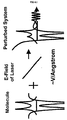
- the result of the interaction of such a high electric field with a molecule is schematically shown in Figure 4.1 where the one-dimensional electrostatic potential energy surface of a diatomic molecule is modified by a laser pulse of approximately 1 V/ ⁇ , a field strength that is on the order of the fields binding valance electrons to nuclei.
- the control of the strong field induced near continuum using closed-loop methods has been used to influence gas-phase chemical reactions (see, e.g., (1) Levis, R. J.; Menkir, G. M.; Rabitz, H.
- the goal is typically expressed in terms of seeking a tailored laser electric field ⁇ (t) that couples into the Schrödinger equation ih ⁇ ⁇ t
- ⁇ [ H 0 - ⁇ • ⁇ (t)]
- This Born-Oppenheimer picture can be expanded to explicitly consider the electrons and nuclei.
- the general mechanism for achieving quantum control is through the manipulation of constructive and destructive quantum wave interferences.
- One goal is to create maximum constructive interference in the state
- the quantum dynamic discriminators for analyzing compositions.
- the quantum dynamic discriminators include a tunable field pulse generator for generating a field pulse to manipulate at least one component of the composition and a detector for detecting at least one signal arising from at least one interaction arising from the application of an observation field to the composition.
- the detected signal is typically correlated to at least one of the following characteristics of the composition: the quantum dynamic state of the component, the Hamiltonian of the component, the molecular structure of the component, the amounts of two or more components, and the presence of an unknown component of the composition.
- a closed loop quantum controller is also provided in this aspect of the invention for the tunable field pulse generator, the controller being adapted with an optimal identification algorithm for iteratively changing the field pulse applied to the composition.
- the optimal identification algorithm operates to minimize the variance between the detected signal and at least one other detected signal in the iteration loop.
- sample identification systems for ascertaining the identity of at least one component in a composition.
- This aspect of the invention couples a quantum dynamic discriminator with a data set to correlate the characteristics of the field pulses with the detected signals to indicate the presence or absence of one or more components in a composition.
- the quantum dynamic discriminators include a tunable field pulse generator for generating a field pulse to manipulate at least one component of the composition and a detector for detecting at least one signal arising from at least one interaction between an observation field applied to the composition.
- a closed loop quantum controller for the tunable field pulse generator is also provided, the controller being adapted for iteratively changing the field pulse applied to the composition.
- an optimal identification algorithm typically operates to minimize the variance between the detected signal and at least one other detected signal in the iteration loop.
- the devices for ascertaining the molecular structure of a quantum system, e.g., a molecule.
- the devices include a quantum control/measurement component and an inversion component, which are linked together in a closed-loop architecture.
- the closed-loop architecture includes a feedback signal that is determined from the quality of the emerging molecular structural parameters of the quantum system.
- optimal identification (OI) devices for ascertaining the quantum Hamiltonian of a quantum system, e.g., a molecule.
- the OI devices include a quantum control/measurement component and an inversion component, which are linked together in a closed-loop architecture.
- the closed-loop architecture includes a feedback signal that is determined from the quality of the emerging quantum Hamiltonian of the quantum system.
- a fourth aspect of the present invention there are provided methods of ascertaining the molecular structure of a quantum system. These methods include manipulating a quantum system with at least one field pulse tuned with respect to at least one of frequency, phase, amplitude, timing and duration and detecting at least one signal arising from at least one interaction between an observation field and the manipulated quantum system. The detected signals are inverted to estimate at least one aspect of the molecular structure and an inversion error. These steps are performed iteratively, in which the tuning of at least one field pulse is in response to at least one aspect of the molecular structure and the inversion error of the manipulated quantum system.
- methods of ascertaining the quantum Hamiltonian of a quantum system include manipulating a quantum system with at least one field pulse tuned with respect to at least one of frequency, phase, amplitude, timing and duration and detecting at least one signal arising from at least one interaction between an observation field and the manipulated quantum system.
- the detected signals are inverted to provide an estimated quantum Hamiltonian and an inversion error.
- steps are performed iteratively, in which the tuning of at least one field pulse is in response to the estimated quantum Hamiltonian and the inversion error of the manipulated quantum system.
- identifying at least one component of a composition typically include manipulating the component in the composition with at least one field pulse and detecting at least one signal arising from at least one interaction between an observation field applied to the composition.
- the detected signal is typically correlated to at least one of the following characteristics of the composition: the quantum dynamic state of the component, the Hamiltonian of the component, the molecular structure of the component, the amounts of two or more components, and the presence of an unknown component in the composition.
- the method is carried out by repeating the manipulating and detecting steps under the control of a closed loop quantum controller, and correlating the tunable field pulse and the detected signal to the presence or absence of the component in the composition.
- methods for determining the presence of a unknown component in a composition are provided.
- aspects of the invention also include irradiating molecular mixtures with a first laser pulse tuned with respect to at least one of frequency, phase, amplitude, timing and duration and detecting at least one interaction between the tuned laser pulse and the component.
- the mixtures are irradiated with at least one further laser pulse tuned with respect to at least one of frequency, phase and amplitude, the further laser pulse being tuned differently from at least one of the prior laser pulses and detecting at least one interaction between the further laser pulse and the component.
- Another related aspect of the invention includes dynamically discriminating the quantum dynamic state of the at least one component from the quantum dynamic state of at least one other component in the composition.
- mass spectrometers that include a sample chamber, a tunable field pulse generator for generating at least one field pulse, and an ion detector for detecting ions.
- the mass spectrometers of the present invention are configured such that at least one of the field pulses is directed upon a sample in the sample chamber, and at least one of the components of the sample being manipulated by at least one of the field pulses.
- at least a portion of the manipulated sample is detected by the ion detector, and at least one tuned field pulse is altered in response to a signal arising from the detected ions, a signal arising from the manipulated sample, or any combination thereof.
- the methods include dynamically discriminating the component of the sample from at least one other component in the sample, and obtaining the analytical spectrum of the dynamically discriminated sample.
- a quantum dynamic discriminator device e.g, a machine, whose function is to discriminate chemical and biological agents (e.g., components, such as molecules) in the presence of complex background interference.
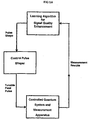
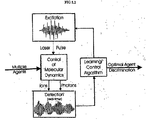
- Fig. 5.1 depicts a schematic of operational components of a quantum dynamic discriminator of molecular agents.
- the device can be operated to maximize the signal from a particular component, e.g., agent, while minimizing the background from the other components present. It typically enables the identification of agents with high sensitivity and selectivity by optimally enhancing the differences between one agent versus another by means of smart detectors recognizing in the unique dynamical behavior of the agents.
- one embodiment of the device includes a combination of individual components and technologies from (a) ultrashort laser pulse generation, (b) pulse shaping, (c) sensitive detection, and (d) closed loop optimal control.
- Each component can be provided by currently available technology.
- the detection technology typically exploits tailored laser-driven molecular dynamics.
- a shaped laser pulse can be used to both excite a time-dependent molecular quantum mechanical wave packet and then specifically probe for a given agent using rapid (e.g. optical and/or mass-spectroscopic) detection methods. Alternatively, a separate probe (observation) field can be applied.
- a closed loop learning algorithm based on quantum feedback control concepts typically slaves together the pulse shaping and detection units and achieves maximal discrimination of molecules in an environment with multiple complex agents.
- the quantum dynamic discriminator typically exploits the subtle features of the agent's dynamical driven temporal and spectral diversity in the detection process. This provides significant fidelity and efficiency of agent detection and discrimination.
- the quantum dynamic discriminators of the present invention can be used to serve the increasing need to detect chemical and biological agents in the laboratory, field and in industrial settings, where the agents of interest may be found in the presence of similar masking materials.
- the quantum dynamic discriminators typically allow rapid, sensitive, and secure identification of agents confirmable by multiple detection schemes.
- the optimal dynamic discriminators make use of a new paradigm drawing on the unique dynamical features of an molecular agent or a fingerprint of its presence. That is, although traditional spectral images of very similar agents may overlap each other, their coherent quantum dynamical behavior is rich due to structural, mass, and even subtle differences in their internal atomic interactions.
- the present inventions optimally discriminate one agent from another by effectively expanding the detection "dimension" to utilize the characteristic dynamical capabilities of each agent.
- the present invention can be used in a great variety of applications requiring molecular agent discrimination and selectivity.
- employing the invented machine in a femtosecond LIDAR (Light Detection And Ranging) apparatus for pollution monitoring will allow for the fast discrimination of atmospheric particles (e.g. aerosols) and pollutants.
- the present invention enables the ready and unambiguous discrimination of mixtures of molecules, e.g. proteins, dyes or pharmaceutical agents under realistic laboratory or clinical conditions.
- the dynamic discrimination of agents according to the present invention typically involves the use of shaped pulse (typically a laser pulse) field excitation coupled to highly sensitive optical, mass spectrometric, or other suitable detection techniques.
- the discrimination methods are typically carried out using the time-dependent unique evolution of an agent's excited state quantum mechanical wave packet after photoexcitation using polychromatic radiation.
- the polychromatic pulse shaping and detection units are typically linked by a feedback learning-algorithm that enables the optimization of an agent's characteristic fingerprint and, hence, the discriminating detection of a particular agent within a mixture.
- the present invention draws on the special dynamical characteristics of each molecule under quantum control to form a new detection technology capable of maximally discriminating amongst chemical and biological agents. It exploits the subtle features of the agent's (Hamiltonian) diversity in the detection method, as there is no greater source of discrimination than this. An effective multi-parameter agent detection capability is produced by drawing on this diversity combined with the high duty cycle for generating a very large number of discriminating laser pulses.
- One embodiment of the method of discriminating agents draws on the unique dynamical features of any molecular agent. While traditional spectral images of very similar agents often overlap each other, their coherent quantum dynamical behavior is much richer due to structural, mass, and even subtle differences in their internal atomic interactions.
- the present invention optimally discriminates one agent from another by effectively expanding the detection dimension to utilize the characteristic dynamical capabilities of each agent Usage of the term "optimally discriminates" as used throughout this specification is meant that a high degree of discrimination is achieved in keeping within the capabilities of having flexible multivariate controls.
- the degree of discrimination that is achieved is as high as possible in keeping with the capabilities of having flexible multivariate controls.
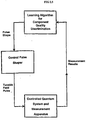
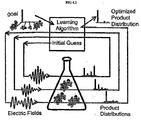
- One embodiment of the quantum dynamic discriminator is based on quantum feedback control concepts, as illustrated in Fig. 5.2.
- This embodiment is composed of four major components tied together in a loop: (a) a source for the generation of ultrashort laser pulses in a given wavelength region, (b) a device capable of rapidly shaping the generated laser pulses in a great variety of forms, (c) a detection system (e.g. optical or mass spectroscopic) that is sensitive to specific changes of a laser pulse-induced observable of the agent of interest, and (d) a controller (e.g., computer) with implemented learning algorithm to guide the closed loop process to discriminate at least one of the components of a composition from at least one other component in the composition. Typically, the controller is operated to achieve maximum discrimination.
- the discriminator operates to maximize the detection signal from a particular agent at one or more times, while minimizing the background signal from the other components present.
- the learning algorithm typically employs the prior detected signals to specify the criteria for a new laser pulse for another refined excursion around the loop pulse.
- Quantum dynamic discriminators for analyzing compositions are provided by the present invention.
- the quantum dynamic discriminators include a tunable field pulse generator for generating a field pulse to manipulate at least one component of the composition and a detector for detecting at least one signal arising from at least one interaction arising from the application of an observation field to the composition.
- Suitable tunable field pulse generators useful in the present invention are capable of generating a pulse field that varies in timing, frequency, wavelength, amplitude, phase and duration, or any combination thereof. Any type of field that can be shaped with a suitable field generating device can be used in the present invention. Typically, the field is an electromagnetic field, although other types of fields can be used. Typically, the tunable field pulse generator comprises a pulsed laser. Suitable pulsed lasers described elsewhere in this specification are readily available to those skilled in the art and are described elsewhere in this specification. Suitable electromagnetic fields include laser light, typically having wavelengths of from 200 nanometers ("nm") to 10 microns (" ⁇ m), although other wavelengths may be used. Examples of other fields that can be tuned and formed into a pulse include microwaves, radio waves, UV radiation and X-rays.
- the field pulse is typically controlled to manipulate the quantum dynamic state of at least one component in the composition. In certain embodiments, the field pulse is controlled to manipulate the amount of at least one component in the composition. The field pulse may also be controlled to manipulate the ionization state of at least one component in the composition. This is useful in certain embodiments that couple quantum dynamic discrimination with mass spectrometric techniques.
- the field pulse is controlled to manipulate the detected signal for determining the molecular structure of at least one component in the composition.
- the IR absorption spectra of a component being sensitive to molecular structure can be manipulated with the field pulse to determine the molecular structure of the component. This can be carried out, for example, by using a suitable IR light source as the observation field, detecting the IR absorption spectra of the component, and using closed loop quantum controller techniques to invert the IR absorption to a family of consistent molecular structures and to tune the field pulse generator in response thereto.
- Suitable generators of the observation field include a continuous laser, a pulsed laser, a tunable pulsed laser, or any combination thereof.
- the observation field may also be generated by the tunable field pulse generator that generates the field pulse for manipulating at least one component in the composition.
- the observation field may be generated by a separate tunable field pulse generator.
- Suitable electromagnetic fields used by the observation field include laser light, typically having wavelengths of from 200 nanometers ("nm") to 10 microns (" ⁇ m), although other wavelengths may be used. Examples of other fields that can be tuned and formed into a pulse include microwaves, radio waves, UV radiation and X-rays.
- the shape of the observation field can be selected using a closed loop quantum controller employing an optimal identification algorithm. Optimal identification algorithms are described elsewhere in this specification.
- the detected signals are typically correlated to at least one of the following characteristics of the composition: the quantum dynamic state of the component, the Hamiltonian of the component, the molecular structure of the component, the amounts of two or more components, and the presence of an unknown component of the composition.
- the term "amount” as used herein with regard to composition refers to both relative amounts and absolute amounts.
- a closed loop quantum controller is also provided in this embodiment of the invention for the tunable field pulse generator.
- Suitable controllers are adapted with an optimal identification algorithm for iteratively changing the field pulse applied to the composition.
- Suitable closed loop quantum controllers will typically vary at least one of frequency, wavelength, amplitude, phase, timing, or duration, of the field pulse.
- the optimal identification algorithm operates to minimize the variance between the detected signal and at least one other detected signal in the iteration loop.
- the optimal identification algorithm includes a genetic algorithm to control the tunable field pulse generator.
- the closed loop quantum controller carries out the optimal identification algorithm by manipulating the constructive and destructive interferences of the field pulse and the quantum dynamic state of at least one component in the composition.
- the signals from the targeted component are preferentially amplified over the signals from the other components in the composition.
- the tunable field pulse typically induces at least one signal from at least one component in the composition while suppressing at least one signal from at least one other component in the composition.
- the quantum dynamic discriminators of the present invention typically utilize an optimal identification algorithm. This algorithm operates to minimize the variance between the detected signal and at least one other detected signal in the iteration loop. Variance minimization is carried out by the controller to manipulate at least one of a variety of characteristics of the state of the composition, which include the quantum dynamic state of at least one component in the composition, the amount of at least one component in the composition, the ionization state of at least one component in the composition, the molecular structure of at least one component in the composition, and the amounts (e.g., the presence or absence of) one or more components in the composition.
- Detected signals arising from the interaction between the observation field and the composition can be of any type of signal that provides information to a detector
- suitable signals include an electric field, a magnetic field, an electromagnetic field, an optical field, an acoustical field, a particle, an ionized particle, a magnetized particle, or any combination thereof.
- the signals can be detected statically, dynamically, or both statically and dynamically. Typically, multiple signals are detected, and preferably averaged to improve the quality of the detected signals.
- the quantum dynamic discriminators may further include a sample chamber for holding the composition and exposing the composition to the tunable field pulse.
- a particularly useful embodiment is providing the sample chamber is in fluid communication with a mass spectrometer.
- the quantum dynamic discriminators may be used for enhancing the peak position of a particular mass peak in the mass spectrum of a composition.
- the quantum dynamic discriminators of the present invention can also be used for estimating the quantum Hamiltonian of the component from a plurality of detected signals.
- a plurality of detected signals arise from interactions between the observation field and the component in the composition.
- the optimal identification algorithm determines the inversion error of the emerging quantum Hamiltonian of the component in the composition, and the optimal identification algorithm generates a feedback signal to the controller.
- the optimal identification algorithm assesses the quality of the emerging quantum Hamiltonian of the component to minimize the inversion error, thereby iteratively generating improved estimates of the Hamiltonian of a composition.
- Sample identification systems for ascertaining the identity of at least one component in a composition are also provided by the present invention.
- This embodiment of the invention couples a quantum dynamic discriminator with a data set to correlate the characteristics of the field pulses with the detected signals to indicate the presence or absence of one or more components in a composition.
- suitable quantum dynamic discriminators include a tunable field pulse generator for generating a field pulse to manipulate at least one component of the composition and a detector for detecting at least one signal arising from at least one interaction between an observation field applied to the composition.
- a closed loop quantum controller for the tunable field pulse generator also provides for iteratively changing the field pulse applied to the composition.
- the sample identification system utilizes quantum dynamic discriminator enabled by an optimal identification algorithm that minimizes the variance between the detected signal and at least one other detected signal in the iteration loop.
- Variance minimization is typically carried out by the controller to manipulate at least one of a variety of characteristics of the state of the composition.
- the composition characteristics that may be manipulated include the quantum dynamic state of at least one component in the composition, the amount of at least one component in the composition, the ionization state of at least one component in the composition, the molecular structure of at least one component in the composition, and the amounts (e.g., the presence or absence of) one or more components in the composition.
- Optimal identification (OI) devices for ascertaining the quantum Hamiltonian of a quantum system, e.g., a molecule, the molecular structure of a quantum system, and interactions between a quantum system's atoms, nuclei and electrons with an external field, are also provided in the present invention.
- the Hamiltonian of a quantum system is a measurement of the various interactions of internal fields within a quantum system, as well as a measurement of the interactions of external fields on a quantum system. Accordingly, knowledge about the Hamiltonian of a quantum system is useful for determining the quantum systems' structure (e.g., molecular structure).
- the OI devices include a quantum control/measurement component and an inversion component, which are linked together in a closed-loop architecture.
- the quantum control/measurement component typically includes a control optimization manager, a tunable field pulse generator for generating field pulses to manipulate the quantum system, and a detector.
- the detector is used for detecting a plurality of signals arising from interactions between a plurality of observation pulses applied to the quantum system (i.e. a composition).
- the inversion component is used for inverting data received by the quantum control/measurement component to estimate the quantum Hamiltonian.
- the quantum control/measurement component and the inversion component are typically linked together in a closed-loop architecture.
- the closed-loop architecture typically includes a feedback signal that is determined from the quality of the emerging quantum Hamiltonian of the quantum system.
- the Hamiltonian determination methods typically include manipulating a quantum system with at least one field pulse tuned with respect to at least one of frequency, phase, amplitude, timing and duration and detecting at least one signal arising from at least one interaction between an observation field applied to the manipulated quantum system. As described in further detail elsewhere in this specification, the detected signals are inverted to provide an estimated quantum Hamiltonian and an inversion error. These steps are typically performed iteratively, in which the tuning of at least one field pulse is in response to the estimated quantum Hamiltonian and the inversion error of the manipulated quantum system.
- Methods are also provided by the present invention for identifying at least one component of a composition. These methods typically include manipulating at least one component in a composition with at least one field pulse and detecting at least one signal arising from at least one interaction between an observation field applied to the composition.
- the detected signal is typically correlated to at least one of the following characteristics of the composition: the quantum dynamic state of the component, the Hamiltonian of the component, the molecular structure of the component, the amounts of two or more components, and the presence of an unknown component in the composition.
- the method is carried out by repeating the manipulating and detecting steps under the control of a closed loop quantum controller, and correlating the tunable field pulse and the detected signal to the presence or absence of the component in the composition.
- Closed loop quantum controllers typically utilize an optimal identification algorithm. Suitable algorithms operate to minimize the variance between the detected signal and at least one other detected signal in the iteration loop.
- Variance minimization is carried out by the controller to manipulate at least one of a variety of characteristics of the state of the composition, which include the quantum dynamic state of at least one component in the composition, the amount of at least one component in the composition, the ionization state of at least one component in the composition, the molecular structure of at least one component in the composition, and the amounts (e.g., the presence or absence of) one or more components in the composition.
- the manipulating step typically provides for constructive and destructive wave interferences of the quantum dynamic states of the component in the composition.
- Detected signals arising from the interaction between the observation field and the composition can be of any type of signal that provides information to a detector.
- suitable signals include an electric field, a magnetic field, an electromagnetic field, an optical field, an acoustical field, a particle, an ionized particle, a magnetized particle, or any combination thereof.
- the signals can be detected statically, dynamically, or both statically and dynamically. Typically, multiple signals are detected, and preferably averaged to improve the quality of the detected signals.
- the methods described herein are useful for identifying the components of compositions composed of molecules, especially where the molecules have similar optical absorption spectra.
- similar optical absorption spectra is meant that essentially no optical absorption peaks are discernible in an optical spectra that could discriminate the similar molecules.
- the field pulse comprises electromagnetic radiation, typically a laser light pulse which is tunable with respect at least one of frequency, phase, amplitude, timing and duration.
- the wavepacket motion of the targeted component gives rise to at least one discriminating signal.
- the discriminating signal includes an electric field, a magnetic field, an electromagnetic field, an optical field, an acoustical field, a particle, an ionized particle, a magnetized particle, or any combination thereof, and is correlated to a component in the composition.
- the process of correlating the discriminating signal to a component in the composition can be carried out deductively or inductively for component identification.
- the method for identifying at least one component of a composition can also be used for determining the presence of a unknown component in a composition.
- the method detects a signal that is not correlated to any a priori known signal, thereby identifying the presence of an unknown agent.
- the method for identifying at least one component of a composition can further include the steps of detecting at least one discriminating signal and applying to the composition at least one additional tunable electromagnetic pulse.
- the additional tunable electromagnetic pulse is typically tuned under the control of a closed loop quantum controller in response to at least one prior discriminating signal. Correlating the tunable electromagnetic pulse and the discriminating signal is then carried out to ascertain the presence or absence of the at least one component in the composition.
- Related embodiments of the present method also include irradiating molecular mixtures with a first laser pulse tuned with respect to at least one of frequency, phase, amplitude, timing and duration and detecting at least one interaction between the tuned laser pulse and the component.
- the mixtures can be irradiated with at least one further laser pulse tuned with respect to at least one of frequency, phase and amplitude, the further laser pulse being tuned differently from at least one of the prior laser pulses and detecting at least one interaction between the further laser pulse and the component.
- Mass spectrometers are also provide by the present invention.
- the mass spectrometers include a sample chamber, a tunable field pulse generator for generating at least one field pulse, and an ion detector for detecting ions.
- the mass spectrometers of the present invention are typically configured such that at least one of the field pulses is directed upon a sample in the sample chamber, and at least one of the components of the sample being manipulated by at least one of the field pulses.
- At least a portion of the manipulated sample is detected by the ion detector, and at least one tuned field pulse is altered in response to a signal arising from the detected ions, a signal arising from the manipulated sample, or any combination thereof.
- the detection and alteration of tuning steps are typically performed iteratively, which is typically carried out with a computer.
- the tunable field pulse induces at least one signal from at least one component in the composition while suppressing at least one signal from at least one other component in the composition.
- the mass spectrometer is capable of controlling the field pulse to manipulate a variety of characteristic states of a composition, including the quantum dynamic state of at least one component in the composition, the amount of at least one component in the composition, the ionization state of at least one component in the composition, the molecular structure of at least one component in the composition, the amounts of one component over another in the composition, and any combination thereof.
- a closed loop quantum controller is provide that is capable of manipulating the constructive and destructive interferences of the field pulse and the quantum dynamic state of at least one component in the composition.
- mass spectrometers are provided that further contain a detector for detecting at least one signal arising from an interaction between the field pulse or an observation field applied to the sample and at least one component of the sample, and a closed loop quantum controller for the tunable field pulse generator.
- a detector for detecting at least one signal arising from an interaction between the field pulse or an observation field applied to the sample and at least one component of the sample
- a closed loop quantum controller for the tunable field pulse generator.
- interactions can be detected, a number of which typically include optical absorbance, optical emission, nuclear spin state, molecular spin state, and ionic fragmentation of the component.
- the controller can be adapted for iteratively changing the field pulse applied to the composition in response to the signal arising from the interaction.
- the closed loop quantum controller includes a genetic algorithm to control the tunable field pulse generator, which is preferably driven to minimize the variance in the detected signals during an iteration loop.
- the tuning of the closed loop quantum controller typically varies at least one of frequency, wavelength, amplitude, phase, timing, or duration, of the electromagnetic pulse.
- the observation field is typically generated by a generator which can be the same as or different than the tunable field pulse generator that provides the field pulse for manipulating the component.
- the shape of the observation field is typically selected using a closed loop quantum controller employing an optimal identification algorithm.
- the tunable field pulse generator typically generates at least one electromagnetic pulse that is capable of tuning the frequency, wavelength, amplitude; phase, timing, duration, or any combination thereof, of the electromagnetic pulse.
- the tunable field pulse generator comprises a pulsed laser, which can also be used for generating the observation field.
- a different source may also be provide for the observation field, in which case the generator of the observation field is typically a continuous laser, a pulsed laser, a tunable pulsed laser, or any combination thereof.
- Suitable detected signal include an electric field, a magnetic field, an electromagnetic field, an optical field, an acoustical field, a particle, an ionized particle, a magnetized particle, or any combination thereof.
- the signal is typically detected statically, dynamically, or both, and multiple signals can be detected and averaged for improving data quality.
- the methods include dynamically discriminating the component of the sample from at least one other component in the sample, and obtaining the analytical spectrum of the dynamically discriminated sample.
- any analytical spectrometer can be adapted with the dynamic discrimination methods described throughout this specification.
- Typical analytical spectrometers include the following: a nuclear magnetic resonance spectrometer, an optical spectrometer, a photoacoustic spectrometer, and preferably a mass spectrometer. Combinations of various other analytical spectrometers, including the aforementioned spectrometers, are also envisioned to be adaptable with the dynamic discrimination methods of the present inventions.
- the dynamically discriminating step includes manipulating the component in the sample with at least one field pulse, and detecting at least one signal arising from at least one interaction between the field pulse or an observation field applied to the sample and the component of the sample.
- manipulating and detecting steps are typically repeated under the control of a closed loop controller to control the peak intensity of the component in the spectrum.
- controllers are typically under the operative control with a computer, that preferably uses a feedback learning algorithm, such as a genetic algorithm, to control the tuning.
- the manipulating step typically includes constructive and destructive wave interferences of the quantum dynamic states of the component in the composition.
- This can be typically carried out with a field pulse that includes electromagnetic radiation, which is preferably laser light that is tunable with respect to at least one of frequency, phase, amplitude, timing and duration.
- the detected signal typically have a type including an electric field, a magnetic field, an electromagnetic field, an optical field, an acoustical field, a particle, an ionized particle, a magnetized particle, or any combination thereof.
- the method will typically include measuring the mass/charge ratio of at least one component of the composition with a mass spectrometer.
- the present methods are particularly useful for determining the presence of a suspicious, unknown, agent in a sample. These methods can be carried out by optimizing the discriminator on a peak that is otherwise unidentifiable compared to a set of known peaks that are expected for the sample. Thus, in a related embodiment, these methods for identifying components in a sample are preferably carried out with the assistance of a data set for comparing peak positions measured from samples to the peak positions of know components. Accordingly, the information derived from the detection steps can be further stored in at least one further data set.
- the embodiments presented in this section introduce optimal identification (OI), a collaborative laboratory/computational algorithm for extracting various characterization information of compositions from experimental data specifically sought to minimize the measured variance in the data.
- the characterization information that can be extracted include the following: quantum Hamiltonians and the quantum dynamic states by minimizing the variance in the inversion error; molecular structure by minimizing the variance in the uncertainty of the measured molecular structure determination; and the component distribution by minimizing the variance in the measured component distribution.
- OI incorporates the components of quantum control and inversion by combining ultra-fast pulse shaping technology and high throughput experiments with global inversion techniques to actively identify quantum Hamiltonians from tailored observations. These techniques can also be applied to actively identify the quantum dynamic state, molecular structure, and component distribution in a wide variety of compositions.
- the OI concept rests on the general notion that optimal data can be measured under the influence of suitable controls to minimize uncertainty in the measured date, e.g., extracted Hamiltonian information, despite data limitations such as finite resolution and noise.
- the transition dipole moments of a multi-level quantum Hamiltonian were extracted from simulated population transfer experiments.
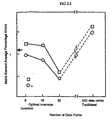
- the OI algorithm reveals a simple optimal experiment that determined the Hamiltonian matrix elements to an accuracy two orders of magnitude better than obtained from inverting 500 random data sets.
- the optimal and nonlinear nature of the algorithm are shown to be capable of reliably identifying the Hamiltonian even when there were more variables than observations.
- the optimal experiment acts as a tailored filter to prevent the laboratory noise from significantly propagating into the extracted Hamiltonian.
- a general goal in chemistry and physics is to quantitatively predict quantum dynamics from quantitative knowledge of the molecular Hamiltonian.
- laboratory data continues to provide a valuable source of this information. Extracting components of the Hamiltonian from measured observables has motivated an ongoing effort to develop inversion procedures aimed at specific types of laboratory data.
- setting the instrument's "knobs" to provide the best measurement conditions for the purpose of inversion has often been an ad hoc endeavor.
- the knobs are simple, intuitive approaches may be sufficient.
- many modem experiments with large numbers of knobs, such as laser pulse shapers cannot be effectively operated using intuition alone.
- identification refers to the process of inverting laboratory data to reveal a system's Hamiltonian (often the potential), while control implies driving the system toward a specified objective using tailored electromagnetic fields.
- identification and control appear to be different and the subjects have developed more-or-less independently. However, upon closer inspection, both draw on the same underlying process; they employ inversion procedures to search for an unknown portion of the Hamiltonian.
- identification the goal is to extract a potential that adequately reproduces the laboratory data, while for control, it is to find an external field that produces a specified physical objective. The two are intimately linked by their dependence on optimization to obtain the best results.
- Hamiltonian identification has typically been approached using a number of specialized inversion tools. Examples include the Rydberg-Klein-Rees (RKR) method[1-3] for diatomic rovibrational spectra, the exponential distorted wave (EDW) approach for approximately inverting inelastic scattering cross sections[4], fully quantum procedures[5] for elastic scattering, the self-consistent-field method for inverting triatomic rovibrational lines[6, 7], etc. More recently, inverse perturbation analysis methods[8-10] coupled with Tikhonov[11-15] regularization have provided a means for treating various observables in a fully quantum manner without resort to constrained potential forms or parameter fitting.
- RKR Rydberg-Klein-Rees
- EDW exponential distorted wave
- inverse perturbation analysis methods[8-10] coupled with Tikhonov[11-15] regularization have provided a means for treating various observables in a fully quantum manner without resort to constrained potential forms or parameter fitting.
- Hamiltonian identification via inversion has played an important role in many molecular systems despite its shortcoming of being subservient to the available laboratory measurements.
- Data sets either because of range, resolution, precision, etc., contain varying degrees of information about the system being investigated.
- a better Hamiltonian identification is possible when the laboratory data contains more information about the system; however, it is rarely clear, even when observables are measured for the explicit purpose of inversion, which experiments optimally specify the Hamiltonian. Without this guidance, quantum system identification has sufficed with existing data and the implicit admission that a better quality inversion might be possible if the laboratory observations were performed in a different, albeit unknown, manner.
- Quantum control has recently seen increasing experimental success in manipulating systems to obtain intricate and diverse objectives.
- the most promising, generally applicable approach for controlling quantum dynamics phenomena utilize shaped electromagnetic fields[24-27] and laboratory closed-loop learning[28-38].
- Closed-loop control algorithms[31-35, 38] incorporate robust search procedures where the measured outcomes from previously tested pulses guide the selection of new trial fields as part of a learning process that capitalizes on the extremely high throughput of the laboratory experiments.
- Closed-loop learning commonly employs genetic algorithms[39, 40] (GAs) to minimize the difference between the observed outcome and the desired target.
- GAs permit global searches over the space of accessible laser fields, simultaneously propagate a large control solution family, remain convergent despite diverse algorithmic starting conditions, and are capable of providing high yields for well posed objectives.
- OI Quantum optimal identification
- OI is typically laboratory control linked to computational quantum inversion in a closed-loop fashion.
- the quantum system is subjected to a shaped laser pulse, that creates an evolving wavepacket, followed by a measurement of a set of physical observables that are sensitive to the quantum dynamics. Measurements of the time-evolved observables are then inverted by computationally propagating wavepackets governed by trial Hamiltonians (including the corresponding control field) until finding one or more Hamiltonians that reproduce the data.
- OI is overseen by a laser control field optimization that minimizes the error in the inverted Hamiltonian by tailoring the shape of the electromagnetic field.
- For each trial pulse a separate inversion is performed and the quality of the identified Hamiltonian is assessed. The resulting quality assessment is used to guide the selection of new pulses until identifying the best possible Hamiltonian.
- the optimal control fields must be chosen without a precise target, driven only by the assessed quality of the emerging Hamiltonian. This objective implicitly requires finding robust fields such that laboratory data errors minimally contaminate the inversion, yet allow the data to maximally reveal the details of the quantum Hamiltonian. Thus, the optimal measurements should be simultaneously sensitive to the Hamiltonian, but insensitive to laboratory noise. OI attempts to resolve these seemingly contradictory requirements.
- OI is an interactive interrogation of the system's Hamiltonian and dynamics accomplished with tailored electromagnetic fields that best unveil the system.
- probing complex molecular Hamiltonians does not come without both experimental and computational effort.
- OI stands to provide superior information about quantum systems.
- the process can be expensive since a collection of measurements and individual inversions must be performed as part of a hybrid experimental/computational process.
- OI can be massively parallelized providing practical machinery for aggressively studying molecular Hamiltonians.
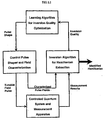
- the proposed laboratory OI machine concept incorporates the operating components of both quantum control and global inversion, linked together in a closed-loop architecture.
- OI shares some structural features with many emerging quantum control experimental procedures; however, in OI, the feedback signal is the quality of the emerging Hamiltonian, not a pre-specified target observable.
- data measured for using a trial laser pulse shape is sent to the inversion component to identify the system's Hamiltonian, along with a measure of its uncertainty.
- the inversion error or the uncertainty in the recovered Hamiltonian, provides the feedback signal for the overseeing control experiment.
- the objective is to minimize the inversion error over the space of accessible pulse shapes and measurement capabilities to identify the Hamiltonian with as little uncertainty as possible.
- Section Sec. IIA describes the overall layout of the proposed OI machine, while Sections IIB and IIC describe the control and inversion components.
- the overseeing component is the control optimization manager, Fig. 1(Ai), which is responsible for automating the entire optimal inversion by performing the following tasks:
- the first part of the OI operation involves a control/measurement component, Fig. 1 (A) that utilizes the familiar closed-loop design found in current quantum control procedures.
- the learning algorithm (A 1 ) is attached to the pulse-shaper (A 2 ), which can be any of a variety of types, e.g., deformable mirrors, liquid crystal masks, acousto-optical modulators, etc.
- the shaped pulse is then used to manipulate the quantum system (A 3 ), which was either previously state prepared or specified as a thermal distribution.
- the incoming pulse triggers an observation (A 4 ) of the system after it has evolved under the influence of the electromagnetic field. Any synchronization, if needed, between A 3 and A 4 , as well as the type of measurement performed is determined by the system being studied. However, in general, the observation must measure observables that are sensitive to the time-evolution.
- the electromagnetic field optimization (Ai) is accomplished by expressing the pulse in terms of a discrete collection of variables, called control "knobs", ⁇ c 1 , ..., c Nc ⁇ , E(t) ⁇ E(t ; c 1 , c 2 ,..., c Nc ) and the space of accessible fields is defined by varying each c i over its laboratory range, c (min) / t ⁇ c i ⁇ c (max) / t .
- control variables might represent the voltages applied to pixels in a liquid crystal mask, the offsets used in a spatially deformable mirror, the waveform used to drive an acousto-optical modulator, the parameters characterizing the field phase and/or amplitude, etc .
- the optimal field i.e. , for the control variables, c
- the inversion stage of OI must know the actual field used to influence the system so that it can properly compare the computed and observed propagation results. Characterizing the field may be accomplished using post-shot field analysis techniques, such as frequency-resolved optical gating (FROG) [42], or similar algorithms. However, a high quality set of knob ⁇ field calibrations could be performed prior to the actual OI operation to provide the field's frequency or time domain composition without real-time pulse characterization.
- FROG frequency-resolved optical gating
- E k (t) After the quantum system's (A 3 ) wavepacket has evolved under the influence of the field, E k (t), a suitable measurement, ⁇ k (lab) , (A 4 ) is performed on the system and the data is returned to the overseeing control optimization manager to be submitted for inversion (c.f., Sec. IIC, below).
- inversion c.f., Sec. IIC, below.
- ⁇ k (lab) represents the average value of the observable, where the appropriate number of replicate measurements depends on factors including noise from the laser and the pulse-shaper, detector resolution and sensitivity, environmental conditions, etc. Since the inversion quality may be adversely affected by the data error, it is typical to obtain high precision by performing many averages. As used herein, "good inversion quality" means that the inversion error is low. A typical criterion for reliable inversion is to have available good knowledge of the errors in the data. Given the high duty cycle of current laser control experiments, which are many times faster than the inversions, it is possible to perform a large number of replicate measurements and accurately characterize the data error.
- the inversion component Fig. 1 (B) is responsible for extracting the Hamiltonian from the data measured in Fig. 1 (A 2 -A 4 ). Due to the availability of only finite, error-contaminated experimental data, there is generally a large family of different Hamiltonians that all reproduce the data to within its precision. A larger and more diverse solution family corresponds to greater inversion uncertainty, i.e., the data admits a broader distribution with a greater number of distinct Hamiltonians. In a good inversion the solution family contains only a narrow distribution of similar Hamiltonians that all reproduce the data. Under less favorable conditions, the inversion algorithm might fail to find any Hamiltonians that are consistent with the data, perhaps because of a systematic error in the laboratory data. In this case, the inversion quality is measured by the discrepancy between the observed and computed data sets. A sophisticated OI algorithm with global search capabilities is capable of handling the possibilities of inconsistent data.
- the OI algorithm seeks laser control pulses which minimize the diversity of the identified Hamiltonian family.
- the full family of Hamiltonians consistent with the observed data must be obtained.
- most traditional inversion procedures only produce a single solution because they utilize linearization and local (e.g., gradient based) search techniques.
- a recently introduced class of global inversion algorithms [20-22], as well as others that provide nonlinear searches over the space of appropriate Hamiltonians[16-19] are capable of finding the full family of inverse solutions.
- Fig. 1(A) At the disposal of the OI manager in Fig. 1(A) is a collection of client computers (B 1 , B 2 , B 3 ,...), for performing inversions.
- the control manager When the control manager receives data, it queries the list of clients to find a networked computer that is available for inverting the new data set. If none are idle, then the control manager may temporarily suspend the laboratory components while waiting for an inversion computer to signal its availability; without the interactive feedback provided by the inversion results, the pulse optimization can not proceed. It is therefore desirable that each inversion be performed as quickly as possible.
- the client polling process, performed by the supervising control manager should be network-aware, i.e., maintain statistics about its client machines so that the fastest computers are preferentially dispatched at all times.
- h ⁇ h 1 ,..., h N h ⁇
- the Hamiltonian family have the freedom to be consistent with the radiative interaction being utilized.
- the Hamiltonian variables There are many possible ways to define the Hamiltonian variables, and the best representation must be selected to suit the quantum system being inverted.
- N h >> 1.
- the ⁇ h i ⁇ might be matrix elements, such as H nm in a chosen basis, interpolation points or parameters used to define a potential energy surface, transition dipole moments, etc.
- choosing suitable parameters with sufficient flexibility normally excludes the use of simple parameter fitting.
- ⁇ k,i (h) is the observable's computed value for the trial Hamiltonian, H , under the influence of the external field, E k (t), and M is the number of distinct measurements in the data set.
- a regularization operator, K and acting on the Hamiltonian, h, can be used to incorporate a priori behavior, such as smoothness in potential energy functions, proper asymptotic behavior, the correct symmetry, etc ., into the inverted Hamiltonian[8, 12, 20, 22].
- Identifying the full family of inverse solutions consistent with the data requires an optimization algorithm that is capable of simultaneously finding many minima in Eq. (3).
- GAs are an ideal choice because they propagate a solution family, are insensitive to initialization, converge under practical operating conditions, and provide global searches over nonlinear functional landscapes. GAs offer excellent exploration capabilities and can identify many distinct extrema.
- N p an algorithmic parameter
- the output of the inversion optimization is a set of N s identified Hamiltonians, ⁇ h * / i,...,h * / N s ⁇ .
- Each optimized member, h * / s describes a Hamiltonian that reproduces the measured observable, ⁇ k (lab) , and the set provides a discrete estimation of the full solution family, H*.
- the upper and lower bounds of each inverted variable defines the family, where h * / m 2 i is the i th Hamiltonian variable from the m th member of H*.
- N 8 is large, the true Hamiltonian will lie somewhere between the upper and lower limits of the optimized solution family.
- the ⁇ h * / i ⁇ can be used to define the inversion error metric, in ⁇ H*[ E k ( t )]Eq. (2), for the associated field, E k (t], where h * / s is the s th member of the inversion family found from E k (t).
- the first term in Eq. (7) measures the ability of the inversion family to reproduce the data and the second measures the inversion uncertainty. The first sum vanishes if inversion can reproduce the data to within its experimental error, and the latter is weighted by an algorithmic parameter, ⁇ . Under normal circumstances the value of ⁇ will be unimportant because there will be no systematic error in the data and the first term in Eq. (7) will vanish. When this is not the case, ⁇ balances the relative importance of matching the data versus minimizing uncertainty and must be selected on a problem by problem basis.
- the output is a collection of optimal pulses, their associated laboratory data and errors, and their corresponding inversion results, ⁇ E * / k ( t ), ⁇ * / k , ⁇ * / k , h * / i ⁇ .
- the family defined by H * is the optimal identification result.
- the final optimization may not be significantly better than that provided by ⁇ E * / 1 ( t ), ⁇ * / 1, ⁇ * / 1, h * / 1 ⁇ .
- the error analysis described in Sec. IIC 3 can be used to assess the uncertainty in the optimally inverted Hamiltonian variables.
- normal statistics could be performed on the distribution of Hamiltonians in the OI family; however, a rigorous nonlinear treatment is best provided by Eq. (8).
- the actual distribution of each variable, h i * can be examined from the final GA inversion results, H*.
- Simulated error, ⁇ (lab) was introduced into the population observations according to, where the ⁇ ij were chosen randomly between ⁇ ( abs ) the relative error in each population observation. A different random value, p ij , was selected every time a measurement was simulated.
- Each noise contaminated control field took the form of a modulated Gaussian shaped pulse, where the ⁇ t were the resonance frequencies [48,49] of H 0 , A ( j ) / t their corresponding amplitudes and ⁇ ( j ) / t , their associated phases.
- Field noise was modeled as uncertainties in the A t and ⁇ t , which includes various types of both correlated and uncorrelated noise typical of laboratory pulse shaping devices.
- the field error was produced by introducing the parameters, ⁇ ( j ) / A and ⁇ ( j ) / 0 , that were chosen randomly over [- ⁇ ( fld ), + ⁇ ( fld )], corresponding to the relative error in the field amplitude or phase.
- a different random value (constant over the lifetime of the pulse) for ⁇ ( j ) / A t and ⁇ ( j ) / ⁇ t was selected each time a replicate simulation was performed.
- the laboratory error distribution, p [ ⁇ ( lab ) / k,i ], of the measured observable includes the combined effects of the noise in the control laser pulse, ⁇ ( ftd ) , and measurement error, ⁇ ( abs ) , in the observable detection process.
- the laboratory error distribution can be obtained by inspecting the individual values of the D replicate measurements. For small fluctuations in the field and significant signal averaging, the laboratory error distribution may be Gaussian; however, the combined effects of field noise and measurement error can be correlated, complex and not a priori predictable.
- the only general approach for obtaining the error distribution used to define ⁇ ( lab ) must be determined in the laboratory for the problem at hand.
- the error distribution was simulated as uniform between its error-bars, ⁇ ( lab ) / k , which were defined as the Pythagorian sum of ⁇ ( abs ) and ⁇ ( fld ) .
- the input to the inversion stage including the population measurements, their error, and their corresponding fields (i.e., the noise-free field requested of the pulse shaper), ⁇ ( lab ) / k , ⁇ ( lab ) / k E k ⁇ , was used to globally extract the family of transition dipole moment matrices consistent with the data, as described in Sec. IIC 1.
- a raw optimization of Eq. (3) from Sec. IIC 1 using a genetic algorithm was performed to obtain the solution family from the k th experiment.
- the calculated populations, ⁇ k (h) were obtained by propagating the initial wavefunction,
- Minimizing Eq. (3) for the inversion was performed with a steady state genetic algorithm, a population size of N p - 200, a mutation rate of 5%, a crossover rate of 80%, and an trans-generation population overlap of 50%. The large population size was used to ensure adequate sampling of the solution family in accord with the arguments of Sec. IIC 1. No regularization was performed in the inversion and therefore, the second term in Eq. (3) was ignored.
- Table I depicts the OI dipole results, ⁇ *, for the fields restricted to v ⁇ v + 1 transition frequencies.
- the identification quality obtained by performing a standard global inversion on data for 500 sub-optimal, random fields is also provided. This latter inversion used all 500 experiments simultaneously, as commonly performed. In both the optimal and sub-optimal cases, the inversions were capable of reproducing the data to within its error.
- Fig. 2(A) shows the ability of OI to precisely obtain all of the Hamiltonian variables, despite the bandwidth constraints on the applied field.
- Panel (A1) shows the power spectrum of the best field, E * / i , identified by the algorithm in Fig. 1 to extract the transition dipole matrix.
- Panel (A2) shows the power spectrum of one of the fields rejected by the control optimization used for the inversion.
- the inset plots provide a graphical depiction of the inversion errors in each transition dipole moment where darker shading represents a larger ⁇ h i *, for (A1), and ⁇ h * / i , for (A2).
- the optimized field made it possible to identify precise values for all the ⁇ mn despite the bandwidth restrictions, whereas the rejected field only allowed precise determination of ⁇ m,m +1 .
- the OI algorithm was able to identify fields for which the quality of the extracted Hamiltonian variables was relatively insensitive to the data noise.
- map-facilitated algorithms involve a two part learning-inversion procedure where a high-speed functional representation of the observations in terms of the quantum system's Hamiltonian is first learned by computing the observable for a selected set of representative Hamiltonians. After the map is learned, it replaces the arduous task of repeatedly solving the Schrödinger equation in the inversion with an extremely fast map evaluation time. The map learning process could be performed prior to the laboratory optimization, thus alleviating any algorithmic bottleneck involving the data inversion in closed loop operations. A simulation of map-facilitated OI was performed, confirming the potential savings.
- a third means to accelerate the inversion component of OI is through the introduction of a special additional term into the guiding cost function in Eq. (2).
- a cost can be included to guide the controls towards stimulating motion in a subspace [51]. This guidance can be performed in a consistent fashion with the inversion, where encroachment on the subspace boundaries can be monitored for control field guidance. In this way, the overall inversion problem could be broken into an overlaying set of simpler reduced problems.
- Each reduced problem might be characterized by either sampling a select set of Hamiltonian matrix elements, or motion in restricted domains of configuration space (although all of the relevant coordinates might still be active in a limited way in the subspace).
- OI for extracting Hamiltonian information combines the strongest features of both modem laser control experiments and nonlinear inversion techniques to make use of global searching, high experimental repetition rates and ultra-fast pulse shaping technology to actively probe the quantum Hamiltonian and reveal the optimal data set for performing an identification.
- closed-loop quantum control techniques were originally suggested[28] as a means to overcome the lack of detailed, quantitative information about molecular Hamiltonians.
- OI shows how one variant of these same principles[52, 53] can be redirected to obtain the very same information about molecular Hamiltonians whose absence lead to their development in the first place.
- the OI concept is not limited to extracting transition dipole moments and is immediately applicable to many Hamiltonian inversion problems that are currently of interest.
- Applications in quantum mechanics include extracting an intermodular potential, either by identifying its matrix elements in a chosen basis, or by directly identifying the potential function itself. Another application would be to directly address the dipole moment as a function of the molecular system's internal coordinates. It should be simultaneously possible to identify the potential and the dipole. Regardless of the inversion goal, the sought after Hamiltonian must encompass the proper physics consistent with the nature of the experiment. In this context, strong fields could be treated provided that the Hamiltonian was suitably formulated.
- a closed loop learning controller is introduced for teaching lasers to manipulate quantum systems for the purpose of optimally identifying Hamiltonian information.
- the closed loop optimal identification algorithm operates by revealing the distribution of Hamiltonians consistent with the data.
- the control laser is guided to perform additional experiments, based on minimizing the dispersion of the distribution. Operation of such an apparatus can be readily carried for two model finite dimensional quantum systems.
- a closed loop procedure for optimally identifying (OI) Hamiltonian information is provided, which takes advantage of the freedom inherent with shaped control fields to manipulate physical systems.
- execution of the OI concept is particularly attractive in situations that may exploit the emerging capabilities of closed loop laser control of quantum dynamics phenomena (see, e.g., R.S. Judson and H. Rabitz, Phys. Rev. Lett., 68 , 1500-1503 (1992), and T. Brixner, N.H. Damrauer, and G. Gerber, Adv. Atom. Mol. Opt. Phys., 46 , 1 (2001)).
- similar closed loop laboratory operations can be redirected for the purpose of extracting information about the underlying Hamiltonian, rather than meeting some particular observational target.
- high quality Hamiltonian structure e.g., matrix elements, potentials, dipoles, etc.
- the OI algorithm guides a controlled collection of data to reveal an optimal set of experiments that are robust to the noise and optimal for inversion.
- the OI device deduces tailored controls and associated observations that minimizes the uncertainty, typically absolutely minimizes the uncertainty, about the underlying Hamiltonian.
- Figure 1 presents an overall view of the basic OI machine components of one embodiment of the present invention.
- the inversion algorithm in the loop extracts Hamiltonian information from the laboratory observations, while the learning control algorithm suggests new laser pulses guided by the goal of improving the quality of the inversion.
- the inversion algorithm typically provides as much information as possible about the full distribution of Hamiltonians consistent with the data in order for the learning control algorithm to make reliable choices for minimizing the breadth of the distribution.
- the learning control algorithm in the OI loop can attractively function using genetic algorithms (GA), see, e.g., D.E. Goldberg, in Genetic Algorithms in Search. Optimization and Machine Learning (Addison-Wesley Publishing Company, Inc., 1989); B.J.
- GA genetic algorithms
- the action of each field upon the quantum system is repeated due to field and observation noise, yielding a distribution of observations P lab / k [ ⁇ lab / k , ⁇ k ].
- This distribution may have a Gaussian profile or another type of distribution profile.
- the inversion of the k-th data set typically results in a distribution q k (H) of consistent Hamiltonians H.
- H is typically described using a collection of matrix elements or some other representation of the relevant Hamiltonian components.
- the shape of the distribution q k (H) is typically determined by the laboratory data distribution and the various dynamical intricacies driving the quantum phenomena.
- the inversion is typically carried out aiming at a match between the laboratory and theoretical observational distributions, P lab / k and P th / k, where the inversion is typically performed by taking into account the reported errors in the control field and observations.
- a cost function guiding the GA for this purpose could have any of a variety of standard forms.
- a typical choice is to minimize the norm ⁇ P lab / k - P th / k ⁇ over the set of consistent Hamiltonians ⁇ H s ⁇ to yield the distribution of acceptable Hamiltonians q k (H) associated with the k-th control field.
- a suitable error metric ⁇ H k may be obtained (e.g., the left and right relative error variance of the relevant components of H) from q k (H).
- the choice of a new family of control fields ⁇ k (t) ⁇ for another excursion around the loop is typically made by balancing the inversion quality J k / inv (which is expected to be readily achieved, such that J k / inv ⁇ 0) against minimization of the Hamiltonian uncertainty ⁇ H k , along with some weighting on ⁇ k ⁇ to keep the control field within a physically meaningful range.
- the new family of control fields ⁇ k (t) ⁇ is deduced by the GA considering the performance of the prior family of controls in successfully minimizing J k / cont.
- the normalization places the small and large matrix elements on an equal footing and provides a rather generic test of the OI algorithm.
- the simulations will be carried out with noise in the control fields and in the observations, where the overall error distribution is assumed to arise from a root mean square combination of both error sources.
- the GA's used for inversion and control in both illustrations performed in a standard fashion with mutation and crossover operations (see, e.g., D.E. Goldberg, id ., B.J. Pearson, et al., id . and D. Zeidler, et al.).
- control fields were chosen to have the form where the actual controls are the amplitudes a k / l and phases ⁇ k / l associated with the system resonance frequencies ⁇ l .
- the matrix H 0 was taken as diagonal and known, with the goal of deducing the real dipole matrix elements ⁇ nm ⁇ .
- the latter elements [15] had the natural trend of having larger magnitude associated with smaller values of
- , n ⁇ m. With ⁇ nm 0, there are a total of 45 unknown matrix elements to be determined by the closed loop OI operation.
- this high quality extracted information was obtained using a single optimally deduced control field and its 10 observations.
- the fact that a successful inversion may be performed with only 10 observations to determine 17 unknown matrix elements reflects the fact that the relation between the data and the sought-after matrix elements in the inversion is highly nonlinear.
- This nonlinear feature is advantageous in aiding the OI procedure to find a single optimal control experiment that produces a high quality Hamiltonian consistent with the data.
- the OI process required less than 500 experiments to deduce the single optimal experiment.
- a series of non-optimal reference experiments were simulated, involving 500 randomly chosen amplitudes and phases for the control fields, and therefore, 5000 population observations. Utilizing all of this collective data for inversion produced the associated error distribution also shown in Figure 2.
- a quantum system e.g., a composition
- a control pulse shaper i.e., a tunable field pulse generator
- the characterization of the pulse fields is sent to the inversion algorithm, along with the measurement results (i.e., arising from the detected signals) for estimating the molecular structure of the controlled quantum system.
- the quality of the inversion is used by a learning algorithm to generate an optimal pulse shape (i.e., field pulse characterization) that minimizes the variance with a subsequent determination of the inversion quality of the molecular structure.
- the measurement apparatus includes a detector for detecting a signal arising from an interaction between the observation field and the component.
- the detected signal is typically sensitive to the molecular structure and driven by the tunable field pulse.
- the control field i.e., the field pulse that manipulates the composition
- the detected signals arising from the interaction of the composition with an observation field are used as input parameters by the inversion algorithm to estimate a family of molecular structures that is consistent with these input parameters.
- the inversion quality is typically a measurement of the degree of variation (e.g., the statistical variance) among the family members. As the variation within the family of consistent molecular structures decreases, the inversion quality typically increases.
- the optimal identification algorithm operates to minimize the variance in the family of molecular structures consistent with the input parameters.
- the molecular structure is, optimally identified when a user-defined level of inversion quality is achieved.
- the family of consistent molecular structures can be identified using any number and combination of characterizing parameters that are known to be useful for describing the structure of molecules.
- suitable molecular structural parameters include the following: atom type (i.e., any element having at least one nucleon), number of atoms, bond lengths between adj acent atoms, bond angles between the atoms, bond type (e.g., s, p, sp, sp 2 , sp 3 , d, f, etc.), number of bonds, functional groups, number of functional groups, ionization state, molecular weight, molecular weight distribution, mass/charge ratio, nuclear isotope, electronic quantum state, macromolecular conformation, intra-molecular interactions (e.g., hydrogen bonding in mRNA forming secondary loop structures), and intermolecular interactions (e.g., van der Waals bonds, hydrogen bonds), particularly in condensed matter systems.
- atom type i.e., any element having at least one nucle
- a quantum dynamic discriminator for discriminating the characteristics (e.g., 'quality') of components in a composition.
- a quantum system e.g., a composition
- the tunable field pulse is tuned (i.e., "shaped") by a control pulse shaper (i.e., a tunable field pulse generator), and a detected signal (i.e., 'measurement results') arising from the interaction of the controlled quantum system with an observation field (not shown) is sent to the learning algorithm.
- the learning algorithm varies the subsequent pulse shape in the iteration loop in response to the previous detected signal to enhance the discrimination of the component.
- the measurement results along with characterization information from the field pulses may be used by a suitable inversion algorithm (as depicted above in Figure 2.1) to extract compositional information (e.g, the identification and amount of components, i.e., the component distribution).
- compositional information e.g, the identification and amount of components, i.e., the component distribution.
- control principles described above for identifying Hamiltonians can also be applied for identifying molecular structure in another embodiment of the present invention.
- a quantum system e.g., a composition
- controlled in a measurement apparatus arising from an interaction of the quantum system with a tunable field pulse.
- the tunable field pulse is tuned (i.e., "shaped") by a control pulse shaper (i.e., a tunable field pulse generator), and the characterization of the pulse fields is sent to the inversion algorithm, along with the measurement results (i.e., arising from the detected signals) for estimating the compositional distribution of the controlled quantum system.
- the quality of the inversion is used by a learning algorithm to generate an optimal pulse shape (i.e., field pulse characterization) that minimizes the variance with a subsequent determination of the inversion quality of the compositional distribution.
- the measurement apparatus includes a detector for detecting a signal arising from an interaction between the observation field and the components in the composition.
- the detected signal is typically sensitive to the compositional distribution and driven by the tunable field pulse.
- the control field i.e., the field pulse that manipulates the composition
- the detected signals arising from the interaction of the composition with an observation field are used as input parameters by the inversion algorithm to estimate a family of compositional distributions that is consistent with these input parameters.
- the inversion quality is typically a measurement of the degree of variation (e.g., the statistical variance) among the family members. As the variation within the family of consistent compositional distributions decreases, the inversion quality typically increases.
- the optimal identification algorithm operates to minimize the variance in the family of compositional distributions consistent with the input parameters.
- the compositional distribution is optimally identified when a user-defined level of inversion quality is achieved.
- compositional distribution characterizing parameters include the following: atom type (i.e., any element having at least one nucleon), number of atoms, molecule type, number of atoms, functional group type, number of functional groups, functional group molecular weight, component molecular weight, overall molecular weight, bond lengths between adjacent atoms, bond angles between the atoms, bond type (e.g., s, p, sp, sp 2 , sp 3 , d, f, etc.), ionization state, nuclear isotope, electronic quantum state, macromolecular conformation, intra-molecular interactions (e.g., hydrogen bonding in mRNA forming secondary loop structures), and intermolecular interactions (e.g., van der Waals bonds, hydrogen bonds), particularly in condensed matter systems.
- an analytical spectrometer which uses optimal dynamic discrimination techniques for controlling (e.g., enhancing) the peak intensity of at least one component of a composition (e.g., sample).
- a quantum system e.g., a composition
- a measurement apparatus arising from an interaction of the quantum system with a tunable field pulse.
- the tunable field pulse is tuned (i.e., "shaped") by a control pulse shaper (i.e., a tunable field pulse generator), and a detected signal (i.e., 'measurement results') arising from the interaction of the controlled quantum system with an observation field (not shown) is sent to the learning algorithm.
- the learning algorithm varies the subsequent pulse shape in the iteration loop in response to the previous detected signal to control the peak intensity of the component in the analytical spectrum.
- an analytical spectrometer is provided that is able to control peak intensities as well as identify additional characterization information of the composition (e.g., Hamiltonians, molecular structures, compositional distributions, and any combination thereof).
- additional characterization information of the composition e.g., Hamiltonians, molecular structures, compositional distributions, and any combination thereof.
- the measurement results along with characterization information from the field pulses may be used by any one, or combination of, the inversion algorithms provided above, e.g., as depicted in Figure 2.1) to extract any additional characterization information about the composition as described above.
- Hamiltonians can be identified by using a suitable inversion algorithm for Hamiltonian extraction (as described earlier); molecular structure information can be obtained using a suitable inversion algorithm for molecular structure extraction (as described earlier); and compositional information (e.g, the identification and amount of components, i.e., the component distribution) can be obtained by using a suitable inversion algorithm for compositional distribution extraction (as described earlier).
- a quantum system e.g., a composition
- a measurement apparatus arising from an interaction of the quantum system with a tunable field pulse.
- the tunable field pulse is tuned (i.e., "shaped") by a control pulse shaper (i.e., a tunable field pulse generator), and the characterization of the pulse fields is sent to the inversion algorithm, along with the measurement results (i.e., arising from the detected signals) for estimating the additional information that is sought.
- the quality of the inversion is used by a learning algorithm to generate an optimal pulse shape (i.e., field pulse characterization) that minimizes the variance with a subsequent determination of the inversion quality of the additional characterization information that is sought.
- the measurement apparatus includes a detector for detecting a signal arising from an interaction between the observation field and the components in the composition.
- the detected signal is typically sensitive to the additional characterization information that is sought and driven by the tunable field pulse.
- an optimal dynamic discrimination (ODD) approach that exploits the richness of quantum molecular dynamics.
- ODD optimal dynamic discrimination
- the dynamics of similar quantum systems are governed by related Hamiltonians, each species could evolve in a distinct fashion under the same properly tailored external control.
- the detection "dimension" is dynamically expanded, opening up the prospect for ODD.
- Exploiting ODD draws on emerging laser pulse shaping techniques combined with closed loop optimal learning control concepts, e.g., as provided in (2) Assion, A.; Baumert, T.; Bergt, M.; Brixner, T.; Kiefer, B.; Seyfried, V.; Strehle, M.; Gerber, G. Science 1998, 282, 919.
- Control theory was recently applied to separating an isotopic mixture of diatomic molecules, (11) Leibscher, M.; Averbukh, I. S. Phys. Rev. A 2001, 6304, 3407, and a closed loop learning control experiment was shown to be possible working with two separate molecular samples, (12) Brixner, T.; Damrauer, N. H.; Niklaus, P.; Gerber, G. Nature 2001,414, 57. Closed loop learning control for ODD has attractive features, including the fact that little knowledge of the sample molecules is needed to determine tailored laser pulses capable of attaining selective dynamic evolution. Success in this regard requires only the existence of a clearly distinct one-to-one relationship connecting a specific laser pulse shape to the recorded signals from each species in the mixture.
- the ODD approach is not restricted by the complexity of the quantum systems to be discriminated, nor the intricacy of the quantum processes involved.
- the wave packets of the similar molecules in the system are excited by a common laser pulse, which is tailored with the goal of inducing signals (possibly detected with another common laser pulse) from only one species, while suppressing signals from all the others.
- Optimal control techniques see, e.g., (13) Kosloff, R; Rice, S. A.; Gaspard, P.; Tersigni, S.; Tannor, D. J. Chem. Phys. 1989, 139, 201.(14) Peirce, A.; Dahleh, M.; Rabitz, H. Phys. Rev.
- ⁇ ( t ) ⁇ of all the species has the form ⁇
- Equation 2 and 5 are consistent, as under the evolution driven by ⁇ c ( t ) the amplitude in the detection state
- ⁇ ⁇ ⁇ satisfies d ⁇ ( T ) 0, - T ⁇ t ⁇ T .
- the systems are excited by a second detection laser pulse ⁇ d ( t ), whose frequency components couple the levels
- the field ⁇ d ( t ) could be initiated at any time, including even before T ; here it is assumed to act over the interval T ⁇ t ⁇ T' with an associated time propagator U ⁇ / d( T + T', T ).
- the detection signal O ⁇ is simply taken as the final population in the detection state.
- the signal O ⁇ [ ⁇ c ( t ), ⁇ d ( t )] used for discrimination purposes could be either static and evaluated at a fixed T' or dynamic, as a time profile of O [ ⁇ c ( t ), ⁇ d ( t ), T '] versus T '.
- a static signal is used in the present study, but dynamic signals have more flexibility and possibly offer higher degrees of discrimination.
- Both the control pulse ⁇ c ( t ) and the detection pulse. ⁇ d ( t ) can be tailored for maximum ODD performance. To simplify the simulations here only the control pulse ⁇ c ( t ) is optimized to attain discrimination.
- Equation 9 now has the following simple form for the detection signal of system ⁇ : where the symbol ⁇ denotes a scalar product.
- ⁇ c ( t ) Given the similarity of the species; application of an arbitrary field ⁇ c ( t ) might give similar dynamics and signal O ⁇ [ ⁇ c ( t )] for all the species v with little discrimination, and this outcome was observed to be the case in the simulations in section III. Rather, we seek to optimize ⁇ c ( t ) to achieve ODD.
- the structure of eq 14a implies that the vectors c ⁇ ,Re ( T ) and c ⁇ ,lm ( T ) are either parallel or antiparallel to the vector D ⁇ , which is a demanding condition to arrange by ⁇ c ( t ).
- Controllability in the present context is defined as the existence of at least one control field ⁇ c ( t ) capable of steering a quantum system from a certain initial state to a certain final state within finite time.
- the system here is understood to be described by the full Hamiltonian consisting of the ensemble ⁇ H ⁇ / 0 - ⁇ ⁇ ⁇ c ( t ) ⁇ for all species, with controllability being simultaneously sought for all of the states
- control field is constrained to the following form: in winch ⁇ 0 , ⁇ , and all the frequencies ⁇ l are fixed beforehand, while all the amplitudes ⁇ l and phases ⁇ l are control variables to be optimized over the intervals [0,1] and [0,2, ⁇ ], respectively. Because of the restrictions on duration, amplitude, and shape of the excitation pulse, reaching the maximal possible ODD signals is not guaranteed.
- the power spectrum of each frequency component of ⁇ c ( t ) in eq 17 is a finite-width Gaussian-shaped peak exp[-( ⁇ - ⁇ /(2/ ⁇ ) 2 ] centered at ⁇ l , with a half width of 1.67/ ⁇ .
- B is chosen to be similar to A 22 with the randomly set parameters in ref 23.
- Figure 2 shows the optimal control pulse ⁇ c ( t ) and its power spectrum.
- the transition frequencies of A and B are close and the power spectrum of the excitation pulse is a collection of Gaussian peaks centered around them, there inevitably are overlaps between the corresponding transitions of A and B, as discussed above and shown in Figure 2.
- the species A and B may be independently controlled based on frequency alone.
- the molecules may be subjected to various, environmental effects including intermolecular interactions for samples at sufficient densities, and various other line broadening processes. These processes can compromise the constructive/destructive interference beneficial to the performance of ODD. Nevertheless, this situation does not necessarily suggest a breakdown of ODD, as alternative discrimination mechanisms can arise including the beneficial manipulation of decoherence among the family of similar quantum systems. Simulations of ODD in this regime call for a suitable density matrix formulation, and laboratory studies already operate in this domain. 12
- J A-B-C (a, ⁇ ) O A (a, ⁇ ) - O B (a, ⁇ ) - O C (a, ⁇ )
- J B-A-C (a, ⁇ ) O B (a, ⁇ ) - O A (a, ⁇ ) - O C (a, ⁇ )
- J C-A-B (a, ⁇ ) O C (a, ⁇ ) - O A (a, ⁇ ) - O B (a, ⁇ )
- Each case attempts to induce a maximal signal exclusively from the first of the three species while suppressing signals from the other two (e.g., maximize O A for J A-B-C while minimizing O B and O C ).
- J B-A-C was maximized to the value of 0.8263 (98.2% discrimination), and J C-A-B to 0.7969 (94.2% discrimination).
- the evolution of the achieved maximum discrimination throughout the GA optimization process is displayed in Figure 3 as a function of generation. Each species was separately detected to a high degree of quality in the presence of the other two competing species.
- Optimal control of quantum systems using closed-loop learning algorithms directly in the laboratory is a general procedure with demonstrated successful control over a variety of chemical and physical phenomena. (2-5,7,9,12)
- the simulations provided in this section suggest that quantum ODD is a practical tool for many applications.
- the simulations used one particular type of signal, and in principle any signal sensitive to the evolving quantum states can be employed. This flexibility is one significant feature of the ODD procedure.
- ODD is able to draw on the richness of quantum dynamics behavior to magnify the differences between seemingly similar systems. Because quantum ODD utilizes quantum interference phenomena, quantum ODD has the potential of achieving higher sensitivity, compared with the traditional "static" discrimination approaches.
- Quantum ODD detection/separation of isotopes, see e.g., (11), and isotope labeled molecules and discrimination of molecules with similar spectroscopic features, see e.g., (12).
- detection/separation of isotopes see e.g., (11)
- isotope labeled molecules see e.g., (12)
- discrimination of molecules with similar spectroscopic features see e.g., (12).
- a variety of optical and mass spectroscopic detection (7) approaches are also applicable to implement ODD.
- the method of closed-loop control for laser-induced processes 2 offers a way to surmount our lack of knowledge of the Hamiltonian to find appropriate pulse shapes, ⁇ ( t ).
- the molecule, the laser pulse shaper, and a pattern recognizing learning algorithm form the elements for repeated cyclic operation to teach the laser how to control the molecules.
- a schematic of this process is shown in Figure 2.
- This procedure, especially in the strong field regime, provides the only general means at the present time to deduce laser pulse shapes that can successfully manipulate molecular dynamics phenomena.
- the method is general because any molecule can be excited in the strong field regime using a nominally 800 nm pulse, and closed-loop methods provide a means to determine the optimal time-dependent, strong field excitation to produce a specific target state.
- the quantum system upon each cycle of the loop, is replaced by a new one, thereby (a) avoiding the need for ultrafast computations, electronics, and laser switching, and (b) eliminating any concerns about the observation process disturbing the actual dynamics.
- the phase and amplitudes of the component frequencies of a 40 fs pulse are the control variables, and the resultant mass spectrum is the observable employed to evaluate the fitness of the pulse shape.
- Optical or other means of detection could also be employed for a feedback signal.
- Pulses of femtosecond duration have been shown to couple into electronic channels, resulting in ionization without nuclear fragmentation for molecules such as benzene and naphthalene. 3
- the energy in excess of the ionization potential (up to 50 eV!) 39,40 couples mainly into the kinetic energy of the photoelectron.
- the ability to produce intact ions at such elevated laser intensities suggested the possibility that intense lasers could be used to guide the dynamics of a molecule into a channel other than catastrophic decomposition.
- Molecules interacting with intense laser fields may also convert the fundamental of the excitation laser into higher harmonics. 41 This review will focus on the channels of dissociative ionization and molecular ionization listed in Figure 3.
- the characteristic length is defined as the largest distance between classical turning points in the three-dimensional electrostatic potential energy surface at the ionization potential of the molecule.
- the height of the rectangular well is the ionization potential of the molecule.
- the experiments reviewed in this article focus on both. photoelectron and photoion measurements to determine the basic phenomenology of strong field excitation of polyatomic species and to test theoretical models.
- the apparati used to measure the photoelectron and photoion distributions are shown in Figure 5.
- the electron kinetic energy distributions have been measured as a function of molecular structure and laser intensity.
- the photoelectron distribution provides a snapshot of the intense laser-molecule interaction during excitation because the time scale for photoelectron ejection is short ( ⁇ fs) in comparison with the time scale for photoion decomposition ( ⁇ ps). The latter provides information about the final state distribution of the laser-molecule interaction.
- the photoion experiments reviewed here include measurements of the ion mass distribution and ion kinetic energy distribution.
- the photoion kinetic energy distribution measurements compliment the photoelectron measurements regarding the final state energy partitioning after strong field excitation.
- the first four terms describe the field free motion of the system.
- the last two terms describe the effect of the laser radiation on the population of eigenstates and corresponding shifts in the eigenstates of the system.
- the last term becomes Ze 2 E 2 ( x c , t )/(2 ⁇ 2 ) where E is the electric field of the laser, and ⁇ is the frequency of the laser.
- U p is known as the ponderomotive potential. In strong fields this term shifts all eigenstates upward in energy equally by U p.
- a differential shifting of eigenstates results from the A•P term.
- the A•P term may be used to describe allowed transitions of amplitude between eigenstates.
- this term will describe differential shifting of the eigenstates.
- the magnitude and sign of the shift of a given state are dependent on the wavelength and the electronic structure of the system.
- Pan et al. 53 have derived expressions for the shifting of the ground state and Rydberg/continuum states of a model system.
- the first term in eq 7 is the negative of the ponderomotive potential U p .
- the second term is equivalent to the dc Stark shift. This treatment is valid when the ground state is deeply bound and separated from adjacent ei genstates by many times the photon energy, hv- (the low-frequency approximation).
- the laser intensities employed in recent high field experimental manipulation of chemical reactivity range up to 5 ⁇ 10 14 W cm -2 . This corresponds to ponderomotive shifts up to 10 eV with similar shifts in the separation of the ground and excited-state potential energy levels.
- the laser employed in these investigations has a period of 2.5 fs and an envelope with fwhm of 60-170 fs corresponding to at least a several hundred significant oscillations in the electric field vector interacting with the molecule.
- the states of the molecule undergo an associated oscillation in the splitting between energy levels that may result in periodic excitation on a time scale of the period of the laser. This dynamic shifting of energy levels implies that there will be transient field-induced resonances (or Freeman resonances).
- Transient resonances are not the only strong field processes induced upon molecular eigenstates during intense laser.
- the electric field can also broaden molecular states through a lifetime mechanism. Lifetime broadening is expected for any mechanism that causes decay of population from a given state, including, for example, ionization, nonadiabatic effects, and dissociation.
- an electric field superimposed on any system can result in tunneling.
- the tunneling rate may be calculated using the WKB approximation (modeling the system as one-dimensional) where the rate is given by where the limits of integration are defined by the path length for tunneling, as shown in Figure 4.
- the lifetime of the molecule in the neutral state is given by the inverse of the tunnel ionization rate.
- the excitation bandwidth is the combination of the laser bandwidth and the width of the field-induced quasi continuum. In the weak field regime, the excitation bandwidth is given almost exclusively by the bandwidth of the exciting laser.
- a long duration radiation source such as a nanosecond laser, will have a bandwidth of ⁇ eV, while a 100 fs duration laser will have a bandwidth of ⁇ 50 meV.
- the excitation scheme is necessarily limited to states that fall within the spectral range of the excitation source and possibly low harmonics of that source.
- the strong field case there is an opportunity to increase the bandwidth of the excitation laser by widening the eigenstate to a band of perhaps several eV by the lifetime broadening mechanism.
- a schematic of the combined effects of state shifting and lifetime broadening is shown in Figure 7.
- FIG. 8 displays the photoelectron kinetic energy distribution for benzene with the energy axis rotated by 90 degrees.
- the energy scale has been offset to include the energy of the ground and ionization potential of the molecule in the absence of the strong electric field.
- the arrows on the figure represent the photons involved in both exceeding the ionization potential and in creating the above threshold ionization photoelectron distribution.
- At least six photons are required to surmount the ionization potential of benzene. Recall that in the presence of the strong electric field, the ionization potential will increase by an amount greater than the ponderomotive potential, further increasing the actual number of photons involved in the excitation process. At the intensity of 10 14 W cm -2 in this measurement, on the order of 10 photons may be absorbed to induce the photoelectron spectra shown. Including the photons required to reach the ionization potential, this means that approximately 20 photons may be involved in the excitation process. With the shaped pulses used in the experiments described in section IV, the intensities are lower and on the order of 10 or fewer photons are likely involved in the excitation process.
- the response of a molecule to a time-dependent electric field is the means by which chemical reactivity is controlled in these experiments. In the case of weak laser fields, the response can be calculated with reasonable accuracy. 58-60 In the case of strong fields, the situation is much more complex but the dynamical possibilities are much richer. In principle, the nuclear dynamics in strong laser fields could be determined using exact numerical solutions of the time-dependent Schrödinger equation. Such solutions are possible only for the simplest of molecules at the present time. 42-44 In fact, the bulk of such simulations have been performed using a one-dimensional model for the H 2 + system. 61-63 These calculations show the presence of non-Born-Oppenheimer electron ⁇ nuclear dynamics.
- the electron gains ponderomotive energy from the laser.
- the probability of nonadiabatic excitation within the Landau-Zener model becomes exp(- ⁇ o 2 /4 ⁇ L EL ).
- OCT forms a reliable design procedure to identify the best control field possible under a given set of conditions. 70,72,73,85,86
- the most comprehensive means for controlling a molecule undergoing complex dynamical evolution is through coordination of the controlling electromagnetic field with the molecule's characteristics. The spectral content and temporal structure of the control field should be continuously alterable throughout the process. This tight coordination ensures that all of the dynamical capabilities (i.e., both electronic and nuclear) of the molecule can be exploited to best meet the chemical objectives.
- the time-dependent control field required to meet the objective may be designed using OCT.
- This general formulation encompasses both the weak and strong field limits, and, in principle, is capable of discovering control methods based on two-pathway interference induced by monochromatic laser fields, 92,93 the '"pump-dump” techniques based on two ultrashort laser pulses, 94,95 and control via stimulated Raman adiabatic passage. 96,97
- Optimal control theory has an extensive history in traditional engineering applications, 98 but the quantum nature of molecular-scale phenomena imposes special features.
- a quantum system e.g., a molecule
- H H 0 - ⁇ ( t )
- eq 3 the dynamics prescribed by eq 3.
- the goal of OCT is to design an electric field that will allow manipulation of the system dynamics in a desired way, subject to eq 3 being satisfied.
- a typical quantum control objective is to maximize the magnitude of the expectation value ⁇ ⁇ ( T )
- O might be the flux operator associated with a reactive channel, with the control objective being maximization of the product yield in that channel.
- the cost functional may take the form
- ⁇ t ⁇ / ⁇ t , ⁇ 0 is a positive parameter chosen to weight the significance of the laser fluence
- ⁇ ( t ) ⁇ is the system wave function
- ⁇ ( t ) ⁇ is a Lagrange multiplier introduced to ensure satisfaction of the Schrödinger equation in the design process.
- Equations 15-17 will generally have multiple solutions corresponding to a family of locally optimal control field designs.
- Various iterative algorithms have been developed for the calculation of optimal control fields and many numerical examples have demonstrated quantum optimal control of molecular-scale phenomena, (e.g., rotational, 101 vibrational, 102 electronic, 103 reactive, 104,105 and other processes.
- the OCT design process may also include the goal of achieving the objectives while simultaneously having the process be as robust as possible to laser field errors or Hamiltonian uncertainties. 107
- a new molecular sample is used in each cycle of the loop, which (i) circumvents the possibly disruptive back action exerted by the measurement process on a quantum system, and (ii) permits the loop closure to be performed on laboratory apparatus cycling time scales (e.g., ⁇ 10 -3 s for liquid crystal laser modulators).
- the OCE learning process is based on the following realizations: (A) The molecule "knows" its own Hamiltonian, with no uncertainty. (B) when exposed to a laboratory control field, a molecule will solve its Schrödinger equation on ultrafast real molecular time scales, with absolute fidelity. (C) Laser pulse shapers with duty cycles of up to 10 4 distinct pulses per second are becoming available under full computer control. (D) Many physical objectives correspond to easily detectable outcomes, calling for little or no refined data analysis. (E) Fast algorithms exist to recognize patterns in the emerging control field ⁇ observable relationships, to automatically suggest new (better) control fields.
- steps (A),...,(E) produces an efficient closed-loop learning procedure for teaching lasers to control quantum systems, and a schematic of this process is shown in Figure (2).
- the learning control procedure for manipulating quantum systems generally involves five basic elements: (1) an input trial control laser design, (2) the laboratory apparatus for generation of shaped laser pulses, (3) application of the laser control fields to the quantum system sample, (4) observation of the resultant control outcome, and (5) a learning algorithm that analyzes the measurement results from the prior experiments and suggests a new control field to be used in the next loop cycle. All of the current closed-loop learning control experiments 1,30-32,35,88,89 were started by generating random initial control fields (i.e., side-stepping element (1) above). However, an OCT design may yield a good initial estimate for further laboratory OCE refinement as well as provide helpful guidance on the physical mechanism involved. 73,87
- An important enabling technology for laboratory quantum learning control is the ability to shape ultrafast laser pulses on the femtosecond scale. 108 This technology is presently available and rapidly improving. Phase and amplitude modulation of the frequency components of the dispersed pulse is performed in the focal plane typically by an acousto-optic modulator (AOM) 17 or by a liquid crystal modulator (LCM). 20
- AOM acousto-optic modulator
- LCD liquid crystal modulator
- the advantages of the AOM include high spectral resolution and fast response time, but it suffers from low light transmission (typically, about 5%).
- a LCM exhibits high light transmission (about 80%) and easy implementation (these devices are commercially available for the spectral range from 430 nm to 1.6 ⁇ m).
- a LCM has low spectral resolution (typically 128 discrete pixels) and slow transformation times, requiring at least a millisecond to change the pixels.
- Fast transformation times are important for closed-loop learning control, which may require exploring many thousands of distinct pulse shapes before finding an optimal result.
- current molecular implementations are not significantly limited by the number of LCM pixels or the pixel transformation time.
- the present pulse-shaping technology in the visible and near-infrared spectral ranges is suitable for exciting transitions between molecular electronic surfaces and for the manipulation of highly excited molecular vibrations. Further progress in the development of pulse shapers working in the mid- and far-infrared spectral ranges is necessary for control of molecules in their ground electronic state. The stability of pulse shapers appears to be adequate for the majority of chemical applications. The presence of modest noise in the laser electric field does not limit the quality of laboratory learning techniques employing evolutionary algorithms, and can even help the search for a better solution in a complex multidimensional parameter space.
- control knobs e.g., pulse shaper parameters
- the learning algorithm should be sufficiently intelligent to ensure that the cyclic control process will converge on the objective.
- a variety of learning algorithms may be employed,7 5,76,79 but following the original proposal,2 the recent laboratory studies 1,31-33,35,84,88,109-11 have focused on the use of evolutionary genetic algorithms 26,112 -114 as global search techniques. These techniques are quite effective even when noise is present, 74,75,80 both in the measurements of the control outcome and in the tuning of the laser field.
- HDMR high-dimensional model representation
- HDMR maps reveal the degree to which each field variable contributes to the desired control output, as well as the relative importance of correlations (e.g., O ij ) between different field parameters.
- O ij the relative importance of correlations
- closed-loop learning algorithms provide a broad generic tool for teaching a laser how to manipulate quantum phenomena of any type.
- the technique may operate with any suitable laser and detector appropriate for the particular physical system and its chosen objectives.
- closed-loop OCE in the strong field regime is especially attractive, as it can form a generic means for manipulating molecules and other quantum systems.
- Products are measured using time-of-flight mass spectrometry, and this requires approximately 10 ⁇ s to detect all of the ion fragments.
- the mass spectra are signal averaged with a number of repeats for the same pulse shape and analyzed by the computer to determine the quality of the match to the desired goal.
- the remainder of the control fields sequentially interact with the sample, and the fitness of the products are also stored on a computer. After each of the 40 control fields have been analyzed in terms of the product distribution, the results of the fitness are employed to determine which fields will be used to create the next set of laser pulses for interaction with the sample. The system iterates until an acceptable product distribution has been achieved.
- Kerr lens mode locking in an Ar ion-pumped Ti:sapphire crystal is used to generate the initial short pulse.
- the pulse duration is approximately 20 is and is supported in 80 nm of bandwidth centered at 800 mn.
- the production of the short pulse occurs when the frequencies of the emission of the Ti:sapphire are phase locked according to ⁇ i cos ⁇ i t + ⁇ i ) where the relative phase, ⁇ i , is zero for each of the frequency components.
- the pulse Before amplification can occur, the pulse must be stretched from 20 fs to approximately 100 ps so that damage of the optics does not occur.
- Stretching is accomplished by making each frequency travel a different, well-defined path length before amplification. This is accomplished in our system by first dispersing the radiation using a grating as shown in Figure 12. The radiation is then collimated using a lens and is refocused onto a second grating. If the second grating is at the focal point of the second lens, no stretching occurs to the radiation and such an optical layout is termed a zero length stretcher. This stretching configuration is used (without retroreflection) in spatial light modulation schemes. If the second grating is not at the focal point of the second lens, the redder frequencies of the radiation travel a shorter path length than the blue frequencies and the pulse is stretched to a desired duration that depends on the path length difference. Most importantly, the relative phase delay between the frequency components can be compensated for after amplification in a second optical device, the compressor.
- the pulse amplification occurs in a second Ti:sapphire cavity that is pumped by a Nd:YAG laser.
- the pulse is amplified by passage through the gain medium on the order of 15 times, and the amplified pulse is fed to a dual grating compressor to return the relative phase of the frequency components as close as possible to the initial values.
- the distance between the grating pair can be adjusted to compensate for second order retardation effects of the optical components and thus minimize the duration of the amplified pulse.
- the bluer (redder) frequencies lead the redder (bluer) frequencies producing a so-called negatively (positively) chirped pulse.
- the pulse duration can be adjusted using the separation in the gratings or by altering the bandwidth of the laser pulse that is amplified. Less bandwidth leads to longer pulse duration.
- Regenerative amplifiers have an intrinsic bandwidth limit due to gain narrowing, a phenomenon that arises because the laser gain profile is not a uniform function of frequency. There is a preferred frequency (having the highest gain) that becomes amplified at the expense of frequencies having lower gain.
- each of the frequency components of the pulse can be spatially addressed with high resolution. Modification of the relative phases and amplitudes of these components will change the shape of the time-dependent laser electric field after recombination on the second grating.
- a CRI liquid crystal spatial light modulator is employed. This device has two arrays of liquid crystals, each having 128 pixels that are 100 ⁇ m wide and 2 mm high. The dead space between pixels is 3 ⁇ m. The arrays have crossed polarization axes.
- the sum of the retardances provides the phase modulation, ⁇ i , and the difference of the retardances provides the amplitude modulation.
- the retardance is set by specifying a voltage (between 0 and 10 V with 8-bit resolution in our case) to be applied to the liquid crystal.
- the set of the 2 ⁇ 128 voltages uniquely specifies the time-dependent electric field.
- the voltages used to specify a time-dependent electric field are determined on the fly upon each cycle of the closed-loop by the computer using a genetic algorithm.
- the genetic algorithm produces a set of 40 time-dependent electric fields using the methods of cloning, crossover, and mutation. When cloned, the electric field with the best fitness value is simply copied n number of times in the next generation. A cloning rate of 2 provided good convergence rates in these experiments.
- Crossover denotes an operator that allows exchange between two tailored pulses. In this process two voltage arrays (genomes), A and B, are copied verbatim up to a randomly chosen element in the arrays. After that point the remaining genome of A is switched with B, while the remainder of B is switched with A.
- Mutation refers to a process where each voltage in the new genome has some probability to be modified to a new random value. For these experiments a mutation rate of 6% per pixel was found to acceptable convergence rates. The particular rates of mutation and crossover are specific to each laser system, detection scheme, and physical system.
- Pulse energy modulation is achieved here using a combination of a polarization rotator and beam splitter or by the use of thin glass cover slips to reflect away several percent of the beam.
- Pulse duration control can be implemented by either restricting the bandwidth of the seed laser or by placing a chirp onto the amplified pulse in the compressor optics.
- Figure 13 shows the mass spectral distributions measured for p -nitroanaline as a function of either pulse duration ( Figure 13a) or pulse energy ( Figure 13b).
- Figure 13a shows the mass spectral distributions measured for p -nitroanaline as a function of either pulse duration ( Figure 13a) or pulse energy ( Figure 13b).
- Figure 13a shows the mass spectral distributions measured for p -nitroanaline as a function of either pulse duration ( Figure 13a) or pulse energy (Figure 13b).
- Figure 13a shows the mass spectral distributions measured for p -nitroanaline as a function of either pulse duration ( Figure 13a) or pulse energy ( Figure 13b).
- Figure 13a shows the mass spectral distributions measured for p -nitroanaline as a function of either pulse duration ( Figure 13a) or pulse energy ( Figure 13b).
- Figure 13b shows the mass spectral distributions measured for p -nitroanaline as a function of either pulse duration ( Figure 13a) or
- the second pathway, (b), observed is cleavage of one methyl group to produce the CH 3 CO and methyl ions.
- the third pathway corresponds to the removal of two methyl species to produce the CO and methyl ions. Only one of the product species in each channel is shown with a positive charge. Clearly there will be a probability for each of the product species to be ionized that depends on the details of the laser pulse, the fragment's electronic and nuclear structure, and the dissociation pathway.
- One of the simplest illustrations of the OCE closed-loop control algorithm is the case of enhancing the CH 3 CO ion signal from acetone. This corresponds to specifying optimization of the second pathway b shown in Scheme 1.
- the intensity of this ion increases by an order of magnitude by the fifth generation in comparison with the initial randomly generated pulses and is seen to saturate shortly thereafter.
- the modulation in the signal in subsequent generations is largely due to the algorithm searching new regions of amplitude and phase control field space through the operations of mutation and crossover.
- Trifluoroacetone was investigated because there are two distinct unimolecular decomposition routes as shown in Scheme 2 a and b.
- Figure 16 displays the mass spectrum associated with the transform limited, intense laser excitation of trifluoroacetone.
- the ions of importance in the spectrum include peaks at m / e 15, 28, 43, 69, and 87 corresponding to CH 3 , CO, CH 3 CO, CF 3 , and CF 3 CO. These peaks are associated with cleavage of the methyl, fluoryl, or both species from the carbonyl group as indicated in Scheme 2.
- m / e 50 amu that can only be assigned to CH 3 OF shown in pathway (c). This species must be formed by an intense field rearrangement process and has not been observed in the weak field regime of photochemical reactivity. Such rearrangement processes are discussed in more detail in section IV.4.
- Figure 17 demonstrates that the closed-loop OCE method may be used to enhance the desired ion signal by a factor of approximately 30 in comparison with the initial random pulses. While this experiment was successful in enhancing the desired ion yield, it does not necessarily demonstrate control. Control is achieved when one channel is enhanced at the expense of another.
- Scheme 3(c) implies the rearrangement of acetophenone to produce toluene and CO, and this is signified in the mass spectrum by peaks at 92 and 28 amu, respectively.
- enhancement of the ion ratio for the species C 6 H 5 CO/C 6 H 5 This denotes selective cleavage of the methyl group at the expense of the phenyl group. Note that we do not stipulate how the ratio should be increased, i.e., increase C 6 H 5 CO or decrease C 6 H 5 . Picking a particular path could be done with another cost functional.
- the ratio as a function of generation is shown in Figure 19. The ratio increases by approximately a factor of 2 after 20 generations.
- the limit on the range in control in the examples shown here may be due to a number of factors.
- the first is that we have employed a limited search space by ganging a series of eight collective pixels in each of the two masks to produce a total of 16 variable elements.
- other researchers have employed schemes using all pixels, as well as schemes to constrain the amplitude and phase search space. 26,113
- the mass spectrometer was limited to eight averages for these experiments so that convergence can occur on a reasonable time scale. Obviously longer averaging will require longer experiment times. This parameter is under investigation at the present time.
Landscapes
- Health & Medical Sciences (AREA)
- Nuclear Medicine, Radiotherapy & Molecular Imaging (AREA)
- Physics & Mathematics (AREA)
- Life Sciences & Earth Sciences (AREA)
- Chemical & Material Sciences (AREA)
- Analytical Chemistry (AREA)
- Biochemistry (AREA)
- General Health & Medical Sciences (AREA)
- General Physics & Mathematics (AREA)
- Immunology (AREA)
- Pathology (AREA)
- Other Investigation Or Analysis Of Materials By Electrical Means (AREA)
Applications Claiming Priority (3)
| Application Number | Priority Date | Filing Date | Title |
|---|---|---|---|
| US651602A | 2002-03-04 | 2002-03-04 | |
| US6516 | 2002-03-04 | ||
| EP02807124A EP1481082A2 (de) | 2002-03-04 | 2002-12-18 | Quantendynamischer diskriminator für molekulare agentien |
Related Parent Applications (1)
| Application Number | Title | Priority Date | Filing Date |
|---|---|---|---|
| EP02807124A Division EP1481082A2 (de) | 2002-03-04 | 2002-12-18 | Quantendynamischer diskriminator für molekulare agentien |
Publications (1)
| Publication Number | Publication Date |
|---|---|
| EP1566624A1 true EP1566624A1 (de) | 2005-08-24 |
Family
ID=34712563
Family Applications (1)
| Application Number | Title | Priority Date | Filing Date |
|---|---|---|---|
| EP05075109A Withdrawn EP1566624A1 (de) | 2002-03-04 | 2002-12-18 | Quantendynamischer diskriminator für molekulare agentien |
Country Status (1)
| Country | Link |
|---|---|
| EP (1) | EP1566624A1 (de) |
Cited By (4)
| Publication number | Priority date | Publication date | Assignee | Title |
|---|---|---|---|---|
| CN107941662A (zh) * | 2017-11-10 | 2018-04-20 | 吉林大学 | 一种利用强场激光检测火焰内颗粒物分布的装置与方法 |
| CN111854954A (zh) * | 2020-07-10 | 2020-10-30 | 上海交通大学 | 在弱测量中对抗振幅型噪声的光谱数据处理方法及系统 |
| CN114611263A (zh) * | 2021-09-07 | 2022-06-10 | 上海交通大学 | 基于经典随机数在三维光子芯片上实现哈尔酉正随机的方法 |
| CN115856454A (zh) * | 2022-12-27 | 2023-03-28 | 中山大学 | 一种周期性电场力测量方法 |
-
2002
- 2002-12-18 EP EP05075109A patent/EP1566624A1/de not_active Withdrawn
Non-Patent Citations (6)
| Title |
|---|
| B. J. PEARSON, J. L. WHITE, T. C. WEINACT AND P. H. BUCKSBAUM: "Coherent control using adaptive learning algorithms", PHYSICAL REVIEW A, vol. 63, 16 May 2001 (2001-05-16), pages 063412-1 - 063412-12, XP002330754 * |
| B. LI, G. TURINICI, V. RAMAKRISHNA AND H. RABITZ: "Optimal dynamic discrimination of similar molecules through quantum learning control", JOURNAL OF PHYSICAL CHEMISTRY B, vol. 106, 3 July 2002 (2002-07-03), pages 8125 - 8131, XP002330751 * |
| D. ZEIDLER, S. FREY, K.-L. KOMPA AND M. MOTZKUS: "Evolutionary algorithms and their application to optimal control systems", PHYSICAL REVIEW A, vol. 64, 17 July 2001 (2001-07-17), pages 023420-1 - 023420-13, XP002330755 * |
| J. M. GEREMIA AND H. RABITZ: "Optimal identification of Hamiltonian information by closed-loop laser control of quantum systems", PHYSICAL REVIEW LETTERS, vol. 89, no. 26, 12 December 2002 (2002-12-12), pages 263902-1 - 263902-4, XP002330752 * |
| R. J. LEVIS AND H. A. RABITZ: "Closing the loop on bond selective chemistry using tailored strong field laser pulses", JOURNAL OF PHYSICAL CHEMISTRY A, vol. 106, no. 27, 18 June 2002 (2002-06-18), pages 6427 - 6444, XP002330750 * |
| R. S. JUDSON AND H. RABITZ: "Teaching lasers to control molecules", PHYSCIAL REVIEW LETTERS, vol. 68, no. 10, 9 March 1992 (1992-03-09), pages 1500 - 1503, XP002330753 * |
Cited By (4)
| Publication number | Priority date | Publication date | Assignee | Title |
|---|---|---|---|---|
| CN107941662A (zh) * | 2017-11-10 | 2018-04-20 | 吉林大学 | 一种利用强场激光检测火焰内颗粒物分布的装置与方法 |
| CN111854954A (zh) * | 2020-07-10 | 2020-10-30 | 上海交通大学 | 在弱测量中对抗振幅型噪声的光谱数据处理方法及系统 |
| CN114611263A (zh) * | 2021-09-07 | 2022-06-10 | 上海交通大学 | 基于经典随机数在三维光子芯片上实现哈尔酉正随机的方法 |
| CN115856454A (zh) * | 2022-12-27 | 2023-03-28 | 中山大学 | 一种周期性电场力测量方法 |
Similar Documents
| Publication | Publication Date | Title |
|---|---|---|
| US20040128081A1 (en) | Quantum dynamic discriminator for molecular agents | |
| Levis et al. | Closing the loop on bond selective chemistry using tailored strong field laser pulses | |
| Liu et al. | Precision test of statistical dynamics with state-to-state ultracold chemistry | |
| Rabitz et al. | Optimal control of molecular motion: Design, implementation, and inversion | |
| Brixner et al. | Quantum control of gas‐phase and liquid‐phase femtochemistry | |
| Sung et al. | Four wave mixing spectroscopy for a multilevel system | |
| Gordon et al. | Coherent control of chemical reactions | |
| Ding et al. | Heterodyned 3D IR spectroscopy | |
| Cardoza et al. | Transformations to diagonal bases in closed-loop quantum learning control experiments | |
| Heazlewood | Cold ion chemistry within Coulomb crystals | |
| Tudorovskaya et al. | Effects of probe energy and competing pathways on time-resolved photoelectron spectroscopy: the ring-opening of 1, 3-cyclohexadiene | |
| Dhamija et al. | A revisit on impulsive stimulated Raman spectroscopy: Importance of spectral dispersion of chirped broadband probe | |
| Persinger et al. | Electronic spectroscopy and photoionization of LiMg | |
| Tran et al. | Simulating attochemistry: Which dynamics method to use? | |
| Rose et al. | Interpretations of high-order transient absorption spectroscopies | |
| Cook et al. | A quantum trajectory picture of single photon absorption and energy transport in photosystem II | |
| EP1566624A1 (de) | Quantendynamischer diskriminator für molekulare agentien | |
| WO2003079971A2 (en) | Quantum dynamic discriminator for molecular agents | |
| Donovan et al. | Quantum control by means of Hamiltonian structure manipulation | |
| Qiang et al. | Probing avoided crossings and conical intersections by two-pulse femtosecond stimulated Raman spectroscopy: Theoretical study | |
| Diprose et al. | Spatial and temporal detection of ions ejected from Coulomb crystals | |
| Xing et al. | Gaining Mechanistic Insight with Control Pulse Slicing: Application to the Dissociative Ionization of CH2BrI | |
| Abma et al. | Single-color isomer-resolved spectroscopy | |
| Rothberg | II Dephasing-Induced Coherent Phenomena | |
| Hegazy | Merging ultrafast gas-phase diffraction experiment, theory, and machine learning for a new look at molecular dynamics |
Legal Events
| Date | Code | Title | Description |
|---|---|---|---|
| PUAI | Public reference made under article 153(3) epc to a published international application that has entered the european phase |
Free format text: ORIGINAL CODE: 0009012 |
|
| 17P | Request for examination filed |
Effective date: 20050202 |
|
| AC | Divisional application: reference to earlier application |
Ref document number: 1481082 Country of ref document: EP Kind code of ref document: P |
|
| AK | Designated contracting states |
Kind code of ref document: A1 Designated state(s): AT BE BG CH CY CZ DE DK EE ES FI FR GB GR IE IT LI LU MC NL PT SE SI SK TR |
|
| AX | Request for extension of the european patent |
Extension state: AL LT LV MK RO |
|
| AKX | Designation fees paid |
Designated state(s): AT BE BG CH CY CZ DE DK EE ES FI FR GB GR IE IT LI LU MC NL PT SE SI SK TR |
|
| 17Q | First examination report despatched |
Effective date: 20090211 |
|
| STAA | Information on the status of an ep patent application or granted ep patent |
Free format text: STATUS: THE APPLICATION IS DEEMED TO BE WITHDRAWN |
|
| 18D | Application deemed to be withdrawn |
Effective date: 20090623 |