EP1566245A1 - Procédé et dispositif de traitement d'une commande de robot effectuée par l'intermédiaire d'un dispositif de commande distant relié par un réseau de télécommunication à un serveur - Google Patents
Procédé et dispositif de traitement d'une commande de robot effectuée par l'intermédiaire d'un dispositif de commande distant relié par un réseau de télécommunication à un serveur Download PDFInfo
- Publication number
- EP1566245A1 EP1566245A1 EP05290388A EP05290388A EP1566245A1 EP 1566245 A1 EP1566245 A1 EP 1566245A1 EP 05290388 A EP05290388 A EP 05290388A EP 05290388 A EP05290388 A EP 05290388A EP 1566245 A1 EP1566245 A1 EP 1566245A1
- Authority
- EP
- European Patent Office
- Prior art keywords
- robot
- label
- command
- control device
- value
- Prior art date
- Legal status (The legal status is an assumption and is not a legal conclusion. Google has not performed a legal analysis and makes no representation as to the accuracy of the status listed.)
- Withdrawn
Links
Images




Classifications
-
- B—PERFORMING OPERATIONS; TRANSPORTING
- B25—HAND TOOLS; PORTABLE POWER-DRIVEN TOOLS; MANIPULATORS
- B25J—MANIPULATORS; CHAMBERS PROVIDED WITH MANIPULATION DEVICES
- B25J9/00—Program-controlled manipulators
- B25J9/16—Program controls
- B25J9/1679—Program controls characterised by the tasks executed
- B25J9/1689—Teleoperation
-
- G—PHYSICS
- G05—CONTROLLING; REGULATING
- G05B—CONTROL OR REGULATING SYSTEMS IN GENERAL; FUNCTIONAL ELEMENTS OF SUCH SYSTEMS; MONITORING OR TESTING ARRANGEMENTS FOR SUCH SYSTEMS OR ELEMENTS
- G05B2219/00—Program-control systems
- G05B2219/30—Nc systems
- G05B2219/33—Director till display
- G05B2219/33192—Radio link, wireless
-
- G—PHYSICS
- G05—CONTROLLING; REGULATING
- G05B—CONTROL OR REGULATING SYSTEMS IN GENERAL; FUNCTIONAL ELEMENTS OF SUCH SYSTEMS; MONITORING OR TESTING ARRANGEMENTS FOR SUCH SYSTEMS OR ELEMENTS
- G05B2219/00—Program-control systems
- G05B2219/30—Nc systems
- G05B2219/34—Director, elements to supervisory
- G05B2219/34038—Web, http, ftp, internet, intranet server
-
- G—PHYSICS
- G05—CONTROLLING; REGULATING
- G05B—CONTROL OR REGULATING SYSTEMS IN GENERAL; FUNCTIONAL ELEMENTS OF SUCH SYSTEMS; MONITORING OR TESTING ARRANGEMENTS FOR SUCH SYSTEMS OR ELEMENTS
- G05B2219/00—Program-control systems
- G05B2219/30—Nc systems
- G05B2219/36—Nc in input of data, input key till input tape
- G05B2219/36016—Unified language for machines and translation to each
-
- G—PHYSICS
- G05—CONTROLLING; REGULATING
- G05B—CONTROL OR REGULATING SYSTEMS IN GENERAL; FUNCTIONAL ELEMENTS OF SUCH SYSTEMS; MONITORING OR TESTING ARRANGEMENTS FOR SUCH SYSTEMS OR ELEMENTS
- G05B2219/00—Program-control systems
- G05B2219/30—Nc systems
- G05B2219/36—Nc in input of data, input key till input tape
- G05B2219/36143—Use of icon to represent a function, part of program
Definitions
- the present invention relates to a method and a device for treating a robot control performed via a remote control device connected by a telecommunication network to a remote monitoring server.
- the invention lies in the field of remote monitoring of an environment predetermined using a robot.
- Known remote control devices of robots such as robots intervention in dangerous sites, demining robots or robots exploration.
- the control devices of these robots are all adapted to specificities of remote-controlled robots and are specifically developed for one of these particular applications.
- Most of these robots are ordered from communication systems such as wireline, radio or infrared systems and it therefore, it is not possible to order robots from points far away from them.
- the crawlers can be ordered from points very far away.
- complex and expensive remotes are used.
- the control devices of these robots use protocols and dedicated languages reserved for specialists in a given scientific field.
- control devices existing ones are dedicated to the robot they control.
- the link between the command and the remote-controlled robot is often a point-to-point link and uses a application-specific language.
- the object of the invention is to solve the disadvantages of the prior art by providing a method and a device for processing a robot command performed via a remote control device connected by a network telecommunications service to a server that is able to provide control of different types of robots without requiring a specific command language for each robot between the controller and the server.
- the invention provides a method and a device for treating a robot control performed via a remote control device classic and not dedicated to robot control.
- the invention proposes a method of processing of a robot control carried out via a device of remote control part of a group of remote control devices, the control device being connected by a telecommunication network to a server, characterized in that the method comprises the steps of associating with a label and a label value of a command and / or a command parameter, the label and the label value belonging to a predetermined group of labels and tag values known from remote control devices belonging to the group of remote control devices, command translation and / or command parameter in at least one command executable in a language interpretable by the robot and transfer of the or each executable command robot audit.
- the invention relates to a remote monitoring server for the processing of a robot control carried out via a device of remote control part of a group of remote control devices, the control device being connected by a telecommunication network to a server, characterized in that the server comprises means for associating with a label and a label value of a command and / or a command parameter, the label and the label value belonging to a predetermined group of labels and tag values known from remote control devices belonging to the group of remote control devices, means of translation of the command and / or command parameter in at least one executable command in a language interpretable by the robot and transfer means of the or each executable command to said robot.
- the robot performs a reference run in a predetermined environment at predetermined times.
- the course of reference includes predefined points and the remote monitoring server remembers information obtained by the robot at predetermined points.
- the stored information is compared with information from a reference path and at least one message is generated at destination of the controller if the stored information is different information from the reference course.
- representative data is transferred from a user interface to the remote controller to control the robot.
- the user interface is adapted to the type of control device.
- the robot evolves in an environment predetermined, the position of the robot in the predetermined environment is determined, a graphical representation of the predetermined environment is transferred to control device and the determined position is transferred to the ordered.
- the user of such a remote monitoring system can easily find out where the robot is and easily determine the appropriate commands for robot to get the information he wants.
- the information obtained is at least an image or readings of sensor measurements.
- the information transferred between the server telemonitoring and the robot are transferred via another network of wireless telecommunications.
- the information transferred between the server telemonitoring and the robot are transferred via the network of telecommunications, a bridge between the telecommunications network and another telecommunication network.
- the remote monitoring server can be placed on a remote site of the environment in which the robot moves.
- the invention also relates to a label for controlling a robot by via a control device connected by a telecommunication network to a server, characterized in that the label is a label for directing the robot or a robot setting label in a predetermined operating mode or a robot speed definition label or a selection label of a robot among a set of robots or an actuation label of at least one sensor of the robot and in that qa'à the label is associated a value.
- the invention also relates to computer programs stored on a medium information, said programs including instructions for putting implement the previously described treatment method, when it is loaded and executed by a computer system.
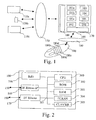
- Fig. 1 represents the architecture of the remote monitoring system according to the present invention.
- a user control the movement as well as different operations performed by a robot 180 via a control device 110 connected via from a telecommunication network 150 to a remote monitoring server 100 placed at proximity of the robot 180, for example in the environment that must monitor the robot 180.
- the robot 180 is a robot able to move in an environment such as the home of the user of the remote monitoring system of the present invention.
- the robot 180 is for example a robot marketed by the company Wany Robotics ⁇ under the name of Pekee ⁇ robot.
- the robot 180 includes a module of 180a command able to control the different elements of the robot 180.
- the module 180a control inter alia the moving means of the robot 180 in function of commands received from the remote monitoring server 100 or in function received from a distance measuring module 180b between the robot 180 and possible obstacles that could hinder the robot's journey.
- command 180a receives from the remote monitoring server 100, via a 180c network interface and a wireless telecommunications network 190, different control signals.
- the control module 180a controls the movement of the robot 180 and / or the activation of the various sensors equipping the robot 180 according to of these control signals.
- the different sensors are for example a device capturing audiovisual information such as a 180d camera, a sensor temperature, or even an infrared sensor.
- the control module 180a transfers to the remote monitoring server 100, by via the network interface 180c and the wireless telecommunications network 190, images and / or sequences of images and / or measurements made by the temperature sensor or infrared sensor.
- the wireless telecommunications network 190 is for example a network of WiFi type telecommunication.
- the "WiFi” ⁇ for "Wireless Fidelity" is the trade name of the 802.11 standard.
- the wireless telecommunications network 190 is alternatively a network type "Bluetooth” ⁇ or a network type "zigBee” ⁇ .
- the remote monitoring server 100 is, according to the first embodiment of the present invention, a computer placed in the dwelling of the user of the system remote monitoring.
- the remote monitoring server 100 is able to exchange information with a controller 110a or 110b or 110c by via the telecommunication network 150.
- the remote monitoring server 100 is also able to exchange information with the robot 180 via of the telecommunication network 190.
- the remote monitoring server 100 comprises a wireless telecommunications network interface 170 enabling the exchange information through the telecommunication network 190 and a telecommunication network interface 160 allowing the exchange of information by via the telecommunication network 150.
- the remote monitoring server 100 includes presentation modules 101. These presentation modules 101 are modules that define the human machine interface that will be reproduced by the control device 110 used by the user of the remote monitoring system according to the invention.
- Presentation module 101a is a presentation module dedicated to control device 110a.
- the control device 110a is for example the computer of the user of the remote monitoring system according to the invention located on his place of work or in another residence of the user.
- the presentation module 101b is a presentation module dedicated to control device 110b.
- the control device 110b is for example the mobile phone of the user of the remote monitoring system according to the invention.
- the mobile phone 110b is for example a mobile phone type SPV E200 marketed by Orange ⁇ .
- the presentation module 101c is a presentation module dedicated to control device 110c.
- the control device 110c is for example a personal assistant of the user of the remote monitoring system according to the invention.
- the remote monitoring server 100 includes a reference module This module allows to associate, when the user uses the keyboard of a control device 110 to effect a command of the robot 180, a predetermined information.
- the reference module of labels 103 uses for this the information included in the table of FIG. 6.
- the labels are directly associated with the commands at the controller 110 and are transferred to the server of remote monitoring 100 via the telecommunication network 150.
- the remote monitoring server 100 comprises an interpretation module 104.
- This module makes it possible to associate with each of the labels processed by the module of label reference 103 or received from the controller 110 by via the telecommunication network 150, at least one parameter of predetermined order.
- the interpretation module 104 uses for this purpose the information included in the table of FIG. 7.
- the remote monitoring server 100 includes an interpretation module of macro-commands 102.
- This module allows to associate with a predefined label a set of predetermined commands.
- the interpretation module 104 receives a macro-command tag, this one queries the module interpretation of macro-commands 102 to obtain the labels corresponding to the macro-command tag to process.
- a macro-command is independent of the type of control device used.
- a label macro-command is for example a representative label of a command moving the robot 180 to a predetermined point and performing measurements.
- This macro-command label is for example associated with a key of a control device such as the "*" key of a telephone mobile or computer keyboard.
- the remote monitoring server 100 comprises a robot control module 105.
- This module makes it possible to associate for each determined control parameter by interpretation module 104 one or more commands interpretable by the robot 180.
- the robot control module 105 is adapted to the type of robot 180 used in the present invention.
- the robot control module 105 uses for this purpose the information included in the table of FIG. 8.
- the remote monitoring server 100 also includes a database 106.
- This database 106 includes reference routes by the user of the remote monitoring system that are run periodically by the robot 180 as well reference images and reference measurement records.
- the base of data 106 also includes the different images or sequences of images taken by the camera 180d of the robot 180 as well as the various measurements taken by the sensors equipping the robot 180 during the execution of previous reference courses.
- the remote monitoring server 100 will be described in more detail with reference to the Fig. 2.
- the telecommunication network 150 is for example a network of ADSL type telecommunication.
- ADSL is the acronym for "Asymetric Digital Subscriber Line ".
- the controller 110a includes a modem for transferring commands to the robot 180 through the telecommunication network 150 and of the remote monitoring server 100.
- the control device 110a also includes a screen to display a presentation page generated by the module of presentation 101a of the remote monitoring server 100.
- the control device 110a also includes a keyboard and / or a mouse that the user manipulates for order the robot 180 via the telecommunication network 150 and the remote monitoring server 100.
- the control device 110a may alternatively be connected to the telecommunication network 150 by via a Wi-Fi type network or a cellular telephone network of the type GPRS.
- the controller 110a transfers commands to the robot 180 through through the cellular telephone network to which it is connected, the network of telecommunication 150 and the remote monitoring server 100.
- the control device 110b also includes a screen for displaying between others a presentation page generated by the presentation module 101b of the the remote control server 100.
- the control device 110b also includes a keyboard and / or means of navigation on a screen that the user manipulates for order the robot 180 via the cellular telephone network to which it is connected to the telecommunication network 150 and the remote monitoring server 100.
- the control device 110c transfers commands to the robot 180 through via a wireless local area network to which it is connected, the network of telecommunications 150 and the remote monitoring server 100.
- the device for command 110c also includes a screen for displaying among other things a page of presentation generated by the presentation module 101c of the server of remote control 100.
- the control device 110c includes means for navigation on a screen that the user manipulates to control the robot 180 by via the wireless local area network, the telecommunication network 150 and the remote monitoring server 100.
- the remote monitoring server 100 is placed on a remote site environments to monitor.
- users control with the respective control devices 110 the displacement and that different operations performed by their respective robot 180 via of a telecommunication network 150, an associated monitoring server 100 to the telecommunication network 150, and a telecommunication gateway respective ones providing the interface between the telecommunication network 150 and a network wireless communication system 190 of each user.
- the remote monitoring server 100 manages remote surveillance of a plurality of dwellings and controls the robots placed in each home. The exchange information between the server for maintaining secure home people 100 and the robots is carried out via the telecommunication network 150 to which is connected a gateway placed in each dwelling to watch.
- Each gateway ensures the transfer of information between the telecommunication network 150 and a wireless network such as a Wifi ⁇ or ZigBee ⁇ network connecting the gateway to the robot present in the dwelling.
- the gateway is for example a gateway between a network of ADSL telecommunication 150 and a telecommunication network of Wifi type.
- a gateway is placed at home of each user of the remote monitoring system.
- Fig. 2 represents a block diagram of the remote monitoring server according to the present invention.
- the remote monitoring server 100 is for example a computer placed in the home of the user of the remote monitoring system according to the present invention.
- the remote monitoring server 100 comprises a communication bus 301 to which are connected a central unit 300, a non-volatile memory 302, a random access memory 303, a database 106, two network interfaces 160 and 170 and a screen 304 and a keyboard 305.
- the non-volatile memory 302 stores the programs implementing the invention which will be described later with reference to FIGS. 4, 5a and 5b.
- the non-volatile memory 302 also stores the presentation modules 101a, 101b and 101c, the label reference module 103, the module macro-command interpreter 102, the interpretation module 104 and the robot control module 205.
- the non-volatile memory 302 also stores the tables such as those shown in Figs. 6, 7 and 8 and including information used respectively by the label reference module 103, the module 104 and the robot control module 105.
- the non-volatile memory 302 is for example a hard disk.
- the programs according to the present invention are stored in a storage means.
- This storage means is readable by a computer or a microprocessor 300.
- This storage means is integrated or not monitoring server 100, and can be removable.
- the programs which will be described later with reference to Figs. 4, 5a and 5b the different modules according to the invention as well as the different arrays are transferred into RAM 303 which then contains the code executable of the invention as well as the data necessary for the implementation of the invention.
- the remote monitoring server 100 also includes a screen 304 and a keyboard 305 serving as a human machine interface with the user of the remote monitoring according to the present invention. Via this interface machine, the user defines a path that the robot will have to perform in housing at predetermined times. Through this same human machine interface, the user defines along the course, points, called hot spots, to which robot 180 will have to execute a number of capture of information. The course and the hotspots will be explained in more detail with reference to FIG. 3.
- the remote monitoring server 100 also comprises a network interface of 160.
- This interface is for example constituted of a modem of ADSL type able to communicate with a control device 110 by via the telecommunication network 150.
- the remote monitoring server 100 also comprises a network interface of wireless telecommunication 170.
- This interface is for example a radio interface Wireless compliant with 802.11.
- the database 106 stores the different images or sequences of images taken by the camera 180d of the robot 180 with each passage of the robot by a hot spot and the values recorded by the different sensors of the robot 180.
- Fig. 3 represents an example of a predefined path carried out by a robot of remote monitoring according to the present invention.
- the path is for example defined graphically by the user of the system according to the present invention using a computer or defined from a succession of user-generated commands via a control device 110. This succession of commands is then stored by the monitoring server 100 as the user-defined path.
- the path is defined by a succession of coordinates.
- Fig. 3 graphically represents the visualization of the defined path and the position of the robot 180 in this way. This representation is for example transferred to control device 110 when an event has been detected by the system of remote monitoring according to the present invention.
- a user-defined path in an environment 500 must, according to the present invention, leave and stop at a point predetermined. This predetermined point denoted 510 is for example the point at which the robot 180 reloads its energy accumulators or the point at which the robot 180 is considered to be at rest.
- the reference route consists of a succession of trips according to different directions.
- Lines 531 to 536 of FIG. 3 represent these trips.
- Lines 531 and 532 represent the path already made by the robot 180, the lines 533 to 536 represent the remaining path to be performed by the robot 180.
- Points 521 to 524 are user-defined hot spots in the system remote monitoring. At each of these hot spots, the robot 180 transfers audiovisual information to the remote monitoring server 100. At these same points hot, the robot 180 also transfers the values measured by the various sensors to the monitoring server 100.
- a hotspot is defined by storing in the robot the coordinates corresponding to this hot spot. At a hot spot, are associated a label and a value. The value of the label includes coordinates of the hot spot allowing the robot to move towards it.
- Fig. 4 represents an algorithm performed by the remote monitoring server of detection and notification of events according to the present invention.
- Step E600 is a waiting loop for the activation of the present algorithm.
- the reference run as defined by the user of the system of remote monitoring is executed by the robot 180 periodically or at defined times by the user.
- the processor 300 proceeds to step E601.
- step E601 the processor 300 reads the representative information of the user-defined reference path stored in the database 106.
- the information representative of the course is a series of instructions such those which will be described later with reference to FIG. 8.
- the processor 300 proceeds to the next step E602 and proceeds to the transfer of this information to robot 180.
- This information is transferred via the wireless telecommunications network interface 170, telecommunications network 190.
- the robot 180 then executes this suite instructions.
- the control module 180a of the robot 180 stores this set of instructions and executes them upon receipt of an order predetermined of the remote monitoring server 100.
- the next step E603 consists of a waiting loop of the reception of data from the robot 180 via the telecommunication network 190.
- data are for example a shooting carried out by the camera 180d of the robot 180 or a temperature measurement made by the temperature sensor of the robot 180.
- the shooting as well as the measurement of the temperature are transferred by via the telecommunication network 190 to the remote monitoring server 100 when the robot 180 passes through a point such as for example hot spot 521 of FIG. 3.
- the processor 300 Upon receipt of this data, the processor 300 stores in step E604 the data received in the database 106.
- the processor 300 consults the database 106 and reads data that has been stored for the same hot point in previous 180.
- the processor 300 reads the data that has memorized for the hot spot 521 during the previous passage of the robot 180 to this point.
- the processor 300 checks in step E606 whether the data received at step 603 are comparable with the data read in step E605.
- this data is for example a shooting
- the processor 300 executes a image processing algorithm for determining whether the image received at step E603 is significantly different from the image read in step E605.
- the robot 180 running periodically the same route, images are taken periodically at the same place, according to the same angle of view and are therefore, under normal, similar.
- the processor 300 proceeds to the next step E607. At this stage, the processor 300 checks whether there are still other hot spots in the predefined path periodically executed by robot 180.
- the processor 300 stops the present algorithm and returns to step E600 waiting for a new activation of the present algorithm.
- processor 300 returns to step E603 previously described and reiterates the loop consisting of steps E603 to E607 as long as the robot 180 does not will not go through all the hot spots defined in the course.
- Step E608 is a step of classifying the comparison made in step E606.
- the comparison made in step E606 reveals differences significant, but that processor 300 can not perform an interpretation of differences, the processor 300 classifies it as an uninterpreted alarm.
- the comparison made at step E606 reveals differences significant that the processor 300 associates with a human silhouette; the processor 300 classifies it as an intrusion.
- a motion detection is classified by the 300 processor as an intrusion.
- a variation important of the temperature is classified by the 300 processor as a technical anomaly.
- step E609 consists in transferring an alert message to the control device 110 of the user of the remote monitoring system.
- This alert message is transmitted under the form of an e-mail message such as an e-mail via telecommunication network 150 and includes information representative of the classification previously made in step E608.
- the message is transmitted to the user of the remote monitoring via a cellular network in the form of a message short message service, short message service acronym.
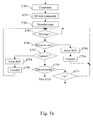
- Figs. 5a and 5b show the command processing algorithm by the remote monitoring server 100, the commands being generated by a Remote controller 110 for robot control.
- step E700 the processor 300 of the remote monitoring server 100 receives a connection message of a controller 110 via the telecommunication network 150 and telecommunication network interface 160.
- the processor 300 determines the type of device 110 from the command at the origin of the connection message.
- the control device 110 can be a 110a computer, a 110b mobile phone or a personal assistant 110c.
- the processor 300 controls step E702 the transfer of a page serving as a man-machine interface with the user of the remote monitoring system.
- the man-machine interface transferred is adapted to the type of control device 110.
- the processing device 110 determined is a computer 110a
- the processor 300 controls, the module of presentation dedicated to the computer 101a, the transfer of a page to the computer 110a.
- the processor 300 controls, the presentation module dedicated to 101b mobile phone, the transfer of a page to the mobile phone 110b.
- the determined processing device 110 is a personal assistant 110c
- the 300 command processor to the presentation module dedicated to the personal assistant 101c, the transfer of a page to the personal assistant 110c.
- each of the presentation modules 101 transfers pages adapted to the characteristics of the controller 110. These features are the characteristics of the screen of the controller 110 or the characteristics of the keyboard or other means of entry or activation have the control devices 110. For example, for a computer 110a, the page informs the user of the possibility of ordering the robot via predetermined keys on the 110a computer keyboard
- the processor 300 proceeds to the next step E703.
- the processor 300 of the remote monitoring server 100 waits for reception, via the telecommunication network 150 and the network interface of telecommunication 160, a message from the controller 110 to which a page has been transferred.
- the processor 300 proceeds to the next step E704.
- the processor 300 determines whether the message is representative of a command for obtaining a shot. Via the page previously transferred, the user of the remote monitoring system may indeed send several orders.
- step E705 accesses the base of data 106 to obtain the different images or sequences of stored images when the robot 180 executes a reference run.
- the processor 300 transfers to step E706 the different images or image sequences previously obtained in step E705.
- the processor 300 only transfers images or sequences of images relating to a hot spot.
- the processor then returns to step E703 previously described.
- step E703 If the message received in step E703 does not include a command to take view, the processor 300 goes from step E704 to step E707. At this stage, the processor 300 determines whether the message is representative of a command for obtaining sensor values. If so, processor 300 proceeds to step E708 and access the database 106 to obtain the different values sensors that the robot 180 transferred during its passage to hot spots when performing a reference run.
- step E709 the different values previously obtained in step E708.
- the processor 300 only transfers the values of the sensors relating to a hotspot. The processor then returns to step E703 previously described.
- step E703 If the message received in step E703 does not include a command of values of sensors, the processor 300 goes from step E707 to step E710. At this stage, the processor 300 determines whether the message is representative of a request for remote control of the robot 180. Indeed, the user of the remote monitoring system according to the present invention can both receive stored information previously by the remote monitoring server 100 when executing a journey defined by the robot 180 and control the movement of the robot 180 through the environment 500.
- the processor 300 determines whether the message is representative end of communication with the controller 110. If the message is representative of a communication end, the processor 300 stops the present algorithm. If the message is not representative of an end of communication, the processor 300 then returns to step E703 previously described.
- the processor 300 controls the step E720 the transfer of a page serving as a human machine interface with the user of the remote monitoring system for controlling the robot 180.
- the man interface transferred machine is adapted to the type of control device 110.
- the processor 300 controls at step E721 the transfer of a card representing the path defined in the environment as well as the position of the robot 180 in this environment.
- This card is for example in accordance with FIG. 3 and is reproduced by the screen of the control device 110.
- step E722 is a waiting loop of receipt of a command or remote robot 180 by the user of the controller 110.
- This command is issued from the computer 110a or the mobile phone 110b or the personal assistant 110c.
- This command is a command generated from a command page representing eight axes of movement of the robot. These axes are North, South, East, West, North-West, North-East, South-East and South-West.
- the robot 180 interprets a control according to the North axis as a control movement of the robot according to the axis in which it is located.
- the robot 180 also interprets an order according to the South axis as a backward motion control.
- the robot 180 also interprets an order along the West axis as a command of move to the left.
- the robot 180 also interprets a command along the axis Is like a move command to the right.
- This command can also be a command generated by a support on navigation keys in pull-down menus of a mobile phone 110b.
- This command can also be a command generated by a support on direction keys on a computer keyboard 110a.
- This command can also be a command to move to one of hot spots defined in the course. This command is carried out for example in selecting one of the hot spots reproduced in the graphical representation of defined path.
- processor 300 Upon receipt of this command, processor 300 proceeds to step E723. AT this step, the processor 300 determines if the command is a command under the form of a label and associated value or if the order is representative pressing a predetermined key on the keyboard of the controller 110. If the command is a command in the form of a label and a value associated, the processor goes to step E725.
- the processor 300 proceeds to step E724 and transfers to the tag reference module 103 the command received and processed by the representation module 101 corresponding to the control device 110 used by the user of the remote monitoring system.
- the reference module of labels 103 associates with a command made the user on the control device 110, a predetermined information. For example, when the user of the device command 110a pressed a direction key on the device keypad 110a, for example the arrow " ⁇ ", the command received is interpreted by the module reference label 103 as a command whose associated label is direction and the value of this tag is "North". For this, the module of label reference 103 uses the table which will be described later in reference to FIG. 6. This operation performed, processor 300 goes to step following E725.
- step E725 the processor 300 transfers the name of the label and its value previously determined by the tag reference module 103 to the module of interpretation 104.
- the interpretation module 104 determines the script parameter corresponding to the label and its value.
- the corresponding script parameter is no longer precisely the program equivalent to the label and its value written in the language PHP, or "Hypertext PreProcessor".
- the interpretation module 104 uses the table which will be described later with reference to FIG. 7.
- control device 110 transfers the script parameter corresponding to the label.
- the processor 300 does not perform step E725 and proceeds directly to step E726.
- interpretation module 104 interrogates the interpretation module of macro-commands 102 so that it delivers in return a sequence of labels and values corresponding to this macro-command label.
- the processor 300 transfers the script parameter to the module robot control 105.
- the robot control module 105 ensures the transfer of command commands to robot 180. From the script parameter in PHP language, the robot control module 105 determines the corresponding commands in the language interpreted by the robot 180.
- the processor 300 then transfers to step E727 the determined commands to the robot 180 via the telecommunication network 190.
- control device 110 transfers the commands interpretable by the robot 180.
- the processor 300 does not perform step E726 and proceeds directly to step E727.
- the three-step treatment E724, E725 and E726 performed according to the invention allows the remote monitoring system to be rendered easily compatible with different types of control devices 110, 180 robots or other equipment.
- the processor 300 receives in step E728 an image or a sequence of images of the robot 180 and / or measurement readings of the sensors by via the telecommunication network 190.
- the processor 300 formats the image or the sequence images received in a format suitable for transmission over the network of telecommunication 150 and to the control device 110.
- the processor 300 determines in step E730 the position of the robot 180.
- the position is determined from the position of the predetermined point noted 510 in FIG. 3 and different commands previously transmitted to the robot 180.
- processor 300 transfers to step E731 the image or the sequence of images formatted at the controller 110 and / or readings measurements of the sensors.
- the processor 300 also transfers to step E732 the position of the robot 180 at control device 110.
- the image, the sequence of images are reproduced by the processing device 110 thus enabling the user of the remote monitoring system to be informed of different events that occurred in the environment to be monitored.
- the robot position in the map representing the path defined in the environment and reproduced by the control device 110 is modified thus allowing the user to know where the robot is precisely.
- step E733 the processor 300 checks whether other commands are generated by the user of the remote monitoring system. If so, the 300 processor returns to the previously described step E722 and repeats the loop consisting of steps E722 to E733 as long as the user generates new commands. In the negative, the processor 300 stops the present algorithm.
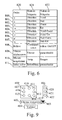
- Fig. 6 represents a table including information used by the tag reference module according to the present invention.
- the table of FIG. 6 consists of three columns denoted 820 to 822.
- Column 820 includes examples of commands or orders generated by the user of a control device 110.
- Column 821 includes the name of the label associated with each of the orders included in column 820 and column 822 includes the value of the label associated with each of the commands included in column 820.
- the table of FIG. 6 consists of twelve lines. Each line corresponds a command made by the user of a control device.
- a move command of the robot to a hot spot by a predetermined press on a keyboard key can also be associated with a label and a displacement value at the coordinate of the hotspot.
- the hot spot coordinate is set to from the reference of point 510 of FIG. 3.
- Line 800 associates with the command " ⁇ ", a label Direction having the North value.
- Line 801 associates with the command " ⁇ ", a label Direction having the South value.
- Line 802 associates with the " ⁇ ” command, a Direction label having the value West.
- Line 803 associates with the " ⁇ ” command, a label Direction having the value East.
- Line 804 associates with the command " ⁇ ", a Direction label with Northwestern value.
- Line 805 associates with the command " ⁇ ", a Direction label with the value North-East.
- Line 806 associates with the command " ⁇ ", a Direction label with the value Southwest.
- Line 807 associates with the " ⁇ ” command, a Direction label with the value South-East.
- the line 808 associates with the Reflex command, a Robot Command label with the ON or OFF value, that is active or inactive.
- the Reflex command is a command allowing the robot 180 to enter a detection procedure automatic removal of obstacles and changes in its movements according to detected obstacles. During the automatic obstacle detection procedure, the robot 180 transmits to the remote monitoring server 100 any modification of displacement according to the detected obstacles that it carries out.
- Line 809 associates with the speed control, a Speed label with a defined value by the user. This parameterizable value makes it possible to modify the speed of moving the robot 180.
- the line 810 associates with the command measurement temperature, a Temp label having as value the Tempin variable whose value is the temperature measured by the robot.
- Line 811 associates with the robot index command to select a robot from a set of robots, a label Robotnum having as value an index previously assigned to the robot that the user of the remote monitoring system wishes to order.
- Fig. 7 represents a table including information used by the label interpretation module according to the present invention.
- the table of FIG. 7 consists of three columns denoted 920 to 922.
- Column 920 includes the name of the label associated with each of the controls included in column 820 of FIG. 6 previously described or received from the controller 110.
- Column 921 includes the value of the label associated with each of the commands included in column 820 of the Fig. 6 or received from the controller 110.
- the table of FIG. 7 consists of twelve lines. Each line corresponds a label and its value as well as the script parameter described according to our example in the PHP language. Of course, a larger number of labels and values such as hot-spot displacement tags or more reduced labels and values can be considered according to the present invention.
- Fig. 8 represents a table including information used by the robot control module according to the present invention.
- the table of FIG. 8 consists of two columns denoted 1020 and 1021.
- Column 1020 includes the script parameter described in our example in the PHP language to each of the labels as well as their value included in the columns 920 and 921 of FIG. 7 previously described.
- Column 1021 includes the commands equivalent to the script parameter in column 1020 in the language of control adapted to the robot 180.
- the table of FIG. 8 consists of twelve lines. Each line corresponds a script parameter described in PHP and the equivalent commands described in the control language adapted to robot 180. Of course, a number most important script parameters such as scripting parameters to move to a hot spot or a smaller number of script parameters can be considered according to the present invention.
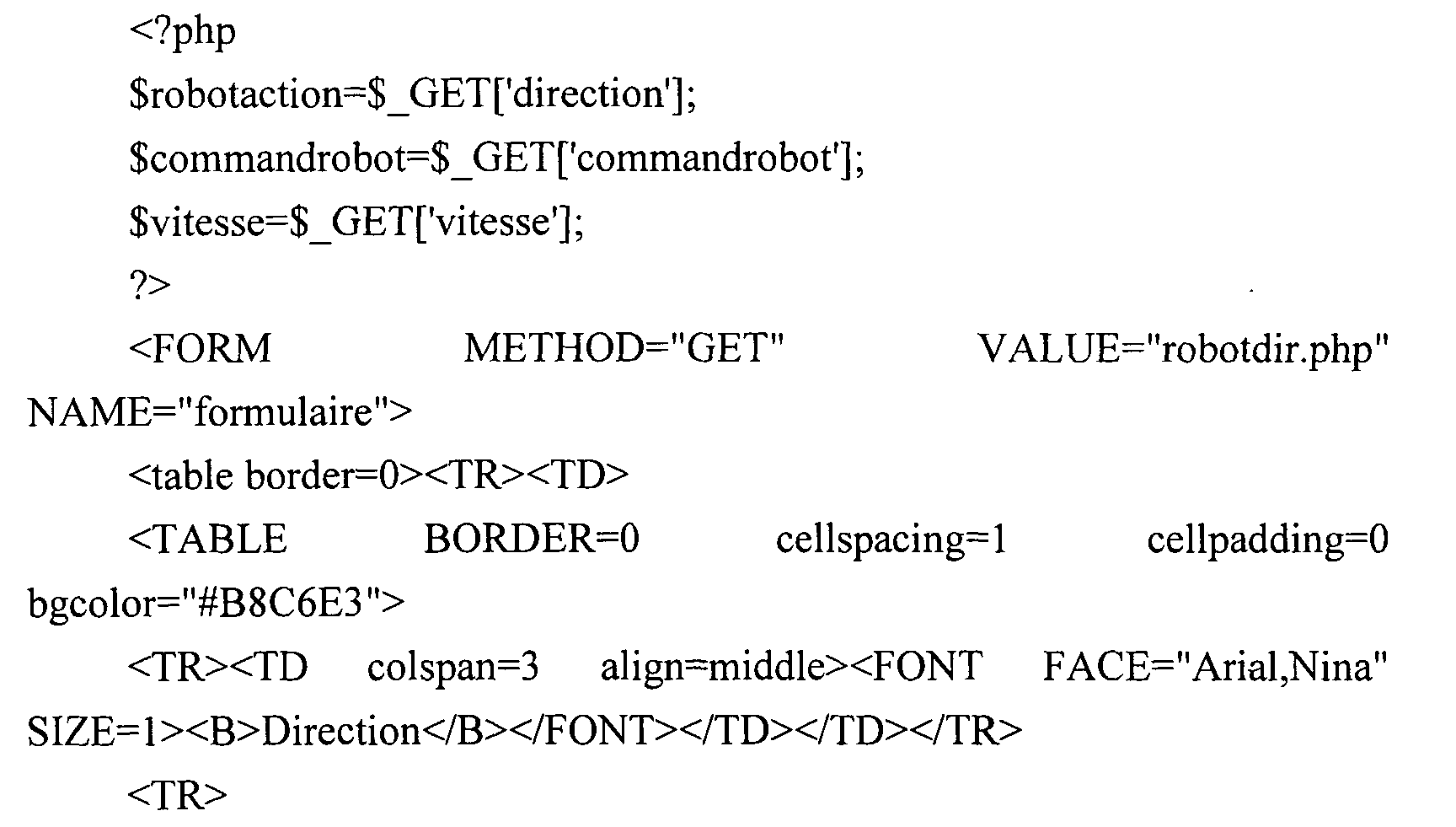
- This page includes information allowing the display on the screen of the mobile phone 110b of a human interface machine as shown in FIG. 9.
- This page allows the robot 180 to be controlled by the system user. telemonitoring via telecommunication networks 150 and 190 and of the remote monitoring server 100. This page is transmitted by the server of remote monitoring 100 in the form of a PHP file.
- the PHP file includes a declaration of the HTML document including PHP commands as well as labels indicating that this page should not be stored in the browser cache of the controller 110b and the title of the HTML page.
- This part of the file is of the form:
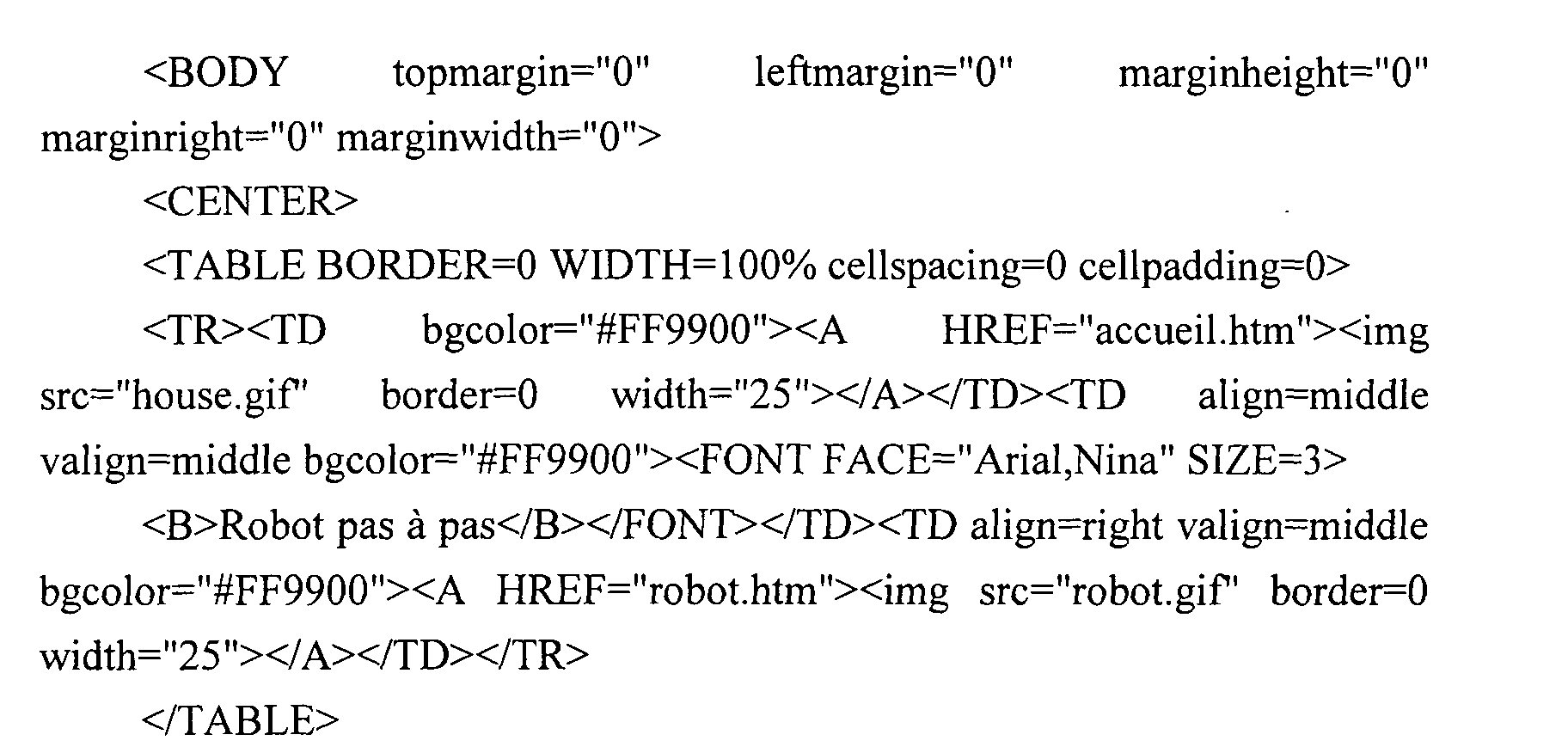
- the PHP file also includes page margin definitions and a table to represent the various action buttons that allow the robot to be ordered and associated tags to be sent. This part of the file is of the form:
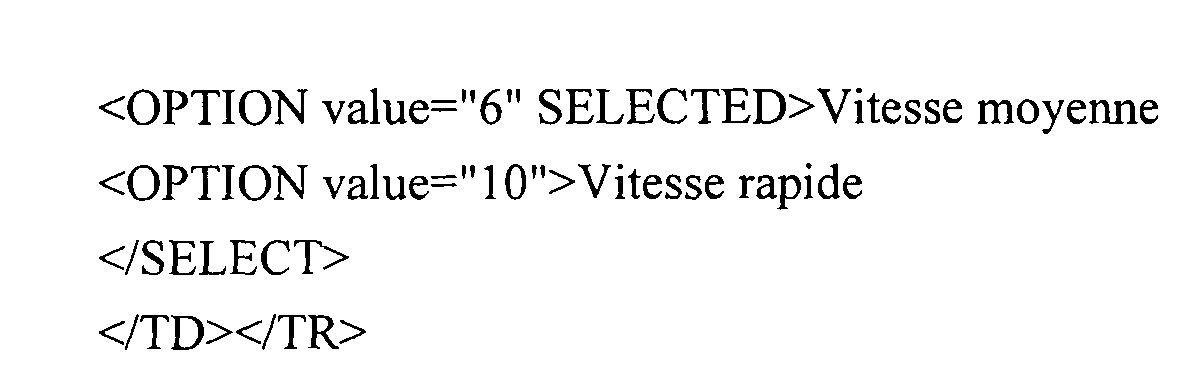
- the PHP file also includes the information enabling the PHP script to retrieve the values corresponding to the directions 400, robot control 401 and speed 402 and 403 labels represented in FIG. 9.
- the PHP file also includes information for the transfer of labels to the PHP module for processing labels. This part of the file is of the form:
- the PHP file also includes the information to define the different values of the direction label according to the zone activated by the user. These values are eight in number.
- the area 410 shown in FIG. 9 corresponds to a North value
- the zone 411 shown in FIG. 9 corresponds to a North-East value
- the zone 412 shown in FIG. 9 corresponds to the value East
- the zone 413 shown in FIG. 9 corresponds to the South-East value
- the zone 414 shown in FIG. 9 corresponds to the value South
- the zone 415 shown in FIG. 9 corresponds to the Southwest value
- the zone 416 shown in FIG. 9 corresponds to the West value
- This part of the file is of the form:
- the PHP file also includes the table for transmitting the different values of the robot control label according to the area 401 of FIG. 9 activated by the user. These values are for example three in number.
- the area 420 of FIG. 9 corresponds to a reset of the system
- the zone 421 of FIG. 9 corresponds to an activation of the distance measuring module 180b between the robot 180 and any obstacles that may hinder the travel of the robot 180
- the zone 422 of FIG. 9 corresponds to a deactivation of the distance measurement module 180b between the robot 180 and possible obstacles that may hinder the path of the robot 180.
- This part of the file is of the form:
- the PHP file also includes a drop-down menu 402, 403 of FIG. 9 to select a robot speed value for the speed label.
- This part of the file is of the form:
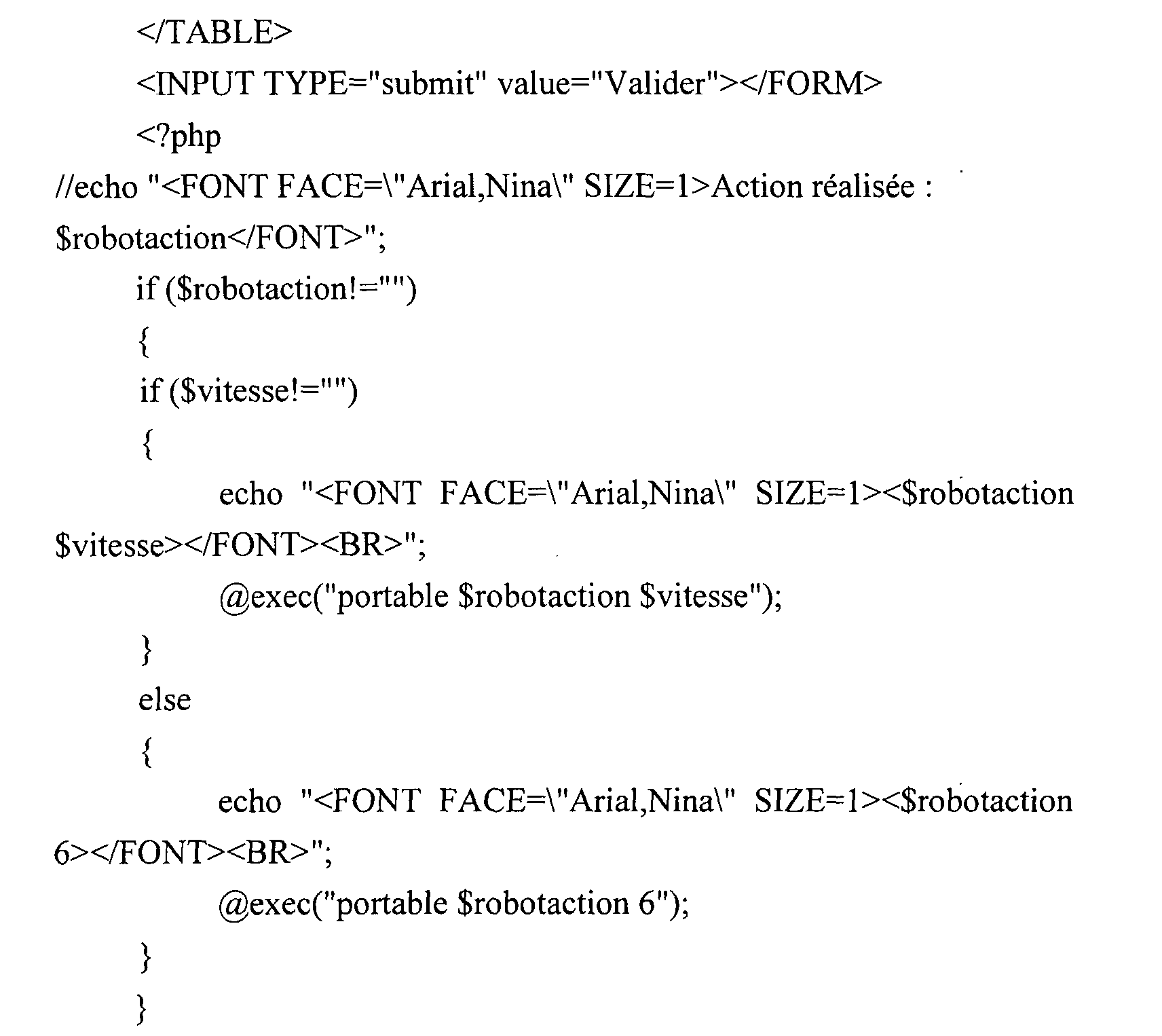
- the PHP file also includes data noted 404 in FIG. 9 to validate the transfer of one or more commands to the remote monitoring server as well as a module for interpreting the tags.
- This part of the file is of the form:
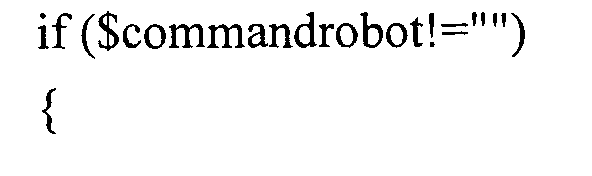
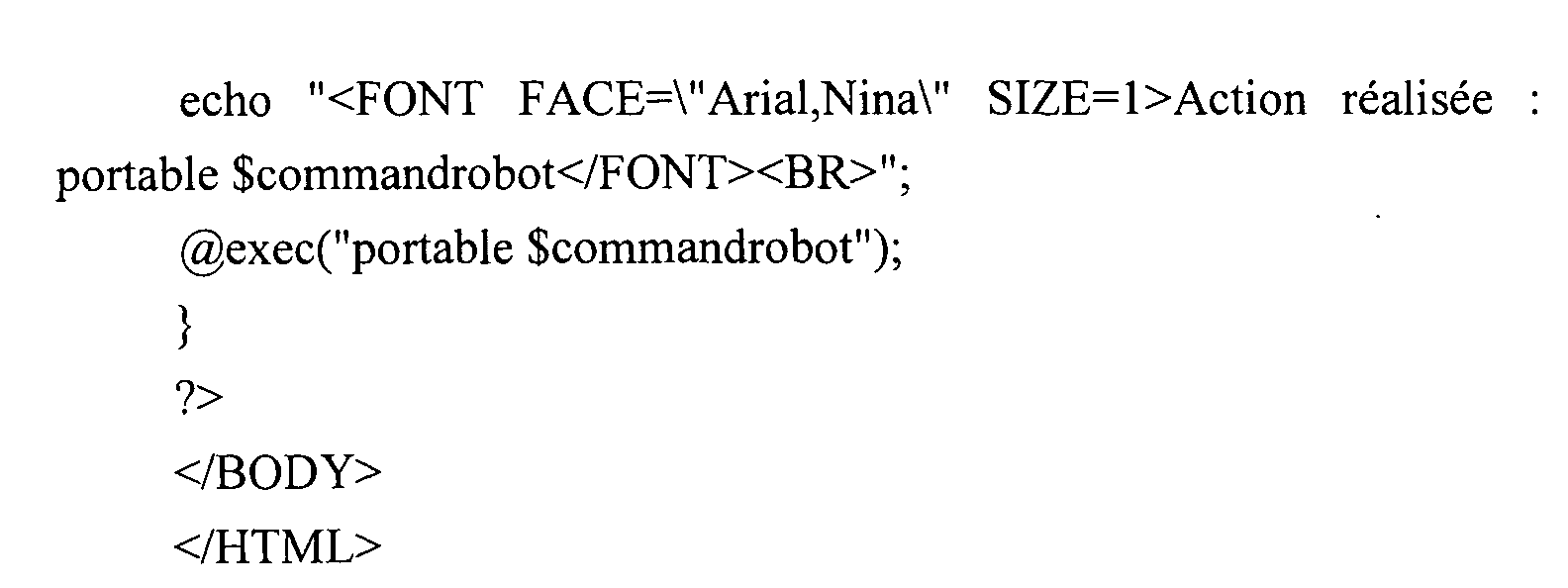
- the PHP file also includes a robot control module for sending the commands and parameters of commands that can be interpreted by the robot 180.
- This part of the file is of the form:
Landscapes
- Engineering & Computer Science (AREA)
- Robotics (AREA)
- Mechanical Engineering (AREA)
- Manipulator (AREA)
- Numerical Control (AREA)
Abstract
Description



Claims (15)
- Procédé de traitement d'une commande de robot (180) effectuée par l'intermédiaire d'un dispositif de commande (110a, 110b, 110c) distant faisant partie d'un groupe de dispositifs de commande distants, le dispositif de commande distant étant relié par un réseau de télécommunication (150) à un serveur (100), caractérisé en ce que le procédé comporte les étapes de :association (E725) à une étiquette et à une valeur d'étiquette d'une commande et/ou d'un paramètre de commande, l'étiquette et la valeur d'étiquette faisant partie d'un groupe prédéterminé d'étiquettes et de valeurs d'étiquettes connu des dispositifs de commande distants appartenant au groupe de dispositifs de commande distants,traduction (E726) de la commande et/ou du paramètre de commande en au moins une commande exécutable dans un langage interprétable par le robot,transfert (E727) de la ou de chaque commande exécutable audit robot.
- Procédé selon la revendication 1, caractérisé en ce que le robot effectue un parcours de référence dans un environnement prédéterminé à des moments prédéterminés, le parcours de référence comprend des points prédéfinis (521, 522, 523, 524) et le serveur de télésurveillance (100) mémorise des informations obtenues par le robot aux points prédéterminés.
- Procédé selon la revendication 2, caractérisé en ce que le procédé comporte en outre les étapes de :comparaison (E606) des informations mémorisées avec des informations d'un parcours de référence,génération d'au moins un message (E609) à destination du dispositif de commande si les informations mémorisées sont différentes des informations du parcours de référence.
- Procédé selon l'une quelconque des revendications 1 à 3, caractérisé en ce que le procédé comporte en outre une étape de transfert de données représentatives d'une interface utilisateur (E720) au dispositif de commande distant pour commander le robot.
- Procédé selon la revendication 4, caractérisé en ce que l'interface utilisateur est adaptée au type de dispositif de commande.
- Procédé selon la revendication 4 ou 5, caractérisé en ce que le robot évolue dans un environnement prédéterminé et en ce que le procédé comporte les étapes de :détermination (E730) de la position du robot dans l'environnement prédéterminé,transfert d'une représentation graphique (E721) de l'environnement prédéterminé au dispositif de commande,transfert de la position déterminée (E732) au dispositif de commande.
- Procédé selon l'une quelconque des revendications 4 à 6, caractérisé en ce que le procédé comporte en outre une étape de transfert d'informations (E731) obtenues par le robot sur l'environnement dans lequel il évolue.
- Procédé selon la revendication 7, caractérisé en ce que les informations obtenues sont au moins une image ou des relevés de mesures de capteurs.
- Procédé selon l'une quelconque des revendications 1 à 8, caractérisé en ce que le groupe prédéterminé d'étiquettes et de valeurs d'étiquettes comprend des étiquettes pour diriger le robot, des étiquettes de mise du robot dans un mode de fonctionnement prédéterminé, des étiquettes de définition de la vitesse du robot, des étiquettes de sélection d'un robot parmi un ensemble de robot et des étiquettes d'actionnement d'au moins un capteur du robot.
- Procédé selon l'une quelconque des revendications 1 à 9, caractérisé en ce que le dispositif de commande est un ordinateur ou un téléphone mobile ou un assistant personnel et en ce que le serveur de télésurveillance comporte des modules d'interface respectivement adaptés aux dispositifs de commande.
- Procédé selon l'une quelconque des revendications 1 à 10, caractérisé en ce que les informations transférées entre le serveur de télésurveillance et le robot sont transférées par l'intermédiaire d'un autre réseau de télécommunication sans fil.
- Procédé selon l'une quelconque des revendications 1 à 10, caractérisé en ce que les informations transférées entre le serveur de télésurveillance et le robot sont transférées par l'intermédiaire du réseau de télécommunication, d'une passerelle entre le réseau de télécommunication et un autre réseau de télécommunication.
- Serveur de télésurveillance pour le traitement d'une commande de robot effectuée par l'intermédiaire d'un dispositif de commande distant faisant partie d'un groupe de dispositifs de commande distants, le dispositif de commande étant relié par un réseau de télécommunication à un serveur, caractérisé en ce que le serveur comporte :des moyens d'association à une étiquette et à une valeur d'étiquette d'une commande et/ou d'un paramètre de commande, l'étiquette et la valeur d'étiquette faisant partie d'un groupe prédéterminé d'étiquettes et de valeurs d'étiquettes connu des dispositifs de commande distants appartenant au groupe de dispositifs de commande distants,des moyens de traduction de la commande et/ou du paramètre de commande en au moins une commande exécutable dans un langage interprétable par le robot,des moyens de transfert de la ou de chaque commande exécutable audit robot.
- Etiquette pour la commande d'un robot par l'intermédiaire d'un dispositif de commande relié par un réseau de télécommunication à un serveur, caractérisée en ce que l'étiquette est une étiquette pour diriger le robot ou une étiquette de mise du robot dans un mode de fonctionnement prédéterminé ou une étiquette de définition de la vitesse du robot ou une étiquette de sélection d'un robot parmi un ensemble de robot ou une étiquette d'actionnement d'au moins un capteur du robot et en ce qu'à l'étiquette est associée une valeur.
- Programme d'ordinateur stocké sur un support d'informations, ledit programme comportant des instructions permettant de mettre en oeuvre le procédé de traitement selon l'une quelconque des revendications 1 à 12, lorsqu'il est chargé et exécuté par un système informatique.
Applications Claiming Priority (2)
| Application Number | Priority Date | Filing Date | Title |
|---|---|---|---|
| FR0401796 | 2004-02-23 | ||
| FR0401796A FR2866723A1 (fr) | 2004-02-23 | 2004-02-23 | Procede et dispositif de traitement d'une commande de robot effectuee par l'intermediaire d'un dispositif de commande distant relie par un reseau de telecommunication a un serveur |
Publications (1)
| Publication Number | Publication Date |
|---|---|
| EP1566245A1 true EP1566245A1 (fr) | 2005-08-24 |
Family
ID=34708017
Family Applications (1)
| Application Number | Title | Priority Date | Filing Date |
|---|---|---|---|
| EP05290388A Withdrawn EP1566245A1 (fr) | 2004-02-23 | 2005-02-21 | Procédé et dispositif de traitement d'une commande de robot effectuée par l'intermédiaire d'un dispositif de commande distant relié par un réseau de télécommunication à un serveur |
Country Status (2)
| Country | Link |
|---|---|
| EP (1) | EP1566245A1 (fr) |
| FR (1) | FR2866723A1 (fr) |
Cited By (2)
| Publication number | Priority date | Publication date | Assignee | Title |
|---|---|---|---|---|
| DE102010039540C5 (de) * | 2010-08-19 | 2020-01-02 | Kuka Deutschland Gmbh | Handbediengerät zum manuellen Bewegen eines Roboterarms |
| CN112346366A (zh) * | 2020-11-03 | 2021-02-09 | 深圳Tcl新技术有限公司 | 终端设备的控制方法、装置、设备及计算机可读存储介质 |
Families Citing this family (1)
| Publication number | Priority date | Publication date | Assignee | Title |
|---|---|---|---|---|
| CN110275787B (zh) * | 2019-06-24 | 2021-10-22 | 博普乐科技(北京)有限公司 | 在线平台数据传输方法、装置、介质及电子设备 |
Citations (4)
| Publication number | Priority date | Publication date | Assignee | Title |
|---|---|---|---|---|
| US20020153855A1 (en) * | 2001-04-18 | 2002-10-24 | Jeong-Gon Song | Robot cleaning system using mobile communication network |
| US6584376B1 (en) * | 1999-08-31 | 2003-06-24 | Swisscom Ltd. | Mobile robot and method for controlling a mobile robot |
| EP1344613A1 (fr) * | 2000-11-17 | 2003-09-17 | Honda Giken Kogyo Kabushiki Kaisha | Dispositif de commande a distance de robot bipede |
| EP1383019A1 (fr) * | 2002-07-15 | 2004-01-21 | Kawasaki Jukogyo Kabushiki Kaisha | Méthode et dispositif pour télécommander un robot |
-
2004
- 2004-02-23 FR FR0401796A patent/FR2866723A1/fr not_active Withdrawn
-
2005
- 2005-02-21 EP EP05290388A patent/EP1566245A1/fr not_active Withdrawn
Patent Citations (4)
| Publication number | Priority date | Publication date | Assignee | Title |
|---|---|---|---|---|
| US6584376B1 (en) * | 1999-08-31 | 2003-06-24 | Swisscom Ltd. | Mobile robot and method for controlling a mobile robot |
| EP1344613A1 (fr) * | 2000-11-17 | 2003-09-17 | Honda Giken Kogyo Kabushiki Kaisha | Dispositif de commande a distance de robot bipede |
| US20020153855A1 (en) * | 2001-04-18 | 2002-10-24 | Jeong-Gon Song | Robot cleaning system using mobile communication network |
| EP1383019A1 (fr) * | 2002-07-15 | 2004-01-21 | Kawasaki Jukogyo Kabushiki Kaisha | Méthode et dispositif pour télécommander un robot |
Non-Patent Citations (3)
| Title |
|---|
| MONTEIRO F ET AL: "Teleoperating a mobile robot. A solution based on JAVA language", INDUSTRIAL ELECTRONICS, 1997. ISIE '97., PROCEEDINGS OF THE IEEE INTERNATIONAL SYMPOSIUM ON GUIMARAES, PORTUGAL 7-11 JULY 1997, NEW YORK, NY, USA,IEEE, US, 7 July 1997 (1997-07-07), GUIMARAES, PORTUGAL, pages SS263 - SS267, XP010265177, ISBN: 0-7803-3936-3 * |
| PRIVAT G: "A system-architecture viewpoint on smart networked devices", MICROELECTRONIC ENGINEERING, ELSEVIER PUBLISHERS BV., AMSTERDAM, NL, vol. 54, no. 1-2, 1 December 2000 (2000-12-01), pages 193 - 197, XP004360503, ISSN: 0167-9317, DOI: 10.1016/S0167-9317(00)80070-2 * |
| WEIGUO LIN ET AL: "Localization of service mobile robot using ID tag", SICE 2003 ANNUAL CONFERENCE FUKUI, JAPAN AUG. 4-6, 2003, PISCATAWAY, NJ, USA,IEEE, vol. 1, 4 August 2003 (2003-08-04), pages 1098 - 1103, XP010716320, ISBN: 978-0-7803-8352-4 * |
Cited By (2)
| Publication number | Priority date | Publication date | Assignee | Title |
|---|---|---|---|---|
| DE102010039540C5 (de) * | 2010-08-19 | 2020-01-02 | Kuka Deutschland Gmbh | Handbediengerät zum manuellen Bewegen eines Roboterarms |
| CN112346366A (zh) * | 2020-11-03 | 2021-02-09 | 深圳Tcl新技术有限公司 | 终端设备的控制方法、装置、设备及计算机可读存储介质 |
Also Published As
| Publication number | Publication date |
|---|---|
| FR2866723A1 (fr) | 2005-08-26 |
Similar Documents
| Publication | Publication Date | Title |
|---|---|---|
| JP7560228B2 (ja) | ニューラルネットワークを用いたビデオ監視 | |
| JP2013068615A (ja) | 赤外線サーモグラフィの制御システム及び制御方法 | |
| US10055803B2 (en) | Portable system for managing events | |
| US8768307B1 (en) | Methods and devices for remote processing of messages, and performing user tracking and monitoring with respect to data originating from a mobile communication device | |
| US20150058802A1 (en) | Graphical User Interface for Defining Relations Among Products and Services | |
| FR2993385A1 (fr) | Procede et systeme de reconstruction de trajectoire 3d en temps reel | |
| US10862988B2 (en) | On-demand real-time sensor data distribution system | |
| FR2930105A1 (fr) | Module d'inventaire pour un systeme de videosurveillance, procede pour realiser l'inventaire d'une zone surveillee et programme d'ordinateur. | |
| US11635755B2 (en) | Integrated agricultural production system and method | |
| KR20210099218A (ko) | 서버 및 이를 포함하는 로봇 시스템 | |
| WO2019133638A1 (fr) | Étiquetage vocal de vidéo pendant un enregistrement | |
| EP2238579B1 (fr) | Système de surveillance comportant un grand nombre de cameras | |
| CN101341753A (zh) | 用于广域安全监控、传感器管理及情况认知的方法和系统 | |
| EP4100832A1 (fr) | Système et procédé de création d'un diagramme de flux de processus qui incorpore la connaissance des mises en oeuvre techniques de noeuds de flux | |
| JP2023092989A (ja) | プログラム、情報処理方法、ドライブレコーダー、及び情報処理システム | |
| EP2818965B1 (fr) | Procédé d'interaction entre un objet numérique, représentatif d'au moins un objet réel ou virtuel localisé dans un périmètre géographique distant, et un dispositif de pointage local | |
| EP1566782A1 (fr) | Procédé et dispositif de maintien sécurisé d'au moins une personne évoluant dans un environnement prédéterminé | |
| KR102366773B1 (ko) | 모바일 단말기를 이용한 전자명함 교환 시스템 및 방법 | |
| FR2739207A1 (fr) | Systeme de video surveillance | |
| EP1975751A1 (fr) | Transfert de données pour analyse et évaluation | |
| EP2792129B1 (fr) | Procede d'association d'un terminal machine avec un terminal utilisateur | |
| EP2015549B1 (fr) | Procédé et dispositif portable d'alerte autonome en situation demobilité évolutifs | |
| FR2898719A1 (fr) | Procede de parametrisation d'une interface de commande adaptable,et systeme d'adaptation associe. | |
| JP6484464B2 (ja) | 通信システム | |
| JP7508311B2 (ja) | 情報処理装置、及び管理システム |
Legal Events
| Date | Code | Title | Description |
|---|---|---|---|
| PUAI | Public reference made under article 153(3) epc to a published international application that has entered the european phase |
Free format text: ORIGINAL CODE: 0009012 |
|
| AK | Designated contracting states |
Kind code of ref document: A1 Designated state(s): AT BE BG CH CY CZ DE DK EE ES FI FR GB GR HU IE IS IT LI LT LU MC NL PL PT RO SE SI SK TR |
|
| AX | Request for extension of the european patent |
Extension state: AL BA HR LV MK YU |
|
| AKX | Designation fees paid | ||
| RBV | Designated contracting states (corrected) |
Designated state(s): AT BE BG CH CY CZ LI |
|
| REG | Reference to a national code |
Ref country code: DE Ref legal event code: 8566 |
|
| 17P | Request for examination filed |
Effective date: 20060412 |
|
| RBV | Designated contracting states (corrected) |
Designated state(s): AT BE BG CH CY CZ DE DK EE ES FI FR GB GR HU IE IS IT LI LT LU MC NL PL PT RO SE SI SK TR |
|
| 17Q | First examination report despatched |
Effective date: 20070209 |
|
| RAP1 | Party data changed (applicant data changed or rights of an application transferred) |
Owner name: ORANGE |
|
| GRAP | Despatch of communication of intention to grant a patent |
Free format text: ORIGINAL CODE: EPIDOSNIGR1 |
|
| INTG | Intention to grant announced |
Effective date: 20131125 |
|
| RIN1 | Information on inventor provided before grant (corrected) |
Inventor name: GUEGAN-BOURGOIN, DELPHINE Inventor name: MARTIN, FREDERIC Inventor name: JUMPERTZ, SYLVIE |
|
| STAA | Information on the status of an ep patent application or granted ep patent |
Free format text: STATUS: THE APPLICATION IS DEEMED TO BE WITHDRAWN |
|
| 18D | Application deemed to be withdrawn |
Effective date: 20140408 |