EP1566187A2 - Polyacrylates coating for implantable medical devices - Google Patents
Polyacrylates coating for implantable medical devices Download PDFInfo
- Publication number
- EP1566187A2 EP1566187A2 EP05011307A EP05011307A EP1566187A2 EP 1566187 A2 EP1566187 A2 EP 1566187A2 EP 05011307 A EP05011307 A EP 05011307A EP 05011307 A EP05011307 A EP 05011307A EP 1566187 A2 EP1566187 A2 EP 1566187A2
- Authority
- EP
- European Patent Office
- Prior art keywords
- mass
- drug
- coating
- layer
- stent
- Prior art date
- Legal status (The legal status is an assumption and is not a legal conclusion. Google has not performed a legal analysis and makes no representation as to the accuracy of the status listed.)
- Granted
Links
Images
Classifications
-
- A—HUMAN NECESSITIES
- A61—MEDICAL OR VETERINARY SCIENCE; HYGIENE
- A61L—METHODS OR APPARATUS FOR STERILISING MATERIALS OR OBJECTS IN GENERAL; DISINFECTION, STERILISATION OR DEODORISATION OF AIR; CHEMICAL ASPECTS OF BANDAGES, DRESSINGS, ABSORBENT PADS OR SURGICAL ARTICLES; MATERIALS FOR BANDAGES, DRESSINGS, ABSORBENT PADS OR SURGICAL ARTICLES
- A61L31/00—Materials for other surgical articles, e.g. stents, stent-grafts, shunts, surgical drapes, guide wires, materials for adhesion prevention, occluding devices, surgical gloves, tissue fixation devices
- A61L31/14—Materials characterised by their function or physical properties, e.g. injectable or lubricating compositions, shape-memory materials, surface modified materials
- A61L31/16—Biologically active materials, e.g. therapeutic substances
-
- A—HUMAN NECESSITIES
- A61—MEDICAL OR VETERINARY SCIENCE; HYGIENE
- A61L—METHODS OR APPARATUS FOR STERILISING MATERIALS OR OBJECTS IN GENERAL; DISINFECTION, STERILISATION OR DEODORISATION OF AIR; CHEMICAL ASPECTS OF BANDAGES, DRESSINGS, ABSORBENT PADS OR SURGICAL ARTICLES; MATERIALS FOR BANDAGES, DRESSINGS, ABSORBENT PADS OR SURGICAL ARTICLES
- A61L31/00—Materials for other surgical articles, e.g. stents, stent-grafts, shunts, surgical drapes, guide wires, materials for adhesion prevention, occluding devices, surgical gloves, tissue fixation devices
- A61L31/08—Materials for coatings
- A61L31/10—Macromolecular materials
-
- A—HUMAN NECESSITIES
- A61—MEDICAL OR VETERINARY SCIENCE; HYGIENE
- A61L—METHODS OR APPARATUS FOR STERILISING MATERIALS OR OBJECTS IN GENERAL; DISINFECTION, STERILISATION OR DEODORISATION OF AIR; CHEMICAL ASPECTS OF BANDAGES, DRESSINGS, ABSORBENT PADS OR SURGICAL ARTICLES; MATERIALS FOR BANDAGES, DRESSINGS, ABSORBENT PADS OR SURGICAL ARTICLES
- A61L2300/00—Biologically active materials used in bandages, wound dressings, absorbent pads or medical devices
- A61L2300/40—Biologically active materials used in bandages, wound dressings, absorbent pads or medical devices characterised by a specific therapeutic activity or mode of action
- A61L2300/416—Anti-neoplastic or anti-proliferative or anti-restenosis or anti-angiogenic agents, e.g. paclitaxel, sirolimus
-
- A—HUMAN NECESSITIES
- A61—MEDICAL OR VETERINARY SCIENCE; HYGIENE
- A61L—METHODS OR APPARATUS FOR STERILISING MATERIALS OR OBJECTS IN GENERAL; DISINFECTION, STERILISATION OR DEODORISATION OF AIR; CHEMICAL ASPECTS OF BANDAGES, DRESSINGS, ABSORBENT PADS OR SURGICAL ARTICLES; MATERIALS FOR BANDAGES, DRESSINGS, ABSORBENT PADS OR SURGICAL ARTICLES
- A61L2300/00—Biologically active materials used in bandages, wound dressings, absorbent pads or medical devices
- A61L2300/60—Biologically active materials used in bandages, wound dressings, absorbent pads or medical devices characterised by a special physical form
- A61L2300/602—Type of release, e.g. controlled, sustained, slow
-
- A—HUMAN NECESSITIES
- A61—MEDICAL OR VETERINARY SCIENCE; HYGIENE
- A61L—METHODS OR APPARATUS FOR STERILISING MATERIALS OR OBJECTS IN GENERAL; DISINFECTION, STERILISATION OR DEODORISATION OF AIR; CHEMICAL ASPECTS OF BANDAGES, DRESSINGS, ABSORBENT PADS OR SURGICAL ARTICLES; MATERIALS FOR BANDAGES, DRESSINGS, ABSORBENT PADS OR SURGICAL ARTICLES
- A61L2300/00—Biologically active materials used in bandages, wound dressings, absorbent pads or medical devices
- A61L2300/60—Biologically active materials used in bandages, wound dressings, absorbent pads or medical devices characterised by a special physical form
- A61L2300/606—Coatings
-
- A—HUMAN NECESSITIES
- A61—MEDICAL OR VETERINARY SCIENCE; HYGIENE
- A61L—METHODS OR APPARATUS FOR STERILISING MATERIALS OR OBJECTS IN GENERAL; DISINFECTION, STERILISATION OR DEODORISATION OF AIR; CHEMICAL ASPECTS OF BANDAGES, DRESSINGS, ABSORBENT PADS OR SURGICAL ARTICLES; MATERIALS FOR BANDAGES, DRESSINGS, ABSORBENT PADS OR SURGICAL ARTICLES
- A61L2300/00—Biologically active materials used in bandages, wound dressings, absorbent pads or medical devices
- A61L2300/60—Biologically active materials used in bandages, wound dressings, absorbent pads or medical devices characterised by a special physical form
- A61L2300/606—Coatings
- A61L2300/608—Coatings having two or more layers
-
- A—HUMAN NECESSITIES
- A61—MEDICAL OR VETERINARY SCIENCE; HYGIENE
- A61L—METHODS OR APPARATUS FOR STERILISING MATERIALS OR OBJECTS IN GENERAL; DISINFECTION, STERILISATION OR DEODORISATION OF AIR; CHEMICAL ASPECTS OF BANDAGES, DRESSINGS, ABSORBENT PADS OR SURGICAL ARTICLES; MATERIALS FOR BANDAGES, DRESSINGS, ABSORBENT PADS OR SURGICAL ARTICLES
- A61L2420/00—Materials or methods for coatings medical devices
- A61L2420/08—Coatings comprising two or more layers
Definitions
- This invention is directed to coatings for implantable medical devices, such as drug eluting vascular stents.
- Percutaneous transluminal coronary angioplasty is a procedure for treating heart disease.
- a catheter assembly having a balloon portion is introduced percutaneously into the cardiovascular system of a patient via the brachial or femoral artery.
- the catheter assembly is advanced through the coronary vasculature until the balloon portion is positioned across the occlusive lesion.
- the balloon is inflated to a predetermined size to radially compress against the atherosclerotic plaque of the lesion to remodel the lumen wall.
- the balloon is then deflated to a smaller profile to allow the catheter to be withdrawn from the patient's vasculature.
- a problem associated with the above procedure includes formation of intimal flaps or tom arterial linings which can collapse and occlude the conduit after the balloon is deflated. Moreover, thrombosis and restenosis of the artery may develop over several months after the procedure, which may require another angioplasty procedure or a surgical by-pass operation. To reduce the partial or total occlusion of the artery by the collapse of arterial lining and to reduce the chance of the development of thrombosis and restenosis, a stent is implanted in the lumen to maintain the vascular patency.
- Stents are used not only as a mechanical intervention but also as a vehicle for providing biological therapy.
- stents act as scaffoldings, functioning to physically hold open and, if desired, to expand the wall of the passageway.
- stents are capable of being compressed, so that they can be inserted through small vessels via catheters, and then expanded to a larger diameter once they are at the desired location. Examples in patent literature disclosing stents which have been applied in PTCA procedures include stents illustrated in U.S. Patent No. 4,733,665 issued to Palmaz, U.S. Patent No. 4,800,882 issued to Gianturco, and U.S. Patent No. 4,886,062 issued to Wiktor.
- Biological therapy can be achieved by medicating the stents.
- Medicated stents provide for the local administration of a therapeutic substance at the diseased site. In order to provide an efficacious concentration to the treated site, systemic administration of such medication often produces adverse or toxic side effects for the patient. Local delivery is a preferred method of treatment in that smaller total levels of medication are administered in comparison to systemic dosages, but are concentrated at a specific site. Local delivery thus produces fewer side effects and achieves more favorable results.
- One proposed method for medicating stents involves the use of a polymeric carrier coated onto the surface of a stent. A solution which includes a solvent, a polymer dissolved in the solvent, and a therapeutic substance dispersed in the blend is applied to the stent. The solvent is allowed to evaporate, leaving on the stent surface a coating of the polymer and the therapeutic substance impregnated in the polymer.
- the embodiments of the invention provide coatings for implantable devices, such as stents, and methods of coating the same.
- a coating for an implantable medical device comprises a thermoplastic polyacrylate material free from acetate species and a therapeutically active agent incorporated therein.
- the polyacrylate material can include homopolymers, copolymers or terpolymers of alkylacrylates or alkylmethacrylates, and blends thereof.
- the polyacrylate material can be poly(n-butyl methacrylate).
- the polyacrylate material can include non-acrylate polymers such as fluorinated polymers or poly(ethylene-co-vinyl alcohol).
- a coating for an implantable medical device comprises a first layer having an active agent incorporated therein and a second layer disposed over the first layer, wherein the second layer comprises a thermoplastic polyacrylate material for modifying the rate of release of the agent.
- a method of coating an implantable medical device comprises depositing a first layer on the device, the first layer including an active agent for the sustained release of the agent, and depositing a second layer over the first layer, the second layer comprising a thermoplastic polyacrylate material for modifying the rate of release of the agent.
- a coating for an implantable medical device can include a drug-polymer layer, an optional topcoat layer, and an optional primer layer.
- the drug-polymer layer can be applied directly onto the stent surface to serve as a reservoir for a therapeutically active agent or drug which is incorporated into the drug-polymer layer.
- the topcoat layer which can be essentially free from any therapeutic substances or drugs, serves as a rate limiting membrane which further controls the rate of release of the drug.
- the optional primer layer can be applied between the stent and the drug-polymer layer to improve the adhesion of the drug-polymer layer to the stent.
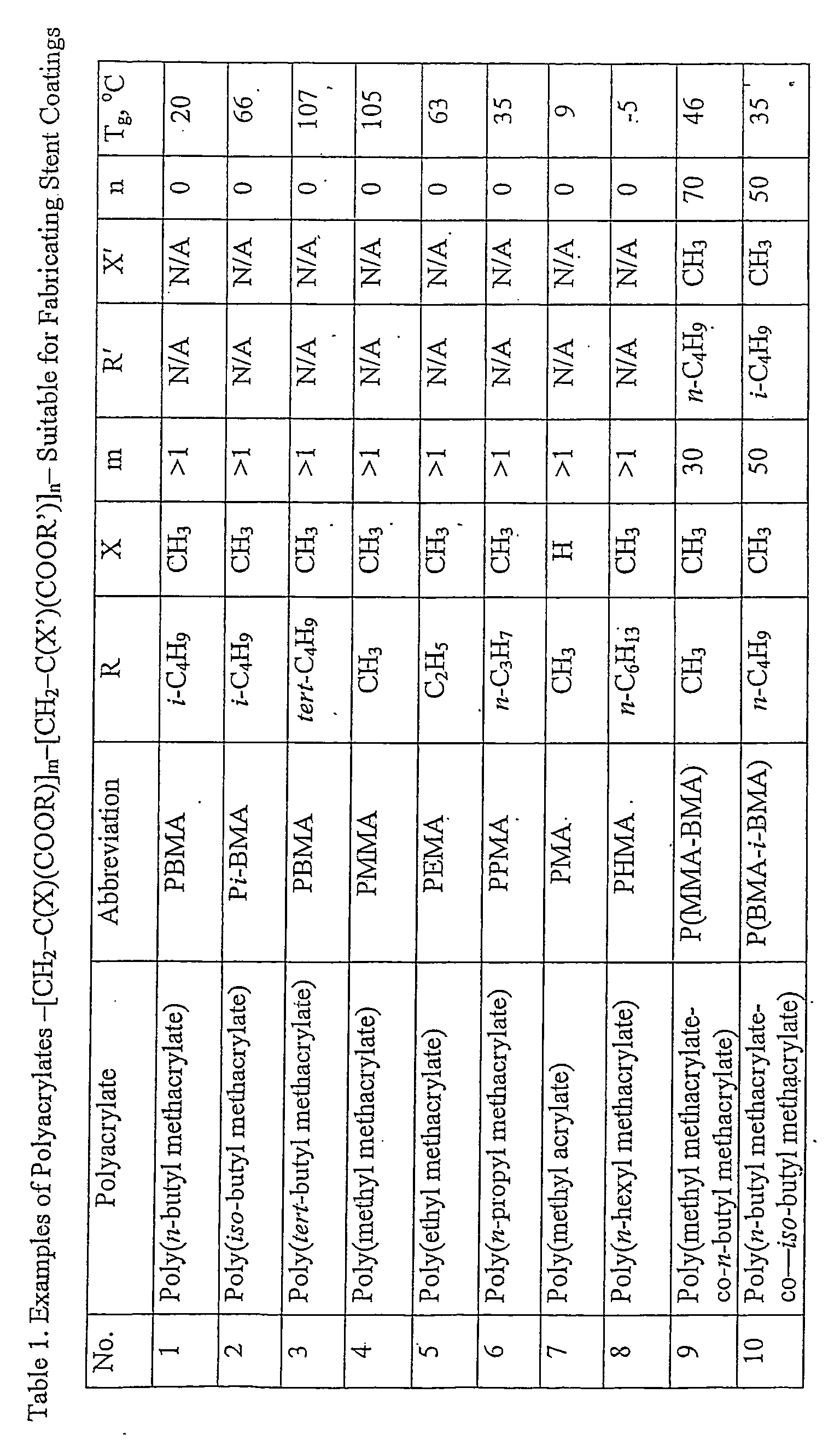
- polymers of esters having the general formula (I) -[CH 2 -C(X)(COOR)] m -[CH 2 -C(X')(COOR'] n -[CH 2 -C(X")(COOR")] p -, or blends thereof, can be used for making the stent coatings.
- X, X', and X" is each, independently, a hydrogen atom (actylates) or an alkyl group, such as a methyl group CH 3 (methacrylates);
- R, R' and R" is each, independently, a C 1 to C 12 straight chained or branched aliphatic radical;
- m is an integer larger than 1
- the polymer of formula (I) is a copolymer, and if n ⁇ 0 and p ⁇ 0, the polymer of formula (I) is a terpolymer.
- Polymers of formula (I) can be used for making either the drug-polymer layer, the topcoat membrane, the optional primer layer, or any combination thereof.
- such polymers, or blends thereof are defined as “polyacrylates” or as “polyacrylate materials.”
- PBMA poly( n -butyl methacrylate)
- PBMA has good biocompatibility, is soluble in many common solvents, has good mechanical and physical properties, and adheres well to the underlying stent surface or the primer layer.
- PBMA is available commercially from Aldrich Chemical Co. of Milwaukee, Wisconsin, and from Esschem, Inc. of Lynwood, Pennsylvania.
- the rate of release of the drug through the polymer is related to the rate of diffusion of the drug through the, matrix.
- the slower the rate of diffusion the greater the polymer's ability to prolong the rate of release and the residence time of the drug at the implantation site.
- the rate of diffusion is in turn related to the water adsorption rate, the degree of crystallinity, if any, and the glass transition temperature (T g ) of the polymer.
- One common technique for producing these polymers is by free radical polymerization yielding amorphous polymers with no crystallinity. Hence, it is the glass transition temperature that is one of important discriminating characteristic for these polymers.
- the polyacrylates having low values of T g can be used.
- PBMA is one of such polyacrylates having the T g of about 20°C.
- the Tg (on the Kelvin scale) is generally the mass fraction-weighted average of the constituent components of the copolymer. Consequently, a copolymer or terpolymer of formula (I) with predetermined higher or lower value of T g can be used as drug-polymer layer and/or a topcoat membrane, thus providing a desirable lower or higher rate of release of the drug, respectively.
- a random poly(methyl methacrylate-co- n -butyl methacrylate) [P(MMA-BMA)] having about 30 molar percent of methyl methacrylate-derived units and about 70 molar percent of n -butyl methacrylate-derived units, has a theoretical T g of about 45.5°C. Therefore, a topcoat membrane made of P(MMA-BMA) will provide faster drug release than pure PMMA but slower than pure PBMA.
- blends of individual polyacrylates, e.g ., PBMA and PMMA can be used.
- one of the polyacrylates, or a blend thereof can be applied on the stent using commonly used techniques known to those having ordinary skill in the art.
- the polyacrylate can be applied to the stent by dissolving the polymer in a solvent, or a mixture of solvents, and applying the resulting solution on the stent by spraying or immersing the stent in the solution.
- solvents include N,N-dimethylacetamide (DMAC), N,N-'dimethylformamide (DMF), tethrahydrofurane (THF), cyclohexanone, xylene, toluene, acetone, methyl ethyl ketone, propylene glycol monomethyl ether, methyl butyl ketone, ethyl acetate, n -butylacetate, and dioxane.
- DMAC N,N-dimethylacetamide
- DMF N,N-'dimethylformamide
- THF tethrahydrofurane
- cyclohexanone cyclohexanone
- xylene toluene
- acetone methyl ethyl ketone
- propylene glycol monomethyl ether methyl butyl ketone
- ethyl acetate n -butylacetate
- suitable mixtures of solvents include mixtures of DMAC and methanol (e.g., a 50:50 by mass mixture), cyclohexanone and acetone (e.g., 80:20, 50:50, 20:80 by mass mixtures), acetone and xylene (e.g. a 50:50 by mass mixture), and acetone, FLUX REMOVER AMS, and xylene (e.g., a 10:50:40 by mass mixture).
- FLUX REMOVER AMS is trade name of a solvent manufactured by Tech Spray, Inc.
- blends of polyacrylates with polymers other than polyacrylates can be used to fabricate the coating.
- the blend of polyacrylates with non-acrylate materials is free from acetate species.
- Poly(ethylene-co-vinyl alcohol) (EVAL) is one example of a suitable non-acrylate polymer.
- EVAL has the general formula -[CH 2 -CH 2 ] q -[CH 2 -CH(OH)] r -, where "q" and "r” is each an integer.
- EVAL may also include up to 5 molar % of units derived from styrene, propylene and other suitable unsaturated monomers.
- a brand of copolymer of ethylene and vinyl alcohol distributed commercially under the trade name EVAL by Aldrich Chemical Co., or manufactured by EVAL Company of America of Lisle, Illinois, can be used.
- Examples of other polymers with which polyacrylates can be blended include fluorinated polymers, such as poly(vinylidene fluoride) (PVDF) and poly(vinylidene fluoride-co-hexafluoro propene) (PVDF-HFP).
- PVDF poly(vinylidene fluoride)
- PVDF-HFP poly(vinylidene fluoride-co-hexafluoro propene)
- the blend of a polyacrylate and a fluorinated polymer can contain between about 10 and about 95% (mass) of the fluorinated polymer.
- the polyacrylates can be used to manufacture the primer layer, drug-polymer layer, topcoat membrane, or all three layers.
- the polyacrylates can be used to make both the drug-polymer layer and the topcoat membrane, but not the primer layer. Any combination of the three layers can include a polyacrylate, so long as at least one of the layers includes the material. If a polyacrylate is used to make only one of the layers, the other layer or layers can be made of an alternative polymer.
- suitable alternative polymers include EVAL, poly(hydroxyvalerate), poly(L-lactic acid), polycaprolactone, poly(lactide-co-glycolide), poly(hydroxybutyrate), poly(hydroxybutyrate-co-valerate), polydioxanone, polyorthoester, polyanhydride, poly(glycolic acid), poly(D,L-lactic acid), poly(glycolic acid-co-trimethylene carbonate), polyphosphoester, polyphosphoester urethane; poly(amino acids), cyanoacrylates, poly(trimethylene carbonate), poly(iminocarbonate), co-poly(ether-esters) (e.g.
- PEO/PLA polyalkylene oxalates, polyphosphazenes, biomolecules (such as fibrin, fibrinogen, cellulose, starch, collagen and hyaluronic acid), polyurethanes, silicones, polyesters, polyolefins, polyisobutylene and ethylene-alphaolefin copolymers, acrylic polymers and copolymers other than polyacrylates, vinyl halide polymers and copolymers (such as polyvinyl chloride), polyvinyl ethers (such as polyvinyl methyl ether), polyvinylidene halides (such as polyvinylidene fluoride and polyvinylidene chloride), polyacrylonitrile, polyvinyl ketones, polyvinyl aromatics (such as polystyrene), polyvinyl esters (such as polyvinyl acetate), acrylonitrile-styrene copolymers, ABS resins, and ethylene-vinyl acetate cop
- the coating of the present invention has been described in conjunction with a stent. However, the coating can also be used with a variety of other medical devices.
- the implantable medical device that can be used in conjunction with the embodiments of this invention include stent-grafts, grafts (e.g., aortic grafts), artificial heart valves, cerebrospinal fluid shunts, pacemaker electrodes, axius coronary shunts and endocardial leads (e.g., FINELINE and ENDOTAK, available from Guidant Corporation).
- the underlying structure of the device can be of virtually any design.
- the device can be made of a metallic material or an alloy such as, but not limited to, cobalt-chromium alloys (e.g., ELGILOY), stainless steel (316L), "MP35N,” “MP20N,” ELASTINITE (Nitinol), tantalum, tantalum-based alloys, nickel-titanium alloy, platinum, platinum-based alloys such as, e.g., platinum-iridium alloy, iridium, gold, magnesium, titanium, titanium-based alloys, zirconium-based alloys, or combinations thereof.
- Devices made from bioabsorbable or biostable polymers can also be used with the embodiments of the present invention.
- MP35N and MP20N are trade names for alloys of cobalt, nickel, chromium and molybdenum available from Standard Press Steel Co. of Jenkintown, Pennsylvania.
- MP35N consists of 35%cobalt, 35% nickel, 20% chromium, and 10% molybdenum.
- MP20N consists of 50% cobalt, 20% nickel, 20% chromium, and 10% molybdenum.
- the active agent or the drug can include any substance capable of exerting a therapeutic or prophylactic effect for a patient.
- the drug may include small molecule drugs, peptides, proteins, oligonucleotides, and the like.
- the active agent could be designed, for example, to inhibit the activity of vascular smooth muscle cells. It can be directed at inhibiting abnormal or inappropriate migration and/or proliferation of smooth muscle cells to inhibit restenosis.
- Examples of drugs include antiproliferative substances such as actinomycin D, or derivatives and analogs thereof. Synonyms of actinomycin D include dactinomycin, actinomycin IV, actinomycin I 1 , actinomycin X 1 , and actinomycin C 1 .
- the active agent can also fall under the genus of antineoplastic, anti-inflammatory, antiplatelet, anticoagulant, antifibrin, antithrombin, antimitotic, antibiotic, antiallergic and antioxidant substances.
- antineoplastics and/or antimitotics include paclitaxel, docetaxel, methotrexate, azathioprine, vincristine, vinblastine, fluorouracil, doxorubicin, hydrochloride, and mitomycin.
- antiplatelets examples include sodium heparin, low molecular weight heparins, heparinoids, hirudin, argatroban, forskolin, vapiprost, prostacyclin and prostacyclin analogues, dextran, D-phe-pro-arg-chloromethylketone (synthetic antithrombin), dipyridamole, glycoprotein IIb/IIIa platelet membrane receptor antagonist antibody, recombinant hirudin, and thrombin.
- sodium heparin low molecular weight heparins
- heparinoids examples include sodium heparin, low molecular weight heparins, heparinoids, hirudin, argatroban, forskolin, vapiprost, prostacyclin and prostacyclin analogues, dextran, D-phe-pro-arg-chloromethylketone (synthetic antithrombin), dipyridamole, glycoprotein II
- cytostatic or antiproliferative agents examples include angiopeptin, angiotensin converting enzyme inhibitors such as captopril, cilazapril or lisinopril, calcium channel blockers (such as nifedipine), colchicine, fibroblast growth factor (FGF) antagonists, fish oil ( ⁇ -3-fatty acid), histamine antagonists, lovastatin (an inhibitor of HMG-CoA reductase, a cholesterol lowering drug), monoclonal antibodies (such as those specific for Platelet-Derived Growth Factor (PDGF) receptors), nitroprusside, phosphodiesterase inhibitors, prostaglandin inhibitors, suramin, serotonin blockers, steroids, thioprotease inhibitors, triazolopyrimidine (a PDGF antagonist), and nitric oxide.
- angiopeptin angiotensin converting enzyme inhibitors such as captopril, cilazapril or lisinopril
- an antiallergic agent is permirolast potassium.
- Other therapeutic substances or agents which may be appropriate include alpha-interferon; genetically engineered epithelial cells; rapamycin and structural derivatives or functional analogs thereof, such as 40-0-(2-hydroxy)ethyl-rapamycin (known by the trade name of Everolimus available from Novartis) 40-O-(3-hydroxy)propyl-rapamycin and 40-O-[2-(2-hydroxy)ethoxy]ethyl-rapamycin; tacrolimus; and dexamethasone.
- 40-0-(2-hydroxy)ethyl-rapamycin known by the trade name of Everolimus available from Novartis
- tacrolimus and dexamethasone.
- a polymer solution containing between about 0.1 mass % and about 15 mass %, for example, about 2.0 mass % of EVAL and the balance, DMAC solvent, can be prepared.
- the solution can be applied onto a stent to form a primer layer.
- a spray apparatus such as an EFD 780S spray nozzle with a VALVEMATE 7040 control system, manufactured by EFD, Inc. of East Buffalo, Rhode Island can be used.
- the EFD 780S spray nozzle is an air-assisted external mixing atomizer.
- the composition is atomized by air and applied to the stent surfaces.
- the stent can be optionally rotated about its longitudinal axis, at a speed of 50 to about 150 rpm.
- the stent can also be linearly moved along the same axis during the application.
- the EVAL solution can be applied to a 13-mm TETRA stent (available from Guidant Corporation) in a series of 10-second passes, to deposit, for example, 10 ⁇ g of coating per spray pass.
- a 13-mm TETRA stent available from Guidant Corporation
- another suitable stent can be used, for example, a 12-mm VISION stent (also available from Guidant Corporation).
- the stent can be dried for about 10 seconds using flowing air with a temperature of about 60°C.
- Five spray passes can be applied, followed by baking the primer layer at about 140°C for one hour.
- a primer layer can be formed having a solids content of about 50 ⁇ g.
- Solids means the amount of the dry residue deposited on the stent after all volatile organic compounds (e.g., the solvent) have been removed.
- a drug-containing formulation can be prepared comprising:
- five spray passes can be performed, followed by baking the drug-polymer layer at about 50°C for about 2 hours, to form the drug-polymer layer having a solids content between about 30 ⁇ g and 750 ⁇ g, for example, about 90 ⁇ g, and a drug content of between about 10 ⁇ g and about 250 ⁇ g, for example, 30 ⁇ g.
- a topcoat composition to control the drug release rate can be prepared, comprising between about 0.1 mass % and about 15 mass %, for example, about 2.0 mass % PBMA and the balance a solvent system, for example, a solvent system including a 10:50:40 (mass) blend of acetone, Techspray's FLUX REMOVER AMS, and xylene.
- a solvent system for example, a solvent system including a 10:50:40 (mass) blend of acetone, Techspray's FLUX REMOVER AMS, and xylene.
- a number of spray passes are performed followed by final baking at about 50°C for about 2 hours.
- the topcoat membrane can be formed, the membrane having a solids content of between about 30 ⁇ g and about 350 ⁇ g, for example, about 50 ⁇ g.
- a stent was coated as described in Example 1, except instead of the Everolimus, estradiol was used.
- the coated stent was tested for a study of the drug release.
- the stent was immersed for 24 hours in bovine serum.
- the drug was extracted, and the amount of estradiol released after 24 hours was measured chromatographically (by HPLC).
- the results of this study are summarized in Table 2.
- Topcoat Membrane Solids ⁇ g Drug Loaded in the Drug-Polymer Layer, ⁇ g % of the Drug Released in 24 Hours 1 30 240 15.0 2 50 240 13.0 3 100 240 11.0 4 160 240 4.3 5 300 170 1.5
- the stent had the total amount of solids of the topcoat membrane of about 160 ⁇ g and the total amount of estradiol in the drug-polymer layer of about 30 ⁇ g.
- the stent was immersed in a phosphate buffered saline solution having 1 mass % of sodium dodecyl sulfate. A sample of the solution was taken every 20 minutes and analyzed by HPLC for the amount of estradiol released.
- a stent was coated as described in Example 1, except instead of Everolimus, etoposide was used.
- the coated stent was tested for a study of the drug release as described in Example 2. The results of this study are summarized in Table 3.
- Topcoat Membrane Solids ⁇ g Topcoat Membrane Thickness, ⁇ m Stent Drug Loaded in the Drug- Polymer Layer, ⁇ g Amount of the Drug Released in 24 Hours, ⁇ g % of the Drug Released in 24 Hours 1 30 0.54 12mm VISION 240 139 57.9 2 50 0.89 12 mm VISION 240 58 24.2 3 100 1.30 12 mm VISION 240 24 10.0 4 50 0.61 13 mm TETRA 180 148 82.2 5 120 1.46 13 mm TETRA 180 70 38.9 6 200 2.44 13mm TETRA 180 72 40.0 7 200 2.44 13 mm TETRA 180 41 22.7 8 300 3.86 13mm TETRA 180 50 27.8
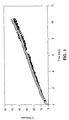
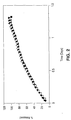
- the stent was immersed in a phosphate-buffered saline solution having about 1 mass % of sodium dodecyl sulfate. The solution was frequently sampled and the drug concentration was measured using HPLC. The stent had the total amount of solids of the topcoat membrane of about 30 ⁇ g and the total amount of estradiol in the drug-polymer layer of about 160 ⁇ g. As seen from the release profile for three different coated stents shown on FIG. 2, the profile was close to linear and the reproducibility was excellent.
- a primer layer can be applied onto a stent as described in Example 1.
- a drug formulation can be prepared comprising:
- the drug containing formulation can then be applied to the stent, and a drug-polymer layer is formed, in a manner identical to that described in Example 1.
- the solids contents of the drug-polymer layer can be 1,200 ⁇ g.
- a topcoat composition to control the drug release rate can be prepared, comprising between about 0.1 mass % and about 15 mass %, for example, about 2.0 mass % PBMA and the balance a solvent system, for example, a solvent system including a 10:50:40 (mass) blend of acetone, Techspray's FLUX REMOVER AMS and xylene, and the topcoat membrane can be formed, in a manner identical to that described in Example 1.
- the topcoat membrane can have a solids content of between about 20 ⁇ g and about 200 ⁇ g, for example, about 30 ⁇ g.
- a primer layer can be applied onto a 8-mm stent as described in Example 1.
- a drug formulation can be prepared comprising:
- the drug formulation can then be applied onto the stent, and a drug-polymer layer is formed in a manner identical to that described in Example 1.
- the solids contents of the drug-polymer layer can be 1,200 ⁇ g.
- the stent coating has no separate topcoat membrane.
- a primer layer can be applied onto a 8-mm stent as described in Example 1.
- a drug formulation can be prepared comprising:
- PBM 150 contains about 79.2 mass % of units derived from BMA.
- the drug formulation can then be applied onto the dried primer layer, and a drug-polymer layer is formed, in a manner identical to that described in Example 1.
- the drug-polymer layer can have the total amount of solids of between about 300 and 600 ⁇ g, for example, about 520 ⁇ g. In this Example, the stent coating has no separate topcoat membrane.
- a primer layer and a drug-polymer layer can be applied onto a stent as described in Example 1, the drug-polymer layer having the total amount of EVAL between about 300 and 800 ⁇ g, for example, about 325 ⁇ g.
- a topcoat composition to control the drug release rate can be prepared, comprising between about 0.1 mass % and about 15 mass %, for example, about 2.0 mass % P(MMA-BMA) having about 66.5 mass % of units derived from BMA, and the balance of a solvent system, for example, a solvent system including a 10:50:40 (mass) blend of acetone, Techspray's FLUX REMOVER AMS and xylene.
- the topcoat membrane can be formed having the total amount of solids between about 20 and 200 ⁇ g, for example, about 30 ⁇ g.
- a primer layer and a drug-polymer layer can be applied onto a stent as described in Example 1, the drug-polymer layer having the total amount of EVAL between about 300 and 800 ⁇ g, for example, about 380 ⁇ g.
- a topcoat composition to control the drug release rate can be prepared, comprising between about 0.1 mass % and about 15 mass %, for example, about 2.0 mass % of a 1:1 (by mass) blend of P(MMA-BMA) and PBMA, and the balance of a solvent system, for example, the solvent system including a 10:50:40 (mass) blend of acetone, Techspray's FLUX REMOVER AMS and xylene.
- the P(MMA-BMA)/PBMA blend can have about 83.3 mass % of units derived from BMA.
- the topcoat membrane can be formed having the total amount of solids between about 20 and 200 ⁇ g, for example, about 30 ⁇ g.
- a primer layer and a drug-polymer layer can be applied onto a stent as described in Example 1, the drug-polymer layer having the total amount of EVAL between about 300 and 800 ⁇ g, for example, about 350 ⁇ g.
- a topcoat composition to control the drug release rate can be prepared, comprising between about 0.1 mass % and about 15 mass %, for example, about 2.0 mass % of a 2:1 (by mass) blend of P(MMA-BMA) and PBMA, and the balance a solvent system, for example, a solvent system including a 10:50:40 (mass) blend of acetone, Techspray's FLUX REMOVER AMS and xylene.
- the P(MMA-BMA)/PBMA blend can have about 77.8 mass % of units derived from BMA.
- the topcoat membrane can have a total amount of solids between about 20 and 200 ⁇ g, for example, about 28 ⁇ g.
- a primer layer and a drug-polymer layer can be applied onto a stent as described in Example 9.
- a topcoat composition to control the drug release rate can be prepared, comprising between about 0.1 mass % and about 15 mass %, for example, about 2.0 mass % of a 4:1 (by mass) blend of P(MMA-BMA) and PBMA, and the balance a solvent system, for example, a solvent system including a 10:50:40 (mass) blend of acetone, Techspray's FLUX REMOVER AMS and xylene.
- the P(MMA-BMA)/PBMA blend can have about 73.3 mass % of units derived from BMA.
- the topcoat membrane can have a total amount of solids between about 20 and 200 ⁇ g, for example, about 32 ⁇ g.
- a primer layer and a drug-polymer layer can be applied onto a stent as described in Example 9.
- a topcoat composition to control the drug release rate can be prepared, comprising between about 0.1 mass % and about 15 mass %, for example, about 2.0 mass % of PEMA, and the balance a solvent system, for example, a solvent system including a 80:20 (mass) blend of acetone and cyclohexanone.
- a solvent system for example, a solvent system including a 80:20 (mass) blend of acetone and cyclohexanone.
- Poly(ethyl methacrylate) having a weight-average molecular weight M w of about 101,400 available from Aldrich Chemical Company is one example of a brand of PEMA that can be used.
- the topcoat composition can be applied onto the dried drug-polymer layer.
- a number of spray passes can be performed followed by final baking, first at about 60°C for about 2 hours and then at about 140°C for about 1 hour.
- the topcoat membrane can be formed, the membrane having a solids content of between about 20 ⁇ g and about 300 ⁇ g, for example, about 40 ⁇ g.
- a primer layer and a drug-polymer layer can be applied onto a stent as described in Example 9.
- a topcoat composition to control the drug release rate can be prepared, comprising between about 0.1 mass % and about 15 mass %, for example, about 2.0 mass % of a blend of PEMA with a fluorinated polymer; and the balance a solvent system, for example, a solvent system including a 50:50 (mass) blend of acetone and cyclohexanone.
- a solvent system for example, a solvent system including a 50:50 (mass) blend of acetone and cyclohexanone.
- the brand of PEMA described in Example 10 can be used.
- PVDF-HFP polyvinyl dimethacrylate-propylene
- SOLEF 21508 having about 85 mass % of vinylidene fluoride-derived units and about 15 mass % of hexafluoro propene-derived units.
- SOLEF 21508 is available from Solvay Fluoropolymers, Inc. of Houston, Texas.
- the PEMA/SOLEF 21508 blend can be 3:1 (mass) (containing about 75 mass % of PEMA and about 25 mass % of SOLEF 21508).
- the topcoat composition can be applied onto the dried drug-polymer layer.
- a number of spray passes can be performed followed by final baking, first at about 60°C for about 2 hours and then at about 100°C for about 1 hour.
- the topcoat membrane can have a solids content of between about 20 ⁇ g and about 300 ⁇ g, for example, about 42 ⁇ g.
- a stent was coated as described in Example 12, except instead of the 3:1 PEMA/SOLEF 21508 blend, a 3:1 (mass) blend of PEMA/PBMA can be used to form the topcoat membrane.
- the dry topcoat membrane can have a solids content of between about 20 ⁇ g and about 300 ⁇ g, for example, about 50 ⁇ g.
- a stent was coated as described in Example 13, except instead of the 3 : 1 PEMA/PBMA blend, a 1: 1 (mass) blend of PEMA/PBMA can be used to form the topcoat membrane (containing about 50 mass % of PEMA and about 50 mass % of PBMA).
- a primer layer and a drug-polymer layer can be applied onto a stent as described in Example 4.
- a topcoat composition to control the drug release rate can be prepared, comprising between about 0.1 mass % and about 15 mass %, for example, about 2.0 mass % of a 1:1 (by mass) blend of PBMA and EVAL, and the balance a solvent system, for example, a solvent system including a 80:20 (mass) blend of DMAC and pentane.
- the topcoat membrane can have a total amount of solids of between about 20 and 200 ⁇ g, for example, about 30 ⁇ g.
- a primer layer can be applied onto a stent as described in Example 1.
- a drug formulation can be prepared comprising:
- the drug containing formulation can then be applied onto the stent.
- the solids contents of the drug-polymer layer can be 1,200 ⁇ g.
- a primer layer and a drug-polymer layer can be applied onto a stent as described in Example 16.
- a topcoat composition to control the drug release rate can be prepared, comprising between about 0.1 mass % and about 15 mass %, for example, about 2.0 mass % PBMA and the balance a solvent system, for example, a solvent system including a 10:50:40 (mass) blend of acetone, Techspray's FLUX REMOVER AMS and xylene.
- the topcoat membrane can have a solids content of between about 20 ⁇ g and about 200 ⁇ g, for example, about 30 ⁇ g.
- a primer layer and a drug-polymer layer can be applied onto a stent as described in Example 16.
- a topcoat composition to control the drug release rate can be prepared as described in Example 15.
- the topcoat membrane can have a total amount of solids between about 20 and 200 ⁇ g, for example; about 30 ⁇ g.
- a primer layer and a drug-polymer layer can be applied onto a stent as described in Example 1.
- a topcoat composition to control the drug release rate can be prepared as described in Example 15.
- the topcoat membrane can be formed, in a manner identical to that described in Example 1, the topcoat membrane having the total amount of solids between about 20 and 200 ⁇ g, for example, about 30 ⁇ g.
- a primer layer and a drug-polymer layer can be applied onto a stent as described in Example 16.
- a topcoat composition to control the drug release rate can 5 be prepared, the composition comprising between about 0.1 mass % and about 15 mass %, for example, about 2.0 mass % EVAL and the balance DMAC solvent
- the topcoat membrane can be formed, in a manner identical to that described in Example 1.
Landscapes
- Health & Medical Sciences (AREA)
- Life Sciences & Earth Sciences (AREA)
- Public Health (AREA)
- Veterinary Medicine (AREA)
- Epidemiology (AREA)
- Surgery (AREA)
- Animal Behavior & Ethology (AREA)
- General Health & Medical Sciences (AREA)
- Heart & Thoracic Surgery (AREA)
- Vascular Medicine (AREA)
- Chemical & Material Sciences (AREA)
- Engineering & Computer Science (AREA)
- Biomedical Technology (AREA)
- Medicinal Chemistry (AREA)
- Molecular Biology (AREA)
- Materials For Medical Uses (AREA)
- Pharmaceuticals Containing Other Organic And Inorganic Compounds (AREA)
Abstract
Description
| Drug Release Study of Stent Coatings Having PBMA Topcoat Membranes (EVAL-based Drug-Polymer Layer, Estradiol Drug) | |||
| No. | Topcoat Membrane Solids, µg | Drug Loaded in the Drug-Polymer Layer, µg | % of the Drug Released in 24 Hours |
| 1 | 30 | 240 | 15.0 |
| 2 | 50 | 240 | 13.0 |
| 3 | 100 | 240 | 11.0 |
| 4 | 160 | 240 | 4.3 |
| 5 | 300 | 170 | 1.5 |
| Drug Release Study of Stent Coatings Having PBMA Topcoat Membranes (EVAL-based Drug-Polymer Layer, Etoposide Drug) | ||||||
| No. | Topcoat Membrane Solids, µg | Topcoat Membrane Thickness, µm | Stent | Drug Loaded in the Drug- Polymer Layer, µg | Amount of the Drug Released in 24 Hours, µg | % of the Drug Released in 24 Hours |
| 1 | 30 | 0.54 | 12mm VISION | 240 | 139 | 57.9 |
| 2 | 50 | 0.89 | 12 mm VISION | 240 | 58 | 24.2 |
| 3 | 100 | 1.30 | 12 mm VISION | 240 | 24 | 10.0 |
| 4 | 50 | 0.61 | 13 mm TETRA | 180 | 148 | 82.2 |
| 5 | 120 | 1.46 | 13 mm TETRA | 180 | 70 | 38.9 |
| 6 | 200 | 2.44 | 13mm TETRA | 180 | 72 | 40.0 |
| 7 | 200 | 2.44 | 13 mm TETRA | 180 | 41 | 22.7 |
| 8 | 300 | 3.86 | 13mm TETRA | 180 | 50 | 27.8 |
| Summary of Examples 1-20 | ||||
| Example No | Polymer of the Drug-Polymer Layer | Drug | Polymer of the Topcoa Matrix | |
| 1 | | Everolimus | PBMA | |
| 2 | EVAL | Estradiol | PBMA | |
| 3 | | Etoposite | PBMA | |
| 4 | PBMA | Everolimus | PBMA | |
| 5 | PBMA | Everolimus | None | |
| 6 | P(MMA-BMA) | Everolimus | None | |
| 7 | EVAL - | Everolimus | P(MMA-BMA) | |
| 8 | EVAL | Everolimus | 1:1 blend of P(MMA-BMA) and PBMA | |
| 9 | EVAL | Everolimus | 2:1 blend of P(MMA-BMA) and | |
| 10 | EVAL | Everolimus | 4:1 blend of P(MMA-BMA) and PBMA | |
| 11 | | Everolimus | PEMA | |
| 12 | EVAL | Everolimus | 3 : blend of PEMA and P(VDF-HFP) | |
| 13 | EVAL | Everolimus | 3:1 blend of PEMA and PBMA | |
| 14 | EVAL | Everolimus | 1:1 blend of PEMA and PBMA | |
| 15 | PBMA | Everolimus | 1:1 blend of PBMA EVAL | |
| 16 | 1:1 blend of PBMA EVAL | Everolimus | None | |
| 17 | 1:1 blend of PBMA EVAL | Everolimus | PBMA | |
| 18 | 1:1 blend of PBMA EVAL | Everolimus | 1:1 blend of PBMA EVAL | |
| 19 | EVAL | Everolimus | 1:1 blend of | |
| 20 | 1:1 blend of PBMA EVAL | Everolimus | EVAL |
Claims (11)
- A coating for an implantable medical device, the coating comprising a first layer having an active agent incorporated therein and a second layer disposed over the first layer, wherein the second layer comprises a thermoplastic polyacrylate material for modifying the rate of release of the agent.
- A coating according to claim 1, wherein the agent is for reducing, inhibiting or preventing restenosis.
- A method of coating an implantable medical device, the method comprising depositing a first layer on the device, the first layer comprising an active agent for the sustained release of the agent, and depositing a second layer over the first layer, the second layer comprising a thermoplastic polyacrylate material for modifying the rate of release of the agent.
- A method according to claim 3, wherein the active agent is rapamycin or derivatives or analogs thereof.
- A coating or method according to any one of the preceding claims, wherein the implantable medical device is a stent.
- A coating or method according to any one of the preceding claims, wherein the polyacrylate material comprises homopolymers, copolymers or terpolymers of alkylacrylates or alkylmethacrylates, and blends thereof.
- A coating or method according to claim 6, wherein the alkyls of the alkylacrylates or alkylmethacrylates are C1-C12 straight-chained or branched alkyls.
- A coating or method according to any one of the preceding claims, wherein the polyacrylate material is poly (n-butyl methacrylate).
- A coating or method according to any one of the preceding claims wherein the second layer additionally comprises a non-acrylate polymer.
- A coating or method according to claim 9, wherein the non-acrylate polymer(s) is/are fluorinated polymers or poly(ethylene-co-vinyl alcohol).
- A coating or method according to claim 10, wherein the fluorinated polymers are poly(vinylidene fluoride) or poly(vinylidene fluoride-co-hexafluoropropene).
Applications Claiming Priority (3)
| Application Number | Priority Date | Filing Date | Title |
|---|---|---|---|
| US10/176,504 US7247313B2 (en) | 2001-06-27 | 2002-06-21 | Polyacrylates coatings for implantable medical devices |
| US176504 | 2002-06-21 | ||
| EP03738930A EP1517716B1 (en) | 2002-06-21 | 2003-05-14 | Polyacrylates coatings for implantable medical devices |
Related Parent Applications (1)
| Application Number | Title | Priority Date | Filing Date |
|---|---|---|---|
| EP03738930A Division EP1517716B1 (en) | 2002-06-21 | 2003-05-14 | Polyacrylates coatings for implantable medical devices |
Publications (3)
| Publication Number | Publication Date |
|---|---|
| EP1566187A2 true EP1566187A2 (en) | 2005-08-24 |
| EP1566187A3 EP1566187A3 (en) | 2005-08-31 |
| EP1566187B1 EP1566187B1 (en) | 2009-12-02 |
Family
ID=29999065
Family Applications (2)
| Application Number | Title | Priority Date | Filing Date |
|---|---|---|---|
| EP05011307A Expired - Lifetime EP1566187B1 (en) | 2002-06-21 | 2003-05-14 | Polyacrylates coating for implantable medical devices |
| EP03738930A Expired - Lifetime EP1517716B1 (en) | 2002-06-21 | 2003-05-14 | Polyacrylates coatings for implantable medical devices |
Family Applications After (1)
| Application Number | Title | Priority Date | Filing Date |
|---|---|---|---|
| EP03738930A Expired - Lifetime EP1517716B1 (en) | 2002-06-21 | 2003-05-14 | Polyacrylates coatings for implantable medical devices |
Country Status (8)
| Country | Link |
|---|---|
| US (1) | US7247313B2 (en) |
| EP (2) | EP1566187B1 (en) |
| JP (1) | JP2005530552A (en) |
| AT (2) | ATE450277T1 (en) |
| AU (1) | AU2003245291A1 (en) |
| DE (2) | DE60330380D1 (en) |
| ES (1) | ES2335416T3 (en) |
| WO (1) | WO2004000383A2 (en) |
Cited By (1)
| Publication number | Priority date | Publication date | Assignee | Title |
|---|---|---|---|---|
| EP2067493A1 (en) * | 2007-11-14 | 2009-06-10 | Cordis Corporation | Polymeric materials for medical devices |
Families Citing this family (144)
| Publication number | Priority date | Publication date | Assignee | Title |
|---|---|---|---|---|
| US6776792B1 (en) | 1997-04-24 | 2004-08-17 | Advanced Cardiovascular Systems Inc. | Coated endovascular stent |
| US20070032853A1 (en) | 2002-03-27 | 2007-02-08 | Hossainy Syed F | 40-O-(2-hydroxy)ethyl-rapamycin coated stent |
| US8088060B2 (en) | 2000-03-15 | 2012-01-03 | Orbusneich Medical, Inc. | Progenitor endothelial cell capturing with a drug eluting implantable medical device |
| US9522217B2 (en) | 2000-03-15 | 2016-12-20 | Orbusneich Medical, Inc. | Medical device with coating for capturing genetically-altered cells and methods for using same |
| US20020111590A1 (en) * | 2000-09-29 | 2002-08-15 | Davila Luis A. | Medical devices, drug coatings and methods for maintaining the drug coatings thereon |
| US6783793B1 (en) | 2000-10-26 | 2004-08-31 | Advanced Cardiovascular Systems, Inc. | Selective coating of medical devices |
| GB0100761D0 (en) * | 2001-01-11 | 2001-02-21 | Biocompatibles Ltd | Drug delivery from stents |
| US6780424B2 (en) | 2001-03-30 | 2004-08-24 | Charles David Claude | Controlled morphologies in polymer drug for release of drugs from polymer films |
| US8741378B1 (en) | 2001-06-27 | 2014-06-03 | Advanced Cardiovascular Systems, Inc. | Methods of coating an implantable device |
| US7056338B2 (en) | 2003-03-28 | 2006-06-06 | Conor Medsystems, Inc. | Therapeutic agent delivery device with controlled therapeutic agent release rates |
| US7285304B1 (en) | 2003-06-25 | 2007-10-23 | Advanced Cardiovascular Systems, Inc. | Fluid treatment of a polymeric coating on an implantable medical device |
| US7989018B2 (en) * | 2001-09-17 | 2011-08-02 | Advanced Cardiovascular Systems, Inc. | Fluid treatment of a polymeric coating on an implantable medical device |
| US6753071B1 (en) | 2001-09-27 | 2004-06-22 | Advanced Cardiovascular Systems, Inc. | Rate-reducing membrane for release of an agent |
| US7070798B1 (en) | 2002-06-21 | 2006-07-04 | Advanced Cardiovascular Systems, Inc. | Coatings for implantable medical devices incorporating chemically-bound polymers and oligomers of L-arginine |
| US7033602B1 (en) | 2002-06-21 | 2006-04-25 | Advanced Cardiovascular Systems, Inc. | Polycationic peptide coatings and methods of coating implantable medical devices |
| US8506617B1 (en) | 2002-06-21 | 2013-08-13 | Advanced Cardiovascular Systems, Inc. | Micronized peptide coated stent |
| US6994867B1 (en) | 2002-06-21 | 2006-02-07 | Advanced Cardiovascular Systems, Inc. | Biocompatible carrier containing L-arginine |
| US7217426B1 (en) | 2002-06-21 | 2007-05-15 | Advanced Cardiovascular Systems, Inc. | Coatings containing polycationic peptides for cardiovascular therapy |
| US7011842B1 (en) | 2002-06-21 | 2006-03-14 | Advanced Cardiovascular Systems, Inc. | Polycationic peptide coatings and methods of making the same |
| US7056523B1 (en) | 2002-06-21 | 2006-06-06 | Advanced Cardiovascular Systems, Inc. | Implantable medical devices incorporating chemically conjugated polymers and oligomers of L-arginine |
| US6896965B1 (en) | 2002-11-12 | 2005-05-24 | Advanced Cardiovascular Systems, Inc. | Rate limiting barriers for implantable devices |
| US7758880B2 (en) | 2002-12-11 | 2010-07-20 | Advanced Cardiovascular Systems, Inc. | Biocompatible polyacrylate compositions for medical applications |
| US7776926B1 (en) | 2002-12-11 | 2010-08-17 | Advanced Cardiovascular Systems, Inc. | Biocompatible coating for implantable medical devices |
| US7074276B1 (en) | 2002-12-12 | 2006-07-11 | Advanced Cardiovascular Systems, Inc. | Clamp mandrel fixture and a method of using the same to minimize coating defects |
| US7094256B1 (en) | 2002-12-16 | 2006-08-22 | Advanced Cardiovascular Systems, Inc. | Coatings for implantable medical device containing polycationic peptides |
| EP1596895B1 (en) | 2003-02-18 | 2009-02-04 | Medtronic, Inc. | Occlusion resistant hydrocephalic shunt |
| US7063884B2 (en) | 2003-02-26 | 2006-06-20 | Advanced Cardiovascular Systems, Inc. | Stent coating |
| US20090093875A1 (en) | 2007-05-01 | 2009-04-09 | Abbott Laboratories | Drug eluting stents with prolonged local elution profiles with high local concentrations and low systemic concentrations |
| EP2289571B1 (en) | 2003-03-28 | 2016-08-03 | Innovational Holdings, LLC | Implantable medical device with beneficial agent concentration gradient |
| US8791171B2 (en) | 2003-05-01 | 2014-07-29 | Abbott Cardiovascular Systems Inc. | Biodegradable coatings for implantable medical devices |
| US7279174B2 (en) | 2003-05-08 | 2007-10-09 | Advanced Cardiovascular Systems, Inc. | Stent coatings comprising hydrophilic additives |
| US20050118344A1 (en) | 2003-12-01 | 2005-06-02 | Pacetti Stephen D. | Temperature controlled crimping |
| US20050033417A1 (en) * | 2003-07-31 | 2005-02-10 | John Borges | Coating for controlled release of a therapeutic agent |
| US7785512B1 (en) | 2003-07-31 | 2010-08-31 | Advanced Cardiovascular Systems, Inc. | Method and system of controlled temperature mixing and molding of polymers with active agents for implantable medical devices |
| US7645474B1 (en) * | 2003-07-31 | 2010-01-12 | Advanced Cardiovascular Systems, Inc. | Method and system of purifying polymers for use with implantable medical devices |
| US20050037052A1 (en) * | 2003-08-13 | 2005-02-17 | Medtronic Vascular, Inc. | Stent coating with gradient porosity |
| US9114198B2 (en) | 2003-11-19 | 2015-08-25 | Advanced Cardiovascular Systems, Inc. | Biologically beneficial coatings for implantable devices containing fluorinated polymers and methods for fabricating the same |
| US7220816B2 (en) | 2003-12-16 | 2007-05-22 | Advanced Cardiovascular Systems, Inc. | Biologically absorbable coatings for implantable devices based on poly(ester amides) and methods for fabricating the same |
| US8747881B2 (en) | 2003-12-19 | 2014-06-10 | Cordis Corporation | Intraluminal medical devices in combination with therapeutic agents |
| US7435788B2 (en) | 2003-12-19 | 2008-10-14 | Advanced Cardiovascular Systems, Inc. | Biobeneficial polyamide/polyethylene glycol polymers for use with drug eluting stents |
| US8652502B2 (en) * | 2003-12-19 | 2014-02-18 | Cordis Corporation | Local vascular delivery of trichostatin A alone or in combination with sirolimus to prevent restenosis following vascular injury |
| US8309112B2 (en) * | 2003-12-24 | 2012-11-13 | Advanced Cardiovascular Systems, Inc. | Coatings for implantable medical devices comprising hydrophilic substances and methods for fabricating the same |
| US7563324B1 (en) | 2003-12-29 | 2009-07-21 | Advanced Cardiovascular Systems Inc. | System and method for coating an implantable medical device |
| EP1568394A1 (en) * | 2004-02-26 | 2005-08-31 | Muijs van de Moer, Wouter Matthijs | Coated electrode |
| US20050208093A1 (en) | 2004-03-22 | 2005-09-22 | Thierry Glauser | Phosphoryl choline coating compositions |
| US7767220B2 (en) * | 2004-04-23 | 2010-08-03 | Boston Scientific Scimed, Inc. | Implantable or insertable medical articles having covalently modified, biocompatible surfaces |
| US7553377B1 (en) | 2004-04-27 | 2009-06-30 | Advanced Cardiovascular Systems, Inc. | Apparatus and method for electrostatic coating of an abluminal stent surface |
| US8293890B2 (en) | 2004-04-30 | 2012-10-23 | Advanced Cardiovascular Systems, Inc. | Hyaluronic acid based copolymers |
| US9561309B2 (en) | 2004-05-27 | 2017-02-07 | Advanced Cardiovascular Systems, Inc. | Antifouling heparin coatings |
| US7563780B1 (en) | 2004-06-18 | 2009-07-21 | Advanced Cardiovascular Systems, Inc. | Heparin prodrugs and drug delivery stents formed therefrom |
| US20050287184A1 (en) * | 2004-06-29 | 2005-12-29 | Hossainy Syed F A | Drug-delivery stent formulations for restenosis and vulnerable plaque |
| US8236338B2 (en) | 2004-07-13 | 2012-08-07 | The University Of Tennessee Research Foundation | Adhesive composition for carrying therapeutic agents as delivery vehicle on coatings applied to vascular grafts |
| US20060013853A1 (en) * | 2004-07-19 | 2006-01-19 | Richard Robert E | Medical devices having conductive substrate and covalently bonded coating layer |
| US7494665B1 (en) | 2004-07-30 | 2009-02-24 | Advanced Cardiovascular Systems, Inc. | Polymers containing siloxane monomers |
| US7311980B1 (en) | 2004-08-02 | 2007-12-25 | Advanced Cardiovascular Systems, Inc. | Polyactive/polylactic acid coatings for an implantable device |
| US8980300B2 (en) | 2004-08-05 | 2015-03-17 | Advanced Cardiovascular Systems, Inc. | Plasticizers for coating compositions |
| US7244443B2 (en) | 2004-08-31 | 2007-07-17 | Advanced Cardiovascular Systems, Inc. | Polymers of fluorinated monomers and hydrophilic monomers |
| US8110211B2 (en) * | 2004-09-22 | 2012-02-07 | Advanced Cardiovascular Systems, Inc. | Medicated coatings for implantable medical devices including polyacrylates |
| US9011831B2 (en) | 2004-09-30 | 2015-04-21 | Advanced Cardiovascular Systems, Inc. | Methacrylate copolymers for medical devices |
| US7166680B2 (en) | 2004-10-06 | 2007-01-23 | Advanced Cardiovascular Systems, Inc. | Blends of poly(ester amide) polymers |
| US8603634B2 (en) | 2004-10-27 | 2013-12-10 | Abbott Cardiovascular Systems Inc. | End-capped poly(ester amide) copolymers |
| US7390497B2 (en) | 2004-10-29 | 2008-06-24 | Advanced Cardiovascular Systems, Inc. | Poly(ester amide) filler blends for modulation of coating properties |
| US7481835B1 (en) | 2004-10-29 | 2009-01-27 | Advanced Cardiovascular Systems, Inc. | Encapsulated covered stent |
| US7214759B2 (en) | 2004-11-24 | 2007-05-08 | Advanced Cardiovascular Systems, Inc. | Biologically absorbable coatings for implantable devices based on polyesters and methods for fabricating the same |
| US7632307B2 (en) | 2004-12-16 | 2009-12-15 | Advanced Cardiovascular Systems, Inc. | Abluminal, multilayer coating constructs for drug-delivery stents |
| US7604818B2 (en) | 2004-12-22 | 2009-10-20 | Advanced Cardiovascular Systems, Inc. | Polymers of fluorinated monomers and hydrocarbon monomers |
| US7419504B2 (en) | 2004-12-27 | 2008-09-02 | Advanced Cardiovascular Systems, Inc. | Poly(ester amide) block copolymers |
| US7202325B2 (en) | 2005-01-14 | 2007-04-10 | Advanced Cardiovascular Systems, Inc. | Poly(hydroxyalkanoate-co-ester amides) and agents for use with medical articles |
| US9381279B2 (en) | 2005-03-24 | 2016-07-05 | Abbott Cardiovascular Systems Inc. | Implantable devices formed on non-fouling methacrylate or acrylate polymers |
| US7700659B2 (en) * | 2005-03-24 | 2010-04-20 | Advanced Cardiovascular Systems, Inc. | Implantable devices formed of non-fouling methacrylate or acrylate polymers |
| JP5082058B2 (en) * | 2005-04-05 | 2012-11-28 | テルモ株式会社 | Medical instruments |
| US7637941B1 (en) | 2005-05-11 | 2009-12-29 | Advanced Cardiovascular Systems, Inc. | Endothelial cell binding coatings for rapid encapsulation of bioerodable stents |
| US7622070B2 (en) | 2005-06-20 | 2009-11-24 | Advanced Cardiovascular Systems, Inc. | Method of manufacturing an implantable polymeric medical device |
| US20070048350A1 (en) * | 2005-08-31 | 2007-03-01 | Robert Falotico | Antithrombotic coating for drug eluting medical devices |
| JP5137841B2 (en) | 2005-10-13 | 2013-02-06 | シンセス ゲーエムベーハー | Drug impregnation container |
| US7591841B2 (en) | 2005-12-16 | 2009-09-22 | Advanced Cardiovascular Systems, Inc. | Implantable devices for accelerated healing |
| US7638156B1 (en) | 2005-12-19 | 2009-12-29 | Advanced Cardiovascular Systems, Inc. | Apparatus and method for selectively coating a medical article |
| US7601383B2 (en) | 2006-02-28 | 2009-10-13 | Advanced Cardiovascular Systems, Inc. | Coating construct containing poly (vinyl alcohol) |
| US9561351B2 (en) | 2006-05-31 | 2017-02-07 | Advanced Cardiovascular Systems, Inc. | Drug delivery spiral coil construct |
| US20090258028A1 (en) * | 2006-06-05 | 2009-10-15 | Abbott Cardiovascular Systems Inc. | Methods Of Forming Coatings For Implantable Medical Devices For Controlled Release Of A Peptide And A Hydrophobic Drug |
| US8323676B2 (en) * | 2008-06-30 | 2012-12-04 | Abbott Cardiovascular Systems Inc. | Poly(ester-amide) and poly(amide) coatings for implantable medical devices for controlled release of a protein or peptide and a hydrophobic drug |
| US8703167B2 (en) * | 2006-06-05 | 2014-04-22 | Advanced Cardiovascular Systems, Inc. | Coatings for implantable medical devices for controlled release of a hydrophilic drug and a hydrophobic drug |
| KR100815242B1 (en) * | 2006-06-13 | 2008-03-19 | 한국과학기술원 | Face Detection Method Using Evolutionary Algorithm |
| US20080095918A1 (en) * | 2006-06-14 | 2008-04-24 | Kleiner Lothar W | Coating construct with enhanced interfacial compatibility |
| US8956640B2 (en) * | 2006-06-29 | 2015-02-17 | Advanced Cardiovascular Systems, Inc. | Block copolymers including a methoxyethyl methacrylate midblock |
| US20080008736A1 (en) * | 2006-07-06 | 2008-01-10 | Thierry Glauser | Random copolymers of methacrylates and acrylates |
| US9028859B2 (en) | 2006-07-07 | 2015-05-12 | Advanced Cardiovascular Systems, Inc. | Phase-separated block copolymer coatings for implantable medical devices |
| US8685430B1 (en) | 2006-07-14 | 2014-04-01 | Abbott Cardiovascular Systems Inc. | Tailored aliphatic polyesters for stent coatings |
| US8293318B1 (en) | 2006-08-29 | 2012-10-23 | Abbott Cardiovascular Systems Inc. | Methods for modulating the release rate of a drug-coated stent |
| US8414910B2 (en) | 2006-11-20 | 2013-04-09 | Lutonix, Inc. | Drug releasing coatings for medical devices |
| US8414526B2 (en) | 2006-11-20 | 2013-04-09 | Lutonix, Inc. | Medical device rapid drug releasing coatings comprising oils, fatty acids, and/or lipids |
| US8414909B2 (en) | 2006-11-20 | 2013-04-09 | Lutonix, Inc. | Drug releasing coatings for medical devices |
| US9700704B2 (en) | 2006-11-20 | 2017-07-11 | Lutonix, Inc. | Drug releasing coatings for balloon catheters |
| US9737640B2 (en) | 2006-11-20 | 2017-08-22 | Lutonix, Inc. | Drug releasing coatings for medical devices |
| US8414525B2 (en) | 2006-11-20 | 2013-04-09 | Lutonix, Inc. | Drug releasing coatings for medical devices |
| US20080276935A1 (en) | 2006-11-20 | 2008-11-13 | Lixiao Wang | Treatment of asthma and chronic obstructive pulmonary disease with anti-proliferate and anti-inflammatory drugs |
| US8430055B2 (en) | 2008-08-29 | 2013-04-30 | Lutonix, Inc. | Methods and apparatuses for coating balloon catheters |
| US8425459B2 (en) | 2006-11-20 | 2013-04-23 | Lutonix, Inc. | Medical device rapid drug releasing coatings comprising a therapeutic agent and a contrast agent |
| US8998846B2 (en) | 2006-11-20 | 2015-04-07 | Lutonix, Inc. | Drug releasing coatings for balloon catheters |
| WO2008064058A2 (en) * | 2006-11-21 | 2008-05-29 | Abbott Laboratories | Use of a terpolymer of tetrafluoroethylene, hexafluoropropylene, and vinylidene fluoride in drug eluting coatings |
| US7713541B1 (en) | 2006-11-21 | 2010-05-11 | Abbott Cardiovascular Systems Inc. | Zwitterionic terpolymers, method of making and use on medical devices |
| US20080118541A1 (en) * | 2006-11-21 | 2008-05-22 | Abbott Laboratories | Use of a terpolymer of tetrafluoroethylene, hexafluoropropylene, and vinylidene fluoride in drug eluting coatings on medical devices |
| US8017141B2 (en) | 2006-12-15 | 2011-09-13 | Advanced Cardiovascular Systems, Inc. | Coatings of acrylamide-based copolymers |
| ATE491479T1 (en) * | 2006-12-15 | 2011-01-15 | Bausch & Lomb | SURFACE TREATMENT OF BIOMEDICAL DEVICES |
| EP2125058B1 (en) | 2007-02-07 | 2014-12-03 | Cook Medical Technologies LLC | Medical device coatings for releasing a therapeutic agent at multiple rates |
| US20080286332A1 (en) | 2007-05-14 | 2008-11-20 | Pacetti Stephen D | Implantable medical devices with a topcoat layer of phosphoryl choline acrylate polymer for reduced thrombosis, and improved mechanical properties |
| US8147769B1 (en) | 2007-05-16 | 2012-04-03 | Abbott Cardiovascular Systems Inc. | Stent and delivery system with reduced chemical degradation |
| US9056155B1 (en) | 2007-05-29 | 2015-06-16 | Abbott Cardiovascular Systems Inc. | Coatings having an elastic primer layer |
| US10155881B2 (en) * | 2007-05-30 | 2018-12-18 | Abbott Cardiovascular Systems Inc. | Substituted polycaprolactone for coating |
| US20090028921A1 (en) | 2007-06-18 | 2009-01-29 | New Jersey Institute Of Technology | Electrospun Ceramic-Polymer Composite As A Scaffold For Tissue Repair |
| US9737638B2 (en) | 2007-06-20 | 2017-08-22 | Abbott Cardiovascular Systems, Inc. | Polyester amide copolymers having free carboxylic acid pendant groups |
| US20090004243A1 (en) | 2007-06-29 | 2009-01-01 | Pacetti Stephen D | Biodegradable triblock copolymers for implantable devices |
| US9814553B1 (en) | 2007-10-10 | 2017-11-14 | Abbott Cardiovascular Systems Inc. | Bioabsorbable semi-crystalline polymer for controlling release of drug from a coating |
| US20090104241A1 (en) * | 2007-10-23 | 2009-04-23 | Pacetti Stephen D | Random amorphous terpolymer containing lactide and glycolide |
| US20090306120A1 (en) * | 2007-10-23 | 2009-12-10 | Florencia Lim | Terpolymers containing lactide and glycolide |
| US8642062B2 (en) | 2007-10-31 | 2014-02-04 | Abbott Cardiovascular Systems Inc. | Implantable device having a slow dissolving polymer |
| US20090325296A1 (en) | 2008-03-25 | 2009-12-31 | New Jersey Institute Of Technology | Electrospun electroactive polymers for regenerative medicine applications |
| US8128983B2 (en) * | 2008-04-11 | 2012-03-06 | Abbott Cardiovascular Systems Inc. | Coating comprising poly(ethylene glycol)-poly(lactide-glycolide-caprolactone) interpenetrating network |
| US8475844B2 (en) * | 2008-04-16 | 2013-07-02 | Boston Scientific Scimed, Inc. | Fluoropolymer-based medical implant coating compositions |
| US8916188B2 (en) * | 2008-04-18 | 2014-12-23 | Abbott Cardiovascular Systems Inc. | Block copolymer comprising at least one polyester block and a poly (ethylene glycol) block |
| US20090297584A1 (en) * | 2008-04-18 | 2009-12-03 | Florencia Lim | Biosoluble coating with linear over time mass loss |
| US20090285873A1 (en) * | 2008-04-18 | 2009-11-19 | Abbott Cardiovascular Systems Inc. | Implantable medical devices and coatings therefor comprising block copolymers of poly(ethylene glycol) and a poly(lactide-glycolide) |
| US8697113B2 (en) * | 2008-05-21 | 2014-04-15 | Abbott Cardiovascular Systems Inc. | Coating comprising a terpolymer comprising caprolactone and glycolide |
| US8562669B2 (en) * | 2008-06-26 | 2013-10-22 | Abbott Cardiovascular Systems Inc. | Methods of application of coatings composed of hydrophobic, high glass transition polymers with tunable drug release rates |
| US8765162B2 (en) * | 2008-06-30 | 2014-07-01 | Abbott Cardiovascular Systems Inc. | Poly(amide) and poly(ester-amide) polymers and drug delivery particles and coatings containing same |
| US8092822B2 (en) * | 2008-09-29 | 2012-01-10 | Abbott Cardiovascular Systems Inc. | Coatings including dexamethasone derivatives and analogs and olimus drugs |
| US9192655B2 (en) | 2009-03-12 | 2015-11-24 | New Jersey Institute Of Technology | System and method for a hydrogel and hydrogel composite for cartilage repair applications |
| US9476026B2 (en) | 2009-03-12 | 2016-10-25 | New Jersey Institute Of Technology | Method of tissue repair using a piezoelectric scaffold |
| US9771557B2 (en) | 2009-03-12 | 2017-09-26 | New Jersey Institute Of Technology | Piezoelectric scaffold for nerve growth and repair |
| US9334476B2 (en) * | 2009-03-12 | 2016-05-10 | New Jersey Institute Of Technology | Method for nerve growth and repair using a piezoelectric scaffold |
| US8183337B1 (en) | 2009-04-29 | 2012-05-22 | Abbott Cardiovascular Systems Inc. | Method of purifying ethylene vinyl alcohol copolymers for use with implantable medical devices |
| US8697110B2 (en) * | 2009-05-14 | 2014-04-15 | Abbott Cardiovascular Systems Inc. | Polymers comprising amorphous terpolymers and semicrystalline blocks |
| US9180166B2 (en) | 2010-03-12 | 2015-11-10 | New Jersey Institute Of Technology | Cartilage repair systems and applications utilizing a glycosaminoglycan mimic |
| US8685433B2 (en) | 2010-03-31 | 2014-04-01 | Abbott Cardiovascular Systems Inc. | Absorbable coating for implantable device |
| US10081794B2 (en) | 2011-04-13 | 2018-09-25 | New Jersey Institute Of Technology | System and method for electrospun biodegradable scaffold for bone repair |
| TWI590843B (en) | 2011-12-28 | 2017-07-11 | 信迪思有限公司 | Films and methods of manufacture |
| CN107043561B (en) | 2012-10-29 | 2019-10-11 | 阿里斯特医疗有限责任公司 | Polymer coating composition and coated product |
| JP5675756B2 (en) * | 2012-11-21 | 2015-02-25 | アルテリアル リモデリング テクノロジーズ, インコーポレイテッド | Polymer-based stent assembly |
| BR112015032045B1 (en) | 2013-06-21 | 2020-06-09 | Depuy Synthes Products Inc | flexible body, method for forming a multilayer film for use in combination with an implantable medical device, film storage system and orthopedic treatment system |
| CN106471074A (en) | 2014-04-22 | 2017-03-01 | 阿里斯特医疗公司 | Methods and processes for applying drug delivery polymer coatings |
| WO2016022536A2 (en) | 2014-08-04 | 2016-02-11 | MiRagen Therapeutics, Inc. | Inhibitors of myh7b and uses thereof |
| CN107108685B (en) | 2014-09-08 | 2020-10-20 | 米拉根医疗股份有限公司 | miR-29 mimics and their uses |
| US11066545B2 (en) | 2016-08-25 | 2021-07-20 | University Of Florida Research Foundation, Inc. | Lubricious structures, methods of making them, and methods of use |
| US20210213176A1 (en) * | 2020-01-15 | 2021-07-15 | The Board of Regents for the Oklahoma Agricultural and Mechanical Colleges | Chemical vapor deposition of polymer coatings for controlled drug release, assemblies containing same, and methods of production and use thereof |
Family Cites Families (235)
| Publication number | Priority date | Publication date | Assignee | Title |
|---|---|---|---|---|
| DE1078329B (en) | 1955-04-27 | 1960-03-24 | Du Pont | Process for the production of an elastic copolymer from vinylidene fluoride and another fluoroolefin |
| US2968649A (en) | 1958-12-04 | 1961-01-17 | Du Pont | Elastomeric terpolymers |
| US3178399A (en) | 1961-08-10 | 1965-04-13 | Minnesota Mining & Mfg | Fluorine-containing polymers and preparation thereof |
| US3324069A (en) | 1964-10-23 | 1967-06-06 | Pennsalt Chemicals Corp | Vinylidene fluoride polymer dispersions |
| US3856827A (en) | 1970-12-28 | 1974-12-24 | Jefferson Chem Co Inc | Silicon containing molybdenum catalysts |
| US3779805A (en) | 1971-05-19 | 1973-12-18 | Bell Telephone Labor Inc | Method of making waveguide mode filter |
| US4076929A (en) | 1975-10-30 | 1978-02-28 | Pennwalt Corporation | Vinylidene fluoride polymer having improved melt flow properties |
| US4197380A (en) | 1978-03-01 | 1980-04-08 | Raychem Corporation | Hot melt adhesive comprising fluorocarbon elastomer, ethylene copolymer and tackifier |
| US4346710A (en) | 1978-06-16 | 1982-08-31 | Pennwalt Corporation | Article for storage and transport of biogenic fluids |
| US4353960A (en) | 1978-09-21 | 1982-10-12 | Kureha Kagaku Kogyo Kabushiki Kaisha | Composite and conjugate filaments |
| JPS6037733B2 (en) | 1978-10-12 | 1985-08-28 | 住友電気工業株式会社 | Tubular organ prosthesis material and its manufacturing method |
| US4423183A (en) | 1980-09-16 | 1983-12-27 | David Hudson, Inc. | Fluoroelastomer film compositions and solutions containing fatty polyamide curatives |
| JPS57144756A (en) | 1981-03-04 | 1982-09-07 | Koken Kk | Impermeable laminated film |
| US5000547A (en) | 1981-08-20 | 1991-03-19 | E. I. Du Pont De Nemours And Company | Amorphous copolymers of perfluoro-2,2-dimethyl-1,3-dioxole |
| US4530569A (en) | 1981-08-20 | 1985-07-23 | E. I. Du Pont De Nemours And Company | Optical fibers comprising cores clad with amorphous copolymers of perfluoro-2,2-dimethyl-1,3-dioxole |
| US4977025A (en) | 1981-08-20 | 1990-12-11 | E. I Du Pont De Nemours And Company | Amorphous copolymers of perfluoro-2,2-dimethyl-1,3-dioxole |
| US4977026A (en) | 1981-08-20 | 1990-12-11 | E. I. Du Pont De Nemours And Company | Amorphous copolymers of perfluoro-2,2-dimethyl-1,3-dioxole |
| US4982056A (en) | 1981-08-20 | 1991-01-01 | E. I. Du Pont De Nemours And Company | Amorphous copolymers of perfluoro-2,2-dimethyl-1,3-dioxide |
| US4975505A (en) | 1981-08-20 | 1990-12-04 | E. I. Du Pont De Nemours And Company | Amorphous copolymers of perfluoro-2,2-dimethyl-1,3-dioxole |
| US5006382A (en) | 1981-08-20 | 1991-04-09 | E. I. Du Pont De Nemours And Company | Amorphous copolymers of perfluoro-2,2-dimethyl-1,3-dioxole |
| US4985308A (en) | 1981-08-20 | 1991-01-15 | E. I. Du Pont De Nemours And Company | Amorphous copolymers of perfluoro-2,2-dimethyl-1,3-dioxole |
| US4977297A (en) | 1981-08-20 | 1990-12-11 | E. I. Du Pont De Nemours And Company | Amorphous copolymers of perfluoro-2,2-dimethyl-1,3-dioxole |
| US4973142A (en) | 1981-08-20 | 1990-11-27 | E. I. Du Pont De Nemours And Company | Amorphous copolymers of perfluoro-2,2-dimethyl-1,3-dioxole |
| US4999248A (en) | 1981-08-20 | 1991-03-12 | E. I. Du Pont De Nemours And Company | Amorphous copolymers of perfluoro-2,2-dimethyl-1,3-dioxole |
| US4935477A (en) | 1981-08-20 | 1990-06-19 | E. I. Du Pont De Nemours And Company | Amorphous copolymers of perfluoro-2,2-dimethyl-1,3-dioxole |
| US4948851A (en) | 1981-08-20 | 1990-08-14 | E. I. Du Pont De Nemours And Company | Amorphous copolymers of perfluoro-2,2-dimethyl-1,3-dioxole |
| US4754009A (en) | 1981-08-20 | 1988-06-28 | E. I. Du Pont De Nemours And Company | Amorphous copolymers of perfluoro-2,2-dimethyl-1,3-dioxole |
| US4977008A (en) | 1981-08-20 | 1990-12-11 | E. I Du Pont De Nemours And Company | Amorphous copolymers of perfluoro-2,2-dimethyl-1,3-dioxole |
| US4485250A (en) | 1981-11-19 | 1984-11-27 | E. I. Du Pont De Nemours And Company | Perfluorodioxole and its polymers |
| US4399264A (en) | 1981-11-19 | 1983-08-16 | E. I. Du Pont De Nemours & Co. | Perfluorodioxole and its polymers |
| US5051978A (en) | 1982-11-30 | 1991-09-24 | Burroughs Corporation | Coated media for optical recording |
| US4636346A (en) | 1984-03-08 | 1987-01-13 | Cordis Corporation | Preparing guiding catheter |
| US4564013A (en) | 1984-05-24 | 1986-01-14 | Ethicon, Inc. | Surgical filaments from vinylidene fluoride copolymers |
| US4569978A (en) | 1984-07-25 | 1986-02-11 | Pennwalt Corporation | Emulsion polymerization of vinylidene fluoride polymers in the presence of trichlorofluoromethane as chain transfer agent |
| US4718907A (en) | 1985-06-20 | 1988-01-12 | Atrium Medical Corporation | Vascular prosthesis having fluorinated coating with varying F/C ratio |
| US4632842A (en) | 1985-06-20 | 1986-12-30 | Atrium Medical Corporation | Glow discharge process for producing implantable devices |
| US4733665C2 (en) | 1985-11-07 | 2002-01-29 | Expandable Grafts Partnership | Expandable intraluminal graft and method and apparatus for implanting an expandable intraluminal graft |
| US4871357A (en) | 1986-01-21 | 1989-10-03 | Baxter International Inc. | Ionic heparin coating |
| US4749585A (en) | 1986-04-11 | 1988-06-07 | University Of Medicine And Dentistry Of New Jersey | Antibiotic bonded prosthesis and process for producing same |
| GB2194539B (en) | 1986-09-01 | 1990-08-01 | Labofina Sa | Pvdf-based powder coatings |
| JPS6389138A (en) | 1986-10-03 | 1988-04-20 | オリンパス光学工業株式会社 | Cover of curved pipe for endoscope |
| US4800882A (en) | 1987-03-13 | 1989-01-31 | Cook Incorporated | Endovascular stent and delivery system |
| US5100689A (en) | 1987-04-10 | 1992-03-31 | University Of Florida | Surface modified surgical instruments, devices, implants, contact lenses and the like |
| US4876109A (en) | 1987-04-13 | 1989-10-24 | Cardiac Pacemakers, Inc. | Soluble covering for cardiac pacing electrode |
| US4910276A (en) | 1987-08-14 | 1990-03-20 | Asahi Glass Company, Ltd. | Cyclic polymerization |
| US5047020A (en) | 1987-09-14 | 1991-09-10 | Baxter International Inc. | Ionic heparin coating |
| US4886062A (en) | 1987-10-19 | 1989-12-12 | Medtronic, Inc. | Intravascular radially expandable stent and method of implant |
| US5185408A (en) | 1987-12-17 | 1993-02-09 | Allied-Signal Inc. | Medical devices fabricated totally or in part from copolymers of recurring units derived from cyclic carbonates and lactides |
| US5076659A (en) | 1988-05-27 | 1991-12-31 | E. I. Du Pont De Nemours And Company | Process for the stabilization of fluoropolymers |
| US4931287A (en) | 1988-06-14 | 1990-06-05 | University Of Utah | Heterogeneous interpenetrating polymer networks for the controlled release of drugs |
| US5444113A (en) | 1988-08-08 | 1995-08-22 | Ecopol, Llc | End use applications of biodegradable polymers |
| US4908404A (en) | 1988-08-22 | 1990-03-13 | Biopolymers, Inc. | Synthetic amino acid-and/or peptide-containing graft copolymers |
| US5328471A (en) | 1990-02-26 | 1994-07-12 | Endoluminal Therapeutics, Inc. | Method and apparatus for treatment of focal disease in hollow tubular organs and other tissue lumens |
| US5053048A (en) | 1988-09-22 | 1991-10-01 | Cordis Corporation | Thromboresistant coating |
| US5030394A (en) | 1988-11-08 | 1991-07-09 | Labofina, S.A. | PVdF-based powder coatings |
| US4977901A (en) | 1988-11-23 | 1990-12-18 | Minnesota Mining And Manufacturing Company | Article having non-crosslinked crystallized polymer coatings |
| CA2055446C (en) | 1989-06-15 | 2000-08-29 | Stuart Marshall Nemser | Perfluorodioxole membranes |
| US5196404B1 (en) | 1989-08-18 | 1996-09-10 | Biogen Inc | Inhibitors of thrombin |
| US5971954A (en) | 1990-01-10 | 1999-10-26 | Rochester Medical Corporation | Method of making catheter |
| US5545208A (en) | 1990-02-28 | 1996-08-13 | Medtronic, Inc. | Intralumenal drug eluting prosthesis |
| US5107852A (en) | 1990-04-02 | 1992-04-28 | W. L. Gore & Associates, Inc. | Catheter guidewire device having a covering of fluoropolymer tape |
| US5093427A (en) | 1990-05-10 | 1992-03-03 | Atochem North America, Inc. | Copolymers of vinylidene fluoride and hexafluoropropylene and process for preparing the same |
| US5395311A (en) | 1990-05-14 | 1995-03-07 | Andrews; Winston A. | Atherectomy catheter |
| AU7998091A (en) | 1990-05-17 | 1991-12-10 | Harbor Medical Devices, Inc. | Medical device polymer |
| US6060451A (en) | 1990-06-15 | 2000-05-09 | The National Research Council Of Canada | Thrombin inhibitors based on the amino acid sequence of hirudin |
| US5112457A (en) | 1990-07-23 | 1992-05-12 | Case Western Reserve University | Process for producing hydroxylated plasma-polymerized films and the use of the films for enhancing the compatiblity of biomedical implants |
| US5455040A (en) | 1990-07-26 | 1995-10-03 | Case Western Reserve University | Anticoagulant plasma polymer-modified substrate |
| US5302385A (en) | 1990-08-20 | 1994-04-12 | Becton, Dickinson And Company | Polyurethane-polyvinylpyrrolidone block copolymer and iodine carrier therefrom |
| US5632776A (en) | 1990-11-22 | 1997-05-27 | Toray Industries, Inc. | Implantation materials |
| CA2108472A1 (en) | 1991-04-15 | 1992-10-16 | Josephus Maria Schakenraad | Method for modifying fluorine-containing plastic, modified plastic and bio-material containing this plastic |
| US5246451A (en) | 1991-04-30 | 1993-09-21 | Medtronic, Inc. | Vascular prosthesis and method |
| US5604283A (en) | 1991-08-27 | 1997-02-18 | Daikin Industries, Ltd. | Fluororubber coating composition |
| US5176972A (en) | 1991-09-11 | 1993-01-05 | Polaroid Corporation | Imaging medium with low refractive index layer |
| WO1993005825A1 (en) | 1991-09-20 | 1993-04-01 | Baxter International Inc. | Processes for reducing the thrombogenicity of biomaterials |
| AU2605592A (en) | 1991-10-15 | 1993-04-22 | Atrix Laboratories, Inc. | Polymeric compositions useful as controlled release implants |
| JPH05307137A (en) | 1992-01-07 | 1993-11-19 | Olympus Optical Co Ltd | Lens barrel |
| US5296283A (en) | 1992-01-13 | 1994-03-22 | E. I. Du Pont De Nemours And Company | Protective coating for machine-readable markings |
| US5573934A (en) | 1992-04-20 | 1996-11-12 | Board Of Regents, The University Of Texas System | Gels for encapsulation of biological materials |
| US5591224A (en) | 1992-03-19 | 1997-01-07 | Medtronic, Inc. | Bioelastomeric stent |
| US5599352A (en) | 1992-03-19 | 1997-02-04 | Medtronic, Inc. | Method of making a drug eluting stent |
| SE500972C2 (en) | 1992-03-30 | 1994-10-10 | Moelnlycke Ab | Method and apparatus for manufacturing wound dressings and a wound dressing made by the method |
| CA2094858C (en) | 1992-04-28 | 2004-06-15 | Robert D. Mitchell | Method of treating hyperproliferative vascular disease |
| US5368566A (en) | 1992-04-29 | 1994-11-29 | Cardiovascular Dynamics, Inc. | Delivery and temporary stent catheter having a reinforced perfusion lumen |
| US5276121A (en) | 1992-05-05 | 1994-01-04 | E. I. Du Pont De Nemours And Company | Amorphous copolymers of two fluorinated ring monomers |
| US5383928A (en) | 1992-06-10 | 1995-01-24 | Emory University | Stent sheath for local drug delivery |
| WO1994002185A1 (en) | 1992-07-20 | 1994-02-03 | Advanced Cardiovascular Systems, Inc. | Inflatable member formed of fluoropolymeric material |
| US5383853A (en) | 1992-11-12 | 1995-01-24 | Medtronic, Inc. | Rapid exchange catheter |
| US5342348A (en) | 1992-12-04 | 1994-08-30 | Kaplan Aaron V | Method and device for treating and enlarging body lumens |
| US5336518A (en) | 1992-12-11 | 1994-08-09 | Cordis Corporation | Treatment of metallic surfaces using radiofrequency plasma deposition and chemical attachment of bioactive agents |
| US5443458A (en) | 1992-12-22 | 1995-08-22 | Advanced Cardiovascular Systems, Inc. | Multilayered biodegradable stent and method of manufacture |
| US5464650A (en) | 1993-04-26 | 1995-11-07 | Medtronic, Inc. | Intravascular stent and method |
| US5824048A (en) | 1993-04-26 | 1998-10-20 | Medtronic, Inc. | Method for delivering a therapeutic substance to a body lumen |
| JPH07498A (en) | 1993-06-02 | 1995-01-06 | Uchida Yasunari | Bone induction material |
| US5861168A (en) | 1993-06-11 | 1999-01-19 | The Board Of Trustees Of The Leland Stanford Junior University | Intramural delivery of nitric oxide enhancer for inhibiting lesion formation after vascular injury |
| JPH0767895A (en) | 1993-06-25 | 1995-03-14 | Sumitomo Electric Ind Ltd | Antibacterial artificial blood vessel and antibacterial surgical suture |
| US5994341A (en) | 1993-07-19 | 1999-11-30 | Angiogenesis Technologies, Inc. | Anti-angiogenic Compositions and methods for the treatment of arthritis |
| EG20321A (en) | 1993-07-21 | 1998-10-31 | Otsuka Pharma Co Ltd | Medical material and process for producing the same |
| JPH08507243A (en) | 1993-07-23 | 1996-08-06 | クック インコーポレイティッド | Flexible stent with pattern formed from sheet material |
| AU7476894A (en) | 1993-07-29 | 1995-02-28 | Government Of The United States Of America, As Represented By The Secretary Of The Department Of Health And Human Services, The | Method of treating atherosclerosis or restenosis using microtubule stabilizing agent |
| US5380299A (en) | 1993-08-30 | 1995-01-10 | Med Institute, Inc. | Thrombolytic treated intravascular medical device |
| US5310838A (en) | 1993-09-07 | 1994-05-10 | E. I. Du Pont De Nemours And Company | Functional fluoropolymers |
| US5723004A (en) | 1993-10-21 | 1998-03-03 | Corvita Corporation | Expandable supportive endoluminal grafts |
| DE4337613A1 (en) | 1993-11-04 | 1995-05-11 | Fichtel & Sachs Ag | Friction clutch with automatic wear compensation and play generator |
| JP2791222B2 (en) | 1993-12-10 | 1998-08-27 | シュナイダー・(ユーエスエイ)・インコーポレーテッド | Guide catheter |
| US5759205A (en) | 1994-01-21 | 1998-06-02 | Brown University Research Foundation | Negatively charged polymeric electret implant |
| US5403341A (en) | 1994-01-24 | 1995-04-04 | Solar; Ronald J. | Parallel flow endovascular stent and deployment apparatus therefore |
| EP0804249A2 (en) | 1994-03-15 | 1997-11-05 | Brown University Research Foundation | Polymeric gene delivery system |
| CA2261941C (en) | 1994-04-01 | 2005-06-21 | Prograft Medical, Inc. | Self-expandable stent and stent-graft and method of using them |
| US5408020A (en) | 1994-05-09 | 1995-04-18 | E. I. Du Pont De Nemours And Company | Copolymers of perhalo-2,2-di-loweralkyl-1,3-dioxole, and perfluoro-2-methylene-4-methyl-1,3-dioxolane |
| US5670558A (en) | 1994-07-07 | 1997-09-23 | Terumo Kabushiki Kaisha | Medical instruments that exhibit surface lubricity when wetted |
| US5656121A (en) | 1994-08-19 | 1997-08-12 | Minnesota Mining And Manufacturing Company | Method of making multi-layer composites having a fluoropolymer layer |
| US5578073A (en) | 1994-09-16 | 1996-11-26 | Ramot Of Tel Aviv University | Thromboresistant surface treatment for biomaterials |
| US5649977A (en) | 1994-09-22 | 1997-07-22 | Advanced Cardiovascular Systems, Inc. | Metal reinforced polymer stent |
| TW363075B (en) | 1994-11-01 | 1999-07-01 | Daikin Ind Ltd | Fluoride polymer compound painting and coating method thereof |
| US5637113A (en) | 1994-12-13 | 1997-06-10 | Advanced Cardiovascular Systems, Inc. | Polymer film for wrapping a stent structure |
| AU4757596A (en) | 1995-01-14 | 1996-07-31 | Prograft Medical, Inc. | Kink-resistant stent-graft |
| US5919570A (en) | 1995-02-01 | 1999-07-06 | Schneider Inc. | Slippery, tenaciously adhering hydrogel coatings containing a polyurethane-urea polymer hydrogel commingled with a poly(N-vinylpyrrolidone) polymer hydrogel, coated polymer and metal substrate materials, and coated medical devices |
| US6017577A (en) | 1995-02-01 | 2000-01-25 | Schneider (Usa) Inc. | Slippery, tenaciously adhering hydrophilic polyurethane hydrogel coatings, coated polymer substrate materials, and coated medical devices |
| US5575818A (en) | 1995-02-14 | 1996-11-19 | Corvita Corporation | Endovascular stent with locking ring |
| US6179817B1 (en) | 1995-02-22 | 2001-01-30 | Boston Scientific Corporation | Hybrid coating for medical devices |
| US5869127A (en) | 1995-02-22 | 1999-02-09 | Boston Scientific Corporation | Method of providing a substrate with a bio-active/biocompatible coating |
| US6147168A (en) | 1995-03-06 | 2000-11-14 | Ethicon, Inc. | Copolymers of absorbable polyoxaesters |
| US6264684B1 (en) | 1995-03-10 | 2001-07-24 | Impra, Inc., A Subsidiary Of C.R. Bard, Inc. | Helically supported graft |
| US5605696A (en) | 1995-03-30 | 1997-02-25 | Advanced Cardiovascular Systems, Inc. | Drug loaded polymeric material and method of manufacture |
| CN1181098A (en) | 1995-04-07 | 1998-05-06 | 生物技术生物学自然包装有限公司 | Biodegradable Polymer Blend |
| US6120536A (en) | 1995-04-19 | 2000-09-19 | Schneider (Usa) Inc. | Medical devices with long term non-thrombogenic coatings |
| US6099562A (en) | 1996-06-13 | 2000-08-08 | Schneider (Usa) Inc. | Drug coating with topcoat |
| US5837313A (en) | 1995-04-19 | 1998-11-17 | Schneider (Usa) Inc | Drug release stent coating process |
| US5900425A (en) | 1995-05-02 | 1999-05-04 | Bayer Aktiengesellschaft | Pharmaceutical preparations having controlled release of active compound and processes for their preparation |
| US5628728A (en) | 1995-05-31 | 1997-05-13 | Ekos Corporation | Medicine applying tool |
| US5562734A (en) | 1995-05-31 | 1996-10-08 | Zimmer, Inc. | Method for reducing gamma radiation sterilization induced discoloration |
| US5704910A (en) | 1995-06-05 | 1998-01-06 | Nephros Therapeutics, Inc. | Implantable device and use therefor |
| US6129761A (en) | 1995-06-07 | 2000-10-10 | Reprogenesis, Inc. | Injectable hydrogel compositions |
| US5820917A (en) | 1995-06-07 | 1998-10-13 | Medtronic, Inc. | Blood-contacting medical device and method |
| US5750234A (en) | 1996-06-07 | 1998-05-12 | Avery Dennison Corporation | Interior automotive laminate with thermoplastic low gloss coating |
| US5609629A (en) | 1995-06-07 | 1997-03-11 | Med Institute, Inc. | Coated implantable medical device |
| AU716005B2 (en) | 1995-06-07 | 2000-02-17 | Cook Medical Technologies Llc | Implantable medical device |
| US5667767A (en) | 1995-07-27 | 1997-09-16 | Micro Therapeutics, Inc. | Compositions for use in embolizing blood vessels |
| US5804318A (en) | 1995-10-26 | 1998-09-08 | Corvita Corporation | Lubricious hydrogel surface modification |
| JP2000503559A (en) | 1995-12-14 | 2000-03-28 | ゴア エンタープライズ ホールディングス,インコーポレイティド | Apparatus and method for deploying a stent-graft |
| US6042605A (en) | 1995-12-14 | 2000-03-28 | Gore Enterprose Holdings, Inc. | Kink resistant stent-graft |
| WO1997022371A1 (en) | 1995-12-18 | 1997-06-26 | Collagen Corporation | Crosslinked polymer compositions and methods for their use |
| JP3941128B2 (en) | 1995-12-18 | 2007-07-04 | ダイキン工業株式会社 | Powder coating composition |
| US5713949A (en) | 1996-08-06 | 1998-02-03 | Jayaraman; Swaminathan | Microporous covered stents and method of coating |
| US5932299A (en) | 1996-04-23 | 1999-08-03 | Katoot; Mohammad W. | Method for modifying the surface of an object |
| GB9608882D0 (en) | 1996-04-30 | 1996-07-03 | Luthra Ajay K | Non-thrombogenic and anti-thrombogenic polymers |
| US5874165A (en) | 1996-06-03 | 1999-02-23 | Gore Enterprise Holdings, Inc. | Materials and method for the immobilization of bioactive species onto polymeric subtrates |
| NL1003497C2 (en) | 1996-07-03 | 1998-01-07 | Cordis Europ | Catheter with temporary vena-cava filter. |
| US5928279A (en) | 1996-07-03 | 1999-07-27 | Baxter International Inc. | Stented, radially expandable, tubular PTFE grafts |
| US6060534A (en) | 1996-07-11 | 2000-05-09 | Scimed Life Systems, Inc. | Medical devices comprising ionically and non-ionically crosslinked polymer hydrogels having improved mechanical properties |
| US5830178A (en) | 1996-10-11 | 1998-11-03 | Micro Therapeutics, Inc. | Methods for embolizing vascular sites with an emboilizing composition comprising dimethylsulfoxide |
| AU4090997A (en) | 1996-08-30 | 1998-03-19 | Helix Medical Corporation | Medical devices having microbial resistant material properties |
| AUPO251096A0 (en) | 1996-09-23 | 1996-10-17 | Cardiac Crc Nominees Pty Limited | Polysiloxane-containing polyurethane elastomeric compositions |
| US6033724A (en) | 1996-11-27 | 2000-03-07 | Spalding Sports Worldwide, Inc. | Golf ball mold preparation technique and coating system |
| US6315791B1 (en) | 1996-12-03 | 2001-11-13 | Atrium Medical Corporation | Self-expanding prothesis |
| US5980972A (en) | 1996-12-20 | 1999-11-09 | Schneider (Usa) Inc | Method of applying drug-release coatings |
| US5997517A (en) | 1997-01-27 | 1999-12-07 | Sts Biopolymers, Inc. | Bonding layers for medical device surface coatings |
| ES2251073T3 (en) | 1997-02-20 | 2006-04-16 | Cook Incorporated | IMPLANTABLE MEDICAL DEVICE WITH A COVER. |
| US5858990A (en) | 1997-03-04 | 1999-01-12 | St. Elizabeth's Medical Center | Fas ligand compositions for treatment of proliferative disorders |
| US5843172A (en) * | 1997-04-15 | 1998-12-01 | Advanced Cardiovascular Systems, Inc. | Porous medicated stent |
| US6273913B1 (en) * | 1997-04-18 | 2001-08-14 | Cordis Corporation | Modified stent useful for delivery of drugs along stent strut |
| US6165166A (en) | 1997-04-25 | 2000-12-26 | Schneider (Usa) Inc. | Trilayer, extruded medical tubing and medical devices incorporating such tubing |
| US5879697A (en) | 1997-04-30 | 1999-03-09 | Schneider Usa Inc | Drug-releasing coatings for medical devices |
| DE19723723C2 (en) | 1997-05-30 | 1999-05-20 | Fraunhofer Ges Forschung | Polymer coating for prostheses, implants and body electrodes and processes for their manufacture |
| US6056993A (en) | 1997-05-30 | 2000-05-02 | Schneider (Usa) Inc. | Porous protheses and methods for making the same wherein the protheses are formed by spraying water soluble and water insoluble fibers onto a rotating mandrel |
| JP2000513988A (en) | 1997-06-18 | 2000-10-24 | ボストン サイエンティフィック リミテッド | Polycarbonate-polyurethane dispersion for antithrombotic coating |
| US6110483A (en) * | 1997-06-23 | 2000-08-29 | Sts Biopolymers, Inc. | Adherent, flexible hydrogel and medicated coatings |
| JP2002504842A (en) | 1997-06-24 | 2002-02-12 | シェリング アクチェンゲゼルシャフト | Stent coated with fluoroalkyl group, method for producing the same, and use for restenosis prevention |
| US5980928A (en) | 1997-07-29 | 1999-11-09 | Terry; Paul B. | Implant for preventing conjunctivitis in cattle |
| US5897911A (en) | 1997-08-11 | 1999-04-27 | Advanced Cardiovascular Systems, Inc. | Polymer-coated stent structure |
| US6121027A (en) | 1997-08-15 | 2000-09-19 | Surmodics, Inc. | Polybifunctional reagent having a polymeric backbone and photoreactive moieties and bioactive groups |
| US6890546B2 (en) * | 1998-09-24 | 2005-05-10 | Abbott Laboratories | Medical devices containing rapamycin analogs |
| US6015541A (en) | 1997-11-03 | 2000-01-18 | Micro Therapeutics, Inc. | Radioactive embolizing compositions |
| US6242041B1 (en) | 1997-11-10 | 2001-06-05 | Mohammad W. Katoot | Method and composition for modifying the surface of an object |
| US6054504A (en) * | 1997-12-31 | 2000-04-25 | Hydromer, Inc. | Biostatic coatings for the reduction and prevention of bacterial adhesion |
| US6096396A (en) | 1998-01-21 | 2000-08-01 | Rexam Industries Corp. | Decorative sheet material suitable for use as a flexible weatherable paint film or decal |
| EP0960918B1 (en) | 1998-03-05 | 2004-07-14 | Solvay Solexis, Inc. | Polyvinylidene fluoride weather restistant coating compositions including polymethyl methacrylate |
| US6110188A (en) | 1998-03-09 | 2000-08-29 | Corvascular, Inc. | Anastomosis method |
| US20020099438A1 (en) * | 1998-04-15 | 2002-07-25 | Furst Joseph G. | Irradiated stent coating |
| US8029561B1 (en) | 2000-05-12 | 2011-10-04 | Cordis Corporation | Drug combination useful for prevention of restenosis |
| US20010029351A1 (en) | 1998-04-16 | 2001-10-11 | Robert Falotico | Drug combinations and delivery devices for the prevention and treatment of vascular disease |
| US7658727B1 (en) | 1998-04-20 | 2010-02-09 | Medtronic, Inc | Implantable medical device with enhanced biocompatibility and biostability |
| PT1019111E (en) | 1998-04-27 | 2002-10-31 | Surmodics Inc | COATING RELEASING A BIOACTIVE AGENT |
| US20020188037A1 (en) | 1999-04-15 | 2002-12-12 | Chudzik Stephen J. | Method and system for providing bioactive agent release coating |
| US6113629A (en) | 1998-05-01 | 2000-09-05 | Micrus Corporation | Hydrogel for the therapeutic treatment of aneurysms |
| US6153252A (en) | 1998-06-30 | 2000-11-28 | Ethicon, Inc. | Process for coating stents |
| NL1009551C2 (en) | 1998-07-03 | 2000-01-07 | Cordis Europ | Vena cava filter with improvements for controlled ejection. |
| AU4645299A (en) | 1998-07-08 | 2000-02-01 | Advanced Biocompatible Coatings Inc. | Biocompatible metallic stents with hydroxy methacrylate coating |
| US5921933A (en) | 1998-08-17 | 1999-07-13 | Medtronic, Inc. | Medical devices with echogenic coatings |
| WO2000010622A1 (en) | 1998-08-20 | 2000-03-02 | Cook Incorporated | Coated implantable medical device |
| US6335029B1 (en) | 1998-08-28 | 2002-01-01 | Scimed Life Systems, Inc. | Polymeric coatings for controlled delivery of active agents |
| CA2338788A1 (en) | 1998-09-02 | 2000-03-09 | Scimed Life Systems, Inc. | Drug delivery device for stent |
| EP1126890A4 (en) | 1998-11-06 | 2003-08-13 | Salter Labs | MOUTHPIECE AND ACCESSORIES FOR NEBULIZER |
| US6187024B1 (en) | 1998-11-10 | 2001-02-13 | Target Therapeutics, Inc. | Bioactive coating for vaso-occlusive devices |
| FR2785812B1 (en) | 1998-11-16 | 2002-11-29 | Commissariat Energie Atomique | BIOACTIVE PROSTHESES, IN PARTICULAR WITH IMMUNOSUPPRESSIVE PROPERTIES, ANTISTENOSIS AND ANTITHROMBOSIS, AND THEIR MANUFACTURE |
| WO2000041738A1 (en) | 1999-01-12 | 2000-07-20 | Quanam Medical Corporation | Polymer compositions for intraluminal stent |
| US6090134A (en) | 1999-02-16 | 2000-07-18 | Polymerex Medical Corp. | Surface fluorinated stent and methods thereof |
| DE60005423T2 (en) | 1999-03-03 | 2004-07-22 | KURARAY CO., LTD, Kurashiki | Relining material for dentures |
| AU4975500A (en) | 1999-04-23 | 2000-11-10 | Agion Technologies, Llc | Stent having antimicrobial agent |
| CN100402850C (en) | 1999-06-28 | 2008-07-16 | 加利福尼亚技术学院 | Microfabricated Elastomer Valve and Pump Systems |
| FR2795326B1 (en) | 1999-06-28 | 2001-08-31 | Adir | SOLID THERMOFORMABLE PHARMACEUTICAL COMPOSITION WITH CONTROLLED RELEASE |
| US6258121B1 (en) | 1999-07-02 | 2001-07-10 | Scimed Life Systems, Inc. | Stent coating |
| US6790228B2 (en) | 1999-12-23 | 2004-09-14 | Advanced Cardiovascular Systems, Inc. | Coating for implantable devices and a method of forming the same |
| US6503556B2 (en) | 2000-12-28 | 2003-01-07 | Advanced Cardiovascular Systems, Inc. | Methods of forming a coating for a prosthesis |
| US6713119B2 (en) * | 1999-09-03 | 2004-03-30 | Advanced Cardiovascular Systems, Inc. | Biocompatible coating for a prosthesis and a method of forming the same |
| US20070032853A1 (en) * | 2002-03-27 | 2007-02-08 | Hossainy Syed F | 40-O-(2-hydroxy)ethyl-rapamycin coated stent |
| US6203551B1 (en) | 1999-10-04 | 2001-03-20 | Advanced Cardiovascular Systems, Inc. | Chamber for applying therapeutic substances to an implant device |
| US6638259B1 (en) | 1999-10-28 | 2003-10-28 | Scimed Life Systems, Inc. | Biocompatible medical devices |
| US6355058B1 (en) | 1999-12-30 | 2002-03-12 | Advanced Cardiovascular Systems, Inc. | Stent with radiopaque coating consisting of particles in a binder |
| US6776796B2 (en) | 2000-05-12 | 2004-08-17 | Cordis Corportation | Antiinflammatory drug and delivery device |
| DE60117251T2 (en) | 2000-05-16 | 2006-11-16 | Ortho-Mcneil Pharmaceutical, Inc. | METHOD OF COATING MEDICAL DEVICES USING SUPERCRITICAL CARBON DIOXIDE |
| WO2002024249A2 (en) | 2000-09-22 | 2002-03-28 | Koole Levinas H | Method for immobilizing poly(hema) on stents |
| US6716444B1 (en) * | 2000-09-28 | 2004-04-06 | Advanced Cardiovascular Systems, Inc. | Barriers for polymer-coated implantable medical devices and methods for making the same |
| US6254632B1 (en) | 2000-09-28 | 2001-07-03 | Advanced Cardiovascular Systems, Inc. | Implantable medical device having protruding surface structures for drug delivery and cover attachment |
| US7261735B2 (en) | 2001-05-07 | 2007-08-28 | Cordis Corporation | Local drug delivery devices and methods for maintaining the drug coatings thereon |
| WO2002026281A1 (en) | 2000-09-29 | 2002-04-04 | Cordis Corporation | Coated medical devices |
| DE60112777T2 (en) * | 2000-09-29 | 2006-06-08 | Cordis Corp., Miami Lakes | COATED MEDICAL DEVICES AND METHODS FOR STERILIZATION |
| WO2002026139A1 (en) | 2000-09-29 | 2002-04-04 | Cordis Corporation | Coated medical devices |
| US20020051730A1 (en) | 2000-09-29 | 2002-05-02 | Stanko Bodnar | Coated medical devices and sterilization thereof |
| US6746773B2 (en) | 2000-09-29 | 2004-06-08 | Ethicon, Inc. | Coatings for medical devices |
| US6863685B2 (en) | 2001-03-29 | 2005-03-08 | Cordis Corporation | Radiopacity intraluminal medical device |
| US20020111590A1 (en) | 2000-09-29 | 2002-08-15 | Davila Luis A. | Medical devices, drug coatings and methods for maintaining the drug coatings thereon |
| EP1341475A1 (en) | 2000-12-01 | 2003-09-10 | Nephros Therapeutics, Inc. | Intravascular blood conditioning device and use thereof |
| US6545097B2 (en) | 2000-12-12 | 2003-04-08 | Scimed Life Systems, Inc. | Drug delivery compositions and medical devices containing block copolymer |
| KR20030074660A (en) | 2000-12-14 | 2003-09-19 | 오스테오테크, 인코포레이티드 | Method of making demineralized bone particles |
| US6663662B2 (en) | 2000-12-28 | 2003-12-16 | Advanced Cardiovascular Systems, Inc. | Diffusion barrier layer for implantable devices |
| BR0209198A (en) | 2001-04-26 | 2004-06-08 | Control Delivery Sys Inc | Synthesis methods of phenol-containing compounds |
| US6585755B2 (en) | 2001-06-29 | 2003-07-01 | Advanced Cardiovascular | Polymeric stent suitable for imaging by MRI and fluoroscopy |
| US20030060873A1 (en) * | 2001-09-19 | 2003-03-27 | Nanomedical Technologies, Inc. | Metallic structures incorporating bioactive materials and methods for creating the same |
| US7195640B2 (en) | 2001-09-25 | 2007-03-27 | Cordis Corporation | Coated medical devices for the treatment of vulnerable plaque |
| US20030065377A1 (en) | 2001-09-28 | 2003-04-03 | Davila Luis A. | Coated medical devices |
| US20030073961A1 (en) | 2001-09-28 | 2003-04-17 | Happ Dorrie M. | Medical device containing light-protected therapeutic agent and a method for fabricating thereof |
| US7108701B2 (en) | 2001-09-28 | 2006-09-19 | Ethicon, Inc. | Drug releasing anastomosis devices and methods for treating anastomotic sites |
| US20030077312A1 (en) | 2001-10-22 | 2003-04-24 | Ascher Schmulewicz | Coated intraluminal stents and reduction of restenosis using same |
| US6939376B2 (en) * | 2001-11-05 | 2005-09-06 | Sun Biomedical, Ltd. | Drug-delivery endovascular stent and method for treating restenosis |
-
2002
- 2002-06-21 US US10/176,504 patent/US7247313B2/en not_active Expired - Lifetime
-
2003
- 2003-05-14 AU AU2003245291A patent/AU2003245291A1/en not_active Abandoned
- 2003-05-14 EP EP05011307A patent/EP1566187B1/en not_active Expired - Lifetime
- 2003-05-14 ES ES05011307T patent/ES2335416T3/en not_active Expired - Lifetime
- 2003-05-14 AT AT05011307T patent/ATE450277T1/en not_active IP Right Cessation
- 2003-05-14 JP JP2004515690A patent/JP2005530552A/en active Pending
- 2003-05-14 AT AT03738930T patent/ATE437666T1/en not_active IP Right Cessation
- 2003-05-14 DE DE60330380T patent/DE60330380D1/en not_active Expired - Lifetime
- 2003-05-14 DE DE60328608T patent/DE60328608D1/en not_active Expired - Lifetime
- 2003-05-14 EP EP03738930A patent/EP1517716B1/en not_active Expired - Lifetime
- 2003-05-14 WO PCT/US2003/015544 patent/WO2004000383A2/en not_active Ceased
Cited By (4)
| Publication number | Priority date | Publication date | Assignee | Title |
|---|---|---|---|---|
| EP2067493A1 (en) * | 2007-11-14 | 2009-06-10 | Cordis Corporation | Polymeric materials for medical devices |
| US8216600B2 (en) | 2007-11-14 | 2012-07-10 | Cordis Corporation | Polymeric materials for medical devices |
| US8871239B2 (en) | 2007-11-14 | 2014-10-28 | Cordis Corporation | Polymeric materials for medical devices |
| US9561310B2 (en) | 2007-11-14 | 2017-02-07 | CARDINAL HEALTH SWITZERLAND 515 GmbH | Polymeric materials for medical devices |
Also Published As
| Publication number | Publication date |
|---|---|
| AU2003245291A1 (en) | 2004-01-06 |
| DE60330380D1 (en) | 2010-01-14 |
| EP1566187B1 (en) | 2009-12-02 |
| WO2004000383A3 (en) | 2004-05-27 |
| ATE437666T1 (en) | 2009-08-15 |
| US7247313B2 (en) | 2007-07-24 |
| EP1517716A2 (en) | 2005-03-30 |
| ATE450277T1 (en) | 2009-12-15 |
| JP2005530552A (en) | 2005-10-13 |
| WO2004000383A2 (en) | 2003-12-31 |
| EP1517716B1 (en) | 2009-07-29 |
| DE60328608D1 (en) | 2009-09-10 |
| ES2335416T3 (en) | 2010-03-26 |
| EP1566187A3 (en) | 2005-08-31 |
| US20050106203A1 (en) | 2005-05-19 |
Similar Documents
| Publication | Publication Date | Title |
|---|---|---|
| EP1566187B1 (en) | Polyacrylates coating for implantable medical devices | |
| US7396539B1 (en) | Stent coatings with engineered drug release rate | |
| US8551446B2 (en) | Poly(vinyl acetal) coatings for implantable medical devices | |
| US6926919B1 (en) | Method for fabricating a coating for a medical device | |
| US7087263B2 (en) | Rare limiting barriers for implantable medical devices | |
| US7063884B2 (en) | Stent coating | |
| EP1793877B1 (en) | Medicated coatings for implantable medical devices including polyacrylates | |
| EP1684821B1 (en) | Biologically beneficial coatings for implantable devices containing fluorinated polymers and methods for fabricating the same | |
| EP1523343B1 (en) | Purified polymers for coatings of implantable medical devices | |
| US8192752B2 (en) | Coatings for implantable devices including biologically erodable polyesters and methods for fabricating the same | |
| US7094256B1 (en) | Coatings for implantable medical device containing polycationic peptides | |
| US7803394B2 (en) | Polycationic peptide hydrogel coatings for cardiovascular therapy | |
| US7645504B1 (en) | Coatings for implantable medical devices comprising hydrophobic and hydrophilic polymers | |
| US7563483B2 (en) | Methods for fabricating a coating for implantable medical devices | |
| US7875285B1 (en) | Medicated coatings for implantable medical devices having controlled rate of release | |
| HK1079717A (en) | Polyacrylates coating for implantable medical devices |
Legal Events
| Date | Code | Title | Description |
|---|---|---|---|
| PUAI | Public reference made under article 153(3) epc to a published international application that has entered the european phase |
Free format text: ORIGINAL CODE: 0009012 |
|
| PUAL | Search report despatched |
Free format text: ORIGINAL CODE: 0009013 |
|
| AC | Divisional application: reference to earlier application |
Ref document number: 1517716 Country of ref document: EP Kind code of ref document: P |
|
| AK | Designated contracting states |
Kind code of ref document: A2 Designated state(s): AT BE BG CH CY CZ DE DK EE ES FI FR GB GR HU IE IT LI LU MC NL PT RO SE SI SK TR |
|
| AX | Request for extension of the european patent |
Extension state: AL LV MK |
|
| AK | Designated contracting states |
Kind code of ref document: A3 Designated state(s): AT BE BG CH CY CZ DE DK EE ES FI FR GB GR HU IE IT LI LU MC NL PT RO SE SI SK TR |
|
| AX | Request for extension of the european patent |
Extension state: AL LV MK |
|
| RIC1 | Information provided on ipc code assigned before grant |
Ipc: 7A 61L 31/10 B Ipc: 7A 61L 27/34 A |
|
| REG | Reference to a national code |
Ref country code: HK Ref legal event code: DE Ref document number: 1079717 Country of ref document: HK |
|
| AKX | Designation fees paid | ||
| 17P | Request for examination filed |
Effective date: 20060116 |
|
| RBV | Designated contracting states (corrected) |
Designated state(s): AT BE BG CH CY CZ DE DK EE ES FI FR GB GR HU IE IT LI LU MC NL PT RO SE SI SK TR |
|
| REG | Reference to a national code |
Ref country code: DE Ref legal event code: 8566 |
|
| 17Q | First examination report despatched |
Effective date: 20070716 |
|
| RAP1 | Party data changed (applicant data changed or rights of an application transferred) |
Owner name: ABBOTT CARDIOVASCULAR SYSTEMS INC. |
|
| GRAP | Despatch of communication of intention to grant a patent |
Free format text: ORIGINAL CODE: EPIDOSNIGR1 |
|
| GRAS | Grant fee paid |
Free format text: ORIGINAL CODE: EPIDOSNIGR3 |
|
| GRAA | (expected) grant |
Free format text: ORIGINAL CODE: 0009210 |
|
| AC | Divisional application: reference to earlier application |
Ref document number: 1517716 Country of ref document: EP Kind code of ref document: P |
|
| AK | Designated contracting states |
Kind code of ref document: B1 Designated state(s): AT BE BG CH CY CZ DE DK EE ES FI FR GB GR HU IE IT LI LU MC NL PT RO SE SI SK TR |
|
| REG | Reference to a national code |
Ref country code: GB Ref legal event code: FG4D |
|
| REG | Reference to a national code |
Ref country code: CH Ref legal event code: EP |
|
| REG | Reference to a national code |
Ref country code: IE Ref legal event code: FG4D |
|
| REF | Corresponds to: |
Ref document number: 60330380 Country of ref document: DE Date of ref document: 20100114 Kind code of ref document: P |
|
| REG | Reference to a national code |
Ref country code: ES Ref legal event code: FG2A Ref document number: 2335416 Country of ref document: ES Kind code of ref document: T3 |
|
| REG | Reference to a national code |
Ref country code: NL Ref legal event code: VDEP Effective date: 20091202 |
|
| PG25 | Lapsed in a contracting state [announced via postgrant information from national office to epo] |
Ref country code: SE Free format text: LAPSE BECAUSE OF FAILURE TO SUBMIT A TRANSLATION OF THE DESCRIPTION OR TO PAY THE FEE WITHIN THE PRESCRIBED TIME-LIMIT Effective date: 20091202 Ref country code: FI Free format text: LAPSE BECAUSE OF FAILURE TO SUBMIT A TRANSLATION OF THE DESCRIPTION OR TO PAY THE FEE WITHIN THE PRESCRIBED TIME-LIMIT Effective date: 20091202 |
|
| PG25 | Lapsed in a contracting state [announced via postgrant information from national office to epo] |
Ref country code: SI Free format text: LAPSE BECAUSE OF FAILURE TO SUBMIT A TRANSLATION OF THE DESCRIPTION OR TO PAY THE FEE WITHIN THE PRESCRIBED TIME-LIMIT Effective date: 20091202 Ref country code: CY Free format text: LAPSE BECAUSE OF FAILURE TO SUBMIT A TRANSLATION OF THE DESCRIPTION OR TO PAY THE FEE WITHIN THE PRESCRIBED TIME-LIMIT Effective date: 20091202 |
|
| PG25 | Lapsed in a contracting state [announced via postgrant information from national office to epo] |
Ref country code: AT Free format text: LAPSE BECAUSE OF FAILURE TO SUBMIT A TRANSLATION OF THE DESCRIPTION OR TO PAY THE FEE WITHIN THE PRESCRIBED TIME-LIMIT Effective date: 20091202 |
|
| PG25 | Lapsed in a contracting state [announced via postgrant information from national office to epo] |
Ref country code: RO Free format text: LAPSE BECAUSE OF FAILURE TO SUBMIT A TRANSLATION OF THE DESCRIPTION OR TO PAY THE FEE WITHIN THE PRESCRIBED TIME-LIMIT Effective date: 20091202 Ref country code: PT Free format text: LAPSE BECAUSE OF FAILURE TO SUBMIT A TRANSLATION OF THE DESCRIPTION OR TO PAY THE FEE WITHIN THE PRESCRIBED TIME-LIMIT Effective date: 20100402 Ref country code: NL Free format text: LAPSE BECAUSE OF FAILURE TO SUBMIT A TRANSLATION OF THE DESCRIPTION OR TO PAY THE FEE WITHIN THE PRESCRIBED TIME-LIMIT Effective date: 20091202 Ref country code: EE Free format text: LAPSE BECAUSE OF FAILURE TO SUBMIT A TRANSLATION OF THE DESCRIPTION OR TO PAY THE FEE WITHIN THE PRESCRIBED TIME-LIMIT Effective date: 20091202 Ref country code: BG Free format text: LAPSE BECAUSE OF FAILURE TO SUBMIT A TRANSLATION OF THE DESCRIPTION OR TO PAY THE FEE WITHIN THE PRESCRIBED TIME-LIMIT Effective date: 20100302 |
|
| PG25 | Lapsed in a contracting state [announced via postgrant information from national office to epo] |
Ref country code: SK Free format text: LAPSE BECAUSE OF FAILURE TO SUBMIT A TRANSLATION OF THE DESCRIPTION OR TO PAY THE FEE WITHIN THE PRESCRIBED TIME-LIMIT Effective date: 20091202 Ref country code: CZ Free format text: LAPSE BECAUSE OF FAILURE TO SUBMIT A TRANSLATION OF THE DESCRIPTION OR TO PAY THE FEE WITHIN THE PRESCRIBED TIME-LIMIT Effective date: 20091202 Ref country code: BE Free format text: LAPSE BECAUSE OF FAILURE TO SUBMIT A TRANSLATION OF THE DESCRIPTION OR TO PAY THE FEE WITHIN THE PRESCRIBED TIME-LIMIT Effective date: 20091202 |
|
| PLBE | No opposition filed within time limit |
Free format text: ORIGINAL CODE: 0009261 |
|
| STAA | Information on the status of an ep patent application or granted ep patent |
Free format text: STATUS: NO OPPOSITION FILED WITHIN TIME LIMIT |
|
| PG25 | Lapsed in a contracting state [announced via postgrant information from national office to epo] |
Ref country code: GR Free format text: LAPSE BECAUSE OF FAILURE TO SUBMIT A TRANSLATION OF THE DESCRIPTION OR TO PAY THE FEE WITHIN THE PRESCRIBED TIME-LIMIT Effective date: 20100303 |
|
| 26N | No opposition filed |
Effective date: 20100903 |
|
| PG25 | Lapsed in a contracting state [announced via postgrant information from national office to epo] |
Ref country code: MC Free format text: LAPSE BECAUSE OF NON-PAYMENT OF DUE FEES Effective date: 20100531 |
|
| REG | Reference to a national code |
Ref country code: CH Ref legal event code: PL |
|
| PG25 | Lapsed in a contracting state [announced via postgrant information from national office to epo] |
Ref country code: DK Free format text: LAPSE BECAUSE OF FAILURE TO SUBMIT A TRANSLATION OF THE DESCRIPTION OR TO PAY THE FEE WITHIN THE PRESCRIBED TIME-LIMIT Effective date: 20091202 |
|
| PG25 | Lapsed in a contracting state [announced via postgrant information from national office to epo] |
Ref country code: LI Free format text: LAPSE BECAUSE OF NON-PAYMENT OF DUE FEES Effective date: 20100531 Ref country code: CH Free format text: LAPSE BECAUSE OF NON-PAYMENT OF DUE FEES Effective date: 20100531 |
|
| PG25 | Lapsed in a contracting state [announced via postgrant information from national office to epo] |
Ref country code: IE Free format text: LAPSE BECAUSE OF NON-PAYMENT OF DUE FEES Effective date: 20100514 |
|
| REG | Reference to a national code |
Ref country code: HK Ref legal event code: WD Ref document number: 1079717 Country of ref document: HK |
|
| PG25 | Lapsed in a contracting state [announced via postgrant information from national office to epo] |
Ref country code: LU Free format text: LAPSE BECAUSE OF NON-PAYMENT OF DUE FEES Effective date: 20100514 Ref country code: HU Free format text: LAPSE BECAUSE OF FAILURE TO SUBMIT A TRANSLATION OF THE DESCRIPTION OR TO PAY THE FEE WITHIN THE PRESCRIBED TIME-LIMIT Effective date: 20100603 |
|
| PG25 | Lapsed in a contracting state [announced via postgrant information from national office to epo] |
Ref country code: TR Free format text: LAPSE BECAUSE OF FAILURE TO SUBMIT A TRANSLATION OF THE DESCRIPTION OR TO PAY THE FEE WITHIN THE PRESCRIBED TIME-LIMIT Effective date: 20091202 |
|
| REG | Reference to a national code |
Ref country code: FR Ref legal event code: PLFP Year of fee payment: 14 |
|
| REG | Reference to a national code |
Ref country code: FR Ref legal event code: PLFP Year of fee payment: 15 |
|
| REG | Reference to a national code |
Ref country code: FR Ref legal event code: PLFP Year of fee payment: 16 |
|
| PGFP | Annual fee paid to national office [announced via postgrant information from national office to epo] |
Ref country code: ES Payment date: 20190603 Year of fee payment: 17 Ref country code: IT Payment date: 20190523 Year of fee payment: 17 |
|
| PGFP | Annual fee paid to national office [announced via postgrant information from national office to epo] |
Ref country code: FR Payment date: 20190417 Year of fee payment: 17 |
|
| PGFP | Annual fee paid to national office [announced via postgrant information from national office to epo] |
Ref country code: GB Payment date: 20200429 Year of fee payment: 18 |
|
| PG25 | Lapsed in a contracting state [announced via postgrant information from national office to epo] |
Ref country code: FR Free format text: LAPSE BECAUSE OF NON-PAYMENT OF DUE FEES Effective date: 20200531 |
|
| PGFP | Annual fee paid to national office [announced via postgrant information from national office to epo] |
Ref country code: DE Payment date: 20210413 Year of fee payment: 19 |
|
| REG | Reference to a national code |
Ref country code: ES Ref legal event code: FD2A Effective date: 20210929 |
|
| PG25 | Lapsed in a contracting state [announced via postgrant information from national office to epo] |
Ref country code: IT Free format text: LAPSE BECAUSE OF NON-PAYMENT OF DUE FEES Effective date: 20200514 |
|
| PG25 | Lapsed in a contracting state [announced via postgrant information from national office to epo] |
Ref country code: ES Free format text: LAPSE BECAUSE OF NON-PAYMENT OF DUE FEES Effective date: 20200515 |
|
| GBPC | Gb: european patent ceased through non-payment of renewal fee |
Effective date: 20210514 |
|
| PG25 | Lapsed in a contracting state [announced via postgrant information from national office to epo] |
Ref country code: GB Free format text: LAPSE BECAUSE OF NON-PAYMENT OF DUE FEES Effective date: 20210514 |
|
| REG | Reference to a national code |
Ref country code: DE Ref legal event code: R119 Ref document number: 60330380 Country of ref document: DE |
|
| PG25 | Lapsed in a contracting state [announced via postgrant information from national office to epo] |
Ref country code: DE Free format text: LAPSE BECAUSE OF NON-PAYMENT OF DUE FEES Effective date: 20221201 |
|
| P01 | Opt-out of the competence of the unified patent court (upc) registered |
Effective date: 20230530 |