EP1565892B1 - Modeles virtuels - Google Patents
Modeles virtuels Download PDFInfo
- Publication number
- EP1565892B1 EP1565892B1 EP03810521.9A EP03810521A EP1565892B1 EP 1565892 B1 EP1565892 B1 EP 1565892B1 EP 03810521 A EP03810521 A EP 03810521A EP 1565892 B1 EP1565892 B1 EP 1565892B1
- Authority
- EP
- European Patent Office
- Prior art keywords
- model
- shape
- vectors
- variation
- fused
- Prior art date
- Legal status (The legal status is an assumption and is not a legal conclusion. Google has not performed a legal analysis and makes no representation as to the accuracy of the status listed.)
- Expired - Lifetime
Links
Images



Classifications
-
- G—PHYSICS
- G06—COMPUTING OR CALCULATING; COUNTING
- G06T—IMAGE DATA PROCESSING OR GENERATION, IN GENERAL
- G06T13/00—Animation
- G06T13/20—Three-dimensional [3D] animation
- G06T13/40—Three-dimensional [3D] animation of characters, e.g. humans, animals or virtual beings
-
- G—PHYSICS
- G06—COMPUTING OR CALCULATING; COUNTING
- G06T—IMAGE DATA PROCESSING OR GENERATION, IN GENERAL
- G06T17/00—Three-dimensional [3D] modelling for computer graphics
- G06T17/10—Constructive solid geometry [CSG] using solid primitives, e.g. cylinders, cubes
-
- G—PHYSICS
- G16—INFORMATION AND COMMUNICATION TECHNOLOGY [ICT] SPECIALLY ADAPTED FOR SPECIFIC APPLICATION FIELDS
- G16H—HEALTHCARE INFORMATICS, i.e. INFORMATION AND COMMUNICATION TECHNOLOGY [ICT] SPECIALLY ADAPTED FOR THE HANDLING OR PROCESSING OF MEDICAL OR HEALTHCARE DATA
- G16H50/00—ICT specially adapted for medical diagnosis, medical simulation or medical data mining; ICT specially adapted for detecting, monitoring or modelling epidemics or pandemics
- G16H50/50—ICT specially adapted for medical diagnosis, medical simulation or medical data mining; ICT specially adapted for detecting, monitoring or modelling epidemics or pandemics for simulation or modelling of medical disorders
-
- Y—GENERAL TAGGING OF NEW TECHNOLOGICAL DEVELOPMENTS; GENERAL TAGGING OF CROSS-SECTIONAL TECHNOLOGIES SPANNING OVER SEVERAL SECTIONS OF THE IPC; TECHNICAL SUBJECTS COVERED BY FORMER USPC CROSS-REFERENCE ART COLLECTIONS [XRACs] AND DIGESTS
- Y10—TECHNICAL SUBJECTS COVERED BY FORMER USPC
- Y10S—TECHNICAL SUBJECTS COVERED BY FORMER USPC CROSS-REFERENCE ART COLLECTIONS [XRACs] AND DIGESTS
- Y10S707/00—Data processing: database and file management or data structures
- Y10S707/99941—Database schema or data structure
- Y10S707/99944—Object-oriented database structure
- Y10S707/99945—Object-oriented database structure processing
-
- Y—GENERAL TAGGING OF NEW TECHNOLOGICAL DEVELOPMENTS; GENERAL TAGGING OF CROSS-SECTIONAL TECHNOLOGIES SPANNING OVER SEVERAL SECTIONS OF THE IPC; TECHNICAL SUBJECTS COVERED BY FORMER USPC CROSS-REFERENCE ART COLLECTIONS [XRACs] AND DIGESTS
- Y10—TECHNICAL SUBJECTS COVERED BY FORMER USPC
- Y10S—TECHNICAL SUBJECTS COVERED BY FORMER USPC CROSS-REFERENCE ART COLLECTIONS [XRACs] AND DIGESTS
- Y10S707/00—Data processing: database and file management or data structures
- Y10S707/99941—Database schema or data structure
- Y10S707/99948—Application of database or data structure, e.g. distributed, multimedia, or image
Definitions
- the present invention relates to virtual models, in particular to a method of generating a virtual model of an object, a virtual model of an object and a virtual model of an object embodied on a record medium.
- the modelling of realistic virtual human models is of importance to both research and industrial communities.
- Realistic modelling of individual human characters is essential for advanced multimedia, augmented reality, teleconferencing, and situation planning for plastic surgery or even a hair cut.
- a human body is a collection of complex rigid and non-rigid components, such as skeleton, muscles, skin, and hair. Of these, the musculature has attracted a lot of attention because it is the most complex anatomical system that determines the surface form.
- Muscles typically consist of different kinds of tissue, allowing some parts to be contracted and others not. Depending on their state of contraction, muscles have different shapes and thus, they influence the surface form in different ways.
- anatomical models have been constructed, which typically involve a biomechanical model to represent muscle deformation. These methods provide an accurate representation of the major structures of the body, but take up a lot of computational power, which means ability to animate the models in real time is compromised.
- an example based method in which a model of some body parts in different poses with the same underlying mesh is generated.
- One example based method would be to construct the shape of a specific person by mapping 2D photographs onto a generic 3D model.
- GHASSAN HAMARNEH, RAFEEF ABU-GHARBIEH and TOMAS GUSTAVSSON "Review, Active Shape Models - Part 1 : Modeling Shape and Gray Level Variations", PROCEEDINGS OF THE SWEDISH SYMPOSIUM ON IMAGE ANALYSIS, SSAB, 1998, pages 125-128, XP002279766 , discloses a method capable of modeling the different appearance of objects in images. Objects are represented by well-defined landmark points and shape variations are modeled using principal component analysis. Gray level variations are also modeled. An iterative algorithm is disclosed, which deforms an initial model to fit data in ways that are consistent with shape variations found in previously acquired training data. An application to image classification is outlined.
- a method of generating a virtual model of an object comprising the step of constructing a fused model to represent the variation of the shape of the object in a plurality of configurations, in which; position variation vectors are calculated which describe the variation of a plurality of points in the fused model from their mean positions over all the configurations of the object; the position variation vectors are assigned a weighting factor which represents a measure of their probabilistic confidence; a weighted covariance matrix is constructed to represent the variations; the weighted covariance matrix is operated on by singular value decomposition to obtain shape variation vectors representing the weighted direction and magnitude of variations; such that the fused model describes how the shape of the object varies as a function of the shape variation vectors scaled by a shape parameter; characterised in that:
- the shape variation vectors are found by converting the eigenvectors of a factorised matrix into 3-vectors.
- the shape variation vectors are found by considering the variations as being constrained to a single vector orthogonal to a longitudinal axis of the object.
- a function is calculated that maps the joint angles and gravity vector to the shape parameter.
- the function provides a linear relationship.
- the generic model is a generic mesh model.
- the method further comprises the step of performing a complete model reassembly, wherein the shape of the intersection betweeen two reassembled subcomponents is accomodated as the mean of their shared vertices.
- the shape of the object in the fused model is further scaled by an exaggeration parameter.
- the exaggeration parameter defines a factor by which the magnitude of the modelled deformation of the object is multiplied.
- a plurality of objects forms a composite object and the relative positions of the objects are calculated so that a combined model can be constructed to represent the composite object.
- the objects are assumed to be rigidly connected by joints positioned at a start and an end position of each object;
- a region of intersection between two adjacent rigid subcomponents defines an overlap region, the the shape of which is derived as the mean shape.
- the axis is the main axis of an ellipsoid which is fitted to the fused model of the object, and the start and end points are determined from an estimation of the closest intersection points between the axes of the approximating ellipsoid and the ellipsoids fitted to the vertices of the neighbouring objects.
- the composite object is part of a human body and the objects making up the composite object are parts of the body.
- the present application is not limited to the modelling of a human body.
- Animal bodies and other jointed mechanisms can be modelled using the techniques of the present invention.
- the model is used to represent the deformation of muscle tissue in the body to create a virtual model of how a body deforms as it moves.
- model generation means to generate a virtual model of an object, comprising fused model construction means to construct a fused model suitable for modelling the variation of the shape of the object in a plurality of configurations, in which; position variation vectors are calculated which describe the variation of a plurality of points in the fused model from their mean positions over all the configurations of the object; the position variation vectors are assigned a weighting factor which represents a measure of their probabilisticconfidence; a weighted covariance matrix is constructed to represent the variations; the weighted covariance matrix is operated on by singular value decomposition to obtain shapevariation vectors representing the weighted direction and magnitude of variations; and such that the fused model describes how the shape of the object varies as a function of the shape variation vectors scaled by a shape parameter; characterised in that: said fused model construction means comprises means for obtaining a conformed data set, said means comprising: data gathering means to obtain a set of range data from an object in a plurality of
- the fused model construction means further comprises singular value decomposition means suitable to operate on the covariance matrix, and eigenvector conversion means to convert the eigenvectors of a factorised matrix into 3-vectors, so as to find the shape variation vectors.
- the fused model construction means further comprises means to derive a single vector orthogonal to a longitudinal axis of the object, to which the variations are constrained.
- the generic model is a generic mesh model.
- the model generation means is further suitable for performing a complete model reassembly wherein the shape of the intersection betweeen two reassembled subcomponents is accomodated as the mean of their shared vertices.
- a data carrier embodying data which is capable of co-operating with a computer apparatus to perform the method of the first aspect.
- a data carrier embodying data which is capable of co-operating with a computer apparatus to form the model generation means of the second aspect.
- a virtual model of an object generated using the method of the first aspect of the present invention is provided.
- the virtual model of the fourth aspect is provided on a computer usable medium.
- any or all the steps of the method described in the first aspect of the present invention can be performed by the model generation means of the second aspect, and a virtual model according to the fourth aspect of the invention may be created using any or all of the steps of the method described in the first aspect of the invention, or using the model generation means described in the second aspect.
- All merged meshes have the same vertices, but the vertices are in slightly different positions arising from the conformation process applied to different views.
- Each vertex in the conformed mesh has a weighting factor that indicates the reliability of the node.
- the vertices of the conformed meshes may be dependent on the observed 3D data in which case the weight factors will usually be non-zero. If there was no nearby data to influence shape changes in the conformed mesh, then the weight factors are usually zero. noisy vertices may also have their weights reduced.
- the use of weights in the conformed mesh allows the fusion of multiple partial observations of the surface into a single model. This is essential as most 3D data acquisition systems will be unable to obtain data from all of a surface, for example due to blind spots and occlusion.
- each view has consistent shape, which may vary as a function of joint angle, and that each model subcomponent instance is represented by a triangular mesh with the same topology, and where each vertex represents approximately the same surface point on the original object.
- the invention is described as being for the creation of a model for an object, with a plurality of objects forming a composite object.
- the object also called a subcomponent of the model, may correspond to a particular limb, or to a particular segment of a limb
- the composite object is that represented by the model, which can be the entire human body, or a subdivision thereof, for example, a torso or a head.
- the invention can be used to enable easy and cheap creation of virtual clones of specific individuals that can be animated in computer games, film and television, e-commerce, advertisements and many other media applications.
- Construction of a fused model for a body or body portion takes these steps:
- the goal is to transform all instances j of subcomponent k into the same reference frame.
- y ⁇ 0 j k 1 V k ⁇ i y ⁇ ij k be the mean vertex position of the j th data instance of the k th component.
- z ⁇ ij k y ⁇ ij k ⁇ y ⁇ 0 j k be the direction vector of each vertex i relative to the mean position.
- any frame can be chosen as reference frame, but the estimation of the skeleton becomes much easier if the chosen frame is close to the so-called zero position.
- the input for the method is a set of conformed meshes, which should be as accurate as possible.
- the initial generic model for the leg consists of only 536 vertices and we observed in our experiments that the approximation of the scanned data can be sometimes a little bit bumpy using this relatively sparse generic model.
- the number of vertices (and triangular meshes) in the generic model can be increased by subdividing each triangular mesh into four. This results in 2091 vertices being available rather than 536, and 4076 triangles being available, rather than 1019.
- a ⁇ i 0 k be the mean position of vertex i over all instances.
- b ⁇ ij k a ⁇ ij k ⁇ a ⁇ i 0 k as the variation vectors for vertex i.
- construct a new vector f ⁇ j k where the 3i - 2, 3i - 1, 3i components of the vector are ⁇ ⁇ j k .
- each vertex has a variable length displacement vector.
- k we have a parametric model of the body components whose mean shape is an average of the J observed individual shapes.
- Each component model is expressed in its own local coordinate system.
- the shape parameters describe the variation of an individual shape relative to the estimated mean shape. While the estimation of the mean shape can be realised having only one or two good measurements per vertex, in order to get a reliable estimation of the shape deformation, more measurements per vertex with a sufficient variation are needed. With a typically available 3D data set, it may be that around 20% of the conformed vertices are observed in the scanning process twice or less. This problem can be obviated by either getting more observations, or modifying the configuration of the cameras in the 3D whole body scanner to get a better coverage.
- the process has 2 steps:
- the model consists of K subcomponents rigidly connected by joints
- the following method is used to compute the average subcomponent relative position.
- Let s ⁇ j k and e ⁇ j k be the start and endpoints of a rigid skeleton of subcomponent k in view j. These are computed from the mesh vertices y ⁇ ij k by estimating the characteristic 2D surface primitive. Because most of the subcomponents can be described best by ellipsoids, the estimation of the underlying skeleton is based on fitting an ellipsoid to all vertices a ⁇ ij k of the k-th subcomponent (see Fig.1a ). Thus, to define the skeleton, the main axes can be used.
- the axis to be used can be specified a-priori. Otherwise, s ⁇ j k and e ⁇ j k can be determined by estimating the closest intersection points between the axes of the approximating ellipsoid and the ellipsoids fitted to the vertices of the neighbouring subcomponents. The resulting start and end points are illustrated in Fig.1b .
- ⁇ k arccos v ⁇ ⁇ k ⁇ v ⁇ ⁇ k + 1 v ⁇ ⁇ k v ⁇ ⁇ k + 1
- the estimation of the deformation function itself is based on the assumption that it is a function of the joint angles.
- the deformation of one particular body part could be influenced by all joints.
- each deformable component model is estimated with the joint angle set to some value in the standard reference frame ⁇ . All deformations are expressed relative to the standard position. To reconstruct the model using the rotation given in Eqn (9), we need to rotate relative to the standard reference frame.
- ⁇ ⁇ be the joint angles in the standard reference frame.
- T 0 be the base subcomponent orientation and s ⁇ F 0 be the starting point of the base subcomponent.
- q ⁇ F T 0 T 1 ⁇ 1 ⁇ ⁇ ⁇ 1 ⁇ T k ⁇ 1 ⁇ k ⁇ 1 ⁇ ⁇ ⁇ k ⁇ 1 q ⁇ k ⁇ ⁇ s ⁇ k ⁇ + s ⁇ k 0
- e ⁇ k F T 0 T 1 ⁇ 1 ⁇ ⁇ ⁇ 1 ⁇ T k ⁇ 1 ⁇ k ⁇ 1 ⁇ ⁇ ⁇ k ⁇ 1 e ⁇ k ⁇ ⁇ s ⁇ k ⁇ + s ⁇ k 0
- e ⁇ F k s ⁇ F k + 1
- the data sets used for generating realistic body muscle deformation in the triangular mesh models were captured at The Edinburgh Virtual Environment Centre [7] using the 3D whole body scanner.
- the data that the 3D scanner produces is remarkably accurate under ideal conditions.
- ideal conditions are sometimes difficult to achieve, especially when scanning humans.
- the main problem is caused by the time needed to capture all views. Usually, it takes up to eight seconds in which the scanned objects ideally is in a fixed pose.
- Another problem is the compact architecture of the scanner where it is difficult or sometimes impossible to get a complete scan of a full body in arbitrary positions. And last but not least the accuracy of a scan may be affected by reflections caused by the mirrors mounted in the scanning chamber.
- the polygonal representation of the scanned data necessary in the conformation process was generated by using the Polyworks / Modeler software toolkit, [8].
- Fig. 3a Two examples of raw data patches are shown in Fig. 3a .
- the polygonal representation consists of ⁇ 58 k 3D points and ⁇ 120 k triangular patches.
- a generic model that consists of ⁇ 2 k vertices and ⁇ 4 k triangular patches, shown in Fig. 3b-c , is fitted to the raw data patches.
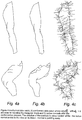
- the results of the conformation process are visualised in Fig. 4 .
- the conformed raw data patches are the input for our method.
- In the middle column of Fig. 4 only the vertices and triangular meshes which are properly fitted to the raw data patches are shown.
- vertex normals are visualised in the right column where the direction of a vertex normal is colour coded.
- the brighter colour means that the vertex normal is pointing towards the observer's view point, and darker coloured normals point away from the observer's view point.
- the vertex normals are orthogonal to the surface it is easy to see that it isn't the case. In fact, it seems the direction of the vertex normals is more or less arbitrary. In the merged result this is largely corrected.
- the shape can be described by as many shape parameters as measured vertices a ⁇ ij k belonging to subcomponent k. But, it is obvious that estimating all possible parameters is unnecessary and useless because most of them are zero or very small compared to the largest parameter. Thus, the number of estimated and used parameters can be limited a priori. In our experiments we estimated just two shape parameters for each subcomponent of each instance to give a very compact description of the body components. The final models (see Fig. 5 ) result from the estimated mean shape combined with the pose specific six shape parameters (two shape parameters per body part). Additionally, the vertex normals were estimated on the basis of an assumed Gouraud shading [9].
- the final parametric model can be used for several purposes, for example, generating a smooth movement by interpolating between different key positions, or simply exaggerating the model shape by varying the shape parameter.
Landscapes
- Engineering & Computer Science (AREA)
- Physics & Mathematics (AREA)
- General Physics & Mathematics (AREA)
- Theoretical Computer Science (AREA)
- Geometry (AREA)
- Public Health (AREA)
- Medical Informatics (AREA)
- Health & Medical Sciences (AREA)
- Biomedical Technology (AREA)
- Data Mining & Analysis (AREA)
- Databases & Information Systems (AREA)
- Software Systems (AREA)
- Pathology (AREA)
- Computer Graphics (AREA)
- Epidemiology (AREA)
- General Health & Medical Sciences (AREA)
- Primary Health Care (AREA)
- Processing Or Creating Images (AREA)
Claims (24)
- Procédé de génération d'un modèle virtuel d'un objet, comprenant l'étape de construction d'un modèle fusionné pour représenter la variation de la forme de l'objet dans une pluralité de configurations, dans lequel :des vecteurs de variation de position sont calculés qui décrivent la variation d'une pluralité de points dans le modèle fusionné à partir de leurs positions moyennes sur toutes les configurations de l'objet ; caractérisé en ce que :un facteur de pondération est attribué aux vecteurs de variation de position, lequel représente une mesure de leur intervalle de confiance de probabilité ;une matrice de covariance pondérée desdits vecteurs est construite pour représenter les variations ;la matrice de covariance pondérée est appliquée par décomposition en valeurs singulières pour obtenir des vecteurs de variation de forme représentant la direction et la grandeur pondérées de variations, en convertissant les vecteurs propres de la matrice factorisée en 3 vecteurs ;de manière que le modèle fusionné décrive comment la forme de l'objet varie en fonction des vecteurs de variation de forme proportionnés par un paramètre de forme ;le modèle fusionné est construit à partir d'un ensemble de données rendu conforme, obtenu en effectuant les étapes suivantes ;l'obtention d'un ensemble de données de plages à partir d'un objet dans une pluralité de configurations, lesquelles données de plages représentent l'objet en définissant une pluralité de sommets, dont les positions sont décrites par des vecteurs ;la transformation des données de plage de chaque configuration à une trame de référence commune ; etl'adaptation des données de plages transformées à un modèle générique, moyennant quoi le modèle virtuel résulte de la forme moyenne estimée combinée aux paramètres de forme spécifiques à la posture.
- Procédé selon la revendication 1, dans lequel les vecteurs de variation de forme sont trouvés en convertissant les vecteurs propres d'une matrice factorisée en 3 vecteurs orthogonaux d'une trame de référence commune pour chacun de la pluralité de points.
- Procédé selon la revendication 1, dans lequel les vecteurs de variation de forme sont trouvés en considérant les variations comme étant limitées à un unique vecteur orthogonal à un axe longitudinal de l'objet.
- Procédé selon une quelconque revendication précédente, dans lequel une fonction est calculée qui met en correspondance les angles d'articulation et le vecteur de gravité avec le paramètre de forme.
- Procédé selon la revendication 4, dans lequel la fonction fournit une relation linéaire.
- Procédé selon la revendication 1, dans lequel le modèle générique est un modèle maillé générique.
- Procédé selon une quelconque revendication précédente, comprenant en outre l'étape d'exécution d'un réassemblage de modèle complet, dans lequel la forme de l'intersection entre deux sous-composants réassemblés est adaptée comme la moyenne de leurs sommets communs.
- Procédé selon une quelconque revendication précédente, dans lequel la forme de l'objet dans le modèle fusionné est en outre proportionné par un paramètre d'exagération.
- Procédé selon la revendication 8, dans lequel le paramètre d'exagération définit un facteur par lequel la grandeur de la déformation modélisée de l'objet est multipliée.
- Procédé selon une quelconque revendication précédente, dans lequel une pluralité d'objets forme un objet composite et les positions relatives des objets sont calculées de manière qu'un modèle combiné puisse être construit pour représenter l'objet composite.
- Procédé selon la revendication 10, dans lequel les objets sont supposés être reliés rigidement par des articulations positionnées au niveau d'une position de début et une position de fin de chaque objet ;
un axe est défini pour chaque objet, qui s'étend d'une position de début telle qu'établie en moyenne sur toutes les configurations à une position de fin telle qu'établie en moyenne sur toutes les configurations ;
le point de fin d'un objet est supposé être correspondant au point de début d'un objet adjacent ; et
un modèle complet de l'objet composite est construit, dans lequel les positions relatives moyennes des objets sont combinées avec un ensemble de configurations spécifique, l'ensemble définissant les configurations spécifiques pour chaque objet dans l'objet composite. - Procédé selon la revendication 11, dans lequel une région d'intersection entre deux sous-composants rigides adjacents définit une région de chevauchement, dont la forme est dérivée comme la forme moyenne.
- Procédé selon la revendication 11 ou la revendication 12, dans lequel l'axe est l'axe principal d'un ellipsoïde qui est adapté au modèle fusionné de l'objet, et les points de début et de fin sont déterminés à partir d'une estimation des points d'intersection les plus proches entre les axes de l'ellipsoïde d'approximation et les ellipsoïdes adaptés aux sommets des objets voisins.
- Procédé selon la revendication 13, dans lequel l'objet composite est une partie d'un corps humain et les objets constituant l'objet composite sont des parties du corps.
- Procédé selon la revendication 14, dans lequel le modèle est utilisé pour représenter la déformation d'un tissu musculaire dans le corps pour créer un modèle virtuel de la manière dont un corps se déforme quand il se déplace.
- Moyen de génération de modèle pour générer un modèle virtuel d'un objet, comprenant des moyens de construction de modèle fusionné pour construire un modèle fusionné adapté pour modéliser la variation de la forme de l'objet dans une pluralité de configurations, dans lequel ;
des vecteurs de variation de position sont calculés, qui décrivent la variation d'une pluralité de points dans le modèle fusionné à partir de leurs positions moyennes sur toutes les configurations de l'objet ; caractérisé en ce que :un facteur de pondération est attribué aux vecteurs de variation de position, lequel représente une mesure de leur intervalle de confiance de probabilité ;une matrice de covariance pondérée desdits vecteurs est construite pour représenter les variations ;la matrice de covariance pondérée est appliquée par décomposition en valeurs singulières pour obtenir des vecteurs de variation de forme représentant la direction et la grandeur pondérées de variations, en convertissant les vecteurs propres de la matrice factorisée en 3 vecteurs ; et de manière que le modèle fusionné décrive comment la forme de l'objet varie en fonction des vecteurs de variation de forme proportionnés par un paramètre de forme ;lesdits moyens de construction de modèle fusionné comprennent des moyens pour obtenir un ensemble de données rendu conforme, lesdits moyens comprenant :des moyens de collecte de données pour obtenir un ensemble de données de plages à partir d'un objet dans une pluralité de configurations, lesquelles données de plages représentent l'objet en définissant une pluralité de sommets, dont les positions sont décrites par des vecteurs ;des moyens de transformation pour transformer les données de plage de chaque configuration à une trame de référence commune ; etdes moyens d'adaptation pour adapter les données de plages transformées à un modèle générique, moyennant quoi le modèle virtuel résulte de la forme moyenne estimée combinée aux paramètres de forme spécifiques à la posture. - Moyen de génération de modèle selon la revendication 16, dans lequel les moyens de construction de modèle fusionné comprennent en outre des moyens de décomposition en valeurs singulières adaptés pour appliquer la matrice de covariance, et des moyens de conversion des vecteurs propres pour convertir les vecteurs propres d'une matrice factorisée en 3 vecteurs orthogonaux d'une trame de référence commune pour chacun de la pluralité de points, de manière à trouver les vecteurs de variation de forme.
- Moyen de génération de modèle selon la revendication 16, dans lequel les moyens de construction de modèle fusionné comprennent en outre des moyens pour obtenir un unique vecteur orthogonal à un axe longitudinal de l'objet, auquel les variations sont limitées.
- Moyen de génération de modèle selon l'une quelconque des revendications 16 à 18, dans lequel le modèle générique est un modèle maillé générique.
- Moyen de génération de modèle selon l'une quelconque des revendications 16 à 19, étant adapté en outre pour effectuer un réassemblage de modèle complet, dans lequel la forme de l'intersection entre deux sous-composants réassemblés est établie comme la moyenne de leurs sommets communs.
- Support de données incorporant des données qui est capable de coopérer avec un appareil informatique pour effectuer le procédé selon l'une quelconque des revendications 1 à 15.
- Support de données incorporant des données qui est capable de coopérer avec un appareil informatique pour former les moyens de génération de modèle selon l'une quelconque des revendications 16 à 20.
- Modèle virtuel d'un objet généré en utilisant le procédé selon l'une quelconque des revendications 1 à 15.
- Modèle virtuel selon la revendication 23, prévu sur un support utilisable par ordinateur.
Applications Claiming Priority (3)
| Application Number | Priority Date | Filing Date | Title |
|---|---|---|---|
| GB0225716 | 2002-11-05 | ||
| GBGB0225716.0A GB0225716D0 (en) | 2002-11-05 | 2002-11-05 | Virtual models |
| PCT/GB2003/004765 WO2004042660A2 (fr) | 2002-11-05 | 2003-11-05 | Modeles virtuels |
Publications (2)
| Publication Number | Publication Date |
|---|---|
| EP1565892A2 EP1565892A2 (fr) | 2005-08-24 |
| EP1565892B1 true EP1565892B1 (fr) | 2017-03-15 |
Family
ID=9947193
Family Applications (1)
| Application Number | Title | Priority Date | Filing Date |
|---|---|---|---|
| EP03810521.9A Expired - Lifetime EP1565892B1 (fr) | 2002-11-05 | 2003-11-05 | Modeles virtuels |
Country Status (5)
| Country | Link |
|---|---|
| US (1) | US7440878B2 (fr) |
| EP (1) | EP1565892B1 (fr) |
| AU (1) | AU2003276457A1 (fr) |
| GB (1) | GB0225716D0 (fr) |
| WO (1) | WO2004042660A2 (fr) |
Families Citing this family (9)
| Publication number | Priority date | Publication date | Assignee | Title |
|---|---|---|---|---|
| GB0225716D0 (en) | 2002-11-05 | 2002-12-11 | Univ Edinburgh | Virtual models |
| TWI235041B (en) * | 2004-12-09 | 2005-07-01 | Univ Tsinghua | Characteristic points automatically identification method for three-dimensional space scanning data of human body |
| US20080158224A1 (en) * | 2006-12-28 | 2008-07-03 | National Tsing Hua University | Method for generating an animatable three-dimensional character with a skin surface and an internal skeleton |
| CN101751695B (zh) * | 2008-12-10 | 2012-05-23 | 中国科学院自动化研究所 | 点云数据的主曲率和主方向估计方法 |
| GB201002855D0 (en) * | 2010-02-19 | 2010-04-07 | Materialise Dental Nv | Method and system for achiving subject-specific, three-dimensional information about the geometry of part of the body |
| US9292967B2 (en) * | 2010-06-10 | 2016-03-22 | Brown University | Parameterized model of 2D articulated human shape |
| US8872852B2 (en) | 2011-06-30 | 2014-10-28 | International Business Machines Corporation | Positional context determination with multi marker confidence ranking |
| EP3671557B1 (fr) * | 2018-12-20 | 2025-03-12 | RaySearch Laboratories AB | Augmentation de données |
| US20210142342A1 (en) * | 2019-11-10 | 2021-05-13 | Zhiqing Cheng | Methods and systems for provisioning digital data to an individual |
Family Cites Families (5)
| Publication number | Priority date | Publication date | Assignee | Title |
|---|---|---|---|---|
| US6229546B1 (en) * | 1997-09-09 | 2001-05-08 | Geosoftware, Inc. | Rapid terrain model generation with 3-D object features and user customization interface |
| US6594538B1 (en) * | 1999-12-10 | 2003-07-15 | General Electric Company | Method for identifying and applying families of part shape variations |
| US6873724B2 (en) * | 2001-08-08 | 2005-03-29 | Mitsubishi Electric Research Laboratories, Inc. | Rendering deformable 3D models recovered from videos |
| US6873718B2 (en) * | 2001-10-12 | 2005-03-29 | Siemens Corporate Research, Inc. | System and method for 3D statistical shape model for the left ventricle of the heart |
| GB0225716D0 (en) | 2002-11-05 | 2002-12-11 | Univ Edinburgh | Virtual models |
-
2002
- 2002-11-05 GB GBGB0225716.0A patent/GB0225716D0/en not_active Ceased
-
2003
- 2003-11-05 EP EP03810521.9A patent/EP1565892B1/fr not_active Expired - Lifetime
- 2003-11-05 AU AU2003276457A patent/AU2003276457A1/en not_active Abandoned
- 2003-11-05 WO PCT/GB2003/004765 patent/WO2004042660A2/fr not_active Ceased
-
2005
- 2005-05-05 US US11/123,699 patent/US7440878B2/en not_active Expired - Lifetime
Non-Patent Citations (1)
| Title |
|---|
| None * |
Also Published As
| Publication number | Publication date |
|---|---|
| EP1565892A2 (fr) | 2005-08-24 |
| AU2003276457A8 (en) | 2004-06-07 |
| WO2004042660A3 (fr) | 2004-07-29 |
| WO2004042660A2 (fr) | 2004-05-21 |
| GB0225716D0 (en) | 2002-12-11 |
| US20050278156A1 (en) | 2005-12-15 |
| AU2003276457A1 (en) | 2004-06-07 |
| US7440878B2 (en) | 2008-10-21 |
Similar Documents
| Publication | Publication Date | Title |
|---|---|---|
| Allen et al. | Articulated body deformation from range scan data | |
| CN113421328B (zh) | 一种三维人体虚拟化重建方法及装置 | |
| Singh et al. | Skinning Characters using Surface Oriented Free-Form Deformations. | |
| EP2710557B1 (fr) | Suivi de mouvement articulé rapide | |
| EP0621969B1 (fr) | Procede infographique implante en memoire et appareil infographique | |
| US7307633B2 (en) | Statistical dynamic collisions method and apparatus utilizing skin collision points to create a skin collision response | |
| US7515155B2 (en) | Statistical dynamic modeling method and apparatus | |
| KR100530812B1 (ko) | 아바타 애니메이션을 위한 웨이브렛-기반 얼굴 움직임 캡쳐 | |
| Kallmann | Analytical inverse kinematics with body posture control | |
| US20080071507A1 (en) | Methods and apparatus for capturing and rendering dynamic surface deformations in human motion | |
| CN106023288A (zh) | 一种基于图像的动态替身构造方法 | |
| EP1565892B1 (fr) | Modeles virtuels | |
| Starck et al. | Animated statues | |
| Colmenarez et al. | Facial analysis from continuous video with applications to human-computer interface | |
| Hassanpour et al. | Delaunay triangulation based 3d human face modeling from uncalibrated images | |
| Han et al. | Representing multifigure anatomical objects | |
| KR102945265B1 (ko) | 라플라시안 좌표를 이용하는 디테일 3차원 객체 복원 방법 및 장치 | |
| Zhang et al. | Synthesis of 3D faces using region‐based morphing under intuitive control | |
| Zhang et al. | Adaptation-based individualized face modeling for animation using displacement map | |
| EP1636759A1 (fr) | Procede et appareil de collisions dynamiques statistiques | |
| Allen | Learning body shape models from real-world data | |
| Park et al. | An efficient virtual aesthetic surgery model based on 2D color photograph | |
| Perriollat et al. | A single directrix quasi-minimal model for paper-like surfaces | |
| Zhang et al. | From range data to animated anatomy-based faces: a model adaptation method | |
| Zhang et al. | Animating Scanned Human Models |
Legal Events
| Date | Code | Title | Description |
|---|---|---|---|
| PUAI | Public reference made under article 153(3) epc to a published international application that has entered the european phase |
Free format text: ORIGINAL CODE: 0009012 |
|
| 17P | Request for examination filed |
Effective date: 20050601 |
|
| AK | Designated contracting states |
Kind code of ref document: A2 Designated state(s): AT BE BG CH CY CZ DE DK EE ES FI FR GB GR HU IE IT LI LU MC NL PT RO SE SI SK TR |
|
| AX | Request for extension of the european patent |
Extension state: AL LT LV MK |
|
| DAX | Request for extension of the european patent (deleted) | ||
| GRAP | Despatch of communication of intention to grant a patent |
Free format text: ORIGINAL CODE: EPIDOSNIGR1 |
|
| INTG | Intention to grant announced |
Effective date: 20160920 |
|
| GRAS | Grant fee paid |
Free format text: ORIGINAL CODE: EPIDOSNIGR3 |
|
| GRAA | (expected) grant |
Free format text: ORIGINAL CODE: 0009210 |
|
| AK | Designated contracting states |
Kind code of ref document: B1 Designated state(s): AT BE BG CH CY CZ DE DK EE ES FI FR GB GR HU IE IT LI LU MC NL PT RO SE SI SK TR |
|
| REG | Reference to a national code |
Ref country code: CH Ref legal event code: EP Ref country code: GB Ref legal event code: FG4D |
|
| REG | Reference to a national code |
Ref country code: IE Ref legal event code: FG4D |
|
| REG | Reference to a national code |
Ref country code: AT Ref legal event code: REF Ref document number: 876275 Country of ref document: AT Kind code of ref document: T Effective date: 20170415 |
|
| REG | Reference to a national code |
Ref country code: DE Ref legal event code: R096 Ref document number: 60350013 Country of ref document: DE |
|
| REG | Reference to a national code |
Ref country code: NL Ref legal event code: MP Effective date: 20170315 |
|
| PG25 | Lapsed in a contracting state [announced via postgrant information from national office to epo] |
Ref country code: GR Free format text: LAPSE BECAUSE OF FAILURE TO SUBMIT A TRANSLATION OF THE DESCRIPTION OR TO PAY THE FEE WITHIN THE PRESCRIBED TIME-LIMIT Effective date: 20170616 Ref country code: FI Free format text: LAPSE BECAUSE OF FAILURE TO SUBMIT A TRANSLATION OF THE DESCRIPTION OR TO PAY THE FEE WITHIN THE PRESCRIBED TIME-LIMIT Effective date: 20170315 |
|
| REG | Reference to a national code |
Ref country code: AT Ref legal event code: MK05 Ref document number: 876275 Country of ref document: AT Kind code of ref document: T Effective date: 20170315 |
|
| PG25 | Lapsed in a contracting state [announced via postgrant information from national office to epo] |
Ref country code: SE Free format text: LAPSE BECAUSE OF FAILURE TO SUBMIT A TRANSLATION OF THE DESCRIPTION OR TO PAY THE FEE WITHIN THE PRESCRIBED TIME-LIMIT Effective date: 20170315 Ref country code: BG Free format text: LAPSE BECAUSE OF FAILURE TO SUBMIT A TRANSLATION OF THE DESCRIPTION OR TO PAY THE FEE WITHIN THE PRESCRIBED TIME-LIMIT Effective date: 20170615 |
|
| PG25 | Lapsed in a contracting state [announced via postgrant information from national office to epo] |
Ref country code: NL Free format text: LAPSE BECAUSE OF FAILURE TO SUBMIT A TRANSLATION OF THE DESCRIPTION OR TO PAY THE FEE WITHIN THE PRESCRIBED TIME-LIMIT Effective date: 20170315 |
|
| PG25 | Lapsed in a contracting state [announced via postgrant information from national office to epo] |
Ref country code: EE Free format text: LAPSE BECAUSE OF FAILURE TO SUBMIT A TRANSLATION OF THE DESCRIPTION OR TO PAY THE FEE WITHIN THE PRESCRIBED TIME-LIMIT Effective date: 20170315 Ref country code: IT Free format text: LAPSE BECAUSE OF FAILURE TO SUBMIT A TRANSLATION OF THE DESCRIPTION OR TO PAY THE FEE WITHIN THE PRESCRIBED TIME-LIMIT Effective date: 20170315 Ref country code: SK Free format text: LAPSE BECAUSE OF FAILURE TO SUBMIT A TRANSLATION OF THE DESCRIPTION OR TO PAY THE FEE WITHIN THE PRESCRIBED TIME-LIMIT Effective date: 20170315 Ref country code: RO Free format text: LAPSE BECAUSE OF FAILURE TO SUBMIT A TRANSLATION OF THE DESCRIPTION OR TO PAY THE FEE WITHIN THE PRESCRIBED TIME-LIMIT Effective date: 20170315 Ref country code: ES Free format text: LAPSE BECAUSE OF FAILURE TO SUBMIT A TRANSLATION OF THE DESCRIPTION OR TO PAY THE FEE WITHIN THE PRESCRIBED TIME-LIMIT Effective date: 20170315 Ref country code: CZ Free format text: LAPSE BECAUSE OF FAILURE TO SUBMIT A TRANSLATION OF THE DESCRIPTION OR TO PAY THE FEE WITHIN THE PRESCRIBED TIME-LIMIT Effective date: 20170315 Ref country code: AT Free format text: LAPSE BECAUSE OF FAILURE TO SUBMIT A TRANSLATION OF THE DESCRIPTION OR TO PAY THE FEE WITHIN THE PRESCRIBED TIME-LIMIT Effective date: 20170315 |
|
| REG | Reference to a national code |
Ref country code: FR Ref legal event code: PLFP Year of fee payment: 15 |
|
| PG25 | Lapsed in a contracting state [announced via postgrant information from national office to epo] |
Ref country code: PT Free format text: LAPSE BECAUSE OF FAILURE TO SUBMIT A TRANSLATION OF THE DESCRIPTION OR TO PAY THE FEE WITHIN THE PRESCRIBED TIME-LIMIT Effective date: 20170717 |
|
| REG | Reference to a national code |
Ref country code: DE Ref legal event code: R097 Ref document number: 60350013 Country of ref document: DE |
|
| PLBE | No opposition filed within time limit |
Free format text: ORIGINAL CODE: 0009261 |
|
| STAA | Information on the status of an ep patent application or granted ep patent |
Free format text: STATUS: NO OPPOSITION FILED WITHIN TIME LIMIT |
|
| PG25 | Lapsed in a contracting state [announced via postgrant information from national office to epo] |
Ref country code: DK Free format text: LAPSE BECAUSE OF FAILURE TO SUBMIT A TRANSLATION OF THE DESCRIPTION OR TO PAY THE FEE WITHIN THE PRESCRIBED TIME-LIMIT Effective date: 20170315 |
|
| 26N | No opposition filed |
Effective date: 20171218 |
|
| PG25 | Lapsed in a contracting state [announced via postgrant information from national office to epo] |
Ref country code: SI Free format text: LAPSE BECAUSE OF FAILURE TO SUBMIT A TRANSLATION OF THE DESCRIPTION OR TO PAY THE FEE WITHIN THE PRESCRIBED TIME-LIMIT Effective date: 20170315 |
|
| PG25 | Lapsed in a contracting state [announced via postgrant information from national office to epo] |
Ref country code: MC Free format text: LAPSE BECAUSE OF FAILURE TO SUBMIT A TRANSLATION OF THE DESCRIPTION OR TO PAY THE FEE WITHIN THE PRESCRIBED TIME-LIMIT Effective date: 20170315 |
|
| PG25 | Lapsed in a contracting state [announced via postgrant information from national office to epo] |
Ref country code: LU Free format text: LAPSE BECAUSE OF NON-PAYMENT OF DUE FEES Effective date: 20171105 |
|
| REG | Reference to a national code |
Ref country code: BE Ref legal event code: MM Effective date: 20171130 |
|
| REG | Reference to a national code |
Ref country code: IE Ref legal event code: MM4A |
|
| PG25 | Lapsed in a contracting state [announced via postgrant information from national office to epo] |
Ref country code: IE Free format text: LAPSE BECAUSE OF NON-PAYMENT OF DUE FEES Effective date: 20171105 |
|
| PG25 | Lapsed in a contracting state [announced via postgrant information from national office to epo] |
Ref country code: BE Free format text: LAPSE BECAUSE OF NON-PAYMENT OF DUE FEES Effective date: 20171130 |
|
| PG25 | Lapsed in a contracting state [announced via postgrant information from national office to epo] |
Ref country code: HU Free format text: LAPSE BECAUSE OF FAILURE TO SUBMIT A TRANSLATION OF THE DESCRIPTION OR TO PAY THE FEE WITHIN THE PRESCRIBED TIME-LIMIT; INVALID AB INITIO Effective date: 20031105 |
|
| PG25 | Lapsed in a contracting state [announced via postgrant information from national office to epo] |
Ref country code: CY Free format text: LAPSE BECAUSE OF NON-PAYMENT OF DUE FEES Effective date: 20170315 |
|
| PG25 | Lapsed in a contracting state [announced via postgrant information from national office to epo] |
Ref country code: TR Free format text: LAPSE BECAUSE OF FAILURE TO SUBMIT A TRANSLATION OF THE DESCRIPTION OR TO PAY THE FEE WITHIN THE PRESCRIBED TIME-LIMIT Effective date: 20170315 |
|
| PGFP | Annual fee paid to national office [announced via postgrant information from national office to epo] |
Ref country code: DE Payment date: 20211124 Year of fee payment: 19 Ref country code: GB Payment date: 20211123 Year of fee payment: 19 Ref country code: FR Payment date: 20211123 Year of fee payment: 19 |
|
| PGFP | Annual fee paid to national office [announced via postgrant information from national office to epo] |
Ref country code: CH Payment date: 20211122 Year of fee payment: 19 |
|
| REG | Reference to a national code |
Ref country code: DE Ref legal event code: R119 Ref document number: 60350013 Country of ref document: DE |
|
| REG | Reference to a national code |
Ref country code: CH Ref legal event code: PL |
|
| GBPC | Gb: european patent ceased through non-payment of renewal fee |
Effective date: 20221105 |
|
| PG25 | Lapsed in a contracting state [announced via postgrant information from national office to epo] |
Ref country code: LI Free format text: LAPSE BECAUSE OF NON-PAYMENT OF DUE FEES Effective date: 20221130 Ref country code: CH Free format text: LAPSE BECAUSE OF NON-PAYMENT OF DUE FEES Effective date: 20221130 |
|
| PG25 | Lapsed in a contracting state [announced via postgrant information from national office to epo] |
Ref country code: GB Free format text: LAPSE BECAUSE OF NON-PAYMENT OF DUE FEES Effective date: 20221105 Ref country code: DE Free format text: LAPSE BECAUSE OF NON-PAYMENT OF DUE FEES Effective date: 20230601 |
|
| PG25 | Lapsed in a contracting state [announced via postgrant information from national office to epo] |
Ref country code: FR Free format text: LAPSE BECAUSE OF NON-PAYMENT OF DUE FEES Effective date: 20221130 |