-
The present invention is directed to a method to increase the stability of double-stranded
linear polynucleotides in the presence of exonucleases. In addition, the
invention provides double-stranded linear polynucleotides stabilized against
exonucleolytic attack, as well as compositions containing such stabilized double-stranded
linear polynucleotides.
-
Exonucleases are enzymes of the hydrolase class that catalyze the hydrolysis of
terminal bonds of deoxyribonucleotide or ribonucleotide chains, releasing
mononucleotides. Exonucleolytic activity is found in a number of DNA
(desoxyribonucleicacid) polymerases which are required to maintain the integrity
of the genome during processes such as DNA replication, DNA repair, translesion
DNA synthesis, DNA recombination, cell-cycle control and DNA-damage-checkpoint
function. Many polymerases (for instance, pols γ, δ and ε) contain a 3'-5'
exonuclease enzymatic activity in the DNA polymerase polypeptide. This
enzymatic activity can proofread for the polymerase, and enhances the accuracy of
its DNA synthesis by excising incorrectly polymerized nucleotides. In addition,
further autonomous 3'-5' exonucleases are known as well as 5'-3' exonucleases
(Shevelev, I.V. and Hübscher, U., Nature Reviews Molecular Cell Biology (2002) 3:
364-376). Exonucleases additionally differ with respect to their specificity. Thus,
some exonucleases specifically degrade either single-stranded (ss) or double-stranded
(ds) DNA, and some exonucleases are capable of degrading both types.
Table 1 gives an overview regarding the exonucleases of Escheichia coli (E. coli).
| E. coli exonucleases |
| Name | Gene | Polarity | DNA substrate | Function |
| ExoI | sbcB | 3'-5' | ss | Repair, recombination |
| ExoII | polA | 3'-5' | ss | Replication, repair |
| ExoIII | xthA | 3'-5' | ds | Repair |
| ExoIV | | | ss |
| ExoV | recB, recC, recD | 3'-5' 5'-3' | ss / ds | Repair, recombination |
| ExoVI | polA | 5'-3' | ds | Repair |
| ExoVII | xseA, xseB | 3'-5' 5'-3' | ss | Repair, recombination |
| ExoVIII | recE | 5'-3' | ds | Recombination |
| ExoIX | xni | 3'-5' | ss (ds) | Repair |
| ExoX | yobC | 3'-5' | ss (ds) | Repair |
| ε subunit of PolIII | dnaQ | 3'-5' | ss | Replication |
| PolII | polB | 3'-5' | ss | Replication, repair |
| RecJ | recJ | 5'-3' | ss | Repair, recombination |
| SbcCD | sbcC, sbcD | ? | ds | Recombination |
| RNaseT | mt | 3'-5' | ss | Repair, processing of tRNA |
-
In E. coli, the major proofreading 3'-5' exonuclease activity has been attributed to
the ε subunit of PolIII whereas the major 5'-3' exonuclease activity has been
attributed to ExoVII. Remarkably, ExoV has an ATP (adenosinetriphosphate)
dependent exonucleolytic activity on ss and ds DNA, and an ATP independent
endonucleolytic activity on ss DNA.
Background art
-
Degradation of linear DNA molecules is a widely known and frequent problem
when applying certain methods of molecular biology. For example, cell-free DNA-dependent
in vitro transcription and translation works quite well in practice with
respect to the expression of circular double helix DNA and with respect to the
expression of long linear DNA. Attempts at expressing shorter linear DNA
fragments had only limited success. The smaller the DNA that is used the more
difficult it was to obtain appreciable amounts of the gene product. It was
established that these difficulties were due to the presence of exonucleases in the
cell-free extracts. Hence, it was shown that ExoV is responsible for the degradation
of linear DNA when S30 lysates of E. coli were transcribed and translated in vitro.
-
ExoV (exonuclease V) is composed of three subunits (the gene products of recB,
recC, redD). A previous approach to increase the stability of linear DNA molecules
in cell-free E. coli lysates was to mutate the genes encoding the ExoV subunits.
Yang, H.L. et al., (1980) Proc Natl Acad Sci USA 77:7029-7033 describe an
improved protein synthesis starting from linear DNA templates using the E. coli
strain CF300 after deletion of ExoV (elimination of the genes recB, recC; strain
recB21). Jackson, M. er al., FEBS Lett. (1983) 163:221-224 describe the preparation
of an improved in vitro coupled transcription-translation system from E. coli
strains lacking ExoV. Bassett, C.L and Rawson, J.R. J Bacteriol (1983) 156:1359-1362
additionally mutated the RNase and polynucleotide phosphorylase genes (rna-19,
pnp-7) in the recB21 strain (strain CLB7) and achieved a significantly higher
protein expression with linear DNA templates after a one hour incubation period.
Lesley, S.A. et al., J Biol Chem (1991) 266:2632-2638 used an ExoV-deficient recD
BL21 strain which was referred to as the SL119 strain and describe for the first time
the method of in vitro protein synthesis starting from PCR-generated templates.
Lysates of the strain SL119 are commercially available (Promega) for in vitro
transcription and translation using linear templates.
-
A shortcoming of the mutational measures described above is that the E. coli
mutants mentioned grow more slowly than the wildtype and also the lysates
obtained from these strains have a significantly poorer rate of synthesis. Apparently,
ExoV plays an important role in the metabolism of the bacteria. Hence, when
producing cell-free extracts for coupled transcription and translation in vitro it
appears to be important to use lysates in which exonucleases are present.
-
Another conceivable measure to protect linear DNA against exonucleolytic
degradation is to modify the nucleic acids either by covalently attaching protecting
grops to the nucleotides at both ends of the linear DNA or by incorporating certain
modified nucleotides. Single-stranded DNA or RNA molecules can be protected by
protecting the ends with alkyl groups and by modifying the bases (Pandolfi, D. et
al., (1999) Nucleosides Nucleotides. 18:2051-2069). Verheijen, J.C. et al. (2000)
Bioorg Med Chem Lett 10:801-804 show an increased stability of single-stranded
DNA molecules by protecting the ends with 4-hydroxy-N-acetylprolinol, L-serinol
or by 3'-3'-phosphodiester bonds. Kandimalla, E.R. et al., Nucleic Acids Res (1997)
25:370-378 describe mixed backbone oligonucleotides containing 2'-5'-ribo- and 3'-5'-deoxyribonucleotide
segments. Pure or mixed phosphorothioate bonds and
chemically modified oligonucleotides e.g. methylphosphonates and
phosphoramidates are more stable and are degraded more slowly by exonucleases.
Tohda, H. et al., J Biotechnol (1994) 34:61-69 show that RNA containing
phosphorothioates is more stable towards nucleases and therefore has a higher
translation efficiency. However, on the whole only small amounts of protein could
be produced. Tang, J.Y. et al., Nucleic Acids Res (1993) 21:2729-2735 describe
oligonucleotides that have hairpin loop structures at their 3' ends, and show
increased resistance to degradation by exonucleases. Hirao, I. et al., FEBS Lett
(1993) 321:169-172 show that the hairpin, which the DNA fragment d(GCGAAGC)
forms, is extremely resistant to nucleases from E. coli extracts. Yoshizawa, S. et al.,
Nucleic Acids Res (1994) 22:2217-2221 describe that a stabilization of the 3' end of
mRNA by hybridization with the same hairpin results in a 200-fold increase in the
efficiency of in vitro translation with E. coli extracts. Good, L and Nielsen, P.E. Proc
Natl Acad Sci USA (1998) 95:2073-2076 show that synthetic molecules containing
bases that are coupled to a peptide backbone (peptide nucleic acid, PNA) are
resistant to hydrolytic cleavage in E. coli extracts and can be used as anti-sense
molecules. Burdick, G. and Emlen, W. J Immunol (1985) 135:2593-2597 describe
that in DNA anti-DNA immunocomplexes bound IgG molecules can protect DNA
from nucleolytic degradation.
-
WO 90/15065 discloses oligonucleotides with phosphoramidite linkages at the 3'
end and the 5' end. WO 94/16090 discloses the use of exonuclease-resistant single-stranded
DNA oligonucleotides containing nucleotide derivatives in which one or
two of the non-bridging oxygens in the phosphate moiety of a nucleotide has been
replaced with a sulfur-containing group (e.g. a phosphothioate), an alkyl group
(e.g. a methyl or ethyl group), a nitrogen-containing group (e.g. an amine), or a
selenium-containing group. WO 00/40592 discloses exonuclease-resistant nucleic
acids modified by replacing at the 3' end the hydrogen atom at the 3' or the 2'
position on the sugar molecule by a chemical moiety such as a butyl or a butanol. In
addition, butyl blocking groups are disclosed for the 5' end. WO 03/072051
discloses fluorescence energy transfer labeled oligonucleotides that include a 3'-5'
exonuclease resistant quencher domain. EP 0 431 523 discloses a nuclease resistant
nucleotide compound which contains an intercalating agent, a
methylthiophosphate, a carbodiimide, an N-hydroxybenzotriazole, isourea, a
polypeptide or a protein. EP 0 967 274 describes methods for preparing dumbbell-shaped
linear double-stranded DNA molecules with increased stability towards
exonucleolytic activity. US 5,245,022 dicloses nuclease resistant oligonucleotides
with a diol such as tetraethylene glycol at either or both termini.
-
Cell-free in vitro expression systems but without strategies for protection of linear
template DNA against exonucleolytic attack are described in the prior art. In
US 5,571,690 Hecht describes a method for the cell-free synthesis of a protein
starting with a template which was generated in a PCR reaction. In this method the
entire gene sequence including the phage promoter region is amplified from a
plasmid. After in vitro transcription a lysate from rabbit reticulocytes is used for
translation. With this method it was possible to produce 57 µg/ml of a protein using
mRNA which was modified after transcription with a 5'CAP. Martemyanov, K.A. et
al., FEBS Lett (1997) 414:268-270 use an S30 extract from E. coli for the cell-free
synthesis of a protein starting with a template which was generated in a 2-step PCR
reaction. In this method the target gene is firstly amplified in a PCR reaction with
the aid of two gene-specific oligonucleotide primers and subsequently subjected to
a second PCR reaction in which a so-called megaprimer is used to fuse the T7
promoter and the ribosomal binding site to the amplified gene. It was however only
possible to produce radioactively detectable amounts of protein. Yang, J. et al., J
Bacteriol (2000) 182:295-302 use an S30 extract from E. coli to demonstrate the
cell-free synthesis of a protein starting with a template which was generated in a
PCR reaction. It was only possible in this method to produce radioactively
detectable amounts of protein. Nakano, H. et al., (1999) Biotechnol Bioeng 64:194-199
use an S30 extract from E. coli in a hollow fibre reactor to at least produce 80
µg/ml protein reaction mixture starting with a template which was generated in a
PCR reaction. US 6,027,913 discloses an extract from reticulocytes for the cell-free
synthesis of a protein starting with a template which was generated in a single step
PCR reaction. In this method the T7 promoter and the ribosomal binding site are
fused to the target gene. Even with this method only small amounts of protein were
produced.
-
Although eukaryotic lysates from rabbit reticulocytes are relatively nuclease-free, it
is a shortcoming that these lysates cannot be produced economically in large
amounts. They only allow very small protein yields. The same applies to lysates
from wheat germs which either have prepared in a laborious process or they
otherwise may be strongly contaminated with translation-inhibiting factors.
-
In contrast, E. coli lysates yield much larger amounts of protein. However, the
described methods for preparing lysates from E. coli only allow relatively short
reaction periods of up to about one hour with linear DNA templates since
afterwards these DNA templates are completely degraded by the exonucleases
contained in the lysate. The lysates obtained from E. coli exonuclease mutants (i.e.
exonuclease-deficient strains) have a significantly poorer synthesis performance
than comparable wildtype strains such as, e.g. the A19 strain. Methods for
protecting mRNA have the disadvantage that firstly an in vitro transcription has to
be carried out before the protected mRNA can be added to the lysate. This in turn
does not permit a coupled reaction and a continuous RNA synthesis. Methods for
protecting RNA are described in Tohda, H. et al., J Biotechnol (1994) 34:61-69,
Yoshizawa, S. et al., Nucleic Acids Res(1994) 22:2217-2221.
-
EP 1 251 168 discloses methods for improving the stability of linear DNA in cell-free
in vitro transcription and translation systems. The document discloses that the
yield of protein expressed in the cell-free expression system can be increased by
adding unspecific linear DNA to the exonuclease-containing lysates.
-
It is also known to the skilled artisan that DNA-binding proteins or DNA-binding
protein complexes protect the DNA to which they bind to. Wu, C. Nature (1985)
317:84-87 describes an exonuclease protection assay on free linear DNA for
detecting sequence-specific DNA-binding proteins. The assay method was used to
fractionate from a crude extract the protein factor that is bound constitutively to a
heat-shock gene TATA box region in native chromatin of Drosophila cells.
However, the protection assay in the cited document (as well as numerous other
DNAse protection assays that are documented in the literature) was aimed at
locating the boundaries of protein-binding on DNA.
-
The the methods of the state of the art have certain disadvantages. Therefore, the
problem solved by the present invention is to provide an alternative method for
producing a double-stranded polynucleotide, that is to say a double-stranded DNA,
that is stabilized against exonucleolytic attack. The inventors have unexpectedly
found that adding to both ends of the double-stranded linear DNA a target
sequence for a DNA-binding protein the double-stranded linear DNA with the two
added target sequences has an increased stability against exonucleolytic attack when
contacted with the DNA-binding protein.
-
As discussed above, such a stabilized double-stranded DNA (polynucleotide)
presents a particular advantage when used as a template DNA in cell-free
expression systems, that is to say in a cell-free reaction mixture for coupled
transcription and translation. However, further advantageous applications of a
stabilized double-stranded polynucleotide according to the invention are possible.
Summary of the invention
-
Therefore, a first aspect of the invention is a method to produce a double-stranded
linear polynucleotide stabilized against exonucleolytic attack, comprising the steps
of (i) providing a single- or double-stranded polynucleotide; (ii) providing a first
single-stranded oligonucleotide consisting of (a) a 3'-terminal nucleotide sequence
of 7 to 25 nucleotides complementary to the nucleotide sequence at the 3'-end of
the polynucleotide, (b) a first operator adjacent to (a), (c) a first 5'-terminal
nucleotide sequence adjacent to (b) and consisting of 1 to 15 nucleotides, and a
second single-stranded oligonucleotide consisting of (d) a 3'-terminal nucleotide
sequence of 7 to 25 nucleotides identical to the nucleotide sequence at the 5'-end of
the polynucleotide, (e) a second operator adjacent to (d), (f) a second 5'-terminal
nucleotide sequence adjacent to (e) and consisting of 1 to 15 nucleotides; (iii)
providing an amplification reaction mixture and adding to the amplification
reaction mixture the polynucleotide and the first and the second single-stranded
oligonucleotide primer; (iv) annealing in the resulting mixture of step (iii) the first
and/or the second single-stranded oligonucleotide to the polynucleotide; (v)
amplifying the polynucleotide by means of the polymerase chain reaction thereby
producing a double-stranded linear polynucleotide; (vi) providing a first agent
capable of binding to the operator of step (ii) (b) and a second agent capable of
binding to the operator of step (ii) (e) and contacting the double-stranded linear
polynucleotide of step (v) with both, the first agent capable of binding to the
operator of step (ii) (b) and the second agent capable of binding to the operator of
step (ii) (e), whereby each of the first and the second agent capable of binding to an
operator is selected from the group consisting of (A) a DNA-binding protein, (B) a
DNA-binding protein complex, (C) a DNA-binding protein or a DNA-binding
protein complex and a cofactor binding to the DNA-binding protein or the DNA-binding
protein complex, thereby producing a double-stranded linear
polynucleotide stabilized against exonucleolytic attack. Another aspect of the
present invention is a double-stranded linear polynucleotide stabilized against
exonucleolytic attack, obtainable by the method according to the invention and
mentioned above. Another aspect of the present invention is a composition
comprising an aequous solution containing an exonuclease and a double-stranded
linear polynucleotide stabilized against exonucleolytic attack, obtainable by the
method according to the invention and mentioned above.
Detailed description
-
As used herein, the term "repressor" refers to molecules which act to inhibit the
expression of a target structural gene by binding to a specific operator functionally
linked to the target structural gene, and the term "repressor gene" refers to a gene
which codes for the repressor molecule. The term "operator" as used herein refers
to a specific site on a nucleic acid at which a repressor specifically binds, such
specific binding blocking the expression of an associated structural gene. Typically,
repressors act by preventing the transcription of a structural gene into mRNA by
blocking the attachment of RNA polymerase to the nucleic acid. Therefore, when
repressor molecules are not present, RNA polymerase can bind to nucleic acid and
initiate transcription, and, when repressor molecules are present, the RNA
polymerase is prevented from binding to the nucleic acid, and transcription, and
therefore expression, is effectively blocked. According to the invention, a preferred
repressor is selected from the group consisting of (A) a DNA-binding protein, (B) a
DNA-binding protein complex, and (C) a DNA-binding protein or a DNA-binding
protein complex and a cofactor binding to the DNA-binding protein or the DNA-binding
protein complex. Binding of the repressor to the operator may be increased
when a cofactor binds to the repressor. Such a cofactor is known to the person
skilled in the art as a corepressor or an anti-inducer. An example therefor is
orthonitrophenylfucoside binding to the E. coli Lac repressor (Bell, C.E. and Lewis,
M. Curr Opin Struct Biol (2001) 11:19-25). Another example is hypoxanthine
binding to the E. coli purine repressor. A repressor may be bound by more than one
cofactor. An example therefor is hypoxanthine and guanine binding to the E. coli
purine repressor (Choi, K.Y. and Zalkin, H. J Bacteriol (1992) 174:6207-6214).
-
It is understood that the term "repressor" also comprises a variant, by way of amino
acid addition, deletion or exchange, of the repressor. In case the repressor does not
consist of a single DNA-binding protein but is a DNA-binding protein complex, the
variant therof contains an amino acid addition, deletion or exchange in at least one
subunit of the complex. It is also understood that the variant remains capable of
operator binding.
-
Similarly, the term "operator" comprises a variant, by way of nucleotide addition,
deletion or exchange, of the operator. It is understood that the variation is such that
the binding of the repressor to the operator remains possible.
-
As used herein, the term "oligonucleotide" is used for a DNA molecule, with up to
100 nucleotides in length. The term "polynucleotide" is used for a DNA molecule
with more than 100 nucleotides in length.
-
The terms "to amplify", "amplifying" and "amplification" are understood to imply
the use of the polymerase chain reaction (PCR). PCR is an in vitro method for
producing large amounts of specific DNA or RNA fragments of defined length and
sequence from small amounts of short oligonucleotide flanking sequences
(primers). The essential steps include thermal denaturation of the double-stranded
target molecules, annealing of the primers to their complementary sequences, and
extension of the annealed primers by enzymatic synthesis with DNA polymerase.
Methods to perform PCR in order to amplify a nucleic acid as well as amplification
reaction mixtures are well known to the person skilled in the art and include the
teachings of US 4,683,195 as well as various other publications such as Sambrook,
Fritsch & Maniatis, Molecular Cloning, A Laboratory Manual, 3rd edition, CSHL
Press, 2001.
-
A first aspect of the present invention is a method to produce a double-stranded
linear polynucleotide stabilized against exonucleolytic attack, comprising the steps
of (i) providing a single- or double-stranded polynucleotide; (ii) providing a first
single-stranded oligonucleotide consisting of (a) a 3'-terminal nucleotide sequence
of 7 to 25 nucleotides complementary to the nucleotide sequence at the 3'-end of
the polynucleotide, (b) a first operator adjacent to (a), (c) a first 5'-terminal
nucleotide sequence adjacent to (b) and consisting of 1 to 15 nucleotides, and a
second single-stranded oligonucleotide consisting of (d) a 3'-terminal nucleotide
sequence of 7 to 25 nucleotides identical to the nucleotide sequence at the 5'-end of
the polynucleotide, (e) a second operator adjacent to (d), (f) a second 5'-terminal
nucleotide sequence adjacent to (e) and consisting of 1 to 15 nucleotides; (iii)
providing an amplification reaction mixture and adding to the amplification
reaction mixture the polynucleotide and the first and the second single-stranded
oligonucleotide primer; (iv) annealing in the resulting mixture of step (iii) the first
and/or the second single-stranded oligonucleotide to the polynucleotide; (v)
amplifying the polynucleotide by means of the polymerase chain reaction thereby
producing a double-stranded linear polynucleotide; (vi) providing a first agent
capable of binding to the operator of step (ii) (b) and a second agent capable of
binding to the operator of step (ii) (e) and contacting the double-stranded linear
polynucleotide of step (v) with both, the first agent capable of binding to the
operator of step (ii) (b) and the second agent capable of binding to the operator of
step (ii) (e), whereby each of the first and the second agent capable of binding to an
operator is selected from the group consisting of (A) a DNA-binding protein, (B) a
DNA-binding protein complex, (C) a DNA-binding protein or a DNA-binding
protein complex and a cofactor binding to the DNA-binding protein or the DNA-binding
protein complex, thereby producing a double-stranded linear
polynucleotide stabilized against exonucleolytic attack.
-
Thus, the first and the second oligonucleotide represent a pair of primers which are
used to amplify the polynucleotide. Essentially, by means of the amplification both
termini of the polynucleotide are extended by the addition of an operator sequence
and a further terminal sequence (comprising 1 to 15 nucleotides) to each end.
Selective hybridization of the two oligonucleotides to the polynucleotide in the
course of the PCR process is mediated by the 3'-terminal nucleotide sequences of
(a) and/or (d) in step (ii). That is to say, the 3'-terminal nucleotide sequences of (a)
and/or (d) in step (ii) hybridize to the polynucleotide. When annealing for the first
time the remaining portions of any oligonucleotide, i.e. the operator and the 5'-terminal
nucleotide sequence will not hybridize. In the case amplification starts
with a single-stranded polynucleotide, following completion of the second PCR
cycle, the remaining portions of both oligonucleotides will form the termini of the
extended template.
-
A well-known example for binding of a repressor to an operator is found in the Lac
operon of E. coli. The Lac operon encodes in three consecutive reading frames three
proteins involved in the metabolism of lactose (glucose-galactose disaccharide): β-galactosidase
(also called LacZ) involved in hydrolyzing lactose to form glucose and
galactose; a permease that allows lactose to enter cell; and a transacetylase that
modifies lactose-like compounds. The Lac operon mRNA synthesis is controlled by
a promoter domain at the 5' end. In the situation where no lactose is present,
transcription of the operon is blocked by the Lac repressor, also known as LacI, a
37-kDa protein with high affinity for a specific DNA sequence, that is to say the Lac
operator present in the promoter. The Lac repressor is synthesized by the LacI gene
present elsewhere in the E. coli genome. The operator site of the lac operon has
been extensively studied. The nucleotide sequence of the operator site shows a
nearly perfect inverted repeat, indicating that the DNA in this region has an
approximate twofold axis of symmetry. Symmetry in the operator site usually
corresponds to symmetry in the repressor protein that binds the operator site.
-
In the E. coli cell the lac repressor protein in the absence of lactose binds to the
operator and blocks transcription. The lac repressor can exist as a dimer of 37 kDa
subunits, and two dimers often come together to form a tetramer. In the absence of
lactose, the repressor binds very tightly and rapidly to the operator. When the lac
repressor is bound to DNA, it prevents bound RNA polymerase from locally
unwinding the DNA to expose the bases that will act as the template for the
synthesis of the RNA strand. The lac repressor binds 4 × 10⁶ times as strongly to
operator DNA as it does to random sites in the genome. This high degree of
selectivity allows the repressor to find the operator efficiently even with a large
excess (4.6 x 10⁶) of other sites within the E. coli genome. The dissociation constant
for the repressor-operator complex is approximately 0.1 pM (10-13 M). The rate
constant for association (1010 M-1 s-1) is strikingly high, indicating that the repressor
finds the operator by diffusing along a DNA molecule corresponding to a one-dimensional
search rather than encountering it from the aqueous medium
corresponding to a three-dimensional search.
-
Inspection of the complete E. coli genome sequence reveals two sites within 500 bp
of the primary operator site that approximate the sequence of the operator. Other
lac repressor dimers can bind to these sites, particularly when aided by cooperative
interactions with the lac repressor dimer at the primary operator site. No other sites
that closely match sequence of the lac operator site are present in the rest of the E.
coli genome sequence. Thus, the DNA-binding specificity of the lac repressor is
sufficient to specify a nearly unique site within the E. coli genome.
-
The three-dimensional structure of the lac repressor has been determined in
various forms. Each monomer consists of a small amino-terminal domain that
binds DNA and a larger domain that mediates the formation of the dimer and the
tetramer. A pair of the amino-terminal domains come together to form the
functional DNA-binding unit. Complexes between the lac repressor and
oligonucleotides that contain the lac operator sequence have been structurally
characterized. The lac repressor binds DNA by inserting a helix into the major
groove of DNA and making a series of contacts with the edges of the base pairs as
well as with the phosphodiester backbone. For example, an arginine residue in a
helix forms a pair of hydrogen bonds with a guanine residue within the operator.
Other bases are not directly contacted but may still be important for binding by
virtue of their effects on local DNA structure. As expected, the twofold axis of the
operator coincides with a twofold axis that relates the two DNA-binding domains.
-
Ligand binding can induce structural changes in regulatory proteins such as the E.
coli lac repressor. Lactose itself does not have this effect; rather, allolactose, a
combination of galactose and glucose with an α-1,6 rather than an α-1,4 linkage,
does. Allolactose is thus referred to as the inducer of the lac operon. Allolactose is a
side product of the β-galactosidase reaction produced at low levels by the few
molecules of β-galactosidase that are present before induction. Some other β-galactosides
such as isopropylthiogalactoside (IPTG) are potent inducers of β-galactosidase
expression, although they are not substrates of the enzyme.
-
When the inducer has bound to the lac repressor, the repressor's affinity for
operator DNA is greatly reduced. The inducer binds in the center of the large
domain within each monomer. This binding leads to local conformational changes
that are transmitted to the interface with the DNA-binding domains. The relation
between the two small DNA-binding domains is modified so that they cannot easily
contact DNA simultaneously, leading to a dramatic reduction in DNA-binding
affinity (Berg, J., Tymoczko, J, Stryer, L. (eds.) Biochemistry, 5th ed. W. H. Freeman
and Company, New York). As a consequence, the Lac repressor/lactose complex
more frequently dissociates from the operator leaving the promoter accessible for
RNA polymerase thereby allowing an increased level of transcription of mRNA.
-
Conversely, an anti-inducer such as, for example, orthonitrophenylfucoside
(ONPF) allosterically stabilizes the Lac repressor Lac operator complex by
increasing the binding affinity of the Lac repressor to the Lac operator (Choi, K.Y.
and Zalkin, H. J Bacteriol (1992) 174:6207-6214; Bell, C.E. and Lewis, M. Curr
Opin Struct Biol (2001) 11:19-25).
-
The operator binding conformation has been shown be stabilized in a variant of the
Lac repressor. In the variant the alanine residue at position 110 of the LacI
polypeptide has been replaced by a lysine residue (Müller-Hartmann, H. and
Müller-Hill, B. J Mol Biol (1996) 257:473-478).
-
Other combinations of repressors and cognate operators from prokaryotic
organisms, including bacteriophages are known to the skilled artisan. Some of the
best studied repressor operator complexes are listed in Kercher, M.A., et al. Curr
Opin Struct Biol (1997) 7:76-85. Thus, in another preferred embodiment of the
invention in step (ii) at least one of the operators of (b) and (e) is a naturally-occurring
operator of prokaryotic origin. By way of example, SEQ ID NO:1, SEQ
ID NO:2 and SEQ ID NO:3 illustrate naturally-occurring Lac operators from E.
coli. SEQ ID NO:4 shows an artificial and symmetrical Lac operator. SEQ ID NO:5
and SEQ ID NO:6 show examples of sequences of the E. coli operator of the purine
operon. Thus, in another preferred embodiment of the invention in step (ii) at least
one of the operators of (b) and (e) is a variant, by way of addition, deletion or
exchange of at least one nucleotide, of the respective naturally-occurring operator
of prokaryotic origin.
-
Furthermore, in another preferred embodiment of the invention in step (vi) each of
the first and the second agent capable of binding to the operator is selected from the
group consisting of (A) a prokaryotic repressor capable of binding at least one of
the operators of (b) and (e) of step (ii); (B) a prokaryotic repressor bound by a
corepressor or an anti-inducer, whereby the prokaryotic repressor bound by the
corepressor or the anti-inducer is capable of binding at least one of the operators of
(b) and (e) of step (ii).
-
In another preferred embodiment of the invention in step (ii) the operators of (b)
and (e) are identical. In yet another preferred embodiment of the invention in step
(vi) the first and the second agent capable of binding to the operator are identical.
-
In another preferred embodiment of the invention in step (ii) at least one operator
and in step (vi) at least one agent capable of binding to the operator are selected
from the group consisting of the Escherichia coli purine operator according to SEQ
ID NO:5 and the Escherichia coli purine repressor with hypoxanthine or,
optionally, hypoxanthine and guanine bound to the purine repressor; the
Escherichia coli purine operator according to SEQ ID NO:6 and the Escherichia coli
purine repressor with hypoxanthine or, optionally, hypoxanthine and guanine
bound to the purine repressor.
-
In another preferred embodiment of the invention in step (ii) at least one operator
and in step (vi) at least one agent capable of binding to the operator are selected
from the group consisting of (I) the Escherichia coli Lac operator according to SEQ
ID NO:1 and the Escherichia coli Lac repressor; (II) the Escherichia coli Lac
operator according to SEQ ID NO:1 and the Escherichia coli Lac repressor with
orthonitrophenylfucoside binding to the Lac repressor; (III) the variant of the
Escherichia coli Lac operator according to SEQ ID NO:4 and the Escherichia coli
Lac repressor; (IV) the variant of the Escherichia coli Lac operator according to
SEQ ID NO:4 and the Escherichia coli Lac repressor with orthonitrophenylfucoside
binding to the Lac repressor.
-
In another preferred embodiment of the invention in step (ii) at least one operator
and in step (vi) at least one agent capable of binding to the operator are the
Escherichia coli Lac operator according to SEQ ID NO:1 and a variant of the
Escherichia coli Lac repressor, whereby the variant is characterized by an amino
acid exchange of the LacI polypeptide in that the alanine residue at position 110 is
replaced by a lysine residue. Such a variant is known to be stabilized in the operator
binding conformation (Müller-Hartmann, H. and Müller-Hill, B. J Mol Biol (1996)
257:473-478).
-
Several trans-acting factors, i.e. agents capable of binding to an operator, also exist
in eukaryotic organisms. Such agents take part in the transcriptional regulation in
yeast in that they that bind to enhancer-like upstream activating sequences (UASs).
In the present document "enhancer-like upstream activating sequences" are
understood to be encompassed by the term "operator". Thus, in another preferred
embodiment of the invention in step (ii) at least one of the operators of (b) and (e)
is a naturally-occurring operator of eukaryotic origin or a variant thereof. In an
even more preferred embodiment of the invention, the operator is an enhancer-like
upstream activating sequence derived from yeast. Even more preferred, the
operator is an enhancer-like upstream activating sequence derived from the yeast
Saccharomyces cerevisiae. It is also preferred that the operator consists of several
copies of the upstream activating sequence of eukaryotic origin.
-
Particularly, the GCN4 or the GAL4 protein are each considered as exemplifying an
eukaryotic agent capable of binding to an operator. GCN4 activates the
transcription of many genes involved in amino acid biosynthetic pathways. In
response to amino acid starvation, GCN4 protein levels rise and, in turn, increase
the levels of the amino acid biosynthetic genes. The UASs recognized by GCN4
contain the principal recognition sequence element ATGACTCAT. Therefore, it is
even more preferred that in step (ii) at least one operator consists of one to four
copies of the sequence ATGACTCAT and in step (vi) at least one agent capable of
binding to the operator is GCN4. It is even more preferred that in the operator the
copies of the GCN4 recognition sequence are each joined by a spacer sequence.
-
GAL4 is involved in activating UASs for the promoters of genes involved in
galactose metabolism. GAL4 binds as a dimer to four sites with similar symmetrical
17 bp sequences within these promoters. Liang, S.D., et al. Mol Cell Biol (1996)
16:3773-3780 describe wildtype as well as artificially altered GAL4 recognition
sequences with increased GAL4 binding. Thus, in an even more preferred
embodiment of the invention in step (ii) at least one operator consists of one or two
copies of a sequence selected from the group consisting of SEQ ID NO:7, SEQ ID
NO:8, SEQ ID NO:9, SEQ ID NO:10, and SEQ ID NO:11, and in step (vi) at least
one agent capable of binding to an operator is GAL4. It is even more preferred that
in case the operator contains two copies of a GAL4 recognition sequence, said
copies are joined by a spacer sequence.
-
Another aspect of the invention is a double-stranded linear polynucleotide
stabilized against exonucleolytic attack, obtainable by the method of the invention
and detailed above. In a preferred embodiment of the invention the polynucleotide
encodes a polypeptide. It is very much preferred that the polynucleotide encodes a
polypeptide in a contiguous open reading frame. It is even more preferred that the
polynucleotide additionally contains a ribosome binding site upstream of the open
reading frame. Preferred is a ribosome binding site of prokaryotic origin, more
preferred an E. coli ribosome binding site. It is even more preferred that the
polynucleotide additionally contains a promoter upstream of the open reading
frame and the ribosome binding site. Preferably, the promoter upstream of the
open reading frame and the ribosome binding site is a prokaryotic promoter. Very
much preferred, the promoter is a phage promoter. Also very much preferred is an
Escherichia coli promoter.
-
Yet, another aspect of the invention is a composition comprising an aequous
solution containing an exonuclease and a double-stranded linear polynucleotide
stabilized against exonucleolytic attack, obtainable by the method of the invention
and detailed above. In a preferred embodiment of the invention the aequous
solution containing an exonuclease is a cell-free reaction mixture for coupled
transcription and translation, whereby the cell-free reaction mixture contains a first
agent capable of binding to the operator according to claim 1 step (ii) (b) and a
second agent capable of binding to the operator according to claim 1 step (ii) (e). In
vitro systems for coupled transcription and translation are known in the state of the
art. In a preferred embodiment of the invention the cell-free reaction mixture is an
Escherichia coli lysate. In such a case, using in any of the steps (ii) (b) and (ii) (e) an
Escherichia coli derived operator is advantageous as the cognate repressor usually is
comprised in the extract. Many repressors in the Escherichia coli cell are expressed
constitutively such as the Lac repressor. It is therefore very much preferred to select
in any of the steps (ii) (b) and (ii) (e) the E. coli Lac operator or a variant thereof.
-
It is also possible to express or coexpress in the cell-free reaction mixture for
coupled transcription and translation the agent capable of binding to the operator
to form said agent capable of binding to the operator. Thus, in another
embodiment of the invention the cell-free reaction mixture additionally contains a
nucleic acid encoding an agent capable of binding to an operator according to claim
1 step (ii) (b) or (e) that is expressed in the cell-free reaction mixture to provide the
agent capable of binding to an operator. E.g., if it is desired to increase the
concentration of the Lac repressor in a cell-free reaction mixture for coupled
transcription and translation that is based on an E. coli extract, the LacI polypeptide
can be expressed in the reaction mixture. It is also possible to express in this case a
variant of the LacI polypeptide. Very much preferred is expressing a LacI
polypeptide with an amino acid exchange at position 110 from alanine to lysine.
Such a variant is known to be stabilized in the operator binding conformation
(Müller-Hartmann, H. and Müller-Hill, B. J Mol Biol (1996) 257:473-478). By way
of another example, if it is desired to provide GAL4 in a cell-free reaction mixture
for coupled transcription and translation that is based on an E. coli extract, GAL4
polypeptide can be expressed in the reaction mixture.
-
Another possibility to provide the said agent capable of binding to the operator is to
synthesize said agent independently. E.g., if it is desired to provide GAL4 in a cell-free
reaction mixture for coupled transcription and translation that is based on an
E. coli extract, GAL4 polypeptide can be expressed and purified independently, and
thenbe to the reaction mixture.
-
In case the agent capable of binding to an operator is an allosteric repressor it is
understood that, in order to achieve the desired effect of the invention, the presence
of any cofactor that reduces the affinity of the agent to its cognate operator is
preferably minimized. Generally, the lysate which is used to prepare the cell-free
reaction mixture for coupled transcription and translation is preferably prepared
from an E. coli culture that has been grown in the absence of said cofactor. For
example, the Lac repressor is selected as a preferred allosteric repressor. The lysate
which is used to prepare the cell-free reaction mixture for coupled transcription
and translation is then preferably prepared from an E. coli culture that has been
grown in the absence of lactose or allolactose.
-
Conversely, if the binding of the allosteric repressor is enhanced by a corepressor or
an anti-inducer, the cell-free reaction mixture for coupled transcription and
translation can be prepared from an E: coli culture that has been grown in the
presence of said corepressor or anti-inducer or a precursor of said corepressor or
anti-inducer, whereby the precursor is converted in the E. coli cell to form said
corepressor or anti-inducer. Alternatively, the corepressor or anti-inducer can be
added after the extract has been prepared. By way of example, the binding of the
Lac repressor to the lac operator is enhanced in the presence of
orthonitrophenylfucoside (ONPF), whereby ONPF binds to the Lac Repressor and
stabilizes the operator binding conformation of the Lac repressor. Thus, when
stabilizing the polynucleotide in a cell-free reaction mixture for coupled
transcription and translation that is based on an extract of E. coli cells, by way of
binding of the Lac repressor to its cognate operator on the flanks of the
polynucleotide, it is preferred that ONPF is added to the reaction mixture.
-
In addition, enhancement of an allosteric repressor may require more than one
corepressor. In such cases it is preferred that a first and a second corepressor are
added to the lysate. A preferred allosteric repressor requiring a first and a second
corepressor is the purine repressor with hypoxanthine and guanine preferably being
added to the lysate in this case.
-
Yet another embodiment of the invention is a method for increasing the expression
of a desired polypeptide in a cell-free reaction mixture for coupled transcription
and translation from a linear double-stranded polynucleotide comprising the
reading frame encoding the desired polypeptide, a ribosome binding site, and a
promoter, comprising the steps of (α) producing from the linear double-stranded
polynucleotide a double-stranded linear polynucleotide stabilized against
exonucleolytic attack by way of the method of the invention; (β) adding the
stabilized double-stranded linear polynucleotide to the cell-free reaction mixture;
(γ) incubating the cell-free reaction mixture to form the desired polypeptide.
-
The following examples, references, sequence listing and figures are provided to aid
the understanding of the present invention, the true scope of which is set forth in
the appended claims. It is understood that modifications can be made in the
procedures set forth without departing from the spirit of the invention.
Description of the Figures
-
-
Figure 1
- Linear templates for in vitro transcription/translation of GFP
without (NlacO) and with (lacO) flanking lac operator sequence,
according to Example 1. The left lane contains size marker
fragments.
-
Figure 2
- Yield of GFP as measured by determining GFP fluorescence,
according to Example 2.
-
Figure 3
- Yield of GFP as measured by Western blotting, according to
Example 3.
Example 1
Production of a double-stranded linear DNA
-
To assess the stabilizing effect of the Lac repressor on a linear DNA molecule
containing a Lac operator sequence on both ends of the molecule, a DNA fragment
according to SEQ ID NO:12 with the gene for GFP (green fluorescent protein) was
amplified from pIVEX2.3GFP (Figure 1) using in separate amplification reactions
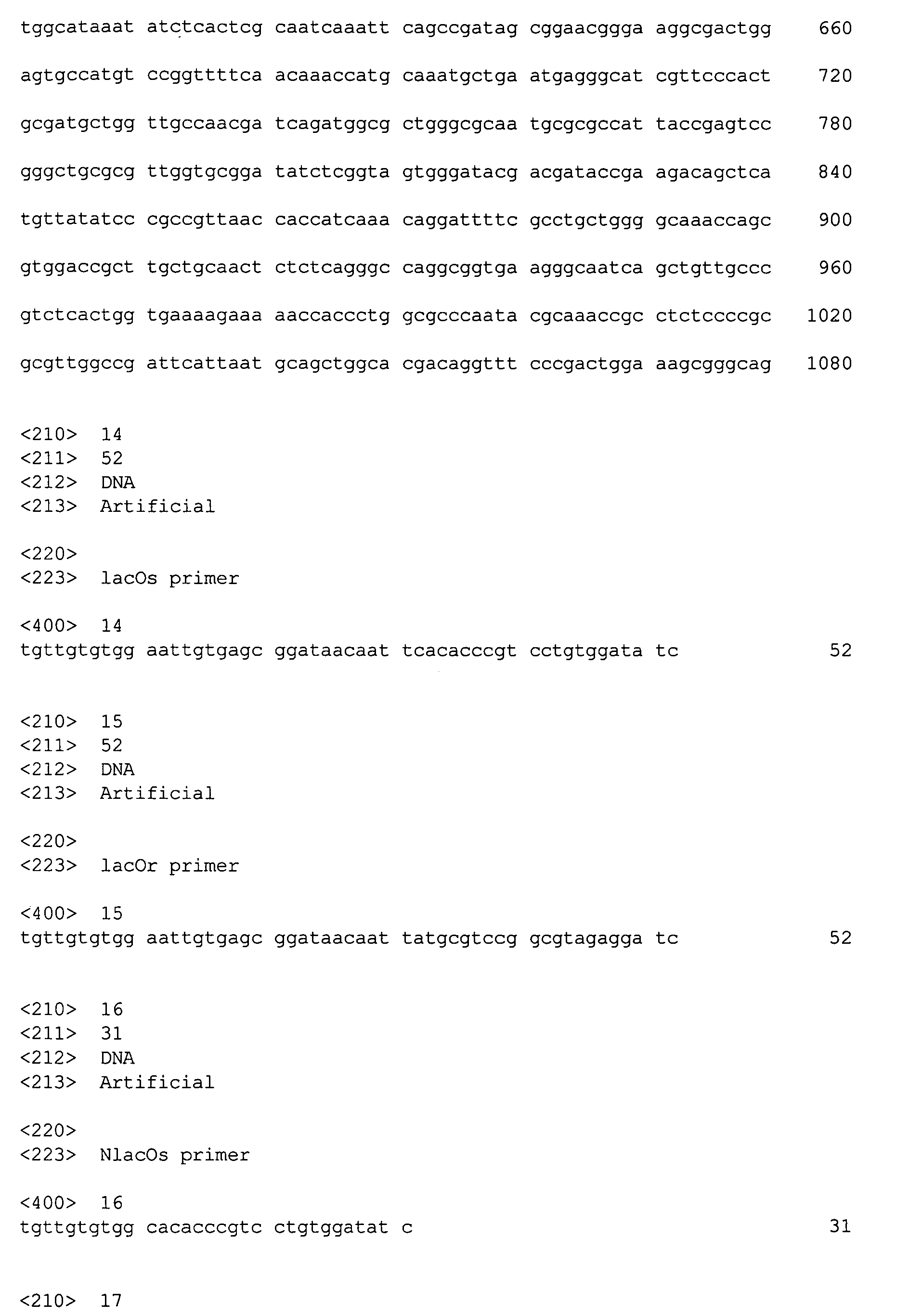
the two primer pairs lacOs/lacOr (SEQ ID NO:14 and SEQ ID NO:15) and
NlacOs/NlacOr (SEQ ID NO:16 and SEQ ID NO:17). The fragment corresponded
to the DNA fragment generated by means of the RTS (rapid translation system)
Linear Template Generation Set (LTGS, His-tag; Roche Diagnostics GmbH,
Mannheim, Cat.No.: 3186237) and contained all necessary elements for in vitro
transcription/translation. One fragment was amplified using primers with the same
sequence as the standard outer primers from the LTGS plus additional 10 bases at
the 5'-end. As a control, a second fragment with a pair of primers containing
additional 21 bases of the lac operator downstream of the terminal 6 bases. was
generated.
Example 2
Double-stranded linear DNA in a cell-free reaction mixture for coupled
transcription and translation containing exonucleases
-
3 µl aliquots of each PCR were incubated in 50 µl of the RTS 100 HY
transcription/translation mixture according to the manufacturer's protocol (30°C)
both in batch and continuous exchange (CECF) mode. For the CECF reactions 1 ml
of the feeding solution from the RTS 500 HY kit was used.
-
For co-expression of the LacI protein, 3 µg/ml of the vector pIVEXlacI was added to
the reaction, while control reactions contained no pIVEXlacI vector (i.e. the LacI
coding sequence comprised in SEQ ID NO: 13 inserted into the pIVEX vector).
Finally 10 µg/ml of the original expression vector pIVEX2.3GFP was used as control
with and without coexpression of LacI.
-
The batch reactions were run for 4 h without shaking, while the CECF reactions
were incubated for 6 h with shaking at 900 rpm in the ProteoMaster instrument.
After incubation the reactions were kept at 4°C overnight for maturation of the
GFP chromophore. Figure 2 shows the resulting quantities of the reactions (A:
CECF-mode, B: batch mode).
Example 3
Comparison of yield
-
As shown in Figure 3 the differences in yield quantified by measuring GFP
fluorescence were confirmed by Western blotting. The presence of the lac operator
sequence in the PCR fragments resulted in a significant increase in yield compared
to the unprotected fragments, both in batch (left side of Figure 3) and CECF mode
(right side of Figure 3). An increase of about 90% in batch and 40% in CECF
reactions without co-expression show the stabilizing effect of the LacI protein
already present in the lysate. Co-expression leads to lower absolute yields but to
higher relative differences between protected and unprotected fragments.
List of References
-
- Bassett, C.L and Rawson, J.R. J Bacteriol (1983) 156:1359-1362
- Bell, C.E. and Lewis, M. Curr Opin Struct Biol (2001) 11:19-25
- Berg, J., Tymoczko, J, Stryer, L. (eds.) Biochemistry, 5th ed. W. H. Freeman and
Company, New York
- Burdick, G. and Emlen, W. J Immunol (1985) 135:2593-2597
- Choi, K.Y. and Zalkin, H. J Bacteriol (1992) 174:6207-6214
- EP 0 431 523
- EP 0 967 274
- EP 1 251 168
- Good, L and Nielsen, P.E. Proc Natl Acad Sci USA (1998) 95:2073-2076
- Hirao, I. et al., FEBS Lett (1993) 321:169-172
- Jackson, M. er al., FEBS Lett. (1983) 163:221-224
- Kandimalla, E.R. et al., Nucleic Acids Res (1997) 25:370-378
- Kercher, M.A., et al. Curr Opin Struct Biol (1997) 7:76-85
- Lesley, S.A. et al., J Biol Chem (1991) 266:2632-2638
- Liang, S.D., et al. Mol Cell Biol (1996) 16:3773-3780
- Martemyanov, K.A. et al., FEBS Lett (1997) 414:268-270
- Müller-Hartmann, H. and Müller-Hill, B. J Mol Biol (1996) 257:473-478
- Nakano, H. et al., (1999) Biotechnol Bioeng 64:194- 199
- Pandolfi, D. et al., (1999) Nucleosides Nucleotides. 18:2051-2069
- Sambrook, Fritsch & Maniatis, Molecular Cloning, A Laboratory Manual, 3rd
edition, CSHL Press, 2001
- Shevelev, I.V. and Hübscher, U., Nature Reviews Molecular Cell Biology (2002) 3:
364-376
- Tang, J.Y. et al., Nucleic Acids Res (1993) 21:2729-2735
- Tohda, H. et al., J Biotechnol (1994) 34:61-69
- Yoshizawa, S. et al., Nucleic Acids Res( 1994) 22:2217-2221
- US 4,683,195
- US 5,245,022
- US 5,571,690
- US 6,027,913
- Verheijen, J.C. et al. (2000) Bioorg Med Chem Lett 10:801-804
- WO 00/40592
- WO 03/072051
- WO 90/15065
- WO 94/16090
- Wu, C. Nature (1985) 317:84-87
- Yang, H.L. et al., (1980) Proc Natl Acad Sci USA 77:7029-7033
- Yang, J. et al., J Bacteriol (2000) 182:295-302
- Yoshizawa, S. et al., Nucleic Acids Res (1994) 22:2217-2221
-