EP1564220A1 - Sustained release drug carrier - Google Patents
Sustained release drug carrier Download PDFInfo
- Publication number
- EP1564220A1 EP1564220A1 EP03774146A EP03774146A EP1564220A1 EP 1564220 A1 EP1564220 A1 EP 1564220A1 EP 03774146 A EP03774146 A EP 03774146A EP 03774146 A EP03774146 A EP 03774146A EP 1564220 A1 EP1564220 A1 EP 1564220A1
- Authority
- EP
- European Patent Office
- Prior art keywords
- group
- branched
- linear
- hyaluronic acid
- acid derivative
- Prior art date
- Legal status (The legal status is an assumption and is not a legal conclusion. Google has not performed a legal analysis and makes no representation as to the accuracy of the status listed.)
- Withdrawn
Links
Images


Classifications
-
- A—HUMAN NECESSITIES
- A61—MEDICAL OR VETERINARY SCIENCE; HYGIENE
- A61K—PREPARATIONS FOR MEDICAL, DENTAL OR TOILETRY PURPOSES
- A61K9/00—Medicinal preparations characterised by special physical form
- A61K9/06—Ointments; Bases therefor; Other semi-solid forms, e.g. creams, sticks, gels
-
- A—HUMAN NECESSITIES
- A61—MEDICAL OR VETERINARY SCIENCE; HYGIENE
- A61K—PREPARATIONS FOR MEDICAL, DENTAL OR TOILETRY PURPOSES
- A61K47/00—Medicinal preparations characterised by the non-active ingredients used, e.g. carriers or inert additives; Targeting or modifying agents chemically bound to the active ingredient
- A61K47/30—Macromolecular organic or inorganic compounds, e.g. inorganic polyphosphates
- A61K47/36—Polysaccharides; Derivatives thereof, e.g. gums, starch, alginate, dextrin, hyaluronic acid, chitosan, inulin, agar or pectin
-
- A—HUMAN NECESSITIES
- A61—MEDICAL OR VETERINARY SCIENCE; HYGIENE
- A61K—PREPARATIONS FOR MEDICAL, DENTAL OR TOILETRY PURPOSES
- A61K9/00—Medicinal preparations characterised by special physical form
- A61K9/0012—Galenical forms characterised by the site of application
- A61K9/0019—Injectable compositions; Intramuscular, intravenous, arterial, subcutaneous administration; Compositions to be administered through the skin in an invasive manner
-
- C—CHEMISTRY; METALLURGY
- C08—ORGANIC MACROMOLECULAR COMPOUNDS; THEIR PREPARATION OR CHEMICAL WORKING-UP; COMPOSITIONS BASED THEREON
- C08B—POLYSACCHARIDES; DERIVATIVES THEREOF
- C08B37/00—Preparation of polysaccharides not provided for in groups C08B1/00 - C08B35/00; Derivatives thereof
- C08B37/006—Heteroglycans, i.e. polysaccharides having more than one sugar residue in the main chain in either alternating or less regular sequence; Gellans; Succinoglycans; Arabinogalactans; Tragacanth or gum tragacanth or traganth from Astragalus; Gum Karaya from Sterculia urens; Gum Ghatti from Anogeissus latifolia; Derivatives thereof
- C08B37/0063—Glycosaminoglycans or mucopolysaccharides, e.g. keratan sulfate; Derivatives thereof, e.g. fucoidan
- C08B37/0072—Hyaluronic acid, i.e. HA or hyaluronan; Derivatives thereof, e.g. crosslinked hyaluronic acid (hylan) or hyaluronates
Definitions
- the present invention relates to sustained-release drug carriers based on a hyaluronic acid hydrogel, which allow sustained release of proteins or peptides.
- sustained-release formulations of pharmacologically active proteins or peptides will cause denaturation or aggregation of the proteins or peptides during formulation preparation or sustained release, which results in a reduced recovery rate and constitutes a major obstacle to their development for commercial use. It has been attempted to prepare sustained-release formulations based on a biodegradable polymer matrix such as polylactic acid-polyglycolic acid copolymer (PLGA), but such formulations have been reported to cause protein denaturation and/or aggregation due to the hydrophobicity of the matrix, a drying step and/or a decrease in pH (see J. Pharm. Sci. vol. 88, pp. 166-173, 1999 and J. Microencapsulation vol. 15, pp.
- PLGA polylactic acid-polyglycolic acid copolymer
- sustained-release formulations based on a hydrophilic hydrogel matrix with reduced risks of these problems, but such formulations are not ready for commercial use.
- a material used as a sustained-release matrix should combine non-antigenicity, non-mutagenicity, non-toxicity and biodegradability.
- no sustained-release formulation is now ready for commercial use in all aspects, i.e., encapsulation rate and recovery rate of proteins or peptides, as well as safety.
- Hyaluronic acid HA
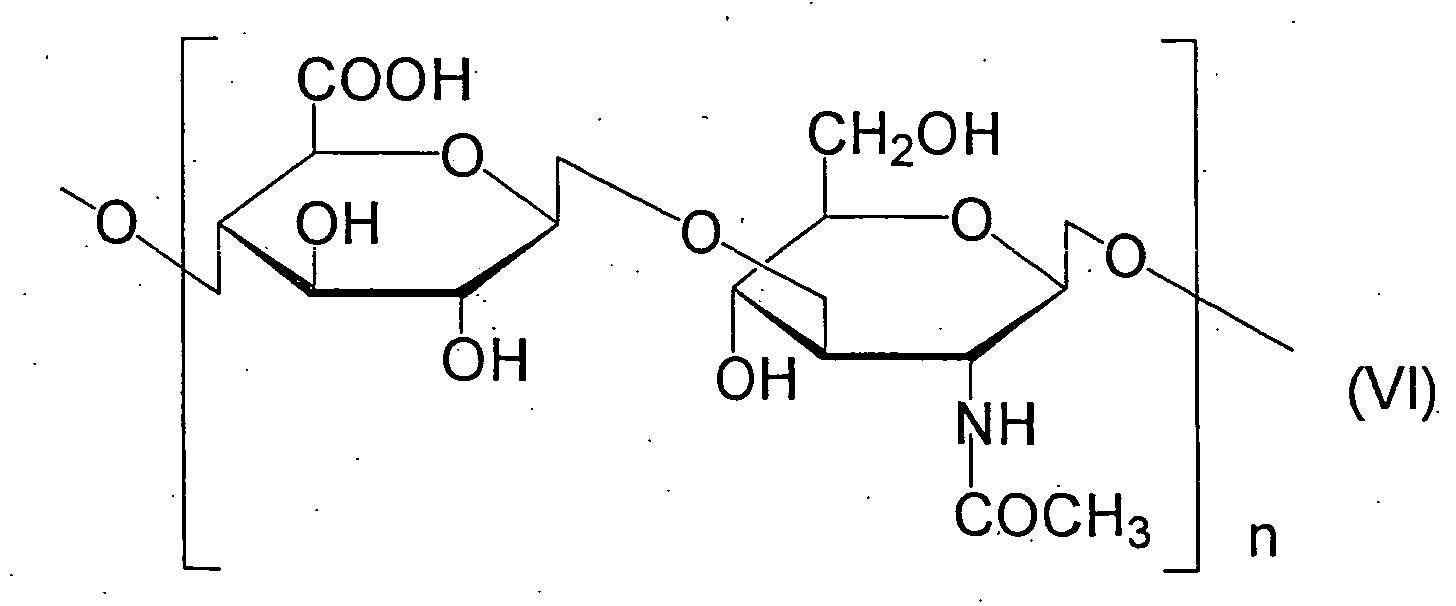
- HA is a kind of glycosaminoglycan composed of disaccharide units in which D-glucuronic acid and N-acetylglucosamine are linked to one another via ⁇ (1 ⁇ 3)glycosidic linkages (Formula (VI)).
- HA is therefore the safest medical biomaterial in terms of immuogenicity and toxicity.
- microbial mass production of high-molecular-weight HA became possible allowing commercial use of HA in the fields of therapeutic agents for degenerated cartilage, cosmetics, etc.
- in situ crosslinking when in situ crosslinking is performed in the presence of a protein or peptide, it is advantageous in that the protein or peptide can be held in a gel at a high encapsulation rate.
- in situ crosslinking is adapted for encapsulation of proteins or peptides into hyaluronic acid derivative gels to give sustained-release formulations (see, e.g., United States Patent No. 5827937).
- a method is reported in which a hyaluronic acid derivative (HA-HZ) modified to have a hydrazide group (HZ) is crosslinked with a crosslinking agent comprising N-hydroxysuccinimide (NHS) (see International Publication No. WO95/15168).
- HZ hyaluronic acid derivative
- NHS N-hydroxysuccinimide
- This method is intended for in situ crosslinking under physiological conditions and limits crosslinkage formation at pH 7.4 to pH 8.5.
- this method results in low recovery rates of proteins or peptides from the thus obtained hyaluronic acid derivative gel. This is because the proteins or peptides are partially reacted (mainly at their amino groups) with the crosslinking agent during crosslinking reaction resulting in crosslinked proteins.
- This method also suffers from a problem in that denatured proteins or peptides remaining in the gel have reduced biological activity and, if anything, are responsible for the development of antigenicity. It is an essential requirement for pharmaceutical preparations that the encapsulated drug is released at a high recovery rate, and no method is known for chemically crosslinking and gelling hyaluronic acid without causing proteins or peptides to react. Also, another method has been reported to encapsulate proteins or peptides at high recovery rates, in which polyethylene glycol (PEG) is used as a matrix and crosslinked through nucleophilic addition reaction of unsaturated functional groups (see International Publication No. WO00/44808), but this method suffers from a problem in that fragments of non-biodegradable polyethylene glycol remain in the resulting material.
- PEG polyethylene glycol
- a hyaluronic acid derivative having an unsaturated bond-containing group(s) or a mercapto group(s) introduced into hyaluronic acid is chemically crosslinked with a mercapto group-containing compound or an unsaturated bond-containing compound, respectively, to give a hydrogel, such treatment enables efficient encapsulation of proteins or peptides while retaining their biological activity and enables the provision of biodegradable and safe sustained-release carriers for proteins or peptides. This finding led to the completion of the present invention.
- the present invention provides a sustained-release drug carrier comprising a hydrogel of a hyaluronic acid derivative chemically crosslinked in a solution in the presence of a protein or a peptide, wherein the hyaluronic acid derivative has an unsaturated bond(s) introduced into hyaluronic acid and is chemically crosslinked with a mercapto group-containing compound or, alternatively, wherein the hyaluronic acid derivative has a mercapto group(s) introduced into hyaluronic acid and is chemically crosslinked with an unsaturated bond-containing compound.
- the present invention provides a method for preparing such a hyaluronic acid derivative having a mercapto group(s) as mentioned above, which comprises the following steps:
- the hyaluronic acid derivative formed in step (a) is preferably a hyaluronic acid derivative whose molecule contains at least one or more repeated structures represented by Formula (I):
- R 1 represents a hydrogen atom, a linear or branched C 1-10 alkyl group, a linear or branched C 1-10 hydroxyalkyl group, a polyalkylene oxide group, a polypeptide group, or a polyester group
- R a2 , R a3 , R a4 , R a5 and R a6 each independently represent a hydrogen atom, a linear or branched C 1-6 alkyl group, a linear or branched C 1-6 alkenyl group, a linear or branched C 1-6 alkynyl group, a linear or branched C 1-6 alkylcarbonyl group, a linear or branched C 1-6 alkenylcarbon
- polyalkylene oxide group refers to a group represented by -(CH(-R)CH 2 O) n -OH (wherein R represents a hydrogen atom or a C 1-5 alkyl group) and preferably represents a polyethylene oxide group or a polypropylene oxide group.
- n is preferably an integer of 1 to 20.
- the polypeptide group is not limited in any way, it is preferably composed of 1 to 20 amino acids.
- polyester group is not limited in any way, it is preferably a polyglycolic acid group or a polylactic acid group.
- X 0 preferably represents -N(-R 1 )-.
- R 1 preferably represents a hydrogen atom.
- X 1 preferably represents -Y 1 -Q 1 -Y 2 -NH-R 2 .
- Y 1 preferably represents a single bond or -N(-R 3 )-.
- Y 2 preferably represents a single bond.
- Q 1 preferably represents a linear or branched C 1-4 alkylene group.
- R 2 and R 3 each preferably represent a hydrogen atom.
- the hyaluronic acid derivative formed in step (b) is preferably a hyaluronic acid derivative whose molecule contains at least one or more repeated structures represented by Formula (II):
- X 2 represents -Y 1 -Q 1 -Y 2 -N(-R 2 )-Y 3 -Q 2 -SH or -N(-R 2 )-Y 3 -Q 2 -SH
- X 0 , R 1 , R a2 , R a3 , R a4 , R a5 , R a6 , Y 1 , Y 2 , Q 1 , R 2 , R 3 and R 4 are as defined above for Formula (I)
- X 0 preferably represents -N(-R 1 )-.
- R 1 preferably represents a hydrogen atom.
- X 2 preferably represents -Y 1 -Q 1 -Y 2 -N(-R 2 )-Y 3 -Q 2 -SH.
- Y 1 preferably represents a single bond or -N(-R 3 )-.
- Y 2 preferably represents a single bond.
- Q 1 preferably represents a linear or branched C 1-4 alkylene group.
- R 2 and R 3 each preferably represent a hydrogen atom.
- Y 3 preferably represents -CO-.
- Q 2 preferably represents a linear or branched C 1-4 alkylene group.
- the present invention provides a method for preparing such a hyaluronic acid derivative having a mercapto group(s) as mentioned above, which comprises the step of converting, in an organic solvent, at least one or more carboxyl groups of hyaluronic acid into N-substituted amide group(s) having a substituent containing a mercapto group.
- the resulting hyaluronic acid derivative having a mercapto group(s) is preferably a hyaluronic acid derivative whose molecule contains at least one or more repeated structures represented by Formula (IIa):
- R 1 represents a hydrogen atom, a linear or branched C 1-10 alkyl group, a linear or branched C 1-10 hydroxyalkyl group, a polyalkylene oxide group, a polypeptide group, or a polyester group
- R a2 , R a3 , R a4 , R a5 and R a6 each independently represent a hydrogen atom, a linear or branched C 1-6 alkyl group, a linear or branched C 1-6 alkenyl group, a linear or branched C 1-6 alkynyl group, a linear or branched C 1-6 alkylcarbonyl group, a linear or branched
- polyalkylene oxide group refers to a group represented by -(CH(-R)CH 2 O) n -OH (wherein R represents a hydrogen atom or a C 1-5 alkyl group) and preferably represents a polyethylene oxide group or a polypropylene oxide group.
- n is preferably an integer of 1 to 20.
- the polypeptide group is not limited in any way, it is preferably composed of 1 to 20 amino acids.
- polyester group is not limited in any way, it is preferably a polyglycolic acid group or a polylactic acid group.
- X 0 preferably represents -N(-R 1 )-.
- R 1 preferably represents a hydrogen atom.
- X 2a preferably represents -Y 1 -Q 1 -Y 2 -Q 3 -Y 3 -Q 2 -SH.
- Y 1 preferably represents a single bond or -N(-R 3 )-.
- Y 2 preferably represents a single bond.
- Y 3 preferably represents a single bond.
- Q 1 , Q 2 and Q 3 each preferably represent a linear or branched C 1-4 alkylene group.
- R 2 and R 3 each preferably represent a hydrogen atom.
- Y 3 preferably represents -CO-.
- the present invention provides a hyaluronic acid derivative having a mercapto group(s) prepared by the above method.
- the hyaluronic acid derivative having a mercapto group(s) preferably contains the repeated structure A represented by Formula (III): (wherein R a1 represents a hydroxyl group, an amino group which may be mono- or di-substituted with a linear or branched C 1-6 alkyl group, or a linear or branched C 1-6 alkoxy group, or R a1 may form a carboxylate salt with a cation selected from the group consisting of sodium ion, potassium ion, calcium ion, magnesium ion, lithium ion and an optionally substituted ammonium ion, and R a2 , R a3 , R a4 , R a5 and R a6 each independently represent a hydrogen atom, a linear or branched C 1-6 alkyl group, a linear or branched C 1-6 alkenyl group, a linear or branched C 1-6 alkynyl group, a linear or branched
- the present invention provides a method for preparing such a hyaluronic acid derivative having an unsaturated bond-containing group(s) as mentioned above, which comprises the following steps:
- the hyaluronic acid derivative formed in step (a) is preferably a hyaluronic acid derivative whose molecule contains at least one or more repeated structures represented by the above Formula (I).
- the hyaluronic acid derivative formed in step (b) is preferably a hyaluronic acid derivative whose molecule contains at least one or more repeated structures represented by Formula (IV):
- X 0 represents -O- or -N(-R 1 )-
- X 3 represents -Y 1 -Q 1 -Y 2 -N(-R 2 )-Y 3 -Q 4 or -N(-R 2 )-Y 3 -Q 4
- R 1 represents a hydrogen atom, a linear or branched C 1-10 alkyl group, a linear or branched C 1-10 hydroxyalkyl group, a polyalkylene oxide group, a polypeptide group, or a polyester group
- R a2 , R a3 , R a4 , R a5 and R a6 each independently represent a hydrogen atom, a linear or branched C 1-6 alkyl group, a linear or branched C 1-6 alkenyl group
- polyalkylene oxide group refers to a group represented by -(CH(-R)CH 2 O) n -OH (wherein R represents a hydrogen atom or a C 1-5 alkyl group) and preferably represents a polyethylene oxide group or a polypropylene oxide group.
- n is preferably an integer of 1 to 20.
- the polypeptide group is not limited in any way, it is preferably composed of 1 to 20 amino acids.
- polyester group is not limited in any way, it is preferably a polyglycolic acid group or a polylactic acid group.
- X 0 preferably represents -N(-R 1 )-.
- R 1 preferably represents a hydrogen atom.
- X 3 preferably represents -Y 1 -Q 1 -Y 2 -N (-R 2 )-Y 3 -Q 4 .
- Y 1 preferably represents a single bond, -N(-R 3 )CO-, or -N(-R 3 )-, and more preferably -N(-R 3 )CO-.
- Y 2 preferably represents a single bond or -CON(-R 3 )-, and more preferably -CON(-R 3 )-.
- Y 3 preferably represents a single bond, -CO-, or -N(-R 3 )-, and more preferably -CO-.
- Q 1 preferably represents a linear or branched C 1-4 alkylene group.
- R 2 and R 3 each preferably represent a hydrogen atom.
- Q 4 preferably represents a linear or branched C 2-10 alkenyl group.
- the present invention provides a hyaluronic acid derivative having an unsaturated bond-containing group(s) prepared by the above method.
- the hyaluronic acid derivative having an unsaturated bond-containing group(s) preferably contains the repeated structure A represented by the above Formula (III) and the repeated structure C represented by the above Formula (IV), wherein the abundance ratio between these repeated structures A and C is 95:5 to 10:90, preferably 90:10 to 10:90, and more preferably 80:20 to 20:80.
- the present invention provides a chemically crosslinked hyaluronic acid derivative formed by chemically crosslinking the above hyaluronic acid derivative having an unsaturated bond-containing group(s) with an unsaturated bond-containing compound, as well as a chemically crosslinked hyaluronic acid derivative formed by chemically crosslinking the above hyaluronic acid derivative having a mercapto group(s) with an unsaturated bond-containing compound.
- the chemically crosslinked hyaluronic acid derivative is preferably a chemically crosslinked hyaluronic acid derivative whose molecule contains at least one or more repeated structures represented by Formula (V): (wherein X 0 represents -O- or -N(-R 1 )-, R 1 represents a hydrogen atom, a linear or branched C 1-6 alkyl group, a linear or branched C 1-10 hydroxyalkyl group, a polyalkylene oxide group, a polypeptide group, or a polyester group, R a2 , R a3 , R a4 , R a5 and R a6 each independently represent a hydrogen atom, a linear or branched C 1-6 alkyl group, a linear or branched C 1-6 alkenyl group, a linear or branched C 1-6 alkynyl group, a linear or branched C 1-6 alkylcarbonyl group, a linear or branched C 1-6 alkenylcarbony
- polyalkylene oxide group refers to a group represented by -(CH(-R)CH 2 O) n -OH (wherein R represents a hydrogen atom or a C 1-5 alkyl group) and preferably represents a polyethylene oxide group or a polypropylene oxide group.
- n is preferably an integer of 1 to 20.
- the polypeptide group is not limited in any way, it is preferably composed of 1 to 20 amino acids.
- polyester group is not limited in any way, it is preferably a polyglycolic acid group or a polylactic acid group.
- X 0 preferably represents -N(-R 1 )-.
- R 1 preferably represents a hydrogen atom.
- X 4 preferably represents -Y 1 -Q 1 -Y 2 -X 5 -Y 3 -Q 2 -S-L.
- X 5 preferably represents -N(-R 2 )-.
- Y 1 preferably represents a single bond, - N(-R 3 )CO-, or -N(-R 3 )-, and more preferably -N(-R 3 )CO-.
- Y 2 preferably represents a single bond or -CON(-R 3 )-, and more preferably -CON(-R 3 )-.
- Y 3 preferably represents a single bond, -CO-, or -N(-R 3 )-, and more preferably -CO-.
- Q 1 preferably represents a linear or branched C 1-4 alkylene group.
- R 2 and R 3 each preferably represent a hydrogen atom.
- Q 2 and Q 3 each preferably represent a linear or branched C 1-4 alkylene group.
- L preferably represents a linear or branched C 1-4 alkylene group which may be substituted with one or more hydroxyl groups, carboxyl groups or linear or branched C 1-4 alkyl groups, and more preferably a linear or branched C 1-4 alkylene group.
- the chemically crosslinked hyaluronic acid derivative preferably contains the repeated structure A represented by the above Formula (III) and the repeated structure D represented by the above Formula (V), wherein the abundance ratio between these repeated structures A and D is preferably 95:5 to 10:90, more preferably 90:10 to 10:90, and even more preferably 80:20 to 20:80.
- the sustained-release drug carrier of the present invention is characterized by comprising a hydrogel of a hyaluronic acid derivative chemically crosslinked in a solution in the presence of a protein or a peptide, wherein the hyaluronic acid derivative has an unsaturated bond(s) introduced into hyaluronic acid and is chemically crosslinked with a mercapto group-containing compound or, alternatively, wherein the hyaluronic acid derivative has a mercapto group(s) introduced into hyaluronic acid and is chemically crosslinked with an unsaturated bond-containing compound.
- the sustained-release drug carrier of the present invention has excellent characteristics as shown below.
- chemical(ly) crosslinking or “chemically crosslinked” is intended to mean containing intermolecular or intramolecular crosslinkages via covalent bonds. It also means having both intermolecular and intramolecular crosslinkages.
- the pH during crosslinking is not limited in any way, but it is preferably a pH at which the selective reaction between unsaturated bond and mercapto group preferentially occurs without causing protein or peptide denaturation preventing reactions with amino groups contained in proteins or peptides.
- a pH can be selected as appropriate by those skilled in the art, it ranges from pH 3.0 to 9.0, preferably pH 6.0 to 8.5, by way of example.
- Examples of an unsaturated bond-containing group include, without any limitation, a methacryloyl group, an acryloyl group, a maleimide group, a vinylsulfone group, and an acetylenecarbonyl group.
- the crosslinking agent used for introduction of an unsaturated bond-containing group into hyaluronic acid may be a compound whose molecule contains two or more mercapto groups capable of reacting with an unsaturated bond via nucleophilic addition reaction. Examples include dithiothreitol (DTT), butanedithiol, polyethylene glycol dithiol, and a peptide having two or more cysteines.
- the crosslinking agent used for introduction of a mercapto group into hyaluronic acid may be a compound whose molecule contains two or more unsaturated bond-containing groups capable of reacting with a mercapto group via nucleophilic addition reaction.
- examples include ethylene glycol dimethacrylate, ethylenebisacrylamide, tris-2-maleimidoethylamine, 1,8-bismaleimidotriethylene glycol, and 1,4-bismaleimidyl-2,3-dihydroxybutane.
- a basic compound for the purpose of improving the stability of proteins or peptides during crosslinking reaction and improving the reaction velocity.
- a basic compound available for use include, without any limitation, carbonate salts (e.g., sodium carbonate, sodium bicarbonate), hydroxides (e.g., sodium hydroxide), and amines (e.g., aqueous ammonia, pyridine, triethylamine, ethylenediamine, ethanolamine, diethanolamine, triethanolamine). Among them, amines are preferred for use and triethanolamine is more preferred for use.
- the preferred concentration for this purpose is 10 to 20 ⁇ L/mL.
- unreacted mercapto groups remain for a long time after completion of the crosslinking reaction, such groups facilitate protein denaturation. It is therefore preferable to remove unreacted mercapto groups, e.g., by washing off the unreacted mercapto groups immediately after gel preparation or by adding a compound (e.g., iodoacetic acid) capable of selectively reacting with a mercapto group.
- a compound e.g., iodoacetic acid
- hyaluronic acid derivative having an unsaturated bond-containing group(s) there is no particular limitation on the method for preparing a hyaluronic acid derivative having an unsaturated bond-containing group(s), but it is difficult to achieve a high introduction rate, e.g., when glycidyl ether methacrylate or methacrylic anhydride is directly reacted with a hydroxyl group of HA (J. Biomed. Mat. Res. 54, 115-121, 2001). This is because hyaluronic acid will form a higher order structure in an aqueous solution by the action of hydrogen bonding or hydrophobic interaction to reduce the reactivity of its functional groups including hydroxyl and carboxylic acid groups. A higher crosslinking density is desired to achieve prolonged sustained release of proteins or peptides.
- hyaluronic acid may be converted into a tertiary ammonium salt form, dissolved in a polar organic solvent such as dimethyl sulfoxide (DMSO), and then reacted with an unsaturated bond-containing amine or hydrazide in the presence of a coupling agent such as 1-ethyl-3-(3-dimethylaminopropyl)carbodiimide (EDC) to prepare the desired derivative.
- DMSO dimethyl sulfoxide
- EDC 1-ethyl-3-(3-dimethylaminopropyl)carbodiimide
- Examples of such an unsaturated bond-containing amine include, without any limitation, allylamine, diallylamine, 4-amino-1-butene, acrylhydrazide, and methacrylhydrazide.
- carboxylic acid in hyaluronic acid may be condensed with adipic acid dihydrazide (ADH) or a divalent compound containing hydrazide or amino groups (e.g., ethylenediamine) in the presence of a condensing agent (e.g., EDC) to synthesize a hydrazide group-modified hyaluronic acid derivative (HA-HZ) or an amino group-modified hyaluronic acid derivative (HA-amino group), which may then be reacted with methacrylic anhydride.
- ADH adipic acid dihydrazide
- EDC condensing agent
- hyaluronic acid may be converted into a tertiary ammonium salt form, dissolved in a polar organic solvent such as dimethyl sulfoxide (DMSO), and then reacted with a mercapto group-containing amine or hydrazide in the presence of a coupling agent such as 1-ethyl-3-(3-dimethylaminopropyl)carbodiimide (EDC) to prepare the desired derivative.
- DMSO dimethyl sulfoxide
- EDC 1-ethyl-3-(3-dimethylaminopropyl)carbodiimide
- Examples of such a mercapto group-containing amine include, without any limitation, 2-aminoethane-1-thiol, 3-aminopropane-1-thiol, and thioglycolic acid hydrazide.
- carboxylic acid in hyaluronic acid may be condensed with adipic acid dihydrazide (ADH) or a divalent compound containing hydrazide or amino groups (e.g., ethylenediamine) in the presence of a condensing agent such as 1-ethyl-3-(3-dimethylaminopropyl)carbodiimide (EDC) to synthesize a hydrazide group-modified hyaluronic acid derivative (HA-HZ) or an amino group-modified hyaluronic acid derivative (HA-amino group), which may then be reacted with, e.g., N-succinimidyl-3-[2-pyridyldithio]propionate (ADH) or a divalent compound containing hydrazide or amino groups (e.g., ethylenediamine) in the presence of a condensing agent such as 1-ethyl-3-(3-dimethyla
- the rate of hydrazide groups introduced into a hyaluronic acid derivative is preferably 5 mol% or more, particularly preferably 10 mol% or more, based on glucuronic acid in the hyaluronic acid derivative.
- the rate of amino groups introduced into a hyaluronic acid derivative is 5 mol% or more, preferably 10 mol% or more, based on glucuronic acid in HA.
- the rate of unsaturated bond-containing groups introduced into a hyaluronic acid derivative in order to obtain a non-flowable gel, it is preferably 5 mol% or more, particularly preferably 10 mol% or more, based on glucuronic acid in the hyaluronic acid derivative.
- the rate of mercapto groups introduced into a hyaluronic acid derivative in order to obtain a non-flowable gel, it is 5 mol% or more, preferably 10 mol% or more, based on glucuronic acid in hyaluronic acid.
- the ratio of mercapto groups to unsaturated bond-containing groups is not limited in any way and can be selected as appropriate by those skilled in the art. However, the ratio of mercapto groups to unsaturated bonds is preferably 3:1 to 1:1, more preferably 2:1 to 1.5:1, in order to minimize reactions with proteins or peptides, to prevent unsaturated bond-containing groups from remaining in the gel and to ensure rapid reaction.
- the ratio of unsaturated bond-containing groups to mercapto groups is not limited in any way and can be selected as appropriate by those skilled in the art. However, the ratio of unsaturated bonds to mercapto groups is preferably 3:1 to 1:1, more preferably 2:1 to 1.5:1, in order to minimize reactions with proteins or peptides, to prevent unsaturated bond-containing groups from remaining in the gel and to ensure rapid reaction.
- a hydrogel comprising a HA derivative and a pharmacologically active protein or peptide
- the HA derivative and the protein or peptide may be dissolved in phosphate-buffered physiological saline.
- a crosslinking agent may then be added to and dispersed uniformly in the resulting solution, followed by reaction at room temperature or 4°C. Because of its relatively low reaction velocity, this crosslinking method is advantageous in ensuring more uniform crosslinking of HA and preparing a uniform gel. This is effective for stabilization and prolongation of sustained release performance.
- Hyaluronic acid used in the present invention may be of any origin, including those extracted from animal tissues, those obtained by fermentation techniques, and those chemically synthesized. Moreover, further treatment (e.g., hydrolysis) may be performed on hyaluronic acid.
- Modified HA prepared in various manners and its salts with alkali metals also fall within the scope of HA according to the present invention.
- HA is often modified at its carboxyl or hydroxyl group
- the modified HA according to the present invention may be modified at any moiety.
- Such modified HA is not limited in any way and may receive any modification. Examples include sulfated HA (International Publication No. WO95/25751), N-sulfated HA (International Publication No. WO98/45335), esterified HA (European Patent Publication No. 0216453, International Publication No. WO98/08876, European Patent Publication No. 0341745), periodate-oxidized HA, and amide-modified HA.
- hyaluronic acid used in the present invention, and it is possible to use hyaluronic acid of any molecular weight.
- hyaluronic acid of 5,000 to 3,500,000 daltons, preferably 10,000 to 2,000,000 daltons, can be used.
- a pharmacologically active protein or peptide examples include, without any limitation, erythropoietin (EPO), granulocyte colony-stimulating factor (G-CSF), interferons- ⁇ , ⁇ and ⁇ (INF- ⁇ , ⁇ , ⁇ ), thrombopoietin (TPO), ciliary neurotrophic factor (CNTF), tumor necrosis factor binding protein (TNFbp), interleukin-10 (IL-10), FMS-like tyrosine kinase (Flt-3), growth hormone (GH), insulin, insulin-like growth factor-1 (IGF-1), platelet-derived growth factor (PDFG), interleukin-1 receptor antagonist (IL-1ra), brain-derived neurotrophic factor (BDNF), keratinocyte growth factor (KGF), stem cell factor (SCF), megakaryocyte growth and defferenciation factor (MGDF), osteoprotegerin (OPG), leptin, parathyroid hormone (PTH), basic fibroblast growth
- the hyaluronic acid derivative gel of the present invention is not limited in any way and may be a hydrosol or an organosol, preferably a hydrosol.
- the sustained-release carrier of the present invention may be administered as a pharmaceutical composition in any dosage form suitable for the intended route of administration, in combination with one or more pharmaceutically acceptable diluents, wetting agents, emulsifiers, dispersants, auxiliaries, antiseptics, buffers, binders, stabilizers and the like.
- the route of administration may be either parenteral or oral.
- injectable microparticles of the hyaluronic acid derivative known techniques can be used, including those in which the gelled derivative is dried, frozen and then ground, those in which a gel in a microparticulate form is prepared using the emulsion method and then dried, those which are used for preparation of dry microparticles (e.g., the spray-drying method, the supercritical solution method), and those in which this composition is administered in a solution form before completion of the crosslinking reaction and then crosslinked in vivo.
- NMR measurement was carried out using a nuclear magnetic resonance system JNM-ECA500 (JEOL. Ltd., Japan) and heavy water as a solvent.
- the introduction rate of each substituent was determined from the integral ratio between a peak unique to the introduced substituent and a peak derived from hyaluronic acid.
- Hyaluronic acid (HA) having a molecular weight of 1.9 ⁇ 10 5 daltons 200 mg, Denki Kagaku Kogyo Kabushiki Kaisha, Japan
- distilled water 200 mg, Denki Kagaku Kogyo Kabushiki Kaisha, Japan
- 5N hydrochloric acid 5N hydrochloric acid
- EDC 1-Ethyl-3-(3-dimethylaminopropyl)carbodiimide
- ADH adipic acid dihydrazide
- the reaction mixture was dialyzed against a 100 mM sodium chloride solution and a 25% ethanol solution (SpectraPor 7, molecular weight cutoff (MWCO): 12k-14k daltons) and lyophilized to give the titled HA-HZ.
- MWCO molecular weight cutoff
- HZ The introduction rate of HZ in the resulting HA-HZ was determined for each batch by proton NMR, indicating that carboxylic acid in HA was modified with HZ at a content of 26% (Batch 1-1), 46% (Batch 1-2) or 69% (Batch 1-3) (calculated from comparison of N-acetyl groups in HA and HA-HZ, 2.1 ppm (3H) and methylene groups in the adipic acid-derived moiety of HA-HZ, 1.7 ppm, 2.4 ppm (2H each)).
- HA-HZ obtained in Batches 1 to 3 of Example 1-1 (90 mg each) was dissolved in 0.45 mL of 100 mM phosphate buffer, pH 8 (HA-HZ 2% w/v), followed by addition of 0.54 mL methacrylic anhydride. The mixture was reacted while stirring at room temperature for 1 day and precipitated in ethanol, followed by washing with ethanol and drying.
- HA-MA (introduction rate of MA: 29%) obtained in Batch 3 of Example 1-2 (11 mg) and EPO (100 ⁇ g) were dissolved in 0.25 mL phosphate buffered saline (pH 7.4, PBS) (stirring at room temperature for 1 hour), followed by addition of 3.5 ⁇ L triethanolamine (TEA) and 10 ⁇ L dithiothreitol (DTT) solution (92.55 mg/mL in PBS). The mixture was reacted at room temperature for 3 hours to give a gel. The resulting gel was dialyzed against 400 mL PBS for 3 hours to wash off unreacted DTT.
- TEA triethanolamine
- DTT dithiothreitol
- Example 1-3 The same procedure as shown in Example 1-3 was repeated to prepare an EPO-encapsulating HA hydrogel, except that the gel prepared in Example 1-3 was supplemented with 10 ⁇ L iodoacetic acid solution (223.2 mg/mL in PBS, 2-fold molar excess over DTT) instead of being dialyzed.
- Example 3 In situ crosslinked EPO-encapsulating HA hydrogels
- HA-MA (introduction rate of MA: 29%) obtained in Batch 2 of Example 1-2 (22 mg) and EPO (400 ⁇ g) were dissolved in 0.48 mL phosphate buffered saline (pH 7.4, PBS) (stirring at room temperature for 1 hour), followed by addition of 3.5 ⁇ L triethanolamine (TEA) and 20 ⁇ L dithiothreitol (DTT) (92.55 mg/mL). After stirring at room temperature for 10 minutes, the resulting solution was filled into a 1 mL syringe and then subcutaneously administered to rats in 100 ⁇ L volumes (using a 22-gauge needle) at 120 minutes after addition of DTT.
- TEA triethanolamine
- DTT dithiothreitol
- Figure 2 presents photographs showing a state of the solution subcutaneously injected into the rats and the gel collected from the rats. This figure indicates that the solution with this composition is crosslinked and gelled in the subcutaneous tissue.
- Example 1 The same procedure as shown in Example 1-3 was repeated to prepare an EPO-encapsulating HA hydrogel, except that 20 ⁇ L of dithiothreitol (DTT) (92.55 mg/mL) was added and reacted in PBS (pH 8.0), but TEA was not used in the preparation of EPO-encapsulating HA hydrogels according to Example 1.
- DTT dithiothreitol
- Example 2 The same procedure as shown in Example 1 was repeated to prepare an EPO-encapsulating HA hydrogel, except that 5 ⁇ L of dithiothreitol (DTT) (92.55 mg/mL) was added and reacted in PBS (pH 8.0), but TEA was not used in the preparation of EPO-encapsulating HA hydrogels according to Example 1.
- DTT dithiothreitol
- Example 2 The same procedure as shown in Example 1 was repeated to prepare an EPO-encapsulating HA hydrogel, except that 10 ⁇ L of dithiothreitol (DTT) (92.55 mg/mL) was added and reacted in PBS (pH 8.0), but TEA was not used in the preparation of EPO-encapsulating HA hydrogels according to Example 1.
- DTT dithiothreitol
- Test Example 1 Measurement of EPO recovery rate in EPO-encapsulating HA hydrogels
- the gels prepared in Examples 1 and 2 and Comparative Examples 1 to 3 (0.25 mL each, containing 100 ⁇ g/mL EPO) were each supplemented with 0.75 mL PBS (pH 7.4) containing 0.5 units of Hyaluronidase SD (Seikagaku Corporation, Japan) and enzymatically treated at 25°C for 3 hours to completely digest the gels.
- the resulting solutions after enzymatic treatment (0.15 mL each) were used as sample solutions.
- sample solutions were measured by reversed-phase high performance liquid chromatography (RP-HPLC) using a 0.1 mg/mL aqueous EPO solution as a standard solution to calculate the EPO concentration in each sample solution from the peak area ratio between standard solution and sample solution.
- the recovery rate was calculated as the amount of EPO determined by RP-HPLC relative to the amount of EPO added (0.1 mg/gel).
- Table 2 shows the recovery rate of EPO collected from each gel relative to the initial amount of EPO, along with the time required for gelling.
- Sample Reaction time EPO recovery rate Example 1 3 hrs 90%
- Test Example 2 Sustained release of EPO from the prepared EPO-encapsulating HA hydrogels
- Example 2 The gel prepared in Example 2 was incubated in 2 mL PBS at 37°C and sampled over time in 200 ⁇ L aliquots. The amount of EPO released into the buffer was determined by RP-HPLC.
- Figure 1 shows the release profile of EPO from the gel, as determined by assuming that EPO collected from the gel after degaradation with hyaluronidase immediately after preparation is set to 100%. After 12 days, hyaluronidase was added. The results indicate that EPO in the gel remains undenatured, 90% or more of which is sustained released.
- proteins or peptides can be encapsulated in hydrogels during the in situ crosslinking reaction while retaining their biological activity to prepare sustained-release protein or peptide formulations.
- Test Example 3 Sustained release performance of EPO from in situ crosslinked EPO-encapsulating HA hydrogels
- Example 3 After addition of DTT, the prepared solution from Example 3 was allowed to stand at room temperature for 150 minutes and then subcutaneously administered to rats in 120 ⁇ L volumes.
- the serum EPO concentration was measured with an ELISA kit (Roche Diagnistics GmbH, Mannheim, Germany).
- Table 3 shows the mean residence time (MRT) analyzed by a non-compartment model using WinNonlin ver. 2.1 (Pharsight), along with MRT of controls, i.e., an EPO solution and an EPO+HA solution (molecular weight of HA: 2,000,000 daltons, 1% concentration).
- EPO solution shown in Table 3 was calculated from dose-corrected simulation data of the reported value (Motohiro Kato, The disposition of recombinant human erythropoietin (EPOCH) after subcutaneous administration (1): Pharmacokinetics of non-labeled EPOCH in rats and dogs upon single administration; Xenobiotic Metabolism and Disposition, 8[4], 471-479, 1933).
- the tested crosslinked gel resulted in a prolonged period of EPO release.
- MRT days
- EPO solution 0.675 EPO+HA solution 0.924
- the sustained-release drug carrier of the present invention allows encapsulation of proteins or peptides into HA hydrogels during in situ chemical crosslinking of the HA derivative while retaining their biological activity, and enables sustained release of the proteins or peptides with high recovery rates.
Landscapes
- Health & Medical Sciences (AREA)
- Chemical & Material Sciences (AREA)
- Life Sciences & Earth Sciences (AREA)
- Medicinal Chemistry (AREA)
- General Health & Medical Sciences (AREA)
- Veterinary Medicine (AREA)
- Epidemiology (AREA)
- Animal Behavior & Ethology (AREA)
- Pharmacology & Pharmacy (AREA)
- Public Health (AREA)
- Materials Engineering (AREA)
- Molecular Biology (AREA)
- Engineering & Computer Science (AREA)
- Biochemistry (AREA)
- Inorganic Chemistry (AREA)
- Chemical Kinetics & Catalysis (AREA)
- Polymers & Plastics (AREA)
- Organic Chemistry (AREA)
- Dermatology (AREA)
- Polysaccharides And Polysaccharide Derivatives (AREA)
- Medicinal Preparation (AREA)
- Cosmetics (AREA)
- Medicines That Contain Protein Lipid Enzymes And Other Medicines (AREA)
Abstract
Description
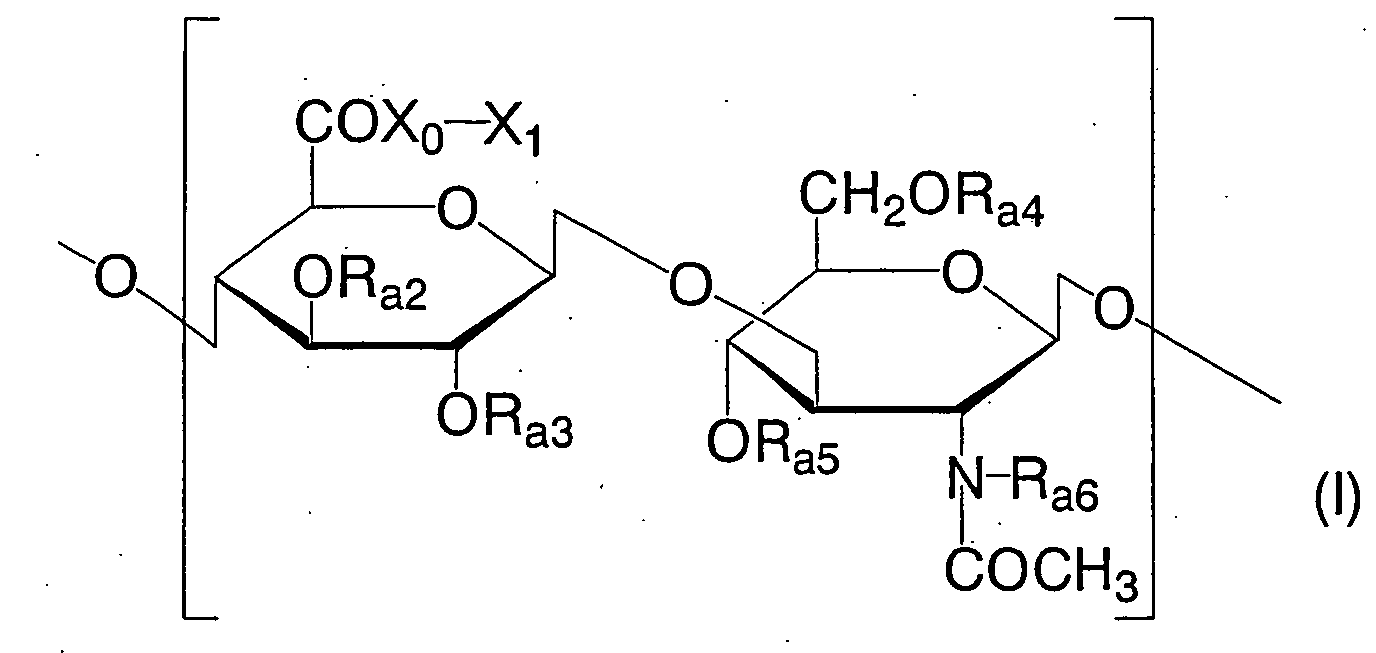
X0 represents -O- or -N(-R1)-,
R1 represents a hydrogen atom, a linear or branched C1-10 alkyl group, a linear or branched C1-10 hydroxyalkyl group, a polyalkylene oxide group, a polypeptide group, or a polyester group,
Ra2, Ra3, Ra4, Ra5 and Ra6 each independently represent a hydrogen atom, a linear or branched C1-6 alkyl group, a linear or branched C1-6 alkenyl group, a linear or branched C1-6 alkynyl group, a linear or branched C1-6 alkylcarbonyl group, a linear or branched C1-6 alkenylcarbonyl group, a linear or branched C1-6 alkynylcarbonyl group, or -SO2OH,
X1 represents -Y1-Q1-Y2-NH-R2 or -NH-R2,
Y1 represents a single bond, -N(-R3)CO-, -N(-R3)-, -CO-, or -CH2CO-,
Y2 represents a single bond, -CON(-R4)-, or -N(-R4)-,
Q1 represents a linear or branched C1-10 alkylene group, a linear or branched C1-10 hydroxyalkylene group, a polyalkylene oxide group, a polypeptide group, or a polyester group, and
R2, R3, and R4 each independently represent a hydrogen atom, a linear or branched C1-10 alkyl group, a linear or branched C1-10 hydroxyalkyl group, a polyalkylene oxide group, a polypeptide group, or a polyester group).
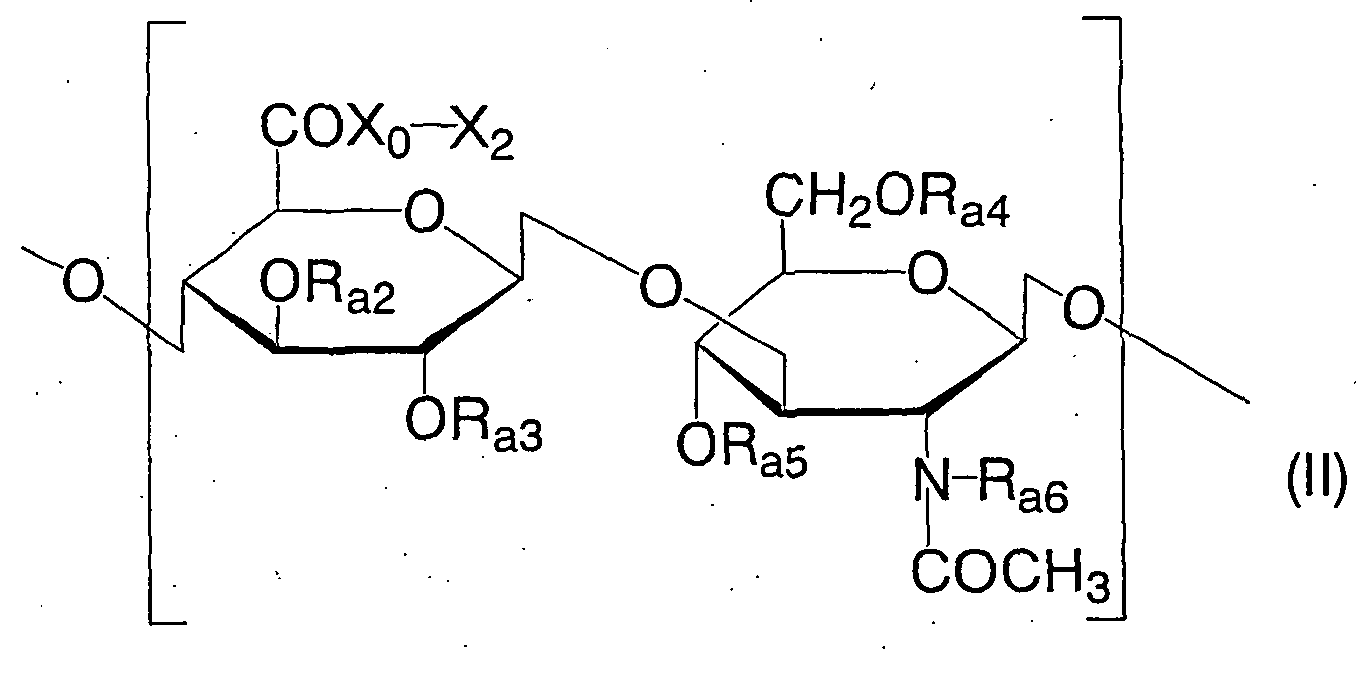
X2 represents -Y1-Q1-Y2-N(-R2)-Y3-Q2-SH or -N(-R2)-Y3-Q2-SH,
X0, R1, Ra2, Ra3, Ra4, Ra5 , Ra6, Y1, Y2, Q1, R2, R3 and R4 are as defined above for Formula (I),
Y3 represents a single bond, -CO-, -C6H4-, -CO2-, -SO2-, -CH2-CH(OH)-, -C(=NH)-, -PO(OH)-O-, -CSNH-, or -CONH-, and
Q2 represents a linear or branched C1-10 alkylene group, a linear or branched C1-10 hydroxyalkylene group, a polyalkylene oxide group, a polypeptide group, or a polyester group).
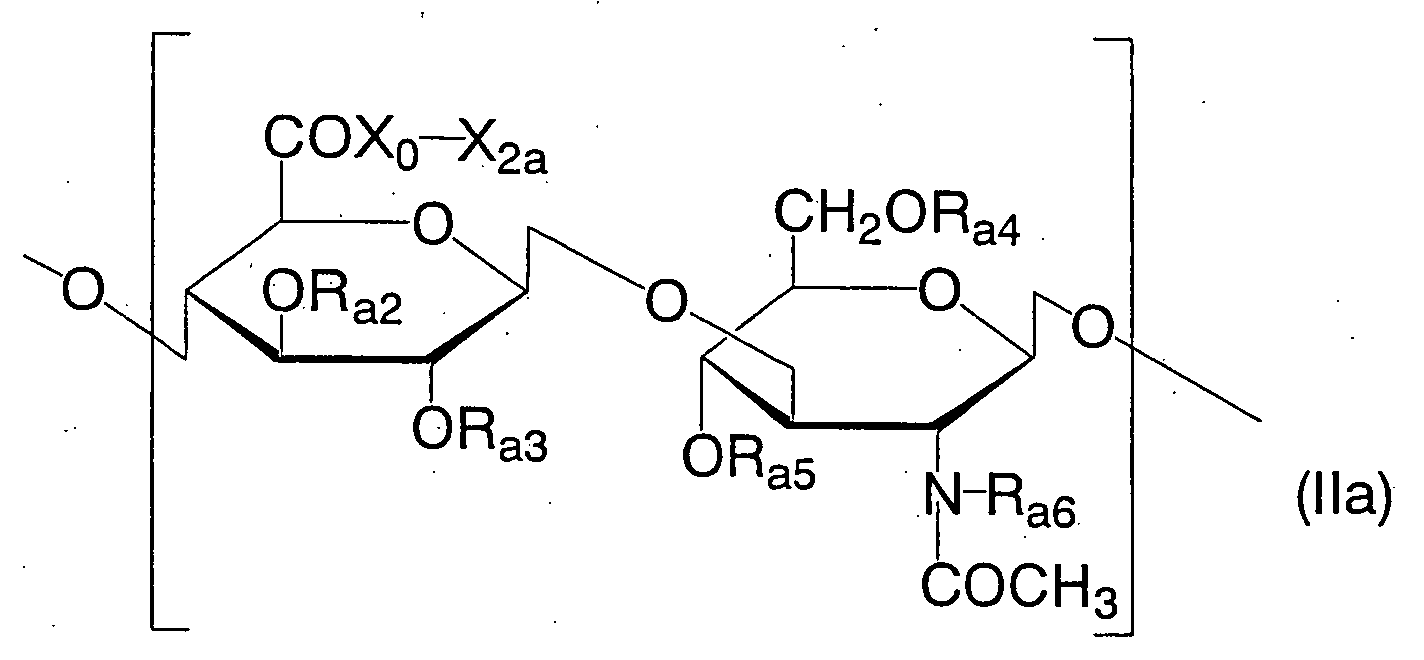
X0 represents -O- or -N(-R1)-,
R1 represents a hydrogen atom, a linear or branched C1-10 alkyl group, a linear or branched C1-10 hydroxyalkyl group, a polyalkylene oxide group, a polypeptide group, or a polyester group,
Ra2, Ra3, Ra4, Ra5 and Ra6 each independently represent a hydrogen atom, a linear or branched C1-6 alkyl group, a linear or branched C1-6 alkenyl group, a linear or branched C1-6 alkynyl group, a linear or branched C1-6 alkylcarbonyl group, a linear or branched C1-6 alkenylcarbonyl group, a linear or branched C1-6 alkynylcarbonyl group, or -SO2OH,
X2a represents -Y1-Q1-Y2-Q3-Y3-Q2-SH or -N(-R2)-Y3-Q2-SH,
Y1 represents a single bond, -N(-R3)CO-, -N(-R3)-, -CO-, or -CH2CO-,
Y2 and Y3 each independently represent a single bond, -O-, -S-, -SO-, -SO2-, -N(-R4)-, -COO-, -OCO-, -CON(-R4)-, -N(-R4)CO-, or -N(-R4)CON(-R5)-,
Q1, Q2 and Q3 each independently represent a linear or branched C1-10 alkylene group, a linear or branched C1-10 hydroxyalkylene group, a polyalkylene oxide group, a polypeptide group, or a polyester group, and
R2, R3, R4 and R5 each independently represent a hydrogen atom, a linear or branched C1-10 alkyl group, a linear or branched C1-10 hydroxyalkyl group, a polyalkylene oxide group, a polypeptide group, or a polyester group).

Ra1 represents a hydroxyl group, an amino group which may be mono- or di-substituted with a linear or branched C1-6 alkyl group, or a linear or branched C1-6 alkoxy group, or Ra1 may form a carboxylate salt with a cation selected from the group consisting of sodium ion, potassium ion, calcium ion, magnesium ion, lithium ion and an optionally substituted ammonium ion, and
Ra2, Ra3, Ra4, Ra5 and Ra6 each independently represent a hydrogen atom, a linear or branched C1-6 alkyl group, a linear or branched C1-6 alkenyl group, a linear or branched C1-6 alkynyl group, a linear or branched C1-6 alkylcarbonyl group, a linear or branched C1-6 alkenylcarbonyl group, a linear or branched C1-6 alkynylcarbonyl group, or -SO2OH) and the repeated structure B represented by the above Formula (II) or (IIa), wherein the abundance ratio between these repeated structures A and B is preferably 95:5 to 10:90, more preferably 90:10 to 10:90, and even more preferably 80:20 to 20:80.

X0 represents -O- or -N(-R1)-,
X3 represents -Y1-Q1-Y2-N(-R2)-Y3-Q4 or -N(-R2)-Y3-Q4,
R1 represents a hydrogen atom, a linear or branched C1-10 alkyl group, a linear or branched C1-10 hydroxyalkyl group, a polyalkylene oxide group, a polypeptide group, or a polyester group,
Ra2, Ra3, Ra4, Ra5 and Ra6 each independently represent a hydrogen atom, a linear or branched C1-6 alkyl group, a linear or branched C1-6 alkenyl group, a linear or branched C1-6 alkynyl group, a linear or branched C1-6 alkylcarbonyl group, a linear or branched C1-6 alkenylcarbonyl group, a linear or branched C1-6 alkynylcarbonyl group, or -SO2OH,
Y1 represents a single bond, -N(-R3)CO-, -N(-R3)-, -CO-, or -CH2CO-,
Y2 represents a single bond, -CON(-R4)-, or -N(-R4)-,
Y3 represents a single bond, -CO-, -N(-R5)CO-, -N(-R5)-, or -CH2CO-,
Q1 represents a linear or branched C1-10 alkylene group, a linear or branched C1-10 hydroxyalkylene group, a polyalkylene oxide group, a polypeptide group, or a polyester group,
R2, R3, R4 and R5 each independently represent a hydrogen atom, a linear or branched C1-10 alkyl group, a linear or branched C1-10 hydroxyalkyl group, a polyalkylene oxide group, a polypeptide group, or a polyester group, and
Q4 represents a linear or branched C2-10 alkenyl group, or a linear or branched C2-10 alkynyl group).

X0 represents -O- or -N(-R1)-,
R1 represents a hydrogen atom, a linear or branched C1-6 alkyl group, a linear or branched C1-10 hydroxyalkyl group, a polyalkylene oxide group, a polypeptide group, or a polyester group,
Ra2, Ra3, Ra4, Ra5 and Ra6 each independently represent a hydrogen atom, a linear or branched C1-6 alkyl group, a linear or branched C1-6 alkenyl group, a linear or branched C1-6 alkynyl group, a linear or branched C1-6 alkylcarbonyl group, a linear or branched C1-6 alkenylcarbonyl group, a linear or branched C1-6 alkynylcarbonyl group, or -SO2OH,
X4 represents -Y1-Q1-Y2-X5-Y3-Q2-S-L or -N(-R2)-Y3-Q2-S-L,
X5 represents -Q3- or -N(-R2)-,
Y1 represents a single bond, -N(-R3)CO-, -N(-R3)-, -CO-, or -CH2CO-,
Y2 represents a single bond, -O-, -S-, -SO-, -SO2-, -N(-R4)-, -COO-, -OCO-, -CON(-R4)-, -N(-R4)CO-, or -N(-R4)CON(-R5)-,
Y3 represents a single bond, -CO-, -C6H4-, -CO2-, -SO2-, -CH2-CH(OH)-, -C(=NH)-, -PO(OH)-O-, -CSNH-, or -CONH-,
Q1, Q2 and Q3 each independently represent a linear or branched C1-10 alkylene group, a linear or branched C1-10 hydroxyalkylene group, a polyalkylene oxide group, a polypeptide group, or a polyester group,
R2 and R3 each independently represent a hydrogen atom, a linear or branched C1-10 alkyl group, a linear or branched C1-10 hydroxyalkyl group, a polyalkylene oxide group, a polypeptide group, or a polyester group,
L represents a linear or branched C1-10 alkylene group, a linear or branched C1-10 alkenylene group, or a polyethylene oxide group, each of which forms an intramolecular or intermolecular crosslinkage together with L in another repeated structure and which may optionally contain Z1, Z2, Z3, Z4 and Z5 at the end of or within its main chain,
Z1, Z2, Z3, Z4 and Z5 each independently represent -O-, -S-, -SO-, -SO2-, -N(-R4)-, -CH(-R6)-, -C(-R6)(-R7)-, -CO-, -COO- , -OCO- , -CON(-R4)-, -N(-R4)CO-, or -N(-R4)CON(-R5)-,
R4 and R5 each independently represent a hydrogen atom, a linear or branched C1-10 alkyl group, a linear or branched C1-10 hydroxyalkylene group, a polyalkylene oxide group, a polypeptide group, or a polyester group, and
R6 and R7 each independently represent a hydroxyl group, a linear or branched C1-4 alkoxy group, a halogen atom, a carboxyl group, an amide group, or an ester group).
Column: C4 (particle diameter: 5 µm, size: 4.6 × 250 mm)
Mobile phases: A: water/acetonitrile/trifluoroacetic acid = 400/100/1, B: water/acetonitrile/trifluoroacetic acid = 100/400/1
Flow rate: 1 mL/minute, eluted with a gradient of the mobile phases A/B = 65/35 to 0/100
Column temperature: around room temperature
Sample temperature: 4°C
Detection wavelength: UV 280 nm
Analysis software: Millenium 32 ver. 3.21
| Control | Batch 1 | | Batch 3 | |
| | 0% | 26% | 46% | 69 |
| MA introduction | ||||
| 4% | 12% | 17% | 29% |
| Sample | Reaction time | EPO recovery rate |
| Example 1 | 3 | 90% |
| Example 2 | 3 hrs | 92% |
| Comparative Example 1 | 5 hrs | 75% |
| Comparative Example 2 | 1 day | 71% |
| Comparative Example 3 | 6 to 7 hrs | 78% |
| MRT (days) | |
| EPO solution | 0.675 |
| EPO+HA solution | 0.924 |
| In situ crosslinked EPO-encapsulating HA hydrogel | 1.54 |
Claims (32)
- A sustained-release drug carrier, which comprises a hydrogel of a hyaluronic acid derivative chemically crosslinked in a solution in the presence of a protein or a peptide, wherein the hyaluronic acid derivative has (an) unsaturated bond(s) introduced into hyaluronic acid and is chemically crosslinked with a mercapto group-containing compound or, alternatively, wherein the hyaluronic acid derivative has (a) mercapto group(s) introduced into hyaluronic acid and is chemically crosslinked with an unsaturated bond-containing compound.
- A method for preparing a hyaluronic acid derivative having (a) mercapto group(s), which comprises the following steps:(a) introducing (a) hydrazyl group(s) or (an) amino group(s) by converting at least one or more carboxyl groups of hyaluronic acid into N-substituted amide or ester group(s) having a substituent containing a hydrazyl or amino group; and ,(b) introducing (a) mercapto group(s) into the resulting hyaluronic acid derivative having (a) hydrazyl or amino group(s).
- The method for preparing a hyaluronic acid derivative having (a) mercapto group(s) according to claim 2, which comprises the following steps:(a) converting at least one or more carboxyl groups of hyaluronic acid into N-substituted amide or ester group(s) having a substituent containing a hydrazyl or amino group to synthesize a hyaluronic acid derivative whose molecule contains at least one or more repeated structures represented by Formula (I):(wherein

X0 represents -O- or -N(-R1)-,
R1 represents a hydrogen atom, a linear or branched C1-10 alkyl group, a linear or branched C1-10 hydroxyalkyl group, a polyalkylene oxide group, a polypeptide group, or a polyester group,
Ra2, Ra3, Ra4, Ra5 and Ra6 each independently represent a hydrogen atom, a linear or branched C1-6 alkyl group, a linear or branched C1-6 alkenyl group, a linear or branched C1-6 alkynyl group, a linear or branched C1-6 alkylcarbonyl group, a linear or branched C1-6 alkenylcarbonyl group, a linear or branched C1-6 alkynylcarbonyl group, or -SO2OH,
X1 represents -Y1-Q1-Y2-NH-R2 or -NH-R2,
Y1 represents a single bond, -N(-R3)CO-, -N(-R3)-, -CO-, or -CH2CO-,
Y2 represents a single bond, -CON(-R4)-, or -N(-R4)-,
Q1 represents a linear or branched C1-10 alkylene group, a linear or branched C1-10 hydroxyalkylene group, a polyalkylene oxide group, a polypeptide group, or a polyester group, and
R2, R3 and R4 each independently represent a hydrogen atom, a linear or branched C1-10 alkyl group, a linear or branched C1-10 hydroxyalkyl group, a polyalkylene oxide group, a polypeptide group, or a polyester group); and(b) introducing (a) mercapto group(s) into the resulting hyaluronic acid derivative to synthesize a hyaluronic acid derivative whose molecule contains at least one or more repeated structures represented by Formula (II):(wherein
X2 represents -Y1-Q1-Y2-N(-R2) -Y3-Q2-SH or -N(-R2)-Y3-Q2-SH,
X0, R1, Ra2, Ra3, Ra4, Ra5, Ra6, Y1, Y2, Q1, R2, R3 and R4 are as defined above for Formula (I),
Y3 represents a single bond, -CO-, -C6H4-, -CO2-, -SO2-, -CH2-CH(OH)-, -C(=NH)-, -PO(OH)-O-, -CSNH-, or -CONH-, and
Q2 represents a linear or branched C1-10 alkylene group a linear or branched C1-10 hydroxyalkylene group, a polyalkylene oxide group, a polypeptide group, or a polyester group). - A method for preparing a hyaluronic acid derivative having (a) mercapto group(s), which comprises the step of converting, in an organic solvent, at least one or more carboxyl groups of hyaluronic acid into N-substituted amide or ester group(s) having a substituent containing a mercapto group.
- A method for preparing a hyaluronic acid derivative having (a) mercapto group(s), which comprises the step of converting, in an organic solvent, at least one or more carboxyl groups of hyaluronic acid into N-substituted amide or ester group(s) having a substituent containing a mercapto group to synthesize a hyaluronic acid derivative whose molecule contains at least one or more repeated structures represented by Formula (IIa):(wherein
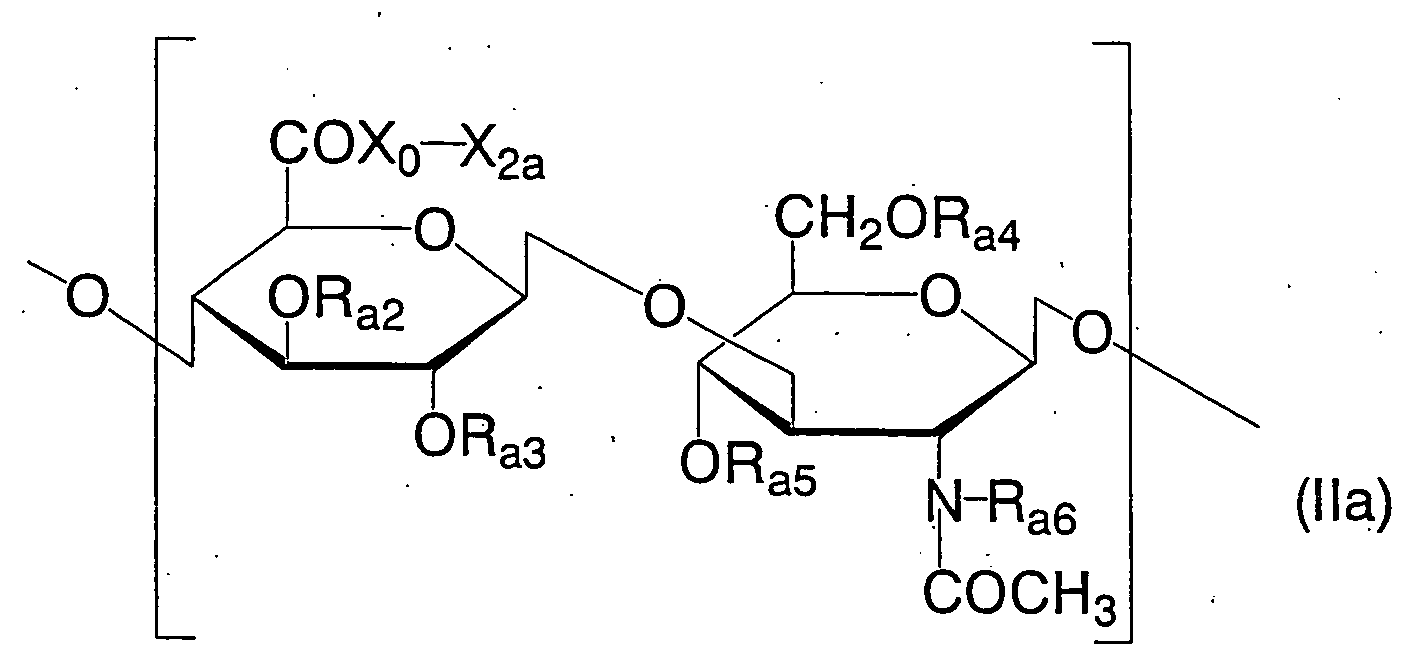
X0 represents -O- or -N(-R1)-,
R1 represents a hydrogen atom, a linear or branched C1-10 alkyl group, a linear or branched C1-10 hydroxyalkyl group, a polyalkylene oxide group, a polypeptide group, or a polyester group,
Ra2, Ra3, Ra4, Ra5 and Ra6 each independently represent a hydrogen atom, a linear or branched C1-6 alkyl group, a linear or branched C1-6 alkenyl group, a linear or branched C1-6 alkynyl group, a linear or branched C1-6 alkylcarbonyl group, a linear or branched C1-6 alkenylcarbonyl group, a linear or branched C1-6 alkynylcarbonyl group, or -SO2OH,
X2a represents -Y1-Q1-Y2-Q3-Y3-Q2-SH or -N(-R2)-Y3-Q2-SH,
Y1 represents a single bond, -N(-R3)CO-, -N(-R3)-, -CO-, or -CH2CO-,
Y2 and Y3 each independently represent a single bond, -O-, -S-, -SO-, -SO2-, -N(-R4)-, -COO-, -OCO-, -CON(-R4)-, -N(-R4)CO-, or -N(-R4)CON(-R5)-,
Q1, Q2 and Q3 each independently represent a linear or branched C1-10 alkylene group, a linear or branched C1-10 hydroxyalkylene group, a polyalkylene oxide group, a polypeptide group, or a polyester group, and
R2, R3, R4 and R5 each independently represent a hydrogen atom, a linear or branched C1-10 alkyl group, a linear or branched C1-10 hydroxyalkyl group, a polyalkylene oxide group, a polypeptide group, or a polyester group). - A hyaluronic acid derivative having (a) mercapto group(s), which is prepared by the method according to claim 2, 3, 4 or 5.
- The hyaluronic acid derivative according to claim 6, whose molecule contains at least one or more repeated structures represented by Formula (II) (wherein X0, X2, Ra2, Ra3, Ra4, Ra5 and Ra6 are as defined in claim 3) or Formula (IIa) (wherein X0, X2a, Ra2, Ra3, Ra4, Ra5 and Ra6 are as defined in claim 5).
- The hyaluronic acid derivative according to claim 6 or 7, wherein the introduction rate of mercapto groups is 5 mol% or more based on glucuronic acid in the hyaluronic acid derivative.
- The hyaluronic acid derivative according to claim 6, 7 or 8, which contains the repeated structure A represented by Formula (III):(wherein
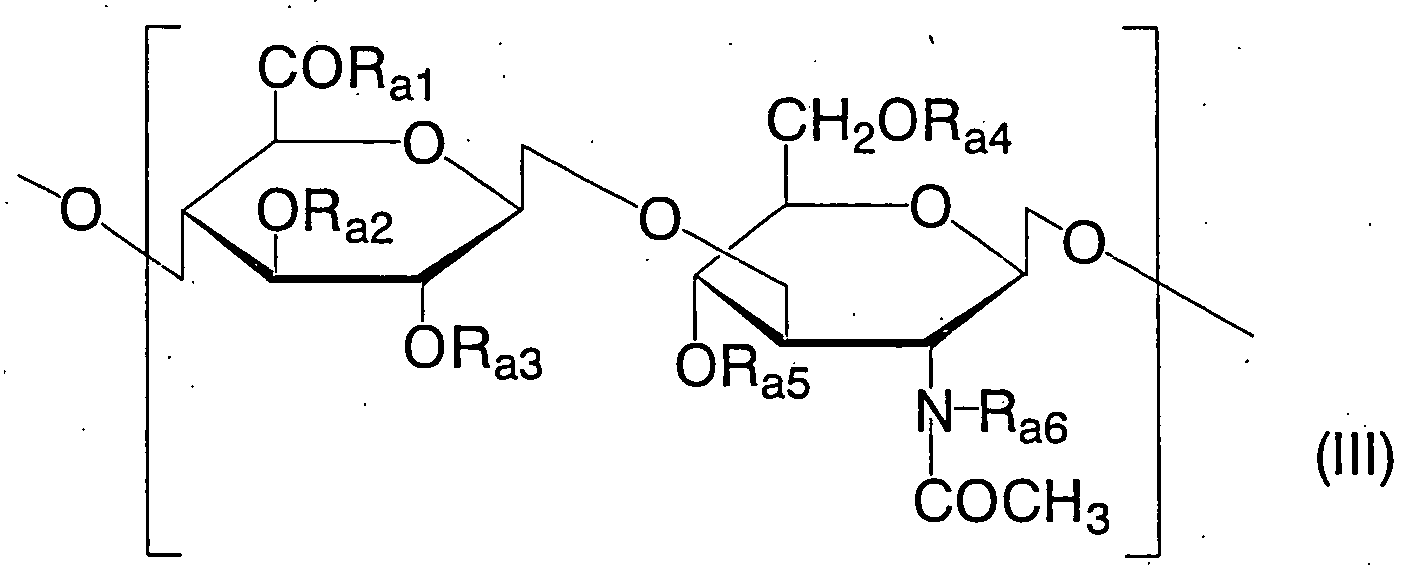
Ra1 represents a hydroxyl group, an amino group which may be mono- or di-substituted.with a linear or branched C1-6 alkyl group, or a linear or branched C1-6 alkoxy group, or Ra1 may form a carboxylate salt with a cation selected from the group consisting of sodium ion, potassium ion, calcium ion, magnesium ion, lithium ion and an optionally substituted ammonium ion, and
Ra2, Ra3, Ra4, Ra5 and Ra6 each independently represent a hydrogen atom, a linear or branched C1-6 alkyl group, a linear or branched C1-6 alkenyl group, a linear or branched C1-6 alkynyl group, a linear or branched C1-6 alkylcarbonyl group, a linear or branched C1-6 alkenylcarbonyl group, a linear or branched C1-6 alkynylcarbonyl group, or -SO2OH) and the repeated structure B represented by Formula (II) (wherein X0, X2, Ra2, Ra3, Ra4, Ra5 and Ra6 are as defined in claim 3) or Formula (IIa) (wherein X0, X2a, Ra2, Ra3, Ra4, Ra5 and Ra6 are as defined in claim 5),
wherein the abundance ratio between the repeated structures A and B is 95:5 to 10:90. - A chemically crosslinked hyaluronic acid derivative obtainable by chemically crosslinking the hyaluronic acid derivative according to claim 6, 7, 8 or 9 with an unsaturated bond-containing compound.
- A method for preparing a hyaluronic acid derivative having (an) unsaturated bond-containing group(s), which comprises the following steps:(a) introducing (a) hydrazyl group(s) or (an) amino group(s) by converting at least one or more carboxyl groups of hyaluronic acid into N-substituted amide or ester group(s) having a substituent containing a hydrazyl or amino group; and(b) introducing (an) unsaturated bond-containing group(s) into the resulting hyaluronic acid derivative having (a) hydrazyl or amino group(s).
- The method for preparing a hyaluronic acid derivative having (an) unsaturated bond-containing group(s) according to claim 11, which comprises the following steps:(a) converting at least one or more carboxyl groups of hyaluronic acid into N-substituted amide or ester group(s) having a substituent containing a hydrazyl or amino group to synthesize a hyaluronic acid derivative whose molecule contains at least one or more repeated structures represented by Formula (I) (wherein X0 , X1, Ra2 , Ra3, Ra4, Ra5 and Ra6 are as defined in claim 3); and(b) introducing (an) unsaturated bond-containing group(s) into the resulting hyaluronic acid derivative to synthesize a hyaluronic acid derivative whose molecule contains at least one or more repeated structures represented by Formula (IV):(wherein
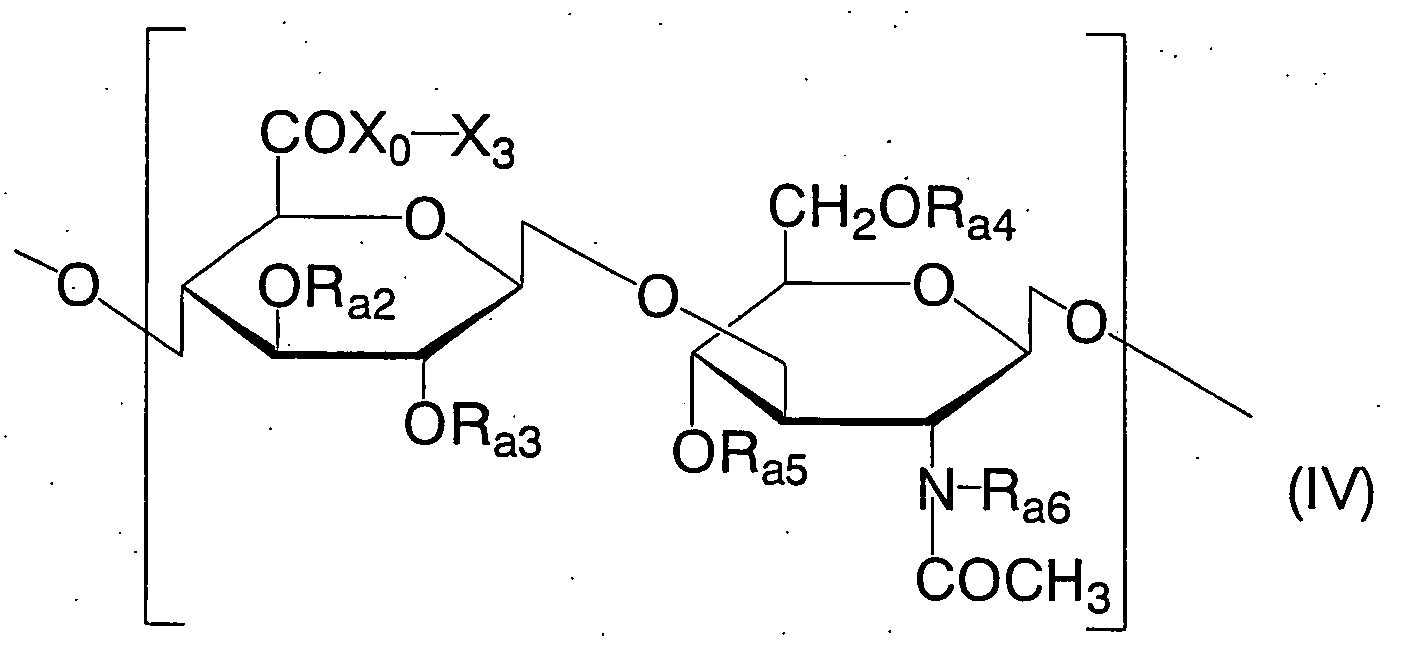
X0 represents -O- or -N(-R1)-,
X3 represents -Y1-Q1-Y2-N(-R2)-Y3-Q4 or -N(-R2)-Y3-Q4,
R1 represents a hydrogen atom, a linear or branched C1-10 alkyl group, a linear or branched C1-10 hydroxyalkyl group, a polyalkylene oxide group, a polypeptide group, or a polyester group,
Ra2, Ra3, Ra4, Ra5 and Ra6 each independently represent a hydrogen atom, a linear or branched C1-6 alkyl group, a linear or branched C1-6 alkenyl group, a linear or branched C1-6 alkynyl group, a linear or branched C1-6 alkylcarbonyl group, a linear or branched C1-6 alkenylcarbonyl group, a linear or branched C1-6 alkynylcarbonyl group, or -SO2OH,
Y1 represents a single bond, -N(-R3)CO-, -N(-R3)-, -CO-, or -CH2CO-,
Y2 represents a single bond, -CON(-R4)-, or -N(-R4)-,
Y3 represents a single bond, -CO-, -N(-R5)CO-, -N(-R5)-, or -CH2CO-,
Q1 represents a linear or branched C1-10 alkylene group, a linear or branched C1-10 hydroxyalkylene group, a polyalkylene oxide group, a polypeptide group, or a polyester group,
R2, R3, R4 and R5 each independently represent a hydrogen atom, a linear or branched C1-10 alkyl group, a linear or branched C1-10 hydroxyalkyl group, a polyalkylene oxide group, a polypeptide group, or a polyester group, and
Q4 represents a linear or branched C2-10 alkenyl group, or a linear or branched C2-10 alkynyl group). - A hyaluronic acid derivative having (an) unsaturated bond-containing group(s), which is prepared by the method according to claim 11 or 12.
- The hyaluronic acid derivative according to claim 13, whose molecule contains at least one or more repeated structures represented by Formula (IV) (wherein X0, X3, Ra2, Ra3, Ra4, Ra5 and Ra6 are as defined in claim 12).
- The hyaluronic acid derivative according to claim 13 or 14, wherein the introduction rate of unsaturated bond-containing groups is 5 mol% or more based on glucuronic acid in hyaluronic acid.
- The hyaluronic acid derivative according to claim 13, 14 or 15, which contains the repeated structure A represented by Formula (III) (wherein Ra1, Ra2, Ra3, Ra4, Ra5 and Ra6 are as defined in claim 9) and the repeated structure C represented by Formula (IV) (wherein X0, X3, Ra2, Ra3, Ra4, Ra5 and Ra6 are as defined in claim 3),
wherein the abundance ratio between the repeated structures A and C is 95:5 to 10:90. - A chemically crosslinked hyaluronic acid derivative obtainable by chemically crosslinking the hyaluronic acid derivative according to claim 13, 14, 15 or 16 with a mercapto group-containing compound.
- The chemically crosslinked hyaluronic acid derivative according to claim 10 or 17, whose molecule contains at least one or more repeated structures represented by Formula (V):(wherein

X0 represents -O- or -N(-R1)-,
R1 represents a hydrogen atom, a linear or branched C1-6 alkyl group, a linear or branched C1-10 hydroxyalkyl group, a polyalkylene oxide group, a polypeptide group, or a polyester group,
Ra2, Ra3, Ra4, Ra5 and Ra6 each independently represent a hydrogen atom, a linear or branched C1-6 alkyl group, a linear or branched C1-6 alkenyl group, a linear or branched C1-6 alkynyl group, a linear or branched C1-6 alkylcarbonyl group, a linear or branched C1-6 alkenylcarbonyl group, a linear or branched C1-6 alkynylcarbonyl group, or -SO2OH,
X4 represents -Y1-Q1-Y2-X5-Y3-Q2-S-L or -N(-R2)-Y3-Q2-S-L,
X5 represents -Q3- or -N(-R2)-,
Y1 represents a single bond, -N(-R3)CO-, -N(-R3)-, -CO-, or -CH2CO-,
Y2 represents a single bond, -O-, -S-, -SO-, -SO2-, -N(-R4)-, -COO-, -OCO-, -CON(-R4)-, -N(-R4)CO-, or -N(-R4)CON(-R5)-,
Y3 represents a single bond, -CO-, -C6H4-, -CO2-, -SO2-, -CH2-CH(OH)-, -C(=NH)-, -PO(OH)-O-, -CSNH-, or -CONH-,
Q1, Q2 and Q3 each independently represent a linear or branched C1-10 alkylene group, a linear or branched C1-10 hydroxyalkylene group, a polyalkylene oxide group, a polypeptide group, or a polyester group,
R2 and R3 each independently represent a hydrogen atom, a linear or branched C1-10 alkyl group, a linear or branched C1-10 hydroxyalkyl group, a polyalkylene oxide group, a polypeptide group, or a polyester group,
L represents a linear or branched C1-10 alkylene group, a linear or branched C1-10 alkenylene group, or a polyethylene oxide group, each of which forms an intramolecular or intermolecular crosslinkage together with L in another repeated structure and which may optionally contain Z1, Z2, Z3, Z4 and Z5 at the end of or within its main chain,
Z1, Z2, Z3, Z4 and Z5 each independently represent -O-, -S-, -SO-, -SO2-, -N(-R4)-, -CH(-R6)-, -C(-R6)(-R7)-, -CO-, -COO-, -OCO-, -CON(-R4)-, -N(-R4)CO-, or -N(-R4)CON(-R5)-,
R4 and R5 each independently represent a hydrogen atom, a linear or branched C1-10 alkyl group, a linear or branched C1-10 hydroxyalkylene group, a polyalkylene oxide group, a polypeptide group, or a polyester group, and
R6 and R7 each independently represent a hydroxyl group, a linear or branched C1-4 alkoxy group, a halogen atom, a carboxyl group, an amide group, or an ester group). - The chemically crosslinked hyaluronic acid derivative according to claim 10, 17 or 18, which contains the repeated structure A represented by Formula (III) (wherein Ra1, Ra2, Ra3, Ra4, Ra5 and Ra6 are as defined in claim 9) and the repeated structure D represented by Formula (V) (wherein X0, X4, Ra2, Ra3, Ra4, Ra5 and Ra6 are as def ined in claim 18),
wherein the abundance ratio between the repeated structures A and D is 95:5 to 10:90. - A method for preparing a chemically crosslinked hyaluronic acid derivative, which comprises chemically crosslinking the hyaluronic acid derivative according to claim 6, 7, 8 or 9 with an unsaturated bond-containing compound.
- The method for preparing a chemically crosslinked hyaluronic acid derivative according to claim 20, wherein the hyaluronic acid derivative according to claim 6, 7, 8 or 9 is chemically crosslinked with an unsaturated bond-containing compound in a solution in the presence of a protein or a peptide.
- The method according to claim 20 or 21, wherein the chemically crosslinked hyaluronic acid derivative is a hyaluronic acid derivative whose molecule contains at least one or more repeated structures represented by Formula (V) (wherein X0, X4, Ra2, Ra3, Ra4, Ra5 and Ra6 are as def ined in claim 18).
- A method for preparing a chemically crosslinked hyaluronic acid derivative, which comprises chemically crosslinking the hyaluronic acid derivative according to claim 13, 14, 15 or 16 with a mercapto group-containing compound.
- The method for preparing a chemically crosslinked hyaluronic acid derivative according to claim 23, wherein the hyaluronic acid derivative according to claim 13, 14, 15 or 16 is chemically crosslinked with a mercapto group-containing compound in a solution in the presence of a protein or a peptide.
- The method according to claim 23 or 24, wherein the chemically crosslinked hyaluronic acid derivative is a hyaluronic acid derivative whose molecule contains at least one or more repeated structures represented by Formula (V) (wherein X0, X4, Ra2, Ra3, Ra4, Ra5 and Ra6 are as defined in claim 18).
- A hyaluronic acid derivative gel, which comprises the chemically crosslinked hyaluronic acid derivative according to claim 10, 17, 18 or 19.
- The hyaluronic acid derivative gel according to claim 26, which is a hydrogel.
- The hyaluronic acid derivative gel according to claim 26 or 27, which contains a protein or a peptide.
- A sustained-release drug carrier, which comprises the chemically crosslinked hyaluronic acid derivative according to claim 10, 17, 18 or 19.
- A sustained-release drug carrier, which comprises the hyaluronic acid derivative gel according to claim 26, 27 or 28.
- A pharmaceutical composition, which comprises the hyaluronic acid derivative gel according to claim 26, 27 or 28.
- A pharmaceutical composition, which comprises the sustained-release drug carrier according to claim 1, 29 or 30.
Applications Claiming Priority (3)
| Application Number | Priority Date | Filing Date | Title |
|---|---|---|---|
| JP2002338167 | 2002-11-21 | ||
| JP2002338167 | 2002-11-21 | ||
| PCT/JP2003/014906 WO2004046200A1 (en) | 2002-11-21 | 2003-11-21 | Sustained release drug carrier |
Publications (2)
| Publication Number | Publication Date |
|---|---|
| EP1564220A1 true EP1564220A1 (en) | 2005-08-17 |
| EP1564220A4 EP1564220A4 (en) | 2010-03-17 |
Family
ID=32321880
Family Applications (1)
| Application Number | Title | Priority Date | Filing Date |
|---|---|---|---|
| EP03774146A Withdrawn EP1564220A4 (en) | 2002-11-21 | 2003-11-21 | EXCIPIENT FOR DELAYED RELEASE MEDICINE |
Country Status (5)
| Country | Link |
|---|---|
| US (1) | US7816316B2 (en) |
| EP (1) | EP1564220A4 (en) |
| JP (1) | JP4636883B2 (en) |
| AU (1) | AU2003284634A1 (en) |
| WO (1) | WO2004046200A1 (en) |
Cited By (4)
| Publication number | Priority date | Publication date | Assignee | Title |
|---|---|---|---|---|
| WO2008008859A3 (en) * | 2006-07-11 | 2008-03-06 | Univ Utah Res Found | Macromolecules modified with electrophilic groups and methods of making and using thereof |
| CN101200504B (en) * | 2006-12-11 | 2010-05-12 | 上海百瑞吉生物医药有限公司 | Macromolecule thiolated modified derivatives and cross-linking material thereof |
| US8143391B2 (en) | 2004-09-07 | 2012-03-27 | Chugai Seiyaku Kabushiki Kaisha | Process for producing water-soluble hyaluronic acid modification |
| WO2012066133A1 (en) | 2010-11-18 | 2012-05-24 | Centre National De La Recherche Scientifique (Cnrs) | Polysaccharide derivatives including an alkene unit and thiol-click chemical coupling reaction |
Families Citing this family (20)
| Publication number | Priority date | Publication date | Assignee | Title |
|---|---|---|---|---|
| WO2005054301A1 (en) * | 2003-11-14 | 2005-06-16 | Chugai Seiyaku Kabushiki Kaisha | Crosslinked polysaccharide microparticles and process for producing the same |
| TW200643033A (en) * | 2005-03-08 | 2006-12-16 | Chugai Pharmaceutical Co Ltd | Conjugate of water-soluble modified hyaluronic acid and glp-1 analogue |
| KR100849185B1 (en) * | 2006-01-19 | 2008-07-30 | 서울산업대학교 산학협력단 | Chitosan or Hyaluronic acid-Polyethylene oxide- and Chitosan-Hyaluronic acid-Polyethylene oxide-Based hydrogel and Manufacturing Method Therefor |
| US7674781B2 (en) * | 2006-04-28 | 2010-03-09 | Heather Sheardown | Hyaluronic acid-retaining polymers |
| JP5443976B2 (en) * | 2007-05-01 | 2014-03-19 | 国立大学法人 東京医科歯科大学 | Hybrid gel containing chemically crosslinked hyaluronic acid derivative and pharmaceutical composition using the same |
| FR2931360B1 (en) * | 2008-05-20 | 2012-05-18 | Centre Nat Rech Scient | NANOPARTICLES CONTAINING A PEPTIDE, VECTORS CONTAINING SAME AND PHARMACEUTICAL USES OF SAID NANOPARTICLES AND VECTORS |
| BR112012002117A2 (en) | 2009-07-30 | 2019-09-24 | Carbylan Biosurgery Inc | modified polymeric compositions of hyaluronic acid and related methods. |
| CN102399295B (en) | 2010-09-09 | 2013-11-06 | 常州百瑞吉生物医药有限公司 | Low-sulfhydrylation-modification-degree biocompatible high-molecular sulfhydrylation derivatives, cross-linking material thereof, and purpose thereof |
| CN104602712A (en) * | 2012-09-06 | 2015-05-06 | 南洋理工大学 | Hyaluronic acid-based drug delivery systems |
| US9572832B2 (en) * | 2013-08-29 | 2017-02-21 | Holy Stone Healthcare Co., Ltd. | Compound of glycosaminoglycan and its fabrication method as well as application |
| WO2015077401A1 (en) | 2013-11-20 | 2015-05-28 | Drexel University | Compositions and methods for macrophage conversion |
| KR102228571B1 (en) * | 2017-02-09 | 2021-03-16 | 주식회사 메디폴리머 | Drug delivery system for treatment of psychosis or central nervous system diseases |
| JP7216006B2 (en) | 2017-03-22 | 2023-01-31 | ジェネンテック, インコーポレイテッド | Hydrogel Crosslinked Hyaluronic Acid Prodrug Compositions and Methods |
| CN109966558A (en) * | 2019-04-08 | 2019-07-05 | 四川大学 | A kind of injectable intelligent response hydrogel and its preparation method and application |
| HUE071637T2 (en) * | 2019-05-07 | 2025-09-28 | Genzyme Corp | Methods for quantifying drug concentration in a prodrug composition |
| CN110105594A (en) * | 2019-05-26 | 2019-08-09 | 杭州枫霖科技有限公司 | A kind of Sodium Hyaluronate hydrogel and preparation method thereof with rapid curing function |
| PT3747267T (en) * | 2019-06-03 | 2023-11-03 | Symborg S L | Methylobacterium sp. nov. strain, compositions comprising it, and its use as bio-stimulant and endophyte nitrogen-fixing bacterium |
| CN110498936A (en) * | 2019-07-15 | 2019-11-26 | 北京化工大学 | A kind of preparation method of sodium hyaluronate/sodium alginate injection composite hydrogel |
| CN112812329B (en) * | 2019-11-18 | 2023-06-16 | 孛朗孚(杭州)生物科技有限公司 | Hydrogel of sulfhydryl modified high molecular compound, preparation method and application thereof |
| JPWO2025070791A1 (en) | 2023-09-27 | 2025-04-03 |
Family Cites Families (24)
| Publication number | Priority date | Publication date | Assignee | Title |
|---|---|---|---|---|
| US4582865A (en) | 1984-12-06 | 1986-04-15 | Biomatrix, Inc. | Cross-linked gels of hyaluronic acid and products containing such gels |
| US4851521A (en) | 1985-07-08 | 1989-07-25 | Fidia, S.P.A. | Esters of hyaluronic acid |
| IT1198449B (en) * | 1986-10-13 | 1988-12-21 | F I D I Farmaceutici Italiani | ESTERS OF POLYVALENT ALCOHOLS OF HYALURONIC ACID |
| JP2837675B2 (en) * | 1987-09-22 | 1998-12-16 | 中外製薬株式会社 | Sustained-release fine-particle preparation |
| IT1219587B (en) | 1988-05-13 | 1990-05-18 | Fidia Farmaceutici | SELF-CROSS-LINKED CARBOXYLY POLYSACCHARIDES |
| US5356883A (en) | 1989-08-01 | 1994-10-18 | Research Foundation Of State University Of N.Y. | Water-insoluble derivatives of hyaluronic acid and their methods of preparation and use |
| US5529914A (en) * | 1990-10-15 | 1996-06-25 | The Board Of Regents The Univeristy Of Texas System | Gels for encapsulation of biological materials |
| JPH05140201A (en) | 1991-11-25 | 1993-06-08 | Shiseido Co Ltd | Crosslinked hyaluronic acid gel and method for producing the same |
| DE69329594T2 (en) * | 1992-02-28 | 2001-05-31 | Board Of Regents, The University Of Texas System | PHOTOPOLYMERINABLE, BIODEGRADABLE HYDROGELS AS TISSUE CONTACT MATERIALS AND SUBSTANCES FOR CONTROLLED RELEASE |
| US5616568A (en) * | 1993-11-30 | 1997-04-01 | The Research Foundation Of State University Of New York | Functionalized derivatives of hyaluronic acid |
| ITPD940054A1 (en) | 1994-03-23 | 1995-09-23 | Fidia Advanced Biopolymers Srl | SULPHATED POLYSACCHARIDES |
| JP3955107B2 (en) | 1995-05-01 | 2007-08-08 | 生化学工業株式会社 | Method for producing crosslinked polysaccharide |
| US5827937A (en) * | 1995-07-17 | 1998-10-27 | Q Med Ab | Polysaccharide gel composition |
| JPH0959303A (en) | 1995-08-22 | 1997-03-04 | Shiseido Co Ltd | Biocompatible hyaluronic acid gel and its use |
| JP3898783B2 (en) * | 1996-08-26 | 2007-03-28 | 久光製薬株式会社 | Biodegradable hyaluronic acid crosslinked gel composition and biodegradable hyaluronic acid crosslinked gel preparation |
| IT1287698B1 (en) | 1996-08-29 | 1998-08-18 | Fidia Advanced Biopolymers Srl | SUTURE THREADS ESSENTIALLY MADE OF ESTERE DERIVATIVES OF HYALURONIC ACID |
| US5874471A (en) * | 1997-02-27 | 1999-02-23 | Waugh; William Howard | Orthomolecular medical use of L-citrulline for vasoprotection, relaxative smooth muscle tone and cell protection |
| ATE229038T1 (en) | 1997-04-04 | 2002-12-15 | Fidia Advanced Biopolymers Srl | N-SULFATED HYALURONIC ACID COMPOUNDS, THEIR DERIVATIVES AND METHOD FOR THEIR PRODUCTION |
| EP2311895B1 (en) | 1999-02-01 | 2017-04-12 | Eidgenössische Technische Hochschule Zürich | Biomaterials formed by nucleophilic addition reaction to conjugated unsaturated groups |
| GB9902412D0 (en) * | 1999-02-03 | 1999-03-24 | Fermentech Med Ltd | Process |
| WO2002068383A2 (en) * | 2001-02-22 | 2002-09-06 | Anika Therapeutics, Inc. | Thiol-modified hyaluronan |
| CA2445239C (en) * | 2001-04-25 | 2012-08-21 | Eidgenossische Technische Hochschule Zurich | Drug delivery matrices to enhance wound healing |
| AU2003299509A1 (en) * | 2002-06-21 | 2004-05-13 | University Of Utah Research Foundation | Crosslinked compounds and methods of making and using thereof |
| US7767806B2 (en) * | 2003-09-08 | 2010-08-03 | Chugai Seiyaku Kabushiki Kaisha | Hyaluronic acid modification products and drug carriers using them |
-
2003
- 2003-11-21 WO PCT/JP2003/014906 patent/WO2004046200A1/en not_active Ceased
- 2003-11-21 US US10/536,031 patent/US7816316B2/en not_active Expired - Fee Related
- 2003-11-21 EP EP03774146A patent/EP1564220A4/en not_active Withdrawn
- 2003-11-21 JP JP2004553228A patent/JP4636883B2/en not_active Expired - Fee Related
- 2003-11-21 AU AU2003284634A patent/AU2003284634A1/en not_active Abandoned
Cited By (7)
| Publication number | Priority date | Publication date | Assignee | Title |
|---|---|---|---|---|
| US8143391B2 (en) | 2004-09-07 | 2012-03-27 | Chugai Seiyaku Kabushiki Kaisha | Process for producing water-soluble hyaluronic acid modification |
| US9394379B2 (en) | 2004-09-07 | 2016-07-19 | Chugai Seiyaku Kabushiki Kaisha | Process for producing water-soluble hyaluronic acid modification |
| WO2008008859A3 (en) * | 2006-07-11 | 2008-03-06 | Univ Utah Res Found | Macromolecules modified with electrophilic groups and methods of making and using thereof |
| CN101200504B (en) * | 2006-12-11 | 2010-05-12 | 上海百瑞吉生物医药有限公司 | Macromolecule thiolated modified derivatives and cross-linking material thereof |
| WO2012066133A1 (en) | 2010-11-18 | 2012-05-24 | Centre National De La Recherche Scientifique (Cnrs) | Polysaccharide derivatives including an alkene unit and thiol-click chemical coupling reaction |
| FR2967677A1 (en) * | 2010-11-18 | 2012-05-25 | Centre Nat Rech Scient | POLYSACCHARIDE DERIVATIVES COMPRISING ALKENOUS PATTERN AND THIO-CLICK CHEMICAL COUPLING REACTION |
| US20130231474A1 (en) * | 2010-11-18 | 2013-09-05 | Universite Joseph Fourier - Grenoble 1 | Polysaccharide derivatives including an alkene unit and thiol-click chemical coupling reaction |
Also Published As
| Publication number | Publication date |
|---|---|
| EP1564220A4 (en) | 2010-03-17 |
| JP4636883B2 (en) | 2011-02-23 |
| AU2003284634A1 (en) | 2004-06-15 |
| JPWO2004046200A1 (en) | 2006-03-16 |
| US20060110458A1 (en) | 2006-05-25 |
| WO2004046200A1 (en) | 2004-06-03 |
| US7816316B2 (en) | 2010-10-19 |
Similar Documents
| Publication | Publication Date | Title |
|---|---|---|
| US7816316B2 (en) | Sustained release drug carrier | |
| EP1683812B1 (en) | Crosslinked polysaccharide microparticles and method for their preparation | |
| AU2021201321C1 (en) | Preparation and/or formulation of proteins cross-linked with polysaccharides | |
| JP3094074B2 (en) | Polysaccharide gel composition | |
| US8987230B2 (en) | Hybrid gel comprising chemically crosslinked hyaluronic acid derivative and pharmaceutical composition comprising the same | |
| EP1790665B1 (en) | Process for producing water-soluble modified hyaluronic acid | |
| JPH0834747A (en) | Collagen-based injectable drug delivery formulations and uses thereof | |
| Motokawa et al. | Selectively crosslinked hyaluronic acid hydrogels for sustained release formulation of erythropoietin | |
| CN104603156A (en) | Hyaluronic acid derivative having amino acid and steryl group introduced thereinto | |
| JPWO2004050712A1 (en) | Drug sustained-release carrier |
Legal Events
| Date | Code | Title | Description |
|---|---|---|---|
| PUAI | Public reference made under article 153(3) epc to a published international application that has entered the european phase |
Free format text: ORIGINAL CODE: 0009012 |
|
| 17P | Request for examination filed |
Effective date: 20050615 |
|
| AK | Designated contracting states |
Kind code of ref document: A1 Designated state(s): AT BE BG CH CY CZ DE DK EE ES FI FR GB GR HU IE IT LI LU MC NL PT RO SE SI SK TR |
|
| AX | Request for extension of the european patent |
Extension state: AL LT LV MK |
|
| DAX | Request for extension of the european patent (deleted) | ||
| A4 | Supplementary search report drawn up and despatched |
Effective date: 20100212 |
|
| 17Q | First examination report despatched |
Effective date: 20110729 |
|
| GRAP | Despatch of communication of intention to grant a patent |
Free format text: ORIGINAL CODE: EPIDOSNIGR1 |
|
| INTG | Intention to grant announced |
Effective date: 20191211 |
|
| STAA | Information on the status of an ep patent application or granted ep patent |
Free format text: STATUS: THE APPLICATION IS DEEMED TO BE WITHDRAWN |
|
| 18D | Application deemed to be withdrawn |
Effective date: 20200603 |