EP1563559B1 - An innovative method for the preparation of proton conducting nanopolymeric membranes for use in fuel cells or in catalytic membrane reactors - Google Patents
An innovative method for the preparation of proton conducting nanopolymeric membranes for use in fuel cells or in catalytic membrane reactors Download PDFInfo
- Publication number
- EP1563559B1 EP1563559B1 EP03744819.8A EP03744819A EP1563559B1 EP 1563559 B1 EP1563559 B1 EP 1563559B1 EP 03744819 A EP03744819 A EP 03744819A EP 1563559 B1 EP1563559 B1 EP 1563559B1
- Authority
- EP
- European Patent Office
- Prior art keywords
- organic
- organic solutions
- nano
- membrane
- particles
- Prior art date
- Legal status (The legal status is an assumption and is not a legal conclusion. Google has not performed a legal analysis and makes no representation as to the accuracy of the status listed.)
- Expired - Lifetime
Links
- 239000012528 membrane Substances 0.000 title claims description 104
- 238000002360 preparation method Methods 0.000 title claims description 26
- 238000000034 method Methods 0.000 title claims description 22
- 239000000446 fuel Substances 0.000 title claims description 16
- 230000003197 catalytic effect Effects 0.000 title description 10
- 150000001875 compounds Chemical class 0.000 claims description 43
- SECXISVLQFMRJM-UHFFFAOYSA-N N-Methylpyrrolidone Chemical compound CN1CCCC1=O SECXISVLQFMRJM-UHFFFAOYSA-N 0.000 claims description 38
- 229910052751 metal Inorganic materials 0.000 claims description 38
- 239000002184 metal Substances 0.000 claims description 38
- 239000000203 mixture Substances 0.000 claims description 36
- 239000002904 solvent Substances 0.000 claims description 34
- 229910006069 SO3H Inorganic materials 0.000 claims description 30
- 229920000554 ionomer Polymers 0.000 claims description 28
- MDBVZFGSKMWJFD-UHFFFAOYSA-N OP(O)=O.OP(O)(O)=O Chemical class OP(O)=O.OP(O)(O)=O MDBVZFGSKMWJFD-UHFFFAOYSA-N 0.000 claims description 23
- 239000002105 nanoparticle Substances 0.000 claims description 23
- 229920000642 polymer Polymers 0.000 claims description 23
- 239000011148 porous material Substances 0.000 claims description 22
- 239000002253 acid Substances 0.000 claims description 19
- 238000011049 filling Methods 0.000 claims description 17
- 239000011159 matrix material Substances 0.000 claims description 17
- 229910018828 PO3H2 Inorganic materials 0.000 claims description 16
- 150000003839 salts Chemical class 0.000 claims description 16
- 239000003960 organic solvent Substances 0.000 claims description 15
- 238000001704 evaporation Methods 0.000 claims description 13
- 238000003780 insertion Methods 0.000 claims description 13
- 230000037431 insertion Effects 0.000 claims description 13
- 230000008020 evaporation Effects 0.000 claims description 12
- 229910052726 zirconium Inorganic materials 0.000 claims description 11
- WEVYAHXRMPXWCK-UHFFFAOYSA-N Acetonitrile Chemical compound CC#N WEVYAHXRMPXWCK-UHFFFAOYSA-N 0.000 claims description 10
- ZMXDDKWLCZADIW-UHFFFAOYSA-N N,N-Dimethylformamide Chemical compound CN(C)C=O ZMXDDKWLCZADIW-UHFFFAOYSA-N 0.000 claims description 10
- IAZDPXIOMUYVGZ-UHFFFAOYSA-N Dimethylsulphoxide Chemical compound CS(C)=O IAZDPXIOMUYVGZ-UHFFFAOYSA-N 0.000 claims description 8
- OAICVXFJPJFONN-UHFFFAOYSA-N Phosphorus Chemical compound [P] OAICVXFJPJFONN-UHFFFAOYSA-N 0.000 claims description 6
- 229910052698 phosphorus Inorganic materials 0.000 claims description 6
- 239000011574 phosphorus Substances 0.000 claims description 6
- 239000000919 ceramic Substances 0.000 claims description 5
- 230000008030 elimination Effects 0.000 claims description 5
- 238000003379 elimination reaction Methods 0.000 claims description 5
- UADUAXMDVVGCGW-UHFFFAOYSA-N propanoic acid;zirconium Chemical compound [Zr].CCC(O)=O UADUAXMDVVGCGW-UHFFFAOYSA-N 0.000 claims description 5
- 229920000620 organic polymer Polymers 0.000 claims description 4
- 229910052684 Cerium Inorganic materials 0.000 claims description 3
- 239000003792 electrolyte Substances 0.000 claims description 3
- 229920000592 inorganic polymer Polymers 0.000 claims description 3
- 150000004715 keto acids Chemical class 0.000 claims description 3
- 229920001643 poly(ether ketone) Polymers 0.000 claims description 3
- 229910052718 tin Inorganic materials 0.000 claims description 3
- 229910052719 titanium Inorganic materials 0.000 claims description 3
- RYHBNJHYFVUHQT-UHFFFAOYSA-N 1,4-Dioxane Chemical compound C1COCCO1 RYHBNJHYFVUHQT-UHFFFAOYSA-N 0.000 claims description 2
- 125000003178 carboxy group Chemical group [H]OC(*)=O 0.000 claims description 2
- 238000005470 impregnation Methods 0.000 claims description 2
- DLFVBJFMPXGRIB-UHFFFAOYSA-N Acetamide Chemical compound CC(N)=O DLFVBJFMPXGRIB-UHFFFAOYSA-N 0.000 claims 2
- 125000000962 organic group Chemical group 0.000 claims 2
- VEXZGXHMUGYJMC-UHFFFAOYSA-M Chloride anion Chemical compound [Cl-] VEXZGXHMUGYJMC-UHFFFAOYSA-M 0.000 claims 1
- 150000004703 alkoxides Chemical class 0.000 claims 1
- 150000001450 anions Chemical class 0.000 claims 1
- 150000007942 carboxylates Chemical class 0.000 claims 1
- 150000001805 chlorine compounds Chemical class 0.000 claims 1
- 229920006393 polyether sulfone Polymers 0.000 claims 1
- 239000002245 particle Substances 0.000 description 20
- OKKJLVBELUTLKV-UHFFFAOYSA-N Methanol Chemical compound OC OKKJLVBELUTLKV-UHFFFAOYSA-N 0.000 description 15
- 229920000557 Nafion® Polymers 0.000 description 13
- 230000015572 biosynthetic process Effects 0.000 description 11
- IGBFPCWHFQAPMX-UHFFFAOYSA-J [Zr+4].OP([O-])=O.[O-]P([O-])([O-])=O Chemical class [Zr+4].OP([O-])=O.[O-]P([O-])([O-])=O IGBFPCWHFQAPMX-UHFFFAOYSA-J 0.000 description 10
- 239000000499 gel Substances 0.000 description 10
- 229910000166 zirconium phosphate Inorganic materials 0.000 description 10
- QCWXUUIWCKQGHC-UHFFFAOYSA-N Zirconium Chemical compound [Zr] QCWXUUIWCKQGHC-UHFFFAOYSA-N 0.000 description 9
- 238000001556 precipitation Methods 0.000 description 9
- 239000007787 solid Substances 0.000 description 9
- LEHFSLREWWMLPU-UHFFFAOYSA-B zirconium(4+);tetraphosphate Chemical compound [Zr+4].[Zr+4].[Zr+4].[O-]P([O-])([O-])=O.[O-]P([O-])([O-])=O.[O-]P([O-])([O-])=O.[O-]P([O-])([O-])=O LEHFSLREWWMLPU-UHFFFAOYSA-B 0.000 description 9
- NBIIXXVUZAFLBC-UHFFFAOYSA-N Phosphoric acid Chemical compound OP(O)(O)=O NBIIXXVUZAFLBC-UHFFFAOYSA-N 0.000 description 8
- -1 (e.g. Substances 0.000 description 7
- 230000001747 exhibiting effect Effects 0.000 description 7
- XLYOFNOQVPJJNP-UHFFFAOYSA-N water Substances O XLYOFNOQVPJJNP-UHFFFAOYSA-N 0.000 description 7
- VYPSYNLAJGMNEJ-UHFFFAOYSA-N Silicium dioxide Chemical compound O=[Si]=O VYPSYNLAJGMNEJ-UHFFFAOYSA-N 0.000 description 6
- 230000035699 permeability Effects 0.000 description 6
- 238000001035 drying Methods 0.000 description 5
- 239000002114 nanocomposite Substances 0.000 description 5
- BDERNNFJNOPAEC-UHFFFAOYSA-N propan-1-ol Chemical compound CCCO BDERNNFJNOPAEC-UHFFFAOYSA-N 0.000 description 5
- 238000000935 solvent evaporation Methods 0.000 description 5
- 229910000147 aluminium phosphate Inorganic materials 0.000 description 4
- 238000006243 chemical reaction Methods 0.000 description 4
- 239000003153 chemical reaction reagent Substances 0.000 description 4
- 239000011521 glass Substances 0.000 description 4
- 239000011229 interlayer Substances 0.000 description 4
- MBKDYNNUVRNNRF-UHFFFAOYSA-N medronic acid Chemical compound OP(O)(=O)CP(O)(O)=O MBKDYNNUVRNNRF-UHFFFAOYSA-N 0.000 description 4
- 150000002739 metals Chemical class 0.000 description 4
- 241000894007 species Species 0.000 description 4
- 238000003756 stirring Methods 0.000 description 4
- AZUYLZMQTIKGSC-UHFFFAOYSA-N 1-[6-[4-(5-chloro-6-methyl-1H-indazol-4-yl)-5-methyl-3-(1-methylindazol-5-yl)pyrazol-1-yl]-2-azaspiro[3.3]heptan-2-yl]prop-2-en-1-one Chemical compound ClC=1C(=C2C=NNC2=CC=1C)C=1C(=NN(C=1C)C1CC2(CN(C2)C(C=C)=O)C1)C=1C=C2C=NN(C2=CC=1)C AZUYLZMQTIKGSC-UHFFFAOYSA-N 0.000 description 3
- UFHFLCQGNIYNRP-UHFFFAOYSA-N Hydrogen Chemical compound [H][H] UFHFLCQGNIYNRP-UHFFFAOYSA-N 0.000 description 3
- KFZMGEQAYNKOFK-UHFFFAOYSA-N Isopropanol Chemical compound CC(C)O KFZMGEQAYNKOFK-UHFFFAOYSA-N 0.000 description 3
- 229910019142 PO4 Inorganic materials 0.000 description 3
- 239000002033 PVDF binder Substances 0.000 description 3
- ZJDGKLAPAYNDQU-UHFFFAOYSA-J [Zr+4].[O-]P([O-])=O.[O-]P([O-])=O Chemical compound [Zr+4].[O-]P([O-])=O.[O-]P([O-])=O ZJDGKLAPAYNDQU-UHFFFAOYSA-J 0.000 description 3
- 238000001246 colloidal dispersion Methods 0.000 description 3
- 238000011161 development Methods 0.000 description 3
- XBDQKXXYIPTUBI-UHFFFAOYSA-N dimethylselenoniopropionate Natural products CCC(O)=O XBDQKXXYIPTUBI-UHFFFAOYSA-N 0.000 description 3
- 238000001879 gelation Methods 0.000 description 3
- 238000010438 heat treatment Methods 0.000 description 3
- 229910052739 hydrogen Inorganic materials 0.000 description 3
- 239000001257 hydrogen Substances 0.000 description 3
- 235000021317 phosphate Nutrition 0.000 description 3
- 150000003009 phosphonic acids Chemical class 0.000 description 3
- 229920001343 polytetrafluoroethylene Polymers 0.000 description 3
- 239000004810 polytetrafluoroethylene Substances 0.000 description 3
- 229920002981 polyvinylidene fluoride Polymers 0.000 description 3
- TVCBSVKTTHLKQC-UHFFFAOYSA-M propanoate;zirconium(4+) Chemical compound [Zr+4].CCC([O-])=O TVCBSVKTTHLKQC-UHFFFAOYSA-M 0.000 description 3
- 239000003930 superacid Substances 0.000 description 3
- ABLZXFCXXLZCGV-UHFFFAOYSA-N Phosphorous acid Chemical group OP(O)=O ABLZXFCXXLZCGV-UHFFFAOYSA-N 0.000 description 2
- 239000004696 Poly ether ether ketone Substances 0.000 description 2
- MIPBRUSCLWRYIR-UHFFFAOYSA-J [Zr+4].[O-]P(=O)OP([O-])=O.[O-]P(=O)OP([O-])=O Chemical compound [Zr+4].[O-]P(=O)OP([O-])=O.[O-]P(=O)OP([O-])=O MIPBRUSCLWRYIR-UHFFFAOYSA-J 0.000 description 2
- 150000007513 acids Chemical class 0.000 description 2
- 239000012736 aqueous medium Substances 0.000 description 2
- 238000005266 casting Methods 0.000 description 2
- 230000003247 decreasing effect Effects 0.000 description 2
- 239000006185 dispersion Substances 0.000 description 2
- 238000004299 exfoliation Methods 0.000 description 2
- 230000006872 improvement Effects 0.000 description 2
- 238000011065 in-situ storage Methods 0.000 description 2
- 230000003993 interaction Effects 0.000 description 2
- 239000010410 layer Substances 0.000 description 2
- 238000002156 mixing Methods 0.000 description 2
- 150000003013 phosphoric acid derivatives Chemical class 0.000 description 2
- 229920002530 polyetherether ketone Polymers 0.000 description 2
- 238000000634 powder X-ray diffraction Methods 0.000 description 2
- 230000008569 process Effects 0.000 description 2
- 238000011160 research Methods 0.000 description 2
- 239000000741 silica gel Substances 0.000 description 2
- 229910002027 silica gel Inorganic materials 0.000 description 2
- 239000000377 silicon dioxide Substances 0.000 description 2
- 230000009466 transformation Effects 0.000 description 2
- 229910052845 zircon Inorganic materials 0.000 description 2
- 150000003754 zirconium Chemical class 0.000 description 2
- GFQYVLUOOAAOGM-UHFFFAOYSA-N zirconium(iv) silicate Chemical compound [Zr+4].[O-][Si]([O-])([O-])[O-] GFQYVLUOOAAOGM-UHFFFAOYSA-N 0.000 description 2
- 238000005160 1H NMR spectroscopy Methods 0.000 description 1
- 241000446313 Lamella Species 0.000 description 1
- FYYHWMGAXLPEAU-UHFFFAOYSA-N Magnesium Chemical compound [Mg] FYYHWMGAXLPEAU-UHFFFAOYSA-N 0.000 description 1
- PITNEWAGOVWIQT-UHFFFAOYSA-J P([O-])([O-])=O.P(=O)([O-])OP(=O)[O-].[Zr+4] Chemical class P([O-])([O-])=O.P(=O)([O-])OP(=O)[O-].[Zr+4] PITNEWAGOVWIQT-UHFFFAOYSA-J 0.000 description 1
- 239000004809 Teflon Substances 0.000 description 1
- 229920006362 Teflon® Polymers 0.000 description 1
- 230000002378 acidificating effect Effects 0.000 description 1
- 230000008901 benefit Effects 0.000 description 1
- 230000001413 cellular effect Effects 0.000 description 1
- 239000002131 composite material Substances 0.000 description 1
- 239000004020 conductor Substances 0.000 description 1
- 238000011109 contamination Methods 0.000 description 1
- 238000001816 cooling Methods 0.000 description 1
- 230000007423 decrease Effects 0.000 description 1
- 239000008367 deionised water Substances 0.000 description 1
- 230000003111 delayed effect Effects 0.000 description 1
- 238000009826 distribution Methods 0.000 description 1
- 230000000694 effects Effects 0.000 description 1
- 238000005516 engineering process Methods 0.000 description 1
- 239000003344 environmental pollutant Substances 0.000 description 1
- 230000004907 flux Effects 0.000 description 1
- 238000009472 formulation Methods 0.000 description 1
- 239000007789 gas Substances 0.000 description 1
- 230000036571 hydration Effects 0.000 description 1
- 238000006703 hydration reaction Methods 0.000 description 1
- 238000007654 immersion Methods 0.000 description 1
- 230000008595 infiltration Effects 0.000 description 1
- 238000001764 infiltration Methods 0.000 description 1
- 150000002484 inorganic compounds Chemical class 0.000 description 1
- 229910010272 inorganic material Inorganic materials 0.000 description 1
- 239000010954 inorganic particle Substances 0.000 description 1
- 238000005342 ion exchange Methods 0.000 description 1
- 239000007788 liquid Substances 0.000 description 1
- 229910052749 magnesium Inorganic materials 0.000 description 1
- 239000011777 magnesium Substances 0.000 description 1
- 238000012423 maintenance Methods 0.000 description 1
- 239000000463 material Substances 0.000 description 1
- 238000005259 measurement Methods 0.000 description 1
- 239000002609 medium Substances 0.000 description 1
- 230000007935 neutral effect Effects 0.000 description 1
- 229910052757 nitrogen Inorganic materials 0.000 description 1
- 150000002894 organic compounds Chemical class 0.000 description 1
- NFBAXHOPROOJAW-UHFFFAOYSA-N phenindione Chemical class O=C1C2=CC=CC=C2C(=O)C1C1=CC=CC=C1 NFBAXHOPROOJAW-UHFFFAOYSA-N 0.000 description 1
- NBIIXXVUZAFLBC-UHFFFAOYSA-K phosphate Chemical compound [O-]P([O-])([O-])=O NBIIXXVUZAFLBC-UHFFFAOYSA-K 0.000 description 1
- 239000010452 phosphate Substances 0.000 description 1
- UEZVMMHDMIWARA-UHFFFAOYSA-M phosphonate Chemical compound [O-]P(=O)=O UEZVMMHDMIWARA-UHFFFAOYSA-M 0.000 description 1
- 231100000719 pollutant Toxicity 0.000 description 1
- 229920005597 polymer membrane Polymers 0.000 description 1
- 239000000843 powder Substances 0.000 description 1
- 239000002244 precipitate Substances 0.000 description 1
- 239000000047 product Substances 0.000 description 1
- 235000019260 propionic acid Nutrition 0.000 description 1
- IUVKMZGDUIUOCP-BTNSXGMBSA-N quinbolone Chemical compound O([C@H]1CC[C@H]2[C@H]3[C@@H]([C@]4(C=CC(=O)C=C4CC3)C)CC[C@@]21C)C1=CCCC1 IUVKMZGDUIUOCP-BTNSXGMBSA-N 0.000 description 1
- 238000012552 review Methods 0.000 description 1
- 238000007789 sealing Methods 0.000 description 1
- 238000000371 solid-state nuclear magnetic resonance spectroscopy Methods 0.000 description 1
- 230000007928 solubilization Effects 0.000 description 1
- 238000005063 solubilization Methods 0.000 description 1
- 239000000126 substance Substances 0.000 description 1
- 230000008961 swelling Effects 0.000 description 1
- 238000007669 thermal treatment Methods 0.000 description 1
Images
Classifications
-
- H—ELECTRICITY
- H01—ELECTRIC ELEMENTS
- H01M—PROCESSES OR MEANS, e.g. BATTERIES, FOR THE DIRECT CONVERSION OF CHEMICAL ENERGY INTO ELECTRICAL ENERGY
- H01M4/00—Electrodes
- H01M4/86—Inert electrodes with catalytic activity, e.g. for fuel cells
- H01M4/88—Processes of manufacture
-
- B—PERFORMING OPERATIONS; TRANSPORTING
- B01—PHYSICAL OR CHEMICAL PROCESSES OR APPARATUS IN GENERAL
- B01J—CHEMICAL OR PHYSICAL PROCESSES, e.g. CATALYSIS OR COLLOID CHEMISTRY; THEIR RELEVANT APPARATUS
- B01J31/00—Catalysts comprising hydrides, coordination complexes or organic compounds
- B01J31/16—Catalysts comprising hydrides, coordination complexes or organic compounds containing coordination complexes
- B01J31/18—Catalysts comprising hydrides, coordination complexes or organic compounds containing coordination complexes containing nitrogen, phosphorus, arsenic or antimony as complexing atoms, e.g. in pyridine ligands, or in resonance therewith, e.g. in isocyanide ligands C=N-R or as complexed central atoms
- B01J31/1845—Catalysts comprising hydrides, coordination complexes or organic compounds containing coordination complexes containing nitrogen, phosphorus, arsenic or antimony as complexing atoms, e.g. in pyridine ligands, or in resonance therewith, e.g. in isocyanide ligands C=N-R or as complexed central atoms the ligands containing phosphorus
- B01J31/185—Phosphites ((RO)3P), their isomeric phosphonates (R(RO)2P=O) and RO-substitution derivatives thereof
-
- B—PERFORMING OPERATIONS; TRANSPORTING
- B01—PHYSICAL OR CHEMICAL PROCESSES OR APPARATUS IN GENERAL
- B01D—SEPARATION
- B01D69/00—Semi-permeable membranes for separation processes or apparatus characterised by their form, structure or properties; Manufacturing processes specially adapted therefor
- B01D69/14—Dynamic membranes
- B01D69/141—Heterogeneous membranes, e.g. containing dispersed material; Mixed matrix membranes
- B01D69/1411—Heterogeneous membranes, e.g. containing dispersed material; Mixed matrix membranes containing dispersed material in a continuous matrix
- B01D69/14111—Heterogeneous membranes, e.g. containing dispersed material; Mixed matrix membranes containing dispersed material in a continuous matrix with nanoscale dispersed material, e.g. nanoparticles
-
- B—PERFORMING OPERATIONS; TRANSPORTING
- B01—PHYSICAL OR CHEMICAL PROCESSES OR APPARATUS IN GENERAL
- B01J—CHEMICAL OR PHYSICAL PROCESSES, e.g. CATALYSIS OR COLLOID CHEMISTRY; THEIR RELEVANT APPARATUS
- B01J19/00—Chemical, physical or physico-chemical processes in general; Their relevant apparatus
- B01J19/24—Stationary reactors without moving elements inside
- B01J19/2475—Membrane reactors
-
- B—PERFORMING OPERATIONS; TRANSPORTING
- B01—PHYSICAL OR CHEMICAL PROCESSES OR APPARATUS IN GENERAL
- B01J—CHEMICAL OR PHYSICAL PROCESSES, e.g. CATALYSIS OR COLLOID CHEMISTRY; THEIR RELEVANT APPARATUS
- B01J27/00—Catalysts comprising the elements or compounds of halogens, sulfur, selenium, tellurium, phosphorus or nitrogen; Catalysts comprising carbon compounds
- B01J27/14—Phosphorus; Compounds thereof
- B01J27/16—Phosphorus; Compounds thereof containing oxygen, i.e. acids, anhydrides and their derivates with N, S, B or halogens without carriers or on carriers based on C, Si, Al or Zr; also salts of Si, Al and Zr
-
- B—PERFORMING OPERATIONS; TRANSPORTING
- B01—PHYSICAL OR CHEMICAL PROCESSES OR APPARATUS IN GENERAL
- B01J—CHEMICAL OR PHYSICAL PROCESSES, e.g. CATALYSIS OR COLLOID CHEMISTRY; THEIR RELEVANT APPARATUS
- B01J31/00—Catalysts comprising hydrides, coordination complexes or organic compounds
- B01J31/02—Catalysts comprising hydrides, coordination complexes or organic compounds containing organic compounds or metal hydrides
- B01J31/0234—Nitrogen-, phosphorus-, arsenic- or antimony-containing compounds
- B01J31/0255—Phosphorus containing compounds
- B01J31/0257—Phosphorus acids or phosphorus acid esters
- B01J31/0258—Phosphoric acid mono-, di- or triesters ((RO)(R'O)2P=O), i.e. R= C, R'= C, H
-
- B—PERFORMING OPERATIONS; TRANSPORTING
- B01—PHYSICAL OR CHEMICAL PROCESSES OR APPARATUS IN GENERAL
- B01J—CHEMICAL OR PHYSICAL PROCESSES, e.g. CATALYSIS OR COLLOID CHEMISTRY; THEIR RELEVANT APPARATUS
- B01J31/00—Catalysts comprising hydrides, coordination complexes or organic compounds
- B01J31/02—Catalysts comprising hydrides, coordination complexes or organic compounds containing organic compounds or metal hydrides
- B01J31/0234—Nitrogen-, phosphorus-, arsenic- or antimony-containing compounds
- B01J31/0255—Phosphorus containing compounds
- B01J31/0257—Phosphorus acids or phosphorus acid esters
- B01J31/0259—Phosphorus acids or phosphorus acid esters comprising phosphorous acid (-ester) groups ((RO)P(OR')2) or the isomeric phosphonic acid (-ester) groups (R(R'O)2P=O), i.e. R= C, R'= C, H
-
- B—PERFORMING OPERATIONS; TRANSPORTING
- B01—PHYSICAL OR CHEMICAL PROCESSES OR APPARATUS IN GENERAL
- B01J—CHEMICAL OR PHYSICAL PROCESSES, e.g. CATALYSIS OR COLLOID CHEMISTRY; THEIR RELEVANT APPARATUS
- B01J31/00—Catalysts comprising hydrides, coordination complexes or organic compounds
- B01J31/16—Catalysts comprising hydrides, coordination complexes or organic compounds containing coordination complexes
- B01J31/18—Catalysts comprising hydrides, coordination complexes or organic compounds containing coordination complexes containing nitrogen, phosphorus, arsenic or antimony as complexing atoms, e.g. in pyridine ligands, or in resonance therewith, e.g. in isocyanide ligands C=N-R or as complexed central atoms
-
- B—PERFORMING OPERATIONS; TRANSPORTING
- B01—PHYSICAL OR CHEMICAL PROCESSES OR APPARATUS IN GENERAL
- B01J—CHEMICAL OR PHYSICAL PROCESSES, e.g. CATALYSIS OR COLLOID CHEMISTRY; THEIR RELEVANT APPARATUS
- B01J35/00—Catalysts, in general, characterised by their form or physical properties
- B01J35/50—Catalysts, in general, characterised by their form or physical properties characterised by their shape or configuration
- B01J35/58—Fabrics or filaments
- B01J35/59—Membranes
-
- C—CHEMISTRY; METALLURGY
- C07—ORGANIC CHEMISTRY
- C07F—ACYCLIC, CARBOCYCLIC OR HETEROCYCLIC COMPOUNDS CONTAINING ELEMENTS OTHER THAN CARBON, HYDROGEN, HALOGEN, OXYGEN, NITROGEN, SULFUR, SELENIUM OR TELLURIUM
- C07F9/00—Compounds containing elements of Groups 5 or 15 of the Periodic Table
- C07F9/02—Phosphorus compounds
- C07F9/28—Phosphorus compounds with one or more P—C bonds
- C07F9/38—Phosphonic acids [RP(=O)(OH)2]; Thiophosphonic acids ; [RP(=X1)(X2H)2(X1, X2 are each independently O, S or Se)]
- C07F9/3804—Phosphonic acids [RP(=O)(OH)2]; Thiophosphonic acids ; [RP(=X1)(X2H)2(X1, X2 are each independently O, S or Se)] not used, see subgroups
- C07F9/3834—Aromatic acids (P-C aromatic linkage)
-
- C—CHEMISTRY; METALLURGY
- C07—ORGANIC CHEMISTRY
- C07F—ACYCLIC, CARBOCYCLIC OR HETEROCYCLIC COMPOUNDS CONTAINING ELEMENTS OTHER THAN CARBON, HYDROGEN, HALOGEN, OXYGEN, NITROGEN, SULFUR, SELENIUM OR TELLURIUM
- C07F9/00—Compounds containing elements of Groups 5 or 15 of the Periodic Table
- C07F9/02—Phosphorus compounds
- C07F9/28—Phosphorus compounds with one or more P—C bonds
- C07F9/38—Phosphonic acids [RP(=O)(OH)2]; Thiophosphonic acids ; [RP(=X1)(X2H)2(X1, X2 are each independently O, S or Se)]
- C07F9/3804—Phosphonic acids [RP(=O)(OH)2]; Thiophosphonic acids ; [RP(=X1)(X2H)2(X1, X2 are each independently O, S or Se)] not used, see subgroups
- C07F9/3839—Polyphosphonic acids
- C07F9/3843—Polyphosphonic acids containing no further substituents than -PO3H2 groups
-
- C—CHEMISTRY; METALLURGY
- C08—ORGANIC MACROMOLECULAR COMPOUNDS; THEIR PREPARATION OR CHEMICAL WORKING-UP; COMPOSITIONS BASED THEREON
- C08J—WORKING-UP; GENERAL PROCESSES OF COMPOUNDING; AFTER-TREATMENT NOT COVERED BY SUBCLASSES C08B, C08C, C08F, C08G or C08H
- C08J5/00—Manufacture of articles or shaped materials containing macromolecular substances
- C08J5/20—Manufacture of shaped structures of ion-exchange resins
- C08J5/22—Films, membranes or diaphragms
- C08J5/2206—Films, membranes or diaphragms based on organic and/or inorganic macromolecular compounds
- C08J5/2275—Heterogeneous membranes
-
- H—ELECTRICITY
- H01—ELECTRIC ELEMENTS
- H01M—PROCESSES OR MEANS, e.g. BATTERIES, FOR THE DIRECT CONVERSION OF CHEMICAL ENERGY INTO ELECTRICAL ENERGY
- H01M8/00—Fuel cells; Manufacture thereof
- H01M8/02—Details
-
- H—ELECTRICITY
- H01—ELECTRIC ELEMENTS
- H01M—PROCESSES OR MEANS, e.g. BATTERIES, FOR THE DIRECT CONVERSION OF CHEMICAL ENERGY INTO ELECTRICAL ENERGY
- H01M8/00—Fuel cells; Manufacture thereof
- H01M8/10—Fuel cells with solid electrolytes
- H01M8/1016—Fuel cells with solid electrolytes characterised by the electrolyte material
- H01M8/1018—Polymeric electrolyte materials
- H01M8/1041—Polymer electrolyte composites, mixtures or blends
- H01M8/1044—Mixtures of polymers, of which at least one is ionically conductive
-
- H—ELECTRICITY
- H01—ELECTRIC ELEMENTS
- H01M—PROCESSES OR MEANS, e.g. BATTERIES, FOR THE DIRECT CONVERSION OF CHEMICAL ENERGY INTO ELECTRICAL ENERGY
- H01M8/00—Fuel cells; Manufacture thereof
- H01M8/10—Fuel cells with solid electrolytes
- H01M8/1016—Fuel cells with solid electrolytes characterised by the electrolyte material
- H01M8/1018—Polymeric electrolyte materials
- H01M8/1041—Polymer electrolyte composites, mixtures or blends
- H01M8/1046—Mixtures of at least one polymer and at least one additive
- H01M8/1048—Ion-conducting additives, e.g. ion-conducting particles, heteropolyacids, metal phosphate or polybenzimidazole with phosphoric acid
-
- H—ELECTRICITY
- H01—ELECTRIC ELEMENTS
- H01M—PROCESSES OR MEANS, e.g. BATTERIES, FOR THE DIRECT CONVERSION OF CHEMICAL ENERGY INTO ELECTRICAL ENERGY
- H01M8/00—Fuel cells; Manufacture thereof
- H01M8/10—Fuel cells with solid electrolytes
- H01M8/1016—Fuel cells with solid electrolytes characterised by the electrolyte material
- H01M8/1018—Polymeric electrolyte materials
- H01M8/1067—Polymeric electrolyte materials characterised by their physical properties, e.g. porosity, ionic conductivity or thickness
-
- B—PERFORMING OPERATIONS; TRANSPORTING
- B01—PHYSICAL OR CHEMICAL PROCESSES OR APPARATUS IN GENERAL
- B01J—CHEMICAL OR PHYSICAL PROCESSES, e.g. CATALYSIS OR COLLOID CHEMISTRY; THEIR RELEVANT APPARATUS
- B01J2531/00—Additional information regarding catalytic systems classified in B01J31/00
- B01J2531/30—Complexes comprising metals of Group III (IIIA or IIIB) as the central metal
- B01J2531/38—Lanthanides other than lanthanum
-
- B—PERFORMING OPERATIONS; TRANSPORTING
- B01—PHYSICAL OR CHEMICAL PROCESSES OR APPARATUS IN GENERAL
- B01J—CHEMICAL OR PHYSICAL PROCESSES, e.g. CATALYSIS OR COLLOID CHEMISTRY; THEIR RELEVANT APPARATUS
- B01J2531/00—Additional information regarding catalytic systems classified in B01J31/00
- B01J2531/40—Complexes comprising metals of Group IV (IVA or IVB) as the central metal
- B01J2531/42—Tin
-
- B—PERFORMING OPERATIONS; TRANSPORTING
- B01—PHYSICAL OR CHEMICAL PROCESSES OR APPARATUS IN GENERAL
- B01J—CHEMICAL OR PHYSICAL PROCESSES, e.g. CATALYSIS OR COLLOID CHEMISTRY; THEIR RELEVANT APPARATUS
- B01J2531/00—Additional information regarding catalytic systems classified in B01J31/00
- B01J2531/40—Complexes comprising metals of Group IV (IVA or IVB) as the central metal
- B01J2531/46—Titanium
-
- B—PERFORMING OPERATIONS; TRANSPORTING
- B01—PHYSICAL OR CHEMICAL PROCESSES OR APPARATUS IN GENERAL
- B01J—CHEMICAL OR PHYSICAL PROCESSES, e.g. CATALYSIS OR COLLOID CHEMISTRY; THEIR RELEVANT APPARATUS
- B01J2531/00—Additional information regarding catalytic systems classified in B01J31/00
- B01J2531/40—Complexes comprising metals of Group IV (IVA or IVB) as the central metal
- B01J2531/48—Zirconium
-
- B—PERFORMING OPERATIONS; TRANSPORTING
- B01—PHYSICAL OR CHEMICAL PROCESSES OR APPARATUS IN GENERAL
- B01J—CHEMICAL OR PHYSICAL PROCESSES, e.g. CATALYSIS OR COLLOID CHEMISTRY; THEIR RELEVANT APPARATUS
- B01J37/00—Processes, in general, for preparing catalysts; Processes, in general, for activation of catalysts
- B01J37/02—Impregnation, coating or precipitation
- B01J37/0201—Impregnation
-
- B—PERFORMING OPERATIONS; TRANSPORTING
- B82—NANOTECHNOLOGY
- B82Y—SPECIFIC USES OR APPLICATIONS OF NANOSTRUCTURES; MEASUREMENT OR ANALYSIS OF NANOSTRUCTURES; MANUFACTURE OR TREATMENT OF NANOSTRUCTURES
- B82Y30/00—Nanotechnology for materials or surface science, e.g. nanocomposites
-
- C—CHEMISTRY; METALLURGY
- C08—ORGANIC MACROMOLECULAR COMPOUNDS; THEIR PREPARATION OR CHEMICAL WORKING-UP; COMPOSITIONS BASED THEREON
- C08J—WORKING-UP; GENERAL PROCESSES OF COMPOUNDING; AFTER-TREATMENT NOT COVERED BY SUBCLASSES C08B, C08C, C08F, C08G or C08H
- C08J2327/00—Characterised by the use of homopolymers or copolymers of compounds having one or more unsaturated aliphatic radicals, each having only one carbon-to-carbon double bond, and at least one being terminated by a halogen; Derivatives of such polymers
- C08J2327/02—Characterised by the use of homopolymers or copolymers of compounds having one or more unsaturated aliphatic radicals, each having only one carbon-to-carbon double bond, and at least one being terminated by a halogen; Derivatives of such polymers not modified by chemical after-treatment
- C08J2327/12—Characterised by the use of homopolymers or copolymers of compounds having one or more unsaturated aliphatic radicals, each having only one carbon-to-carbon double bond, and at least one being terminated by a halogen; Derivatives of such polymers not modified by chemical after-treatment containing fluorine atoms
- C08J2327/16—Homopolymers or copolymers of vinylidene fluoride
-
- C—CHEMISTRY; METALLURGY
- C08—ORGANIC MACROMOLECULAR COMPOUNDS; THEIR PREPARATION OR CHEMICAL WORKING-UP; COMPOSITIONS BASED THEREON
- C08J—WORKING-UP; GENERAL PROCESSES OF COMPOUNDING; AFTER-TREATMENT NOT COVERED BY SUBCLASSES C08B, C08C, C08F, C08G or C08H
- C08J5/00—Manufacture of articles or shaped materials containing macromolecular substances
- C08J5/20—Manufacture of shaped structures of ion-exchange resins
- C08J5/22—Films, membranes or diaphragms
- C08J5/2287—After-treatment
-
- H—ELECTRICITY
- H01—ELECTRIC ELEMENTS
- H01M—PROCESSES OR MEANS, e.g. BATTERIES, FOR THE DIRECT CONVERSION OF CHEMICAL ENERGY INTO ELECTRICAL ENERGY
- H01M8/00—Fuel cells; Manufacture thereof
- H01M8/10—Fuel cells with solid electrolytes
- H01M8/1016—Fuel cells with solid electrolytes characterised by the electrolyte material
- H01M8/1018—Polymeric electrolyte materials
- H01M8/1058—Polymeric electrolyte materials characterised by a porous support having no ion-conducting properties
- H01M8/1062—Polymeric electrolyte materials characterised by a porous support having no ion-conducting properties characterised by the physical properties of the porous support, e.g. its porosity or thickness
-
- Y—GENERAL TAGGING OF NEW TECHNOLOGICAL DEVELOPMENTS; GENERAL TAGGING OF CROSS-SECTIONAL TECHNOLOGIES SPANNING OVER SEVERAL SECTIONS OF THE IPC; TECHNICAL SUBJECTS COVERED BY FORMER USPC CROSS-REFERENCE ART COLLECTIONS [XRACs] AND DIGESTS
- Y02—TECHNOLOGIES OR APPLICATIONS FOR MITIGATION OR ADAPTATION AGAINST CLIMATE CHANGE
- Y02E—REDUCTION OF GREENHOUSE GAS [GHG] EMISSIONS, RELATED TO ENERGY GENERATION, TRANSMISSION OR DISTRIBUTION
- Y02E60/00—Enabling technologies; Technologies with a potential or indirect contribution to GHG emissions mitigation
- Y02E60/30—Hydrogen technology
- Y02E60/50—Fuel cells
Definitions
- Nafion membranes owing to their excellent chemical stability and high proton conductivity, are presently the most suitable membranes for PEM FC using pure hydrogen as fuel.
- Nafion membranes are very expensive, loss efficiency at temperature higher than 80-90 °C and besides are permeable to methanol.
- a polymeric nano-composite (or nano-polymer) is a polymer, which contains an appreciable amount of inorganic nano-particles dispersed as uniformly as possible within its polymeric matrix. Due to the high specific surface of the nano-particles, their interfacial interaction with the polymer matrix may become very strong and may therefore have a deep influence on the properties of the polymer itself. The stronger the interfacial interaction, the greater the influence of the nano-particles on the polymer characteristics. In this respect, the high specific surface of lamellar nano-particles seems to be very convenient.
- WO 03/077340 A2 discloes that ⁇ - or, ⁇ -layered zirconium phoshate as well as zirconium phosphate metasulfoarylenphosphonates are able to form stable colloidal dispersions in organic solvents such as N,N'-dimethylformamid, N-methyl-2-pyrrolidone, dimethylsulfoxide, acetonitrile, alkanols and the like.
- the conductivity of ⁇ - and, ⁇ -type zirconium sulfoarylphosphonates may be derived from Alberti et. al. (Inorgano-organic proton conducting membranes for fuel cells and sensors at medium temperatures, Journal of Membrane Science 172 (2000) 233-239 ).
- US 5,892,080 pertains to solid mesoporous crystalline compositions of disphosphonate-phosphite of a tetravalent metal with a limited distribution of mesopores.
- the present invention is related to organic solutions according to claim 1 and is also related to the preparation of polymeric nano-composites according to claim 8 containing metal (IV) salts, preferably phosphate-phosphonates, of tetravalent metals dispersed in a polymeric matrix.
- metal (IV) salts preferably phosphate-phosphonates
- the nano-polymers are not obtained as reported in said Italian patent but a completely different strategy is followed.
- compositions of possible metal(IV) phosphate-phosphonates can be very different from each other since the phosphonate groups can be chosen among a large variety of species and even their mixtures in different ratios can be used.
- G is an inorganic (e.g.,-OH) or organic (e.g., - CH 2 OH) or an inorganic-organic group (e.g., -CH 2 -SO 3 H ; -CF 2 -PO 3 H 2 );
- R 1 is an arylen group (e.g., phenylen);
- X is an acid group chosen between -SO 3 H, -PO 3 H 2 and -COOH;
- n is a coefficient which can vary between 0 and about 1.5.
- the O 3 P- (i.e. written with the three oxygens to the left of phosphorus) indicates that each phosphorus is bonded to three different zirconium atoms through three oxygens, as in the lamellar structure of ⁇ -zirconium phosphate.
- the metal(IV) phosphate-phosphonates are very insoluble in water and in organic solvents and exhibit a very high protonic conductivity (in some cases > 10 -1 S cm -1 ) if they possess very acidic groups. More detailed information on the proton conductivity of these lamellar compounds can be found, for example, in G. Alberti, M. Casciola Solid State Ionics 97, 177 (1997 ), while information on the chemistry of these compounds can be found in the chapter 5 of volume 7 of the series Comprehensive Supramolecular Chemistry (volume editors G. Alberti and T. Bein; editor of the series Jean-Marie Lehn), Pergamon 1996 and in the review A. Clearfield "Metal phosphonate chemistry" in "Progress in Inorganic Chemistry", volume 47, p.371-509, John Wiley & Sons, 1998 .
- lamellar metal(IV) acid phosphates and phosphate-sulfoarylenphosphonates e.g., Zr(O 3 P-OH) 2-x (O 3 P-C 6 H 4 -SO 3 H) x
- organic solvents e.g., DMF and CH 3 CN and/or their mixtures
- the possibility of forming colloidal dispersions of these compounds in the solvents that are able to solubilize the ionomers of the state of the art made it easier to disperse the layered nano-particles of these compounds in the polymeric matrix of the ionomers according to claims 8,10.
- the preparation of the nano-polymers is carried out in four steps: 1) the preparation of the wanted metal(IV) phosphate-sulfoarylenphosphonate; 2) the formation of its dispersion in an organic solvent of the ionomer to be modified; 3) the mixing of this dispersion with a solution of the ionomer; 4) the evaporation of the solvent.
- This invention has represented a considerable progress relatively to the international patent WO 96/29752 already cited, where the insertion of the lamellar compound in the polymeric matrix has been performed by "in situ precipitation" and where the chosen compound was the zirconium phosphate which exhibits a modest proton conductivity (this conductivity can vary in a large range, depending on the crystallinity degree, on the particle size, on the temperature and relative humidity, but the maximum values are of the order of 10 -3 S cm -1 ).
- the new method allowed a better control of the size and orientation of the dispersed lamellar particles; furthermore, the method used for the first time lamellar compounds exhibiting proton conductivity 10-100 times higher than that of zirconium phosphate.
- Magic angle 31 P solid state NMR showed that the oxoacids of the phosphorus are coordinated to zirconium as in the lamellar structures of ⁇ -type (i.e., through three oxygens) while X-ray powder diffraction patterns showed that the first reflection corresponds to the interlayer distance (1.9 nm) of an ⁇ -type compound of composition Zr(O 3 P-OH)(O 3 P- R 1 -SO 3 H) obtained by precipitation in an aqueous medium. Besides, the proton conductivity is of the same order of magnitude compared to the same compound prepared in an aqueous medium.
- the compounds obtained after drying of the said gels have a layered structure of ⁇ -type and, in their anhydrous state, they can be formulated as M(IV)(O 3 P-OH) 2-n (O 3 P-R 1 -SO 3 H) n .
- the type of lamellar structure is not significant for the present invention because it is essentially based on the experimental facts that, after solvent elimination from said organic solutions (e.g. by evaporation), it is possible to obtain compounds that, after thermal treatment at 120-140 °C, become insoluble in all known solvents and that in some cases exhibit very high proton conductivity.
- zirconium phosphate-sulfoarylenphosphonates can be extended to the whole class of zirconium phosphate-phosphonates.
- these solutions have a behaviour similar to that of some solutions of organic compounds, from which, after polymerisation, insoluble polymers can be obtained.
- This is of great technological importance because it allows the use of these solutions as true solutions of very insoluble compounds.
- This peculiarity can be utilized, for example, for filling the pores of porous membranes with the said metal(IV) salts, preferably phosphate-phosphonates. If the membrane is first soaked with the organic solution and then the solvent is eliminated, said insoluble compounds are formed directly inside the pores.
- a method for the filling of porous membranes wherein the filling of pores is carried out by (1) closing the bottom of a tube with the membrane, (2) pouring in the tube an amount of the organic solution sufficient to completely cover the inner face of the membrane, (3) sealing the upper part of the tube in order to avoid the evaporation of the organic solvent and (4) allowing solvent evaporation from the external face of the membrane eventually assisted with a gas flow so that the filling of pores takes place starting from that face.
- the final elimination of the solvent in the membrane is preferably performed by evaporation of the solvent and the reaction of transformation of the residual solid thus obtained into the final tetravalent metal phosphate-phosphonate compound is completed by heating at 120-150 °C for 5-10 hrs.
- the peculiarity of the organic solutions of the present invention can also be exploited for another important application because the solvents of these solutions are notably the same solvents commonly used for dissolving various polymers, and in particular acid proton conducting ionomers such as Nafion, polyetherketones etc. It is possible to insert lamellar metal(IV) salts, preferably phosphate-phosphonates, nano-particles in the matrix of organic polymers by means of the simple mixing of the two solutions and subsequent solvent evaporation so as to form the wished particles inside the polymeric matrix according to claim 13.
- the invention allows the preparation of a large number of different solutions, with the wished concentrations, and the formation of metal(IV) salts, preferably phosphate-phosphonates, with a great variety compositions and different properties.
- the present invention can therefore be used for the preparation of a large variety of hybrid polymers and ionomers with the wished properties.
- the said organic solutions are very suitable also for the preparations of hybrid membranes either in laboratory scale or with automatic or semiautomatic machinery such as "Erichsen film casting processor".
- the solutions containing sulfoarylenphosphonic acids assume a particular relevance, due to the high proton conductivity of the compounds containing -SO 3 H groups. In this respect, also some solutions containing diphosphonic acids were found of great interest.
- High proton conductivity for compounds that do not contain -SO 3 H acid groups is of interest also for the development of protonic conductors stable at temperatures greater than 200 °C, where the -SO 3 H acid groups cannot be used because of their thermal degradability.
- the organic solutions of the present invention can also be used for another important application in the field of PEM FC. These solutions, or their mixtures with proton conducting ionomers such as Nafion or sulfonated polyetherketones (s-PEK), can be sprayed over the electrodes of the fuel cells. In such a way it is possible to insert a large variety of lamellar nano-particles with high proton conductivity in the electrode/membrane interfaces of PEM FCs according to claim 12.
- An objective of the present invention is the preparation of organic solutions containing tetravalent metal salts and mixtures of phosphorus oxoacids that, at room or lower temperature, do not give place to gelations or precipitations for a sufficiently long time (at least one hour) and from which, after evaporation of the solvent, it is possible to obtain directly insoluble compounds of composition M(IV)(O 3 P-G) 2 or of mixed compositions such as M(IV)(O 3 P-G) 2-n (O 3 P-R 1 -SO 3 H) n or M(IV)(O 3 P-G) 2-n (O 3 P-R 1 -PO 3 H 2 ) n where G, R 1 and n have the same meaning as before defined.
- the complete filling of the pores with compounds exhibiting high proton conductivity allows the preparation of membranes thin enough and with a good protonic conduction for their use in fuel cells.
- the partial filling of the pores with compounds which possess a high catalytic activity allows the preparation of membranes that may be used in membrane catalytic reactors.
- the use can be extended also to polymers soluble in different solvents from those of the organic solutions object of the present invention, provided that they are mixable with said organic solutions and do not provoke a fast gelation of the solution or the precipitation of the compound to be dispersed in the polymeric matrix.
- the insertion of lamellar nano-particles with high proton conductivity allows the preparation of nano-ionomeric membranes, which combine improved mechanical properties (hence less swelling) and/or a decreased permeability to methanol or to hydrogen with high proton conductivity.
- a method for the preparation of membranes according to claim 7, made up by nano-polymers constituted by nano-particles of tetravalent metal phosphate-phosphonates dispersed in the matrix of organic or inorganic polymers based on the following steps: (a) preparation of an organic solution and containing, at the same time, a polymer or an ionomer of the state of the art, (b) use of such an organic solution for preparing a nano-polymer as a membrane by a known technique of the state of the art, (c) elimination of the organic solvent and hydration for preparing a nano-polymeric membrane containing the wished weight percentage of the lamellar compound and exhibiting the required characteristics for a particular application.
- the organic solution of the step (a) is poured on a plane surface, preferably a glass plate, in order to obtain a flat and thin layer; the solvent is then eliminated by drying for 1 hr. at 80-90 °C and for about 2 hrs at 120-140 °C. The resulting membrane is finally detached from the support.
- a semiautomatic film casting processor for making up the membrane out of the solution of step (a) it can be advantageous to use a semiautomatic film casting processor.
- metal(IV) salts preferably phosphate-phosphonates
- the invention is based on the preparation of an organic solution of phosphonic acids and salts of tetravalent metals in organic solvents, which behaves as a solution of layered phosphate-phosphonates of the corresponding metals, which are completely insoluble in the known solvents.
- This peculiarity allows an easy insertion of particles of the above compounds in the pores of porous membranes, in the matrices of those polymers, which are soluble in the same organic solvents, as well as in the membrane/electrode interfaces of fuel cells.
- zirconium phosphate-phosphonates possessing high proton conductivity allows the preparation of impregnated porous membranes and of nano-polymeric membranes combining good mechanical properties, and/or reduced permeability to gaseous species, with good proton conductivity. These membranes can therefore be employed in fuel cells even at temperatures higher than 80 °C. These membranes also possess a high catalytic activity and can therefore be employed in catalytic membrane reactors.
- anhydrous sulfophenylenphosphonic acid (23.8 g) and 0.1 mol of anhydrous phosphoric acid (9.8 g) are dissolved in 65 g of NMP.
- the former solution is slowly added, under stirring at room temperature, to the last solution. A clear solution is obtained. If this solution is maintained at temperature ⁇ 30 °C, no precipitation or gel formation is observed for at least a week. When the solution is warmed at temperature ⁇ 80 °C, the formation of a compact and transparent gel is observed (it takes usually less than 30 minutes).
- the solid obtained by evaporation of the solvent at 80 °C does not contain, as shown by 1 H NMR measurements, appreciable amount of propionates, but the presence of a large amount of NMP is still well evident.
- a solid of composition Zr(O 3 P-OH)(O 3 P-C 6 H 4 -SO 3 H) is obtained.
- the interlayer distance of this compound, determined by X-ray powder diffraction pattern, is 1.9 nm.
- the protonic conductivity is 3.2*10 -2 S cm -1 at 100 °C and 95 % relative humidity.
- Example 1 a According to a procedure analogous to that described in Example 1 a, 0.1 mol of anhydrous zirconyl propionate are dissolved in 53 g of NMP while 0.2 mol of anhydrous methandiphosphonic acid (35.2 g) are dissolved in 65 g of NMP. The solution of methandiphosphonic acid is then slowly added, at room temperature and under stirring, to the solution of zirconyl propionate. A clear solution is obtained. The behaviour of the obtained solution at temperatures ⁇ 30 °C and at temperatures ⁇ 80 °C is very similar to that of the solution described in example 1a.
- Solvent evaporation at 80 °C leaves a residue which, after heating at 130-140 °C, is completely converted into an amorphous solid of composition Zr(O 3 P-CH 2 -PO 3 H 2 ).
- the protonic conductivity is 4.0*10 -2 S cm -1 at 100 °C and 96 % relative humidity.
- a clear NMP solution containing an amount of reagents corresponding to 20-30 wt % of the zirconium phosphate-phosphonate chosen for the filling of the porous membrane is prepared according to the procedure described in the examples 1a-1c.
- a PTFE membrane (Mupor micro porous PM9P, Porex Corporation, GA, USA, pore size 1,0 ⁇ m; thickness 0.0051 cm; porosity 30 %) is out gassed under vacuum in a desiccator. The membrane, kept under vacuum at room temperature, is then completely covered with the solution for about 10-20 min. The atmospheric pressure is re-established and the membrane is maintained covered by the solution for about 1 hr in order to permit a good infiltration of the solution inside the pores.
- the membrane is taken out from the solution and the liquid excess on the external faces of the membrane is quickly eliminated (e.g., by contacting alternatively the two membrane faces with a paper filter) while the solvent inside the pores is eliminated by drying at 80 °C for about 1 hr and then at 120-130 °C for about 3 hrs. The entire filling procedure is repeated several times depending on the wished pore filling degree.
- the membrane is placed in the bottom of an open tube (made for example of glass or another material insoluble in the used solvent) so as to hermetically seal the low part of the tube.
- a small volume of the organic solution is poured in the tube.
- This part is well plugged.
- the solvent is allowed to evaporate slowly only through the external face of the membrane and, if wished, the slow evaporation can be assisted by a tepid airflow. In such a way, the filling of the pores takes place starting from the external side of the membrane.
- a clear NMP solution containing an amount of reagents corresponding to 20-30 wt % of the zirconium phosphate-phosphonate of composition Zr(O 3 P-OH)(O 3 P-C 6 H 4 -SO 3 H) is prepared according to the procedure described in the example 1a.
- a zircon tubular asymmetrical ceramic membrane (TAMI tri-channel, thickness of thin layer 0.14 ⁇ m) is out gassed under vacuum in a desiccator. The membrane, kept under vacuum at room temperature, is then completely covered with the solution for about 10 min. Then the same procedure described in example 2a followed. The number of the filling steps is chosen in order to have a partial filling of the pores, preferably in the range 30-70 %, with particles of composition Zr(O 3 P-OH)(O 3 P-C 6 H 4 -SO 3 H).
- a solution containing 0.07 mol of anhydrous phosphoric acid, 0.13 mol of anhydrous metasulfophenylenphosphonic acid and 0.1 mol of anhydrous zirconium propionate in 118 g of NMP is prepared.
- 2.0 g of PVDF are dissolved in 18 g of NMP.
- 5 g of the former solution are added to the last solution.
- the resulting solution is stirred for about 1 hr at room temperature and then poured on a glass plate.
- the solvent is evaporated for about 1 hr at 80-90 °C and then for about 2 hrs at 120-130 °C.
- the membrane is then detached from the glass support by immersion in water, washed with a diluted HCI solution, washed again with deionised water and stored in water at room temperature.
- the membrane (thickness 0.006 cm) is transparent.
- the percentage of the compound of composition Zr(O 3 P-OH) 0.7 (O 3 P-C 6 H 4 -SO 3 H) 1.3 in the anhydrous membrane is 40 wt %.
- the protonic conductivity is 5*10 -3 S cm -1 at 100 °C and 95 % relative humidity.
- the protonic conductivity of the pure polymer membrane prepared under similar conditions is negligible ( ⁇ 10 -6 S cm -1 ).
- a transparent membrane (thickness 0.005 cm) is obtained.
- the weight percentage of the anhydrous zirconium phosphate-phosphonate Zr(O 3 P-OH)(O 3 P-C 6 H 4 -SO 3 H) in the anhydrous membrane is 9.5 %.
- the protonic conductivity is 6.6*10 -3 S cm -1 at 100 °C and 95 % relative humidity.
- the protonic conductivity of a membrane of pure s-PEK 1.4, prepared under similar conditions, is 5.1*10 -3 S cm -1 at 100 °C and 95 % relative humidity.
- 0.1 mol of anhydrous metasulfophenylenphosphonic acid and 0.1 mol of anhydrous phosphoric acid are dissolved in 200 g of propanol (solution a).
- 0.1 mol of anhydrous zirconium propionate (corresponding to 20.6 g) are dissolved in 200 g of propanol (solution b).
- the solution (a) is slowly added under stirring to solution (b) at room temperature thus obtaining a clear solution.
- 0.51 g of this solution are added to 10 cm 3 of Nafion solution (37.5 % 1-propanol, 37.5 % 2-propanol, 20 % water, 5 % Nafion 1100).
- a membrane is prepared according to the procedure described in the previous example.
- a transparent membrane (thickness 0.015 cm) containing 10.0 % wt/wt of Zr(O 3 P-OH)(O 3 P-C 6 H 4 -SO 3 H) is obtained.
- the proton conductivity is 7.2*10 -2 S cm -1 at 100 °C and 94 % relative humidity.
- the invention is based on the preparation of an organic solution of preferably phosphonic acids and tetravalent metals salts, preferably of Zr, Ti, Sn and Ce, in organic solvents, which behaves as a solution of layered tetravalent metals salts, preferably phosphate-phosphonates, which are completely insoluble in the known solvents.
- This peculiarity allows an easy insertion of particles of the above compounds in the pores of porous membranes, in the matrices of those polymers, which are soluble in the same organic solvents, as well as in the membrane/electrode interfaces of fuel cells.
- tetravalent metals salts preferably zirconium phosphate-phosphonates, possessing high proton conductivity (in some cases higher than 10 -1 S cm -1 ) allows the preparation of impregnated porous membranes and of nano-polymeric membranes combining good mechanical properties, and/or reduced permeability to gaseous species, with good proton conductivity.
- membranes can therefore be employed in fuel cells even at temperatures higher than 80 °C. These membranes also possess a high catalytic activity and can therefore be employed in catalytic membrane reactors.
Landscapes
- Chemical & Material Sciences (AREA)
- Engineering & Computer Science (AREA)
- Chemical Kinetics & Catalysis (AREA)
- Organic Chemistry (AREA)
- Materials Engineering (AREA)
- Manufacturing & Machinery (AREA)
- Life Sciences & Earth Sciences (AREA)
- Electrochemistry (AREA)
- General Chemical & Material Sciences (AREA)
- Sustainable Development (AREA)
- Sustainable Energy (AREA)
- Health & Medical Sciences (AREA)
- Inorganic Chemistry (AREA)
- Composite Materials (AREA)
- Biochemistry (AREA)
- General Health & Medical Sciences (AREA)
- Molecular Biology (AREA)
- Nanotechnology (AREA)
- Dispersion Chemistry (AREA)
- Medicinal Chemistry (AREA)
- Polymers & Plastics (AREA)
- Conductive Materials (AREA)
- Fuel Cell (AREA)
- Polymers With Sulfur, Phosphorus Or Metals In The Main Chain (AREA)
- Manufacture Of Porous Articles, And Recovery And Treatment Of Waste Products (AREA)
Description
- The interest for proton conducting polymeric membranes has considerably grown in recent years for their possible use in fuel cells of the PEM FC type (Polymeric Electrolyte Membrane Fuel Cells) that, as well known, are presently the most suitable power supplies for electrical cars or for electrical portable devices such as computers, cellular telephones, telecameras etc. Owing to their strong acid and sometime super acid properties, these proton conducting membranes can also find applications in membrane catalytic reactors, especially for acid catalysed processes.
- Nafion membranes, owing to their excellent chemical stability and high proton conductivity, are presently the most suitable membranes for PEM FC using pure hydrogen as fuel. However, Nafion membranes are very expensive, loss efficiency at temperature higher than 80-90 °C and besides are permeable to methanol.
- This leads to an increase of the already high costs of PEM FC, complicate the cooling of the stacks and does not allow their use in PEM FCs using methanol as fuel. On the other hand, the well-known contamination of the air, provoked, especially in large towns, by the intense vehicular traffic, makes the demand of less pollutant innovative cars more and more urgent. Among the different possible solutions offered by today's technology, presently the preference seems to be oriented towards electrical vehicles fed by PEM FCs. Thus, in the most industrialized countries, attempts are in progress to prepare new proton conducting membranes less expensive and exhibiting better characteristics than Nafion as far as a higher working temperature and a lower permeability to methanol are concerned. All this, in the hope that more economical and more efficient PEM FC may be obtained with these membranes.
- Two main research lines are presently followed: a) development of new ionomeric membranes with the above-mentioned characteristics; b) development of membranes prepared with ionomers of the state of art but with improved characteristics.
- Concerning the latter point, the improvement of the characteristics of an ionomer can be obtained by taking advantage of the present knowledge on polymeric nano-composites. A polymeric nano-composite (or nano-polymer) is a polymer, which contains an appreciable amount of inorganic nano-particles dispersed as uniformly as possible within its polymeric matrix. Due to the high specific surface of the nano-particles, their interfacial interaction with the polymer matrix may become very strong and may therefore have a deep influence on the properties of the polymer itself. The stronger the interfacial interaction, the greater the influence of the nano-particles on the polymer characteristics. In this respect, the high specific surface of lamellar nano-particles seems to be very convenient. The recent industrial success on polymeric nano-composites containing organophilic clays has clearly demonstrated that the presence of the dispersed lamellar nano-particles, obtained by exfoliation of clays, may indeed modify to a great extent some important properties of the polymers such as inflammability, permeability to neutral or ionic species, mechanical resistance and thermal stability.
- The strategy of dispersing fine powders of inorganic compounds such as silica and zirconium phosphate in ionomers of the state of art has been seldom used but it is not new. For example, in the U.S.A. patent
US 5,523,181 it is claimed that silica gel particles dispersed in ionomers favours the maintenance of the water balance, thus allowing the fuel cell to work with reduced humidity in the flux of gaseous reagents. In the Italian patentIT MI 002443 (14/11/2000 international patent WO 96/29752 - In order to prepare proton conducting composite membranes exhibiting better properties than pure membranes of the state of art, it was recognized the need of a more appropriate method for the insertion of the insoluble lamellar particles in the ionomeric matrix and of using particles with proton conductivity much higher than zirconium phosphate and preferably higher than or comparable to that of the ionomer in which the particles have to be dispersed.
- In a previous Italian patent (
IT PG 2002A 0013
WO 03/077340 A2
The conductivity of α- and, γ-type zirconium sulfoarylphosphonates may be derived from Alberti et. al. (Inorgano-organic proton conducting membranes for fuel cells and sensors at medium temperatures, Journal of Membrane Science 172 (2000) 233-239).
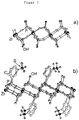
US 5,892,080 pertains to solid mesoporous crystalline compositions of disphosphonate-phosphite of a tetravalent metal with a limited distribution of mesopores. - The present invention is related to organic solutions according to claim 1 and is also related to the preparation of polymeric nano-composites according to claim 8 containing metal (IV) salts, preferably phosphate-phosphonates, of tetravalent metals dispersed in a polymeric matrix. The nano-polymers are not obtained as reported in said Italian patent but a completely different strategy is followed. This strategy, as it will be reported in detail later, does not only allow the use of a very large number of phosphate-phosphonates of tetravalent metals and makes the process of nano-composite preparation much easier and more economical, but also allows a further extension of the present invention to other applications of interest as, for example, the filling of the pores of polymeric or ceramic membranes with nano-particles exhibiting very high proton conductivity and catalytic activity or the insertion of inorganic particles in the electrode/membrane interfaces. It is well known that metal(IV) phosphate-phosphonates are members of a very large family of lamellar compounds. They can be seen as organic derivatives of the corresponding layered metal(IV) phosphates among which the most investigated compound is the zirconium phosphate, Zr(O3P-OH)2, exhibiting the typical layered α-structure, schematically illustrated in
Fig. 1a . The compositions of possible metal(IV) phosphate-phosphonates can be very different from each other since the phosphonate groups can be chosen among a large variety of species and even their mixtures in different ratios can be used. Thus, for sake of brevity, when a more precise definition of the composition is not necessary, the zirconium phosphate-phosphonates will be here simply indicated by the general formula M(IV)(O3P-G)2-x(O3P-R1X)n where
M(IV)=Zr, Ti, Sn or Ce; G is an inorganic (e.g.,-OH) or organic (e.g., - CH2OH) or an inorganic-organic group (e.g., -CH2-SO3H ; -CF2-PO3H2); R1 is an arylen group (e.g., phenylen); X is an acid group chosen between -SO3H, -PO3H2 and -COOH; n is a coefficient which can vary between 0 and about 1.5. In this formulation, the O3P- (i.e. written with the three oxygens to the left of phosphorus) indicates that each phosphorus is bonded to three different zirconium atoms through three oxygens, as in the lamellar structure of α-zirconium phosphate. As an example, a schematic view of a single lamella of the compound Zr(O3P-OH)(O3P-C6H4-SO3H) (i.e., where G= -OH; -R1- = -C6H4-; -X= -SO3H) is shown in part (b) offigure 1 . - The metal(IV) phosphate-phosphonates are very insoluble in water and in organic solvents and exhibit a very high protonic conductivity (in some cases > 10-1 S cm-1) if they possess very acidic groups. More detailed information on the proton conductivity of these lamellar compounds can be found, for example, in G. Alberti, M. Casciola Solid State Ionics 97, 177 (1997), while information on the chemistry of these compounds can be found in the chapter 5 of volume 7 of the series Comprehensive Supramolecular Chemistry (volume editors G. Alberti and T. Bein; editor of the series Jean-Marie Lehn), Pergamon 1996 and in the review A. Clearfield "Metal phosphonate chemistry" in "Progress in Inorganic Chemistry", volume 47, p.371-509, John Wiley & Sons, 1998.
- In the cited Italian patent it is claimed that lamellar metal(IV) acid phosphates and phosphate-sulfoarylenphosphonates (e.g., Zr(O3P-OH)2-x(O3P-C6H4-SO3H)x) appreciably exfoliate in water and in some organic solvents, (e.g., DMF and CH3CN and/or their mixtures) which are used for the solubilization of proton conducting ionomers.
- The possibility of forming colloidal dispersions of these compounds in the solvents that are able to solubilize the ionomers of the state of the art made it easier to disperse the layered nano-particles of these compounds in the polymeric matrix of the ionomers according to claims 8,10. The preparation of the nano-polymers is carried out in four steps: 1) the preparation of the wanted metal(IV) phosphate-sulfoarylenphosphonate; 2) the formation of its dispersion in an organic solvent of the ionomer to be modified; 3) the mixing of this dispersion with a solution of the ionomer; 4) the evaporation of the solvent.
This invention has represented a considerable progress relatively to theinternational patent WO 96/29752
It was surprisingly found that if the preparation of metal(IV) phosphate-phosphonates is directly carried out in the organic solvents commonly used for dissolving sulfonated ionomers or other polymers (e.g., N,N-dimethylformamide (DMF), N-methyl 2-pyrrolidone (NMP), dioxane, dimethylsulfoxide (DMSO), acetonitrile, alkanols etc, and/or their mixtures) the formation of the metal(IV) phosphate- phosphonates takes place very slowly at temperatures <40 °C so that precipitation or gel formation are not observed even after many days. It was also found by the inventors that the stability of these solutions depends on the temperature, on the composition of the metal(IV) phosphate-phosphonates and on the concentration of the initial solution. For example, if in 0.1 litre of NMP 0.1 mol of phosphoric acid, 0.1 mol of sulfophenylenphosphonic acid and 0.1 mol of zirconium propionate (i.e., reagents corresponding to the stoichiometric formation of a zirconium phosphate- sulfoarylenphosphonate with -G=-OH; -R'-=-C6H4- and x = 1) are solubilized at about 20 °C, no formation of gels or precipitation takes place. As time passes, a gradual increase of the viscosity of the solution is observed and a gel is finally formed only after 8-10 days. The gelation time considerably decreases at higher temperatures. For example, at 80-90 °C the same solution gives a gel only after some minutes. From these gels, after evaporation of the solvent and elimination of the propionic acid formed in the reaction at 120-140 °C, the anhydrous product of composition Zr(HPO4)(PO3-C6H4-SO3H) is obtained. - Magic angle 31P solid state NMR showed that the oxoacids of the phosphorus are coordinated to zirconium as in the lamellar structures of α-type (i.e., through three oxygens) while X-ray powder diffraction patterns showed that the first reflection corresponds to the interlayer distance (1.9 nm) of an α-type compound of composition Zr(O3P-OH)(O3P- R1-SO3H) obtained by precipitation in an aqueous medium. Besides, the proton conductivity is of the same order of magnitude compared to the same compound prepared in an aqueous medium. Although additional experimental evidence is necessary to draw definitive conclusions, it is therefore reasonable to conclude that also the compounds obtained after drying of the said gels have a layered structure of α-type and, in their anhydrous state, they can be formulated as M(IV)(O3P-OH)2-n(O3P-R1-SO3H)n. However, it must be pointed out that the type of lamellar structure is not significant for the present invention because it is essentially based on the experimental facts that, after solvent elimination from said organic solutions (e.g. by evaporation), it is possible to obtain compounds that, after thermal treatment at 120-140 °C, become insoluble in all known solvents and that in some cases exhibit very high proton conductivity.
- It was found that the results obtained for zirconium phosphate-sulfoarylenphosphonates can be extended to the whole class of zirconium phosphate-phosphonates.
- No specific research to explain the reasons of the delayed precipitation of metal(IV) phosphate-sulfoarylenphosphonates in the above organic solvents has been carried out up to now.
- Without wishing the present invention to be bound to any particular theory, it is reasonable to assume that the phosphonic acids may strongly interact with proton acceptor solvents, thus decreasing their acid activity. Therefore, the rate of the global reaction which leads, for example, to the generic Zr(O3P-G)2-n(O3P- R1-X)n compound (where G, R1, X and n have the same meaning previously reported) could be considerably slowed down, especially at low temperatures. Thus, only soluble intermediate compounds such as small clusters of zirconyl phosphate-phosphonates could be initially formed; then, these clusters grow in size and concentration thus leading to the formation of dense gels. During the drying of such gels (e.g. at temperatures higher than 80 °C) the reaction can be completed with the transformation of these intermediate clusters into the final zirconium phosphate-phosphonate with layered structure. Once formed, these compounds become insoluble in solvents.
- In any case, independently of their nature, the above solutions behave, from a practical point of view, as solutions of insoluble metal(IV) phosphate-phosphonates because, after drying, insoluble compounds with the wished composition are obtained.
- In other words, these solutions have a behaviour similar to that of some solutions of organic compounds, from which, after polymerisation, insoluble polymers can be obtained. This is of great technological importance because it allows the use of these solutions as true solutions of very insoluble compounds. This peculiarity can be utilized, for example, for filling the pores of porous membranes with the said metal(IV) salts, preferably phosphate-phosphonates. If the membrane is first soaked with the organic solution and then the solvent is eliminated, said insoluble compounds are formed directly inside the pores. In this connection, it must be pointed out that all attempts till now carried out to fill the pores with colloidal dispersions of exfoliated lamellar compounds, both in water and in organic solvent, always showed that only the solvent can enter in the pores while the lamellar particles remain on the membrane surface.
- Further, it is disclosed a method for the filling of porous membranes wherein the filling of pores is carried out by (1) closing the bottom of a tube with the membrane, (2) pouring in the tube an amount of the organic solution sufficient to completely cover the inner face of the membrane, (3) sealing the upper part of the tube in order to avoid the evaporation of the organic solvent and (4) allowing solvent evaporation from the external face of the membrane eventually assisted with a gas flow so that the filling of pores takes place starting from that face.
The final elimination of the solvent in the membrane is preferably performed by evaporation of the solvent and the reaction of transformation of the residual solid thus obtained into the final tetravalent metal phosphate-phosphonate compound is completed by heating at 120-150 °C for 5-10 hrs.
The peculiarity of the organic solutions of the present invention can also be exploited for another important application because the solvents of these solutions are fortunately the same solvents commonly used for dissolving various polymers, and in particular acid proton conducting ionomers such as Nafion, polyetherketones etc. It is possible to insert lamellar metal(IV) salts, preferably phosphate-phosphonates, nano-particles in the matrix of organic polymers by means of the simple mixing of the two solutions and subsequent solvent evaporation so as to form the wished particles inside the polymeric matrix according to claim 13. Note that the invention allows the preparation of a large number of different solutions, with the wished concentrations, and the formation of metal(IV) salts, preferably phosphate-phosphonates, with a great variety compositions and different properties. The present invention can therefore be used for the preparation of a large variety of hybrid polymers and ionomers with the wished properties. - The said organic solutions are very suitable also for the preparations of hybrid membranes either in laboratory scale or with automatic or semiautomatic machinery such as "Erichsen film casting processor". The solutions containing sulfoarylenphosphonic acids assume a particular relevance, due to the high proton conductivity of the compounds containing -SO3H groups. In this respect, also some solutions containing diphosphonic acids were found of great interest. From these solutions the formation of compounds with general formula Zr(O3P-R2-PO3H2)2 or Zr(O3P-R2)2-n(O3P-C6H4-PO3H2)n, where R2 = -CH2-, -CF2- or -(CF2)n-groups, can be obtained when the solvent is eliminated. Mixed compounds such as Zr(O3P-R2-PO3H2)2-x(O3P-C6H4-PO3H2)x and Zr(O3P-R2-P-O3H2)2-n(O3P-C6H4-SO3H)n with n in the range 0-1.5, may be also obtained.
The compound of composition Zr(O3P-CH2-PO3H2)2 , obtained by evaporating the organic solvent, exhibited a very high protonic conductivity (about 4*10-2 S cm-1 at 70 °C and 95 % relative humidity). High proton conductivity for compounds that do not contain -SO3H acid groups is of interest also for the development of protonic conductors stable at temperatures greater than 200 °C, where the -SO3H acid groups cannot be used because of their thermal degradability.
The organic solutions of the present invention can also be used for another important application in the field of PEM FC. These solutions, or their mixtures with proton conducting ionomers such as Nafion or sulfonated polyetherketones (s-PEK), can be sprayed over the electrodes of the fuel cells. In such a way it is possible to insert a large variety of lamellar nano-particles with high proton conductivity in the electrode/membrane interfaces of PEM FCs according to claim 12. This represents a significant improvement of the method described in the Italian patentMI 0022443
An objective of the present invention is the preparation of organic solutions containing tetravalent metal salts and mixtures of phosphorus oxoacids that, at room or lower temperature, do not give place to gelations or precipitations for a sufficiently long time (at least one hour) and from which, after evaporation of the solvent, it is possible to obtain directly insoluble compounds of composition M(IV)(O3P-G)2 or of mixed compositions such as M(IV)(O3P-G)2-n(O3P-R1-SO3H)n or M(IV)(O3P-G)2-n(O3P-R1-PO3H2)n where G, R1 and n have the same meaning as before defined. - It is a further objective of the present invention to use said solutions for obtaining an easy filling of the pores of porous membranes either of polymeric or ceramic type. The complete filling of the pores with compounds exhibiting high proton conductivity allows the preparation of membranes thin enough and with a good protonic conduction for their use in fuel cells.
The partial filling of the pores with compounds which possess a high catalytic activity allows the preparation of membranes that may be used in membrane catalytic reactors. - It is a further objective of the present invention to use said solutions for obtaining an easy insertion of nano-particles of said compounds within organic or inorganic polymeric structures provided that they are soluble in the same solvents. The use can be extended also to polymers soluble in different solvents from those of the organic solutions object of the present invention, provided that they are mixable with said organic solutions and do not provoke a fast gelation of the solution or the precipitation of the compound to be dispersed in the polymeric matrix.
It is a further objective of the present invention to use said solutions for obtaining an easy insertion of nano-particles of said compounds in proton conducting ionomers with the formation of proton conducting nano-structured ionomers. As reported in the previous cited patent, the insertion of lamellar nano-particles with high proton conductivity allows the preparation of nano-ionomeric membranes, which combine improved mechanical properties (hence less swelling) and/or a decreased permeability to methanol or to hydrogen with high proton conductivity.
It is further disclosed a method for the preparation of membranes according to claim 7, made up by nano-polymers constituted by nano-particles of tetravalent metal phosphate-phosphonates dispersed in the matrix of organic or inorganic polymers based on the following steps: (a) preparation of an organic solution and containing, at the same time, a polymer or an ionomer of the state of the art, (b) use of such an organic solution for preparing a nano-polymer as a membrane by a known technique of the state of the art, (c) elimination of the organic solvent and hydration for preparing a nano-polymeric membrane containing the wished weight percentage of the lamellar compound and exhibiting the required characteristics for a particular application. - In one specification of the above method the organic solution of the step (a) is poured on a plane surface, preferably a glass plate, in order to obtain a flat and thin layer; the solvent is then eliminated by drying for 1 hr. at 80-90 °C and for about 2 hrs at 120-140 °C. The resulting membrane is finally detached from the support. For making up the membrane out of the solution of step (a) it can be advantageous to use a semiautomatic film casting processor.
It is a further objective of the present invention to use said solutions for the easy insertion of a large variety of lamellar nano-particles of metal(IV) salts, preferably phosphate-phosphonates, in the electrode/membrane interfaces of PEM FCs, either as pure compounds or in mixture with ionomers such as Nafion and s-PEK. - The invention is based on the preparation of an organic solution of phosphonic acids and salts of tetravalent metals in organic solvents, which behaves as a solution of layered phosphate-phosphonates of the corresponding metals, which are completely insoluble in the known solvents. This peculiarity allows an easy insertion of particles of the above compounds in the pores of porous membranes, in the matrices of those polymers, which are soluble in the same organic solvents, as well as in the membrane/electrode interfaces of fuel cells. The use of zirconium phosphate-phosphonates possessing high proton conductivity (in some cases higher than 10-1 S cm-1) allows the preparation of impregnated porous membranes and of nano-polymeric membranes combining good mechanical properties, and/or reduced permeability to gaseous species, with good proton conductivity. These membranes can therefore be employed in fuel cells even at temperatures higher than 80 °C. These membranes also possess a high catalytic activity and can therefore be employed in catalytic membrane reactors.
- The following examples have the purpose of facilitating the understanding of the invention, and do not intend to limit in any manner its scope, which is solely defined by the appended claims.
- (This example illustrates the detailed preparation of an NMP solution containing a zirconium salt and oxoacids of phosphorus from which a layered zirconium phosphate-phosphonate of composition Zr(O3P-OH)(O3P-C6H4-SO3H) is obtained. Some data on the stability of these solutions, the interlayer distance and the proton conductivity of the obtained solids are also reported).
- 20.6 g of zirconyl propionate (Magnesium Elektron Limited, England) are dissolved in 53 g of NMP. Taking into account that the composition of this compound was found to be ZrO1.36(CH3CH2COO)1.28 (MW = 206 Dalton), the above amount corresponds to 0.1 mol.
- Separately, 0.1 mol of anhydrous sulfophenylenphosphonic acid (23.8 g) and 0.1 mol of anhydrous phosphoric acid (9.8 g) are dissolved in 65 g of NMP. The former solution is slowly added, under stirring at room temperature, to the last solution. A clear solution is obtained. If this solution is maintained at temperature ≤ 30 °C, no precipitation or gel formation is observed for at least a week. When the solution is warmed at temperature ≤ 80 °C, the formation of a compact and transparent gel is observed (it takes usually less than 30 minutes). The solid obtained by evaporation of the solvent at 80 °C does not contain, as shown by 1H NMR measurements, appreciable amount of propionates, but the presence of a large amount of NMP is still well evident. When the solvent is then completely eliminated at 130-140 °C, a solid of composition Zr(O3P-OH)(O3P-C6H4-SO3H) is obtained. The interlayer distance of this compound, determined by X-ray powder diffraction pattern, is 1.9 nm.
- The protonic conductivity is 3.2*10-2 S cm-1 at 100 °C and 95 % relative humidity.
- (This example illustrates the detailed preparation of a solution containing a zirconium salt and methandiphosphonic acid in an NMP solution from which, after evaporation, it is possible to obtain a zirconium diphosphonate of composition Zr(O3P-CH2-PO3H2)2. Some data on the stability of the solution and on the proton conductivity of the compound collected after the evaporation of the solvent are also reported).
- According to a procedure analogous to that described in Example 1 a, 0.1 mol of anhydrous zirconyl propionate are dissolved in 53 g of NMP while 0.2 mol of anhydrous methandiphosphonic acid (35.2 g) are dissolved in 65 g of NMP. The solution of methandiphosphonic acid is then slowly added, at room temperature and under stirring, to the solution of zirconyl propionate. A clear solution is obtained. The behaviour of the obtained solution at temperatures ≤ 30 °C and at temperatures ≥ 80 °C is very similar to that of the solution described in example 1a. Solvent evaporation at 80 °C leaves a residue which, after heating at 130-140 °C, is completely converted into an amorphous solid of composition Zr(O3P-CH2-PO3H2). The protonic conductivity is 4.0*10-2 S cm-1 at 100 °C and 96 % relative humidity.
- (This example illustrates the preparation of a solution in NMP from which a zirconium methandiphosphonate-sulfophenylenphosphonate of composition Zr(O3P-CH2-PO3H2)1.5(O3P-C6H4-SO3H)0.5 can be obtained. The stability, the interlayer distance and the proton conductivity of the solid collected after the evaporation of the solvent are also reported).
- According to a procedure analogous to that described in Examples 1 a and 1 b, a clear solution containing 0.15 mol of anhydrous methandiphosphonic acid, 0.05 mol of anhydrous sulfophenylenphosphonic acid (23.8 g) and 0.1 mol of anhydrous zirconyl propionate in 118 g of NMP is prepared.
- The behaviour of this solution at temperature ≤ 30 °C and at temperature ≥ 80 °C is very similar to that of the solution described in example 1a. Solvent evaporation at 80 °C leaves a residue which, after heating at 130-140 °C, is completely converted into a solid of composition Zr(O3P-CH2-PO3H2)1.5(O3P-C6H4-SO3H)0.5 is obtained. The protonic conductivity is 1.0*10-1 S cm-1 at 60 °C and 98 % relative humidity.
- (This example gives a detailed description of the use of the organic solutions reported in examples 1a-1c, or similar, to fill the pores of a porous polymeric membrane with a zirconium phosphonate to obtain a membrane with a good protonic conductivity. Case of a porous polytetrafluoroethylene (PTFE or Teflon) membrane. The protonic conductivities of the membranes filled with some zirconium acid phosphonates are reported).
- A clear NMP solution containing an amount of reagents corresponding to 20-30 wt % of the zirconium phosphate-phosphonate chosen for the filling of the porous membrane is prepared according to the procedure described in the examples 1a-1c. A PTFE membrane (Mupor micro porous PM9P, Porex Corporation, GA, USA, pore size 1,0 µm; thickness 0.0051 cm; porosity 30 %) is out gassed under vacuum in a desiccator. The membrane, kept under vacuum at room temperature, is then completely covered with the solution for about 10-20 min. The atmospheric pressure is re-established and the membrane is maintained covered by the solution for about 1 hr in order to permit a good infiltration of the solution inside the pores. The membrane is taken out from the solution and the liquid excess on the external faces of the membrane is quickly eliminated (e.g., by contacting alternatively the two membrane faces with a paper filter) while the solvent inside the pores is eliminated by drying at 80 °C for about 1 hr and then at 120-130 °C for about 3 hrs. The entire filling procedure is repeated several times depending on the wished pore filling degree.
- Alternatively, especially when a gradient of impregnation is required, the membrane is placed in the bottom of an open tube (made for example of glass or another material insoluble in the used solvent) so as to hermetically seal the low part of the tube. A small volume of the organic solution, but sufficient to completely cover the inner membrane surface, is poured in the tube. To avoid solvent evaporation from the upper part of the tube, this part is well plugged. The solvent is allowed to evaporate slowly only through the external face of the membrane and, if wished, the slow evaporation can be assisted by a tepid airflow. In such a way, the filling of the pores takes place starting from the external side of the membrane. Some proton conductivity values (at 65 °C and 98 % relative humidity.) of said porous membrane filled with zirconium phosphate-phosphonates, zirconium diphosphonate-phosphonates and zirconium diphosphonates are reported:
- Membrane filled with 54 wt % of Zr(O3P-C6H4-SO3H)(O3P-OH):
- Proton conductivity: 1.3*10-2 S cm-1.
- Membrane filled with 45 wt % of Zr(O3P-CH2-PO3H2)2 and 10 % Nafion 1100:
- Proton conductivity: 2.1*10-2 S cm-1.
- Membrane filled with 49 wt % of Zr(O3P-CH2-PO3H2)1.3 (O3P-C6H4-SO3H)0.7 and 3 % Nafion 1100: Proton conductivity: 3.6*10-2 S cm-1.
- (This example illustrates the use of the organic solutions reported in the examples 1a-1c or similar, for a partial filling of the pores of a porous inorganic membrane with a super acid zirconium phosphonate in order to prepare a membrane with super acid catalytic properties. Case of a zircon tubular asymmetrical ceramic membrane filled with particles of composition Zr(O3P-OH)(O3P-C6H4-SO3H)).
- A clear NMP solution containing an amount of reagents corresponding to 20-30 wt % of the zirconium phosphate-phosphonate of composition Zr(O3P-OH)(O3P-C6H4-SO3H) is prepared according to the procedure described in the example 1a.
- A zircon tubular asymmetrical ceramic membrane (TAMI tri-channel, thickness of thin layer 0.14 µm) is out gassed under vacuum in a desiccator. The membrane, kept under vacuum at room temperature, is then completely covered with the solution for about 10 min. Then the same procedure described in example 2a followed. The number of the filling steps is chosen in order to have a partial filling of the pores, preferably in the range 30-70 %, with particles of composition Zr(O3P-OH)(O3P-C6H4-SO3H).
- (This example illustrates the use of the organic solutions reported in the examples 1a-1c for preparing a hybrid membrane made of a polymeric matrix filled with a given percentage of the wished nano-particles. Case of the polyvinylidene fluoride (PVDF) filled with 40 wt % of particles having composition Zr(O3P-OH)0.7(O3P-C6H4-SO3H)1.3. The proton conductivities of membranes made of the pure polymer and of the hybrid polymer, respectively, are reported).
- According to a procedure analogous to that described in the examples 1 a and 1 c, a solution containing 0.07 mol of anhydrous phosphoric acid, 0.13 mol of anhydrous metasulfophenylenphosphonic acid and 0.1 mol of anhydrous zirconium propionate in 118 g of NMP is prepared. Separately, 2.0 g of PVDF are dissolved in 18 g of NMP. Then, 5 g of the former solution are added to the last solution. The resulting solution is stirred for about 1 hr at room temperature and then poured on a glass plate. The solvent is evaporated for about 1 hr at 80-90 °C and then for about 2 hrs at 120-130 °C. The membrane is then detached from the glass support by immersion in water, washed with a diluted HCI solution, washed again with deionised water and stored in water at room temperature. The membrane (thickness 0.006 cm) is transparent. The percentage of the compound of composition Zr(O3P-OH)0.7 (O3P-C6H4-SO3H)1.3 in the anhydrous membrane is 40 wt %. The protonic conductivity is 5*10-3 S cm-1 at 100 °C and 95 % relative humidity. The protonic conductivity of the pure polymer membrane prepared under similar conditions is negligible (< 10-6 S cm-1).
- (This example illustrates the use of the organic solutions reported in the examples 1 a-1 b for preparing a hybrid membrane consisting of a polymeric matrix of a proton conducting ionomer of the state of art filled with the wanted percentage of nano-particles. Case of sulfonated polyetheretherketone (s-PEK) filled with 9.5 wt % particles of Zr(O3P-OH)(O3P-C6H4-SO3H). The protonic conductivities of membranes made of the pure and hybrid ionomer are reported).
- 2.0 g of s-PEK 1.4, with ion-exchange capacity 1.4*10-3 equivalent/g, previously dehydrated at 80 °C overnight are dissolved in 24 g of NMP at 80 °C. To this solution 0.85 g of the solution of example 1 a are added. The resulting mixture is kept under stirring for 1 hr. With this solution a membrane is prepared according to the procedure described in example 2a.
- A transparent membrane (thickness 0.005 cm) is obtained. The weight percentage of the anhydrous zirconium phosphate-phosphonate Zr(O3P-OH)(O3P-C6H4-SO3H) in the anhydrous membrane is 9.5 %. The protonic conductivity is 6.6*10-3 S cm-1 at 100 °C and 95 % relative humidity. The protonic conductivity of a membrane of pure s-PEK 1.4, prepared under similar conditions, is 5.1*10-3 S cm-1 at 100 °C and 95 % relative humidity.
- (This example illustrates the use of the organic solutions reported in the examples 1a-1b for preparing a hybrid membrane consisting of a polymeric matrix of a proton conducting ionomer of the state of art filled with an established percentage of the wished nano-particles. Case of Nafion filled with 10 wt % particles of composition Zr(O3P-OH)(O3P-C6H4-SO3H). The proton conductivities of membranes made of pure and hybrid ionomers are reported).
- 0.1 mol of anhydrous metasulfophenylenphosphonic acid and 0.1 mol of anhydrous phosphoric acid are dissolved in 200 g of propanol (solution a). Separately, 0.1 mol of anhydrous zirconium propionate (corresponding to 20.6 g) are dissolved in 200 g of propanol (solution b). The solution (a) is slowly added under stirring to solution (b) at room temperature thus obtaining a clear solution. Then, 0.51 g of this solution are added to 10 cm3 of Nafion solution (37.5 % 1-propanol, 37.5 % 2-propanol, 20 % water, 5 % Nafion 1100). With this solution a membrane is prepared according to the procedure described in the previous example. A transparent membrane (thickness 0.015 cm) containing 10.0 % wt/wt of Zr(O3P-OH)(O3P-C6H4-SO3H) is obtained. The proton conductivity is 7.2*10-2 S cm-1 at 100 °C and 94 % relative humidity.
- As a summary it can be said that according to preferred embodiments the invention is based on the preparation of an organic solution of preferably phosphonic acids and tetravalent metals salts, preferably of Zr, Ti, Sn and Ce, in organic solvents, which behaves as a solution of layered tetravalent metals salts, preferably phosphate-phosphonates, which are completely insoluble in the known solvents. This peculiarity allows an easy insertion of particles of the above compounds in the pores of porous membranes, in the matrices of those polymers, which are soluble in the same organic solvents, as well as in the membrane/electrode interfaces of fuel cells. The use of tetravalent metals salts, preferably zirconium phosphate-phosphonates, possessing high proton conductivity (in some cases higher than 10-1 S cm-1) allows the preparation of impregnated porous membranes and of nano-polymeric membranes combining good mechanical properties, and/or reduced permeability to gaseous species, with good proton conductivity.
- These membranes can therefore be employed in fuel cells even at temperatures higher than 80 °C. These membranes also possess a high catalytic activity and can therefore be employed in catalytic membrane reactors.
Claims (13)
- Organic solutions containing metal(IV) salts and oxoacids of phosphorus from which, after evaporation of a solvent, insoluble compounds of general composition M(IV)(O3P-G)2-n(O3P-R1-X)n are obtained, where M(IV) is a tetravalent metal chosen between Zr, Ti, Sn and Ce or their mixture, wherein the group -G is chosen among the acid groups -OH ; -R2-SO3H and -R2-PO3H2, wherein -R2- is an organic group with preferably linear chain such as -(CH2)m- and -(CF2)m-, wherein -R1- is an organic group, wherein -X is an acid group chosen between -SO3H, -PO3H2 and -COOH and wherein n is a coefficient ranging from 0 to 1.5.
- Organic solutions of claim 1 wherein the anion of the tetravalent metal salt is chosen among carboxylates, chlorides and alkoxides.
- Organic solutions of claim 1 or 2, wherein the tetravalent salt is the zirconyl propionate or chloride.
- Organic solutions of any of the preceding claims wherein the group -R1- is an arylen group chosen preferably among -C6H4-; -C6H4-CH2- and - C6H4-CF2-.
- Organic solutions of any of the preceding claims wherein the organic solvent is chosen among the protonable solvents, especially N,N-dimethylformamide, N-methyl-2-pyrrolidone, dioxane, dimethylsulfoxide, acetamide, acetonitrile, various alkanols and/or their mixtures.
- Use of the organic solutions of any of the preceding claims for the insertion of nano-particles of tetravalent metal salts, preferably phosphate-phosphonates, within the pores of polymeric or ceramic porous membranes.
- A method for filling porous membranes with the organic solutions of any of claims 1 to 5 with tetravalent metal salts, especially phosphate-phosphonates, based on the following steps:a) preparation of the organic solution of claims 1 - 5;b) impregnation of a porous membrane with such a solution;c) elimination of the solvent;d) repetition of the steps b) and c) until the wished percentage of pore filling is obtained.
- Use of the organic solutions of any of claims 1-5 for the preparation of nano-polymers constituted by nano-particles of tetravalent metal salts, preferably phosphate-phosphonates, dispersed in the matrix of organic or inorganic polymers soluble in the same solvents as used for the organic solutions.
- Use of the organic solutions according to claim 8, wherein the organic polymeric matrix is that of a proton conducting ionomer.
- Use of the organic solutions of any of claims 1-5 for the preparation of membranes constituted by nano-polymers constituted by nano-particles of tetravalent metal salts, preferably phosphate-phosphonates, dispersed in the matrix of organic or inorganic polymers.
- Use of the organic solutions according to claim 10 wherein the polymeric matrix is that of a synthetic ionomer of the state of the art chosen among perfluorosulphonic polymers, sulfonated polyetherketones (sPEK), sulfonated polyethersulfones and sulfonated polyvinylidenfluoride (sPVDF).
- Use of the organic solutions of any of claims 1-5 for an easy insertion of a large variety of lamellar nano-particles of tetravalent metal salts, preferably phosphate-phosphonates, in the membrane/electrode interfaces of Polymeric Electrolyte Membrane Fuel Cells.
- Use of the organic solutions of any of claims 1-5, with the addition of ionomers and/or other proton conducting compounds soluble in the same solvents as used for the organic solutions, for an easy insertion of a large variety of lamellar nano-particles of tetravalent metal salts, preferably phosphate-phosphonates, in mixture with other proton conducting compounds in the membrane/electrode interfaces of Polymeric Electrolyte Membrane Fuel Cells.
Applications Claiming Priority (3)
| Application Number | Priority Date | Filing Date | Title |
|---|---|---|---|
| IT2002PG000015A ITPG20020015A1 (en) | 2002-03-22 | 2002-03-22 | AN INNOVATIVE METHOD FOR THE PREPARATION OF PROTONIC NANOPOLYMER MEMBRANES FOR USE IN FUEL CELLS OR IN AC REACTORS |
| ITPG20020015 | 2002-03-22 | ||
| PCT/EP2003/002904 WO2003081691A2 (en) | 2002-03-22 | 2003-03-20 | An innovative method for the preparation of proton conducting nanopolymeric membranes for use in fuel cells or in catalytic membrane reactors |
Publications (2)
| Publication Number | Publication Date |
|---|---|
| EP1563559A2 EP1563559A2 (en) | 2005-08-17 |
| EP1563559B1 true EP1563559B1 (en) | 2017-08-23 |
Family
ID=28053458
Family Applications (1)
| Application Number | Title | Priority Date | Filing Date |
|---|---|---|---|
| EP03744819.8A Expired - Lifetime EP1563559B1 (en) | 2002-03-22 | 2003-03-20 | An innovative method for the preparation of proton conducting nanopolymeric membranes for use in fuel cells or in catalytic membrane reactors |
Country Status (8)
| Country | Link |
|---|---|
| US (1) | US7521141B2 (en) |
| EP (1) | EP1563559B1 (en) |
| JP (1) | JP2005527545A (en) |
| KR (1) | KR20040101350A (en) |
| AU (1) | AU2003226671A1 (en) |
| CA (1) | CA2479314C (en) |
| IT (1) | ITPG20020015A1 (en) |
| WO (1) | WO2003081691A2 (en) |
Families Citing this family (32)
| Publication number | Priority date | Publication date | Assignee | Title |
|---|---|---|---|---|
| KR100524819B1 (en) * | 2003-07-14 | 2005-10-31 | 학교법인 서강대학교 | High Temperature Proton Exchange Membrane Using Ionomer/Soild Proton Conductor, Preparation Method Thereof and Fuel Cell Containing the Same |
| FR2869032B1 (en) | 2004-04-15 | 2006-06-02 | Commissariat Energie Atomique | PROCESS FOR THE PREPARATION OF PROTON-CONDUCTIVE CLAY PARTICLES AND MATERIAL COMPRISING SUCH PARTICLES |
| US7199172B2 (en) * | 2004-04-21 | 2007-04-03 | Plastic Technologies, Inc. | Metal phosphonates and related nanocomposites |
| ITPG20040013A1 (en) * | 2004-04-30 | 2004-07-30 | Fuma Tech Gmbh | ORGANIC SOLUTIONS OF TETRAVALENT METAL PHOSPHATES AND PYROPHOSPHATES PRECURSORS AND THEIR USE FOR THE MODIFICATION OF ELECTRODES AND FOR THE PREPARATION OF COMPOSITE MEMBRANES FOR FUEL CELLS OPERATING AT TEMPERATURES> 900 CENTIGRADS AND / OR LOW |
| KR100684730B1 (en) * | 2004-10-14 | 2007-02-20 | 삼성에스디아이 주식회사 | Polymer electrolyte membrane for a direct oxidation fuel cell, a method of manufacturing the same, and a direct oxidation fuel cell apparatus including the same |
| FR2877147B1 (en) * | 2004-10-22 | 2010-09-03 | Peugeot Citroen Automobiles Sa | IMPROVED PROTONIC CONDUCTIVE MEMBRANE, PROCESS FOR PRODUCING THE SAME, AND APPLICATION TO A FUEL CELL. |
| KR100668321B1 (en) | 2004-12-22 | 2007-01-12 | 삼성에스디아이 주식회사 | Fuel cell electrode using metal phosphate and fuel cell employing same |
| US7459487B2 (en) * | 2005-02-16 | 2008-12-02 | The University Of Hong Kong | Polymer composite membrane and method of making the same |
| EP1942507A4 (en) * | 2005-08-19 | 2012-02-29 | Univ Tokyo | PROTON CONDUCTIVE HYBRID MATERIAL AND CATALYTIC LAYER FOR L-FUEL CELL USING THE SAME |
| KR100766896B1 (en) * | 2005-11-29 | 2007-10-15 | 삼성에스디아이 주식회사 | Polymer electrolyte membrane for fuel cell and fuel cell system comprising same |
| JP5061385B2 (en) * | 2005-12-08 | 2012-10-31 | 株式会社ノリタケカンパニーリミテド | Solid electrolyte |
| JP4496160B2 (en) | 2005-12-13 | 2010-07-07 | 株式会社東芝 | Proton conductive inorganic material, electrolyte membrane, electrode, membrane electrode composite, and fuel cell |
| KR100791780B1 (en) * | 2005-12-31 | 2008-01-03 | 성균관대학교산학협력단 | Acid / base / inorganic polyelectrolyte composite membrane for fuel cell and its manufacturing method |
| JP4719015B2 (en) * | 2006-01-20 | 2011-07-06 | 株式会社東芝 | Electrolyte membrane, membrane electrode assembly and fuel cell |
| ES2820275T3 (en) | 2006-12-18 | 2021-04-20 | Optis Wireless Technology Llc | Implementation of a link layer control protocol |
| KR101000197B1 (en) | 2006-12-20 | 2010-12-10 | 주식회사 엘지화학 | Catalyst layer formation method of membrane-electrode assembly for fuel cell and catalyst layer and membrane-electrode assembly manufactured using the same |
| DE102007011424A1 (en) | 2007-03-08 | 2008-09-11 | Lanxess Deutschland Gmbh | Polymer electrolyte membrane with functionalized nanoparticles |
| US8007573B2 (en) * | 2007-09-28 | 2011-08-30 | General Electric Company | Filter and associated method |
| US8110283B2 (en) * | 2007-09-28 | 2012-02-07 | General Electric Company | Article and associated method |
| WO2009042264A1 (en) * | 2007-09-28 | 2009-04-02 | General Electric Company | Filter and associated method |
| EP2276728B1 (en) | 2008-04-24 | 2013-07-17 | 3M Innovative Properties Company | Proton conducting materials |
| DE102008002457A1 (en) | 2008-06-16 | 2009-12-17 | Elcomax Membranes Gmbh | Use of a proton conductivity-imparting material in the manufacture of fuel cells |
| CN101946032B (en) * | 2009-01-16 | 2013-03-20 | 帝人纤维株式会社 | Polyester fiber, process for producing the polyester fiber, and tire code, tire, fiber material for reinforcing belt and belt each comprising the polyester fiber |
| WO2011018905A1 (en) * | 2009-08-13 | 2011-02-17 | 国立大学法人 東京工業大学 | Method for producing strongly acidic zirconium particles, method for producing proton conducting material and proton conducting film, and proton conducting film |
| US8906270B2 (en) * | 2010-03-19 | 2014-12-09 | Colorado School Of Mines | Acidic ion exchange membrane and method for making and using the same |
| JP5570878B2 (en) * | 2010-06-07 | 2014-08-13 | 株式会社ノリタケカンパニーリミテド | Catalyst layer and catalyst paste for polymer electrolyte fuel cell |
| JP5664635B2 (en) * | 2012-11-19 | 2015-02-04 | 株式会社豊田中央研究所 | Method for producing non-crosslinked layered metal phosphonate compound |
| JP2016064987A (en) * | 2014-09-22 | 2016-04-28 | 国立大学法人東京工業大学 | PROTON CONDUCTIVE MATERIAL, PROCESS FOR PRODUCING THE SAME, AND ELECTROLYTE MEMBRANE FOR FUEL CELL |
| TWI565737B (en) | 2015-12-16 | 2017-01-11 | 財團法人工業技術研究院 | Porous hydrophobic fluorine-containing polymer membrane and production methods thereof |
| CN111205465B (en) * | 2020-01-11 | 2021-11-05 | 山东理工大学 | Preparation method and application of poly (diphosphophosphazene) high-temperature proton conductor |
| CN115490871B (en) * | 2022-08-23 | 2023-10-24 | 郑州大学 | PolyMOF nano-sheet, preparation method, membrane prepared from PolyMOF nano-sheet and application of PolyMOF nano-sheet |
| CN119608237B (en) * | 2024-12-09 | 2025-09-23 | 天津大学 | Heterogeneous conductive film catalyst for photocatalytic coenzyme regeneration and preparation method thereof |
Family Cites Families (6)
| Publication number | Priority date | Publication date | Assignee | Title |
|---|---|---|---|---|
| US5616749A (en) * | 1994-09-27 | 1997-04-01 | National Science Council | Preparation of layered zirconium phosphite sulfophenylphosphonates and their use as a catalyst |
| US5919583A (en) * | 1995-03-20 | 1999-07-06 | E. I. Du Pont De Nemours And Company | Membranes containing inorganic fillers and membrane and electrode assemblies and electrochemical cells employing same |
| IT1273512B (en) * | 1995-04-07 | 1997-07-08 | Eniricerche Spa | MESOPOROUS CRYSTALLINE ACID COMPOSITION OF A DIPHOSPHONATE-PHOSPHITE OF A TETRAVALENT METAL USEFUL AS A CATALYST |
| FR2753971A1 (en) | 1996-09-27 | 1998-04-03 | Rhone Poulenc Chimie | New metallic and metalloid tetravalent phosphonates and their preparation |
| JP4234422B2 (en) * | 2000-09-20 | 2009-03-04 | バージニア テック インテレクチュアル プロパティーズ インコーポレーテッド | Ion conductive sulfonated polymer material |
| ITPG20020013A1 (en) * | 2002-03-13 | 2003-09-15 | Fuma Tech | PROTONIC CONDUCT MEMBRANES CONTAINING ZIRCONIUM PHOSPHATE OR ZIRCONIUM SULPHARYLENPHOSPHONATES DISPERSED IN A POLYMER MATRIX |
-
2002
- 2002-03-22 IT IT2002PG000015A patent/ITPG20020015A1/en unknown
-
2003
- 2003-03-20 WO PCT/EP2003/002904 patent/WO2003081691A2/en not_active Ceased
- 2003-03-20 JP JP2003579295A patent/JP2005527545A/en active Pending
- 2003-03-20 US US10/508,748 patent/US7521141B2/en not_active Expired - Fee Related
- 2003-03-20 AU AU2003226671A patent/AU2003226671A1/en not_active Abandoned
- 2003-03-20 EP EP03744819.8A patent/EP1563559B1/en not_active Expired - Lifetime
- 2003-03-20 KR KR10-2004-7015060A patent/KR20040101350A/en not_active Ceased
- 2003-03-20 CA CA2479314A patent/CA2479314C/en not_active Expired - Fee Related
Non-Patent Citations (1)
| Title |
|---|
| None * |
Also Published As
| Publication number | Publication date |
|---|---|
| ITPG20020015A1 (en) | 2003-09-22 |
| AU2003226671A1 (en) | 2003-10-08 |
| CA2479314A1 (en) | 2003-10-02 |
| AU2003226671A8 (en) | 2003-10-08 |
| US7521141B2 (en) | 2009-04-21 |
| CA2479314C (en) | 2011-04-19 |
| EP1563559A2 (en) | 2005-08-17 |
| JP2005527545A (en) | 2005-09-15 |
| US20050164092A1 (en) | 2005-07-28 |
| KR20040101350A (en) | 2004-12-02 |
| WO2003081691A3 (en) | 2005-06-23 |
| WO2003081691A2 (en) | 2003-10-02 |
Similar Documents
| Publication | Publication Date | Title |
|---|---|---|
| CA2479314C (en) | An innovative method for the preparation of proton conducting nanopolymeric membranes for use in fuel cells or in catalytic membrane reactors | |
| EP1481438B1 (en) | Ion conducting composite membrane materials containing zirconium phosphate dispersed in a polymeric matrix, method for preparation of the membrane material and its use | |
| Vijayakumar et al. | 2D layered nanomaterials as fillers in polymer composite electrolytes for lithium batteries | |
| KR100915021B1 (en) | Organic-inorganic membranes | |
| JP3894002B2 (en) | Membrane electrode assembly and fuel cell and electrolysis cell provided with the same | |
| Helen et al. | Synthesis and characterization of composite membranes based on α-zirconium phosphate and silicotungstic acid | |
| Alberti et al. | Inorganic ion-exchange pellicles obtained by delamination of α-zirconium phosphate crystals | |
| KR101132990B1 (en) | Precursor organic solutions of tetravalent metal phosphates and pyrophosphates and their use for electrode modification and for the preparation of composite membrane for fuel cells working at temperatures ? 90? and/or at low relative humidity | |
| US7488559B2 (en) | Solid electrolyte | |
| Alberti et al. | New preparation methods for composite membranes for medium temperature fuel cells based on precursor solutions of insoluble inorganic compounds | |
| US8808807B2 (en) | Functionalized inorganic films for ion conduction | |
| ES2349383T3 (en) | ORGANIC-INORGANIC HYBRID DRIVER MATERIAL THAT INCLUDES A MESOPOROUS, MEMBRANE, ELECTRODE AND FUEL BATTERY PHASE. | |
| Sun et al. | Organic-inorganic backbone with high contents of proton conducting groups: a newly designed high performance proton conductor | |
| Li et al. | Synthesis and properties of imidazole-grafted hybrid inorganic–organic polymer membranes | |
| Lakshminarayana et al. | Synthesis and characterization of proton conducting inorganic− organic hybrid nanocomposite membranes based on mixed PWA-PMA-TEOS-GPTMS-H3PO4-APTES for H2/O2 fuel cells | |
| CA2516174C (en) | Tetravalent metal acid triphosphates | |
| Hibino et al. | Design of proton-conducting Sn 0.95 Al 0.05 P 2 O 7 with a mesoporous structure | |
| Song et al. | A new high-temperature inorganic–organic proton conductor: lanthanum sulfophenyl phosphate | |
| KR102635523B1 (en) | Tin oxide aerogel with excellent electric conductivity, conductive catalyst and electrode for fuel cell including the same aerogel and preparing method of the same aerogel | |
| Feng et al. | Synthesis of proton conducting tungstosilicate mesoporous materials and polymer composite membranes |
Legal Events
| Date | Code | Title | Description |
|---|---|---|---|
| PUAI | Public reference made under article 153(3) epc to a published international application that has entered the european phase |
Free format text: ORIGINAL CODE: 0009012 |
|
| 17P | Request for examination filed |
Effective date: 20040928 |
|
| AK | Designated contracting states |
Kind code of ref document: A2 Designated state(s): AT BE BG CH CY CZ DE DK EE ES FI FR GB GR HU IE IT LI LU MC NL PT RO SE SI SK TR |
|
| 17Q | First examination report despatched |
Effective date: 20100225 |
|
| RAP1 | Party data changed (applicant data changed or rights of an application transferred) |
Owner name: FUMA-TECH GESELLSCHAFT FUER FUNKTIONELLE MEMBRANEN |
|
| RAP1 | Party data changed (applicant data changed or rights of an application transferred) |
Owner name: FUMATECH BWT GMBH |
|
| GRAP | Despatch of communication of intention to grant a patent |
Free format text: ORIGINAL CODE: EPIDOSNIGR1 |
|
| RIC1 | Information provided on ipc code assigned before grant |
Ipc: C07F 9/38 20060101ALI20170201BHEP Ipc: B01D 69/14 20060101ALI20170201BHEP Ipc: B01J 31/18 20060101ALI20170201BHEP Ipc: C08J 5/22 20060101ALI20170201BHEP Ipc: H01M 8/1062 20160101ALN20170201BHEP Ipc: B01J 31/02 20060101ALI20170201BHEP Ipc: B01J 37/02 20060101ALI20170201BHEP Ipc: B01J 27/16 20060101ALI20170201BHEP Ipc: H01M 8/1048 20160101ALI20170201BHEP Ipc: H01M 8/1067 20160101ALI20170201BHEP Ipc: B01J 35/06 20060101AFI20170201BHEP Ipc: B01J 19/24 20060101ALI20170201BHEP Ipc: H01M 8/1044 20160101ALI20170201BHEP |
|
| INTG | Intention to grant announced |
Effective date: 20170228 |
|
| GRAS | Grant fee paid |
Free format text: ORIGINAL CODE: EPIDOSNIGR3 |
|
| GRAJ | Information related to disapproval of communication of intention to grant by the applicant or resumption of examination proceedings by the epo deleted |
Free format text: ORIGINAL CODE: EPIDOSDIGR1 |
|
| GRAL | Information related to payment of fee for publishing/printing deleted |
Free format text: ORIGINAL CODE: EPIDOSDIGR3 |
|
| REG | Reference to a national code |
Ref country code: DE Ref legal event code: R079 Ref document number: 60350542 Country of ref document: DE Free format text: PREVIOUS MAIN CLASS: H01M0008020000 Ipc: B01J0035060000 |
|
| GRAR | Information related to intention to grant a patent recorded |
Free format text: ORIGINAL CODE: EPIDOSNIGR71 |
|
| GRAA | (expected) grant |
Free format text: ORIGINAL CODE: 0009210 |
|
| INTC | Intention to grant announced (deleted) | ||
| RIC1 | Information provided on ipc code assigned before grant |
Ipc: C07F 9/38 20060101ALI20170706BHEP Ipc: H01M 8/1067 20160101ALI20170706BHEP Ipc: C08J 5/22 20060101ALI20170706BHEP Ipc: H01M 8/1048 20160101ALI20170706BHEP Ipc: H01M 8/1062 20160101ALN20170706BHEP Ipc: H01M 8/1044 20160101ALI20170706BHEP Ipc: B01J 31/18 20060101ALI20170706BHEP Ipc: B01D 69/14 20060101ALI20170706BHEP Ipc: B01J 27/16 20060101ALI20170706BHEP Ipc: B01J 31/02 20060101ALI20170706BHEP Ipc: B01J 19/24 20060101ALI20170706BHEP Ipc: B01J 37/02 20060101ALI20170706BHEP Ipc: B01J 35/06 20060101AFI20170706BHEP |
|
| AK | Designated contracting states |
Kind code of ref document: B1 Designated state(s): AT BE BG CH CY CZ DE DK EE ES FI FR GB GR HU IE IT LI LU MC NL PT RO SE SI SK TR |
|
| INTG | Intention to grant announced |
Effective date: 20170718 |
|
| REG | Reference to a national code |
Ref country code: GB Ref legal event code: FG4D |
|
| REG | Reference to a national code |
Ref country code: CH Ref legal event code: EP |
|
| REG | Reference to a national code |
Ref country code: AT Ref legal event code: REF Ref document number: 920752 Country of ref document: AT Kind code of ref document: T Effective date: 20170915 |
|
| REG | Reference to a national code |
Ref country code: IE Ref legal event code: FG4D |
|
| REG | Reference to a national code |
Ref country code: DE Ref legal event code: R096 Ref document number: 60350542 Country of ref document: DE |
|
| REG | Reference to a national code |
Ref country code: NL Ref legal event code: FP |
|
| REG | Reference to a national code |
Ref country code: AT Ref legal event code: MK05 Ref document number: 920752 Country of ref document: AT Kind code of ref document: T Effective date: 20170823 |
|
| PG25 | Lapsed in a contracting state [announced via postgrant information from national office to epo] |
Ref country code: AT Free format text: LAPSE BECAUSE OF FAILURE TO SUBMIT A TRANSLATION OF THE DESCRIPTION OR TO PAY THE FEE WITHIN THE PRESCRIBED TIME-LIMIT Effective date: 20170823 Ref country code: FI Free format text: LAPSE BECAUSE OF FAILURE TO SUBMIT A TRANSLATION OF THE DESCRIPTION OR TO PAY THE FEE WITHIN THE PRESCRIBED TIME-LIMIT Effective date: 20170823 Ref country code: SE Free format text: LAPSE BECAUSE OF FAILURE TO SUBMIT A TRANSLATION OF THE DESCRIPTION OR TO PAY THE FEE WITHIN THE PRESCRIBED TIME-LIMIT Effective date: 20170823 |
|
| PG25 | Lapsed in a contracting state [announced via postgrant information from national office to epo] |
Ref country code: BG Free format text: LAPSE BECAUSE OF FAILURE TO SUBMIT A TRANSLATION OF THE DESCRIPTION OR TO PAY THE FEE WITHIN THE PRESCRIBED TIME-LIMIT Effective date: 20171123 Ref country code: ES Free format text: LAPSE BECAUSE OF FAILURE TO SUBMIT A TRANSLATION OF THE DESCRIPTION OR TO PAY THE FEE WITHIN THE PRESCRIBED TIME-LIMIT Effective date: 20170823 Ref country code: GR Free format text: LAPSE BECAUSE OF FAILURE TO SUBMIT A TRANSLATION OF THE DESCRIPTION OR TO PAY THE FEE WITHIN THE PRESCRIBED TIME-LIMIT Effective date: 20171124 |
|
| REG | Reference to a national code |
Ref country code: FR Ref legal event code: PLFP Year of fee payment: 16 |
|
| PG25 | Lapsed in a contracting state [announced via postgrant information from national office to epo] |
Ref country code: CZ Free format text: LAPSE BECAUSE OF FAILURE TO SUBMIT A TRANSLATION OF THE DESCRIPTION OR TO PAY THE FEE WITHIN THE PRESCRIBED TIME-LIMIT Effective date: 20170823 Ref country code: RO Free format text: LAPSE BECAUSE OF FAILURE TO SUBMIT A TRANSLATION OF THE DESCRIPTION OR TO PAY THE FEE WITHIN THE PRESCRIBED TIME-LIMIT Effective date: 20170823 Ref country code: DK Free format text: LAPSE BECAUSE OF FAILURE TO SUBMIT A TRANSLATION OF THE DESCRIPTION OR TO PAY THE FEE WITHIN THE PRESCRIBED TIME-LIMIT Effective date: 20170823 |
|
| PGFP | Annual fee paid to national office [announced via postgrant information from national office to epo] |
Ref country code: NL Payment date: 20180322 Year of fee payment: 16 Ref country code: GB Payment date: 20180326 Year of fee payment: 16 |
|
| REG | Reference to a national code |
Ref country code: DE Ref legal event code: R097 Ref document number: 60350542 Country of ref document: DE |
|
| PG25 | Lapsed in a contracting state [announced via postgrant information from national office to epo] |
Ref country code: EE Free format text: LAPSE BECAUSE OF FAILURE TO SUBMIT A TRANSLATION OF THE DESCRIPTION OR TO PAY THE FEE WITHIN THE PRESCRIBED TIME-LIMIT Effective date: 20170823 Ref country code: IT Free format text: LAPSE BECAUSE OF FAILURE TO SUBMIT A TRANSLATION OF THE DESCRIPTION OR TO PAY THE FEE WITHIN THE PRESCRIBED TIME-LIMIT Effective date: 20170823 Ref country code: SK Free format text: LAPSE BECAUSE OF FAILURE TO SUBMIT A TRANSLATION OF THE DESCRIPTION OR TO PAY THE FEE WITHIN THE PRESCRIBED TIME-LIMIT Effective date: 20170823 |
|
| PGFP | Annual fee paid to national office [announced via postgrant information from national office to epo] |
Ref country code: FR Payment date: 20180326 Year of fee payment: 16 |
|
| PLBE | No opposition filed within time limit |
Free format text: ORIGINAL CODE: 0009261 |
|
| STAA | Information on the status of an ep patent application or granted ep patent |
Free format text: STATUS: NO OPPOSITION FILED WITHIN TIME LIMIT |
|
| 26N | No opposition filed |
Effective date: 20180524 |
|
| PG25 | Lapsed in a contracting state [announced via postgrant information from national office to epo] |
Ref country code: SI Free format text: LAPSE BECAUSE OF FAILURE TO SUBMIT A TRANSLATION OF THE DESCRIPTION OR TO PAY THE FEE WITHIN THE PRESCRIBED TIME-LIMIT Effective date: 20170823 |
|
| REG | Reference to a national code |
Ref country code: CH Ref legal event code: PL |
|
| PG25 | Lapsed in a contracting state [announced via postgrant information from national office to epo] |
Ref country code: MC Free format text: LAPSE BECAUSE OF FAILURE TO SUBMIT A TRANSLATION OF THE DESCRIPTION OR TO PAY THE FEE WITHIN THE PRESCRIBED TIME-LIMIT Effective date: 20170823 |
|
| REG | Reference to a national code |
Ref country code: BE Ref legal event code: MM Effective date: 20180331 |
|
| REG | Reference to a national code |
Ref country code: IE Ref legal event code: MM4A |
|
| PG25 | Lapsed in a contracting state [announced via postgrant information from national office to epo] |
Ref country code: LU Free format text: LAPSE BECAUSE OF NON-PAYMENT OF DUE FEES Effective date: 20180320 |
|
| PG25 | Lapsed in a contracting state [announced via postgrant information from national office to epo] |
Ref country code: IE Free format text: LAPSE BECAUSE OF NON-PAYMENT OF DUE FEES Effective date: 20180320 |
|
| PG25 | Lapsed in a contracting state [announced via postgrant information from national office to epo] |
Ref country code: LI Free format text: LAPSE BECAUSE OF NON-PAYMENT OF DUE FEES Effective date: 20180331 Ref country code: CH Free format text: LAPSE BECAUSE OF NON-PAYMENT OF DUE FEES Effective date: 20180331 Ref country code: BE Free format text: LAPSE BECAUSE OF NON-PAYMENT OF DUE FEES Effective date: 20180331 |
|
| REG | Reference to a national code |
Ref country code: NL Ref legal event code: MM Effective date: 20190401 |
|
| GBPC | Gb: european patent ceased through non-payment of renewal fee |
Effective date: 20190320 |
|
| PG25 | Lapsed in a contracting state [announced via postgrant information from national office to epo] |
Ref country code: GB Free format text: LAPSE BECAUSE OF NON-PAYMENT OF DUE FEES Effective date: 20190320 Ref country code: NL Free format text: LAPSE BECAUSE OF NON-PAYMENT OF DUE FEES Effective date: 20190401 |
|
| PG25 | Lapsed in a contracting state [announced via postgrant information from national office to epo] |
Ref country code: FR Free format text: LAPSE BECAUSE OF NON-PAYMENT OF DUE FEES Effective date: 20190331 |
|
| PG25 | Lapsed in a contracting state [announced via postgrant information from national office to epo] |
Ref country code: TR Free format text: LAPSE BECAUSE OF FAILURE TO SUBMIT A TRANSLATION OF THE DESCRIPTION OR TO PAY THE FEE WITHIN THE PRESCRIBED TIME-LIMIT Effective date: 20170823 |
|
| PGFP | Annual fee paid to national office [announced via postgrant information from national office to epo] |
Ref country code: DE Payment date: 20200319 Year of fee payment: 18 |
|
| PG25 | Lapsed in a contracting state [announced via postgrant information from national office to epo] |
Ref country code: HU Free format text: LAPSE BECAUSE OF FAILURE TO SUBMIT A TRANSLATION OF THE DESCRIPTION OR TO PAY THE FEE WITHIN THE PRESCRIBED TIME-LIMIT; INVALID AB INITIO Effective date: 20030320 Ref country code: PT Free format text: LAPSE BECAUSE OF FAILURE TO SUBMIT A TRANSLATION OF THE DESCRIPTION OR TO PAY THE FEE WITHIN THE PRESCRIBED TIME-LIMIT Effective date: 20170823 |
|
| PG25 | Lapsed in a contracting state [announced via postgrant information from national office to epo] |
Ref country code: CY Free format text: LAPSE BECAUSE OF FAILURE TO SUBMIT A TRANSLATION OF THE DESCRIPTION OR TO PAY THE FEE WITHIN THE PRESCRIBED TIME-LIMIT Effective date: 20170823 |
|
| REG | Reference to a national code |
Ref country code: DE Ref legal event code: R119 Ref document number: 60350542 Country of ref document: DE |
|
| PG25 | Lapsed in a contracting state [announced via postgrant information from national office to epo] |
Ref country code: DE Free format text: LAPSE BECAUSE OF NON-PAYMENT OF DUE FEES Effective date: 20211001 |