EP1562542B1 - Perfume polymeric particles - Google Patents
Perfume polymeric particles Download PDFInfo
- Publication number
- EP1562542B1 EP1562542B1 EP03778025A EP03778025A EP1562542B1 EP 1562542 B1 EP1562542 B1 EP 1562542B1 EP 03778025 A EP03778025 A EP 03778025A EP 03778025 A EP03778025 A EP 03778025A EP 1562542 B1 EP1562542 B1 EP 1562542B1
- Authority
- EP
- European Patent Office
- Prior art keywords
- perfume
- acrylate
- prm
- methacrylate
- polymeric particle
- Prior art date
- Legal status (The legal status is an assumption and is not a legal conclusion. Google has not performed a legal analysis and makes no representation as to the accuracy of the status listed.)
- Revoked
Links
- 0 C*(*1(C(N=C)=*CC1)N)C1(CN)*C(*=C)=**CC1 Chemical compound C*(*1(C(N=C)=*CC1)N)C1(CN)*C(*=C)=**CC1 0.000 description 1
Classifications
-
- A—HUMAN NECESSITIES
- A61—MEDICAL OR VETERINARY SCIENCE; HYGIENE
- A61K—PREPARATIONS FOR MEDICAL, DENTAL OR TOILETRY PURPOSES
- A61K8/00—Cosmetics or similar toiletry preparations
- A61K8/18—Cosmetics or similar toiletry preparations characterised by the composition
- A61K8/72—Cosmetics or similar toiletry preparations characterised by the composition containing organic macromolecular compounds
- A61K8/81—Cosmetics or similar toiletry preparations characterised by the composition containing organic macromolecular compounds obtained by reactions involving only carbon-to-carbon unsaturated bonds
- A61K8/8141—Compositions of homopolymers or copolymers of compounds having one or more unsaturated aliphatic radicals, each having only one carbon-to-carbon double bond, and at least one being terminated by only one carboxyl radical, or of salts, anhydrides, esters, amides, imides or nitriles thereof; Compositions of derivatives of such polymers
- A61K8/8158—Homopolymers or copolymers of amides or imides, e.g. (meth) acrylamide; Compositions of derivatives of such polymers
-
- A—HUMAN NECESSITIES
- A61—MEDICAL OR VETERINARY SCIENCE; HYGIENE
- A61K—PREPARATIONS FOR MEDICAL, DENTAL OR TOILETRY PURPOSES
- A61K8/00—Cosmetics or similar toiletry preparations
- A61K8/18—Cosmetics or similar toiletry preparations characterised by the composition
- A61K8/72—Cosmetics or similar toiletry preparations characterised by the composition containing organic macromolecular compounds
- A61K8/81—Cosmetics or similar toiletry preparations characterised by the composition containing organic macromolecular compounds obtained by reactions involving only carbon-to-carbon unsaturated bonds
- A61K8/8141—Compositions of homopolymers or copolymers of compounds having one or more unsaturated aliphatic radicals, each having only one carbon-to-carbon double bond, and at least one being terminated by only one carboxyl radical, or of salts, anhydrides, esters, amides, imides or nitriles thereof; Compositions of derivatives of such polymers
- A61K8/8152—Homopolymers or copolymers of esters, e.g. (meth)acrylic acid esters; Compositions of derivatives of such polymers
-
- A—HUMAN NECESSITIES
- A61—MEDICAL OR VETERINARY SCIENCE; HYGIENE
- A61Q—SPECIFIC USE OF COSMETICS OR SIMILAR TOILETRY PREPARATIONS
- A61Q13/00—Formulations or additives for perfume preparations
-
- C—CHEMISTRY; METALLURGY
- C11—ANIMAL OR VEGETABLE OILS, FATS, FATTY SUBSTANCES OR WAXES; FATTY ACIDS THEREFROM; DETERGENTS; CANDLES
- C11D—DETERGENT COMPOSITIONS; USE OF SINGLE SUBSTANCES AS DETERGENTS; SOAP OR SOAP-MAKING; RESIN SOAPS; RECOVERY OF GLYCEROL
- C11D3/00—Other compounding ingredients of detergent compositions covered in group C11D1/00
- C11D3/0005—Other compounding ingredients characterised by their effect
- C11D3/001—Softening compositions
- C11D3/0015—Softening compositions liquid
-
- C—CHEMISTRY; METALLURGY
- C11—ANIMAL OR VEGETABLE OILS, FATS, FATTY SUBSTANCES OR WAXES; FATTY ACIDS THEREFROM; DETERGENTS; CANDLES
- C11D—DETERGENT COMPOSITIONS; USE OF SINGLE SUBSTANCES AS DETERGENTS; SOAP OR SOAP-MAKING; RESIN SOAPS; RECOVERY OF GLYCEROL
- C11D3/00—Other compounding ingredients of detergent compositions covered in group C11D1/00
- C11D3/50—Perfumes
- C11D3/502—Protected perfumes
- C11D3/505—Protected perfumes encapsulated or adsorbed on a carrier, e.g. zeolite or clay
Definitions
- the present invention relates to a method for making perfume polymeric particles, which are useful as delivery systems for perfume raw materials.
- top notes are responsible for the "fresh smelling” consumers experience, it is desirable for the more volatile top notes to be released in a controlled and sustained manner. Moreover, top notes are often lost due to evaporation and/or dissolution in aqueous media.
- Oue challenge for the formulators is to minimize tube loss of top notes by exploring technologies that enhance the deposition of top notes on substrates, especially in the presence of water or when the substrate is subsequently exposed to water or moisture.
- Another challenge for the formulators is to control and extend the release of the deposited top notes so that the fresh smelling scent is not exhausted in a short burst.
- perfume polymeric particles that selectively absorb/adsorb PRMs and efficiently deliver the PRMs to a substrate.
- perfume polymeric particles having a higher affinity for PRMs such that the amount of PRMs available for delivery to the substrate and for subsequent release is increased.
- perfume polymeric particles, once deposited onto a substrate provide a controlled, sustained release of the PRMs, especially the volatile top notes, over an extended period of time.
- compositions comprising such perfume polymeric particles such that the amount of PRMs remain with the perfume polymeric particles through the wash, rinse and drying is increased. Additionally, processes for making such perfume polymeric particles and compositions containing them are also needed.
- the invention relates to a method for making a composition for improved delivery of perfume raw material, the method comprising the steps of:
- Perfumes or perfume oils comprise perfume raw materials ("PRMs") as well as other less volatile materials.
- PRMs are characterized by their boiling point (B.P.), their octanol/water partitioning coefficient (P), and their Kovats Index values.
- the octanol/water partitioning coefficient of a material is the ratio between its equilibrium concentrations in octanol and in water.
- the octanol/water partitioning coefficient can alternatively be reported on a base 10 logarithmic scale, as logP, and when the calculated value is reported, as ClogP.
- the perfume ingredients suitable for use in this invention typically have logP of less than about 3.
- the logP of many perfume ingredients has been reported; for example, the Pomona92 database, available from Daylight Chemical Information Systems, Inc. (Daylight CIS), Irvine, California, contains many, along with citations to the original literature. However, the logP values are most conveniently calculated by the "CLOGP” program, also available from Daylight CIS. This program also lists experimental logP values when they are available in the Pomona92 database.
- the "calculated logP” (ClogP) is determined by the fragment approach of Hansch and Leo (cf., A. Leo, in Comprehensive Medicinal Chemistry, Vol. 4, C. Hansch, P. G. Sammens, J. B. Taylor and C. A. Ramsden, Eds., p. 295, Pergamon Press, 1990 ).
- the fragment approach is based on the chemical structure of each perfume ingredient, and takes into account the numbers and types of atoms, the atom connectivity, and chemical bonding.
- the ClogP values which are the most reliable and widely used estimates for this physicochemical property, are preferably used instead of the experimental logP values in the selection of perfume ingredients which are useful in the present invention.
- the Kovats Retention Index system is an accurate method for reporting gas chromatographic (GC) data for interlaboratory substance identification. It is used for eliminating the effects of instrument parameters on the correlations between the retention time and the chemical identification by GC.
- the Kovats Index (KI or I) value of many perfume ingredients has been reported.
- n is the number of carbon atoms in the smaller alkane
- N is the number of carbon atoms in the larger alkane
- t r ⁇ N is the adjusted retention time of the smaller alkane
- this equation applies to a particular stationary phase in the GC column.
- the Kovats Index for a linear alkane equal to 100 times the number of carbon atoms.
- octane has a KI value of 800, and decane would have a KI value of 1000.
- octanol has a KI value of 826, on a particular phase and hexadecanol would have a KI value of 1626.
- the KI value used herein are determined using polydimethylsiloxane as the non-polar stationary phase in the column (referred to as a "DB-5 column"). Representative PRMs are identified in the KI Table described herein.
- VLKI Very Low KI
- PRM KI Value CAS # MW ethyl acetate 604 141-78-6 88.1 methyl-2-methylpropanoate 685 547-63-7 102.1 3-hydroxy-2-butanone 718 513-86-0 88.1 1-hexen-3-ol 789 4798-44-1 100.1 propyl propanoate 812 106-36-5 116.1 ethyl 2-me butyrate 849 7452-79-1 130.1 (Z)-3-hexen-1-ol 858 928-96-1 100.1 propyl butyrate 898 105-66-8 130.1 alpha-Pinene 937 80-56-8 136.1 Low KI (LKI) beta-Pinene 1002 127-91-3 136.1 Limonene 1033 138-86-3 136.1 benzyl alcohol 1037 100-51-6 108.1 Melonal 1055 106-72-9 140.1 dihydromyrcenol 1072 18479-58-8 156.2 methyl benzoate 1081
- low KI PRMs refers to PRMs having Kovats Index value between 1000 and 1400
- high KI PRMs refers to PRMs having Kovats Index value greater than 1700.
- the perfume associated with the polymeric particle used in the method of the present invention comprises PRMs having one or more of the following characteristics: a molecular weight of less than about 200, a boiling point less than about 250 °C (measured at the normal, standard pressure), a ClogP of less than about 3, or a Kovats Index value of less than about 1700.
- PRMs having one or more of the following characteristics: a molecular weight of less than about 200, a boiling point less than about 250 °C (measured at the normal, standard pressure), a ClogP of less than about 3, or a Kovats Index value of less than about 1700.
- PRMs are often referred to as the "top notes”.
- PRMs suitable for use herein include, but are not limited to, benzaldehyde, benzyl acetate, laevo-carvone, geraniol, hydroxycitronellal, cis-jasmone, linalool, nerol, phenyl ethyl alcohol, alpha-terpineol, eugenol, iso-eugenol, indole, methyl cinnamate, methyl-N-methyl anthranilate, vanillin, iso-bornyl acetate, carvacrol, alpha-citronellol, citronellol, anisic aldehyde, linalyl acetate, methyl anthranilate, flor acetate and dihydro myrcenol.
- the PRMs are selected from the group consisting of: benzaldehyde, benzyl acetate, laevo-carvone, geraniol, hydroxycitronellal, cis-jasmone, linalool, nerol, phenyl ethyl alcohol, alpha-terpineol, dihydro myrcenol, citronellol, anisic aldehyde, linalyl acetate, methyl anthranilate, flor acetate and mixtures thereof.
- the perfume polymeric particles useful in the perfume compositions prepared by the method of the present invention encompass perfume polymeric particles that enhance/increase the level of perfume raw materials deposited onto and/or released from a substrate.
- test protocols For purposes of determining if the perfume polymeric particles enhance/increase deposition onto and/or release from a substrate, the following test protocols are provided. A fabric article in an aqueous medium is used as the substrate for purposes of these test protocols. The following test protocols can be used to determine if a perfume polymeric particle falls within the scope of the method of the present invention. A perfume polymeric particle falls outside the scope of the method of present invention when all of the following test protocols indicate so.
- Protocol IA Perfume Accord Delivery or Longevity Test: Each benefit agent delivery system that comprises a perfume raw material and a polymeric particle is tested in accordance with Protocol IA. Each perfume raw material (PRM) commonly found in a perfume is tested with each polymeric particle (PP) to determine if the combination (PRM-PP) demonstrates an enhancement and/or increase in the level of PRM delivered and/or a longevity that is greater than that obtained for the PRM alone.
- PRM perfume raw material
- PP polymeric particle
- PRMs such as those available in a commercial perfume accord
- PPs polymeric particles
- a PRM delivery system that contains three PRMs, and a single polymeric particle (PP 1 ) requires the following single-variable test: the Sample, which contains PRM 1 -PP 1 , PRM 2 -PP 1 and PRM 3 -PP 1 , is compared with the Control, which contains PRM 1 , PRM 2 and PRM 3 , provided that said PRMs are chromatographically separable such that the amount of each PRM can be determined in the presence of the other. Perfume raw materials that are not chromatographically separable from one another must be run in separate tests.
- the PRM in any test should not be present at a concentration much greater than the concentration of another PRM in the same test such that the results are affected (i.e., causing the results to be significantly different than when the PRMs are tested separately). Typically, when the concentrations of the PRMs are within a factor of about 10, the results do not appear to be affected by the presence of other PRMs in the same test. If test results appear to be affected, separate tests for the PRMs are required.
- the concentrations of PRMs and PP to be used in the Longevity Test are the lowest concentrations, in a series of solutions prepared from an initial test solution (TS 0 ), at which each PRM in the test solution is detected in the headspace sample collected from the treated substrate at one or more of the designated time points. If this condition is not met by TS 0 , the concentrations of PRMs and PP in the test solution are doubled and the new solution (TS 1 ) is tested in the same manner. The process is repeated until the above PRM detection condition is met.
- the process of doubling the concentration is repeated until the concentration of the PRMs and of PP both exceed 5% by weight of the test solution and the above PRM detection condition is still not met.
- the following alternatives may be used in conducting the test.
- the aliquot of TS n transferred onto the substrate is increased from 1.0 mL to 3 mL, then to 10 mL, or the substrate size is increased to 1.0 g, 3.g, then to 10 g, until (i) the above PRM detection condition is met, or (ii) with respect to individual PRM that has a concentration greater than 0.1 wt% of the perfume, at least one of the following two alternative conditions is met:
- the test solution is prepared by dissolving or mixing PRM(s) and PP(s) that are to be tested together into a composition at concentrations equal to those used in a consumer product, such as a laundry detergent.
- concentrations equal to those used in a consumer product, such as a laundry detergent.
- the respective concentration of PRM(s) and PP(s) in a consumer product may be 2.0% and 4.0% by weight of the product.
- the solution is closed to the atmosphere and aged for 24 hours at room temperature to obtain the initial test solution, designated TS 0 .
- a 4 cm diameter fabric circle weighing 0.45 to 0.65 g, is cut from an 86/14 cotton/poly terry wash cloth (obtained from EMC, 7616 Reinfold Drive, Cincinnati, OH 45237) and used as the test substrate.
- the weights of substrates in a given test should be within ⁇ 0.02 g of one another.
- a 1.0 mL aliquot of TS 0 is transferred by a pipette onto the substrate, with the pipette pointing close to the center of the substrate. Then, a 1.0 mL aliquot of deionized (DI) water is added to the substrate in the same manner.
- DI deionized
- the substrate is then placed in a bottle containing 40 mL of 35°C DI water; the bottle is capped and shaken for 30 seconds. The substrate is then removed using forceps and gently blotted on paper towels to remove excess water.
- the substrate, treated by the above steps (including charging with test solution, diluting, lathering/washing and rinsing) is left open to the atmosphere under ambient conditions to air dry for the specified period of time. Subsequently, the substrate is analyzed via headspace gas chromatography (HSGC) to determine the amount of each perfume raw material in the headspace at each of the following times: 2, 6 and 24 hours.
- HSGC headspace gas chromatography
- a suitable equipment is described by S. Maeno and P.A. Rodriguez in J. Chromatography, vol. A731 (1996) pages 201-215 .
- the equipment includes:
- a substrate which has been treated and air dried for a specified time period as described above, is placed in a headspace collector and allowed to partition and reach equilibrium, which takes about two hours.
- a trap containing a porous polymer having the ability to retain aroma materials preferably Tenax® TA 35/60 mesh (available from Gerstel, Inc., Baltimore, MD)
- a transfer device is used to transfer the trapped headspace vapors, which contains perfume raw materials, onto a GC for quantitative analysis.
- This device is able to heat the porous polymer trap containing the collected headspace vapors, and transfer the vapors to a cold trap cooled to lower than about -100°C (generally by liquid nitrogen). Following complete transfer to the cold trap, the cold trap is flash heated in a short period of time, typically about 1 minute, to a temperature of about 280°C, resulting in the transfer of the headspace vapors directly onto a capillary GC column.
- a typical column is a 30 - 60 meters long with an inner diameter of 0.18 - 0.32 mm, with a stationary phase, which can be, 100% dimethylpolysiloxane (a DB-5 column) or phenylmethylpolysiloxane containing about 5% phenyl.
- the GC-MS has the capability of identifying and quantifying PRMs of the aldehyde- or ketone-type. Identification is accomplished via Mass Spectrometry and quantification is performed using a separate detector, such as an FID (flame ionization) detector or PID (photo ionization) detector. Specific GC/MS conditions are described below.
- the perfume components are separated on a DB-5 column (dimethylsiloxane, 60m x 0.32mm, 0.25 ⁇ m) in split mode to both an MS (for identification) and FID (for quantitation).
- GC conditions are as following: the sample is held at oven temperature of about 35°C for 2 min, then the GC is programmed to ramp up to 200°C at 4°C/min, followed by a ramp to 325°C at 10°C/min.
- Inlet pressure is kept constant at 13.7 psi (9.45 N/m 2 ), which is equivalent to an inert gas (e.g., helium) flow of about 2.4mL/min.
- MS conditions are as following: scan range 35 to 400 amu (atomic units). Transfer line is maintained at about 250°C.
- the quantitative measurements should be reproducible to within 20% of the average from the runs. If the result from a given run is not within said range, the data from said run should be discarded and the test repeated. The average of at least 3 satisfactory runs is reported.
- a given test solution TS n meeting the above PRM detection condition or alternative condition(s) is prepared.
- a second test solution TS c is prepared containing all the components of TS n at the same concentrations as in TS n except that the polymeric particles are not included. Identical procedure is carried out using a solution (TS c ) containing no polymeric particles (PPs). The solution TS c serves as the control solution in the test. Data are gathered at identical test conditions for a given set of test solution (TS c and TS n ) as described above and analyzed via headspace gas chromatography (HSGC) to determine the amount of each PRM in the headspace at each of the following three designated times: 2, 6 and 24 hours.
- HSGC headspace gas chromatography
- a Longevity Benefit of a perfume polymeric particle is confirmed for a particular PRM when, at any one of the three designated times points, the RF of the particular PRM is at least about 1.5, preferably at least about 3, more preferably at least about 5, and most preferably at least about 10. If the longevity benefit is confirmed, then the perfume polymeric particle can be used in the method of the present invention.
- the data in the above tables confirm a longevity benefit for PRM 1 and PRM 3 in the presence of PP 1 , because at air drying time equals to 24 hours, both PRM/PP exhibit a greater (at least about 1.5 times) HSGC area count from TS n than that of TS c .
- a perfume polymeric particle falls within the scope of the present invention if the longevity benefit is confirmed for the PRM mixture.
- the longevity benefit is confirmed for a PRM mixture when, at any one of the three designated time points, the RFs or ARF meet one or more of the following requirements:
- the data in the above tables confirm a longevity benefit for perfume polymeric particles of a perfume accord containing PRM 1-6 and PP 1 .
- Protocol IB Perfume Raw Material Accord Delivery or Longevity Test: Each benefit agent delivery system comprising a polymeric particle is tested in accordance with Protocol IB, in which an accord, made of selected perfume raw materials, is tested with each polymeric particle (PP) to determine if the combination of PRMs and PP(s) demonstrates an enhancement or increase in the level of PRM(s) delivered to or released from a substrate, or a sustained release time, compared to that obtained for the PRM alone.
- Protocol IB Perfume Raw Material Accord Delivery or Longevity Test
- the relative concentration of each PRM in the mixture of 20 PRMs to be used in the Longevity Test is the concentration at which at least 18 of the 20 PRMs in the test solution is detected by HSGC in at least one of the designated time points (2, 6 or 24 hours). Note when a PRM has an HSGC area count below the instrument detection limit, it exhibits a zero value in the HSGC analysis, which such PRM shall be referred to as a "non-detected" PRM.
- Polymeric particles can be used in the method of the present invention when the ARF reported for 10 of the Low Kovats Index (LKI) PRMs is greater than the ARF reported for 10 of the High Kovats Index (HKI) PRMs.
- the ratio of ARF LKI / ARF HKI is at least about 1.2, preferably at least about 2, and more preferably at least about 4.
- this ratio also demonstrates a selectivity or affinity of the polymeric particles for low KI PRMs than high KI PRMs.
- Protocol II Perfume Deposition
- Fabrics are treated under normal consumer laundry conditions using fabric softener product containing 2 wt% of the perfume polymeric particles prepared for Protocol I above.
- a normal consumer laundry condition includes 3.2 Kg of fabric bundle load washed in 64 liters of water (6 grains per gallon hardness) at 32°C and rinsed in water (6 ppg hardness) at 21°C, wherein the fabric bundle load typically includes nine large cotton T-shirts (100% cotton), seven polycotton pillowcases, seven polycotton hand towels, four 100% cotton terry cloths and four 86/14 cotton/poly terry wash cloths (same as the fabric used in Protocol IA).
- Perfume deposition is measured via fabric extraction analysis in which 0.2 grams of fabric from the 86/14 cotton/poly terry wash cloth is placed in a glass tube and heated for 20 minutes while being purged with 50 mL/min of helium.
- the perfume extract is collected on a Tenax® TA 60/80 trap (available from Gerstel, Inc. of Baltimore, MD) and subsequently analyzed via GC/MS to quantitatively determine the amount of each PRM present. The results are compared to fabrics treated with fabric softener product containing the same level of perfume, but no polymeric particles.
- top note PRMs Typical increases in the level of top note PRMs provided by the present invention range from about 3 times to about 1000 times, preferably from about 5 times to about 500 times higher than for fabric treated with softener product not containing the polymeric particles. It has also been found that for fabric softener product not containing polymeric particles, some top note PRMs on fabric are below the detection limit of the GC/MS instrument. However, the presence of polymeric particles in the fabric softener product increases the level of these top note PRMs on fabric to above the detection limit.
- the polymeric particles useful in the compositions prepared by the method of the present invention exhibit greater affinity for a PRM, which has a Kovats Index value of from about 1000 to about 1400; and one or more of the following characteristics: a molecular weight of less than about 200; a boiling point of less than about 250°C; a ClogP of less than about 3; than its affinity for other PRMs having none of these characteristics.
- the following Polymeric Particle Affinity Test Protocol III can be used to determine if a polymeric particle can be used in the method of the present invention.
- the polymeric particles are thoroughly mixed (via stirring, shaking, and the like) in a liquid consumer product containing perfume (such as a liquid fabric softener).
- a liquid consumer product containing perfume such as a liquid fabric softener.
- the product and polymeric particles are allowed to equilibrate (e.g., for 3-4 days), during which the polymeric particles become associated (or "loaded") with one or more of the PRMs in the perfume.
- the product and loaded polymeric particles are separated via ultra centrifugation at 40,000 rpm for 16 hours. Subsequent to centrifugation, the contents separate into distinguishable layers, e.g. a lipid layer on top, an aqueous layer in the middle, and a particle layer on the bottom.
- a sample from each layer is extracted with a suitable organic solvent (e.g. acetone) and analyzed via GC/MS for perfume identification using the instrument conditions given above.
- a suitable organic solvent e.g. acetone
- the selectivity or affinity of the polymeric particle is demonstrated when the bottom particule layer is relatively enriched in PRMs having the above description of molecular weight, boiling point, ClogP and/or Kovats Index value, compared to the concentrations of the same PRMs in either of the top or middle layer.
- the ARF of the low KI PRMs in the bottom particle layer is at least about 1.2x, preferably at least about 4x, higher than the ARF of the low KI PRMs in the top or middle layer.
- the polymeric particle used in the method of the present invention is polymerized from at least one cationic monomer as defined in the summary and preferably one or more non-cationic monomers, more preferably also a cross-linking monomer.
- the polymerization process may be any suitable process known in the art, such as emulsion, suspension or mini-emulsion polymerization.
- an emulsifier or stabilizer may be present to keep the polymeric particles from coagulating and/or crashing out of the aqueous solution in which the polymeric particles are being formed.
- the polymeric particle can be derived a mixture of monomers comprising from about 50% to about 99.9%, preferably from about 60% to about 95% by weight of non-cationic monomers; from about 0.1% to about 50%, preferably from about 1% to about 10% by weight of cationic monomers; and from about 0% to about 25%, preferably from about 1% to about 10% by weight of cross-linking monomers.
- the weight ratio of non-cationic monomer to cationic monomer to cross-linking monomer of the mixture ranges from about 10:0.02:0 to about 5:2.5:1.
- the polymeric particles may be micro-particles or nanoparticles having the polymeric particle may have an average particle size of from about 100nm to about 50 ⁇ m, as measured by light scattering using Brookhaven Particle size analyzer or Horiba particle size analyzer.
- the polymeric particle may have an average particle size of from about 1 ⁇ m to about 39 ⁇ m, preferably from about 3 ⁇ m to about 20 ⁇ m and more preferably from about 5 ⁇ m to about 12 ⁇ m
- the polymeric particle may have an average particle size of from about 100nm to about 1 ⁇ m, preferably from about 200nm to about 900nm and more preferably from about 700 nm to about 900nm.
- the polymeric particles have a glass transition temperature (Tg) from about 50°C and 150°C, preferably from about 80°C to about 120°C.
- Tg glass transition temperature
- the polymeric particle may comprise a single polymer after polymerization of the monomers.
- the polymeric particle may comprise two or more polymers, which are produced by the reaction (e.g., grafting) between the emulsifier or stabilizer and the polymerizing monomers or resulting polymeric particle.
- the polymeric particle may comprise a first polymer resulting from the polymerization of the monomers, and a second polymer grafted or associated with the first polymer, such as polystyrene and poly(methyl methacrylate-dimethyl amino ethyl methacrylate) copolymer.
- the polymeric particle is stable in aqueous dispersions. It is also desirable that the polymeric particle is stable within product formulations, such as perfume compositions or fabric softener compositions that contain laundry adjuncts, fabric softeners, and the like.
- Stability of the polymeric particle can be influenced by factors such as the average particle size of the resulting polymeric particle, the net charge of the resulting polymeric particle, the interactions or compatibility between the polymeric particles and other ingredients in the compositions, such as emulsifiers or stabilizers.
- the polymeric particle has a net cationic charge about 20 mV to about 80 mV, preferably from about 30 mV to about 50 mV and more preferably from about 35 mV to about 45 mV, as measured by a Brookhaven zeta potential analyzer.
- a stabilizer also known as a colloidal stabilizer may be added to the aqueous dispersion and/or product formulation. It is desirable that the colloidal stabilizer be compatible with other ingredients within the aqueous dispersion and/or product formulation.
- the polymeric particle may be water-insoluble.
- the polymeric particle when added to water, the polymeric particle physically separates from the water (i.e., settles-out, flocculates, emulsifies, or floats) within 5 minutes after addition, whereas a material that is "soluble in water " does not physically separate from the water within 5 minutes after addition. It is not required that the physical separation be visible to the naked eyes. The physical separation can be detectable by instruments, such as light scattering or refraction.
- water-insoluble materials are not soluble in distilled (or equivalent) water, at 25°C, at a concentration of greater than about 5%, preferably greater than about 3% and more preferably greater than about 1% by weight of the mixture containing water and polymeric particles.
- the polymeric particle may have a weight-average molecular weight of from about 1,000 to about 2,000,000 preferably from about 5,000 to about 1,000,000, more preferably from about 10,000 to about 750,000, more preferably from about 20,000 to about 500,000 daltons.
- the weight-average molecular weight of the polymeric particle can be determined via conventional methods such as gel permeation chromatography.
- the non-cationic monomer may be a hydrophobic group-containing monomer.
- hydrophobic group include, but are not limited to, alkyl, cycloalkyls, aryls, alkaryl, aralkyls and mixtures thereof.
- the non-cationic monomer may be a hydroxyl-containing monomer, an anionic group-containing monomer, or a zwitterionic monomer.
- the non-cationic monomer include, but are not limited to, ethylene glycol phenyl ether acrylate (EGPhA), trans-cinnamic acid, 2-ethyl hexyl acrylate, and mixtures thereof.
- Nonlimiting examples of suitable non-cationic monomers include, but are not limited to, methyl methacrylate, methyl acrylate, ethyl acrylate, n-propyl acrylate, iso-propyl acrylate, n-butyl acrylate, isobutyl acrylate, hydroxyethyl acrylate, hydroxypropyl acrylate, benzyl acrylate, ethylhexyl acrylate, n-propyl methacrylate, ethyl methacrylate, iso-propyl methacrylate, isobutyl methacrylate, n-butyl methacrylate, methacrylic acid, acrylic acid, acrylamide, methacrylamide, styrene, ⁇ -methyl styrene, hydroxyethyl methacrylate, hydroxypropyl methacrylate, hydroxybutyl acrylate, hydroxybutyl methacrylate, PEG acrylate
- the cationic monomer used in the polymeric particle for the method of the present invention comprises a cationic
- the term "cationic unit" is defined as a moiety which when incorporated into the structure of the polymeric particle used for the method of the present invention, is capable of maintaining a cationic charge within the pH range of from about 2 to about 8.
- the cationic unit is not required to be protonated at every pH value within the range of about 2 to about 8.
- R 6 , R 7 and R 8 are independently, hydrogen, C 1 to C 4 alkyl.
- NR 6 R 7 or NR 6 R 7 R 8 can form a heterocyclic ring containing from 4 to 7 carbon atoms, optionally containing additional hetero atoms, optionally fused to a benzene ring, and optionally substituted by C 1 to C 8 hydrocarbyl, or acetates.
- heterocycles both substituted and unsubstituted are indolyl, isoindolinyl imidazolyl, imidazolinyl, piperidinyl pyrazolyl, pyrazolinyl, pyridinyl, piperazinyl, pyrrolidinyl, pyrrolidinyl, guanidino, amidino, quinidinyl, thiazolinyl, morpholine and mixtures thereof, with morpholino and piperazinyl being preferred.
- Nonlimiting examples of suitable cationic monomers of the particle used for the method of the present invention include, but are not limited to, dimethylamino alkyl acrylates, especially dimethylaminoethyl methacrylate, vinyl pyrrolidones, vinyl imidazoyls, vinyl ethers having dialkyl amino groups, vinyl pyridines, alkyl acrylamides, dialkylamino alkyl acrylamides, and amino alkyl acrylamides.
- the cross-linking monomer may be present in the polymeric particle used in the method the present invention.
- suitable cross-linking monomers include, but are not limited to, diacrylate, dimethacrylate, diethylene glycol diacrylate, divinylbenzene, divinyl ether, ethylene glycol dimethacrylate, pentaerythritol triacrylate, polyallyl sucrose, trivinyl benzene, divinyl toluene, trivinyl toluene, triethylenglycol dimethacrylate, tetraethylenglycol dimethacrylate, allylmethacrylate, diallylmaleate, triallylmaleate and 1,4-butanediol diacrylate, triallylmaleate 1,2-ethanediol diacrylate, 1,3-propanediol diacrylate, 1,6-hexanediol diacrylate, divinyl bezene, and ethylene glycol di
- Suitable emulsifiers and/or colloidal stabilizers for use in the present invention are known in the art.
- Nonlimiting examples of such emulsifiers or colloidal stablizers include, but are not limited to, ricinolyamidopropyltrimethyl-ammoniummetho sulfate, cocopentylethoxymethyl-ammoniummethyl sulfate, cocobis(2-hydroxyethyl) methylammonium chloride, cetyltrimethylammonium bromide, cetylpyridinium chloride, glyceryl stearate, stearadamidoethyl diethylamine, ethoxylated oleylamines, ethoxylated fatty amines, ethoxylated quaternised fatty amines, ethoxylated fatty alcohols, sorbitan stearate, polysorbate, stearate, sodium dodecyl sulfate, ammoniumnon
- a colloidal stabilizer may be used to maintain particle dispersive stability, particularly of larger sized particles.
- Suitable colloidal stabilizer include, but are not limited to, propylene oxide-ethylene oxide copolymers or ethyleneoxide-propylenoxide graphted polyethylenimines, polyoxyethylene (X) isooctylphenyl ether where X is an integer from 20 to 80, fatty alcohol ethoxylates, polyethoxylated polyterephthalate block co-polymers polyvinylpyrrolidone polyvinylpyrrolidone and copolymers containing vinylpyrolidone.
- Suitable initiators for use in the polymerization process for the preparation of the particle used in the method of the present invention are known in the art. Examples include, but are not limited to sodium persulfate and azo initiators, such as 2,2'-azobis(2-methylpropionamide)dihydrochloride; 2,2'-azobis(2-amidinopropane)dihydrochloride; 2,2' -azobis(N,N' -dimethyleneisobutyramidme)dihydrochloride; 2,2'-azobis(2-methylbutyronitrile); 2,2'-azobis(4-methoxy-2,4dimethylvaleronitrile); and 2-(Carbamoylazo)-isobutyronitrile.
- sodium persulfate and azo initiators such as 2,2'-azobis(2-methylpropionamide)dihydrochloride; 2,2'-azobis(2-amidinopropane)dihydrochloride; 2,2' -azobis(N
- the above substances are initially introduced at room temperature with exception of the perpivalate, and are adjusted to a pH of 6 with 10% strength hydrochloric acid.
- the water and monomer phase are dispersed using a high-speed dissolver stirrer at 2500 rm After 40 minutes of dispersing, a stable emulsion with an average particle size of from 2 to 12 microns (diameter) is obtained.
- the t-butyl perpivalate is added and the emulsion is first heated to 72°C, while stirring with an anchor stirrer, then heated to 85°C over the course of a further 120 minutes, and holding at 85°C over the course of a further 60 minutes.
- the resulting microparticle dispersion is cooled with stirring to 70°C, and feedstream 1 is added. Feedstream 2 is metered in with stirring over 80 minutes at 70°C. The composition is then cooled, and the resulting microparticle dispersion has a solids content of 31.2% and a particle size comparable to the average particle size of the emulsion prior to polymerization.
- Example 1 is repeated as described with the following monomer mixture: 390 g of methyl methacrylate, 180 g of styrene and 30 g of dimethylaminoethyl methacrylate.
- the resulting microparticle dispersion has a solids content of 31.1% and a volume median particle size 9.6 ⁇ m.
- Distilled and deionized water (943.85 g) and 37% hydrochloric acid (4.95 g) are placed into a 2000 ml three-necked round-bottomed flask, fitted with a heating mantle, an anchor type mechanical stirrer, an internal thermometer, a reflux condenser and an argon gas inlet.
- 2-(dimethylamino)ethyl methacrylate (5.26 g) is added with stirring.
- Methyl methacrylate (100.00 g), cetyl pyridinium chloride (6.0 g) and 2,2'-azobis(2-methylpropionamide) dihydrochloride (1.06 g) are added with stirring.
- the perfume polymeric particle used in the method of the present invention may be incorporated along with one or more adjunct ingredients to form a perfume-containing composition, referred to as the perfume composition.
- a perfume composition referred to as the perfume composition.
- compositions suitable for incorporating perfume polymeric particles therein are disclosed in US 4,994,193 and US 5,767,052 .
- the perfume, polymeric particle may be present in the perfume composition at any suitable level, typically it is present at a level of from about 0.1% to about 20%, preferably from about 1% to about 10%, and more preferably from about 1% to about 5% by weight of the perfume composition.
- the perfume composition of the present invention may be in any suitable form, such as liquids, gels, foams, paste, granules, and tablets.
- adjunct ingredients for inclusion in the perfume compositions prepared by the method of the present invention include, but are not limited to, surfactants, fabric softening agents, suds boosting agents, suds suppressors, perfume, soil release agents, fatty acids, dyes, colorants, antibacterial agents and electrolytes.
- the perfume composition is referred to as a fabric softener composition.
- the fabric softener composition can include a liquid fabric softener composition and a rinse-added liquid fabric softener composition.
- the weight ratio of perfume polymeric particle to fabric softening agent is from about 1:10 to about 1:0.5, preferably from about 1:5 to about 1:1.
- the weight ratio of perfume polymeric particle to adjunct ingredient is from about 20:1 to about 1:20, preferably from about 5:1 to about 1:5.
- Nonlimiting examples of suitable fabric softening agents include, but are not limited to: diester quaternary ammonium fabric softening active compounds (DEQA) and polyquaternary ammonium compounds.
- DEQA diester quaternary ammonium fabric softening active compounds
- polyquaternary ammonium compounds include, but are not limited to: diester quaternary ammonium fabric softening active compounds (DEQA) and polyquaternary ammonium compounds.
- the anion A - which is any softening active compatible anion, provides electrical neutrality.
- the anion used to provide electrical neutrality in these salts is from a strong acid, especially a halide, such as chloride, methylsulfate, bromide, or iodide.
- a halide such as chloride, methylsulfate, bromide, or iodide.
- other anions can be used, such as ethylsulfate, acetate, formats, sulfate, carbonate, and the like. Chloride and methylsulfate arc preferred herein as anion A.
- the present invention relates to a method wherein the polymeric particles and perfume raw materials are mixed directly to prepare the perfume polymeric particle.
- This pre-loading step is typically done in the presence of a solvent, such as water or lower alcohols, to facilitate the mixing process.
- a solvent such as water or lower alcohols
- the solvent used during the synthesis of the polymeric particle is sufficient.
- the pre-loaded perfume polymeric particle can then be added to a product matrix, (a liquid or a granule) in a manner similar to adding an essential or adjunct ingredient to prepare the final product. High shear agitation and gentle heating can be used in the pre-loading step or the subsequent product formulating step.
- the polymeric particles typically in the form of an aqueous dispersion (about 30 wt% polymer in water), and the perfume (a mixture of PRMs) are pre-mixed in a higher shear mixer at room temperature. Additional solvent (such as water or lower alcohols) may be used, though it is not required,
- the pre-mixing time ranges from about 15 minutes to about 16 hours. It is found that after about 4 hours, approximately 90 wt% of the added perfume are loaded onto the Polymeric particle.
- the pre-loaded perfume polymeric particles can be added to a product matrix, and allowed to equilibrate for at least about 1 week, preferably at least about 2 weeks, before the product is put to use.
- perfume compositions especially fabric softener compositions according to the present invention.
- the polymeric particles are added separately to the fabric softener compositions.
- the polymeric particles and perfume are pre-mixed together prior to addition to the fabric softener composition.
Landscapes
- Life Sciences & Earth Sciences (AREA)
- Health & Medical Sciences (AREA)
- Chemical & Material Sciences (AREA)
- Veterinary Medicine (AREA)
- Animal Behavior & Ethology (AREA)
- General Health & Medical Sciences (AREA)
- Public Health (AREA)
- Engineering & Computer Science (AREA)
- Organic Chemistry (AREA)
- Epidemiology (AREA)
- Birds (AREA)
- Chemical Kinetics & Catalysis (AREA)
- Oil, Petroleum & Natural Gas (AREA)
- Wood Science & Technology (AREA)
- Dispersion Chemistry (AREA)
- Fats And Perfumes (AREA)
- Detergent Compositions (AREA)
- Compositions Of Macromolecular Compounds (AREA)
- Cosmetics (AREA)
- Chemical Or Physical Treatment Of Fibers (AREA)
- Treatments For Attaching Organic Compounds To Fibrous Goods (AREA)
Abstract
Description
- The present invention relates to a method for making perfume polymeric particles, which are useful as delivery systems for perfume raw materials.
- In many consumer products, it is desirable for perfume, especially perfume raw materials ("PRMs") to be released slowly over time. Since the most volatile perfume raw materials, referred to as "top notes" are responsible for the "fresh smelling" consumers experience, it is desirable for the more volatile top notes to be released in a controlled and sustained manner. Moreover, top notes are often lost due to evaporation and/or dissolution in aqueous media.
- Oue challenge for the formulators is to minimize tube loss of top notes by exploring technologies that enhance the deposition of top notes on substrates, especially in the presence of water or when the substrate is subsequently exposed to water or moisture. Another challenge for the formulators is to control and extend the release of the deposited top notes so that the fresh smelling scent is not exhausted in a short burst.
- Some recent developments to meet those challenges arc directed to polymerizing the perfume, especially the perfume raw materials, into a polymeric particle; details of these developments are described in
WO 01/79303 EP 925,776 US 6,149,375 ;WO 00/68352 WO 98/28398 WO 98/28339 - Accordingly, there is a need for perfume polymeric particles that selectively absorb/adsorb PRMs and efficiently deliver the PRMs to a substrate. Moreover, there is a need for perfume polymeric particles having a higher affinity for PRMs such that the amount of PRMs available for delivery to the substrate and for subsequent release is increased. There is a further need that such perfume polymeric particles, once deposited onto a substrate, provide a controlled, sustained release of the PRMs, especially the volatile top notes, over an extended period of time. There is also a need for compositions comprising such perfume polymeric particles such that the amount of PRMs remain with the perfume polymeric particles through the wash, rinse and drying is increased. Additionally, processes for making such perfume polymeric particles and compositions containing them are also needed.
- The invention relates to a method for making a composition for improved delivery of perfume raw material, the method comprising the steps of:
- a) obtaining a perfume polymeric particle;
- b) adding the perfume polymeric particle to a product matrix; and
- c) adding an adjunct ingredient to the product matrix,
wherein the perfume polymeric particle comprises a polymer, the polymer comprising a cationic monomer having the formula
-(R9O)yR10
wherein R9 is C2-C4 linear or branched alkylene, carbonyl alkyl, or mixtures thereof; R10 is hydrogen, C1-C4 alkyl carbonyl alkyl, or mixtures thereof; y is an integer from 1 to 10,
wherein the perfume polymeric particle comprises a perfume, the perfume comprising a perfume raw material having a Kovats Index value of from 1000 to 1400, determined using a DB-5 column, and
wherein the Response Factor (RF) of the perfume polymeric material is at least 1.5, as measured by Longevity Test Protocols I or II. -
- "Non-polymerically associated" as used herein means that the perfume is absorbed in, adsorbed on, or otherwise associated with the polymeric particle after the polymeric particle has been formed. In other words, the perfume is not present during polymerization or melting of the polymeric particle. Specifically, the perfume is mixed with preformed polymeric particles to produce a perfume polymeric particle in accordance with the method of the present invention. For purposes of the present invention, the association between the perfume and the polymeric particle excludes encapsulation, which means a polymer almost completely surrounds a perfume in a core-shell type structure.
- "Longevity" is indicated by an enhancement and/or increase in the amount of perfume raw material that is released from a substrate at any time point following contact with a benefit agent delivery system.
- "Benefit agent delivery system" as used herein refers to a perfume composition comprising a perfume raw material, a polymeric particle an optionally, an adjunct ingredient, combined in such a manner as to increase or enhance the deposition of perfume raw material onto a substrate and/or the release of perfume raw material from a substrate at any time point after said substrate has been exposed to said benefit agent delivery system
- Perfumes or perfume oils comprise perfume raw materials ("PRMs") as well as other less volatile materials. PRMs are characterized by their boiling point (B.P.), their octanol/water partitioning coefficient (P), and their Kovats Index values.
- The boiling points of many perfume ingredients are reported in, e.g., "Perfume and Flavor Chemicals (Aroma Chemicals)," Steffen Arctander, published by the author, 1969.
- The octanol/water partitioning coefficient of a material is the ratio between its equilibrium concentrations in octanol and in water. The octanol/water partitioning coefficient can alternatively be reported on a base 10 logarithmic scale, as logP, and when the calculated value is reported, as ClogP. The perfume ingredients suitable for use in this invention typically have logP of less than about 3.
- The logP of many perfume ingredients has been reported; for example, the Pomona92 database, available from Daylight Chemical Information Systems, Inc. (Daylight CIS), Irvine, California, contains many, along with citations to the original literature. However, the logP values are most conveniently calculated by the "CLOGP" program, also available from Daylight CIS. This program also lists experimental logP values when they are available in the Pomona92 database. The "calculated logP" (ClogP) is determined by the fragment approach of Hansch and Leo (cf., A. Leo, in Comprehensive Medicinal Chemistry, Vol. 4, C. Hansch, P. G. Sammens, J. B. Taylor and C. A. Ramsden, Eds., p. 295, Pergamon Press, 1990). The fragment approach is based on the chemical structure of each perfume ingredient, and takes into account the numbers and types of atoms, the atom connectivity, and chemical bonding. The ClogP values, which are the most reliable and widely used estimates for this physicochemical property, are preferably used instead of the experimental logP values in the selection of perfume ingredients which are useful in the present invention.
- The Kovats Retention Index system is an accurate method for reporting gas chromatographic (GC) data for interlaboratory substance identification. It is used for eliminating the effects of instrument parameters on the correlations between the retention time and the chemical identification by GC. The Kovats Index (KI or I) value of many perfume ingredients has been reported. The Kovats Index value of an unknown substance can be calculated from the following equation:

where n is the number of carbon atoms in the smaller alkane
N is the number of carbon atoms in the larger alkane


- It is noted that this equation applies to a particular stationary phase in the GC column. Based on the above equation, the Kovats Index for a linear alkane equal to 100 times the number of carbon atoms. For example, octane has a KI value of 800, and decane would have a KI value of 1000. In another example, octanol has a KI value of 826, on a particular phase and hexadecanol would have a KI value of 1626. The KI value used herein are determined using polydimethylsiloxane as the non-polar stationary phase in the column (referred to as a "DB-5 column").
Representative PRMs are identified in the KI Table described herein. Very Low KI(VLKI) PRM KI Value CAS # MW ethyl acetate 604 141-78-6 88.1 methyl-2-methylpropanoate 685 547-63-7 102.1 3-hydroxy-2-butanone 718 513-86-0 88.1 1-hexen-3-ol 789 4798-44-1 100.1 propyl propanoate 812 106-36-5 116.1 ethyl 2-me butyrate 849 7452-79-1 130.1 (Z)-3-hexen-1-ol 858 928-96-1 100.1 propyl butyrate 898 105-66-8 130.1 alpha-Pinene 937 80-56-8 136.1 Low KI (LKI) beta-Pinene 1002 127-91-3 136.1 Limonene 1033 138-86-3 136.1 benzyl alcohol 1037 100-51-6 108.1 Melonal 1055 106-72-9 140.1 dihydromyrcenol 1072 18479-58-8 156.2 methyl benzoate 1081 93-58-3 136.1 Linalool 1100 78-70-6 154.1 Ligustral 1090, 1119 68039-49-6 138.1 methyl cinnamate 1113 103-26-4 162.1 phenyl ethyl alcohol 1122 60-12-8 122.1 Citronellal 1155 106-23-0 154.1 benzyl acetate 1164 140-11-4 150.1 1-carvone 1227 6485-40-1 150.1 Citronellol 1237 106-22-9 156.2 Citral 1254 5392-40-5 152.1 anisic aldehyde 1271 123-11-5 136.2 Geraniol 1275 106-24-1 154.1 ethyl benzoate 1300 93-89-0 150.1 methyl anthranilate 1359 134-20-3 151.2 Eugenol 1364 97-53-0 164.1 beta damascenone 1386 23726-93-4 190.1 delta-damascone 1394 71048-82-3 192.2 Medium KI (MKI) PRM KI Value CAS # MW Vanillin 1410 121-33-5 152.0 alpha-ionone 1425 127-41-3 192.2 flor acetate 1443 2500-83-6 192 Gamma ionone 1445 79-76-5 192.2 Geranyl propionate 1476 105-91-9 210.2 beta-ionone 1493 14901-07-6 192.2 sandalore 1512 065113-99-7 210.2 Geranyl acetate 1577 105-87-3 196.1 helional 1589 1205-17-0 192.1 High KI (HKI) PRM KI Value CAS # MW methyl-(E)-cinnamate 1700 1754-62-7 162.1 Iso E Super 1703 54464-57-2 234.2 hexyl salicylate 1713 6259-76-3 222.1 delta dodecalactone 1713 713-95-1 198.2 nonanoic acid 1762 112-05-0 158.1 hexyl cinnamic aldehyde 1770 101-86-0 216.2 benzyl benzoate 1791 120-51-4 212.1 cedryl acetate 1811 77-54-3 264.2 Ambrox 1812 100679-85-4 236.2 exaltolide 1876 106-02-5 240.2 phenyl ethyl benzoate 1887 94-47-3 226.2 galaxolide 1893 1222-05-5 258.2 exaltenone 1901 14595-54-1 222.2 isoeugenol 1902 97-54-1 164.1 benzyl salicylate 1904 118-58-1 228.1 phenyl ethyl phenyl acetate 1945 102-20-5 240.1 musk C14/Zenolide 1959 54982-83-1 256.2 geranyl benzoate 1985 100012-96-0 258.2 phenyl ethyl salicylate 1987 87-22-9 242.1 (E,E)-farnesol 2002 106-28-5 222.2 ethylene brassylate 2060 105-95-3 270.2 tetradecanol 2116 4706-81-4 214.2 Phytol 2128 7541-49-3 296.5 acetovanillone 2292 498-02-2 166.1 - For the purpose of this invention and the test protocols described herein, low KI PRMs refers to PRMs having Kovats Index value between 1000 and 1400, and high KI PRMs refers to PRMs having Kovats Index value greater than 1700.
- The perfume associated with the polymeric particle used in the method of the present invention comprises PRMs having one or more of the following characteristics: a molecular weight of less than about 200, a boiling point less than about 250 °C (measured at the normal, standard pressure), a ClogP of less than about 3, or a Kovats Index value of less than about 1700. Such PRMs are often referred to as the "top notes".
- Nonlimiting examples of PRMs suitable for use herein include, but are not limited to, benzaldehyde, benzyl acetate, laevo-carvone, geraniol, hydroxycitronellal, cis-jasmone, linalool, nerol, phenyl ethyl alcohol, alpha-terpineol, eugenol, iso-eugenol, indole, methyl cinnamate, methyl-N-methyl anthranilate, vanillin, iso-bornyl acetate, carvacrol, alpha-citronellol, citronellol, anisic aldehyde, linalyl acetate, methyl anthranilate, flor acetate and dihydro myrcenol.
- In one embodiment, the PRMs are selected from the group consisting of: benzaldehyde, benzyl acetate, laevo-carvone, geraniol, hydroxycitronellal, cis-jasmone, linalool, nerol, phenyl ethyl alcohol, alpha-terpineol, dihydro myrcenol, citronellol, anisic aldehyde, linalyl acetate, methyl anthranilate, flor acetate and mixtures thereof.
- The perfume polymeric particles useful in the perfume compositions prepared by the method of the present invention encompass perfume polymeric particles that enhance/increase the level of perfume raw materials deposited onto and/or released from a substrate.
- For purposes of determining if the perfume polymeric particles enhance/increase deposition onto and/or release from a substrate, the following test protocols are provided. A fabric article in an aqueous medium is used as the substrate for purposes of these test protocols. The following test protocols can be used to determine if a perfume polymeric particle falls within the scope of the method of the present invention. A perfume polymeric particle falls outside the scope of the method of present invention when all of the following test protocols indicate so.
- Protocol IA (Perfume Accord Delivery or Longevity Test): Each benefit agent delivery system that comprises a perfume raw material and a polymeric particle is tested in accordance with Protocol IA. Each perfume raw material (PRM) commonly found in a perfume is tested with each polymeric particle (PP) to determine if the combination (PRM-PP) demonstrates an enhancement and/or increase in the level of PRM delivered and/or a longevity that is greater than that obtained for the PRM alone.
- Multiple PRMs, such as those available in a commercial perfume accord, may be tested together in the presence of single or multiple polymeric particles (PPs), as long as the analytical measurements (such as chromatography) are not compromised by such combination.
- For example, a PRM delivery system that contains three PRMs, and a single polymeric particle (PP1) requires the following single-variable test: the Sample, which contains PRM1-PP1, PRM2-PP1 and PRM3-PP1, is compared with the Control, which contains PRM1, PRM2 and PRM3, provided that said PRMs are chromatographically separable such that the amount of each PRM can be determined in the presence of the other. Perfume raw materials that are not chromatographically separable from one another must be run in separate tests.
- In another example where PRM1 and PRM3 are not separable, then one of the following tests is required:
- I. sample (PRM1-PP1 and PRM2-PP1) vs. control (PRM1 and PRM2), and sample (PRM3-PP1) vs. control (PRM3); or
- II. sample (PRM2-PP1 and PRN3-PP1) vs. control (PRM2 and PRM3), and sample (PRM1-PP1) vs. control (PRM1); or
- III. sample (PRM1-PP1) vs. control (PRM1), sample (PRM2-PP1) vs. control (PRM2), and sample (PRM3-PP1) vs. control (PRM3).
- The PRM in any test should not be present at a concentration much greater than the concentration of another PRM in the same test such that the results are affected (i.e., causing the results to be significantly different than when the PRMs are tested separately). Typically, when the concentrations of the PRMs are within a factor of about 10, the results do not appear to be affected by the presence of other PRMs in the same test. If test results appear to be affected, separate tests for the PRMs are required.
- The concentrations of PRMs and PP to be used in the Longevity Test (LT) are the lowest concentrations, in a series of solutions prepared from an initial test solution (TS0), at which each PRM in the test solution is detected in the headspace sample collected from the treated substrate at one or more of the designated time points. If this condition is not met by TS0, the concentrations of PRMs and PP in the test solution are doubled and the new solution (TS1) is tested in the same manner. The process is repeated until the above PRM detection condition is met. The concentrations of PRMs and PP in the test solution (TSn) that meets the above PRM detection condition relate to the concentrations of the PRMs and PP in TS0 according to the following equation:

- In some instances, the process of doubling the concentration is repeated until the concentration of the PRMs and of PP both exceed 5% by weight of the test solution and the above PRM detection condition is still not met. Then, the following alternatives may be used in conducting the test. The aliquot of TSn transferred onto the substrate is increased from 1.0 mL to 3 mL, then to 10 mL, or the substrate size is increased to 1.0 g, 3.g, then to 10 g, until (i) the above PRM detection condition is met, or (ii) with respect to individual PRM that has a concentration greater than 0.1 wt% of the perfume, at least one of the following two alternative conditions is met:
- (1) at least 80 % of the low KI PRMs in the test solution and at least 80 % of high KI PRMs in the test solution are detected in the headspace sample collected from the treated substrate at one or more of the designated time points; or
- (2) at least 10 of the low KI PRMs in the test solution and at least 5 of the high KI PRMs in the test solution are detected in the headspace sample collected from the treated substrate at one or more of the designated time points.
- The test solution is prepared by dissolving or mixing PRM(s) and PP(s) that are to be tested together into a composition at concentrations equal to those used in a consumer product, such as a laundry detergent. For example, the respective concentration of PRM(s) and PP(s) in a consumer product may be 2.0% and 4.0% by weight of the product. The solution is closed to the atmosphere and aged for 24 hours at room temperature to obtain the initial test solution, designated TS0.
- A 4 cm diameter fabric circle, weighing 0.45 to 0.65 g, is cut from an 86/14 cotton/poly terry wash cloth (obtained from EMC, 7616 Reinfold Drive, Cincinnati, OH 45237) and used as the test substrate. The weights of substrates in a given test should be within ± 0.02 g of one another. A 1.0 mL aliquot of TS0 is transferred by a pipette onto the substrate, with the pipette pointing close to the center of the substrate. Then, a 1.0 mL aliquot of deionized (DI) water is added to the substrate in the same manner. The substrate is lathered by rubbing against the palm of a nitrile-gloved hand for 1 minute. The substrate is then placed in a bottle containing 40 mL of 35°C DI water; the bottle is capped and shaken for 30 seconds. The substrate is then removed using forceps and gently blotted on paper towels to remove excess water. The substrate, treated by the above steps (including charging with test solution, diluting, lathering/washing and rinsing) is left open to the atmosphere under ambient conditions to air dry for the specified period of time. Subsequently, the substrate is analyzed via headspace gas chromatography (HSGC) to determine the amount of each perfume raw material in the headspace at each of the following times: 2, 6 and 24 hours.
- A suitable equipment is described by S. Maeno and P.A. Rodriguez in J. Chromatography, vol. A731 (1996) pages 201-215. The equipment includes:
- 1) a headspace collector to contain the substrate (treated and air dried as described above) and allow PRM(s) to partition into the headspace and reach equilibrium;
- 2) a trap containing a porous polymer, which has the ability to retain aroma materials (such as perfume or perfume raw materials);
- 3) a transfer device to transfer the trapped headspace vapors onto a GC for quantitative analysis; and
- 4) GC-MS with headspace detection capabilities, and uses helium as the mobile phase.
- A substrate, which has been treated and air dried for a specified time period as described above, is placed in a headspace collector and allowed to partition and reach equilibrium, which takes about two hours. After equilibration, a trap containing a porous polymer having the ability to retain aroma materials, preferably Tenax® TA 35/60 mesh (available from Gerstel, Inc., Baltimore, MD), is operatively connected to the headspace collector to capture the equilibrated headspace vapors. A transfer device is used to transfer the trapped headspace vapors, which contains perfume raw materials, onto a GC for quantitative analysis. This device is able to heat the porous polymer trap containing the collected headspace vapors, and transfer the vapors to a cold trap cooled to lower than about -100°C (generally by liquid nitrogen). Following complete transfer to the cold trap, the cold trap is flash heated in a short period of time, typically about 1 minute, to a temperature of about 280°C, resulting in the transfer of the headspace vapors directly onto a capillary GC column.
- A typical column is a 30 - 60 meters long with an inner diameter of 0.18 - 0.32 mm, with a stationary phase, which can be, 100% dimethylpolysiloxane (a DB-5 column) or phenylmethylpolysiloxane containing about 5% phenyl. The GC-MS has the capability of identifying and quantifying PRMs of the aldehyde- or ketone-type. Identification is accomplished via Mass Spectrometry and quantification is performed using a separate detector, such as an FID (flame ionization) detector or PID (photo ionization) detector. Specific GC/MS conditions are described below.
- The perfume components are separated on a DB-5 column (dimethylsiloxane, 60m x 0.32mm, 0.25µm) in split mode to both an MS (for identification) and FID (for quantitation). GC conditions are as following: the sample is held at oven temperature of about 35°C for 2 min, then the GC is programmed to ramp up to 200°C at 4°C/min, followed by a ramp to 325°C at 10°C/min. Inlet pressure is kept constant at 13.7 psi (9.45 N/m2), which is equivalent to an inert gas (e.g., helium) flow of about 2.4mL/min. MS conditions are as following: scan range 35 to 400 amu (atomic units). Transfer line is maintained at about 250°C.
- The quantitative measurements should be reproducible to within 20% of the average from the runs. If the result from a given run is not within said range, the data from said run should be discarded and the test repeated. The average of at least 3 satisfactory runs is reported.
- A given test solution TSn meeting the above PRM detection condition or alternative condition(s) is prepared. A second test solution TSc is prepared containing all the components of TSn at the same concentrations as in TSn except that the polymeric particles are not included. Identical procedure is carried out using a solution (TSc) containing no polymeric particles (PPs). The solution TSc serves as the control solution in the test. Data are gathered at identical test conditions for a given set of test solution (TSc and TSn) as described above and analyzed via headspace gas chromatography (HSGC) to determine the amount of each PRM in the headspace at each of the following three designated times: 2, 6 and 24 hours. The following tables demonstrate the type of results that can be obtained from a Longevity Test at the time point of 24 hours:
HSGC Area Count for PRM having Low KI* (LKI) value with and without PP1 PRM1 PRM2 PRM3 TSc TSn TSc TSn TSc TSn 38,000 418,000 250,000 250,000 55,000 275,000 RF=11x RF= 1.0x RF = 4.1x ARFLKI = Average Response Factor (TSn / TSc) = 5.4 HSGC Area Count for PRM having High KI* (HKI) value with and without PP1 PRM4 PRM5 PRM6 TSc TSn TSc TSn TSc TSn 110,000 143,000 10,000 12,000 550,000 550,000 RF = 1.3x RF = 1.2x RF = 1.0x ARFHKI = Average Response Factor (TSn / TSc) = 1.2 - A Longevity Benefit of a perfume polymeric particle is confirmed for a particular PRM when, at any one of the three designated times points, the RF of the particular PRM is at least about 1.5, preferably at least about 3, more preferably at least about 5, and most preferably at least about 10. If the longevity benefit is confirmed, then the perfume polymeric particle can be used in the method of the present invention.
- For example, the data in the above tables confirm a longevity benefit for PRM1 and PRM3 in the presence of PP1, because at air drying time equals to 24 hours, both PRM/PP exhibit a greater (at least about 1.5 times) HSGC area count from TSn than that of TSc.
- Additionally, a perfume polymeric particle falls within the scope of the present invention if the longevity benefit is confirmed for the PRM mixture. The longevity benefit is confirmed for a PRM mixture when, at any one of the three designated time points, the RFs or ARF meet one or more of the following requirements:
- 1. When the Response Factor for one or more LKI perfume raw material is greater than the Response Factor for any HKI perfume raw material; or
- 2. When the Response Factor for one or more LKI perfume raw material is greater than the Average Response Factor (ARF) for HKI perfume raw materials; or
- 3. When the ARF for all measured LKI perfume raw material is greater than the ARF for all measured HKI perfume raw materials.
- For example, the data in the above tables confirm a longevity benefit for perfume polymeric particles of a perfume accord containing PRM1-6 and PP1.
- Protocol IB (Perfume Raw Material Accord Delivery or Longevity Test): Each benefit agent delivery system comprising a polymeric particle is tested in accordance with Protocol IB, in which an accord, made of selected perfume raw materials, is tested with each polymeric particle (PP) to determine if the combination of PRMs and PP(s) demonstrates an enhancement or increase in the level of PRM(s) delivered to or released from a substrate, or a sustained release time, compared to that obtained for the PRM alone.
- Under Protocol IB, total of 20 PRMs (including 10 PRMs having a Kovats Index value between 1000 and 1400 and 10 PRMs having a Kovats Index value greater than 1700, all of which are selected from the representative PRMs table herein above) must be evaluated in the perfume polymeric particles as described in the above Longevity Test for test solutions (TSn and TSc) with the following changes.
- The relative concentration of each PRM in the mixture of 20 PRMs to be used in the Longevity Test is the concentration at which at least 18 of the 20 PRMs in the test solution is detected by HSGC in at least one of the designated time points (2, 6 or 24 hours). Note when a PRM has an HSGC area count below the instrument detection limit, it exhibits a zero value in the HSGC analysis, which such PRM shall be referred to as a "non-detected" PRM.
- (a) If this detection condition is not met by TS0, the overall concentration of the PRMs in the test solution is doubled and the new solution (TS1) is tested in the same manner. The process is repeated until the test solutions solutions (TSn and TSc) meets the detection condition set forth above, provided that the overall concentration of the PRMs in either test solution does not exceed 5 wt%.
- (b) If after the concentration adjustment (up to the 5 wt% limit), the detection condition set forth above is still not met, that is, less than 18 of the 20 PRMs in the test solution are detected by HSGC at the designated time points, the relative concentrations of the 20 PRMs should be adjusted by increasing the concentrations of those non-detected PRMs in the test solution.
- (c) If increasing the concentration of a specific PRM failed to meet the detection condition set forth above, the non-detected PRM(s) will be handled according to the following:
- (i) if the non-detected PRM(s) is a high KI PRM, it should be replaced by an alternative high KI PRM selected from the representative table herein above; this is because the polymeric particles used in the method of the present invention are made to have affinity for low KI RPMs, thus, the response from the a high KI PRM is merely a control showing the level of delivery achieved by the polymeric particle towards a PRM having low or no affinity with the polymeric particle; and
- (ii) since the polymeric particles used in the method of the present invention should desirably have enhanced affinity for low KI PRMs (i.e., top notes), it can be expected that a low KI PRM may be non-detectable in TSc and becomes detectable in TSn, which indicates that an enhanced delivery of said PRM to the substrate is achieved when the polymeric particle is present; in this situation, the low KI PRM of interest should not be replaced, instead, the Response Factor value for such PRM shall be defined as 10x.
- (d) In addition, if any of the 20 PRMs exhibits an HSGC area count in TSn (the sample solution) that is less than the HSGC area count in TSc (the control solution), the Response Factor value for such PRM(s) shall be defined as 1.0x.
- The following table demonstrates the type of results that can be obtained from a Longevity Test at the time point of 24 hours:
HSGC Area Count for PRM having Low KI value with and without PP1 PRM1 PRM2 PRM3 TSc TSn TSc TSn TSc TSn ND 418,000 250,000 250,000 55,000 275,000 RF=TSn/TSc=10x RF=TSn/TSc=1.0x RF=TSn/TSc=4.1x ARFLKI = Average Response Factor (TSn / TSc) = 5.0 ND = Not detected. - Polymeric particles can be used in the method of the present invention when the ARF reported for 10 of the Low Kovats Index (LKI) PRMs is greater than the ARF reported for 10 of the High Kovats Index (HKI) PRMs. Specifically, the ratio of ARFLKI / ARFHKI is at least about 1.2, preferably at least about 2, and more preferably at least about 4. Moreover, this ratio also demonstrates a selectivity or affinity of the polymeric particles for low KI PRMs than high KI PRMs.
- Protocol II (Perfume Deposition) - Fabrics are treated under normal consumer laundry conditions using fabric softener product containing 2 wt% of the perfume polymeric particles prepared for Protocol I above. A normal consumer laundry condition includes 3.2 Kg of fabric bundle load washed in 64 liters of water (6 grains per gallon hardness) at 32°C and rinsed in water (6 ppg hardness) at 21°C, wherein the fabric bundle load typically includes nine large cotton T-shirts (100% cotton), seven polycotton pillowcases, seven polycotton hand towels, four 100% cotton terry cloths and four 86/14 cotton/poly terry wash cloths (same as the fabric used in Protocol IA). Perfume deposition is measured via fabric extraction analysis in which 0.2 grams of fabric from the 86/14 cotton/poly terry wash cloth is placed in a glass tube and heated for 20 minutes while being purged with 50 mL/min of helium. The perfume extract is collected on a Tenax® TA 60/80 trap (available from Gerstel, Inc. of Baltimore, MD) and subsequently analyzed via GC/MS to quantitatively determine the amount of each PRM present. The results are compared to fabrics treated with fabric softener product containing the same level of perfume, but no polymeric particles. Typical increases in the level of top note PRMs provided by the present invention range from about 3 times to about 1000 times, preferably from about 5 times to about 500 times higher than for fabric treated with softener product not containing the polymeric particles. It has also been found that for fabric softener product not containing polymeric particles, some top note PRMs on fabric are below the detection limit of the GC/MS instrument. However, the presence of polymeric particles in the fabric softener product increases the level of these top note PRMs on fabric to above the detection limit.
- The polymeric particles useful in the compositions prepared by the method of the present invention exhibit greater affinity for a PRM, which has a Kovats Index value of from about 1000 to about 1400; and one or more of the following characteristics: a molecular weight of less than about 200; a boiling point of less than about 250°C; a ClogP of less than about 3; than its affinity for other PRMs having none of these characteristics. The following Polymeric Particle Affinity Test Protocol III can be used to determine if a polymeric particle can be used in the method of the present invention.
- The polymeric particles are thoroughly mixed (via stirring, shaking, and the like) in a liquid consumer product containing perfume (such as a liquid fabric softener). The product and polymeric particles are allowed to equilibrate (e.g., for 3-4 days), during which the polymeric particles become associated (or "loaded") with one or more of the PRMs in the perfume. Then, the product and loaded polymeric particles are separated via ultra centrifugation at 40,000 rpm for 16 hours. Subsequent to centrifugation, the contents separate into distinguishable layers, e.g. a lipid layer on top, an aqueous layer in the middle, and a particle layer on the bottom. A sample from each layer is extracted with a suitable organic solvent (e.g. acetone) and analyzed via GC/MS for perfume identification using the instrument conditions given above.
- The selectivity or affinity of the polymeric particle, as shown in the GC/MS analysis results, is demonstrated when the bottom particule layer is relatively enriched in PRMs having the above description of molecular weight, boiling point, ClogP and/or Kovats Index value, compared to the concentrations of the same PRMs in either of the top or middle layer. In other words, the ARF of the low KI PRMs in the bottom particle layer is at least about 1.2x, preferably at least about 4x, higher than the ARF of the low KI PRMs in the top or middle layer.
- The polymeric particle used in the method of the present invention is polymerized from at least one cationic monomer as defined in the summary and preferably one or more non-cationic monomers, more preferably also a cross-linking monomer. The polymerization process may be any suitable process known in the art, such as emulsion, suspension or mini-emulsion polymerization. During the polymerization, an emulsifier or stabilizer may be present to keep the polymeric particles from coagulating and/or crashing out of the aqueous solution in which the polymeric particles are being formed.
- The polymeric particle can be derived a mixture of monomers comprising from about 50% to about 99.9%, preferably from about 60% to about 95% by weight of non-cationic monomers; from about 0.1% to about 50%, preferably from about 1% to about 10% by weight of cationic monomers; and from about 0% to about 25%, preferably from about 1% to about 10% by weight of cross-linking monomers. The weight ratio of non-cationic monomer to cationic monomer to cross-linking monomer of the mixture ranges from about 10:0.02:0 to about 5:2.5:1.
- The polymeric particles may be micro-particles or nanoparticles having the polymeric particle may have an average particle size of from about 100nm to about 50µm, as measured by light scattering using Brookhaven Particle size analyzer or Horiba particle size analyzer. In one embodiment, the polymeric particle may have an average particle size of from about 1µm to about 39µm, preferably from about 3µm to about 20µm and more preferably from about 5µm to about 12µm In another embodiment, the polymeric particle may have an average particle size of from about 100nm to about 1µm, preferably from about 200nm to about 900nm and more preferably from about 700 nm to about 900nm.
- In a representative embodiment, the polymeric particles have a glass transition temperature (Tg) from about 50°C and 150°C, preferably from about 80°C to about 120°C.
- In one embodiment, the polymeric particle may comprise a single polymer after polymerization of the monomers. In another embodiment, the polymeric particle may comprise two or more polymers, which are produced by the reaction (e.g., grafting) between the emulsifier or stabilizer and the polymerizing monomers or resulting polymeric particle. For example, the polymeric particle may comprise a first polymer resulting from the polymerization of the monomers, and a second polymer grafted or associated with the first polymer, such as polystyrene and poly(methyl methacrylate-dimethyl amino ethyl methacrylate) copolymer.
- It is desirable that the polymeric particle is stable in aqueous dispersions. It is also desirable that the polymeric particle is stable within product formulations, such as perfume compositions or fabric softener compositions that contain laundry adjuncts, fabric softeners, and the like.
- Stability of the polymeric particle can be influenced by factors such as the average particle size of the resulting polymeric particle, the net charge of the resulting polymeric particle, the interactions or compatibility between the polymeric particles and other ingredients in the compositions, such as emulsifiers or stabilizers.
- In one embodiment, the polymeric particle has a net cationic charge about 20 mV to about 80 mV, preferably from about 30 mV to about 50 mV and more preferably from about 35 mV to about 45 mV, as measured by a Brookhaven zeta potential analyzer.
- To aid in the stabilizing the polymeric particle in aqueous dispersions and/or in product formulations, such as perfume compositions, a stabilizer, also known as a colloidal stabilizer may be added to the aqueous dispersion and/or product formulation. It is desirable that the colloidal stabilizer be compatible with other ingredients within the aqueous dispersion and/or product formulation.
- The polymeric particle may be water-insoluble. In other words, when added to water, the polymeric particle physically separates from the water (i.e., settles-out, flocculates, emulsifies, or floats) within 5 minutes after addition, whereas a material that is "soluble in water " does not physically separate from the water within 5 minutes after addition. It is not required that the physical separation be visible to the naked eyes. The physical separation can be detectable by instruments, such as light scattering or refraction. Another way of describing water-insoluble materials for purposes of the present invention is the fact that water-insoluble materials are not soluble in distilled (or equivalent) water, at 25°C, at a concentration of greater than about 5%, preferably greater than about 3% and more preferably greater than about 1% by weight of the mixture containing water and polymeric particles.
- The polymeric particle may have a weight-average molecular weight of from about 1,000 to about 2,000,000 preferably from about 5,000 to about 1,000,000, more preferably from about 10,000 to about 750,000, more preferably from about 20,000 to about 500,000 daltons. The weight-average molecular weight of the polymeric particle, can be determined via conventional methods such as gel permeation chromatography.
- The non-cationic monomer may be a hydrophobic group-containing monomer. Examples of the hydrophobic group include, but are not limited to, alkyl, cycloalkyls, aryls, alkaryl, aralkyls and mixtures thereof.
- The non-cationic monomer may be a hydroxyl-containing monomer, an anionic group-containing monomer, or a zwitterionic monomer. The non-cationic monomer include, but are not limited to, ethylene glycol phenyl ether acrylate (EGPhA), trans-cinnamic acid, 2-ethyl hexyl acrylate, and mixtures thereof.
- Nonlimiting examples of suitable non-cationic monomers include, but are not limited to, methyl methacrylate, methyl acrylate, ethyl acrylate, n-propyl acrylate, iso-propyl acrylate, n-butyl acrylate, isobutyl acrylate, hydroxyethyl acrylate, hydroxypropyl acrylate, benzyl acrylate, ethylhexyl acrylate, n-propyl methacrylate, ethyl methacrylate, iso-propyl methacrylate, isobutyl methacrylate, n-butyl methacrylate, methacrylic acid, acrylic acid, acrylamide, methacrylamide, styrene, α-methyl styrene, hydroxyethyl methacrylate, hydroxypropyl methacrylate, hydroxybutyl acrylate, hydroxybutyl methacrylate, PEG acrylate, phenyl methacrylamide, t-butyl methacrylamide, p-hydroxyphenyl methacrylamide, vinyl ethers, vinyl ketones, vinyl acetates, vinyl phenols, acylamido-2-methylpropanesulfonic acid, vinlysulfonate, vinylpropionate, methylallylsulfonic acid, N-vinyl formamide and N-vinylpyrrolidone.
- The cationic monomer used in the polymeric particle for the method of the present invention comprises a cationic For the purposes of the present invention the term "cationic unit" is defined as a moiety which when incorporated into the structure of the polymeric particle used for the method of the present invention, is capable of maintaining a cationic charge within the pH range of from about 2 to about 8. The cationic unit is not required to be protonated at every pH value within the range of about 2 to about 8. Units which comprise a cationic moiety in the present invention have the formula:

-(R9O)yR10
wherein R9 is C2 to C4 linear or branched alkylene or carbonyl alkyl; R10 is hydrogen or C1 to C4 alkyl,; y is from 1 to about 10. In one embodiment, R6, R7 and R8 are independently, hydrogen, C1 to C4 alkyl. Alternatively, NR6R7 or NR6R7R8 can form a heterocyclic ring containing from 4 to 7 carbon atoms, optionally containing additional hetero atoms, optionally fused to a benzene ring, and optionally substituted by C1 to C8 hydrocarbyl, or acetates. Examples of suitable heterocycles, both substituted and unsubstituted, are indolyl, isoindolinyl imidazolyl, imidazolinyl, piperidinyl pyrazolyl, pyrazolinyl, pyridinyl, piperazinyl, pyrrolidinyl, pyrrolidinyl, guanidino, amidino, quinidinyl, thiazolinyl, morpholine and mixtures thereof, with morpholino and piperazinyl being preferred. - Nonlimiting examples of suitable cationic monomers of the particle used for the method of the present invention include, but are not limited to, dimethylamino alkyl acrylates, especially dimethylaminoethyl methacrylate, vinyl pyrrolidones, vinyl imidazoyls, vinyl ethers having dialkyl amino groups, vinyl pyridines, alkyl acrylamides, dialkylamino alkyl acrylamides, and amino alkyl acrylamides.
- The cross-linking monomer may be present in the polymeric particle used in the method the present invention. Nonlimiting examples of suitable cross-linking monomers include, but are not limited to, diacrylate, dimethacrylate, diethylene glycol diacrylate, divinylbenzene, divinyl ether, ethylene glycol dimethacrylate, pentaerythritol triacrylate, polyallyl sucrose, trivinyl benzene, divinyl toluene, trivinyl toluene, triethylenglycol dimethacrylate, tetraethylenglycol dimethacrylate, allylmethacrylate, diallylmaleate, triallylmaleate and 1,4-butanediol diacrylate, triallylmaleate 1,2-ethanediol diacrylate, 1,3-propanediol diacrylate, 1,6-hexanediol diacrylate, divinyl bezene, and ethylene glycol diacylate.
- Suitable emulsifiers and/or colloidal stabilizers for use in the present invention are known in the art. Nonlimiting examples of such emulsifiers or colloidal stablizers include, but are not limited to, ricinolyamidopropyltrimethyl-ammoniummetho sulfate, cocopentylethoxymethyl-ammoniummethyl sulfate, cocobis(2-hydroxyethyl) methylammonium chloride, cetyltrimethylammonium bromide, cetylpyridinium chloride, glyceryl stearate, stearadamidoethyl diethylamine, ethoxylated oleylamines, ethoxylated fatty amines, ethoxylated quaternised fatty amines, ethoxylated fatty alcohols, sorbitan stearate, polysorbate, stearate, sodium dodecyl sulfate, ammoniumnonoxynol sulfate, dodecyltrimethyl ammonium bromide, sodium lauryl sulfate, sodium laurate, gelatine, polyvinylalcohol, aminomethylated starch, poly(vinylalcohol-co-vinylacetate) copolymers, modified cellulose cellulose like carboxymethyl cellulose, methyl cellulose, hydroxyethyl cellulose, polyoxyethylene, polyvinylpyrrolidone, polyoxyethylene-polyoxypropylene-polyoxyethylene copolymers, polyether-modified dimethicones and polyetheralkyl-dimethicones copolymers, cationic silicones and polyimides.
- A colloidal stabilizer may be used to maintain particle dispersive stability, particularly of larger sized particles. Suitable colloidal stabilizer include, but are not limited to, propylene oxide-ethylene oxide copolymers or ethyleneoxide-propylenoxide graphted polyethylenimines, polyoxyethylene (X) isooctylphenyl ether where X is an integer from 20 to 80, fatty alcohol ethoxylates, polyethoxylated polyterephthalate block co-polymers polyvinylpyrrolidone polyvinylpyrrolidone and copolymers containing vinylpyrolidone.
- Suitable initiators for use in the polymerization process for the preparation of the particle used in the method of the present invention are known in the art. Examples include, but are not limited to sodium persulfate and azo initiators, such as 2,2'-azobis(2-methylpropionamide)dihydrochloride; 2,2'-azobis(2-amidinopropane)dihydrochloride; 2,2' -azobis(N,N' -dimethyleneisobutyramidme)dihydrochloride; 2,2'-azobis(2-methylbutyronitrile); 2,2'-azobis(4-methoxy-2,4dimethylvaleronitrile); and 2-(Carbamoylazo)-isobutyronitrile.
-
- 1080 g of water
- 160 g of a 10% solution of a 88% hydrolysed poly vinyl acetate (wherein the viscosity of a 4% aqueous solution is 40 mPas), alternatively referred to as "poly vinyl alcohol"
- 510 g of methyl methacrylate
- 60 g of butanediol diacrylate
- 30 g of dimethylaminoethyl methacrylate
- 3.8 g of t-butyl perpivalate
- Feedstream 1: 1.08 g of t-butyl hydroperoxide, 70% strength in water
- Feedstream 2: 0.38 g of ascorbic acid, 14 g of water
- The above substances are initially introduced at room temperature with exception of the perpivalate, and are adjusted to a pH of 6 with 10% strength hydrochloric acid. The water and monomer phase are dispersed using a high-speed dissolver stirrer at 2500 rm After 40 minutes of dispersing, a stable emulsion with an average particle size of from 2 to 12 microns (diameter) is obtained. The t-butyl perpivalate is added and the emulsion is first heated to 72°C, while stirring with an anchor stirrer, then heated to 85°C over the course of a further 120 minutes, and holding at 85°C over the course of a further 60 minutes. The resulting microparticle dispersion is cooled with stirring to 70°C, and feedstream 1 is added. Feedstream 2 is metered in with stirring over 80 minutes at 70°C. The composition is then cooled, and the resulting microparticle dispersion has a solids content of 31.2% and a particle size comparable to the average particle size of the emulsion prior to polymerization.
- Example 1 is repeated as described with the following monomer mixture: 390 g of methyl methacrylate, 180 g of styrene and 30 g of dimethylaminoethyl methacrylate. The resulting microparticle dispersion has a solids content of 31.1% and a volume median particle size 9.6 µm.
- Distilled and deionized water (943.85 g) and 37% hydrochloric acid (4.95 g) are placed into a 2000 ml three-necked round-bottomed flask, fitted with a heating mantle, an anchor type mechanical stirrer, an internal thermometer, a reflux condenser and an argon gas inlet. 2-(dimethylamino)ethyl methacrylate (5.26 g) is added with stirring. Methyl methacrylate (100.00 g), cetyl pyridinium chloride (6.0 g) and 2,2'-azobis(2-methylpropionamide) dihydrochloride (1.06 g) are added with stirring. Heat is applied with stirring and a temperature of 75°C is reached after 1 hour. The mixture is stirred for 16 hours at 70°C and filtered through an ASTM 4-8 µm glass-fritted funnel. Reduced pressure rotary evaporation is used to concentrate the product to a nanolatex emulsion having about 30% polymer content and an average particle size of 170 nm (diameter).
- In a 2 liter flask fitted with a heating mantle, an anchor type mechanical stirrer, an internal thermometer, a reflux condenser and an argon gas inlet is placed 17 g methyl methacrylate, 0.4 g sulphuric acid (50%), 4.5 g styrene, 1.2 g dimethylaminoethyl methacrylate, 3.4 g oleylaminoethoxylatequat (Lipamin OK, 40 % aqueous solution), 7.9 g of 2,2'-azobis(2-amidineopropane)dihydrochloride (V-50, 2.5 % aqueous solution), and 566 g water. Heat is applied with stirring and a temperature of 85°C is reached after 10 minutes. Continuous addition in 180 min at a stir rate of 130 rpm of 320.5 g methyl methacrylate, 8.6 g sulphuric acid, 85.5 g styrene, 64 g oleylaminoethoxylatequat, 68.9 g 2,2'-azobis(2-amidineopropane)dihydrochloride (2.5 % aqueous solution), and 396.7 g deionised water is performed. The mixture is stirred for 0.5 hours at 85°C. An aqueous dispersion (30 % solids content) with a pH of 5.2 and average particle size of about 150 nm (diameter) is obtained.
- In a 2 liter flask fitted with a heating mantle, an anchor type mechanical stirrer, an internal thermometer, a reflux condenser and an argon gas inlet is placed 1.5 g sulfuric acid (50%), 20.0 g polyvinylalcohol (88% hydrolyzed), 4.0 g of 2,2'-azobis(2-amidineopropane)dihydrochloride (V-50, 2.5 % aqueous solution), and 953 g water. Heat is applied with stirring and a temperature of 85°C is reached after 10 minutes. Continuous addition in 105 min at a stir rate of 150 rpm of 95 g methyl methacrylate, 6.25 g dimethylaminoethylacrylatemethochloride, and 116 g 2,2'-azobis(2-amidineopropane)dihydrochloride (2.5 % aqueous solution) produces an aqueous dispersion (10 % solids content) with a pH of 2 and average particle size of 110 nm (diameter).
- In a 2 liter flask fitted with a heating mantle, an anchor type mechanical stirrer, an internal thermometer, a reflux condenser and an argon gas inlet is placed 0.3 g allyl methacrylate, 17.5 g methyl methacrylate, 0.3 g sulfuric acid (50%), 0.9 g dimethylaminoethyl methacrylate, 2.8 g oleylaminoethoxylatequat (Lipamin OK, 40 % aqueous solution), 6.3 g of 2,2'-azobis(2-amidineopropane)dihydrochloride (V-50, 2.5 % aqueous solution), and 463 g water. Heat is applied with stirring and a temperature of 80°C is reached after 10 minutes. Continuous addition in 210 min at a stir rate of 180 rpm of 3.4 g allyl methacrylate, 334 g methyl methacrylate, 6.1 g sulphuric acid, 52.5 g oleylaminoethoxylatequat, 56.7 g 2,2'-azobis(2-amidineopropane) dihydrochloride (2.5 % aqeous solution), and 326.5 g deionised water is performed. The mixture is stirred for 0.5 hours at 80°C. An aqueous dispersion (30 % solids content) with a pH of 5.6 and average particle size of about 180 nm (diameter) is obtained.
- In a 2 liter flask fitted with a heating mantle, an anchor type mechanical stirrer, an internal thermometer, a reflux condenser and an argon gas inlet is placed 9.1 g 2-ethylhexyl acrylate, 10.2 g methyl methacrylate, 0.35 g sulfuric acid (50%), 1.0 g dimethylaminoethyl methacrylate, 3.8 g cetylpyridinium chloride, 6.3 g of 2,2'-azobis(2-amidineopropane)dihydrochloride (V-50, 2.5 % aqueous solution), and 464 g water. Heat is applied with stirring and a temperature of 80°C is reached after 10 minutes. Continuous addition in 210 min at a stir rate of 130 rpm of 174 g 2-ethylhexyl acrylate, 193.3 g methyl methacrylate, 6.1 g sulphuric acid, 3.8 g cetyl pyridinium chloride, 63.0 g 2,2'-azobis(2-amidineopropane)dihydrochloride (2.5 % aqueous solution), and 360 g deionised water is performed. The mixture is stirred for 0.5 hours at 80°C. An aqueous dispersion 30% solids content of a pH of 6.6 and average particle size of about 170 nm (diameter) is obtained.
- In a 2 liter flask fitted with a heating mantle, an anchor type mechanical stirrer, an internal thermometer, a reflux condenser and an argon gas inlet is placed 7.0 g acrylic acid, 20.0 g dimethylaminoethyl methacrylate, 253.9 g deionized water, 15.75 g sulfuric acid (50 %), and 15.7 g sodium peroxodisulfate (7 % aqueous solution). Heat is applied with stirring and a temperature of 95°C is reached after 15 minutes and maintained for another 60 minutes. Deionized water (560 g) is added and the temperature maintained at 85°C for 30 minutes. Continuous addition in 120 min at a stir rate of 150 rpm of 190 g methyl methacrylate, and 25.1 g sodium peroxodisulfate (7 % aqueous solution) gave an aqueous dispersion 19.7 % solids content of a pH of 2.1 and average particle size of about 250 nm (diameter) is obtained.
- In a 2 liter flask fitted with a heating mantle, an anchor type mechanical stirrer, an internal thermometer, a reflux condenser and an argon gas inlet is placed 7.0 g acrylic acid, 20.0 g dimethylaminoethyl methacrylate, 253.9 g deionized water, 15.75 g sulfuric acid (50 %), and 15.7 g sodium peroxodisulfate (7 % aqueous solution). Heat is applied with stirring and a temperature of 95°C is reached after 15 minutes and maintained for another 60 minutes. Deionized water (560 g) is added and the temperature is maintained at 85°C for 30 minutes. Continuous addition in 120 min at a stir rate of 150 rpm of 190 g methyl methacrylate, and 25.1 g sodium peroxodisulfate (7 % aqueous solution) produces an aqueous dispersion of 19.7 % solids content of a pH of 2.1 and average particle size of about 250 nm (diameter) is obtained.
- In a 2 liter flask fitted with a heating mantle, a heating mantle, an anchor type mechanical stirrer, an internal thermometer, a reflux condenser and an argon gas inlet is placed 0.9 g sodium hydroxide (10% aqueous solution), 20.0 g polyvinylalcohol (88% hydrolyzed), and 954 g water. Heat is applied with stirring and a temp of 85°C is reached after 10 minutes. Temperature is adjusted to 75°C and 4.0 g of 2,2'-azobis(2-amidineopropane)dihydrochloride (2.5 % aqueous solution) is added. Continuous addition in 105 min at a stir rate of 150 rpm of 95 g methyl methacrylate, 5.0 g dimethylaminopropyl methacrylamide, and 116 g 2,2'-azobis(2-amidineopropane)dihydrochloride (2.5 % aqueous solution) produces an aqueous dispersion (10 % solids content) with a pH of 6.8 and average particle size of 133 nm (diameter).
- The perfume polymeric particle used in the method of the present invention may be incorporated along with one or more adjunct ingredients to form a perfume-containing composition, referred to as the perfume composition. Examples of compositions suitable for incorporating perfume polymeric particles therein are disclosed in
US 4,994,193 andUS 5,767,052 . - The perfume, polymeric particle may be present in the perfume composition at any suitable level, typically it is present at a level of from about 0.1% to about 20%, preferably from about 1% to about 10%, and more preferably from about 1% to about 5% by weight of the perfume composition.
- The perfume composition of the present invention may be in any suitable form, such as liquids, gels, foams, paste, granules, and tablets.
- Nonlimiting examples of suitable adjunct ingredients for inclusion in the perfume compositions prepared by the method of the present invention include, but are not limited to, surfactants, fabric softening agents, suds boosting agents, suds suppressors, perfume, soil release agents, fatty acids, dyes, colorants, antibacterial agents and electrolytes.
- When the adjunct ingredient is a fabric softening agent (also referred to as "softening active"), the perfume composition is referred to as a fabric softener composition. The fabric softener composition can include a liquid fabric softener composition and a rinse-added liquid fabric softener composition. In one embodiment, the weight ratio of perfume polymeric particle to fabric softening agent is from about 1:10 to about 1:0.5, preferably from about 1:5 to about 1:1. In another embodiment, the weight ratio of perfume polymeric particle to adjunct ingredient is from about 20:1 to about 1:20, preferably from about 5:1 to about 1:5.
- Nonlimiting examples of suitable fabric softening agents include, but are not limited to: diester quaternary ammonium fabric softening active compounds (DEQA) and polyquaternary ammonium compounds.
- (1) The first type of DEQA preferably comprises, as the principal active, compounds of the formula:
[R4-m-N+[(CH2)n-Y-R1]m] A-
wherein each R substituent is selected from hydrogen; a short chain C1-C6 alkyl or hydroxyalkyl, preferably methyl. ethyl, propyl, or hydroxyethyl, and more preferably methyl; poly(C1-C3 alkoxy), preferably polyethoxy; benzyl; or a mixture thereof; each m is 2 or 3; each n is from 1 to about 4; each Y is -O-(O)C-, -C(O)-O-, -NR-C(O)-, or -C(O)-NR-; the sum of carbons in each R1 plus one when Y is -O-(O)C- or -NR-C(O) -, is C12-C22, preferably C14-C20, with each R1 being a hydrocarbyl, or substituted hydrocarbyl group, and A- can be any softener-compatible anion, preferably, chloride, bromide, methylsulfate, ethylsulfate, sulfate, and nitrate, more preferably chloride or methyl sulfate. (As used herein, the "percent of softening active" containing a given R1 group is based upon taking a percentage of the total active based upon the percentage that the given R1 group is, of the total R1 groups present.). - (2) A second type of DEQA active has the general formula:
[R3N+CH2CH(YR1)(CH2YR1)]] A-
wherein each Y, R, R1, and A- have the same meanings as before. Such compounds include those having the formula:
[CH3]3 N(+)[CH2CH(CH2O(O)CR1)O(O)CR1] C1(-)
where each R is a methyl or ethyl group and preferably each R1 is in the range of C15 to C19. - (3) The DEQA actives described hereinabove also include the neutralized amine softening actives wherein at least one R group is a hydrogen atom. A non-limiting example of actives of this type is the chloride salt of (unsaturated alkoyloxyethyl)(unsaturated alkylamidotrimethylene)methylamine. Other examples of suitable amine softening actives are disclosed in
PCT application WO 99/06509 - (4) Polyquaternary Ammonium Softening Actives. Fabric softening actives carrying more than one positive quaternary ammonium charge are also useful in the rinse-added compositions prepared by the method of the present invention. An example of this type of softening active is that having the formula:

- (5) Softening active having the formula:
[R4-m-N+-R1 m] A-
wherein each m is 2 or 3, each R1 is a linear or branched, saturated or unsaturated C6-C22 moiety, preferably C14-C20 moiety, but no more than one being less than about C12 and then the other is at least about C16; or hydrocarbyl or substituted hydrocarbyl substituent, preferably C10-C20 alkyl or alkenyl, most preferably C12-C18 alkyl or alkenyl.
Examples of Compound (5) are dialkylenedimethylammonium salts, such as commercially available dialkylenedimethylammonium salts usable in the present invention is dioleyldimethylammonium chloride available from Witco Corporation under the trade name Adogen® 472.
Other examples of Compound (5) are the monoalkenyltrimethylammonium salts such as monooleyltrimethylamnaonium chloride, monocanolatrimethylammonium chloride, and soyatrimethylammonium chloride. Monooleyltrimethylammonium chloride and monocanolatrimethylammonium chloride are preferred. - (6) Softening active having the formula:

An example of Compound (6) is 1-methyl-1-oleylamidoethyl-2-oleylimidazolinium methylsulfate, which is available commercially from the Witco Corporation under the trade name Varisoft® 3690.
Other examples of Compound (6) are substituted imidazolinium salts having the formula:
- (7) Softening active having the formula:
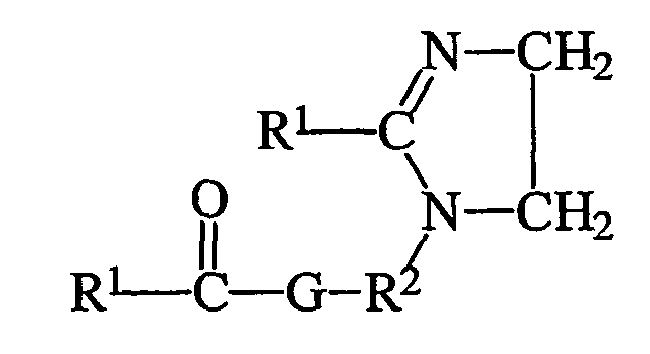
- (8) Reaction products of substantially unsaturated and/or branched chain higher fatty acids with dialkylenetriamines in, e.g., a molecular ratio of about 2:1, said reaction products containing compounds of the formula:
R1-C(O)-NH-R2-NH-R3-NH-C(O)-R1
wherein R1, R2 are defined as above in (6), and each R3 is a C1-C6 alkylene group, preferably an ethylene group. Examples of Compound (8) include Emersol® 223LL and Emersol® 7021, which are available from Henkel Corporation. - (9) Softening active having the formula:
[R1-C(O)-NR-R2-N(R)2-R3-R-C(O)-R1]+ A-
wherein R, R1, R2, R3 and A- are defined as above in (6) and (8). An example of Compound (9) is a difatty amidoamine based softening active available commercially from the Witco Corporation under the trade name Varisoft® 222LT. - (10) The reaction product of substantially unsaturated and/or branched chain higher fatty acid with hydroxyalkylalkylenediamines in a molecular ratio of about 2:1, said reaction products containing compounds of the formula:
R1-C(O)-NH-R2-N(R3OH)-C(O)-R1
wherein R1, R2 and R3 are defined as above in (8). Examples of Compound (10) include reaction products of oleic acids with N-2-hydroxyethylethylenediamine in a molecular ratio of about 2:1, said reaction product mixture containing a compound of the formula:
R1-C(O)-NH-CH2CH2-N(CH2CH2OH)-C(O)-R1
wherein R1-C(O) is oleoyl group of a commercially available oleic acid derived from a vegetable or animal source, such as Emersol® 223LL or Emersol® 7021, available from Henkel Corporation. - (11) Alkylpyridinium salts having the formula:

- (12) Alkanamide alkylene pyridinium salts having the formula:

- (13) Monoalkyl diquaternary salts, e.g., that having the formula:
A- [R1-N(+)(R)2-R2N(+)(R)3] A-
wherein. R, R1, R2 and A- are defined as herein above in (6) and (9).
An example of Compound (13) is N-tallow pentamethyl propane diammonium dichloride, with the formula:
Cl- [(tallowalkyl)-N(+)(CH3)2-CH2-CH2-N(+)(CH3)3] Cl-
available from Witco Corporation under the trade name Adogen® 477. - (14) Mixtures of compounds (1)-(13) disclosed above.
- In the cationic nitrogenous salts herein, the anion A-, which is any softening active compatible anion, provides electrical neutrality. Most often, the anion used to provide electrical neutrality in these salts is from a strong acid, especially a halide, such as chloride, methylsulfate, bromide, or iodide. However, other anions can be used, such as ethylsulfate, acetate, formats, sulfate, carbonate, and the like. Chloride and methylsulfate arc preferred herein as anion A.
- The present invention relates to a method wherein the polymeric particles and perfume raw materials are mixed directly to prepare the perfume polymeric particle. This pre-loading step is typically done in the presence of a solvent, such as water or lower alcohols, to facilitate the mixing process. In a typical embodiment, the solvent used during the synthesis of the polymeric particle is sufficient. The pre-loaded perfume polymeric particle can then be added to a product matrix, (a liquid or a granule) in a manner similar to adding an essential or adjunct ingredient to prepare the final product. High shear agitation and gentle heating can be used in the pre-loading step or the subsequent product formulating step.
- In a typical embodiment, the polymeric particles, typically in the form of an aqueous dispersion (about 30 wt% polymer in water), and the perfume (a mixture of PRMs) are pre-mixed in a higher shear mixer at room temperature. Additional solvent (such as water or lower alcohols) may be used, though it is not required, The pre-mixing time ranges from about 15 minutes to about 16 hours. It is found that after about 4 hours, approximately 90 wt% of the added perfume are loaded onto the Polymeric particle. The pre-loaded perfume polymeric particles can be added to a product matrix, and allowed to equilibrate for at least about 1 week, preferably at least about 2 weeks, before the product is put to use.
- The following are examples of perfume compositions, especially fabric softener compositions according to the present invention.
Component A B C D DEQA 19.0 18.0 25.0 20.0 Fatty acid -- 1.0 -- 1.0 Hydrochloric acid 0.02 0.02 0.02 0.2 Soil Release Polymer 0.02 0.02 0.02 0.2 PEG 0.6 0.6 -- 0.6 Perfume Polymeric Particles 2.0 5.0 0.5 1.0 Eletrolyte 600ppm 600ppm 600ppm 600ppm Dye 50ppm 50ppm 30ppm 50ppm Water Balance Balance Balance Balance - In examples A-D, the polymeric particles are added separately to the fabric softener compositions. In examples E-H, the polymeric particles and perfume are pre-mixed together prior to addition to the fabric softener composition.
Claims (10)
- A method for making a composition for improved delivery of perfume raw material, the method comprising the steps of:a) obtaining a perfume polymeric particle;b) adding the perfume polymeric particle to a product matrix; andc) adding an adjunct ingredient to the product matrix,wherein the perfume polymeric particle comprises a polymer, the polymer comprising a cationic monomer having the formula

—(R9O)yR10
wherein R9 is C2-C4 linear or branched alkylene, carbonyl alkyl, or mixtures thereof; R10 is hydrogen, C1-C4 alkyl carbonyl alkyl, or mixtures thereof; y is an integer from 1 to 10,
wherein the perfume polymeric particle comprises a perfume, the perfume comprising a perfume raw material having a Kovats Index value of from 1000 to 1400, determined using a DB-5 column, and
wherein the Response Factor (RF) of the perfume polymeric material is at least 1.5, as measured by Longevity Test Protocols I or II. - The method according to claim 1 wherein the perfume raw material has one or more of the following characteristics:a molecular weight of less than 200;a boiling point of less than 250°C; ora ClogP of less than 3.
- The method according to claim 1 wherein the adjunct ingredient comprises a fabric softening agent.
- The method according to claim 1 wherein the polymeric particle further comprises a non-cationic monomers.
- The method according to Claim 4 wherein the non-cationic monomer comprises a hydrophobic group selected from the group consisting of: alkyls, cycloalkyls, aryls, alkaryls, aralkyls and mixtures thereof.
- The method according to Claim 5 wherein the non-cationic monomer is selected from the group consisting of: methyl methacrylate, methyl acrylate, ethyl acrylate, n-propyl acrylate, iso-propyl acrylate, n-butyl acrylate, isobutyl acrylate, hydroxyethyl acrylate, hydroxypropyl acrylate, benzyl acrylate, ethylhexyl acrylate, n-propyl methacrylate, ethyl methacrylate, iso-propyl methacrylate, isobutyl methacrylate, n-butyl methacrylate, methacrylic acid, acrylic acid, acrylamide, methacrylamide, styrene, α-methyl styrene, hydroxyethyl methacrylate, hydroxypropyl methacrylate, hydroxybutyl acrylate, hydroxybutyl methacrylate, PEG acrylate, phenyl methacrylamide, t-butyl methacrylamide, p-hydroxyphenyl methacrylamide, vinyl ethers, vinyl ketones, vinyl acetates, vinyl phenols, acylamido-2-methylpropanesulfonic acid, vinlysulfonate, vinylpropionate, methylallylsulfonic acid, N-vinyl formamide and N-vinylpyrrolidone, and mixtures thereof.
- The method according to Claim 1 wherein the perfume polymeric particle has an average particle size of from 1 µm, to 39 µm.
- The method according to Claim 1 wherein the perfume polymeric particle has an average particle size of from 200 nm to 900 nm.
- The method according to Claim 1 wherein the polymer is a water-insoluble polymer such that the polymeric particle physically separates from water within 5 minutes of addition thereto.
- The method particle according to Claim 1 wherein the perfume raw material having a Kovats Index of from 1000 to 1400 comprises at least 10% by weight of the perfume.
Applications Claiming Priority (3)
| Application Number | Priority Date | Filing Date | Title |
|---|---|---|---|
| US42310702P | 2002-11-01 | 2002-11-01 | |
| US423107P | 2002-11-01 | ||
| PCT/US2003/034676 WO2004041232A1 (en) | 2002-11-01 | 2003-10-31 | Perfume polymeric particles |
Publications (2)
| Publication Number | Publication Date |
|---|---|
| EP1562542A1 EP1562542A1 (en) | 2005-08-17 |
| EP1562542B1 true EP1562542B1 (en) | 2009-10-14 |
Family
ID=32312607
Family Applications (1)
| Application Number | Title | Priority Date | Filing Date |
|---|---|---|---|
| EP03778025A Revoked EP1562542B1 (en) | 2002-11-01 | 2003-10-31 | Perfume polymeric particles |
Country Status (12)
| Country | Link |
|---|---|
| US (1) | US7316994B2 (en) |
| EP (1) | EP1562542B1 (en) |
| JP (1) | JP2006515029A (en) |
| CN (1) | CN1708284A (en) |
| AT (1) | ATE445386T1 (en) |
| AU (1) | AU2003286811B2 (en) |
| CA (1) | CA2504386A1 (en) |
| DE (1) | DE60329702D1 (en) |
| ES (1) | ES2334995T3 (en) |
| MX (1) | MXPA05004663A (en) |
| PL (1) | PL376600A1 (en) |
| WO (1) | WO2004041232A1 (en) |
Families Citing this family (84)
| Publication number | Priority date | Publication date | Assignee | Title |
|---|---|---|---|---|
| US7316994B2 (en) * | 2002-11-01 | 2008-01-08 | The Procter & Gamble Company | Perfume polymeric particles |
| JP2005105508A (en) * | 2003-10-01 | 2005-04-21 | Rohm & Haas Co | Polymers and methods for controlling the rheology of aqueous compositions |
| GB0328848D0 (en) * | 2003-12-12 | 2004-01-14 | Unilever Plc | Fabric conditioning composition |
| GB0328842D0 (en) * | 2003-12-12 | 2004-01-14 | Unilever Plc | Fabric conditioning composition |
| US7723285B2 (en) * | 2004-07-20 | 2010-05-25 | Michigan Molecular Institute | Beneficial agent delivery systems |
| US20060237555A1 (en) * | 2005-04-11 | 2006-10-26 | Cetti Jonathan R | Systems and devices for delivering volatile materials having perfume components with a high Kovat's Index |
| MX2007015068A (en) * | 2005-05-31 | 2008-01-24 | Procter & Gamble | A cleaning wipe comprising perfume microcapsules, a kit and a method of use thereof. |
| DE102005026522B4 (en) * | 2005-06-08 | 2007-04-05 | Henkel Kgaa | Reinforcement of cleaning performance of detergents by polymer |
| DE102005026544A1 (en) | 2005-06-08 | 2006-12-14 | Henkel Kgaa | Reinforcement of cleaning performance of detergents by polymer |
| GB2432844A (en) * | 2005-12-02 | 2007-06-06 | Unilever Plc | Laundry composition |
| GB2432850A (en) * | 2005-12-02 | 2007-06-06 | Unilever Plc | Polymeric particle comprising perfume and benefit agent, in particular a laundry composition |
| GB2432843A (en) * | 2005-12-02 | 2007-06-06 | Unilever Plc | Perfume carrying polymeric particle |
| JP5175263B2 (en) * | 2006-03-14 | 2013-04-03 | ザ プロクター アンド ギャンブル カンパニー | Decorative illuminant |
| US20070275866A1 (en) * | 2006-05-23 | 2007-11-29 | Robert Richard Dykstra | Perfume delivery systems for consumer goods |
| GB0610562D0 (en) * | 2006-05-30 | 2006-07-05 | Givaudan Sa | Microcapsules |
| EP1886698B1 (en) * | 2006-08-09 | 2011-02-16 | The Procter & Gamble Company | Absorbent articles including an improved odour control system |
| EP2093323B1 (en) * | 2006-12-12 | 2012-10-10 | Kao Corporation | Liquid softener composition, or transparent or semi-transparent liquid softener composition |
| TWI417438B (en) | 2006-12-28 | 2013-12-01 | Kao Corp | Fiber treatment agent |
| JP4944756B2 (en) * | 2006-12-28 | 2012-06-06 | 花王株式会社 | Textile treatment agent |
| US7850038B2 (en) * | 2007-02-23 | 2010-12-14 | The Procter & Gamble Company | Scented container |
| US7681725B2 (en) * | 2007-02-23 | 2010-03-23 | The Procter And Gamble Company | Container with ability to transfer a material to container content |
| EP1967545A1 (en) * | 2007-03-09 | 2008-09-10 | Rohm and Haas France SAS | Cationic polymer latex |
| EP2125552A2 (en) * | 2007-03-13 | 2009-12-02 | The Procter and Gamble Company | Perfuming method and product |
| EP2055351B1 (en) * | 2007-10-29 | 2016-05-25 | The Procter and Gamble Company | Compositions with durable pearlescent aesthetics |
| JP4944757B2 (en) * | 2007-11-19 | 2012-06-06 | 花王株式会社 | Textile treatment agent |
| US8143206B2 (en) | 2008-02-21 | 2012-03-27 | S.C. Johnson & Son, Inc. | Cleaning composition having high self-adhesion and providing residual benefits |
| US9481854B2 (en) | 2008-02-21 | 2016-11-01 | S. C. Johnson & Son, Inc. | Cleaning composition that provides residual benefits |
| EP2254980B2 (en) | 2008-02-21 | 2016-11-30 | S.C. Johnson & Son, Inc. | Cleaning composition having high self-adhesion and providing residual benefits |
| US9410111B2 (en) | 2008-02-21 | 2016-08-09 | S.C. Johnson & Son, Inc. | Cleaning composition that provides residual benefits |
| US8993502B2 (en) | 2008-02-21 | 2015-03-31 | S. C. Johnson & Son, Inc. | Cleaning composition having high self-adhesion to a vertical hard surface and providing residual benefits |
| US8980813B2 (en) | 2008-02-21 | 2015-03-17 | S. C. Johnson & Son, Inc. | Cleaning composition having high self-adhesion on a vertical hard surface and providing residual benefits |
| US20090233836A1 (en) * | 2008-03-11 | 2009-09-17 | The Procter & Gamble Company | Perfuming method and product |
| WO2010053891A1 (en) * | 2008-11-04 | 2010-05-14 | The Procter & Gamble Company | Malodor control system |
| BRPI0922770A2 (en) * | 2008-12-01 | 2019-09-24 | Procter & Gamble | perfume systems |
| US8754028B2 (en) * | 2008-12-16 | 2014-06-17 | The Procter & Gamble Company | Perfume systems |
| EP2270124A1 (en) | 2009-06-30 | 2011-01-05 | The Procter & Gamble Company | Bleaching compositions comprising a perfume delivery system |
| MX2012006616A (en) | 2009-12-09 | 2012-06-21 | Procter & Gamble | Fabric and home care products. |
| JP5782046B2 (en) | 2009-12-17 | 2015-09-24 | ザ プロクター アンド ギャンブルカンパニー | Freshening composition comprising malodor binding polymer and malodor control component |
| CN107028801A (en) * | 2009-12-18 | 2017-08-11 | 宝洁公司 | Spices and spices encapsulation object |
| US20110164834A1 (en) * | 2010-01-05 | 2011-07-07 | The Glad Products Company | Trash bag with malodor control |
| JP5744192B2 (en) | 2010-06-22 | 2015-07-01 | ザ プロクター アンド ギャンブルカンパニー | Perfume |
| EP3287511A1 (en) | 2010-06-22 | 2018-02-28 | The Procter & Gamble Company | Perfume systems |
| JP5859526B2 (en) | 2010-07-02 | 2016-02-10 | ザ プロクター アンド ギャンブルカンパニー | Filaments containing an activator nonwoven web and methods for making the same |
| RU2541275C2 (en) | 2010-07-02 | 2015-02-10 | Дзе Проктер Энд Гэмбл Компани | Filaments, containing non-aromatised active agent, non-woven cloths and methods of obtaining thereof |
| WO2012003351A2 (en) | 2010-07-02 | 2012-01-05 | The Procter & Gamble Company | Web material and method for making same |
| RU2543892C2 (en) | 2010-07-02 | 2015-03-10 | Дзе Проктер Энд Гэмбл Компани | Production of films from nonwoven webs |
| CA2803382C (en) | 2010-07-02 | 2015-03-31 | The Procter & Gamble Company | Method for delivering an active agent |
| US8912350B2 (en) | 2011-06-23 | 2014-12-16 | The Procter & Gamble Company | Perfume systems |
| US20140141126A1 (en) | 2011-06-29 | 2014-05-22 | Solae Llc | Baked food compositions comprising soy whey proteins that have been isolated from processing streams |
| ES2529502T3 (en) | 2011-09-13 | 2015-02-20 | The Procter & Gamble Company | Water-stable unit dose stable items |
| US8835373B2 (en) | 2011-09-13 | 2014-09-16 | The Procter & Gamble Company | Fluid fabric enhancer compositions |
| EP3369845B1 (en) | 2012-01-04 | 2020-03-25 | The Procter & Gamble Company | Active containing fibrous structures with multiple regions having differing densities |
| EP3719192B1 (en) | 2012-01-04 | 2025-06-25 | The Procter & Gamble Company | Fibrous structures comprising particles and methods for making same |
| US9139802B2 (en) | 2012-01-04 | 2015-09-22 | The Procter & Gamble Company | Active containing fibrous structures with multiple regions |
| EP2708588A1 (en) | 2012-09-14 | 2014-03-19 | The Procter & Gamble Company | Fabric care composition |
| EP2708592B2 (en) | 2012-09-14 | 2022-03-16 | The Procter & Gamble Company | Fabric care composition |
| EP2708589A1 (en) | 2012-09-14 | 2014-03-19 | The Procter & Gamble Company | Fabric care composition |
| US9303232B2 (en) | 2012-12-06 | 2016-04-05 | The Procter & Gamble Company | Perfume systems |
| US20140161741A1 (en) | 2012-12-06 | 2014-06-12 | The Procter & Gamble Company | Perfume systems |
| MX367307B (en) | 2012-12-14 | 2019-08-14 | Procter & Gamble | ANTIPERSPIRANT and DEODORANT COMPOSITIONS. |
| EP2803719A1 (en) | 2013-05-14 | 2014-11-19 | The Procter & Gamble Company | Cleaning composition |
| BR112015031917A2 (en) | 2013-06-19 | 2017-07-25 | Procter & Gamble | absorbent article comprising a fragrance or odor control composition |
| RU2015152087A (en) | 2013-06-19 | 2017-07-24 | Дзе Проктер Энд Гэмбл Компани | An absorbent article containing complexed or encapsulated reactive compounds |
| EP4253649B1 (en) | 2013-12-09 | 2025-04-23 | The Procter & Gamble Company | Fibrous structures including an active agent and having a graphic printed thereon |
| MX2016011830A (en) | 2014-03-12 | 2016-12-02 | Noxell Corp | Detergent composition. |
| WO2015138578A1 (en) | 2014-03-12 | 2015-09-17 | The Procter & Gamble Company | Detergent composition |
| ES2658819T3 (en) | 2014-03-12 | 2018-03-12 | The Procter & Gamble Company | Detergent composition |
| EP3116982B2 (en) | 2014-03-12 | 2022-03-02 | The Procter & Gamble Company | Detergent composition |
| CA2938300A1 (en) | 2014-03-26 | 2015-10-01 | The Procter & Gamble Company | Perfume systems |
| EP3139902A2 (en) | 2014-05-06 | 2017-03-15 | The Procter & Gamble Company | Fragrance compositions |
| CA2952982C (en) * | 2014-07-23 | 2020-04-28 | The Procter & Gamble Company | Fabric and home care treatment compositions |
| US20160024432A1 (en) | 2014-07-23 | 2016-01-28 | The Procter & Gamble Company | Treatment compositions |
| EP3172300B1 (en) | 2014-07-23 | 2018-12-26 | The Procter and Gamble Company | Fabric and home care treatment composition |
| US9499770B2 (en) | 2015-03-10 | 2016-11-22 | The Procter & Gamble Company | Freshening compositions resisting scent habituation |
| US11697904B2 (en) | 2017-01-27 | 2023-07-11 | The Procter & Gamble Company | Active agent-containing articles that exhibit consumer acceptable article in-use properties |
| WO2018140472A1 (en) | 2017-01-27 | 2018-08-02 | The Procter & Gamble Company | Active agent-containing articles that exhibit consumer acceptable article in-use properties |
| US11697906B2 (en) | 2017-01-27 | 2023-07-11 | The Procter & Gamble Company | Active agent-containing articles and product-shipping assemblies for containing the same |
| US11697905B2 (en) | 2017-01-27 | 2023-07-11 | The Procter & Gamble Company | Active agent-containing articles that exhibit consumer acceptable article in-use properties |
| US11485940B2 (en) | 2019-12-05 | 2022-11-01 | The Procter & Gamble Company | Method of making a cleaning composition |
| CN114667337A (en) | 2019-12-05 | 2022-06-24 | 宝洁公司 | Cleaning composition |
| CN111349518A (en) * | 2020-03-18 | 2020-06-30 | 名畔科技(镇江)有限公司 | A kind of preparation method of flavor and fragrance sustained-release |
| CN114196029B (en) * | 2022-01-11 | 2023-05-30 | 万华化学(宁波)有限公司 | Core-shell structure toughening agent, preparation method and application thereof in preparation of oil-resistant high-toughness PC alloy |
| EP4299706A1 (en) | 2022-06-27 | 2024-01-03 | The Procter & Gamble Company | Alkaline hard surface cleaning composition |
| EP4299697A1 (en) | 2022-06-27 | 2024-01-03 | The Procter & Gamble Company | Acidic hard surface cleaning composition |
Family Cites Families (24)
| Publication number | Priority date | Publication date | Assignee | Title |
|---|---|---|---|---|
| US3577518A (en) | 1969-07-18 | 1971-05-04 | Nat Patent Dev Corp | Hydrophilic hairspray and hair setting preparations |
| LU65552A1 (en) | 1972-06-20 | 1973-12-27 | ||
| US3946949A (en) * | 1974-09-04 | 1976-03-30 | Allis-Chalmers Corporation | Nozzle for rotary kiln |
| PH17005A (en) | 1980-02-07 | 1984-05-11 | Unilever Nv | A method of depositing perfume and compositions therefor |
| US4326967A (en) | 1980-06-24 | 1982-04-27 | Lever Brothers Company | Liquid formulations for depositing perfumes on fabrics |
| JPS63122796A (en) | 1986-11-11 | 1988-05-26 | 花王株式会社 | Liquid detergent composition |
| FI891918L (en) | 1987-08-24 | 1989-04-21 | Allied Colloids Ltd | POLYMER COMPOSITIONS. |
| US5246603A (en) | 1991-09-25 | 1993-09-21 | Lever Brothers Company, Division Of Conopco, Inc. | Fragrance microcapsules for fabric conditioning |
| WO1997011151A1 (en) | 1995-09-18 | 1997-03-27 | The Procter & Gamble Company | Delivery systems |
| EP0950088A1 (en) | 1996-12-23 | 1999-10-20 | Quest International B.V. | Particles containing absorbed liquids and methods of making them |
| EP0925776A3 (en) | 1997-12-16 | 2001-08-29 | Givaudan SA | Polymer with binding capacity for organoleptic substances |
| FR2774388B1 (en) | 1998-02-02 | 2002-12-13 | Rhodia Chimie Sa | SYSTEM COMPRISING A HYDROPHOBIC ORGANIC ACTIVE MATERIAL ENCAPSULATED IN AN ALKALI-WATER-SOLUBLE SOLID ORGANIC POLYMER AND SUSCEPTIBLE TO BE RELEASED IN AN ALKALINE MEDIUM |
| GB9910389D0 (en) | 1999-05-05 | 1999-07-07 | Unilever Plc | Laundry compositions |
| DE19932144A1 (en) * | 1999-07-09 | 2001-01-11 | Basf Ag | Microcapsule preparations and washing and cleaning agents containing microcapsules |
| BR0015562A (en) | 1999-11-16 | 2002-09-03 | Unilever Nv | Process for tissue rinsing, and rinse composition for use in the same |
| EP1146057A1 (en) | 2000-04-15 | 2001-10-17 | Givaudan SA | Polymeric nanoparticles including olfactive molecules |
| JP2001335800A (en) | 2000-05-30 | 2001-12-04 | Takasago Internatl Corp | Perfume composition for washing clothes |
| US20020016269A1 (en) | 2000-07-06 | 2002-02-07 | The Procter & Gamble Co. | Particle perfume delivery system |
| FR2813313B1 (en) | 2000-08-25 | 2007-06-15 | Rhodia Chimie Sa | COMPOSITION BASED ON NANOPARTICLES OR NANOLATEX POLYMERS FOR LAUNDRY CARE |
| US6531444B1 (en) | 2000-11-09 | 2003-03-11 | Salvona, Llc | Controlled delivery system for fabric care products |
| DE10063428A1 (en) | 2000-12-20 | 2002-07-11 | Henkel Kgaa | Dispersions of nanoparticulate fragrance-containing composite materials |
| US7799421B2 (en) * | 2002-02-14 | 2010-09-21 | Akzo Nobel N.V. | Controlled release materials |
| US7125835B2 (en) * | 2002-10-10 | 2006-10-24 | International Flavors & Fragrances Inc | Encapsulated fragrance chemicals |
| US7316994B2 (en) * | 2002-11-01 | 2008-01-08 | The Procter & Gamble Company | Perfume polymeric particles |
-
2003
- 2003-10-28 US US10/695,282 patent/US7316994B2/en not_active Expired - Lifetime
- 2003-10-31 MX MXPA05004663A patent/MXPA05004663A/en active IP Right Grant
- 2003-10-31 CN CNA2003801021999A patent/CN1708284A/en active Pending
- 2003-10-31 EP EP03778025A patent/EP1562542B1/en not_active Revoked
- 2003-10-31 DE DE60329702T patent/DE60329702D1/en not_active Expired - Lifetime
- 2003-10-31 AT AT03778025T patent/ATE445386T1/en not_active IP Right Cessation
- 2003-10-31 WO PCT/US2003/034676 patent/WO2004041232A1/en not_active Ceased
- 2003-10-31 JP JP2004550333A patent/JP2006515029A/en active Pending
- 2003-10-31 PL PL376600A patent/PL376600A1/en not_active Application Discontinuation
- 2003-10-31 ES ES03778025T patent/ES2334995T3/en not_active Expired - Lifetime
- 2003-10-31 AU AU2003286811A patent/AU2003286811B2/en not_active Ceased
- 2003-10-31 CA CA002504386A patent/CA2504386A1/en not_active Abandoned
Also Published As
| Publication number | Publication date |
|---|---|
| WO2004041232A1 (en) | 2004-05-21 |
| CA2504386A1 (en) | 2004-05-21 |
| EP1562542A1 (en) | 2005-08-17 |
| ATE445386T1 (en) | 2009-10-15 |
| MXPA05004663A (en) | 2005-06-08 |
| CN1708284A (en) | 2005-12-14 |
| DE60329702D1 (en) | 2009-11-26 |
| AU2003286811A1 (en) | 2004-06-07 |
| PL376600A1 (en) | 2006-01-09 |
| AU2003286811B2 (en) | 2007-08-02 |
| ES2334995T3 (en) | 2010-03-18 |
| US7316994B2 (en) | 2008-01-08 |
| US20040110648A1 (en) | 2004-06-10 |
| JP2006515029A (en) | 2006-05-18 |
Similar Documents
| Publication | Publication Date | Title |
|---|---|---|
| US7316994B2 (en) | Perfume polymeric particles | |
| US8187580B2 (en) | Polymeric assisted delivery using separate addition | |
| CN107835707B (en) | Microcapsules | |
| EP3172301B1 (en) | Fabric and home care treatment compositions | |
| US8765659B2 (en) | Cationic polymer stabilized microcapsule composition | |
| EP3172303B1 (en) | Fabric and home care treatment compositions | |
| JP6827961B2 (en) | Improvements in or related to encapsulated fragrance compositions | |
| EP3172298B1 (en) | Fabric and home care treatment compositions | |
| DE69210825T2 (en) | LIQUID TISSUE SOFTENER WITH PROTECTED CYCLODEXTRIN / PERFUME COMPLEX | |
| JP5911480B2 (en) | Perfume compositions and their use | |
| JP2020504771A (en) | High-impact fragrance microcapsules with balanced density | |
| EP3172305B1 (en) | Fabric and home care treatment compositions | |
| MXPA05004639A (en) | Rinse-off personal care compositions comprising cationic perfume polymeric particles. | |
| JP2023529103A (en) | particulate laundry additive | |
| BRPI0919806B1 (en) | perfume composition and its uses | |
| JP5726682B2 (en) | Textile treatment composition | |
| CA3046279C (en) | Use of polyester terephthalate to reduce malodour on fabrics | |
| CN107787357A (en) | In the flavor compositions of encapsulating or associated improvement | |
| WO2009121831A1 (en) | Controlled release particles | |
| CN101098955A (en) | olfactory delivery composition | |
| WO2024118728A1 (en) | Treatment composition with delivery particles made from redox-initiator-treated chitosan |
Legal Events
| Date | Code | Title | Description |
|---|---|---|---|
| PUAI | Public reference made under article 153(3) epc to a published international application that has entered the european phase |
Free format text: ORIGINAL CODE: 0009012 |
|
| 17P | Request for examination filed |
Effective date: 20050524 |
|
| AK | Designated contracting states |
Kind code of ref document: A1 Designated state(s): AT BE BG CH CY CZ DE DK EE ES FI FR GB GR HU IE IT LI LU MC NL PT RO SE SI SK TR |
|
| AX | Request for extension of the european patent |
Extension state: AL LT LV MK |
|
| DAX | Request for extension of the european patent (deleted) | ||
| 17Q | First examination report despatched |
Effective date: 20060821 |
|
| RIN1 | Information on inventor provided before grant (corrected) |
Inventor name: BOECKH, DIETER Inventor name: BAKER, ELLEN, SCHMIDT Inventor name: DYKSTRA, ROBERT, RICHARD Inventor name: FRENZEL, STEFAN Inventor name: KLUESENER, BERNARD, WILLIAM Inventor name: SANTAMARINA, VICENTE Inventor name: SCHWENDEMANN, VOLKER Inventor name: JORDAN, GLENN, THOMAS, IV Inventor name: SIVIK, MARK, ROBERT Inventor name: GALLON, LOIS, SARA Inventor name: AMRHEIN, PATRICK Inventor name: JAHNS, EKKEHARD Inventor name: LEBEDEV, NATHALIA |
|
| RAP1 | Party data changed (applicant data changed or rights of an application transferred) |
Owner name: THE PROCTER & GAMBLE COMPANY Owner name: BASF SE |
|
| APBN | Date of receipt of notice of appeal recorded |
Free format text: ORIGINAL CODE: EPIDOSNNOA2E |
|
| APBR | Date of receipt of statement of grounds of appeal recorded |
Free format text: ORIGINAL CODE: EPIDOSNNOA3E |
|
| APBV | Interlocutory revision of appeal recorded |
Free format text: ORIGINAL CODE: EPIDOSNIRAPE |
|
| GRAP | Despatch of communication of intention to grant a patent |
Free format text: ORIGINAL CODE: EPIDOSNIGR1 |
|
| RIC1 | Information provided on ipc code assigned before grant |
Ipc: C11D 3/00 20060101ALI20080909BHEP Ipc: A61K 8/04 20060101AFI20080909BHEP Ipc: A61Q 13/00 20060101ALI20080909BHEP Ipc: C11D 3/50 20060101ALI20080909BHEP |
|
| GRAS | Grant fee paid |
Free format text: ORIGINAL CODE: EPIDOSNIGR3 |
|
| GRAA | (expected) grant |
Free format text: ORIGINAL CODE: 0009210 |
|
| AK | Designated contracting states |
Kind code of ref document: B1 Designated state(s): AT BE BG CH CY CZ DE DK EE ES FI FR GB GR HU IE IT LI LU MC NL PT RO SE SI SK TR |
|
| REG | Reference to a national code |
Ref country code: GB Ref legal event code: FG4D |
|
| REG | Reference to a national code |
Ref country code: CH Ref legal event code: EP |
|
| REG | Reference to a national code |
Ref country code: IE Ref legal event code: FG4D |
|
| REF | Corresponds to: |
Ref document number: 60329702 Country of ref document: DE Date of ref document: 20091126 Kind code of ref document: P |
|
| PGFP | Annual fee paid to national office [announced via postgrant information from national office to epo] |
Ref country code: ES Payment date: 20091029 Year of fee payment: 7 |
|
| PGFP | Annual fee paid to national office [announced via postgrant information from national office to epo] |
Ref country code: NL Payment date: 20091028 Year of fee payment: 7 |
|
| REG | Reference to a national code |
Ref country code: ES Ref legal event code: FG2A Ref document number: 2334995 Country of ref document: ES Kind code of ref document: T3 |
|
| PG25 | Lapsed in a contracting state [announced via postgrant information from national office to epo] |
Ref country code: FI Free format text: LAPSE BECAUSE OF FAILURE TO SUBMIT A TRANSLATION OF THE DESCRIPTION OR TO PAY THE FEE WITHIN THE PRESCRIBED TIME-LIMIT Effective date: 20091014 Ref country code: PT Free format text: LAPSE BECAUSE OF FAILURE TO SUBMIT A TRANSLATION OF THE DESCRIPTION OR TO PAY THE FEE WITHIN THE PRESCRIBED TIME-LIMIT Effective date: 20100215 Ref country code: SE Free format text: LAPSE BECAUSE OF FAILURE TO SUBMIT A TRANSLATION OF THE DESCRIPTION OR TO PAY THE FEE WITHIN THE PRESCRIBED TIME-LIMIT Effective date: 20091014 |
|
| PGFP | Annual fee paid to national office [announced via postgrant information from national office to epo] |
Ref country code: IT Payment date: 20091016 Year of fee payment: 7 |
|
| PG25 | Lapsed in a contracting state [announced via postgrant information from national office to epo] |
Ref country code: SI Free format text: LAPSE BECAUSE OF FAILURE TO SUBMIT A TRANSLATION OF THE DESCRIPTION OR TO PAY THE FEE WITHIN THE PRESCRIBED TIME-LIMIT Effective date: 20091014 Ref country code: MC Free format text: LAPSE BECAUSE OF NON-PAYMENT OF DUE FEES Effective date: 20091031 |
|
| REG | Reference to a national code |
Ref country code: CH Ref legal event code: PL |
|
| PG25 | Lapsed in a contracting state [announced via postgrant information from national office to epo] |
Ref country code: BE Free format text: LAPSE BECAUSE OF FAILURE TO SUBMIT A TRANSLATION OF THE DESCRIPTION OR TO PAY THE FEE WITHIN THE PRESCRIBED TIME-LIMIT Effective date: 20091014 Ref country code: AT Free format text: LAPSE BECAUSE OF FAILURE TO SUBMIT A TRANSLATION OF THE DESCRIPTION OR TO PAY THE FEE WITHIN THE PRESCRIBED TIME-LIMIT Effective date: 20091014 |
|
| PLBI | Opposition filed |
Free format text: ORIGINAL CODE: 0009260 |
|
| PLBI | Opposition filed |
Free format text: ORIGINAL CODE: 0009260 |
|
| PG25 | Lapsed in a contracting state [announced via postgrant information from national office to epo] |
Ref country code: DK Free format text: LAPSE BECAUSE OF FAILURE TO SUBMIT A TRANSLATION OF THE DESCRIPTION OR TO PAY THE FEE WITHIN THE PRESCRIBED TIME-LIMIT Effective date: 20091014 Ref country code: EE Free format text: LAPSE BECAUSE OF FAILURE TO SUBMIT A TRANSLATION OF THE DESCRIPTION OR TO PAY THE FEE WITHIN THE PRESCRIBED TIME-LIMIT Effective date: 20091014 Ref country code: BG Free format text: LAPSE BECAUSE OF FAILURE TO SUBMIT A TRANSLATION OF THE DESCRIPTION OR TO PAY THE FEE WITHIN THE PRESCRIBED TIME-LIMIT Effective date: 20100114 Ref country code: RO Free format text: LAPSE BECAUSE OF FAILURE TO SUBMIT A TRANSLATION OF THE DESCRIPTION OR TO PAY THE FEE WITHIN THE PRESCRIBED TIME-LIMIT Effective date: 20091014 |
|
| 26 | Opposition filed |
Opponent name: HENKEL AG & CO. KGAA Effective date: 20100625 |
|
| PLAX | Notice of opposition and request to file observation + time limit sent |
Free format text: ORIGINAL CODE: EPIDOSNOBS2 |
|
| 26 | Opposition filed |
Opponent name: ROHM AND HAAS COMPANY Effective date: 20100714 Opponent name: HENKEL AG & CO. KGAA Effective date: 20100625 |
|
| PG25 | Lapsed in a contracting state [announced via postgrant information from national office to epo] |
Ref country code: CZ Free format text: LAPSE BECAUSE OF FAILURE TO SUBMIT A TRANSLATION OF THE DESCRIPTION OR TO PAY THE FEE WITHIN THE PRESCRIBED TIME-LIMIT Effective date: 20091014 Ref country code: SK Free format text: LAPSE BECAUSE OF FAILURE TO SUBMIT A TRANSLATION OF THE DESCRIPTION OR TO PAY THE FEE WITHIN THE PRESCRIBED TIME-LIMIT Effective date: 20091014 |
|
| PLAF | Information modified related to communication of a notice of opposition and request to file observations + time limit |
Free format text: ORIGINAL CODE: EPIDOSCOBS2 |
|
| PG25 | Lapsed in a contracting state [announced via postgrant information from national office to epo] |
Ref country code: CH Free format text: LAPSE BECAUSE OF NON-PAYMENT OF DUE FEES Effective date: 20091031 Ref country code: GR Free format text: LAPSE BECAUSE OF FAILURE TO SUBMIT A TRANSLATION OF THE DESCRIPTION OR TO PAY THE FEE WITHIN THE PRESCRIBED TIME-LIMIT Effective date: 20100115 Ref country code: IE Free format text: LAPSE BECAUSE OF NON-PAYMENT OF DUE FEES Effective date: 20091031 Ref country code: LI Free format text: LAPSE BECAUSE OF NON-PAYMENT OF DUE FEES Effective date: 20091031 |
|
| PLAF | Information modified related to communication of a notice of opposition and request to file observations + time limit |
Free format text: ORIGINAL CODE: EPIDOSCOBS2 |
|
| PLBB | Reply of patent proprietor to notice(s) of opposition received |
Free format text: ORIGINAL CODE: EPIDOSNOBS3 |
|
| PG25 | Lapsed in a contracting state [announced via postgrant information from national office to epo] |
Ref country code: LU Free format text: LAPSE BECAUSE OF NON-PAYMENT OF DUE FEES Effective date: 20091031 |
|
| REG | Reference to a national code |
Ref country code: NL Ref legal event code: V1 Effective date: 20110501 |
|
| PG25 | Lapsed in a contracting state [announced via postgrant information from national office to epo] |
Ref country code: HU Free format text: LAPSE BECAUSE OF FAILURE TO SUBMIT A TRANSLATION OF THE DESCRIPTION OR TO PAY THE FEE WITHIN THE PRESCRIBED TIME-LIMIT Effective date: 20100415 |
|
| PG25 | Lapsed in a contracting state [announced via postgrant information from national office to epo] |
Ref country code: TR Free format text: LAPSE BECAUSE OF FAILURE TO SUBMIT A TRANSLATION OF THE DESCRIPTION OR TO PAY THE FEE WITHIN THE PRESCRIBED TIME-LIMIT Effective date: 20091014 Ref country code: NL Free format text: LAPSE BECAUSE OF NON-PAYMENT OF DUE FEES Effective date: 20110501 |
|
| PG25 | Lapsed in a contracting state [announced via postgrant information from national office to epo] |
Ref country code: CY Free format text: LAPSE BECAUSE OF FAILURE TO SUBMIT A TRANSLATION OF THE DESCRIPTION OR TO PAY THE FEE WITHIN THE PRESCRIBED TIME-LIMIT Effective date: 20091014 |
|
| REG | Reference to a national code |
Ref country code: ES Ref legal event code: FD2A Effective date: 20111118 |
|
| PG25 | Lapsed in a contracting state [announced via postgrant information from national office to epo] |
Ref country code: IT Free format text: LAPSE BECAUSE OF NON-PAYMENT OF DUE FEES Effective date: 20101031 |
|
| PG25 | Lapsed in a contracting state [announced via postgrant information from national office to epo] |
Ref country code: ES Free format text: LAPSE BECAUSE OF NON-PAYMENT OF DUE FEES Effective date: 20101101 |
|
| RDAF | Communication despatched that patent is revoked |
Free format text: ORIGINAL CODE: EPIDOSNREV1 |
|
| APBM | Appeal reference recorded |
Free format text: ORIGINAL CODE: EPIDOSNREFNO |
|
| APBP | Date of receipt of notice of appeal recorded |
Free format text: ORIGINAL CODE: EPIDOSNNOA2O |
|
| APAH | Appeal reference modified |
Free format text: ORIGINAL CODE: EPIDOSCREFNO |
|
| PGFP | Annual fee paid to national office [announced via postgrant information from national office to epo] |
Ref country code: GB Payment date: 20120925 Year of fee payment: 10 |
|
| REG | Reference to a national code |
Ref country code: DE Ref legal event code: R064 Ref document number: 60329702 Country of ref document: DE Ref country code: DE Ref legal event code: R103 Ref document number: 60329702 Country of ref document: DE |
|
| APBU | Appeal procedure closed |
Free format text: ORIGINAL CODE: EPIDOSNNOA9O |
|
| RDAG | Patent revoked |
Free format text: ORIGINAL CODE: 0009271 |
|
| STAA | Information on the status of an ep patent application or granted ep patent |
Free format text: STATUS: PATENT REVOKED |
|
| 27W | Patent revoked |
Effective date: 20121214 |
|
| GBPR | Gb: patent revoked under art. 102 of the ep convention designating the uk as contracting state |
Effective date: 20121214 |
|
| PGFP | Annual fee paid to national office [announced via postgrant information from national office to epo] |
Ref country code: FR Payment date: 20121010 Year of fee payment: 10 Ref country code: DE Payment date: 20121031 Year of fee payment: 10 |
|
| REG | Reference to a national code |
Ref country code: DE Ref legal event code: R107 Ref document number: 60329702 Country of ref document: DE Effective date: 20130321 |