EP1562115A2 - Connexions de socket via une liaison série - Google Patents
Connexions de socket via une liaison série Download PDFInfo
- Publication number
- EP1562115A2 EP1562115A2 EP05250753A EP05250753A EP1562115A2 EP 1562115 A2 EP1562115 A2 EP 1562115A2 EP 05250753 A EP05250753 A EP 05250753A EP 05250753 A EP05250753 A EP 05250753A EP 1562115 A2 EP1562115 A2 EP 1562115A2
- Authority
- EP
- European Patent Office
- Prior art keywords
- client
- host computer
- application
- socket
- server
- Prior art date
- Legal status (The legal status is an assumption and is not a legal conclusion. Google has not performed a legal analysis and makes no representation as to the accuracy of the status listed.)
- Withdrawn
Links
Images


Classifications
-
- G—PHYSICS
- G06—COMPUTING OR CALCULATING; COUNTING
- G06F—ELECTRIC DIGITAL DATA PROCESSING
- G06F9/00—Arrangements for program control, e.g. control units
- G06F9/06—Arrangements for program control, e.g. control units using stored programs, i.e. using an internal store of processing equipment to receive or retain programs
- G06F9/46—Multiprogramming arrangements
- G06F9/54—Interprogram communication
- G06F9/547—Remote procedure calls [RPC]; Web services
-
- H—ELECTRICITY
- H04—ELECTRIC COMMUNICATION TECHNIQUE
- H04L—TRANSMISSION OF DIGITAL INFORMATION, e.g. TELEGRAPHIC COMMUNICATION
- H04L67/00—Network arrangements or protocols for supporting network services or applications
- H04L67/50—Network services
- H04L67/56—Provisioning of proxy services
- H04L67/563—Data redirection of data network streams
-
- H—ELECTRICITY
- H04—ELECTRIC COMMUNICATION TECHNIQUE
- H04L—TRANSMISSION OF DIGITAL INFORMATION, e.g. TELEGRAPHIC COMMUNICATION
- H04L69/00—Network arrangements, protocols or services independent of the application payload and not provided for in the other groups of this subclass
- H04L69/16—Implementation or adaptation of Internet protocol [IP], of transmission control protocol [TCP] or of user datagram protocol [UDP]
- H04L69/161—Implementation details of TCP/IP or UDP/IP stack architecture; Specification of modified or new header fields
- H04L69/162—Implementation details of TCP/IP or UDP/IP stack architecture; Specification of modified or new header fields involving adaptations of sockets based mechanisms
-
- H—ELECTRICITY
- H04—ELECTRIC COMMUNICATION TECHNIQUE
- H04L—TRANSMISSION OF DIGITAL INFORMATION, e.g. TELEGRAPHIC COMMUNICATION
- H04L67/00—Network arrangements or protocols for supporting network services or applications
- H04L67/2866—Architectures; Arrangements
- H04L67/2871—Implementation details of single intermediate entities
Definitions
- the present invention relates generally to computer systems and software, and specifically to methods and devices for socket-based communications between computers over a serial link.
- a socket is one endpoint of a two-way communication link between two programs or processes.
- sockets are implemented at the transport layer, and require underlying support of a complete networking protocol stack, including physical layer, data link layer and network layer protocols.
- HTTP Hypertext Transfer Protocol
- TCP Transmission Control Protocol
- IP Internet Protocol
- Small computing devices such as mobile and embedded systems, may need sockets for some applications, but may not have the resources necessary to support a complete protocol stack.
- the communication capability of such devices may be limited (at least for the purposes of the applications in question) to a simple serial link to a host computer.
- Embodiments of the present invention enable a client computing device to establish socket connections over a serial link, using a novel "Socket over Serial” (SoS) protocol, which does not require the support of a networking stack.
- SoS Socket over Serial
- Socket requests by client applications running on the client device are passed over the serial link to the host using the SoS protocol.
- the host serves as a socket proxy for the client device.
- the host parses and processes the client requests, and then uses its own operating system to make the socket connection to the server application that has been requested by the client application.
- the host sends responses from the server application back to the client device over the serial link using the SoS protocol.
- the proxy operation of the host is transparent to the client and to the server, which may thus communicate with one another (through the host) as though there were a direct network connection between the client and server.
- the client uses the SoS protocol to communicate, via the host, with applications running on remote servers, with which the host may communicate over a network. In other embodiments, the client communicates in this manner with local server programs running on the host itself.
- server refers to all server applications, whether local or remote, unless specified otherwise.
- a method for communication including:
- creating the socket includes opening a Transmission Control Protocol (TCP) socket, and conveying the data includes conveying a Hypertext Transfer Protocol (HTTP) packet through the TCP socket.
- TCP Transmission Control Protocol
- HTTP Hypertext Transfer Protocol
- the method requires no more than a single program thread to run on the client device, and conveying the data over the serial link includes transmitting and receiving the data without using a networking protocol stack, such as a TCP stack, on the client device.
- creating the socket includes creating the socket for communication between a proxy server process running on the host computer and an application process of the server application that is running on the host computer. In other embodiments, creating the socket includes creating the socket for communication over a network between the host computer and a server on which the server application is running.
- apparatus for communication including:
- a computer software product for use on a client computing device, which is adapted to be connected by a serial link to a host computer, the product including a computer-readable medium in which program instructions are stored, which instructions, when read by the client computing device, cause the client computing device to submit a request via the serial link, in response to a call made by a client application running on the client computing device, to open a proxy connection for communication between the client application and a server application, thereby causing the host computer to create a socket on the host computer for communication with the server application so as to establish the proxy connection via the socket, the instructions further causing the client computing device to receive data from the server application over the serial link using the proxy connection, and to convey the data to the client application.
- a computer software product for use on a host computer, which is adapted to be connected by a serial link to a client computing device, the product including a computer-readable medium in which program instructions are stored, which instructions, when read by the host computer, cause the host computer to create a socket for communication with a server application in response to a request received from the client computing device over the serial link to open a proxy connection for communication between a client application on the client computing device and the server application, the instructions further causing the host computer to convey data between the server application and the client application over the serial link using the proxy connection via the socket.
- Fig. 1 is a schematic, pictorial illustration of a computer communication system 20.
- System 20 comprises a client computing device 22, running a client application, which communicates with a remote server 24 using an appropriate socket-based connection.
- client device 22 transmits and receives data over a serial link 26, which connects to a serial port 28 of a proxy host computer 30.
- proxy host computer 30 comprises a general-purpose computer, with a user interface 31 and a display 33.
- host 30 establishes socket-based communications with server 24 via a network 32, in accordance with requests submitted by client device 22 using the SoS protocol.
- host 30 may establish and use such sockets internally, so as to permit client device 22 to communicate with a server application running on the host itself.
- client computing device 22 and a single server are shown in Fig. 1, host 30 may be configured to support multiple client devices on different serial ports, and to carry out socket-based communications with multiple servers simultaneously, both external and internal to the host itself.
- Client device 22 is shown in Fig. 1 as a mobile telephone, and serial link 26 is a standard RS-232 link.
- serial link 26 is a standard RS-232 link.
- Such a configuration may be used, for example, in testing a JavaTM software implementation that has been written for the mobile telephone.
- Sun Microsystems (Palo Alto, California) supplies a Technology Compatibility Kit (TCK), which runs as a server application either on host 30 or on remote server 24.
- TCK Technology Compatibility Kit
- the TCK communicates with a corresponding client application on client device 22 using HTTP requests and responses.
- HTTP requires an underlying TCP socket.
- the socket is supplied by a SoS server program running on host 30, as described hereinbelow.
- Other socket-based applications and upper-level protocols may be supported in like manner.
- client device 22 may comprise a personal digital assistant (PDA) or an embedded computing system, or substantially any other sort of computing device that is required to carry out client/server communications over a serial link.
- serial link 26 may comprise a Universal Serial Bus (USB) link or substantially any other type of serial communication link that is known in the art.
- PDA personal digital assistant
- USB Universal Serial Bus
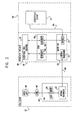
- Fig. 2 is a block diagram that schematically illustrates software components on client 22 and host 30 that are used in implementing the SoS protocol and functionality.
- SoS is used to support communications between a Java client application 48 running on client 22 and a server application 34 running on a server 36, such as the above-mentioned TCK client and server components.
- server 36 may be remote server 24, or it may be a server process running on host 30 itself.
- Client device 22 runs a native operating system (OS) 40, which comprises a serial handler 42 and a SoS client 44.
- Serial handler 42 handles low-level communications over serial link 26, using conventional buffered read and write commands. For example, the serial handler may read bytes of data from link 26 in response to the getchar() command, and may write bytes to link 26 in response to the put char () command, as is known in the art.
- SoS client 44 handles the higher-level functions associated with socket-based communications. These functions are typically invoked by client application 48 by means of a socket application programming interface (API), which is provided by a Java Virtual Machine (JVM) 46. In the Java context, such an API might be provided by the MIDP (Mobile Information Device Profile) layer of the JVM.
- API socket application programming interface
- MIDP Mobile Information Device Profile
- socket API In devices known in the art, which support a full communication protocol stack, invocation of the socket API causes the operating system of the client device to use its networking protocol stack to establish a socket directly with server 36. In the present example, however, the functionality of the socket API is altered so as to invoke SoS client 44, and thus to transfer the burden of actually creating the socket from OS 40 of client device 22 to host 30.
- Host 30 runs a host operating system (host OS) 50, such as Windows® or UNIX®.
- the host OS includes a serial handler 52, which is similar to serial handler 42.
- the host OS also includes a networking protocol stack 54, which provides full socket support, as is known in the art.
- SoS server program 56 In the present example, the SoS server is assumed to be written as a Java application, and thus runs over a JVM 58.
- the JVM provides the server program with the required APIs, including a communication API (commAPI) 60 for reading to and writing from serial handler 52, and a connect API 62 for invoking socket-related functions of protocol stack 54.
- These functions include opening, closing and using connections, such as a TCP connection 64, with server application 34.
- Java is convenient for the present purposes, however, alternative server implementations are also possible, as will be apparent to those skilled in the art.
- SoS server 56 comprises a console component 66, which communicates with user interface 31 and display 33 (Fig. 1).
- the console component permits a user of host 30 to configure functions of the SoS server, such as serial port assignments. It also permits data received over serial link 26 to be output directly to display 33.
- client application 48 may use a printf () command to print out debug data that are generated during testing using the package.
- the printf () command on client 22 directs the debug data to serial handler 42, which passes the data over link 26, via serial handler 52, to console component 66.
- the console component outputs the data to display 33.
- Other channels of this sort which bypass the socket-oriented functions of SoS server 56, may similarly be provided.
- the software enabling client 22 and host 30 to perform the functions described herein may be downloaded to the client and/or host in electronic form, over a network, for example, or it may alternatively be provided on tangible media, such as CD-ROM, DVD or non-volatile memory.
- Fig. 3 is a flow chart that schematically illustrates a method for socket-based communication between client 22 and server 36.
- Client application 48 invokes the socket API provided by JVM 46 in order to establish a connection with server application 34, at a connection step 70.
- the client application may submit a HTTP request directed to the server application, which would normally cause the client operating system to open a TCP connection to server 36.
- JVM 46 passes the request from application 48 to SoS client 44, which uses the services of SoS server 56 on host 30 in establishing the connection, as described hereinbelow.
- SoS client 44 uses the services of SoS server 56 on host 30 in establishing the connection, as described hereinbelow.
- SoS client 44 encapsulates the message received from application 48 in a packet in accordance with the SoS protocol, at an encapsulation step 72.
- the SoS protocol provides that messages be encapsulated in accordance with a simple, predetermined packet format.
- the packet comprises the following fields:
- SoS client 44 passes the packet to serial handler 42, at a packet transmission step 74.
- the SoS client uses the putchar () command, or its equivalent, to write the packet byte-by-byte to the serial handler, which transmits the bytes over link 26 to host 30.
- SoS client 44 then waits for a response from the host.
- client OS 40 provides only a single thread for use by JVM 46 and application 48
- the application (and possible other Java functions) may be blocked while the client waits for a response to be returned by host 30.
- the application or the JVM may be configured to periodically poll serial handler 42 for data from host 30. If no response is received within a predetermined period, SoS client 44 may retransmit the packet. Typically, if no response is received after certain number of retransmission attempts, such as three retransmission attempts, the SoS client returns an exception to application 48.
- SoS server 56 on host 30 may initiate a challenge/response routine at regular intervals, for example, once every 500 ms, when no other packets have been transmitted during the preceding period. Client 22 must respond to every message sent by host 30, in order to permit the host to verify that the connection is alive.
- This routine may make use of the following packet types (specified in the packet "Type" field mentioned above):
- SoS server 56 listens for incoming data from serial handler 52, using API 60. Upon receiving a data packet, SoS server 56 parses the fields in the packet, in accordance with the packet structure described above, at a packet parsing step 76. Typically, the SoS server checks the packet syntax and CRC, and discards packets that contain errors.
- SoS server 56 invokes API 62 in order to request that connection 64 be opened, at a connection request step 78.
- Connection 64 may be opened either over network 32 (Fig. 1) to remote server 24, or internally within host 30, depending on where the target server application is running.
- host OS 50 exchanges the conventional three-way TCP handshake with server 24.
- SoS server 56 If host OS 50 is unable to open the desired connection, it informs SoS server 56, which sends a failure message over serial link 26 to client 22, at a failure response step 80. SoS client 44 then returns the appropriate exception to client application 48.
- connection to server application 34 when the connection to server application 34 is established successfully, the connection may be used to convey application traffic between server application 34 and client application 48, at a traffic transfer step 82.
- SoS server 56 maintains a binding between network connection 64 and the connection to client application 48 over serial link 26.
- the SoS server strips the unneeded protocol headers from packets that it receives over connection 64 from server application 34, and then encapsulates the payloads in the arguments of packets that it creates in accordance with the SoS protocol described above.
- SoS server 56 will strip the protocol headers, such as the IP and TCP headers, that precede the HTTP header, but will encapsulate the HTTP headers in the SoS packets along with the payload data.
- SoS client 44 parses the SoS packets and delivers the contents to client application 48.
- the SoS server receives packets from client 22 over serial link 26, it adds appropriate network (IP) and transport (TCP) headers to the payloads contained in the arguments of these packets, and transmits the complete packets over connection 64 to server application 34.
- IP network
- TCP transport
- the methods of the present invention may be extended in a straightforward manner to support opening of server sockets on the client device.
- applications running on other computers can connect to an open and waiting server socket on the client device.
Landscapes
- Engineering & Computer Science (AREA)
- Computer Networks & Wireless Communication (AREA)
- Signal Processing (AREA)
- Software Systems (AREA)
- Theoretical Computer Science (AREA)
- Physics & Mathematics (AREA)
- General Engineering & Computer Science (AREA)
- General Physics & Mathematics (AREA)
- Computer Security & Cryptography (AREA)
- Computer And Data Communications (AREA)
- Communication Control (AREA)
Applications Claiming Priority (4)
| Application Number | Priority Date | Filing Date | Title |
|---|---|---|---|
| US11432 | 1993-01-29 | ||
| US54295804P | 2004-02-09 | 2004-02-09 | |
| US542958P | 2004-02-09 | ||
| US11/011,432 US7529812B2 (en) | 2004-02-09 | 2004-12-14 | Socket connections over a serial link |
Publications (2)
| Publication Number | Publication Date |
|---|---|
| EP1562115A2 true EP1562115A2 (fr) | 2005-08-10 |
| EP1562115A3 EP1562115A3 (fr) | 2006-01-04 |
Family
ID=34680853
Family Applications (1)
| Application Number | Title | Priority Date | Filing Date |
|---|---|---|---|
| EP05250753A Withdrawn EP1562115A3 (fr) | 2004-02-09 | 2005-02-09 | Connexions de socket via une liaison série |
Country Status (2)
| Country | Link |
|---|---|
| US (1) | US7529812B2 (fr) |
| EP (1) | EP1562115A3 (fr) |
Families Citing this family (6)
| Publication number | Priority date | Publication date | Assignee | Title |
|---|---|---|---|---|
| IES20050376A2 (en) | 2005-06-03 | 2006-08-09 | Asavie R & D Ltd | Secure network communication system and method |
| US8539374B2 (en) * | 2005-09-23 | 2013-09-17 | Disney Enterprises, Inc. | Graphical user interface for electronic devices |
| US8505031B2 (en) * | 2008-08-18 | 2013-08-06 | Oracle America, Inc. | Method for sharing data |
| US9240952B2 (en) * | 2011-04-02 | 2016-01-19 | Open Invention Network, Llc | System and method for communication between networked applications |
| CN103166824B (zh) * | 2011-12-13 | 2016-09-28 | 华为技术有限公司 | 一种互联方法、装置和系统 |
| US9515976B2 (en) * | 2011-12-19 | 2016-12-06 | Facebook, Inc. | Proxied outgoing message transmission |
Family Cites Families (3)
| Publication number | Priority date | Publication date | Assignee | Title |
|---|---|---|---|---|
| US6434620B1 (en) | 1998-08-27 | 2002-08-13 | Alacritech, Inc. | TCP/IP offload network interface device |
| US6212560B1 (en) * | 1998-05-08 | 2001-04-03 | Compaq Computer Corporation | Dynamic proxy server |
| US7200679B2 (en) * | 2001-04-13 | 2007-04-03 | Telefonaktiebolaget Lm Ericsson (Publ) | Creating distributed proxy configurations |
-
2004
- 2004-12-14 US US11/011,432 patent/US7529812B2/en active Active
-
2005
- 2005-02-09 EP EP05250753A patent/EP1562115A3/fr not_active Withdrawn
Also Published As
| Publication number | Publication date |
|---|---|
| US7529812B2 (en) | 2009-05-05 |
| EP1562115A3 (fr) | 2006-01-04 |
| US20050198308A1 (en) | 2005-09-08 |
Similar Documents
| Publication | Publication Date | Title |
|---|---|---|
| US7817634B2 (en) | Network with a constrained usage model supporting remote direct memory access | |
| US8176187B2 (en) | Method, system, and program for enabling communication between nodes | |
| US6618359B1 (en) | Error recovery in a mixed protocol networks | |
| US5894557A (en) | Flexible point-to-point protocol framework | |
| US5379296A (en) | Method and apparatus for interfacing a workstation to a plurality of computer platforms | |
| US6757744B1 (en) | Distributed transport communications manager with messaging subsystem for high-speed communications between heterogeneous computer systems | |
| US7966380B2 (en) | Method, system, and program for forwarding messages between nodes | |
| US5745685A (en) | Protocol extension in NSPP using an acknowledgment bit | |
| CA2325652C (fr) | Methode d'intercepion de paquets de reseau dans un dispositif informatique | |
| US20040250253A1 (en) | Method and apparatus for providing multi-client support in a sip-enabled terminal | |
| US6229809B1 (en) | Method and system for combining computer network protocols | |
| EP1750401B1 (fr) | UBS 1.1 sur une liaison à haut débit | |
| US7039710B2 (en) | Method and apparatus for providing multi-client support in a SIP-enabled terminal | |
| EP1277322A2 (fr) | Fourniture de services a distance de specification d'interface de logiciel pilote sur un support a frequence radio sans fil | |
| US7680944B1 (en) | Rapid transport service in a network to peripheral device servers | |
| US9288287B2 (en) | Accelerated sockets | |
| US6618393B1 (en) | Method and apparatus for transparent support of network protocols with header translation | |
| US7529812B2 (en) | Socket connections over a serial link | |
| MXPA02009369A (es) | Metodo y aparato para notificar a la aplicacion de una estacion movil eventos especificos. | |
| CN117615042B (zh) | 数据通信方法、装置、计算机设备及存储介质 | |
| US20050283545A1 (en) | Method and system for supporting write operations with CRC for iSCSI and iSCSI chimney | |
| US20030018831A1 (en) | Application programming interface for providing direct access to a WSP layer of a WAP stack | |
| CN110851116A (zh) | 一种嵌入式系统消息交互中间件 | |
| CN118984342B (zh) | 一种基于改进的tcp传输协议架构的应用层消息传输方法、系统和dpu设备 | |
| Ko et al. | Internet Small Computer System Interface (iSCSI) Extensions for Remote Direct Memory Access (RDMA) |
Legal Events
| Date | Code | Title | Description |
|---|---|---|---|
| PUAI | Public reference made under article 153(3) epc to a published international application that has entered the european phase |
Free format text: ORIGINAL CODE: 0009012 |
|
| AK | Designated contracting states |
Kind code of ref document: A2 Designated state(s): AT BE BG CH CY CZ DE DK EE ES FI FR GB GR HU IE IS IT LI LT LU MC NL PL PT RO SE SI SK TR |
|
| AX | Request for extension of the european patent |
Extension state: AL BA HR LV MK YU |
|
| PUAL | Search report despatched |
Free format text: ORIGINAL CODE: 0009013 |
|
| AK | Designated contracting states |
Kind code of ref document: A3 Designated state(s): AT BE BG CH CY CZ DE DK EE ES FI FR GB GR HU IE IS IT LI LT LU MC NL PL PT RO SE SI SK TR |
|
| AX | Request for extension of the european patent |
Extension state: AL BA HR LV MK YU |
|
| RIC1 | Information provided on ipc code assigned before grant |
Ipc: H04L 29/08 20060101ALI20051112BHEP Ipc: H04L 29/06 20060101ALI20051112BHEP Ipc: G06F 9/54 20060101AFI20051112BHEP |
|
| 17P | Request for examination filed |
Effective date: 20060620 |
|
| 17Q | First examination report despatched |
Effective date: 20060719 |
|
| AKX | Designation fees paid |
Designated state(s): DE GB |
|
| STAA | Information on the status of an ep patent application or granted ep patent |
Free format text: STATUS: THE APPLICATION IS DEEMED TO BE WITHDRAWN |
|
| 18D | Application deemed to be withdrawn |
Effective date: 20070130 |