EP1561766A1 - Ring-opened polynorbornenes - Google Patents
Ring-opened polynorbornenes Download PDFInfo
- Publication number
- EP1561766A1 EP1561766A1 EP03772707A EP03772707A EP1561766A1 EP 1561766 A1 EP1561766 A1 EP 1561766A1 EP 03772707 A EP03772707 A EP 03772707A EP 03772707 A EP03772707 A EP 03772707A EP 1561766 A1 EP1561766 A1 EP 1561766A1
- Authority
- EP
- European Patent Office
- Prior art keywords
- ene
- ring
- general formula
- group
- dione
- Prior art date
- Legal status (The legal status is an assumption and is not a legal conclusion. Google has not performed a legal analysis and makes no representation as to the accuracy of the status listed.)
- Withdrawn
Links
- 0 CC(*)(CC1C2)C2C2C1C1C(CIC)=CC2C1 Chemical compound CC(*)(CC1C2)C2C2C1C1C(CIC)=CC2C1 0.000 description 4
- KFWJXQDORLWKBB-UHFFFAOYSA-N OC(C(CC1C2)C2C2C1C1C=CC2C1)=O Chemical compound OC(C(CC1C2)C2C2C1C1C=CC2C1)=O KFWJXQDORLWKBB-UHFFFAOYSA-N 0.000 description 2
- KDUJSXYOLBPKQW-UHFFFAOYSA-N CC(CC1C2)(C2C2C1C1C=CC2C1)C(F)(F)F Chemical compound CC(CC1C2)(C2C2C1C1C=CC2C1)C(F)(F)F KDUJSXYOLBPKQW-UHFFFAOYSA-N 0.000 description 1
- YXFVVABEGXRONW-UHFFFAOYSA-N Cc1ccccc1 Chemical compound Cc1ccccc1 YXFVVABEGXRONW-UHFFFAOYSA-N 0.000 description 1
- FWTCMFUMDIZFFI-UHFFFAOYSA-N FC(C(C(CC12)C3C1C1C=CC3C1)C2C(F)(F)F)(F)F Chemical compound FC(C(C(CC12)C3C1C1C=CC3C1)C2C(F)(F)F)(F)F FWTCMFUMDIZFFI-UHFFFAOYSA-N 0.000 description 1
- NVQCIGFOMGXANF-UHFFFAOYSA-N FC(C(CC12)C3C1C1C=CC3C1)(C2(F)F)F Chemical compound FC(C(CC12)C3C1C1C=CC3C1)(C2(F)F)F NVQCIGFOMGXANF-UHFFFAOYSA-N 0.000 description 1
- LBRVDIUBNUGRCI-UHFFFAOYSA-N FC(C(CC12)C3C1C1C=CC3C1)C2(F)F Chemical compound FC(C(CC12)C3C1C1C=CC3C1)C2(F)F LBRVDIUBNUGRCI-UHFFFAOYSA-N 0.000 description 1
- GPKBWHIDABESCF-UHFFFAOYSA-N FC(C(CC1C2)(C2C2C1C1C=CC2C1)C(F)(F)F)(F)F Chemical compound FC(C(CC1C2)(C2C2C1C1C=CC2C1)C(F)(F)F)(F)F GPKBWHIDABESCF-UHFFFAOYSA-N 0.000 description 1
- CKKGPNARILRMPQ-UHFFFAOYSA-N O=C(C(C1C2)C3C2C2C1C1C=CC2C1)OC3=O Chemical compound O=C(C(C1C2)C3C2C2C1C1C=CC2C1)OC3=O CKKGPNARILRMPQ-UHFFFAOYSA-N 0.000 description 1
Images


Classifications
-
- C—CHEMISTRY; METALLURGY
- C08—ORGANIC MACROMOLECULAR COMPOUNDS; THEIR PREPARATION OR CHEMICAL WORKING-UP; COMPOSITIONS BASED THEREON
- C08G—MACROMOLECULAR COMPOUNDS OBTAINED OTHERWISE THAN BY REACTIONS ONLY INVOLVING UNSATURATED CARBON-TO-CARBON BONDS
- C08G61/00—Macromolecular compounds obtained by reactions forming a carbon-to-carbon link in the main chain of the macromolecule
- C08G61/02—Macromolecular compounds containing only carbon atoms in the main chain of the macromolecule, e.g. polyxylylenes
-
- C—CHEMISTRY; METALLURGY
- C08—ORGANIC MACROMOLECULAR COMPOUNDS; THEIR PREPARATION OR CHEMICAL WORKING-UP; COMPOSITIONS BASED THEREON
- C08G—MACROMOLECULAR COMPOUNDS OBTAINED OTHERWISE THAN BY REACTIONS ONLY INVOLVING UNSATURATED CARBON-TO-CARBON BONDS
- C08G61/00—Macromolecular compounds obtained by reactions forming a carbon-to-carbon link in the main chain of the macromolecule
- C08G61/02—Macromolecular compounds containing only carbon atoms in the main chain of the macromolecule, e.g. polyxylylenes
- C08G61/04—Macromolecular compounds containing only carbon atoms in the main chain of the macromolecule, e.g. polyxylylenes only aliphatic carbon atoms
- C08G61/06—Macromolecular compounds containing only carbon atoms in the main chain of the macromolecule, e.g. polyxylylenes only aliphatic carbon atoms prepared by ring-opening of carbocyclic compounds
-
- Y—GENERAL TAGGING OF NEW TECHNOLOGICAL DEVELOPMENTS; GENERAL TAGGING OF CROSS-SECTIONAL TECHNOLOGIES SPANNING OVER SEVERAL SECTIONS OF THE IPC; TECHNICAL SUBJECTS COVERED BY FORMER USPC CROSS-REFERENCE ART COLLECTIONS [XRACs] AND DIGESTS
- Y10—TECHNICAL SUBJECTS COVERED BY FORMER USPC
- Y10S—TECHNICAL SUBJECTS COVERED BY FORMER USPC CROSS-REFERENCE ART COLLECTIONS [XRACs] AND DIGESTS
- Y10S525/00—Synthetic resins or natural rubbers -- part of the class 520 series
- Y10S525/94—Hydrogenation of a polymer
Definitions
- the present invention relates to a ring-opened polynorbornene, and particularly to a ring-opened polynorbornene low in birefringence, high in wavelength dependency about birefringence and excellent in transparency and heat resistance.
- Transparent resins have heretofore been used as ordinary materials for automobile parts, lighting equipments, electric parts, etc., of which transparency is required, and have recently been being applied to, particularly, optical materials that optical properties are of great importance.
- Polycarbonate resins and acrylic resins are known as transparent resins suitably used for such application fields.
- the acrylic resins involve problems in points of heat resistance and water resistance (low water absorption property) and the like though they are excellent in transparency.
- the polycarbonate resins involve such problems that birefringence is high though they are superb in heat resistance and water resistance to the acrylic resins. Therefore, as transparent resins for optical materials, attention has been recently attracted to cycloolefin resins that have good transparency, water resistance, low birefringence, heat resistance and the like in combination and is supplied to actual use.
- phase difference plates formed of a film of a cycloolefin resin are described in Patent Literature 7 to Patent Literature 10.
- Patent Literature 11 to Patent Literature 13 it is described that a film of a cycloolefin resin is used as a protective film for a polarizing plate.
- a substrate for a liquid crystal display device which is composed of a film of a cycloolefin resin, is described in Patent Literature 14.
- optical films formed respectively of these cycloolefin reins have property that the absolute value of phase difference (birefringence) of transmitted light becomes lower as the wavelength of the transmitted light becomes longer, however, it is extremely difficult to give a specific phase difference of, for example, a 1/4 wavelength to the transmitted light of all rays in a visible region (400 to 800 nm).
- phase difference birefringence
- optical films formed respectively of other resins in addition to the conventional cycloolefin resins.
- the present invention has been made on the basis of the foregoing circumstances and has as its object the provision of a ring-opened polynorbornene that is relatively low in birefringence, has specific wavelength dependency about birefringence and is excellent in transparency and heat resistance.
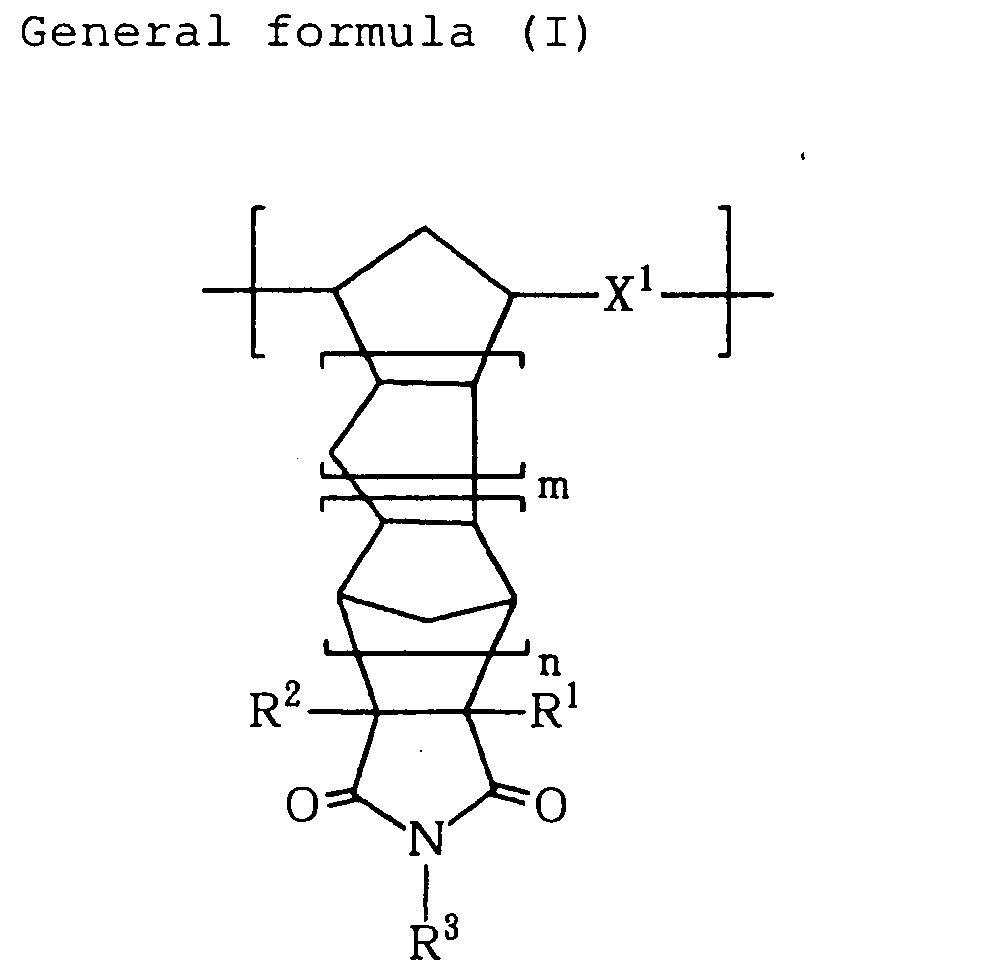
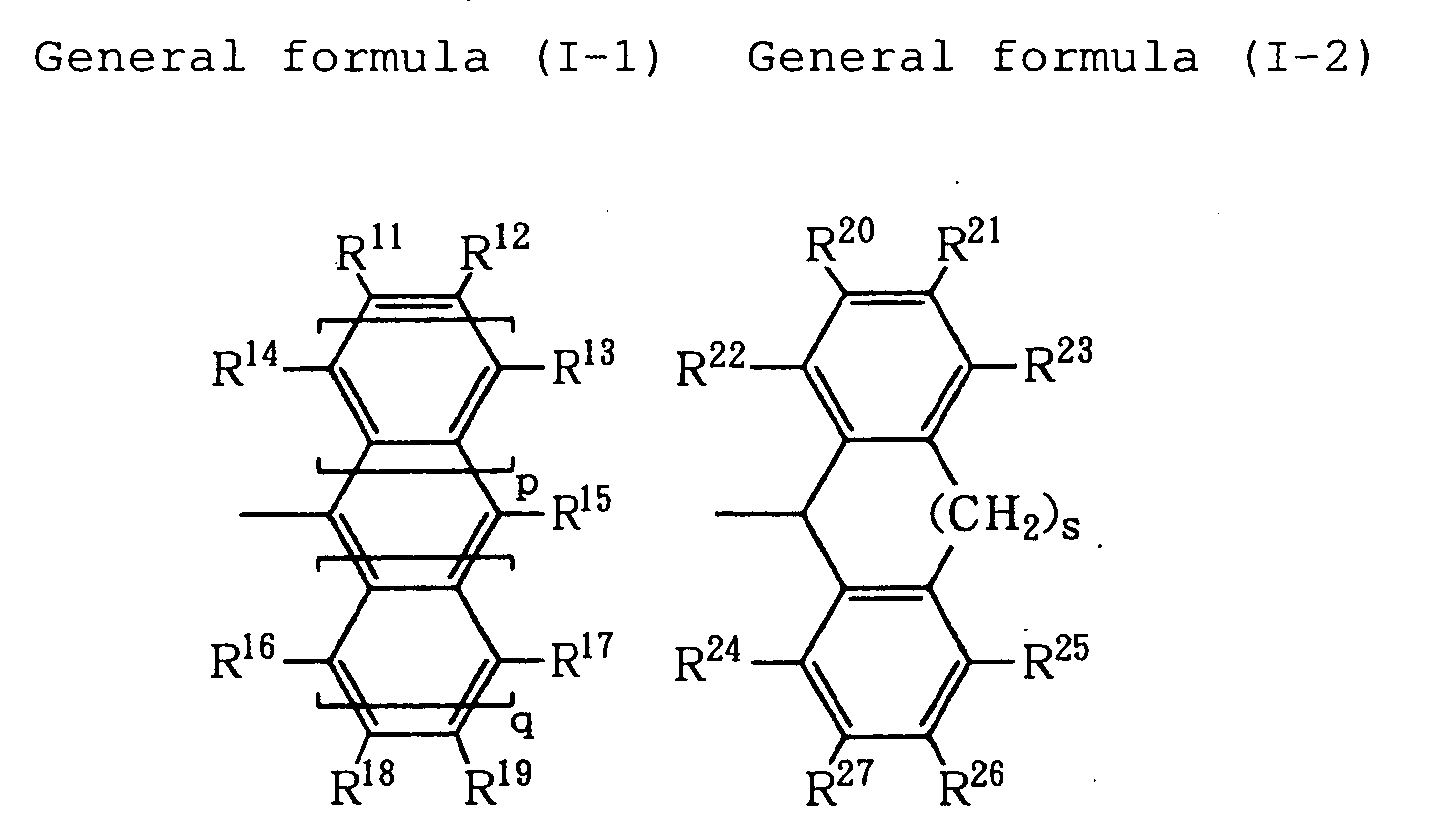
- a ring-opened polynorbornene comprising a structural unit (I) represented by the following general formula (I): [Chemical formula 1] wherein in the general formula (I), m and n are, independently of each other, an integer of 0 to 2, X 1 means an ethylene or vinylene group, R 1 and R 2 denote, independently of each other, a hydrogen atom or a substituted or unsubstituted hydrocarbon group having 1 to 30 carbon atoms, and R 3 represents a group represented by the following general formula (I-1) or a group represented by the following general formula (I-2): [Chemical formula 2] wherein in the general formulae (I-1) and (I-2), R 11 to R 27 denote, independently of one another, a hydrogen atom; a halogen atom; a substituted or unsubstituted hydrocarbon group having 1 to 30 carbon atoms, which may have a linkage containing or not containing oxygen, sulfur, nitrogen and
- the ring-opened polynorbornene according to the present invention may be that comprising a structural unit represented by the following general formula (II).
- the proportion of the structural unit (II) may preferably be at most 98 mol% based on the whole structural unit.
- X 2 means an ethylene or vinylene group
- R 4 to R 7 denote, independently of one another, a hydrogen atom; a halogen atom; a substituted or unsubstituted hydrocarbon group having 1 to 30 carbon atoms, which may have a linkage containing or not containing oxygen, sulfur, nitrogen and/or silicon atom(s); or a polar group, with the proviso that R 4 and R 5 , or R 6 and R 7 may be united with each other to form a divalent hydrocarbon group, R 4 or R 5 , and R 6 or R 7 may be bonded to each other to form a carbon ring or heterocyclic ring, and the carbon ring or heterocycl
- At least 90 mol% of X 1 in the general formula (I) and X 2 in the general formula (II) may be preferably ethylene groups.
- the ring-opened polynorbornene may preferably have a structural unit (I) that in the general formula (I), m is 0, and n is 1.
- the ring-opened polynorbornene may also preferably have a structural unit (I) that in the general formula (I-1), p is 0, q is 0, and at least one of R 11 and R 18 is another substituent group than hydrogen.
- the ring-opened polynorbornene may further preferably have a structural unit (I) that in the general formula (I-1), p is 0, q is 0, at least one of R 11 and R 18 has another substituent group than hydrogen, and at least one of R 12 , R 15 and R 19 is another substituent group than hydrogen.
- the ring-opened polynorbornene may still further preferably have a structural unit (I) that in the general formula (I-1), p is 0, q is 0, and both R 11 and R 18 are other substituent groups than hydrogen.
- the ring-opened polynorbornenes according to the present invention exhibit specific wavelength dependency about birefringence and have low birefringence and high heat resistance and transparency, they are useful in fields of optical parts, electric and electronic materials, and the like. Specifically, they are useful as disks, magneto-optical disks, optical lenses (F ⁇ lenses, pickup lenses, lenses for laser printers, lenses for cameras, etc.), spectacle lenses, optical films (films for display, phase difference films, polarizing films, transparent conductive films, wave plates, optical pickup films, etc.), liquid crystal orientation films, optical sheets, optical fibers, light guide plates, light-diffusing plates, optical cards, optical mirrors, and sealing materials for semiconductors such as IC, LSI and LED.
- optical lenses F ⁇ lenses, pickup lenses, lenses for laser printers, lenses for cameras, etc.
- spectacle lenses optical films (films for display, phase difference films, polarizing films, transparent conductive films, wave plates, optical pickup films, etc.), liquid crystal orientation films, optical sheets, optical fibers, light guide
- the ring-opened polynorbornene according to the present invention comprises the structural unit (I) represented by the general formula (I).
- n and n are, independently of each other, an integer of 0 to 2
- X 1 is an ethylene or vinylene group.
- R 1 and R 2 denote, independently of each other, a hydrogen atom or a substituted or unsubstituted hydrocarbon group having 1 to 30 carbon atoms, preferably 1 to 10 carbon atoms.
- the hydrocarbon group include alkyl groups such as methyl, ethyl and propyl groups; cycloalkyl groups such as cyclopentyl and cyclohexyl groups; alkenyl groups such as vinyl and allyl groups; alkylidene groups such as ethylidene and propylidene groups; aromatic groups such as a phenyl group; and groups with a part or the whole of hydrogen atoms of these groups substituted by a halogen atom such as fluorine, chlorine or bromine, a phenylsulfonyl group, or the like.
- a halogen atom such as fluorine, chlorine or bromine, a phenylsulfonyl group, or the like.
- R 3 is a group represented by the above general formula (I-1) or a group represented by the above general formula (1-2).
- R 11 to R 27 are, independently of one another, a hydrogen atom; a halogen atom; a substituted or unsubstituted hydrocarbon group having 1 to 30 carbon atoms, preferably 1 to 20 carbon atoms, which may have a linkage containing or not containing oxygen, sulfur, nitrogen and/or silicon atom(s); or a polar group.
- halogen atom examples include fluorine, chlorine and bromine atoms.
- substituted or unsubstituted hydrocarbon group having 1 to 30 carbon atoms include the same groups as those exemplified as R 1 and R 2 in the general formula (I). These hydrocarbon groups may be directly bonded to the carbon atom of the aromatic ring or may be bonded through a linkage.
- the linkage is a group containing or not containing oxygen, sulfur, nitrogen and/or silicon atom(s).
- divalent hydrocarbon groups [for example, alkylene groups represented by -(CH 2 ) m -, in which m is an integer of 1 to 10] having 1 to 10 carbon atoms, a carbonyl group (-CO-), a carbonyloxy group (-COO-), a sulfone group (-SO 2 -), an ether linkage (-O-), a thioether linkage (-S-), an imino group (-NH-), an amide linkage (-NHCO-), siloxane linkages (-Si(R 2 )O-, in which R is an alkyl group such as a methyl or ethyl group), and combinations of 2 or more of these groups.
- alkylene groups represented by -(CH 2 ) m -, in which m is an integer of 1 to 10
- Examples of the polar group include hydroxyl groups, alkoxy groups having 1 to 10 carbon atoms, ester groups, alkoxycarbonyl groups, aryloxycarbonyl groups, a cyano group, an amide group, an imide group, triorganosiloxy groups, triorganosilyl groups, amino groups, an acyl group, alkoxysilyl groups, a sulfonyl group and a carboxyl group.
- examples of the alkoxy groups include methoxy and ethoxy groups;
- examples of the ester groups include fatty acid ester groups such as acetate and propionate groups, and aromatic ester groups such as a benzoate group;
- examples of the alkoxycarbonyl groups include methoxycarbonyl and ethoxycarbonyl groups;
- examples of the aryloxycarbonyl groups include phenoxycarbonyl and naphthyloxycarbonyl, fluorenyloxycarbonyl and biphenylyloxycarbonyl groups;
- examples of the triorganosiloxy groups include trimethylsiloxy and triethylsiloxy groups;
- examples of the triorganosilyl groups include trimethylsilyl and triethylsilyl groups;
- examples of the amino groups include a primary amino group; and examples of the alkoxysilyl groups include trimethoxysilyl and triethoxysilyl groups.
- p and q are individually 0 or a positive integer, preferably 0, 1 or 2.
- s is 0 or a positive integer, preferably 0, 1 or 2.
- R 12 and R 15 , or R 19 and R 15 may be bonded to each other to form a carbon ring or heterocyclic ring, and the carbon ring or heterocyclic ring may be either a monocyclic structure or a polycyclic structure.
- Specific examples of such ring structures include those shown in the following formulae (i) to (iii): [Chemical formula 4]
- a structural unit (I) are preferred those, in which in the general formula (I), m is 0, n is 1, both R 1 and R 2 are hydrogen atoms, and R 3 is a group represented by the general formula (I-1) or the general formula (I-2), in that a ring-opened polynorbornene high in heat resistance and low in water absorption property is obtained.
- both p and q in the general formula (I-1) are 0, or s in the general formula (I-2) is 0, are more preferred, with those, in which R 3 is a group represented by the general formula (I-1), both p and q in the general formula (I-1) are 0, and at least one of R 11 and R 18 is another substituent group than hydrogen, being particularly preferred.
- both p and q in the general formula (I-1) are 0, at least one of R 11 and R 18 has another substituent group than hydrogen, and at least one of R 12 , R 15 and R 19 is another substituent group than hydrogen, or in which both R 11 and R 18 are other substituent groups than hydrogen, being particularly preferred.
- Such a structural unit (I) is obtained by subjecting a norbornene monomer (hereinafter referred to as "Specific Monomer (I)”) represented by the following general formula (Im) to ring-opening polymerization.
- Specific Monomer (I) represented by the following general formula (Im)
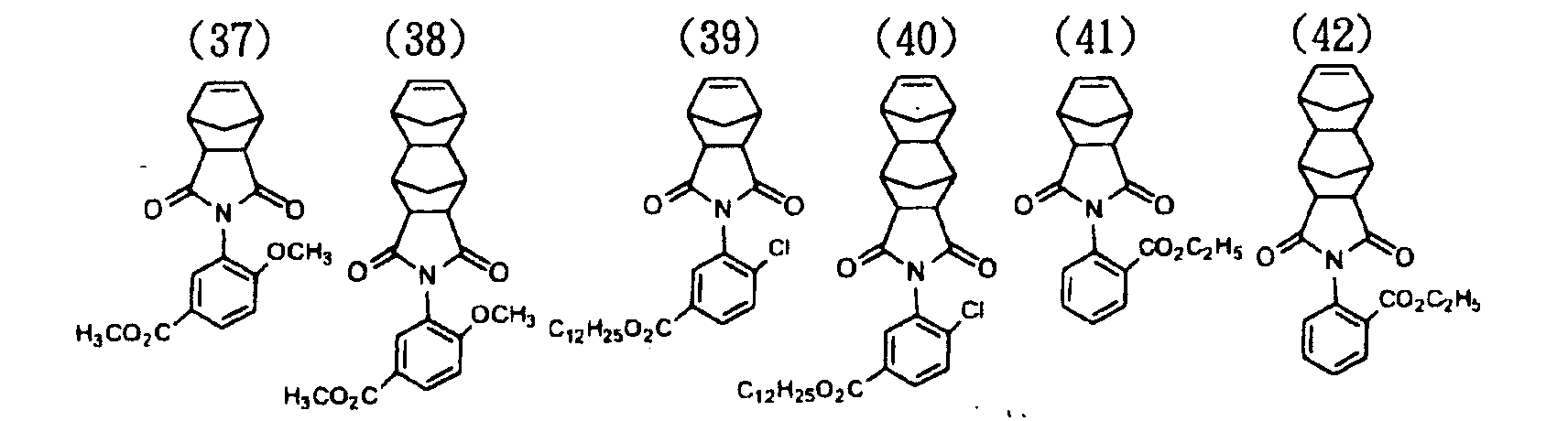
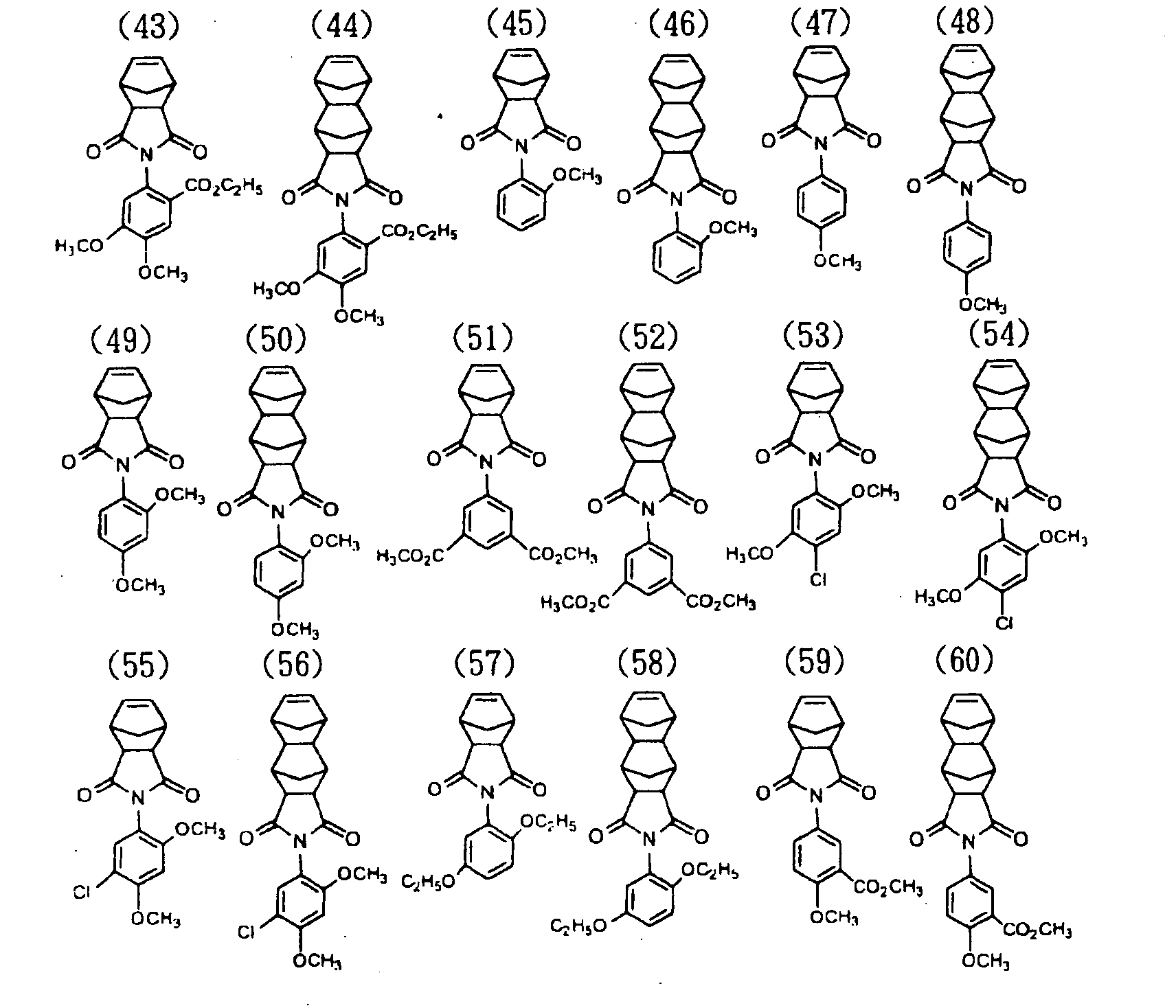
- Specific Monomer (I) may be used an imide compound obtained by, for example, a reaction of a norbornenic acid anhydride such as 4-oxa-tricyclo-[5.2.1.0 2,6 ]dec-8-ene-3,5-dione or 6-oxa-pentacyclo-[9.2.1.1 3,9 .0 2,10 .0 4,8 ]pentadec-12-ene-5,7-dione with an aromatic amine.
- a norbornenic acid anhydride such as 4-oxa-tricyclo-[5.2.1.0 2,6 ]dec-8-ene-3,5-dione or 6-oxa-pentacyclo-[9.2.1.1 3,9 .0 2,10 .0 4,8 ]pentadec-12-ene-5,7-dione with an aromatic amine.
- a norbornenic acid anhydride such as 4-oxa-tricyclo-[5.2.1.0 2,6 ]dec-8-ene-3,5-dione
- the ring-opened polynorbornenes according to the present invention may have a structural unit (II) represented by the above general formula (II) in addition to the structural unit (I).
- t and u are, independently of each other, 0 or a positive integer, and preferably t is 0 or 1, and u is an integer of 0 to 3.
- X 2 is an ethylene or vinylene group.
- R 9 to R 7 are, independently of one another, a hydrogen atom; a halogen atom; a substituted or unsubstituted hydrocarbon group having 1 to 30 carbon atoms, which may have a linkage containing or not containing oxygen, sulfur, nitrogen and/or silicon atom(s); or a polar group, with the proviso that R 4 and R 5 , or R 6 and R 7 may be united with each other to form a divalent hydrocarbon group, or R 9 or R 5 , and R 6 or R 7 may be bonded to each other to form a carbon ring or heterocyclic ring, and the carbon ring or heterocyclic ring may be either a monocyclic structure or a polycyclic structure.
- Specific examples of these atoms or groups include the same atoms or groups as those exemplified as R 1 and R 2 in the general formula (I) and R 11 to R 27 in the general formula (I-1) and the general formula (I-2).
- R 4 to R 7 are preferred those, in which in the general formula (II), at least one of R 4 to R 7 is a carboxylic acid ester group represented by - (CH 2 ) k COOR 29 , in which R 29 is a hydrocarbon group having 1 to 20 carbon atoms, and k is an integer of 0 to 10, in that a copolymer good in balance among heat resistance, solubility and adhesion property or adhesive property to other materials, etc. is obtained.
- hydrocarbon group having 1 to 20 carbon atoms represented by R 29 include alkyl groups such as methyl, ethyl and propyl groups, aryl groups such as a phenyl group, and aralkyl groups such as a benzyl group. Among these, methyl, ethyl and phenyl groups are preferred, with a methyl group being more preferred.
- Such a structural unit (II) is obtained by subjecting a norbornene monomer (hereinafter referred to as "Specific Monomer (II)”) represented by the following general formula (IIm) to ring-opening copolymerization with Specific Monomer (I).
- Specific Monomer (II) represented by the following general formula (IIm)
- R 4 to R 7 denote, independently of one another, a hydrogen atom; a halogen atom; a substituted or unsubstituted hydrocarbon group having 1 to 30 carbon atoms, which may have a linkage containing or not containing oxygen, sulfur, nitrogen and/or silicon atom(s); or a polar group, with the proviso that R 4 and R 5 , or R 6 and R 7 may be united with each other to form a divalent hydrocarbon group, or R 4 and R 5 , or R 6 and R 7 may be bonded to each other to form a carbon ring or heterocyclic ring, and the carbon ring or heterocyclic ring may be either a monocyclic structure or a polycyclic structure.
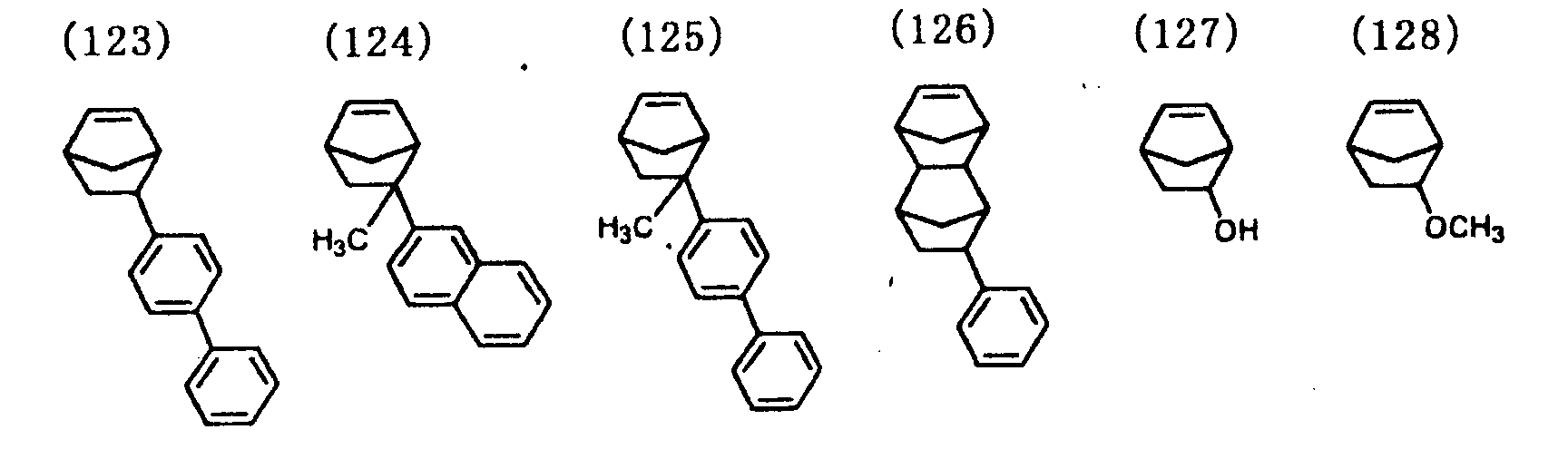
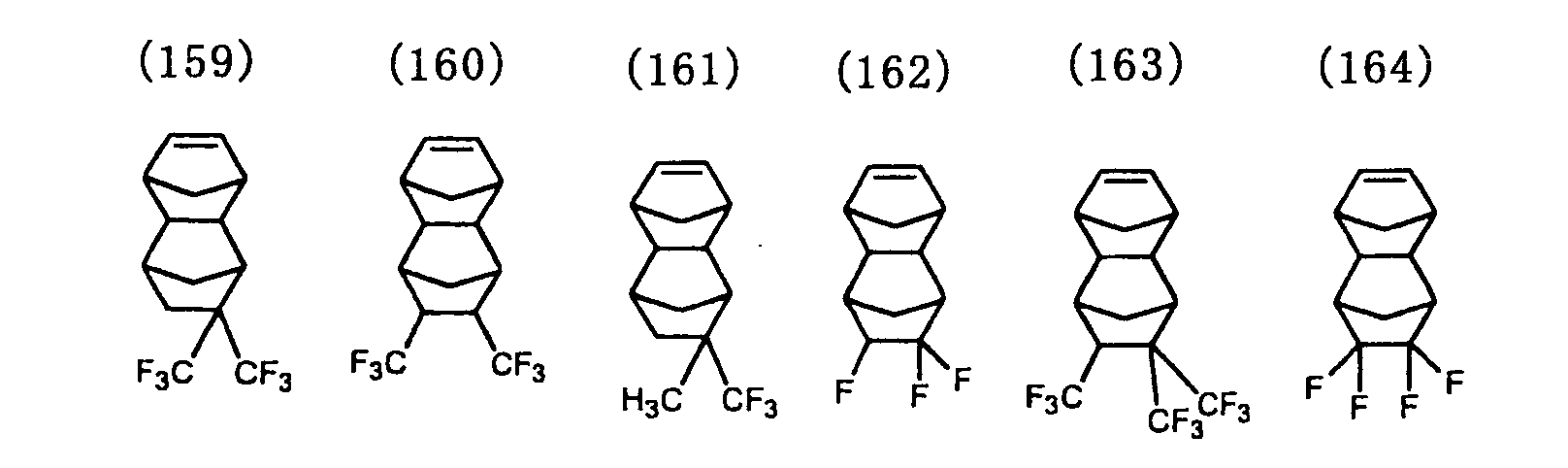
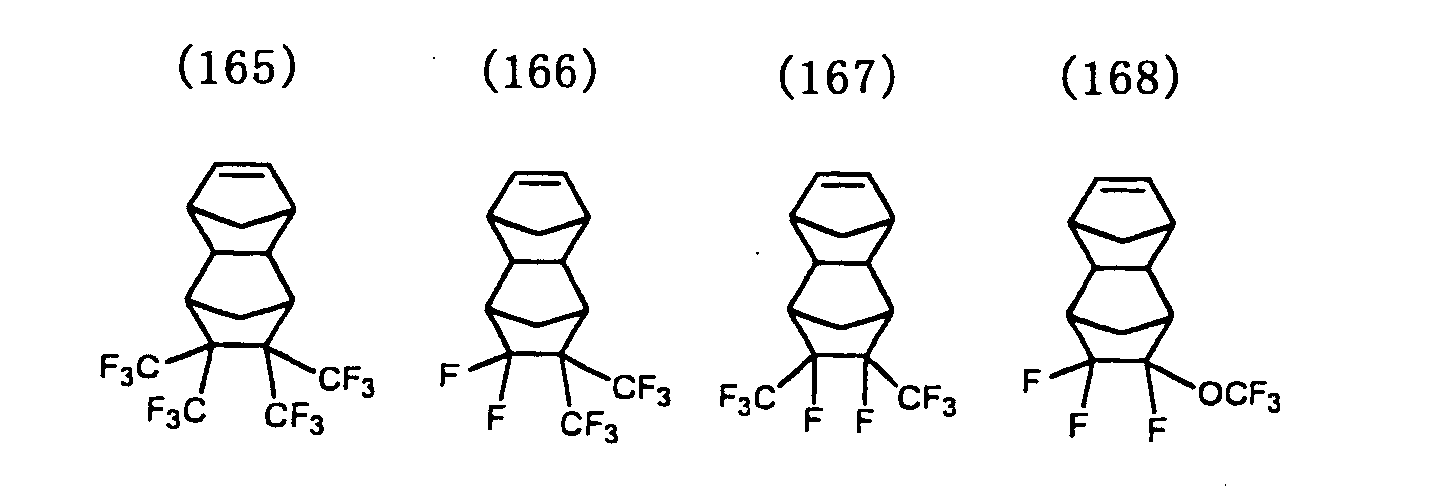
- Specific examples of such Specific Monomer (II) include
- 8-methyl-8-methoxycarbonyltetracyclo-[4.4.0.1 2,5 .1 7,10 ] dodec-3-ene is particularly preferred in that its preparation process is easy.
- the proportion of the structural unit (II) is preferably at most 98 mol% based on the whole structural unit.
- a ratio of the structural unit (I) to the structural unit (II) is generally 100:0 to 2:98, preferably 100:0 to 5:95, more preferably 100:0 to 10:90 in terms of a molar ratio.
- the total proportion of the structural unit (I) that X 1 in the general formula (I) is an ethylene group and the structural unit (II) that X 2 in the general formula (II) is an ethylene group is preferably at least 90 mol%, more preferably at least 95 mol%, still more preferably at least 98 mol% of the structural unit (I) and the structural unit (II). If this proportion is too low, the heat resistance of the resulting ring-opened polynorbornene may become low in some cases.
- the ring-opened polynorbornenes according to the present invention may have any other structural unit (hereinafter referred to as "further structural unit") than the structural unit (I) and the structural unit (II).
- cycloolefins such as cyclobutane, cyclopentene, cyclooctene and cyclododecene, and non-conjugated cyclic polyenes such as 1,4-cyclooctadiene, dicyclopentadiene and cyclododecatriene.
- ring-opening polymerization of Specific Monomer (I), Specific Monomer (II) and the other monomer(s) may be conducted in the presence of polybutadiene, polyisoprene, a styrene-butadiene polymer, an ethylene-non-conjugated diene polymer, an unhydrogenated product of a ring-opened (co)polymer of a norbornene monomer, or the like.
- the proportion of the structural unit (I) is preferably at least 2 mol%, more preferably at least 5 mol%, still more preferably at least 10 mol% based on the whole structural unit.
- the ring-opened polynorbornene according to the present invention has a logarithmic viscosity ( ⁇ inh) of generally 0.2 to 5.0, preferably 0.3 to 4.0, more preferably 0.35 to 2.0 as measured by a Ubbelohde viscometer.
- Mn number average molecular weight in terms of polystyrene as measured by gel permeation chromatography (GPC; tetrahydrofuran solvent) is generally 1,000 to 500,000, preferably 2,000 to 300,000, more preferably 5,000 to 300,000, and its weight average molecular weight (Mw) as measured in the same manner as described above is generally 5,000 to 2,000,000, preferably 10,000 to 1,000,000, more preferably 15,000 to 500,000.
- the logarithmic viscosity ( ⁇ inh) is lower than 0.2, the number average molecular weight (Mn) is lower than 1,000, or the weight average molecular weight (Mw) is lower than 5,000, the strength of such a ring-opened polynorbornene may become markedly low in some cases.
- the logarithmic viscosity ( ⁇ inh) exceeds 5.0, the number average molecular weight (Mn) exceeds 500,000, or the weight average molecular weight (Mw) exceeds 2,000,000, the melt viscosity or solution viscosity of such a ring-opened polynorbornene may become too high in some cases, resulting in difficulty in providing a desired molded or formed product.
- a phenolic or hydroquinone antioxidant such as triethylene glycol-bis[3-(3-t-butyl-5-methyl-4-hydroxyphenyl) propionate], 1,6-hexanediol-bis[3-(3,5-di-t-butyl-4-hydroxyphenyl) propionate], 2,4-bis(n-octylthio)-6-(4-hydroxy-3,5-di-t-butylanilino)-1,3,5-triazine, pentaerythrityl-tetrakis[3-(3,5-di-t-butyl-4-hydroxyphenyl) propionate], 2,2-thio-diethylenebis[3-(3,5-di-t-butyl-4-hydroxyphenyl) propionate], octadecyl-3-(3,5-di-t-butyl-4-hydroxyphenyl) propionate, N,N'-hexamethylenebis(3,5
- An ultraviolet absorbent such as 2,4-dihydroxybenzophenone, 2-hydroxy-4-methoxybenzophenone or 2,2-methylenebis[4-(1,1,3,3-tetramethylbutyl)-6-[(2H-benzotriazol-2-yl)phenol]], or of the hindered amine type or benzoate type may also be used.
- the light resistance of the resulting ring-opened polynorbornene can be improved by adding one or more of these ultraviolet absorbents.
- Additives such as a lubricant may also be added for the purpose of improving processability.
- the ring-opened polynorbornene according to the present invention can be prepared by subjecting Specific Monomer (I) to ring-opening polymerization or subjecting Specific Monomer (I) to ring-opening copolymerization with Specific Monomer (II) and the other monomer(s) used as needed, or subjecting these monomers to ring-opening (co)polymerization and then further hydrogenating the resultant (co)polymer.
- ring-opening polymerization catalysts used in the present invention are used catalysts described in Olefin Metathesis and Metathesis Polymerization (K. J. IVIN, J. C. MOL, Academic Press, 1997), for example, the following metathesis polymerization catalysts. More specifically, those are catalysts composed of a combination of (a) at least one selected from compounds of W, Mo, Re, V and Ti and (b) at least one selected from compounds of Li, Na, K, Mg, Ca, Zn, Cd, Hg, B, Al, Si, Sn, Pb and the like, which have at least one element-carbon bond, or at least one element-hydrogen bond.
- an additive (c), which will be described subsequently, may also be added.
- examples of other catalysts include (d) metathesis catalysts composed of a carbene complex of a metal of Group 4 to Group 8 of the periodic table or metallacyclo butene complex using no promoter.
- the compounds used as the component (b) may be mentioned the compounds described in Japanese Patent Application Laid-Open No. 240517/1989, such as n-C 4 H 9 Li, (C 2 H 5 ) 3 Al, (C 2 H 5 ) 2 AlCl, (C 2 H 5 ) 1.5 AlCl 1.5 , (C 2 H 5 )AlCl 2 , methyl alumoxane and LiH.
- the additive which is the component (c)
- the additive may be suitably used alcohols, aldehydes, ketones and amines. Further, the compounds described in Japanese Patent Application Laid-Open No. 240517/1989 may also be used.
- the amount of the metathesis catalyst used is within a range that a proportion of the component (a) to the total of Specific Monomer (I) and Specific Monomer (II) amounts to 1:500 to 1:500,000 in terms of a molar ratio, preferably 1:1,000 to 1:100,000.
- a proportion of the component (a) to the component (b) is within a range of 1:1 to 1:100 in terms of a metal atom ratio of "the component (a) to the component (b)", preferably 1:2 to 1:50.
- a proportion of the component (a) to the component (c) is within a range of 0.005:1 to 15:1 in terms of a molar ratio of "the component (c) to the component (a)", preferably 0.05:1 to 10:1.
- the amount of the catalyst (d) used is within a range that a proportion of the component (d) to the total of Specific Monomer (I) and Specific Monomer (II) amounts to 1:30 to 1:100,000 in terms of a molar ratio, preferably 1:50 to 1:50,000.
- the molecular weight of the ring-opened polymer may also be controlled by a polymerization temperature, the kind of a catalyst used and the kind of a solvent used. In the present invention, however, the molecular weight is preferably controlled by causing a molecular weight modifier to coexist in the reaction system.
- molecular weight modifiers suitable for use herein may be mentioned ⁇ -olefins such as ethylene, propene, 1-butene, 1-pentene, 1-hexene, 1-heptene, 1-octene, 1-nonene and 1-decene, and styrene. Among these, 1-butene and 1-hexene are particularly preferred. These molecular weight modifiers may be used either singly or in any combination thereof.
- the amount of the molecular weight modifier used is 0.005 to 1.0 mol, preferably 0.02 to 0.5 mol per mol in total of Specific Monomer (I) and Specific Monomer (II) used in the ring-opening (co)polymerization reaction.
- alkanes such as pentane, hexane, heptane, octane, nonane and decane
- cycloalkanes such as cyclohexane, cyclopentane, cyclooctane, decalin and norbornane
- aromatic hydrocarbons such as benzene, toluene, xylene, ethylbenzene and cumene
- halogenated alkanes such as chlorobutane, bromohexane, methylene chloride, dichloroethane, hexamethylene dibromdie, chlorobenzene, chloroform and tetrachloroethylene
- aryl compounds saturated carboxylic acid esters such as ethyl acetate, n-butyl
- the amount of the solvent used is such that a weight ratio of "solvent to monomer(s)" amounts to 1:1 to 30:1, preferably 1:1 to 20:1.
- the ring-opened polynorbornene obtained by the above-described ring-opening polymerization has the structural unit (I) and structural unit (II), in which both X 1 in the general formula (I) and X 2 in the general formula (II) are vinylene groups.
- a polynorbornene may be used in various application fields as it is.
- a part or the whole of the vinylene groups in the ring-opened polymer are preferably hydrogenated into ethylene groups to provide a hydrogenated product.
- the aromatic rings located at side chains based on Specific Monomers (I) and (II) are preferably substantially not hydrogenated.
- the hydrogenation rate of the vinylene groups is preferably at least 90%, more preferably at least 95%, still more preferably at least 98%. Coloration or deterioration by heat is more inhibited as the hydrogenation rate is higher. It is hence preferable that the hydrogenation rate be higher.
- the hydrogenation reaction is conducted by adding a hydrogenation catalyst to a solution of the ring-opened polymer and causing hydrogen gas of normal pressure to 300 atm, preferably 3 to 200 atm to act on the solution at 0 to 200°C, preferably 20 to 180°C.
- the hydrogenation catalyst may be used that used in an ordinary hydrogenation reaction of an olefinic compound.
- a hydrogenation catalyst may be used either a heterogeneous catalyst or a homogenous catalyst.
- the heterogeneous catalyst may be mentioned solid catalysts with a noble metal catalytic substance such as palladium, platinum, nickel, rhodium or ruthenium carried on a carrier such as carbon, silica, alumina or titania.
- the homogenous catalyst may be mentioned nickel naphthenate/triethylaluminum, nickel acetylacetonate/triethylaluminum, cobalt octanoate/n-butyllithium, titanocene dichloride/diethylaluminum monochloride, rhodium acetate, chlorotris(triphenylphosphine)rhodium, dichlorotris-(triphenylphosphine)ruthenium, chlorohydrocarbonyltris-(triphenylphosphine)ruthenium and dichlorocarbonyltris-(triphenylphosphine)ruthenium.
- the form of the catalyst may be either powder or particles.
- the catalyst is generally used in a proportion that a weight ratio of "the ring-opened polymer to "the hydrogenation catalyst” amounts to 1:(1 x 10 -6 ) to 1:2.
- the ring-opened polynorbornenes according to the present invention exhibit specific wavelength dependency about birefringence and have low birefringence and high heat resistance and transparency, they are useful in fields of optical parts, electric and electronic materials, etc. Specifically, they are useful as disks, magneto-optical, optical lenses (F ⁇ lenses, pickup lenses, lenses for laser printers, lenses for cameras, etc.), spectacle lenses, optical films (films for display, phase difference films, polarizing films, transparent conductive films, wave plates, optical pickup films, etc.), liquid crystal orientation films, optical sheets, optical fibers, light guide plates, light-diffusing plates, optical cards, optical mirrors, and sealing materials for semiconductors such as IC, LSI and LED.
- optical lenses F ⁇ lenses, pickup lenses, lenses for laser printers, lenses for cameras, etc.
- spectacle lenses optical films (films for display, phase difference films, polarizing films, transparent conductive films, wave plates, optical pickup films, etc.), liquid crystal orientation films, optical sheets, optical fibers, light guide plates, light-
- glass transition temperature (Tg), number average molecular weight (Mn), weight average molecular weight (Mw) and molecular weight distribution (Mw/Mn) were measured or determined in accordance with the following respective methods.
- the glass transition temperature of a sample was measured at a heating rate of 20°C/min under a nitrogen atmosphere by means of a differential scanning calorimeter manufactured by Seiko Instruments Inc.
- the number average molecular weight, weight average molecular weight and molecular weight distribution in terms of polystyrene of a sample were measured by "HLC-8020 Gel Permeation Chromatograph” manufactured by TOSOH CORP. using tetrahydrofuran as a solvent.
- a 1-L three neck flask equipped with a reflux condenser was charged with 30 g (0.1303 mol) of 6-oxa-pentacyclo-[9.2.1.1 3,9 .0 2,10 .0 4,8 ]pentadec-12-ene-5,7-dione represented by the following structural formula (B) and 19.96 g (0.1303 mol) of 2, 4-dimethoxyaniline, and 300 mL of acetic acid was further added as a solvent.
- this reaction system was heated, the reaction system became a homogeneous state. In this state, the reaction system was refluxed for 3 hours.
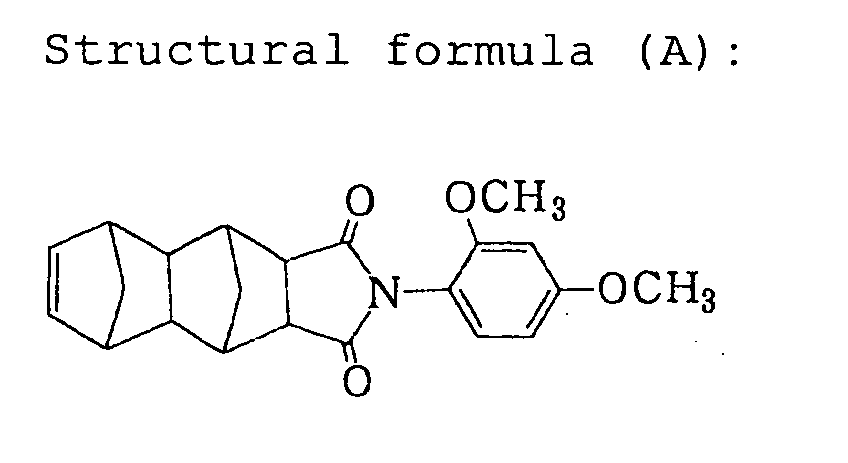
- a reaction vessel purged with nitrogen was charged with 7.90 g (21.6 mmol), of 6-(2,4-dimethoxyphenyl)-6-aza-pentacyclo [9.2.1.1 3,9 .0 2,10 .0 4,8 ] pentadec-12-ene-5,7-dione represented by the above structural formula (A) as Specific Monomer (I), 5.01 g (21.6 mmol) of 8-methyl-8-methoxycarbonyltetracyclo [4.4.0.1 2,5 .1 7,10 ]dodec-3-ene represented by the following structural formula (C) as Specific Monomer (II), 0.27 g of 1-hexene as a molecular weight modifier and 51.5 g of toluene as a solvent, and the contents were heated to 80°C.
- the ring-opened polynorbornene thus obtained had a weight average molecular weight (Mw) of 14.2 x 10 4 , a number average molecular weight (Mn) of 3.38 x 10 4 and a molecular weight distribution (Mw/Mn) of 4.20.
- Mw weight average molecular weight
- Mn number average molecular weight
- Mw/Mn molecular weight distribution
- the resultant polymer solution was placed in an autoclave, and 300 g of toluene was further added.
- RuHCl (CO) [P(C 6 H 5 ) 3 ] 3 was then added in an amount of 2500 ppm to the charged amount of the monomers in the reaction system to conduct a hydrogenation reaction under conditions that a hydrogen gas pressure was 9 to 10 MPa, a reaction temperature was 160 to 165°C , and the reaction conditions were 4 hours.
- the resultant reaction solution was poured into a great amount of methanol to precipitate a product, thereby obtaining a hydrogenated ring-opened polynorbornene.
- This ring-opened polynorbornene is referred to as "Polymer (P1)".
- Polymer (P1) had a weight average molecular weight (Mw) of 14.9 x 10 4 , a number average molecular weight (Mn) of 3.59 x 10 4 , a molecular weight distribution (Mw/Mn) of 4.15, an intrinsic viscosity ( ⁇ inh) of 0.74 and a glass transition temperature (Tg) of 221.4°C.
- a proportion of the structural unit (I) derived from 6-(2,4-dimethoxyphenyl)-6-aza-pentacyclo[9.2.1.1 3,9 .0 2,10 . 0 4,8 ]pentadec-12-ene-5,7-dione in Polymer (P1) was 44 mol%
- a proportion of the structural unit (II) derived from 8-methyl-8-methoxycarbonyltetracyclo[4.4.0.1 2,5 .1 7,10 ]-dodec-3-ene was 56 mol%.
- the ring-opened polynorbornene thus obtained had a weight average molecular weight (Mw) of 10.7 x 10 4 , a number average molecular weight (Mn) of 3.49 x 10 4 and a molecular weight distribution (Mw/Mn) of 3.07.
- Mw weight average molecular weight
- Mn number average molecular weight
- Mw/Mn molecular weight distribution
- Polymer (P2) had a weight average molecular weight (Mw) of 10.3 x 10 4 , a number average molecular weight (Mn) of 3.50 x 10 4 , a molecular weight distribution (Mw/Mn) of 2.94, an intrinsic viscosity ( ⁇ inh) of 0.58 and a glass transition temperature (Tg) of 215.0°C.
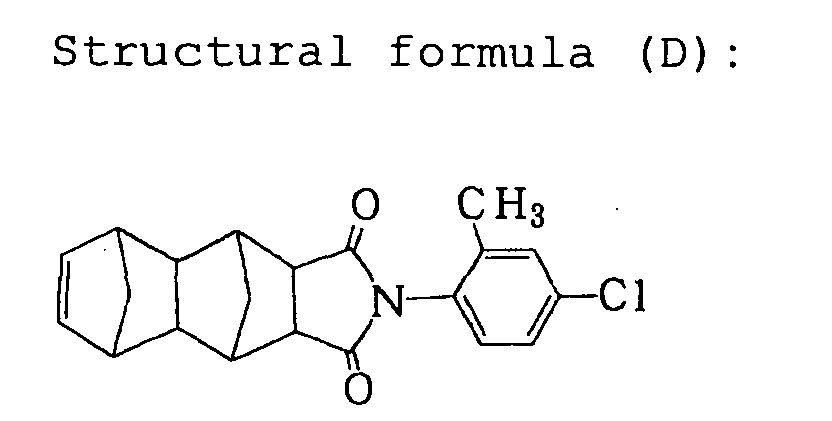
- a proportion of the structural unit (I) derived from 6-(4-chloro-2-methylphenyl)-6-aza-pentacyclo[9.2.1.1 3,9 . 0 2,10 .0 4,8 ]pentadec-12-ene-5,7-dione in Polymer (P2) was 37.2 mol%
- a proportion of the structural unit (II) derived from 8-methyl-8-methoxy-carbonyltetracyclo[4.4.0.1 2,5 .1 7,10 ]-dodec-3-ene was 62.8 mol%.
- the ring-opened polynorbornene thus obtained had a weight average molecular weight (Mw) of 26.3 x 10 4 , a number average molecular weight (Mn) of 3.35 x 10 4 and a molecular weight distribution (Mw/Mn) of 7.86.
- Mw weight average molecular weight
- Mn number average molecular weight
- Mw/Mn molecular weight distribution
- the resultant ring-opened polynorbornene was subjected to a hydrogenation reaction in the same manner as in Example 1, thereby obtaining a hydrogenated ring-opened polynorbornene.
- This ring-opened polynorbornene is referred to as "Polymer (P3)".
- Polymer (P3) had a weight average molecular weight (Mw) of 26.0 x 10 4 , a number average molecular weight (Mn) of 4.50 x 10 4 , a molecular weight distribution (Mw/Mn) of 5.78, an intrinsic viscosity ( ⁇ inh) of 1.12 and a glass transition temperature (Tg) of 205.1°C.
- the ring-opened polynorbornene thus obtained had a weight average molecular weight (Mw) of 11.2 x 10 4 , a number average molecular weight (Mn) of 5.77 x 10 4 and a molecular weight distribution (Mw/Mn) of 1.94.
- Mw weight average molecular weight
- Mn number average molecular weight
- Mw/Mn molecular weight distribution
- Polymer (P4) had a weight average molecular weight (Mw) of 10.1 x 10 4 , a number average molecular weight (Mn) of 4.41 x 10 4 , a molecular weight distribution (Mw/Mn) of 2.29, an intrinsic viscosity ( ⁇ inh) of 0.56 and a glass transition temperature (Tg) of 225.3°C.
- a proportion of the structural unit (I) derived from 6-(4-bromo-2,6-dimethylphenyl)-6-aza-pentacyclo[9.2.1.1 3,9 . 0 2,10 .0 4,8 ]pentadec-12-ene-5,7-dione in Polymer (P4) was 36.6 mol%
- a proportion of the structural unit (II) derived from 8-methyl-8-methoxy-carbonyltetracyclo[4.4.0.1 2,5 .1 7,10 ]-dodec-3-ene was 63.4 mol%.
- the ring-opened polynorbornene thus obtained had a weight average molecular weight (Mw) of 15.8 x 10 4 , a number average molecular weight (Mn) of 3.35 x 10 4 and a molecular weight distribution (Mw/Mn) of 4.73.
- Mw weight average molecular weight
- Mn number average molecular weight
- Mw/Mn molecular weight distribution
- the resultant ring-opened polynorbornene was subjected to a hydrogenation reaction in the same manner as in Example 1, thereby obtaining a hydrogenated ring-opened polynorbornene.
- This ring-opened polynorbornene is referred to as "Polymer (P5)”.
- Polymer (P5) had a weight average molecular weight (Mw) of 11.8 x 10 4 , a number average molecular weight (Mn) of 3.69 x 10 4 , a molecular weight distribution (Mw/Mn) of 3.18, an intrinsic viscosity ( ⁇ inh) of 0.50 and a glass transition temperature (Tg) of 215.0°C.
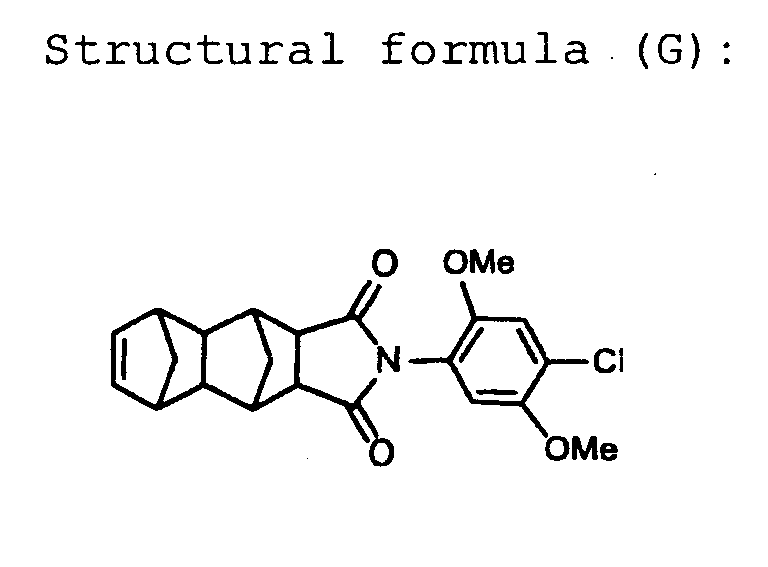
- a proportion of the structural unit (I) derived from 6-(4-chloro-2,5-dimethoxyphenyl)-6-aza-pentacyclo[9.2.1. 1 3,9 .0 2,10 .0 4,8 ]pentadec-12-ene-5,7-dione in Polymer (P5) was 41.6 mol%
- a proportion of the structural unit (II) derived from 8-methyl-8-methoxycarbonyltetracyclo-[4.4.0.1 2,5 .1 7,10 ]dodec-3-ene was 58.4 mol%.
- the ring-opened polynorbornene thus obtained had a weight average molecular weight (Mw) of 20.0 x 10 4 , a number average molecular weight (Mn) of 2.31 x 10 4 and a molecular weight distribution (Mw/Mn) of 8.66.
- Mw weight average molecular weight
- Mn number average molecular weight
- Mw/Mn molecular weight distribution
- Polymer (P6) had a weight average molecular weight (Mw) of 26.5 x 10 4 , a number average molecular weight (Mn) of 4.21 x 10 4 , a molecular weight distribution (Mw/Mn) of 6.30, an intrinsic viscosity ( ⁇ inh) of 0.97 and a glass transition temperature (Tg) of 211.6°C.
- a proportion of the structural unit (I) derived from 6-(2-methyl-5-methoxycarbonylphenyl)-6-aza-pentacyclo-[9.2.1.1 3,9 .0 2,10 .0 4,8 ]pentadec-12-ene-5,7-dione in Polymer (P6) was 44.1 mol%, and a proportion of the structural unit (II) derived from 8-methyl-8-methoxycarbonyltetracyclo-[4.4.0.1 2,5 .1 7,10 ]dodec-3-ene was 55.9 mol%.
- a reaction vessel purged with nitrogen was charged with 50 g of 8-methyl-8-methoxycarbonyltetracyclo-[4.4.0.1 2,5 .1 7,10 ]dodec-3-ene represented by the above structural formula (C) as a monomer, 3.6 g of 1-hexene as a molecular weight modifier and 100 g of toluene as a solvent, and the contents were heated to 80°C.
- Polymer (P7) had a weight average molecular weight (Mw) of 5.6 x 10 4 , a number average molecular weight (Mn) of 1.75 x 10 4 , a molecular weight distribution (Mw/Mn) of 3.2 and a glass transition temperature (Tg) of 167°C.
- Polymer (P1) to Polymer (P7) obtained in Examples 1 to 6 and Comparative Example 1 were separately dissolved in toluene or methylene chloride, thereby preparing solutions for solvent casting. Each of these solutions was placed on a glass plate and subjected to a drying treatment, thereby producing a colorless and transparent film having a thickness of 200 ⁇ m and a residual solvent of 0.5 to 0.8%.
- the films thus obtained were respectively uniaxially stretched at their corresponding stretching ratios shown in the following Table 1, thereby producing stretched films.
- the stretching temperature was Tg + 10°C, in which Tg was a glass transition temperature of the polymer forming the film.
- Example 1 221.4 1.7 5.0 ⁇ 10 -4
- Example 2 215.0 1.7 12.0 ⁇ 10 -4
- Example 3 205.1 1.4 6.4 ⁇ 10 -4
- Example 4 225.3 2.0 - 0.3 ⁇ 10 -4
- Example 5 215.0 1.7 5.5 ⁇ 10 -4
- Example 6 211.6 1.7 9.3 ⁇ 10 -4 Comparative Example 1 167.0 1.7 31.4 ⁇ 10 -4
Landscapes
- Chemical & Material Sciences (AREA)
- Health & Medical Sciences (AREA)
- Chemical Kinetics & Catalysis (AREA)
- Medicinal Chemistry (AREA)
- Polymers & Plastics (AREA)
- Organic Chemistry (AREA)
- Polyoxymethylene Polymers And Polymers With Carbon-To-Carbon Bonds (AREA)
- Addition Polymer Or Copolymer, Post-Treatments, Or Chemical Modifications (AREA)
- Organic Low-Molecular-Weight Compounds And Preparation Thereof (AREA)
- Manufacture Of Macromolecular Shaped Articles (AREA)
Abstract
[Solving means] The polymer of the present invention has a structural unit (I) of the general formula (I):
[Chemical formula 1]

Description
[Chemical formula 1]
[Chemical formula 2]
[Chemical formula 3]

[Chemical formula 4]

[Chemical formula 5]

[Chemical formula 6]


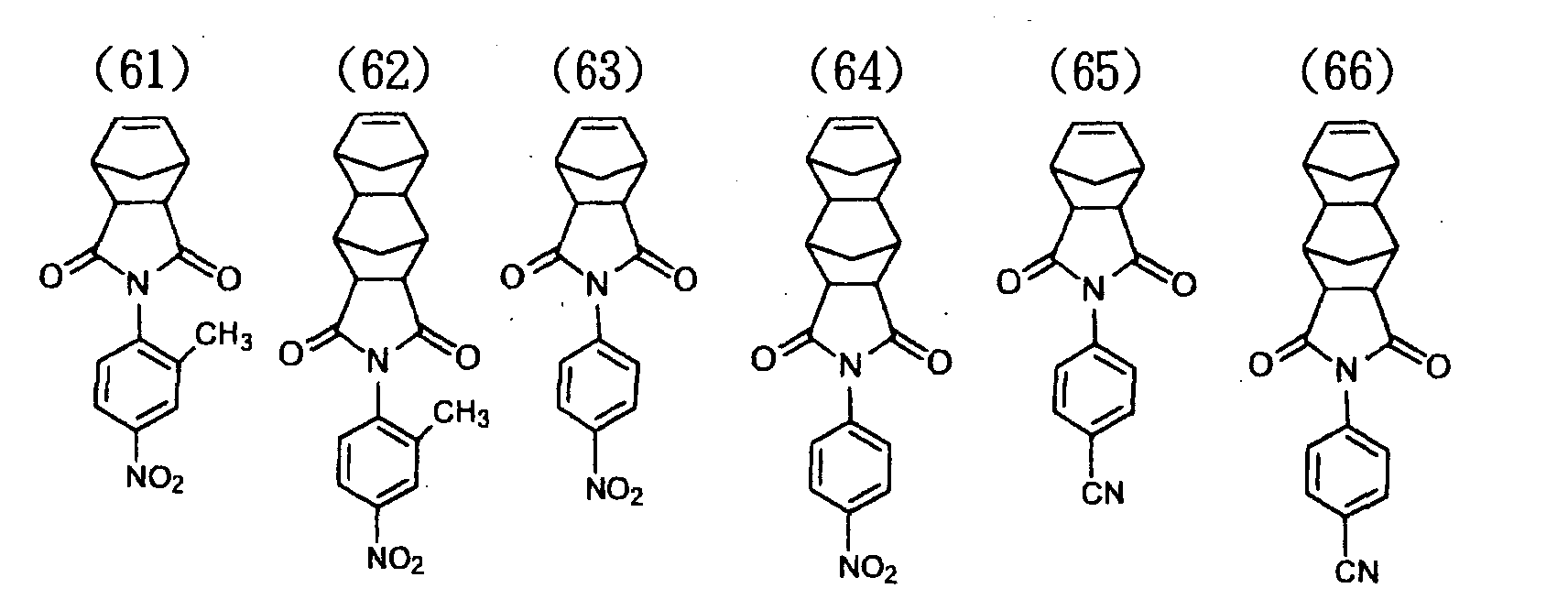

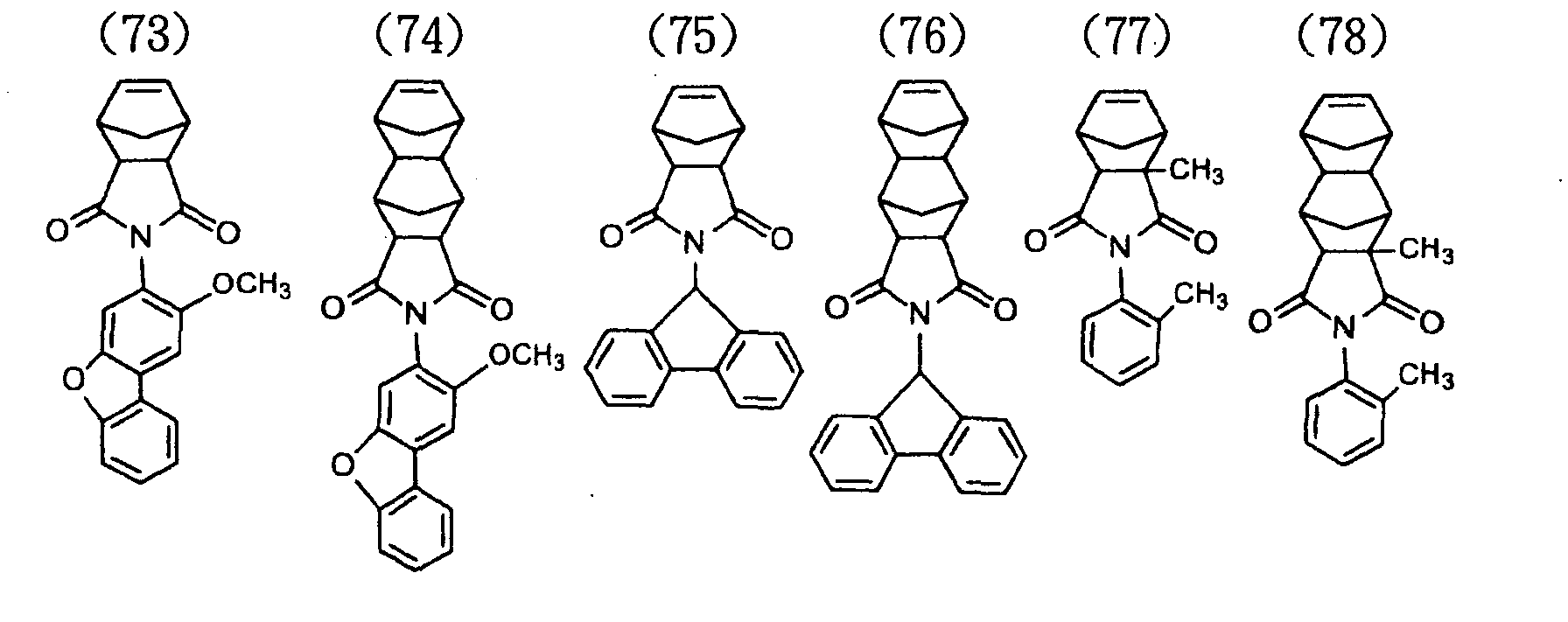
[Chemical formula 9]

[Chemical formula 10]


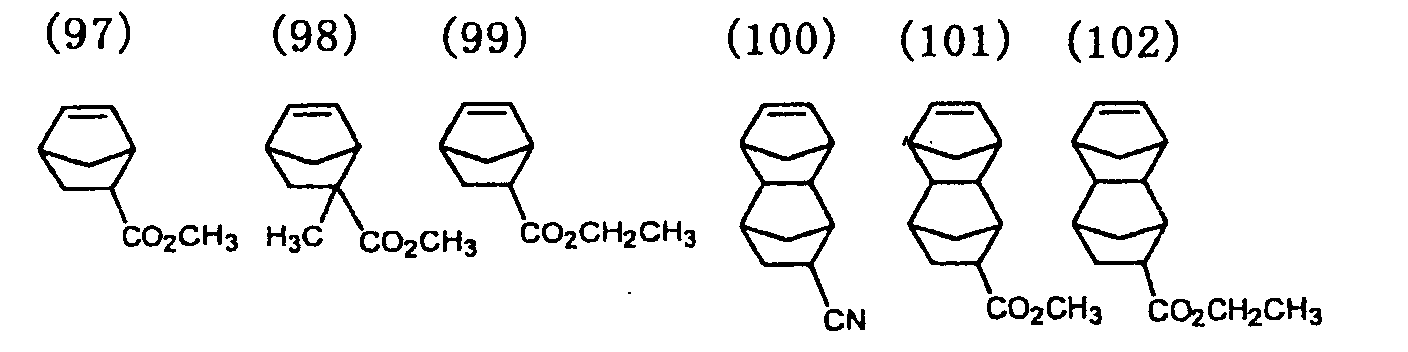


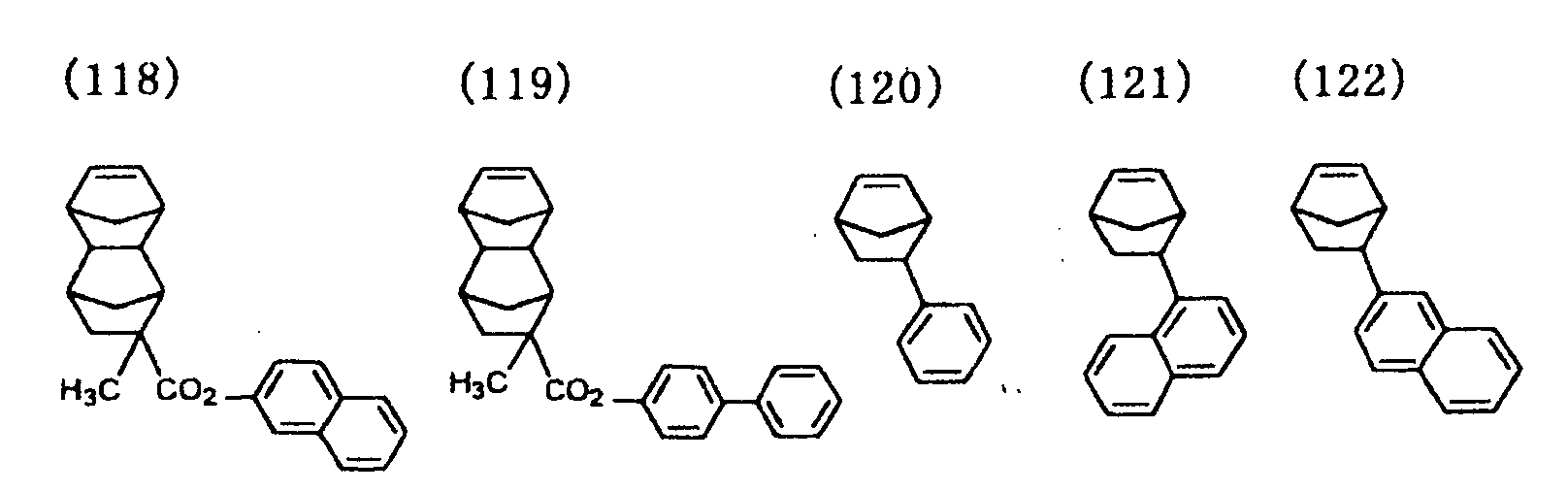



[Chemical formula 13]

[Chemical formula 15]

[Chemical formula 16]
[Chemical formula 17]

[Chemical formula 18]

[Chemical formula 19]
[Chemical formula 20]

| Glass transition temperature (°C) | Stretching ratio (times) | Birefringence Δ n (550nm) | |
| Example 1 | 221.4 | 1.7 | 5.0×10⁻⁴ |
| Example 2 | 215.0 | 1.7 | 12.0×10⁻⁴ |
| Example 3 | 205.1 | 1.4 | 6.4×10⁻⁴ |
| Example 4 | 225.3 | 2.0 | - 0.3×10⁻⁴ |
| Example 5 | 215.0 | 1.7 | 5.5×10⁻⁴ |
| Example 6 | 211.6 | 1.7 | 9.3×10⁻⁴ |
| Comparative Example 1 | 167.0 | 1.7 | 31.4×10⁻⁴ |
Claims (8)
- A ring-opened polynorbornene comprising a structural unit (I) represented by the following general formula (I):
[Chemical formula 1]wherein in the general formula (I), m and n are, independently of each other, an integer of 0 to 2, X1 means an ethylene or vinylene group, R1 and R2 denote, independently of each other, a hydrogen atom or a substituted or unsubstituted hydrocarbon group having 1 to 30 carbon atoms, and R3 represents a group represented by the following general formula (I-1) or a group represented by the following general formula (I-2):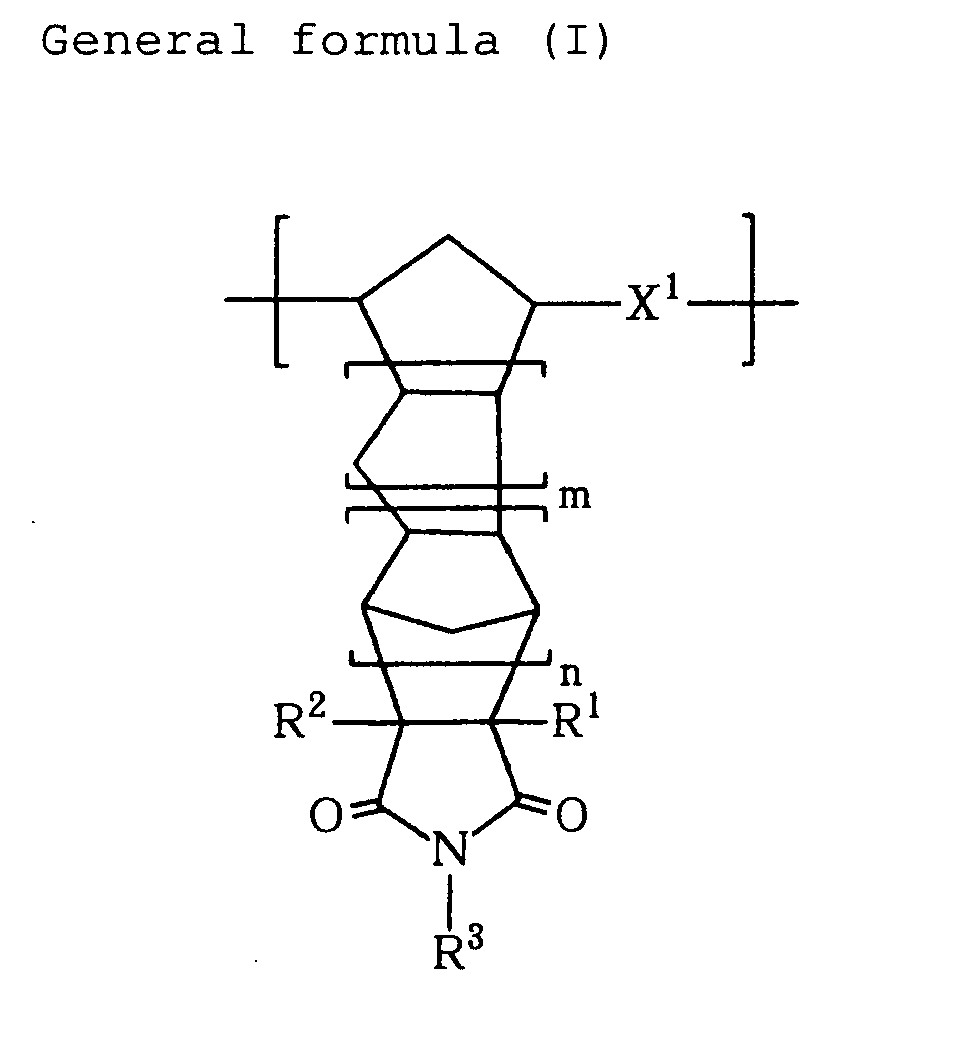
[Chemical formula 2]wherein in the general formulae (I-1) and (I-2), R11 to R27 denote, independently of one another, a hydrogen atom; a halogen atom; a substituted or unsubstituted hydrocarbon group having 1 to 30 carbon atoms, which may have a linkage containing or not containing oxygen, sulfur, nitrogen and/or silicon atom(s); or a polar group, p and q in the general formula (I-1) are individually 0 or a positive integer, with the proviso that when both p and q are 0, R12 and R15, or R19 and R15 may be bonded to each other to form a carbon ring or heterocyclic ring, and the carbon ring or heterocyclic ring may be either a monocyclic structure or a polycyclic structure, and s in the general formula (I-2) is 0 or an integer of 1 or greater.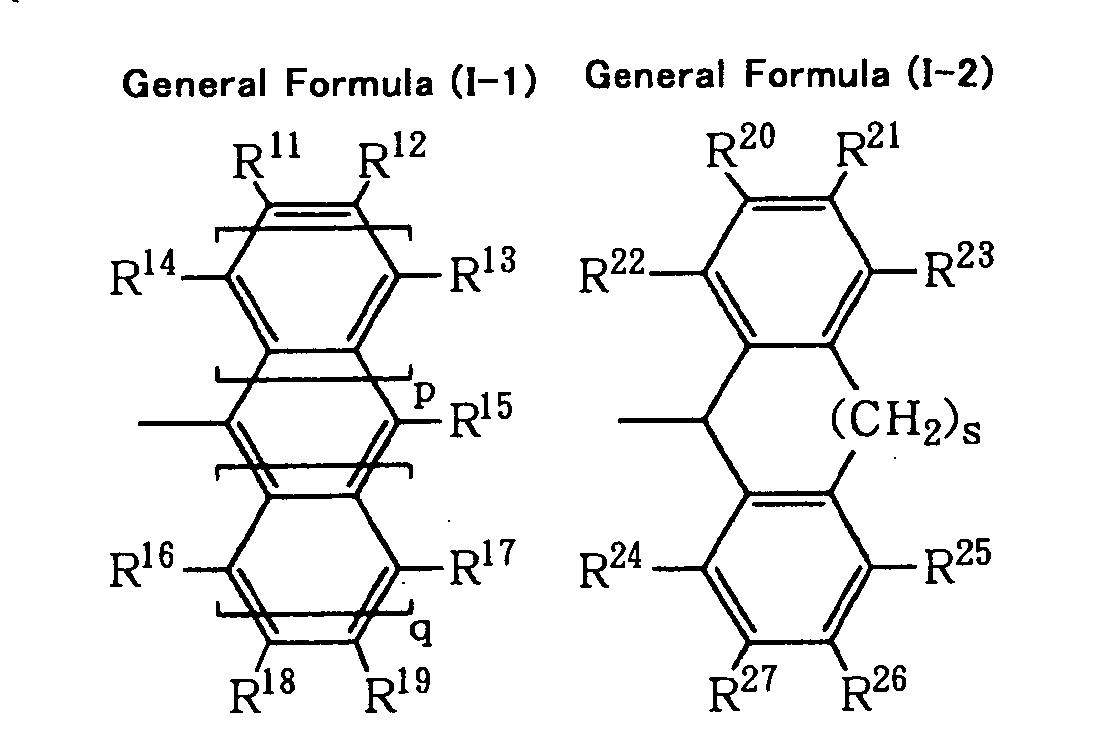
- The ring-opened polynorbornene according to claim 1, which comprises a structural unit (II) represented by the following general formula (II).
[Chemical formula 3]wherein in the general formula (II), t and u are, independently of each other, 0 or a positive integer, X2 means an ethylene or vinylene group, R4 to R7 denote, independently of one another, a hydrogen atom; a halogen atom; a substituted or unsubstituted hydrocarbon group having 1 to 30 carbon atoms, which may have a linkage containing or not containing oxygen, sulfur, nitrogen and/or silicon atom(s); or a polar group, with the proviso that R4 and R5, or R6 and R7 may be united with each other to form a divalent hydrocarbon group, R4 or R5, and R6 or R7 may be bonded to each other to form a carbon ring or heterocyclic ring, and the carbon ring or heterocyclic ring may be either a monocyclic structure or a polycyclic structure.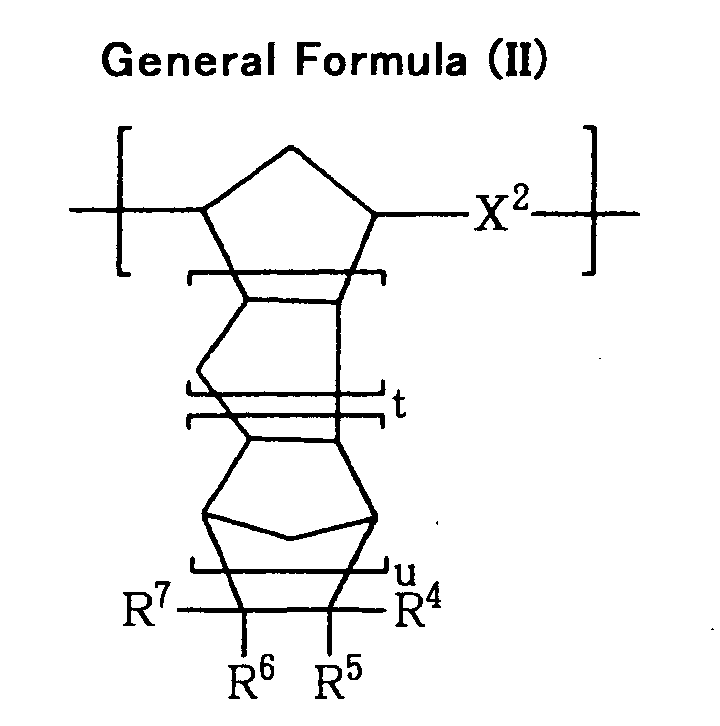
- The ring-opened polynorbornene according to claim 2, wherein the proportion of the structural unit (II) is at most 98 mol% based on the whole structural unit.
- The ring-opened polynorbornene according to any one of claims 1 to 3, wherein at least 90 mol% of X1 in the general formula (I) and X2 in the general formula (II) are ethylene groups.
- The ring-opened polynorbornene according to any one of claims 1 to 4, which has the structural unit (I), in which in the general formula (I), m is 0, and n is 1.
- The ring-opened polynorbornene according to any one of claims 1 to 5, which has the structural unit (I), in which in the general formula (I-1), p is 0, q is 0, and at least one of R11 and R18 is another substituent group than hydrogen.
- The ring-opened polynorbornene according to any one of claims 1 to 5, which has the structural unit (I), in which in the general formula (I-1), p is 0, q is 0, at least one of R11 and R18 has another substituent group than hydrogen, and at least one of R12, R15 and R19 is another substituent group than hydrogen.
- The ring-opened polynorbornene according to any one of claims 1 to 5, which has the structural unit (I), in which in the general formula (I-1), p is 0, q is 0, and both R11 and R18 are other substituent groups than hydrogen.
Applications Claiming Priority (3)
| Application Number | Priority Date | Filing Date | Title |
|---|---|---|---|
| JP2002331040 | 2002-11-14 | ||
| JP2002331040 | 2002-11-14 | ||
| PCT/JP2003/014375 WO2004044029A1 (en) | 2002-11-14 | 2003-11-12 | Ring-opened polynorbornenes |
Publications (2)
| Publication Number | Publication Date |
|---|---|
| EP1561766A1 true EP1561766A1 (en) | 2005-08-10 |
| EP1561766A4 EP1561766A4 (en) | 2006-06-21 |
Family
ID=32310612
Family Applications (1)
| Application Number | Title | Priority Date | Filing Date |
|---|---|---|---|
| EP03772707A Withdrawn EP1561766A4 (en) | 2002-11-14 | 2003-11-12 | Ring-opened polynorbornenes |
Country Status (7)
| Country | Link |
|---|---|
| US (2) | US7157523B2 (en) |
| EP (1) | EP1561766A4 (en) |
| KR (1) | KR100969433B1 (en) |
| CN (1) | CN1298762C (en) |
| AU (1) | AU2003280745A1 (en) |
| TW (1) | TW200420599A (en) |
| WO (1) | WO2004044029A1 (en) |
Cited By (1)
| Publication number | Priority date | Publication date | Assignee | Title |
|---|---|---|---|---|
| EP2060937A4 (en) * | 2006-08-25 | 2011-08-31 | Nippon Oil Corp | DELAY FILM AND LIQUID CRYSTAL DISPLAY DEVICE USING THE SAME |
Families Citing this family (6)
| Publication number | Priority date | Publication date | Assignee | Title |
|---|---|---|---|---|
| JP4843943B2 (en) * | 2004-10-01 | 2011-12-21 | Jsr株式会社 | Thermoplastic resin composition, optical film and retardation film |
| WO2007010830A1 (en) * | 2005-07-22 | 2007-01-25 | Jsr Corporation | Cyclic olefin ring-opening copolymer, use thereof, and process for production of retarder comprising the copolymer |
| RU2383556C2 (en) * | 2007-07-16 | 2010-03-10 | ГОУ ВПО Иркутский государственный университет | Method of producing norbornene addition polymers |
| JP6241399B2 (en) * | 2014-09-12 | 2017-12-06 | Jsr株式会社 | Block copolymer, method for producing the same, and film |
| KR101746789B1 (en) * | 2014-12-18 | 2017-06-13 | 주식회사 엘지화학 | Vertical alignment layer comprising a cyclic olefin copolymer |
| CN108752568A (en) * | 2018-04-26 | 2018-11-06 | 东南大学 | Polynorbornene and its derivative film and hydrogenated products film and preparation method and application |
Family Cites Families (34)
| Publication number | Priority date | Publication date | Assignee | Title |
|---|---|---|---|---|
| JPS5818369B2 (en) * | 1973-09-05 | 1983-04-12 | ジェイエスアール株式会社 | Norbornenecarbosanamide Oyobi / Matahai Middle Ino (Kiyo) |
| JPS5075300A (en) * | 1973-11-05 | 1975-06-20 | ||
| JPS50138050A (en) * | 1974-04-23 | 1975-11-04 | ||
| JPS52126500A (en) * | 1976-04-16 | 1977-10-24 | Japan Synthetic Rubber Co Ltd | Recovery of ring opening polymers |
| DE2731263A1 (en) * | 1976-07-13 | 1978-01-26 | Japan Synthetic Rubber Co Ltd | PROCESS FOR THE PRODUCTION OF A POLYMER OR MIXED POLYMER FROM A NORBORN DERIVATIVE AND A CATALYST FOR IT |
| US4614778A (en) * | 1984-02-03 | 1986-09-30 | Hirokazu Kajiura | Random copolymer |
| JPS61115912A (en) | 1984-11-12 | 1986-06-03 | Mitsui Petrochem Ind Ltd | Novel random multicomponent copolymer |
| JPS6177673A (en) | 1984-09-20 | 1986-04-21 | 三井東圧化学株式会社 | Method of drying monolithic refractories |
| JPS61120816A (en) | 1984-11-19 | 1986-06-07 | Mitsui Petrochem Ind Ltd | Novel polymer |
| JPH0717740B2 (en) * | 1986-10-01 | 1995-03-01 | 帝人株式会社 | Method for producing crosslinked polymer molding |
| KR920002679B1 (en) * | 1987-06-26 | 1992-03-31 | 몬산토 캄파니 | Norbornene dicarboximide polymer |
| JPH0826124B2 (en) | 1987-11-17 | 1996-03-13 | 日本合成ゴム株式会社 | Optical materials |
| EP0317262B1 (en) * | 1987-11-17 | 1996-01-31 | Japan Synthetic Rubber Co., Ltd. | Transparent resin material |
| JPH01132625A (en) | 1987-11-17 | 1989-05-25 | Japan Synthetic Rubber Co Ltd | Optical material |
| JPS63218726A (en) | 1987-12-24 | 1988-09-12 | Nippon Zeon Co Ltd | Production method of hydrogenated polymer |
| JP2825157B2 (en) | 1988-03-22 | 1998-11-18 | ジェイエスアール株式会社 | Method for producing polymer |
| JPH0816129B2 (en) * | 1988-11-14 | 1996-02-21 | 日本ゼオン株式会社 | Method for producing norbornene ring-opening polymer |
| US5115037A (en) * | 1990-12-19 | 1992-05-19 | Monsanto Company | Hydrogenated cyclic alkyl polymers |
| US5200470A (en) * | 1990-12-19 | 1993-04-06 | Monsanto Company | Norbornene dicarboxy phenylimide polymers |
| JPH04245202A (en) | 1991-01-30 | 1992-09-01 | Toyo Chem Co Ltd | Phase difference plate |
| JPH0561026A (en) | 1991-06-17 | 1993-03-12 | Nippon Zeon Co Ltd | Liquid crystal substrate and liquid crystal display using the same |
| JP3273046B2 (en) * | 1991-06-25 | 2002-04-08 | 日本ゼオン株式会社 | Phase plate |
| JP3297450B2 (en) | 1991-07-22 | 2002-07-02 | 日本ゼオン株式会社 | Polarizing film for liquid crystal display |
| JPH0564865A (en) | 1991-09-10 | 1993-03-19 | Toray Ind Inc | Amorphous polyolefin laminated sheet for retarder and retarder |
| JP3132122B2 (en) | 1992-02-05 | 2001-02-05 | 日本ゼオン株式会社 | Composite sheet |
| JPH0777608A (en) | 1993-09-07 | 1995-03-20 | Nippon Synthetic Chem Ind Co Ltd:The | Polarizer |
| CA2199567C (en) * | 1996-03-20 | 2003-01-14 | Volker Rheinberger | Functionalized and polymerizable polymer |
| CN1223615C (en) * | 1998-02-23 | 2005-10-19 | 住友电木株式会社 | Polycyclic resist composition with increased etch resistance |
| JP4103260B2 (en) * | 1999-07-27 | 2008-06-18 | Jsr株式会社 | Production method of transparent resin sheet |
| JP3899511B2 (en) * | 2001-04-27 | 2007-03-28 | Jsr株式会社 | Thermoplastic norbornene resin-based optical film |
| JP4238501B2 (en) * | 2001-04-27 | 2009-03-18 | Jsr株式会社 | Thermoplastic norbornene resin-based optical film |
| JP2003043252A (en) * | 2001-07-31 | 2003-02-13 | Sekisui Chem Co Ltd | Polarizer protective film |
| US6846890B2 (en) * | 2001-10-10 | 2005-01-25 | Jsr Corporation | Norbornene derivative and norbornene polymer obtained therefrom through ring opening polymerization |
| JP4178810B2 (en) * | 2001-12-25 | 2008-11-12 | Jsr株式会社 | Thermoplastic norbornene resin-based optical film |
-
2003
- 2003-11-12 CN CNB2003801063351A patent/CN1298762C/en not_active Expired - Lifetime
- 2003-11-12 AU AU2003280745A patent/AU2003280745A1/en not_active Abandoned
- 2003-11-12 KR KR1020057008586A patent/KR100969433B1/en not_active Expired - Fee Related
- 2003-11-12 TW TW092131690A patent/TW200420599A/en not_active IP Right Cessation
- 2003-11-12 WO PCT/JP2003/014375 patent/WO2004044029A1/en not_active Ceased
- 2003-11-12 US US10/534,003 patent/US7157523B2/en not_active Expired - Lifetime
- 2003-11-12 EP EP03772707A patent/EP1561766A4/en not_active Withdrawn
-
2006
- 2006-02-27 US US11/362,086 patent/US7230058B2/en not_active Expired - Lifetime
Cited By (1)
| Publication number | Priority date | Publication date | Assignee | Title |
|---|---|---|---|---|
| EP2060937A4 (en) * | 2006-08-25 | 2011-08-31 | Nippon Oil Corp | DELAY FILM AND LIQUID CRYSTAL DISPLAY DEVICE USING THE SAME |
Also Published As
| Publication number | Publication date |
|---|---|
| US20060041092A1 (en) | 2006-02-23 |
| US7157523B2 (en) | 2007-01-02 |
| TW200420599A (en) | 2004-10-16 |
| KR100969433B1 (en) | 2010-07-14 |
| WO2004044029A1 (en) | 2004-05-27 |
| US7230058B2 (en) | 2007-06-12 |
| CN1726244A (en) | 2006-01-25 |
| KR20050086609A (en) | 2005-08-30 |
| AU2003280745A1 (en) | 2004-06-03 |
| CN1298762C (en) | 2007-02-07 |
| EP1561766A4 (en) | 2006-06-21 |
| TWI322161B (en) | 2010-03-21 |
| WO2004044029A8 (en) | 2005-06-16 |
| US20060189771A1 (en) | 2006-08-24 |
| AU2003280745A8 (en) | 2004-06-03 |
Similar Documents
| Publication | Publication Date | Title |
|---|---|---|
| KR100969086B1 (en) | Norbornene derivatives and norbornene-based ring-opening polymers thereof | |
| EP1623967B1 (en) | Norbornene derivative, norbornene polymer produced by ring-opening (co)polymerization, and process for producing the polymer by ring-opening (co)polymerization | |
| US7230058B2 (en) | Ring-opened polynorbornenes | |
| JP4356528B2 (en) | Norbornene-based ring-opening (co) polymer and process for producing the same | |
| JP4148107B2 (en) | Norbornene ring-opening polymer | |
| JP2008069358A (en) | Optical film | |
| JP5304244B2 (en) | Cyclic olefin ring-opening copolymer and use thereof | |
| JP4352776B2 (en) | Optical film and use thereof | |
| JP4039194B2 (en) | Norbornene ring-opening polymer | |
| JPH08217860A (en) | Method for producing norbornene-based polymer | |
| JP4356527B2 (en) | Norbornene-based ring-opening (co) polymer, process for producing the same and molded article | |
| JP4395732B2 (en) | Norbornene ring-opening polymer | |
| JP4193672B2 (en) | Norbornene resin and process for producing the same | |
| JP2003165828A (en) | Cyclic olefin ring-opening copolymer and its hydrogenated product | |
| JP2003082074A (en) | Norbornene-based ring-opening (co) polymer and hydrogenated product thereof | |
| JP2005263995A (en) | Norbornene ring-opening polymer | |
| JP4356532B2 (en) | Method for producing norbornene-based ring-opening polymer and method for adjusting wavelength dispersion of retardation of molded product thereof | |
| JP2007204731A (en) | Cyclic olefin-based ring-opening copolymer, optical component comprising cyclic olefin-based ring-opening copolymer, film and use thereof | |
| JP2006137959A (en) | Process for producing hydrogenated cyclic olefin ring-opening copolymer | |
| JP2008045118A (en) | Method for producing cyclic olefin-based ring-opening polymer hydrogenated product and cyclic olefin-based ring-opened polymer hydrogenated product obtained by the production method | |
| JP2003183360A (en) | Cyclic olefin ring-opening copolymer and its hydrogenated product | |
| JP2006137958A (en) | Method for producing hydrogenated cyclic olefin ring-opening copolymer | |
| JP2005200626A (en) | Olefin resin composition, optical material, and olefin copolymer |
Legal Events
| Date | Code | Title | Description |
|---|---|---|---|
| PUAI | Public reference made under article 153(3) epc to a published international application that has entered the european phase |
Free format text: ORIGINAL CODE: 0009012 |
|
| 17P | Request for examination filed |
Effective date: 20050506 |
|
| AK | Designated contracting states |
Kind code of ref document: A1 Designated state(s): AT BE BG CH CY CZ DE DK EE ES FI FR GB GR HU IE IT LI LU MC NL PT RO SE SI SK TR |
|
| AX | Request for extension of the european patent |
Extension state: AL LT LV MK |
|
| DAX | Request for extension of the european patent (deleted) | ||
| RBV | Designated contracting states (corrected) |
Designated state(s): DE FR GB NL |
|
| A4 | Supplementary search report drawn up and despatched |
Effective date: 20060524 |
|
| 17Q | First examination report despatched |
Effective date: 20070828 |
|
| STAA | Information on the status of an ep patent application or granted ep patent |
Free format text: STATUS: THE APPLICATION IS DEEMED TO BE WITHDRAWN |
|
| 18D | Application deemed to be withdrawn |
Effective date: 20090924 |