EP1561750A1 - Verfahren zur asymmetrischen Epoxidierung von Olefinen - Google Patents
Verfahren zur asymmetrischen Epoxidierung von Olefinen Download PDFInfo
- Publication number
- EP1561750A1 EP1561750A1 EP05002337A EP05002337A EP1561750A1 EP 1561750 A1 EP1561750 A1 EP 1561750A1 EP 05002337 A EP05002337 A EP 05002337A EP 05002337 A EP05002337 A EP 05002337A EP 1561750 A1 EP1561750 A1 EP 1561750A1
- Authority
- EP
- European Patent Office
- Prior art keywords
- formula
- hydrogen
- aryl
- alkyl
- pyridine
- Prior art date
- Legal status (The legal status is an assumption and is not a legal conclusion. Google has not performed a legal analysis and makes no representation as to the accuracy of the status listed.)
- Withdrawn
Links
- 238000000034 method Methods 0.000 title claims abstract description 32
- 150000001336 alkenes Chemical class 0.000 title abstract description 12
- 238000006735 epoxidation reaction Methods 0.000 title description 7
- 239000001257 hydrogen Substances 0.000 claims abstract description 36
- 229910052739 hydrogen Inorganic materials 0.000 claims abstract description 36
- 150000001875 compounds Chemical class 0.000 claims abstract description 34
- 125000003118 aryl group Chemical group 0.000 claims abstract description 32
- -1 hydroxy, amino Chemical group 0.000 claims abstract description 32
- 125000003710 aryl alkyl group Chemical group 0.000 claims abstract description 30
- 125000000217 alkyl group Chemical group 0.000 claims abstract description 24
- 150000002431 hydrogen Chemical class 0.000 claims abstract description 20
- UFHFLCQGNIYNRP-UHFFFAOYSA-N Hydrogen Chemical compound [H][H] UFHFLCQGNIYNRP-UHFFFAOYSA-N 0.000 claims abstract description 19
- 125000004432 carbon atom Chemical group C* 0.000 claims abstract description 17
- 125000004453 alkoxycarbonyl group Chemical group 0.000 claims abstract description 10
- 125000001997 phenyl group Chemical group [H]C1=C([H])C([H])=C(*)C([H])=C1[H] 0.000 claims abstract description 10
- 125000003545 alkoxy group Chemical group 0.000 claims abstract description 9
- 239000003446 ligand Substances 0.000 claims abstract description 9
- 150000003303 ruthenium Chemical class 0.000 claims abstract description 9
- 239000012327 Ruthenium complex Substances 0.000 claims abstract description 8
- QGZKDVFQNNGYKY-UHFFFAOYSA-O Ammonium Chemical compound [NH4+] QGZKDVFQNNGYKY-UHFFFAOYSA-O 0.000 claims abstract description 7
- 125000004183 alkoxy alkyl group Chemical group 0.000 claims abstract description 7
- 125000002947 alkylene group Chemical group 0.000 claims abstract description 7
- 125000001449 isopropyl group Chemical group [H]C([H])([H])C([H])(*)C([H])([H])[H] 0.000 claims abstract description 5
- 150000003222 pyridines Chemical class 0.000 claims abstract description 3
- JUJWROOIHBZHMG-UHFFFAOYSA-N Pyridine Chemical compound C1=CC=NC=C1 JUJWROOIHBZHMG-UHFFFAOYSA-N 0.000 claims description 52
- UMJSCPRVCHMLSP-UHFFFAOYSA-N pyridine Natural products COC1=CC=CN=C1 UMJSCPRVCHMLSP-UHFFFAOYSA-N 0.000 claims description 25
- 150000003254 radicals Chemical class 0.000 claims description 24
- 239000011541 reaction mixture Substances 0.000 claims description 10
- 238000006243 chemical reaction Methods 0.000 claims description 8
- 229910052799 carbon Inorganic materials 0.000 claims description 7
- 229910052736 halogen Inorganic materials 0.000 claims description 7
- 150000002367 halogens Chemical class 0.000 claims description 7
- 239000000654 additive Substances 0.000 claims description 6
- 125000004122 cyclic group Chemical group 0.000 claims description 6
- 125000001188 haloalkyl group Chemical group 0.000 claims description 6
- 239000002904 solvent Substances 0.000 claims description 6
- 238000002360 preparation method Methods 0.000 claims description 5
- 150000007579 7-membered cyclic compounds Chemical class 0.000 claims description 4
- SMWDFEZZVXVKRB-UHFFFAOYSA-N Quinoline Chemical compound N1=CC=CC2=CC=CC=C21 SMWDFEZZVXVKRB-UHFFFAOYSA-N 0.000 claims description 4
- KJTLSVCANCCWHF-UHFFFAOYSA-N Ruthenium Chemical compound [Ru] KJTLSVCANCCWHF-UHFFFAOYSA-N 0.000 claims description 4
- 125000002887 hydroxy group Chemical group [H]O* 0.000 claims description 4
- 229910052760 oxygen Inorganic materials 0.000 claims description 4
- 239000001301 oxygen Substances 0.000 claims description 4
- 229910052707 ruthenium Inorganic materials 0.000 claims description 4
- FERMVCULDZOVOJ-UHFFFAOYSA-N 2-(1-oxidopyridin-2-ylidene)pyridin-1-ium 1-oxide Chemical compound [O-]N1C=CC=CC1=C1[N+](=O)C=CC=C1 FERMVCULDZOVOJ-UHFFFAOYSA-N 0.000 claims description 3
- QVGXLLKOCUKJST-UHFFFAOYSA-N atomic oxygen Chemical group [O] QVGXLLKOCUKJST-UHFFFAOYSA-N 0.000 claims description 3
- 238000011065 in-situ storage Methods 0.000 claims description 3
- 239000000543 intermediate Substances 0.000 claims description 3
- 229920000642 polymer Polymers 0.000 claims description 3
- 150000003333 secondary alcohols Chemical class 0.000 claims description 3
- 150000003509 tertiary alcohols Chemical class 0.000 claims description 3
- RPVFYIHRKXUWDA-UHFFFAOYSA-N 2,2,6,6-tetramethyl-1-(2,2,6,6-tetramethylpiperidin-1-yl)oxypiperidine Chemical compound CC1(C)CCCC(C)(C)N1ON1C(C)(C)CCCC1(C)C RPVFYIHRKXUWDA-UHFFFAOYSA-N 0.000 claims description 2
- ROFVEXUMMXZLPA-UHFFFAOYSA-N Bipyridyl Chemical group N1=CC=CC=C1C1=CC=CC=N1 ROFVEXUMMXZLPA-UHFFFAOYSA-N 0.000 claims description 2
- LFTLOKWAGJYHHR-UHFFFAOYSA-N N-methylmorpholine N-oxide Chemical compound CN1(=O)CCOCC1 LFTLOKWAGJYHHR-UHFFFAOYSA-N 0.000 claims description 2
- GIIWGCBLYNDKBO-UHFFFAOYSA-N Quinoline 1-oxide Chemical compound C1=CC=C2[N+]([O-])=CC=CC2=C1 GIIWGCBLYNDKBO-UHFFFAOYSA-N 0.000 claims description 2
- 239000003905 agrochemical Substances 0.000 claims description 2
- 150000007933 aliphatic carboxylic acids Chemical class 0.000 claims description 2
- 229910001413 alkali metal ion Inorganic materials 0.000 claims description 2
- 229910001420 alkaline earth metal ion Inorganic materials 0.000 claims description 2
- 150000001412 amines Chemical class 0.000 claims description 2
- 125000003277 amino group Chemical group 0.000 claims description 2
- 150000003863 ammonium salts Chemical class 0.000 claims description 2
- 159000000032 aromatic acids Chemical class 0.000 claims description 2
- 125000002915 carbonyl group Chemical group [*:2]C([*:1])=O 0.000 claims description 2
- 150000001244 carboxylic acid anhydrides Chemical class 0.000 claims description 2
- 239000003814 drug Substances 0.000 claims description 2
- ORTFAQDWJHRMNX-UHFFFAOYSA-N hydroxidooxidocarbon(.) Chemical group O[C]=O ORTFAQDWJHRMNX-UHFFFAOYSA-N 0.000 claims description 2
- 150000002460 imidazoles Chemical class 0.000 claims description 2
- 238000004519 manufacturing process Methods 0.000 claims description 2
- MPQXHAGKBWFSNV-UHFFFAOYSA-N oxidophosphanium Chemical class [PH3]=O MPQXHAGKBWFSNV-UHFFFAOYSA-N 0.000 claims description 2
- AQSJGOWTSHOLKH-UHFFFAOYSA-N phosphite(3-) Chemical class [O-]P([O-])[O-] AQSJGOWTSHOLKH-UHFFFAOYSA-N 0.000 claims description 2
- 239000002243 precursor Substances 0.000 claims description 2
- ILVXOBCQQYKLDS-UHFFFAOYSA-N pyridine N-oxide Chemical compound [O-][N+]1=CC=CC=C1 ILVXOBCQQYKLDS-UHFFFAOYSA-N 0.000 claims description 2
- 150000001721 carbon Chemical group 0.000 claims 2
- 239000007800 oxidant agent Substances 0.000 abstract description 28
- 150000002924 oxiranes Chemical class 0.000 abstract description 6
- JRZJOMJEPLMPRA-UHFFFAOYSA-N olefin Natural products CCCCCCCC=C JRZJOMJEPLMPRA-UHFFFAOYSA-N 0.000 abstract description 3
- 125000001475 halogen functional group Chemical group 0.000 abstract 4
- 229910052784 alkaline earth metal Inorganic materials 0.000 abstract 2
- 101100516568 Caenorhabditis elegans nhr-7 gene Proteins 0.000 abstract 1
- 239000003513 alkali Substances 0.000 abstract 1
- 150000001342 alkaline earth metals Chemical class 0.000 abstract 1
- 125000003178 carboxy group Chemical group [H]OC(*)=O 0.000 abstract 1
- 125000000623 heterocyclic group Chemical group 0.000 abstract 1
- 125000004356 hydroxy functional group Chemical group O* 0.000 abstract 1
- 230000001590 oxidative effect Effects 0.000 description 19
- WJJMNDUMQPNECX-UHFFFAOYSA-L dipicolinate(2-) Chemical compound [O-]C(=O)C1=CC=CC(C([O-])=O)=N1 WJJMNDUMQPNECX-UHFFFAOYSA-L 0.000 description 15
- PJANXHGTPQOBST-VAWYXSNFSA-N trans-stilbene Chemical compound C=1C=CC=CC=1/C=C/C1=CC=CC=C1 PJANXHGTPQOBST-VAWYXSNFSA-N 0.000 description 11
- PPBRXRYQALVLMV-UHFFFAOYSA-N Styrene Chemical compound C=CC1=CC=CC=C1 PPBRXRYQALVLMV-UHFFFAOYSA-N 0.000 description 10
- OKKJLVBELUTLKV-UHFFFAOYSA-N Methanol Chemical compound OC OKKJLVBELUTLKV-UHFFFAOYSA-N 0.000 description 9
- 239000003054 catalyst Substances 0.000 description 9
- MHAJPDPJQMAIIY-UHFFFAOYSA-N Hydrogen peroxide Chemical compound OO MHAJPDPJQMAIIY-UHFFFAOYSA-N 0.000 description 6
- AWMVMTVKBNGEAK-UHFFFAOYSA-N Styrene oxide Chemical compound C1OC1C1=CC=CC=C1 AWMVMTVKBNGEAK-UHFFFAOYSA-N 0.000 description 5
- LAXRNWSASWOFOT-UHFFFAOYSA-J (cymene)ruthenium dichloride dimer Chemical compound [Cl-].[Cl-].[Cl-].[Cl-].[Ru+2].[Ru+2].CC(C)C1=CC=C(C)C=C1.CC(C)C1=CC=C(C)C=C1 LAXRNWSASWOFOT-UHFFFAOYSA-J 0.000 description 4
- 229940077464 ammonium ion Drugs 0.000 description 4
- 125000002496 methyl group Chemical group [H]C([H])([H])* 0.000 description 4
- 239000003960 organic solvent Substances 0.000 description 4
- XLYOFNOQVPJJNP-UHFFFAOYSA-N water Substances O XLYOFNOQVPJJNP-UHFFFAOYSA-N 0.000 description 4
- MSXVEPNJUHWQHW-UHFFFAOYSA-N 2-methylbutan-2-ol Chemical compound CCC(C)(C)O MSXVEPNJUHWQHW-UHFFFAOYSA-N 0.000 description 3
- QTBSBXVTEAMEQO-UHFFFAOYSA-N Acetic acid Chemical compound CC(O)=O QTBSBXVTEAMEQO-UHFFFAOYSA-N 0.000 description 3
- YMWUJEATGCHHMB-UHFFFAOYSA-N Dichloromethane Chemical compound ClCCl YMWUJEATGCHHMB-UHFFFAOYSA-N 0.000 description 3
- 230000000996 additive effect Effects 0.000 description 3
- 239000000460 chlorine Substances 0.000 description 3
- 125000002485 formyl group Chemical group [H]C(*)=O 0.000 description 3
- 125000000999 tert-butyl group Chemical group [H]C([H])([H])C(*)(C([H])([H])[H])C([H])([H])[H] 0.000 description 3
- 125000004209 (C1-C8) alkyl group Chemical group 0.000 description 2
- KTZVZZJJVJQZHV-UHFFFAOYSA-N 1-chloro-4-ethenylbenzene Chemical compound ClC1=CC=C(C=C)C=C1 KTZVZZJJVJQZHV-UHFFFAOYSA-N 0.000 description 2
- JWVTWJNGILGLAT-UHFFFAOYSA-N 1-ethenyl-4-fluorobenzene Chemical compound FC1=CC=C(C=C)C=C1 JWVTWJNGILGLAT-UHFFFAOYSA-N 0.000 description 2
- 125000004206 2,2,2-trifluoroethyl group Chemical group [H]C([H])(*)C(F)(F)F 0.000 description 2
- DKGAVHZHDRPRBM-UHFFFAOYSA-N Tert-Butanol Chemical compound CC(C)(C)O DKGAVHZHDRPRBM-UHFFFAOYSA-N 0.000 description 2
- DHKHKXVYLBGOIT-UHFFFAOYSA-N acetaldehyde Diethyl Acetal Natural products CCOC(C)OCC DHKHKXVYLBGOIT-UHFFFAOYSA-N 0.000 description 2
- 125000002777 acetyl group Chemical class [H]C([H])([H])C(*)=O 0.000 description 2
- 239000013543 active substance Substances 0.000 description 2
- 150000007854 aminals Chemical class 0.000 description 2
- 230000015572 biosynthetic process Effects 0.000 description 2
- 125000004093 cyano group Chemical group *C#N 0.000 description 2
- UXIGLKSQMPZUGZ-UHFFFAOYSA-L disodium;pyridine-2,6-dicarboxylate Chemical compound [Na+].[Na+].[O-]C(=O)C1=CC=CC(C([O-])=O)=N1 UXIGLKSQMPZUGZ-UHFFFAOYSA-L 0.000 description 2
- 238000004821 distillation Methods 0.000 description 2
- 238000000605 extraction Methods 0.000 description 2
- 238000000769 gas chromatography-flame ionisation detection Methods 0.000 description 2
- 239000000203 mixture Substances 0.000 description 2
- VLKZOEOYAKHREP-UHFFFAOYSA-N n-Hexane Chemical compound CCCCCC VLKZOEOYAKHREP-UHFFFAOYSA-N 0.000 description 2
- 125000001624 naphthyl group Chemical group 0.000 description 2
- 125000000449 nitro group Chemical group [O-][N+](*)=O 0.000 description 2
- 125000005246 nonafluorobutyl group Chemical group FC(F)(F)C(F)(F)C(F)(F)C(F)(F)* 0.000 description 2
- 125000002524 organometallic group Chemical group 0.000 description 2
- 125000006340 pentafluoro ethyl group Chemical group FC(F)(F)C(F)(F)* 0.000 description 2
- 239000002798 polar solvent Substances 0.000 description 2
- 238000001953 recrystallisation Methods 0.000 description 2
- 125000001424 substituent group Chemical group 0.000 description 2
- 229910052717 sulfur Inorganic materials 0.000 description 2
- 238000003786 synthesis reaction Methods 0.000 description 2
- CIHOLLKRGTVIJN-UHFFFAOYSA-N tert‐butyl hydroperoxide Chemical compound CC(C)(C)OO CIHOLLKRGTVIJN-UHFFFAOYSA-N 0.000 description 2
- 125000002023 trifluoromethyl group Chemical group FC(F)(F)* 0.000 description 2
- 238000010626 work up procedure Methods 0.000 description 2
- UFDULEKOJAEIRI-UHFFFAOYSA-N (2-acetyloxy-3-iodophenyl) acetate Chemical compound CC(=O)OC1=CC=CC(I)=C1OC(C)=O UFDULEKOJAEIRI-UHFFFAOYSA-N 0.000 description 1
- 125000004454 (C1-C6) alkoxycarbonyl group Chemical group 0.000 description 1
- 125000004955 1,4-cyclohexylene group Chemical group [H]C1([H])C([H])([H])C([H])([*:1])C([H])([H])C([H])([H])C1([H])[*:2] 0.000 description 1
- LJYNYLMLKGMXCC-UHFFFAOYSA-N 2,2,3-triphenyloxirane Chemical compound C=1C=CC=CC=1C1(C=2C=CC=CC=2)OC1C1=CC=CC=C1 LJYNYLMLKGMXCC-UHFFFAOYSA-N 0.000 description 1
- GIMKHGWDFQQNSB-UHFFFAOYSA-N 2,2-dimethyl-3-phenyloxirane Chemical compound CC1(C)OC1C1=CC=CC=C1 GIMKHGWDFQQNSB-UHFFFAOYSA-N 0.000 description 1
- IGDFTUPVJILWDI-UHFFFAOYSA-N 2-[2-(4,5-dihydro-1,3-oxazol-2-yl)pyridin-3-yl]-4,5-dihydro-1,3-oxazole Chemical compound O1CCN=C1C1=CC=CN=C1C1=NCCO1 IGDFTUPVJILWDI-UHFFFAOYSA-N 0.000 description 1
- 125000004182 2-chlorophenyl group Chemical group [H]C1=C([H])C(Cl)=C(*)C([H])=C1[H] 0.000 description 1
- SDLOAJBYHVVDQI-UHFFFAOYSA-N 2-methyl-2,3-diphenyloxirane Chemical compound C=1C=CC=CC=1C1(C)OC1C1=CC=CC=C1 SDLOAJBYHVVDQI-UHFFFAOYSA-N 0.000 description 1
- MRXPNWXSFCODDY-UHFFFAOYSA-N 2-methyl-2-phenyloxirane Chemical compound C=1C=CC=CC=1C1(C)CO1 MRXPNWXSFCODDY-UHFFFAOYSA-N 0.000 description 1
- YVCOJTATJWDGEU-UHFFFAOYSA-N 2-methyl-3-phenyloxirane Chemical compound CC1OC1C1=CC=CC=C1 YVCOJTATJWDGEU-UHFFFAOYSA-N 0.000 description 1
- BTOVVHWKPVSLBI-UHFFFAOYSA-N 2-methylprop-1-enylbenzene Chemical compound CC(C)=CC1=CC=CC=C1 BTOVVHWKPVSLBI-UHFFFAOYSA-N 0.000 description 1
- 125000001622 2-naphthyl group Chemical group [H]C1=C([H])C([H])=C2C([H])=C(*)C([H])=C([H])C2=C1[H] 0.000 description 1
- ZCYVEMRRCGMTRW-UHFFFAOYSA-N 7553-56-2 Chemical compound [I] ZCYVEMRRCGMTRW-UHFFFAOYSA-N 0.000 description 1
- WKBOTKDWSSQWDR-UHFFFAOYSA-N Bromine atom Chemical compound [Br] WKBOTKDWSSQWDR-UHFFFAOYSA-N 0.000 description 1
- ZAMOUSCENKQFHK-UHFFFAOYSA-N Chlorine atom Chemical compound [Cl] ZAMOUSCENKQFHK-UHFFFAOYSA-N 0.000 description 1
- MYMOFIZGZYHOMD-UHFFFAOYSA-N Dioxygen Chemical compound O=O MYMOFIZGZYHOMD-UHFFFAOYSA-N 0.000 description 1
- PXGOKWXKJXAPGV-UHFFFAOYSA-N Fluorine Chemical compound FF PXGOKWXKJXAPGV-UHFFFAOYSA-N 0.000 description 1
- VFEDNNQIBTVBDE-UHFFFAOYSA-H N1=C(C=CC=C1C(=O)[O-])C(=O)[O-].[Ru+3].N1=C(C=CC=C1C(=O)[O-])C(=O)[O-].N1=C(C=CC=C1C(=O)[O-])C(=O)[O-].[Ru+3] Chemical class N1=C(C=CC=C1C(=O)[O-])C(=O)[O-].[Ru+3].N1=C(C=CC=C1C(=O)[O-])C(=O)[O-].N1=C(C=CC=C1C(=O)[O-])C(=O)[O-].[Ru+3] VFEDNNQIBTVBDE-UHFFFAOYSA-H 0.000 description 1
- 239000002262 Schiff base Substances 0.000 description 1
- 150000004753 Schiff bases Chemical class 0.000 description 1
- VYPSYNLAJGMNEJ-UHFFFAOYSA-N Silicium dioxide Chemical compound O=[Si]=O VYPSYNLAJGMNEJ-UHFFFAOYSA-N 0.000 description 1
- NINIDFKCEFEMDL-UHFFFAOYSA-N Sulfur Chemical group [S] NINIDFKCEFEMDL-UHFFFAOYSA-N 0.000 description 1
- MKYQPGPNVYRMHI-UHFFFAOYSA-N Triphenylethylene Chemical group C=1C=CC=CC=1C=C(C=1C=CC=CC=1)C1=CC=CC=C1 MKYQPGPNVYRMHI-UHFFFAOYSA-N 0.000 description 1
- QROGIFZRVHSFLM-QHHAFSJGSA-N [(e)-prop-1-enyl]benzene Chemical compound C\C=C\C1=CC=CC=C1 QROGIFZRVHSFLM-QHHAFSJGSA-N 0.000 description 1
- OVZXISBUYCEVEV-SEYXRHQNSA-N [(z)-1-phenylprop-1-en-2-yl]benzene Chemical compound C=1C=CC=CC=1C(/C)=C\C1=CC=CC=C1 OVZXISBUYCEVEV-SEYXRHQNSA-N 0.000 description 1
- 125000002015 acyclic group Chemical group 0.000 description 1
- XYLMUPLGERFSHI-UHFFFAOYSA-N alpha-Methylstyrene Chemical compound CC(=C)C1=CC=CC=C1 XYLMUPLGERFSHI-UHFFFAOYSA-N 0.000 description 1
- 150000001414 amino alcohols Chemical class 0.000 description 1
- 125000002178 anthracenyl group Chemical group C1(=CC=CC2=CC3=CC=CC=C3C=C12)* 0.000 description 1
- 150000004945 aromatic hydrocarbons Chemical class 0.000 description 1
- 150000005840 aryl radicals Chemical class 0.000 description 1
- 125000001797 benzyl group Chemical group [H]C1=C([H])C([H])=C(C([H])=C1[H])C([H])([H])* 0.000 description 1
- GDTBXPJZTBHREO-UHFFFAOYSA-N bromine Substances BrBr GDTBXPJZTBHREO-UHFFFAOYSA-N 0.000 description 1
- 229910052794 bromium Inorganic materials 0.000 description 1
- 230000003197 catalytic effect Effects 0.000 description 1
- 150000008280 chlorinated hydrocarbons Chemical class 0.000 description 1
- 229910052801 chlorine Inorganic materials 0.000 description 1
- 238000004587 chromatography analysis Methods 0.000 description 1
- 238000011097 chromatography purification Methods 0.000 description 1
- 238000004440 column chromatography Methods 0.000 description 1
- 239000002537 cosmetic Substances 0.000 description 1
- 125000000113 cyclohexyl group Chemical group [H]C1([H])C([H])([H])C([H])([H])C([H])(*)C([H])([H])C1([H])[H] 0.000 description 1
- IGARGHRYKHJQSM-UHFFFAOYSA-N cyclohexylbenzene Chemical compound C1CCCCC1C1=CC=CC=C1 IGARGHRYKHJQSM-UHFFFAOYSA-N 0.000 description 1
- 125000002933 cyclohexyloxy group Chemical group C1(CCCCC1)O* 0.000 description 1
- SPWVRYZQLGQKGK-UHFFFAOYSA-N dichloromethane;hexane Chemical compound ClCCl.CCCCCC SPWVRYZQLGQKGK-UHFFFAOYSA-N 0.000 description 1
- 150000002009 diols Chemical class 0.000 description 1
- 229940079593 drug Drugs 0.000 description 1
- 238000001035 drying Methods 0.000 description 1
- 239000003480 eluent Substances 0.000 description 1
- 125000001495 ethyl group Chemical group [H]C([H])([H])C([H])([H])* 0.000 description 1
- 238000002474 experimental method Methods 0.000 description 1
- 239000012847 fine chemical Substances 0.000 description 1
- 239000011737 fluorine Substances 0.000 description 1
- 229910052731 fluorine Inorganic materials 0.000 description 1
- 238000002290 gas chromatography-mass spectrometry Methods 0.000 description 1
- 125000005843 halogen group Chemical group 0.000 description 1
- 125000005842 heteroatom Chemical group 0.000 description 1
- 125000004029 hydroxymethyl group Chemical group [H]OC([H])([H])* 0.000 description 1
- AQYSYJUIMQTRMV-UHFFFAOYSA-N hypofluorous acid Chemical compound FO AQYSYJUIMQTRMV-UHFFFAOYSA-N 0.000 description 1
- 239000011261 inert gas Substances 0.000 description 1
- 239000011630 iodine Substances 0.000 description 1
- 229910052740 iodine Inorganic materials 0.000 description 1
- 150000002576 ketones Chemical class 0.000 description 1
- 125000001160 methoxycarbonyl group Chemical group [H]C([H])([H])OC(*)=O 0.000 description 1
- 238000012544 monitoring process Methods 0.000 description 1
- 125000004108 n-butyl group Chemical group [H]C([H])([H])C([H])([H])C([H])([H])C([H])([H])* 0.000 description 1
- 125000003136 n-heptyl group Chemical group [H]C([H])([H])C([H])([H])C([H])([H])C([H])([H])C([H])([H])C([H])([H])C([H])([H])* 0.000 description 1
- 125000001280 n-hexyl group Chemical group C(CCCCC)* 0.000 description 1
- 125000000740 n-pentyl group Chemical group [H]C([H])([H])C([H])([H])C([H])([H])C([H])([H])C([H])([H])* 0.000 description 1
- 125000004123 n-propyl group Chemical group [H]C([H])([H])C([H])([H])C([H])([H])* 0.000 description 1
- 229930014626 natural product Natural products 0.000 description 1
- 229910052757 nitrogen Inorganic materials 0.000 description 1
- IJGRMHOSHXDMSA-UHFFFAOYSA-N nitrogen Substances N#N IJGRMHOSHXDMSA-UHFFFAOYSA-N 0.000 description 1
- QJGQUHMNIGDVPM-UHFFFAOYSA-N nitrogen group Chemical group [N] QJGQUHMNIGDVPM-UHFFFAOYSA-N 0.000 description 1
- 239000012074 organic phase Substances 0.000 description 1
- 230000003647 oxidation Effects 0.000 description 1
- 238000007254 oxidation reaction Methods 0.000 description 1
- 238000010791 quenching Methods 0.000 description 1
- 230000000171 quenching effect Effects 0.000 description 1
- 239000002994 raw material Substances 0.000 description 1
- 230000035484 reaction time Effects 0.000 description 1
- 229920006395 saturated elastomer Polymers 0.000 description 1
- 239000000741 silica gel Substances 0.000 description 1
- 229910002027 silica gel Inorganic materials 0.000 description 1
- ARCJQKUWGAZPFX-UHFFFAOYSA-N stilbene oxide Chemical compound O1C(C=2C=CC=CC=2)C1C1=CC=CC=C1 ARCJQKUWGAZPFX-UHFFFAOYSA-N 0.000 description 1
- 238000003756 stirring Methods 0.000 description 1
- 239000000126 substance Substances 0.000 description 1
- 239000011593 sulfur Chemical group 0.000 description 1
- OVZXISBUYCEVEV-UHFFFAOYSA-N trans-alpha-methylstilbene Natural products C=1C=CC=CC=1C(C)=CC1=CC=CC=C1 OVZXISBUYCEVEV-UHFFFAOYSA-N 0.000 description 1
- 125000003866 trichloromethyl group Chemical group ClC(Cl)(Cl)* 0.000 description 1
Classifications
-
- C—CHEMISTRY; METALLURGY
- C07—ORGANIC CHEMISTRY
- C07F—ACYCLIC, CARBOCYCLIC OR HETEROCYCLIC COMPOUNDS CONTAINING ELEMENTS OTHER THAN CARBON, HYDROGEN, HALOGEN, OXYGEN, NITROGEN, SULFUR, SELENIUM OR TELLURIUM
- C07F15/00—Compounds containing elements of Groups 8, 9, 10 or 18 of the Periodic Table
- C07F15/0006—Compounds containing elements of Groups 8, 9, 10 or 18 of the Periodic Table compounds of the platinum group
- C07F15/0046—Ruthenium compounds
- C07F15/0053—Ruthenium compounds without a metal-carbon linkage
-
- C—CHEMISTRY; METALLURGY
- C07—ORGANIC CHEMISTRY
- C07D—HETEROCYCLIC COMPOUNDS
- C07D301/00—Preparation of oxiranes
- C07D301/02—Synthesis of the oxirane ring
- C07D301/03—Synthesis of the oxirane ring by oxidation of unsaturated compounds, or of mixtures of unsaturated and saturated compounds
- C07D301/12—Synthesis of the oxirane ring by oxidation of unsaturated compounds, or of mixtures of unsaturated and saturated compounds with hydrogen peroxide or inorganic peroxides or peracids
-
- C—CHEMISTRY; METALLURGY
- C07—ORGANIC CHEMISTRY
- C07D—HETEROCYCLIC COMPOUNDS
- C07D301/00—Preparation of oxiranes
- C07D301/02—Synthesis of the oxirane ring
- C07D301/03—Synthesis of the oxirane ring by oxidation of unsaturated compounds, or of mixtures of unsaturated and saturated compounds
- C07D301/19—Synthesis of the oxirane ring by oxidation of unsaturated compounds, or of mixtures of unsaturated and saturated compounds with organic hydroperoxides
-
- C—CHEMISTRY; METALLURGY
- C07—ORGANIC CHEMISTRY
- C07D—HETEROCYCLIC COMPOUNDS
- C07D303/00—Compounds containing three-membered rings having one oxygen atom as the only ring hetero atom
- C07D303/02—Compounds containing oxirane rings
- C07D303/04—Compounds containing oxirane rings containing only hydrogen and carbon atoms in addition to the ring oxygen atoms
-
- C—CHEMISTRY; METALLURGY
- C07—ORGANIC CHEMISTRY
- C07D—HETEROCYCLIC COMPOUNDS
- C07D303/00—Compounds containing three-membered rings having one oxygen atom as the only ring hetero atom
- C07D303/02—Compounds containing oxirane rings
- C07D303/08—Compounds containing oxirane rings with hydrocarbon radicals, substituted by halogen atoms, nitro radicals or nitroso radicals
-
- C—CHEMISTRY; METALLURGY
- C07—ORGANIC CHEMISTRY
- C07B—GENERAL METHODS OF ORGANIC CHEMISTRY; APPARATUS THEREFOR
- C07B2200/00—Indexing scheme relating to specific properties of organic compounds
- C07B2200/07—Optical isomers
Definitions
- the present invention relates to a process for the asymmetric epoxidation of olefins with catalysts based on ruthenium complexes, as well as the appropriate ruthenium complexes even.
- Olefins are readily available and inexpensive raw materials for industrial applications. By Oxidation can be converted into epoxides, which in turn contribute as versatile intermediates the synthesis of active substances as well as fine chemicals (cosmetics, polymer industry etc.) of are of great importance. Particularly valuable in this case are chiral epoxides, because of them numerous Structural elements, such as e.g. chiral diols or chiral amino alcohols, which are particularly common in natural products and biologically active agents. The most efficient and economical method for the synthesis of chiral epoxides is the catalytic, asymmetric epoxidation of olefins.
- stereoisomerically enriched means that a diastereomer or enantiomer in a higher relative proportion than the other diastereomers or the other Enantiomer.
- aryl is preferably carbocyclic aromatic radicals having 6 to 24 skeletal carbon atoms or heteroaromatic radicals having 5 to 24 skeletal carbon atoms in which none, one, two or three skeletal carbon atoms per cycle, but at least one skeleton carbon atom in the entire molecule, may be substituted by heteroatoms selected from the group consisting of nitrogen, sulfur or oxygen.
- carbocyclic aromatic radicals or heteroaromatic radicals may be substituted by up to five identical or different substituents per cycle, selected from the group hydroxy, fluorine, nitro, cyano, free or protected formyl, C 1 -C 12 -alkyl, C 5 - C 14 aryl, C 6 -C 15 arylalkyl, -PO - [(C 1 -C 8 ) alkyl] 2 , -PO - [(C 5 -C 14 ) aryl] 2 , -PO - [( C 1 -C 8 ) -alkyl) (C 5 -C 14 ) -aryl)], tri (C 1 -C 8 -alkyl) -siloxyl or radicals of the formulas (IIa) to (IIf).
- substituents per cycle selected from the group hydroxy, fluorine, nitro, cyano, free or protected formyl, C 1 -C 12 -alkyl, C 5
- aryl is particularly preferably phenyl, naphthyl or anthracenyl, which is optionally monosubstituted, disubstituted or trisubstituted by radicals each independently selected from the group C 1 -C 6 alkyl, C 5 -C 14 aryl, C C 1 -C 6 -alkoxy, C 1 -C 6 -alkoxycarbonyl, halogen, hydroxy, nitro or cyano.
- alkyl or alkylene or alkoxy is, unless stated separately, in each case independently of one another a straight-chain, cyclic, branched or unbranched alkyl, alkylene or alkoxy radical which is unsubstituted or C 1 -C 4 -alkoxy Residues may be further substituted.
- alkylene part of an arylalkyl radical is unsubstituted or C 1 -C 4 -alkoxy Residues.
- alkyl is particularly preferably methyl, ethyl, n-propyl, isopropyl, n-butyl, tert-butyl, n-pentyl, cyclohexyl and n-hexyl, n-heptyl, n-octyl, iso-octyl, n-decyl and n-dodecyl.
- alkylene is preferably methylene, 1,1-ethylene, 1,2-ethylene, 1,1-propylene, 1,2-propylene, 1,3-propylene, 1,1-butylene, 1,2-butylene, 2,3-butylene and 1,4-butylene, 1,5-pentylene, 1,6-hexylene, 1,1-cyclohexylene, 1,4-cyclohexylene, 1,2-cyclohexylene and 1,8-octylene.
- alkoxy is preferably methoxy, ethoxy, isopropoxy, n-propoxy, n-butoxy, tert-butoxy and cyclohexyloxy.
- Arylalkyl is in the context of the invention, unless noted separately preferably each independently for a straight-chain, cyclic, branched or unbranched alkyl radical which is simple or more than once, more preferably simply by aryl radicals as defined above is substituted.
- haloalkyl or haloalkylene is, unless stated separately, in each case independently a straight-chain, cyclic, branched or unbranched alkyl radical which is substituted by one, more or completely independently of halogen atoms selected from the group consisting of fluorine, chlorine, bromine and iodine can be.
- C 1 -C 8 -haloalkyl is particularly preferably trifluoromethyl, trichloromethyl, 2,2,2-trifluoroethyl, pentafluoroethyl and nonafluorobutyl, C 1 -C 8 -fluoroalkyl for trifluoromethyl, 2,2,2-trifluoroethyl, pentafluoroethyl and nonafluorobutyl.
- Protected formyl means a formyl residue obtained by conversion to an aminal, acetal or a mixed aminal acetal is protected, wherein the aminals, acetals and mixed Aminalacetale may be acyclic or cyclic.
- R 1 , R 2 , R 3 and R 4 are each, independently of one another, hydrogen, C 1 -C 8 -alkyl, C 5 -C 14 -aryl, C 6 -C 15 -arylalkyl, C 1 C 8 haloalkyl or in each case two of the radicals R 1 , R 2 , R 3 and R 4 together form part of a 3 to 7-membered cycle comprising a total of 3 to 16 carbon atoms.
- R 8 is preferably hydrogen or C 3 -C 6 -alkyl, more preferably hydrogen or tert-butyl, and most preferably hydrogen.
- R 9 is preferably hydrogen, halogen, C 1 -C 4 -alkoxy, C 1 -C 4 -alkyl, phenyl, particularly preferably hydrogen or phenyl.
- L 1 and L 2 are each identical to radicals of the formula (VI-a) or (VI-b).
- the radicals R 10a and / or R 10b are preferably each independently hydrogen, methyl or phenyl, more preferably in each case one of the radicals R 10a and / or R 10b is methyl or phenyl and the second radical R 10a and / or R 10b and optionally the two other radicals R 10a or R 10b are hydrogen, or one radical R 10a is hydrogen and the second radical R 10a together with R 11 is indandiyl.
- R 10a in the formula (VI-a) or R 10a and R 10b in the formula (VI-b) are hydrogen.
- the radical R 11 is preferably methyl, isopropyl, tert-butyl, 2-naphthyl, phenyl, 2-chlorophenyl, benzyl, hydroxymethyl, tributylsiloxymethyl, 2-tributylsiloxyethyl or methoxycarbonyl.
- R 12 is preferably hydrogen, hydroxyl, C 1 -C 4 -alkoxy and phenyl, particularly preferably hydrogen.
- radicals X 1, X 2, X 3 preferably at least two, preferably three for CH or CR 12th n is preferably 0 or 1 and more preferably a substituent in the 4-position.
- Preferred ruthenium complexes are those of the formula (VIII) [Ru (V) (VII)] in which (V) a compound of the formula (V) and (VII) is a compound of the formula (VII).
- Such complexes can be prepared in a conventional manner analogous to the literature cited above.
- Examples of such compounds of formula (V) are 4-Chloro-2,6-bis [4 '- ( S ) -phenyl-oxazolin-2'-yl] pyridine, 4-phenyl-2,6-bis [4' - ( S ) -phenyl-oxazolin-2'-yl] pyridine, 2,6-bis [( R ) -4 '- (1''- naphthyl) -5', 6'-dihydro-4 ' H - [1', 3 '] oxazin-2'-yl] pyridine and 2,6-bis [( R ) -4 '- (2 "-naphthyl) -5', 6'-dihydro-4 ' H - [1', 3 '] oxazin-2'-yl] pyridine.
- the process of the invention is carried out in a preferred embodiment in the presence of organic solvent such as in particular secondary or tertiary alcohols, aprotic polar solvents, ketones, chlorinated hydrocarbons and aromatic hydrocarbons.
- organic solvent such as in particular secondary or tertiary alcohols, aprotic polar solvents, ketones, chlorinated hydrocarbons and aromatic hydrocarbons.
- Aprotic polar solvents are to be understood as those which have a dielectric constant of 5 or more at 25 ° C. and a pKa value based on an aqueous reference scale at 25 ° C. of 20 or more.
- Particularly preferred for the process according to the invention are secondary and tertiary alcohols, in particular t- amyl alcohol and t- butyl alcohol.
- the reaction is carried out, for example, so that the compounds of the formula (III) and the Ruthenium complex and optionally an additive presented in an organic solvent and with the oxidizing agent, optionally in a suitable organic Solvent is dissolved, are added.
- a solution of the oxidizing agent over a period of 10 minutes to 24 hours to the reaction mixture added.
- reaction time for example, up to 24 hours, preferably up to 5 hours and preferably up to 2 hours.
- the reaction can be carried out at temperatures from -20 ° C to 150 ° C, preferably at 0 to 80 ° C, more preferably at 0 ° C to 40 ° C and most preferably at 15 ° C to 30 ° C.
- the pressure in the reaction is not critical and may for example be 0.5 to 100 bar, preferably 0.8 to 10 bar. Particularly preferred is ambient pressure.
- the oxidizing agent is preferably used in an amount of 1 to 10 molar equivalents based on compounds of Formula (III), more preferably from 1 to 5 molar equivalents, and most preferably from 1 to 3 molar equivalents used.
- the oxidizing agent is optionally advantageous as Solution used in a solvent, particularly preferably as a solution in water.
- additives can be added to the reaction mixture. Suitable examples of these are: amines, phosphites, phosphine oxides, N -methylmorpholine- N- oxide, 2,2,6,6-tetramethylpiperidin-1-yloxide, pyridines, pyridine- N- oxide, imidazoles, quinoline, quinoline- N- oxide , 2,2'-bipyridyl, 2,2'-bipyridyl N, N 'dioxide, ammonium salts, aromatic and aliphatic carboxylic acids, carboxylic anhydrides, (R) - or (S) -Alkansulfinklarileamide or aromatic alcohols. These additives are preferably used in an amount of from 5 to 100 mol%, based on compounds of the formula (III), particularly preferably from 10 to 50 mol% and very particularly preferably 20 mol%.
- the ruthenium complex can be used either as an isolated complex or generated in situ in the reaction mixture.
- a suitable ruthenium precursor complex such as [Ru ( p- cymene) Cl 2 ] 2
- the two ligands of formulas (V) and (VII) are combined in the reaction mixture.
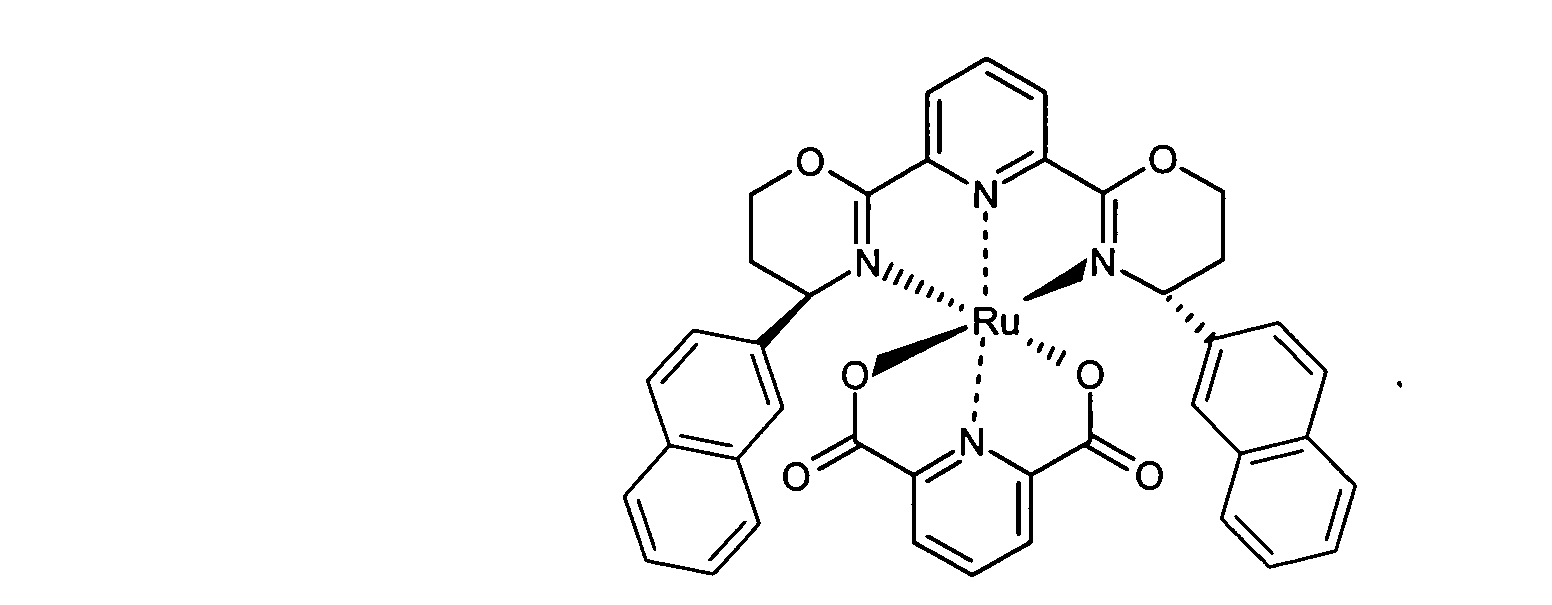
- Isolated complexes are for example [Ru (4-chloro-2,6-bis [4 '- ( S ) -phenyl-oxazolin-2'-yl] pyridine) (pyridine-2,6-dicarboxylate)] [Ru (4-phenyl-2,6-bis [4 '- ( S ) -phenyl-oxazolin-2'-yl] -pyridine) (pyridine-2,6-dicarboxylate)] [Ru (2,6-bis [4 '- ( S ) - iso -propyl-oxazolin-2'-yl] pyridine) (pyridine-2,6-dicarboxylate)] [Ru (2,6-bis [( R ) -4'-phenyl-5 ', 6'-dihydro-4' H - [1 ', 3'] oxazin-2'-yl] pyridine) (pyridine-2 , 6-dicarboxylate)] [Ru (2,6
- the preparation of the isolated complexes is preferably also carried out by combining a suitable Rutheniumprecursorkomplexes, such as [Ru ( p- cymene) Cl 2 ] 2 , and the two ligands of the formulas (V) and (VII) in such a way, for example, the Rutheniumprecursorkomplex with the ligand of formula (V) is initially charged in a suitable solvent in an inert gas atmosphere and a solution of the ligand of formula (VII) is added, the reaction mixture subsequently heated and the ruthenium complex after workup by extraction, drying and optionally subsequent chromatographic purification and / or recrystallization becomes.
- a suitable Rutheniumprecursorkomplexes such as [Ru ( p- cymene) Cl 2 ] 2
- the two ligands of the formulas (V) and (VII) in such a way, for example, the Rutheniumprecursorkomplex with the ligand of formula (V) is
- the amount of ruthenium complex or Rutheniumprecursorkomplexes used is within the scope of the invention, for example, between 0.01 and 20 mol%, preferably between 1 and 10 mol%, and more preferably between 2 and 5 mol%.
- the compounds of the formula (I) which can be prepared according to the invention are suitable in particular for the preparation of drugs, agrochemicals, polymers or intermediates thereof.
- the inventive method is characterized in that the asymmetric epoxidation of olefins under high chemo- and enantioselectivity and very good product yields supplies.
- the possibility of using the inexpensive oxidizing agent Hydrogen peroxide is a particular advantage.
- ⁇ -methylstyrene oxide was obtained in 82% yield and 58% ee with H 2 O 2 as the oxidant analogous to Example 1.
- triphenylethylene was obtained with t -BuOOH as the oxidant analogous to Example 1 triphenyl ethylene oxide in 90% yield and with 8% ee .
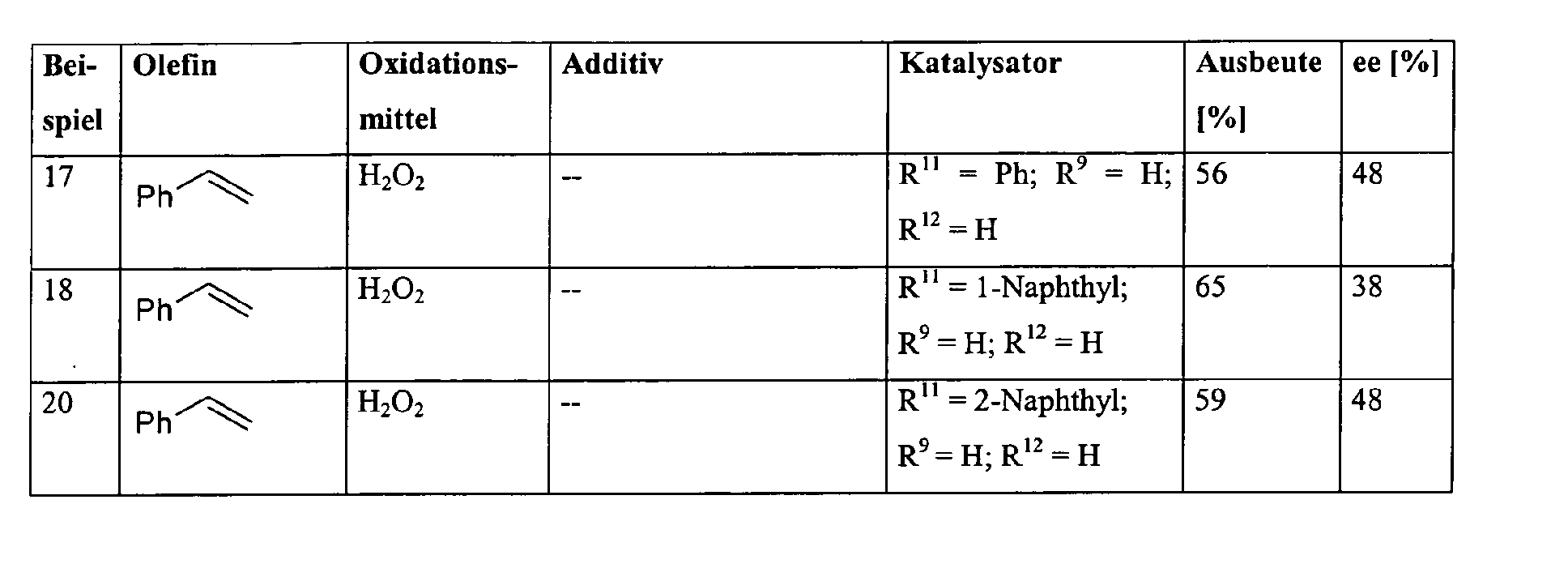
- Styrene was treated with H 2 O 2 as the oxidant according to the general procedure but with the catalyst [Ru (2,6-bis [( R ) -4'-phenyl-5 ', 6'-dihydro-4' H - [ 1 ', 3'] oxazin-2'-yl] pyridine) (pyridine-2,6-dicarboxylate)] (0.025 mmol) of styrene oxide in 56% yield and 48% ee .
- Styrene was treated with H 2 O 2 as the oxidant according to the general procedure, but with the catalyst [Ru (2,6-bis [( R ) -4 '- (1 "-naphthyl) -5', 6'-dihydro- 4 ' H - [1', 3 '] oxazin-2'-yl] pyridine) (pyridine-2,6-dicarboxylate)] (0.025 mmol) styrene oxide in 65% yield and 38% ee .
- Styrene was treated with H 2 O 2 as the oxidant according to the general procedure, but with the catalyst [Ru (2,6-bis [( R ) -4 '- (2 "-naphthyl) -5', 6'-dihydro- 4 ' H - [1', 3 '] oxazin-2'-yl] pyridine) (pyridine-2,6-dicarboxylate)] (0.025 mmol) styrene oxide in 59% yield and 48% ee .
Landscapes
- Chemical & Material Sciences (AREA)
- Organic Chemistry (AREA)
- Inorganic Chemistry (AREA)
- Catalysts (AREA)
- Organic Low-Molecular-Weight Compounds And Preparation Thereof (AREA)
Abstract
Description

- "*"
- für ein (R)- oder (S)- konfiguriertes Kohlenstoffatom steht und R1, R2, R3 und R4 jeweils
unabhängig voneinander für Wasserstoff, Alkyl, Aryl, Arylalkyl, Halogenalkyl oder Reste
der Formel (IIa) bis (IIf) stehen
- A
- fehlt oder für einen Alkylen- oder Halogenalkylenrest steht und
- B
- fehlt oder für Sauerstoff oder NR5 steht, wobei
- R5
- für Wasserstoff, Arylalkyl oder Aryl steht und
- D
- für eine Carbonyl-Gruppe steht und
- E
- für R6, OR6, NHR7 oder N(R7)2 steht,
- R6
- für Alkyl, Arylalkyl oder Aryl und
- R7
- jeweils unabhängig für Alkyl, Arylalkyl oder Aryl steht oder N(R7)2 zusammen für einen cyclischen Aminorest mit 4 bis 12 Kohlenstoffatomen steht und
- W
- für OH, NH2, oder OM steht, wobei M ein Alkalimetallion, ein halbes Äquivalent eines Erdalkalimetallions, ein Ammoniumion oder ein organisches Ammoniumion steht

mit Verbindungen der Formel (IV) umgesetzt werden,
wobei die Umsetzung in Gegenwart eines Rutheniumkomplexes erfolgt, der als Liganden sowohl Verbindungen der Formel (V) trägt
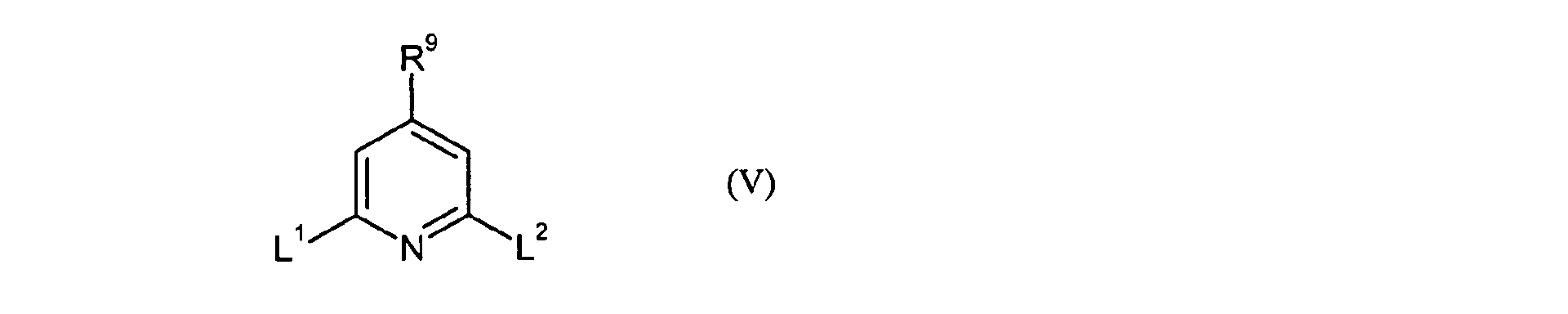
L1 und L2 jeweils unabhängig für Reste der Formel (VI-a) und/oder für Reste der Formel (VI-b), bevorzugt jedoch jeweils identisch für Reste der Formel (VI-a) oder für Reste der Formel (VI-b) stehen

als auch Verbindungen der Formel (VII) trägt

- X1, X2 und X3
- jeweils unabhängig voneinander für N, CH Bzw. CR12 stehen und
- R12
- für Wasserstoff, Halogen, Hydroxy, Hydroxycarbonyl, Alkoxycarbonyl, Alkoxy, Alkoxyalkyl, Arylalkyl oder Aryl steht und
- n
- für = 1, 2 oder 3, bevorzugt für 0, oder 1 und besonders bevorzugt für 0 steht.
4-Chlor-2,6-bis[4'-(S)-phenyloxazolin-2'-yl]pyridin, 4-Phenyl-2,6-bis[4'-(S)-phenyloxazolin-2'-yl]pyridin, 2,6-bis[(R)-4'-(1''-naphthyl)-5',6'-dihydro-4'H-[1',3']oxazin-2'-yl]pyridin und 2,6-bis[(R)-4'-(2"-naphthyl)-5',6'-dihydro-4'H-[1',3']oxazin-2'-yl]pyridin.
[Ru(4-Chlor-2,6-bis[4'-(S)-phenyloxazolin-2'-yl]pyridin)(Pyridin-2,6-dicarboxylat)]
[Ru(4-Phenyl-2,6-bis[4'-(S)-phenyloxazolin-2'-yl]pyridin) (Pyridin-2,6-dicarboxylat)]
[Ru(2,6-bis[4'-(S)-iso-propyl-oxazolin-2'-yl]pyridin)(Pyridin-2,6-dicarboxylat)]
[Ru(2,6-bis[(R)-4'-phenyl-5',6'-dihydro-4'H-[1',3']oxazin-2'-yl]pyridin)(Pyridin-2,6-dicarboxylat)]
[Ru(2,6-bis[(R)-4'-(1''-naphthyl)-5',6'-dihydro-4'H-[1',3']oxazin-2'-yl]pyridin)(Pyridin-2,6-dicarboxylat)]
[Ru(2,6-bis[(R)-4'-(2"-naphthyl)-5',6'-dihydro-4'H-[1',3']oxazin-2'-yl]pyridin)(Pyridin-2,6-dicarboxylat)]




Claims (11)
- Verfahren zur Herstellung von stereoisomerenangereicherten Verbindungen der Formel (I),in der

- "*"
- für ein (R)- oder (S)- konfiguriertes Kohlenstoffatom steht und R1, R2, R3 und R4
jeweils unabhängig voneinander für Wasserstoff, Alkyl, Aryl, Arylalkyl, Halogenalkyl
oder Reste der Formel (IIa) bis (IIf) stehen
- A
- fehlt oder für einen Alkylen- oder Halogenalkylenrest steht und
- B
- fehlt oder für Sauerstoff oder NR5 steht, wobei
- R5
- für Wasserstoff, Arylalkyl oder Aryl steht und
- D
- für eine Carbonyl-Gruppe steht und
- E
- für R6, OR6, NHR7 oder N(R7)2 steht,
- R6
- für Alkyl, Arylalkyl oder Aryl und
- R7
- jeweils unabhängig für Alkyl, Arylalkyl oder Aryl steht oder N(R7)2 zusammen für einen cyclischen Aminorest mit 4 bis 12 Kohlenstoffatomen steht und
- W
- für OH, NH2, oder OM steht, wobei M ein Alkalimetallion, ein halbes Äquivalent eines Erdalkalimetallions, ein Ammoniumion oder ein organisches Ammoniumion steht
dadurch gekennzeichnet, dass Verbindungen der Formel (III),in der R1, R2, R3 und R4 jeweils unabhängig voneinander die vorstehend genannte Bedeutung besitzen,
mit Verbindungen der Formel (IV) umgesetzt werden,
wobei die Umsetzung in Gegenwart eines Rutheniumkomplexes erfolgt, der als Liganden sowohl Verbindungen der Formel (V) trägtin der R9 für Wasserstoff, Halogen, Hydroxy, Alkoxy, Hydroxycarbonyl, Alkoxycarbonyl, Alkyl, Arylalkyl oder Aryl steht und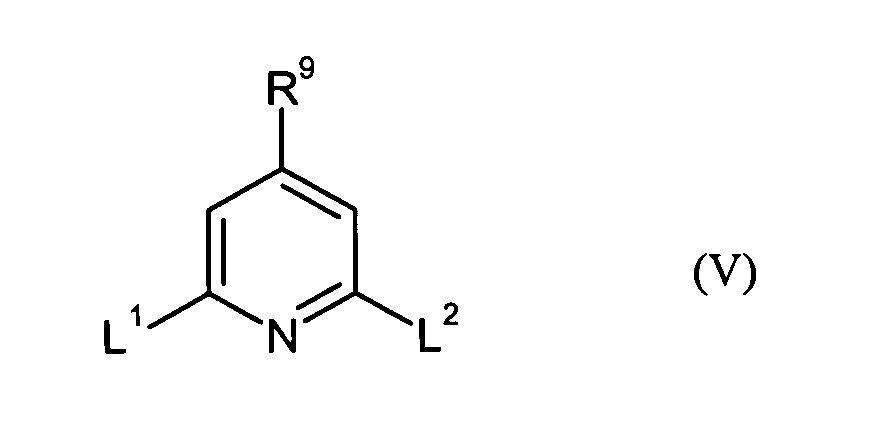
L1 und L2 jeweils unabhängig für Reste der Formel (VI-a) und/oder für Reste der Formel (VI-b) stehenin der "*1" und/oder "*2" und/oder "*3" ein asymmetrisches Kohlenstoffatom in (R) oder (S)-Konfiguration ist, der Pfeil die Bindungsstelle zum zentralen Pyridincyclus zeigt und R10a, R10b und R11 unabhängig voneinander für Alkyl, Alkoxyalkyl, Trialkylsiloxyalkyl, Alkoxycarbonyl, Arylalkyl oder Aryl steht oder R10a und R11 oder R10a und R10b Teil eines cyclischen Restes mit insgesamt 5 bis 16 Kohlenstoffatomen sind und R11 und/oder R10a und/oder R10b darüber hinaus auch für Wasserstoff stehen kann
als auch Verbindungen der Formel (VII) trägtin der
- X1, X2 und X3
- jeweils unabhängig voneinander für N, CH bzw. CR12 stehen und
- R12
- für Wasserstoff, Halogen, Hydroxy, Hydroxycarbonyl, Alkoxycarbonyl, Alkoxy, Alkoxyalkyl, Arylalkyl oder Aryl steht und
- n
- für =1, 2 oder 3, bevorzugt für 0, oder 1 und besonders bevorzugt für 0 steht.
- Verfahren nach Anspruch 1, dadurch gekennzeichnet, dass in Formel (I) R1, R2, R3 und R4 bevorzugt jeweils unabhängig voneinander für Wasserstoff, C1-C8-Alkyl, C5-C14-Aryl, C6-C15-Arylalkyl, C1-C8-Halogenalkyl stehen oder jeweils zwei der Reste R1, R2, R3 und R4 zusammen Teil eines 3 bis 7-gliedrigen Cyclus sind, der insgesamt 3 bis 16 Kohlenstoffatome umfasst.
- Verfahren nach Anspruch 1 oder 2, dadurch gekennzeichnet, dass in Formel (IV) R8 für Wasserstoff oder C3-C6-Alkyl steht.
- Verfahren nach einem der Ansprüche 1 bis 3, dadurch gekennzeichnet, dass in Formel (IV) R8 für Wasserstoff steht.
- Verfahren nach einem der Ansprüche 1 bis 4, dadurch gekennzeichnet, dass als Rutheniumkomplexe solche der Formel (VIII) eingesetzt werden
- Verfahren nach einem der Ansprüche 1 bis 5, dadurch gekennzeichnet, dass es in Gegenwart von sekundären oder tertiären Alkoholen als Lösungsmittel durchgeführt wird.
- Verfahren nach einem der Ansprüche 1 bis 6, dadurch gekennzeichnet, dass Additive ausgewählt aus der Gruppe Amine, Phosphite, Phosphanoxide, N-Methylmorpholin-N-oxid, 2,2,6,6-Tetramethylpiperidin-1-yloxyd, Pyridine, Pyridin-N-oxid, Imidazole, Chinolin, Chinolin-N-oxid, 2,2'-Bipyridyl, 2,2'-Bipyridyl-N,N'-dioxid, Ammoniumsalze, aromatische und aliphatische Carbonsäuren, Carbonsäureanhydride, (R)- oder (S)-Alkansulfinsäureamide oder aromatische Alkohole zugesetzt werden.
- Verbindungen der Formel (V) mit der Definition gemäß Anspruch 1 mit Ausnahme solcher in denen L1 und L2 jeweils für einen Rest der Formel (VI-a) stehen, worin R10a jeweils für Wasserstoff und R11 für Isopropyl oder Phenyl steht.
- 4-Chlor-2,6-bis[4'-(S)-phenyloxazolin-2'-yl]pyridin, 4-Phenyl-2,6-bis[4'-(S)-phenyloxazolin-2'-yl]pyridin, 2,6-bis[(R)-4'-(1"-naphthyl)-5',6'-dihydro-4'H-[1',3']oxazin-2'-yl]pyridin und 2,6-bis[(R)-4'-(2"-naphthyl)-5',6'-dihydro-4'H-[1',3']oxazin-2'-yl]pyridin.
- Rutheniumkomplexe enthaltend Verbindungen nach einem der Ansprüche 8 oder 9 und Verbindungen der Formel (VII) gemäß Definition in Anspruch 1.
- Verwendung von Verbindungen der Formel (I), die nach einem oder mehreren der Ansprüche 1 bis 8 hergestellt werden zur Herstellung von Arzneimitteln, Agrochemikalien, Polymeren oder Zwischenprodukten davon.
Applications Claiming Priority (4)
| Application Number | Priority Date | Filing Date | Title |
|---|---|---|---|
| DE102004005725 | 2004-02-05 | ||
| DE102004005725 | 2004-02-05 | ||
| DE102004024709A DE102004024709A1 (de) | 2004-02-05 | 2004-05-19 | Verfahren zur asymmetrischen Epoxidierung von Olefinen |
| DE102004024709 | 2004-05-19 |
Publications (1)
| Publication Number | Publication Date |
|---|---|
| EP1561750A1 true EP1561750A1 (de) | 2005-08-10 |
Family
ID=34680172
Family Applications (1)
| Application Number | Title | Priority Date | Filing Date |
|---|---|---|---|
| EP05002337A Withdrawn EP1561750A1 (de) | 2004-02-05 | 2005-02-04 | Verfahren zur asymmetrischen Epoxidierung von Olefinen |
Country Status (4)
| Country | Link |
|---|---|
| US (2) | US7544819B2 (de) |
| EP (1) | EP1561750A1 (de) |
| CN (2) | CN1680345A (de) |
| DE (1) | DE102004024709A1 (de) |
Cited By (1)
| Publication number | Priority date | Publication date | Assignee | Title |
|---|---|---|---|---|
| EP1683791A1 (de) * | 2005-01-20 | 2006-07-26 | Lanxess Deutschland GmbH | Verfahren zur Ruthenium-katalysierten Epoxidierung von Olefinen mit Wasserstoffperoxid |
Citations (2)
| Publication number | Priority date | Publication date | Assignee | Title |
|---|---|---|---|---|
| US4943644A (en) * | 1988-01-22 | 1990-07-24 | The University Of Florida | Olefin and alkane oxidations, ruthenium carboxylate catalyst therefor and method of preparation thereof |
| DE4447232A1 (de) * | 1994-12-30 | 1996-07-04 | Hoechst Ag | Übergangsmetallkomplexe von Ruthenium, ihre Darstellung und ihre Verwendung als Epoxidationskatalysatoren |
Family Cites Families (1)
| Publication number | Priority date | Publication date | Assignee | Title |
|---|---|---|---|---|
| EP0869843A1 (de) | 1994-12-30 | 1998-10-14 | Hoechst Aktiengesellschaft | Epoxiden durch oxidation von olefinen mit luft oder sauerstoff |
-
2004
- 2004-05-19 DE DE102004024709A patent/DE102004024709A1/de not_active Withdrawn
-
2005
- 2005-02-04 US US11/051,279 patent/US7544819B2/en not_active Expired - Fee Related
- 2005-02-04 EP EP05002337A patent/EP1561750A1/de not_active Withdrawn
- 2005-02-05 CN CNA2005100091834A patent/CN1680345A/zh active Pending
- 2005-02-05 CN CNA2006100913208A patent/CN1869029A/zh active Pending
-
2009
- 2009-05-13 US US12/464,933 patent/US20090221816A1/en not_active Abandoned
Patent Citations (2)
| Publication number | Priority date | Publication date | Assignee | Title |
|---|---|---|---|---|
| US4943644A (en) * | 1988-01-22 | 1990-07-24 | The University Of Florida | Olefin and alkane oxidations, ruthenium carboxylate catalyst therefor and method of preparation thereof |
| DE4447232A1 (de) * | 1994-12-30 | 1996-07-04 | Hoechst Ag | Übergangsmetallkomplexe von Ruthenium, ihre Darstellung und ihre Verwendung als Epoxidationskatalysatoren |
Non-Patent Citations (24)
| Title |
|---|
| BRUNNER H ET AL: "Asymmetric catalysis. Part 153: Metal-catalysed enantioselective alpha-ketol rearrangement", TETRAHEDRON: ASYMMETRY, ELSEVIER SCIENCE PUBLISHERS, AMSTERDAM, NL, vol. 14, no. 15, 1 August 2003 (2003-08-01), pages 2177 - 2187, XP004441352, ISSN: 0957-4166 * |
| CHEM. COMMUN., 1997, pages 1863 - 1864 |
| DATTAGUPTA A ET AL: "Catalytic Enantioselective Allylic Oxidation of Olefins with Copper Complexes of Chiral Nonracemic Bis(oxazolinyl)pyridine Type Ligands", TETRAHEDRON LETTERS, ELSEVIER SCIENCE PUBLISHERS, AMSTERDAM, NL, vol. 37, no. 15, 8 April 1996 (1996-04-08), pages 2633 - 2636, XP004029756, ISSN: 0040-4039 * |
| DESIMONI G ET AL: "A new and highly efficient catalyst for the enantioselective Mukaiyama-Michael reaction between (E)-3-crotonoyl-1,3-oxazolidin-2- one and 2-trimethylsilyloxyfuran", TETRAHEDRON, ELSEVIER SCIENCE PUBLISHERS, AMSTERDAM, NL, vol. 57, no. 51, 17 December 2001 (2001-12-17), pages 10203 - 10212, XP004329195, ISSN: 0040-4020 * |
| DESIMONI G ET AL: "synergistic effect of pybox substituents and lanthanide cations in reversing the asymmetric induction in the catalysed Diels-Alder reaction between 3-acryloyl-1,3-oxazolidin-2-one and yclopentadiene", EUR. J. ORG. CHEM, 2004, pages 3057 - 3062, XP002331858 * |
| DESIMONI G ET AL: "The stereodivergent synthesis of chiral 4,5-disubstituted pybox ligands", TETRAHEDRON: ASYMMETRY, ELSEVIER SCIENCE PUBLISHERS, AMSTERDAM, NL, vol. 13, no. 15, 14 August 2002 (2002-08-14), pages 1651 - 1654, XP004385891, ISSN: 0957-4166 * |
| DURCH MEZETTI ET AL., GREEN CHEMISTRY, vol. 1, 1999, pages 39 - 41 |
| GUPTA AD ET AL: "synthesis of homochiral bis(oxazolinyl)pyridine type ligands for asymmetric cyclopropanation reactions", TETRAHEDRON, vol. 50, no. 48, 1994, pages 13725 - 13730, XP002331842 * |
| JUN L ET AL: "highly enantioselective allylation of aldehydes catalyzed by indium(III)-pybox complex", ORGANIC LETTERS, vol. 7, no. 1, 2005, pages 159 - 161, XP002331859 * |
| KURESHI ET AL., J MOL. CATAL. A: CHEMICAL, vol. 124, 1997, pages 91 - 97 |
| KURESHY RI ET AL: "Chiral Ru(III) metal complex-catalyzed aerobic enantioselective epoxidation of styrene derivatives with co-oxidation of aldehyde", JOURNAL OF MOLECULAR CATALYSIS A: CHEMICAL, vol. 124, 1997, pages 91 - 97, XP002331848 * |
| LAWRENCE N J ET AL: "An efficient protocol for the reduction of ketones with tin(II) complexes and PMHS", TETRAHEDRON LETTERS, ELSEVIER SCIENCE PUBLISHERS, AMSTERDAM, NL, vol. 41, no. 22, June 2000 (2000-06-01), pages 4507 - 4512, XP004205598, ISSN: 0040-4039 * |
| LI X ET AL: "The enantioselective diethylzinc addition to imines catalyzed by chiral Cu(II)-oxazoline complexes", TETRAHEDRON: ASYMMETRY, ELSEVIER SCIENCE PUBLISHERS, AMSTERDAM, NL, vol. 14, no. 24, 12 December 2003 (2003-12-12), pages 3819 - 3821, XP004476250, ISSN: 0957-4166 * |
| MIYABE H ET AL: "utility of the iridium complex of the pybox ligand in regio and enantioselective allylic substitution", ORGANIC LETTERS, vol. 6, no. 24, 2004, pages 4631 - 4634, XP002331857 * |
| MÜLLER P ET AL: "carbenoid pathways in copper-catalyzed intramolecular cyclopropanations of phenyliodonium ylides", HELVETICA CHIMICA ACTA, vol. 84, 2001, pages 1093 - 1111, XP002331844 * |
| NISHIYAMA ET AL: "novel ruthenium-pyridinedicarboxylate complexes of terpyridine and chiral bis(oxazolinyl)pyridine: a new catalytic system for alkene epoxidation with [bis(acetoxy)iodo]benzene as an oxygen donor", CHEMICAL COMMUNICATIONS, 1997, pages 1863 - 1864, XP002331856 * |
| ORGANOMETALLICS, vol. 19, 2000, pages 4117 - 4126 |
| QIAN C ET AL: "Asymmetric glyoxylate-ene reaction catalyzed by C2-symmetric chiral bis(oxazoline)-lanthanide complexes", TETRAHEDRON: ASYMMETRY, ELSEVIER SCIENCE PUBLISHERS, AMSTERDAM, NL, vol. 11, no. 11, June 2000 (2000-06-01), pages 2347 - 2357, XP004205796, ISSN: 0957-4166 * |
| SEKAR G ET AL: "asymmetric kharasch reaction: catalytic enantioselective allylic oxidation of olefins using chiral pyridine bis(diphenyloxazoline)-copper complexes and tert.-butyl perbenzoate", JOURNAL OF ORGANIC CHEMISTRY, vol. 63, 1998, pages 2961 - 2967, XP002331845 * |
| SLEE DH ET AL: "development of potent non-carbohydrate imidazole-based small molecule slectin inhibitors with antiinflammatory activity", JOURNAL OF MEDICINAL CHEMISTRY, vol. 44, 2001, pages 2094 - 2107, XP002331846 * |
| STOOP RM ET AL: "ruthenium(II)complexes with chiral tetradentate P2N2 ligands catalyze the asymmetric epoxidation of olefins with H2O2", ORGANOMETALLICS, vol. 19, 2000, pages 4117 - 4126, XP002331847 * |
| TSE M K ET AL: "An improved protocol for the ruthenium(pybox)-catalyzed asymmetric alkene epoxidation", TETRAHEDRON LETTERS, ELSEVIER SCIENCE PUBLISHERS, AMSTERDAM, NL, vol. 44, no. 40, 29 September 2003 (2003-09-29), pages 7479 - 7483, XP004453451, ISSN: 0040-4039 * |
| TSE M.K. ET AL., TETRAHEDRON LETTERS, vol. 44, 2003, pages 7479 - 7483 |
| WEI C ET AL: "enantioselective direct-addition of terminal alkynes to imines catalyzed by copper(I)pybox complex in water and toluene", J. AM. CHEM. SOC., vol. 124, 2002, pages 5638 - 5639, XP002331843 * |
Cited By (1)
| Publication number | Priority date | Publication date | Assignee | Title |
|---|---|---|---|---|
| EP1683791A1 (de) * | 2005-01-20 | 2006-07-26 | Lanxess Deutschland GmbH | Verfahren zur Ruthenium-katalysierten Epoxidierung von Olefinen mit Wasserstoffperoxid |
Also Published As
| Publication number | Publication date |
|---|---|
| US7544819B2 (en) | 2009-06-09 |
| DE102004024709A1 (de) | 2005-09-15 |
| US20090221816A1 (en) | 2009-09-03 |
| CN1869029A (zh) | 2006-11-29 |
| US20050203303A1 (en) | 2005-09-15 |
| CN1680345A (zh) | 2005-10-12 |
Similar Documents
| Publication | Publication Date | Title |
|---|---|---|
| EP3994117B1 (de) | Hydrierung von estern zu alkoholen in gegenwart eines ru-pnn-komplexes | |
| DE102009000661A1 (de) | Verfahren zur Herstellung von 2,6-Dioxabicyclo-(3.3.0)-octan-4,8-dion[1S,5S] | |
| EP0987239B1 (de) | Verfahren zur Synthese alpha-substituierter Ringsysteme | |
| EP1322583B1 (de) | Verfahren zur isomerisierung von allylalkoholen | |
| DE60129211T2 (de) | Imidazolidinonen-saureadditionssalze als reaktionskatalysatoren | |
| DE19920038A1 (de) | Verfahren zur Dihydroxylierung von Olefinen mittels Übergangsmetall-Katalysatoren | |
| DE102004024709A1 (de) | Verfahren zur asymmetrischen Epoxidierung von Olefinen | |
| EP1235775B1 (de) | Verfahren zur isomerisierung von allylalkoholen | |
| EP4359372B1 (de) | Hydrierung von estern zu alkoholen in gegenwart eines mn-pnn-komplexes | |
| EP1469005B1 (de) | Verfahren zur asymmetrischen Hydrierung von Ketocarbonsäureestern | |
| EP3953324B1 (de) | Photoredoxkatalytische selektive aktivierung von schwefelhexafluorid zur alpha-alkoxypentafluorsulfanylierung von ungesättigten kohlenwasserstoffverbindungen sowie derivatisierung zu ungesättigten pentafluorsulfanen | |
| DE19722373A1 (de) | Verwendung eines Rhodiumkatalysators sowie ein neues Verfahren zur Herstellung von 2-arylsubstituierten Ethylen- und Ethylaminen | |
| EP3095773B1 (de) | Herstellung von limonenderivaten | |
| DE19853558A1 (de) | Verfahren zur Herstellung von 2,3-Dihydroindolen (Indolinen), neuartige 2,3-Dihydroindole sowie deren Verwendung | |
| WO2007017453A1 (de) | Verfahren zur herstellung von heteroaromatischen alkoholen | |
| EP1683791B1 (de) | Verfahren zur Ruthenium-katalysierten Epoxidierung von Olefinen mit Wasserstoffperoxid | |
| EP1819647A1 (de) | Verfahren zur hydrierung von , -ungesättigten carbonylverbindungen | |
| EP1279657B1 (de) | Verfahren zur Herstellung von Carbonylverbindungen aus Alkoholen | |
| EP1628985A2 (de) | Chirale liganden und deren bergangsmetallkomplexe | |
| EP1175379B1 (de) | Verfahren zur asymmetrischen dihydroxylierung von olefinen mittels osmium-katalysatoren | |
| DE10039247A1 (de) | Verfahren zur Herstellung von Carbonsäureamiden durch Oxidation von Aldehyden in Gegenwart von Aminen | |
| EP1469006A2 (de) | Verfahren zur Reduktion von Ketocarbonsäureestern | |
| EP1491548A1 (de) | Verfahren zur Reduktion von Ketocarbonsäureestern | |
| DE19629523A1 (de) | Verfahren zur Herstellung von optisch aktiven Verbindungen durch enantioselektive intramolekulare Stetter-Reaktion | |
| DE19954396A1 (de) | Verfahren zur Herstellung von Nitrosobenzolen |
Legal Events
| Date | Code | Title | Description |
|---|---|---|---|
| PUAI | Public reference made under article 153(3) epc to a published international application that has entered the european phase |
Free format text: ORIGINAL CODE: 0009012 |
|
| AK | Designated contracting states |
Kind code of ref document: A1 Designated state(s): AT BE BG CH CY CZ DE DK EE ES FI FR GB GR HU IE IS IT LI LT LU MC NL PL PT RO SE SI SK TR |
|
| AX | Request for extension of the european patent |
Extension state: AL BA HR LV MK YU |
|
| RIN1 | Information on inventor provided before grant (corrected) |
Inventor name: KLAWONN, MARKUS Inventor name: BHOR, SANTOSH Inventor name: TSE, MAN-KIN, DR. Inventor name: DOEBLER, CHRISTIAN, DR. Inventor name: BELLER, MATTHIAS, PROF. DR. Inventor name: MAEGERLEIN, WOLFGANG, DR. |
|
| RIN1 | Information on inventor provided before grant (corrected) |
Inventor name: KLAWONN, MARKUS Inventor name: BHOR, SANTOSH Inventor name: TSE, MAN-KIN, DR. Inventor name: DOEBLER, CHRISTIAN, DR. Inventor name: BELLER, MATTHIAS, PROF. DR. Inventor name: MAEGERLEIN, WOLFGANG, DR. |
|
| RIN1 | Information on inventor provided before grant (corrected) |
Inventor name: KLAWONN, MARKUS Inventor name: BHOR, SANTOSH Inventor name: TSE, MAN-KIN, DR. Inventor name: DOEBLER, CHRISTIAN, DR. Inventor name: BELLER, MATTHIAS, PROF. DR. Inventor name: MAEGERLEIN, WOLFGANG, DR. |
|
| 17P | Request for examination filed |
Effective date: 20060210 |
|
| AKX | Designation fees paid |
Designated state(s): AT BE BG CH CY CZ DE DK EE ES FI FR GB GR HU IE IS IT LI LT LU MC NL PL PT RO SE SI SK TR |
|
| RAP1 | Party data changed (applicant data changed or rights of an application transferred) |
Owner name: SALTIGO GMBH |
|
| 17Q | First examination report despatched |
Effective date: 20070727 |
|
| RAP1 | Party data changed (applicant data changed or rights of an application transferred) |
Owner name: SALTIGO GMBH |
|
| GRAP | Despatch of communication of intention to grant a patent |
Free format text: ORIGINAL CODE: EPIDOSNIGR1 |
|
| GRAS | Grant fee paid |
Free format text: ORIGINAL CODE: EPIDOSNIGR3 |
|
| STAA | Information on the status of an ep patent application or granted ep patent |
Free format text: STATUS: THE APPLICATION HAS BEEN WITHDRAWN |
|
| 18W | Application withdrawn |
Effective date: 20100723 |